Definitely Maybe: Defining Affordable Housing

Affordable housing is defined in the NPPF as follows:
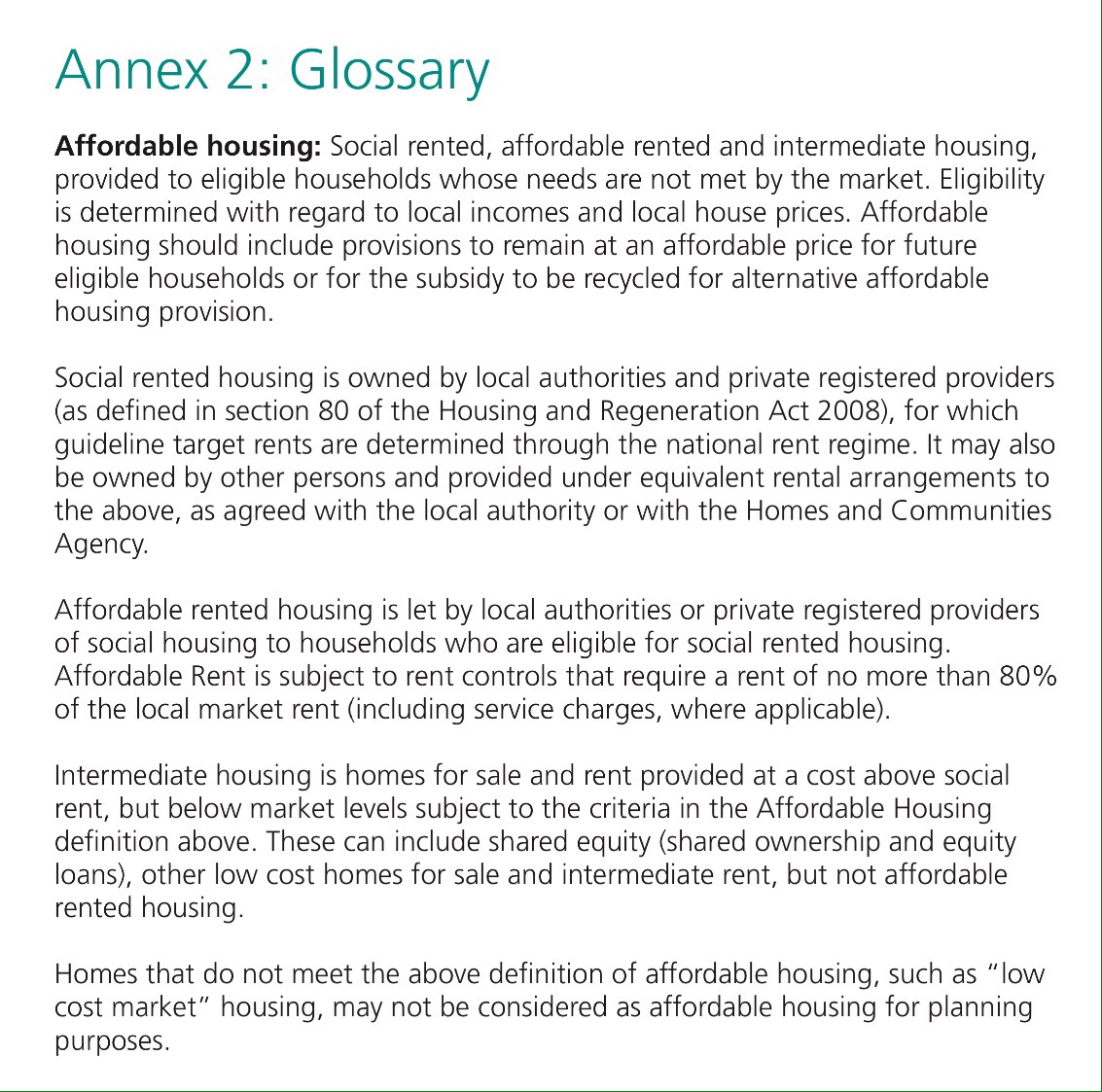
The Government carried out a consultation  in December 2015, proposing that the definition be expanded so as to include

– low cost ownership models, which “would include products that are analogous to low cost market housing or intermediate rent, such as discount market sales or innovative rent to buy housing”
– starter homes (of which more later). 

Two further changes were proposed in the February 2017 response to consultation:  
* introduction of a household income eligibility cap of £80,000 (£90,000 for London) on starter homes. 

* introduction of affordable private rented housing

The Government is accordingly consulting until 2 May 2017 on the following replacement definition for the NPPF (long isn’t it?):


Starter homes

There were howls of anguish at the starter homes initiative as first unveiled by the Government, the key elements of which were (as set out in chapter 1 of the Housing and Planning Act 2016 and March 2016 technical consultation):
– a legal requirement that 20% of new homes in developments should be starter homes, ie
– to be sold at a discount of at least 20% to open market value to first time buyers aged under 40. 

– Price cap of £250,000 (£450,000 in London)

– The restriction should last for a defined number of years, the first suggestion being five years, replaced with the concept of a tapered restriction to potentially eight years

– Commuted sums in lieu of on site provision for specified categories of development, eg build to rent

The obvious consequence would have been a significant reduction in the potential for schemes to include a meaningful proportion of traditional forms of affordable housing. 
After all of last year’s battles over the Bill, it is now plain from the Government’s response to the technical consultation, that the starter home concept is now much watered down:
– There will be no statutory requirement on local planning authorities to secure starter homes, just a policy requirement in the NPPF, which is to be amended accordingly. 

– Rather than requiring that 20% of new homes be starter homes, the requirement will be that 10% of new homes will be “affordable housing home ownership products” so could include shared equity or indeed low cost home ownership. 

– maximum eligible household income of £80,000 a year or less (or £90,000 a year or less in Greater London 

– 15 year restriction

– No cash buyers, evidence of mortgage of at least 25% loan to value

– It will only be applicable to schemes of ten units or more (or on sites of more than 0.5h). 

There will be a transitional period of 18 months (to August 2018) rather than the initially intended 6 to 12 months. 
Whilst we now have a more workable arrangement, plainly all that Parliamentary work was a complete waste of time. There was no need for chapter 1 of the 2016 Act – the current proposals can be delivered without any need for legislation. 
We will need to see the degree to which LPAs embrace the starter homes concept in reviewing their local plans. We will also need to be wary that we may lose the only benefit of a national standardised approach, ie the hope that there might be a standard set of section 106 clauses defining the operation of the mechanism (which will not be straightforward – see my 21.6.16 blog post Valuing Starter Homes). 
Affordable Private Rent
One of the documents accompanying the Housing White Paper was a consultation paper: Planning and affordable housing for build to rent.
The term Affordable Private Rent is now used for what we have all previously been calling Discounted Market Rent. Changes to the NPPF are proposed (subject to consultation) advising LPAs to consider asking for Affordable Private Rent in place of other forms of affordable housing in Build to Rent schemes, comprising a minimum of 20% of the homes in the development, at a minimum of 20% discount to local market rent (excluding use of comparables within the scheme itself), provided in perpetuity. The Affordable Private Rent housing would be tenure blind and representative of the development in terms of numbers of bedrooms. Eligible income bands are to be negotiated between developer and LPA. Developers will be able to offer alternative approaches where appropriate (eg greater discount, fewer discounted homes – or different tenures). “Build to Rent” will be defined and it is acknowledged that developers should be able to cease to operate the property as Build To Rent subject to payment of a commuted sum reflecting the affordable housing requirement that would otherwise have been applicable. 
There is also recognition in the consultation paper that factors in London may be different, allowing for an amended response and recognition of Mayor of London’s November 2016 affordable housing and viability draft SPG.
There will be a transitional period of 6 months from the time that the NPPF changes are made. The possibility is held out of model section 106 clauses, which would help minimise unnecessary delays. 

The recognition that Build to Rent is a model that doesn’t sit well with ‘ownership’ forms of affordable housing is what that industry (largely self-defining through scale of scheme and extent of professional management) has been lobbying for. Nor is there any more any reference to off-site starter home provision.
Wider implications
The extensions to the meaning of ‘affordable housing’ are all in the direction of private sector provision. The definition is now very wide indeed. Battles lie ahead once LPAs consider the implications of the changes for their local plan affordable housing requirements against a backdrop of, for example:
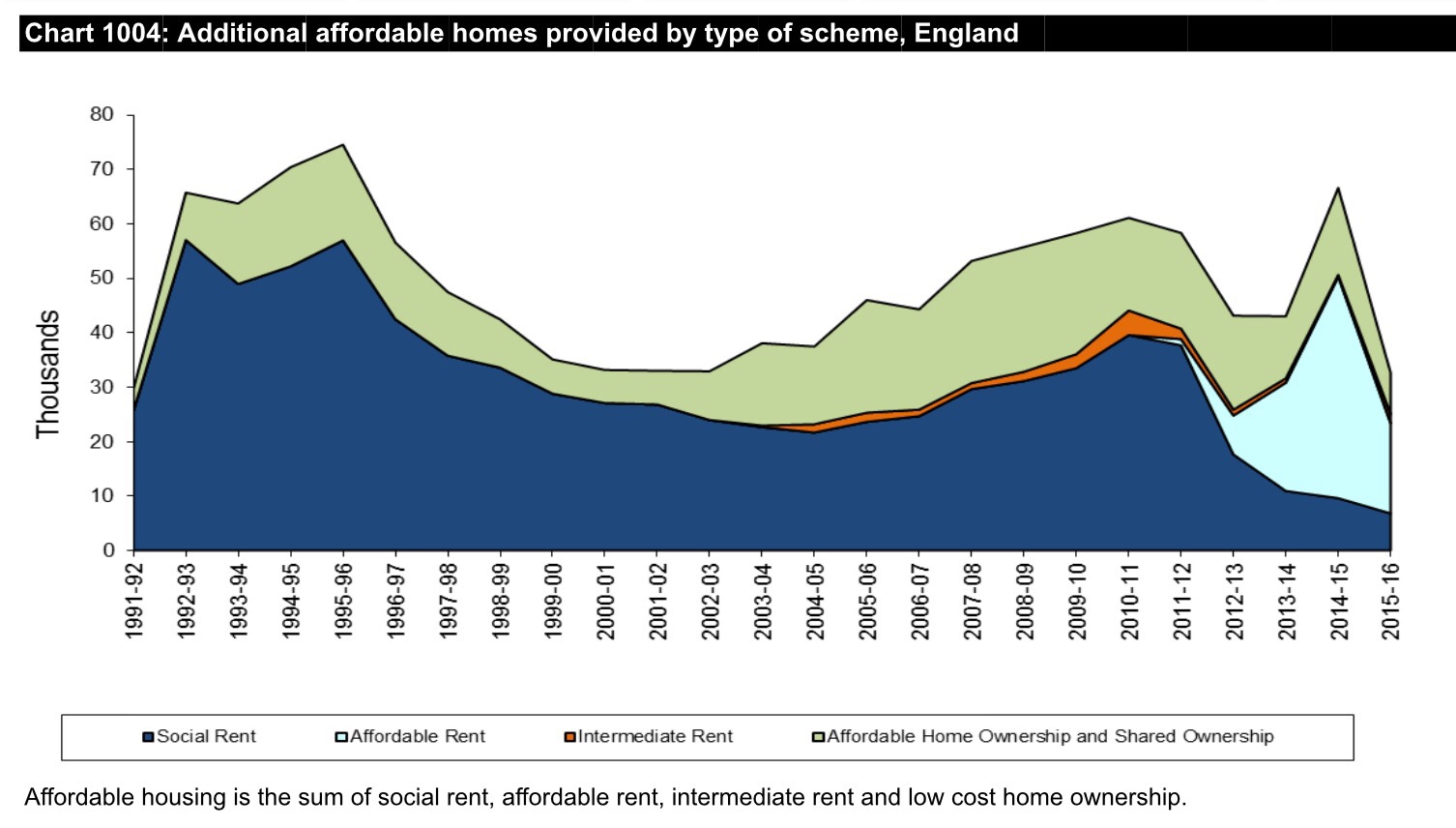
– reduced levels of socially rented housing over the last six years or so following the introduction of affordable rent (minimum discount of at least 20% to market rent), vividly demonstrated in the Government’s affordable housing statistics published on 2 March 2017:
– restrictions on housing benefit, for instance ineligibility of 18-21 year olds from 1 April 2017 under the Universal Credit (Housing Costs Element for claimants aged 18 to 21) (Amendment) Regulations 2017  made on 2 March 2017. 
– the continuing, onerous, requirement on registered providers since 2015 to reduce rents by 1% a year for four years resulting in a 12% reduction in average rents by 2020-21. 
– Loss of stock via the Housing and Planning Act 2016’s voluntary right to buy scheme in relation to registered providers and the Act’s provisions requiring local authorities to sell vacant higher value housing (the Government’s most recent statistics on sales date from October 2016 but already show significant numbers). 
A debate took place in the House of Lords this week, on 2 March 2017, on the Economic Affairs Committee’s July 2016 report, Building More Homes  in the context of the Housing White Paper. Lord Young closed for the Government saying many of the right things but, after such a background of continuing changes (I believe it was Adam Challis at JLL who recently counted 180 housing initiatives since 2010), with further uncertainty for at least 18 months, surely we now just need to get on with the matter in hand – ensuring that there are enough homes to meet all social needs, whilst not killing the golden goose without which this will simply not happen under any foreseeable system, ie profitable development by the private sector.
Simon Ricketts 4.3.17
Personal views, et cetera

From The White Paper Mountain, What Do We See?

After so long we have reached the top of the mountain: the white paper and accompanying documents have all been published today, 7 February 2017. However, now we see a series of further peaks on the horizon. 
A good way into the white paper itself, Fixing Our Broken Housing Market, is to start at the back end. From page 72 you have the detailed proposals listed, including a series of proposed changes to the NPPF and other policies which are now the subject of a consultation process from today until 2 May 2017. The consultation focuses on a series of 38 questions but some of the questions are potentially very wide-ranging. Further consultation is proposed on various matters, including 
– housing requirements of older people and the disabled

– Increasing local authorities’ flexibility to dispose of land at less than best consideration and related powers

– Potentially increasing fees for planning appeals (up to a maximum of £2,000 for the largest schemes, recoverable if the appeal is allowed)

– Changes to section 106 processes (with further consideration being given to dispute resolution “in the context of longer term reform”)

– Requiring housebuilders to provide aggregate information on build-out rates and, for large-scale sites, as to the relevance of the applicant’s track record of delivering similar schemes

– Encouragement of use of CPO powers to support the build out of stalled sites. 

There is a supplementary consultation paper on planning and affordable housing for build to rent  containing a further 26 questions, with a consultation deadline of 1 May 2017.
There are responses to previous consultation papers and reports:
– Summary of responses to the technical consultation on implementation of planning changes, consultation on upward extensions and Rural Planning Review Call for Evidence  (including a u-turn on the previous idea of an upwards extensions permitted development right in London, now to be addressed by policy). 
– Government response to the Communities and Local Government Select Committee inquiry into the report of the Local Plans Expert Group 
There is plenty to get to grips with, for example:
– the housing delivery test and new methodology for assessing objectively assessed need

– an understandable focus on whether the applicant will proceed to build out any permission and at what rate, although with a worrying reduction of the default time limit for permissions from three to two years

– Homes and Communities Agency to become “Homes England”. 

It is also reassuring to see the Government applying real focus to build to rent, reducing its emphasis on starter homes – and also reducing its reliance on permitted development rights. 

However, it is surprising how much still remains unresolved. We will apparently have a revised NPPF “later this year” but for much else the start date looks to be April 2018, for example a widened affordable housing definition including watered-down starter homes proposals (no longer a statutory requirement and with reference to a policy target of a minimum of 10% “affordable housing ownership units” rather than the requirement of 20% starter homes previously proposed) and a new methodology for assessing five year housing land supply. 

Liz Peace’s CIL review team’s review of CIL: “A new approach to developer contributions”  (October 2016 but only now published) remains untackled. The Government’s response will be announced at the time of the Autumn Budget 2017. 

Decision-makers will need to grapple very quickly with the question as to the weight they should give to the white paper as a material consideration, given the Government’s clear policy direction now on a range of issues. 


Simon Ricketts, 7.2.17
Personal views, et cetera

Affordable Housing & Viability: London Leads

Full credit to Sadiq Khan for pressing ahead with his heavily trailed draft Affordable Housing and Viability SPG  despite the Government’s inexplicable delay in publishing the Housing White Paper (whatever its contents prove to be). The deadline for consultation responses to the draft SPG is 28 February 2017. As the draft warns, when the Government’s detailed proposals in relation to starter homes are published, presumably as part of the white paper, there will be knock-on implications for the SPG – after how can the percentages in the draft SPG possibly survive the imposition of a mandatory starter homes top slice?
The SPG will be guidance rather than policy (although I suspect that the distinction may over time prove largely semantic when non compliant schemes come before the Mayor for sign off) and LPAs are “strongly encouraged” to follow it for schemes of ten or more dwellings. The SPG will supersede section 3.3 (Build to Rent) and Part 5 (Viability) of the March 2016 housing SPG. The rest of that SPG remains current. It will inform the drafting of the new London Plan, a consultation draft of which is expected in Autumn 2017. 
What follows will become very familiar I’m sure to all of us negotiating London section 106 agreements. The level of prescription may prove helpful in narrowing the scope for re-inventing the wheel, subject to the attitude that LPAs take to what after all is only draft non-statutory guidance. 
The ‘threshold’ approach
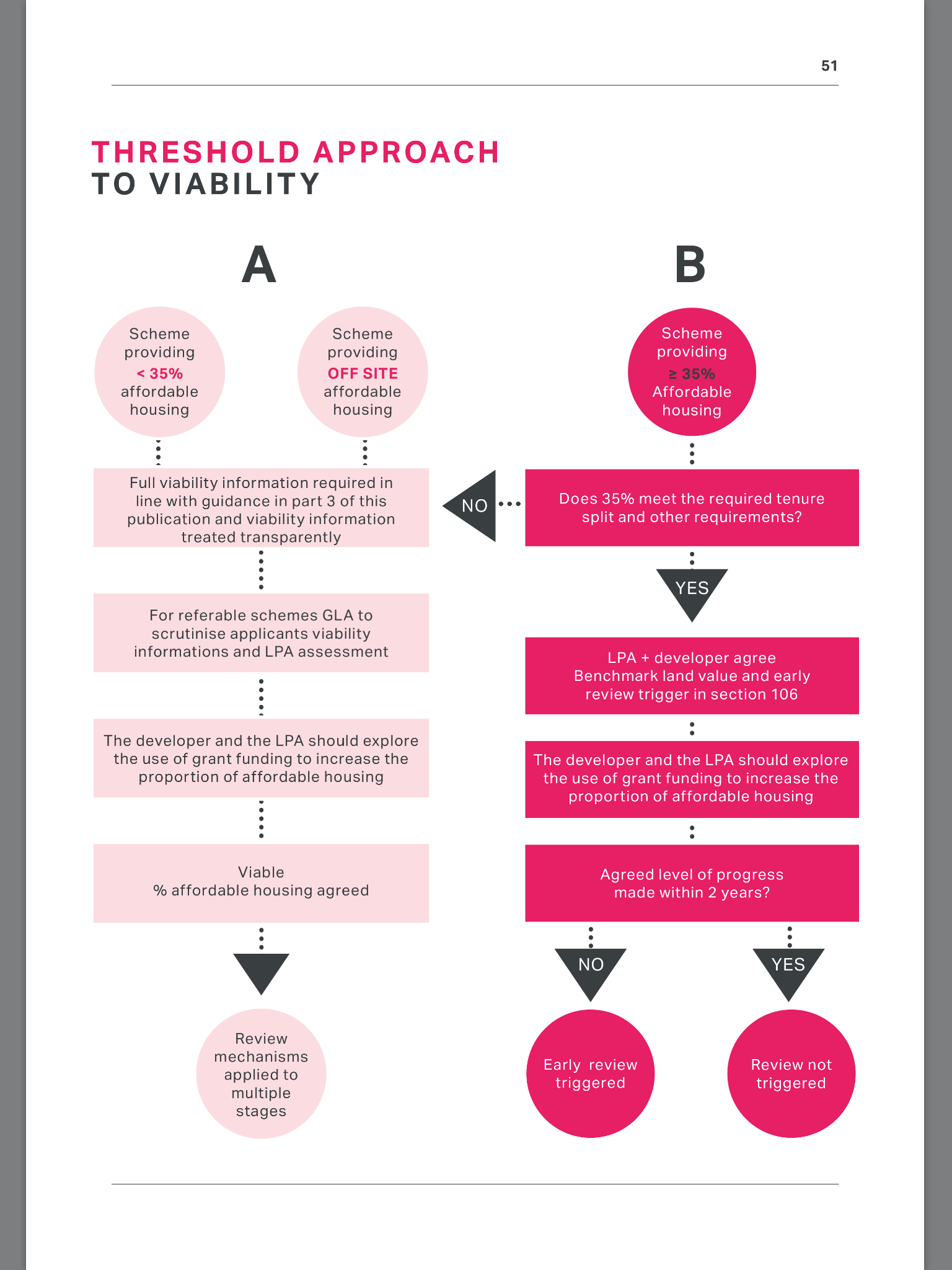
The draft SPG introduces a ‘threshold approach’, whereby schemes meeting or exceeding 35% (by habitable room) affordable housing without public subsidy will not be required to submit viability information. 
Schemes are divided into “route A” and “route B”. 

Route A schemes are:
. applications which do not meet the 35% threshold and required tenure split;

• applications which propose affordable housing off-site or as cash in lieu contribution; 

• applications which involve demolition of existing affordable housing (in particular estate regeneration schemes); 

• applications where the applicant claims the vacant building credit applies. 

Route B schemes are schemes which meet the 35% threshold and required tenure split (and which do not otherwise fall within the route A scheme definition above). Viability appraisal is not required, although there will be an “early review mechanism … triggered if an agreed level of progress is not made within two years of permission being granted” (the agreed level of progress being defined at the outset in the section 106 agreement).
The required tenure split
The required tenure split is:
– “at least 30% low cost rent (social rent or affordable rent) with rent set at levels that the LPA considers ‘genuinely affordable’ (this will generally be significantly less than 80% market rent). As part of [the] consultation, LPAs are being invited
to give guidance on what rent levels they consider to be genuinely affordable if above the benchmarks for London Affordable Rent”.
– “at least 30% as intermediate products, with London Living Rent … and/ or shared ownership being the default tenures assumed in this category. For viability purposes, London Living Rent homes in mixed-tenure schemes can be treated similarly to shared ownership, as it can be assumed that they will be sold on a shared ownership basis after a period of 10 years”.

– the remaining 40% is to be determined by the relevant LPA but must be “genuinely affordable”.

“London Living Rent is a new type of intermediate affordable housing that will help, through low rents on time-limited tenancies, households with around average earnings save for a deposit to buy their own home”. It has “ward-level caps … based on one-third of median gross household income for the local borough. The cap varies from the Borough median by up to 20 per cent in line with house prices within the ward”. The Mayor intends to limit eligibility for London Living Rent and other intermediate rent products to households on incomes of £60,000 a year or less, down from £90,000. 

“[F]or intermediate dwellings to be considered affordable, annual housing costs, including mortgage (assuming reasonable interest rates and deposit requirements), rent and service charges should be no greater than 40% of net household income. 
For shared ownership properties, to ensure mortgage costs assumptions are reasonable, boroughs, developers and registered provides are advised to assume buyers will access RPs, with a term of 25 years and a 90% loan to value ratio. The prevailing average interest rate being offered to lenders based on the terms above should be used to calculate the monthly payments. Generally shared ownership is not appropriate where unrestricted market values of a unit exceed £600,000”. 
Viability appraisal
Viability appraisal will be required to following a prescriptive approach, set out in part 3 of the draft. In relation to some familiar areas for dispute:
– “The price the RP has agreed to pay for each unit should be used in the viability appraisal and should be enshrined in the Section 106 agreement (for phased schemes the price in the Section 106 should be inflation linked)”.

– It should be assumed that all developers will incur generic average finance costs based on standard market rates.

– The IRR approach will not generally be appropriate for schemes of fewer than 1,000 units. 

– The benchmark value will be based on an existing Use Value plus premium (EUV+) approach, rather than the circularity of a market value approach. The Mayor will generally only accept an Alternative Use Value (AUV) approach where there is an existing implementable permission for that use.

The Mayor expects “all information to be made public, including council and third party assessments. Applicants will have the opportunity to argue that limited elements should be kept undisclosed, but the onus is on the applicant to make this case”. 

Review mechanisms
Section 106 agreements for route A schemes will need to require a two stage review mechanism:
– An “early review” where an agreed level of progress with the scheme is not made within two years of the permission being granted. Any surplus to be split 60/40 between the LPA and the developer and any surplus identified to translate into additional onsite affordable housing. “Thus plans should identify which units would switch to affordable accommodation in the event of an increase in viability at this early stage. If the agreed level of progress has been made, this review will not be triggered. All signatories to the Section 106 need to commit to making their best endeavours to fulfil their relevant requirements (setting out key milestones and requirements) to deliver the scheme and account may be had of the market situation at time of review”. 

– A “near end of development review which will be applied once 75% of units are sold. Where a surplus profit is identified this should be split 60/40 between the LPA and developer. The outcome of this review will typically be a financial contribution towards off-site affordable housing provision”. 

– The surplus is applied up to a total of 50% affordable housing.

The review should consider changes in gross development value and build costs using formulae set out in Appendix A to the draft SPG and which should be set out in the section 106 agreement. 
Build To Rent
Specific favourable provisions apply to Build To Rent, defined as complying with the following criteria:
“• a development, or block/ phase within a development, of at least 50 units; 

• the homes to be held as Build to Rent under a covenant for at least 15 years; 

• all units to be self-contained and let separately; 

• unified ownership and unified management of the development; 

• professional and on-site management; 

• longer tenancies offered (ideally three years or more) with defined in-tenancy rent reviews; and 

• property manager to be part of an accredited Ombudsman Scheme and a member of a recognised professional body”.

The Build To Rent restriction should usually be by way of section 106 agreement and should include a clawback mechanism if the units cease to be used for Build To Rent purposes. Two potential, alternative , clawback mechanisms are being consulted upon:
– to seek to recoup the initial loss of affordable housing if the homes are sold out of the Build to Rent sector, based on an appraisal submitted at application stage showing the reduced number of affordable homes possible due to the Build To Rent model. 

– a clawback to secure a total of 35% affordable housing. 

Affordable housing within Build To Rent schemes can be by way of discounted market rent (DMR), managed by the private sector landlord. The Mayor is seeking that the DMR be at London Living Rent. 
Some relaxation of space standards may be acceptable for Build To Rent products, particularly where they are subject to a longterm covenant that they will remain as Build To Rent. 
Differences are recognised in the approach to viability for Build To Rent schemes. Particularly:
“a different approach to profit (often lower than a build for sale scheme); 
• different approaches to sales and marketing; 

• rate of sale/disposal – this will generally be faster for a Build to Rent scheme (generally a build to rent appraisal will assume a development period and then a sale to an investor or operator); and 

• potentially lower risk compared to for sale schemes”. 

Finally, the Mayor is keen to secure the following five management standards:

“- Longer tenancies (three years or more) should be available to all tenants. These should have break clauses for renters, which allow the tenant to end the tenancy with a month’s notice any time after the first six months. 

– Within these tenancies there should be formula-linked rent increases. The LPA should not stipulate the level of rent increases on market rate tenancies, but these should be made clear to the tenant when the property is let and LPAs should ensure they are not set to discourage tenants from taking longer tenancies. Rents should normally be reset on each new tenancy.

– There must be on-site management. This does not necessarily have to mean
full time dedicated on-site staff in every case, as this could be unviable and unnecessary on small schemes. However all schemes need to have prompt issue resolution systems and some daily onsite presence.

– Providers must have a complaints procedure in place and be a member of
a recognised ombudsman scheme. They must also have membership of a designated professional body, such as the British Property Federation or Royal Institute of Chartered Surveyors.

– Finally, properties must be advertised on the GLA’s London-wide portal, in due course, which can be in addition to any advertising the provider may already be undertaking”.

Registered providers/grant funding

Applicants are encouraged to have registered providers on board at pre-application stage. 
The Mayor’s grant funding will only be available for route B applications if it increases the proportion of affordable housing above the nil-grant position to a level of 40% or more.
“The Mayor’s Homes for Londoners: Affordable Homes Programme 2016-2021, sets out how grant is going to be used to increase the amount of affordable housing delivered on developer-led sites above 35%, and to support approved providers deliver programmes with at least 50% affordable housing”. 

Concluding thoughts

In 2015 private sector schemes only delivered on average 13% affordable housing. Will this approach nudge the percentage upwards? This largely depends on whether developers believe that to button down 35%, with no review as long as development is not delayed, and with no need for viability appraisal, is sufficiently achievable or attractive. If it isn’t then it will be business as usual, with viability appraisals submitted to seek to secure a significantly lower percentage. 

How will LPAs react, particularly those inclined to hold out for the 50% target? And how will the imposition of a mandatory proportion of starter homes impact on this nuanced, London-specific approach?

Is the Mayor’s target of 50% now unachievable by flagging 35% as in practice acceptable or can the use of public land and grant funding make any appreciable difference?

Pass. But at least the likely structure of section 106 agreements for route A, route B and Build To Rent schemes (or rather the Mayor’s starting position) is increasingly clear. Which means, if the approaches are commercially palatable, faster permissions and less delay to development (particularly with the spectre of reviews triggered by delayed implementation). And:

Mayor of London: 1

Secretary of State: nil.
Simon Ricketts 1.12.16
Personal views, et cetera