I have avoided entering the contested environment which is Part 3 of the Planning and Infrastructure Act (dealing with environmental delivery plans and the nature restoration levy) since my 3 August 2025 blog post Picking Up The Bill: What Are We Now Thinking About Part 3? , but the Natural England’s first draft EDP, covering nutrient pollution affecting the Broads Special Area of Conservation (SAC) (Yare and Bure), Broadland Ramsar and River Wensum SAC in Norfolk, was published on 17 September 2026 for a 28 day consultation period and the Nature Restoration Levy Regulations 2026 were made on 10 September 2026, coming into force the following day. So needs must, here goes.
Many thanks to my colleague Adam Choudhury who has contributed the substance of much of what follows (although I have personally introduced any inaccuracies, infelicities and/or personal opinions).
The legislative idea is basically that developers may choose to pay a nature restoration levy (“NRL”) for developments to which an Environmental Delivery Plan (“EDP”) applies, in lieu of site-specific mitigation required for compliance with The Conservation of Habitats and Species Regulations 2017 (“Habitats Regulations”), and compliance with the obligations under the Wildlife and Countryside Act 1981, or the Marine and Coastal Access Act 2009. The approach is not without controversy, see Alexa Culver et al.
The Norfolk EDP was published in draft form for a 28-day consultation on 17 September 2026. Whilst the Norfolk EDP is itself focused on nutrient pollution, following the outcome of the consultation, it is likely to form the template for future EDPs, covering a wider range of issues including specific species, for instance great crested newts. This is a short consultation in relation to a complex document, and it will be interesting to see how the responses shape the final version of the plan.
The Norfolk draft EDP allows for up to 15,780 new homes (of any size or type) together with associated infrastructure to be brought forward over its lifespan, which would be 10 years. It sets the NRL rate at £2,675 per home, plus indexation. This will channel investment from developments to a strategic programme of conservation measures, which are to be maintained for 100 years.
Following this consultation it will be for the Secretary of State to make the EDP, if it passes the “Overall Improvement Test”. This test requires that the conservation measures in the EDP will “materially outweigh” the negative impact of the development provided for under the EDP, by the EDP ten years end date, on the conservation status of each environmental feature specified in it.
The Environmental Delivery Plans (Appropriate Prioritisation) Regulations 2026 modify the mitigation hierarchy for EDPs. They provide that: (a) avoidance is to be prioritised over mitigation and compensation and (b) mitigation is to be prioritised over compensation, where Natural England “consider it appropriate to do so”.
This departs from the precautionary standard in the Habitats Regulations, which requires the avoidance of significant harm, beyond all reasonable scientific doubt, to the integrity of the protected site, save where there are “imperative reasons of overriding public interest”.
The rules in relation to using the nature restoration fund can be found in the Nature Restoration Levy Regulations and Part 3 of PIA 2025.
Section 72(5) PIA 2025 provides that an EDP may make payment of the NRL mandatory. In the case of the Norfolk draft EDP, payment of the NRL and opting in to the NRF is to be voluntary. So far as developments within the scope of the Norfolk EDP are concerned, and indeed where payment of the NRL is voluntary under future EDPs, in practice developers will want to work out whether payment of the NRL is more cost-effective and/or confers less risk than the alternative site-specific mitigation required by the Habitats Regulations. The largely frontloaded nature of the timing of payments may well shape uptake.
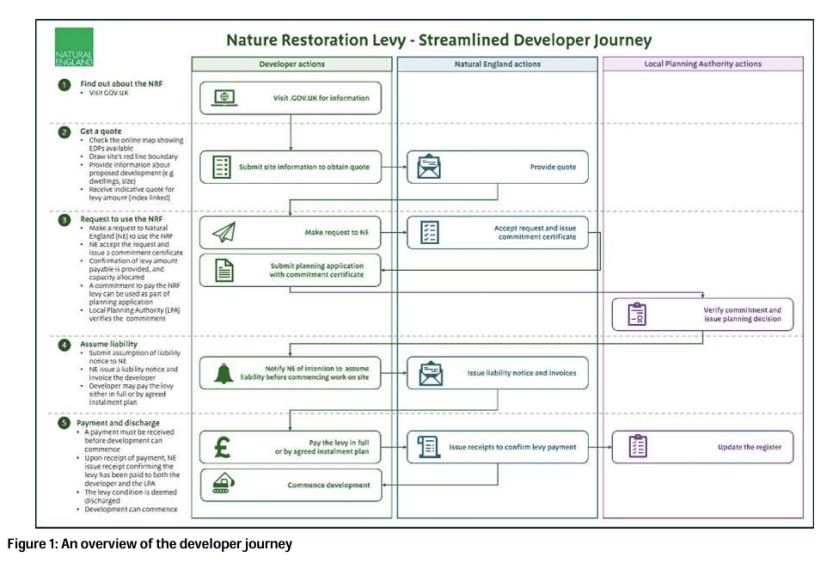
The process for developers to follow has been designed to be digital and streamlined.
The first stage will involve getting a quote from Natural England by logging onto the Natural England system, inputting their red line boundary and proposed number of dwellings within the relevant EDP area. The system responds automatically. If the developer wishes to proceed, if the development is in scope and within the remaining development capacity of the EDP, Natural England then issues the developer with a commitment certificate.
The commitment certificate may then be submitted with a planning application made for that development within 6 months. Regardless of the length of time it takes for the local planning authority to determine the planning application, or an Inspector to determine the case on appeal, the development capacity in the EDP will be held against the development.
After a planning application is submitted with a commitment certificate, and planning permission is granted, a statutory pre-commencement condition is imposed requiring either payment in full prior to the commencement of development or, where the levy is to be paid in instalments, payment of the first instalment. The draft instalment plan for Norfolk envisages payment in three equal instalments: one within 30 days of commencement, the second in 12 months and the final one in 24 months – no matter how large the scheme.
Once planning permission is granted, one or more persons/legal entities assume liability by completing an online assumption of liability form. Natural England “must impose levy liability” where no one has assumed it. Where liability is assumed by more than one person/legal entity, they become jointly and severally liable to pay.
Natural England then issues a liability notice to each liable person when liability arises in the form of a liability notice. Once liability is assumed, the debt is registered as a local land charge. Natural England is given a wide range of enforcement powers to procure payment where it is not forthcoming.
There will be more guidance. The explanatory notes to the Nature Restoration Levy Regulations say this:
“To support effective implementation, the Secretary of State will publish statutory guidance on the NRF and the levy before the first EDPs are made. The guidance will focus on the practical application of the powers and duties set out in these Regulations. This guidance will build on the processes established in the Regulations and will provide detail on how they should be operationalised in practice, including in relation to setting the levy, managing liability and payments, and administering the system. The aim will be to support Natural England in exercising its functions in compliance with the regulatory framework and to support developers and LPAs navigating this new system. As producing and finalising these Regulations has been the priority, it has not been possible to produce guidance ahead of the Regulations being laid, but work is ongoing at pace to ensure that the guidance will be published in a timely manner ahead of the first EDPs being made.”
My thoughts:
- Subject ultimately to the robustness of the “overall improvement” test, the EDPs and NRL mechanism should prove in my view to be a coherent and (both economically and environmentally) efficient way of allowing development to be brought forward where harm may be caused to protected sites.
- It is unfortunate that it has taken successive governments this long. In the meantime, bespoke strategic solutions have of course been developed in various areas, with which this new system will now compete. Will this competition be healthy, or will it in some instances prejudice those solutions by removing their necessary critical mass?
- The frontloading of payments under this mechanism makes it less attractive for larger projects with long build-out periods. This will need to be addressed for the mechanism to be attractive.
- What is the risk of subsequent EDPs coming forward on a compulsory basis?
- If you like the CIL Regulations, you will find much to enjoy in the Nature Restoration Levy Regulations and the various sets of amendment regulations that will surely follow baby duck-like.
Before we rush to criticise, perhaps we should remember how problematic issues such as nutrient neutrality still are in many areas, in terms of leading to either a veto or the need to buy an expensive entry ticket in order to carry out development which has very little to do with the underlying historical causes of the problem at the first place.
Cue a Rory Stewart style hard stare at our farming and water industries.
Simon Ricketts, 4 October 2026
Personal views et cetera


