Data Centres & Community Benefits

Alongside the Chancellor’s budget on Wednesday (28 October 2026) were two interesting documents for those involved with data centre proposals.

The first was the long awaited draft national policy statement for data centres that are promoted as nationally significant infrastructure projects (those where the promoter has secured a direction from the Secretary of State that its proposal should proceed as an NSIP, being of national significance and usually at least 100MW in operating capacity). The document was accompanied by a sustainability appraisal and a habitats regulations assessment.

But I want to focus here on the second document: The Data Centre Covenant, published by HM Treasury.

The Covenant sets out five “new tests all data centres are encouraged to meet, and which strategic data centres must meet to qualify for additional government action”.

  • “Lower electricity bills”

“Data centres will … be expected to make credible commitments for the grid capacity they request, support security of supply, investment in clean power and net zero, use resources responsibly and support an efficient, flexible, and resilient energy system.”

  • “Invest in improving local communities”

“Communities that host nationally important infrastructure should share directly in the rewards.  Strategic data centres should agree a Local Benefit Plan that commits to substantial investment, developed with the local community and linked to the development’s size.  This can be spent on local priorities, like transport, parks and town centres.

The construction and maintenance of AI data centres will increase local employment, open opportunities for local suppliers and support investment in skills and training. But communities hosting major developments should also see clear, lasting improvements to their local area. Developers must already meet planning requirements such as Section 106 and the Community Infrastructure Levy, which fund local infrastructure needs like transport networks and other community assets. Strategic data centre developers will be required to go further, including working with the local area on a Local Benefit Plan for investment in the local community, linked to the development’s size. Communities should have a meaningful say in how these benefits are designed and allocated.”

  • “Adhere to the highest environmental standards”

“Protect nature, minimise water use and publish annual energy and water consumption reports.  They should also capture the heat they produce for nearby homes, schools, hospitals or businesses wherever practical, rather than letting it go to waste.

They should use energy and water efficiently, with new facilities designed to achieve a Power Usage Effectiveness of 1.3 or better and minimise demand for public water supplies by using technologies such as closed loop water systems.  Additionally, developers should design projects to capture and reuse waste heat where there is a viable local user. Strategic data centres should report annually on their energy and water use, efficiency, emissions, heat reuse and participation in flexibility services, and we will strongly encourage existing operators to do the same.”

  • “Create jobs, apprenticeships, and drive reindustrialisation”

“Create local jobs and invest in paid apprenticeships and training places, supporting young people into the AI, digital and infrastructure jobs of the future. They should also prioritise UK suppliers and technologies and make a meaningful contribution to the development and deployment of British AI hardware.

Developers should create good, well-paid jobs that last beyond construction. They should recruit locally where possible and invest in apprenticeships, colleges and universities.  Where roles cannot currently be filled locally, they should invest in education and training to enable more local people to access these opportunities in the future.

Data centres are expected to help build capability in strategically important supply chains. They should also partner with UK researchers and innovative companies, and provide access to compute where appropriate, to accelerate innovation and strengthen national capability. The most strategically important data centres will be expected to make a meaningful contribution to the development and deployment of British AI hardware in the UK.”

  • “Strengthen Britain’s security”

“Provide secure and reliable access to compute the UK needs, including for our NHS and other public services.  They should work with the relevant national technical authorities, including the National Cyber Security Centre, to enhance resilience against cyber and hybrid threats beyond baseline requirements.

Data centres should provide secure, resilient UK access to compute for critical services and national priorities. As critical national infrastructure, operators should share relevant information with government and technical agencies, meet current and future cyber resilience standards and work with the relevant national technical authorities to strengthen security and resilience further. They should also plan with critical suppliers for foreseeable disruption and participate in government exercises to test arrangements for prioritising essential services.”

Given that all of this is simply by encouragement rather than legal prescription, what is the carrot?

“In return for meeting these tests, the government will establish a new Ministerial Control Centre for considering supportive action for strategic data centres. This will be chaired by the Minister for AI, supported by the Exchequer Secretary to the Treasury and relevant ministers from the Department for Energy Security and Net Zero and other departments. It will use the power of the state to accelerate time to power and speed up the planning process for the most strategic data centres.”

The document also sets out additional assistance that the government will provide, by way of facilitating access to power capacity, for sites that demonstrate sufficient strategic value (“The government will set out further details in due course on the definition of strategic data centres and the additional criteria such projects will be expected to meet”).

That second test (“invest in improving local communities”) piqued my interest. The question of how to secure community benefits that go beyond what is necessary to mitigate the effects of development raises its head with so many categories of development where local communities may perceive that they will suffer adverse impacts for what policy determines to be the greater wider, public, good. Where is the dividing line between good practice and, in effect, “buying a planning permission”? The lack of clarity is difficult for all concerned. I wrote about this in my 2 June 2018 blog post Community Benefits.

As I noted back then, the Housing and Planning Act 2016 introduced a new section 75ZA into the Town and Country Planning Act that would perhaps assist, if it is ever brought into force. “Financial benefits information” would need to be included in officers’ reports, including “a list of any financial benefits (whether or not material to the application) which are local finance considerations or benefits of a prescribed description, and which appear to the person making the report to be likely to be obtained” by the authority or third parties within a description to be prescribed, as a result of the proposed development, together with “in relation to each listed financial benefit, a statement of the opinion of the person making the report as to whether the benefit is material to the application” as well as any other prescribed information about each listed financial benefit.

10 years on now, section 75ZA still hasn’t been brought into force. Might now be a convenient moment?

Simon Ricketts, 30 October 2026

Personal views, et cetera

What Will Happen If LPAs Miss The 31 Oct NSD Deadline?

In my 13 June 2026 blog post Delegation Nation I summarised the national scheme of delegation which supposedly takes effect from 31 October 2026. I say “supposedly” because at least three local planning authorities have resolved at full council meetings not to make the changes required to their constitutions so as to bring into effect the NSD in relation to their decision-making. The question on many of our lips is: what are the real implications for decision-making in such authorities after that date?

The Town and Country Planning (Discharge of Local Planning Authority Functions) (England) Regulations 2026 come into force on 31 October 2026. They were made pursuant to section 319ZZC of the Town and Country Planning Act 1990 (NB what absurd section-numbering we now have as a result of 36 years now of non-consolidation of legislative changes. 319ZZC was introduced by the Planning and Infrastructure Act 2025).

Section 319ZZC provides as follows:

  1. The Secretary of State may by regulations require a relevant local planning authority to make arrangements under section 101 of the 1972 Act for such relevant planning functions as are prescribed—
  1. to be discharged by a committee, sub-committee or officer of the authority;
  1. to be discharged by a committee, sub-committee or officer of the authority in prescribed circumstances.
  1. The regulations may —
  1. prescribe the terms of the arrangements (which may include exceptions) and any permitted variations in those terms;
  1. provide for the arrangements to confer a discretion on any person in connection with the delegation of a function.
  1. Where arrangements required by the regulations are in force in relation to a relevant planning function, the function may only be exercised in accordance with the arrangements (and section 101(4) of the 1972 Act does not apply).

Section 101(4) of the Local Government Act 1972 allows local authorities to arrange for the discharge of their functions by a committee, sub-committee, or an officer of the authority.

The 2026 Regulations were made pursuant to this section 319ZZC (as well as other sections) of the 1990 Act. Local planning authorities have a statutory duty from 31 October to make arrangements that are consistent with the Regulations. It seems to me obvious that any local planning authority which fails to comply is in breach of statutory duty and therefore susceptible to judicial review, in relation to which the remedies available to the High Court include making a declaration that it is in breach, quashing any resolution to make arrangements which are in breach and/or a mandatory order to secure compliance. Such proceedings could be brought by any party showing a sufficient interest in the issue.

Such proceedings could also be brought by the Secretary of State and I would envisage a real justification for proceeding on an expedited basis. One might hope that the threat of such proceedings might be sufficient in most instances. I can’t see that any of the Secretary of State’s general powers of intervention in local planning authority decision making are particularly well-suited to the specific task of bring individual authorities’ constitutions into line.

I would also note that the relevant local authority’s monitoring officer will be acutely aware of their personal duty to prepare a report under section 5 of the Local Government and Housing Act 1989 if it appears to them that any proposal, decision or omission by the authority, by a committee or sub-committee or by an officer in exercising delegated powers, has given rise to, or is likely to give rise to a contravention of any enactment; a contravention of any rule of law, or maladministration.

There is also statutory guidance to which local planning authorities must have regard in making and operating their arrangements under the Regulations. This guidance raises the spectre that planning decisions taken under arrangements which are not consistent with the Regulations may be susceptible to judicial review:

“For the avoidance of doubt, where local planning authorities do not comply with the Regulations from the date they come into force (31 October 2026) and their planning committees make decisions on applications which must be delegated officers [sic], those decisions may be subject to judicial review by anyone aggrieved by the decision. This may lead to the quashing of the decision.”

I can see that at least in theory this is indeed a risk for developers where a committee (operating under unlawful decision-making arrangements) approves an application which should have been determined, under the new arrangements, by delegated powers. However, I do think the circumstances would have to be unusual for such proceedings ultimately to succeed. Where the committee’s decision is in line with the officer’s recommendation, the outcome would have been highly likely to be the same in any event.

Where an application is refused, as I say in my previous blog post: “If the authority does not agree to re-determine the application (at least before the decision is formally issued), yes it could judicially review the decision but its more effective remedy may simply be to appeal (and in so will have to grapple with the dilemma of potentially being in a position where it is submitting an appeal in relation to an unlawful refusal notice).”

Finally, I do think that we need to be alert to the practical risk to transparency and probity of local planning authorities arriving at “behind the scenes” arrangements where councillors informally influence officer decision making, including through informal meetings to determine their stance on particular proposals. Be aware as well of Regulation 2(2): in relation to decisions delegated to officers “the authority must not make arrangements that limit the officer’s discretion as to how to determine that application”.

The thrust of the NSD is surely to be welcomed by all. Some applications are minor and should never be determined by anyone other than planning officers – “political” issues do not arise; the tramlines for decision-making are to be set in local and national policies. Other applications should only be determined by elected planning committees where they do genuinely, exceptionally, raise “an economic, social or environmental issue of significance to the local area” and/or “a significant planning matter having regard to the development plan and any other material considerations”. The massively important and influential role that local councillors have is in ensuring that there are up to date policies in place that provide the blueprint for day to day officer decision-making. The inevitable risk arising from this new system lies in the inevitability of mission creep wherever a statutory test contains words such as “of significance” or “significant”.

As all this beds down, I am sure we will be seeing some power struggles between MHCLG and some local planning authorities, as well as power struggles internally within some authorities as to where that “of significance”/”significant” dividing line is to be drawn.

Final word of warning: There is much legal speculation in all of the above. If you are a lawyer who has been grappling with these issues and take a different view as to the potential procedural consequences, do let me know! (Oh and thank you to my brand-new Town Legal colleague Bob Pritchard who sparked some of the above thoughts).

Simon Ricketts, 17 October 2026

Personal views, et cetera
NRL IRL

I have avoided entering the contested environment which is Part 3 of the Planning and Infrastructure Act (dealing with environmental delivery plans and the nature restoration levy) since my 3 August 2025 blog post Picking Up The Bill: What Are We Now Thinking About Part 3? , but the Natural England’s first draft EDP, covering nutrient pollution affecting the Broads Special Area of Conservation (SAC) (Yare and Bure), Broadland Ramsar and River Wensum SAC in Norfolk, was published on 17 September 2026 for a 28 day consultation period and the Nature Restoration Levy Regulations 2026 were made on 10 September 2026, coming into force the following day. So needs must, here goes.

Many thanks to my colleague Adam Choudhury who has contributed the substance of much of what follows (although I have personally introduced any inaccuracies, infelicities and/or personal opinions).

The legislative idea is basically that developers may choose to pay a nature restoration levy (“NRL”) for developments to which an Environmental Delivery Plan (“EDP”) applies, in lieu of site-specific mitigation required for compliance with The Conservation of Habitats and Species Regulations 2017 (“Habitats Regulations”), and compliance with the obligations under the Wildlife and Countryside Act 1981, or the Marine and Coastal Access Act 2009. The approach is not without controversy, see Alexa Culver et al.

The Norfolk EDP was published in draft form for a 28-day consultation on 17 September 2026. Whilst the Norfolk EDP is itself focused on nutrient pollution, following the outcome of the consultation, it is likely to form the template for future EDPs, covering a wider range of issues including specific species, for instance great crested newts. This is a short consultation in relation to a complex document, and it will be interesting to see how the responses shape the final version of the plan.

The Norfolk draft EDP allows for up to 15,780 new homes (of any size or type) together with associated infrastructure to be brought forward over its lifespan, which would be 10 years. It sets the NRL rate at £2,675 per home, plus indexation. This will channel investment from developments to a strategic programme of conservation measures, which are to be maintained for 100 years.

Following this consultation it will be for the Secretary of State to make the EDP, if it passes the “Overall Improvement Test”. This test requires that the conservation measures in the EDP will “materially outweigh” the negative impact of the development provided for under the EDP, by the EDP ten years end date, on the conservation status of each environmental feature specified in it.

The Environmental Delivery Plans (Appropriate Prioritisation) Regulations 2026 modify the mitigation hierarchy for EDPs. They provide that: (a) avoidance is to be prioritised over mitigation and compensation and (b) mitigation is to be prioritised over compensation, where Natural England “consider it appropriate to do so”.

This departs from the precautionary standard in the Habitats Regulations, which requires the avoidance of significant harm, beyond all reasonable scientific doubt, to the integrity of the protected site, save where there are “imperative reasons of overriding public interest”.

The rules in relation to using the nature restoration fund can be found in the Nature Restoration Levy Regulations and Part 3 of PIA 2025.

Section 72(5) PIA 2025 provides that an EDP may make payment of the NRL mandatory. In the case of the Norfolk draft EDP, payment of the NRL and opting in to the NRF is to be voluntary. So far as developments within the scope of the Norfolk EDP are concerned, and indeed where payment of the NRL is voluntary under future EDPs, in practice developers will want to work out whether payment of the NRL is more cost-effective and/or confers less risk than the alternative site-specific mitigation required by the Habitats Regulations. The largely frontloaded nature of the timing of payments may well shape uptake.

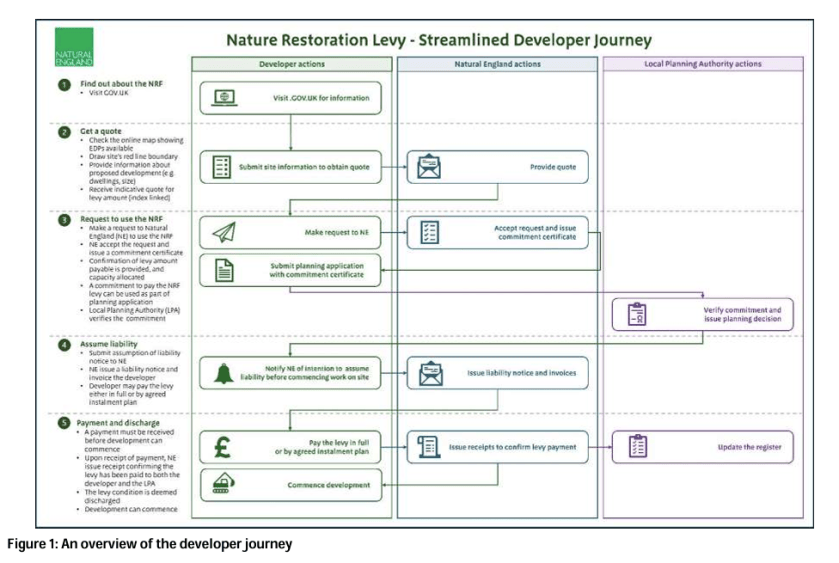
The process for developers to follow has been designed to be digital and streamlined.

The first stage will involve getting a quote from Natural England by logging onto the Natural England system, inputting their red line boundary and proposed number of dwellings within the relevant EDP area. The system responds automatically. If the developer wishes to proceed, if the development is in scope and within the remaining development capacity of the EDP, Natural England then issues the developer with a commitment certificate.

The commitment certificate may then be submitted with a planning application made for that development within 6 months. Regardless of the length of time it takes for the local planning authority to determine the planning application, or an Inspector to determine the case on appeal, the development capacity in the EDP will be held against the development.

After a planning application is submitted with a commitment certificate, and planning permission is granted, a statutory pre-commencement condition is imposed requiring either payment in full prior to the commencement of development or, where the levy is to be paid in instalments, payment of the first instalment. The draft instalment plan for Norfolk envisages payment in three equal instalments: one within 30 days of commencement, the second in 12 months and the final one in 24 months – no matter how large the scheme.

Once planning permission is granted, one or more persons/legal entities assume liability by completing an online assumption of liability form. Natural England “must impose levy liability” where no one has assumed it. Where liability is assumed by more than one person/legal entity, they become jointly and severally liable to pay.

Natural England then issues a liability notice to each liable person when liability arises in the form of a liability notice. Once liability is assumed, the debt is registered as a local land charge. Natural England is given a wide range of enforcement powers to procure payment where it is not forthcoming.

There will be more guidance. The explanatory notes to the Nature Restoration Levy Regulations say this:

“To support effective implementation, the Secretary of State will publish statutory guidance on the NRF and the levy before the first EDPs are made. The guidance will focus on the practical application of the powers and duties set out in these Regulations. This guidance will build on the processes established in the Regulations and will provide detail on how they should be operationalised in practice, including in relation to setting the levy, managing liability and payments, and administering the system. The aim will be to support Natural England in exercising its functions in compliance with the regulatory framework and to support developers and LPAs navigating this new system. As producing and finalising these Regulations has been the priority, it has not been possible to produce guidance ahead of the Regulations being laid, but work is ongoing at pace to ensure that the guidance will be published in a timely manner ahead of the first EDPs being made.”

My thoughts:

  • Subject ultimately to the robustness of the “overall improvement” test, the EDPs and NRL mechanism should prove in my view to be a coherent and (both economically and environmentally) efficient way of allowing development to be brought forward where harm may be caused to protected sites.
  • It is unfortunate that it has taken successive governments this long. In the meantime, bespoke strategic solutions have of course been developed in various areas, with which this new system will now compete. Will this competition be healthy, or will it in some instances prejudice those solutions by removing their necessary critical mass?
  • The frontloading of payments under this mechanism makes it less attractive for larger projects with long build-out periods. This will need to be addressed for the mechanism to be attractive.
  • What is the risk of subsequent EDPs coming forward on a compulsory basis?
  • If you like the CIL Regulations, you will find much to enjoy in the Nature Restoration Levy Regulations and the various sets of amendment regulations that will surely follow baby duck-like.

Before we rush to criticise, perhaps we should remember how problematic issues such as nutrient neutrality still are in many areas, in terms of leading to either a veto or the need to buy an expensive entry ticket in order to carry out development which has very little to do with the underlying historical causes of the problem at the first place.

Cue a Rory Stewart style hard stare at our farming and water industries.

Simon Ricketts, 4 October 2026

Personal views et cetera