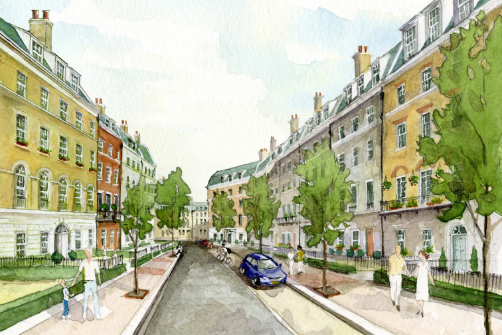
I was going to call this blog post National Lottery but then I remembered I’ve already used that strapline back in 2019. 7 years of this blog, 408 posts – round and round the same track we go.
Much has already been written about the Secretary of State’s decision letter dated 6 February 2024 in which he granted planning permission for the redevelopment of the former London Television Centre, on London’s south bank (NB paragraph 1 of the Secretary of State’s letter curiously describes it as an appeal against refusal of the application by Lambeth Council, which it was not – Lambeth was supportive and had resolved to grant planning permission before the Secretary of State intervened by calling in the application).
See eg Zack Simon’s post as to what the decision may tell us as to the question of “beauty”, Nicola Gooch’s post on severability (although maybe the applicant didn’t have Hillside severability in mind so much as simply phasing for CIL purposes?) and Andy Black’s post on the some of the wider implications of the decision.
I’m not going to duplicate any of those posts. I’m just going to use another aspect of the decision as a jumping off point both for sympathising with all parties who spend vast amounts of time and money at risk on these sorts of application and appeal processes and for giving a small jab at us lawyers.
Because the decision essentially turned on one thing: the Secretary of State having (crucially) found that there was compliance with the development plan as a whole (despite some conflict with individual policies), the pivot was whether there were material considerations which indicated that the proposal should be determined other than in accordance with the development plan – or, more basically, how much relative weight the Secretary of State decided to apply to the public benefits arising from the scheme as against the harms arising from the scheme (whilst applying the appropriate tests in relation to elements of “heritage” harm, for instance requiring “clear and convincing justification” by way of the public benefits arising). To quote the key paragraphs:
“35. Weighing in favour of the proposal are the employment generating opportunities for the Borough in the construction phase as well as the operational phase of the development, which both carry substantial weight, the placemaking benefits delivered by the public realm strategy which carry substantial weight, and the commitment towards an employment and skills strategy over and above the policy requirements as well as the provision of affordable creative workspace which carries moderate weight.
36. Weighing against the proposal is the less than substantial harm to the significance of the designated heritage assets of the RNT, the IBM building, Somerset House, the South Bank CA and the Roupell Street CA, which carries great weight. The Secretary of State has also found that the proposal would not provide a positive contribution to the townscape of the South Bank, which carries moderate weight.
37. The Secretary of State has considered the heritage balance set out at paragraph 208 of the Framework (formerly paragraph 202). He has noted public benefits deriving from the public realm strategy, as well as the other public benefits identified in paragraph 35 above. However, he has also identified less than substantial harm to the significance of the RNT, the IBM building and Somerset House, and to the South Bank CA and Roupell Street CA. Having carefully weighed up the relevant factors, he has concluded that the public benefits of the proposal do outweigh the harm to designated heritage assets. Therefore, in his judgement, the balancing exercise under paragraph 208 of the Framework (formerly paragraph 202) is favourable to the proposal.
38. Overall, in applying s.38(6) of the PCPA 2004, the Secretary of State considers that the accordance with the development plan and the material considerations in this case indicate that permission should be granted.”
Of course, a huge amount of expert evidence was given at the inquiry over 12 sitting days by the parties as to each of these matters and the weight to be applied to each of them, but if the Secretary of State had chosen to give less weight to the public benefits set out in paragraph 35, the decision would probably have gone the other way. How much weight the Secretary of State (or any decision maker) gives to such considerations is very difficult to predict – it is quintessentially a matter of planning (whisper political) judgment. (Similarly his decision as to whether, despite non-compliance with some individual policies, there was compliance with the development plan as a whole).
The weighting is particularly interesting, given that he was more bearish than the inspector (who had recommended that permission be granted) on various aspects, including:
- whether “the scale of the building and the proposed massing provides an appropriate response to the site”
- finding negative elements to the effects on townscape
- disagreeing that “the proposed palette of materials and the aesthetic appearance of the building is appropriate for what is a very prominent and sensitive site. He disagrees with the Inspector that an attractive development would be delivered.”
The Planning Practice Guidance summarises the legal position as to the weight to be given to material considerations:
“What weight can be given to a material consideration?
The law makes a clear distinction between the question of whether something is a material consideration and the weight which it is to be given. Whether a particular consideration is material will depend on the circumstances of the case and is ultimately a decision for the courts. Provided regard is had to all material considerations, it is for the decision maker to decide what weight is to be given to the material considerations in each case, and (subject to the test of reasonableness) the courts will not get involved in the question of weight.
Paragraph: 009 Reference ID: 21b-009-20140306
Revision date: 06 03 2014”
And as for public benefits:
“What is meant by the term public benefits?
The National Planning Policy Framework requires any harm to designated heritage assets to be weighed against the public benefits of the proposal.
Public benefits may follow from many developments and could be anything that delivers economic, social or environmental objectives as described in the National Planning Policy Framework (paragraph 8). Public benefits should flow from the proposed development. They should be of a nature or scale to be of benefit to the public at large and not just be a private benefit. […]
Paragraph: 020 Reference ID: 18a-020-20190723
Revision date: 23 07 2019”
To quote Lindblom LJ in East Staffordshire Borough Council v Secretary of State for Communities and Local Government (Court of Appeal, 30 June 2017):
“Planning decision-making is far from being a mechanical, or quasi-mathematical activity. It is essentially a flexible process not rigid or formulaic. It involves, largely, an exercise of planning judgment, in which the decision-maker must understand relevant national and local policy correctly and apply it lawfully to the particular facts and circumstances of the case in hand, in accordance with the requirements of the statutory scheme. The duties imposed by section 70(2) of the 1990 Act and section 38(6) of the 2004 Act leave with the decision-maker a wide discretion.”
We often pretend that planning decision-making to be a quasi-scientific, quasi-judicial process. But it’s really nothing of the sort. We lawyers can seek to ensure that all material considerations are taken into account, that immaterial considerations are not taken into account, that thresholds and criteria in specific statutory and policy tests are taken into account and that the decision-maker’s reasoning is adequate and rational. We can apply our forensic experience to ensure that the necessary evidence is brought forward and is presented as persuasively as possible – and can stress-test the evidence against us. But beyond that, rather than anything resembling the scales of justice, there is a black box in which there is simply the exercise of planning judgment. (I’m not complaining about that – that is the essence of the role of the planner I would have thought).
My jab at us lawyers is simply that perhaps we do not stress strongly and frequently enough to clients how unscientific the planning application and appeal process is. We are often asked to indicate what the odds are on a proposal finding favour with the decision-maker: what are the percentage prospects of success? This is an entire reasonable question to ask, because otherwise how can the client carry out a proper cost benefit analysis of whether the process is likely to be a worthwhile investment? But save for rare examples of cases which mainly turn on the correct interpretation of a particular policy, we have so little to go on other than analysis (which is often not sufficiently objective and evidence-based and possibly infected by eg optimism bias) of previous trends in decision-making to see what weight has previously been applied to various material considerations, in differing circumstances and permutations – trends which in any event do not amount to formal precedents.
I’m not even sure that appeal odds can be given which are much more than, say:
- Less than 35 – 40% ie very unlikely to succeed given significant technical or legal hurdles to be overcome.
- Circa 50% ie yes it’s arguable but it’s going to come down to whether there has been development plan compliance as a whole and the weight that the decision-maker gives to competing material considerations
- Circa 60% – 65% ie a scheme which appears to be policy compliant and to meet the relevant legislative and policy tests
Would anyone be prepared to bet good money on the basis of assuming prospects materially higher than 65%? In my view it would need to be an unusual case turning on relatively binary issues.
Factors which lead to additional variability:
- The scale of the development proposal, the range of potential issues and process timescale (will the decision maker or other circumstances in fact change along the way?!)
- Cases where the principal live issues give rise to a large element of subjectivity, in relation to matters such as design or townscape
- Is this a Secretary of State decision (ie in relation to an application which he has called in or an appeal he has recovered for his own determination)? – again this inevitably makes the outcome less predictable, both due to the influence of “politics” but due to the additional delays thereby arising (see above)
- Political/media interest or pressure
- Unusual proposals and/or where the decision-maker does not have a relevant or consistent track record.
When set against the scale of investment required to promote a large scheme at inquiry or indeed to defend against it, these may be sobering thoughts.
Simon Ricketts, 9 February 2024
Personal views, et cetera
PS Since I left Twitter I have experimented with a few social media platforms. None are ideal but, now that it is finally public access, you could give Bluesky a go. I share these posts there (my account is here) and on LinkedIn and you may find some related content.

Scheme image courtesy of CO-RE website