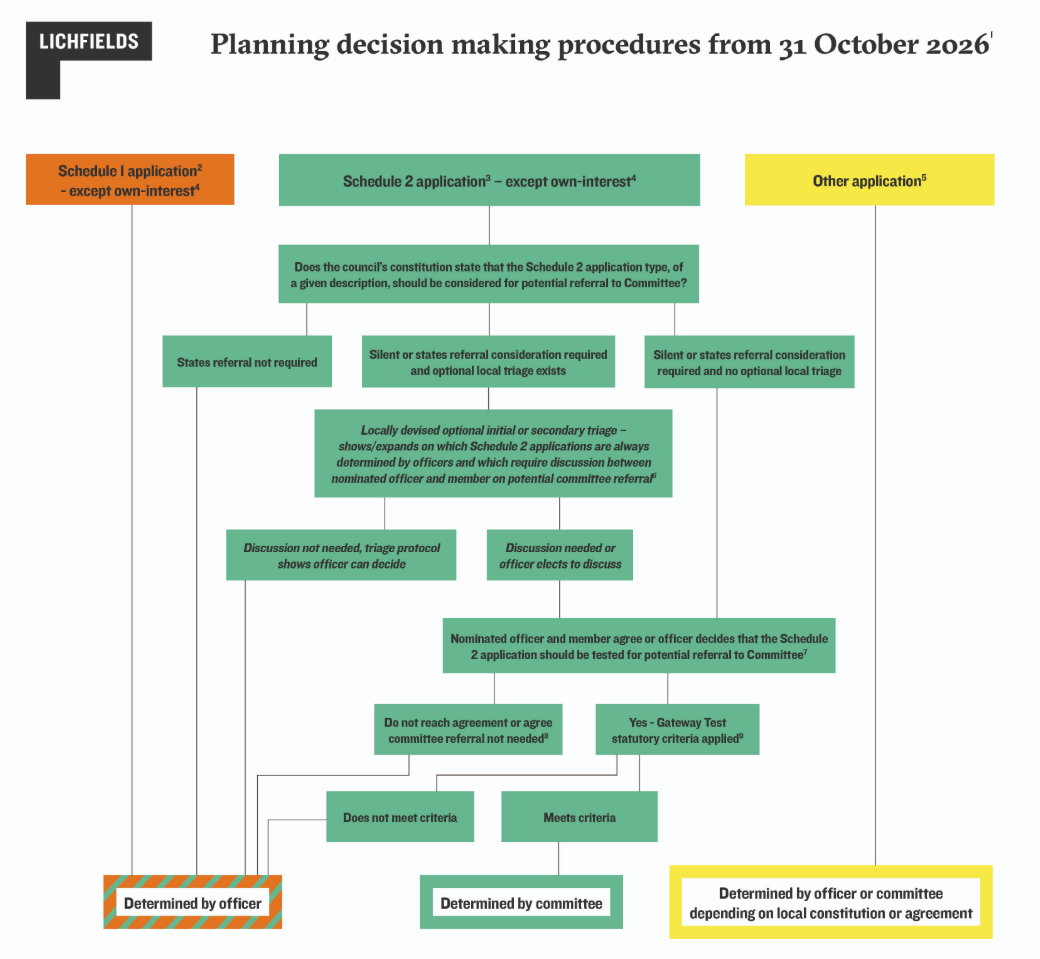
The new rules (for England) limiting which planning applications can be determined by local councillors come into force on 31 October 2026, a month later than previously intended.
The draft Regulations are accompanied by statutory guidance (1 June 2026) and a draft impact assessment which arrives at the following calculation:
““[Net present social value] (2025 prices, 2026 base year): £509.4 million (Low: £102.6 million and
High: £1,352.3 million)
Central direct monetised impacts (NPSV in 2025 prices, 2026 base year):
• Reduction in costs of holding capital related to determination times (to developers): £329.5 million
• Reduction in costs of holding capital related to appeals (to developers): £127.8 million
• Reduction in costs related to appeals (to developers): £46.0 million
• Reduction in costs related to appeals (to public sector): £6.1 million
• Familiarisation costs (to public sector): <£100,000”
Half a billion pounds is not to be sneezed at.
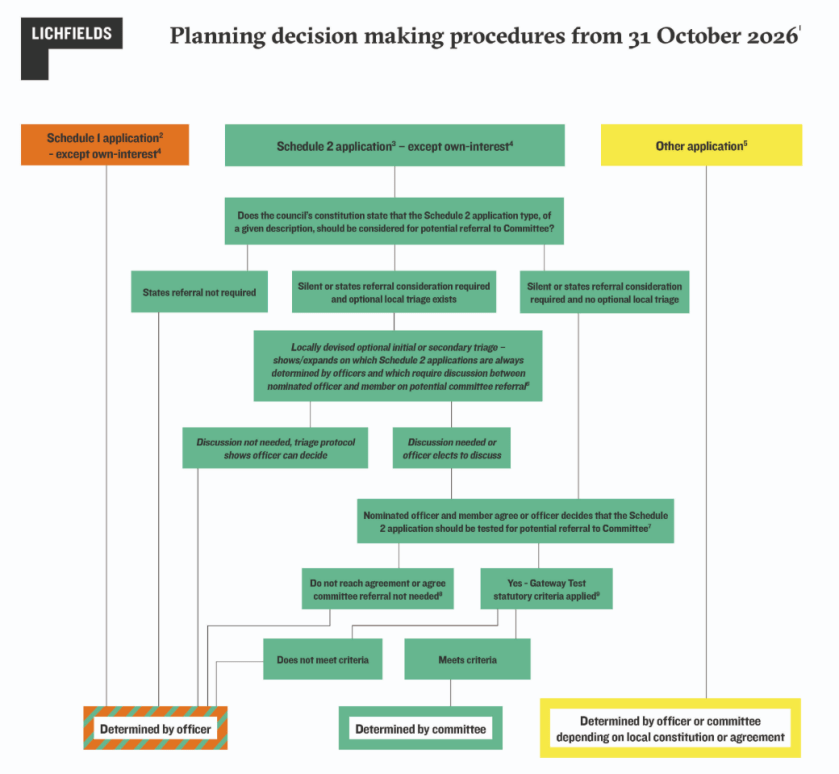
There is (of course) a comprehensive Lichfields blog setting out how the new system will work (Delegation default: power to the Chief Planner, 11 June 2026). Schedule 1 applications must always be delegated to officers. With Schedule 2 applications there is a presumption that applications will also be delegated, unless (1) unless the nominated officer and nominated member agree the application should be referred to a planning committee or sub-committee for determination and (2) it meets at least one of the criteria in regulation 5(3), namely:
- A: where the application raises an economic, social or environmental issue of significance to the local area; and/or
- B: where the application raises a significant planning matter having regard to the development plan and any other material considerations.
For B, “the following circumstances are unlikely to raise a significant planning matter:
- where the application for development broadly complies with a detailed site allocation and other relevant policies set out in a local or neighbourhood plan and national decision making policies set out in the National Planning Policy Framework. Significant planning matters may arise if new material considerations are raised by the application.
- where a specific planning matter (e.g. highways or flood risk) was initially raised by a statutory consultee as a concern, but the development proposal has been modified to make it acceptable in the view of the statutory consultee (unless the nominated officer has compelling reasons to consider otherwise).”
Schedule 1 includes applications for householder development, minor commercial development, minor residential development (fewer than ten dwellings), most reserved matters, condition discharges, prior approvals, permissions in principle, NMAs and certificates of lawfulness.
There are a few changes in the make-up of the schedules since the draft proposals that I summarised in my 31 May 2025 blog post Small Changes , for example:
- reserved matters applications in relation to phased outline planning permissions will only be in Schedule 2 if the outline permission scheme is for the provision of 500 or more dwellings or buildings with 50,000 sq m or more floorspace.
- section 73 applications will now be in the same schedule as the application for the original permission.
Local authorities will need to adopt appropriate processes to get this right. This table in the Lichfields blog post gave me a familiar sinking feeling…
What can go wrong?
Well, as set out in the statutory guidance:
“For the avoidance of doubt, where local planning authorities do not comply with the Regulations from the date they come into force (31 October 2026) and their planning committees make decisions on applications which must be delegated officers [sic], those decisions may be subject to judicial review by anyone aggrieved by the decision. This may lead to the quashing of the decision.”
Let’s look at a couple of permutations:
- Planning committee makes a decision which should have been delegated to an officer. If the decision is to approve, that gives rise to the potential for third parties to challenge the decision. If the decision is to refuse, what does the applicant do? If the authority does not agree to re-determine the application (at least before the decision is formally issued), yes it could judicially review the decision but its more effective remedy may simply be to appeal (and in so will have to grapple with the dilemma of potentially being in a position where it is submitting an appeal in relation to an unlawful refusal notice).
- Officer makes a decision on a Schedule 2 application without having considered with the nominated member, in accordance with its published procedures, whether it should be determined by committee. First of all, to state the obvious, in many contentious cases there is going to be much pressure placed on the nominated officer and member (usually from objectors, sometimes potentially even from the applicant) for the application to go to committee. If there are grounds for asserting that the process has not been carried out lawfully, you can bet that they will be relied upon. Officers really will need to be robust and clear in their approach and to have the full support of members in order for these changes to work as envisaged and not to lead to unnecessary delays.
Last comment: I googled to find that previous blog post I did on these proposals. This is how reliable or not Google AI is, folks. Matt, if you wrote it I’m sure the blog would be more popular!

Simon Ricketts, 13 June 2026
Personal views, et cetera


