20 Changes In The Final Version Of The London Mayor’s Affordable Housing & Viability SPG

The final version of Sadiq Khan’s supplementary planning guidance on affordable housing and viability was published on 16 August 2017. I had previously blogged on the November 2016 draft. 

For internal purposes at Town we have prepared a tracked version, showing the differences. There are many, mostly tightening up the language, but also with some material additions and changes of emphasis.

This blog post focuses on 20 of what appear to me to be material changes from the position I summarised last year: 
1. 50% affordable threshold for public land

The threshold for the ‘fast track route’, where viability information is not required, nor review mechanisms as long as an agreed level of progress is made following the grant of permission, remains at 35% for schemes on private sector owned land. However a higher threshold of 50% has been introduced for land “in public ownership or public use” where grants are not available.

“2.33  It is widely recognised that land in public ownership should make a significant contribution towards the supply of new affordable housing. Land that is surplus to public sector requirements typically has a low value in its current use, allowing higher levels of affordable housing to be delivered. For these reasons the Mayor has an expectation that residential proposals on public land should deliver at least 50 per cent affordable housing to benefit from the Fast Track Route. 


2.34  Where a public landowner has an agreement in place with the Mayor to provide 50 per cent affordable homes across a portfolio of sites, individual sites which meet or exceed the 35 per cent affordable housing threshold and required tenure split may be considered under the Fast Track Route. Where such an agreement is not in place, schemes that do not provide 50 per cent affordable housing will be considered under the Viability Tested Route. 


2.35  Where 50 per cent affordable housing is delivered on public land, the tenure of additional affordable homes above the 35 per cent is flexible and should take in to account the need to maximise affordable housing provision. 


2.36  This will apply to land that is owned or in use by a public sector organisation, or a company or organisation in public ownership, or land that has been released from public ownership and on which housing development is proposed.

Is the definition in paragraph 2.36 specific enough? What are companies or organisations in public ownership? What if the land was released from public ownership long ago?

2. Specific advice in relation to section 73 applications

2.14  For schemes that were approved under the Fast Track Route, any subsequent applications to vary the consent will not be required to submit viability information, provided that the resulting development continues to meet the 35 per cent threshold and required tenure split, and does not otherwise result in a reduction in affordable housing or housing affordability. 


2.15  For schemes where the original permission did not meet the 35 per cent threshold or required tenure split, or where a proposed amendment would cause it to no longer meet these criteria, viability information will be required where an application is submitted to vary the consent and this would alter the economic circumstances of the scheme (for example resulting in a higher development value or lower costs). Such schemes will be assessed under the Viability Tested Route to determine whether additional affordable housing can be provided.

2.16  Proposed amendments that result in a reduction in affordable housing, affordability or other obligations or requirements of the original permission should be rigorously assessed under the Viability Tested Route. In such instances a full viability review should be undertaken that reconsiders the value, costs, profit requirements and land value of the scheme. The Mayor should be consulted where a scheme amendment is proposed that changes the level of affordable housing from that which was secured through the original planning permission.”


There is a risk that the inevitable minor amendments that come forward after grant of planning permission, with less than a material effect on the economic circumstances of a scheme, will lead to the need for updated viability information if paragraph 2.15 is to be applied strictly. This could lead to delays, or to scheme amendments not being pursued if the borough is not prepared to accept that they are non material amendments that can be secured under section 96A.

3. Greater emphasis on viability transparency

The draft guidance already indicated that viability information “should be available for public scrutiny and comment like all other elements of a planning application“. The new guidance ratchets this up a further level:

– “boroughs should implement procedures which promote greater transparency where not already in place”. 

– in submitting viability information, applicants “should also provide a summary of the financial viability assessment which outlines key findings, inputs, and conclusions to assist review by the LPA, Mayor, and members of the public.”

Applicants will still have the opportunity to “argue that limited elements should be confidential, but the onus is on the applicant to make this case“.

4. Habitable floorspace cross-check
Whilst the percentage of affordable housing should be measured in habitable rooms, there is this additional advice:

“Habitable rooms in affordable and market elements of the scheme should be of comparable size when averaged across the whole development. If this is not the case, then it may be more appropriate to measure the provision of affordable housing using habitable floorspace. Applicants should present affordable housing figures as a percentage of total residential provision by habitable rooms, by units, and by floorspace to enable comparison.”

5. Sensible flexibility regarding fast track approach

The draft guidance indicated that in order to follow the fast track approach, even if a scheme offered the threshold level of affordable housing, it was required to “meet all of the other relevant policy requirements and obligations”. The relevant passage now refers to meeting “other obligations and requirements to the satisfaction of the LPA and the Mayor where relevant”.  

6. Greater emphasis on exploring the opportunity for public subsidies

“All schemes are expected to determine whether grant and other forms of subsidy are available and to make the most efficient use of this to increase the level of affordable housing delivered. All applicants are expected to work with the LPA, the Mayor, and Registered Providers (RPs) to ensure affordable housing from all sources is maximised.”

The guidance is intended to be “integrated with the approach to funding set out in the Mayor’s guidance to his Affordable Homes Programme 2016-2021 .

Funding is said to be available on a fixed grant-per-unit basis:

2.24  Where developer-led schemes can provide or exceed 40 per cent affordable housing (with grant) then the fixed grant per unit will be available on all affordable housing units in the scheme. 


2.25  Where developer-led schemes are delivering less than 40 per cent, grant will only be available for the additional affordable homes over and above
the baseline level of affordable housing shown as being viable on a nil-grant basis.”

“2.28  Where public subsidy is available to increase the level of affordable housing on a scheme the tenure of additional affordable homes above the 35 per cent is flexible but should take into account the need to maximise affordable housing provision through the available public subsidy.”


7. Build To Rent

The final version of the guidance retains the Mayor’s support for build to rent. Some additional elements have been spelt out in his “build to rent” definition. As well as being a development of at least 50 units, with a build to rent covenant of at least 15 years, with self-contained units, operated under unified ownership and management, the development must:

” • offer longer tenancies (three years or more) to all tenants, with break clauses that allow the tenant to end the tenancy with a month’s notice any time after the first six months; 


* offer rent certainty for the period of the tenancy, the basis of which should be made clear to the tenant before a tenancy agreement is signed, including any annual increases which should always be formula-linked; 


* include on-site management, which does not necessarily mean full-time dedicated on-site staff, but must offer systems for prompt resolution of issues and some daily on-site presence; 


* be operated by providers who have a complaints procedure in place and are a member of a recognised ombudsman scheme; and 


* not charge up-front fees of any kind to tenants or prospective tenants, other than deposits and rent-in-advance.

There is more detailed guidance about the clawback arrangement if units in the scheme cease to be available as BTR:

“4.14  In line with the Mayor’s approach to affordable housing on Build to Rent schemes, and to ensure that there is no financial incentive to break a covenant, planning permission should only be granted where the scheme is subject to a clawback agreement. The appropriate clawback amount will be the difference between the total value of the market rent units based on the viability assessment at application stage, and those units valued on a ‘for sale’ basis at the point of sale. The LPA should be notified of the sale price of units that are sold and this should inform the market value of remaining units to determine the clawback. The clawback amount must demonstrate a sufficient difference in the value of units between rented and for sale tenures, consistent with the ‘distinct economics’ of build to rent, for the scheme to qualify for the Build to Rent pathway.

4.15  The clawback amount will be payable to the LPA for the provision of affordable housing in the event that market rented units are sold within
the covenant period, which would break the covenant. For larger phased schemes the LPA should consider whether the clawback amount should be disaggregated to the relevant block in which units are sold. The clawback amount should not reduce over time to ensure that the covenant remains effective for the full period. 


4.16  In the event that a share of rented units are sold, and the remaining units are retained within the rental market, an LPA may determine that the clawback 
is calculated based on the units sold. The other units will remain under covenant and the clawback will apply at the point of sale if disposed of within the covenant period. 


4.17  The clawback does not relate to any affordable units provided as part of the scheme. Affordable units are not subject to a minimum covenant period and must always be secured in perpetuity. Additionally, overall ownership of the building(s) in which the units are located may change during the covenanted period without triggering ‘clawback’ if the units remain in single ownership and management as Build to Rent.

Encouragingly, the guidance indicates that, as the sector develops, “the Mayor will keep under review whether it may be possible to set out a Fast Track Route specifically for developments following a Build to Rent pathway through the planning system.”


8. The “early review”

This is the review that the draft guidance stated was to be carried out when an agreed level of progress on implementing the scheme has not been achieved within two years of the permission being granted. The early review is also in the final version of the guidance, although with a little more flexibility: “within two years of the permission being granted or as agreed with the LPA”. 

Plans in the section 106 agreement “should identify which homes would switch to affordable accommodation in the event of an improvement in viability at this early stage”. 

All review mechanisms should generally set a cap on the amount of additional provision to be sought, which should be 50% affordable housing. Suggested formulae are set out in the guidance. 

9. Mid-term review

For applications that do not meet the 35%/50% threshold, as well as the early stage review there is the late stage review at the point at which 75% of units are sold or let (the review generating payments in lieu rather than an additional requirement for affordable housing in the scheme, and with the surplus split 60/40 between the borough and the developer). However, the final version of the guidance introduces the possibility of mid-term reviews for some schemes:

“For longer-term phased schemes it may also be appropriate to secure mid-term reviews prior to implementation of later phases and an updated Early Stage Review in the event that a scheme stalls for a period of 12 or more months following an Early Stage Review.”

10. Targets for registered providers

2.30  Generally the Mayor expects RP-led schemes to seek to deliver as much affordable housing as possible within the context of the requirements of London Plan policy 3.12. RPs with agreements with the Mayor have to deliver at least 50 per cent affordable housing across their programmes, and in the case of strategic partners 60 per cent. 


2.31  The approach to grant funding for approved provider-led schemes is set out in Mayor’s Homes for Londoners: Affordable Homes Programme 2016-21. 


2.32  RP-led schemes are likely to benefit from programme grant as set out in 2.30. Individual schemes which are led by RPs with an agreed programme with the Mayor can follow the Fast Track Route if they can commit to delivering a minimum of 35 per cent without grant. This should be set out in the Section 106 agreement along with the proportion of affordable housing which can be delivered with grant.”


11. Density opportunities

“2.37  Where a scheme meets the 35 per cent affordable housing threshold it may also be appropriate to explore the potential to increase densities on a case- by-case basis to enable the delivery of additional affordable homes where this meets exemplary design standards. It is for LPAs, and the Mayor where relevant, to consider the weight to be given to the benefit of additional affordable housing above the threshold, where this arises through increased densities or scale.”

12. Incentivising largely or entirely affordable housing schemes


2.42  To incentivise schemes that are largely or entirely affordable, those that propose 75 per cent affordable housing or more as defined by the NPPF may be considered under the Fast Track Route whatever their tenure mix, as long as the tenure and other relevant standards are supported by the LPA.”

13. Affordable housing requirements for co-living and student accommodation

As did the draft, the final version of the guidance sets out that”new types of non-self contained accommodation [the final version adds: “such as purpose-built shared accommodation“] can play a role in meeting housing need where they are of high quality and well designed.” These should not be classed as affordable provision (and nor should hostels). The final version of the guidance states:

“2.51…Affordable housing contributions on these schemes will be assessed through the Viability Tested Route, and should be provided as separate or off-site self- contained provision, or cash in lieu payments. 


2.52  Student accommodation developments will also be assessed under the Viability Tested Route. Affordable student accommodation should be provided onsite in line with the Mayor’s Housing SPG.”


14. More detailed guidance on off-site affordable housing and cash-in lieu contributions

The guidance stresses that “[v]iability alone is insufficient justification for off-site affordable housing provision or a cash in lieu payment” and goes on to set out in more detail than previously how off-site provision and cash-in-lieu payments are to be calculated:

2.61  Off-site affordable housing requirements will be calculated by reference to the total housing provision on the main development site and any linked sites providing off-site affordable housing. For the purposes of the initial assessment and viability reviews the policy target would equate to 50 per cent affordable housing provided across the main site and any linked sites providing affordable housing when considered as a whole. 


2.62  The starting point for determining in-lieu contributions should be the maximum reasonable amount of affordable housing that could be provided on-site as assessed through the Viability Tested Route. The value of the in- lieu contribution should be based on the difference in Gross Development Value arising when the affordable units are changed to market units within the appraisal. This is to ensure that where the on-site component of
market housing is increased as a result of the affordable contribution being provided as a cash in-lieu payment, this does not result in a higher assumed profit level for the market homes within the assessment which would have the effect of reducing the affordable housing contribution. 


2.63  The maximum value of any in-lieu contribution, for the purposes of the
initial assessment and viability reviews (the policy cap), will be based on
the equivalent of 50 per cent affordable housing provision. As with off-site affordable housing provision (see above), the target will be a percentage of the on-site market housing taken together with additional affordable housing provided off-site. 


2.64  Where an LPA has established a locally based approach for determining in-lieu contributions, such as a tariff based approach, this may be applied where this would result in a higher level of affordable housing provision (or higher policy cap).”

15. More detailed advice on estate regeneration schemes

Existing affordable housing that would be lost in an estate regeneration scheme should be replaced on a like-for-like basis. The guidance clarifies that this means “that, for example, homes at social rent levels should be replaced with homes at the same or similar rent levels, or that specialist types of affordable housing should be replaced with the same type of housing. The Fast Track Route does not apply in these circumstances, and all estate regeneration schemes should follow the Viability Tested Route to deliver the re-provision of the existing affordable floorspace on a like-for-like basis and maximise additional affordable housing.”


There is also this new passage

“2.67  Where a borough is redeveloping an estate as part of a wider programme then it may be possible to re-provide a different mix of affordable housing
on the estate, taking account of the wishes of people who want to return to the estate, if the affordable housing is re-provided like-for-like or increased across the programme as a whole. This must also take account of the affordable housing requirements on the linked sites (i.e. it must be in addition to what the linked site would have delivered on its own). Further information on Estate Regeneration can be found in the Mayor’s Good Practice Guide.

16. Scheme delivery


There are these new passages:

3.10  Applicants should demonstrate that their proposal is deliverable and that their approach to viability is realistic. As such appraisals would normally be expected to indicate that the scheme does not generate a deficit, and that the target profit and benchmark land value can be achieved with the level of planning obligations provided. If an appraisal shows a deficit position the applicant should demonstrate how the scheme is deliverable. 


3.11  Where an applicant is seeking to rely on assumptions of growth in values these should be provided. For shorter-term non-phased schemes which are based on current day values and costs, growth assumptions should be included as a scenario test. 


3.12  For phased or longer-term schemes, it may be appropriate to include growth assumptions within the appraisal to ensure that this is realistic and that affordable housing is maximised. These should be informed by recognised market sources for the relevant area. Where this is the case viability review mechanisms will be required as set out in this guidance given the uncertainty in determining viability at the application stage. Higher profit targets should not be assumed which offset the benefits of this approach.”

17. Greater examination of costs information

Appraisals should set out the gross to net floorspace ratio of the proposed development. 

There are these additional passages as well:

3.23… Applicants should submit elemental cost plans that are consistent with the level of detail provided in the drawings in support of planning applications (i.e. RIBA Plan of Works Stage C). Wherever possible such assessments should be benchmarked against other similar projects. Where an appraisal is based on current day values, costs should not include build cost inflation. 

3.24  LPAs are strongly encouraged to use cost consultants to rigorously assess scheme proposals and verify whether costs are appropriate taking into account pricing, quantities, specification, and assumed development values. Consideration should also be given to scheme design and whether development costs could be reduced as part of a cost/ value assessment.”

“3.26  Professional and marketing fees should be justified taking account of the complexity of the development and development values. Costs applied on a percentage basis should be realistic when considering the monetary value of the assumed cost.”
17. Additional passages in relation to developer profit

“3.32 In line with PPG a rigid approach to assumed profit levels should be avoided and applicants cannot rely on typically quoted levels. 


3.33  Factors that may be relevant when assessing scheme-specific target profit levels include the scheme’s development programme, and whether it is speculative or provides pre-sold/ pre-let accommodation. Market forecasts and stock market trends may also provide an indication of perceived market-wide risk”. 

18. Greater flexibility as to the use of internal rate of return

The draft guidance set out an expectation that the IRR measure of return would not be used for schemes providing fewer than 1,000 units. This is gone, although where IRR is used, profit must also now be considered as a factor of gross development costs or gross development value.

19. Defining EUV and any premium 

The guidance clarifies that where “a proposed EUV is based on a refurbishment scenario, or a redevelopment of the current use, this is an alternative development scenario and the guidance relating to Alternative Use Value (AUV) will apply.”


There is this additional passage in relation to the quantification of any premium:

“The level of premium can be informed by benchmark land values that have been accepted for planning purposes on other comparable sites where determined on a basis that is consistent with this guidance.”
20. Advice on the use of market value

In the limited circumstances where a non EUV+ approach is acceptable, there is more detailed guidance on the use of transactional evidence to establish market value:

3.49  In the very limited circumstances where this approach may be justified,
an applicant must demonstrate that the site value fully reflects policy requirements, planning obligations, and CIL charges, and takes account of site-specific circumstances. Market land transactions used must be fully evidenced and justified as being genuinely comparable and consistent with the methodology applied in the viability assessment. These should also be used to determine whether the residual value of the scheme and cost and value inputs are realistic. The applicant should also consider the: 


- EUV; 

– the Residual Land Value assuming a policy compliant affordable housing offer; 

– the Residual Land Value based on an assumption of no affordable housing; and

– the Residual Land Value based on evidence from recent comparable market transactions. 


3.50  Land is valued on a current day basis; changes in circumstances since a site has been purchased are a factor of development risk. Land transactions may also be based on unrealistic assumptions regarding development density, changes of use, or planning obligations. Where site value does not take full account of the Development Plan or CIL charges, where market land transactions are not fully evidenced and genuinely comparable, or where transactions are based on a different methodology and have not been appropriately adjusted, reliance on market transactions will not be supported. 


3.51  If an applicant seeks to use an ‘alternative use value’ (AUV) approach it must fully reflect policy requirements. Generally the Mayor will only accept the use of AUV where there is an existing implementable permission for that use. Where there is no existing implementable permission, the approach should only be used if the alternative use would fully comply with development 
plan polices, and if it can be demonstrated that the alternative use could be implemented on the site in question and there is market demand for that use. 


3.52  In order to demonstrate the value of a policy compliant alternative that does not benefit from an implementable permission but does have a realistic prospect of achieving planning permission, the applicant should provide a detailed alternative proposal, incorporating current day costs and values. The applicant should also explain why the alternative use has not been pursued.”


In short, there’s a lot for us all to get our heads around. If I have missed anything, no doubt you will let me know…

Simon Ricketts, 20 August 2017

Personal views, et cetera

[Thank you, Rebecca Craig at Town Legal for rising to my initial “spot the difference” challenge].


New Cases, Old Law: Verdin, Cumberlege

There have been two interesting judgments already this August, both by well-respected members of the planning bar sitting as deputies. Not everyone is away. Both cases illustrate the political and unpredictable nature of decision-making where neighbourhood plan issues arise. Between them they include a range of traditional, but still interesting and difficult, planning principles:
– When is the decision maker taken to have a closed mind or for his or her decision to be improperly infected by lobbying?
– How should the decision maker determine whether proposed planning conditions may or may not be relevant to the decision?
– The test to be applied when determining when a decision may be invalid when a consideration, that is capable of being material, is not taken into account.
– the extent of the requirement for consistency in decision making. 
– the effect on a decision of a material error of fact in its reasoning
The first two issues are addressed (as well as others) in Verdin and the last three issues are addressed in Cumberlege.
Verdin (t/a the Darnhall Estate) v Secretary of State & Cheshire West and Chester Borough Council  (Robin Purchas QC sitting as a deputy High Court judge, 10 August 2017). 
This proposal for 184 dwellings on the edge of Winsford, Cheshire, had been recovered on appeal for the Secretary of State’s own decision, rather than being left for an inspector to determine, due to the then emerging Winsford neighbourhood plan. (It will be remembered that the Secretary of State’s policy, most recently stated on 12 December 2016, for a further period of six months which ended on 12 June 2017, has been to recover for his own decision making all appeals in relation to “proposals for residential development over 25 dwellings in areas where a qualifying body has submitted a neighbourhood plan proposal to the local planning authority but the relevant plan has not been made“. This has slowed down and added uncertainty in relation to many appeals that frankly should have been left for capable inspectors to determine.)

After a very slow application and appeal process (application July 2013, refusal November 2013, inquiry June 2014, reopened inquiry following representations that material considerations had changed September 2015, decision letter July 2016), the Secretary of State had dismissed the appeal, against his inspector’s recommendations. In so doing he partly relied on a finding that the scheme was in conflict with the Winsford neighbourhood plan. Unlike his inspector, who found that there were “very substantial social benefits from the proposal“, the Secretary of State found that any benefits of the proposal not outweighing a combination of that conflict and “moderate harm to the environmental dimension of sustainable development from the adverse impact of the loss of open fields”. As part of his downgrading of the benefits that the inspector saw as arising from the scheme, the Secretary of State took the view that four proposed conditions put forward by the appellant (requiring self-build housing as part of the development; requiring training and employment measures; requiring local building firms to be used, and requiring local procurement) did not meet the six tests in the NPPF (necessary; relevant to planning and to the development to be permitted; enforceable; precise; reasonable in all other respects) and therefore he did not take them into account.

The deputy judge’s judgment is interesting for the factual references in passing to the lobbying and internal deliberation that is going on behind the scenes. See for instance paragraph 129, referring to lobbying from the local MP seeking to delay the decision until after an inspector had reported on the local plan (presumably with the hope that the report would assist objectors’ case on the five year housing land position) and referring to civil servants’ internal email correspondence which was said by the appellant to demonstrate that the decision was being delayed to give time for the neighbourhood plan to be made. Paragraph 144 also refers to “the existence of a draft submission from one officer in the planning casework division which proposed a recommendation that the appeal be allowed but which was subsequently changed in the submission that was made to ministers”. 

A number of the appellant’s grounds of challenge were rejected, including that the then planning minister Brandon Lewis had a closed mind in deciding not to permit residential schemes on sites not allocated in the neighbourhood plan by virtue of the letter that he had sent in 2016 to the Planning Inspectorate in relation to appeals involving neighbourhood plan issues (“wholly unarguable”); that the Secretary of State had unlawfully delayed his decision (which the deputy judge did not infer into the internal email correspondence) and that he acted unlawfully in allowing himself to be lobbied by local members of Parliament (no basis for that because the letters were made available allowing representations to be made).
However, the deputy judge went on to quash the decision on the basis that the Secretary of State had no basis for rejecting the proposed conditions requiring training and employment measures; requiring local building firms to be used, and requiring local procurement. Whilst the Secretary of State was justified in rejecting the self-build housing as going beyond the advice in the NPPF because it sought to control the values at the plots would be made available, there was no basis for his criticisms of the other conditions. The judgment includes a useful analysis of the legal tests and an examination of the conditions against those tests. 
Whilst no doubt the appellant will be pleased to have another shot at persuading the Secretary of State to arrive at a different conclusion this time round, it is disappointing to be left with the sense that timing is all and the Secretary of State and his civil servants, as well as of course objectors, know it. Who hasn’t sensed from time to time that decisions have been subject to delay whilst at the same time, conveniently for objectors, the housing land supply position has changed or an emerging neighbourhood or local plan has gained traction? And who doesn’t sense that appeals such as this are as much about the politics as the about the evidence?
Baroness Cumberlege of Newick v Secretary of State & DLA Delivery Limited (John Howell QC sitting as a deputy High Court judge, 4 August 2017). 
This related to an appeal against refusal of planning permission for an even smaller scheme, for up to 50 dwellings in Newick, Sussex. Here the appeal had been allowed by the Secretary of State who had recovered it due to the then emerging Newick neighbourhood plan. However the decision was challenged by Baroness Cumberlege and her husband, both local residents and members of the Newick Village Society. The baroness, aside from being a Conservative peer, has, according the judgment “been a parish, district and county councillor representing the village“. She argued that:
– the Secretary of State had wrongly determined that a key policy of the local plan was out of date, without explaining the inconsistency of that conclusion with the reverse conclusion reached by him in another recovered appeal decision. 

– the Secretary of State had made a material error of fact in treating the appeal site as falling outside an area of 7km designated for the purpose of protecting the Ashford Forest SPA and SAC (yes, this is a case to add to those covered in my 8.4.17 blog post, Heffalump Traps: The Ashdown Forest Cases).

Having allowed the appeal, when faced with the challenge the Secretary of State submitted to judgment on the first ground of challenge and did not participate in the hearing in front of John Howell QC – never a good moment for the developer to be left to justify as lawful that which the decision maker himself is now prepared to disown. 
For what would seem to be a limited series of issues, the judgment is a long one at over 50 pages. Helpfully, the deputy judge’s conclusions are summarised from paragraph 148 onwards. To summarise the summary (rarely a good idea):
– Where a matter is not required by legislation to be taken into account, “a decision may be invalid when no reasonable decision maker in the circumstances would have failed to take that matter into account”. 

– “There is a public interest in securing reasonable consistency in the exercise of administrative discretions, which may mean that it is unreasonable for a decision maker not to take into account other decisions that may bear in some respect on the decision to be made

– “Given that one reason why the Secretary of State may “recover” planning appeals in order to determine them himself is to introduce coherence and consistency in development control, however, avoiding apparent and unexplained inconsistencies in the Secretary of State’s own decisions on matters that may have ramifications for decision making in other cases is an important consideration in determining what may be required of him if he is not to act unreasonably”. 

– No reasonable decision maker would have failed to take reasonable steps to ensure that he had not issued any decisions relating to the question as to whether the relevant local plan policy was out of date. “It can only undermine public confidence in the operation of the development control system for there to be two decisions of the Secretary of State himself, issued from the same unit of his department on the same floor of the same building within 10 weeks of each other, reaching an apparently different conclusion on whether a development plan policy is up to date without any reference to, or sufficient explanation in the later one for, the difference”. 

– The Secretary of State made a material error of fact in relation to whether any part of the site was within the Ashdown Forest 7km radius, which led to no consideration as to whether a condition should be imposed to prevent any dwellings from being constructed in that part of the site in breach of the Habitats Regulations. 

The planning permission was quashed, although the deputy judge granted permission to appeal on both grounds.
It is indeed concerning that the DCLG would appear to have no adequate system to prevent the Secretary of State from issuing obviously inconsistent decisions – and indeed concerning that the conflicting conclusions could be reached in the first place, calling into question the extent to which objective determinations, shorn of context and politics, can be reached. Perhaps if the Secretary of State had not recovered so many appeals the problem wouldn’t have arisen. (It is even more difficult for the rest of us to keep track without a public-access searchable database). 
The political obsession with seeking to give neighbourhood plan making a strong role in decision making is coming at great cost: delay, expense, a reduction in the objectivity of decision making (in my personal view) and, most worryingly, is continuing to be a drag on the delivery of new homes. 
Simon Ricketts, 12 August 2017
Personal views, et cetera

First World Problems 2: Amalgamations And Deconversions

Securing planning permission for your proposed super-basement is definitely a first world problem (see my previous 5 December 2016 blog post). 
As is seeking to knock two or more flats or houses into one.
There’s that scene in Help! where John, Paul, George and Ringo each open their separate front doors in a terraced street, which all open into one enormous Beatle mansion. (Illusions shattered: in reality Ailsa Road, St Margarets followed by a set at Twickenham Film Studios.).

Until 2000, the general view was that amalgamations like this, as well as deconversions of flats back into single dwellinghouses, probably didn’t amount to development requiring planning permission. The statutory definition of development specifically includes sub-division of dwellings (“the use as two or more separate dwellinghouses of any building previously used as a single dwellinghouse involves a material change in the use of the building and of each part of it which is so used“, section 55(3)(a), Town and Country Planning Act 1990) but is silent as to amalgamation. 
The way in which that position has changed, without any change in legislation is an interesting example of the way in which the scope of planning law and of relevant planning considerations can change over time to reflect social priorities and concerns.
The judgment of Christopher Lockhart-Mummery QC sitting as a deputy High Court judge in London Borough of Richmond v Secretary of State (28 March 2000) was a significant turning point. “It is undoubtedly the law that material considerations are not confined to strict questions of amenity or environmental impact and that the need for housing in a particular area is a material consideration…” The case involved a conversion from seven flats to one dwelling. 
It was then thought that this case could often be distinguished in terms of the number of units that were to be lost in that case and that LPAs would face an uphill struggle where they did not have policies in place restricting amalgamations resulting in the loss of dwellings. 
For instance, Kensington and Chelsea’s consolidated local plan currently states that the council will “resist development which results in the net loss of five or more residential units”. Until August 2014, the council took the view that this constrained its ability to argue that amalgamations leading to the loss of less than five units did not amount to development requiring planning permission. In R (Royal Borough of Kensington and Chelsea) v Secretary of State (Holgate J, 15 June 2016), Christopher Lockhart-Mummery QC was representing the owners of two flats in Stanhope Gardens SW7 seeking to defend a certificate of lawfulness of proposed use which they had won on appeal. The inspector had considered that without a formal change in policy, the loss of a unit by way of amalgamation could not be relevant, even though the inspector accepted that “the scale of amalgamation in the Borough may be having a material effect on the number of dwellings in the Borough“. Holgate J held that this approach was wrong – whilst the nature of the policy would be relevant to whether planning permission should be granted, this did not mean that the housing need concerns raised by the council were not significant “for the threshold purpose of deciding whether planning permission even applied“. All was not however lost for the owners – the inspector had also granted planning permission for the amalgamation and the council’s challenge to that decision was rejected. 
RBKC’s local plan partial review, which is currently under examination, proposes a more restrictive policy that would only allow any amalgamation where the resulting dwelling is less than 170 sq m. Westminster City Council takes a different approach. Policy S14 of its city plan indicates that:
“Proposals that would result in a reduction in the number of residential units will not be acceptable, except where: 

* the council considers that reconfiguration or redevelopment of affordable housing would better meet affordable housing need; 


* a converted house is being returned to a family-sized dwelling or dwellings; or 


* 2 flats are being joined to create a family-sized dwelling.”

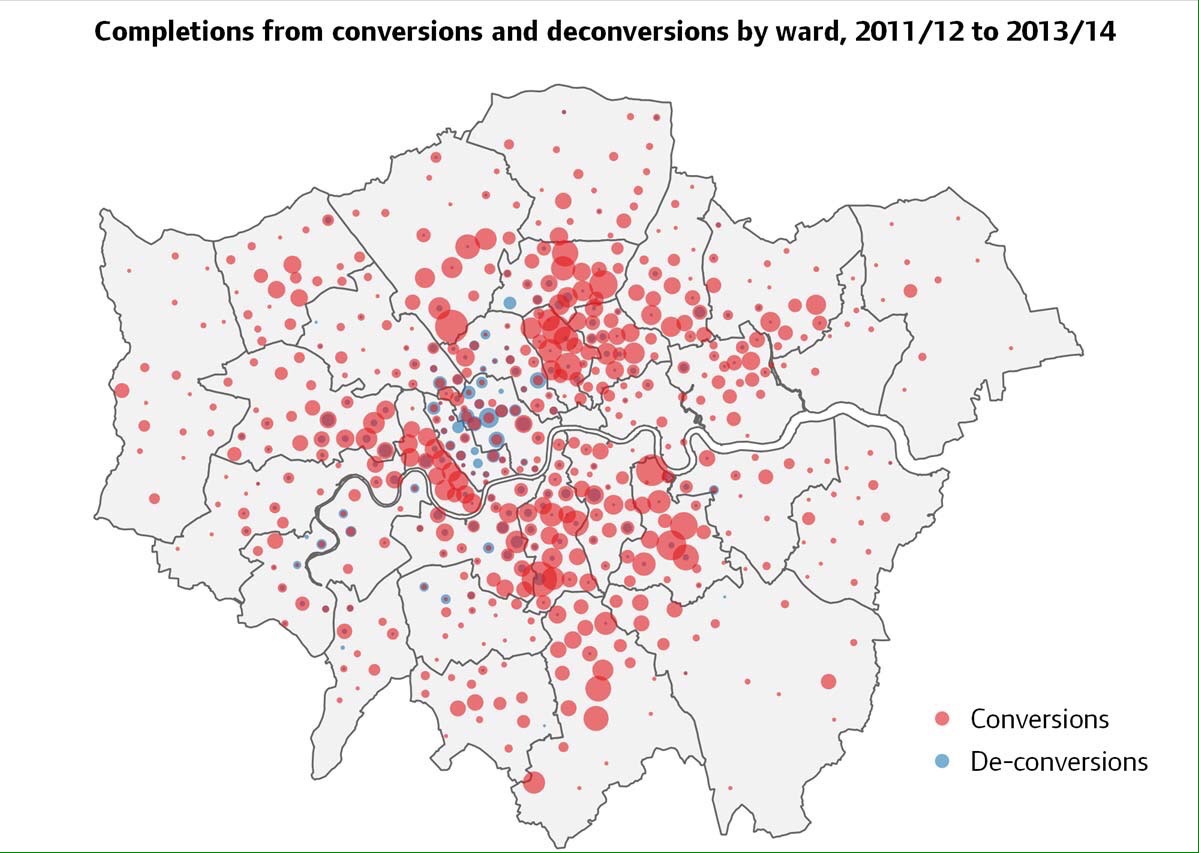
Amalgamations are a drag on net housing supply in both boroughs. Housing in London 2015: The evidence base for the Mayor’s Housing Strategy (Mayor of London, September 2015) reports:

“Between 2011/12 and 2013/14 a net 5,010 homes were created through conversions and a net 1,160 homes were lost through de-conversions.

Conversions were most common in accessible Inner London locations, and de-conversions in high price areas. The ward with the most conversions in this period was St. Leonard’s in Lambeth with 74 followed by Childs Hill in Barnet with 65. The three wards with the highest numbers of de- conversions were all in Westminster – Hyde Park (with 42), Knightsbridge and Belgravia (27) and Bayswater (26).


Planning Resource briefly reported (subscriber only content) a ruling by Lang J on 27 July 2017 in Royal Borough of Kensington and Chelsea v Secretary of State, where she apparently quashed the decision of a planning inspector, who had allowed an appeal against refusal of planning permission partly on the basis of a certificate of lawfulness of proposed use or development for a proposed amalgamation that had been issued before the council’s August 2014 change in stance. Presumably she considered that circumstances had materially changed such that the certificate could no longer be relied upon. 

The battle has moved now to whether planning permission should be granted, rather than whether it is necessary. On 13 July 2017, in Royal Borough of Kensington and Chelsea v Secretary of State and Noell and Royal Borough of Kensington and Chelsea v Secretary of State and Lahham Deputy High Court Judge Neil Cameron QC quashed two decisions where separate inspectors had granted permission on appeal. The inspector had made a mistake of fact in both decisions when calculating housing land supply as he deducted vacant units returning to use from the requirement whilst including those units in the supply and by stating that the housing land supply would be boosted further by recent deliverable planning permissions when those planning permissions were already accounted for in the calculated supply. The Secretary of State did not defend either claim. Christopher Lockhart-Mummery QC acted for the owners (if there’s a golden thread that runs through the case-law on amalgamation, it’s Christopher). 
Pending a tighter policy being in place, Inspectors have indeed still been allowing appeals in Kensington and Chelsea. For instance:
Warwick Gardens, Kensington, 17 May 2017:
“In regards to the development plan, whilst I find conflict with Local Plan Policy CH3 and London Plan Policy 3.14 in that a unit of residential accommodation would be lost, and saved UDP Policy H17, the appeal proposal would not prejudice the Council’s ability to meet its housing supply targets or give rise to unacceptable harm in regards to housing choice. Indeed, it would assist to address the imbalance in the housing stock in regards to 3 bedroom dwellings. Consequently, I do not consider that the appeal proposal conflicts with the development plan when taken as a whole.”

15 Cheyne Place, Kensington, 10 April 2017:

“The proposal would conflict with Policy CH3 of the CLP and 3.14 of the LP, which seek to ensure that that there is a sufficient supply and choice of housing. Notwithstanding this conflict, I do not find that, in this instance, the proposal would undermine the Council’s ability to achieve its housing targets. In addition, it would also make a contribution towards an identified need for three bedroomed units. Moreover, the emerging Local Plan Partial Review indicates that the Council intend to accept amalgamation development of this scale. Therefore, in culmination, I attribute significant weight to these matters which outweighs the moderate conflict the proposal has with the CLP and LP.”
28 Victoria Road, Kensington, 11 January 2017:
“I saw at the site visit that the garden arrangement as existing is not ideal. There are presently no separate areas that 2 individual units could use and, if shared, residents of the upper floors would be able to gain views into the bedroom window of the ground floor flat whilst using the garden. To restrict the use of the garden to the ground floor occupants would leave the larger unit with no outdoor amenity space apart from a small terrace at first floor level.

77 Drayton Gardens, Kensington, 4 November 2016:

“As part of its Local Plan Partial Review, the Council is about to consult on a policy which would permit the amalgamation of two residential units to one, if the gross floorspace of the resulting unit would not exceed 170 sqm. Mr Burroughs’ unchallenged evidence is that the resulting unit in this case is 99 sqm. ”

“The amalgamation of two residential units (second and third floor flats) into a single residential unit conflicts with CLP Policy CH3, saved UDP Policy H17 and LP Policy 3.14B, which aim to ensure an adequate supply and choice of housing to meet identified needs. The Framework also requires Council to boost significantly the supply of housing. However, on the evidence before me, the amalgamation will not, on the balance of probability, affect the Council’s ability to meet its housing targets. Furthermore, it will contribute to meeting a current identified need for larger dwellings in the borough, whilst improving the quality of accommodation, in accordance with LP 3.14A. Furthermore, in the light of the terms of a policy now being proposed as part of the Local Plan Partial Review, the Council appears to consider that amalgamations of this kind could be acceptable. On balance, these are material considerations which indicate that I should allow the appeal on ground (a) and grant planning permission, notwithstanding the conflict with the development plan.”

Simon Ricketts, 6 August 2017
Personal views, et cetera

Not In My Neighbourhood

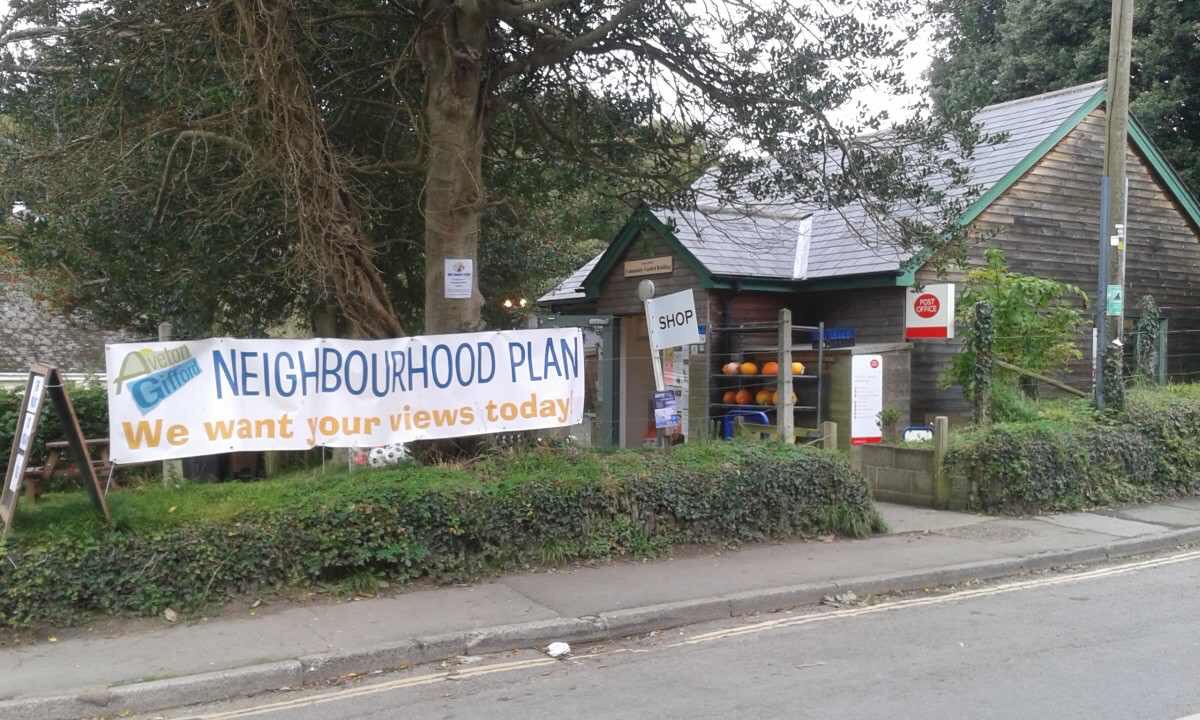
To my mind, the problems with neighbourhood plans that I listed in my 19.2.17 blog post haven’t gone away. 

In fact, two changes to the neighbourhood plan process that were switched on from 19 July 2017 by the Neighbourhood Planning Act 2017 (Commencement No. 1) Regulations 2017 will just bring the issues to the boil at an earlier stage:

– section 1 of the 2017 Act gives decision makers a duty to have regard to neighbourhood plans as a material consideration once they have been examined, prior to their having been approved in a neighbourhood referendum or finally made (ie ‘adopted’ in local plan language). 

– section 3 of the 2017 Act requires decision makers to treat a neighbourhood plan as part of the statutory development plan once they have been approved by a referendum (unless the local authority then decides not to make it). 

In the meantime, the last few weeks have seen various rulings from the High Court and decision letters from the Secretary of State that demonstrate the complexities, uncertainties and tensions that are arising. 

Farnham Neighbourhood Plan

Bewley Homes Limited v Waverley District Council (Lang J, 18 July 2017) 

The claimants, Bewley, Wates and Catesby, were three development companies unhappy that their respective development sites were not allocated for development in the draft Farnham neighbourhood development plan. 
The case illustrates the real difficulties that arise both with grappling with detailed issues during the examination process and seeking to assert, when the report has been published, that the examiner’s reasoning is deficient. 
The claimants’ first line of attack was that the examiner was wrong to conclude that the draft plan complied with the basic condition of being in conformity with the strategic policies of the 2002 local plan. 
Lang J sets the bar very low in terms of the extent of the examiner’s duty to give reasons for the conclusions in his report: “I consider that an Examiner examining a neighbourhood plan is undertaking a function which is narrowly prescribed by statute and he is subject to a limited statutory duty to give reasons. It is distinguishable from the function of an Inspector determining a planning appeal, where the duty to give reasons is expressed in general terms.”
Secondly, she makes clear that the requirement that the neighbourhood plan must be in general conformity with strategic policies in the relevant local plan is pretty loose in practice: “The authorities establish that the phrase “in general conformity” is a flexible test which allows for some differences. The plans do not have to match precisely. It was a matter of planning judgment for the Examiner to decide whether the degree of the differences was such that he could not properly find that “the making of the [plan] was in general conformity with the strategic policies in the development plan”, as required by paragraph 8(2)(e) of Schedule 4B. For that purpose, he was required to consider the plan as a whole.”


The judge found that it was sufficient that the examiner referred to his consideration of Farnham Parish Council’s Basic Conditions Statement, from which it could be taken that he accepted Farnham’s Basic Conditions Statement as the basis for identifying the strategic policies in the Local Plan 2002.
Lang J noted that even if the reasoning had been flawed, in the light of the Court of Appeal’s ruling in DLA Delivery, “the Examiner could lawfully have adopted a different route, holding that the strategic policies restricting housing development had become time-expired in 2006 and were now redundant, and could be disregarded.”
The claimants’ other grounds of challenge arose from detailed evidence and submissions that they had made on issues relating to SANGS land and relating to a landscape study on which a key policy in the draft plan was based. It is clear that the developers had approached both issues in some forensic detail. However, the judge was satisfied with the light-touch way in which the matters had been addressed in the report:

“It was sufficient that the Examiner recorded at paragraphs 2.4, 2.7 and 2.8 that he had considered all the written material submitted to him, together with the discussions at the public hearing, all of which provided him with sufficient information to enable him to reach his conclusions. The main points raised by the Claimants were adequately addressed in the report and the Examiner’s conclusions were made sufficiently clear
.”

“The Claimants invited me to infer that the Examiner did not consider the Wates’ material because he did not refer to it. However, given the limited scope of his examination, he was not required to refer specifically to the evidence and representations presented by the Claimants, and the points raised therein. There was a large volume of evidence and these were not principal documents. It was sufficient that the Examiner recorded that he had considered the representations. He also stated at paragraphs 2.4, 2.7 and 2.8 that he had considered all the written material submitted to him, together with the discussions at the public hearing, all of which provided him with sufficient information to enable him to reach his conclusions
.”

Faringdon Neighbourhood plan

Hoare v Vale of White Horse District Council (Deputy High Court Judge John Howell QC, 7 July 2017)
Here policy 4.5B in the draft plan sought to safeguard Wicklesham Quarry for employment uses following completion of quarrying and restoration activities on the site and to support such development on it provided that there is a demonstrable need for it, no other suitable site closer to the town centre is available and certain other conditions are met.
The claimant was a local resident objecting to the allocation. 
The court took a similar approach as in Bewley to complaints as to the lack of general conformity with strategic policies in the local plan:


“The phrase “strategic policies” is, like “general conformity”, inherently imprecise, and it is not one in my judgment to which the court should seek to give a spurious degree of precision. Which policies in a development plan warrant that classification will inevitably involve a question of planning judgment that will be framed (but not necessarily exhausted) by the objectives of the particular plan and the policy’s significance in relation to their achievement and to the character, use or development of land in the area to which the plan relates which it seeks to promote or inhibit. The more central or important the policy is in relation to such matters the more likely it will be that it may be a “strategic policy” in that plan. Its identification as “strategic” or as part of the “strategic policies” in that plan may well provide a good indication of its significance. But the fact that it is not so identified does not necessarily mean that it is not a strategic policy and its identification as such does not necessarily mean that it is.”


The claimant also submitted that Policy 4.5B is about a “county matter”, which is a category of “excluded development” that cannot lawfully form part of a neighbourhood plan; and that the District Council erred in treating the quarry as “previously developed land” for the purpose of the NPPF. 
The deputy judge held that the policy was not about a county matter, given that it sought to safeguard the Quarry for employment uses following the completion of quarrying and restoration activities on the site: “The provision which is excluded from a neighbourhood plan is not any provision about any development in respect of land which is the subject of a restoration condition or an aftercare condition. It is any provision about development which “would conflict with or prejudice compliance with” such a condition. There may be operations or uses that can be carried on on such land without doing so. Moreover there is nothing to preclude a neighbourhood development plan making provision about a development that may be carried out on land subject to such conditions but only after they have been complied with. That may in fact be desirable in order to provide guidance about the future use of the land. Thus in my judgment the mere existence of such conditions applicable to an area of land does not mean that no provision about that land may be made in a neighbourhood plan.”


The deputy judge agreed that the council had indeed been wrong to categorise the site as previously developed land, given the restoration condition. However, he did not consider that the error was material to the outcome of the plan and declined to quash the plan on that basis.

 
Not easy to challenge a neighbourhood plan, is it?

Central Milton Keynes Business Neighbourhood Plan

The Secretary of State issued his decision letter on 19 July 2017, granting planning permission to Intu Milton Keynes Limited for extension of the Intu Milton Keynes shopping centre. The application was supported by Milton Keynes Council but had been called in by the previous Secretary of State Greg Clark in November 2015, who indicated that for the purposes of determining the application he wished to be informed as to “the consistency of the application with the development plan for the area including the Central Milton Keynes Business Neighbourhood Plan”.

The Central Milton Keynes Business Neighbourhood Plan was England’s first business neighbourhood plan. Central Milton Keynes Town Council objected to the application. As part of its objections it sought to portray the proposals as contrary to policies of the Neighbourhood Plan seeking to protect semi-public open space in Midsummer Place and seeking to retain Central Milton Keynes’ classic grid pattern.

However, the Secretary of State agreed with his inspector’s conclusion that the application was “in accordance with development plan policies, including those in the Neighbourhood Plan, and is in accordance with the development plan overall”.

The inspector indicated that her finding was “based on a balanced interpretation of Policy CMKAP G3. Had I taken an absolute approach to the policy, the reduction in the quantity of semi-public open space, would have resulted in a breach of the policy. Nevertheless, the proposed development would have been consistent with the development plan as a whole. In the final instance the considerable benefits of the proposal would have been material considerations sufficient to indicate that it should be determined other than in accordance with the development plan”. 


Buckingham Neighbourhood Plan

The Secretary of State declined to follow his inspector’s recommendation and, by his decision letter dated 17 July 2017, refused planning permission to Bellway Homes for a development of 130 dwellings in Buckingham. The inspector concluded that the neighbourhood plan was silent as to the proposed development of the application site. The Secretary of State disagreed:

“the larger housing sites, representing both the acceptable location and level of housing, are specifically identified and allocated in the BNDP. Both larger sites and the smaller windfall sites being confined to within the settlement boundary (HP7). The application site, being both unallocated and outside the settlement boundary, falls within neither category above and, as a consequence, the Secretary of State considers the proposals are not policy compliant. This is a policy conflict to which the Secretary of State attaches very substantial negative weight in view of the Framework policy (paragraphs 183-185) that neighbourhood plans are able to shape and direct sustainable development in their area and that where an application conflicts with a neighbourhood plan, planning permission should not normally be granted (paragraph 198).


Barnham and Eastergate Neighbourhood Plan & the Walberton Neighbourhood Development Plan

 Yet another application called in so that the Secretary of State could consider whether development proposals (for 400 dwellings as well as commercial development in Fontwell, West Sussex) were consistent with (here two) neighbourhood plans. The Secretary of State granted planning permission, by his decision letter dated 13 July 2017, finding that the proposals were indeed consistent, “subject to careful consideration at the reserved matters stage”. 
In relation to each of these applications, call in by the Secretary of State on neighbourhood plan grounds has been directly responsible for significant delays, of at least 18 months. In each of the applications there has been significant debate, argument and uncertainty as to the meaning of neighbourhood plan policies – perhaps no surprise given the light touch, difficult to challenge, nature of the neighbourhood plans examination process.
Isn’t it time for a proper review of the costs and benefits of the neighbourhood plans system as it is currently operating?
Simon Ricketts, 22 July 2017

Personal views, et cetera

Courts Interpret NPPF Paras 14, 133/134, 141 (But Couldn’t It Be Clearer In The First Place?)

The Government’s chief planner Steve Quartermain has confirmed this week that the revised NPPF will be published before the end of the year. To what extent will it reflect the proposed changes set out in the previous Government’s ‘response to consultation’ document that was published alongside the February 2017 housing white paper and to what extent will it take on board any changed political priorities since the June 2017 election or indeed various inherent uncertainties and ambiguities which have continued to occupy the courts?
Paragraph 14
I have previously blogged as to the Supreme Court’s ruling in Suffolk Coastal, which resolved (by way of a judgment of Solomon in which all parties, by operation of unexpected judicial reasoning, both won and lost) the question as to how the paragraph 14 presumption applies where there is no five year supply of housing land. 
The Court of Appeal in Barwood Strategic Land II LLP v East Staffordshire Borough Council (30 June 2017) has now resolved the question as to the presumption in favour of sustainable development applies in the mirror image position, where there is a five year supply and where the plan is not in other respects out of date. 
As in other matters, the NPPF is unclear on the meaning and application of the presumption in favour of sustainable development. Perhaps the presumption is oversold in the ministerial foreword: “Development that is sustainable should go ahead, without delay – a presumption in favour of sustainable development that is the basis for every plan, and every decision.
Paragraph 14 expresses the presumption as a “golden thread running through both plan-making and decision-taking“, before going on to set out what this means for plan making and decision making. For decision making it means:
” ◦ approving development proposals that accord with the development plan without delay; and

    * where the development plan is absent, silent or relevant policies are out-of-date, granting permission unless: 
– any adverse impacts of doing so would significantly and demonstrably outweigh the benefits, when assessed against the policies in this Framework taken as a whole; or

– specific policies in this Framework indicate development should be restricted.

The question that has exercised the courts in a series of cases is whether the presumption applies outside these specific instances, for example even where a scheme is contrary to an up to date plan. 

Lindblom LJ first sets out how judges should approach questions of policy interpretation, referring back to his first instance judgment in Bloor Homes East Midlands Ltd. v Secretary of State for Communities and Local Government (19 March 2014): 
“Planning policies are not statutory or contractual provisions and should not be construed as if they were. The proper interpretation of planning policy is ultimately a matter of law for the court. The application of relevant policy is for the decision-maker. But statements of policy are to be interpreted objectively by the court in accordance with the language used and in its proper context.”
He refers to his statement having been “underscored” by the Supreme Court in Suffolk Coastal where they set out that “the interpretation of policy will be suitable, in principle, for legal analysis – though only to a degree that depends on the context and content of the policy in question.”
Lindblom LJ followed the approach taken by Holgate J in Trustees of the Barker Mill Estates v Test Valley Borough Council (25 November 2016) in finding that is no freestanding presumption in favour of sustainable development outside para 14. 
Of course that is not to say that, as long as paragraph 14 is correctly interpreted, applicants cannot pray in aid other matters (factors where the development would accord with other policies in the NPPF) as material considerations, to overcome the presumption. It was a shame that (because in this case the judge was found to have misinterpreted paragraph 14) Lindblom LJ did not find it necessary expressly to put right some curious reasoning of the first instance judge, Green J, as to the operation of the statutory presumption in favour of the development plan set out in section 38(6) of the Planning and Compulsory Purchase Act 2004. In his judgment Green J tries to box in the exercise of a decision maker’s discretion with odd passages such as this:
Insofar therefore as paragraph [14] permits of a residual discretion it must be recognised that the outcome arrived at by the operation of paragraph [14] should carry considerable gravitational pull. It should yield only as an exception to the norm where there exists objective and substantial reasons which can be readily demonstrated to a high degree of probative value and which takes into account the particular reasons why a development has been found to collide with the Local Plan. I should add however (see paragraph [54] below) that I express no concluded view on exactly how exceptional “exceptional” actually is; this being an issue better explored in a case where that issue truly arises.”

Whilst not specifically tackling this approach, Lindblom LJ pointedly follows the Supreme Court in Suffolk Coastal and Holgate J in Barker Mill with a warning against excessive legalism in matters of policy interpretation:

“I would, however, stress the need for the court to adopt, if it can, a simple approach in cases such as this. Excessive legalism has no place in the planning system, or in proceedings before the Planning Court, or in subsequent appeals to this court. The court should always resist over-complication of concepts that are basically simple. Planning decision-making is far from being a mechanical, or quasi-mathematical activity. It is essentially a flexible process, not rigid or formulaic. It involves, largely, an exercise of planning judgment, in which the decision-maker must understand relevant national and local policy correctly and apply it lawfully to the particular facts and circumstances of the case in hand, in accordance with the requirements of the statutory scheme. The duties imposed by section 70(2) of the 1990 Act and section 38(6) of the 2004 Act leave with the decision-maker a wide discretion. The making of a planning decision is, therefore, quite different from the adjudication by a court on an issue of law (see paragraphs 8 to 14, 22 and 35 above). I would endorse, and emphasize, the observations to the same effect made by Holgate J. in paragraphs 140 to 143 of his judgment in Trustees of the Barker Mill Estates.

Paragraphs 133/134

What is the extent of the setting of a listed building for the purposes of assessment of harm?

In Steer v Secretary of State (Lang J, 22 June 2017) the main issue was treatment by an appeal inspector of the impact that proposals in Allestree, Derbyshire, for residential development and associated development would have on the landscape character of the area and heritage assets, namely Kedleston Hall (a grade 1 listed building), Kedleston Park (a grade 1 listed park), Kedleston Conservation Area, Kedleston Hotel and Quarndon Conservation Area. The Council, Historic England, the National Trust and others had opposed the appeals on the basis that whilst the proposed development was at some distance from, and would not be visible from the assets, there were historic and social/economic connections between the areas which meant that the appeal site was properly to be regarded as within the setting of the listed hall and park. 
The definition of ‘setting’ in the glossary to the NPPF is unspecific: “The surroundings in which a heritage asset is experienced. Its extent is not fixed and may change as the asset and its surroundings evolve.”
Lang J concluded that the inspector adopted an unlawfully narrow approach when determining whether the appeal site was part of the setting of Kedleston Hall and misdirected himself that a visual connection was necessary or determinative, in addition to the evidence of a historical connection.
The judge found that the inspector’s “focus was upon identifying a visual connection, and assessing the proposal’s impact upon it. The historic social and economic connections were set to one side in this exercise.”
“The evidence was that the appeal site was part of the setting of the Hall because it had formed part of the estate, managed historically as an economic and social entity, and it remained in its historic agricultural use, with hedges and mature trees characterising the field boundaries. From the Hall and the Park, the surrounding rural context was important in preserving a sense of a parkland landscape at the centre of a managed rural estate, rather than in a suburban context. The site was on the primary visitor route to the Hall and Park and so visitors would experience the historical narrative, and the concentric influence of the Hall on its landscape, as they traversed the agricultural estate, then entered the enclosed, designed park and gardens, enjoying the drama of anticipation as a great English country house was revealed to them.
In reaching her conclusion it is interesting to see the reliance that Lang J places on Historic England’s good practice guide on the setting of heritage assets. 

Paragraph 141

Hayes v City of York Council (Kerr J, 9 June 2017) concerned a planning permission granted by York Council for the construction of a visitor centre at the base of the motte at Clifford’s Tower in York and the installation of a new staircase and tower floor, with walkways, balustrading, a roof deck with a café and other restoration works. A car park next to the site is to be removed. The project includes archaeological works and disturbance to buried artefacts. 

The case concerned the meaning of paragraph 141 of the NPPF, which states that where heritage assets are lost or partly lost, local planning authorities and developers should make archaeological records publicly available, but “the ability to record evidence of our past should not be a factor in deciding whether such loss should be permitted”. 
The challenge was brought by a member of the council. One of his complaints was that the council had taken account of a legally irrelevant factor, namely the ability to record evidence of the past.
Kerr J reviewed the more detailed national heritage policies that preceded the NPPF and the way in which the precise wording changed and finally was summarised in, and replaced by, the NPPF:

The codification exercise which created the NPPF delivered commendable brevity, at the price (well worth paying) of replacing detailed exposition with general policy statements that can be Delphic, as in this instance.”

He turned to paragraph 141:
“The difficulty arises from the wording in the last sentence: “the ability to record evidence shall not be a factor in deciding …”. Those words do express, as a matter of language, what appears in conventional public law parlance to be the exclusion of a material consideration. Read literally, those words say not only that the ability to record evidence cannot be the sole justification for the harm; it cannot even contribute to the justification for the harm.”
Kerr J had real difficulty with this literal reading:
“Why should the preservation of information about an asset not be weighed in the balance along with other factors in favour of a development that harms a heritage asset? The harm is attenuated by the preservation of information and making it publicly available, which enhances and better reveals the significance of the harmed asset and hence its positive contribution to the locality and to our heritage.”

“This difficulty can only be overcome, in my judgment, once it is recognised that a non sequitur crept in when PPS 5 replaced PPS 16, and then found its way into the language of NPPF paragraph 141. In my judgment, the last sentence of that paragraph only makes good sense if interpreted so that the words “should not be a factor” are taken to bear the meaning “should not be a decisive factor”, in deciding whether the harm to the asset should be permitted.

I appreciate that, even allowing for the fact that the NPPF is a policy document and not a statutory provision, this interpretation stands uneasily with the actual words of the last sentence of the paragraph. But unless the paragraph is interpreted in that way, it would be very difficult to apply in a coherent manner.”

Kerr J rejected paragraph 141’s “literal interpretation in favour of a sensible and liberal construction of the paragraph in its proper historical context“.
Wider thoughts

So, three recent examples of the way in which the courts embark upon interpreting policy (whether national or local) and its application, consistent of course with the Supreme Court’s approach in Tesco Stores Limited v Dundee City Council (21 March 2012) that “policy statements should be interpreted objectively in accordance with the language used, read as always in its proper context. 

That is not to say that such statements should be construed as if they were statutory or contractual provisions. Although a development plan has a legal status and legal effects, it is not analogous in its nature or purpose to a statute or a contract. As has often been observed, development plans are full of broad statements of policy, many of which may be mutually irreconcilable, so that in a particular case one must give way to another. In addition, many of the provisions of development plans are framed in language whose application to a given set of facts requires the exercise of judgment. Such matters fall within the jurisdiction of planning authorities, and their exercise of their judgment can only be challenged on the ground that it is irrational or perverse (Tesco Stores Ltd v Secretary of State for the Environment [1995] 1 WLR 759, 780 per Lord Hoffmann). Nevertheless, planning authorities do not live in the world of Humpty Dumpty: they cannot make the development plan mean whatever they would like it to mean.”
Despite the reference to interpreting policies “objectively”, it will be seen that the courts will draw upon context, previous gestations of guidance and extraneous guidance documents to assist them. Sometimes, as in Hayes, the strict meaning of words will be stretched in a way that potentially leads to uncertainty. 
A broader approach to the interpretation of development consents by reference to extraneous documents than has traditionally been the case was signalled by the Supreme Court in Trump International Golf Club Scotland Limited v the Scottish Ministers (16 December 2015):
“When the court is concerned with the interpretation of words in a condition in a public document such as a section 36 consent, it asks itself what a reasonable reader would understand the words to mean when reading the condition in the context of the other conditions and of the consent as a whole. This is an objective exercise in which the court will have regard to the natural and ordinary meaning of the relevant words, the overall purpose of the consent, any other conditions which cast light on the purpose of the relevant words, and common sense. Whether the court may also look at other documents that are connected with the application for the consent or are referred to in the consent will depend on the circumstances of the case, in particular the wording of the document that it is interpreting. Other documents may be relevant if they are incorporated into the consent by reference (as in condition 7 set out in para 38 below) or there is an ambiguity in the consent, which can be resolved, for example, by considering the application for consent.”
To my mind, this all takes us into dangerous territory. Isn’t the public, or a purchaser of a development site, entitled to take words as meaning what they say. The courts are having to step in and complete the gaps left by inadequate drafting. Whilst its focus is a long way away from planning law, Lord Sumption’s speech The Supreme Court and the Interpretation of Contracts given at Keble College Oxford on 8 May 2017 is a thought-provoking read. One of the concluding passages:
“It is I think time to reassert the primacy of language in the interpretation of contracts. It is true that language is a flexible instrument. But let us not overstate its flexibility. Language, properly used, should speak for itself and it usually does. The more precise the words used and the more elaborate the drafting, the less likely it is that the surrounding circumstances will add anything useful. I do not therefore accept that the flexibility of language is a proper basis for treating the surrounding circumstances as an independent source from which to discover the parties’ objective intentions.
I agree! Let’s aspire to use words precisely, whether in the drafting of policies, permissions or indeed agreements, rather than relying on the courts as a slow, expensive and unpredictable backstop. And given their broad effect, surely policies ought to be written even more carefully than contracts?
Simon Ricketts, 8 July 2017
Personal views, et cetera
Image by Rob Cowan.

Crossrail 2, Where Are You?

We’ve got some work to do now. 
George Osborne’s March 2016 budget indicated that the then Government would be “investing in the infrastructure that will deliver economic growth for the next generation” by a number of measures, including “securing London’s future infrastructure by giving the green light for Crossrail 2 to proceed. The government will provide £80 million to develop the project with the aim of bringing forward a Hybrid Bill this Parliament”. 


There have been rumours that the Treasury or Department for Transport subsequently have not yet been convinced of the business case but, whatever the reason (the twin challenges of Brexit and the need to devote resources to Northern Ireland to prop up a new born minority government? Politics = events, dear boy, events), the project’s absence from the Conservatives’ 2017 manifesto and subsequently from the Queen’s Speech on 21 June has been hugely disappointing. 
Perhaps given Mr Osborne’s new job it is no surprise that on the day of the Commons debate on the Queen’s Speech, 29 June, the London Evening Standard set out its concern in a strongly written editorial, but the points are surely well made. 
Delay to the project would have a series of harmful consequences:
– Postponement of the commuting benefits and congestion relief that it will bring. Given the need to provide additional capacity at Euston ready for the opening of HS2 in 2033, it is time critical (see City am’s 28 June 2017 piece).
– Loss of the opportunities that it will open up for additional housing and employment development around stations on the route, including opportunities for Transport for London to explore the possibilities for land value capture mechanisms. The Crossrail 2 Growth Commission confirmed in its 2016 report that the project could unlock 200,000 additional homes and 200,000 additional jobs. Without Crossrail 2, how will further housing come forward at the scale that is needed? In this uncertain period, are key sites going to lie fallow or developed at less than the scale that could be achieved with better rail connectivity?

– The unnecessary cost of delay, estimated by Crossrail 2 managing director Michele Dix at £2bn a year.

– Extended blight that will be caused along its current route, safeguarded in 2015 and shown on this interactive map.

– The uncertainty that has now been created for the impending replacement London Plan, the first draft of which we will see in November. The implications of Crossrail 2 are so significant that might the Mayor have to publish “with and without Crossrail 2” draft policies? How can the likely effects of the plan be properly assessed with such a question mark over Crossrail 2? 

The Mayor commenced consultation on 26 June 2017 in relation to his Mayor of London Community Infrastructure Levy 2 Preliminary Draft Charging Schedule (MCIL2 PDCS). MCIL1, which was adopted on 1 April 2012, was directed towards funding Crossrail 1. MCIL2 is directed towards funding Crossrail 2 and the Mayor intends for it to be adopted in April 2019. 

The proposed per sq m rates are £80 for band 1, £60 for band 2 and £25 for band 3, save that in central London and the Isle of Dogs, the rates for office, retail and hotel uses will be £185 for offices, £165 for retail and £140 for hotel uses.
 
Central London. 


Isle of Dogs

The Mayor’s supporting information says this about the current funding position for Crossrail:
Since the 2016 Budget, Transport for London, the Greater London Authority and the Government have been working to develop a funding package for the project as part of the development of a strategic outline business case. The London contribution to the costs of Crossrail consists of four funding sources: 

    * Crossrail 2 net operating surplus – i.e. the net impact of Crossrail 2 on TfL’s rail revenues 


    * over station development – proceeds from development of land and property initially required for construction (development related with Crossrail 2 will pay Mayoral CIL 2 on the same basis other developments) 


    * a Business Rate Supplement (BRS) (once the current BRS repays Crossrail 1 related debt) 


    * a Mayoral Community Infrastructure Levy (MCIL2).”


MCIL2 is intended to meet approximately 15% of the project’s costs. What if Crossrail 2 does not go ahead? The document states:

“Negotiations on the Crossrail 2 scheme are still underway and there is no agreed funding package at present. However, MCIL2 does need to be brought forward now to avoid a charging gap at the end of Crossrail 1 construction and to allow for early funding of the Crossrail 2 scheme. Should no funding deal be achievable, the Mayor will be able to apply the MCIL2 proceeds to fund other strategic transport projects for which there is a significant funding gap.
Crossrail 2 is also a key strand of the Mayor’s draft transport strategy published on 21 June 2017: “It
 will enable London’s highly productive economy to continue to grow by helping 270,000 more people get into the centre in the morning peak. It will thereby support 200,000 new jobs, as well as unlocking 200,000 additional new homes – more than 30 per cent of them outside London”

So what is happening behind the scenes? Will Crossrail 2 emerge in a leaner form? A City am story on 26 June asserts (denied by Crossrail 2) that a revised business case provided to the Government in March had dropped the proposed station at Kings Road Chelsea (the subject of a vociferous celebrity-backed campaign) and that possible stations at Turnpike Lane and Balham have been replaced by Wood Green and Tooting Broadway options respectively. The continued speculation without any real information, isn’t helping anybody.

What political weight, if any, does the National Infrastructure Commission still have? George Osborne (him again) established the NIC in October 2015 to “determine Britain’s infrastructure priorities and hold governments to account for their delivery” and appointed Lord Andrew Adonis as its chairman. NIC’s support of Crossrail 2 was hugely influential in the lead up to that March 2016 announcement. It set out on 26 June 2017 its top 12 infrastructure priorities, with Crossrail 2 featuring strongly: “The Government should by the end of 2017 publish a plan, agreed with the Mayor of London, for the funding and phased construction of Crossrail 2, and for securing the necessary parliamentary consent, taking account of the recommendations in the NIC’s Transport for a World City report.”
If this stasis goes on much longer I may even start to get nostalgic about all of those photos of George Osborne in high vis and hard hat…
Simon Ricketts, 1 July 2017

Personal views, et cetera


Viability & Affordable Housing: Update

This is a supplement to my 28 May 2017 Affordable Housing Tax blog post, since when:
Politics, people
The avoidable tragedy on 14 June of Grenfell and its aftermath – with its residents needing to be rehoused and concerns as to the fire safety of many other council housing blocks – has surely focused attention on the challenge of providing adequate housing.
Except that by cruel irony this has come precisely when the Government is of course having to face other challenges as a result of the 8 June election. Despite the Conservatives’ manifesto promises in relation to “social housing” (later confirmed to be in fact not social housing) and changes to compulsory purchase processes, the background notes to the Queen’s Speech on 21 June simply said this on housing:

HOUSING


“Proposals will be brought forward to […] help ensure more homes are built.” 

We have not built enough homes in this country for generations. In order to fix the dysfunctional housing market, we need to build more of the right homes, in the right places, and ensure the housing market works for all parts of our community. 


This will help to tackle the increasing lack of affordability by bringing more properties onto the market. It will slow the rise in housing costs relative to the rise in wages, and help ordinary working people gain better access to this most basic of necessities. It will help more ordinary working families buy an affordable home and will bring the cost of renting down. 


In February we published a Housing White Paper, which proposes end-to-end action across the whole housing system, with measures to: 

    * release more land for homes where people want to live; 


    * build the homes we need faster; 


    * get more people building homes; 


    * support people who need help now.

We will deliver the reforms proposed in the White Paper to increase transparency around the control of land, to “free up more land for new homes in the right places, speed up build-out by encouraging modern methods of construction and diversify who builds homes in the country” (p.70). 
We will consult and look to take action to promote transparency and fairness for leaseholders. We will look at the sale of leasehold houses and onerous ground rents, working with property developers, the Competition and Markets
 Authority and others as outlined in the Housing White Paper. 


Key facts 


Getting more homes built 

    * In 2016, the median house price in England was nearly eight times the median earnings – an all time record high. 


    * Home ownership among 25-34 year-olds in England has fallen from 56% in 2005/06 to 38% in 2015/16, whereas the percentage of 25-34 year-olds living in the private rented sector increased from 24% to 46% over the same time period. 


    * 189,650 net additional homes were delivered in 2015/16 in England, up 11% on 2014/15 and the highest level since 2007/08. We need to sustain that momentum to meet the affordability challenge. All credible sources agree we need between 225,000 and 275,000 new homes per year to tackle this problem. “

Are we moving into a period when local rather than national government will have to make the running, regardless of political complexion? Plus ça change, perhaps. Nickie Aiken, leader of Conservative-run Westminster City Council, gave a no-holds-barred speech to the London Real Estate Forum on 13 June 2017:
“There’s no time for on-going pleasant and cosy chats that might improve things for the better at some undefined point in the future.”

“My view is that too many times we have not always pushed back enough in requiring affordable homes onsite, have buckled on viability or surrendered to the idea that brutal market economics simply denies housing opportunities for most people and that is just a harsh fact of life.”

“If you are a developer who wants to invest in and be invested in the future of our city for the long haul you are very welcome.

However, if you are just a speculator who wants to make a fast buck by building properties that only oligarchs and absent overseas investors can afford, you are in the wrong borough.
It’s good for a politician to make statements such as this but it’s not so popular (although equally true) to say that viability is still a challenge on many schemes. Many sites do attract a high market value regardless of any developer’s proposal (even when circular arguments are avoided) and why would the owner relinquish the site at a loss? Sales prices and costs budgets cannot be guaranteed. Development values are maximised by targeting the most profitable segments of the market and in the approach taken to density, yes to maximise return, but also to make the affordable housing numbers work on top of CIL and other non-negotiable requirements. Criticise from the side lines but would you speculate or lend your own money on any different or more altruistic basis, given the commercial and political uncertainties to which any significant longterm project will be exposed to? For a decision maker to make the right judgment call that maximises both the amount of housing that will actually be delivered and, within that, the amount and range of affordable housing (rather than ending up with nothing more than homes on paper, an unimplemented permission), is never going to be easy. What would make it easier would be:
– closer prescription as to the appropriate methodology to be followed – and for that methodology to follow economic reality as closely as possible so that, on the one hand, developers cannot avoid their proper obligations but, on the other, equally importantly, so that they still have every incentive to develop.  

– alongside that greater prescription, real penalties for those who game the system and bring it into disrepute. 

– due recognition for genuine altruism – how can we encourage good behaviour?

It is crucial to crack this because what the public perhaps doesn’t appreciate is the degree to which affordable housing subsidies are being left to be provided by the private sector – see for example the government’s latest statistics (April 2009 to March 2017) as to HCA/GLA funded affordable housing starts/completions by tenure type.
High Court
The current realities of viability negotiations have been exposed to the light in Minerva (Wandsworth) Limited v Greenland Ram (London) Limited (Rose J, 23 June 2017), a contractual dispute over an overage payment that Minerva, seller of the Ram Brewery site, successfully claimed from its purchaser, Chinese developer Greenland for securing a section 73 permission enabling a tower within the redevelopment scheme to be two storeys higher than initially approved. The factual account by Mrs Justice Rose is relentless in its detail.  
Appeal decisions
One theme of the Minerva case was the way in which the different parties’ viability consultants arrived at vastly differing figures, given the uncertainties as to the approach to be taken to, for instance the hypothetical land cost (benchmark land value) to be taken into account. Whilst the Mayor has set out his preferred approach in his draft affordable housing and viability SPG, the debate has continued and there have been two decision letters this month where inspectors have had to arbitrate between differing approaches taken by appellant and LPA. 
I referred in my 18 June 2017 blog post to a decision letter dated 12 June 2017 concerning a site at the junction of Notting Hill Gate and Kensington Church Street in which Inspector David Nicolson considered that the site value of £33m within the appellant’s viability appraisal (and indeed agreed by RBKC) was too high and he consequently did not accept the appellant’s position that affordable housing “could not be provided on site or, more importantly, that there needs to be a loss of all the existing 20 social housing bed spaces on the site or a net loss in the borough“. The inspector gave little weight to an alternative use value approach and was sceptical as to any figure that might be arrived at using an EUV approach. In his view, in the absence of any planning permission, there was “little sound evidence to show that the site is more of an asset than a liability”. 

The 19 June 2017 decision letter issued a week later in relation to the proposed redevelopment of the former Territorial Army Centre, Parkhurst Road, Islington was highly unusual as the central issue for the inspector, Michael Boniface, to determine was “whether the development would provide the maximum reasonable level of affordable housing in accordance with the development plan”. The proposal, by Parkhurst Road Limited, was for 96 homes and related works. The appellant had purchased the site for £13.25m in May 2013 from the Ministry of Defence. 
At the inquiry the appellant offered to provide 10% affordable housing (up from an initial position that 0% was justified given the viability position). Islington Council’s final position at the inquiry was that it would accept 34% (down from an initial requirement of 50%). The main issue between the parties was as to the appropriate land cost to be allowed for. The benchmark land value argued for by the appellant was £13.26m, a figure established at a previous inquiry, and sought to support the figure by reference to various comparables. The council argued for the EUV+ (existing use value plus premium) approach advocated for by the Mayor in his draft SPG and put forward a figure of £6.75m, which approach and figure was favoured by the inspector. The inspector was also not satisfied with the review mechanism that was proposed. 
Of note for other schemes in Islington, the inspector did not support the council’s proposed obligation, pursuant to its “Wasted Housing Supply” SPD, that would have required that none of the dwellings be left unoccupied or unused for a period of three months or more. The inspector did not consider on the evidence that the obligation was justified or that it could be properly and fairly enforced.
What next?
Obviously all eyes are on Alok Sharma, new housing and planning minister, for some hint of the approach that he will take. 
In the meantime, in London, the adoption of the Mayor’s affordable housing and viability SPG in July will provide more certainty, together with first sight of his draft Replacement London Plan later in the year. 
But ahead of that, an announcement is due on 26 June as to the Mayor’s proposed changes to his CIL charging schedule (to come into effect in 2019). Just remember that almost every penny of any extra charges levied on housing schemes will simply feed through into viability assessments and will reduce any surplus available for affordable housing. 
Time finally for a quick plug: LD Events’ annual Viability & Planning conference is taking place on 28 September 2017. 
Simon Ricketts 24.6.17
Personal views, et cetera

(Town Legal acted for the appellant in relation to the Parkhurst Road inquiry)

Elsewhere In Kensington

Last weekend’s blog post was written in different times. 
As predicted given May’s weak majority, Sajid Javid stayed in position as Secretary of State for Communities and Local Government. The announcement of Alok Sharma as housing and planning minister on 13 June was frankly a disappointment. No doubt he is a capable politician, but the task of planning for housing should be a critical priority for the government and to appoint again a junior minister without experience at a senior level of government, without a cabinet role and without previous planning or housing experience was not a good sign. The appalling fire in the Grenfell tower in the early hours of 14 June and the anger that followed was an immediate reality check as to why we need to get a grip on the seriousness of what we face. Come back Lord Heseltine. 
This country has a housing crisis. Not enough homes are being built, there is a need for housing which is affordable for those of low means (including social housing with fixed rents) and we must ensure that what is occupied, new or old, is safe. 
If, as the housing white paper trumpeted on its cover, we have a broken housing market, who is going to fix it, when and how?
Who is also going to make sure that the Building Regulations remain fit for purpose and that, crucially, local authorities have the powers and resources properly to enforce them? What is the bulwark against those inevitably lobbying for another “red tape challenge” or “one in two out” rule? This is wider than about the Grenfell tragedy, whatever its causes turn out to be. The next tragedy may well not be a fire but another lapse or loophole, where we will be told, again, that “lessons will need to be learned”, that there will be a “full public inquiry” and all of the other usual platitudes. 
It is truly depressing that the present government (as well indeed as the Labour party) has Brexit (a riddle, wrapped in a mystery, inside an enigma) as its main policy focus rather than something as urgent and important as providing sufficient and safe housing. And more widely, to what extent has one reason for Brexit been to allow the UK government greater freedom to relax regulations that were designed to protect us or our environment? The government’s continued prevarication on air quality (largely pushing compliance down to local authorities) and the disdain for EU environmental protections expressed by our new Secretary of State for the Environment, Food and Rural Affairs bring this into clear and immediate focus. But do we agree with these priorities? Housing, safety and security are fundamental human rights. Where do the objectives of Brexit (whatever they may be) appear on Maslow’s hierarchy of needs for any of us?
But this is meant to be a planning law blog. I had intended this week to look at a recent inspector’s decision letter in relation to a planning appeal, as well as two recent rulings from the Court of Appeal. By coincidence, the local planning authority for all of them is the Royal Borough of Kensington and Chelsea. 
On 12 June 2017, an inspector, David Nicolson, dismissed an appeal by Notting Hill Gate KCS Limited for planning permission for the demolition of the existing buildings on a large site at the junction of Notting Hill Gate and Kensington Church Street and redevelopment to provide office, residential, and retail uses, and a flexible surgery/office use, across six buildings (ranging from ground plus two storeys to ground plus 17 storeys), together with landscaping to provide a new public square, ancillary parking and associated works. 
On the site at present are a number of buildings, including the ugly and tired 12 storey office block known as Newcombe House; a linear block along Kensington Church Street with shops and restaurants, and Royston Court, a 5 storey building with ground floor retail and 20 self-contained studio units on the upper floors owned and managed by Notting Hill Housing Trust. The studios are occupied by former rough sleepers, in accordance with the grant conditions for its acquisition and refurbishment from the Rough Sleepers Initiative, although this is not secured at present by any section 106 obligation. The site is surrounded by four conservation areas but is outside all of them. There are listed buildings in the area, including Kensington Palace, listed grade 1. 
Notting Hill Housing Trust proposed to compensate the Borough for the loss of nominations to Royston Court through the provision of 10 two-bed homes outside the Borough and committed that proceeds from the sale would be invested in the provision of new family homes in lower value areas.
The inspector identified the main issues in this appeal as “the effects of the proposals on: 

a)  the character and appearance of the area with particular regard to the relative height, scale and massing of the proposed tower and the architectural quality of its design; 


b)  the settings of nearby conservation areas and listed buildings; 


c)  the availability of social rented floorspace within the Borough.”

The inspector was satisfied on the first issue. On the second issue he found that there would in some instances be less than substantial harm, but that (subject to the scheme including sufficient affordable housing) this would be outweighed by the public benefits arising. However, the appeal was dismissed on the final, affordable housing, issue, for two reasons:
– There would therefore be a loss of social rented housing floorspace within the borough contrary to its policy CH3b which resists the net loss of both social rented and intermediate affordable housing floorspace and units throughout the borough
– The inspector considered that the site value of £33m within the appellant’s viability appraisal was too high and he consequently did not accept the appellant’s position that affordable housing “could not be provided on site or, more importantly, that there needs to be a loss of all the existing 20 social housing bed spaces on the site or a net loss in the borough“.

With a compliant affordable housing offer, or adjusted viability appraisal, the door is now open to the appellant to reapply. No doubt it is disappointing for all concerned that after such a slow and expensive process, appeal procedures are not such as to allow the appellant to respond to an inspector’s conclusions, perhaps by increasing its affordable housing commitment, before the formal decision was issued. Would that in some instances speed things up, or simply lead to additional brinksmanship?

Now turning to the two Court of Appeal rulings. In both cases our haphazard planning legislation, with its layers of amendments and its practical failings/ambiguities, has again been found wanting, although in neither case of any assistance to the claimant: 

– In Republic of France v Royal Borough of Kensington & Chelsea (16 June 2017) the Court of Appeal unsurprisingly found that section 26H of the Planning (Listed Buildings and Conservation Areas) Act 1990 (a provision inserted by the Enterprise and Regulatory Reform Act 2013) is of no use as a procedure for certifying that sufficient works have been carried out so as to keep a listed building consent alive – it simply exists to certify that specific works would not require consent on the basis that they would not affect the character of the listed building as a special architectural or historic interest. There is therefore still no procedure for listed building consents, analogous to section 192 of the Town and Country Planning Act in the case of planning permissions. Nor is there a definition of “material operation” in the Listed Buildings Act. The court found that equivalent works may suffice as for planning permissions but the position remains unsatisfactorily uncertain for all concerned – in that case on one side of the grandest of neighbourly disputes Jon Hunt seeking to keep alive consents for a five storey super-basement scheme at 10 Kensington Park Gardens, on the other side the French Ambassador’s residence at 11 Kensington Park Gardens and, trying to adjudicate between competing interests, RBKC (I previously blogged on 6 December 2016 as to the extent to which the borough is particularly beleaguered by these types of cases in First World Problems: Basements).
– In R (Khodari) v Royal Borough of Kensington & Chelsea (11 May 2017), the Court of Appeal held that obligations to requiring dwellings within a development to be “permit free”, ensuring that no one who occupied the additional units would apply for a resident’s parking permit, could not be secured by way of section 106 of the Town and Country Planning Act, given that the obligation did not fall within the restrictive list in section 106(1) of the types of obligation that may be secured (ie (a) restricting the development or use of the land in any specified way; (b) requiring specified operations or activities to be carried out in, on, under or over the land; (c) requiring the land to be used in any specified way; or (d) requiring a sum or sums to be paid to the authority … on a specified date or dates or periodically). In London the issue is academic only as the wider powers within section 16 of the Greater London Council (General Powers) Act 1974 can be recited but outside of London it is certainly an unnecessary headache. (The claimant, Mr Khodari, wasn’t even really concerned about the “permit free” issue – he was simply looking for a technicality to quash the permission as the permission was being relied upon by his landlord in proceedings being taken to end his tenancy).

Both cases currently seem an unnecessary distraction and examples of the disputes that increasingly occupy too much time for planners – certainly first world problems in contrast to the more fundamental challenges those affected by the Grenfell disaster now face. Donations to the British Red Cross London Fire Relief Fund may be made here.

Simon Ricketts 18.6.17
Personal views, et cetera

Affordable Housing Tax

In requiring the developers of private housing schemes to contribute to the provision of affordable housing, the planning system has become a tax collection system, and an inefficient, opaque one at that. 
The OECD classifies  taxes as follows:
“… compulsory, unrequited payments to general government. Taxes are unrequited in the sense that benefits provided by government to taxpayers are not normally in proportion to their payments. 

The term “tax” does not include fines unrelated to tax offences and compulsory loans paid to government. […]

General government consists of supra-national authorities, the central administration and the agencies whose operations are under its effective control, state and local governments and their administrations, social security schemes and autonomous governmental entities, excluding public enterprises.
Participants in the planning system seem to accept the political policy choice that has been made: to require developers to subsidise the provision of affordable housing, whether by requiring them to dispose of land or built units to registered affordable housing providers at less than market value (and nowadays at less than cost, given the increasing scarcity of any public sector grants or other forms of subsidy) or to make financial payments towards the provision of affordable housing elsewhere in the area. 
The provision of market housing does not in any way increase the need for affordable housing, indeed over time by increasing supply if anything it should decrease it. It may be said that mixed use communities can only be achieved by requiring the inclusion of affordable housing within market residential schemes, but that in itself does not justify the state putting the cost of the affordable housing at the door of the developer. The only reason that affordable housing section 106 planning obligations meet the requirements of regulation 122 of the Community Infrastructure Levy Regulations 2010 (necessary to make the development acceptable in planning terms; directly related to the development; and fairly and reasonably related in scale and kind to the development) is because of local policies seeking such obligations, supported by national policy. Policy could have easily required development across the board to contribute to affordable housing – or another category of development other than market housing. Why shouldn’t we use plain language and describe the extent of subsidy on each scheme as a tax? Hypothecated it may be but it still surely meets that OECD definition. For the rest of this post I will refer to it as Affordable Housing Tax, AHT. 
How to calculate AHT? Frequently, the high proportion of affordable housing that is required to be provided in connection with a private market housing development, when taken with the other costs of that development (including CIL where chargeable, a more straight-forward and transparent tax – that’s how bad AHT is!), would render the project unviable and so AHT ends up being as much as can be extracted from a development whilst allowing it to go ahead, assuming a fixed capped profit level for the developer and a fixed capped land value for the land owner (often less than its “real” value or actual acquisition cost). 
Take London. The London Plan requires boroughs to seek to maximise affordable housing provision. The current Mayor has indicated that his “long-term aim is for half of all new homes to be affordable”. In his November 2016 draft affordable housing and viability SPG (the subject of my 1.12.16 blog post  ), he introduced a ‘threshold approach’, whereby schemes meeting or exceeding 35% (by habitable room) affordable housing without public subsidy will not be required to submit viability information. There are also minimum requirements as to the proportions of different types of affordable housing that will be required (“tenure split” in the affordable housing industry jargon that we have grown up with). For schemes that cannot meet the threshold, viability appraisal is required to justify how much affordable housing the scheme can deliver.
Imagine such a concept in any other sector:
1. The market produces goods which reduce the need for the state to provide a service, or which are at least neutral. 

2. The market is taxed on those goods, with the tax applied towards provision of that service, instead of that service being paid for by the state. 

3. The level of that tax differs according to location but will often equate to all profits arising from the production of the goods, less a capped profit and capped input cost. 

I’m expressing no view as to whether this process is right or wrong. However, I do feel that the underlying reality has been conveniently forgotten. And the collateral damage from AHT is:
1. loading complexity into the planning process, with local planning authorities having to fulfil both a tax assessment and tax collection role

2. encouraging bad outcomes, with developers incentivised to expend resources on AHT mitigation (complex affordable housing negotiations, arguments over tenures, viability appraisal)

3. reducing housing delivery by rendering some projects unviable. 

How did we get here? There is an interesting 2002 study by the Joseph Rowntree Foundation, “Planning gain and affordable housing: making it count”, which starts with this brief history:

“Local authorities had been experimenting with ways of using the planning system to secure affordable housing in a number of areas in England in the 1970s, but official government endorsement first came in 1979 when the rural exceptions policy was announced. This enables rural planning authorities to grant planning consent for housing on sites that would not otherwise receive permission, provided that only affordable housing is developed on them
The approach was more widely sanctioned to enable affordable housing to be secured on all larger housing developments in 1981 and subsequently included in all Planning Policy Guidance on housing (PPG3) issued since then (DETR, 2000). Provided that local planning authorities have policies in their adopted statutory development plans that assess the need for new affordable housing in their districts, they may require private developers to contribute to meeting this need. They may also set specific targets to be achieved on sites allocated for new housing in adopted plans. When developers agree to make contributions these are made legally binding contracts, where they enter into agreements with the relevant planning authority under section 106 of the 1990 Town and Country Planning Act as part of the process of securing planning permission.”

“In 1998, the policy was amended, to reduce site thresholds above which contributions would normally be sought, and to link it more closely with the government’s policies on social inclusion, mixed communities and urban renaissance through on-site provision of affordable housing (DETR, 1998). In the 2000 version of PPG3, the government made it clear that developers’ unwillingness to make contributions to affordable housing would be an appropriate reason, of itself, to refuse planning permission (DETR, 2000). 

In the 2001 Green Paper on reform of the planning system the government proposed widening the scope of the affordable planning policy to incorporate small sites and commercial developments. It also proposed replacing negotiated contributions by standard authority- wide financial tariffs, which would still mainly be used for on-site provision. (DTLR, 2001a, 2001b).”
In my view, a significant turning point was paragraph 38 of PPG3 (1992): “A community’s need for affordable housing is a material consideration which may properly be taken into account in formulating development plan policies.”
This from an interesting 26 October 2011 paper  by Tim Mould QC:
At the time, the introduction of that policy provoked considerable controversy in planning circles. In Mitchell v Secretary of State, Roy Vandermeer QC sitting as a deputy High Court Judge held that a planning appeal decision based upon considerations of housing price and tenure was unlawful, on the ground that such considerations had nothing to do with the character and use of land. Had that view prevailed, the now conventional approach to delivering affordable housing through the planning process would have been dead in the water, considerations of price and tenure being part and parcel of the means whereby affordable housing is actually secured through the development control process. 

That view did not, however, prevail. The Court of Appeal overturned Mr Vandermeer’s decision. In Mitchell v Secretary of State [1994] 2 PLR 23, Saville LJ said (page 26G-H) : 

“On the law as it presently stands, therefore, the need for housing in a particular area is a planning purpose which relates to the character and use of land. Given that this is so, the proposition advanced on behalf of Mr Mitchell is that the need for a particular type of housing in an area is not a planning purpose which relates to the character of the use of land if that need is itself dictated or generated by considerations of cost or type of tenure. 

I cannot accept this argument. To my mind there is no sensible distinction to be drawn between a need for housing generally and a need for particular types of housing, whether or not the latter can be defined in terms of cost, tenure or otherwise. In each case the question is whether, as a matter of planning for the area under consideration, there is a need for housing which the grant or refusal of the application would affect. 

The fact that the need may be dictated by considerations of cost or type of tenure seems to me to be immaterial….
….the fallacy in the argument is that it simply confuses the need for housing (which on the authorities is a legitimate consideration) with the reasons for that need and concentrates exclusively on the latter while effectively ignoring the former. ”

Thereafter the national planning policy for the delivery of affordable housing through the planning process became encapsulated in a departmental circular devoted to that topic – DETR Circular 6/98 “Planning and Affordable Housing“. Building on the established materiality of the need for affordable housing, paragraph 1 of the circular required local planning authorities to investigate the degree of need for affordable housing in their area and, based on that evidence, to include in their local plans a policy for seeking an element of such housing on suitable sites. Such policies would then be material consideration in determining an application for planning permission.”

Tim then points to PPS3 (2005), which is even more specific as to what was required from developers: “planning authorities were required to set overall targets for affordable housing during the plan period based on (inter alia) the findings of a Strategic Housing Market Assessment; to include separate targets for social rented and intermediate housing; to specify the size and type of affordable housing likely to be needed in particular locations; to set out the range of circumstances in which affordable housing would be required; and to set out the approach to seeking developer contributions towards affordable housing provision in their area. There was further guidance on the provision of affordable housing in rural areas.”
As we then move forward to the publication in 2012 of the NPPF, the references to seeking developer contributions to affordable housing are lost. Not because the approach has changed but because by now this is just the system, isn’t it?
The NPPF simply says this about affordable housing, para 50:

“To deliver a wide choice of high quality homes, widen opportunities for home ownership and create sustainable, inclusive and mixed communities, local planning authorities should: 

    * plan for a mix of housing based on current and future demographic trends, market trends and the needs of different groups in the community (such as, but not limited to, families with children, older people, people with disabilities, service families and people wishing to build their own homes); 


    * identify the size, type, tenure and range of housing that is required in particular locations, reflecting local demand; and 


    * where they have identified that affordable housing is needed, set policies for meeting this need on site, unless off-site provision or a nancial contribution of broadly equivalent value can be robustly justified (for example to improve or make more effective use of the existing housing stock) and the agreed approach contributes to the objective of creating mixed and balanced communities. Such policies should be sufficiently exible to take account of changing market conditions over time“
 

Similarly, there is the assumption in the Government’s 2014 planning practice guidance, along with specific references later introduced into the document as to the circumstances in which affordable housing requirements should not be sought (reflecting the 28 November 2014 written ministerial statement that set out the small sites threshold and the vacant building credit). 

Throughout this period the availability of public subsidies to support the delivery of affordable housing has reduced.  
What an example of mission creep all of this is. How enticing for successive governments to restrict general taxation by progressively increasing the burden of paying for affordable housing onto private sector residential development. 
The political sleight of hand goes further: recognising the financial impact that this responsibility places on residential development, beneath the headline proportions of affordable housing that are sought, the definition of affordable housing has been adjusted to the disadvantage of those in most need of it:
– first with the introduction of affordable rent rather than social rent (see the House of Commons Library briefing paper dated 7 May 2015), affordable rent being a reduction of at least 20% on market rent as opposed to social rent’s generally lower, fixed rent, levels
– more recently with consultation on widening the definition of affordable housing to include “starter homes” and also, for build to rent development, discount market rent (see my 4.3.17 blog post). 

One advantage of calling a tax a tax would be that we could then have an honest conversation as to whether it is right that CIL always has priority over AHT. That 15% of CIL that is for neighbourhoods to apply (25% where a neighbourhood plan is in place) – can’t AHT take priority over that? Indeed, given that neighbourhood slice doesn’t even have to be spent on the provision of infrastructure (but on either “the provision, improvement, replacement, operation or maintenance of infrastructure” or “anything else that is concerned with addressing the demands that development places on an area”), why not advise that in areas of particular need of affordable housing the neighbourhood slice should automatically go toward affordable housing?
Of course the very term “affordable housing” is politician-speak. After all, all housing is affordable to some and unaffordable to others. Don’t we really mean “subsidised housing”, “low income housing” or “public housing”? I’m surprised indeed we haven’t yet seen it rebranded as “community housing”. 
But what other approach could be taken to securing it, other than the present one?
An interesting exercise would be to calculate, nationally or authority area by authority area, the annual level of AHT that is secured from developers by way of section 106 obligations (some useful national figures to begin with are within Annex A of the Government’s May 2016 starter homes consultation paper) and then to work out what that might equate to if it became an across the board (all development, not just housing) CIL-type charge. As I say, why should the cost of affordable housing solely fall on residential development? Indeed, arguably it is employment development that adds more directly to the need for homes. 
Indeed, as part of any review of CIL, doesn’t the concept of a Community Housing and Infrastructure Levy, or CHIL, have a ring to it?
Furthermore, whilst there is a much bigger role for local authorities to play in delivering affordable housing, direct and in conjunction with registered providers and the private sector (and potentially with a greater focus on neighbourhood, community, participation in delivery and management), why not turn the system on its head and boost production by making it positively in the developer’s interest to deliver affordable housing, through offering tax credits? This has been the US model, via the Low-Income Housing Tax Credit (LIHTC), ironically now under threat due to Trump’s proposed tax changes (see for example Bloomberg piece Trump Corporate Tax Shakeup Puts Housing Developers in Tailspin 26 April 2017). 

Or do we have it right with our present system? Question. 
Simon Ricketts 28.5.17
Personal views, et cetera

Money For Nothing? CPO Compensation Reform, Land Value Capture

To what extent might the state choose to tax land owners, through reducing their compensation entitlement, in order to facilitate the provision of housing or infrastructure, rather than subsidise that provision through more general tax raising? How can the state capture land value gains created by its own infrastructure provision, or due to its own strategic planning for development?
These questions are central to a number of current areas of public policy thinking, including:
– Using compulsory purchase 
– Land auctions and land value capture charges
– Benchmark land values in viability appraisal
– CIL reform
There are some confluences arising in this area between current Conservative party thinking, other political parties, Transport for London and Shelter to name but a few. I’m not sure that land owner interests have yet joined all the dots. Developers may wish to partner more closely and regularly with local authorities with compulsory purchase powers, but in other situations should also be aware of the risks ahead for their businesses if additional costs are not sufficiently predictable as to come off the land price or if they cause land owners simply to hold rather than sell. 
Using compulsory purchase

Compulsory purchase is already a practical mechanism for securing land where there is a compelling case in the public interest for interfering with private property rights. Of course it isn’t easy, and will never be. The power is draconian. The necessary procedural safeguards to protect against its abuse make for a slow, procedurally technical process and for uncertain outcomes.

Another disincentive for local authorities can be the significant compensation costs payable, given the fundamental principle that the land owner is entitled to what the value of his interest would have been were it not for the compulsory acquisition (the ‘equivalence’ principle). Even where compensation liability is being underwritten by a developer partner, the extent of compensation is:
– likely to affect whether the project is viable after all; and
– not ascertainable until all parties are too far in to back out due to the leisurely pace at which a compensation figure is determined (both pre- and post-reference to the Lands Tribunal, aka Lands Chamber of the Upper Tribunal). 
The Conservative manifesto, published on 17 May 2017, refers to compulsory purchase in this one paragraph:
“We will enter into new Council Housing Deals with ambitious, pro-development, local authorities to help them build more social housing. We will work with them to improve their capability and capacity to develop more good homes, as well as providing them with significant low-cost capital funding. In doing so, we will build new fix-term social houses, which will be sold privately after ten to fifteen years with an automatic Right to Buy for tenants, the proceeds of which will be recycled into further homes. We will reform Compulsory Purchase Orders to make them easier and less expensive for councils to use and to make it easier to determine the true market value of sites”

I am guessing that what is planned goes further than making the current system work better. Changes are being considered which would enable in some circumstances greater use of compulsory purchase and, in some circumstances, acquisition at lower values than the equivalence principle would suggest. 
The February 2017 Housing White Paper says this:
“2.43 Compulsory purchase law gives local authorities extensive powers to assemble land for development. Through the Housing and Planning Act 2016 and the Neighbourhood Planning Bill currently in Parliament we are reforming compulsory purchase to make the process clearer, fairer, and faster, while retaining proper protections for landowners. Local planning authorities should now think about how they can use these powers to promote development, which is particularly important in areas of high housing need. 

2.44 We propose to encourage more active use of compulsory purchase powers to promote development on stalled sites for housing. The Government will prepare new guidance to local planning authorities following separate consultation, encouraging the use of their compulsory purchase powers to support the build out of stalled sites. We will investigate whether auctions, following possession of the land, are sufficient to establish an unambiguous value for the purposes of compensation payable to the claimant, where the local authority has used their compulsory purchase powers to acquire the land.

2.45 [ ]

2.46 We will keep compulsory purchase under review and welcome any representations for how it can be reformed further to support development.”
Note the references to encouraging the use of compulsory purchase where development has stalled, and investigating the use of auctions to establish land value (more on that later in this blog post).
Revealingly, in the week before the publication of the manifesto there was a press release with this passage in its “notes to editors”:
“To further incentivise councils to build, the Conservatives also intend to reform compulsory purchase rules to allow councils to buy brownfield land and pocket sites more cheaply. At the moment, councils must purchase land at “market value”, which includes the price with planning permission, irrespective of whether it has it or not. As a result, there has been a more than 100% increase in the price of land relative to GDP over the last 20 years and the price of land for housing has diverged considerably from agricultural land in the last fifty years. Between 1959 and 2017, agricultural land has doubled in value in real terms from £4,300 per acre to £8,900 per acre, while land for planning permission has increased by 1,200%, from £107,000 to just over £1,450,000. Local authorities therefore very rarely use their CPO powers for social housing, leaving derelict buildings in town centres, unused pocket sites and industrial sites remain undeveloped.
I’m guessing at the following policy strands for a future Conservative government from these various statements:
1. Further encouragement for use of CPO powers in the right circumstances, including particular encouragement where a “Council Housing Deal” is in place (guaranteeing social housing with a fixed-term right to buy for tenants) and possibly where private sector development is shown to have stalled (link this and the “delivery” elements of the Housing White Paper and this could be quite a stick to wield).
2. Further process reform likely.
3. Reform likely of the process for determining the compensation price to be paid, so that (1) figures are known earlier on, (2) the land auctions model is followed (see later in this blog post) to determine values in appropriate circumstances and (if those ‘notes to editors’ are to believed) (3) in some circumstances authorities will be able to acquire land for less than it is worth (possibly ruling out hope value unless planning permission or a certificate of appropriate alternative development under section 17 of the Land Compensation Act 1961, has actually been obtained). 
The last point (still speculation) has caused consternation and excitement in equal measure. The principle of equivalence is at stake, but equally this opens up the prospect of securing land for development at an undervalue so as to achieve affordable housing at no cost to the state. Money for nothing (unless you are the land owner). Shelter for example have been lobbying for a similar approach. Their May 2017 paper Financing the infrastructure and new homes of the future: the case for enabling acquiring authorities to purchase land for strategic development under a special CPO compensation code May 2017 lobbies for Government to:

enable acquiring authorities to purchase land for strategic development under a special CPO compensation code. This would involve three changes:

1)  An amendment to the National Planning Policy Framework to allow planning authorities to designate land for strategic development; 

2)  An amendment to Section 14 of the 1961 Land Compensation Act to disregard prospective planning permissions on land designated for strategic development; 


3)  An amendment to Section 17 of the 1961 Land Compensation Act to restrict the use of certificates of alternative development on land designated for strategic development.”

Shelter’s delight at the references in the Conservatives’ recent policy announcements is plain to see from their subsequent 16 May 2017 blog post Compulsory purchase and council homes – a new direction for housing policy?
Do the Conservatives really intend such a radical market intervention, or do they misunderstand how the compensation system currently works? The reference in the press release’s “notes to editors” that “councils must purchase land at “market value”, which includes the price with planning permission, irrespective of whether it has it or not” is of course wrong. The prospect of planning permission for development in the “no scheme world” is taken into account in arriving at a valuation but the existence of a planning permission is never assumed. 

However logically necessary the concept is, the “no scheme world” (or “Pointe Gourde”) rule been much criticised for being difficult to apply in practice. Its complexities were most recently explored by the Supreme Court in Homes & Communities Agency v JS Bloor (Wilmslow) Ltd  (22 February 2017), where Lord Carnwath said this:
The rule has given rise to substantial controversy and difficulty in practice. In Waters v Welsh Development Agency [2004] 1 WLR 1304; [2004] UKHL 19, para 2 (“Waters”), Lord Nicholls of Birkenhead spoke of the law as “fraught with complexity and obscurity”. In a report in 2003 the Law Commission conducted a detailed review of the history of the rule and the relevant jurisprudence, and made recommendations for the replacement of the existing rules by a comprehensive statutory code…”

Lord Carnwath had himself of course chaired that review. Too late for the litigants in Bloor, now finally, by virtue of section 32 of the Neighbourhood Planning Act 2017  (which introduces new sections 6A to E into the Land Compensation Act 1961) we have a codified version of the “no scheme world” rule. (The compulsory purchase provisions within the 2017 Act are well summarised by David Elvin QC in a paper  to the 2017 PEBA conference). 

New section 6E has refined the rule so that it is now more difficult for claimants to rely on increases in value of their land created by the transport project for which the land has been acquired, where regeneration or redevelopment was part of the justification for the transport project. 
The big question is whether a more radical manipulation of the “no scheme world” rule might be possible, even if it parted from the principle of equivalence. After all, if land for development could be secured at little more than agricultural value…?
It would be mightily difficult, indeed controversial to the extent of potentially being counter-productive, if land is to be acquired without prolonged legal wrangling. If in the real world your land has hope value for another form of development, why should that be ignored? However, in fact it’s not legally impossible.
Article 1 of the protocol to the European Convention on Human Rights states as follows:
Every natural or legal person is entitled to the peaceful enjoyment of his possessions. No one shall be deprived of his possessions except in the public interest and subject to the conditions provided for by law and by the general principles of international law. 

The preceding provisions shall not, however, in any way impair the right of a State to enforce such laws as it deems necessary to control the use of property in accordance with the general interest or to secure the payment of taxes or other contributions or penalties.”

(Incidentally, the Conservative manifesto confirms: “We will not repeal or replace the Human Rights Act while the process of Brexit is underway but we will consider our human rights legal framework when the process of leaving the EU concludes. We will remain signatories to the European Convention on Human Rights for the duration of the next parliament.“)
The European Court of Human Rights interprets Article 1 of the protocol so as to require compensation to be paid in relation to the confiscation of property. In Lithgow v UK  (European Court of Human Rights, 8 July 1986), a case arising from Labour’s nationalisation of various industries under the Aircraft and Shipbuilding Industries Act 1977, the court said:
“The Court further accepts the Commission’s conclusion as to the standard of compensation: the taking of property without payment of an amount reasonably related to its value would normally constitute a disproportionate interference which could not be considered justifiable under Article 1 (P1-1). Article 1 (P1-1) does not, however, guarantee a right to full compensation in all circumstances, since legitimate objectives of “public interest”, such as pursued in measures of economic reform or measures designed to achieve greater social justice, may call for less than reimbursement of the full market value”.


Whilst a distinction was drawn in the case between state nationalisation of industries and the compulsory purchase of property, the same basic principles apply. It is clear from this and other cases that individual states are given a margin of appreciation to determine what is in the public interest. For example:
Sporrong and Lönnroth v. Sweden  (22 September 1982) (a case about longterm blight caused by ‘zonal expropriation permits’)
 “…the Court must determine whether a fair balance was struck between the demands of the general interests of the community and the requirements of the protection of the individual’s fundamental rights…
James v UK  (21 February 1986) (a challenge brought by the trustees of the estate of the Duke of Westminster to leasehold enfranchisement under Leasehold Reform Act 1967):
“Because of their direct knowledge of their society and its needs, the national authorities are in principle better placed than the international judge to appreciate what is “in the public interest”. Under the system of protection established by the Convention, it is thus for the national authorities to make the initial assessment both of the existence of a problem of public concern warranting measures of deprivation of property and of the remedial action to be taken… Here as in other fields to which the safeguards of the Convention extend, the national authorities accordingly enjoy a certain margin of appreciation.” The Court went on to find that the aim of the Leasehold Reform Act 1967, namely greater social justice in the sphere of housing, was a legitimate aim in the public interest


Similarly, in theory a mechanism might be arrived at which in some way disentitled land owners in some circumstances from achieving a full market value for their land. But the circumstances would need to be carefully circumscribed and the reaction of most land owners would be to fight rather than one of flight. 
It is not as if compulsory purchase compensation is presently particularly generous, even with the additional loss payments (capped, even for owner-occupiers, at the lesser of 10% of the compensation payable and £100,000) that were introduced by the Planning and Compulsory Purchase Act 2004 specifically to sweeten the pill for land owners and make compulsory purchase less contentious! Do we really want more uncertain situations such has arisen at the Aylesbury Estate, with the Secretary of State rejecting  a CPO made by the London Borough of Southwark, on the basis of the prejudice that would be caused to leaseholders by the inadequate level of compensation payable to them, and now reportedly  having consented to judgment following a challenge by the council, such that all concerned now face a re-opened inquiry?
Furthermore, if these amended compensation principles are only to apply to, for example, Council Housing Deals, how will dispossessed owners be able to recover their property, or further compensation, if the land ends up not being used for the restricted purposes for which the land was taken?
Lastly, that manifesto reference to making it “easier to determine the true market value of sites”. Does this suggest a simplification of compensation principles? Or an overhaul of the timescales for determining compensation liability? Transport for London have recently suggested (in the paper referred to in the next section of this blog post) that the Government might make “the process of acquiring land through compulsory acquisition more transparent by:

* Introducing an independent valuation panel to determine the market value of the land based on the ‘no scheme’ principle set out in the Neighbourhood Planning Bill 2016 

* Establishing (early in the land acquisition process) an objective and transparent evidence base on alternative development potential in the absence of the scheme, for such a panel to determine ‘no scheme’ market values, for instance through the use of a modified section 17 certificate”.
Land auctions, land value capture charges

The passage quoted earlier from the Housing White Paper refers to “auctions”. Academic Tim Leunig has been promoting  the idea of “community land auctions” for a long time and indeed the idea was toyed with in the early years of the coalition government, whilst to a number of us it seemed naive in its assumption as to how planning actually works:
“The council first asks all landowners to name the price at which they are willing to sell their land. By naming a price, the landowner gives the council the right to buy the land for 18 months at that price. The council then writes a development plan. As now, they will take into account the suitability of the land offered for development, but will also consider the price of the land, and the likely financial return to the council.”
Transport for London has more recently been promoting a more sophisticated “development rights auction model” as a method of capturing land value increases created by transport infrastructure improvements. Their 20 February 2017 land value capture report , summarises it as follows:
“For zones with high development potential (particularly for housing) with multiple landowners, the Government, TfL and the GLA should consider the development rights auction model (DRAM), a new land value capture mechanism. 

The key features of the development rights auction model are: 

* The integrated planning and consenting of land use and density in a defined zone around a major new transport facility, in parallel with the planning of the transport scheme 
* The introduction of a periodic development rights auction, in which development rights over land put forward (voluntarily) by landowners are auctioned in assembled packages to a competitive field of developers. Gains above a reserve price are shared between the participating landowners and the planning/auctioning authority. No development taxes (such as CILs or s106 payments) are payable under this scheme. All non-operational but developable public sector-owned land within the zone is entered into the auction as part of a standard public sector land pooling arrangement 

* The introduction of a high zonal CIL for those landowners who wish to self- develop rather than participate in the auction 

* The use of reformed compulsory purchase order (CPO) powers (following successful passage of the Neighbourhood Planning Bill 2016) to deal with holdout problems that threaten to stall development, together with further consideration of other options as discussed in the report”.
The Government’s 8 March 2017 budget announcements included a memorandum of understanding  entered into with the GLA, that says this:
“At Budget 2016, the government invited Transport for London (TfL) to bring forward proposals for financing infrastructure projects from land value uplift. 

The government has agreed to establish a joint taskforce bringing together the GLA, TfL, London Councils, HM Treasury, Department for Transport (DfT) and Department for Communities and Local Government (DCLG) to explore the options for piloting a Development Rights Auction Model (DRAM) on a major infrastructure project in London.

Should a pilot of DRAM be agreed, it will be jointly evaluated by London and the government to review its effectiveness and determine whether a similar model could be applied to other infrastructure projects.”


I can’t presently relate the DRAM initiative to the reference in the Housing White Paper (quoted above) to establishing land value via auctions in CPO situations, following possession. What on earth is that a reference to?
TfL’s February 2017 paper has various other more radical policy suggestions to capture infrastructure-related land value increases, including changes to SDLT, to retention of business rates and a new “land value capture charge” This would “capture a proportion of the premium paid to landowners by new purchasers or tenants of residential property for access to new transport facilities“. (Shall we call a tax a tax though, folks?). 
There is also a current RTPI research project The Use of Alternative Land Value Capture Mechanisms to Deliver Housing in England and Wales.
Benchmark land values in viability appraisal

One of the most contentious issues in relation to developers’ project viability appraisals (carried out for the purposes of seeking to agree reductions in the scale of section 106 affordable housing and other obligations) is the benchmark land value that should be applied as a cost input. Clearly it should not be the actual market value (which would lead to circularity) but equally it should not be just the existing use value (EUV), which would not reflect reality and would result in schemes being assumed to be viable when in reality they would not be because the land would not be made available at the assumed benchmark value. 
The 2012 RICS guidance, Financial Viability In Planning  , advises that it is appropriate to take into account alternative use value (AUV):
“Site Value should equate to the market value subject to the following assumption: that the value has regard to development plan polices and all other material planning considerations and disregards that which is contrary to the development plan.”
As summarised in my 1.12.16 blog post  , the London Mayor is seeking to move away from accepting AUV, preferring an “EUV+” approach, ie existing use value “plus premium”, with the methodology for calculating the premium left undefined, and therefore a recipe for continuing debate. 
In practice, surely any attempt to pitch EUV+ at less than AUV is equivalent to restricting the application of the “no scheme world” rule – a policy intervention to apply that shortfall for public purposes. Except that with viability negotiations, it could of course lead to development simply not proceeding. Is there then a stalled scheme and grounds for compulsory purchase? The extent to which this sort of economic intervention is acceptable needs to be carefully limited and defined. 
CIL reform

There have been rumours that the reason why the Government parked in February any response to the CIL review team’s report was that the new ministerial team had started to think about whether in fact any replacement for CIL should encapsulate land value concepts (memories of the planning gain supplement anyone?). There is certainly no mention of CIL in the Conservative manifesto. Certainly the policy priorities as between CIL and affordable housing need to be reconsidered. 

If we weren’t in such dire straits, we could of course go back to a position where the state invested in social housing and funded public services without weighing the costs so heavily on land owners and developers. In the meantime, over the next five years we’ll definitely see answers emerge to those questions I posed back at the beginning of this overlong post. 
Simon Ricketts 20.5.17

Personal views, et cetera