It’s like Route 66 but with more roundabouts.
My Town Legal colleague Charlie Austin recently wrote a piece in Estates Gazette, The beginning of the end for localism? (18 May 2026, behind paywall). He goes through various strands of MHCLG’s current programme, including expanded delegation of decision-making to officers (see my 13 June 2026 blog post Delegation Nation), new referral requirements to the Secretary of State and London Mayor (see my 5 April 2026 blog post Further Measures To Discourage LPA Refusals Of Large Housing Schemes…Activated) and the more prescriptive thrust of the draft revised NPPF.
To that list could be added MHCLG’s designation on 15 June 2026 pursuant to section 62A of the Town and Country Planning Act 1990, of nine local planning authorities where applications for planning permission for major development may now be made direct to the Planning Inspectorate.
The list is:
• Cherwell
• Dacorum
• Epping Forest
• Hertsmere
• Malvern Hills
• Rossendale
• South Tyneside
• Staffordshire Moorlands
• Wychavon
All of which join Lewes, which was designated back on 8 May 2024.
This week’s designation notices all have the same text:
“On 4 December 2024 the Secretary of State laid before Parliament a document setting out the criteria for designation and de-designation under section 62B of the Town and Country Planning Act 1990 (“the designation criteria”). Neither House of Parliament resolved that the designation criteria should not be approved within the 40-day period referred to in that section.
In applying the designation criteria, the Secretary of State has considered data for the two year period ending on 31 March 2025 and subsequent appeals decisions to 31 December 2025 on the quality of decision making by local planning authorities on applications for planning permission for major development. The Secretary of State, in exercise of the powers conferred by section 62A of the Town and Country Planning Act 1990, and by reference to the designation criteria mentioned above, considers that there are respects in which the local planning authority specified below is not adequately performing their function of determining applications for planning permission for major development under Part 3 of the Town and Country Planning Act 1990 and therefore, it is appropriate to make the following designation:
[ ] Council in respect of applications for planning permission for major development. Duration of designation This designation has effect from 09:00 on 15 June 2026 and shall remain in force until revoked.”
MHCLG’s designation criteria guidance is here.
For the purposes of this week’s designation: “The threshold for designation on applications for both major and non-major development, above which a local planning authority is eligible for designation, is 10 per cent of an authority’s total number of decisions on applications made during the assessment period [the 12 months up to and including the most recent quarter for which data on planning application decisions are available at the time of designation] being overturned at appeal.”
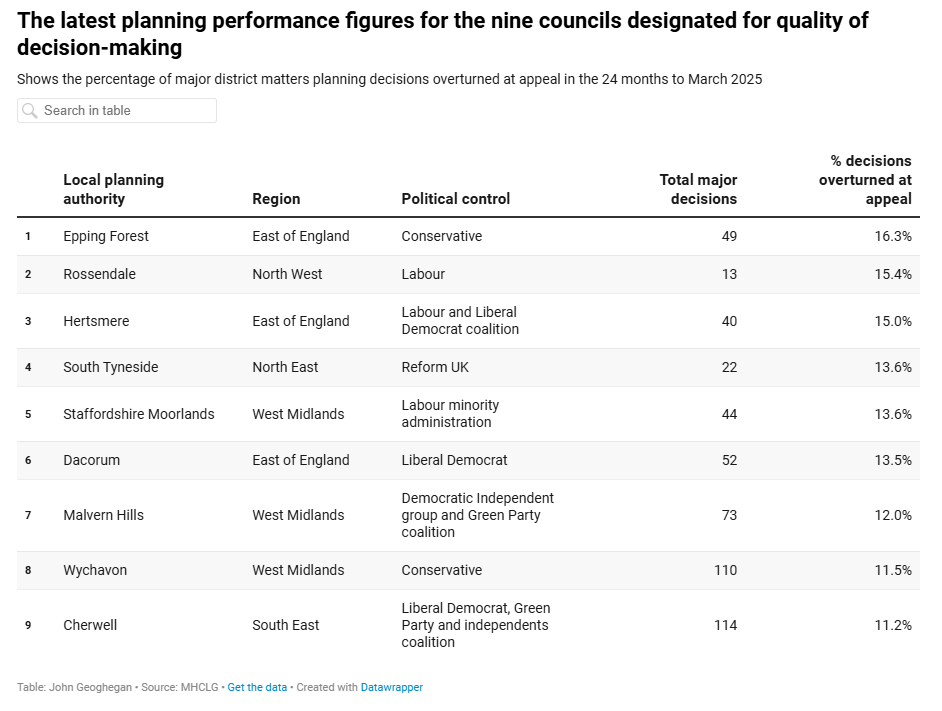
Planning magazine provided the useful table below in their designation day news piece (Pennycook places nine councils in planning performance ‘special measures’ for poor quality decision-making, 15 June 2026 (behind paywall)):
What are the implications of designation?
The applications can now be made direct to the Planning Inspectorate are those for major development, namely:
- for housing, development where 10 or more homes will be provided, or the site has an area of 0.5 hectares or more
- the provision of a building or buildings where the floor space to be created by the development is 1,000 square metres or more; or
- development carried out on a site having an area of 1 hectare or more.
We have a good picture both from the procedural requirements and guidance but also given previous designations (Fareham de-designated in March 2024, Chorley, St Albans and Uttlesford de-designated in June 2025 and Bristol de-designated in January 2026).
The Planning Inspectorate has procedural guidance for applicants, designated authorities and interested parties . In broad summary:
- Applicants can secure pre-application advice from PINS at £134 per hour. PINS appoints a case officer who is then the main point of contact and requests necessary background documentation from the authority. The planning inspector reviews the pre-application submission (there is a form and a list of necessary documentation) and carries out a site visit, holds a meeting with the applicant and issues formal advice to the applicant. Pre-application community consultation by the applicant is strongly encouraged as well as “meaningful” consultation with statutory consultees.
- The application can then be submitted (with at least ten working days’ advance notification given). The fee is the same as for submission to the local planning authority.
- PINS carries out consultation with statutory consultees and the designated local planning authority, advertises the application in a local newspaper (how quaint), and publishes any consultation responses online.
- The local planning authority must provide a substantive response to the consultation within 21 days, including matters it considers should be addressed by way of section 106 agreement or conditions and should “work constructively with the applicant to ensure any Section 106 agreement is completed within the required timescales”.
- “When submitting an application to the Planning Inspectorate, applicants must ensure that it is ready for determination. A decision will be made on the application as submitted. There is no specific provision in the process for amendments or revision to the application once it has been submitted. Applicants should ensure that the relevant information is submitted with the application, as we will not accept any additional information once the application has been submitted, other than in exceptional circumstances.”
- At the end of the consultation period, PINS will determine the procedure to be followed. “Planning applications relating to development of a significant scale, and which raise issues which cannot be clearly understood from the written submissions will require a hearing.”
- “It is the responsibility of the applicant and the LPA to ensure that a completed agreement is in place so that it can be taken into account in reaching a decision. For applications dealt with by the written representations procedure, the completed agreement should be submitted within two weeks of the end of the representation period. Where there is a hearing the agreement should be submitted in advance of the hearing date.”
- “The Planning Inspectorate will issue a formal decision notice incorporating a statement setting out the reasons for the decision. If the application is approved the decision will also list any conditions which are considered necessary.”
- There is no provision to appeal the decision.
- CIL processes work as if the decision were taken by the authority.
- “Where planning permission has been granted under Section 62A the LPA continues to have the responsibility for monitoring the implementation of the permission, ensuring that it is carried out in accordance with the approved plans and any attached conditions. Applications for the approval of details required by condition must be submitted to the LPA. Applications for variation or removal of conditions can also be made to the LPA.”
What all this means in practice is that potential applicants have much to weigh up in deciding or not whether to make their application direct to PINS.
On the plus side, for a scheme that is straight-forward with little risk of subsequent refinements being required, there is more time certainty (and particularly in relation to negotiation and completion of any section 106 agreement), a straight-forward approach to the pre-application engagement and, if the sense is that the application may need to go to appeal anyway, it gets you before an inspector without that initial application stage.
On the minus side, many applicants may wish to maintain a constructive relationship with the particular local planning authority, and will be rightly concerned about the lack of any ability to revise applications or submit further material during the process, as well as the fact that there is just the one roll of the dice, with no subsequent right of appeal. For the local planning authority, the loss of planning application fees can of course have a significant impact.
If you would like to see some examples of applications made, timescales and the relevant documentation there are links here to all applications made in relation to Uttlesford before that authority was eventually de-designated.
Simon Ricketts, 20 June 2026
Personal views, et cetera
 SIMONICITY