Should Appeal Costs Decisions Be More Widely Publicised?

…because surely much of their value lies in guiding participants in future appeals as to the conduct that is expected of them – whether appellants, local planning authorities or third parties?

Ironically, the thought occurred to me due to an unusual headline in yesterday’s Planning magazine update, Inspector awards costs against both housebuilder and objectors for ‘unreasonable behaviour’ after allowing 1,730-home appeal (30 May 2024, paywall). Following on from the news on 24 May 2024 that inspector Christina Downes had allowed Taylor Wimpey’s long-running appeal in relation to up to 1,730 dwellings and associated development at Wisley Airfield, Guildford, I hadn’t been aware of her decisions the same day in relation to an application for costs made by Wisley Action Group, Ockham Parish Council and RHS Wisley against Taylor Wimpey and an application for costs made by Taylor Wimpey against Wisley Action Group, Ockham Parish Council and RHS Wisley.

The inspector made a partial award of costs against Taylor Wimpey on the basis of an error in modelling contained in a transport assessment which was not addressed until it was the basis for cross-examination at the inquiry. The inspector found that the objectors were put to unnecessary expense identifying the error, preparing written notes and extra evidence, recalling their highway witness and preparing and delivering cross-examination which all took an extra inquiry day.

Going the other way, the inspector also made a partial award of costs against the objectors, finding that there had been “unreasonable behaviour in the following respects:

• In the ecology evidence insofar as it related to matters that had already been addressed by previous decision makers; and in raising issues about the surveys, other than in relation to bats.

• In the highway evidence insofar as it related to the difference between the TA and ES in respect of peak traffic flows.

• In the planning evidence insofar as it persisted in raising issues about the principle of the development, but the costs limited to the cross-examination of this point and its preparation.”

In the context of an inquiry which ran to (by my reckoning) 32 days this may all be small beer but is an interesting indication of the extent to which parties may be prepared to put the behaviour of their opponents under the microscope.

There is of course detailed Planning Practice Guidance as to the award of costs in planning appeals, the basic principle being that costs may be awarded, either on the application of any party or at the instigation of the inspector, where a party has behaved unreasonably and the unreasonable behaviour has directly caused another party to incur unnecessary or wasted expense in the appeal process. I often have to explain to clients that, no, they can’t cover their wider commercial losses caused by that unreasonable behaviour…

My colleague Jack Curnow ran a search of appeal decisions today – there have been around 93 costs award decisions in the last 12 months. How much more might we learn if the key findings were made available, in the way that the Local Government and Social Care Ombudsman provides a comprehensive database of its rulings?

A couple of other interesting costs decisions spotted in the wild (on LinkedIn that is):

  • First of all, as with that first costs award at Wisley, a reminder that a party may end up winning the appeal but being on the receiving end of an award of costs for unreasonable behaviour. On 16 May 2024 Bellway Homes lost a planning appeal for a proposed development of 148 dwellings in County Durham, but (perhaps small comfort) secured an award of costs against Durham County Council on the basis that it had not substantiated three of its reasons for refusal (on effect on countryside, unacceptable harm to the landscape and on design). In relation to the remaining reasons for refusal – on planning and transport, where the relevant LPA witnesses appear to have made significant concessions under cross-examination, there is an interesting passage:

“In my view, the concessions made by the sustainable transport and planning witnesses rather than being a deficiency in the Council’s case were the result of a series of subtly directed questions by a skilled advocate and the inability of the witnesses to grasp the direction of the examinations.  That said concessions made by witnesses are material considerations in concluding on a proposal and I did not ignore them.  However, as the decisionmaker, whether I am bound by them is not, in my view, a binary choice.  As the various examples of Case Law referred to show, I am entitled to bring to bear my own judgement, both as a planning professional and an Inspector, to weigh the written and oral evidence before me.  This is particularly so where, as in this case, the final decision turned on a matter of planning judgement i.e., whether the proposal represented sustainable development and the relevant witness’s failure to grapple with the basis of their own evidence.  In this context, despite the direction that the cross-examinations took the witnesses, I consider the Council was able to substantiate its case in relation to the second main issue, sustainability.  On this basis, I consider that, continuing the case in the face of the planning witness’s concessions, the Council did not act unreasonably.”

[Who might that “skilled advocate” be, Hashi…?]

  • Secondly, an example of an appeal in relation to non-determination of the application within the statutory period (in this case an appeal, which was allowed on 2 April 2024, for up to 540 dwellings and associated development at Yarnton, Oxfordshire, where both the local planning authority and county education and highways authority were the subject of full costs awards in favour of the appellant, through not having resolved matters, ultimately conceded in the immediate run-up to the inquiry, far earlier in the process.

From the award against Cherwell District Council:

The concerns of the Council set out in the putative reasons for refusal should have been addressed early in the life of the application; some of them, in particular those relating to green infrastructure, could have been dealt with as conditions on a planning permission or as part of a planning obligation. The fact that all the objections were withdrawn by the Council prior to the opening of the inquiry demonstrates that there was nothing substantive in the Council’s reasons for refusal that could not have been agreed much earlier in the process. As it was, the applicant was forced to address these matters through an appeal, and to produce revised material and re-consult at the appeal stage. It had to produce evidence on the reasons for refusal and, given that this was an appeal against non-determination, it had to produce adequate evidence on all matters relevant to the planning application to enable the decision-maker to reach a decision.

Although costs can only be awarded in relation to unnecessary or wasted expense at the appeal, the behaviour and actions of the Council at the time of the planning application can be taken into account in the consideration of whether or not costs should be awarded. The Council acted unreasonably in its handling of the planning application and the application should not have needed to come to an appeal. The Council delayed development that should clearly have been permitted, failed to produce evidence that substantiated each putative reason for refusal, and issued putative reasons for refusal on grounds that were capable of being dealt with by planning condition or in an obligation. The Council’s unreasonable behaviour led the applicant to the unnecessary costs of an appeal with the consequent need to maintain an appeal team with legal representation and to produce evidence on a wide range of matters.

For the reasons given above, unreasonable behaviour resulting in unnecessary or wasted expense has occurred and an award of costs against Cherwell District Council is therefore warranted, covering all the costs relating to the appeal, with the exception of the two matters which are the subject of the costs claim against Oxfordshire County Council.”

From the award against Oxfordshire County Council:

Costs should only be awarded against a third party in exceptional circumstances. In this case those circumstances exist. The County Council’s position was critical to the progress of the planning application and subsequent appeal because of its role as a main party to the s106 obligation, and it bears full responsibility for the delay and costs incurred in addressing the matters discussed above. The matter of the playing field access was capable of being addressed much earlier as part of the planning application if the County Council had taken a reasonable approach, and should never have had to come to appeal. The County Council did not defend its position at the inquiry. The request for a contribution for the Cassington Road to Peartree Interchange highways works should never have been made. The County Council behaved unreasonably in both respects and caused the applicant to incur unnecessary expense in addressing these issues in respect of legal representation, expert witnesses, the preparation of statements of case, proofs and rebuttals, and in having to seek information and prepare a legal opinion to inform the inquiry. A partial award of costs is therefore warranted.”

[NB the highways contribution point may be of wider interest: the county council had sought a contribution towards highways works “which were not dependent on the development and which had already been funded from the public purse and built”!]

Some other costs decisions this year that may be of interest:

  • An award in favour of Bellway Homes in relation to an appeal in Stroud, where planning permission was granted for 54 dwellings. In his decision letter dated 20 May 2024 the inspector awards costs against Stroud District Council largely through its failure to grapple properly with biodiversity net gain issues:

“In a large part, the reason for the appeal is because the Council failed to review, accept and liaise with the appellant on the Mitigation Hierarchy Review. In my view, this necessitated the submission of the appeal. In addition, the

Council’s lack of engagement added unnecessary time at the hearing and necessitated further time being given to the main parties to agree the wording of a Grampian condition after the close of the hearing.

I am cognisant that the position on the value of high value habitats has been clarified with the statutory metric coming into force and has confirmed the basis on which such units can be traded and that this has been a recent change that the Council has not been obliged to accept. However, given that the Council were not seeking to resist the principle of development, the absence of indication that the appellant had met the expectations of the hierarchical approach should have been provided at an earlier point in time to have paved the way for more meaningful negotiations on the mitigation package. This concession was only made at the hearing in person, with the written evidence still having largely maintained a defensive position.

In view of this, my conclusion is that the Council has behaved unreasonably, for reasons including its failure to determine a planning application based on an issue that was capable of being dealt with by condition and failing to review and clarify its case promptly following the lodging of an appeal.”

  • A full award of costs in favour of the promoter of a solar farm in Rayleigh. The appeal was allowed on 11 March 2024 and full costs were awarded against Rochford District Council. The decision to refuse the application had been made by members against officers’ recommendations. The inspector concluded:

Overall, I consider that the Council has not produced relevant evidence at appeal stage to support their decision to refuse planning permission and has therefore delayed a development that should have been permitted, having regard to the development plan and other material considerations. It has also been inconsistent in its decision making. I therefore consider that the Council’s approach does represent unreasonable behaviour, and this has resulted directly in the need for this appeal.”

The council tried to make the case that it was difficult to find private sector consultants to support them. The inspector didn’t think much to that excuse!

“In the rebuttal to the cost claim it was suggested that it is difficult for members to provide a substantial evidence base as few consultancies will take on such work as it would be likely to lose them future work as they would be known as “Council lovers”. Whilst in my experience consultancies quite regularly support Council’s at appeal, even if that were the case this does not absolve the Council from the need to substantiate the reasons for refusal at appeal.”

  • Finally, a reminder to councils of the need to engage in pre-app discussions. An appeal in Mole Valley was dismissed on 28 February 2024, but with the appellant awarded its costs due to the council’s failure to engage at pre-application stage:

“In respect of the appellant’s attempt to engage with the Council at the pre-application stage, I note that the Council suspended these services due to resourcing limitations. Although not binding, this process, if it had been available, would have been an opportunity for the Council to raise any concerns at an early stage in respect of design, living conditions and affordable housing provision. The appellant, therefore, would have been well-informed and provided with the opportunity to amend the scheme as necessary.

The Council’s resourcing is not a matter for the appellant, who sought an effective, positive and pro-active approach at an early stage. Given that the Council has an established pre-application function, which was suspended for a time, and which did not allow the appellant to use it, amounts to unreasonable behaviour. This is my view, irrespective of the Council’s communications later in the process.

For the reasons given above, unreasonable behaviour resulting in unnecessary or wasted expense has occurred in respect of pre-application advice and a partial award of costs is therefore warranted.”

I could go on, and on. There are so many. There’s a lesson in each decision – whether as to how parties should behave or as to how the system itself, under-resourced as it is, may be failing us all. After all, perhaps penalising authorities with costs awards is simply adding to the resourcing problem – it certainly is if costs awards do not influence future behaviour. So as well as my suggestion that these decisions should be more widely publicised, I would go further: when an award is made against an authority and the amount of costs payable has been determined, by negotiation or following reference to a High Court costs judge, why shouldn’t authorities be under a duty to publicise to their members and to their local electorate the financial consequences of what has happened and why?

Simon Ricketts, 31 May 2024

Personal views, et cetera

Extract from photograph by Elena Mozhvilo courtesy of Unsplash

Two Apples: Bramley & Worcestershire

I hope you didn’t notice that there was no blog post last weekend. I really needed the clocks to go back again to give me enough time. Picking up the tablet and chisel a fortnight later is not easy.

So much to say!

Another planning minister bit the dust. I liked Iain Thomson’s quip on LinkedIn about 15 minute planning ministers – far more of a scourge than 15 minute cities.

As part of its ongoing market study into housebuilding the Competition and Markets Authority has published on 15 November 2023 two further working papers, on landbanks and planning rules. To quote from the press release:

On land banks, the CMA’s analysis has found that, although land equivalent to over a million plots is held in landbanks, in most local areas that land is held by several different builders. The CMA is seeking feedback on this analysis, and in particular, whether local competition is being negatively impacted in the small number of areas where large amounts of developable land are controlled by a small number of housebuilders.

The CMA is continuing to examine the size of land banks overall, recognising that housebuilders need to hold a pipeline of land as sites pass through the planning system. The conclusions of this analysis will be published in the final report.

On planning, the CMA has developed options that the UK, Scottish and Welsh governments may consider when reforming their planning systems, including:

Whether a zoning or rules-based approach to development may help improve competition between housebuilders and boost housing delivery.

Making better use of councils’ limited time and resources by requiring them to only consult statutory stakeholders, rather than a wider group, as part of their assessment of planning applications. Late consultee responses on development could also be ignored.

Having an effective housing target which reflects the housing need of specific areas, and improving the ways governments ensure all councils have a proper local plan in place.”

Yep, another set of helpful suggestions as to planning reform.

But I wanted to step back from the politics and just shine a torch on two useful recent planning law cases. And to save myself from too much chiselling, all I am going to do is to point you to the following case summaries put out by those involved:

First of all, a summary by No 5 Chambers’ Thea Osmund-Smith and Odette Chalaby of R (Bramley Solar Farm Residents Group) v Secretary of State (Lang J, 15 November 2023).

In the context of a challenge by local residents to an inspector’s decision to allow an appeal for a solar farm and battery storage scheme in Hampshire, the judgment covers a number of practical issues such as:

  • Where an environmental statement is to be updated at the appeal stage, can the appellant carry out the publicity and consultation process? Yes.
  • Can a party choose not to call a witness, despite having submitted that witness’ proof of evidence to the inquiry? Yes.
  • Does the Government’s Planning Practice Guidance on renewable and low carbon energy impose a requirement to consider alternatives where solar farms use best and most versatile agricultural land? No. Consideration of alternative sites will only be relevant to a planning application in “exceptional circumstances”.

Secondly, a summary by Landmark Chambers of NRS Saredon Aggregates Limited v Secretary of State and Worcestershire County Council (Eyre J, 16 November 2023), a case in which Landmark’s Jenny Wigley KC appeared for the successful claimant. Eyre J quashed an inspector’s decision refusing planning permission for a sand and gravel quarry in the green belt, on the basis that the inspector made a legal error in relation to the weight to be applied to the biodiversity net gain (BNG) that would arise from the project. To quote from the summary:

It was agreed at the inquiry that the scheme would deliver over 39% BNG. The Inspector afforded ‘only moderate weight’ to this on the basis that “some of the biodiversity net gain that would be achieved is required to meet national policy and future legislative requirements in order to mitigate the environmental impact of the development”.

The High Court agreed with the Claimant that the Inspector’s judgement as to weight was affected by a mistaken view as to requirements of forthcoming legislation. Because there was no basis for considering that the legislation might be retrospective, it was plainly not applicable to the scheme to be determined:

The effect of that interpretation is that when assessing the weight to be attributed to the biodiversity net gain for the purposes of assessing whether there were very special circumstances outweighing the harm to the openness of the Green Belt the Inspector reduced the weight on the basis of a mistaken view as to the law. He did so believing incorrectly that some of the net gain would be required in any event by reason of the forthcoming legislation. That was an error of law and meant that the Inspector exercised his planning judgement as to the weight to be given to that material consideration (namely the net gain) on a basis that was wrong in law.”

The case is a useful way of reminding decision makers that there is, as yet, no legal requirement for 10% biodiversity net gain. The relevant provisions in the Environment Act 2021 have yet to come into force and, when they do (in January, we’re now told), the requirement will only apply to new applications submitted on or after that date. There is a policy requirement in the NPPF for biodiversity net gain, but only that such gain should be positive, i.e above zero, and there are also varying policy requirements in some Local Plans, but still no legal requirement. In emphasising benefits of development proposals, it is useful to stress the degree of BNG being offered and, for all applications already in the system, it is worth pointing out that any degree of BNG goes above and beyond legal requirements and should be afforded due weight accordingly.

Two reminders that the courts are often more useful than politicians in clarifying how important practical aspects of the planning system should work.

Another fact to note:  in the NRS Saredon case, all four counsel were female. In the Bramley case, three of the five counsel were female, as well as of course the judge.

As always, these cases, together with any others handed down last week by the Planning Court or on appeal from the Planning Court, will feature in our Town Library Planning Court Judgments weekly update and you can subscribe for free at the link.

Simon Ricketts, 18 November 2023

Personal views, et cetera

Pic courtesy of Thiva via Unsplash

Planning Appeal Timescales: Better Faster (But Harder?)!

I tried DLUHC in wordle but the app didn’t accept it.

Never mind – there was one significant announcement from the Department this week which I thought would cause more of a stir than it did, an announcement which could be really positive news for all of us who have been anxious for a long time that one of the operational failings of the current planning system is how long appeals take, such that in many instances, no matter how difficult it may be to make progress with the local planning authority, appeal is not a practical remedy (and perversely the delays are currently worse for smaller schemes than for schemes where any appeal is likely to be determined by way of inquiry).

The Department has now announced by way of a letter from housing minister Christopher Pincher to Sarah Richards, chief executive of the Planning Inspectorate dated 20 January 2022 (but published on 26 January 2022) that:

As an initial milestone in making more consistent, timely decisions The Planning Inspectorate should be working towards consistently achieving decisions in these ranges:

· Appeals decided entirely using writing evidence in 16 – 20 weeks

· Appeals decided including at least some evidence through hearing or inquiry 24 – 26 weeks (30 weeks to recommendation for called in or recovered cases)”

These targets for written representations appeals and hearings are new.

Detailed measures are set out for:

• The proportion of appeals which are valid on first submission

• How long appeal decisions take from valid receipt to decision

• Customer satisfaction.

These measures apply regardless of the legislative basis for the appeal, for example whether it is in relation to enforcement or resulting from the refusal of a planning application.

These targets and measures should make a real difference.

But there is a much more radical coda to the letter:

“As you know, the Government is also committed to improving and modernising the planning system. The work you are undertaking to develop twenty-first century digital public services is an important part of this. I would welcome you complementing that by identifying what steps might be necessary to achieve a further significant consistent improvement in appeal timescales beyond those above so that most appeals could be consistently decided in 4 – 8 weeks, or faster, whilst maintaining good standards of decision. Consideration can then be given to whether these steps might be appropriate.”

Yes, you read that correctly – an aspirations that “most appeals could be consistently decided in 4 – 8 weeks, or faster”. PINS director operations Graham Stallwood spoke at a Clubhouse session last week about what steps PINS is taking towards digitalising its processes (a replay of the whole event is here and Graham’s comments are from 53 minutes in). It will be interesting to see what further changes will be recommended to procedures to achieve anything like those timescales.

The Planning Inspectorate’s response dated 27 January 2022 welcomes the new measures. PINS will “start reporting on them to ministers and customers straight away as part of our monthly statistical release and performance updates.”

There is this statement from Sarah Richards:

“I welcome the minister’s request to report to him on what would be necessary to support a further significant improvement in appeals. This recognises the importance of a fair appeal system to the nation’s economy and is an important opportunity to reflect on how the appeal system can be reframed to operate sustainably for the future. We will engage with key stakeholders on this in due course before we report to the minister.”

My understanding is that PINS is likely to be starting that process this Spring. There will be no Bridget Rosewell overseeing it all this time round. No doubt it will in part be an equivalent series of pragmatic incremental gains in terms of efficiencies and timescales but I would have thought that some statutory timescales set out within secondary legislation may need to be revisited. And let’s not be under any illusion: “4-8 weeks appeal timescales” are going to need significant changes in terms of processes but also behaviour:

• (As discussed by Graham at the Clubhouse event) how can we get to a position where on appeal a link can simply be provided to the documents on the LPA’s planning portal rather than starting a wholly new paper chase, and appeal submission can be pass/fail in terms of submission of the correct documents, as if you were applying for a passport?

• What fresh evidence should be allowed to be submitted at the appeal stage (and what does this mean in practice for those preparing their applications – at application stage your documents will need to be forensically prepared so as to be “appeal ready”)?

• What should decision letters look like?

• How do we avoid unintended consequences given that on these timescales, it will usually be quicker to appeal as soon as you can rather than engage in protracted negotiations with the LPA – and so will the appeal system very quickly get clogged up?

• Will any necessary trade-offs as between on the one hand an element of procedural flexibility and on the other hand speed prove counter-productive for prospective appellants? Is there a point at which appeals become too quick? And what resources will be required on the part of LPAs and third parties to be able to participate effectively?

• Not mentioned, but are we going to see appeal fees introduced, at least for some types of appeal?

This is all a long way from the current performance statistics (20 January 2022):

We will be talking about all of this at our Clubhouse session at 6 pm on Tuesday 1 February. At this session we don’t have any special guests because we want to hear from you. Your current experiences of the system, good and bad, and what you think of these proposals. Whether you are a planning consultant, local authority planner, community group representative, advocate or developer, what do you think? Link to app here.

Simon Ricketts, 28 January 2022

Personal views, et cetera
PS I know there have been distractions around those parts recently but it is still startling to see a ministerial letter with a phrase such as “until such time as me or my successors agree new measures”. Yuck. (Or should that be YUHC?).

Courtesy Daft Punk

This Is Not A Blog Post

Faithful reader, life’s hard enough and I’m giving you another week off from a proper blog post. However…

The High Court rulings and planning appeal decisions keep coming and it’s worth subscribing to the Town Library free weekly updates for those, including great summaries of every High Court ruling, prepared by my Town Legal colleagues.

I know I go on about clubhouse but do join one of our Planning Law Unplanned sessions if you can. I suppose that in tone it’s a cross between a live podcast (there’s no subsequent recording – miss it and it’s gone), a radio phone-in show and an after-work chat in the pub around a (large) table. Clubhouse recently upgraded their audio system to what they call spatial audio and if you listen now on earphones on an iphone or ipad you’ll notice that there is indeed the sense that you are in a room with the voices coming from different directions, as if around the table.

This Tuesday’s (7 September 2021, 6 to 7.15 pm) is genuinely unmissable: “Planning application/appeal timescales – tell us your tales”. It follows on from my last blog post, How Long Has This Been Going On and features the following special guests: Graham Stallwood (director of operations at The Planning Inspectorate), Bridget Rosewell (chair of the 2018 independent review into planning appeal inquiries), Alice Lester (director regeneration at Brent Council) & James Cross (strategic sites project planner, Arun District Council).

Timing is all, so they say. What are people’s current experiences of “the system”, good & bad?

In relation to appeals, PINS these days publishes excellent data but where are the pinchpoints that people experience in practice (without referring to specific cases)? Post lockdown, are we now on our way back to the improved timescales for appeal inquiries that were being achieved as a result of the Rosewell reforms? What about hearings and written reps appeals? How are we finding the move back from wholly screen-based events?

In relation to applications, what approaches by applicants and/or LPA can help avoid undue delays? How can we speed up negotiation of section 106 agreements? What is the role for pre-app discussions and early public engagement?

Please join us for a good-natured, positive but hopefully probing session. You are free just to listen or to participate in the discussion. Indeed we would love to hear your tales, of woe or joy! Link to app here.

Finally, clubhouse obviously is a platform for all sorts of discussions on all manner of topics. Nothing to do with work – any reference to planning or law, or indeed whatever work you do, is entirely banned – but tomorrow evening (Sunday 5 September, 8 pm) a few of us are hosting the third in an occasional series of events I’ve called Sound Recommendations, which is basically just chats about music, around a theme, as a result of which we put together a spotify playlist of what’s been mentioned (search for Sound Recommendations #1 and #2 on spotify). Tomorrow night’s theme is: “GIGS: first, best, last, next”. Do join us for that one too! Link here. (And if you’re only reading this after the event you’ll have to console yourself by searching for the Sound Recommendations #3 playlist).

Maybe next week I’ll get round to a proper post again….

Simon Ricketts, 4 September 2021

Personal views, et cetera

How Long Has This Been Going On?

Time is money. Time is unmet needs. Time is unrealised public benefits.

I just wanted to capture some of the current, frankly depressing, data that is out there on application and appeal timescales.

The purpose of this post is to underline that there is a significant problem to be addressed. What to do about it will be for another post – there is certainly much that can be done that does not require (1) legislation (2) additional resources or (3) any procedural shortcuts.

Applications

A piece from yesterday’s Planning daily online: Council signs off 2,380-home urban extension almost four years after committee approval (£). Four years is certainly going it some but I can confirm from constant first-hand experience how difficult it can be to move a project from resolution to grant to permission at any speed. The larger or more complex the project, the longer those negotiations over the section 106 agreement and associated aspects can end up taking.

My colleague Lida Nguyen has been looking at the position in London. She has looked at all applications for planning permission which were referred to the Mayor between 3 January and 11 December 2020, so applications of potential strategic importance as defined in the Mayor of London Order 2008 and, for those which were then approved by the relevant borough (without intervention by the Mayor or secretary of State), she has looked at the average time that the application took from validation to the borough’s resolution to approve and from the borough’s resolution to approve to permission being issued. Discarding a few anomalous cases, this left 88 to be analysed.

In my humble view the statistics are appalling, but not surprising:

Application submission to resolution to approve

Median: 228.5 days

Mean: 269 days

Resolution to approve to grant of permission

Median: 218.5 days

Mean: 259 days

It’s rather deflating for applicants and (when you stand back from the detail) surely absurd that resolution to grant in reality only marks the halfway point to a permission in relation to significant projects in London. Wouldn’t it be a start for boroughs, the Mayor and those acting for applicants to set a target of halving each of those figures and agreeing the necessary steps to achieve that reduction?

Appeals

My 25 May 2019 blog post Pace Making: Progress At PINS reported on Bridget Rosewell’s recommendation, adopted by the Planning Inspectorate, that inquiry appeals decided by an inspector (i.e. not recovered by the Secretary of State) should be decided within 24 weeks of receipt and that where the Secretary of State is to be the decision-maker, inspectors’ reports should be submitted to the Secretary of State within 30 weeks of receipt of the appeal. Initial progress was really impressive – until the first lockdown struck in March 2020. After a slow start (see my 2 May 2020 blog post There Is No E In Inquiry), PINS of course eventually, to the massive credit of all involved, embraced virtual hearings, inquiries and examinations and the risk of an impossible backlog was averted. However, it is clear from the latest Planning Inspectorate statistical update (19 August 2021) that there is still much work to do:

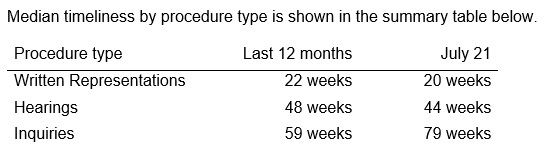
“The mean average time to make a decision, across all cases in the last 12 months (Aug 20 to Jul 21), was 27 weeks. The median time is 23 weeks.

The median time to decide a case decreased by 0.6 weeks between June and July 21, with the median being 21.4 weeks.

Median timeliness by procedure type is shown in the summary table below.

Performance since April 21 against the median measure has only varied by 0.7 weeks, between 21.4 weeks and 22.1 weeks. Performance had been improving between November 20 and March 21. For inquiries, in the last two months, cases have taken longer to decide as a result of very old enforcement inquiry cases being decided.

Enforcement decisions made in the last 12 months had a median decision time of 34 weeks. Looking at the annual totals, the median and mean time to decision for specialist decisions have been broadly the same as for enforcement decisions, and longer than the median for planning decisions. Since February 21 there has been a change in this trend, with Specialist cases being quicker than Enforcement.

The median time for planning appeals decided by inquiry under the Rosewell Process over the 12 months to July 21 is 35 weeks. This is quicker than other types of casework decided by inquiry.

Whilst the extent of statistical information provided these days is welcome, it is difficult sometimes to track the figures through the different tables so as to work out what the likely timescale outcome for a prospective appellant will turn out to be. I have also looked in vain within the statistics for any information as the time being taken between appeal receipt and validation – a traditional black hole when it comes to appeal timescales. I’m also struggling to see any breakdown as to what the “Rosewell” inquiries were (35 weeks average) as compared to inquiries overall (79 weeks!).

That overall 27 weeks average is deceptively encouraging for anyone looking at anything other than a written representations appeal. Because those appeals make up 95% of the total of course they massively skew the mean figure. But even then, although not reflected in these statistics, my own anecdotal impression is that validation of appeals which proceed by way of written representations or hearing is very slow indeed, raising a large question mark over the overall statistics. Possibly something to do with the focus on Rosewell inquiry appeal targets. Am I being unfair? What solid information on this is there out there? If there isn’t any, why not??

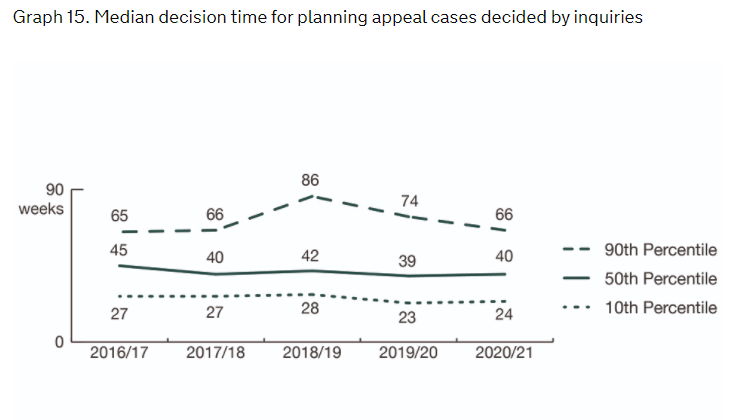
The Planning Inspectorate Annual Report and Accounts (July 2021) contains further statistical information, with tables such as these looking back at the changing position over the last five years:

In order to meet Rosewell targets, surely on that last table the 90th percentile needs to come down from 66 weeks to 24 weeks – and to be measured from receipt of appeal rather than validation?

Again, as with timescales for major applications in London, with appeal inquiries, surely we are looking at the need to more than halve current timescales?

All tables above have been taken from PINS documentation, for which thanks.

Simon Ricketts, 20 August 2021

Personal views, et cetera

Planning Law Unplanned is having a summer break this week, before returning at 6pm on Tuesday 31 August for somewhat of a BECG/DP9 special, London Elections 2022: Politics Meets Planning. Join the club here for notifications of this and future clubhouse Planning Law Unplanned events.

Photograph by Ben White on Unsplash

‘Twas The Week Before Recess

The House of Commons and House of Lords both rise on 22 July 2021 and are due to return on 6 September 2021, which means that each year this week and next we always see many documents published and announcements made. Much festivity.

This week last year the Planning White Paper was eagerly awaited of course but ran late, eventually being published in the first week of August. At one stage we had expected an update by the Government on progress by now, including its response to last year’s consultation process but Robert Jenrick announced back at the beginning of the month that we will not see this until the Autumn and there will be no Bill until some time after that. (For a summary of MHCLG’s current priorities, see his 6 July 2021 speech to the Local Government Association, or indeed Nicola Gooch’s 16 July 2021 blog post on the speech).

But there have already been various other announcements and publications and in this post I will just pick randomly from them, Quality Street style.

Of particular interest is the Department for Transport’s Transport Decarbonisation Plan (14 July 2021) which sets out the road map (no, wrong expression) for reducing transport’s greenhouse gas emissions to net zero. It is a turbo-charged (no, wrong expression), “high ambition”, plan covering all modes of transport. There is a wide-ranging series of commitments over 220 pages of text.

What is there that directly refers to the planning system? Aside from confirmation that the Government will be reviewing the National Networks National Policy Statement, there is a wider commitment to “embed transport decarbonisation principles in spatial planning and across transport policymaking“. Pages 156 to 160 address this in detail and I am going to no more than set out below large sections of this section:

…The planning system has an important role to play in encouraging development that promotes a shift towards sustainable transport networks and the achievement of net zero transport systems.

Traffic issues have often caused opposition to housebuilding. There is a legacy of developments that give people few alternatives to driving, are difficult to serve efficiently by public transport and are laid out in ways which discourage walking and cycling. Developments which are planned to minimise car use, promote sustainable transport choices, and are properly connected to existing public transport could help make new building more publicly acceptable.

The National Planning Policy Framework (NPPF) makes clear we already expect sustainable transport issues to be considered from the earliest stages of plan-making and development proposals, so that opportunities to promote cycling, walking and public transport are pursued. Planning policies should already provide for high quality cycling and walking networks and supporting facilities such as cycle parking (drawing on Local Cycling and Walking Infrastructure Plans). The NPPF also outlines that new developments should promote sustainable transport, taking opportunities to promote walking, cycling and public transport. However, while many local plans already say the right things, they are not always followed consistently in planning decisions. Developments often do little or nothing meaningful to enable cycling and walking, or to be properly and efficiently accessible by public transport. Sometimes they make cycling and walking provision worse. We can and must do better.

Last summer, the Government set out its vision for a new and improved planning system in the Planning for the Future White Paper, a vision to make good on the Government’s pledge to build back better, build back faster and build back greener. The White Paper set out how the planning system is central to our most important national challenges, including combating climate change and supporting sustainable growth.

A reformed planning system can assist in achieving the ambition of a zero emission transport future. The planning reforms will provide an opportunity to consider how sustainable transport is planned for and importantly how it is delivered to support sustainable growth and drive more sustainable use of our existing built environment e.g. planning for new development around existing transport hubs, for all developments to be easily and safely accessible and navigable by foot and cycle, and to make existing cycling and walking provision better. Through good design and proper consideration of the needs of our communities, we can better connect people, making communities more accessible, inclusive, safe, and attractive as well as promoting the principles of 20-minute neighbourhoods. We are working with the Ministry of Housing, Communities & Local Government and the Local Government Association to place cycling, walking and public transport provision at the heart of local plan making and decision taking for new developments. In doing so, we recognise the particular challenges faced by rural and remote areas in this regard, and will work, including through the upcoming Future of Transport: Rural Strategy, to ensure policies recognise differing geographies.

The National Model Design Code sets out a process for developing local design codes and guides, with supporting design guidance on movement and public spaces including streets. It outlines an expectation that development should consist of a well-connected network of streets with good public transport and an emphasis on active travel modes including walking and cycling. Building on this, we will also ensure that an updated Manual for Streets aligns with these principles and is routinely used for plan making and decision taking to secure better outcomes for our streets and public realm. These documents can play a key role in delivering high quality, accessible, secure and safe cycle storage. We will work with Active Travel England and other key stakeholders to ensure that the importance of securing high quality cycling and walking provision is embedded within the planning system.

We recognise that the Government has a role in helping Local Planning and Highways Authorities to better plan for sustainable transport and develop innovative policies to reduce car dependency. We need to move away from transport planning based on predicting future demand to provide capacity (‘predict and provide’) to planning that sets an outcome communities want to achieve and provides the transport solutions to deliver those outcomes (sometimes referred to as ‘vision and validate’). We will continue to work with MHCLG to identify how we can best support local authorities to develop innovative sustainable transport policies as part of the planning process, how this can be used to better assess planning applications, and better monitor local transport outcomes to deliver on our ambitions for sustainable transport use.

Achieving these ambitions will require a long-term collective effort across government, local authorities, communities, businesses, and developers. We are exploring with MHCLG how the planning system can be designed to facilitate better collaboration and planning for growth across local authority boundaries, with all key stakeholders involved, to ensure that we align that growth with both strategic and local infrastructure delivery to make good on our manifesto commitment to put infrastructure first and drive growth sustainably.”

The next day, 15 July 2021, we had the Prime Minister’s florid Levelling Up speech, although for actual announcements it might be better to go straight to, for example, a press statement issued the same day: PM sets out new ‘County Deals’ to devolve power to local communities in Levelling Up speech (15 July 2021).

“New ‘County Deals’ to take devolution beyond the largest cities, offering the rest of England the same powers metro mayors have gained over things like transport, skills and economic support.

County Deals will be bespoke to the needs of individual places, bringing decisions closer to people and places, potentially allowing more places to benefit from strong, high profile local champions. County Deals will give places the tools they need to pilot new ideas, create jobs, drive growth and improve public services.

Further detail will be set out in the Levelling Up White Paper, but as the Prime Minister set out, county deals will not be one size fits all, and government will take a flexible approach to allow more places to agree devolution.”

The same day there was also the press statement Government strategy to regenerate high streets (MHCLG, 15 July 2021), with various announcements, including the publication of Build Back BHS – apologies: Build Back Better High Streets. Compulsory purchase practitioners will be interested to see this passage:

“We are […] encouraging councils to use Compulsory Purchase Orders (CPOs) for long-term empty properties and where property owners are stalling regeneration plans. We want to:

• Ensure councils have the right Compulsory Purchase Order enabling powers to support the transformation of high streets and other regeneration projects so that they can acquire vacant and derelict buildings in order to attract new private investment.

• Ensure as part of our planning reforms that Compulsory Purchase Orders can support more effective land assembly to facilitate the development of growth areas identified in the new-style local plans, particularly when they support town centre regeneration.

Strengthen the capacity and support for local authorities to ensure they are able to use these new Compulsory Purchase Order powers and rights to support the transformation of high streets.”

As regards the conversion of high streets to homes, the following passage was eyebrow raising. So how would this work with the operation of permitted development rights then? And the provision of “green infrastructure” a justification for development intensification?

Where high streets are being repurposed for homes, green infrastructure and improved public space should be integral. We will explore how reforms to the planning system can ensure green infrastructure is better incorporated into new development. Development of homes, businesses and community space could be intensified on parts of sites to free up land for green infrastructure provision.”

And just to keep practitioners on their toes, there was the Planning Inspectorate’s announcement Plans to resume in-person events (15 July 2021). In one part of the policy forest there’s the transport decarbonisation plan, in another part, brmm brmm, off we go back to in person inquiries from 13 September:

“For hearings and inquiries taking place from 13 September we will be reverting to the pre-pandemic approach of them being arranged by local authorities. In-person events will be possible, but where participants (including the inspector) need to present their evidence or participate virtually this will need to be facilitated by the local authority.

Where in-person elements are planned, the local authority will need to be prepared for the event to be held fully virtually in case pandemic restrictions change.

Let’s see what more announcements the coming week brings…

Simon Ricketts, 16 July 2021

Personal views, et cetera

This week’s clubhouse Planning Law Unplanned session (6pm Tuesday 20 July) is on the theme “A Green Recovery”: what does it mean; what opportunities? Lucy Wood (Barton Willmore) will lead the session, which will take a good hard look at the government’s green policy agenda (including the transport decarbonisation plan) and what it means for business, councils and communities, alongside special guests including Neil Collar (Brodies) and others still to be confirmed. An invitation to the app and event is here.

(Public transport = tick).

Covid-19 As A Material Consideration

The idea for this blog post started by way of a search we did this week for inspectors’ appeal decision letters that take into account the economic and other effects arising from the current pandemic.

There does not seem to have been any proper analysis on that at present (and this post doesn’t fill the gap!). Instead most people’s focus has been on the specific legislative measures that have been introduced by the Government and its narrow policy exhortations (for instance in relation to limited aspects of the CIL regime).

Before I turn to that appeals search, can I say two more things on the legislative changes.

First, a further round of amendments to the GPDO were laid before Parliament on 11 November (the Town and Country Planning (General Permitted Development) (England) (Amendment) Regulations 2020). Aside from extending some temporary permitted development rights (outdoor markets; takeaway food operations from restaurants, cafes and drinking establishments, and some emergency development rights), there are two permanent amendments:

⁃ introduction from 6 April 2021 of a requirement that dwellings created by way of the operation of permitted development rights must meet the nationally described space standard

⁃ Prohibition on the demolition of any building is used, or was last used, for the purpose of a concert hall, venue for live music performance or theatre. (“This permanent change is to protect these venues, preventing their unnecessary loss as a result of having to close due to the coronavirus pandemic.” As a trustee of the Theatres Trust I am particularly pleased to see this now in legislation, following the initial ministerial statement on 14 July 2020).

Secondly, I covered the Rights: Community: Action judicial review of the previous recent GPDO and Use Classes Order changes in my 5 September 2020 blog post Lights Camera Action: The Planning Changes – Parliamentary Scrutiny, That JR. That claim was rejected by Lewis LJ and Holgate J last week in R (Rights: Community: Action) v Secretary of State (Divisional Court, 17 November 2020). There are plenty of other summaries of that judgment and there is nothing particularly novel about it but I was interested in the references to the evidence submitted by MHCLG as to the Covid-19 factors that led to the legislation being introduced in the form and way that it was, and the weight that was given to these matters in the judgment:

“Mr Simon Gallagher is the Director of Planning for MHCLG. In paragraph 10 of his witness statement he states that during the period January to March 2020 the first patients in the UK tested positive for Covid-19 and the first transmissions in the UK were confirmed. He says that the pandemic “has generated an economic emergency and upheaval of a scale and intensity not previously known in peacetime.” He continues by stating that, as a consequence, the Government has had to intervene urgently in the economy as a whole in unprecedented ways in order to avert or minimise potentially very severe and long term impacts on the lives of citizens and the prospects for future economic growth. Forecasts for economic growth were reduced substantially. Indeed, one key forecast made in summer 2020 predicted a reduction in the economy for 2020 of 9.9% (paragraph 13). Through regular discussion with representatives of the housing and construction sectors, the MHCLG became aware of particular difficulties faced by the construction sector as a result of the pandemic. There was a record monthly decline of 40.2% of construction output in April 2020. Whilst the output of that sector had increased in May, June and July, it was still 11.6% lower in July 2020 compared with February 2020 (paragraph 14).

On 20 July 2020 a submission was put to the Minister for Housing asking him to approve the three statutory instruments. The submission records that it had been decided that in order to support economic renewal and regeneration and to respond to the economic crisis caused by the pandemic, additional PD rights for the redevelopment of vacant buildings for residential purposes and a broad Use Class of business, commercial and service uses would be introduced without consultation (paragraphs 2 to 3). The Minister’s attention was drawn to criticisms that the recently enacted PD right for allowing the addition of 2 storeys to blocks of flats lacked any requirement for the provision of affordable housing (paragraph 7). The submission referred to the same point when discussing the application of the PSED to the proposed statutory instruments (paragraph 10). The PSED assessments and impact assessments for each statutory instrument were provided to the Minister.

The Explanatory Memoranda for SI 2020 No. 755 and SI 2020 No. 756 stated that the new PD rights were being introduced to speed up the delivery of housing, reduce the need to develop on greenfield land and to support economic recovery from the pandemic by encouraging development. The Explanatory Memorandum for SI 2020 No. 757 stated that the UCO 1987 was being amended to better reflect the diversity of uses found on high streets and in town centres, to provide flexibility for businesses to adapt and diversify to meet changing demands and to help town centres recover from the economic impact of the pandemic.”

The judges had in part to consider whether the lack of a further consultation stage, which had been previously intended in relation to some of the measures, was justified:

“The explanatory memorandum for the draft SI 2020 No 755 and SI 2020 No. 757 again summarised briefly the degree of support for, and opposition to, the proposal, and the concerns that had been raised. The explanatory memorandum for the draft SI 2020 No 756 referred to the consultation responses and noted that there was to have been a further consultation but it had been decided to introduce the PD right without further consultation in order to support economic regeneration. It noted that the Government had considered the range of matters to be left to planning authorities for prior approval while maintaining a simplified planning system. In those circumstances it is not arguable that the defendant failed conscientiously to consider the consultation responses. The decision on whether to proceed, and if so what provisions to include in the SIs, in the light of the consultation responses and other relevant matters were questions for the defendant to determine.”

The judges, did not consider that the Government had acted unlawfully in not carrying out further consultation:

“First, the defendant has established that there were good reasons for departing from the promise in the present case and not having a second consultation on the proposals for PD rights for demolition of commercial or residential buildings and rebuilding for residential use. The coronavirus pandemic had led to severe economic difficulties including a reduction in the rate of construction and planning applications. The government decided to grant the PD rights in order to stimulate regeneration at a time of great economic difficulty arising out of the pandemic. That appears from the terms of the explanatory memorandum to SI 2020 No. 576.The matter is fully explained in the witness statement of Mr Gallagher who refers to the large-scale public health emergency created by the coronavirus pandemic which in turn generated an economic emergency and upheaval on a scale not previously known in peacetime. The Government had sought to intervene in the economy in unprecedented ways to minimise the very severe effects of the pandemic. In the light of that, the decision was taken in favour of urgent action rather than further consultation.

Secondly, the reasons are proportionate in the circumstances. On the one hand, the decision to depart from the promise deprived the public of the opportunity of making further representations on the proposed PD rights and deprived the Government of further, potentially helpful, input into the policy decision. On the other hand, the economic situation was grave. The grant of PD rights was intended to encourage developers to start the process of taking steps to carry out developments. That in turn would contribute to addressing the economic effects arising out of the pandemic. That was a proportionate course of action in the circumstances. It is correct that developments could not be begun until prior approval of certain matters had been obtained. But the aim was to stimulate the process of development in circumstances of economic urgency. It is correct that the PD rights would continue after the end of the current pandemic (unless amending legislation is enacted) but that does not render departure from the promise of further consultation disproportionate. It is correct that there was a proposal to create PD rights which involved further consultation. But circumstances had changed because of the pandemic. The reasons given for departing from the promise of further consultation were good and were proportionate.”

The economic situation is indeed “grave”!

So how are inspectors responding to it in their appeal decisions, and in the absence of any general guidance from Government which might for instance have advised decision makers to give additional weight to the interests of economic development and the provision of housing? JLL’s Asher Ross drew attention on LinkedIn last week to the Government’s publication on 18 November 2018 of the latest Planning Inspectorate Statistics. I haven’t delved into them yet but reproduce below a table that Asher posted, showing the reduced percentage of appeals that have been allowed over a period when I would have hoped to see exactly the opposite.

One trend that is apparent from the appeal decisions is in the context of enforcement appeals, where a longer period is frequently being given for compliance because of difficulties residents may have finding alternative accommodation due to the pandemic, although not always – in a recent decision in Ealing the inspector held that the nature of the “cramped and sub-standard living conditions“ was such as to outweigh that consideration (10 Torrington Gardens, 17 November 2020).

An appeal in relation to a proposed single dwelling in the countryside in Horsham District was dismissed in part because the inspector accepted the concerns of a nearby dog kennel business that the construction noise could affect the health of their dogs and indirectly affect the business economically if it had to close during this period, especially when considered in conjunction with the downturn in business they had generally suffered due to the coronavirus pandemic (The Mount, Ifield, Crawley, 27 July 2020).

An appeal in relation to five proposed flats in Cambridge was dismissed with the inspector noting that, although the appellant claimed that there was a need to promote economic growth as a result of the Covid -19 pandemic, this did not justify allowing harmful development (Mere Way, Cambridge, 1 October 2020).

An appeal to allow changes to proposed dwelling layouts in Eastbourne was allowed. Whilst the nationally described space standard was breached for a three bedroom home, the inspector placed weight on the need for a ”home office”, noting Covid-19 – a separate room was recognised as useful also for homework and hobbies, noting the “open plan” living room layout at present (land south of Langney shopping centre, 10 September 2020).

An appeal in relation to three proposed self build dwellings in Breckland was dismissed, with the inspector noting that there was little substantive evidence to demonstrate the longer term effects of Covid 19 on housing delivery rates or that that these developments would not be deliverable over the five year period , rather than just delayed (land to the north east of Fakenham Road, Beetley, 9 September 2020).

An appeal in relation to the proposed redevelopment as 27 residential apartments of the Flapper and Firkin music venue in Birmingham was dismissed. Whilst the venue had closed in January 2020 and therefore the minister’s July 2020 statement on preventing the loss of such venues was not directly relevant, the inspector concluded that the community harm arising from the loss of the venue outweighed the social and economic effects of the new homes (Flapper and Firkin, Kingston Row, Birmingham, 2 September 2020).

An appeal in relation to 216 proposed new homes in Wokingham district was rejected, with the inspector not accepting the appellant’s case that the assumed housing supply should be reduced by almost 500 dwellings due to the effects of the pandemic. He considered that the pandemic’s impact would be short-term and that five-year supply would recover (land east of Finchampstead Road, Wokingham, 25 August 2020).

An appeal in relation to a proposed staff car park in connection with a hotel in North Somerset was dismissed, the inspector considering that approval would not significantly contribute towards the economic recovery of the hotel business (Doubletree by Hilton Bristol South Cadbury House, 17 August 2020).

There are earlier appeal examples as well, but with equivalent themes and none that I could see were allowed with any weight given to Covid-19 considerations.

A proper analysis of the patterns emerging would be useful. For instance, how should the effects of the pandemic be taken into account in assessing whether there is five years’ supply of housing land? Is any Government advice required as to particular issues, such as live-work accommodation? Is any temporary advice required on enforcement issues, and on deadlines for compliance? Should Government for instance encourage a liberalised approach in relation to particular types of proposals, with shorter implementation deadlines for permissions approved in that way?

Simon Ricketts, 21 November 2020

Personal views, et cetera
Thank you to my Town colleague Lida Nguyen for the appeal searches, carried out via Compass Online.

Minister Knows Best

Why at the moment do ministers conclude so often that they have to reject their inspectors’ recommendations in relation to planning proposals and major infrastructure projects?

Something is clearly wrong when there can be a hugely expensive, time consuming inquiry or examination, followed by a lengthy, considered and reasoned report, only for the decision letter to arrive at a different balance. Is it the fault of inspectors? Has Government not communicated its up to date policy priorities? Are these decisions driven by political convenience? The problem is that we don’t get to find out – the minister’s decision is inevitably as bland as bland, with differences cloaked by “legal cover” explanations as to the different weight applied to particular considerations. Is it any wonder that the losing party so frequently then embarks on a legal challenge?

Anglia Square, Norwich

Yesterday (13 November 2020), Robert Jenrick issued his decision letter refusing, against his inspector’s recommendations, a called in application for planning permission in relation to the proposed development at Anglia Square, Norwich of “up to 1250 dwellings, hotel, ground floor retail and commercial floorspace, cinema, multi-storey car parks, place of worship and associated works to the highway and public realm areas”. The proposal included a 20 storey tower. Inspector David Prentis had held an inquiry over 15 days in January and February 202, providing his 206 page report to the Secretary of State on 6 June 2020. Russell Harris QC appeared for the applicant (Weston Homes and others), Tim Corner QC appeared for Norwich City Council and Historic England (represented by Guy Williams), Save Britain’s Heritage (represented by Matthew Dale-Harris), the Norwich Society and the Norwich Cycling Campaign were all rule 6 parties.

Photo from Save Britain’s Heritage website (credit: Dan Glimmer)

Why was the inspector’s recommendation not accepted?

“The Secretary of State has carefully considered the Inspector’s assessment at IR468- 469 of the building typologies proposed, and their height. While he recognises that there has been an effort to place the taller buildings within the site rather than on the edges, the Secretary of State considers that the bulk and massing of the built form proposed is not sympathetic to its context. In particular, he is concerned that the frontage to St Crispins Road would include 8, 10 and 12 storey buildings, and he finds, like the Inspector at IR607, that Block F, which would have frontages to Pitt Street and St Crispins Road, would appear strikingly different and unfamiliar, to an extent that would cause harm. The Secretary of State also concurs with the advice of Design South East as quoted in the evidence of Historic England (IR269 and IR474) that:

“with blocks of over 10 storeys, it is only in comparison with the tower that these could be considered low rise, and in the context of the wider city they are very prominent. These blocks are not just tall, but also very deep and wide, creating monoliths that are out of scale with the fine grain of the surrounding historic urban fabric”

He “finds that the tower would be of an excessive size in relation to its context, and does not demonstrate the exceptional quality required by Policy DM3(a).

The Secretary of State “disagrees with the Inspector on the scale of the heritage benefits of the proposal set out in IR542, specifically the second bullet given his concerns over the design of the proposal. Taking account of the wider heritage impacts of the scheme as set out in paragraphs 27 to 59 of this letter, the Secretary of State disagrees with the Inspector and finds that, while the benefits of the scheme are sufficient to outweigh the less than substantial harm to the listed buildings identified at IR536-540, when considered individually, they do not do so when considered collectively, given the range and number of heritage assets affected, and given the increased harm found in comparison to the Inspector. He therefore finds, like the Inspector, that the proposals would conflict with policy DM9. He has also found conflict with elements of policies JCS1 which states that heritage assets, and the wider historic environment will be conserved and enhanced through the protection of their settings, and conflict with elements of policy DM1 which states that development proposals will be expected to protect and enhance the physical, environmental and heritage assets of the city.

“Overall the Secretary of State concludes that the benefits of the scheme are not sufficient to outbalance the identified ‘less than substantial’ harm to the significance of the designated heritage assets identified at IR536-537 and in paragraphs 27-59 above. He considers that the balancing exercise under paragraph 196 of the Framework is therefore not favourable to the proposal.”

Bob Weston of Weston Homes has indicated that the decision will be challenged (Norwich Anglia Square: Robert Jenrick ‘sided with Nimby brigade’, BBC website, 12 November 2020).

A303 Stonehenge DCO

Yesterday (12 November 2020) Grant Shapps overturned the examining authority’s recommendation and confirmed the A3030 Stonehenge DCO. The examining authority comprised no fewer than five inspectors (Wendy McKay, Alan Novitzky, David Richards, Ken Taylor and Edwin Maund).

Why was their recommendation rejected?

“ It is the ExA’s opinion that when assessed in accordance with NPSNN, the Development’s effects on the OUV of the WHS, and the significance of heritage assets through development within their settings taken as a whole would lead to substantial harm [ER 5.7.333]. However, the Secretary of State notes the ExA also accepts that its conclusions in relation to cultural heritage, landscape and visual impact issues and the other harms identified, are ultimately matters of planning judgment on which there have been differing and informed opinions and evidence submitted to the examination [ER 7.5.26]. The Secretary of State notes the ExA’s view on the level of harm being substantial is not supported by the positions of the Applicant, Wiltshire Council, the National Trust, the English Heritage Trust, DCMS and Historic England. These stakeholders place greater weight on the benefits to the WHS from the removal of the existing A303 road compared to any consequential harmful effects elsewhere in the WHS. Indeed, the indications are that they consider there would or could be scope for a net benefit overall to the WHS [ER 5.7.54, ER 5.7.55, ER 5.7.62, ER 5.7.70, ER 5.7.72 and ER 5.7.83].”

“Ultimately, the Secretary of State prefers Historic England’s view on this matter for the reasons given [ER 5.7.62 – 5.7.69] and considers it is appropriate to give weight to its judgment as the Government’s statutory advisor on the historic environment, including world heritage. The Secretary of State is satisfied therefore that the harm on spatial, visual relations and settings is less than substantial and should be weighed against the public benefits of the Development in the planning balance.”

See also his overall conclusions at paragraphs 80 to 86.

Again, as with Anglia Square, the position of Historic England proved influential, as was that of the National Trust and other bodies.

A legal challenge from campaigners appears inevitable.

Manston Airport

On 9 July 2020 Grant Shapps also overturned the examining authority’s recommendation and confirmed the Manston Airport DCO. The examining authority comprised four inspectors (Kelvin MacDonald, Martin Broderick, Jonathan Hockley and Jonathan Manning).

The proposals would permit the reopening and development of Manston Airport, enabling it to become a dedicated air freight facility handling at least 10,000 air cargo movements each year, with the offer of some passenger, executive travel, and aircraft engineering services.

Why was the examining authority’s recommendation to reject the proposals not accepted?

“For the reasons above, the Secretary of State disagrees with the ExA’s recommendation to refuse development consent. As set out above in paragraphs 20 and 21, the Secretary of State considers there is a clear case of need for the Development and this should be given substantial weight. He considers the Development would support the government’s policy objective to make the UK one of the best-connected countries in the world and for the aviation sector to make a significant contribution to economic growth of the UK and comply with the Government’s aviation policy that airports should make the best use of their existing capacity and runways, subject to environmental issues being addressed. Substantial weight is given by the Secretary of State to the conclusion that the Development would be in accordance with such policies and that granting development consent for the Development would serve to implement such policy. The Secretary of State also considers that there are significant economic and socio-economic benefits which would flow from the Development, which should also be given substantial weight.

The Secretary of State accepts that there is the potential for short term congestion and delays on the local road system caused by the Development to occur before appropriate mitigation is delivered; however, he considers that the residual cumulative impacts would not be severe and gives limited weight to these effects. He concludes that the need and public benefits that would result from the Development clearly outweigh the heritage harm and the harm that may be caused to the tourist industry in Ramsgate. The Secretary of State also concludes that with the restrictions imposed by him in the DCO and also through the UUs only limited weight should be given to noise and vibration adverse effects.

For the reasons set out in paragraphs 24-26 above, the Secretary of State is content that climate change is a matter that should be afforded moderate weight against the Development in the planning balance. He does not agree with the ExA that operational matters weigh moderately against the grant of development consent being given for the Development.

The Secretary of State is content that the impacts of the Development in terms of air quality [ER 8.2.28 – 8.2.43]; biodiversity [ER 8.2.44 – 8.2.62]; ground conditions [ER 8.2.76 – 8.2.82]; landscape, design and visual impact [ER 8.2.104 – 8.2.120]; and water resources [ER 8.2.219 – 8.2.227] are of neutral weight in the decision as to whether to make the DCO.

When all the above factors are weighed against each other either individually or in- combination, the Secretary of State is satisfied that the benefits outweigh any adverse impacts of the Development.”

An objector, Jenny Dawes, has challenged the decision. Her crowdfunding page gives some basic information.

The claim was filed on 20 August and was granted permission by the High Court on about 14 October to proceed to a full hearing. It doesn’t seem that a hearing date has yet been set. The barristers are Paul Stinchcombe QC, Richard Wald QC and Gethin Thomas.

Norfolk Vanguard offshore windfarm

On 1 July 2020 Alok Sharma overturned the examining authority’s recommendation and confirmed the Norfolk Vanguard offshore windfarm DCO. The examining authority comprised four inspectors (Karen Ridge (Lead Member), Caroline Jones, Gavin Jones and Grahame Kean).

Why was their recommendation to reject the proposals not accepted?

“The Secretary of State notes that the ExA determined that consent should not be granted for the proposed Development because of potential impacts on habitats and species afforded protection under the Habitats Directive. In determining that it was not possible on the basis of the information available to it to rule out an AEoI on two sites protected by the Directive – the Flamborough and Filey Coast Special Protection Area and the Alde-Ore Estuary Special Protection Area – the ExA concluded that the proposed Development would not be in accordance with NPS EN- 1 and could not therefore be granted consent.

However, in other respects, the ExA concluded that, while there would be impacts arising from the proposed Development across a range of issues (including on local landscape and traffic and transport), those impacts were not of such significance or would be mitigated to such a degree as to be not significant as to outweigh the substantial benefits that would derive from the development of a very large, low carbon, infrastructure project. The ExA notes that, if one set aside the conclusion on Habitats-related issues, then in all other matters, the proposed Development would be in accordance with the National Policy Statements and national policy objectives. This conclusion was subject to some clarification on specific points, including mitigation proposals.

As is set out elsewhere in this submission, in light of the ExA’s Report to the Secretary of State, the Secretary of State consulted a range of parties including the Applicant about the Habitats-related issues and other relevant matters that had been raised in the ExA’s Report. On Habitats, further information on potential bird impacts such that the Secretary of State is now able to conclude that, on balance, there would be no Adverse Impact on Integrity for the Flamborough and Filey Coast Special Protection Area and the Alde-Ore Estuary Special Protection Area.

The Secretary of State notes that there were a range of views about the potential impacts of the Development with strong concerns expressed about the impacts on, among other things, the landscape around the substation, traffic and transport impacts and potential contamination effects at the site of the F-16 plane crash. However, he has had regard to the ExA’s consideration of these matters and to the mitigation measures that would be put in place to minimise those impacts wherever possible. The Secretary of State considers that findings in the ExA’s Report and the conclusions of the HRA together with the strong endorsement of offshore wind electricity generation in NPS EN-1 and NPS EN-3 mean that, on balance, the benefits of the proposed Development outweigh its adverse impacts. He, therefore, concludes that development consent should be granted in respect of the Development.”

Lang J granted permission on 2 July 2020 in relation to a crowdfunded legal challenge brought by an objector, Ray Pearce.

Drax Power Station Re-Powering Project

These DCO overturn instances are of course not new. On 9 October 2019 Alok Sharma overturned the examining authority’s recommendation and confirmed the Drax Power Station Re-Powering Project DCO. A challenge to the decision failed: ClientEarth v Secretary of State (Holgate J, 22 May 2020).

Nor of course are such instances new when it comes to planning appeals and call-ins.

Might I suggest that a review be carried out as to why they are occurring so often?

Finally, given the infrastructure theme to much of this post, please can I recommend my Town partner Duncan Field’s recent paper in the Journal of Urban Regeneration and Renewal, Overcoming obstacles to planning major infrastructure projects.

Simon Ricketts, 14 November 2020

Personal views, et cetera

New Planning Legislation! A Detailed Guide

The Business and Planning Bill was introduced to the House of Commons on 25 June 2020 and the Town and Country Planning (Permitted Development and Miscellaneous Amendments) (England) (Coronavirus) Regulations 2020 were laid before Parliament on 24 June 2020, and have passed into law.

The following is a summary prepared by my Town colleagues Victoria McKeegan, George Morton Jack and Meeta Kaur. I will leave any commentary as to the implications for another week.

Summary

The Bill contains temporary provisions to facilitate the extension of the duration of certain planning permissions and listed building consents. This ensures that relevant permissions and consents will remain extant, enabling development to commence following delays caused by Covid-19. As well as extending the time limit for permissions and consents expiring between enactment of the new provisions and 31 December 2020, these measures also have retrospective effect, facilitating the revival of permissions which expired since 23 March 2020, subject to an ‘additional environmental approval’. The local planning authority may only grant such approval if it is satisfied that EIA and habitats assessments remain up to date. In all cases, the time limits for commencing development are extended until 1 April 2021.

The Bill introduces a fast-track planning application process for the temporary variation of both planning conditions limiting construction site working hours and documents approved pursuant to planning condition containing such limitations. The fast-track process is facilitated through a requirement for the local planning authority to respond to the application within 14 days from the day after submission, and deemed approval in the event of no response.

The Bill also introduces measures introducing flexibility for the Planning Inspectorate to use more than one of the procedures to determine planning appeals in-combination. Appeals could take a hybrid form, combining elements of written representations, hearings and planning inquiries.

The final planning measure affords the Mayor of London temporary flexibility to make the London Plan available for inspection by appropriate electronic means, rather than having to make copies available for inspection at the Greater London Authority’s offices and to distribute copies when requested.

The Regulations amend permitted development rights (“PDR”) – the rights under the Town and Country Planning (General Permitted Development) (England) Order 2015 (the GPDO) that effectively grant planning permission for specific types of development with no need for a planning application, although subject to prior approvals from the local planning authority (LPA) – and certain advertising and other regulations.

The principal changes to PDR are:

o a new requirement for provision of adequate natural light where PDR are exercised for changes of use to housing. This provision relates specifically to all habitable rooms, and is intended to improve the quality of homes delivered under existing PDR for changes of use to housing;

o new PDR for temporary use of land, including temporary use of land by developers for any purpose subject to several restrictions (with this right in force from 25 June 2020 to 31 December 2020), and by local authorities for holding a market (with this right in force from 25 June 2020 to 23 March 2021);

o new PDR for construction of new homes on detached blocks of flats, where the permitted development consists of works for construction of up to two additional storeys of new dwellinghouses (meaning flats for this new PDR), immediately above purpose-built detached block of flats of three or more above-ground storeys. This new PDR permits various related works including reasonably necessary engineering works to construct the additional storeys and the new flats, and is subject to several restrictions.

The PDR amendments also include some minor, more technical or clarificatory updates to the GPDO.

The Regulations include some minor amendments to advertising and compensation regulations.

The Regulations come into force in two stages: first, on 25 June 2020 (including changes to PDR for temporary use of land); and second, on 1 August 2020 (including changes to PDR for residential development).

In detail

THE BILL

1.1 Part Three of the Bill relates to planning. This main section 1 provides a brief summary of those planning matters.

Automatic extension of planning permissions

1.2 The Bill introduces three new sections to the TCPA 1990 on a temporary basis up until 1 April 2021. New section 93A modifies any condition attached to a planning permission imposing a time limit for the commencement of development which is due to expire between the day on which the enabling provision of the Business and Planning Act (the “Act”) comes into force and 31 December 2020. The time limit for the commencement of development is automatically extended to 1 April 2021.

1.3 New section 93B has the same effect as section 93A (extending the time period for implementation until 1 April 2021) for any planning permission subject to a condition that the development must be commenced by a time falling between 23 March 2020 and the day on which the enabling provision of the Act comes into force, if an ‘additional environmental approval’ is granted or deemed to be granted in respect of that permission. As such, it is section 93B which creates retrospective effect, effectively reviving planning permissions which expired during the lockdown period (subject to ‘additional environmental approval’).

1.4 As regards the ‘additional environmental approval’, an application must be made to the local planning authority and contain sufficient information to enable it to determine whether approval should be granted . There is provision for deemed approval of the application within 28 days (or a longer agreed period) if the local planning authority does not issue its decision within this period. The local planning authority may only grant approval if the ‘EIA and habitats requirements’ are met. The EIA requirement is met if either the development is not EIA development or the development remains the subject of an up-to-date EIA assessment. The habitats requirement is met if the development would not presently require an appropriate assessment (if planning permission were being granted for the development now) or, if it would, the development was previously subject to assessment which ascertained that the development would not adversely affect the integrity of a European site / offshore marine site and the local planning authority is satisfied that the assessment remains up to date.

1.5 An ‘additional environmental approval’ is absolute and may not be granted subject to condition. Further, no ‘additional environmental approval’ may be granted following 31 December 2020, unless granted on an appeal lodged on or before that date. There is a right of appeal against a refusal of an ‘additional environmental approval’.

Automatic extension of outline planning permissions

1.6 The Bill introduces further new sections to the TCPA 1990 in relation to outline planning permissions, which have similar effect to those mentioned above in relation to full planning permissions. Again, the new sections are introduced on a temporary basis up until 1 April 2021.

1.7 New section 93D modifies any condition attached to an outline planning permission that imposes a time limit for the submission of an application for approval of any reserved matter which falls between 23 March 2020 and 31 December 2020. The time limit for submission of such applications is extended to 1 April 2021.

1.8 New sections 93E and 93F have the same effect as new sections 93A and 93B, but apply in relation to outline planning permissions. They extend the time period by which development must be begun to 1 April 2021 for those outline planning permissions due to expire between the date on which the enabling provision of the Act comes into force and 31 December 2020. Further, the extension of time for implementation and the ‘additional environmental approval’ process is the same as for full planning permissions in the case of outline planning permissions which expired between 23 March 2020 and the date that the relevant enabling provision of the Act comes into force.

Automatic extension of listed building consents

1.9 The Bill introduces a new section 18A to the Planning (Listed Buildings and Conservation Areas) Act 1990. This modifies any condition attached to a listed building consent which imposes a time limit for the commencement of works which expires between 23 March 2020 and 31 December 2020. The time limit for commencement in such cases will be extended to 1 April 2021. Again, the temporary modifications expire on 1 April 2021.

1.10 The Secretary of State may make regulations to extend the time periods set out in these new sections facilitating the automatic extension of planning permissions and listed building consents, along with their expiry date.

Further measures

Modification of conditions relating to construction working hours

1.11 The Bill introduces three new sections to the TCPA 1990 in order to facilitate a new fast-track application process for the temporary variation of planning conditions relating to construction site working hours. The Explanatory Notes to the Bill state that the new process is designed to enable the facilitation of safe construction working practices in line with social distancing guidance issued by the Government. The fast-track process expires on 1 April 2021.

1.12 New section 74B applies to planning permissions which impose a condition specifying the times during which construction activities may be carried out or where a similar restriction is contained in a separate document approved by a local planning authority pursuant to a planning condition. It allows an applicant to apply to modify the restrictions imposed either by way of condition of approved document so as to allow construction activities to be carried out for a longer period than permitted on a particular day or on a day which is currently not permitted.

1.13 The application must specify the date from which it is proposed that the modifications should take effect which can be no earlier than the end of the period of 14 days from the day after submission of the application. Such an extension may only be for a temporary period not extending beyond 1 April 2021.

1.14 New section 74C provides that the local planning authority can approve the application, refuse the application or determine, with the agreement of the applicant, different modifications or alternative dates during which they will have effect. There is provision for deemed approval of the application if the local planning authority does not respond within a period of 14 days from the day after submission of the application, hence this being termed a ‘fast-track’ process. There is a right of appeal against refusal of an application under the new procedure.

Procedure for certain planning proceedings

1.15 The Bill amends the power of the Secretary of State to determine which procedure (i.e. written representations, hearing or local inquiry) should be adopted in various appeal proceedings. The amendments effectively facilitate a combination of these proceedings and are permanent. They are described in the Explanatory Notes as providing flexibility for a Planning Inspector to use more than one procedure to determine planning appeals which is required to enable the Planning Inspectorate to deal with cases quickly and effectively during the coronavirus pandemic. However, they are also described as providing ‘ongoing efficiencies to the work of the Planning Inspectorate’. The amendments apply to section 319A(2) of the TCPA 1990, section 88D(2) of the LBC Act and section 21A(2) of the Planning (Hazardous Substances) Act 1990.

Electronic inspection of spatial development strategy

1.16 The Bill temporarily modifies the effect of section 43 of the Greater London Authority Act 1999 until 31 December 2020. Section 43 of the GLAA requires the Mayor of London to take steps to give adequate publicity to various strategies and to make the current versions available for public inspection at the GLA’s offices, as well as provide copies where requested. The amendments apply solely in relation to the Mayor’s spatial development strategy, namely the London Plan. In respect of the London Plan, the Bill removes the requirement to make the current version of the London Plan available for inspection and to provide copies if a copy of the current version of the strategy is available for inspection free of charge by appropriate electronic means.

Commencement

1.17 The Bill provides that the permission extension changes would come into force 28 days after the Act is passed, the construction site working hours proposal would come into force six days after the Act is passed, while the appeal procedure flexibility and GLAA amendments would come into force on the day on which the Act is passed.

What’s Next?

1.18 MPs will next consider all stages of the Bill in one day on Monday 29 June 2020. The Government is aiming for it to pass into law by 4 July 2020.

2. THE REGULATIONS

2.1 This main section 2 provides a brief summary of the Regulations’ amendments.

Definitions of “dwellinghouse” and “flat” (Regulation 3, in force on 1 August 2020)

2.2 Regulation 3 updates article 2 of the GPDO’s definitions of “dwellinghouse” and “flat” applying to the new “Class A” PDR (“New dwellinghouses on detached blocks of flats”) in Schedule 2, Part 20 of the GPDO (which is introduced by Regulation 22, for which see the comments below on Regulation 22).

Extension of determination period for prior approval applications (Regulation 4, in force on 1 August 2020)

2.3 Regulation 4 amends article 7 of the GPDO (“Prior approval applications: time periods for decision”). It allows an applicant and an LPA to agree a period longer either than 8 weeks for the authority to determine prior approval applications, or than a time period otherwise specified in the GPDO.

New prior approval fee (Regulation 5, in force on 1 August 2020)

2.4 For the existing PDR “Enlargement, improvement or other alteration of a dwellinghouse” (GPDO Schedule 2, Part 1, Class A), in relation to development of certain dwellinghouses where prior approval is required for a larger single storey rear extension, there is a new a prior approval fee (which is set out in the Town and Country Planning (Fees for Applications, Deemed Applications, Requests and Site Visits) (England) Regulations 2012).

Additions to roof of a dwellinghouse (Regulation 6, in force on 1 August 2020)

2.5 For the PDR “additions etc to the roof of a dwellinghouse” (GPDO Schedule 2, Part 1, Class B), in relation to alteration of a house’s roof, a rear or side extension now includes an original projection or a subsequent extension of the house that extends from the rear or side of the principal part of the original house.

Limit on new PDR for new dwellinghouses (Regulations 5 to 12, in force on 1 August 2020)

2.6 Regulations 5 to 12 amend PDR under Schedule 2, Part 1 of the GPDO.

2.7 They operate to limit the new “Class A” PDR (“New dwellinghouses on detached blocks of flats”) in Schedule 2, Part 20 of the GPDO (for which see our comments below on Regulation 22).

2.8 Regulations 5 to 12 ensure that a new home built under that new “Class A” PDR cannot use PDR under Schedule 2, Part 1 of the GPDO (“Development within the curtilage of a dwellinghouse”).

2.9 They do so in relation to the following classes in Schedule 2, Part 1:

(a) Class A – Enlargement, improvement or other alteration of a dwellinghouse;

(b) Class B – additions etc to the roof of a dwellinghouse;

(c) Class C – other alterations to the roof of a dwellinghouse;

(d) Class D – porches;

(e) Class E – buildings etc incidental to the enjoyment of a dwellinghouse;

(f) Class F – hard surfaces incidental to the enjoyment of a dwellinghouse;

(g) Class G – chimneys, flues etc on a dwellinghouse; and

(h) Class H – microwave antenna on a dwellinghouse.

Adequate natural light in homes (Regulations 13 to 19 and 27, in force on 1 August 2020)

2.10 To improve the quality of homes delivered under existing PDR for changes of use to housing, the Regulations introduce a new requirement for provision of adequate natural light in all habitable rooms (defined as “any rooms used or intended to be used for sleeping or living which are not solely used for cooking purposes, but does not include bath or toilet facilities, service rooms, corridors, laundry rooms, hallways or utility rooms”).

2.11 This requirement applies to development under the following change of use classes under Schedule 2, Part 3 of the GPDO:

(a) Class M – retail, takeaways and specified sui generis uses to dwellinghouses;

(b) Class N – specified sui generis uses to dwellinghouses;

(c) Class O – offices to dwellinghouses;

(d) Class PA – premises in light industrial use to dwellinghouses; and

(e) Class Q – agricultural buildings to dwellinghouses.

2.12 The new requirement for provision of natural light involves, as part of the prior approval application process, mandatory submission to the LPA of design details, in a floor plan indicating the dimensions and proposed use of each room, the position and dimensions of windows, doors and walls, and the elevations of the dwellinghouses. Further (under Regulation 18), “the local planning authority must refuse prior approval if adequate natural light is not provided in all the habitable rooms of the dwellinghouses”.

2.13 Regulation 27 has transitional provisions accounting for where developers, as of 1 August 2020, have already submitted a prior approval application in respect of Classes M, N, O, PA and Q as above. These transitional provisions ensure that any such applications submitted before 1 August 2020 will be determined in accordance with PDR in force before that date. Regulation 27 also covers certain circumstances where a developer may, after 1 August 2020, continue to rely on the PDR in force before that date.

2.14 The same requirement for provision of natural light in respect of Classes M, N, O, PA and Q as above applies to the new “Class A” PDR in Schedule 2, Part 20 of the GPDO, for which see our comments below on Regulation 22.

Additional temporary use of land (Regulation 20, in force on 25 June 2020)

2.15 Regulation 20 creates a new PDR for “additional temporary use of land” (as the new “Class BA” in Schedule 2, Part 4 of the GPDO). This new right permits temporary use of land for any purpose.

2.16 There are the following additional points to note in relation to use of land under the new right:

(a) the right is in addition to use under the existing Schedule 2, Part 4, Class B PDR for temporary use of land;

(iii) the right includes the right to place on the land any moveable structure (such as a stall or a marquee) for the purposes of the permitted use;

(b) any use of land for any purpose must be for not more than 28 days in total during the period 1 July 2020 to 31 December 2020; of those 28 days, no more than 14 days in total may be for the of (i) holding a market, (ii) motor car and motorcycle racing including trials of speed, and practising for these activities;

(c) development is not permitted if the land in question is a building or is within the curtilage of a listed building; if the use of the land is for a caravan site; if the land is, or is within, a site of special scientific interest and the use of the land is for: (i) motor car and motorcycle racing including trials of speed or other motor sports, and practising for these activities; (ii) clay pigeon shooting; or (iii) any war game, or if the use of the land is for the display of an advertisement;

(d) the right will cease to have effect from 1 January 2021.

PDR for local authority markets (Regulation 21, in force on 25 June 2020)

2.17 The Regulations introduce a new PDR “Class BA” to part 12 of Schedule 12 of the GPDO, for local authorities to use land for holding a market (including provision of any moveable structure related to the market use). This PDR lasts until 23 March 2021.

PDR for Construction of new homes on detached blocks of flats (Regulation 22, in force on 1 August 2020)

2.18 This PDR follows from the MHCLG consultation “Planning Reform: Supporting the high street and increasing the delivery of new homes” (October 2018).

2.19 The Regulations introduce a new PDR to Schedule 2 of the GPDO inserting a new Part 20 Class A. It allows development consisting of works for construction of up to two additional storeys of new dwellinghouses (which means flats for this new PDR), immediately above purpose-built detached block of flats of three or more above-ground storeys.

2.20 It also permits, in connection with this, the following works:

(a) reasonably necessary engineering works to construct the additional storeys and the new flats;

(b) replacement of existing or installation of additional rooftop plant reasonably necessary for the new flats;

(c) Construction of safe access and egress including additional external doors or staircases to escape fire;

(d) Construction of storage, waste or other ancillary facilities reasonably necessary for the new flats.

2.21 There are limitations on these connected works, as well as a significant number of other limitations which render the PDR unavailable, including those in the following list.  Hence, development is not permitted if:

(a) the permission to use any building as a dwellinghouse was granted by PDRs set out in any of classes M, N, O, P, PA or Q of the GPDO, which are those that permit changes of use from various uses to residential (and includes the contentious office to residential PDRs);

(b) the building was constructed before 1 July 1948 or after 5 March 2018 (the latter being the date on which the government first announced its intention to introduce the upward extension PDR);

(c) the extended building would be greater than 30m high;

(d) it does not comply with limitations on floor to ceiling heights of the additional storeys and the overall height of the roof of the extended building;

(e) the site on which the building is located is or forms part of a conservation area, National Park, AONBs, or SSSI, a listed building or a scheduled monument or land within their curtilage.

2.22 The PDR is also conditional on a number of matters which include the following:

(a) before beginning the development prior approval must be sought as to the following impacts: transport and highways, air traffic and defence assets, contamination and flooding risks, external appearance, provision of adequate natural light in all habitable rooms and amenity of existing and neighbouring buildings including overlooking, privacy and loss of light and impacts on protected views.

(b) the development must be completed within 3 years and the LPA must be notified of completion;

(c) a report must be submitted to the LPA setting out how the construction will be managed.

2.23 There is a specific procedure set out for applications for prior approval for this PDR which includes a list of information that must accompany the application and the bodies that must be consulted on for the purposes of the specified impacts (see (a) above).  The LPA must publicise the application by way of site notice and notice to owner/occupiers of the existing building and neighbours.

2.24 It is worth noting that applications must be accompanied by detailed plans that show (amongst other things) the position of the windows and doors and the LPA must refuse prior approval if adequate natural light is not provided in all the habitable rooms.

2.25 The LPA can require further information in order to determine the application which may include assessments of impacts or risks or how those may be mitigated having regard to the NPPF.  When determining the application the LPA must have regard to representations received in response to consultation and the NPPF so far as is relevant to the prior approval application, in the same way as if it were a planning application.

2.26 The LPA must determine a prior approval application within 8 weeks but unlike some other PDRs there is no deemed approval if the LPA fails to issue a decision within that period.  There is however a right of appeal for non-determination. The development must not begin before prior approval is received and must be carried out in accordance with the approved details.  Prior approval can be granted unconditionally or subject to conditions reasonably related to the subject matter of the approval.

2.27 The new flats may only be used for Class C3 residential purposes and do not benefit from any of the existing PDRs for dwellinghouses in Part 1 of the GPDO.

2.28 This new PDR can be withdrawn (by way of a direction under article 4 of the 2015 Order), and as a result the Regulations amend “The Town and Country Planning (Compensation) (England) Regulations 2015” so as to limit a LPA’s compensation liability in the event it issues an article 4 direction.

2.29 The Planning Practice Guidance may yet be updated to reference this new PDR but no update has been issued at the time of writing.  CIL will be payable on the new floorspace and, in accordance with the existing PPG, a LPA can require planning obligations, but the PPG currently requires that these should be limited to matters requiring prior approval and should not for example seek contributions for affordable housing.

Advertising (Regulations 23 and 24, in force on 1 August 2020)

2.30 Regulations 23 and 24 amend the Town and Country Planning (Control of Advertisements) (England) Regulations 2007 in order to correct the Town and Country Planning Permitted Development, Advertisement and Compensation Amendments) (England) Regulations 2019. They do so by means of inserting definitions of “electronic communications apparatus”, “electronic communications service” and “telephone kiosk”.

Compensation (Regulations 25 and 26, in force on 1 August 2020)

2.31 See the comments above on the Town and Country Planning (Compensation) (England) Regulations 2015 in relation to Regulation 22.

What next?

2.32 The Explanatory Memorandum to the Regulations notes in relation to the new PDR for homes on detached blocks of flats (Regulation 22) that “Government also intends to introduce further permitted development rights for building upwards, including for new and bigger homes”.

 Simon Ricketts, 26 June 2020

Personal views, et cetera

Apparent Bias, Unfair Hearings

The continuing to-do about Secretary of State’s admission of “apparent bias” in the Westferry Printworks case got me thinking about other apparent bias cases and the overlap with the right to a fair hearing – basically as an excuse to mention this week’s startling case from the Supreme Court, Serafin v Malkiewicz (Supreme Court, 3 June 2020). All the cases in this bias/unfair hearing area have a gossipy, “you need to have been there”, feel to them, and there are lessons in all of them for all decision-makers.

After all, for all the constant chatter about the rights and wrongs of our planning system, at its very root it needs to be fair, and seen as fair. Aside from a being fundamental principle of our legal system, the right to a fair hearing in front of an independent and impartial decision maker is also given force by way of Article 6 of the European Convention on Human Rights:

“In the determination of his civil rights and obligations or of any criminal charge against him, everyone is entitled to a fair and public hearing within a reasonable time by an independent and impartial tribunal established by law…”

Serafin v Malkiewicz

Serafin v Malkiewicz is nothing to do with planning law. It concerns a libel action brought by a litigant in person who found himself against not so much the barrister on the other side but against the judge, Jay J (yes, really, non-lawyers, Jay J). He lost, badly. The Supreme Court judgment, by Lord Wilson attaches a schedule of extracts from the hearing in front of Jay J, which make truly excruciating reading – really and truly, an object lesson in how not to preside over any sort of hearing, let alone in relation to a litigant in person for whom English was not his first language. Imagine an inspector behaving in such a way.

The Supreme Court did not treat the issue in the case as one of potential apparent bias but as to whether the hearing had been fair. It referred to the distinction between the two principles, as described by Hildyard J in M&P Enterprises (London) Limited v Norfolk Square (Northern Square (Northern Section) Limited (High Court, 12 October 2018, namely that whereas “the fairness of a trial required objective judicial assessment, the appearance of bias fell to be judged through the eyes of the fair-minded and informed observer”.

… it is far from clear that the observer would consider that the judge had given an appearance of bias. A painstaking reading of the full transcripts of the evidence given over four and a half days strongly suggests that, insofar as the judge evinced prejudice against the claimant, it was the product of his almost immediate conclusion that the claim was hopeless and that the hearing of it represented a disgraceful waste of judicial resources.”

“… when one considers the barrage of hostility towards the claimant’s case, and towards the claimant himself acting in person, fired by the judge in immoderate, ill-tempered and at times offensive language at many different points during the long hearing, one is driven, with profound regret, to uphold the Court of Appeal’s conclusion that he did not allow the claim to be properly presented; that therefore he could not fairly appraise it; and, that, in short, the trial was unfair. Instead of making allowance for the claimant’s appearance in person, the judge harassed and intimidated him in ways which surely would never have occurred if the claimant had been represented. It was ridiculous for the defendants to submit to us that, when placed in context, the judge’s interventions were “wholly justifiable”.”

The Court of Appeal had similarly concluded that the hearing had been unfair but had only concluded that part of the case be heard again. The Supreme Court went further:

“Lord Reed observed during the hearing that a judgment which results from an unfair trial is written in water. An appellate court cannot seize even on parts of it and erect legal conclusions upon them. That is why, whatever its precise meaning, it is so hard to understand the Court of Appeal’s unexplained order that all issues of liability had, in one way or another, been concluded. Had the Court of Appeal first addressed the issue of whether the trial had been unfair, it would have been more likely to recognise that the only proper order was for a retrial. It is no doubt highly desirable that, prior to any retrial, the parties should seek to limit the issues. It is possible that, in the light of what has transpired in the litigation to date, the claimant will agree to narrow the ambit of his claim and/or that the defendants will agree to narrow the ambit of their defences. But that is a matter for them. Conscious of how the justice system has failed both sides, this court, with deep regret, must order a full retrial.”

Porter v Magill

The classic articulation of the apparent bias test is by Lord Hope in Porter v Magill (House of Lords, 13 December 2001): the “question is whether the fair-minded and informed observer, having considered the facts, would conclude that there was a real possibility that the tribunal was biased”.

Porter v Magill was of course part of the Lady Porter/Westminster City Council “homes for votes” saga. An auditor, John Magill, had been appointed to consider whether “three councillors and three officers had, by wilful misconduct, jointly and severally caused a loss of approximately £31m to the council which they were liable to make good.”

One of the councillors’ grounds of appeal against Mr Magill’s findings of the auditor, John Magill, was on the basis of apparent bias evidenced by the manner in which, ahead of his full inquiry, he had announced his provisional findings:

“A televised announcement was arranged at which the auditor himself appeared and, although he said that his views were provisional, he expressed them in florid language and supported them by reference to the thoroughness of the investigation which he claimed to have carried out. There was a further feature of the event which should have had no place in the middle of a quasi-judicial inquiry. A stack of ring binders on the desk at which the auditor sat bearing the name of his firm for the benefit of the cameras was, ostensibly, under the protection of a security guard: unless it was being implied that the persons under investigation might wish to steal the documents, it is not clear what was the purpose of this posturing.”

The court did not accept that there was apparent bias. In the words of Lord Hope:

“I think that it is plain…that the auditor made an error of judgment when he decided to make his statement in public at a press conference. The main impression which this would have conveyed to the fair-minded observer was that the purpose of this exercise was to attract publicity to himself, and perhaps also to his firm. It was an exercise in self-promotion in which he should not have indulged. But it is quite another matter to conclude from this that there was a real possibility that he was biased…. The auditor’s conduct must be seen in the context of the investigation which he was carrying out, which had generated a great deal of public interest. A statement as to his progress would not have been inappropriate. His error was to make it at a press conference. This created the risk of unfair reporting, but there was nothing in the words he used to indicate that there was a real possibility that he was biased. He was at pains to point out to the press that his findings were provisional. There is no reason to doubt his word on this point, as his subsequent conduct demonstrates. I would hold, looking at the matter objectively, that a real possibility that he was biased has not been demonstrated.”

Broadview Energy

Turning to a case with greater similarities to the Westferry Printworks situation, in Broadview Energy Developments Limited v Secretary of State (Court of Appeal, 22 June 2016) the Court of Appeal deprecated informal lobbying attempts by MPs, in that case Andrea Leadsom MP’s attempts to stop a wind farm scheme, with a conversation in the Commons tea-room and numerous emails from her to the minister, including one referring to her “badgering [him] in the lobby”. Longmore LJ in that case indicated that he “would not endorse that part of the judge’s judgment [at first instance] in which he said that lobbying of Ministers by MPs was part and parcel of the representative role of a constituency MP with its implication that such lobbying was permissible even when the Minister is making a quasi-judicial decision in relation to a controversial planning application. MPs should not, with respect, be in any different position from other interested parties.”

The court’s deprecation fell short of determining that the decision was as a result unlawful. On the specific question of bias:

“Nor do I think it arguable that a well informed observed would consider that there was a real possibility of bias on the part of Mr Hopkins. The well-informed observer would know that it was the responsibility of the relevant Minister to make difficult decisions about controversial projects such as on-shore wind farms. He would also know that sometimes such decisions are, as this one was, finely balanced. He would not think that a Minister’s decision in favour of a vocal body of local objectors supported by their local MP showed any bias against the promoter of the wind farm project. He would accept that the Minister had to make a decision one way or the other and think that the parties should accept the outcome.

Nevertheless the accusation of bias made in this case shows how important the principle is that Ministers making planning decisions should not allow themselves to be lobbied by parties to the planning process or by local MPs. If they do allow it, accusations of bias are all too easily made however unjustified they may be once the proper principles exemplified by Magill v Porter [2002] 2 AC 357 are applied.”

Turning from the position of ministers to that of inspectors:

Turner

Turner v Secretary of State (Court of Appeal, 11 June 2015) was a case where an objector to the proposed redevelopment of the Shell Centre, on London’s south bank, argued that the inquiry inspector had been biased in the way that he had dealt with his case at the inquiry, alleging, as set out in the judgment, that the inspector had curtailed his evidence and submissions and had made adverse procedural rulings.

In determining whether the inspector had acted inappropriately, the Court set out the approach to be followed as follows:

“The notional fair-minded observer would appreciate a number of aspects of the present context: (i) an inspector’s role has a strong inquisitorial dimension, investigating matters in a way which will enable him to report helpfully to the relevant decision-maker, the Secretary of State; with that end in view, it is fair and appropriate for an inspector to seek to focus debate at an inquiry by making interventions to ensure that he is provided with material to assist him in his task; (ii) an inspector has to manage efficiently the conduct of an inquiry within a limited time-frame and involving a range of parties wishing to give evidence, make submissions and participate in cross-examination of witnesses; this may require robust case management in the interests of all participants; (iii) an inspector is entitled to expect, and may legitimately seek to encourage, focused questioning and short and focused answers in the course of cross-examination of witnesses; (iv) the inquiry process provides an inspector with relevant information through a range of media, including written opening statements, examination of plans and the making of detailed closing submissions, as well as through the evidence of witnesses (both by witness statement and orally in cross-examination), and an inspector is expected to have done a good deal of preparation before an inquiry commences and is entitled to seek to focus debate on particular issues in the form which is most likely to provide clarity about what is at stake and assistance for him in writing a report; and (v) as part of his inquiry-management function, and to encourage a focus on what is most likely to assist him in his reporting task, an inspector is entitled to give indications in the course of an inquiry of points which appear to him to be unrealistic or bad and to require concentration on what appear to him to be the real substantive points of contention or where continued debate will be most helpful to him. It is of course possible that an inspector may go too far in robust inquiry management or in closing down debate, so as to give an appearance of bias. But given the expectation that an inspector should be actively managing the inquiry process to ensure that it is efficient, effective and fair to all interested parties, it will be a rare case, as Woolf J observed, in which it is likely that robust inquiry management will be found to have done so.

Another part of the context is the guidance issued by the Planning Inspectorate in the form of “The Inspector’s Code of Conduct”. This sets out principles of conduct for inspectors. Amongst other things, they “should make their decisions and recommendations fairly and in the public interest”; “should not be fettered with pre-determined views and should not judge cases before they have considered the evidence”; “should not be influenced by irrelevant considerations or outside influences when making their decisions and recommendations”; “should avoid unnecessary delay in reaching their decisions and recommendations”; and “should treat each person with dignity and respect”, behaving “at all times with courtesy, patience and understanding, whilst at the same time ensuring that cases are conducted efficiently and effectively.” This guidance is designed to promote best practice. It does not in itself create the standard by which an appearance of bias is to be judged. For example, a lapse in courtesy or patience on the part of an inspector in the course of an inquiry will not in itself give an appearance of bias in the requisite sense. A good deal more than that would be required: cf HCA International Ltd v The Competition and Markets Authority [2015] EWCA Civ 492, in which even a serious element of actual unfairness of treatment of the appellant by the relevant public authority, which misled the appellant at one stage about an aspect of its inquiry, was found not to create an appearance of bias or pre-determination such as to prevent the same personnel in that authority from making a re-determination of matters in contention. (So that we are not misunderstood, and in fairness to the Inspector in the present case, we should add that on the limited evidence which is available we are not persuaded that he behaved discourteously to Mr Turner or anyone else at the inquiry).”

The court dismissed the appeal: “None of the matters relied on by Mr Turner, whether taken individually or together, indicate that there was a real possibility that the Inspector was biased. The Inspector acted properly and without giving any appearance of bias according to the relevant test in Porter v Magill.”

Satnam

Turner was applied in Satnam Millennium Limited v Secretary of State (Sir Duncan Ouseley, 8 October 2019). Satnam challenged the decision by the Secretary of State, on the recommendation of his inspector, to dismiss an appeal in relation a large development proposal in Warrington. Whilst the judge upheld the challenge on other grounds, he rejected a submission that the inspector had showed apparent bias in the way that he conducted the inquiry, as well as the site visit. Again the judgment is a good read as to the facts, particularly paragraphs 112 to 189. Extracts from the PINS manual for inspectors are at paragraphs 190 to 194 and the general legal principles are set out at paragraphs 195 to 206. The judge’s detailed conclusions, in which he rejects the various complaints, are at paragraphs 229 to 254. There are some interesting pointers as to the conduct of hearings and inquiries and as a cheerful point to end on…

Humour is not forbidden:

“The grumbling from Mr Griffiths about a resident giving her evidence in song, followed by the quick interchange over giving evidence in dance and northern humour, rather illustrated my concern about where he was pitching his concern. This was but a moment of light heartedness, essentially initiated by the witness, and briefly responded to by the Inspector. Some Inspectors might have kept silent; but there is nothing in this at all. Not all judges or counsel are humourless automatons either. Although it would avoid some problems if Inspectors were, it could create others at an Inquiry with feelings running high and large numbers of the public attending. This was all very much part of a legitimate judgment about how to run a difficult Inquiry in those venues, with the facilities, and participants there were.”

“I accept that there would have been an impression of familiarity with individuals to whom [the inspector] had spoken on a daily basis, but that does not contrast with how he spoke to the other participants; they were not ignored, their greetings, if any, dismissed. “Banter” is very much in the eye and ear of the beholder. I am not prepared to regard any of it as indicative of possible bias.”

Reading these various cases again, and thinking again about Westferry Printworks, doesn’t so much of this come down to common sense and the facts of each situation rather than the application of any difficult legal concepts? The courts may be surprisingly reluctant at times to intervene (which makes so telling the Serafin ruling, as well as the decision of the government legal department not even to seek to contest Westferry) but decision makers should know what’s not right and, equally importantly, what doesn’t look right.

Simon Ricketts, 6 June 2020

Personal views, et cetera