In DLUHC Jubilo: NPPF & Much More

God bless planners who have been waiting for this day all year. I hope you participated in the nppfestivities although to my mind the NPPF itself was the least interesting of what was published today (19 December 2023).

This is today’s publication list as it stands at 6 pm (ten items):

  1. The new National Planning Policy Framework and
  2. the Government’s response to consultation on reforms to national planning policy.

I’ve been reading the latest version of the NPPF as against the previous September 2023 version and against the amendments consulted on in December 2022. This is just a first quick take. I’ve just read the lines so far. The interesting bit is of course going back and reading between them. (A Landmark Chambers/Town Legal seminar is planned for 15 January 2024 with exactly this in mind – details here).

As compared to the December 2022 consultation (see my 22 December 2022 blog post) the changes are relatively limited, the main substantive ones being (in broad summary):

  • No further restrictions after all as to when the paragraph 11 tilted balance applies (although for an authority whose plan has reached at least regulation 18 stage the requirement to show five years’ worth supply of housing supply drops to four years). The consultation paper had suggested exclusions where meeting need in full “would mean building at densities significantly out of character with the existing area” and where there is “clear evidence of past over-delivery”.
  • The changes consulted upon to the “soundness” test for local plans, particularly the deletion of the “justified” requirement, are not being taken forward.
  • Whilst as per the consultation draft, the outcome of the standard method for assessing housing requirements for an area is expressed as an “advisory starting point”, the exceptional circumstances for departure make it clear that “the particular characteristics of an area” is in fact the “particular demographic characteristics of an area”.
  • References have been added, supportive of “community-led development”.

The “area character” point has instead been picked up in a new paragraph 130 which advises that “significant uplifts in the average density of residential development may be inappropriate if the resulting built form would be wholly out of character with the existing area. Such circumstances should be evidenced through an authority-wide design code which is adopted or will be adopted as part of the development plan.”

Substantively as per the consultation document, there is “no requirement for Green Belt boundaries to be reviewed or changed when plans are being prepared or updated”. How can this possibly work in Green Belt authorities with high levels of unmet housing need?

As per the consultation document there are plenty of exhortations as to beauty.

3. Consequential changes to the advice in the Government’s Planning Practice Guidance about the Green Belt and about traveller sites .

4. The Secretary of State’s Falling Back In Love With The Future speech at the RIBA.

5. The Secretary of State’s written ministerial statement to the House of Commons: The Next Stage in Our Long Term Plan for Housing Update.

Much of the statement simply summarises the other documents covered in this blog post but the section on Cambridge is worth setting out in full:

Cambridge

Finally, I want to provide an update on the Government’s vision for Cambridge 2040. In July, I outlined plans for a new urban quarter – one adjacent to the existing city – with beautiful Neo-classical buildings, rich parkland, concert halls and museums providing homes for thousands. This would be accompanied by further, ambitious, development around and in the city to liberate its potential with tens of thousands of new homes.

In the intervening months, Peter Freeman, the Chair of the Cambridge Delivery Group, has been developing our vision for the city, in collaboration with a whole host of local leaders and representatives. I am clear that delivering our vision means laying the groundwork for the long-term, and that starts now.

We plan to establish a new development corporation for Cambridge, which we will arm with the right leadership and full range of powers necessary to marshal this huge project over the next two decades, regardless of the shifting sands of Westminster.

We recognise the scale of development we are talking about will require support from across the public and private sectors, to realise our level of ambition.

And we must also ensure we have an approach towards water that reflects the nature of Cambridge’s geography. So today I am also announcing that we will review building regulations in Spring next year to allow local planning authorities to introduce tighter water efficiency standards in new homes. In the meantime, in areas of serious water stress, where water scarcity is inhibiting the adoption of Local Plans or the granting of planning permission for homes, I encourage local planning authorities to work with the Environment Agency and delivery partners to agree standards tighter than the 110 litres per day that is set out in current guidance.”

6. Housebuilding in London: Letter from the Secretary of State for Levelling Up, Housing and Communities – the highlights:

We agree that housing delivery in London is far below the levels needed. Not only is delivery considerably short of your own London Plan target by approximately 15,000 homes per year, it was approximately 63,500 homes lower than actual need last year, as calculated by the standard method. This is not a national issue. London was the worst performing region in the Housing Delivery Test 2022. Fewer than half of the London Boroughs and Development Corporations delivered more than 95% of their appropriate housing requirement for the test over the three-year monitoring period. Areas like the West Midlands are overdelivering, while London continues to fall short.

This has a significant effect on the availability of homes for those wanting to live and work in the capital, as well as for the standard of housing available. London’s average house prices remain the most expensive in the UK – an average of £537,000 in September 2023. The average price was over 12.5 times average earnings last year. London has the lowest level of home ownership in England. Our capital also has, as you know, the highest proportion of renters. There are 60,040 homeless households in temporary accommodation, including over 80,000 children.

Under your leadership the GLA is failing to provide affordable homes for those that need them most.

While I welcome the commitments you made in your letter, as well as the ideas you have provided for Government to consider, they are not enough to change this woeful picture. In July, I asked my officials to review housing delivery in London to gain a greater understanding of the reasons for this significant under-delivery. We met stakeholders, including planning authorities, developers, and boroughs to identify the challenges they encounter in delivering housing. In the course of those discussions, a number of issues were raised which stakeholders believe are adversely affecting housing delivery in London.

Due to the significant shortfall in housing supply and under delivery of housing in our capital, I have concluded that it may be necessary to take further action now, as a matter of urgency, to make sure London is delivering the homes our capital needs.

With this in mind, I have asked Christopher Katkowski KC to lead a panel of expert advisers comprising Cllr James Jamieson, Paul Monaghan, and Dr Wei Yang, to consider the aspects of your London Plan which could be preventing thousands of homes being brought forward, with a particular focus on brownfield sites in the heart of our capital. I have asked them to produce their report by January and will make sure that it is shared with you.

If you cannot do what is needed to deliver the homes that London needs, I will.”

7. Housing Delivery Test: 2022 measurement

8. Local Plan intervention: Secretary of State’s letters to 7 local authorities  directing them to revise their local plan timetables – Amber Valley. Ashfield, Basildon, Castle Point, Medway, St Albans and Uttlesford.

9. Direction preventing West Berkshire Council from withdrawing its emerging local plan at a meeting tonight.

10. Freeports delivery roadmap.

A busy day in Marsham Street…

Simon Ricketts, 19 December 2023

Personal views, et cetera

PS This my 400th post. I’ll get the hang of it soon, I promise.

Local Plans System Fails Soundness Test

A vision softly creeping, left its seeds while I was sleeping:

Why don’t we test the whole local plans system against the soundness requirement in paragraph 35 of the National Planning Policy Framework?

Of course it’s not an exact fit but what’s sauce for the goose is sauce for the gander (an expression which also occurs to me whenever we have criticism from Government directed at local authorities for not moving faster). Is the current local plans system, for instance:

  • positively prepared
  • justified
  • effective
  • consistent with national policy?

Plainly not.

Is it a strategy which, as a minimum, seeks to meet the country’s objectively assessed needs? First of all, the 300,000 homes target, whilst undoubtedly being too low, has not been objectively assessed (so as, if nothing else, to reassure the sceptical) and secondly there is an increasing disconnect between that aspiration and local plan making reality.

Is it an appropriate strategy, taking into account the reasonable alternatives, and based on proportionate evidence? Reasonable alternatives? Evidence? Not how national policy-making seems to work.

Deliverable? Of course not.

Consistent with (other) national policy? Given the vital policy objectives to be delivered by proper forward planning – housing, economic growth, climate change mitigation, levelling up – again it’s a no.

I also query whether the proposed changes in the Levelling-up and Regeneration Bill and more detailed implementation proposals, currently being consulted upon, would get to the root of the problems.

This thought occurred when reading the Tandridge local plan inspector’s 10 August 2023  letter to the council’s chief executive, in which the inspector (Philip Lewis) concludes that his concerns as to the soundness of the plan are such that he invites the council to withdraw it, failing which he will write a report setting out his reasoning.

His letter follows a procedural meeting on 27 July 2023 which you can watch on line here . A detailed paper was provided for the inspector by the council ahead of that meeting as a final, unsuccessful, attempt to avoid this outcome. The council issued a statement on 22 August 2023 indicating that it will look to resolve its response to the inspector’s letter at a meeting of the council’s planning policy committee on 21 September 2023.

I was taken back to the opening day of that examination, 8 October 2019, on legal compliance. I’m not sure that I have ever been at a local plan examination session with quite so many lawyers in attendance (not a good thing).

Mr Lewis’ concerns include:

  • unresolved highway capacity issues following the subsequent refusal of HIF funding for transport infrastructure, including works to junction 6 of the M25 on which the deliverability of the south of Godstone new settlement option was predicated– together with the consequent need for further lengthy transport assessment and modelling work
  • the need for the sustainability appraisal to reconsider reasonable alternatives in the light of the change in circumstances
  • the need for the council’s 2017 Gypsy and Traveller Accommodation Assessment to be updated.
  • The fact that we are already half way through the plan period of the submitted plan which is 2013 to 2033 (incidentally is there anything more absurd than these plans which literally are planning for the past?)
  • The fact that much of the evidence base for the plan is now out of date, given for instance changes in the Use Classes Order.

Of course, it took time for the scale of the problems facing the council to become clear, particularly on the question of the deliverability of the south of Godstone new settlement proposal once the Government had refused HIF funding for the necessary infrastructure improvements. I know that it is in the public interest that plans generally should not be found unsound and that time should be given to enable plan-making authorities to do what may be needed to arrive at a sound plan, but was it necessary for the process to take almost four years before we finally get to a conclusion that has seemed on the cards for a long time now, sending the authority right back to the beginning?

I don’t want to make this a piece about the Tandridge plan and its site-specific issues. Because, if you have been out of the country for a few years I can reassure you that the York examination is also still underway – the first hearing session having been on 10 December 2019 – and indeed the Welwyn Hatfield examination is still underway – the first hearing session having been on 21 September 2017!

There is a common factor with all three examinations: these are authorities with large areas of green belt within their boundaries and where their local housing needs cannot be met without releasing land from the green belt, leading to politically-charged debates as to

  • the extent to which any planned shortfall is acceptable;
  • whether sufficiently exceptional circumstances can be demonstrated so as to justify release;
  • the selection of appropriate sites (including the extent to which there is reliance on new settlements rather than more dispersed patterns of growth); and as to
  • whether the selected sites are in fact deliverable.

In areas where housing supply is so constrained, and without any definitive Government guidance as to how these matters are to be resolved, or required timescale for so doing, or consistent, credible, penalties for not having an up to date plan in place, is it any wonder that we are where we are?

To the extent that the Government’s planning reforms would:

  • weaken the role of the standard method as a starting point for determining how many homes need to be planned for;
  • remove any requirement for authorities to review green belt boundaries to meet housing needs;
  • replace the duty to cooperate with an undefined “alignment” test, and
  • propose removing the “justified” limb of the soundness test

how precisely would these changes assist in say Tandridge, York or Welwyn Hatfield?  Would the idea be to allow the authority the freedom to plan to undershoot its local needs by a huge margin and simply accept the consequences of the lack of supply of homes for those needing to live in those areas – for family connections or work or for the sake of achieving balanced communities rather than the lucky few behind a raised drawbridge, perish the thought – to allow the situation to reach boiling point? The process improvements set out in the LURB will help at the margins but will not ease (1) the difficult local politics of arriving at a sensible plan for submission or (2) the difficult task of the inspector at examination (it’s not the local development management policies, or the lack of digital planning, or even the extent of supporting evidence required, which has held up these plans!).

Not only have we had these marathon local plan examinations, akin to the infamous (at the time, maybe now forgotten) Leeds local plan inquiry, the length of which I recall as one of the catalysts for the 2004 Act system in the first place, but we are also seeing authorities trying to read between the lines as to the latitude they perceive that they may now have.

For instance, take Three Rivers Council which has now torn up its draft plan and published a statement announcing that is starting work on an alternative plan that will “protect 98% of [its] precious green belt”, proposing that “the new housing figure for the district over the next 18 years should be 4,852 as opposed to the Government’s high target of 11,466.”

Or take Lichfield District Council which today (25 August 2023) announced that it was proposing to withdraw its submitted plan from examination:

Councillor Alex Farrell, Portfolio Holder for Housing and the Local Plan, says “It is clear to me that our proposed new Local Plan is not suitable, and I’d like to see a new approach to housing that suits our local communities. We want to explore the idea of a new settlement in the district, as opposed to the current approach that is suffocating local communities with a disproportionate amount of housebuilding without sufficient infrastructure.

He continues “It’s clear that the proposed new Local Plan 2040, which was submitted for examination last year, was not appropriate given both the changes that we have seen (and continue to see take place) in government national policy in the four years since it was initiated, plus the level of dissatisfaction we heard from residents about it in its current form.  It became evident that the proposed Local Plan no longer resonates with the evolving needs of our district, and we needed to change.  

We only have two options. One; progress with the currently submitted plan or two, regroup and build a strong, strategic vision for the district that people can support and adopt. We recommend that we take the second option to deliver a strategy that is appropriate for the district today, and in the future, and therefore our recommendation is to withdraw the current plan and work in consultation with our residents and stakeholders to develop a new approach.” 

When is the Government going to stabilise what, in local plan making terms, seems to me to be equivalent to a run on the markets? (Although in the world of planning that’s obviously a very slow walk rather than anything approaching a run).  I’ve previously described Michael Gove’s statements on planning reform as akin to Trussenomics in terms of the (presumably wholly unintended) effect that they have been having on plan making. How else to describe it? Doesn’t something need to be said…?

The sounds of silence.

Simon Ricketts, 25 August 2023

Personal views, et cetera

Extension, Green Belt, Words

My ear-worm for this blog post is a 40 year old song by Spandau Ballet. Possibly not originally about home improvements in the green belt, with one word changed its chorus goes like this:

Reasons, reasons were here from the start,

It’s my extension,

It’s my extension.

Reasons, reasons are part of the art,

It’s my extension,

It’s my extension.

Words are important. If you engage a competent lawyer, their toolbox will be full of precise words, as short as possible for the job, together with the necessary interpretation widgets, i.e. case law. 

If you engage a competent builder and say to them that you would like an extension to your house, would you both be assuming that, inherent in the word the word “extension”, it would need to be attached to the house rather than, say the replacement of an outbuilding by a larger structure down the garden 20 metres away from your house?

Your lawyer now has the very widget to resolve that question, in the form of Warwick District Council v Secretary of State (Eyre J, 12 August 2022).

It’s a really important question if your house is in the green belt, because you don’t have to demonstrate “very special circumstances” where specific exceptions in paragraph 149 of the NPPF apply. Two of the exceptions are as follows:

c) the extension or alteration of a building provided that it does not result in disproportionate additions over and above the size of the original building;

d) the replacement of a building, provided the new building is in the same use and not materially larger than the one it replaces;

If an out-building falls within (d), the size of its replacement is obviously constrained by the fact that must be “not materially larger than the one it replaces”. But what if the replacement were actually to be interpreted as an extension to the house itself, such that you just have to show that the replacement “does not result in disproportionate additions over and above the size of the original” house? Gold!

Over to Eyre J in the Warwick case:

The Second Defendant’s property is in Vicarage Road in Stoneleigh. The village of Stoneleigh is “washed over” by the West Midlands Green Belt. The Second Defendant’s property consists of a Grade II timber-framed cottage (“the Cottage”), a garden, a garage, and a currently disused timber structure. 

That structure has a footprint of 10.2m2 and appears to have been originally used as the garage for the property but that use has been superseded by a more recently-built garage. This timber structure is in the garden of the Cottage but is approximately 20m from the Cottage itself. The Second Defendants sought permission to demolish the timber structure and to replace it with a garden room/home office with a footprint of 16m2.

Warwick District Council had refused the application, taking the position that paragraph 149 (c) did not apply. On appeal, the inspector disagreed: 

9. Framework paragraph 149 (c) permits the extension or alteration of a building provided that it does not result in disproportionate additions over and above the size of the original building. The existing building was the original garage to the house and as such could reasonably be considered to have been a normal domestic adjunct to it. Likewise, the proposed outbuilding would be used for purposes clearly related to the occupation of the dwelling. It would be in the same location on the site, relatively close to the dwelling and within a group of buildings closely associated with it. Therefore, I am satisfied that the proposed out building can be considered as an extension to the dwelling. 

10. The evidence before me is that there have been various extensions to the original building and a detached garage. Planning permission has recently been granted to replace the rear single storey extension with something similar in scale and the garage is relatively small in relation to the dwelling. The proposed outbuilding would be located behind this building and would be much smaller in scale compared with the host dwelling. Given the modest scale of these existing additions and the limited additional footprint from the proposed outbuilding, I find that the proposal, in combination with previous additions, would not result in disproportionate additions to the host dwelling.”

The inspector allowed the appeal and the Council challenged the decision. Eyre J concluded as follows, after analysis as to the normal meaning of the word “extension” and then the policy context within which it is used in paragraph 149 (c) (the Council = Claimant, the Secretary of State = First Defendant):

Looking at the matter in the round no one of the points advanced is conclusive by itself but I am persuaded by the combined weight of the points advanced by the First Defendant. It is right to note that if the language of [149(c)] were to be considered in isolation from its context then the Claimant’s interpretation of the words used would be the more natural reading of those words. It is not, however, the only legitimate reading of the words and the First Defendant’s interpretation that an extension of a building can include a physically detached structure is also a tenable reading of the words used. The First Defendant’s interpretation is, in my judgement, the reading which accords considerably more readily with the content and purpose of the relevant part of the NPPF. While the Claimant’s interpretation has the potential to lead to artificial distinctions which would do nothing to further the purposes of the Green Belt whereas that advanced by the First Defendant would remove the risk of that artificiality without jeopardising those purposes. Accordingly, I am satisfied that [149(c)] is not to be interpreted as being confined to physically attached structures but that an extension for the purposes of that provision can include structures which are physically detached from the building of which they are an extension.

If, as I have found, an extension can be detached from the building of which it is an extension the Inspector did not err in law in granting planning permission and this claim fails.”

I don’t know if Warwick will be applying for permission to appeal. As a humble jobbing planning lawyer I’m not sure I would have predicted the conclusion to which Eyre J came. Surely an “extension” to something is by definition connected to that thing? Isn’t that so unambiguous that you do not then look at the policy ramifications? But my views are irrelevant and I suspect we shall be seeing an increase in proposals by the owners of large homes in the green belt for the construction of out-buildings, relying full square on this case. And the larger the house, the easier it will be to show that the “extension” is not a “disproportionate addition” – it’s the planning law equivalent of regressive taxation!

Of course any politician’s toolbox is also full of words, there to serve a different purpose: not to define, but to win elections – and the two words “green belt” are right there near the top. 

Does Rishi Sunak for instance really believe, or understand the real-world implications of, what he has been saying in relation to the green belt, in terms of tightening current restrictions? See e.g. Rishi Sunak: I’ll save Britain’s ‘precious’ green belt (Telegraph, 27 July 2022). 

Or last week, according to twitter:

We will stop urban mayors trying to push development out to the Greenbelt in largely Conservative areas. I will stop that from happening.

 Odd isn’t it? Owners of large homes in the green belt will be cock-a-hoop over the Warwick ruling (the larger the home, the more advantageous the ruling) and yet, without drawing breath, no doubt fully behind politicians who say no development in the green belt.  Or at least, whether or not Sunak wins, (back to my ear-worm – take it away Tony Hadley…) it’s my instinction.

NB On the subject of words, spoken and written, we have two clubhouse Planning Law Unplanned sessions of interest coming up fast:

  • At 6 pm on Tuesday 30 August 2022, we have Dave Hill, who of course runs On London and is one of the leading commentators on London planning and development issues, to talk about his recent book, Olympic Park – a fascinating story of the politics, deal-making and sheer collective endeavour that delivered London 2012. Invitation here
  • At 6 pm on Monday 12 September 2022, we have barrister and broadcaster Hashi Mohamed, to talk about his forthcoming book, A home of one’s own – his very personal take on the housing crisis, its causes and some possible solutions. Invitation here.

Simon Ricketts, 20 August 2022

Personal views, et cetera

Local Plan Breaking

Computer analogies about the planning system used to be all the vogue. Remember open-source planning anyone, and all that talk of rebooting? Sadly, the phrase “spinning wheel of death” now comes to mind in relation to so many local plan processes up and down the country, particularly in green belt authority areas.

The chief planner’s letter to chief planning officers published on 11 February 2022 said this:

We will be providing a further update on our approach to changes in the planning system in the Spring. This will provide further detail on how we will take forward measures to create a modernised and effective planning system that empowers communities to support, and local authorities to deliver, the beautiful, environmentally-friendly development this country needs.

Whilst we understand that many colleagues in local government are looking forward to further detail on the precise details of our changes to planning, I would like to take this opportunity to encourage local authorities to continue work to ensure they have an up-to-date local plan in place in a timely manner.”

Surely something more than words of encouragement to local plan making authorities is needed in the face of what is now a growing systemic issue (thank you to my colleague Stephanie Bruce-Smith for the list, media links and quotes):

Basildon Council resolved on 10 February 2022 to withdraw its plan, two years into an examination in public:

“Committee papers released prior to the full council meeting last night said the motion to withdraw the plan was “based upon, in part, to the current Conservative Administration views and beliefs in placing a greater emphasis on protecting the Greenbelt for current and future generations than the previous administration.”

Welwyn Hatfield Borough Council resolved on 27 January 2022 to seek to take a different stance to that of the inspector of its local plan, voting down proposed modifications that would have achived the inspector’s required 15,200 homes in favour of a reduced number of 13,279:

The Leader of the Council said the administration was “stuck between a rock and a hard place” [after backing plan to fight inspector on housing targets], but presented a “viable alternative” which involved less building on the green belt.”

• Hertsmere Borough Council resolved on 26 January 2022 to abandon its draft plan:

Cllr Bright acknowledged the decision meant the council was unlikely to meet [the 2023 deadline], but said, “this potential decimation of large swathes of the Green Belt has been too much for local people and local councillors to accept”.

Mid Sussex District Council resolved on 21 January to delay work on its draft plan:

“The scrutiny committee voted in favour of a motion to discuss the district plan review so that “further work and consideration can take place and the outcome of any change in government policy can be known”, the committee’s chairman said.”

Ashfield District Council resolved in November 2021 to pause work on its emerging plan:

“Coun Matthew Relf (Ash Ind), cabinet member for place, planning and economic regeneration on the district council, said: […]

Now Michael Gove has stated that the very assumptions we were forced to use are out of date and all Government housing policy is being looked at.

To that end, we will pause the local plan timetable until we get greater clarity.

Arun District Council resolved on 6 October 2021 to pause work on its emerging plan:

At an Arun District Council planning policy committee on Wednesday (October 6), members voted to put the work on hold [and look again in 6 months’ time].

This was in light of proposed reforms to the planning system as a result of the government’s white paper ‘Planning for the Future’ and the upcoming Planning Bill.

You may know of other examples. The draft Royal Borough of Windsor and Maidenhead plan of course only squeaked through 22 – 17 on 8 February 2022:

Cllr Coppinger said it was “the most important paper” he has brought to the council, adding the borough is “desperate” for affordable family housing.

He warned if the local plan is not adopted, government would ‘force’ the council to adopt it as all local authorities must have an updated plan in place.”

We wait to see what consequences, if any, await those authorities which have decided to take a “wait and see” approach, rather than proceed with green belt release.

The Secretary of State has powers to intervene (see my 18 November 2017 blog post Local Plan Interventions) but Joanna Averley’s “encourage” wording seems some way short of that…yet (contrast with this week’s designation of Uttlesford District Council for “not adequately performing their function of determining applications for planning permission for major development”, meaning that applications for planning permission for major development may now be made direct to the Planning Inspectorate). Much of this is all of course the entirely foreseeable consequence of the ongoing uncertainty as to what reforms to the planning system will now be made. We look forward to the Spring, in so many ways.

As a half-term holiday treat, there will be no clubhouse session this week, although recent events are available on replay on the Planning Law Unplanned club page. Spencer Tewis-Allen is planning a “build to rent” themed discussion for 22 February 2022.

Simon Ricketts, 12 February 2022

Personal views, et cetera

MAD World: Mapped Appeal Decisions

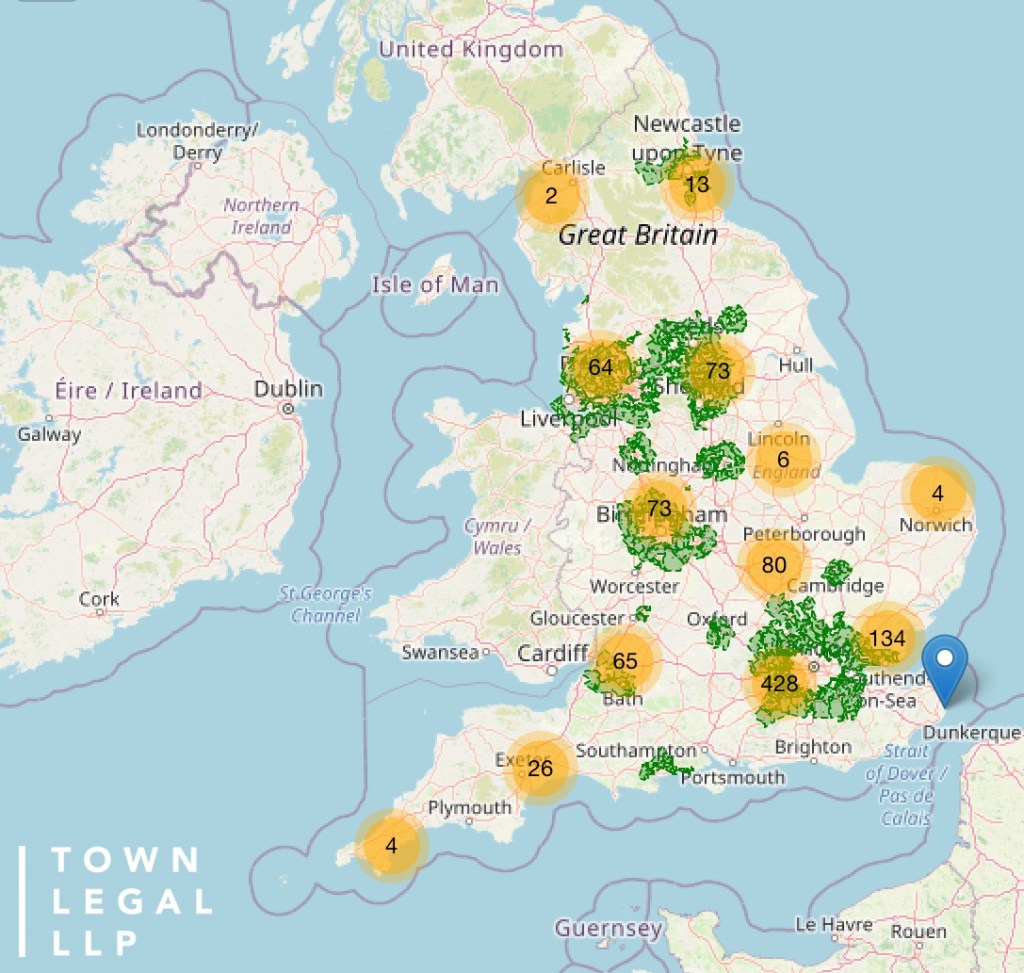
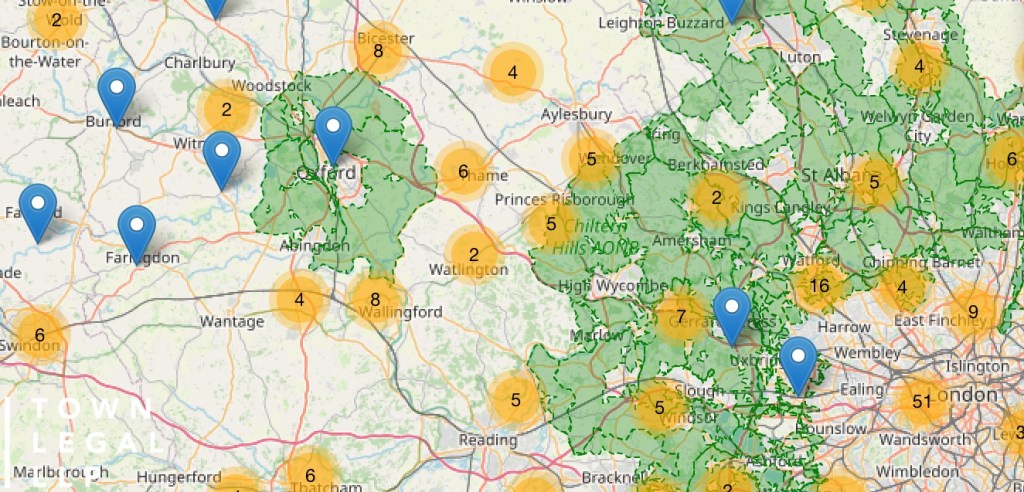
We launched Mapped Appeal Decisions today.

It’s a click-through interactive map that seeks to show the location of every planning appeal decision in England made between 1 January 2017 and 12 December 2021 following a public inquiry, with links to the relevant decision letter. Best viewed on a proper screen!

The data is drawn from our weekly Town Library planning appeal decisions updates over the period (free subscription still available via the link) and for all this work we at Town Legal are very grateful both to the Planning Inspectorate for the information publicly available on its website, which makes these sorts of applications possible, to OpenStreetMap for the base mapping and of course to our friends Simmons Wavelength for the legal engineering (in particular Joy Bradley for pitching the initial idea to me last year).

Any feedback would be very helpful. So far the extent of Green Belt across the country is shown on the map base but of course the possibilities are almost limitless.

Health warning: there are some decision letters where a postcode is not shown for the relevant site – they are not currently shown on the map. If you spot any other glitches do let me know.

Feel free to share the link or indeed this post with colleagues.

The only other thing I am going to mention in this week’s very short blog post is, as always, clubhouse Planning Law Unplanned. This Tuesday, 18 January at 6pm, the subject is SECRET WORLD OF BARRISTERS’ CHAMBERS, with as our guests, Paul Coveney (senior clerk, Francis Taylor Building), Marie Sparkes (head of business development and marketing, Keating Chambers), Gary Smith (chief clerk, Kings Chambers) and Mike Gooch (senior practice manager, Landmark Chambers). Everything you ever wanted to know but never dared to ask…

A link to the clubhouse app and event is here.

Simon Ricketts, 14 January 2022

Personal views, et cetera

The Very Specials

What are “very special circumstances” which may justify the grant of planning permission for inappropriate development in the green belt?

Of course there is no definitive answer to that question. As set out in the National Planning Policy Framework (this is about application of national policy, rather than a matter of legislation), it is for the decision maker to determine whether the potential harm to the green belt by way of inappropriate development (the NPPF defines what is “inappropriate”) is “clearly outweighed by other considerations”.

I highlighted the difficulties of calibrating terms such as “very special circumstances” and (the test for changing green belt boundaries by way of plan making) “exceptional circumstances” in my 9 May 2020 blog post Zen & The Art Of Very Special Circumstances and also referred to a number of recent decisions.

We have now had more.

Colney Heath

Much has of course been written about the inspector’s decision letter dated 14 June 2021 in relation to a proposed residential development in Colney Heath, Hertfordshire (see eg my 19 June 2021 blog post People In Houses…).

I thought I would briefly point to the following other examples:

Focus School, Stoke Poges

This was an inspector’s decision letter dated 24 May 2021 relating to proposed works to a listed school, comprising “erection of a multi-purpose space and ancillary rooms, removal of existing modular classrooms, creation of a new footpath link with Khalsa Academy, creation of temporary construction access on School Lane and related landscaping, SUDS and other drainage works and associated works to 6 no. TPO trees.”

These were the inspector’s conclusions on “very special circumstances”:

“33. The proposal would be inappropriate development in the Green Belt. The Framework establishes that substantial weight should be given to any harm to the Green Belt, and development should not be approved expect in very special circumstances. In addition, I have found that the scheme would also have a modest adverse impact on the openness of the Green Belt and the significance of the listed building. Very special circumstances will not exist unless the harm to the Green Belt and any other harm are clearly outweighed by other considerations.

34. The other considerations before me are substantial and carry significant weight. I am satisfied that the need for the proposal to provide additional accommodation at the school for exams, assemblies and PE has been clearly demonstrated. Paragraph 94 of the Framework gives great weight to the need to expand or alter schools and pupils at the school are currently severely disadvantaged by inadequate facilities at Pioneer House. I am satisfied that there are no alternative locations within the existing building or alternative development proposals that could satisfy this need but result in less Green Belt harm or other material harm.

35. The harm to the significance of the listed building would be less than substantial, with reference to paragraph 196 of the Framework. Paragraph 193 of the Framework establishes that great weight should be given to the conservation of a heritage asset. The statement of common ground establishes that the Council is satisfied that the harm to the listed building would be significantly outweighed by the public benefits that the proposal would bring to the Academy as an educational facility, through the improved facilities it would deliver and improvements to how the Academy operates, and the experience it provides for its pupils. I see no reason to take a contrary view. I am therefore satisfied that the benefits of the proposal, which are significant benefits of a public nature, clearly outweigh the less than substantial level of harm.

36. I find that the other considerations in this case clearly outweigh the harm that I have identified. Looking at the case as a whole, I consider that very special circumstances exist which justify the development.”

Land west of Wingates Industrial Estate, Wimberry Hill Road, Westhoughton, Bolton (ref: 3253244 – 21 June 2021)

This was a decision of the Secretary of State in relation to an application, that he had called in, for a large employment development which Harworth Group had made to Bolton Metropolitan Borough Council. Bolton had resolved to grant planning permission on 10 January 2020. As described by the inspectors, B J Sims BSc (Hons) CEng MICE MRTPI and D M Young JP BSc (Hons) MA MRTPI MIHE:

The Part A outline development concept is to form an extension to the Wingates Industrial Estate where the stated intention of the Applicant Company is to create a high quality employment park incorporating the range of uses described in the application and providing 100,000sqm of floorspace.

The Part B full application is to first remove some timber animal shelters and then to create the site access and form development platforms. This is in anticipation of future proposals for buildings, including one very large scale, key storage and distribution warehouse and a number of smaller units in a range of sizes. The detailed Part B works would also include boundary landscaping works and the creation of an ecological enhancement area at the north western end of the site.”

Other proposals were considered by the same panel of inspectors at four separate inquiries including the Symmetry Park proposal referred to below.

These were the Secretary of State’s conclusions on “very special circumstances”:

“33.For the reasons given above, the Secretary of State considers that the application is not in accordance with Policies CG7AP, CG1,CG3 and OA3 of the development plan, and is not in accordance with the development plan overall. He has gone on to consider whether there are material considerations which indicate that the proposal should be determined other than in accordance with the development plan.

34.The material considerations which weigh against the proposal are the harm to the Green Belt and the landscape and visual impacts. The Secretary of State affords the Green Belt harm substantial negative weight and the landscape and visual harm significant negative weight.

35.The Secretary of State considers that the evident need for development of the type proposed carries substantial weight, and the economic benefits of the proposal carry very substantial weight in favour of the scheme. He considers that the benefits of effective landscape mitigation, a net gain in biodiversity, sustainable drainage to obviate flooding concerns, off site highway works to accommodate generated traffic, new or diverted footpaths where affected by the development, improved bus services and enhanced pedestrian and cycle access to the site each carry limited weight.

36.The Secretary of State has considered whether the harm to the Green Belt by reason of inappropriateness, and the other harms he has identified, are clearly outweighed by other considerations. Overall, the Secretary of State considers that the economic and other benefits of the proposal are collectively sufficient to outweigh the harm to the Green Belt and to the landscape such that very special circumstances exist to justify permitting the development.

37.For the reasons given above the Secretary of State considers that the material considerations in this case indicate a decision other than in accordance with the development plan.

38.The Secretary of State therefore concludes that planning permission should be granted.”

Symmetry Park, Junction 25 of the M6, Wigan (ref: 3253242 – 21 June 2021)

This was another call-in decision, following an inquiry held by the same inspectors, into proposals submitted by Tritax Symmetry Limited to Wigan Metropolitan Borough Council, “for the demolition of existing buildings and reprofiling of the site for development comprising:

• Full planning permission for the erection of 27,871 square metres of employment floor space (Use Class B8 with ancillary integral Use Class B1a floor space), comprising two units and the provision of associated infrastructure including sub-station, car parking, landscaping, access from the A49 roundabout and internal estate road; and

Outline planning permission for the erection of up to 106,095 square metres of employment floor space (Use Class B8 with ancillary integral Use Class B1a floor space), including car parking, internal estate road and landscaping. All matters except for access are reserved, with access proposed from the A49 roundabout.”

Wigan had resolved to grant planning permission in January 2020.

These were the Secretary of State’s conclusions on “very special circumstances”:

41.For the reasons given above, and in the light of his conclusion in paragraph 43 of this letter, the Secretary of State finds no conflict with development plan policies, and thus concludes that the application is in line with the development plan overall. He has gone on to consider whether there are material considerations which indicate that the proposal should be determined other than in accordance with the development plan.

42.The material considerations weighing against the proposal are the definitional harm to the Green Belt by virtue of inappropriate development, the limited and localised harm to Green Belt openness and the moderate harm from encroachment into the countryside. The Green Belt harm carries substantial weight. Also weighing against the proposal is the moderate visual and landscape harm, which carries moderate weight.

43.Weighing in favour of the proposal are the delivery of logistics floorspace which he accords very substantial weight. The locational benefits carry further significant weight. The socio-economic benefits also carry substantial weight. The biodiversity net gain and highway benefits collectively attract moderate weight.

44.The Secretary of State has considered whether the harm to the Green Belt by reason of inappropriateness, and the other harms he has identified, are clearly outweighed by other considerations. Overall, the Secretary of State considers that the economic and other benefits of the proposal are collectively sufficient to outweigh the harm to the Green Belt and to the landscape such that very special circumstances exist to justify permitting the development. As such he finds no conflict with CS Policy CP8 or Green Belt policy in Section 13 of the Framework.

45.Overall the Secretary of State considers that the material considerations in this case indicate a decision which is in line with the development plan – i.e. a grant of permission.

46.The Secretary of State therefore concludes that planning permission should be granted.”

We will continue to see decisions like this, and those referred to in my blog post last year, for so long as local plans do not properly meet the needs for development and/or manage green belt boundaries, although:

⁃ the value of call-ins versus the cost and delays arising may be another question, and

⁃ It is a brave local authority that even attempts to plan for release – see e.g. Green Belt housing plans approved by councillors (Enfield Dispatch, 12 June 2021) and the surrounding brouhaha.

Meanwhile of course the rather dull debate continues as to whether there should be a proper reconsideration of green belt policy – dull only because it is clear how politically toxic (and therefore utterly hypothetical as an idea, whatever its merits) this would be. The HCLG Select Committee’s June 2021 report The future of the planning system in England recommended:

“We agree with evidence that called for the protection of the green spaces in the Green Belt; whilst also recognising that not all Green Belt land are green spaces. A review should examine the purpose of the Green Belt, including whether it continues to serve that purpose, how the public understand it, what should be criteria for inclusion, and what additional protections might be appropriate. The creation of new Local Plans also provides an opportunity for local reviews of Green Belts and the Government should help identify those local authorities where such reviews are particularly urgent. Local Plans can also relieve pressure on Green Belts by prioritising developments on brownfield sites. The Government should ensure there is sufficient funding provided to support their decontamination.”

That recommendation was roundly rejected by housing minister Christopher Pincher in the House of Commons on 14 June 2021:

We are committed not only to protecting the green belt but to enhancing it, and those protections will remain in force when we bring in planning reforms. I can assure you, Mr Speaker, that we will not be taking the advice of the Select Committee, which suggested that we should undertake a wholesale reform of the green belt. We have committed to protect it, and so we shall, because only in exceptional circumstances may a local authority alter a green-belt boundary, using its local plan and consulting local people on where essential new housing should go, and it needs to show real evidence that it has examined all other reasonable options before proposing to release the green belt. We are committed to the green belt, and we will fight for it.”

i.e. , when it comes to any green belt reform, the Government will continue to…

Do Nothing.

Simon Ricketts, 25 June 2021

Personal views, et cetera

This week’s Clubhouse Planning Law Unplanned session will be at 5pm on Monday, so as not to draw too many people from the Tuesday evening football. We celebrate Pride month with Planning with Pride. There will be a series of special guests from the planning world, curated by my Town colleague Spencer Tewis-Allen. We would love your support. An invitation to the app and event is here.

People In Houses…

…really don’t want other people to have houses, do they?

FT, 19 June 2021
Times, 19 June 2021
Telegraph, 19 June 2021

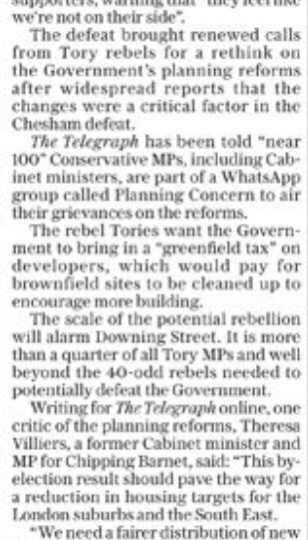
The prime minister can hardly be surprised when the affluent home-owning constituents of Chesham and Amersham register a protest vote against his plans for change, thinking that in some way he is coming for their beautiful part of the country, even though it bristles with statutory protections from development. First there has been the insensitivity with which HS2 has been forced through the Chilterns AONB with the case for longer tunnelling rejected (see my 30 July 2016 blog post HS2: The Very Select Committee) and secondly, as hitherto loyal Conservatives, they will have taken the prime minister at his word when with typical hyperbole he said in his foreword to last August’s white paper:

“Thanks to our planning system, we have nowhere near enough homes in the right places. People cannot afford to move to where their talents can be matched with opportunity. Businesses cannot afford to grow and create jobs. The whole thing is beginning to crumble and the time has come to do what too many have for too long lacked the courage to do – tear it down and start again.

That is what this paper proposes.

Radical reform unlike anything we have seen since the Second World War.

Not more fiddling around the edges, not simply painting over the damp patches, but levelling the foundations and building, from the ground up, a whole new planning system for England.”

“And, above all, that gives the people of this country the homes we need in the places we want to live at prices we can afford, so that all of us are free to live where we can connect our talents with opportunity.

Getting homes built is always a controversial business. Any planning application, however modest, almost inevitably attracts objections and I am sure there will be those who say this paper represents too much change too fast, too much of a break from what has gone before.

But what we have now simply does not work.

So let’s do better. Let’s make the system work for all of us. And let’s take big, bold steps so that we in this country can finally build the homes we all need and the future we all want to see.”

How easy it must be for other parties and for campaign groups to scaremonger when such coarse analogies are used – war, tearing things down, levelling foundations, building from the ground up.

The paper itself was not nearly as radical as the foreword would suggest and we have seen no further detail since. And so he is now on the defensive:

The Independent, 18 June 2021

“What we want is sensible plans to allow development on brownfield sites. We’re not going to build on greenbelt sites, we’re not going to build all over the countryside.”

[What does this even mean? Of course there will continue to be green field development, and of course some green belt development – as there is under the current system].

This is such an unnecessarily controversial issue, carelessly caused, cynically amplified. The planning system doesn’t need to be torn up and was never going to be torn up. But where have the ministers been to explain, to persuade, to engage? Instead, a resounding, almost embarrassed, silence since that August 2020 white paper. The news vacuum as to the form that changes are likely to take has of course been filled with media speculation and campaigners’ characterisations which have now served to make the whole question more political than it ever needed to be.

We all know that what is needed is for the current planning system to work better, largely through clearer carrot and stick policies, through specific process improvements and simplifications – and with better resourcing. So as to deliver, yes, more homes, yes economic growth, yes in a planned way, yes meeting environmental and social, not just economic, goals. But none of that’s going to happen now is it? Because politics is all about retaining power, and planning is dependent on politics. So if you are relying on the planning system to enable you to move out of your parents’ house or out of an HMO; to start a family, or to grow a business, you know what? Your needs don’t matter. Not against the needs of a politician who doesn’t want to be the next Peter Fleet.

All this of course means that the current system needs to continue to work as best it can. The good news is that at least this week we had that Colney Heath appeal decision letter to demonstrate that the entire system is in fact not in total meltdown. If an area is without an up to date plan, with a severe unmet housing need, with need for affordable housing and for sites for self build homes, planning permission may be granted even if the land is, horror of horrors, politicians look away, green belt. My firm Town (well, my colleague Paul Arnett) was pleased to play at least a small role in the appeal as planning solicitors for the appellant, negotiating a section 106 agreement with the St Albans and Welwyn Hatfield councils that secured a commitment that 45% of the 100 homes proposed would be affordable housing and 10% would be self-build, delivering a strategy first formulated by Chris Young QC and developed and implemented at the inquiry itself by Zack Simons (who kindly brought us onto the team). Russell Gray at Woods Hardwick was the lead planning witness and coordinated the team.

Inspector Christa Masters determined that the following were “very special circumstances” that justified inappropriate development in the green belt:

provision of market housing

“I am aware of the Written Ministerial Statement of December 2015 which indicates that unmet need is unlikely to clearly outweigh harm to Green Belt and any other harm so as to establish very special circumstances. However, in common with the appeal decision referred to, I note that this provision has not been incorporated within the Framework which has subsequently been updated and similar guidance within the Planning Practice Guidance has been removed. I can therefore see no reason to give this anything other than little weight as a material consideration.

It is common ground that neither SADC or WHBC can demonstrate a five year supply of deliverable homes. Whilst there is disagreement between the parties regarding the extent of this shortfall, the parties also agreed that this is not a matter upon which the appeals would turn. I agree with this position. Even taking the Councils supply positions of WHBC 2.58 years and SADC at 2.4 years, the position is a bleak one and the shortfall in both local authorities is considerable and significant.

There is therefore no dispute that given the existing position in both local authority areas, the delivery of housing represents a benefit. Even if the site is not developed within the timeframe envisaged by the appellant, and I can see no compelling reason this would not be achieved, it would nevertheless, when delivered, positively boost the supply within both local authority areas. From the evidence presented in relation to the emerging planning policy position for both authorities, this is not a position on which I would envisage there would be any marked improvement on in the short to medium term. I afford very substantial weight to the provision of market housing which would make a positive contribution to the supply of market housing in both local authority areas.”

⁃ provision of self-build

“In common with both market housing and affordable housing, the situation in the context of provision of sites and past completions is a particularly poor one. To conclude, I am of the view that the provision of 10 self build service plots at the appeal site will make a positive contribution to the supply of self build plots in both local planning authority areas. I am attaching substantial weight to this element of housing supply.”

⁃ provision of affordable housing

“The uncontested evidence presented by the appellant on affordable housing for both local authorities illustrates some serious shortcomings in terms of past delivery trends. In relation to WHBC, the affordable housing delivery which has taken place since 2015/16 is equivalent to a rate of 23 homes per annum. The appellant calculates that the shortfall stands in the region of 4000 net affordable homes since the 2017 SHMA Update, a 97% shortfall in affordable housing delivery. If the shortfall is to be addressed within the next 5 years, it would required the delivery of 1397 affordable homes per annum. In SADC, the position is equally as serious. Since the period 2012/13, a total of 244 net affordable homes have been delivered at an average of 35 net dwellings per annum. Again, this equates to a shortfall also in the region of 4000 dwellings (94%) which, if to be addressed in the next 5 years, would require the delivery of 1185 affordable dwellings per annum.

The persistent under delivery of affordable housing in both local authority areas presents a critical situation. Taking into account the extremely acute affordable housing position in both SADC and WHBC, I attach very substantial weight to the delivery of up to 45 affordable homes in this location in favour of the proposals.”

I recommend Zack’s 15 June 2021 blog post Notes from the Green Belt: what’s so very special about Colney Heath?

I also recommend Chris’ earlier paper Winning an inquiry: it’s the benefits, stupid.

More decisions such as Colney Heath are inevitable where authorities, admittedly struggling at times with a sclerotic local plans system, fail to deliver, which of course makes this scaremongering about a new planning system so nonsensical.

Topically, at 6pm this Tuesday 22 June our Clubhouse Planning Law, Unplanned theme is “How can we build enough, affordable, housing?”. Our special guests are Chris Young QC, Nick Walkley (ex Homes England chief executive), Claire Dickinson (director, Quod) and Ric Frankland (founder, wudl.). Please join us. A free link to the app and event is here.

Simon Ricketts, 19 June 2021

Personal views, et cetera

Zen & The Art Of Very Special Circumstances

“The past exists only in our memories, the future only in our plans. The present is our only reality. The tree that you are aware of intellectually, because of that small time lag, is always in the past and therefore is always unreal. Any intellectually conceived object is always in the past and therefore unreal. Reality is always the moment of vision before the intellectualization takes place. There is no other reality.”

Zen and the Art of Motorcycle Maintenance by Robert M Pirsig is a powerful but infuriating book, part fictionalised roadtrip autobiography, part philosophical discourse. Back when I was prepared to read something I didn’t really understand without first having an engagement letter in place, I absolutely loved it.

The book has become an unlikely cultural icon.

As has the green belt, which might have been treated in the book something like this:

What is the green belt and why do people write it as “the Green Belt”? He explained that the green belt is not singular but plural; it was originally described as a girdle rather than a belt, and is better described as a series of urban containment zones. Much of the land within the green belt is not green; much greenfield land (which can include land which is brown but not brownfield) is not within the green belt, and beyond the green belt was originally white land, which was of course never white. To pronounce land to be green belt is so powerful that many people sense that to refer to it as green belt rather than Green Belt is somehow inadequate or disrespectful, notwithstanding usual grammatical rules (a phenomenon which we also experience with references to Inspectors and Inquiries, and, oddly, Counsel).

How do I find the green belt? He sighed. One cannot find it by looking. Its defining features are present by their absence. Instead its existence can only be determined by opening up the relevant development plan, or rather, because the plan is not a plan, the policies map which is not part of the plan (and indeed the green belt around York is defined by an abolished plan which has no map with defined boundaries). Its quality of openness indeed has been determined by the Supreme Court [proper noun] as a quality which can not necessarily be seen.

He sighed again. Green belt was the yin and new towns were to be the yang.

A local planning authority may only make changes to a green belt boundary if there are “exceptional circumstances” and may only grant planning permission for inappropriate development in the green belt if there are “very special circumstances”. The qualifying adjectives are uncalibrated, so the courts have had to make the best of it (my 27 January 2018 blog post Expletive Deleted: Revising Policy was all about these sorts of linguistic problems). We have of course the Calverton ruling on “exceptional circumstances” and Dove J’s more recent ruling in the Guildford local plan case (covered in episode 6 of Heather Sargent’s planning law video podcast series Planning Law Tea Break and in Zack Simons’ #planoraks blog post Guildford’s Local Plan and “exceptional circumstances” (29 March 2020)).

As Dove J made clear in the Guildford case,

“Exceptional circumstances” is a less demanding test than the development control test for permitting inappropriate development in the Green Belt, which requires “very special circumstances.”

He can only derive this from the policy context though, not the words. Is something exceptional less rare or valuable than something which is very special? My policy test calibrator, part-constructed in the garage, would have a dial to 10. Overcoming a normal presumption is anything over 5. Exceptional is, what, about 7, maybe 8, depending on circumstances? Where do you place very special? 8.5 or 9? Of course this is largely nonsense but people trot out the tests, and understandably ask, as if there is an actual answer.

More basically why don’t we have a formulation such as “wholly exceptional circumstances” rather than “very special circumstances”? After all, we do when it comes to heritage (see the contrast between NPPF paras 194(a) and (b)). Well only because the original 1955 ministerial Circular used the term “very special circumstances”:

“Inside a green belt, approval should not be given, except in very special circumstances, for the construction of new buildings or for the change of use of existing buildings for purposes other than agriculture, sport, cemeteries, institutions standing in extensive grounds, or other uses appropriate to a rural area”.

Slightly embellished (particularly in relation to limited infilling and the redevelopment of previously developed land), this language is still recognisable in NPPF para 145.

There is a second level of uncertainty with the use of these tests: not only is the linguistic calibration imprecise, but it is for the decision maker to determine, with adequate reasoning (which may be very basic and not really susceptible to challenge), whether the circumstances are sufficiently “exceptional” or “special”.

Of course the reality is that the fuzziness is deliberate. It allows decision makers, whether the Government or local planning authorities, some necessary wriggle room.

Some recent decisions on “very special circumstances”:

North of Boroughbridge Road, York – inspector’s decision letter 23 October 2019

In finding “very special circumstances” the inspector appears to have relied upon the fact that the site did not fulfil any of the green belt “purposes”, was identified for release for housing in the emerging local plan and that the site would deliver 266 market and affordable homes. The housing land supply in York is well under 5 years (although of course the tilted balance does not apply in relation to green belt proposals).

Since former planning minister Brandon Lewis’s 17 January 2014 ministerial statement we have been wary about relying solely on housing need:

“I also noted the Secretary of State’s policy position that unmet need, […] for conventional housing, is unlikely to outweigh harm to the green belt and other harm to constitute the “very special circumstances” justifying inappropriate development in the green belt.”

The statement has not formally been revoked, so, back to that deliberate fuzziness, here “unlikely” is still the get out word in that it allows for exceptions (where is “unlikely” on the policy test calibrator?), or identifying something other than solely housing need to throw into the scales to assist the “very special circumstances” argument.

Seashell Trust – Stanley Road, Cheadle Hume, Stockport – Secretary of State’s decision letter 22 April 2020

“The Secretary of State considers the need for the redevelopment of the Special Educational Need school carries substantial weight, the housing benefits overall carry very significant weight, and the provision of employment and community benefits each carry moderate weight.

The Secretary of State considers that the above benefits clearly outweigh the harm to the Green Belt by reason of inappropriateness and any other harm, and so very special circumstances exist to justify this development in the Green Belt.”

Oxford Brookes University – Wheatley Campus, College Close, Wheatley, Oxford – Secretary of State’s decision letter 23 April 2020

“The Secretary of State considers that the significant visual benefit to openness over a wide area of the South Oxfordshire Green Belt [by removal of a tower and other large, unsightly structures on the site] and the delivery of up to 500 houses, 173 of which would be affordable, are both considerations that carry very substantial weight.”

West Midlands Rail Freight Interchange DCO – Secretary of State’s decision letter 4 May 2020

“67. The Secretary of State agrees with the Examining Authority that the strategic benefits of the Proposed Development in contributing to an expanded network of SRFIs would assist in achieving and promoting a modal shift of freight from road to rail, thereby playing an important part in the move to a low carbon economy. These benefits are such that they outweigh the adverse impacts identified in relation to the construction and operation of the Proposed Development (ER 9.3.1).

68. The Secretary of State notes and agrees with the Examining Authority that the national and regional need for the proposed development outweighs any harm. He therefore agrees with the Examining Authority that the very special circumstances needed to justify a grant of development consent have been demonstrated (ER 9.2.4).”

Recommended further media:

⁃ My 30 March 2018 blog post Green Belt Developments (although this was before the Supreme Court overturned the Court of Appeal in the Samuel Smith “openness” case)

Five circumstances ‘exceptional’ enough to justify green belt release in local plans, Stuart Watson, Planning (7 May 2020, £)

⁃ 50 Shades of Planning Podcast – Green Belt. Sacred Cow (22 April 2020)

⁃ (As always) John Grindrod’s book Outskirts. (Now, Mr Pirsig, that’s how you write a part autobiography, part treatise on the history of the green belt, life and everything.)

Simon Ricketts, 9 May 2020

Personal views, et cetera

Great Buddha of Kamakura, Japan.

Housing Schemes Approved By Secretary Of State In April 2020

Five out of five proposals for housing development have been approved by the Secretary of State so far in April 2020, in each instance in accordance with his inspectors’ recommendations.

Chronologically:

1 April – Vauxhall Cross Island, Lambeth

The Secretary of State approved a called in application for “the construction of a mixed-use development comprising two towers of 53 storeys (185m) and 42 storeys (151m), with a connecting podium of 10 storeys (49m), containing office (B1), hotel (C1), residential (C3) and flexible ground floor retail and non-residential institution (A1/A2/A3/A4/D1) uses plus plant, servicing, parking and other ancillary space, the provision of hard and soft landscaping, the creation of a new vehicular access point on Wandsworth Road, a vehicular layby on Parry Street and other works incidental to the development”.

“The proposal would deliver 257 homes onsite, including 23 affordable, alongside a Section 106 payment of £30m for further off-site affordable housing provision. The Secretary of State notes that, citing LB Lambeth’s past record of utilising such payments, the Inspector was satisfied this would deliver a further 54 homes and provide a total of 30% affordable… The Secretary of State notes that a viability assessment demonstrated that this was the maximum amount achievable, and was accepted by LB Lambeth.”

The Secretary of State found that the proposals would be in accordance with the development plan. The market and affordable housing components of the scheme attracted “significant weight in favour. There would also be hotel, office and retail uses in an area identified for all three, alongside a new public square. All of these would contribute to the development plan’s goal of creating a new district centre in Vauxhall. This also attracts substantial weight in favour.

(Town acted for the applicant).

1 April – Station Road, Long Melford, Suffolk

The Secretary of State allowed an appeal by Gladman Developments Limited for “outline planning permission for the erection of up to 150 dwellings with public open space, landscaping and sustainable drainage system (SuDS), and vehicular access point from Station Road, with all matters reserved except means of access”.

The Secretary of State found that the proposals were not in accordance with the development plan. In terms of other material considerations:

“The site is outside the settlement boundary, and would result in the development of a greenfield site into housing, which would cause visual harm. However, the settlement boundary is out of date, and the visual harm would be confined to the site itself, with limited impact on the wider settlement. This carries moderate weight against the proposal.

The proposal would provide up to 150 new homes, including around 53 affordable homes. Although the local authority can now demonstrate a supply of housing land above 5 years, this figure is a baseline and not a ceiling. Relevant to this appeal, the appellant has demonstrated there is a local need in this settlement, in line with the expectations of the development plan, for both market and affordable housing. The Secretary of State recognises that there is now a five-year supply of housing land supply. However, in the light of the identified local need, and the Government’s objective of significantly boosting the supply of homes (Framework paragraph 59), he considers that the housing delivery should carry significant weight. The proposal would provide land for a new early years centre, which attracts significant weight in favour. There would be economic benefits provided by the construction of the homes and from the new residents, which attract moderate weight. Improvements to existing public rights of way, public space and play areas, and biodiversity benefits each attract moderate weight in favour. Improvements to bus stops and footway connections attract limited weight in favour.”

7 April – Barbrook Lane, Tiptree, Colchester

The Secretary of State allowed an appeal by Gladman Developments Limited (again) for “outline planning permission for the development of up to 200 dwellings (including 30% affordable housing), provision of 0.6ha of land safeguarded for school expansion, new car parking facility, introduction of structural planting and landscaping and sustainable drainage system (SuDS), informal public open space, children’s play area, demolition of 97 Barbrook Lane to form vehicular access from Barbrook Lane, with all matters to be reserved except for access”.

The Secretary of State found that the proposals were not in accordance with the development plan. In terms of other material considerations:

“As the local authority are unable to demonstrate a five-year supply of housing land, paragraph 11(d) of the Framework indicates that planning permission should be granted unless: (i) the application of policies in the Framework that protect areas or assets of particular importance provides a clear reason for refusing the development proposed; or (ii) any adverse impacts of doing so significantly and demonstrably outweigh the benefits, when assessed against policies in the Framework taken as a whole.

The proposal is an undeveloped agricultural site outside the settlement boundary, and the rural character of the site would change. This carries moderate weight against the proposal.

The proposal would provide up to 200 dwellings, with 30% affordable, helping the local planning authority achieve a five-year supply of housing land. This attracts significant weight in favour of the proposal. The proposal includes informal open space and safeguarded land for a school expansion, which carry limited weight. Although the site would change from rural to a housing estate, there would be little wider impact on the setting of the village as the site is well-screened. The scale of the proposal would not harm or prejudice local services, highways or residential amenity, and the site represents a sustainable location for access to jobs and services.

The Secretary of State considers that there are no protective policies which provide a clear reason for refusing the development proposed. The Secretary of State considers that the adverse impacts of the proposal do not significantly and demonstrably outweigh the benefits.”

22 April – Stanley Road, Cheadle Hume, Stockport

The Secretary of State allowed an appeal by the Seashell Trust “for the erection of a new school with associated kitchen and dining facilities, swimming and hydrotherapy facilities, infrastructure, drop-off parking, access, landscaping and ancillary works; the demolition of the Chadderton building, Orchard/Wainwright/Hydrotherapy/Care block, Dockray building, part of existing college, 1 Scout Hut and 1 garage block, and erection of new campus facilities (Use Class D1/D2 – Reception, Family Assessment Units, Family Support Services/Administration/Training/Storage Facility Sports Hall and Pavilion) with associated infrastructure, parking, landscaping and ancillary works; and up to 325 dwellings (Use Class C3) in northern fields with associated infrastructure, parking, access, landscaping and ancillary works”.

The site is in the green belt and the Secretary of State found that the proposals were not in accordance with the development plan. However, these were his overall conclusions:

“As Stockport Borough Council cannot demonstrate a five year housing land supply, paragraph 11(d) of the Framework indicates that planning permission should be granted unless: (i) the application of policies in the Framework that protect areas or assets of particular importance provides a clear reason for refusing the development proposed; or (ii) any adverse impacts of doing so significantly and demonstrably outweigh the benefits, when assessed against policies in the Framework taken as a whole.

The Secretary of State considers that the harm to the Green Belt carries substantial weight, the ‘less than substantial’ harm to the setting of the listed building carries great weight and harm to the landscape carries moderate weight. The Secretary of State considers the proposal will harm agricultural land, habitat, non-designated heritage assets and demand for mainstream school places and attributes very limited weight to each of these harms.

The Secretary of State considers the need for the redevelopment of the Special Educational Need school carries substantial weight, the housing benefits overall carry very significant weight, and the provision of employment and community benefits each carry moderate weight.

The Secretary of State considers that the above benefits clearly outweigh the harm to the Green Belt by reason of inappropriateness and any other harm, and so very special circumstances exist to justify this development in the Green Belt. In the light of his conclusion on this and the heritage test is paragraph 18 above, the Secretary of State considers that there are no protective policies which provide a clear reason for refusing the development proposed and further considers that the adverse impacts do not significantly and demonstrably outweigh the benefits, when assessed against the policies in the Framework taken as a whole. Paragraph 11(d) of the Framework therefore indicates that planning permission should be granted.”

Paul Tucker QC led the case for the appellant and this is a statement on the decision published by Kings Chambers.

23 April – Wheatley Campus, College Close, Wheatley, Oxford

The Secretary of State allowed an appeal by Oxford Brookes University for outline planning permission for “demolition of all existing structures and redevelopment of the site with up to 500 dwellings and associated works including; engineering operations, including site clearance, remediation, remodelling and deposition of inert fill material arising from demolition on site; installation of new and modification of existing services and utilities; construction of foul and surface water drainage systems, including SuDS; creation of noise mitigation bund and fencing; creation of public open space, leisure, sport and recreation facilities including equipped play areas; ecological mitigation works; construction of a building for community/sport use and associated car parking; construction of internal estate roads, private drives and other highways infrastructure and construction of pedestrian footpaths”.

Again this is a green belt site. Whilst the Secretary of State agreed with the inspector that the appeal should be allowed, he differed as to his reasoning. I set out the Secretary of Statement’s application of the planning balance and overall conclusions as follows:

“For the reasons given above, the Secretary of State considers that the appeal scheme is in accordance with the following policies of the development plan: CS Policy CSEN2, LP Policy GB4. He has identified an overall benefit to heritage assets, so has found no conflict with heritage policies CSEN3, CON5 and CON11. He has found no conflict with CS Policy CSEN1 or LP Policies G2, C4 and C9 insofar as they seek to protect the district’s countryside and settlements from adverse development. While he has found conflict with policies CSS1 and CSH1 regarding the amount and spatial distribution of housing, he has found these policies to be out of date. He has therefore concluded that the appeal scheme is in accordance with the development plan overall. He has gone on to consider whether there are material considerations which indicate that the proposal should be determined other than in accordance with the development plan.

At IR13.118, the Inspector, having concluded that the proposed development would not conflict with the development plan, states that it should be approved without delay in accordance with paragraph 11c) of the Framework. The Secretary of State disagrees. Paragraph 11 c) of the Framework refers to “development proposals that accord with an up-to-date development plan”. As the Secretary of State has concluded that the policies which are most important for determining this appeal are out-of-date, he considers that paragraph 11 c) of the Framework does not apply.

Paragraph 11(d) of the Framework indicates that planning permission should be granted unless: (i) the application of policies in the Framework that protect areas or assets of particular importance provides a clear reason for refusing the development proposed; or (ii) any adverse impacts of doing so significantly and demonstrably outweigh the benefits, when assessed against policies in the Framework taken as a whole.

The Secretary of State considers the harm to the Green Belt on that part of the site where development is considered inappropriate carries substantial weight.

The Secretary of State considers that the significant visual benefit to openness over a wide area of the South Oxfordshire Green Belt and the delivery of up to 500 houses, 173 of which would be affordable, are both considerations that carry very substantial weight.

The Secretary of State considers that the economic benefits of the scheme should be afforded significant weight.

The Secretary of State has considered the development in terms of its impact on heritage assets and on accessibility and considers that both offer benefits that should be afforded significant weight.

The net benefit to biodiversity that would be delivered by the scheme is a consideration of moderate weight, and the reinvestment of the proceeds arising from the sale of the land into the education sector should be afforded significant weight.

Given his findings in this letter, the Secretary of State considers that the proposal meets the emerging Neighbourhood Plan site-specific development principles in respect of Green Belt, affordable housing and accessibility, and public open space.

Having concluded at paragraph 39 of this letter that very special circumstances exist the Secretary of State considers that there are no policies in the Framework that protect areas or assets of particular importance that provide a clear reason for refusing the development proposed. He also concludes that any adverse impacts of granting permission do not significantly and demonstrably outweigh the benefits, when assessed against policies in the Framework taken as a whole.”

Chris Young QC led the case for the appellant and this is a statement on the decision published by No 5 Chambers.

Quite a month so far!

Two quick plugs:

⁃ If on Thursday you watched the first Planning In Brief web event hosted by Charlie Banner QC, Chris Young QC, Sasha White QC, Paul Tucker QC and Town’s Mary Cook you would have heard some discussion about the Seashell Trust decision. I wouldn’t be surprised to hear some coverage of the Oxford Brookes decision this coming week. Another reason to make the charity donation and tune in.

⁃ Do subscribe to Town Legal’s weekly, comprehensive, inquiry appeal decisions updates. Subscriptions to this and our other update services are still free.

Simon Ricketts, 25 April 2020

Personal views, et cetera

Handy lockdown calendar
(H/t @instachaaz)