Delivery!

MHCLG’s announcements this week have clarified three separate issues which go to whether the “tilted balance” in paragraph 11(d) of the NPPF applies in relation to applications for planning permission for housing development.

Where the tilted balance applies, Government policy is of course that planning permission should be granted unless:

(i) the application of policies in this Framework that protect areas or assets of particular importance [being specific categories of policies set out in footnote 6 to the NPPF] provides a clear reason for refusing the development proposed; or

(ii) any adverse impacts of doing so would significantly and demonstrably outweigh the benefits, when assessed against the policies in this Framework taken as a whole.”

Two situations where the tilted balance applies are:

⁃ “where the local planning authority cannot demonstrate a five year supply of deliverable housing sites” with an appropriate buffer percentage of 5%, 10% or 20% calculated by reference to paragraph 73 of the NPPF; and

⁃ “where the Housing Delivery Test indicates that the delivery of housing was substantially below [a defined percentage of] the housing requirement over the previous three years” the defined percentage being 25% in the case of Housing Delivery Test results published in November 2018, 45% in the case of results published in November 2019 and 75% in the case of results published in November 2020 and thereafter. (Additionally, the authority needs to publish an action plan where the delivery percentage is less than 95%, “to assess the causes of under-delivery and identify actions to increase delivery in future years“).

Paragraph 177 of the 2018 NPPF disapplies the presumption in favour of sustainable development (and therefore the possibility of the tilted balance applying) where the project requires appropriate assessment under the Conservation of Habitats Regulations, which has proved problematic following the Court of Justice of the European Union’s judgment in People Over Wind, which led to far more projects requiring appropriate assessment.

This week’s announcements have clarified three things:

1. How “deliverable” is defined for the purposes of that first situation.

2. The presumption in favour of sustainable development is no longer disapplied if there is a negative appropriate assessment.

3. What the November 2018 Housing Delivery Test results are for in relation to each English local planning authority (the results not having been, er, delivered on time by MHCLG).

After a long wait, and initial indications that this would all be done before Christmas, on 19 February MHCLG published:

Government response to technical consultation on updates to national planning policy and guidance

housing delivery test 2018 measurement

further revised NPPF

The revisions to the NPPF are limited but care will be needed when referring to decisions and court rulings to be clear as to the relevant policy basis: the 27 March 2012 NPPF, the 24 July 2018 NPPF or the 19 February 2019 NPPF.

What is deliverable?

Footnote 11 to the 2012 NPPF defined “deliverable” as follows:

To be considered deliverable, sites should be available now, offer a suitable location for development now, and be achievable with a realistic prospect that housing will be delivered on the site within five years and in particular that development of the site is viable. Sites with planning permission should be considered deliverable until permission expires, unless there is clear evidence that schemes will not be implemented within five years, for example they will not be viable, there is no longer a demand for the type of units or sites have long term phasing plans.”

The degree of probability required, given the words “realistic prospect“, was considered by the Court of Appeal in St Modwen Developments Ltd v Secretary of State (Court of Appeal, 20 October 2017), where Lindblom LJ said this:

35…Deliverability is not the same thing as delivery. The fact that a particular site is capable of being delivered within five years does not mean that it necessarily will be. For various financial and commercial reasons, the landowner or housebuilder may choose to hold the site back. Local planning authorities do not control the housing market. NPPF policy recognises that…


37… Had the Government’s intention been to frame the policy for the five-year supply of housing land in terms of a test more demanding than deliverability, this would have been done…


38 The first part of the definition in footnote 11—amplified in paras 3–029, 3–031 and 3–033 of the PPG—contains four elements: first, that the sites in question should be ” available now”; second, that they should “offer a suitable location for development now”; third, that they should be ” achievable with a realistic prospect that housing will be delivered on the site within five years”; and fourth, that “development of the site is viable ” (my emphasis). Each of these considerations goes to a site’s capability of being delivered within five years: not to the certainty, or—as Mr Young submitted—the probability that it actually will be. The second part of the definition refers to “[sites] with planning permission”. This clearly implies that, to be considered deliverable and included within the five-year supply, a site does not necessarily have to have planning permission already granted for housing development on it. The use of the words “realistic prospect” in the footnote 11 definition mirrors the use of the same words in the second bullet point in paragraph 47 in connection with the requirement for a 20% buffer to be added where there has been “a record of persistent under delivery of housing”. Sites may be included in the five-year supply if the likelihood of housing being delivered on them within the five-year period is no greater than a “realistic prospect”—the third element of the definition in footnote 11 (my emphasis). This does not mean that for a site properly to be regarded as “deliverable” it must necessarily be certain or probable that housing will in fact be delivered upon it, or delivered to the fullest extent possible, within five years.”

The wording in glossary to the 2018 NPPF was made more specific:

“”Deliverable: To be considered deliverable, sites for housing should be available now, offer a suitable location for development now, and be achievable with a realistic prospect that housing will be delivered on the site within five years. Sites that are not major development, and sites with detailed planning permission, should be considered deliverable until permission expires, unless there is clear evidence that homes will not be delivered within five years (e.g. they are no longer viable, there is no longer a demand for the type of units or sites have long term phasing plans). Sites with outline planning permission, permission in principle, allocated in the development plan or identified on a brownfield register should only be considered deliverable where there is clear evidence that housing completions will begin on site within five years.”

Due to concerns as to potential ambiguity (which I didn’t really see) as to the treatment of non-major development (ie developments of less than ten homes, with a site area of less than 0.5 hectares), the wording has now been changed in the 2019 NPPF to read as follows

“Deliverable: To be considered deliverable, sites for housing should be available now, offer a suitable location for development now, and be achievable with a realistic prospect that housing will be delivered on the site within five years. In particular:

a)  sites which do not involve major development and have planning permission, and all sites with detailed planning permission, should be considered deliverable until permission expires, unless there is clear evidence that homes will not be delivered within five years (for example because they are no longer viable, there is no longer a demand for the type of units or sites have long term phasing plans).

b)  where a site has outline planning permission for major development, has been allocated in a development plan, has a grant of permission in principle, or is identified on a brownfield register, it should only be considered deliverable where there is clear evidence that housing completions will begin on site within five years

But there will remain room for argument: “realistic prospect” inevitably requires judgement and the local planning authority’s assessment as to the position of individual sites will always be potentially controversial given its interest (and/or that of objectors to development) in demonstrating an adequate supply so as to avoid the tilted balance. We will no doubt still see cases such as East Cheshire Council v Secretary of State (Deputy Judge Justine Thornton QC, 1 November 2018), East Bergholt Parish Council v Babergh District Council (Sir Ross Cranston, 7 December 2018) and (no transcript available but the link is to a useful Cornerstone summary) R (Chilton Parish Council) v Babergh District Council (Deputy Judge Robin Purchas QC, 2 February 2019.

There has also previously been much uncertainty as to the circumstances in which the new standard method for assessing local housing need should be used as the basis for assessing whether a five year supply of specific deliverable sites exists in the case of a plan with strategic policies which are more than five years old (unless those strategic policies had been reviewed and found not not to require updating). Footnote 37 in the 2019 NPPF makes clear that the standard method should indeed be used (which reflects the 5 February 2019 decision of the Secretary of State in relation to the Edenthorpe Doncaster called in application, blogged about by Lichfields on 21 February 2019).

Appropriate assessment

Hooray, paragraph 177 now reads:

The presumption in favour of sustainable development does not apply where the plan or project is likely to have a significant effect on a habitats site (either alone or in combination with other plans or projects), unless an appropriate assessment has concluded that the plan or project will not adversely affect the integrity of the habitats site.

The Housing Delivery Test

Well, the results are finally in. The housing delivery test 2018 measurement. According to analysis by Savills:

⁃ no authority is subject this time round to the tilted balance by virtue of delivering less than 25% of its housing requirement over the last three years

⁃ 86 out of 326 authorities are subject to the requirement of a 20% buffer on their five year housing land supply figure as a result of having delivered less than 85% of their housing requirement over the last three years

⁃ 107 out of 326 authorities have to prepare an action plan as a result of having delivered less than 95% of their housing requirement over the last three years.

A future blog post will deal with the “need” side of the equation…

Simon Ricketts, 23 February 2019

Personal views, et cetera

Permitted Development: Painting By Numbers Versus Painting The Sistine Chapel?

Time now to look at some of the proposals to extend permitted development rights and to amend the Use Classes Order that are set out in the Planning Reform: Supporting the high street and increasing the delivery of new homes consultation paper published alongside the Autumn budget on 29 October 2018, and strongly criticised in Nick Raynsford’s final review of planning in England (November 2018):

The government’s announcement of its intention to extend even further this permissive ‘shadow’ planning process appears to reflect its model for the future direction of the system; and this has real implications for people and for the nature of both planning and planners. This reflects the tension recorded in evidence presented to the Review as to whether planning is a form of land licensing, which implies one set of skills and outcomes, or the much more complex and creative practice of shaping places with people to achieve sustainable development. The former task is like painting by numbers; the latter is like painting the Sistine Chapel. The difference in outcomes for people is equally stark.”

I’m not sure that sort of language (describing traditional planning applications as equivalent to painting the Sistine Chapel, a spectacularly inapt comparison, or indeed TCPA interim chief executive Hugh Ellis’ language in the accompanying press release: “‘Permitted development is toxic and leads to a type of inequality not seen in the Britain for over a century.“) is helpful to the debate.

It seems to me that the two key issues which need to be addressed in relation to permitted development rights that enable additional residential development (whether by way of conversion or construction) are the need for some control at a national or local level over room sizes and the need to provide a proportion of affordable housing whether on site or by way of financial contribution. Aside from those obvious issues (not addressed in the latest consultation paper), what is wrong with the Government looking to streamline development management processes where appropriate? Surely the question is where is the appropriate dividing line. Surely deemed planning permission should be for types of development where, given the public benefit in seeking to encourage them, the local planning authority should not need to question the principle of what is proposed up to a defined scale at a particular location (with more general powers to restrict rights available by way of Article 4 Direction) and where wider issues do not arise that cannot be resolved within a 56 day period for prior approval of specified aspects which are, as far as possible, not open to differing subjective views? Don’t we need to define some sort of principle along these lines before then considering different common types of development?

Allow greater change of use to support high streets to adapt and diversify

The Government proposes that uses in classes A1 (shops), A2 (financial and professional services), and A5 (hot food takeaways) (as well as uses as betting shops, pay day loan shops and laundrettes) should be allowed to change to “office use (B1)” (do they mean “office use” or do they mean B1 which also encompasses light industrial and R&D?). Hot food takeaways will be allowed to change to residential use (C1) as is already the case with the other uses referred to. There would be the requirement for prior approval, as with existing change of use permitted development rights.

Alongside this, the current “pop up” temporary permitted development rights to change the use from shops (A1) financial and professional services (A2), restaurants and cafes (A3), hot food takeaways (A5), offices (B1), non-residential institutions (D1), assembly and leisure uses (D2), betting shops and pay day loan shops to change to shops (A1) financial and professional services (A2), restaurants and cafes (A3) or offices (B1) will be extended from two years to three years. The temporary permitted development rights are proposed now to extend to changes to certain community uses, namely as a public library, exhibition hall, museum, clinic or health centre.

All of these proposals are put forward in the context of “supporting the high street” but no geographical limitation to the proposed changes is indicated that would prevent their application to any building in the relevant use, wherever it is located – shades of the original proposal in relation to the office to residential permitted development right, which was couched in terms of underused and empty office premises, when of course the right turned out not to have any such limitation. There is no indication of any floorspace cap. Might a department store, or supermarket, turn into an office? Nor indeed any cap on the proportion of any shopping area that might be converted to offices.

The document goes on to explore whether changes could also be made to the Use Classes Order, namely to:

“simplify the A1 shops use class to remove the current named uses and allow for a broader definition of uses for the sale, display or service to visiting members of the public.”

⁃ consider whether there is “scope for a new use class that provides for a mix of uses within the A1, A2 and A3 uses beyond that which is considered to be ancillary, which would support the diversification of high street businesses. This would replace the existing A1, A2 and A3 and result in a single use class to cover shops, financial and professional services, restaurants and cafes. This would mean that movement between these uses was no longer development and not a matter for the planning system to consider. It would bring greater flexibility but reduce the ability of communities and local planning authorities to distinguish between shops and restaurant uses“.

I agree that these parts of the Use Classes Order potentially need reform (within boundaries – is it really workable for there to be no distinction at all between A1 and A3?) but can’t this be as part of broader reform of the Order? The B, C and D classes all give rise to equivalent issues in that the old distinctions between uses have become increasingly difficult to apply.

A new permitted development right to support housing delivery by extending buildings upwards to create additional homes

This idea has been around since February 2016 without civil servants arriving at draft legislation, which is surely going to be the practical test.

Looking back, I covered this proposal most recently on 13 October 2018 in my blog post The Up Right, before that in my 17 March 2017 blog post Permitted Development: À La Recherche Du Temps Perdu and before that in my 15 June 2016 blog post Permitted Development: What Next? However, this latest version of the proposals is certainly the most far-reaching.

The permitted development right would allow additional storeys to be built above buildings in a wide range of uses, including residential, retail and offices. The Government indicates:

We want to explore whether there may also be other buildings whose use is compatible with the introduction of new homes. Given they are usually located in residential areas or high streets, would premises such as health centres and buildings used for community and leisure purposes be suitable for inclusion in the permitted development right? Out of town retail parks with a mix of shopping and leisure uses may also be suitable for upward extensions to provide additional homes.”

The consultation paper asks for “examples of how this permitted development right might be used in practice, and particularly of how the use of local design codes could help to encourage take up of the proposed right and improve the design quality and acceptability of upward extensions.”

It’s sounding complicated already. Then add the question of how far upwards the permitted development right could allow development to go. The consultation paper offers two alternatives, both of which could lead to significant factual disputes:

⁃ “A permitted development right could apply to the airspace above premises in a terrace of two or more joined properties where there is at least one higher building in the terrace. The roof of the premises extending upward would be no higher than the main roofline of the highest building in the existing terrace.”

⁃ “An alternative approach would be to permit upward extensions more widely to a height no higher than the prevailing roof height in the locality. While this may extend the proposed right to a greater number of properties, it would not be possible to define prevailing roofline in regulations. Therefore it would be a matter to be considered by the local authority as part of the prior approval. In doing so, the local authority would be able to define what it considered to be the prevailing roofline taking account of the local building types and heights and the extent of the area over which it should be determined.”

To add to the complications:

Where premises are not on level ground the impact of adding additional storeys can be significantly greater on the amenity of neighbouring premises, for example from overlooking and overshadowing and on the character of the area. We would welcome views on how best to take account of the topography of specific areas.”

The consultation paper proposes that there should be a maximum limit of five storeys from ground level for a building once extended (so the extension could be up to four storeys!). But there would be an even broader permitted development right for purpose built, free standing blocks of flats of over five storeys. “The government would also like a permitted development right to apply to such buildings, and is interested in views, including whether there should be a limit on the number of additional storeys that could be added, for example 5

The permitted development right would allow for the physical works required to construct or install additional storeys on a building. It could also, for instance, allow for “works within the curtilage where it is necessary for access to the additional new homes“.

The prior approval requirements would include appearance, ie “considering whether the proposed development is of good design, adds to the overall quality of the area over its lifetime, is visually attractive as a result of good architecture, responds to the local character and history of the area and maintains a strong sense of place, as set out in paragraph 127 of the National Planning Policy Framework. We expect prior approval on design to be granted where the design is in keeping with the existing design of the building.

Prior approval would also consider the impact of the development on the amenity of neighbouring premises, for example, from obscuring existing windows, reducing access to light or resulting in unacceptable impact on neighbours’ privacy from overlooking. It would also consider measures to mitigate these impacts, and enable the neighbours, including owners and occupiers of premises impacted, to comment on the proposal.

This is asking a lot of the 56 day prior approval process – sounds like a job for a traditional planning application to me.

Finally, yet another extension of the previous proposals: “We are seeking views on whether the proposed right to build upwards to create new homes should additionally allow householders to extend their own homes.”

This all sounds like it’s on a collision course with what the Government has set in train with the establishment of the ‘Building Better, Building Beautiful‘ Commission.

The permitted development right to install public call boxes and associated advertisement consent

I may come back in a later blog post to the Government’s proposal to remove permitted development rights for the installation of public call boxes. Since earlier blog posts on the subject, I’m now off-side from commenting in detail due to acting for an electronic communications code operator, but I would briefly note that the need for additional apparatus is about enabling electronic communications both present (3G, 4G and wifi) and future (5G) rather than just being about the old phone box concept and in that respect the terminology in Part 16 and the references in the Control of Advertisements Regulations probably do need updating without throwing the baby out with the bathwater.

Supporting housing delivery by allowing for the demolition of commercial buildings and redevelopment as residential

Well this proposal dates back to October 2015! As with the upwards extensions proposal, is it simply too difficult to draft in legislative form? The wording in the consultation paper is certainly tentative:

⁃ “It may be that a right focused on smaller sites may be more practical...

⁃ Despite the Government having set its face against affordable housing requirements in relation to the office to residential permitted development right, with this right it is said that the Government “would be interested in views on how developer contributions expected towards affordable housing and other infrastructure could be secured.

⁃ “We would welcome views as to the design of a right which could operate effectively to bring sites forward for redevelopment. The responses to these questions will inform further thinking and a more detailed consultation would follow.”

To be provocative, if additional storeys of residential development are to have deemed permission, and if new residential developments are to have deemed permission if they replace commercial buildings, what is the logic for not granting deemed permission for residential development on brownfield land more generally – what is inherently more complex or controversial arising from that than from the development that could come forward under these new rights? Why the prior complications with brownfield land, but not with these other rights, of land having to be placed by a local planning authority on a register before there is permission in principle?

The deadline for consultation responses is 14 January 2019.

Simon Ricketts, 8 December 2018

Personal views, et cetera

A Helpful Case On The Scope Of Section 73

I was pleased to read Finney v Welsh Ministers (Sir Wyn Williams, 15 November 2018), or the Rhydcwmerau wind turbines case, as I hope we’ll call it for ease.

Sir Wyn Williams provides the answer to a question I raised in my 3 March 2018 blog post, A Change Is Gonna Come (But Should It Really Need A Fresh Planning Permission?): can you use a section 73 application when the changes to conditions that you are seeking also entail a change to the description of development on the previous permission?

The implied answer from Singh J in R (Wet Finishing Works Limited) v Taunton Deane Borough Council (20 June 2017) was yes but the point was not specifically addressed in his judgment. Sir Wyn Williams has to deal with the point head-on as it was one of the two grounds of challenge.

In the Rhydcwmerau wind turbines case there was a planning permission granted where the description of the development that was thereby approved was as follows:

Installation and 25 year operation of two wind turbines, with a tip height of up to 100m, and associated infrastructure including turbine foundations, new and upgraded tracks, crane hardstandings, substation, upgraded site entrance and temporary construction compound upon a site situated to the north of the village of Rhydcwmerau, Carmarthenshire

The description of development appears simply to have been incorporated in the permission by reference to the description of development on the application form, but I don’t think anything turns on that.

The permission was subject to a number of conditions. Condition 2 provided that the development was to be carried out in accordance with a number of approved plans and documents which were specified. One such was a “figure” described as “3.1 Typical Wind Turbine Elevation 1:500 @ A3“. It is common ground that this showed a wind turbine with a tip height of 100m.”

The promoter of the project then made an application under section 73 of the Town and Country Planning Act 1990 to substitute plan 3.1 with a plan showing a wind turbine with a tip height of 125m. The local planning authority treated the application as valid but refused it. An inspector allowed the promoter’s appeal.

The claimant challenged the inspector’s decision:

“It is argued that the Inspector should not have allowed the appeal because she had no power under section 73 to amend a condition pursuant to which a prior planning permission had been granted which had the effect of directly contradicting the description of the development permitted in that earlier permission. Further or alternatively, the Claimant asserts that the Inspector failed to consider at all (as she should have done in accordance with established legal principles) whether the application before her constituted a “fundamental alteration” of the prior permission“.

On the first ground of challenge, Sir Wyn Williams held that “the only proper interpretation of the judgment in Wet Finishing Works, is that a variation pursuant to section 73 can be lawful notwithstanding that it may necessitate a variation to the terms of the planning permission which preceded the section 73 application.” The section 73 permission was not unlawful simply because necessarily the permission entailed a change to the original description of development which had referred to a tip height of 100m rather than 125m.

He also referred to the test formulated by Sullivan J in R v Coventry City Council, ex p. Arrowcroft Group plc (2001): “the council is able to impose different conditions upon a new planning permission, but only if they are conditions which the council could lawfully have imposed upon the original planning permission in the sense that they do not amount to a fundamental alteration of the proposal put forward in the original application.”

Applying that test to the decision letter:

Although I am not entirely convinced that the Inspector had in mind that it was necessary for her to consider in terms whether the variation sought would create a fundamental alteration to the original proposal I am prepared to conclude, on balance, that she was aware of that obligation and considered it.”

But even if she had not, it was highly likely that the decision would have been the same. “I have no doubt that had the Inspector considered whether the variation to the condition would have constituted a fundamental alteration to the original proposal she would have concluded that it did not. The whole tenor of her decision letter leads inexorably, in my judgment, to that conclusion as a careful reading of it makes abundantly clear.”

So, a pretty clear signpost for us all to follow – particularly a number of local planning authorities which presently take a plainly too restrictive approach to the use of section 73.

Simon Ricketts, 24 November 2018

Personal views, et cetera

Town Library, New Wing: Decision Letters

Town announcement

One of the joys of starting up Town Legal with colleagues has been the opportunity to play with technology so as to see how up to date information relevant to planners and planning lawyers can be made more readily available, with a little bit of focus on where the gaps are. We have constantly asked ourselves what may be useful to increase people’s understanding and ability to predict outcomes, but which may not be fully accessible?

That was the rationale for the Planning Court Judgments weekly update (with its click through to a full, searchable, list of Planning Court judgments since 2014), announced in my 2 August 2018 blog post . The update now has around 370 subscribers. The latest update, for the week ending 16 November 2018, is at this link. Free subscription is still available via this link. I am really grateful for the hard work of Susie Herbert and other Town associates in preparing, to a weekly deadline, the various case summaries.

We can now announce another Town Library service: a weekly list of decision letters issued in the preceding week by the Secretary of State or Planning Inspectorate. The list comprises section 77 and 78 appeals in relation to proposals for major development that have been determined following a public inquiry, rather than informal hearing or written representations. The latest update, for the week ending 16 November 2018 is at this link. Free subscription is available via this link.

This latest service goes beyond the Planning Court judgments service in that it is fully automated. It was again devised by us in association with legal engineers Wavelength Law, drawing upon the Planning Inspectorate’s website. We are grateful to the Planning Inspectorate for its online service and hope that our weekly updates will assist people both in accessing its content and in generally gaining a better understanding of likely appeal outcomes. Not part of the free update service but with Wavelength’s help we can re-cut the PINS data (which we have in a searchable database going back to 2012) in all manner of ways for individual requirements – if this would be useful for a particular project that we are acting on do let me know – or another Town partner.

Please bear with us as we continue to experiment with update formats and continue to iron out various issues but, as always, comments and suggestions are very welcome. We have plenty more strands of development underway.

I have always loved libraries.

Simon Ricketts, 22 November 2018

Personal views, et cetera

The Up Right

In his speech to the Conservative party conference on 1 October 2018, James Brokenshire announced that the Government will consult “in due course” on “introducing a new permitted development right to allow property owners to extend certain buildings upwards, while maintaining the character of residential and conservation areas and safeguarding people’s privacy“.

Not that one again?!

My second ever blog post, on 15 June 2016, Permitted Development: What Next? summarised the February 2016 consultation paper jointly published by DCLG and the previous Mayor of London, which sought views on proposals “to increase housing supply in the capital by allowing a limited number of additional storeys to be built up to the roofline of an adjoining building through permitted development rights, local development orders or development plan policies”. The paper set out in some detail the criteria and prior approval requirements which would apply.

Nothing then happened, perhaps due to the change in Mayor and the ministerial changes that followed the June 2016 referendum, or perhaps it was always going to be a difficult piece of legislation to draft in a way that arrived at a mechanism that would be simpler for developers than a traditional planning application but which secured necessary amenity protections.

My 17 March 2018 blog post Permitted Development: À La Recherche Du Temps Perdu reported on the conflict between on the one hand a ministerial policy statement on 5 February 2018 which appeared to make it clear that the initiative (now across England, not just London) would be dealt with by policy, within the NPPF and then on the other hand Sajid Javid’s speech launching the draft revised NPPF on 5 March 2018 which had this passage:

And there are also other areas in which we’re ready to go further to take the delivery of housing up a gear.

Including a new permitted development right for building upwards to provide new homes”.

Paragraph 118 (e) of the new NPPF does specifically address upwards extensions: Planning policies and decisions should “support opportunities to use the airspace above existing residential and commercial premises for new homes. In particular, they should allow upward extensions where the development would be consistent with the prevailing height and form of neighbouring properties and the overall street scene, is well- designed (including complying with any local design policies and standards), and can maintain safe access and egress for occupiers.”

In the light of the Javid speech, the Brokenshire announcement was not a big surprise but I do wonder how the permitted development will be drafted so as to avoid the obvious issues that arise and why that NPPF statement isn’t considered to be sufficient.

The RTPI’s response to the announcement on 2 October 2018 was surely right, in which its chief executive, Victoria Hills, said:

Densification of built-up areas can bring about much needed housing supply, but quality is as important as numbers. Blanket height extensions come with issues that have potentially serious impact on streetscape and people’s access to light. National policy can provide a favourable steer, but local communities should be able to set standards which enable higher buildings to make a positive contribution to housing supply.”

There is no indication as to when the consultation will take place. For instance, is the Chancellor’s 29 October Autumn budget statement too soon?

It is interesting that Brokenshire did not take the opportunity at the party conference also to reheat the Autumn 2017 budget policy paper announcement that “the government will consult on introducing… a permitted development right to allow commercial buildings to be demolished and replaced with homes“.

In the meantime, the existing office to residential permitted development right continues to be controversial.

Earlier this year, the RICS published a research paper, Extending permitted development rights in England: the implications for public authorities and communities (1 May 2018)

The study estimated that “between 86,665 and 95,045 dwellings (depending on how student accommodation is classified) might potentially have been created under the extended PD rights between 2010 and 2017. The bulk of these additional dwellings arises from small-scale (less than 10 units created) conversions from commercial uses (including offices) to residential use and from agricultural buildings use to residential use.

These small schemes have been broadly distributed (largely in locations with relatively low property values) through cities and towns without any marked regional patterning. The large-scale conversions of office and other commercial uses to residential use that are a key matter of concern to policy makers are less important with regard to the overall number of dwellings delivered and are overwhelmingly concentrated near the cores of major urban areas. These large scale office conversions (excluding student accommodation) are concentrated in the South East. The scale of PD occurring entirely within the industrial and commercial use classes is relatively modest.

Cost-Benefit Analysis (CBA) compared the direct costs and benefits to local authorities of extended PD rights with the outcomes of an identical development that had obtained formal planning permission. The key findings were that:

The largest estimated financial impact is the loss in affordable housing contributions. This amounted to about £42.5m.

The benefits arising from savings in staffing costs within planning departments (£14m) are not enough to offset the loss of fees (£22m).

Overall, this part of the analysis estimates that the direct financial impact of the extension of PD rights is a net loss to all the Local Authorities across England of around £50m.”

The research indicates that office to residential conversions under PD have also produced a higher amount of poor quality housing than schemes governed through full planning permission.”

But the mechanism still has its cheer leaders. Conservative MP Nick Herbert wrote a piece in the Standard, Permitted development is key to race to build homes on 8 October criticising the London Mayor for encouraging, in the draft London Plan, boroughs to use article 4 directions to remove the permitted development right.

Then a penny dropped. Nick Herbert is chairman of a think tank, called The Project for Modern Democracy. Who should be the research director for the “Planning Change” strand of the think tank’s work but Alex Morton? As set out on the Project for Modern Democracy’s website:

“Alex was Special Adviser to then Prime Minister (David Cameron) for two and a half years, focused on housing, planning, and local government. He also drafted the Conservative 2015 Manifesto on those areas. Prior to working in No.10, he led on housing and planning at the Policy Exchange think tank.”

He was lobbying for a permitted development right to convert offices to residential as long ago as 2011 in a Policy Exchange paper, More Homes: Fewer Empty Buildings.

Morton has now published a short paper, A backwards step on Permitted Development (26 September 2018) on which the Nick Herbert article was based. The piece seeks to rebut criticisms of the office to residential permitted development right, particularly that it has led to shortages of business space, lower affordable housing and “unsuitable homes“. Read it for yourself but I found it a pretty weak analysis. I also found it strangely inconsistent with a comment piece he had written in the Independent in 2013, which contained passages like this:

Finally, there are unnecessary and unhelpful side-shows like the extensions debacle last week, which stripped immediate neighbours of their powers to object to major changes next door, and which even most supporters of planning liberalisation felt went too far.

I wonder what the Project for Modern Democracy thinks about the proposed Up Right?

Simon Ricketts, 13 October 2018

Personal views, et cetera

Maximus: Dove J Ruling On PINS Validation Approach

My 14 April 2018 blog post Telephone Kiosks v Homes commented on the rash of prior approval applications for “telephone kiosks” under Part 16 Class A of Schedule 2 of the Town and Country Planning (General Permitted Development) (England) Order 2015. I queried in passing as to whether some of these applications met the test in the General Permitted Development Order that the development should be for the purpose of the electronic communications code operator’s electronic communications network. I didn’t know at the time that a more basic (and surely from the operator’s perspective entirely avoidable) dispute was under way between one operator and the Planning Inspectorate.

The background to Maximus Networks Limited v Secretary of State (Dove J, 25 July 2018) was that Maximus had lodged around 390 appeals in situations where either the relevant local planning authority had not determined a prior approval application within the statutory period or had decided not treat the application as valid. The London Borough of Hammersmith and Fulham had declined to validate the applications on the basis that Maximus had, in submitting their applications, not met the statutory requirement to provide evidence that notice had been served on the relevant land owner (which in every case was either the London Borough of Hammersmith and Fulham or Transport for London). Maximus “contended that since the land the subject of the application was in the ownership of the highway authority who were also the local planning authority there was no need for compliance with this condition.” The Planning Inspectorate refused to validate the appeals.

Maximus took the position that whilst it is unlawful for a local planning authority to accept an application which does not meet the statutory validation requirements (section 327A of the Town and Country Planning Act 1990) the position is different on appeal, in that the Secretary of State is not constrained by section 327A and, pursuant to section 79 of the 1990 Act, “may deal with the application as if it had been made to him in the first instance” and therefore has a discretion to waive any procedural irregularity. By the time of the court hearing before Dove J, issues had been resolved in all save 53 appeals.

Maximus relied on three grounds of challenge:

1. PINS had wrongly approached the appeals on the basis that they did not have a discretion to treat them as validly made.

2. “even if PINS did, in reality, recognise that there was a discretion which had to be exercised as a consequence of the legislative framework and authorities which are set out below, the discretion was in fact exercised irrationally.”

3. In the event that the court were to find that the appeals were not validly made, Maximus was entitled to refund of the application fees that it had paid to the local planning authorities.

Dove J accepted that PINs did have a discretion to treat the appeals as valid:

“...section 79 of the 1990 Act provides the defendant with a discretion to exercise as to whether or not to accept an appeal even if it is found to be wanting in relation to any procedural aspect. This discretion arises both under section 79(1) which contains a wide discretion for the Secretary of State to allow or dismiss an appeal, reverse or vary the local planning authority’s decision or any part of it, and deal with the application as if made to the defendant in the first instance. A discretion also arises under section 79(6) which provides that the defendant has a discretion to decline to determine an appeal or proceed with its determination if it emerges during the course of the appeal’s determination that the local planning authority could not have granted planning permission…

However, he considered that PINS had indeed exercised its discretion:

“It needs to be borne in mind that this was an administrative decision and thus an overly forensic scrutiny of its terms would be inappropriate. It is particularly pertinent in my judgment that, without being a detailed legal treatise, the decision sets out the nature of the statutory discretion set out in section 79 and summarises the decision of the Court of Appeal in Bath v North East Somerset. I am unable to accept that what follows in terms of PINS’ decision involves a complete negation of the exercise of discretion under section 79. The decision goes on to note the view that had been formed that there had been a failure to comply with the formal requirements in relation to notice under part 16 of schedule 2 of the GPDO and in my judgment that is not evidence of PINS assuming that they only have power to conclude that there was no jurisdiction to entertain appeals, but rather explaining their justification for concluding in applying section 79 of the 1990 Act that the applications have not been valid and therefore the appeals should not be entertained.

In my judgment a fair reading of the decision leads to the conclusion that it is a concise analysis of the basis upon which PINS were declining to accept jurisdiction in respect of the appeals, rather than an assertion that PINS had no power at all to do anything other than refuse to accept the appeals. ”

Dove J accepted that PINS had exercised its discretion rationally in determining that a local authority could be prejudiced in circumstances where it was not served with notice of the making of an application in its capacity as landowning highways authority:

A local authority as a land owner may have very different interests and concerns to take account of in exercising its powers to own and control land. It cannot be assumed that when an application of this kind is made to a local planning authority that the element of the local authority exercising its planning functions will automatically or of necessity consult that part of the council concerned with protecting its interests as a land owner or automatically be aware of all matters which the department responsible for safeguarding the council’s interests as land owner would wish to draw to their attention. Certainly that assumption is not contained within the statutory framework which, uncontroversially, by implication provides for the separate notification of the land owner when it is a local authority as part and parcel of the formalities for the application itself. […] It is a wholly unproved hypothesis that simply because the local planning authority is part of the same organisation as the affected landowner no prejudice from failing to notify the land owner could conceivably arise. It may be that the local authority as land owner would have different concerns and observations to draw to the attention of the local planning authority exercising its development control functions. I am unable to accept therefore that this observation in the pre-action protocol letter betrays circular reasoning or an irrational approach. ”

So, PINS was perfectly entitled to turn the appeals away. However, there was a sting in the tale for the authorities; Dove J accepted that the application fees paid were as a result refundable:

In my view where, as here, the defendant concludes that an appeal is to be rejected on the basis that application is invalid (and he declines to exercise his discretion under section 79 to nonetheless continue to consider the appeal) then that is in effect a conclusion that the application was and should have been rejected as invalid and therefore falls within the scope of regulation 14(3) of the 2012 Regulations. It follows the claimant’s case in relation to Ground 3 should succeed, leading to a declaration that in respect of those applications made to the first interested party they are entitled to have their fees refunded.”

As mentioned, an avoidable dispute, but an interesting reminder of the slightly different approach to validation requirements that applies on appeal. And something other to write about than the NPPF.

Simon Ricketts, 29 July 2018

Personal views, et cetera

The NPPF & Eleven Other Documents Published By MHCLG On 24 July 2018

I declare after all there is no enjoyment like reading!” (Jane Austen)

Happily the House of Commons did not after all rise a few days early, because on the last day before the summer recess the revised NPPF was duly published as the Secretary of State James Brokenshire had promised.

We have since all been busy getting to grips with what it all means – an urgent task given that its policies have immediate effect in relation to the determination of planning applications and appeals (whilst for plan-making the document is only relevant in relation to plans submitted for examination after 24 January 2019). I have already seen many good online summaries and blog posts as to the substance of the document and there are plenty of issues to delve into in coming months. The purpose of this post is simply to provide links to the various documents that were published by MHCLG alongside the NPPF.

Alongside the publication of the NPPF itself, there was a press release, “Government’s new planning rulebook to deliver more quality, well-designed homes“, as well as James Brokenshire’s short written ministerial statement, entitled “housing policy” (although the NPPF is of course about far more than housing and is hardly a “rulebook”).

There is no official marked up version showing the changes that have been made to the 2012 version or to the March 2018 draft, although various of us have our own internal versions – after all the detailed wording matters. Whilst the Government has published its response to the draft revised National Planning Policy Framework consultation, setting out its summary of consultation responses received to the March draft and “the Government’s view on the way forward“, the document only identifies the main substantive changes (not for instance the expunging of references to European Union directives – of no substantive relevance but an interesting reminder that the new NPPF may outlive our membership of the European Union).

The response document is interesting for some of the pointers it provides as to further guidance that may be on the way. For instance, in relation to:

⁃ ensuring the vitality of town centres: “The support for the policy changes is welcomed and the Government intends to implement the changes as set out in the consultation. On the specific request for clarity in relation to ‘reasonable period’, further advice will be set out in updated national planning guidance to assist with the application of the policy. ”

⁃ making effective use of land: “We will publish national planning guidance to enable local authorities to maximise opportunities that arise from delivering increased densities.

⁃ the implications of the European Court of Justice’s People Over Wind judgment, bearing in mind that the draft NPPF (substantively unchanged in the final version) disapplies the presumption in favour of sustainable development where appropriate assessment is required, which will more frequently be the case as a result of the judgment): “The Government notes representations it has received on the impact of the People Over Wind judgement. The Government notes that this judgement concerns both the Habitats Regulations and the Framework. The Government is examining the implications of this judgement closely and is not proposing any changes to the Framework at this stage. ”

⁃ conserving and enhancing the historic environment: “We have also revised the reference to ‘optimum viable use’ and will set out in guidance where its use could be appropriate. We note the concerns about clarifying the policy approach to the assessment of the impact of proposed development on the significance of heritage assets and we will consider this issue further in revising national planning guidance.”

⁃ the definition of “deliverable” in the light of recent case law: “The Government has considered whether the definition of ‘deliverable’ should be amended further, but having assessed the responses it has not made additional changes. This is because the wording proposed in the consultation is considered to set appropriate and realistic expectations for when sites of different types are likely to come forward.”

So, plainly, work is still very much in hand in updating the Planning Practice Guidance and other advice. So far, two main sections have been updated, namely those relating to:

housing and economic development needs assessments (albeit with further guidance to come); and

viability

MHCLG has also published its “Housing Delivery Test Measurement Rule Book“, setting out its method “for calculating the Housing Delivery Test result“.

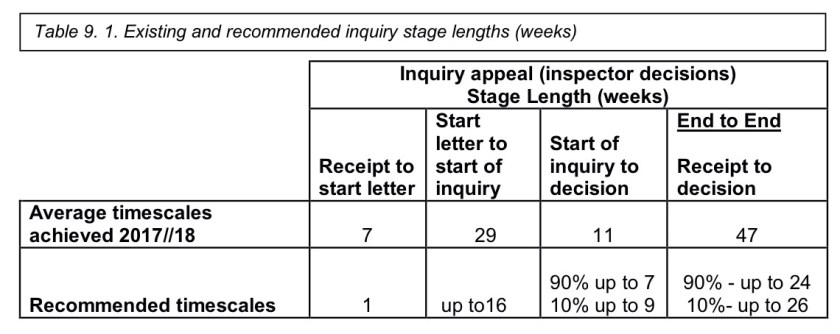
Aside from the above summer reading we have also been given some homework. MHCLG has now published a call for evidence in relation to the Independent Review of Planning Appeal Inquiries chaired by Bridget Rosewell. The deadline for responses is 18 September 2018.

The call for evidence is accompanied by some fascinating additional material which will no doubt be the subject of a future blog post, namely:

Key appeal statistics

Planning appeal statistics

Planning appeals inquiries process timeline (illustrative)

Annex – Case Studies which provide illustrations of when delays in the process can occur

What is right to be done cannot be done too soon.” (Jane Austen)

Simon Ricketts, 25 July 2018

Personal views, et cetera

Long Players: Time & Money

Is there more that can be done to encourage timely resolution of issues that arise at planning application stage?

Two prompts for this blog post:

1.Provectus Remediation Limited v Derbyshire County Council (Sir Wyn Williams, 8 June 2018), which considered the circumstances in which an applicant for planning permission is entitled to a full fee refund if the application is not determined within 26 weeks.

2. The Secretary of State’s Lotmead Farm, Swindon decision dated 13 June 2018 to accept his inspector’s recommendation to award the local authority its costs against the appellant for unreasonable behaviour in relation to two appeals – on the basis that the appeal process had been used to “evolve the schemes“, contrary to the Planning Inspectorate’s procedural guide (the Secretary of State having dismissed the appeals in a separate decision letter of the same date).

Planning application refunds

In our ridiculous legislative patchwork you need to look at the Town and Country Planning (Fees for Applications, Deemed Applications, Requests and Site Visits) (England) (Amendment) Regulations 2013 which amended the 2012 Regulations from 1 October 2013 so as to introduce, as Regulation 9A, the right for an applicant to have its application fee refunded “in the event that the local planning authority fail, or the Secretary of State, in relation to an application made under section 62A of the 1990 Act fails, to determine the application within 26 weeks of the date when a valid application was received by the local planning authority or the Secretary of State, as the case may be.

Regulation 9A (2) provides that the right does not apply where “the applicant and the local planning authority, or, in the case of an application under section 62A of the 1990 Act, the Secretary of State, have agreed in writing that the application is to be determined within an extended period“, the application has been called in, is the subject of an appeal or of judicial review.

In the Provectus case, the claimant had submitted its planning application on 14 September 2014, paying an application fee of £44,000, withdrew the application and resubmitted the application on 22 December 2015 (no additional fee payable due to Regulation 9 of the 2012 Regulations), which was registered by the local planning authority on 25 January 2016. Further environmental information was requested by the authority in April 2016, which was provided (following an extension of time requested by the claimant) in July 2016. On 3 August 2016 the authority requested an extension of time for determining the application and an extension to 7 November 2016 was agreed. Further environmental information was then sought by the authority during the period, the claimant’s agent agreed to that and then was replaced by another agent, which no longer agreed to provide the information, arguing that it had in part already been provided and in part was unnecessary. In December 2016 the claimant appealed on the basis of non-determination and in March 2017 requested that the authority refund the fee.

So in short, a real mess but unfortunately not an unusual sequence of events. From a limited knowledge of events gained solely from the account in the judgment, I would guess that neither side particularly smelt of roses.

The claimant judicially reviewed the decision of the authority to refuse to refund the application fee. The authority took the position that Regulation 9A (2) disapplies the right where the applicant and authority have agreed an extended period for determining the application. The claimant argued that this should not be the case if the application is not then determined within the agreed extended period. To assist their respective stances, both parties’ counsel sought to rely on different parts of the explanatory memorandum that accompanied the 2013 Regulations.

Wholly unsurprisingly, the judge rejected any purposive interpretation:

A refund of a fee paid at the time of a planning application should be made only if a period of 26 weeks has elapsed from the receipt of a valid application and that application has not been determined by the local planning authority. In my judgment, if the applicant and the local planning authority agree in writing that the 26 week period should be extended the planning fee paid by the applicant does not fall to be refunded even if the local planning authority fails to determine the application within the extended period.”

So the claimant did not recover its £44,000 and now faces not only a costs bill from its own lawyers but liability to pay the authority’s costs in relation to the litigation.

The case does highlight a few things:

1. Don’t forget about the right to a refund.

2. Take it into account in your decision making as to whether to agree a time extension.

3. The Regulations plainly risk giving rise to perverse incentives: (1) it is so much safer for an authority if it can agree an extension of time, after which it is not at risk of a fee refund however poor its performance and (2) canny applicants may decline to agree time extensions where an application is running into the sand.

I did wonder to myself why the argument wasn’t made by the claimant that at least 26 weeks had already passed between the submission of a valid application in December 2015 and the agreed time extension but I assume that this wouldn’t have worked given that the formal request under the EIA Regulations for further environmental information would have had the effect of stopping the clock running until the information had been provided and/or that the agreed extension of time for providing that additional environmental information may have itself disapplied Regulation 9A? As ever reality is more complicated than legislation envisages.

Using the appeal system to “evolve” a scheme

Where there is lack of engagement on the part of a local planning authority, what real remedy is there aside from an appeal? And yet Annexe B of the Planning Inspectorate’s procedural guide seeks to encourage resolution of issues before an appeal has been submitted, reflecting the advice in the Planning Practice Guidance:

Before making any appeal the party seeking permission should first consider re-engaging with the local planning authority to discuss whether any changes to the proposal would make it more acceptable and likely to gain permission. It is possible that a further planning application may be submitted without charge. However, this will depend on the circumstances of each case, so parties should ask the local planning authority for further details.”

Annexe M of the PINS procedural guide states:

M.2.1 If an appeal is made the appeal process should not be used to evolve a scheme and it is important that what is considered by the Inspector is essentially what was considered by the local planning authority, and on which interested people’s views were sought.

M.2.2 Where, exceptionally, amendments are proposed during the appeals process the Inspector will take account of the Wheatcroft Principles when deciding if the proposals can be formally amended. In the ‘Wheatcroft’ judgment22 the High Court considered the issue of amendments in the context of conditions and established that “the main, but not the only, criterion on which… judgment should be exercised is whether the development is so changed that to grant it would be to deprive those who should have been consulted on the changed development of the opportunity of such consultation”. It has subsequently been established that the power to consider amendments is not limited to cases where the effect of a proposed amendment would be to reduce the development.

M.2.3 Whilst amendments to a scheme might be thought to be of little significance, in some cases even minor changes can materially alter the nature of an application and lead to possible prejudice to other interested people.

M.2.4 The Inspector has to consider if the suggested amendment(s) might prejudice anyone involved in the appeal. He or she may reach the conclusion that the proposed amendment(s) should not be considered and that the appeal has to be decided on the basis of the proposal as set out in the application.”

The position in which the developer found itself at the Lotmead Farm appeals was that it had sought pre-application advice from Swindon Borough Council over a period from December 2013 to May 2015 in relation to a proposal for up to 2,600 homes together with associated development, on a site with a strategic allocation in the local plan. An application for outline planning permission for the whole scheme as well as an application for outline permission for an initial phase of 200 homes were made on 30 April 2015. The council made a series of requests for further information and for extensions of time. The council refused the applications on 30 June 2016 at a point where the developer was seeking to resolve or at least narrow the issues.

After submitting appeals against the refusals the developer then made a series of amendments to the proposals to seek to address the reasons for refusal. At a pre-inquiry meeting the developer indicated the scope of the amendments that would be made and that an ES addendum would shortly be publicised. The inspector postponed the inquiry to allow participants in the inquiry to have sufficient preparation time. The amendments apparently were then more significant than had been identified. The changes included an additional 2 form entry primary school, an increase in the red line area, changes to the transport proposals, to all of the parameter plans and to the illustrative masterplan and green infrastructure parameter plans. “Moreover, over the following months additional amendments and information were submitted by the appellant and corrections were made to submitted documents“. The ES addendum entailed six of the topic areas being superseded.

In his report on the appeals, the inspector sets out the amendments in detail before stating at paragraph 10.14:

In conclusion, the amended schemes are very significantly different to those determined by the Council and have evolved considerably during the course of the appeals. To use the appeal process in this way is contrary to Procedural Guidance and does not sit comfortably with the Wheatcroft principle. There are no exceptional circumstances to justify this approach. No specific case of prejudice has been highlighted but compliance with the Procedural Guidance is the best way to ensure no-one is disadvantaged through the appeal process.”

She considered that it was appropriate to consider the appeals on the basis of the originally submitted proposals, although (since the appeals had been recovered for the Secretary of State’s own determination) she considered the proposed revisions in detail as well in case the Secretary of State took a different approach. She recommended that the appeals be dismissed, whether or not the revised proposals were considered.

In his decision letter, the Secretary of State accepted the recommendation that the revised proposals should not be considered:

13. The Secretary of State has given careful consideration to the Inspector’s analysis at IR10.1-10.15. The Secretary of State has taken into account that all parameter plans and the illustrative masterplans were amended (IR10.6). The Secretary of State has further taken into account that the ES also was substantially reviewed, with six of the topic chapters being superseded. The Secretary of State has further taken into account at IR10.7 that further amendments were made including proposals for access, surface water management, trees and landscaping. For the reasons given at IR10.6-10.7, the Secretary of State agrees with the Inspector at IR10.7 that the evolution of the proposals results in an overall very considerable change to the schemes and to the quality of the supporting information.

14. For the reasons given at IR10.6-10.7, the Secretary of State agrees with the Inspector at IR10.8 that the amended schemes are not the schemes determined by the local planning authority in June 2016 and on which interested people’s views were sought (IR10.8). The Secretary of State agrees with the Inspector that the narrowing of the areas of dispute was of assistance to the efficient running of the inquiry but was carried out very late in the day. He further agrees that the approach adopted by the appellant during the course of the appeals has not been in accordance with procedural guidance (IR10.8).

15. As such, the Secretary of State agrees with the Inspector at IR10.9 that the changes to the proposals in the Masterplan and the Phase 1 appeals are sufficiently material that consultation on the amendments would be essential.

16. The Secretary of State has taken into account the Inspector’s conclusions on consultation at IR10.10-10.13. The Secretary of State agrees with the Inspector at IR10.14 that the amended schemes are very significantly different to those determined by the Council and have evolved considerably during the course of the appeals. He further agrees that to use the appeal process in this way is contrary to procedural guidance and does not sit comfortably with the Wheatcroft principle and there are no exceptional circumstances to justify this approach; and agrees that no specific case of prejudice has been highlighted but compliance with the procedural guidance is the best way to ensure no-one is disadvantaged through the appeal process (IR10.14). He concludes, in agreement with the Inspector, that the appeals should be determined on the basis of the original proposals (IR10.15).”

A separate report and decision letter addressed an application for costs that was made by the borough council. The inspector recommended that a full award of costs be allowed:

Unreasonable behaviour resulting in unnecessary or wasted expense, as described in the Planning Practice Guidance, has been demonstrated in that:

• appeals were made on the original schemes when there was no reasonable prospect of success, and

• the appeal process was used to evolve the schemes, which was contrary to Procedural Guidance.”

She noted that if amendments to the proposals had been pursued through another application “there would be a greater probability of compromise on both sides, outside of the adversarial appeal process. The normal development management process has been avoided.”

The Secretary of State agreed.

Perhaps here the circumstances were exceptional but I do worry whether this is the right direction for the planning system to be heading in – although I appreciate that the Government and the Planning Inspectorate would prefer a clean, front-loaded appeal process that is only used as a last resort. If anything may conceivably focus a local planning authority on resolving matters with an applicant, it is the risk that its position may come under scrutiny at inquiry. I do not know if this was the case at Lotmead Farm but sometimes it is impossible to ascertain what the authority’s position is, or what changes to a scheme may be considered acceptable. If the developer has to wait for a refusal notice and start again with a further application before appealing, without the ability to bring matters to a head by way of the appeal and changes made as part of the appeal process, appealing becomes increasingly impractical as an option (and the authority knows it).

Of course there has to be a limit to the scale of any amendments made at the appeal stage. But as long as the amendments are fully consulted upon is there really such a problem if they improve the scheme and ensure that permission can be granted by the inspector or Secretary of State rather than a further application being required? Not only do we now have an appeal process that is increasingly slow, we have a process that is increasingly impractical in relation to complex schemes, where interation is inevitable and surely no bad thing.

At least through its appeal, notwithstanding not achieving permission and having an expensive adverse award of costs against it, the Lotmead Farm developer did manage to narrow various issues with the authority and third parties, and secure detailed comments from the inspector on various elements of its proposals, some negative, some negative, but sufficient presumably now to form the firm basis for a further application. The inspector even identified a series of elements of the section 106 package that did not comply with regulation 122 and which presumably will not be included next time round (which will save a substantial sum). It is just a shame that there is not the ability to secure, more nimbly, equivalent independent expert input during the application stage itself so as to resolve differences – rather than tie everyone up in a slow, expensive and adversarial process.

Simon Ricketts, 15 June 2018

Personal views, et cetera

Fawlty Powers: When Is A Permission Safe From Judicial Review?

A case last month arising from a howler of a permission for the erection of three marquees in the grounds of a hotel, a permission that was intended to be temporary but was issued without any condition to that effect, has potentially created a real mess. 
Pretty much the main thing that the commercial and financial world always wants from any consenting or licensing system, and certainly the planning system, is certainty as to when any necessary consent or licence, such as a planning permission, is free from legal challenge. Central to the legal due diligence work in relation to any operational business with a bricks and mortar presence, for instance in connection with its financing or acquisition, and certainly in relation to any property or development financing or acquisition, will be the need to report on the operative planning permissions and whether they are now beyond risk of being quashed by the courts. Once the judicial review period has passed, it is assumed that a permission can safely be relied upon, money can be lent or invested, properties or companies can be acquired. If the judicial review period has not yet expired, transactions will often be made conditional on its expiry without proceedings having been commenced. 

Judicial review periods are deliberately short so that we can all safely rely on public bodies’ decisions after a relatively short period. Compared with the six or twelve years’ limitation periods that are common in private law, the traditional principle in relation to judicial review is that proceedings must be brought promptly and in any event not later than three months after the grounds upon which the claim is based first arose (Civil Procedure Rules Part 54.4). 

In our planning world, time limits are usually even tighter:
– In relation to statutory challenges, for instance under section 288 of the Town and Country Planning Act 1990 for challenges of decisions of the Secretary of State and his inspectors on planning appeals and called-in planning applications, or under section 113 of the Planning and Compulsory Purchase Act 2004 for challenges of adopted development plans, the relevant time limit is six weeks. 
– Since 2013, the deadline for bringing judicial review proceedings in relation to other matters arising under the Planning Acts (care needed over that definition) is six weeks. 

But it isn’t quite as easy as assuming that, if these deadlines have passed, the relevant decision is free from any risk of judicial review. CPR rule 3.1 (2) (a) gives judges some discretion. Except where the rules provide otherwise, the court may “extend or shorten the time for compliance with any rule, practice direction or court order (even if an application for extension is made after the time for compliance has expired)“. 
A separate form needs to be submitted with the claim, asking for a time extension and explaining why it is justified. The Administrative Court Judicial Review Guide states:
The Court will require evidence explaining the delay. The Court will only extend time if an adequate explanation is given for the delay, and if the Court is satisfied that an extension of time will not cause substantial hardship or prejudice to the defendant or any other party, and that an extension of time will not be detrimental to good administration.
The Court of Appeal last year in Connors and others v Secretary of State (17 November 2017) stressed the extent to which the onus is on the claimant to justify being allowed to bring a claim out of time and waiting to learn the outcome of another case was not a sufficient ground:
“In the context of planning decision-making, this court has made it very clear that the exercise of judicial discretion to permit very late challenges to proceed by way of claims for judicial review will rarely be appropriate – regardless of whether the claimant has had available to him and acted upon legal advice (see the judgment of Sales L.J., with whom Lord Dyson M.R. and Tomlinson L.J. agreed, in R. (on the application of Gerber) v Wiltshire Council [2016] 1 W.L.R. 2593, at paragraphs 45 to 58).”
R (Gerber) v (1) Wiltshire Council (Court of Appeal, 23 February 2016) was a case I mentioned in my 24 March 2018 blog post Once More Unto The Breach Of Legitimate Expectation, Dear Friends. The claimant sought to challenge a planning permission for a solar farm project over a year after the permission had been issued. At first instance, Dove J had been persuaded to allow the claim, accepting that the delay was justified first because there had been a breach of legitimate expectation, established by the council’s statement of community involvement, that he would be consulted at application stage about the proposal and so had an excuse for not knowing about the permission being granted and secondly that part of the delay had been caused by a first firm of solicitors having given ‘incomplete’ advice as to his potential remedies. The parties all accepted that there were in fact errors with the permission which made it unlawful. 

The Court of Appeal rejected on the facts the SCI breach of legitimate expectation argument and thought that the abortive approach to the first firm of solicitors was not a sufficient excuse for the delay. Refusing to allow the claim to be brought out of time it took on board took into account that “substantial hardship or prejudice” would be caused to the solar farm operator, which in the meantime had built its facility:
“On 23 July 2014 Terraform completed an Initial Public Offering on the NASDAQ Global Select Market based on a prospectus listing Norrington as a project generating cash flow in the United Kingdom. Terraform and Norrington make the point in these proceedings that if the planning permission is quashed, that will harm the ability of companies seeking to invest in green energy generation in the United Kingdom to attract investors to fund such projects, because of the uncertainty whether they will be able to rely on planning permissions granted by planning authorities to carry out such developments even though they have gone without challenge within the time provided for in CPR Part 54.5 and indeed, as in this case, for a considerably longer period.”

“The evidence for Norrington and Terraform, the substance of which was accepted by the judge, is that if the planning permission is quashed and they are required to dismantle the solar farm, the cost of dismantling it and restoring the Site to agricultural use would be around £1.5 million. In addition, the cost of installing the solar farm of about £10.5 million would have been wasted and lost. In addition, a premium of £2000 paid for an option to take the lease and locked-in rental payments of approximately £36,300 under the lease would also be wasted.
Sales LJ  concluded: 

“In my judgment, where proper notice of an application for planning permission has been given pursuant to the 2010 Order it is not appropriate to extend time for bringing a legal challenge to the grant of such permission simply because an objector did not notice what was happening. Extending time in such a case so that a legal objection could be mounted by someone who happened to remain unaware of what was going on until many months later would unfairly prejudice the interests of a developer who wishes to rely upon a planning permission which appears to have been lawfully granted for the development of his land and who has prudently waited for a period before commencing work to implement the permission to ensure that no legal challenge is likely to be forthcoming, as happened here. Prompt legal action after grant of a planning permission to challenge its lawfulness will be required in all cases, unless very special reasons can be shown of a kind which are wholly absent in this case. Especial speed will be expected in the case of objectors who have been involved in the planning process throughout, as emphasised by Keene LJ in Finn-Kelcey at [24], but it does not follow that the strong requirement of prompt action will be substantially relaxed in the case of someone who, despite a planning authority’s compliance with the notification rules laid down in law, remained in ignorance.
The Court of Appeal did extend the time for bringing a claim in Croke v Secretary of State (Court of Appeal, 6 June 2017) which was, as so often, somewhat of a comedy of errors. Given that the deadline for lodging the claim was 23 March 2016, this is what happened:
“The Applicant, who is acting in person, wished to challenge the Inspector’s decision. He proposed to do so by issuing a section 288 claim in the Administrative Court Office at the Royal Courts of Justice, in person, on 23 March 2016. However, that day, he missed his train. Therefore, he emailed the relevant documents to a friend, Mr Miller, who was apparently located only a few minutes from the court; and he asked him to file the claim. It is the Applicant’s case, accepted by the judge below for the purposes of the application before her and by Mr Mills for the Secretary of State today, that Mr Miller arrived at the Royal Courts of Justice at 4.25pm; but, although the advertised closing time for the court was 4.30pm, he was refused entry at the main front entrance of the building, the security guard there informing Mr Miller that the counters were closed.

The following day, Thursday 24 March, the Applicant personally attended the Administrative Court Office, where he arrived at 3.30pm. It was Maundy Thursday and, for the court office, the last working day before the Easter break. Due to the volume of people in the queue, he was not seen until about 5pm, when he was informed by a member of staff that he had used an out-of-date claim form, and he would need to complete a different form. He was given a copy of the new form, and he asked if he could complete it there and then. He was told that he would have to return the next working day. The following day was Good Friday, and the next day upon which the court office was open was Tuesday 29 March. The Applicant attended the Administrative Court Office that day, and filed the claim.”


The court at first instance struck out the claim as out of time. The Court of Appeal however granted permission to Mr Croke to appeal, taking into account that there did not appear to be any legal authority applying to these precise facts:
“Having considered the ground of appeal with particular care – and not without some hesitation – I am persuaded that this appeal is arguable, particularly given the absence of authority on this point. It is also noteworthy that this issue affects not just section 288 claims, but a variety of proceedings where there are strict time limits. Therefore, although the Applicant himself accepts that the merits of his particular case may not be the strongest or attract great sympathy, the issue of principle involved does or may have some broader importance.”
(I don’t know what then happened with Poor Mr Croke’s claim. Deadlines, the risk of missing or incorrect paperwork (or an incorrectly drawn cheque), reduced court hours for filing out of court terms and the current long queues at the Royal Courts of Justice to file claims all combine to give solicitors nightmares – clients, please don’t leave it to the last moment!). 
All this brings us to last month’s case, R (Thornton Hall Hotel Limited) v Wigan Metropolitan Council (Kerr J, 23 March 2018).
The claimant operates Thornton Hall Hotel and the interested party, Thornton Holdings Limited, operates Thornton Manor. The hotels are competitors for wedding bookings and other functions. 

On 7 September 2011 Wigan Council’s planning committee resolved to grant planning permission for three marquees to be erected in the grounds of Thornton Manor. The hotel is in the green belt (as well as being listed grade II* – any Fawlty Towers references in this blog post are by the way wholly inappropriate as will be seen from the above image, courtesy of hitched.co.uk). According to the judgment the committee resolved that very special circumstances existed to allow for the erection of the marquees for a limited period of five years so as to secure “the “generation of an income stream” to enable restoration of the gardens, which were in decline and at risk“. The proposed permission with appropriate conditions was drafted. Indeed, a draft in that form was annexed to a section 106 agreement that was entered into on 11 November 2011. However, the actual permission that was issued on 20 December 2011 and placed on the council’s website omitted any conditions whatsoever, no restriction to five years, no nothing. 
The agent for Thornton Holdings cottoned onto this immediately and said nothing. However the problem was it seems not apparent to the council until the five years period expired and the marquees were not dismantled. The council took a report to committee in July 2017 accepting that a mistake had occurred. A little over a month later (and almost six years after the decision complained of, ie the issue of the incomplete permission) Thornton Hall Hotel Limited brought its proceedings, which were not opposed by the council – so the hearing was purely hotel versus competitor hotel. 
Kerr J allowed the late challenge, and quashed the permission, for nine reasons:
1. The error had been made in issuing the flawed permission. 
2. Permanent permission would not granted and would not have been in the public interest. 
3. “If the marquees are now allowed to stay permanently, the proper operation of the planning process will have been subverted.”
4. That would be contrary to the public interest. 

5. The interested party was aware of the error. 

6. “it follows that the interested party ran its commercial operation at Thornton Manor from 22 December 2011 knowing that the presence of the marquees after 19 December 2016 would be, at the very least, a matter of possible controversy and possible legal challenge. It was not, in my judgment, realistic to rely on expiry of the three month limitation period without also bringing the issue into the open, which the interested party decided not to do.”

7. It follows that the interested party cannot say that it would be prejudiced by the quashing due to lost bookings. 

8. “it is said by the interested party that it would be detrimental to good administration if the marquees have to be removed. Normally, detriment to good administration in public law cases relates to the undesirability of interfering with the provision of public services rather than commercial interests. I see no detriment to good administration in rectifying the error. I think it is detrimental to good administration that the marquees are still there. Good administration includes correct implementation of planning decisions.”

9. “the interested party signed the section 106 agreement embodying the omitted conditions including the five year time limit. Yet, it proceeds in this litigation as if it were not bound by the terms of that agreement. That seems to me only to compound the unconscionability of its position. It undertook in private law the same obligations as it denies in public law.”

As they say, hard cases make bad law. Whilst clearly no-one should have any sympathy for the interested party, which saw that it had by luck gained something it never deserved, there are really serious repercussions and I can’t see that other factors were taken on board by the judge, for instance:
1. There is no discussion of the public interest in being able to rely on permissions once free from legal challenge. When acting on the acquisition of properties or businesses, what do we now need to do to ensure that our client isn’t going to find that its permission is similarly flawed? Sometimes it will not be at all obvious. Does the permission, even if many years old, need to be checked against the resolution to grant? What about other latent flaws in it?
2. Surely, the council should have sought a revocation or modification order. No doubt it would have had to pay substantial compensation to Thornton Holdings but is that relevant? The permission was on the website and could have been challenged within the deadline. No-one challenged it (and why indeed should it be down to a competitor to spend money at risk on a challenge? What if it hadn’t?). It used to be considered that authorities, in considering whether to make a revocation or modification order, couldn’t take their potential compensation liability into account. To my mind it was a sad day when that changed as a result of the Supreme Court’s ruling in Health & Safety Executive v Wolverhampton City Council (Supreme Court, 18 July 2002). As a result, revocation and modification orders are almost unused. 

3. There are of course many examples of flawed permissions which authorities issued in error where hitherto the possibility of a late challenge does not appear to have been considered. (See some of them in my 14 October 2017 blog post Flawed Drafting: Interpreting Planning Permissions). Is this ruling, even if only slightly, going to open the floodgates, particularly in relation to the errors that most frequently occur on section 73 permissions where it turns out that previous restrictive conditions have been lost, for example as to the types of goods that may be sold from a retail park?

Does anyone knows whether an application for permission to appeal has been made? I would welcome views as to how we all take on board the practical implications of this case. Or do we simply regard it as turning on fairly extreme facts? I’m not so sure. 

Simon Ricketts, 7 April 2018

Personal views, et cetera


No conditions, you say?”

Permitted Development: À La Recherche Du Temps Perdu

Feeling a little Proustian après MIPIM? Where did that time go?
Some minor changes have been made this month to PD rights, more significant changes are possibly still to come and some existing PD rights remain controversial.
The minor changes
The Town and Country Planning (General Permitted Development) (England) (Amendment) Order 2018 was made on 8 March 2018 and comes into force on 6 April 2018. It makes various detailed amendments to the existing regime, the most significant ones being:

– Extending the existing temporary right to change use of a building from a storage or distribution centre to a dwellinghouse, which was shortly to expire. The prior approval date must be by 10 June 2019 and the change of use must be completed within three years of the prior approval date. 
– Expansion of the permitted development right to change the use of agricultural buildings to dwellinghouses such that the maximum amount of floorspace that may be converted is increased from 450 sq m to 465 sq m and up to five dwellinghouses may be created from that floorspace rather than three. 

– Enabling the Secretary of State to pause the 28 day period for prior approval where he is considering calling in an application for his own determination. 

The more significant possible further changes
In my 15 June 2016 blog post Permitted Development: What Next? I speculated as to whether two further permitted development rights would be created, which the Government had previously contemplated, namely:

– Office demolition and residential rebuild
– Upward extensions in London
21 months later, the position is still uncertain in relation to both proposals. If they are introduced their scope could well be wider than initially envisaged, but will they? More lost time if they are introduced and prove to be successful in increasing housing supply. 
We had heard nothing on office demolition and residential rebuild since Brandon Lewis’ October 2015 announcement, and it was assumed that the idea was dead, until the unexpected announcement in the Autumn 2017 budget policy paper that “the government will consult on introducing… a permitted development right to allow commercial buildings to be demolished and replaced with homes“. 
Was the reference to “commercial buildings” intentionally wider in scope than just offices? What would be the prior approval requirements? Would there be a floorspace cap? I had hoped for an update alongside the draft revised NPPF announcements in February or alongside the Spring budget statement this month but still we wait. 
Similarly, we had heard nothing about the proposed PD right for upward extensions in London since a joint Mayor of London/DCLG consultation paper in February 2016. The ministerial policy statement on 5 February 2018 appeared to make it clear that the initiative (now across England, not just London) would be dealt with by policy, within the NPPF. But then Sajid Javid’s speech launching the draft revised NPPF on 5 March 2018 had this passage:
And there are also other areas in which we’re ready to go further to take the delivery of housing up a gear.

Including a new permitted development right for building upwards to provide new homes.”
I’m left scratching my head in relation to both proposals, frankly. 

Office to residential and other existing PD rights
The office to residential permitted development right remains controversial. Undoubtedly it has delivered in terms of increasing housing stock, although with a free ride for developers in terms of affordable housing and other contributions and in some areas jeopardising the stock of office floorspace. Quality of the conversions has been variable. But, in a housing crisis, has the end justified the means?
The Local Government Association published some campaigning research One in 10 new homes was a former office against the right on 18 January 2018.  

The current areas exempted from the right will lose that exemption from 31 May 2019 and many authorities are taking steps to remove it in any event by way of Article 4 Direction, for instance recently Westminster City Council (see its 26 January 2018 report to cabinet). Indeed, policy SD5 F of the draft London Plan supports that approach:
The Mayor will work with boroughs and support them to introduce Article 4 Directions to remove office to residential permitted development rights across the whole of the CAZ and the Northern Isle of Dogs (and those parts of Tech City and Kensington & Chelsea lying outside the CAZ)
It will be interesting to see how this tension with national policy is addressed at the examination into the draft plan.
In the meantime, inevitably given the complexity now of the PD rights regime and its advantages for developers in many situations over the traditional planning applications procedure, we have seen an increase in litigation as to the nuts and bolts of the prior approval procedure. 

Most recently, in R (Marshall) v East Dorset District Council (Lang J, 13 February 2018), prior approval for the erection of an agricultural building was quashed on the basis that the PD right excluded buildings for the accommodation of livestock, whereas the application for prior approval had indicated that one of the proposed uses of the building was to “winter house 45 ewes and their lambs through the winter period“!
Last year’s decision in Keenan v Woking Borough Council (Court of Appeal, 16 June 2017) is also interesting, on a similar theme, making clear that where the authority fails to respond to an application for prior approval within 28 days, such that there is a deemed prior approval, if the proposed development did not fall within the criteria of the relevant part of the General Permitted Development Order it does not as a result of the deemed approval become “permitted development”. 
Accordingly, whether or not you have prior approval, or deemed prior approval, your proposed development still needs to fit within all of the relevant restrictions and thresholds within the Order. 
To end with M Proust:
“...loopholes opened by disappointment. Dreams are not to be converted into reality, that we know; we would not form any, perhaps, were it not for desire, and it is useful to us to form them in order to see them fail and to be instructed by their failure.”
Simon Ricketts, 17 March 2018
Personal views, et cetera