CIL: Kill Or Cure?

If anyone doesn’t think that the Community Infrastructure Levy urgently needs reform, do read this 1 March 2017 VOA ruling on one of many thorny issues that arise constantly in practice: how to calculate indexation (as well as how to calculate chargeable floorspace) in relation to section 73 permissions that amend pre-CIL permissions. The copy of the ruling in the link to the gov.uk website is redacted but I can tell you that around £3m turned on the decision relating to a development of 527 dwellings. The authority in question (I will preserve anonymity) has been interpreting the Regulations in a way which it asserts to be literal and correct, but which leads to unfairly onerous liability arising (which for some people arises completely out of the blue by way of revised liability notices being served). 
The VOA member considered that the authority’s approach “is wrong and undermines the purpose of regulation 128A” (the regulation that seeks to avoid double charging in the case of development pursuant to section 73 permissions). I understand that the issue may now reach the High Court by way of judicial review. As with any tax legislation, the dilemma is as to what room is there for a purposive interpretation, however unfair the consequences of a literal reading. After all, see R (Orbital Shopping Park Swindon) Limited v Swindon Borough Council (Patterson J, 3 March 2016):
“…not only would the defendant’s approach be contrary to the whole approach to the interpretation of planning permissions it would be contrary to constitutional principles. As was said in Vestey v Inland Revenue Commissioners [1980] AC 1148 by Lord Wilberforce:


”Taxes are imposed upon subjects by Parliament. A citizen cannot be taxed unless he is designated in clear terms by a taxing Act as a taxpayer and the amount of his liability is clearly defined. 
A proposition that whether a subject is to be taxed or not, or, if he is, the amount of his liability, is to be decided (even though within a limit) by an administrative body represents a radical departure from constitutional principle. It may be that the revenue could persuade Parliament to enact such a proposition in such terms that the courts would have to give effect to it: but, unless it has done so, the courts, acting on constitutional principles not only should not, but cannot, validate it.
In that case a literal interpretation was to the benefit of the payer rather than the authority. Patterson J underlined “the importance of a close and clear analysis of what the statute actually requires“. 

The problem is that the 2010 Regulations are a hopeless mess; anything but clear to payer or authority alike – the antithesis of good tax legislation or indeed good planning legislation. The successive sets of amendments in 2011, 2012, 2013 and 2014 have resolved some problems, ignored others and created new ones. Due to ambiguities in the Regulations, CIL liability arising from a development is in many cases dependent on the approach being taken by individual collecting authorities, which is plainly contrary to the rule of law as well as wasteful of the time and money of all concerned. Planning consultants are having to act as tax accountants, with very large amounts of money at stake, dependent not just on an accurate reading of the legislation that accords with the collecting authority’s approach (unless there is to be an appeal to the VOA) but on service of the correct notices at the correct time – the process does not allow for any mercy on the part of the authority. 

Of course the planning system has from its outset wrestled with two core unresolved issues:
– The extent to which the system should have any land value capture role

– Apportionment of responsibilities between the state and developers/land owners for infrastructure delivery/funding. 

CIL is the latest attempt to square the circle but has proved hopelessly inefficient. 
For an excellent, detailed, analysis of the underlying issues, still nothing beats Tom Dobson’s 2012 paper to the Oxford Joint Planning Law Conference. 
Tom of course subsequently was one of the team, led by Liz Peace, appointed by the Government in November 2015 to:
“Assess the extent to which CIL does or can provide an effective mechanism for funding infrastructure, and to recommend changes that would improve its operation in support of the Government’s wider housing and growth objectives.” 

Whilst the political reverberations of Brexit have been an unwarranted distraction from things that might actually help to improve lives and provide homes, it is so disappointing that the review team’s report was only published in February 2017, alongside the Housing White Paper. (Why was it held up till then? There is no read-across to the white paper proposals). The report is dated October 2016 but its contents were an open secret as long ago as June last year (see my CIL BILL? 3.6.16 blog post). Not only that but the Government has indicated that it will not be responding to the report’s recommendations until this Autumn’s budget. This presumably means no substantial changes until April or October 2018 at the earliest. 

The review team considered four options:
– do nothing

– abolition

– minor reform

– more extensive reform

The report is a solid piece of work, well argued and rooted in experience. It identifies CIL’s failings (raising less money than anticipated, over-complicated, opaque) and firmly recommends extensive reform, particularly the replacement of the current system with a more standardised approach of Local Infrastructure Tariffs (LITs) and, in combined authority areas, Strategic Infrastructure Tariffs (SITs). LITs would supposedly be set at a low level calculated by reference to a proportion of the market value per square metre of an average three bedroom property in the local authority area, although the “example rates” in appendix 5 of the report are not particularly low given that there would be far fewer exemptions and reliefs and less opportunity to net off existing floorspace:
* £20 – £90 per m2 for Authorities in the North of England

* £30 – £90 per m2 for Authorities in the Midlands

* £30 – £220 per m2 for Authorities in the South and East of England

* £50 – £440 per m2 for London Boroughs

For developments of ten dwellings or more, there would be a return to the flexibility of section 106 for provision of site-specific infrastructure (netting off LIT liability) and of course abolition of the pooling restriction (come on government, if you do nothing else, remove the pooling restriction – even Donald Trump would be able to achieve that!). 

There would be transitional arrangements, with the review team speculating that these could take us to the end of this Parliament in 2020. Alas, with subsequent slippages even that now looks optimistic. 
What do we think the Government will do with the report? It is worrying that Gavin Barwell was talking at MIPIM of somehow including affordable housing in any revised system (see for instance Inside Housing’s article 24 March 2017). Keep it simple!
My personal guess is that significant change may well be too much for this government at this time. If so, ministers need to face that reality and it really is urgent that we at least push for Plan B: a further set of amending Regulations (preferably in the form of a consolidated version of the 2010 Regulations), putting right what we can, including abolition of the pooling restriction, alongside a clearer approach to indexation, to section 73 permissions and to payments in kind. The report called for interim measures but without setting them out in detail. 
Many of you remain in the “kill CIL” camp. I recognise that the CIL review team’s recommendations are radical but to go one step further and lose any levy or tariff mechanism would in my view be impractical. For bigger schemes, section 106 agreements definitely have advantages (as long as the negotiation process can be as streamlined as possible and the authority’s requirements signposted in policies) but for smaller projects a standardised approach should in theory leave everyone knowing where they stand – and another major lurch to a new system would inevitably have unanticipated outcomes. 
That June 2016 blog post was my first. And this is my 50th, with no real progress on CIL in the meantime. Gavin Barwell has rightly won many plaudits as planning minister but for many of us his real test will be to clear up quickly this CIL mess created by his predecessors (the coalition government in 2010 should have ditched it in the way that the Conservatives’ Open Source Planning manifesto document had suggested). As politicians love to say about most things, but true in the case of CIL, it’s broken. 
Simon Ricketts 25.3.17
Personal views, et cetera

London Calling: Mayoral Interventions

Sadiq Khan is now 10 months into his role. How has he been using his Mayor of London Order 2008 powers to intervene in relation to strategic planning applications? The number one priority in his manifesto was, after all, to:
tackle the housing crisis, building thousands more homes for Londoners each year, setting an ambitious target of 50 per cent of new homes being genuinely affordable, and getting a better deal for renters.”


The consultation draft of the new London Plan is expected in August 2017, although we already have his draft affordable housing and viability SPG with its 35% affordable housing threshold approach (below which viability appraisal justification is required), covered in my 1.12.16 blog post. Ahead of the anticipated adopted version, a couple of items in the 14 March 2017 report to the London Assembly’s Planning Committee are of background interest:

– from page 9 a transcript of a discussion held on 1 February 2017 with James Murray, Jamie Ratcliff and private sector representatives in relation to the draft SPG

– from page 51 the Committee’s proposed response to the draft SPG.

Given that the Mayor’s intervention powers under the 2008 Order (to direct refusal of an application or call it in for his own determination) are the most direct levers that he can pull in relation to specific development proposals, it is perhaps surprising that so far we have not seen them used as much as under the last days of the Johnson regime.
This is how it stands as at 18 March 2017:
Flamingo Park, Bromley
Khan’s first intervention was in fact to direct refusal on 15 June 2016 of the Flamingo Park scheme in Bromley of a Green Belt scheme for a new stadium for Cray Wanderers FC along with 28 flats. (One for pub quizzes: Cray Wanderers claim to be the oldest football club in London – and second oldest in the world!). 
The London Borough of Bromley was minded to grant planning permission, but the Mayor considered that the ‘very special circumstances’ test for inappropriate development in the Green Belt had not been met. He added:
“Whilst writing I would take this opportunity to express my concern as to the lack of affordable housing and the effect the excess parking provision will have on the highway network in the vicinity of the site.”
Unusually, the Secretary of State promptly intervened and called in the application before the refusal was issued. The Mayor was preparing to defend the refusal direction but the applicant Cray Wanderers announced yesterday (17 March 2017) that it has withdrawn the application following legal advice and discussions with the Mayor and Bromley Council. It will resubmit a new application “in the next four to six weeks”. 
It will be interesting to see the extent to which the new scheme sees any increased housing component and the approach taken to affordable housing. 

Plough Lane, Merton

Khan’s next intervention also related to a proposed football stadium – this time Galliard Homes proposal for a new 20,000 seat football stadium for AFC Wimbledon and 602 residential units, on the Wimbledon Greyhound Stadium site, next to the site, now redeveloped for housing, of the old Wimbledon FC stadium in Plough Lane (Wimbledon FC now having of course having emigrated to Milton Keynes as MK Dons). (I hope you’re following this – I rather wish I had included Wimbledon and Cray Wanderers in my 7.1.17 blog post Level Playing Fields: Football Stadia & Planning).
The proposals included 9.6% affordable housing (all intermediate, shared ownership) with a review mechanism. The application was called in by previous Mayor Boris Johnson on 26 March 2016 (against GLA officers’ advice), but in an unusual twist, Mayor Sadiq Khan released it back to Merton on 19 August 2016 for Merton to approve. I had previously doubted (and possibly still do) whether it is lawful for a Mayor to release back an application which has previously been called in – there is certainly no express power to do so – but the Mayor’s reports set out the legal justification that he relies on. 
Bishopsgate Goodsyard, Hackney

There is one further Johnson hangover, the application for the mixed use redevelopment of Bishopsgate Goodsyard (including 1,356 residential units) which was called in by him on 23 September 2016 at the request of the applicant. Despite having been called in presumably with the intention of approving it, or at least reaching a determination more speedily than if it had been left with the London Borough of Hackney as local planning authority, the application then hit the buffers when a GLA officers’ report was published on 8 April 2016, recommending that he refuse it at the representation hearing arranged for 18 April 2016. The applicant decided to defer the hearing to address the issues and there it rests. The next twist is anyone’s guess. Will Khan even have to reach any decision or will we see withdrawal and resubmission?

We now come to two much more recent decisions, both on 10 March 2017. The Mayor’s draft SPG was obviously referred to in both cases and affordable housing review mechanisms imposed in both cases, with a cap of 50% – which is the borough-wide requirement applicable in both cases (albeit Haringey’s emerging local plan appears to be proposing a lower 40% borough wide target). 
Hale Wharf, Haringey
Haringey members had resolved, against officers’ recommendations, to refuse planning permission for this 505 residential unit scheme, within the Upper Lee Valley Opportunity Area and the Tottenham Housing Zone, on no fewer than eleven grounds. The Mayor called it in on 4 January 2017 and approved it on 10 March 2017 as recommended in his officers’ stage 3 report.
The position secured on affordable housing was as follows:
a minimum of 177 units (35% of overall units) to be affordable, with 20% affordable rent and 80% shared ownership by habitable room. 

Details of affordability will be secured. Review mechanisms as follows will secure the delivery of more affordable housing (up to 50% of the scheme or the level of grant funding) should it be viable: 
- 

Review mechanism (1): In the event that the development has not been substantially implemented within 2 years of the date of the decision, an updated viability assessment shall be submitted in order to establish if additional affordable housing can be provided and any such additional affordable housing shall be provided on site; 
- 

Review mechanism (2): A viability assessment shall be submitted prior to substantial completion of Phase 1 in order to establish if additional affordable housing can be provided and any such additional housing shall be provided on site; 
- 

Review mechanism (3): A viability assessment shall be submitted prior to substantial completion of Phase 3, to establish whether there is any surplus from the completed scheme which can be contributed towards off-site provision of affordable housing. 
- 

Review mechanism (4): Further review if development stalls for a period of more than 24 months.
It’s worth noting that there was already significant GLA funding being given for infrastructure for the scheme before the application was called in but the Mayor’s involvement appears to have secured £7.75m worth of affordable housing funding to a registered provider, so the review mechanism will be aimed at recovery and recycling of that grant funding.
Palmerston Road, Harrow

Harrow members resolved, again against their officers’ recommendations, to refuse an application by Origin Housing for a mixed use development within the Harrow and Wealdstone Opportunity Area and the Heart of Harrow Housing Zone to provide 187 residential units, within 5 buildings of between 1 and 17 storeys. Again, on 10 March 2017 the Mayor accepted the recommendations in his officers’ stage 3 report.
The affordable housing position secured is as follows: 
– a minimum of 74 homes (40% of overall units) on the site to be provided as affordable homes, with 30% affordable rent and 70% shared ownership (40% was proposed in the original application but the tenure mix is different);

– a viability review mechanism will secure the delivery of more affordable housing (up to a level of 50% of the scheme) should it be viable. 

 The affordable housing is with grant based on the Mayor’s Affordable Housing Programme 2016-21, with an early review mechanism if enabling works are not substantially commenced within two years. 

Conclusions

Of course the Mayor has to be selective as to how to use his powers. After all, the legal limits are clear from R (Spitalfields Historic Trust) v Mayor of London (Gilbart J, 10 May 2016), where Mayor Johnson’s use of the Mayoral call in power was tested and just about survived. However, so far, perhaps true to the man – and maybe no bad thing – we have seen a more cautious approach from Sadiq Khan:

– one direction of refusal where, who knows, a compromise may be on the cards

– one previously called in application returned to the borough to determine

– two applications called in and approved, but both schemes offering more than 35% affordable housing, with a review mechanism potentially to get to 50% – both schemes in opportunity areas and London housing zones where officers’ recommendations to approve had been overturned.

Administrations usually become more interventionist over time. I headed this piece London Calling, but with Mayor Khan we certainly haven’t yet seen The Clash. 
Simon Ricketts 18.3.17
Personal views, et cetera


Aarhus: Caps In The Air Again

 The Aarhus Convention requires that access to justice in environmental matters should be “be fair, equitable, timely and not prohibitively expensive”. 
Dear patient reader, you will recall that in 2013 the Government introduced a relatively simple mutual costs capping system. It is described in my 19 November 2016 blog post Mending Aarhus, along with a summary of the Government’s response to consultation in 2015 as to proposed changes to the regime to address a number of practical flaws or unfairnesses.
Rule 8(5) of the Civil Procedure (Amendment) Rules 2017  came into force on 28 February 2017, largely implementing the Government’s November 2016 proposals.
The new rules will change the nature of planning litigation in a number of important ways:
1. The procedure was available for judicial review litigation concerning “environmental matters”. The reference to “environmental matters” has been replaced by more specific references to claims within the scope of Articles of the Aarhus Convention that relate to access to environmental information and environmental assessment. Claimants challenging decisions in relation to non-EIA development may now find that they can no longer secure costs protection, even though their claim concerns environmental issues. 
2. The procedure is widened from judicial review litigation to include challenges to enforcement notice appeal decisions but, contrary to what the Government has previously indicated, not section 288 planning appeal decision challenges (nor indeed other statutory appeals, for instance in relation to plan making or compulsory purchase orders). 
3. The procedure is now only open to “members of the public” as defined in the Aarhus Convention (the Convention defines “the public” as “one or more natural or legal persons, and, in accordance with national legislation or practice, their associations, organisations or groups”). The interpretation will ultimately be for the courts to determine (more unnecessary cost and uncertainty) but in my view this is likely to exclude local authorities and other emanations of the state, including parish councils. The idea of a district or borough council seeking to rely on Aarhus costs capping in a claim against another council has sometimes been bizarre but query whether poor as church mice parish councils should be similarly shut out. 
4. Any claimant seeking to have its costs exposure capped will have to file and serve with the claim form a “schedule of the claimant’s financial resources which takes into account any financial support which any person has provided or is likely to provide to the claimant and which is verified by a statement of truth”. It will be crucial, in the short period of time available before the claim is filed and served, to make sure that what is said is both accurate and is not likely to lead the court, on application by the defendant or of its own accord, to increase or remove the caps, having regard to the following principles:
Varying the limit on costs recoverable from a party in an Aarhus Convention claim 45.44.—(1) The court may vary the amounts in rule 45.43 or may remove altogether the limits on the maximum costs liability of any party in an Aarhus Convention claim.
(2) The court may vary such an amount or remove such a limit only if satisfied that— 
* (a)  to do so would not make the costs of the proceedings prohibitively expensive for the claimant; and 


* (b)  in the case of a variation which would reduce a claimant’s maximum costs liability or increase that of a defendant, without the variation the costs of the proceedings would be prohibitively expensive for the claimant. 


(3) Proceedings are to be considered prohibitively expensive for the purpose of this rule if their likely costs (including any court fees which are payable by the claimant) either— 

(a) exceed the financial resources of the claimant; or 

(b) are objectively unreasonable having regard to— 

(i) the situation of the parties;
(ii) whether the claimant has a reasonable prospect of success; 

(iii) the importance of what is at stake for the claimant; 

(iv) the importance of what is at stake for the environment; 

(v) the complexity of the relevant law and procedure;and 

(vi) whether the claim is frivolous

There are some big uncertainties in these criteria. For example, what are the “financial resources” of the claimant? Is the claimant expected to sell illiquid capital assets (such as his or her home, or cash in his or her pension) to meet a costs award that has a short deadline for compliance? If what is at stake is of great importance to the claimant, for example the loss of his home, should he be prepared to accept a higher cap? Does the claimant have to own up to what he is paying his own lawyer? How detailed must the information be as to financial support received from, for instance, contributors to a litigation fighting fund? Will potential contributors be discouraged from reaching in their pockets?
Is this the end of wealthy litigants, whether corporates or individuals, relying on costs capping? Few surely would have any problem with that (if you embark on litigation, be prepared to meet to the other side’s costs if you lose – someone has to) but will this also kick out the JAMs? Will the big NGOs face difficulties explaining that a cap of more than £10,000 would be prohibitively expensive? Will the uncertainties prevent potential litigants from embarking on proceedings in case they lose protection when it is too late in practical terms to back out?
5. Defendants who unsuccessfully challenge costs caps will no longer face an award of costs on an indemnity basis in relation to their challenge. Surely challenges will be much more frequent – and the threat, in responses to pre-action letters, of challenges to costs caps so as to discourage potential claimants. 
6. Any hearing on costs capping issues may be held “in private if it involves confidential information (including information relating to personal financial matters) and publicity would damage that confidentiality”. If hearings are required, which judges seek to avoid on costs cap issues so as not add to the costs burden of the parties, what personal financial information wouldn’t fall into that category?
7. The rules now make clear, in line with case law, that where there are multiple claimants, the £5,000 (for an individual) and £10,000 (for a group) caps apply to each claimant rather than being apportioned between them. 
8. The costs capping regime has now been extended to the Court of Appeal but only in the most sketchy way, not materially changing current practice. The Court of Appeal is simply directed to “consider whether the costs of the proceedings will be prohibitively expensive for a party who was a claimant” and “if they will be, make an order limiting the recoverable costs to the extent necessary to prevent this”.
The House of Lords Secondary Legislation Scrutiny Committee has strongly criticised the amended rules: “The MoJ has not provided a convincing case for changing from the previous standardised system of cost capping, which was well understood, to this more complex system which appears to have significant potential to increase both the costs for public administration and the uncapped litigation costs of the claimant”. 

Furthermore, in bad timing for the Government, the UN Aarhus Convention Compliance Committee published a report on 24 February 2017, only four days before the amended rules came into force, continuing to express concerns about the operation in England and Wales of costs capping in environmental cases and the changes that were consulted upon in 2015: “with the exception of the proposal to broaden the scope of “Aarhus claims” to include statutory appeals falling within article 9, paragraph 2, of the Convention” [ironically now not fully included as it transpires!] “all proposed amendments would increase rather than decrease uncertainty and risk of prohibitive costs for claimants”. 

The compliance of the amended rules with the Convention is heading for the courts, following a judicial review brought by ClientEarth, Friends of the Earth and RSPB. 
As both poacher and gamekeeper, what do I think? The 2013 rules have not been working badly but it has been absurd on occasion to see wealthy individuals and substantial companies and groups take advantage of extremely low costs caps in litigation against local authorities that have increasingly tight budgets. What would be wrong in that situation in having a mechanism for doubling or trebling the default £5,000/£10,000 cap, as long as the mechanism can be kept as fast and simple as possible? Balancing simplicity against fairness to all is as always the challenge – and for the developer sitting on the sidelines as an interested party the real devil, as always, is delay. 
Simon Ricketts 11.3.17
Personal views, et cetera

NB Invaluable to this piece was first a call from Nicola Gooch at Irwin Mitchell on 28 February, then this good Will Upton blog post and then finally a thought-provoking Francis Taylor Building event presented by Robert McCracken QC, Ned Westaway and Charles Streeten.

Definitely Maybe: Defining Affordable Housing

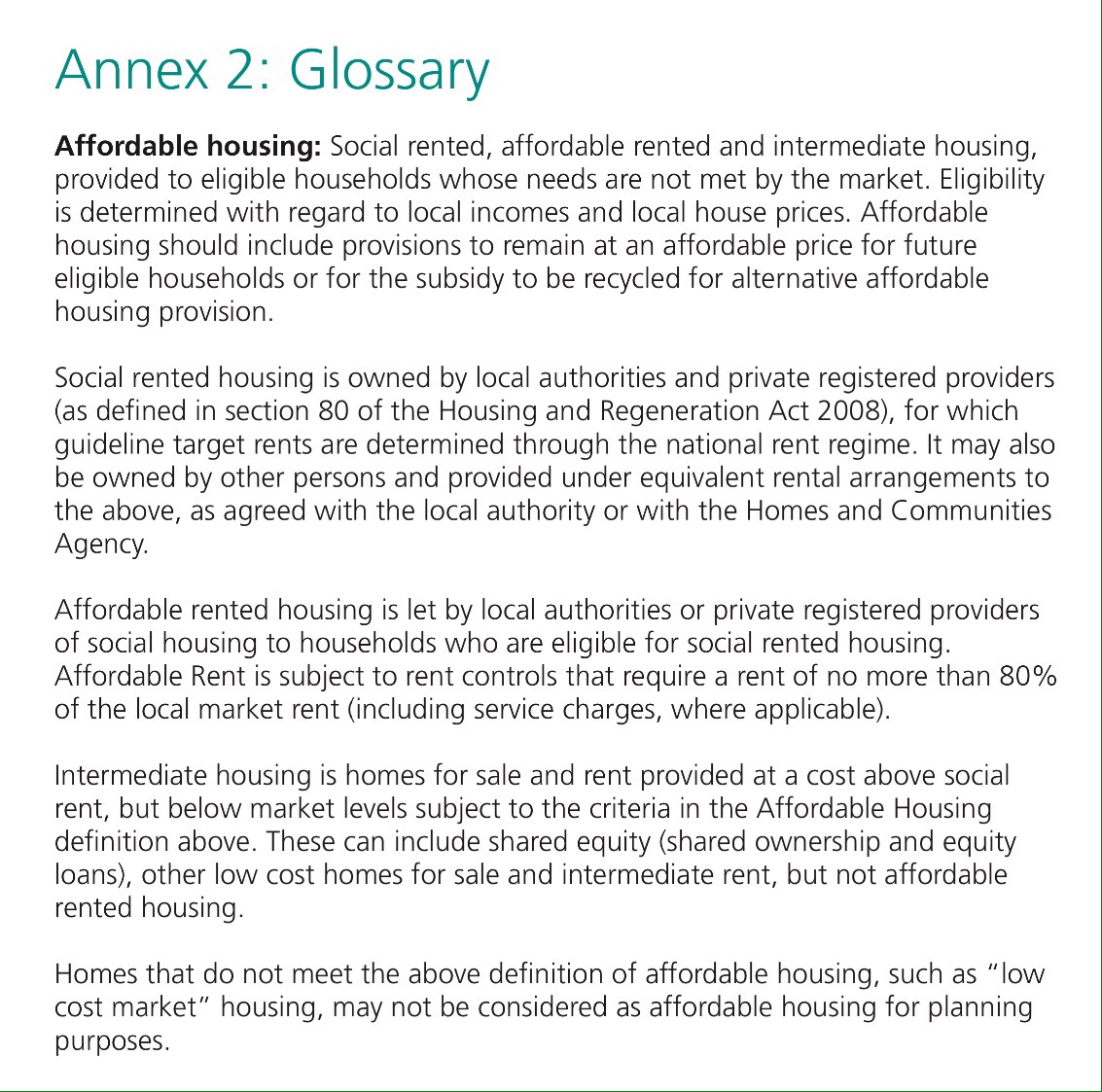
Affordable housing is defined in the NPPF as follows:
The Government carried out a consultation  in December 2015, proposing that the definition be expanded so as to include

– low cost ownership models, which “would include products that are analogous to low cost market housing or intermediate rent, such as discount market sales or innovative rent to buy housing”
– starter homes (of which more later). 

Two further changes were proposed in the February 2017 response to consultation:  
* introduction of a household income eligibility cap of £80,000 (£90,000 for London) on starter homes. 

* introduction of affordable private rented housing

The Government is accordingly consulting until 2 May 2017 on the following replacement definition for the NPPF (long isn’t it?):


Starter homes

There were howls of anguish at the starter homes initiative as first unveiled by the Government, the key elements of which were (as set out in chapter 1 of the Housing and Planning Act 2016 and March 2016 technical consultation):
– a legal requirement that 20% of new homes in developments should be starter homes, ie
– to be sold at a discount of at least 20% to open market value to first time buyers aged under 40. 

– Price cap of £250,000 (£450,000 in London)

– The restriction should last for a defined number of years, the first suggestion being five years, replaced with the concept of a tapered restriction to potentially eight years

– Commuted sums in lieu of on site provision for specified categories of development, eg build to rent

The obvious consequence would have been a significant reduction in the potential for schemes to include a meaningful proportion of traditional forms of affordable housing. 
After all of last year’s battles over the Bill, it is now plain from the Government’s response to the technical consultation, that the starter home concept is now much watered down:
– There will be no statutory requirement on local planning authorities to secure starter homes, just a policy requirement in the NPPF, which is to be amended accordingly. 

– Rather than requiring that 20% of new homes be starter homes, the requirement will be that 10% of new homes will be “affordable housing home ownership products” so could include shared equity or indeed low cost home ownership. 

– maximum eligible household income of £80,000 a year or less (or £90,000 a year or less in Greater London 

– 15 year restriction

– No cash buyers, evidence of mortgage of at least 25% loan to value

– It will only be applicable to schemes of ten units or more (or on sites of more than 0.5h). 

There will be a transitional period of 18 months (to August 2018) rather than the initially intended 6 to 12 months. 
Whilst we now have a more workable arrangement, plainly all that Parliamentary work was a complete waste of time. There was no need for chapter 1 of the 2016 Act – the current proposals can be delivered without any need for legislation. 
We will need to see the degree to which LPAs embrace the starter homes concept in reviewing their local plans. We will also need to be wary that we may lose the only benefit of a national standardised approach, ie the hope that there might be a standard set of section 106 clauses defining the operation of the mechanism (which will not be straightforward – see my 21.6.16 blog post Valuing Starter Homes). 
Affordable Private Rent
One of the documents accompanying the Housing White Paper was a consultation paper: Planning and affordable housing for build to rent.
The term Affordable Private Rent is now used for what we have all previously been calling Discounted Market Rent. Changes to the NPPF are proposed (subject to consultation) advising LPAs to consider asking for Affordable Private Rent in place of other forms of affordable housing in Build to Rent schemes, comprising a minimum of 20% of the homes in the development, at a minimum of 20% discount to local market rent (excluding use of comparables within the scheme itself), provided in perpetuity. The Affordable Private Rent housing would be tenure blind and representative of the development in terms of numbers of bedrooms. Eligible income bands are to be negotiated between developer and LPA. Developers will be able to offer alternative approaches where appropriate (eg greater discount, fewer discounted homes – or different tenures). “Build to Rent” will be defined and it is acknowledged that developers should be able to cease to operate the property as Build To Rent subject to payment of a commuted sum reflecting the affordable housing requirement that would otherwise have been applicable. 
There is also recognition in the consultation paper that factors in London may be different, allowing for an amended response and recognition of Mayor of London’s November 2016 affordable housing and viability draft SPG.
There will be a transitional period of 6 months from the time that the NPPF changes are made. The possibility is held out of model section 106 clauses, which would help minimise unnecessary delays. 

The recognition that Build to Rent is a model that doesn’t sit well with ‘ownership’ forms of affordable housing is what that industry (largely self-defining through scale of scheme and extent of professional management) has been lobbying for. Nor is there any more any reference to off-site starter home provision.
Wider implications
The extensions to the meaning of ‘affordable housing’ are all in the direction of private sector provision. The definition is now very wide indeed. Battles lie ahead once LPAs consider the implications of the changes for their local plan affordable housing requirements against a backdrop of, for example:
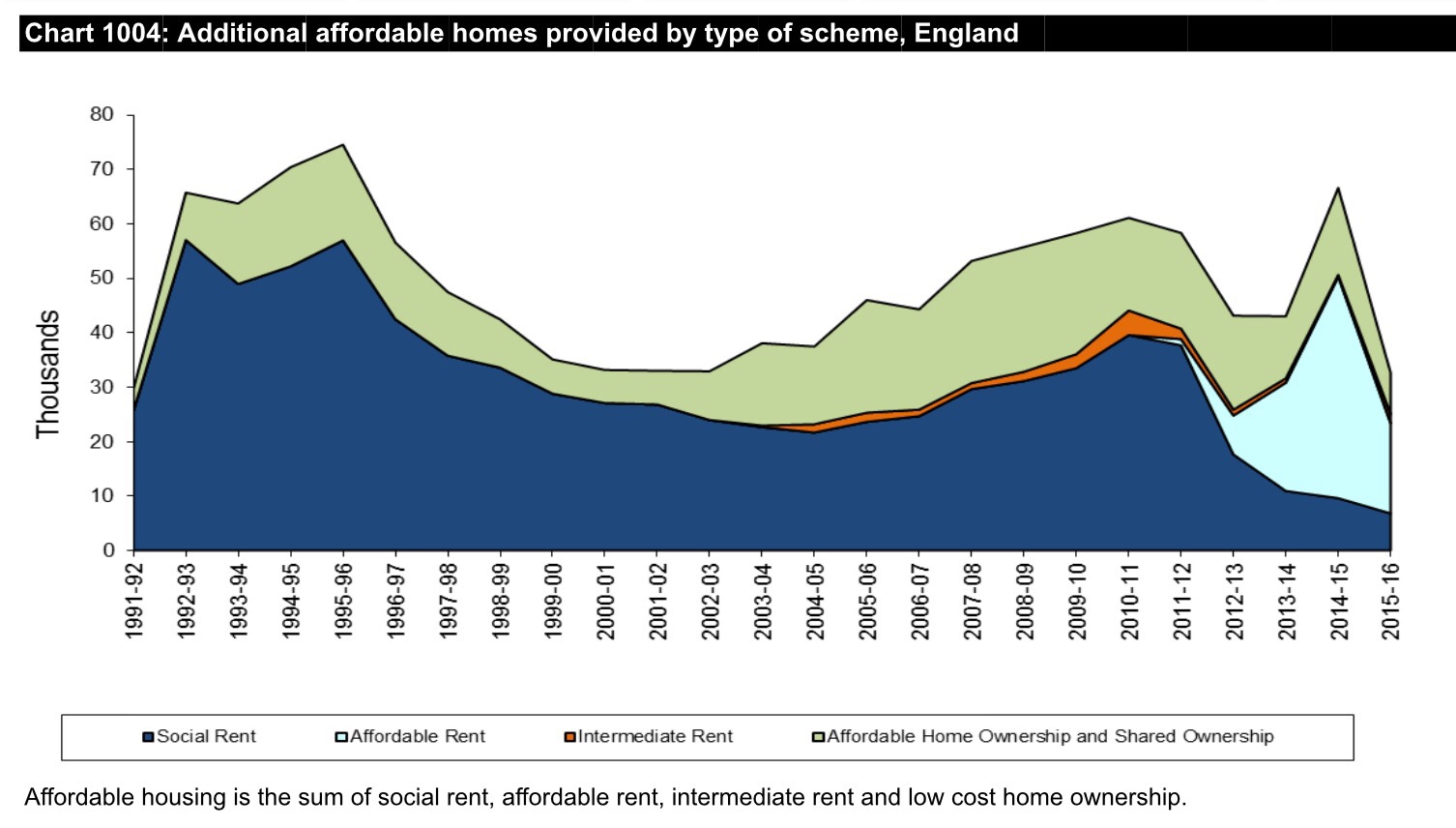
– reduced levels of socially rented housing over the last six years or so following the introduction of affordable rent (minimum discount of at least 20% to market rent), vividly demonstrated in the Government’s affordable housing statistics published on 2 March 2017:

– restrictions on housing benefit, for instance ineligibility of 18-21 year olds from 1 April 2017 under the Universal Credit (Housing Costs Element for claimants aged 18 to 21) (Amendment) Regulations 2017  made on 2 March 2017. 
– the continuing, onerous, requirement on registered providers since 2015 to reduce rents by 1% a year for four years resulting in a 12% reduction in average rents by 2020-21. 
– Loss of stock via the Housing and Planning Act 2016’s voluntary right to buy scheme in relation to registered providers and the Act’s provisions requiring local authorities to sell vacant higher value housing (the Government’s most recent statistics on sales date from October 2016 but already show significant numbers). 
A debate took place in the House of Lords this week, on 2 March 2017, on the Economic Affairs Committee’s July 2016 report, Building More Homes  in the context of the Housing White Paper. Lord Young closed for the Government saying many of the right things but, after such a background of continuing changes (I believe it was Adam Challis at JLL who recently counted 180 housing initiatives since 2010), with further uncertainty for at least 18 months, surely we now just need to get on with the matter in hand – ensuring that there are enough homes to meet all social needs, whilst not killing the golden goose without which this will simply not happen under any foreseeable system, ie profitable development by the private sector.
Simon Ricketts 4.3.17
Personal views, et cetera

Completion Notices: More Pointy, Still Pointless?

Completion notices have always been a blunt tool, little used by local planning authorities. The Housing White Paper proposes sharpening them, but to what end?
If we blow the dust off a bit we can remind ourselves that the current completion notice procedure in sections 94 and 95 of the Town and Country Planning Act 1990 is as follows:
– Development must have been begun within the time limit on the planning permission and that time limit must have now expired. 

– If the LPA considers that the development “will not be completed within a reasonable period” they can serve a completion notice stating that the planning permission will cease to have effect after a period specified in the notice which must be at least 12 months. 

– Any notice is only effective if confirmed by the Secretary of State, who may extend the 12 months’ period. Any person served with a completion notice who objects within a time limit set out on the notice (must be at least 28 days) has a right to a hearing before the Secretary of State before he reaches his decision.

– If the notice takes effect, the planning permission becomes invalid at the end of the specified period, but this does not affect any development carried out under the permission before the end of the period. 

The procedure is very seldom used, for various reasons:
– It doesn’t do what it says on the tin. It does not secure completion of the development. If development has stalled, the developer is already having pretty fundamental problems. The threat of a completion notice is not going to lead to a developer finding significant amount of money to overcome those problems – indeed it could jeopardise a solution being found if funders are spooked.  

– Instead, use of the procedure is likely to lead to an uncompleted development – it should perhaps be called an uncompletion notice. Furthermore, the courts have resisted to date any notion that if, by the end of the specified completion deadline, only part of a building has been built, the part built is in any way no longer unauthorised (Cardiff County Council v National Assembly for Wales, Davis J, 22 June 2006 – in that case, an unsightly part-built garage, which the Council sought unsuccessfully to enforce against after the deadline in the completion notice). 

– The test as to whether the development “will be completed within a reasonable period” is too vague, particularly in relation to major projects. What is it to be judged against?

– The need for approval by the Secretary of State adds to the potential for delay and uncertainty. 

So what is the Government now proposing? As part of its collection of “Holding Developers And Local Authorities To Account” measures, the white paper contains the following:
“2.42 We want to ensure local planning authorities have more effective tools to deal with circumstances where planning permission has been granted but no substantive progress has been made. We propose to simplify and speed up the completion notice process, whereby if development on a site has stopped and there is no prospect of completion, the local authorities can withdraw planning permission for the remainder of the site. This would make it easier for local authorities to serve a completion notice, helping to stimulate building or clear unused permissions from their planned supply of land. “

Views are sought by 2 May on two proposals:

“A.107 The Government proposes to amend legislation to remove the requirement for the Secretary of State to confirm a completion notice before it can take effect. Local authorities know their circumstances best, and removing central government involvement will help shorten the process, and give authorities greater control and certainty. The opportunity for a hearing will be retained where there are objections. 

A.108 We also intend to amend legislation, subject to consultation, to allow a local authority to serve a completion notice on a site before the commencement deadline has elapsed, but only where works have begun. This change could dissuade developers from making a token start on site purely to keep the permission alive. However, it is important that this would not impact on the willingness of lenders to invest.”

These proposals are hardly radical. The Government published a report on completion notices back in July 2001, that it had commissioned from Cardiff University and Buchanan Partnership, no longer on the web as far as I know, which back then made these recommendations (to which it appears the Government never responded):
* Greater thought should be given to tailoring the time period in the standard condition relating to the commencement of development to fit the situation. In particular, the period could be reduced to two years for minor development.
* The Government’s advice, then in Circular 11/95, against including a condition requiring that the whole of an approved development be completed should be reviewed.

* No justification for referral to the Secretary of State, and this should be replaced by a right of appeal.

* Better publicity for the system could lead to its greater use.

The first recommendation in the white paper echoes the 2001 report and is hardly controversial. There should be no reason to require confirmation by the Secretary of State if objections to the notice haven’t been received. 
The second recommendation is more worrying, when looked at in conjunction with the separate proposals in the white paper, that:
– the applicant should “provide information about their estimated ‘start date’ (month/year when a substantive start would take place) and ‘build out rate’ (the number of homes built per financial year) for all proposals for or including housing development
– developers should “provide local authorities with basic information (in terms of actual and projected build out) on progress in delivering the permitted number of homes, after planning permission has been granted”

– large housebuilders should be required to publish “aggregate information on build out rates”

Owners and developers are normally vigilant to keep planning permissions alive by carrying out a material operation prior to the implementation deadline on the permission, reflecting the frequent reality that detailed architectural and engineering work post-permission, as well as the funding structure to underpin a development, often including necessary pre-lets in the case of commercial floorspace, take longer than the deadline for implementation (in relation to which the default period is now proposed to be reduced to two years). Missing the deadline means going down a very long snake to submit a fresh application for planning permission. 
The white paper proposal envisages that an LPA could serve a completion notice at any time after the developer has carried out a material operation, even before the implementation deadline has expired. What would there be to prevent an LPA serving completion notices as a matter of routine where development appears to be slower than was previously indicated, or than housebuilder averages? The white paper itself questions whether this would “impact on the willingness of lenders to invest”. The answer is that it surely would as there would be no certainty for a lender that if the borrower developer defaults on its loan the lender will have time to step in and secure the completion of the development under the same permission – or work through another solution with the borrower. The underpinning certainty of the permission is lost. Two years to implement a permission is no period at all and if relatively minor works within that period may not suffice to keep the permission alive, banks will undoubtedly want to consider the risk profile vis a vis particular authorities very carefully. 
Why not look at more constructive opportunities with the information to be provided about actual or projected build out rates? For example:
– Remember the section 106BC procedure? Revised section 106 arrangements alleviating affordable housing requirements ceased to apply to those parts of the development that had not been completed within three years. That sort of structure could be considered by LPAs in section 106 agreements where justified.

– Any viability review mechanism could be expressed as only operable if specified amounts of development had not been achieved by defined milestones.

– Encourage LPAs to tie any funding they control, eg use of CIL monies for the benefit of the scheme, to timely build out progress.

So much can be achieved by planning obligations and conditions, instead of spending time working out how to hack at the problem with what is hardly the sharpest tool in the box.


Simon Ricketts 25.2.17

Personal views, et cetera

Five Problems With Neighbourhood Plans

The real effects of neighbourhood plan making on housing delivery and on the efficient, democratic operation of the planning system are hard to pin down and yet the Government continues to champion its role. Are we really heading in the right direction? After all, despite the positivity of government sponsored initiatives such as mycommunity.org.uk  it isn’t all sweetness and light. Here is my personal worry list:
1. Neighbourhood Plans are usurping the role of local plans, whilst being subject to a lighter-touch examination process
The Court of Appeal, in R (DLA Delivery Ltd) v Lewes District Council  (10 February 2017), has now confirmed that a neighbourhood plan may be made without there being an up to date local plan. Until such time as the local plan comes forward, as the only up to date development plan, the neighbourhood plan’s policies will benefit from the statutory presumption in section 38(6) of the Planning and Compulsory Purchase Act 2004 and from paragraph 198 of the NPPF: “[where] a planning application conflicts with a neighbourhood plan that has been brought into force, planning permission should not normally be granted”.
This gives neighbourhood plans a role which was surely not foreseen by Parliament. Neighbourhood plans are intended to be in general conformity with the local plan’s strategic policies. But instead any policy vacuum can be filled by the neighbourhood plan’s own strategic policies. Whilst the Planning Practice Guidance urges collaborative working between neighbourhoods and local planning authorities, this does not prevent problems from arising which are exacerbated by two further factors:
–  in order to survive the ‘relatively limited‘ (Court of Appeal in DLA Delivery, para 5) examination process, neighbourhood plans only have to satisfy the ‘basic conditions’ set out in the paragraph 8(2) of Schedule 4B to the Town and Country Planning Act 1990 as applied to neighbourhood plans by section 38A of the Planning and Compulsory Purchase Act 2004, rather than the wider and more rigorous soundness test applicable to local plans. 
–  the Neighbourhood Planning Bill proposes to accelerate the process, by deeming post-examination pre-referendum neighbourhood plans to be a material consideration in the determination of planning applications (clause 1) and by deeming post-referendum neighbourhood plans to be treated as part of the statutory development plan ahead of formally being made by the district or borough council (clause 2). It will be easier for the Secretary of State to dismiss appeals on the basis of inconsistency with emerging neighbourhood plans (a sensitive subject for DCLG given for example Holgate J’s quashing in Woodcock Holdings Limited v Secretary of State, 1 May 2015 and a series of examples of the Secretary of State having consented to judgment in similar circumstances). 
2. The Neighbourhood Plan process is “complex and burdensome”
Not my words but a description given by participants, according to recent research by the University of Reading: Neighbourhood Planning Users Research Revisited.  
Any community embarking on a neighbourhood plan has to be ready for the long haul. Because policies within the plan can have real consequences for communities and developers alike, it is no surprise that the process can be litigious. 
R (Crownhall Estates Limited) v Chichester District Council  (Holgate J, 21 January 2016) was the third (third!) judicial review in relation to the Loxwood Neighbourhood Plan, with the claimant developer seeking unsuccessfully to challenge the plan’s provision for only 60 homes against a background of a failure of the district council to meet its obejectively assessed housing needs. 

I do not believe that there is a transcript of Dove J’s rejection in Swan Quay LLP v Swale Borough Council on 31 January 2017 of a challenge to the Faversham Creek Neighbourhood Plan which contained a policy preventing redevelopment of the claimant’s property on the basis that it would lead to ‘gentrification’. The ruling is summarised by the Faversham Creek Trust in a press release.  
Challenges commonly focus on whether there has been compliance with the requirements of the Strategic Environmental Assessment Directive, another unsuccessful ground of challenge in DLA Delivery. R (Stonegate Homes Limited) v Horsham District Council (the late, missed, Patterson J, 13 October 2016) was an example of a successful challenge on this basis. The Haddenham Neighbourhood Plan is another, where Aylesbury Vale District Council consented to judgment.
3. Neighbourhood Plans dissipate the local planning authority’s resources

Parish councils such as Haddenham are unlikely to have the resources to resist a legal challenge, leaving the responsibility to the local planning authority which, under the legislation, formally “makes” the plan. How much say will they have over the way in which the defence case is brought and, as importantly, why should the local planning authority’s resources be stretched in this way?

We also have of course dissipation of CIL proceeds, with 15% of CIL proceeds available to be spent by parish councils, increased to 25% where a neighbourhood plan is in place – proceeds that would otherwise have applied towards infrastructure projects required to deliver development. 
4. Neighbourhood Plans are unnecessary and marginalise the role of the local planning authority

District and borough councils are designed to operate down to ward level. We elect ward councillors to represent our local interests – that is to say, the things we care about in relation to our home environment, our neighbourhood. Local plans can and do include policies at neighbourhood level. Additionally, there is scope for area action plans to provide more detailed site-specific policies where justified. 

We should all engage more with local plan making. Does the distraction of neighbourhood planning fuel the inaccurate sense that what happens at district or borough level is remote and not to do with us? What if the energy that one sometimes sees expended on neighbourhood planning were to be properly harnessed at local planning authority level, with proper access to officers and with consistency of plan making over a strategically sensible area?
5. Neighbourhood Plans are not fit for the further roles that Government continues to give them
Neighbourhood planning is of course voluntary. It is more prevalent in affluent areas and its heartland is in the south east (Turley research, 2014). In unparished areas it is the preserve of unelected groups. And yet the Government intends it to play a grown up role alongside local plans. Indeed, given that they have statutory force, unlike the NPPF, have neighbourhood plans in fact become more important than the Government’s own planning policies?
Gavin Barwell’s 12 December 2016 written ministerial statement (see my blog post That Ministerial Statement) set out that relevant policies for the supply of housing in a neighbourhood plan that is part of the development plan should not be deemed to be ‘out-of-date’ under paragraph 49 of the National Planning Policy Framework where the following circumstances arise at the time a planning decision is made: 
* the written ministerial statement making the policy change on 12 December 2016 is less than 2 years old, or the neighbourhood plan has been part of the development plan for 2 years or less;

* the neighbourhood plan allocates sites for housing; and

* the local planning authority can demonstrate a three-year supply of deliverable housing sites. 

The statement is of course the subject of a judicial review. In the meantime, the Government’s Housing White Paper has added the further qualification that neighbourhoods should be able to demonstrate that their site allocations and housing supply policies will meet their share of local housing need and that the local planning authority should be able to demonstrate through the White Paper’s housing delivery test that, from 2020, delivery has been over 65% (25% in 2018; 45% in 2019) for the wider authority area (to ensure that delivery rates across the area as a whole are at a satisfactory level). 
 The White Paper also proposes changes to the NPPF to “highlight the opportunities that neighbourhood plans present for identifying and allocating small sites that are suitable for housing, drawing on the knowledge of local communities”.

Finally, local planning authorities will now be “expected to provide neighbourhood planning groups with a housing requirement figure, where this is needed to allow progress with neighbourhood planning. As part of the consultation on a new standard methodology for assessing housing requirements, we will seek views on whether a standard methodology could be developed for calculating housing need in a neighbourhood plan area“.
Let us remember that these are voluntary plans, prepared by parish councils and community groups. Are we not seeing, yet again, a relentless move towards process and complexity, in an effort to make running repairs to a mechanism that was not designed for this function? 
Simon Ricketts 19.2.17
Personal views, et cetera

From The White Paper Mountain, What Do We See?

After so long we have reached the top of the mountain: the white paper and accompanying documents have all been published today, 7 February 2017. However, now we see a series of further peaks on the horizon. 
A good way into the white paper itself, Fixing Our Broken Housing Market, is to start at the back end. From page 72 you have the detailed proposals listed, including a series of proposed changes to the NPPF and other policies which are now the subject of a consultation process from today until 2 May 2017. The consultation focuses on a series of 38 questions but some of the questions are potentially very wide-ranging. Further consultation is proposed on various matters, including 
– housing requirements of older people and the disabled

– Increasing local authorities’ flexibility to dispose of land at less than best consideration and related powers

– Potentially increasing fees for planning appeals (up to a maximum of £2,000 for the largest schemes, recoverable if the appeal is allowed)

– Changes to section 106 processes (with further consideration being given to dispute resolution “in the context of longer term reform”)

– Requiring housebuilders to provide aggregate information on build-out rates and, for large-scale sites, as to the relevance of the applicant’s track record of delivering similar schemes

– Encouragement of use of CPO powers to support the build out of stalled sites. 

There is a supplementary consultation paper on planning and affordable housing for build to rent  containing a further 26 questions, with a consultation deadline of 1 May 2017.
There are responses to previous consultation papers and reports:
– Summary of responses to the technical consultation on implementation of planning changes, consultation on upward extensions and Rural Planning Review Call for Evidence  (including a u-turn on the previous idea of an upwards extensions permitted development right in London, now to be addressed by policy). 
– Government response to the Communities and Local Government Select Committee inquiry into the report of the Local Plans Expert Group 
There is plenty to get to grips with, for example:
– the housing delivery test and new methodology for assessing objectively assessed need

– an understandable focus on whether the applicant will proceed to build out any permission and at what rate, although with a worrying reduction of the default time limit for permissions from three to two years

– Homes and Communities Agency to become “Homes England”. 

It is also reassuring to see the Government applying real focus to build to rent, reducing its emphasis on starter homes – and also reducing its reliance on permitted development rights. 

However, it is surprising how much still remains unresolved. We will apparently have a revised NPPF “later this year” but for much else the start date looks to be April 2018, for example a widened affordable housing definition including watered-down starter homes proposals (no longer a statutory requirement and with reference to a policy target of a minimum of 10% “affordable housing ownership units” rather than the requirement of 20% starter homes previously proposed) and a new methodology for assessing five year housing land supply. 

Liz Peace’s CIL review team’s review of CIL: “A new approach to developer contributions”  (October 2016 but only now published) remains untackled. The Government’s response will be announced at the time of the Autumn Budget 2017. 

Decision-makers will need to grapple very quickly with the question as to the weight they should give to the white paper as a material consideration, given the Government’s clear policy direction now on a range of issues. 


Simon Ricketts, 7.2.17
Personal views, et cetera

Hillingdon JR: Lucky Strike Out?

In R (London Borough of Hillingdon & others) v Secretary of State  (Cranston J, 30 January 2017) the Government achieved an impressive strike out of the first challenge to the proposed third runway at Heathrow, following the Government’s 25 October 2016 announcements. My 15 October 2016 blog post Airports & Courts wins no prizes for predicting a series of such challenges.  
Following the strike out, the draft Airports NPS  was promptly published on 2 February for a 16 weeks’ consultation period. 
However, was this somewhat of a lucky win? The Government’s position, accepted by Cranston J, was that the effect of section 13(1) of the Planning Act 2008 was that there can be no legal challenge of a Government announcement of a decision to publish a draft NPS, but that any challenge instead has to be made within a six week window following final designation of the NPS.
Section 13(1) provides as follows: 
“A court may entertain proceedings for questioning a national policy statement or anything done, or omitted to be done, by the Secretary of State in the course of preparing such a statement only if –


(a) the proceedings are brought by a claim for judicial review, and

(b) the claim form is filed [before the end of] the period of 6 weeks beginning with [the day after] —

 
(i) the day on which the statement is designated as a national policy statement for the purposes of this Act, or


(ii) (if later) the day on which the statement is published.”

So was the 25 October 2016 announcement something done “in the course of preparing” an NPS? Hmm.
Was the operation of section 13(1) intended to be so different from sections 23 and 25 of the Acquisition of Land Act 1981, which provide for a six week deadline for challenging a compulsory purchase order from publication of notice of its confirmation and the exclusion that a CPO otherwise “shall not, either before or after it has been confirmed, made or given, be questioned in any legal proceedings whatsoever“? So, according to the 1981 Act, no challenges before the CPO has been made but the Supreme Court in R (Sainsbury’s Supermarkets Limited) v Wolverhampton City Council  (12 May 2010) has entertained a judicial review of a council’s resolution to make a compulsory purchase order. Is the drafting within the 2008 Act distinguishable from the 1981 Act? Even if it is, where is the logic? With CPOs the widely understood risk of JR of the resolution to make a CPO, before section 25 cuts in to prevent further challenges until the order has been finally confirmed or rejected, is the reason why acquiring authorities commonly seek to leave as little time as possible between that final resolution and making the order. There is no reference in Cranston J’s judgment to this (surely) analogous process

.

Whatever the rights and wrongs, the decision to go for a strike out – always high stakes, given the risk of adding to the time needed to dispose finally of the challenge or at least the risk of egg on face – has so far proved to be the right one, although I do not know whether the claimant local authorities plan to appeal. Even if cleared for take off, the proceedings would in any event face a bumpy ride give that judicial review is a remedy of last resort and it could be said that the claimant authorities should first be making representations to the draft NPS before resorting to litigation?
It was a good week all round for Heathrow. By a decision letter dated 2 February 2017  the Secretaries of State for Communities and Local Government and Transport allowed an appeal by the airport, permitting enabling works to allow it to implement “full runway alternation during easterly operations” (ie, basically, regular easterly departures from the northern runway), after a June 2015 (yes 2015) inquiry and initial refusal by Hillingdon Council in March 2014 (yes 2014) of the airport’s planning application.  
Finally, a post script on challenges to CPO decisions, and to my 22 September 2016 blog post Regeneration X: Failed CPOs. Local Government Lawyer reports that after an oral hearing Collins J has granted Southwark Council permission to challenge the Secretary of State’s decision not to confirm the Aylesbury Estate CPO, Dove J having previously refused permission on the papers. Collins J apparently also “proposed that a meeting should be held between the two parties before any litigation began, considered that it would be unlawful for Southwark to offer more than was allowed under the Compensation Code, and recognised that the decision had significant knock-on effects for other schemes“. It would be no surprise at all to me if the decision is eventually overturned. 
You may now unfasten your seat belts.

Simon Ricketts 4.2.17

Personal views, et cetera

What Happened To The Beautiful Jigsaw? Government Policy v The Plan-Led System

“If we are doing things in parallel, it does mean when we get towards the summer we can make sure these things are knitting together properly and actually bring them together, with those pieces of the jigsaw starting to come together as one whole piece—hopefully, one whole beautiful piece as well” – Brandon Lewis, then minister for housing and planning, 24 February 2016, in evidence to the Commons CLG Select Committee – responding to concerns as to the various changes to the planning system then (and still) underway, including proposed changes to the NPPF, LPEG review and the Housing and Planning Bill (now an Act but still inchoate). (And he was referring to summer 2016…)
Of course a few other things happened to knock summer 2016 off course. But still we wait for the full picture and hence the growing frustration over continued delays to the Housing White Paper and speculation as to its contents.
“OK, that’s politics”, we may say, but is there a more fundamental, longterm, problem to be tackled?
“[M]inisters cannot frustrate the purpose of a statute or a statutory provision, for example by emptying it of content or preventing its effectual operation” (Supreme Court in R (Miller) v Secretary of State for Exiting the European Union 24 January 2017, para 51). 
On reading this, it struck me that there is a logical disconnect at the heart of the modern planning system. Section 38(6) of the Planning and Compulsory Purchase Act 2004 requires that decisions be taken in accordance with the statutory development plan “unless material considerations indicate otherwise”. However, the Government’s non-statutory NPPF, despite an amorphous status as a “material consideration”, somehow often ends up trumping the statutory plan (for example – currently – by way of para 49 deeming policies for the supply of housing to be regarded as out of date in defined circumstances, triggering the para 14 presumption and – under the changes consulted upon last year – by way of the proposed housing delivery test). From where does the NPPF gain its authority in our statutory plan-led system? What is to prevent an LPA from deciding to give its policies little weight and how does the resultant uncertainty help anyone?
The Court of Appeal in Suffolk Coastal District Council v Hopkins Homes, Richborough Estates v Cheshire East Borough Council  (Court of Appeal, 16 March 2016) set out the position as follows:
“The NPPF is a policy document. It ought not to be treated as if it had the force of statute. It does not, and could not, displace the statutory “presumption in favour of the development plan”, as Lord Hope described it in City of Edinburgh Council v Secretary of State for Scotland [1997] 1 W.L.R. 1447 at 1450B-G). Under section 70(2) of the 1990 Act and section 38(6) of the 2004 Act, government policy in the NPPF is a material consideration external to the development plan. Policies in the NPPF, including those relating to the “presumption in favour of sustainable development”, do not modify the statutory framework for the making of decisions on applications for planning permission. They operate within that framework – as the NPPF itself acknowledges, for example, in paragraph 12 (see paragraph 12 above). It is for the decision-maker to decide what weight should be given to NPPF policies in so far as they are relevant to the proposal. Because this is government policy, it is likely always to merit significant weight. But the court will not intervene unless the weight given to it by the decision-maker can be said to be unreasonable in the Wednesbury sense”
Whilst the statutory role of government guidance is clear in relation to plan-making (section 19 of the Planning and Compulsory Purchase Act 2004 provides that “in preparing a local development document the local planning authority must have regard to…national policies and advice contained in guidance issued by the Secretary of State”) there is no such statutory signposting in relation to decision-making. 
It didn’t have to be this way. Consideration was indeed given to giving the NPPF statutory status as the Localism Act went through Parliament. The then minister of state for decentralisation Greg Clark stated in Public Bill Committee on 15 February 2011:
“There are some suggestions that a reference to the significance of the NPPF would be helpful. Against that, however, I have heard some concerns in our discussions that link to the points made by the right hon. Gentleman the Member for Greenwich and Woolwich about not taking a year zero approach to things and completely designing the system from scratch. One of the features of the present regime with which the right hon. Gentleman is familiar is the importance of section 38(6) of the Planning and Compulsory Purchase Act 2004. That provision establishes the primacy of the development plan, which obviously needs to be consistent with national policy. If we were to establish in the Bill a new primacy for national policy that is different from how we have managed in recent decades, I would want to be cautious that we did not introduce something, albeit with the best of intentions, that changed the accepted understanding of the importance of the primacy of the development plan and that, in effect, interferes with section 38(6) without good purpose. If there is a balance of advantage in the approach, I think we can contemplate it, but it behoves us to reflect carefully on the representations that have been made, which I undertake to do.

Scotland’s National Planning Framework has statutory effect pursuant to section 1 of the Planning etc (Scotland) Act 2006
In relation to infrastructure, we of course have a statutory regime of national policy statements  to set the framework for decisions in relation to development consent orders, with ten NPSs having been prepared so far pursuant to section 5 of the Planning Act 2008.
In contrast to these regimes, the NPPF can be amended with little Parliamentary scrutiny. 
The position is even worse in relation to written ministerial statements on planning policy matters, when one recalls, for example:
– Eric Pickles’ 20 May 2010 statement that the then intended abolition of regional strategies was to be a material planning consideration in decision-making, which led to Cala Homes (South) Limited v Secretary of State  (Court of Appeal, 27 May 2011). The court concluded that “…it would not be safe for the Court to assume that at this stage there are no circumstances in which any decision-maker could rationally give some weight to the proposed abolition of regional strategies. In view of the uncertainty created by the legal obstacles…[the need for Parliamentary process to be undergone and SEA]… and any decision-maker who does think it appropriate to give some weight to the Government’s proposal when determining an application or an appeal would be well-advised to give very clear and cogent reasons for reaching that conclusion, but that does not mean that there could be no case whatsoever in which any decision-maker might be able to give such reasons.

– Eric Pickles’ 28 November 2014 statement introducing the vacant building credit and small sites affordable housing threshold, which led to West Berkshire Council v Secretary of State  (Court of Appeal, 11 May 2016). Despite the absolute wording of the statement, it was interpreted by the court as necessarily admitting of exceptions, leading now to a mess of conflicting appeal decisions by inspectors, well documented by Planning magazine (27 January 2017 issue).
– Gavin Barwell’s 12 December 2016 statement amending (without prior consultation) the five year housing land supply threshold in para 49 of the NPPF, which has recently led to a judicial review being brought by a group of no fewer than 25 housebuilders and developers. 
Brandon Lewis’ statement at the outset of this post is quoted in the Commons CLG Select Committee’s review of consultation on national planning policy  published on 1 April 2016. The Committee responded to his optimism as follows:
“We welcome the Minister’s indication that any changes to the NPPF resulting from this consultation will be made during summer 2016, and that he intends to draw together the outcomes of the consultation with those of the other changes affecting the sector“. 

The Committee’s formal recommendations included: 

“As a priority the Department should publish clear timescales for the next steps for this consultation, including timescales for the Government’s response, implementation, and suitable transitional arrangements. If the changes to the NPPF are delayed beyond summer 2016, we expect the Minister to write to us to explain the reasons and provide updated timescales”

” As a matter of principle, we believe that when changes are made to the wording of a key policy framework such as the NPPF, there should be a two-stage consultation process: first on the overall policy, and subsequently on the precise wording which will give effect to the change. If there is no further consultation on the specific wording of the consultation proposals, it is essential that the Department listens carefully to concerns about ambiguity or lack of clarity in the revised NPPF, and provides clarification where required”

“To ensure that proper consideration is given to the impact of changes resulting from this consultation, and from other developments in the housing and planning sector, the Department should carry out a comprehensive review of the operation of the NPPF before the end of this Parliament. The review must include sufficient opportunity for appropriate consultation with stakeholders, and should follow a two-stage approach to consulting, first on general principles, and subsequently on precise wording.”
All sensible, but what a waste of energy. Nine months after the report there has been no Government response!

How are decision-makers meant to balance non-statutory, unstructured interventions from ministers with the outcomes pointed to by statutory planning policies? This surely a very difficult task for decision-makers and with the constant risk of unwelcome surprises for those at the sharp end. Personally, I would go further than the Select Committee’s recommendations and instil basic, legally binding, procedural discipline into ministers’ approach to policy making, given the risk that the statutory planning system is otherwise frustrated, emptied of content or prevented from effective operation (to use the words of the Supreme Court). 
Simon Ricketts 28.1.17
Personal views, et cetera

The Unfortunate Case Of The Council’s Sports Hub

It’s easy for a planning lawyer to summarise R (Boot) v Elmbridge Borough Council  (Supperstone J, 16 January 2017). The High Court confirmed what we already know from paragraph 89 of the NPPF – that “the provision of appropriate facilities for outdoor sport, outdoor recreation and for cemeteries, as long as it preserves the openness of the Green Belt and does not conflict with the purposes of including land within it” is not inappropriate development, but that conversely, if harm is caused to the openness of the Green Belt, even limited harm, the development is inappropriate and permission should be refused save in very special circumstances.
The court duly quashed a planning permission granted on 26 January 2016 for the “Elmbridge Sports Hub” – a proposed athletics stadium, ‘league’ football pitch and training pitches (grass and artificial) for Walton Casuals FC, Walton and Hersham FC and Walton Athletics club to replace their current facilities, on a former landfill site in Waterside Drive, Walton-on-Thames.

However, scratch beneath the surface of any case and there are usually some interesting factors. 

This is not a developer-led proposal. It’s being promoted by Elmbridge Borough Council, on land that it owns. The development is proposed to be funded by the sale by the Council, for the development of 52 homes, of Walton and Hersham FC’s present ground at Stompond Lane. 
Most developers would not take the risk of starting construction work ahead of their permission being free from legal challenge. However, Elmbridge embarked on construction on 21 March 2016, despite the scheme already at that stage having become significantly controversial. Indeed the claimant’s solicitors, renowned claimant firm Richard Buxton & Co, were already on board for objectors and had previously scored an early blow by securing an EIA screening direction from the Secretary of State in July 2015, when the application had already initially gone to committee, requiring environmental impact assessment to be carried out. The Secretary of State ruled:
“Whilst this is a finely balanced case, the proposal does raise concerns to suggest the potential for significant environmental impacts through surface disturbance of the former landfill site, uncertainty about the extent of the contamination of the site and the potential for gas migration to both the River Thames and nearby residential properties.”
Why did development start when the permission was still at risk, presumably when proceedings had already been served, or at least a pre-action protocol letter? I don’t know any of the details but I do note that the local elections took place a little afterwards in May 2016. Was this at all relevant?
Rolling ahead to 2017, by the time that the permission was quashed, the construction project was significantly advanced. With the developer a local planning authority, responsible for planning enforcement, this is surely hardly a comfortable position.  

Image from Get Surrey website

Elmbridge had tried unsuccessfully to delay the court hearing, fixed for 6 December 2016, to allow a second planning application to be determined, for a revised version of the scheme, a request that was rejected by Ouseley J in November.  
The second application eventually went to committee on 17 January 2017, the day after the first permission was quashed and on the basis of a detailed officers’ report, resolved to approve it (perhaps no surprise there). Having delayed the scheme first on an EIA point and secondly on the council’s flawed approach to green belt policy, no doubt objectors will be looking for their next line of attack. 
So a straight-forward ruling by Supperstone J but the situation on the ground is plainly a mess. How does a local planning authority get itself into this sort of position? To what extent is this about financial or political imperatives and, against the backdrop of a construction project in mid flow (one dreads to think of the financial consequences under its construction contract if the authority now pauses or abandons the project), how easy was it for members to determine the second application with open minds but on the contrary how difficult it may be for objectors to prove to a court that minds were already made up?
Simon Ricketts 21 January 2017
Personal views, et cetera