That Written Ministerial Statement

Gavin Barwell’s 12 December 2016 Neighbourhood Planning: Written Statement  has attracted criticism not just for its content, but for inserting significant changes to the operation of the NPPF without prior consultation and without indeed making an amendment to the NPPF itself. 
Paragraph 49 of the NPPF provides that:
“Relevant policies for the supply of housing should not be considered up-to-date if the local planning authority cannot demonstrate a five-year supply of deliverable housing sites.”
ie the presumption in favour of sustainable development in paragraph 14 is triggered. This means:
“where the development plan is absent, silent or relevant policies are out-of-date, granting permission unless: 

    * any adverse impacts of doing so would significantly and demonstrably outweigh the benefits, when assessed against the policies in this Framework taken as a whole; or 


    * specific policies in this Framework indicate development should be restricted”


The December 2016 written ministerial statement provides, “…that relevant policies for the supply of housing in a neighbourhood plan, that is part of the development plan, should not be deemed to be ‘out-of-date’ under paragraph 49 of the National Planning Policy Framework where all of the following circumstances arise at the time the decision is made:

* This written ministerial statement is less than 2 years old, or the neighbourhood plan has been part of the development plan for 2 years or less;


* the neighbourhood plan allocates sites for housing; and


* the local planning authority can demonstrate a three-year supply of deliverable housing sites.”


It seems that consultation will take place in due course that will refine the policy, but in the meantime it takes immediate effect:

“Following consultation, we anticipate the policy for neighbourhood planning set out in this statement will be revised to reflect policy brought forward to ensure new neighbourhood plans meet their fair share of local housing need and housing is being delivered across the wider local authority area. It is, however, right to take action now to protect communities who have worked hard to produce their neighbourhood plan and find the housing supply policies are deemed to be out-of-date through no fault of their own.”

So, suddenly local authorities have an additional “get out of jail” card even where they cannot demonstrate a five-year supply – if the proposal is in a part of its administrative area that (1) has a neighbourhood plan that has policies for the supply of housing (including allocation of sites) and (2) if the local authority has at least a three-year supply of sites.


Local authorities with a dubious housing land supply position may now be immediately tempted to secure that neighbourhood plans within their area contain policies that echo their own housing supply/allocation policies!

Those determining applications and appeals will now need to grapple with the additional questions of whether the relevant neighbourhood plan includes policies for the supply of housing (a phrase that will be examined by the Supreme Court in February in the Hopkins Homes/Richborough Estates litigation) as well whether there is a three-year supply of deliverable housing sites (of course in some situations there may be a five-year supply but not a three-year supply, if the allocated sites have a long lead-in period but the lack of a three-year supply will be irrelevant if the five-year supply is there). 

It seems that the Government does not intend to amend the NPPF but to leave it to be read alongside the written ministerial statement. So much for the intent behind the NPPF in the first place, as described rather sceptically by the Court of Appeal in Hopkins/Richborough  (17 March 2016):
“”The “Ministerial foreword” concludes by stating that “[by] replacing over a thousand pages of national policy with around fifty, written simply and clearly, we are allowing people and communities back into planning”. Some judicial doubt has been expressed about that assertion. As Sullivan L.J. said in Redhill Aerodrome Ltd. v Secretary of State for Communities and Local Government [2015] 1 P. & C.R. 3 (in paragraph 22 of his judgment, with which Tomlinson and Lewison L.JJ. agreed), “[views] may differ as to whether simplicity and clarity have always been achieved, but the policies are certainly shorter”. In an earlier case in which this court had to consider the meaning of the policy in paragraph 47 of the NPPF, City and District Council of St Albans v Hunston Properties Ltd. [2013] EWCA Civ 1610, Sir David Keene had expressed the view (in paragraph 4 of his judgment, with which Maurice Kay and Ryder L.JJ. agreed), that “[unhappily] … the process of simplification has in certain instances led to a diminution in clarity”.” (paragraph 8)
The lack of any intention to amend the NPPF is particularly disappointing given the fact that the Government consulted  in December 2015 over other proposed changes to the framework, which remain in hiatus pending the forthcoming Housing White Paper. If the document is to be updated, why not do the job properly (and clear up other ambiguities at the same time), rather than to allow people and communities to be shut out again from the process by having a supposedly comprehensive policy statement that is anything but?
Policy making by written ministerial statement  is understandably attractive for politicians. Indeed, since the changes to the Government’s consultation principles in January 2016  we can presumably expect much less consultation:
“Do not consult for the sake of it. Ask departmental lawyers whether you have a legal duty to consult…Do not ask questions about issues on which you already have a final view. “
A legal duty to consult often does not arise – if, for example, there is no specific statutory requirement, if there has been no prior indication that has lead to a legitimate expectation that there will be consultation or if the proposal is not a plan or programme to which the Strategic Environmental Assessment Directive applies.  
The Government’s 28 November 2014 written ministerial statement that introduced the vacant building credit and affordable housing small sites threshold predated the Government’s amended consultation principles. It may well be that there was in fact no duty on the Government to consult. However, if a public body chooses to carry out consultation it must abide by judge-made rules of lawful consultation – the Sedley principles:
a)  Consultation must take place when proposals still at a formative stage;
b)  The public must be given sufficient information to allow for intelligent consideration and response;

c)  Adequate time must be given for consideration and 
response;

d) The consultation responses be conscientiously taken into 
account in finalising the proposal.

The adequacy of the consultation undertaken ahead of the 2014 statement was of one of the grounds of challenge in West Berkshire Council v Secretary of State  (Court of Appeal, 11 May 2016). Whilst the Court of Appeal found the consultation process to be lawful, that had not been the conclusion of Holgate J at first instance. No wonder the advice is now: if you don’t have to consult, don’t. Depressing for those who might hope that open debate leads to better policy making and fewer unintended consequences.

Simon Ricketts 29.12.16

Personal views, et cetera

Trees In Court: A Festive Special

Trees stir emotions. Dwarfing us in their scale and their natural lifespan, they are integral to, define and inspire our built and natural landscapes. Their leaves connect us with the changing seasons. But they can be inconveniences: their roots, their debris, sometimes even their very presence.

The £1m lime tree
Who would spend £1m litigating over problems alleged to arise from a single lime tree in a suburban London Street? This is a recent piece from The Lawyer. HHJ Edward Bailey’s 29 July 2016 county court judgment  refusing the owner of the tree (a subsidiary of Grainger Trust plc) access over the neighbouring lawyer’s property (because the answer is of course a lawyer) under section 1 of the Access to Neighbouring Land Act 1992, to prune it, runs to 27 pages. All of the papers relating to the litigation, including transcripts and evidence, are at www.disputewithgrainger.com, a website created for the purpose by the neighbour. A £100,000 interim payment on account of his costs was due to be paid by Grainger yesterday. 
Sets the bar pretty high for future neighbour disputes it must be said. 
Trees & PFI
Where does the line of least resistance lie where a local authority’s PFI contractor faces increased highways maintenance costs due to the presence of trees?
Sheffield City Council, abetted by its contractor Amey, has been engaging in a systematic programme of tree felling and replacement along its highways. 

A somewhat speculative challenge was brought to the process by local residents in R (Dillner) v Sheffield City Council  (Gilbart J, 27 April 2016), following an interim injunction that was granted at short notice.

Gilbart J is in lyrical form, starting his judgment with the following background:

“Sheffield is one of the great cities of Northern England. Parts of it lie within the Peak District, which abuts its western aspect. It lies where several rivers and streams (the Rivers Don, Sheaf, Loxley, Rivelin, and Porter, Meers and Owler Brooks) flow eastwards off the Pennines. Many of its roads and streets (and especially in the suburbs running westwards and south-westwards from the City Centre) have trees planted along them, in the verges or other land within the highway. Like many of the great cities of the north of England, it suffered during the deindustrialisation of the late 20th Century and the financial stringency endured by local authorities over the last 30 years or more. The upkeep of its roads and streets were not immune to the testing climate that created for local authorities, and a backlog of maintenance developed.

It is in the nature of highway trees which are well established that they are intrinsically attractive (save in unusual cases), but also that, if allowed to grow unchecked, they cause problems to the proper maintenance of the roads, verges and pavements in which they sit or which they abut. Thus, the loss of a tree may be seen as regrettable in visual terms, but it may be required if the highway is to be kept in repair. The background to this case concerns the way in which Sheffield City Council (“SCC”) has sought to deal with the backlog of repairs, and in particular of how it has dealt with the presence of trees on its roads and streets”

The grounds of challenge followed familiar territory: inadequate consultation; the need for environmental impact assessment, and engagement of the decision maker’s duty to pay special attention to the desirability of preserving and enhancing the character of conservation areas.

The grounds were rejected:

– “provided the felling or lopping of the tree is carried out in pursuance of [a highways authority’s duty to maintain (and thus repair) [the highway], there is no requirement for consent to fell the tree “. 

– “while there is a requirement in those domestic Regulations which apply the EU Directives for environmental assessment in the case of trees, it only applies to projects of deforestation on sites of at least 1 hectare in size (0.5 ha in a National Park); see Environmental Impact Assessment (Forestry) (England and Wales) Regulations 1999 Schedule 2 paragraph 2. This project cannot be called deforestation”

– It “follows from the above that: 

(a)  the execution of works in the highway to repair it does not constitute development and therefore requires no planning permission; 


(b)  the removal or lopping of trees requires no planning permission in any event; 


(c)  the removal or lopping of highway trees in a Conservation Area requires no consent under s 211 TCPA 1990 if carried out in pursuance of the duty of the highway authority to maintain the highway, keep it in repair, and free of sources of danger or causes of obstruction; 


(d)  there is therefore no question of a development consent being required for the works; 


(e)  no planning function arises relevant to s 72 LBCAA 1990; 


(f)  at most, the fact that a tree could contribute to the appearance and character of a Conservation Area could be a material consideration. There is no evidence at all that Amey and SCC failed to take it into account.

Gilbart J’s closing comments:

“I repeat that nothing in this Judgment is to be read as criticising the residents of Sheffield for seeking to protect the trees in their streets and roads, whose presence many of them appreciate so much. But as with many matters, such an understandable and natural desire must be tempered by acceptance of the important duties cast on the highway authority to maintain those roads and streets in good repair. It is unfortunate in the extreme that those advising the Claimant and others who object have failed to address both sides of the argument, and even more so that the claim was advanced, and the injunction sought, without any proper analysis on their behalf of the statutory and legal context. It may be that those who will be disappointed by the terms of this Judgment will want to see a different legislative regime in place. That is a matter for Parliament, and not for this Court.
So will Parliament now conduct a root and branch review?
Andrew Lainton’s February 2016 blog post, written when the interim injunction was granted, is, as always, worth reading.
Sycamore vs the tree of heaven
In determining in the Sheffield case that the decision by an authority to fell a tree does not engage the conservation area special duty in section 72(1) of the Listed Buildings and Conservation Areas Act 1990, Gilbart J had cited R (McClennan) v London Borough of Lambeth  (HH Judge Sycamore, 16 June 2014), which concerned Lambeth’s proposals to fell a tree of heaven at the rear of the grade II listed Durning Library building in Kennington Lane, within Kennington conservation area – with the objective, said Lambeth, of preventing structural damage to the listed building. Whilst section 72(1) wasn’t engaged, the judge held that Lambeth’s cabinet had failed to take into account a material consideration, namely that the tree was situated in the conservation area. The decision was quashed. Lambeth subsequently carried out public consultation but I think I know where the tree has gone.

Forest Hill Park, Labour In Vain Road
is the address in Wrotham, Kent of a caravan site which has been the subject of a TPO saga. Following the felling of various protected trees, enforcement proceedings were brought and court action was settled on the basis of an undertaking given by the defendants to cease the felling. The felling resumed, the council started proceedings for contempt of court and the defendants applied to release the undertaking, on the basis that they could fell the trees in reliance on a 1983 planning permission for “development … and continuation of use of land as caravan site”. The question that came to the Court of Appeal in Barney-Smith v Tonbridge and Malling Borough Council  (Court of Appeal, 9 December 2016) was whether the exemption from the need for consent, where felling was “immediately required for the purpose of carrying out development authorised by” a planning permission, was satisfied. The court, not unsurprisingly, held that the answer was no – even though the planning permission could have been implemented in such a way as would have necessitated the tree felling, it could be implemented in a manner which left the trees untouched and therefore the exemption did not apply.
The Hampstead Heath dam

R (Heath & Hampstead Society) v City of London  (Lang J, 28 November 2014) concerned the Hampstead Heath dam project, the decision by the City of London to approve and proceed with proposals for reservoir safety works to the ponds on Hampstead Heath. The claimant regarded the proposed works which would entail the loss of over 80 trees, as “damaging, unnecessary and over-engineered”. But Lang J held that the only legal consideration under the Reservoirs Act 1975 is public safety and that the works would not be in breach of the restrictions in the Hampstead Heath Act 1871 which requires that the City of London shall forever keep the Heath “unbuilt on” as they would fall within exceptions for drainage and improvement.  

Festive Litigation
Whatever your religion or non religion, enjoy the break (if I don’t blog again in the meantime). In the US, the constitutional status of the Christmas tree reached the US Supreme Court in Court County of Allegheny v. American Civil Liberties Union (3 July 1989). The combined display outside local authority offices of a Christmas tree, Menorah and sign saluting liberty was sufficiently secular so as not to offend the establishment clause in the First Amendment of the constitution, as opposed to a nativity scene inside a court building, which was held to be unlawful. What would the Daily Mail have to say about any UK Supreme Court justices who made such a ruling one wonders? I gather that since then the US Supreme Court has remained decidedly unfestive – according to one US commentator it has since declined to intervene in cases concerning: a Menorah and Christmas nativity scene combined with Frosty the Snowman and Santa Claus; an attempt to have Christmas decertified as a federal holiday, and efforts to allow Christmas music to be played over the intercom at public schools.


What’s a lawyer to do? The High Court rises on 21 December and the new term starts on 11 January. Oh well, put another log on the fire. 
Simon Ricketts 17.12.16
Personal views, et cetera

First World Problems: Basements

Does anyone actually need to excavate a basement? Despite, or because of, the cheek by jowl impacts on neighbours arising from the construction process and/or concerns as to structural implications, basement excavation does have one benefit – of regularly testing various areas of planning law. 
Permitted development rights
We have yet to see whether Team Javid/Barwell have the same enthusiasm for permitted development rights as Team Pickles/Lewis, with their three tier approach to development management: permitted development rights without the need for prior approval; permitted development rights with the need for prior approval where specific issues arise, and planning permission “for the largest scale development” (budget, 2014). 
Basement development exposes the difficulties with the permitted development process. Indeed the case of Eatherley v London Borough of Camden  (Cranston J, 2 December 2016) has blown a huge hole in the concept of permitted development rights as its conclusions could be applied to all but the most minor forms of development. It will surely have implications for the Government’s more ambitious, but currently stalled permitted development proposals summarised in my 15.6.16 blog post  .
As summarised by Cranston J, the central issue was “a question about the extent to which subterranean development can be carried out relying on the current regime of permitted development rights. The question is of general interest but arises particularly frequently in central London because of economic and social factors, in general terms, the increasing pressure for space. It is a matter of controversy in the planning world and there is a split between local planning authorities as to the correct answer”. 
Class A, Part 1, Schedule 2 of the Town and Country Planning (General Permitted Development) (England) Order 2015 grants deemed permission for the “enlargement, improvement or other alteration of a dwellinghouse” subject to defined limitations. 
The judge held that the proposals involved excavation works which, as a matter of fact and degree, constituted “an engineering operation” which did not benefit from any permitted development right:
“In my judgment the planning committee asked itself the wrong question with its focus on the works being “entirely part” of the overall development, which would “by necessity” involve engineering works. It concluded that because this was the case it followed that the works did not constitute a separate activity of substance. That is not the approach laid down in the authorities. The Council’s conclusion that the engineering works were not a separate activity of substance followed from a misdirection. It should not have asked itself whether the engineering works were part and parcel of making a basement but whether they constituted a separate activity of substance. The Council needed to address the nature of the excavation and removal of the ground and soil, and the works of structural support to create the space for the basement.” 
So now, objectors to projects that are being pursued in reliance upon permitted development rights will be alert to elements of the works that can be said to be engineering works that would require a separate planning permission. 
The judgment is topical – in November 2016, DCLG published Basement Developments and the Planning System – Call for Evidence  which “seeks evidence on the number of basement developments being taken forward: how these developments are currently dealt with through the planning system; and whether any adverse impacts of such developments could be further mitigated through the planning process. This review is not considering whether or not basement development should be permitted, but rather how the planning process manages the impacts of that development where it is permitted. ” The deadline for consultation responses is 16 December 2016.
Other uncertainties of the (similarly worded) equivalent part of the predecessor Order were considered in Royal Borough of Kensington and Chelsea v Secretary of State  (Patterson J, 17 June 2015):
 – whether the limitation in the Order if “the enlarged part of the dwelling house would have more than one storey” is referring to the dwelling house as enlarged by development, i.e. includes the original dwelling house, or whether it is referring to that part of the dwelling house permission for which is given by Class A of the GPDO. The judge held that it was the latter, simply excluding anything more than a single level basement.
– whether the limitation in the Order if “the enlarged part of the dwelling house would be within 7 metres of any boundary of the curtilage of the dwelling house opposite the rear wall of the dwelling house” is referring to the dwelling house being developed, i.e. the application dwelling house, or to another dwelling house opposite the dwelling house being developed”. The judge held that it was the former. 

Article 4 directions
One clear flaw in the Government’s reliance on permitted development rights is the relative ease with which LPAs can disapply the process through Article 4 directions (without giving rise to any rights to compensation if the direction is expressed to come into force at least a year after it is made). In relation to both of the cases referred to above the relevant LPAs have now put directions in place.
On 3 October 2016 the London Borough of Camden confirmed a direction made under Article 4(1) of the GPDO, covering the whole of the borough. From 1 June 2017 planning permission will be required for basements. The direction covers: 
“The enlargement, improvement or other alteration of a dwellinghouse by carrying out below the dwellinghouse or its curtilage of basement or lightwell development integral to and associated with basement development, being development comprised within Class A, Part 1 of Schedule 2 to the Order and not being development comprised within any other Class.” 

The Royal Borough of Kensington and Chelsea made an Article 4 direction on 19 March 2015 which came into force a year later.
Restrictive policies
To the extent that planning permission is required, where the proposed works fall outside the scope of permitted development rights, LPAs have been tightening their policies so as to be able to take a more restrictive approach. 
Lisle-Mainwaring v Royal Borough of Kensington and Chelsea  (Lang J, 24 July 2015) was an application (supported by a basement excavation contractor!) to quash RBKC’s adoption of a revision to its development plan so as to include a basements planning policy  , claiming that the council and the plan inspector “failed to take account of a material consideration, namely the permitted development rights for basement development, and the risk of greater reliance on them if the BPP were adopted, without the benefit of any planning control over construction noise and loss of amenity”, failed to consider “reasonable alternatives” to the policy under the SEA Directive and failed to consult adequately on the new policy. (Ms Lisle-Mainwaring also of course painted her house in candy-cane stripes as part of a bizarre protest against opposition to her proposed three storey basement, thereby creating even more work for the planning bar). 
The 2015 basements policy prevented double basements in most circumstances and restricted the construction of basements under the garden to no more than 50% of the garden area (previously 85%). RBKC has since adopted, on 14 April 2016, a more detailed basements SPD  as well as a code of practice on noise, vibration and dust 
(Of course, policies should not be applied regardless of specific circumstances. By a decision letter dated 18 September 2015  an appeal was allowed for a double basement as part of the redevelopment of the former Kensington Tavern site, albeit partly on the basis of a fallback position by virtue of existing planning permissions). 
First world problems
Celebrity super basements are of course a particular headache for RBKC. 
Brian May continues to lobby  and litigate  against, we have had Jimmy Page reportedly  objecting to a super basement proposal by Robbie Williams, and of course the saga of Foxtons founder’s plans for “new subterranean space for leisure facilities to include a swimming pool and conversion of the existing undercroft into a car museum” at his home in Kensington Palace Gardens, opposed by, amongst others, the French and Japanese embassies and Indian High Commission. 
The dispute as to whether planning permission and listed building consent for the works had been validly implemented and whether lawful development certificates had been lawfully issued came to court in Government of the Republic of France v Royal Borough of Kensington and Chelsea  (Holgate J, 27 November 2015), with the court finding for Hunt. I believe that the case is now heading to the Court of Appeal.
It all makes for interesting press of course – and certainly interesting law – but would most of us would choose to spend our money three storeys down were we to win life’s lottery? 
Simon Ricketts 5.12.16
Personal views, et cetera

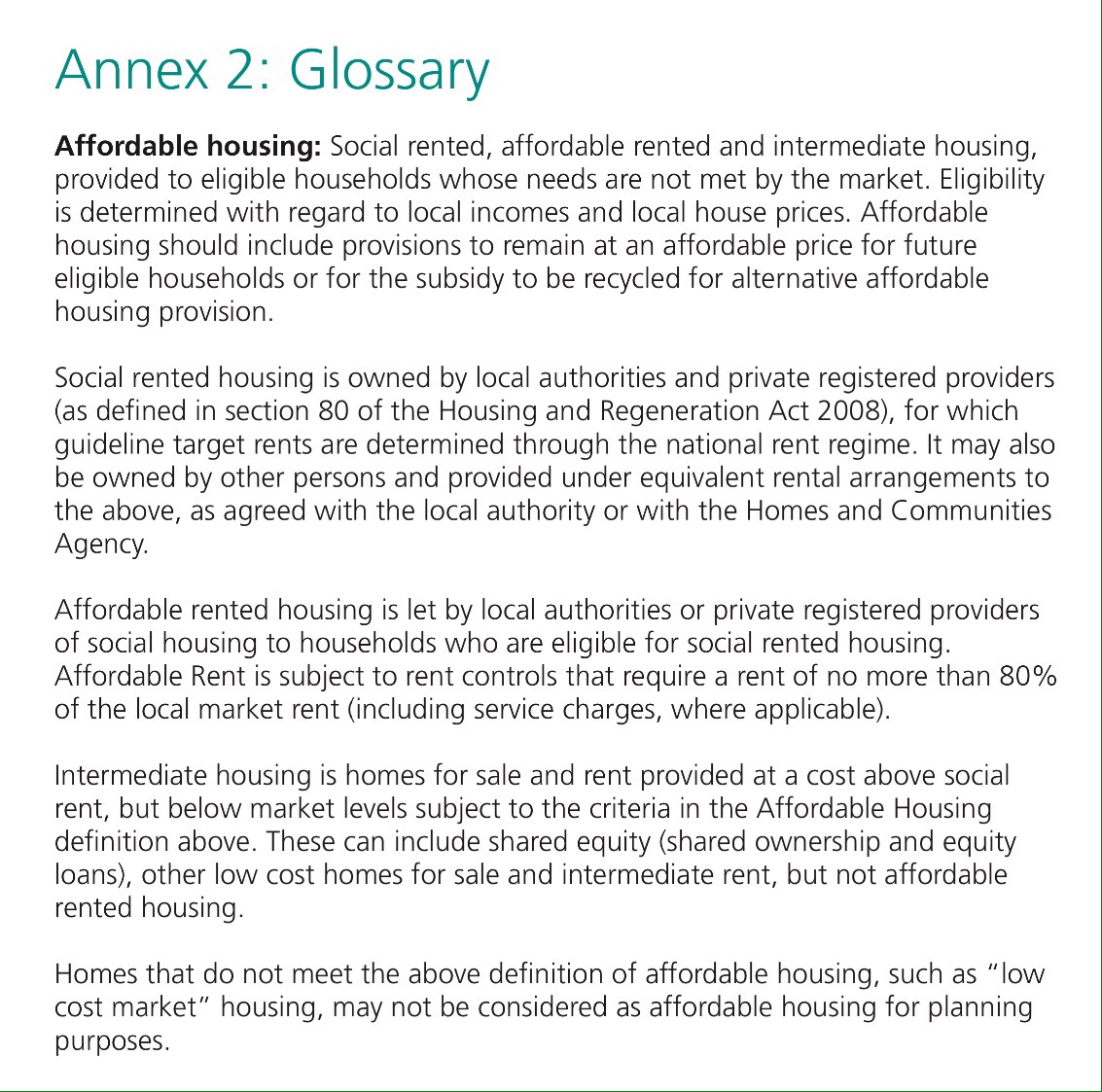
Affordable Housing & Viability: London Leads

Full credit to Sadiq Khan for pressing ahead with his heavily trailed draft Affordable Housing and Viability SPG  despite the Government’s inexplicable delay in publishing the Housing White Paper (whatever its contents prove to be). The deadline for consultation responses to the draft SPG is 28 February 2017. As the draft warns, when the Government’s detailed proposals in relation to starter homes are published, presumably as part of the white paper, there will be knock-on implications for the SPG – after how can the percentages in the draft SPG possibly survive the imposition of a mandatory starter homes top slice?
The SPG will be guidance rather than policy (although I suspect that the distinction may over time prove largely semantic when non compliant schemes come before the Mayor for sign off) and LPAs are “strongly encouraged” to follow it for schemes of ten or more dwellings. The SPG will supersede section 3.3 (Build to Rent) and Part 5 (Viability) of the March 2016 housing SPG. The rest of that SPG remains current. It will inform the drafting of the new London Plan, a consultation draft of which is expected in Autumn 2017. 
What follows will become very familiar I’m sure to all of us negotiating London section 106 agreements. The level of prescription may prove helpful in narrowing the scope for re-inventing the wheel, subject to the attitude that LPAs take to what after all is only draft non-statutory guidance. 
The ‘threshold’ approach
The draft SPG introduces a ‘threshold approach’, whereby schemes meeting or exceeding 35% (by habitable room) affordable housing without public subsidy will not be required to submit viability information. 
Schemes are divided into “route A” and “route B”. 

Route A schemes are:
. applications which do not meet the 35% threshold and required tenure split;

• applications which propose affordable housing off-site or as cash in lieu contribution; 

• applications which involve demolition of existing affordable housing (in particular estate regeneration schemes); 

• applications where the applicant claims the vacant building credit applies. 

Route B schemes are schemes which meet the 35% threshold and required tenure split (and which do not otherwise fall within the route A scheme definition above). Viability appraisal is not required, although there will be an “early review mechanism … triggered if an agreed level of progress is not made within two years of permission being granted” (the agreed level of progress being defined at the outset in the section 106 agreement).
The required tenure split
The required tenure split is:
– “at least 30% low cost rent (social rent or affordable rent) with rent set at levels that the LPA considers ‘genuinely affordable’ (this will generally be significantly less than 80% market rent). As part of [the] consultation, LPAs are being invited
to give guidance on what rent levels they consider to be genuinely affordable if above the benchmarks for London Affordable Rent”.
– “at least 30% as intermediate products, with London Living Rent … and/ or shared ownership being the default tenures assumed in this category. For viability purposes, London Living Rent homes in mixed-tenure schemes can be treated similarly to shared ownership, as it can be assumed that they will be sold on a shared ownership basis after a period of 10 years”.

– the remaining 40% is to be determined by the relevant LPA but must be “genuinely affordable”.

“London Living Rent is a new type of intermediate affordable housing that will help, through low rents on time-limited tenancies, households with around average earnings save for a deposit to buy their own home”. It has “ward-level caps … based on one-third of median gross household income for the local borough. The cap varies from the Borough median by up to 20 per cent in line with house prices within the ward”. The Mayor intends to limit eligibility for London Living Rent and other intermediate rent products to households on incomes of £60,000 a year or less, down from £90,000. 

“[F]or intermediate dwellings to be considered affordable, annual housing costs, including mortgage (assuming reasonable interest rates and deposit requirements), rent and service charges should be no greater than 40% of net household income. 
For shared ownership properties, to ensure mortgage costs assumptions are reasonable, boroughs, developers and registered provides are advised to assume buyers will access RPs, with a term of 25 years and a 90% loan to value ratio. The prevailing average interest rate being offered to lenders based on the terms above should be used to calculate the monthly payments. Generally shared ownership is not appropriate where unrestricted market values of a unit exceed £600,000”. 
Viability appraisal
Viability appraisal will be required to following a prescriptive approach, set out in part 3 of the draft. In relation to some familiar areas for dispute:
– “The price the RP has agreed to pay for each unit should be used in the viability appraisal and should be enshrined in the Section 106 agreement (for phased schemes the price in the Section 106 should be inflation linked)”.

– It should be assumed that all developers will incur generic average finance costs based on standard market rates.

– The IRR approach will not generally be appropriate for schemes of fewer than 1,000 units. 

– The benchmark value will be based on an existing Use Value plus premium (EUV+) approach, rather than the circularity of a market value approach. The Mayor will generally only accept an Alternative Use Value (AUV) approach where there is an existing implementable permission for that use.

The Mayor expects “all information to be made public, including council and third party assessments. Applicants will have the opportunity to argue that limited elements should be kept undisclosed, but the onus is on the applicant to make this case”. 

Review mechanisms
Section 106 agreements for route A schemes will need to require a two stage review mechanism:
– An “early review” where an agreed level of progress with the scheme is not made within two years of the permission being granted. Any surplus to be split 60/40 between the LPA and the developer and any surplus identified to translate into additional onsite affordable housing. “Thus plans should identify which units would switch to affordable accommodation in the event of an increase in viability at this early stage. If the agreed level of progress has been made, this review will not be triggered. All signatories to the Section 106 need to commit to making their best endeavours to fulfil their relevant requirements (setting out key milestones and requirements) to deliver the scheme and account may be had of the market situation at time of review”. 

– A “near end of development review which will be applied once 75% of units are sold. Where a surplus profit is identified this should be split 60/40 between the LPA and developer. The outcome of this review will typically be a financial contribution towards off-site affordable housing provision”. 

– The surplus is applied up to a total of 50% affordable housing.

The review should consider changes in gross development value and build costs using formulae set out in Appendix A to the draft SPG and which should be set out in the section 106 agreement. 
Build To Rent
Specific favourable provisions apply to Build To Rent, defined as complying with the following criteria:
“• a development, or block/ phase within a development, of at least 50 units; 

• the homes to be held as Build to Rent under a covenant for at least 15 years; 

• all units to be self-contained and let separately; 

• unified ownership and unified management of the development; 

• professional and on-site management; 

• longer tenancies offered (ideally three years or more) with defined in-tenancy rent reviews; and 

• property manager to be part of an accredited Ombudsman Scheme and a member of a recognised professional body”.

The Build To Rent restriction should usually be by way of section 106 agreement and should include a clawback mechanism if the units cease to be used for Build To Rent purposes. Two potential, alternative , clawback mechanisms are being consulted upon:
– to seek to recoup the initial loss of affordable housing if the homes are sold out of the Build to Rent sector, based on an appraisal submitted at application stage showing the reduced number of affordable homes possible due to the Build To Rent model. 

– a clawback to secure a total of 35% affordable housing. 

Affordable housing within Build To Rent schemes can be by way of discounted market rent (DMR), managed by the private sector landlord. The Mayor is seeking that the DMR be at London Living Rent. 
Some relaxation of space standards may be acceptable for Build To Rent products, particularly where they are subject to a longterm covenant that they will remain as Build To Rent. 
Differences are recognised in the approach to viability for Build To Rent schemes. Particularly:
“a different approach to profit (often lower than a build for sale scheme); 
• different approaches to sales and marketing; 

• rate of sale/disposal – this will generally be faster for a Build to Rent scheme (generally a build to rent appraisal will assume a development period and then a sale to an investor or operator); and 

• potentially lower risk compared to for sale schemes”. 

Finally, the Mayor is keen to secure the following five management standards:

“- Longer tenancies (three years or more) should be available to all tenants. These should have break clauses for renters, which allow the tenant to end the tenancy with a month’s notice any time after the first six months. 

– Within these tenancies there should be formula-linked rent increases. The LPA should not stipulate the level of rent increases on market rate tenancies, but these should be made clear to the tenant when the property is let and LPAs should ensure they are not set to discourage tenants from taking longer tenancies. Rents should normally be reset on each new tenancy.

– There must be on-site management. This does not necessarily have to mean
full time dedicated on-site staff in every case, as this could be unviable and unnecessary on small schemes. However all schemes need to have prompt issue resolution systems and some daily onsite presence.

– Providers must have a complaints procedure in place and be a member of
a recognised ombudsman scheme. They must also have membership of a designated professional body, such as the British Property Federation or Royal Institute of Chartered Surveyors.

– Finally, properties must be advertised on the GLA’s London-wide portal, in due course, which can be in addition to any advertising the provider may already be undertaking”.

Registered providers/grant funding

Applicants are encouraged to have registered providers on board at pre-application stage. 
The Mayor’s grant funding will only be available for route B applications if it increases the proportion of affordable housing above the nil-grant position to a level of 40% or more.
“The Mayor’s Homes for Londoners: Affordable Homes Programme 2016-2021, sets out how grant is going to be used to increase the amount of affordable housing delivered on developer-led sites above 35%, and to support approved providers deliver programmes with at least 50% affordable housing”. 

Concluding thoughts

In 2015 private sector schemes only delivered on average 13% affordable housing. Will this approach nudge the percentage upwards? This largely depends on whether developers believe that to button down 35%, with no review as long as development is not delayed, and with no need for viability appraisal, is sufficiently achievable or attractive. If it isn’t then it will be business as usual, with viability appraisals submitted to seek to secure a significantly lower percentage. 

How will LPAs react, particularly those inclined to hold out for the 50% target? And how will the imposition of a mandatory proportion of starter homes impact on this nuanced, London-specific approach?

Is the Mayor’s target of 50% now unachievable by flagging 35% as in practice acceptable or can the use of public land and grant funding make any appreciable difference?

Pass. But at least the likely structure of section 106 agreements for route A, route B and Build To Rent schemes (or rather the Mayor’s starting position) is increasingly clear. Which means, if the approaches are commercially palatable, faster permissions and less delay to development (particularly with the spectre of reviews triggered by delayed implementation). And:

Mayor of London: 1

Secretary of State: nil.
Simon Ricketts 1.12.16
Personal views, et cetera

Politician, Heal Thyself: Pruning Planning

Let’s not use the term “red tape”. It is a value-laden term liked by politicians as it suggests that we are all tied up by unnecessary bureaucratic procedures which have arisen by way of inefficient administrative processes, when the truth is that our planning system (and every other arm of government I would therefore guess) is over-burdened with procedures that have been entirely driven by short term political aims – introduced with no rigorous testing and little understanding of their likely effects.
The previous government’s “Red Tape Challenge” produced a long list  of regulations to be scrapped but in my view has ultimately made little difference. No lessons have been learned. 
The current government supposedly has a “Cutting Red Tape” programme  with proposals awaited in various areas, including “house building” and “local authorities” but I do not sense any great activity. Indeed, it is clear from the government’s vacuous and condescending twitter feed @CutRedTapeUK that nothing much is happening.  
So what would I scrap? These are just some examples:
The vacant building credit
It was never an idea that had any logic (being in practice only of benefit to schemes that were already viable) but once first the planning policy guidance was watered down to allow for exceptions and then once the Court of Appeal in their 11 May 2016 judgment underlined that the policy necessarily could not be required to be applied automatically, it really lost any force or relevance. 
The “positive and proactive” incantation
Since December 2012, following the Town & Country Planning (Development Management Procedure) (England) (Amendment No.2) Order 2012, notices for approval or refusal of planning permission now have to include a statement explaining “how, in dealing with the application, the local planning authority have worked with the applicant in a positive and proactive manner based on seeking solutions to problems arising in relation to dealing with a planning application”.
This has no effect in influencing the behaviour of LPAs whatsoever!
“Special measures” applications
The Growth and Infrastructure Act 2013 introduced a procedure for placing statistically poorly performing LPAs into ‘special measures’, enabling applicants to choose to make their planning application directly to the Secretary of State (via the Planning Inspectorate). It is high stakes for an applicant, given that there is no right of appeal from the Planning Inspectorate’s decision. 
Until now the procedure has been limited to applications for major development (eg for ten or more homes). The first application using the procedure was a Gladman scheme for 220 homes in Blaby, which was rejected  in July 2014. I am unsure how many other applicants have dared to follow suit. I’m not sure that I would advise it. 
Since 21 October 2016, a statutory instrument  has extended the procedural route to non-major planning applications as well. Untrialed, of course, so none of us know whether the procedure will remain unused or whether the Planning Inspectorate will be swamped and embroiled in fine-grained planning authority work for which they have little in place by way of the necessary procedural infrastructure. 
Various neighbourhood planning procedures
It was the 5th birthday this month of the Localism Act 2011. A huge amount of work went into the legislation and the various processes that were invented. Views may differ on the concept and reality of neighbourhood plans – and I certainly believe that the assets of community value procedure unduly raises community expectations. But for the purposes of this blog post I have in my sights the Community Right to Build and Neighbourhood Development Orders.  
As of February 2015 Community Rights UK asserted that only three community right to build applications had reached application stage. 
In a web trawl this morning I noticed that the proposed Congresbury new village hall is the subject of an order made by North Somerset Council on 8 November 2016. Reading the independent examiner’s report, I am slightly at a loss as to how this is in any way simpler as a process than a traditional planning application. 
As for Neighbourhood Development Orders, is the Cockermouth NDO made by Allerdale District Council on 10 September 2014 the sole example?
The CLG Commons Select Committee report on Community Rights  (2 February 2015) highlights a number of parts of the Localism Act where there has been little take up. 

Imagine the sheer waste in civil service and Parliamentary time creating these new bespoke procedures, and in each LPA then understanding and promoting them, only for them to rest almost entirely unused. Surely it’s scandalous. 

And it keeps coming

Of course the new bespoke procedures keep coming. We await the secondary legislation necessary to give reality to the permission in principle procedure introduced by the Housing and Planning Act 2016. 

Oh and the section 106 dispute resolution procedure introduced by the same Act. 
And I say nothing of CIL ahead of the Government’s long-awaited publication of the CIL review panel’s recommendations and its response. 

Simon Ricketts 26.11.16
Personal views, et cetera

Mending Aarhus

On 1 April 2013 the Government changed the Civil Procedure Rules to introduce a system of automatic costs capping  for judicial reviews in England and Wales in relation to “environmental matters” (a broad definition that embraces many “planning” JRs). This was to seek to comply with the Aarhus Convention’s principle that access to environmental justice should not be prohibitively expensive. However, surprise surprise, in some ways arguably the Government went further than was necessary and in other ways it didn’t go far enough. 
What the system did was to allow claimants to opt for mutual cost capping when bringing a claim. If the claimant ultimately lost, as an individual (however well-resourced) his or her exposure to the successful defendant’s costs would then be capped at £5k and if a company or other body (however well-resourced) its exposure would be capped at £10k. As a quid pro quo, if the claimant won it could only recover up to £35k. The system only applies at first instance – further applications to the court for specific costs protection are required if the case then goes onto the Court of Appeal and beyond to the Supreme Court 
The Government brought in the new system ahead of the CJEU giving judgment in Case C 530/11 European Commission v United Kingdom of Great Britain and Northern Ireland  (13 February 2014). The CJEU did not address the post 1 April 2013 system but found that the previous regime was indeed non-compliant. Whilst the new system has addressed most of the CJEU’s criticisms, there are certainly still gaps, for example the current restriction of automatic cost capping to judicial review rather than statutory challenges (for instance to appeal decisions by the Secretary of State and inspectors) and the way in which automatic cost capping only applies at first instance.  
The Government consulted  in 2015 on proposals to amend the automatic cost capping system, partly to seek to comply with the CJEU ruling and partly to tighten up on the process where it could. Particularly contentious elements included proposing that claimants should submit a schedule of their financial resources when commencing the proceedings so as to allow for argument as to whether the cap should be increased in the particular case, a proposal that cost capping should only be confirmed once a claim had received permission to proceed to a full hearing (ie had been ruled to be arguable) and a proposal to double the standard caps to £10,000 (for individuals) and £20,000 for all other categories of claimant. 
The Government has now published on 18 November 2016 Costs Protection In Environmental Claims, its response to that consultation document. 
It has stepped back from the more contentious proposals. In summary it proposes that the Civil Procedure Rules be amended to:
– extend Aarhus cost capping to statutory challenges engaging EU law based statutes (this would bring to an end the nonsense of the current Venn litigation saga, in which the refusals of first Ouseley J on 15 August 2016  and then Lewison LJ on 3 November 2016  to grant permission for Ms Venn to appeal are worth a read – further background in this Landmark Chambers update).

– give more certainty that there will be costs protection in Court of Appeal cases “where this is necessary to prevent the proceedings from being prohibitively expensive for the claimant”. The Government will invite the Supreme Court to set equivalent rules to apply to appeals that it hears. So not an automatic system for appeals but clearer guidance.  

– refine a definition of “members of the public” who are entitled to Aarhus cost capping. I take this as code for removing the ability for local authority claimants to obtain automatic Aarhus cost capping protection, subject to the outcome of the Aarhus Convention Compliance Committee’s consideration as to whether Hillingdon Council, and other local authorities engaged in the judicial review of the Government’s decision to proceed with HS2, qualify for protection under the Convention (following the ruling  of the Court of Appeal on 11 March 2015 that they do under the Civil Procedure Rules – which may have been drawn unnecessarily widely). 

– allow parties to make applications to reduce or increase the caps in particular cases. The test will be that the costs of proceedings must “neither be subjectively prohibitively expensive (they must not exceed the financial resources of the claimant) nor appear to be objectively unreasonable” (ie that set out by the CJEU in C-260/11 Edwards v Environment Agency  (11 April 2013). To make its case, the claimant would need to “provide information on significant assets, income, liabilities and expenditure. This information would take account of any third-party funding which the claimant had received”. 

– clarify that where there are multiple claimants, a separate cap applies to each claimant (reflecting incidentally the approach recently taken in R (Birchall Gardens LLP and Tarmac Trading Limited) v Hertfordshire County Council  (Holgate J, 4 November 2016)).

The Government does not intend to extend the Aarhus cost capping system to private nuisance cases (the subject of proceedings currently before the European Court of Human Rights: 39714/15 Austin v. UK) or similar non public law cases that raise environmental issues. Nor does it intend to increase the standard caps or to delay cost capping to beyond the permission stage.  
James Maurici QC has prepared a useful comparative table  of the proposals in the consultation paper and those in the response document. 
Whilst the Government seeks to limit the circumstances in which parties can apply to vary costs caps, stressing the risk of costs orders against parties that do so unreasonably, undoubtedly this will lead to additional pre-hearing sparring and uncertainty (which is not to criticise the proposal – it has sometimes been galling to see claimants obtain automatic costs protection at the standard level, when the claimants’ means may be at least equal that of the cash-strapped defendant authority).  
In my view the response document seeks to achieve a sensible and reasonable balance and for that reason will no doubt come under attack from all quarters…

Simon Ricketts 19.11.16
Personal views, et cetera

Devo West Mids

Connecting the dots as to the Government’s policy announcements is never easy for all of us on the outside, trying to work out what they may turn out to mean in practice. 
An evidence session today with the West Midlands Land Commission was a good excuse for me to get to grips, belatedly, with what changes devolution may bring to planning and compulsory purchase in the West Midlands. 


Background

The West Midlands Combined Authority  was formally established on 16 June 2016 by virtue of the West Midlands Combined Authority Order 2016 . It comprises 17 local authorities and three LEPs and follows a devolution agreement dated 17 November 2015  .

The WMCA is to be chaired by a directly elected Mayor. The election is due to take place on 4 May 2017. Andy Street is to step down from his job as John Lewis chief executive to stand, as the Conservative candidate. Sion Simon is the Labour candidate. 
The devolution agreement includes the following statements in relation to planning:
“Planning powers will be conferred on the Mayor, to drive housing delivery and improvements in housing stock, and give the same competencies as the HCA.

“The Combined Authority and its constituent authorities will support an ambitious target for the increase in new homes, and will report annually on progress against this target. To ensure delivery of this commitment, the Shadow Board of the Combined Authority and the government agree that: 


    * Existing Local Authority functions, which include compulsory purchase powers, will be conferred concurrently on the Combined Authority to be exercised by the Mayor. These powers, which provide the same competencies as the Home and Community Agency, will enable the Combined Authority to deliver its housing and economic growth strategies. The government will bring forward further proposals for consultation in the New Year and will, as part of that consultation, discuss how they can be applied to support housing, regeneration and growth. 


    * The Homes and Communities Agency and the Combined Authority will work together to develop a joint approach to strategic plans for housing and growth proposals for the area. 


    * The government will work with the Combined Authority to support the West Midlands Land Commission. The West Midlands Land Commission will ensure there is a sufficient, balanced supply of readily available sites for commercial and residential development to meet the demands of a growing West Midlands economy. It will create a comprehensive database of available public and private sector land, identify barriers to its disposal/development, and develop solutions to address those barriers to help the West Midlands meet its goal to deliver a significant number of additional new homes over the next 10 years, and to unlock more land for employment use. The Combined Authority will also be able to use their proposed Land Remediation Fund to support bringing brownfield sites back into use for employment and housing provision”. 

WMCA’s ambitious objectives are set out in its Strategic Economic Plan  and include a “higher level of housebuilding than is currently provided for in development plans”. 
A Scheme for the Mayoral West Midlands Combined Authority was published on 4 July 2016 for a consultation period which closed on 21 August 2016. It seeks equivalent powers to establish mayoral development corporations, with the agreement of the relevant LPAs, as the London Mayor currently has. It also seeks, for its area, the same planning and compulsory purchase powers as the Homes and Communities Agency. 
The West Midlands Land Commission has also been set up, with terms of reference  to consider “what measures could be initiated and undertaken to ensure an improved supply of developable land from both a strategic and regional perspective”. 
WMCA has begun to work on specific strategic sites. It published on 19 October 2016 its Greater Ickneild and Smethwick housing growth prospectus. An application for housing zone status is to be made. (Although – is it just me? – the Government’s housing zones announcement 5 January 2016  is very vague as to the implications of HZ status other than the potential for an element of Government funding). 
Implications
What sort of planning powers WMCA will have to encourage, cajole and coordinate the work of its member authorities? Increased housing numbers will not come without real interventions and a new approach by all involved – in which I very much include the Government. After all:
– the Birmingham City Plan is still on hold following the previous Secretary of State’s 26 May 2016 holding direction as a result of concerns expressed by Sutton Coldfield MP Andrew Mitchell as to the proposed release from the green belt of land for the development of 6,000 homes

– we are still waiting for numerous measures to be fleshed out pursuant to the Housing and Planning Act 2016, including permission in principle and also the enticing mystery that is the concept in section 154 of “planning freedoms schemes”

– there is still no sign of the amended NPPF with its stronger policy support for development on brownfield sites. 

Will the WMCA be given CPO powers equivalent to the very wide powers that the HCA has by virtue of section 9 of the Housing and Regeneration Act 2008, or will it at least have a working arrangement with the HCA whereby the HCA will use its powers at the authority’s request? The section 9 power is much wider than LPAs’ normal “planning purposes” CPO power in section 226 of the Town and Country Planning Act 1990 as it can be used to achieve the HCA’s broader objectives as set out in section 2 of the 2008 Act:
“(a) to improve the supply and quality of housing in England, 

(b) to secure the regeneration or development of land or infrastructure in England, 


(c)  to support in other ways the creation, regeneration or development of communities in England or their continued well-being, and 


(d)  to contribute to the achievement of sustainable development and good design in England”

The use, or threat of use, of section 9 as against suitable sites which are not brought forward for development by their owners, might well be effective – particularly when taken with acquiring authorities’ possibly improved position against owners’ “no scheme world” compensation arguments by virtue of clause 22 of the Neighbourhood Planning Bill. 
Interesting also to see the London-style “Mayoral development corporations” proposal in the July Scheme document. But what about possibly developing other London-style structures, including the referral to and potential call-in by the Mayor of applications for strategic schemes?
So many unfinished legislative changes and policy announcements. As E. M. Forster (who died in Coventry – sole tenuous thematic link to blog) might have said: 
only connect
Simon Ricketts 24.10.16
Personal views, et cetera

There Goes The Neighbourhood? Recent Challenges To NDPs

There is still significant legal debate as to what is the proper scope of neighbourhood development plans. This has resulted in a series of cases in which the parish council or neighbourhood forum that has promoted the relevant NDP sits on the sidelines (due to lack of resources) as the borough or district council which has been required to make it finds itself embroiled in significant legal proceedings. 
Can an NDP be made in advance of an up to date local plan?

This question is critical because, if so, there is significant freedom for the NDP to set the local policy agenda on issues (such as housing numbers in the neighbourhood) which might be thought to be more properly the domain of the local plan (whereas if there is an adopted local plan there is the statutory constraint that the NDP must be in “general conformity” with its “strategic policies”). 

To date High Court judges have taken the view that the answer is “yes” but this will come before the Court of Appeal for the first time this coming week, when the claimant’s appeal from the ruling of Foskett J in R (DLA Delivery) v Lewes District Council  (31 July 2015) is heard on 15 and 16 November 2016. Foskett J had taken an equivalent approach to that of Lewis J in R (Gladman Developments Limited) v Aylesbury Vale District Council  (18 December 2014) and Holgate J in Woodcock Holdings v Secretary of State  (1 May 2015). 
Can an NDP require new dwellings to be occupied as a “principal residence”?
This was the main issue before Hickinbottom J (promoted to the Court of Appeal since the hearing) in R (RLT Built Environment Limited) v Cornwall Council  (10 November 2016). This of course concerned the St Ives Neighbourhood Plan’s proposed ban on new dwellings being used as second homes. 
As is so often the case in NDP challenges (see below for more of this) the first line of attack was as to the adequacy of the strategic environmental assessment that had been carried out. The claimant, a local developer, claimed that increasing the amount of market housing for local people to buy was a “reasonable alternative” that should have been assessed. The judge disagreed – as an alternative it was an “obvious non-starter” as it did not achieve the objective of the policy which was to reduce the number of second homes in the area.  
The second line of attack was that the policy would amount to an unjustified interference with the right to a home in Article 8 of the European Convention on Human Rights. The judge held that whilst the right might in theory be interfered with if a resident had to leave the area due to changes in personal circumstances, the interference was proportionate and therefore acceptable. The LPA would also be able to take personal circumstances into account in deciding whether or not to take planning enforcement action. 
Whilst much turned on the local circumstances of the second home honeypot that is St Ives, can one extrapolate to other areas under pressure from second homes, such as parts of London?
When will a plan be quashed on the basis of inadequate strategic environment assessment?
There have been many challenges, whether to decisions to screen out SEA (eg R (Larkfleet Homes Limited) v Rutland County Council  (Court of Appeal, 17 June 2015)) or to the adequacy of the SEA process (most recently in the Cornwall case but before that in for instance in BDW Trading Limited v Cheshire West and Chester Borough Council  (Supperstone J, 9 May 2014)). Until last month, I only knew of one example of an NDP being quashed on the basis of inadequate assessment: the Haddenham Neighbourhood Plan, where Aylesbury Vale District Council consented to judgment  in March 2016 (to the chagrin of the parish council that had promoted the plan). 
So R (Stonegate Homes Limited) v Horsham District Council  (Patterson J, 13 October 2016) is quite something: the Henfield Neighbourhood Plan was quashed by the High Court following a contested hearing on 4 October (Mark Lowe QC acted for the successful claimant, who incidentally also acted for the successful defendant in the Cornwall case two days later on 6 October). The plan favoured residential development to the east of the settlement and, relying on perceived problems with the local road system, no assessment was carried out of the possibility of development to the west, despite a planning appeal having been allowed to the west and a highways reason for refusal having been withdrawn by the LPA following agreement between the appellant and the county council. The plan was quashed on the basis of a flawed assessment of reasonable alternatives within the SEA process as well as on the basis that there was no evidential basis for the examiner of the plan ruling out locations to the west or for the LPA to conclude that the plan met EU law requirements.  
The case is an encouraging example of the SEA Directive fulfilling a necessary role in providing a safeguard against loose or lazy thinking, against the background of a process where examination can be light touch (to put it charitably) and where the legislation has as many holes as a Cornish trawler net when it comes to NDPs, minnows of our plan led system. 

Simon Ricketts 12.11.16
Personal views, et cetera

The UK Government & Air Quality (ahem)

The saga over the UK government’s non-compliance with air quality standards has casualties: a recent study  estimated that around 40,000 premature deaths are caused per year due to air pollution.


The government has been in breach of the Air Quality Directive  since 1 January 2010, by failing to take measures to ensure defined maximum limits of nitrogen dioxide are not exceeded. Limits are currently exceeded in 38 out of 43 zones in the country (each zone representing a conurbation with a population exceeding 250,000). By way of example, acceptable levels are not expected to be realised in London until 2025. 
The Supreme Court in R (ClientEarth) v Secretary of State  (29 April 2015) made a “mandatory order requiring the Secretary of State to prepare new air quality plans under article 23(1), in accordance with a defined timetable, to end with delivery of the revised plans to the Commission not later than 31 December 2015”. 
The Government purported to comply with the order by way of an announcement on 17 December 2015  the main thrust of which was the introduction of Clean Air Zones in Birmingham, Leeds, Nottingham, Derby and Southampton by 2020, within which zones the most polluting vehicles would be discouraged through charging schemes. 
ClientEarth then embarked on a second set of proceedings, challenging the proposals on two grounds:
– they did not meet the Directive’s requirement that exceedance periods be kept “as short as possible”

– The government “gave disproportionate and unlawful weight to cost and political sensitivity“.

The factual background and law are set out in detail in Nathalie Lieven QC’s skeleton argument for ClientEarth.
In a bad week for the Government Legal Department, the High Court found for the claimant in a robust judgment by Garnham J handed down on 2 November 2016 (ClientEarth (no 2) v Secretary of State).

Some interesting passages:
Para 50: “…I reject any suggestion that the state can have any regard to cost in fixing the target date for compliance or in determining the route by which the compliance can be achieved where one route produces results quicker than another. In those respects the determining consideration has to be the efficacy of the measure in question and not their cost.”
Para 53: “…implicit in the obligation “to ensure” is an obligation to take steps which mean meeting the value limits is not just possible, but likely.”
Para 69: “Whatever the reason for selecting 2020 may have been, however, I am satisfied that the department erred in law in selecting so distant a date. The problem of reducing nitrogen dioxide levels was urgent and the plan to do so should have been aimed at achieving compliance in the shortest possible time, regardless of administrative inconvenience or the costs of making the necessary investigations.”
Para 86: “…In my judgement, the [Air Quality Plan] did not identify measures which would ensure that the exceedance period would be kept as short as possible; instead it identified measures which, if very optimistic forecasts happened to be proved right and emerging data happened to be wrong, might achieve compliance. To adopt a plan based on such assumptions was to breach both the Directive and the Regulations.”
Para 89: “…it seems to me likely that fixing on a more proximate compliance target date and adopting a less optimistic assumption for likely emissions might well mean that CAZs are required in more cities, but ultimately that will depend on the outcome of further modelling.”
The judge’s conclusions are set out in para 95: 
“i)  that the proper construction of Article 23 means that the Secretary of State must aim to achieve compliance by the soonest date possible, that she must choose a route to that objective which reduces exposure as quickly as possible, and that she must take steps which mean meeting the value limits is not just possible, but likely.

ii)  that the Secretary of State fell into error in fixing on a projected compliance date of 2020 (and 2025 for London); 


iii)  that the Secretary of State fell into error by adopting too optimistic a model for future emissions; and 


iv)  that it would be appropriate to make a declaration that the 2015 AQP fails to comply with Article 23(1) of the Directive and Regulation 26(2) of the Air Quality Standards Regulations 2010, and an order quashing the plan. “

Despite what the Daily Mail may think, the judge did not prescribe specific steps for the government to take, rejecting Nathalie Lieven’s examples of “fiscal measures to disincentivise the use of diesel cars and vans, locally targeted scrappage schemes, targeted vehicle retrofitting schemes and measures specifically targeting diesel cars, which she suggested ought to be adopted so as either to make more certain the achievement of the objectives in the Directive or advance the date of compliance“. How the limits are to be complied with is for the government to decide.


For a detailed analysis I recommend David Hart QC’s blog post.

The ruling led to a debate in the House of Commons on 3 November 2016. The minister stated: “We accept the judgment of the court and will now carefully consider it, and our next steps, in detail“. Does “accept” mean no appeal? We shall see. 
What does the ruling mean for planning decisions?
The government’s Planning Practice Guidance has a useful section on air quality.

However Robert McCracken QC’s 6 October 2015 opinion has been widely circulated as somewhat of a lobbying document for Clean Air in London, urging a more restrictive approach. It postulates that:
– because of the government’s breaches of the Air Quality Directive, LPAs have a duty in their decision-making to seek to achieve compliance with the Directive’s limit values

– where a development would cause a breach in the locality, would make significantly worse an existing breach or delay the achievement of compliance with limit values, they must refuse permission

– even where limit values are not exceeded in the locality, LPAs must try to prevent developments from worsening air quality and to achieve best air quality. 

The opinion relies on the CJEU’s ruling in Naturschutz Deutschland v Germany  (1 July 2015), a case about water standards under the EU Water Framework Directive. The conclusions reached in the opinion would now need to be tempered by the High Court’s ruling in the Enderby Wharf cruise liner terminal case, PS by his litigation friend TS v Royal Borough of Greenwich  (Collins J, 3 August 2016), where a claim that the LPA failed to consider and give effect to the need to ensure that air quality standards were met was unsuccessful – particularly as the opinion specifically refers to the cruise liner proposal by way of example and suggests, not borne out by the case, that the permission would only be lawful with a Grampian condition preventing use of the terminal until air quality could be shown to be acceptable. 

However (particularly following the latest ClientEarth ruling), in order to minimise the risk of judicial review, undoubtedly care is needed in relation to the analysis and assessment of any project that is in a location where nitrogen dioxide values are exceeded, would be exceeded as a result of the scheme, or would be significantly increased. There is obviously also a read across to the question of Heathrow expansion…
Simon Ricketts 4.11.16

Personal views, et cetera

Building Homes By CPO

This blog post supplements a 27 October 2016 Planning Futures event  hosted by City University on the role of compulsory purchase in solving the planning crisis.
Any discussion like this needs to be in the context of wider legislative and policy initiatives in relation to the operation of the planning system, of seeking to ensure that development is viable and of the role of the public sector in delivery. There is a risk that it is treated by professionals in a silo as a specialist discipline, rather than as an inherent part of the planning system.
Compulsory purchase is not to be considered lightly. But it shouldn’t be written off as a potential tool in the right circumstances. 
LPAs commonly have various concerns over use of theIr CPO powers – that the process
– is time intensive

– is costly

– can be politically sensitive

– needs specialist experience

– gives rise to compensation liabilities

– should be a last resort. 

Much of this true. However the power in section 226 of the Town and Country Planning Act 1990 is there to be used and there is detailed, relatively up to date (2015), guidance. Whilst the procedure is still not simple (it never will be), substantial improvements are being made to the legislative basis. 
Without the threat of CPO, will some, otherwise suitable, sites come forward? Allocation is not always enough to secure development. Indeed, radical thought: should permission in principle under the Housing and Planning Act 2016 in some circumstances come with the threat of CPO if development doesn’t proceed without good reason? The threat could be made clear by the LPA when placing land on its brownfield land register or in any other allocation intended to lead to permission in principle. 
Compulsory purchase is a tried and tested process with city and town centre retail-led schemes, where there is familiarity with the steps and approach to be taken by LPA hand in hand with its developer partner, with the developer partner meeting costs and compensation liabilities by way of an indemnity agreement. Properly drafted, such agreements can avoid difficulties in relation to the duty to secure best consideration in section 123 of the Local Government Act 1972 (Standard Commercial Property Securities Limited v Glasgow City Council  House of Lords, 16 November 2006) or in relation to public procurement (see my previous Section 123…Go!  blog post for more). 
Nationally Significant Infrastructure projects of course have the benefit of the bespoke DCO process under the Planning Act 2008, under which compulsory powers are routinely secured. 
In contrast, CPOs are not so common for housing-led schemes but there is no fundamental reason why this is so. 
Recent and forthcoming improvements to the compulsory purchase system include:
– Those in the Housing and Planning Act 2016  (eg wider powers to enter and survey land and tightening timescales, including timescales for securing advance payments of compensation)

– The imminent freedom under section 160 of the 2016 Act for NSIPs to include related housing on the same infrastructure development site or close to it, with a 500 homes cap having been consulted upon in October 2015.

– Those in the Neighbourhood Planning Bill  (eg facilitating temporary possession of land, codifying and limiting the no scheme world principle and enabling GLA/TfL acquisition of land for joint purposes – no doubt to be relied upon so as to maximise the potential for housing development unlocked by Crossrail 2 when the Hybrid Bill for that scheme comes forward). 

The Act and Bill were both preceded by detailed consultation papers, in March 2015  and March 2016  respectively. 
The changes are for a reason – because the Government wishes to see the powers used!
I assume that there is also appetite from private sector developers willing to partner with LPAs through the process, where significant sites can be unlocked as a result. 
Other bodies of course have CPO powers that can be used to bring about more homes, for instance the Homes and Communities Agency’s wide powers in section 9 of the Housing and Regeneration Act 2008, as well as the Mayor of London and his Mayoral Development Corporations. There is also the intriguing power in clause 48(1) of the HS2 Bill  :
“If the Secretary of State considers, having regard to the relevant development
plan, that the construction or operation of Phase One of High Speed 2 gives rise
 to the opportunity for regeneration or development of any land, the Secretary 5 of State may acquire the land compulsorily”
Obviously there are still pitfalls in the CPO process. I referred to some of them in a recent blog post, Regeneration X: Failed CPOs  since when we have had the Seaton Carew decision letter  dated 13 October 2016 , where the Secretary of State rejected a CPO on the ground that a planning permission (for a community and leisure based project) not rooted in planning policy was not a sufficient basis for use of section 226. Whilst there will always need to be a compelling case in the public interest to justify compulsory purchase, are the Aylesbury Estate and Seaton Carew instances of where the tests are being applied too strictly, or perhaps even an indication that the legislation and guidance should be reviewed again to assess whether the bar is in fact set too high?
More generally, shouldn’t more encouragement (and funding) be given by Government for the use of compulsory purchase to deliver housing sites, whether this is either by way of 
– LPAs either acting for themselves where they have access to funding, or backed by private sector developer partners, to deliver specific schemes or 

– the HCA and other bodies with regeneration CPO powers looking to assemble sites and bring them to market?

Although it seems not to be a popular idea with Government so far, let’s also not forget the potential for expanding by legislation the scope of the DCO process to encompass the very largest urban extension and new settlement proposals. 

Simon Ricketts 28.10.16
Personal views, et cetera