Pause Not Delete: Extending Planning Permissions

Happily, last week’s blog post, on the the scope for remote planning committee meetings, was superseded by regulation 5 of the Local Authorities and Police and Crime Panels (Coronavirus) (Flexibility of Local Authority and Police and Crime Panel Meetings) (England and Wales) Regulations 2020 although of course there will be some practical challenges for authorities now to grapple with.

This post focuses on another specific, urgent, issue. I assume that there is a large measure of consensus that deadlines for commencement of development under planning permissions (and equivalent deadlines other related consents) should be “on pause” for at least the duration of this present lockdown and its eventual gradual unwinding. Otherwise either applicants are going to need to embark on expensive lengthy and time-consuming (for everyone) applications for a fresh planning permission in due course (with a further hiatus on any construction in the meantime) or contractors are going to be out there doing unnecessary implementation works just to keep the existing planning permission alive.

(Some of you at this point will take the opportunity to have a swipe at applicants who have left it until near the deadline before implementing a permission or before submitting applications reserved matters approval, but these are old arguments which I have addressed before).

The current law

My 16 July blog post Unpacking UseItOrLoseIt considered the law on time limited planning permissions and the amendment that was made to section 73 by way of the Planning and Compulsory Purchase Act 2004 so as to prevent section 73 being used to extend the life of planning permissions.

In the wake of the 2008 global financial crisis, a procedure was allowed for, by way of the Town and Country Planning (General Development Procedure) (Amendment No. 3) (England) Order 2009, which sidestepped section 73 and provided for a simplified procedure for grant of a “replacement planning permission” for planning applications made for a planning permission to replace an extant permission, granted on or before 1st October 2009, for development which has not yet begun, with a new planning permission subject to a new time limit. For such applications, the requirement to provide a design and access statement was disapplied, consultation requirements were modified and plans and drawings did not have to be provided. Guidance was provided in the Government’s Greater Flexibility for Planning Permissions document.

As explained in the explanatory memorandum to the subsequent Development Management Procedure Order 2010:

7.6 In 2009, the Department became aware of a reduction in the implementation rate of major schemes that already have planning permission. If large numbers of permissions are not implemented and subsequently lapse, this could delay economic recovery. Developers would have to make new planning applications for those schemes, which could lead to delay and additional costs. Furthermore, local planning authorities could find themselves dealing with a sudden upsurge in applications as the economy moves out of recession.

7.7 Following calls from the Local Government Association, the Confederation of British Industry and the British Property Federation, SI 2009/2261 amended the GDPO to introduce a new power to allow the time limits for implementation of existing planning permissions to be extended. The amendment enabled existing planning permissions to be replaced before expiring, in order to allow a longer period for implementation (although the previous planning permission is not revoked, rather a new permission granted subject to a new time limit). For this new kind of application, the requirement for design and access statements was removed, and the requirements for consultation were modified. SI 2009/2262 made associated amendments to the Listed Buildings Regulations to allow the provisions to apply to linked applications for listed building and conservation area consents.”

The procedure was extended for a final year in 2012 (the impact assessment is interesting to look back to and compare with current circumstances).

The legislative options

It seems to me that there are two basic approaches which might be taken:

The “automatic” extension option

The Government could look to achieve an automatic extension, for a defined period in relation to all planning permissions – in relation to the deadline for implementation and possibly also any deadline for submission of reserved matters applications in relation to outline planning permissions – with the extension potentially only available where the deadline is going to expire within a defined period of time.

Surely, such a change would require primary legislation, to amend the operation of sections 91 and 92 of the Town and Country Planning Act 1990. The Coronavirus Act would have been a useful vehicle but possibly moved too quickly through its legislative changes for this potential measure to jump aboard in the way that was achieved with the provisions enabling local authorities to hold meetings remotely.

Such an approach has in fact been taken in Scotland, as explained in the Scottish Government’s Chief Planner letter dated 3 April 2020:

Some planning permissions will be due to expire over the coming weeks and months and, for various reasons caused by current restrictions, there will be difficulties in commencing development or carrying out necessary processes, such as the submission of applications for approval of matters specified in conditions, before deadlines pass.

The duration of planning permission is set out in primary legislation.  Recognising that activity is likely to slow considerably over coming months, we included provisions in the Coronavirus (Scotland) Bill which will extend the duration of all planning permissions which are due to expire during an ‘emergency period’ of 6 months, so that the relevant permission or time limit shall not lapse for a period of 12 months from the date those provisions come into force.”

More detail is set out in the policy memorandum dated 31 March 2020, accompanying the Coronavirus (Scotland) Bill:

The coronavirus outbreak will affect the ability of both planning authorities and applicants to deal with planning permissions which are due to expire. Planning permissions can broadly be separated into two categories: full planning permission and planning permission in principle.

When planning permission is granted applicants have a period of 3 years to commence development (authorities can provide for a longer period). If development is not commenced then that permission lapses and a new planning application is required. Planning permission in principle also requires the approval of conditions before development can proceed.

It is expected that the current restrictions on movement and potential continuation of social distancing and self-isolation will mean that applicants may be unable to satisfy the conditions attached to their planning permission or to commence development due to the shutdown of non- essential construction.

Policy objectives

The aim is to ensure that where a full planning permission or planning permission in principle would expire then that permission should not lapse for a period of 12 months from the date on which the provisions come into force, irrespective of that development having not been commenced. The permission would only lapse if development has not commenced before the end of the 12-month period.

In relation to applications for approval of conditions, if the last date for making an application for an approval is within the emergency period then the time limit for making such an application is to the end of the 12-month period.

Necessity and urgency

It is important that when the current restrictions on movement are relaxed, developers are able to pick up where they left off, continuing with construction and having a pipeline of sites ready to move onto once current sites are completed. It is also important to reduce the burden on planning authorities who may otherwise be inundated with new applications to obtain a new permission.

Consultation

The expiry of planning permission is an issue which has been raised by industry representatives who had expressed concerns about the ability of applicants to submit required information, apply to amend a condition to in effect get a new permission or commence development. Engagement at official level has also been undertaken with Heads of Planning, Scotland, Society of Local Authority Chief Executives, Society of Local Authority Lawyers and Administrators and the Convention of Scottish Local Authorities. Those consulted understood and appreciated the reasons for taking this action and were supportive of this intervention being time restricted.

Alternative approaches

No alternative to primary legislation is possible, and no powers exist which would allow these changes to be made in this way.”

I can only think of one way of achieving an automatic extension without primary legislation. What about creating a new permitted development right to carry out development within x months of the expiry of planning permission for development, subject to the expiry being before a specified date? There may be issues in relation to EIA development but is this a runner? Standard conditions applicable to any such PD right would need to secure the continued effect of any conditions attached to the original planning permission and somehow ensure that any existing section 106 planning obligations continue to apply.

The “enabling individual extensions” option

The alternative approach that the Government could take would be to find a way of enabling individual applications to be made that can be dealt with by authorities more simply than a fresh application for planning permission (which for a major application is a six or even seven figure sum investment, appalling as that figure is). In my view that would be less helpful than the Scotland-style automatic extension – this is not like the 2008 global economic crisis – all development is currently affected. A “pause” on time limits across the board is surely cleaner and would avoid a mass of individual applications. However, the “enabling individual extensions” option may be a quicker fix.

The “enabling individual extensions” options might include:

⁃ reintroducing the “replacement planning permissions” route exactly as per the 2009 statutory instrument, backed by appropriate guidance

⁃ (I appreciate this may jar but bear with me, we need to be creative) use of section 96A, given that there is no express prohibition (as there is with section 73) on the use of the non-material amendments procedure to vary time limits on planning permissions. Plainly, in normal circumstances, the extension of a time limit on a planning permission would be material, but could the Government, with proper justification, issue guidance that in the current exceptional circumstances, subject to consideration by the relevant local planning authority of individual circumstances when an application is made, it considers that in principle an extension of time for a period not exceeding, say, the current lockdown period, could be regarded as “non material”? I have re-read R (Fulford Parish Council) v City of York Council (Court of Appeal, 30 July 2019) and don’t immediately see that such an approach would be inconsistent with the approach that the Court of Appeal took to section 96A in that case.

⁃ (More cumbersome but surely legally achievable) the use of local planning authorities’ powers in section 97 of the Town and Country Planning Act 1990 to modify planning permissions where they consider it expedient.

What have I missed? I’m hoping that, like its predecessor, this blog post will very soon be past its sell by date.

Simon Ricketts, 4 April 2020

Personal views, etc cetera

Keeping Calm & Carrying On: Planning Committee Meetings

[Subsequent note: much of this post is now superseded by regulation 5 of the Local Authorities and Police and Crime Panels (Coronavirus) (Flexibility of Local Authority and Police and Crime Panel Meetings) (England and Wales) Regulations 2020]

Things are moving fast. My blog post last week was titled What To Do? This week focuses on the solutions that we are seeing already coming forward in the face of local planning authorities’ practical inability at present to hold “normal” planning committee meetings.

It’s not straightforward because obviously any solution isn’t just about the law at all, but about the individual authority’s organisational priorities, operational resilience and access to technology.

I referred in last week’s blog post to the letter dated 17 March 2020 to MHCLG from ADSO (Association of Democratic Services Officers) & LLG (Lawyers in Local Government):

We have advised local authorities to hold only essential meetings and with the minimum number of people attending to satisfy a quorum. Where possible, Councils should be using urgency powers within their Constitutions to take decisions outside of public meetings. This will be possible in most instances but not in others. For example, Schedule 12 of the Local Government Act 1972 requires Councils to hold an Annual meeting during March, April or May depending on whether it is an election year or not. As you will be aware, important business is conducted at these meetings including the election of Mayor/Chairman of the Council and appointments to Committees etc to enable decision-making processes to function effectively.

Paragraph 39 of Schedule 12 to the Local Government Act 1972 states that any decision taken at a local authority meeting (including committees and sub committees) shall be decided by a majority of those present and voting. This means that it is impossible to have a meeting unless a quorum is present in the room. Whilst the law permits other members to join the meeting virtually, they cannot vote. This will become increasingly more difficult as further restrictions on peoples’ movements are imposed. For example, a high proportion of councillors are over 70 years of age and could be prevented from attending even essential meetings if currently publicised Government measures are imposed for that age group. We appreciate that this will require an amendment to the Local Government Act 1972, but we feel it essential to ensure continuity in local authority decision making and the provision of essential services. An alternative could be that local authority members could be counted as being present in a meeting if they are in a location where they can hear the conversation in the meeting room and persons present in the room can hear what they are saying.”

In order to enable “virtual” council meetings, an amendment was introduced to the Coronavirus Bill on 23 March 2020 before it was enacted as the Coronavirus Act 2020 on 25 March 2020. In consequence, section 78 of the Act includes a delegated power enabling the Secretary of State to make regulations relating to:

(a) requirements to hold local authority meetings;

(b) the times at or by which, periods within which, or frequency with which, local authority meetings are to be held;

(c) the places at which local authority meetings are to be held;

(d) the manner in which persons may attend, speak at, vote in, or otherwise participate in, local authority meetings;

(e) public admission and access to local authority meetings;

(f) the places at which, and manner in which, documents relating to local authority meetings are to be open to inspection by, or otherwise available to, members of the public.

In relation to (d) above, Section 78(2) of the Act enables provision to be made in the regulations for persons to attend, speak at, vote in, or otherwise participate in, local authority meetings without all of the persons, or without any of the persons, being together in the same place (i.e. remotely).

Section 78(3) of the Act provides that the special arrangements for Local Authority Meetings to be enacted in the regulations will only apply to meetings to be held before 7 May 2021.

Section 78(13) provides that the regulations to be made under this delegated power are to be subject to the ‘negative resolution procedure’. Under the negative procedure, the regulations become law on the day that the Secretary of State signs them and remain law unless a motion to reject it is agreed by either House of Parliament within 40 sitting days (highly unlikely in practice). Such regulations can also be laid when Parliament is not sitting (handy given that Parliament is currently prorogued until 21 April 2020).

So far so good but obviously (1) regulations are needed and (2) unless the regulations specifically provide (which I would not anticipate) they will not override each authority’s individual constitution which sets out the necessary procedures within that authority as to for instance the holding of meetings and the extent of officers’ delegated powers. Each constitution sets out the procedure to be followed for its amendment.

There are legal risks in any “short cuts” in decision making, where the procedure followed does not comply with legislative requirements, the authority’s own required processes as set out in its constitution or is in breach of wider administrative law requirements. There was an interesting discussion on this tension during today’s 50 Shades of Planning podcast episode Planning and Coronavirus (28 March 2020) featuring Anna Rose (Planning Advisory Service), Jonathan Easton (Kings Chambers) and Stefan Webb (FutureGov) – participants in the process may presently be “nice” in the face of the present Covid-19 crisis but what about in several months’ time when decisions are being crawled over, for instance by objectors?

Ahead of the implementation of the legislation, and after an initial wave of cancelled committee meetings, we are seeing authorities arrive at practical solutions. For instance:

Trio take over Manchester planning decisions (North West Place, 27 March 2020)

The power to decide on major Manchester planning applications has now been delegated to council chief executive Joanne Roney, alongside chair of the planning committee Cllr Basil Curley and deputy chair Cllr Nasrin Ali.

The trio will decide whether to consent or refuse proposals for schemes based on recommendations from the director of planning, Julie Roscoe.

The delegation of power was confirmed at the council’s full meeting on Wednesday. 

A report to the meeting called for authority to be given to the chief executive to enable her to determine any planning application, listed building consent or tree preservation order which would otherwise have been decided by a planning committee.”

Team of just three Brighton councillors will make planning decisions (The Argus, 26 March 2020)

Brighton and Hove City Council’s three party leaders agreed one councillor from each of the Labour, Green and Conservative groups will make urgent decisions rather than leave them to officers.

Three councillors sitting as the Planning Committee on Monday, 23 March, agreed to create the urgency sub-committee to decide on any major developments that need a decision during the Coronavirus (Covid19) pandemic emergency.

For those concerned as to the implications of decisions being left within a small caucus of members, Luton Borough Council has an approach (recounted by David Gurtler on twitter) whereby four members are physically present, with officers presenting virtually and with other members able to log in and participate in the debate (although not vote).

These options seem pretty practical to me. Concerns have been expressed as to whether options such as these constrain the ability for the public to participate. In my view, this concern is overdone. Participation amounts to (1) having the papers in advance (2) being present in order to hear what is said and (3) (subject to what is provided for in the individual authority’s constitution) being allowed to speak. The papers will still be available in advance. If meetings are available on webcast, as many have been for some time, the second concern is addressed. The right to speak is already tightly constrained, invariably with requirements as to advance notification and strict time limits for a presentation and the relevant individual (whether applicant, supporter or objector) could easily join remotely by telephone or web link to say his or her piece in exactly the same way as if present. As for the presentation of schemes to committee and the ability for members to understand the implications of a proposal without the need for a site visit, the possibilities of technological solutions such as Vucity are almost boundless.

Of course, there is no reason why less controversial applications should not be determined by delegated powers as indeed most already are – see my 14 January 2017 blog post The Rest Of The Iceberg: Delegated Decisions.

Various authorities are looking to focus on the use of delegated powers, with additional oversight/ sign-off at chief executive and/or committee chair level. See this statement by Wychavon District Council, for instance:

Planning Committee meetings have been cancelled for the foreseeable future. To make sure planning decisions can continue to be made at the current time, we will be using emergency decision making powers, as delegated within our constitution to the Managing Director, Deputy Managing Director, Planning Committee Chair or Vice-Chair. 


These individuals will work with planning officers  to make what would have been Planning Committee decisions. We are working to minimise the overall level of applications that are required to be considered by the Planning Committee in accordance with the Council’s constitution regarding delegated powers.


Officers will not be carrying out site visits at this time. Instead we will be requesting  applicants provide photographic and/or video evidence as may be necessary. If insufficient evidence is made available to allow officers to adequately assess the applications, we will seek to agree extensions of time with applicants, to deal with their planning applications.  Officers will not themselves  be placing site notices at this time, but will ask applicants to display these and provide evidence to confirm this.”

All of this chimes with the advice in Steve Quartermain’s final chief planners letter (24 March 2020):

It is important that authorities continue to provide the best service possible in these stretching times and prioritise decision-making to ensure the planning system continues to function, especially where this will support the local economy.

We ask you to take an innovative approach, using all options available to you to continue your service. We recognise that face-to-face events and meetings may have to be cancelled but we encourage you to explore every opportunity to use technology to ensure that discussions and consultations can go ahead. We also encourage you to consider delegating committee decisions where appropriate. The Government has confirmed that it will introduce legislation to allow council committee meetings to be held virtually for a temporary period, which we expect will allow planning committees to continue.

We encourage you to be pragmatic and continue, as much as possible, to work proactively with applicants and others, where necessary agreeing extended periods for making decisions.”

One side effect of this period has been to jolt many of us finally into more modern and efficient ways of working and communicating. As a result of new processes having to be used, it could well be that the planning committee process, and indeed local democratic process more generally, will also operate rather differently in the longer term and for the better – perhaps a wider cross-section of the community might even be prepared to play a role as elected councillors if fewer hours needed to be spent physically in the council chamber and committee rooms?

Simon Ricketts, 28 March 2020

Personal views, et cetera

With thanks to Michael Gallimore (who will spot that I cut and pasted passages from a client note that he prepared earlier in the week), Rebecca Craig and Safiyah Islam.

What To Do?

When, as it will, this current terrible phase of the Covid-19 pandemic passes, what needs to be done to ensure that we catch up on efforts to provide housing and resume economic activity?

The main purpose of this blog post, into which a number of my partners at Town have contributed their thoughts (although all errors and omissions are mine), is to try to answer that question.

But first, what is presently being done to make sure that our system continues to operate, efficiently but fairly?

It is encouraging to see the great efforts being made by many local planning authorities to keep going with decision making, by way of innovative approaches to decision making and greater use of officers’ delegated powers, and the commitment of so many officers and members, continuing to work from home against a background of other domestic pressures and technological constraints. It will be excellent to see proactive moves by authorities to amend their constitutions, with necessary safeguards such as chief executive oversight, where there are specific rules against certain categories of application being dealt with other than by committee. Some of the options are set out in a piece by barrister Jonathan Easton, Local authority decision making in a time of crises, 19 March 2020. The Government has also confirmed that it “will consider bringing forward legislation to allow council committee meetings to be held virtually for a temporary period” (Robert Jenrick reaffirms support for councils in their coronavirus response, MHCLG press release, 16 March 2020); the Association of Democratic Services Officers and Lawyers in Local Government wrote jointly to the Secretary of State on 17 March 2020 setting out the full extent of changes that would be needed for local government decision making to function properly during this period of social distancing. The quicker the better please!

It is frustrating after the resounding success of the Rosewell reforms to see planning appeal inquiries, as well as informal hearings and local plan examinations, postponed as a result of the virus (see Coronavirus (COVID-19) – Planning Inspectorate guidance – updated 18 March 2020) – but of course the reason is plain. So far the postponements only relate to those scheduled up to 23 April but surely this will roll forward in due course. The Bar has made much of discussions with the Planning Inspectorate for greater use of video conferencing – which is the stock in trade for all of us at the moment – microsoft teams, zoom, you name it, we’re all on it! But keeping the professionals communicating with the inspector in a structured way is one thing – what about the “public” element of a public inquiry? [subsequent addition to blog post: see this subsequent excellent Landmark Chambers paper Fairness and public participation in video or telephone hearings for planning appeals during the COVID-19 crisis]. For all but the most controversial or complex appeals (so perhaps not those which have been recovered by the Secretary of State), should appellants be given the option of having their appeals determined by written representations, even if until now the appeal has been identified as appropriate for a hearing or inquiry?

The courts have also been quick to consider how to respond. An update from the Lord Chief Justice on 17 March 2020 spoke of the “urgent need to increase the use of telephone and video technology immediately to hold remote hearings where possible”, the “considerable flexibility” provided for in the Civil Procedure Rules and the courts’ “immediate aim is to maintain a service to the public, ensure as many hearings in all jurisdictions can proceed and continue to deal with all urgent matters”. Indeed, colleagues had an early taste of this on 19 March, with Deputy High Court Judge Alice Robinson handing down judgment from open court in a section 288 challenge (following a hearing earlier in the week), with the advocates and parties at the other end of the telephone. Clause 53 and Schedule 24 of the Coronavirus Bill (introduced into the House of Commons on 19 March 2020) proposes greater flexibility in relation to the use of live video and audio links, with appropriate protections, for a temporary period of two years (whoch period may be shortened or extended). I also recommend this excellent piece, Tim Buley QC shares his thoughts on the Public law courts during the coronavirus crisis, which pulls together much of what is currently being done, or contemplated.

Some ideas, looking ahead

Just a week or so ago seems like an age away. The Secretary of State set out a range of proposals for further reform of the planning system in his Planning for the future document (12 March 2020). He announced:

In the Spring, we will publish a bold and ambitious Planning White Paper. It will propose measures to accelerate planning. It will maximise the potential of new technologies to modernise the system. It will make it easier for communities to understand the planning system and play a role in decisions that affect them. Together, the measures it puts forward will set out a pathway to a new English planning system which is fit for the future”.

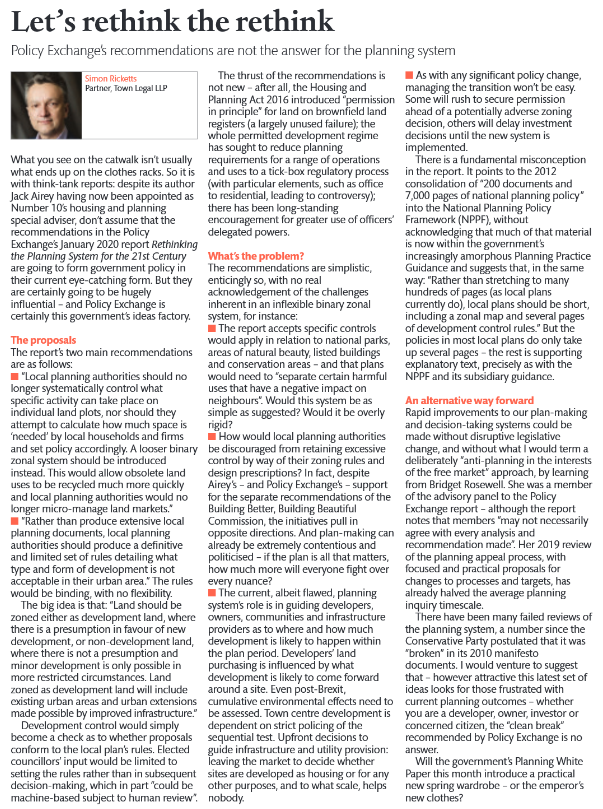
That talk of a “new English planning system” seemed to herald some of the thinking from the Policy Exchange’s paper Rethinking the Planning System for the 21st Century (27 January 2020) and, after all, its co-author Jack Airey is now a 10 Downing Street advisor. I wrote a critique of the paper in the Estates Gazette (Let’s rethink the rethink, 5 March 2020) but perhaps I was being a little premature. Because maybe, once all this subsides, it is time to look at for instance:

⁃ the potential for more of a zoning-style approach, which could begin to be introduced fairly simply by placing a proper duty on authorities to prepare brownfield land registers (as well as making it mandatory for local authorities to import into their registers all sites identified by the Government in its promised national brownfield sites map) and then increasing the scope for use of the ‘permission in principle’ procedure e.g. by allowing it to be used for more than just housing-led development and allowing permission in principle to be established through site allocations in a local plan.

⁃ greater use, this time with better safeguards against abuse, of permitted development rights. After all, setting aside the problems caused by that lack of appropriate safeguards, since the permitted development right to convert offices to residential was initially introduced for a temporary three year period from May 2013 (following an initial announcement in the March 2011 budget), many thousands of new homes have been created at much greater speed than traditional planning application routes would have achieved. Desperate times call for desperate measures. Planning For The Future announces that the Government will introduce “new permitted development rights for building upwards on existing buildings by summer 2020, including to extend residential blocks by up to two storeys and to deliver new and bigger homes. We will also consult on the detail of a new permitted development right to allow vacant commercial buildings, industrial buildings and residential blocks to be demolished and replaced with well-designed new residential units which meet natural light standards.” Devil’s question: if we are to have permitted development rights to demolish and rebuild, why not go further and have permitted rights, with equivalent safeguards, to carry out residential development on already cleared brownfield land (as an alternative to the enhanced brownfield land register/permission in principle proposal above)?

Surely, all these ideas will need to be considered, against the backdrop of months of lost housing delivery and a severe knock to economic confidence.

But I would suggest that, ahead of that promised White Paper, which will surely now slip considerably, there are a number of shorter-term measures to make adjustments in order to make up for the time that has been lost as a result of this crisis. In considering these, I recognise the inevitable tension between on the one hand measures that seek to “put on hold” aspects of our system, particularly time limits, and on the other hand measures to keep the system moving.

We need to learn from recent history. In the wake of the global financial crisis, on 1 October 2009 the Government introduced a temporary measure “to make it easier for developers and local planning authorities to keep planning permissions alive for longer during the economic downturn so that they can more quickly be implemented when economic conditions improve.” Guidance as to the operation of the provisions was set out in Greater flexibility for planning permissions (23 November 2009, amended 1 October 2010 and eventually withdrawn 7 March 2014). (The same document gave guidance as to the operation of the helpful section 96A non-material amendments procedure, introduced at the same time.)

We urgently need an equivalent measure reintroduced or, perhaps more simply, an automatic six months’ extension to all planning permission time limit conditions. After all there is already a year’s automatic extension under section 91 (3A) of the Town and Country Planning Act 1990 where a planning permission is subject to judicial review proceedings. The thinking should extend to other fixed deadlines, for instance in relation to the implementation of compulsory purchase orders and NSIPs.

There are various section 106 obligations which provide for ongoing financial contributions or measures with significant ongoing costs, not linked to progress with stages of development. The Government should surely provide firm guidance to authorities that they must readily agree to the renegotiation of such provisions to take into account the current standstill period if the evidence is, for any specific development, that this is necessary and justified.

In London, there is a particular issue with the early stage viability review mechanism required by the Mayor. The review is triggered if “substantial implementation” (usually development above ground floor level) has not happened within two years of planning permission being issued. Surely we should be avoiding the unnecessary bureaucracy inherent in that process where we can and for most major schemes the 24 months’ deadline is challenging even with a fully deployed design and construction team. Again, boroughs and the Mayor should surely be urged to agree to vary such arrangements so as to allow for an appropriate extension, whether it turns out to be three months, six months, or longer. Flexibility is also urgently needed with agreements that are currently being negotiated and we have been considering various potential drafting options so as to secure that outcome.

Publicity and consultation arrangements for planning applications need to be adapted to fit this world of social distancing and self-isolation: much of this can occur anyway through innovative use social media and other online consultation tools but there should be a temporary lifting of legislative requirements which will currently serve little purpose and may prove difficult to fulfil, such as the deposit of physical copies of Environmental Statements in the community (under Regulation 23 of the Town and Country Planning (Environmental Impact Assessment) Regulations 2017) and the erection of site notices under Article 15 of the Development Management Procedure Order.

Any such proposal would need underwriting from the Government but, as part of any planned economic bounce-back, should there be a year’s window within which schemes can commence free from CIL or with a significant deferment of payments (subject to clawback unless the chargeable development is completed within a specified number of years)? Should the three years period for the “in use” exemption be extended (surely the answer is yes)?

Given the disruption and in some cases the reduction in the capability of local authorities to determine planning applications and in light of the current postponement of hearings and inquiries by PINS there must also be a case for easing the burden on the current system and deferring costs for applicants and would-be appellants by introducing a temporary extension of the statutory period for determination of planning applications and the time limit for appealing against refusal or deemed refusal of planning permission under Articles 34 and 37 of the Development Management Procedure Order.

There will surely need to be adjustments to the operation of the housing delivery test so as not to unfairly penalise authorities facing, for no fault of their own, a slow down in housing starts.

Some have called for the Government to suspend litigation deadlines and limitation periods for the duration of the crisis. It is difficult to see how an across the board standstill would not cause substantial injustices, but should the usual judicial review and statutory challenge periods be extended in relation to decisions taken after a specified date, or perhaps for a temporary period to extend the deadline to three months?

Finally, taking into account the consequences of its social distancing measures, the Government has already announced on 17 March 2020 that permitted development rights will be extended for a period of 12 months to allow the temporary change of use of pubs, bars and restaurants to hot-food take aways; one can readily see that further temporary extensions of permitted development rights might be necessary – e.g. change of use of offices, industrial buildings or warehouses to use for the sale of food and other convenience goods and change of use of hotels and hostels to hospitals or healthcare centres. Planning law will need to be nimble.

It’s times like these we learn to live again.

Simon Ricketts, 21 March 2020

Personal views, et cetera

With thanks to my partners and colleagues at Town. If any of these ideas chime with other organisations’ thoughts, please speak to any of us.

London, Friday The 13th

I’ll pass for now on Thursday’s Planning For The Future and indeed Wednesday’s budget. It’s one week at a time at the moment isn’t it? Planning for the future, and the wider politics of planning, has seemed less relevant than planning for a future – the even wider, and deeper, politics of public health and the intersections between virus control, health service capacity, economics and public messaging. You will already have read some other really good summaries and critiques of that document.

But then yesterday in London some fairly momentous things happened along the currently active fault lines as between MHCLG, the Mayor and the boroughs that I have previously written about in various posts.

Directed modifications to London Plan

First, the Secretary of State issued his letter to the Mayor directing that a series of modifications be made to the draft London Plan pursuant to section 337 of the Greater London Authority Act 1999. The modifications are set out an annex to the letter, in the form of a table setting out each directed “Modification to Remedy National Policy Inconsistency” with a “Statement of Reasons” alongside each modification. The letter and directed modifications are plainly a material consideration to be taken into account where relevant in the determination of planning applications and appeals.

Momentous but perhaps not surprising in the light of the “shot across the bowsletter that Khan had been sent by Robert Jenrick’s predecessor James Brokenshire on 27 July 2018. When you look back at that letter, the position was set out pretty clearly, in allowing the draft plan to proceed under the 2012 NPPF on condition that post adoption the Mayor would then embark on a review of the plan to reflect the revised NPPF (How far away is that review now? Might it have been better if MHCLG had bitten the bullet and required the Mayor to start again on his plan at that stage, so as to be consistent with the new NPPF?).

Back in 2018:

I am not convinced your assessment of need reflects the full extent of housing need in London to tackle affordability problems.

The Government is […] clear that Plans should be effective, deliverable and consistent with national policy. You will recall that the Government highlighted a number of further issues with your draft Plan in response to your consultation, including that:

⁃ A number of policy areas in the draft that are inconsistent with national policy, such as your policies allowing development on residential gardens and your policy on car parking.

⁃ The detail and complexity of the policies within the draft London Plan have the potential to limit accessibility to the planning system and development.

⁃ The draft Plan strays considerably beyond providing a strategic framework.

⁃ The draft Plan does not provide enough information to explain the approach you will take to ensure your targets are delivered, including collaboration with boroughs and neighbouring areas.

⁃ There are a number of policies in the draft Plan which seek to deal with matters relating to building standards and safety. It is important that there is a consistent approach to setting building standards through the framework of Building Regulations.”

20 months later, following a lengthy examination and inspectors’ report (see my 26 October 2019 blog post More Plans Grounded: West Of England; Sevenoaks; London) the 13 March 2020 direction letter surely in part has the hand of a certain former London Mayor behind it in that as soon as it is past the “Dear Sadiq”, the letter is unforgiving in its content and tone and is a broader attack on the Mayor’s approach to housing:

Every part of the country must take responsibility to build the homes their communities need. We must build more, better and greener homes through encouraging well-planned development in urban areas; preventing unnecessary urban sprawl so that we can protect the countryside for future generations. This means densifying, taking advantage of opportunities around existing infrastructure and making best use of brownfield and underutilised land.

Housing delivery in London under your mayoralty has been deeply disappointing, over the last three years housing delivery has averaged just 37,000 a year; falling short of the existing Plan target and well below your assessment of housing need. Over the same period, other Mayors such as in the West Midlands have gripped their local need for housing and recognised the opportunities this brings, leading significant increases in the delivery of homes.

(an echo there of the Chancellor’s budget speech on 11 March 2020, which referred to “a new £400m Fund for ambitious Mayors like Andy Street in the West Midlands, to build on Brownfield sites…”)

Since you became Mayor, the price of an average new build home in London has increased by around £45,000, reaching £515,000 in 2018, 14 times average earnings. Clearly, the housing delivery shortfall you have overseen has led to worsening affordability for Londoners; and things are not improving, with housing starts falling a further 28 per cent last year compared to the previous.”

Critical strategic sites have stalled, epitomised by your Development Corporation in Old Oak and Park Royal being forced to turn away £250 million of Government funding because of your inability to work successfully with the main landowner. You also turned away £1 billion of investment we offered to deliver Affordable Homes, because of the support and oversight that would accompany this. You have put a series of onerous conditions on estate regeneration schemes for them to be eligible for grant- funding, such as the requirement for residents’ ballots. In attaching such conditions, you are jeopardising housing delivery and this approach will make it significantly more difficult to deliver the Plan’s targets and homes needed.”

(I covered the Old Oak and Park Royal Local Plan saga in my 4 January 2020 blog post Elephant, Dove, Old Oak, RICS. The Mayor published guidelines in August 2018 on applying his requirement (as a pre-condition to grant funding) for residents’ ballots in connection with estate regeneration schemes).

Following the Planning Inspectorate’s investigation of your Plan, they only deem your Plan credible to deliver 52,000 homes a year. This is significantly below your own identified need of around 66,000 homes and well below what most commentators think is the real need of London. As I have set out, the shortfall between housing need in London and the homes your Plan delivers has significant consequences for Londoners.”

Everyone should have the chance to save for and buy their own home so they can have a stake in society. In the short run this requires a proactive stance in building homes for ownership, including Shared Ownership and First Homes, and in parallel delivering a consistently high level of housing supply of all tenures. You should also be looking to deliver homes which people of different ages, backgrounds and situations in life can live in. Your Plan tilts away from this, towards one-bed flats at the expense of all else, driving people out of our capital when they want to have a family.”

(Of course, this is one of the largest and deepest fault lines – as to the relative weight to be given to intermediate affordable housing tenures, including in particular shared ownership and now – covered in my 29 February 2020 blog post – first homes).

Your Plan added layers of complexity that will make development more difficult unnecessarily; with policies on things as small as bed linen. Prescription to this degree makes the planning process more cumbersome and difficult to navigate; in turn meaning less developments come forward and those that do progress slowly. One may have sympathy with some of individual policies in your Plan, but in aggregate this approach is inconsistent with the pro-development stance we should be taking and ultimately only serves to make Londoners worse off.

(Bed linen? Well, Policy H16, Large-scale purpose-built shared living, lists the necessary criteria in order for a development to fall within the policy, and, it is true, one of the criteria is that “communal facilities and services are provided that are sufficient to meet the requirements of the intended number of residents and offer at least:

a) convenient access to a communal kitchen

b) outside communal amenity space (roof terrace and/or garden)

c) internal communal amenity space (dining rooms, lounges)

d) laundry and drying facilities

e) a concierge

f) bedding and linen changing and/or room cleaning services.”

Interestingly the Secretary of State is not directing any changes to H16).

This challenging environment is exacerbated by your empty threats of rent controls, which by law you cannot introduce without Government consent. As we all know, evidence from around the world shows that rent controls lead to landlords leaving the market, poorer quality housing and soaring rents for anyone not covered by the controls.

(Mayor demands powers to bring rents down, 19 July 2019)

I had expected you to set the framework for a step change in housing delivery, paving the way for further increases given the next London Plan will need to assess housing need by using the Local Housing Need methodology. This has not materialised, as you have not taken the tough choices necessary to bring enough land into the system to build the homes needed.”

So what modifications are proposed? As set out in the annex to the letter:

⁃ insertion of “the need for additional family housing” into policy H10.

⁃ references to optimising site capacity into policy D3, including the potential for boroughs to consider positively expansion of existing clusters of high density buildings and expanding Opportunity Area boundaries where appropriate.

⁃ deleting from policy H2 references to in lieu affordable housing contributions from schemes of nine or fewer homes.

⁃ removing the “no net loss of industrial floorspace” requirement from policy E4 and allowing boroughs to “identify opportunities to strategically coordinate development plans to identify opportunities to substitute Strategic Industrial Land where evidence that alternative, more suitable, locations exist”.

⁃ amending green belt and metropolitan open land policies G2 and G3 respectively to make them consistent with national policy.

⁃ introductory passage to be amended encouraging boroughs to review their housing targets where “they have additional evidence that suggests they can achieve delivery of housing above these figures whilst remaining in line with the strategic policies established in this plan

⁃ reintroducing the previous 2016 maximum residential car parking standards.

⁃ watering down the restrictions in policy T6 on retail parking: “G. Boroughs should consider alternative standards where there is clear that evidence that the standards in Table 10.5 would result in (a) A diversion of demand from town centres to out of town centres, undermining the town centres first approach (b) a significant reduction in the viability of mixed-use redevelopment proposals in town centre

⁃ deletion of paragraph 4.1.11 which was critical of the Government’s housing delivery test.

In addition to the modifications, the letter indicates that the Secretary of State is “taking this opportunity to highlight some of the specific areas where I think your Plan has fallen short of best serving Londoners.

⁃ He is “Directing” the Mayor to “work constructively with ambitious London Boroughs and my Department to encourage and support the delivery of boroughs which strive to deliver more housing.”

⁃ “I hope that where your small sites policies are appropriate, you are doing all you can to ensure sites are brought forward.”

⁃ “The Inspectors considered your industrial land policies to be unrealistic; taking an over-restrictive stance to hinder Boroughs’ abilities to choose more optimal uses for industrial sites where housing is in high demand. I am directing you to take a more proportionate stance – removing the ‘no net loss’ requirement on existing industrial land sites whilst ensuring Boroughs bring new industrial land into the supply.”

⁃ “I am concerned that your Plan will be to the detriment of family sized dwellings which are and will continue to be needed across London. This is not just in relation to their provision but also their loss, particularly where family sized dwellings are subdivided into flats or redeveloped entirely. I am therefore Directing you to ensure this is a consideration of London Boroughs when preparing policies and taking decisions in relation to dwelling mix.”

⁃ “It is important that development is brought forward to maximise site capacity, in the spirit of and to compliment the surrounding area, not to its detriment. Sites cannot be looked at in isolation and Londoners need to be given the confidence that high density developments will be directed to the most appropriate sites; maximising density within this framework. Examples of this are gentle density around high streets and town centres, and higher density in clusters which have already taken this approach. I am therefore Directing you to ensure that such developments are consented in areas that are able to accommodate them.”

⁃ In relation to aviation, “the Court of Appeal recently handed down judgment in the judicial review claims relating to the Airports National Policy Statement. The government is carefully considering the complex judgment and so does not consider it appropriate to make any direction in relation to Policy T8 Aviation at the present time. This is without prejudice to my power to make a direction under section 337 at any time before publication of the spatial development strategy, including in relation to Policy T8 Aviation.”

Finally, the Secretary of State wishes to see a “new standard for transparency and accountability for delivery at a local level” and a commitment to work together (regular meetings!) to provide “the fullest account of how the housing market and planning system is performing in London, where there are blockages and what is needed to unblock these, and what tools or actions can be undertaken to further increase housing delivery”.

“Housing in our capital is simply too important for the underachievement and drift displayed under you [sic] Mayoralty, and now in your Plan, to continue.”

To receive such a letter would be a bad start to the day for any Mayor.

Kensington Forum Hotel JR

Shortly after the letter was published, I separately saw a consent order, sealed by the High Court yesterday, 13 March 2020, the effect of which was to record the fact that the Mayor has consented to judgment in the judicial review brought by the Royal Borough of Kensington and Chelsea of his decision, having recovered the application, to grant planning permission for the Kensington Forum Hotel development. I have previously referred to the saga in my 26 January 2019 blog post The Secretary Of State & London and my 15 November 2019 blog post Planning Or Politics? Significant London Planning Decisions 2019. You will recall that planning permission was issued by the Mayor the same day as he had held his representation hearing. RBKC had judicially reviewed that permission and on 27 November 2019 secured an order for disclosure. The consent order records that following “a review of the documents disclosed pursuant to that order”, and in the light of RBKC’s case put in its grounds of claim and evidence, the Mayor “concedes that the Decision should be quashed on the basis of Ground 4, in particular that the decision to grant planning permission was made for an improper purpose and having regard to irrelevant considerations; namely that the Secretary of State should not be given the opportunity to call in the application for his own determination”. The Mayor has agreed as part of the order to pay RBKC’s costs in the sum of £90,000.

So the Mayor will now need to reconsider whether to grant planning permission (a further representation hearing) and the Secretary of State will no doubt consider whether to call in the application.

Postponed election

The coup de grace yesterday for the Mayor must surely have been the Government’s announcement that legislation will be introduced to postpone until May 2021 the local, Mayoral and Police & Crime Commissioner elections that were due to take place on 7 May 2020. After all, he would have been a re-election shoe-in this May if the polls are to be believed (eg see Sadiq Khan Has A Massive Lead In The London Mayoral Election According To A New Poll Londonist, 10 March 2020). Next year? Well that’s a long time away.

One last word on Planning For The Future. The Secretary of State promises “an ambitious Planning White Paper in the Spring”. Obviously government has a stretched and blurred definition of the seasons but technically “Spring” starts on 20 March. It’s one week at a time at the moment isn’t it?

Simon Ricketts, 14 March 2020

Personal views, et cetera

A retweet by the Secretary of State. Probably wisely, the Mayor has not yet risen to the bait.

What Are The Non-Airport Implications Of The Heathrow Ruling?

The Court of Appeal’s approach to the issues in the Heathrow cases last month was certainly a surprise to many.

The court found in the main “Plan B” ruling (27 February 2020) that the Secretary of State had acted unlawfully when, following the procedure in section 5 of the Planning Act 2008, on 26 June 2018 he designated the Airports National Policy Statement. The court’s basis for its finding was that the Secretary of State had not complied with section 5(8):

(7) A national policy statement must give reasons for the policy set out in the statement.

(8) The reasons must (in particular) include an explanation of how the policy set out in the statement takes account of Government policy relating to the mitigation of, and adaptation to, climate change.”

The question was what was “Government policy” in relation to climate change as at 26 June 2018. The court found that the Secretary of State had acted unlawfully in not taking into account “its own firm policy commitments on climate change under the Paris Agreement”.

This is somewhat surprising given that at first instance the Divisional Court (Hickinbottom LJ and Holgate J, no slouches) had found that this submission was unarguable:

In our view, given the statutory scheme in the [Climate Change Act 2008] and the work that was being done on if and how to amend the domestic law to take into account the Paris Agreement, the Secretary of State did not arguably act unlawfully in not taking into account that Agreement when preferring the NWR Scheme and in designating the ANPS as he did. As we have described, if scientific circumstances change, it is open to him to review the ANPS; and, in any event, at the DCO stage this issue will be re-visited on the basis of the then up to date scientific position.” (paragraph 648 of the main judgment at first instance, known as “Spurrier” after the then first claimant, who had represented himself at first instance but had dropped out by the time of the appeal, which is why you will hear the appeal ruling called “Plan B” after the lead appellant, campaign group Plan B Earth).

(For a wider summary of the proceedings at first instance see my 4 May 2019 blog post Lessons From The Heathrow Cases).

The Court of Appeal has ordered that the Airports National Policy Statement “is of no legal effect unless and until the Secretary of State has undertaken a review of it in accordance with the relevant provisions of the Planning Act 2008.”

Heathrow Airport Limited has applied to the Supreme Court to appeal from the ruling although the Secretary of State has not (meaning that any appeal could be fairly irrelevant if the Secretary of State decides to review the NPS in any event). Whether permission to appeal is granted depends on whether the Supreme Court considers that there is an arguable point of law of general public importance.

So this is all significant as regards the proposal for a third runway at Heathrow. According to the Planning Inspectorate website the application for a development consent order under the Planning Act 2008 NSIP procedure is/was expected to be submitted in Q4 2020.

The main function of the NPS was to give formal national policy support to the proposal at Heathrow. The way that the Planning Act 2008 works is that, under section 104, the Secretary of State must decide a DCO application in accordance with any relevant national policy statement “except to the extent that one or more of subsections (4) to (8) applies.

(4) This subsection applies if the Secretary of State is satisfied that deciding the application in accordance with any relevant national policy statement would lead to the United Kingdom being in breach of any of its international obligations.

(5) This subsection applies if the Secretary of State is satisfied that deciding the application in accordance with any relevant national policy statement would lead to the Secretary of State being in breach of any duty imposed on the Secretary of State by or under any enactment.

(6) This subsection applies if the Secretary of State is satisfied that deciding the application in accordance with any relevant national policy statement would be unlawful by virtue of any enactment.

(7) This subsection applies if the Secretary of State is satisfied that the adverse impact of the proposed development would outweigh its benefits.

(8) This subsection applies if the Secretary of State is satisfied that any condition prescribed for deciding an application otherwise than in accordance with a national policy statement is met.

(9) For the avoidance of doubt, the fact that any relevant national policy statement identifies a location as suitable (or potentially suitable) for a particular description of development does not prevent one or more of subsections (4) to (8) from applying.

So the first thing to note is that the NPS would not have given Heathrow Airport Limited a free pass to a consent – in determining the application the Secretary of State would need to determine whether, notwithstanding the June 2018 NPS, the proposal is not in accordance with, for instance, up to date treaty obligations or domestic legislation – exactly the point made by the Divisional Court in the passage I quoted earlier.

This is relevant because the issue in the Heathrow cases very much turned on an historical question – what was the Government’s climate change policy as at 26 June 2018. Legislation and policy has plainly moved on since then, and will continue to move on. I referred in my 10 August 2019 blog post The Big CC to Theresa May’s tightening in June 2019 of the Government’s commitment to reduce greenhouse gas emissions, by making the Climate Change Act 2008 (2050 Target Amendment) Order 2019 which changed the duty of the Secretary of State under the Climate Change Act 2008 from being to ensure that the net UK carbon account for the year 2050 is at least 80% lower than the 1990 baseline, to being at least 100% lower, ie net zero. The target does not include international aviation or shipping: paragraph 10.5 of the explanatory notes published with the order states that there is a “need for further analysis and international engagement through the international networks. For now, therefore we will continue to leave headroom for emissions from international aviation and shipping in carbon budgets…” By the time that any Heathrow DCO application is to be/would have been determined, the Secretary of State would have to take into account climate change legislation and international commitments at the time.

It can all of course get messy/political, as demonstrated by former Energy Secretary Andrea Leadsom’s approval last year, against her inspectors’ recommendations, of the Drax gas-fired power stations DCO, a decision which is now being challenged in the High Court by ClientEarth (see Drax legal case: We’re taking the UK government to court over Europe’s largest gas plant, ClientEarth, 30 January 2020).

Although it would be a risky strategy to adopt, given it would entail acknowledging loss of any formal statutory policy support for Heathrow as the favoured option, Heathrow Airport could in theory decide to proceed with a DCO application without the support of an NPS (this appears to be Gatwick’s strategy with its proposed northern runway). In the absence of an NPS, section 105 applies:

(2) In deciding the application the Secretary of State must have regard to—

(a) any local impact report (within the meaning given by section 60(3)) submitted to the Secretary of State before the deadline specified in a notice under section 60(2),

(b) any matters prescribed in relation to development of the description to which the application relates, and

(c) any other matters which the Secretary of State thinks are both important and relevant to the Secretary of State’s decision.”

How even to begin to scope the appropriate approach to decision-making in that situation…

Any wider relevance?

So does this ruling have repercussions away from Heathrow and airports?

People threaten to bring judicial review proceedings, and often end up bringing them for all sorts of reasons. Lord Reed, President of the Supreme Court, made some topical comments to the House of Lords Constitution Committee last week:

Judges are very well aware of the risk of challenges being brought in what are political rather than legal grounds. They are repelling them and are careful to avoid straying into what are genuine political matters. When this is a matter that is to be considered it should not start from the premise that judges are eager to pronounce on political issues. The true position is actually quite the opposite.” (Law Society Gazette, 4 March 2020).

Since the ruling we have seen these stories:

Environmentalists follow Heathrow ruling by calling on government to end fossil fuel developments (Ecotricity, 4 March 2020) (The Secretary of State has a discretion in section 6 of the 2008 Act as to whether and when to review NPSs, and indeed since June 2019 Government climate change targets have been clear regardless of what the position was at June 2018 – which is surely the only relevance of the Heathrow rulings – if the point made by the prospective claimants is a good one, it has been a good one for some time now).

HS2 legal challenge launched by Chris Packham (Guardian, 3 March 2020) (There is surely no duty on a minister to take into account Government climate change targets in making a decision to continue with the construction of an existing project which has already, phase 1 at least, been authorised by Parliament).

What did it for the Secretary of State in relation to the Heathrow NPS was the specific statutory duty to take into account “government policy” on climate change mitigation and adaptation.

Regardless of whether the Court of Appeal was right to determine that Government support for the Paris Agreement (international) targets could be construed as government policy for any particular domestic targets, there is not the same statutory duty when it comes to the Town and Country Planning Act system.

When it comes to plan-making, section 19(1A) of the Planning and Compulsory Purchase Act 2004 imposes a statutory duty on local planning authorities that development plan documents must include policies that contribute to mitigation and adaptation to climate change, and this duty is reflected in paragraph 149 of the National Planning Policy Framework, stating in footnote 48 that policies should be “in line with the objectives and provisions of the Climate Change Act 2008”.

There are no specific equivalent requirements in relation to decision making, just the general statement in paragraph 148, stating that the “planning system should support the transition to a low carbon future in a changing climate” and “should help to: shape places in ways that contribute to radical reductions in greenhouse emissions”.

Beware those who wave about the Heathrow ruling as some kind of game changer in relation to the battle against climate change. It is certainly a game changer in relation to Heathrow Airport’s aspirations, as to project timescale at the very least, but, wider than that? The Court of Appeal determined that a specific statutory duty, peculiar to the making of NPSs, was breached. The question of whether there was a breach depended on determining what government policy on climate change was in June 2018, when it was not as advanced as it is now. Finally, it is not obvious to me that the Court of Appeal’s conclusions would be safe against an appeal to the Supreme Court – but of course all that could well be largely hypothetical, depending upon what steps the Government now takes.

The awaited national infrastructure plan, which was to be published alongside the budget on 11 March, is to be delayed but reportedly could still be “before May” (Government delays Budget infrastructure plan, BBC, 5 March 2020). It will be interesting to see whether any hints are dropped in our new Chancellor’s budget statement as to the Government’s direction of travel.

Simon Ricketts, 7 March 2020

Personal views, et cetera

Starter Homes Were A Non Starter – What Future For First Homes?

Government is consulting on the “design and delivery” of First Homes. The deadline for responses is 3 April 2020. First Homes was of course a manifesto pledge and so there are no questions as to whether the concept itself is supportable or indeed practical.

That is a shame, given the failure of the Starter Homes initiative after so much work and public expenditure. As explained in my 4 March 2017 blog post Definitely Maybe: Defining Affordable Housing, an elaborate structure was arrived at by way of chapter 1 of the Housing and Planning Act 2016 and a technical consultation by the Government in March 2016:

– a legal requirement that 20% of new homes in developments should be starter homes, ie

⁃ to be sold at a discount of at least 20% to open market value to first time buyers aged under 40. 

⁃ Price cap of £250,000 (£450,000 in London)

– The restriction should last for a defined number of years, the first suggestion being five years, replaced with the concept of a tapered restriction to potentially eight years

– Commuted sums in lieu of on site provision for specified categories of development, eg build to rent.

The Government’s response to the technical consultation then significantly watered down the starter home concept, to the extent that the legislation was surplus to requirements (it is still on the statute book, just left hanging):

– There would be no statutory requirement on local planning authorities to secure starter homes, just a policy requirement in the NPPF, which was to be amended accordingly. 

– Rather than requiring that 20% of new homes be starter homes, the requirement would be that 10% of new homes will be “affordable housing home ownership products” so could include shared equity or indeed low cost home ownership. 

– maximum eligible household income of £80,000 a year or less (or £90,000 a year or less in Greater London 

– 15 year restriction

– No cash buyers, evidence of mortgage of at least 25% loan to value

– Only be applicable to schemes of ten units or more (or on sites of more than 0.5h). 

The only reference to starter homes in the February 2019 version of the NPPF is in the glossary’s definition of affordable homes:

b) Starter homes: is as specified in Sections 2 and 3 of the Housing and Planning Act 2016 and any secondary legislation made under these sections. The definition of a starter home should reflect the meaning set out in statute and any such secondary legislation at the time of plan-preparation or decision-making. Where secondary legislation has the effect of limiting a household’s eligibility to purchase a starter home to those with a particular maximum level of household income, those restrictions should be used.”

Paragraph 64 of the NPPF of course requires:

Where major development involving the provision of housing is proposed, planning policies and decisions should expect at least 10% of the homes to be available for affordable home ownership, unless this would exceed the level of affordable housing required in the area, or significantly prejudice the ability to meet the identified affordable housing needs of specific groups. Exemptions to this 10% requirement should also be made where the site or proposed development:

a) provides solely for Build to Rent homes;

b) provides specialist accommodation for a group of people with specific needs (such as purpose-built accommodation for the elderly or students);

c) is proposed to be developed by people who wish to build or commission their own homes; or

d) is exclusively for affordable housing, an entry-level exception site or a rural exception site.”

Going back to the NPPF affordable housing definition, aside from starter homes the other two listed categories of affordable home ownership are:

c) Discounted market sales housing: is that sold at a discount of at least 20% below local market value. Eligibility is determined with regard to local incomes and local house prices. Provisions should be in place to ensure housing remains at a discount for future eligible households.

d) Other affordable routes to home ownership: is housing provided for sale that provides a route to ownership for those who could not achieve home ownership through the market. It includes shared ownership, relevant equity loans, other low cost homes for sale (at a price equivalent to at least 20% below local market value) and rent to buy (which includes a period of intermediate rent). Where public grant funding is provided, there should be provisions for the homes to remain at an affordable price for future eligible households, or for any receipts to be recycled for alternative affordable housing provision, or refunded to Government or the relevant authority specified in the funding agreement.”

Of these different affordable home ownership options (using the Government jargon, I appreciate that what is “affordable” is an open question), starter homes were abandoned by the Government as a concept after a huge amount of money and time had been spent. The National Audit Office’s Investigation into Starter Homes (4 November 2019) found as follows:

In April 2015, the Conservative Party manifesto committed to “200,000 Starter Homes, which will be sold at a 20% discount and will be built exclusively for first-time buyers under the age of 40”. The November 2015 Spending Review subsequently provided £2.3 billion to support the delivery of 60,000 Starter Homes (of the 200,000 previously announced). The Housing and Planning Act (2016) set out the legislative framework for Starter Homes and the Department ran a consultation on Starter Homes Regulations (the regulations) between March and June 2016.

Between 2015 and 2018, government’s policy towards Starter Homes shifted.

In May 2018, the Minister of State for Housing and Planning stated that the government had spent an estimated £250 million of the Starter Homes Land Fund. In July 2018, the Department clarified that it had spent £250 million buying land to build affordable properties from two funds, the Starter Homes Land Fund and the Land Assembly Fund, with work under way to get the land ready for development, but that building had not yet started.”

“No Starter Homes have been built to date.”

“The Starter Homes legislative provisions are not yet in force.”

“The Department no longer has a budget dedicated to the delivery of Starter Homes.”

“Between 2015-16 and 2017-18, the Department spent almost £174 million preparing sites originally intended for building Starter Homes.”

“In 2015-16, Homes England spent £15.4 million of the Starter Homes 2015 funding preparing brownfield land.”

“Since August 2015 the Department has spent £6.45 million supporting local authorities through the Programme.”

“In 2016-17 and 2017-18, the Department spent £151 million under the

[Starter Homes Land Fund], but the spending has not supported the building of Starter Homes.”

“In 2017-18, the Department spent £97 million from the SHLF, but under [Land Assembly Fund] criteria, on acquiring land needing work and preparing it for the market”

No doubt some of the monies earmarked for starter homes may have ended up going towards other housing and affordable housing initiatives (I am not clear on that) but surely what an embarrassment this is for whoever first came up with the bright idea that was starter homes.

However, moving on from that failure, of course the thing to do is to learn from past mistakes? Why didn’t it work? What could have been done better? This is the essence of “black box thinking”. I was certainly not the only one pointing out the potential complexities that might prove its downfall (See my 21 June 2016 blog post Valuing Starter Homes).

But of course there is a insatiable political hunger for new ideas for manifestos, and in the December 2019 Conservative manifesto a concept of First Homes was trumpeted as the new solution to “making the dream of home ownership a reality for everyone” (to quote from the latest consultation document).

The initiative was formally launched on 7 February 2020 with a one page guide and more detailed consultation document.

The headlines are set out in the guide:

• First Homes are flats and houses built on developments up and down the country. They will be no different from other properties except they will be sold with a discount of at least 30 percent.

• They will be sold to local people who want to stay in the community where they live or work but are struggling to purchase a home at market prices.

• They will be prioritised for first-time buyers, serving members and veterans of the Armed Forces, and key workers, such as nurses, police and teachers.

• The discount will be passed on to future buyers when First Homes are resold so more people can be helped onto the ladder.

Jennie Baker at Lichfields has written an excellent summary First Homes: discounted market housing that actually delivers? (10 February 2020).

There has been widespread concern as to whether this new product (however it may be delivered – and there is going to be a statutory or policy requirement for it to be provided as part of the housing tenure mix on major schemes) will be at the expense of other more needed or more efficient affordable housing products (see for instance the piece by Ruth Davison, chief executive of Islington and Shoreditch Housing Association, First Homes won’t extend homeownership and will decimate supply of homes for those most in need) and of course not “affordable” for many (see for instance Shelter’s comments in the 16 February 2020 Guardian piece Discounted housing scheme out of reach of most first-time buyers) and I personally see as many potential valuation pitfalls as identified with starter homes – and surely there is a greater difficulty “selling” a discount product to purchasers where, unlike with starter homes, that discount will remain in perpetuity.

If you are not now going to MIPIM, why not consider the questions in the consultation paper instead? They neatly encapsulate many of the current uncertainties as to how this is all going to work:

Q1.

a) Do you agree with a minimum discount of 30% (but with local flexibility to set a higher one)?

b) If not, what should the minimum discount be? i. 20%

ii. 40%

iii. Other (please specify)

Q2.

a) Should we set a single, nationally defined price cap rather than centrally dictate local/regional price caps?

b) If yes, what is the appropriate level to set this price cap? i. £600,000

ii. £550,000 iii. £500,000 iv. £450,000

v. Other (please specify)

Q3.

a) If you disagree with a national price cap, should central Government set price caps which vary by region instead?

b) If price caps should be set by the Government, what is the best approach to these regional caps?

i. London and nationwide

ii. London, London surrounding local authorities, and nationwide

iii. Separate caps for each of the regions in England iv. Separate caps for each county or metropolitan area

v. Other (please specify)

Q4.

Do you agree that, within any central price caps, Local Authorities should be able to impose their own caps to reflect their local housing market?

Q5.

Do you agree that Local Authorities are best placed to decide upon the detail of local connection restrictions on First Homes?

Q6.

When should local connection restrictions fall away if a buyer for a First Home cannot be found?

i. Less than 3 months

ii. 3 – 6 months

iii. Longer than 6 months

iv. Left to Local Authority discretion

Q7.

In which circumstances should the first-time buyer prioritisation be waived?

Q8.

a) Should there be a national income cap for purchasers of First Homes?

b) If yes, at what level should the cap be set?

c) Do you agree that Local Authorities should have the ability to consider people’s income and assets when needed to target First Homes?

Q9:

Are there any other eligibility restrictions which should apply to the First Homes scheme?

Q10.

a) Are Local Authorities best placed to oversee that discounts on First Homes are offered in perpetuity?

b) If no, why?

Q11.

How can First Homes and oversight of restrictive covenants be managed as part of Local Authorities’ existing affordable homes administration service?

Q12.

How could costs to Local Authorities be minimised?

Q13.

Do you agree that we should develop a standardised First Home model with local discretion in appropriate areas to support mortgage lending?

Q14.

Do you agree that it is appropriate to include a mortgage protection clause to provide additional assurance to lenders?

Q15.

For how long should people be able to move out of their First Home and let it out (so it is not their main or only residence) without seeking permission from the Local Authority?

i. Never

ii. Up to 6 months

iii. 6- 12 months

iv. Up to 2 years

v. Longer than 2 years vi. Other (please specify)

Q16.

Under what circumstances should households be able to move out of their First Home and let it for a longer time period? (Tick all that apply)

i. Short job posting elsewhere

ii. Deployment elsewhere (Armed Forces)

iii. Relationship breakdown

iv. Redundancy

v. Caring for relative/friend

vi. Long-term travelling

vii. Other (please specify)

Q17.

Do you agree that serving members and recent veterans of the Armed Forces should be able to purchase a First Home in the location of their choice without having to meet local connections criteria?

Q18.

What is the appropriate length of time after leaving the Armed Forces for which veterans should be eligible for this exemption?

i. 1 year

ii. 2 years

iii. 3-5 years

iv. Longer than 5 years

Q19.

Are there any other ways we can support members of the Armed Forces and recent veterans in their ability to benefit from the First Homes scheme?

Q20.

Which mechanism is most appropriate to deliver First Homes?

i. Planning policy through changes to the National Planning Policy Framework and guidance

ii. Primary legislation supported by planning policy changes

Q21.

Which do you think is the most appropriate way to deliver First Homes?

i. As a percentage of section 106 affordable housing through developer contributions

ii. As a percentage of all units delivered on suitable sites

Q22.

What is the appropriate level of ambition for First Home delivery?

i. 40% of section 106

ii. 60% of section 106

iii. 80% of section 106

iv. Other (please specify

Q23.

Do you agree with these proposals to amend the entry-level exception site policy to a more focused and ambitious First Homes exception site policy?

Q24.

a) Do you think there are rare circumstances where Local Authorities should have the flexibility to pursue other forms of affordable housing on entry-level exception sites, because otherwise the site would be unviable?

b) If yes, what would be an appropriate approach for Local Authorities to demonstrate the need for flexibility to allow other forms of affordable housing on a specific entry- level exception site?

Q25.

What more could the Government do to encourage the use of the existing rural exception site policy?

Q26.

What further steps could the Government take to boost First Home delivery?

Q27.

Do you agree that the proposal to exempt First Homes from the Community Infrastructure Levy would increase the delivery of these homes?

Q28.

Do you think the Government should take steps to prevent Community Infrastructure Levy rates being set at a level which would reduce the level of affordable housing delivered through section 106 obligations?

Q29.

a) What equality impacts do you think the First Homes scheme will have on protected groups?

b) What steps can the Government take through other programmes to minimise the impact on protected groups?

Q30.

Do you have any other comments on the First Homes scheme?

Obviously there is a place for discount to market “for sale” products, as part of the affordable housing mix on a major project, and obviously local connection/key worker restrictions need to play an important role, but let’s

⁃ be really careful that the First Homes concept does not squeeze out other affordable housing options for which there may be greater need, or through inefficiency place a greater strain on project viability and consequently the overall monies available for affordable housing

⁃ ensure that the regime is loophole-proof, straight-forward and fair, however mutually inconsistent those aspirations may be (cf CIL)

⁃ (above all else) learn from that Starter Homes failure.

Simon Ricketts, 29 February 2020

Personal views, et cetera

Out Of Time

Cases about missed time limits give many of us sleepless nights, so (rapid eye movement) you might want to look away now.

I’m fairly sure that Laing J’s judgment from last September in R (Bellamile Limited) v Ashford Borough Council (Laing J, 19 September 2019), about a missed deadline for challenging a local plan under section 113 of the Planning and Compulsory Purchase Act 2004, only appeared online last week. I’ll deal with that after belatedly bringing you up to date as to what happened in the Croke litigation saga after my 7 April 2018 blog post Fawlty Powers: When Is A Permission Safe From Judicial Review?

Croke

At the time I wrote that blog post, Mr Croke, who had missed the deadline for making a challenge under section 288 of the Town and Country Planning Act 1990 to an inspector’s decision to allow a planning appeal, had secured permission from the Court of Appeal to appeal from a ruling of the High Court that the deadline should not extended.

The full hearing subsequently took place in October 2018. The facts are set out in the judgment, R (Croke) v Secretary of State (Court of Appeal, 1 February 2019):

Mr Croke was aware that the six-week period under section 288 expired on 23 March 2016, which was the Wednesday before the Easter Bank Holiday. He was also aware that on each working day – that is, on every day from Monday to Friday – the doors of the Administrative Court Office in the Royal Courts of Justice are closed at 4.30 p.m. He intended to go to the court office himself on 23 March. But he missed his train at Haddenham and Thame Parkway railway station, and knowing he would not be able to get to the court office before it closed, he sent an email to Mr Miller asking him to lodge the application on his behalf. In his letter to the court dated 26 April 2016 Mr Croke said he “returned home and emailed the Application, signed Statement of Facts and Grounds and a copy of the Decision being challenged, to Mr … Miller, who was located just a few minutes from the Court and who agreed to act for [him] in submitting the application on his behalf”. However, his attempt to get the Statement of Facts and Grounds to Mr Miller by email at 3.59 p.m. failed, because he mistyped Mr Miller’s email address. He eventually succeeded in sending the document to Mr Miller at 4.06 p.m. Mr Miller said in his witness statement (in paragraph 1):

“1. … I did … at 16.25 hrs attended [sic] at Royal Courts of Justice … on behalf of the claimant, in an attempt to seal the section 288 on behalf of the claimant; I was refused entry by security. The adult male security guard stated the counters were closed.”

In his letter of 26 April 2016 Mr Croke added this:

“… Despite [Mr Miller’s] pleading with them to allow him to proceed to the counter he was refused entry. …”.

At 5.09 p.m. Mr Miller sent an email to Mr Croke to tell him what had happened.

On 24 March, Maundy Thursday, Mr Croke himself went to the Administrative Court Office, arriving there at about 3.25 p.m. There was a queue. Mr Croke reached the front of the queue at about 5 p.m. and attempted to file his application using a standard Part 8 claim form (form N208). A member of the court staff told him he had used the wrong form and would have to file a Planning Court claim form (form N208PC) instead. He gave Mr Croke form N208PC but refused his request that he be allowed to complete it and file it straight away. He told him to return with the completed form N208PC on the next working day. Mr Croke did so on 29 March 2016, the Tuesday after the Easter Bank Holiday weekend, filing his application on the correct form.”

The two issues were (1) whether the statutory period for challenging the Secretary of State’s decision could be extended by a single day from 23 to 24 March 2016 and (2) if so whether from 24 to 29 March 2016.

Traditionally, time limit provisions, such as the six weeks deadline in section 288 for commencing proceedings, are absolute (although where the last day is a day when the court is closed the deadline is extended to the following day – the so-called Kaur v Russell principle – and the deadline is also in principle capable of being extended where there would otherwise be “an unjustifiable violation of human rights”). The position is less absolute where there is an error in a claim form (or the wrong claim form is used) but the filing is within time – the court has discretion to allow the error to be corrected.

Mr Croke argued that the Kaur v Russell principle should be extended to a claimant a further working day “where a prospective litigant had been inside the court building within normal court working hours but had then been prevented from lodging his or her claim on that day by some action or inaction on the part of staff employed within the building, or by some other unforeseen event within the responsibility of the court over which he or she had no control, that day should be treated as being a “dies non”. This would also apply, for example, to a failure of the court’s IT system that had the same effect. Certainty for all parties involved in the proceedings could be safeguarded by ensuring that a time limit would never be extended by more than a single day, and by requiring a litigant in this situation to put all parties with standing on notice, so that they would not rely on the decision under challenge – as Mr Croke had done in a letter to the council dated 23 March 2016. Mr Croke did not seek to support his argument with a submission that the court would in any event have a discretion to extend the statutory time limit on human rights grounds.”

The court did not consider that there was any justification for extending the principle. “To extend it to accommodate the unfortunate facts of a particular case such as this would be to undermine it.” The court went on to consider whether it should exercise a discretion to extend time, on human rights grounds but saw no basis for this. The six weeks’ deadline was contrasted with extradition proceedings: “The relevant documents here would have not been hard to assemble; they should all have been in Mr Croke’s possession. And the drafting of the grounds would not have been an onerous task, even for an applicant who had not instructed a lawyer to do it. This is in stark contrast to the situation of the appellant in Pomiechowski who was in custody, facing extradition, and had only seven days to make his appeal.”

The question of whether there could be a further extension from 24 to 29 March 2016 was accordingly academic, although the court was sympathetic in the circumstances, there having been errors on the part of the court on terms of the references to prescribed forms in its guidance, and given that the form which Mr Croke used contained the “essential content, including the grounds on which the challenge was made”.

So near and yet so far.

Bellamile

R (Bellamile Limited) v Ashford Borough Council (Laing J, 19 September 2019) relates to a claim, made out of time, seeking to challenge the adoption of the Ashford local plan. The facts are set out in detailed and plain terms at paragraphs 8 to 20 but can be summarised as follows:

The last day for making the challenge was 4 April 2019. A paralegal at the firm acting for the claimant took the claim bundle to the Administrative Court at about 3.35 on that last day. She had a cheque for £154, which is the right fee for judicial review claims, but is the wrong fee for a statutory review claim (which this was). She was turned away on the basis that the fee should have been £528. An email went back to the solicitor dealing with the matter from another paralegal communicating some internally contradictory information, suggesting that a different court form (one for a judicial review claim, which this wasn’t) was required as well as the higher fee.

On 5 April 2019, the day after the time limit, the claim was filed using a judicial review claim form and the judicial review fee was paid (£154). The solicitor subsequently on 13 May 2019 asked the court to treat the claim as if it had been made under the statutory review claim procedure, but without any “application for an extension of time for filing, production of the replacement claim form, or any offer of the correct fee at that stage”. These were provided on 23 May, with a request for an extension of time.

In her judgment, after rehearsing these facts, Laing J first deals with the substantive grounds of challenge to the plan and rejects them – so the question of whether the court had jurisdiction to hear the claim in the first place was potentially only of academic interest. However she goes on to consider whether the claim was out of time, reviewing the previous cases, including Croke.

First, she rejects any suggestion that the merits of a claim are relevant to the exercise of any exceptional jurisdiction to extend time.

Secondly, she finds that there is nothing in the statutory scheme for challenging local plans which gives rise to a discretion to extend on human rights grounds. But in any event she is not satisfied that the claimant has “personally done all that he can to bring and notify the claim timeously”, pointing to various unexplained gaps in the evidence before the court and lack of contemporaneous evidence as to what actually happened on that last filing date.

Out of time.

It’s surprising how often these sorts of issues arise – memories for instance of late, and therefore rejected, challenges to the Thames Tideway Tunnel development consent order (Challenge by council to London super-sewer plans dismissed as “out of time” Local Government Lawyer, 19 January 2015 and also the “Blue Green” case – since when the deadline under the Planning Act 2008 for challenges has been amended, but the basic pitfalls still remain).

Simon Ricketts, 21 February 2020

Personal views, et cetera

Let Me Count The Ways

How unromantic. To my disappointment, that line from Elizabeth Browning’s poem is not followed by a list of the differences between the section 247 and 257 procedures for stopping up highways.

I need to fill that gap.

After all, the process for stopping up highways in order to enable development to be carried out is a vital corner of our planning system that is particularly dysfunctional and lacking in logic. Perhaps because the process largely comes after the decision as to whether the development itself is to be approved, there is too little focus on whether it is working effectively. The last material change to the procedure was the limited, but welcome, amendment made by way of the Growth and Infrastructure Act 2013, which at least allowed it to commence prior to planning permission being granted.

Section 247 (1) of the Town and Country Planning Act 1990 provides that “the Secretary of State may by order authorise the stopping up or diversion of any highway outside Greater London if he is satisfied that it is necessary to do so in order to enable development to be carried out…in accordance with planning permission...”

The procedure covers all types of highway.

Section 257 (1) of the Town and Country Planning Act 1990 provides that “[s]ubject to section 259, a competent authority may by order authorise the stopping up or diversion of any footpath, bridleway or restricted byway if they are satisfied that it is necessary to do so in order to enable development to be carried out…in accordance with planning permission…”

The procedure just covers footpaths, bridleways and restricted byways.

The substantive test in relation to both processes is whether the stopping up is “necessary” in order to enable the development to proceed and whether stopping up is in the public interest. However, they are administered in very different ways (and the section 247 process is different in London).

(Outside London) a section 247 application is made by the developer to the Secretary of State for Transport, and is administered by the Department for Transport’s National Transport Casework Team in Newcastle. The casework team’s guidance indicates that the “Department aims to process Orders where there are no objections within 13 weeks from receipt of all necessary information.”

If there are objections following publicity for the application, the Secretary of State considers in his discretion whether an inquiry is to be held. If an inquiry is to be held, there are no procedural rules which govern the process. The inspector is appointed by the DfT and reports to the Secretary of State for Transport, who makes the final decision.

(In London, section 247 order applications are made by the developer to the relevant borough.

If objections are received and cannot be resolved, the application is referred to the Mayor of London, who either decides that under section 252 (5A) that “in the special circumstances of the case” an inquiry is unnecessary, in which case the borough may confirm the order, or that inquiry is necessary, in which case the borough must cause an inquiry to be held.)

A section 257 application is made by the developer to the local planning authority, following the form set out in the Town and Country Planning (Public Path Orders) Regulations 1993. If there are objections following publicity for the application, section 259 and schedule 14 of the Town and Country Planning Act 1990 require that the application must be referred by the local planning authority to the Secretary of State for Environment, Food and Rural Affairs (although in practice by way of reference to the Planning Inspectorate’s rights of way section).

Unlike with opposed section 247 order applications, there are procedural rules that govern the determination of opposed section 257 order applications, namely the Rights of Way (Hearings and Inquiries Procedure) (England) Rules 2007 and there is also procedural guidance published by the Planning Inspectorate.

Unless each objector indicates that he or she doesn’t wish to be heard in front of an inspector, PINS will either arrange a hearing or a public inquiry. There are set timescales for the relevant stages. For a hearing, each party wishing to give evidence must provide a statement of case within 12 weeks of the start date. The hearing should generally take place within 20 weeks of the start date. For an inquiry, the parties must provide their statements of case within 14 weeks of the start date and proofs of evidence must then be provided at least four weeks before the start of the inquiry, which should generally be not later than 26 weeks after the start date.

Not only is it odd that the Planning Inspectorate has no discretion to decide that an opposed application be determined by written representations unless all objectors agree (contrast with section 247 but also with the powerless position of an appellant in relation to a section 78 appeal) but these timescales are way out of kilter with modern, post Rosewell, inquiry timescales, where statements of case are due within five weeks of the start date and the inquiry will generally be within 13 to 16 weeks of the start date.

There is a further sting in the tail: The Planning Inspectorate’s procedural guidance warns:

Having received an order from a local authority, we aim to issue the notice containing the ‘start date’ to all the parties within 10 weeks.”

Ten weeks! That is often by definition ten additional weeks on the post permission, pre construction, timeline for a project.

So a section 257 order is likely to take around 36 weeks to get to inquiry…

The only good news is that (another difference between section 247 and 257 orders), the inspector can make the final decision in relation to section 257, so there is no further delay caused by waiting for the Secretary of State to consider his or her report.

In conclusion, there are unjustified differences between what should be very similar processes:

⁃ No overall statutory procedural framework (no procedural rules in relation to section 247; out of date procedural rules in relation to section 257, in terms of leisurely time limits and limited scope for determining that a written representations procedure is adequate)

⁃ No single decision-maker (two different Secretaries of State – and in London the Mayor’s role in relation to section 247 – and section 257 decisions are taken by the relevant inspector rather than needing to be referred to the Secretary of State).

⁃ No single body administering the process (DfT National Transport Casework Team vs Planning Inspectorate rights of way section).

In relation to both processes I would go further: As long as there are appropriate safeguards for those affected and with suitable requirements as to consultation and publicity, surely a local planning authority, at the same time as determining any planning application for development, should be able to approve any highways closures that are required in order for that development to be carried out? Otherwise, the issues are artificially divided, in a way that is particularly confusing for objectors, between two processes (planning and stopping up) which still have to run largely one after the other?

How do I love thee (sections 247 and 257)? Let me count the ways (not).

Simon Ricketts, 15 February 2020

Personal views, et cetera

Stansted Airport

This blog post covers yesterday’s High Court ruling in Ross & Sanders (obo Stop Stansted Expansion) v Secretary of State for Transport (Dove J, 7 February 2020), where the issue before the court was whether an application for planning permission for development at Stansted Airport, made to the local planning authority, Uttlesford District Council, by the airport under the Town and Country Planning Act 1990, should instead have been pursued as a Nationally Significant Infrastructure Project (NSIP), to be determined by the Secretary of State for Transport. I also set out the timeline as to the council’s decision-making in relation to the planning application. I have limited what I say to a factual account, given that my firm is acting for the airport (alongside Tom Hill QC and Philippa Jackson from 39 Essex chambers).

The airport is subject to a cap of 35 million passengers per annum (mppa) and a cap of 274,000 air traffic movements (ATMs) per annum. On 22 February 2018 the airport submitted an application for planning permission which involved “building two new taxiway links, being a rapid entry taxiway and a rapid exit taxiway, and nine additional aircraft stands. These new developments are planned to take place in four separate locations within the existing footprint of Stansted Airport. It is uncontentious that these developments would increase the use of Stansted Airport’s single runway and its potential to handle aircraft movements. The planning application also includes a request for the planning cap of 35 million passengers per annum (“mppa”) to be increased to 43 mppa.” It was not proposed to increase the ATMs cap.

The relevant part of section 23 of the Planning Act 2008 provides that airport-related development is to be treated as an NSIP in the case of any “alteration” to an airport the effect of which is “to increase by at least 10 million per year the number of passengers for whom the airport is capable of providing air passenger transport services”.

Section 23(6) provides that “”alterationin relation to an airport, includes the construction, extension or alteration of:


(a) a runway at the airport,

(b) a building at the airport, or

(c) a radar or radio mast, antenna or other apparatus at the airport.”

The Secretary of State for Transport determined on 28 June 2018 that the 10 mppa threshold would not be exceeded and that he would not exercise his discretionary power under section 35 of the Act to treat the proposals as nationally significant and therefore subject to the 2008 Act decision-taking process and a decision at a national level. The latter determination was taken against the background of the Secretary of State’s publication on 5 June 2018 of the government’s “”Airports National Policy Statement: new runway capacity and infrastructure at airports in south-east of England” (NPS) together with the policy “Beyond the horizon: The future of UK aviation-Making best use of existing runways” (“MBU”).The MBU policy paper stated that the government would be using its Aviation Strategy to progress its wider policy towards tackling aviation carbon. “”[T]o ensure that our policy is compatible with the UK’s climate change commitments we have used the DfT aviation model to look at the impact of allowing all airports to make best use of their existing runway capacity.” The paper stated:

Airports that wish to increase either the passenger or air traffic movement caps to allow them to make best use of their existing runways will need to submit applications to the relevant planning authority. We expect that applications to increase existing planning caps by fewer than 10 million passengers per annum (mppa) can be taken forward through local planning authorities under the Town and Country Planning Act 1990. As part of any planning application airports will need to demonstrate how they will mitigate against local environmental issues, taking account of relevant national policies, including any new environmental policies emerging from the Aviation Strategy. This policy statement does not prejudice the decision of those authorities who will be required to give proper consideration to such applications. It instead leaves it up to local, rather than national government, to consider each case on its merits.”

Stop Stansted Expansion challenged the Secretary of State’s 28 June 2018 determination on two grounds: that the airport’s proposals would in fact lead to the 10 mppa cap being exceeded and that the Secretary of State should have used his discretionary power to treat the proposals as an NSIP, the claimant relying, amongst other things on a “suggestion that the application was in truth part of a wider project for expansion of passenger throughput in excess of the NSIP definition, and the ramifications of increased carbon emissions as a result of increased air travel which ought to have led to the conclusion that the development should be treated as an NSIP.”

On the first ground, the court accepted that the proposed works amounted to an “alteration” of an airport (the argument was as to whether the definition was for the purposes of these proposals limited to alterations to a runway but Dove J accepted a wider definition, given the word “includes” in sub-section (6)). However, the court found that the Secretary of State was correct to conclude that the 10 mppa threshold would not be breached:

I am satisfied that the submissions of the Defendant in this respect are undoubtedly correct. The language of the statute in relation to whether the alteration will “increase by at least 10 million per year the number of passengers for whom the airport is capable of providing air passenger transport services” requires the Defendant to form a judgment in relation to that question. In my view that judgment is to be formed by asking what increase in capacity could realistically be achieved, not what might technically or arithmetically be possible. It requires an analysis based on how the infrastructure is likely to perform, not a hypothetical approach assuming speculative figures in relation to each aspect of the calculation of capacity to show what might be possible rather than what is likely to occur in practice.”

On the second ground, the court noted that from the statutory language of section 35 of the 2008 Act “the Defendant is granted a broad discretion as to whether or not to treat an application for development which does not otherwise meet the definitions for an NSIP as a project which requires development consent on the basis of national significance. Bearing in mind the prescriptive nature of the definitions for various types of NSIP contained in the 2008 Act, the discretion under section 35 is a broad one. Given the nature of the Defendant’s decision, as one which was exercised using a relatively broad discretion, the task of the Claimants to show that the judgment which the Defendant reached was unlawful is daunting.

The court concluded that similarly ground 2 was not made out. One of the claimant’s submissions was that the MBU carbon emissions modelling was flawed and had “underestimated the effects of growth in aircraft traffic at Stansted airport”. The judge accepted the Secretary of State’s submission that in “reality this aspect of the Defendant’s decision was essentially based on reliance on the MBU policy, and that the substance of the Claimants’ case is in fact a challenge to the legality of that policy in disguise (see paragraphs 95 and 96 above). Certainly, the legality of that policy is now beyond argument. As such I accept that the Defendant was, lawfully, entitled to reach the conclusion which he did, based squarely on the MBU policy that “an increase in the planning cap at [Stansted]…could be adequately mitigated to meet the CCC’s 2050 planning assumption”. That was a conclusion which applied the provisions of the MBU policy (see paragraphs 38 to 40 above) which had considered that proposals of this scale would not imperil the achievement of climate change targets in the light of the modelling work which had informed the policy.”

The Defendant has provided in the evidence a clear and coherent explanation of the purpose of the modelling (namely for long-term forecasting at a national level) and the basis on which it was constructed so as to inform and justify the policy in MBU relating to whether planning proposals at airports could be adequately mitigated and dealt with at the local level. Once this background to the technical work is understood, then it becomes clear that the criticisms of the Claimants, based upon short-term analysis or examination of individual years is without substance.”

Accordingly, the airport had been correct to pursue the proposals by way of an application for planning permission to the local planning authority, and the Secretary of State had not acted unlawfully in declining to intervene by way of directing that the proposals should proceed as an NSIP.

So was the local planning authority, Uttlesford District Council, now free to determine the application? Well this would have been the case if it had not resolved, against officers’ recommendations, to refuse planning permission on 24 January 2020, the decision notice then having been issued on 29 January 2020.

It has been a twisting route, summarised in the report prepared for Extraordinary Planning Committee meetings that were held on on 17 and 24 January 2020 (the passages in quotation marks below), with additional factual insertions by me:

The claimant made requests on 19 April and 14 June 2018 to the Secretary of State for Housing, Communities and Local Government for the application to be called in. He responded that the Secretary of State for Transport should first determine whether the application should be treated as an NSIP.

The Secretary of State determined on 28 June 2018 that the application was not to be treated as an NSIP. Stop Stansted Expansion issued judicial review proceedings in relation to that decision (those proceedings eventually being dismissed on 7 February 2020 as described above).

On 14 November 2018, the Planning Committee resolved to grant the application, subject to conditions and subject to completion of an agreement imposing legally binding planning obligations (“section 106 agreement”). The Report and Supplementary Reports identified the planning obligations required. The precise form that the section 106 agreement should take, in accordance with the amended recommendation, was resolved to be delegated to officers. Subsequently, a proposed S106 Agreement was drawn up between the Council, Essex County Council (as relevant highway authority) and Stansted Airport Ltd.”

On 20 March 2019 the Secretary of State for Housing, Communities and Local Government decided not to call in the application. Stop Stansted Expansion issued judicial review proceedings in relation to that decision (Legal bid lodged after Government rejects ‘call in’ of Stansted Airport planning application, Saffron Walden Reporter, 28 March 2019). Those proceedings were subsequently withdrawn.

The purdah period commenced ahead of local government elections on 2 May 2019.

5. An Extraordinary Meeting of the Council was called for 25 April 2019 to consider the following motion:

“To instruct the Chief Executive and fellow officers not to issue a Planning Decision Notice for planning application UTT/18/0460/FUL until the related Section 106 Legal Agreement between UDC and Stansted Airport Limited and the Planning Conditions have been scrutinised, reviewed and approved by the Council’s Planning Committee after the local elections.

The motion was defeated by 14 votes to 18 votes.

6. A further Extraordinary Meeting was called to consider the following motion:

To instruct the Chief Executive and fellow officers not to issue the Planning Decision Notice for planning application UTT/18/0460/FUL until members have had an opportunity to review and obtain independent legal corroboration that the legal advice provided to officers, including the QC opinion referred to by the Leader of the Council on 9th April 2019, confirms that the proposed Section 106 Agreement with Stansted Airport Limited fully complies with the Resolution approved by the Planning Committee on 14 November 2018 such that officers are lawfully empowered to conclude and seal the Agreement without further reference to the Planning Committee.

The meeting was originally scheduled for 3 June but was deferred until 28 June to allow further time for consideration of legal advice.

7. An informal meeting was held on 30 April with members who had requisitioned the Extraordinary Meeting. It was agreed:

⁃ that officers would not complete the section 106 agreement and issue the

planning consent for the time being;

⁃ That the legal advice previously obtained from Christiaan Zwart, barrister,

would be circulated to all members;

⁃ That a briefing session would be held for all members, with Christiaan Zwart in attendance to answer questions about his advice;

⁃ That, if need be, further advice would be sought at Q.C. level and a further briefing for all councillors would be held. This advice would focus on whether the planning obligation requirements made by the Planning Committee have been incorporated fully and effectively into the s106 agreement, and on the origin and consequences of any “gaps” if any between the Planning Committee Resolution and the resulting S106 Agreement.”

At the local government elections on 2 May 2019, the council came under the control of Residents 4 Uttlesford by a substantial majority.

8. A briefing meeting for all councillors was called for 14 May. Advice obtained from the Council’s barrister, Christiaan Zwart, was circulated prior to the meeting. He spoke to his advice on 14 May and answered questions.

9. Further advice was then obtained from Stephen Hockman Q.C. working jointly with Christiaan Zwart. Their joint advice was sent to members prior to a second briefing meeting held on 21 May. They answered questions raised by members at that briefing. Issues raised at the briefing meeting by members, and by Stop Stansted Expansion separately, led to additional further advice from Stephen Hockman, Q.C. and Christiaan Zwart. This also was shared with all members of the Council. In all cases information was shared on a legally privileged and confidential basis.

10. At the Extraordinary Meeting of Full Council on 28 June officers were instructed not to issue a Planning Decision Notice for planning application UTT/18/0460/FUL until the Planning Committee had considered:

(i) the adequacy of the proposed Section 106 Agreement between UDC and Stansted Airport Ltd, having regard to the Heads of Terms contained in the resolution approved by the Council’s Planning Committee on 14th November 2018;

(ii) any new material considerations and/or changes in circumstances since 14 November 2018 to which weight may now be given in striking the planning balance or which would reasonably justify attaching a different weight to relevant factors previously considered.

11. Since that meeting further expert legal advice has been obtained from Philip Coppel QC at the request of Members, and officers have been supporting members of the Planning Committee in preparing to consider the two matters set out above through a series of workshop sessions, in part owing to the significant change in membership of the committee. These sessions have taken members through the content of the draft obligations and issues that might be raised as potential new material considerations and regarded as a material change in circumstances since 14 November. They have provided opportunities for councillors and officers to ensure the obligations and issues are fully understood.

12. This report seeks to set out the issues comprehensively, to enable the Committee to comply with the Council resolution and authorise the release of the appropriate decision notice on the planning application.”

Officers recommended the following:

The Assistant Director – Planning be authorised to issue the decision notice approving the planning application subject to the planning conditions as resolved by the Planning Committee on 14 November 2018 on signing of the amended S106 Agreement appended to this report.”

The Committee sat on 17 and 24 January 2020. Members rejected the officers’ recommendation (ten members voting to reject it, with two abstentions).

The reasons for refusal set out on the decision notice are as follows:

1 The applicant has failed to demonstrate that the additional flights would not result in an increased detrimental effect from aircraft noise, contrary to Uttlesford Local Plan Policy ENV11 and the NPPF.

2 The application has failed to demonstrate that the additional flights would not result in a detrimental effect on air quality, specifically but not exclusively PM2.5 and ultrafine particulates contrary to Uttlesford Local Plan Policy ENV13 and paragraph 181 of the NPPF.

3 The additional emissions from increased international flights are incompatible with the Committee on Climate Change’s recommendation that emissions from all UK departing flights should be at or below 2005 levels in 2050. This is against the backdrop of the amendment to the Climate Change Act 2008 (2050 Target Amendment) to reduce the net UK carbon account for the year 2050 to net zero from the 1990 baseline. This is therefore contrary to the general accepted perceptions and understandings of the importance of climate change and the time within which it must be addressed. Therefore, it would be inappropriate to approve the application at a time whereby the Government has been unable to resolve its policy on international aviation climate emissions.

4 The application fails to provide the necessary infrastructure to support the application, or the necessary mitigation to address the detrimental impact of the proposal contrary to Uttlesford Local Plan Policies GEN6, GEN1, GEN7, ENV7, ENV11 and ENV13.

If you are interested in the debate that led to these conclusions, you are out of luck: No webcast or sound recording of the 24 January session is apparently available. There is an apology on the council’s website:

Unfortunately the broadcasting of today’s meeting failed. Officers worked throughout the day, in liaison with the supplier, to identify and rectify the problem without success.

It has now been established that the back-up local recording of the meeting also failed, meaning an audio recording of the meeting will not be available on the council’s website.

We sincerely apologise to those who had wanted to ‘listen in’ or ‘listen again’ to the meeting.”

From lack of sound to lack of soundness…

The inspectors examining Uttlesford’s local plan concluded in their 10 January 2020 post stage 1 hearings letter as follows:

Unfortunately, despite the additional evidence that has been submitted during the examination and all that we have now read and heard in the examination, including the suggested main modifications to the plan (ED41) put forward by the Council, we have significant concerns in relation to the soundness of the plan. In particular, we are not persuaded that there is sufficient evidence to demonstrate that the Garden Communities, and thus the overall spatial strategy, have been justified. We therefore cannot conclude that these fundamental aspects of the plan are sound.”

But that, friends, is for another blog post.

Simon Ricketts, 8 February 2020

Personal views, et cetera

Beauty Duty

The accelerated planning green paper will be published in November 2019.” (MHCLG press release, 1 October 2019).

Later this year I will publish a White Paper on planning reform, an objective of which will be a simpler and faster system for the benefit of everyone, including homeowners, and small and medium-sized builders” (Robert Jenrick, 13 January 2020, during Commons debate on new homes).

These proposals have certainly lost their acceleration.

Of course the white paper could emerge at any time now, or be part of the now traditional cohort of budget-accompanying announcements on 11 March 2020 (MIPIM week too…). But actually why not take a little longer so as to reflect on the recommendations in the final report of the Building Better Building Beautiful Commission, Living with Beauty: Promoting health, well-being and sustainable growth (30 January 2020)?

For a report on beauty it’s a bit of a beast, at 190 pages.

I blogged here on the appointment of the Building Better Building Beautiful Commission in April 2019 and here on the Commission’s July 2019 report.

As with the interim report it is a wide ranging and discursive read, prickling with all manner of recommendations. It will take some time to assimilate. I almost pulled up at the first fenestration, but spent my commutes yesterday cantering once through the whole document, before then reading the “planning” section in more detail. (I had been to three preparatory discussion sessions held by Commission member Adrian Penfold, who led on this strand. The sessions were in fact extremely interesting with a wide range of perspectives and Adrian obviously has unparalleled experience – the discussion was practical, and action-orientated). I noted down some wider questions and dipped back into the main document in more detail this morning to see if they had been addressed.

The report sets out its overall aims in three exhortations:

• Ask for Beauty

• Refuse Ugliness

• Promote Stewardship

These aims are to be “embedded in the planning system and in the culture of development, in such a way as to incentivise beauty and deter ugliness at every point where the choice arises” by way of eight objectives:

1. Planning: create a predictable level playing field

2. Communities: bring the democracy forward

3. Stewardship: incentivise responsibility to the future

4. Regeneration: end the scandal of left behind place

5. Neighbourhoods: create places not just houses

6. Nature:re-green our towns and cities

7. Education: promote a wider understanding of placemaking

8. Management:value planning,count happiness, procure properly

Each objective leads to a series of recommendations, or “policy propositions”.

For instance these are the ten policy propositions under the “planning” objective, even though many of the policy recommendations under the other objectives would equally call to be delivered by way of changes to the planning system. I don’t see any alternative to setting out the “planning” propositions almost verbatim:

Policy Proposition 1: ask for beauty. The National Planning Policy Framework (NPPF) defines the planning system’s purpose as ‘to contribute to the achievement of sustainable development.’

a. References to the importance of ‘placemaking’ and ‘the creation of beautiful places’ should be placed in chapter 2 as well as in chapter 12 of the NPPF, particularly in paragraphs 7 to 10, at the end of the first sentence of paragraph 17 and in paragraphs 72(c) on new settlement, 73 on buffers and 91 on green infrastructure. Beauty and placemaking should be strategic and cross-cutting themes.

b. References to ‘good design’ in the NPPF should be replaced with ‘good design and beautiful places’ particularly in the section on ‘achieving sustainable development’

c. Beauty and placemaking should be embedded more widely across relevant government strategies. They should also feature in relevant forthcoming government legislation, such as the Environment Bill.

d. We have heard much support for the government’s recent guidance document Design: process and tools, as well as its new National Design Guide (one public sector planner told us it ‘would make things a lot easier’). We warmly endorse both the National Design Guide’s aim – to illustrate ‘how well-designed places

that are beautiful, enduring and successful can be achieved in practice’ – and its contents. We particularly commend its focus on character and identity.

d. Local planning authorities should take up the strong encouragement in paragraph 34 to use the National Design Guide to prepare their own local plan policy, guidance and area-wide or site-specific codes in line with clear evidence of local preferences (see chapter 7).

• Where relevant, a similar aim should be embedded in other planning policy guidance.

• The National Design Guide could be improved further with even more emphasis and more visual explanation on façade quality and materials (the importance of elevational proportions, symmetry, window treatment, storey heights and a façade with both complexity and composure are not mentioned). The guide could illustrate more the importance of block size, type and structure (above all blocks with clear backs and fronts and the way in which houses face the street so that boundaries contain façades). The guide could also focus more on height to width (or enclosure) ratio and street proportions, grain and plot size and effective ways to meet the challenges of parking provision. It should contain even more on street trees and the need for a hierarchy of public squares, streets and green spaces.

e. Paragraph 79e of the NPPF states that planning permission can be given for isolated houses in the countryside where design is ‘truly outstanding or innovative’. This opens a loophole for designs that are not outstanding but that are in some way innovative in these precious sites. The words ‘or innovative’ should be removed. In cases like these, we should always insist on outstanding quality.

Policy proposition 2: expect net gain not just ‘no net harm.’ The planning system operates on the principle of minimising harm. The important paragraph 130 of the NPPF should be reworded to say:

‘Development that is not well designed should be refused. Well-designed development will take the opportunities available for improving the character and quality of an area and the way it functions, be properly served by infrastructure and will contribute towards meeting the needs of the wider community. It will also take into account…’

Policy Proposition 3: say no to ugliness. We have found good examples of schemes being turned down by the Planning Inspectorate on well-argued design grounds after developers appealed against rulings from local authorities.

Such examples should be publicised, celebrated and used to encourage beautiful and popular placemaking and they should encourage neighbourhoods or local media to argue for less unpleasant development. Local planning authorities should feel the full support of government when they reject ugliness. Government and the Planning Inspectorate should have a consistent message about placemaking.

Policy Proposition 4: discover beauty locally. Local authorities, neighbourhood forums and parishes should be strongly encouraged to embed the national requirement for beauty and placemaking from the outset, before any decisions are made about allocating land or making development control decisions. What beauty means and the local ‘spirit of place’ should be discovered and defined empirically

and visually by surveying local views on objective criteria as well as from deliberative engagement with the wider local population. Where appropriate, more detailed design codes should also be included in local plan documents, supplementary planning documents or neighbourhood plans. […]

Policy Proposition 5: masterplan, don’t plan by appeal. Local planning authorities should be encouraged to take a more strategic and less reactive approach to their local plans. Steps to incorporate this would include:

• More clarity on what and where. The ‘plan-making’ section of the NPPF should make it clear in paragraph 16 that plan proposals should provide a clear indication of the scale and design features of development that is proposed, particularly on strategic sites. This could be elaborated in paragraph 23 (which deals with broad locations for development) and in the ‘non-strategic policies’ section in paragraphs 28-30.The soundness test in paragraph 35 should be reworded to read ‘d) consistent with national policy – enabling the delivery of sustainable development, including the creation of beautiful places..’;

• Thinking more broadly about optimisation. We recommend the addition of text in paragraph 123 of the NPPF on the importance of area-based masterplanning in assessing and meeting the need to optimise, whilst also creating beautiful places. The piecemeal site by site approach leads to poor outcomes.

• A process review. We recommend a review of the way in which sites are identified including the ‘call for sites’ process. The review should consider which process changes could reduce the adversarial consequences of the current approach, reduce the resource-pressure on local authorities and better encourage ‘the right growth in the right place.’

• A timescale review. It takes too long to prepare local plans, supplementary planning documents and area action plans. We recommend a detailed review of how the process of creating local plans can be speeded up. Ultimately, local plans should be quicker to write and ‘living documents’ which can be updated more readily when circumstances change.

• Thinking long-term as well as medium-term. We understand and respect why the government has increased the focus on five-year land supply. This has had the very welcome consequence of obliging councils to have local plans in place. However, a longer time frame is necessary when thinking about new settlements, urban extensions and infrastructure investment. We recommend that the phrase ‘within the context of a longer 30-year vision is’ added to paragraph 22 of the NPPF.

[ ]

Policy Proposition 6: use provably popular form-based codes. Local planning authorities should develop more detailed design policy interventions, such as provably popular form-based codes and

pattern books, as a basis for considering planning applications. We believe that form-based codes and non-negotiable infrastructure including green infrastructure (as with the Community Infrastructure Levy) are often appropriate ways to embed quality in a popular and predictable way. [ ]

• The government’s July 2019 guidance on plan-making…should be more specific, requiring a minimum level of detail.

• The local plan should apply the approach taken in the national planning practice guidance on design at the local level, reflecting local circumstances, by setting clear area-wide design criteria, and local planning authorities should consider adopting a co-ordinating code approach in the local plan, particularly for strategic sites. It should also define the requirement for masterplanned area action plans in order to coordinate development across sites in any defined growth area, as well as the application of a co-ordinating code or similar approach to allocated non-strategic sites. These should be prepared as supplementary planning documents or in Neighbourhood Plans prior to the commencement of any planning application process.

• Pages 23 to 28 of the government’s July 2019 guidance on plan- making deal with the evidence required when preparing a local plan. Other than ‘conservation and the historic environment’ there is no section which deals with evidence that might support design policies, such as character assessment. This should be included.

• The Town and Country Planning (Local Planning) (England) Regulations 2012 set out the legal requirements for local planning authorities when preparing local plans and supplementary planning documents. They specify their form and content very generally. There is no specific reference to design. There is scope to specify the minimum design policy level for different types of site.

• The government’s Design: process and tools guidance gives helpful and positive advice to local planning authorities on design policy and its associated tools. It also provides useful advice on assessment frameworks, design review and effective community engagement on design. The ‘What role can non-strategic

policies play?’ section refers specifically to the establishment

of local and/or detailed design principles for an area, including design requirements for site specific allocations. The wording might however be strengthened to move from encouragement (‘can’) to something closer to requirement, (‘should’ or, in some circumstances, ‘must’).

Policy Proposition 7: localise the National Model Design Code. We support the government’s proposal to publish a National Model Design Code, which will function as a template for local authorities to develop, their own codes in accordance with local needs and preferences and to support better urbanism and mixed use…

The model code should include the following elements:

• Design guidance relying on numbers, specifications and images more than words. The model code should define the segments, ratios, façade patterns or cross-sections that make for popular and well-designed places. Local authorities would not be required to accept these definitions in their own codes, but they would form

a template to help local planning authorities understand what they need to define. The national code should provide measured and illustrated exemplars of how all these good principles come together in street segments, public space segments, building and street patterns. These can be stylistically neutral and should take account of parking and servicing.

• Guidance on what goes where. A street hierarchy, and the difference between a good central, urban or suburban street (including levels of mixed use), needs to be set out and illustrated so that it is clear where different elements of guidance are most relevant in different types of place.

• Guidance on scales of development. The National Model Design Code should give examples of what is relevant for various scales of development so that local authorities are helped to be clear about what is (and is not) being scrutinised

• Guidance on turning the The National Model Design Code into a local code. The national code should contain a clear and straightforward suggested process to help turn it into local policy. This will need

to include surveying local preferences empirically and should lay great weight on harmonising with local vernaculars.

[ ]

Policy Proposition 8: require permitted development rights to have standards. There is scope for targeted and carefully drafted use of permitted development rights to free up the delivery of new development, whilst ensuring it achieves better placemaking. But we are not there yet. One way to keep the supply-side advantages of permitted development rights but with some basic standards, would be to move minimum home or room sizes into building regulations. This would prevent some of the worst excesses that have come to light in office to residential conversion. We support this but it is not enough.

The government should evolve a mechanism whereby meaningful local standards of design and placemaking can efficiently apply to permitted development rights. This is not possible at present under the current legal arrangement. It should be. Where it is appropriate, to build housing via permitted development rights or permission in principle should require strict adherence to a very clear (but limited) set of rules on betterment payment and design clearly set in the local plan, supplementary planning document or community code as set out above. If these rules are followed, then approval should be a matter of course. There are precedents for this. For example, permitted development rights for residential extensions requires matching materials.

The Commission recommends that adherence to established design guidance, coupled with a certification process, not unlike the Building Research Establishment Environmental Assessment Method (‘BREEAM’) but directed to the sense of place, is embedded into an overhauled ‘prior approval’ process. It is outside the scope of this report to undertake that drafting, but we consider it to be an important ‘next step’ following these recommendations

Policy Proposition 9: permit a fast track for beauty. If a robust design policy, which is based on community engagement and which has been properly examined, has been established, the detailed planning application stage should be relatively straightforward. The focus should be on compliance with the site-specific design policy, whether contained in the local plan or in a supplementary planning document.

[ ]

Policy Proposition 10: ensure enforcement. Where masterplans or designs are approved, it is those schemes that should be built – not a diluted version down the line. There should be more efficient management of conditions applications, of alterations and a greater probability of enforcement, with stricter sanctions where necessary. Clearer, shorter, more visual local plans should help, but additional ways to achieve this which we recommend include:

• Encouraging specificity on issues such as materials in detailed planning applications.

• Supporting the use of centres of excellence to aid local planning authorities’ enforcement teams.

• Strengthening enforcement penalties for a Breach of Conditions Notice from a maximum of £2,500 to perhaps ten times that. (Breach of Enforcement Notice is already unlimited). The Government should also consider permitting authorities to obtain proceeds from a Process [sic] of Crime Act order in relation to breach of condition notices.

• Tightening the approach and digitising the process of signing off the discharge conditions and regulating non-material and minor alterations. Might it be a requirement that building control sign-off cannot be achieved without adherence to design quality requirements?

• Involving enforcement teams in early discussions about the scheme. This would permit them to understand the relative priorities of members and officers, and the importance of the design features of a scheme. This appears to happen very rarely, if at all, at present.

Many of these recommendations appear to me to be practical and deliverable but obviously questions arise:

Are we all on the same page as to what is “beauty” or “good design”? Can such prescription be imposed in reality without stifling individual design responses? Are we not just feeding bullets to those who will oppose development, using whatever arguments come to hand?

The document says this:
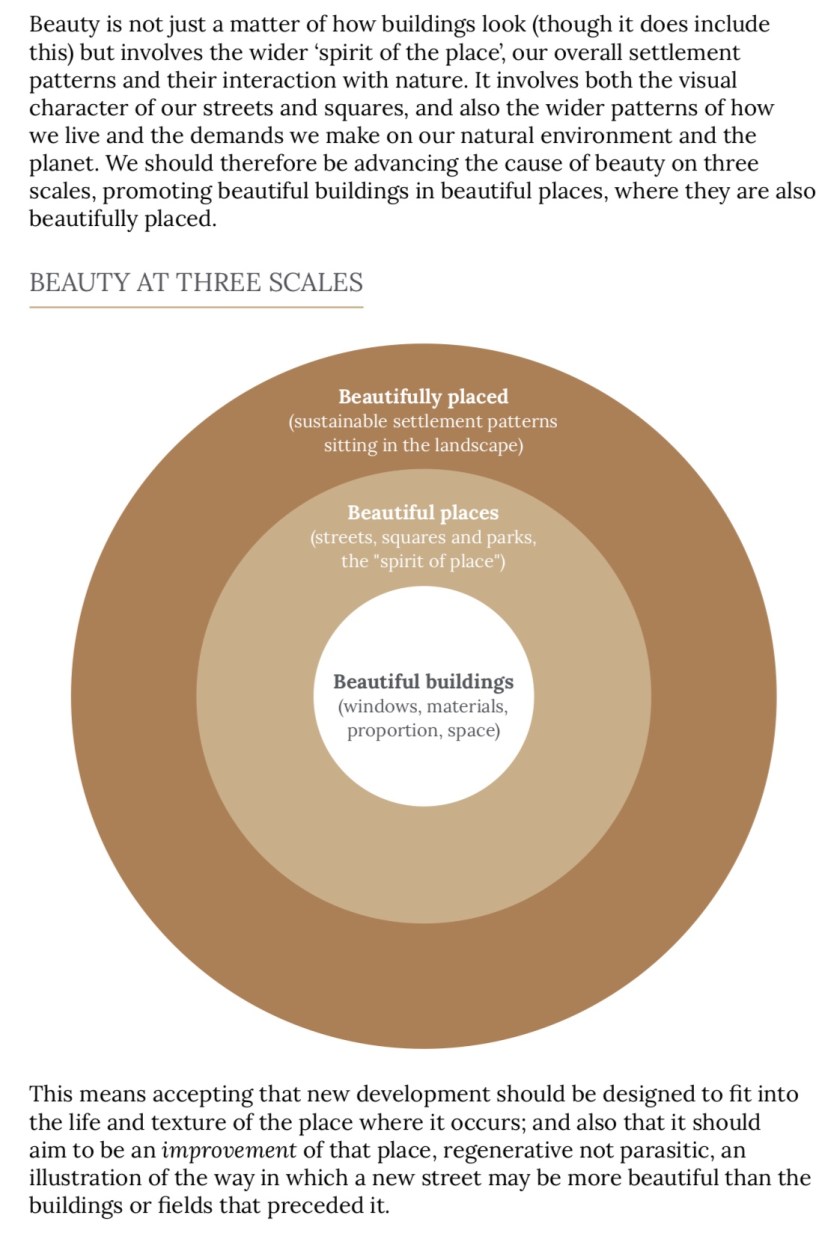
Are there assumptions that arise from political or social outlook, or age? The report roots its stance by describing a “powerful consensus…concerning what people prize in the design of new developments, and about how beauty in human settlement is generally understood”, with passages on:

⁃ townscape

⁃ mixed-use

⁃ building to last

⁃ affordability

⁃ respect for nature

⁃ stewardship.

Much of this must be right, but, faced with specific choices, I am still certain that there is room for debate as to development choices.

The throw-away assumption in the document is that tall buildings are bad:

“...there is much evidence for the view that we will not normally achieve the kind of humane densification that we are looking for by ‘building upwards’ – evidence that has not always been taken into account in recent urban developments, especially in London and Bristol. We need to weave the ground-level fabric more closely, not to stretch it to the skies.”

There is an equivalent dismissive reference to “iconic buildings”, immediately followed by a photograph of the Walkie Talkie:

“...people may not want an ‘iconic’ building in their immediate environment if it does not fit in or harmonise. For many planning protesters, the best outcome is also the outcome that will not be noticed.”

Do we dream of a bland and pleasant land? Where is the room for rebel buildings, for surprises? (I spotted nothing on the desirability or otherwise of preserving, for instance, outstanding examples of brutalist or post modern architecture – little of which would have got past the beauty police). And, whilst the use of traditional materials is eulogised, is this not, in many circumstances, to descend to pastiche and facadism? A logistics warehouse is what it is, or it should be.

Given the difficult value judgments required, are local planning authorities sufficiently resourced to fulfil the central role that the Commission envisages for them?

It is going to be a fascinating debate and, given the warm reception that the Secretary of State has already given to the recommendations (one of which is that he should become the Secretary of State for Place – I would certainly support a change of MHCLG to MoP), I predict that much of the document will find its way into the Government’s agenda. Better this, in my view, than a curious document, almost as long, published earlier in the week by Policy Exchange, Rethinking the Planning System for the 21st Century.

To my mind, we need to move on from the Conservatives’ 2010 mantra that “the planning system is broken”. It either is not, and never has been – or they have had long enough to mend it (and it beggars belief that the Policy Exchange can be advocating “a clean break with the land use planning system introduced in 1947”, unless you read it as part of a wider free market attack on all associated post-war settlements of that time). I tend to favour the former – the planning system is not broken – and the system can indeed accommodate greater attention to be paid to beauty. However, whilst there are always improvements to be made (including some of those recommended by the Commission) there are always two more fundamental influences on outcomes:

stewardship, dealt with well in the the Commission’s report:

We are persuaded, from a wide pool of evidence, that on-going involvement by the landowner very often leads to development which is better for residents’ well-being, more popular and, ultimately, more valuable. Currently, however, most landowners sell or ‘option’ their land to developers or sign deals with land promoters.. If we are to achieve this stewardship model, there are six issues that must be confronted:

1. We need to encourage management structures that can guide longer-term placemaking projects or stewardship projects, as well as the expertise to staff them;

2. We should support and encourage sources of patient capital investment;

3. We need to address ways in which the tax code unintentionally discourages landowners and developers from putting together stewardship projects;

4. We need to use the spatial planning system to encourage the right stewardship projects and infrastructure in the right place (using improving geospatial data where possible);

5. We need to help public bodies pool their land with private landowners for long-term schemes; and

6. We need to encourage competent long-term stewardship (or trusteeship) of the result.

financial resources, the relevance of which is acknowledged but not given particular prominence in the report, by which I mean: both a recognition that is wishful thinking to assert that good design does not cost (in terms of compromises on height and massing, on materials and in the use of appropriate professionals at every stage) and a recognition of the additional resources, including additional skillsets, required by local planning authorities.

My condolences to Sir Roger Scruton’s family. With Nicholas Boys Smith and the other Commissioners, he has produced an elegant and thought-provoking, but practical, piece of work. Let’s not dismiss it out of hand, but equally, as with any contemplated changes to the planning system, let’s be sure that the consequences of what is proposed are fully understood before we hand-chisel again into our battered, much extended, poorly maintained, but still in its own way beautiful, planning system.

Simon Ricketts, 1 February 2020

Personal views, et cetera