Net Heritage Harm: Bramshill

Sometimes I think, why buy a legal text book when you can read it in a court judgment? Lindblom LJ has provided some useful practical guidance, in City & Country Bramshill Limited v Secretary of State (Court of Appeal, 9 March 2021), on how to go about the assessment, required by the NPPF, as to whether development proposals would be likely to cause harm to listed buildings and other heritage assets.

(The case also considers the interpretation of policies in the NPPF against the development of “isolated homes in the countryside” but I’m limiting this blog post to heritage aspects.)

The case arose out of a decision letter dated 31 January 2019 by inspector Vicki Hirst into no fewer than 33 appeals against refusals of planning permission and enforcement notices issued by the second respondent, Hart District Council, relating to development at Bramshill Park in Hampshire. The third and fourth respondents to the proceedings, Historic England and the National Trust, were objectors. The inquiry had sat for 26 days.

From Lindblom LJ’s judgment:

“The site, which extends to about 106 hectares, lies between the villages of Hazeley and Eversley. It was previously used as a national and international police training college. On it stands a grade I listed Jacobean mansion and various other buildings. It also contains a grade I registered park and garden. The proposed development included the conversion of the mansion to 16 apartments and the adjoining stable block to five (appeal 1), or its conversion to a single dwelling (appeal 2), or to class B1 office space (appeal 3); the construction of 235 houses in place of some of the existing buildings (appeal 4), 14 more to the south-west (appeal 5), and nine to the north of an existing lake (appeal 6); the use of 51 residential units – once occupied by staff employed at the training college – as separate dwellings (appeal 7), retaining those against which the council had taken enforcement action alleging a material change of use without planning permission (appeals 8 to 33).

The inspector held a long inquiry into the appeals, which ended in February 2018. In her decision letter, dated 31 January 2019, she allowed appeals 2 and 3, granting planning permission for those proposals. She also allowed appeals 15 and 17 to 33, quashing the enforcement notices in those appeals. She dismissed appeals 1, 4 to 14 and 16. In a separate decision letter dated 14 March 2019 she dismissed City & Country Bramshill’s application for costs against the council. City & Country Bramshill challenged her decisions on appeals 4 to 14 and 16, and on the application for costs. Waksman J. upheld the challenges to the decisions on appeals 7 to 14 and 16. He rejected those to the decisions on appeals 4 to 6 and on costs. The appeal before us is against that part of his order. Permission to appeal was granted by Lewison L.J. on 28 February 2020.

The key dispute before the court in relation to heritage policy was as follows:

“Historic England and the National Trust provided their evidence on the basis that paragraphs 195 and 196 of the [NPPF] would always be engaged where any element of harm was identified. The appellant held that this was not the correct approach […]. The appellant’s case is that an “internal heritage balance” should be carried out where elements of heritage harm and heritage benefit are first weighed to establish whether there is any overall heritage harm to the proposal. Paragraphs 195 and 196 would only be engaged where there is residual heritage harm. This should then be weighed against the public benefits of the scheme.”

I’m now handing the microphone over to my Town Legal colleague, Victoria McKeegan – the rest of this post is largely hers.

So, the key matter was whether, prior to engaging paragraphs 195 and 196 of the NPPF (which apply to cases where a development proposal will lead to substantial / less than substantial harm), an ‘internal heritage balance’ should be carried out where elements of heritage harm and benefit are first weighed up to establish whether there is any overall heritage harm. The appellant argued that this was the case and, as such, that these paragraphs are only engaged where there is residual heritage harm, this then being weighed against the public benefits of the scheme. Put another way, only if “overall harm” (i.e. net harm) emerges from the weighing of “heritage harms” against “heritage benefits” must the “other public benefits” of the development be weighed against that “overall harm“.

On this point, the Court held as follows:

Like the judge, I cannot accept those submissions. It is not stipulated, or implied, in section 66(1), or suggested in the relevant case law, that a decision-maker must undertake a “net” or “internal” balance of heritage-related benefits and harm as a self-contained exercise preceding a wider assessment of the kind envisaged in paragraph 196 of the NPPF. Nor is there any justification for reading such a requirement into NPPF policy. The separate balancing exercise for which Mr Strachan contended may have been an exercise the inspector could have chosen to undertake when performing the section 66(1) duty and complying with the corresponding policies of the NPPF, but it was not required as a matter of law. And I cannot see how this approach could ever make a difference to the ultimate outcome of an application or appeal.

There is also some useful commentary regarding the s66(1) duty and the concepts of ‘harm’ in the NPPF, which I set out below:

1. Matters of weight:

• Section 66(1) duty

Section 66 does not state how the decision-maker must go about discharging the duty to “have special regard to the desirability of preserving the building or its setting …”. The courts have considered the nature of that duty and the parallel duty for conservation areas in section 72 of the Listed Buildings Act, and the concept of giving “considerable importance and weight” to any finding of likely harm to a listed building and its setting. They have not prescribed any single, correct approach to the balancing of such harm against any likely benefits – or other material considerations weighing in favour of a proposal. But in Jones v Mordue this court accepted that if the approach in paragraphs 193 to 196 of the NPPF (as published in 2018 and 2019) is followed, the section 66(1) duty is likely to be properly performed.

• NPPF paragraph 193

The concept in paragraph 193 – that “great weight” should be given to the “conservation” of the “designated heritage asset”, and that “the more important the asset the greater the weight should be” – does not predetermine the appropriate amount of weight to be given to the “conservation” of the heritage asset in a particular case. Resolving that question is left to the decision-maker as a matter of planning judgment on the facts of the case, bearing in mind the relevant case law, including Sullivan L.J.’s observations about “considerable importance and weight” in Barnwell Manor.

2. The concepts of “substantial harm” and “less than substantial harm

The same can be said of the policies in paragraphs 195 and 196 of the NPPF, which refer to the concepts of “substantial harm” and “less than substantial harm” to a “designated heritage asset”. What amounts to “substantial harm” or “less than substantial harm” in a particular case will always depend on the circumstances. Whether there will be such “harm”, and, if so, whether it will be “substantial”, are matters of fact and planning judgment. The NPPF does not direct the decision-maker to adopt any specific approach to identifying “harm” or gauging its extent. It distinguishes the approach required in cases of “substantial harm … (or total loss of significance …)” (paragraph 195) from that required in cases of “less than substantial harm” (paragraph 196). But the decision-maker is not told how to assess what the “harm” to the heritage asset will be, or what should be taken into account in that exercise or excluded. The policy is in general terms. There is no one approach, suitable for every proposal affecting a “designated heritage asset” or its setting.

3. Identifying benefits

Identifying and assessing any “benefits” to weigh against harm to a heritage asset are also matters for the decision-maker. Paragraph 195 refers to the concept of “substantial public benefits” outweighing “substantial harm” or “total loss of significance”; paragraph 196 to “less than substantial harm” being weighed against “the public benefits of the proposal”. What amounts to a relevant “public benefit” in a particular case is, again, a matter for the decision-maker. So is the weight to be given to such benefits as material considerations. The Government did not enlarge on this concept in the NPPF, though in paragraph 196 it gave the example of a proposal “securing [the heritage asset’s] optimum viable use”.

Plainly, however, a potentially relevant “public benefit”, which either on its own or with others might be decisive in the balance, can include a heritage-related benefit as well as one that has nothing to do with heritage. As the inspector said (in paragraph 127 of the decision letter), the relevant guidance in the PPG applies a broad meaning to the concept of “public benefits”. While these “may include heritage benefits”, the guidance confirms that “all types of public benefits can be taken together and weighed against harm”.

Cases will vary. There might, for example, be benefits to the heritage asset itself exceeding any adverse effects to it, so that there would be no “harm” of the kind envisaged in paragraph 196. There might be benefits to other heritage assets that would not prevent “harm” being sustained by the heritage asset in question but are enough to outweigh that “harm” when the balance is struck. And there might be planning benefits of a quite different kind, which have no implications for any heritage asset but are weighty enough to outbalance the harm to the heritage asset the decision-maker is dealing with.

4. Interaction with the overall planning balance and statutory duties

One must not forget that the balancing exercise under the policies in paragraphs 195 and 196 of the NPPF is not the whole decision-making process on an application for planning permission, only part of it. The whole process must be carried out within the parameters set by the statutory scheme, including those under section 38(6) of the Planning and Compulsory Purchase Act 2004 (“the 2004 Act”) and section 70(2) of the 1990 Act, as well as the duty under section 66(1) of the Listed Buildings Act. In that broader balancing exercise, every element of harm and benefit must be given due weight by the decision-maker as material considerations, and the decision made in accordance with the development plan unless material considerations indicate otherwise (see City of Edinburgh Council v Secretary of State for Scotland [1997] 1 WLR 1447). Within that statutory process, and under NPPF policy, the decision-maker must adopt a sensible approach to assessing likely harm to a listed building and weighing that harm against benefits.”

Thanks Victoria. Me again now. With the retirement of Lord Carnwath from the Supreme Court, Lindblom LJ is now our most senior “planning” judge. It is good to see him underlining yet again that it is for the decision maker to take a rational course through the various NPPF policy tests, based on judgment and circumstances – surely we all now know that, although great care is required to take into account what the individual paragraphs in the framework require (for what can go wrong see e.g. my 12 December 2020 blog post Where’s The Harm In That: Misreporting Heritage Effects), this should not be an overly technocratic or legalistic exercise with only one correct methodology?

Simon Ricketts, 12 March 2021

Personal views, et cetera

London Plans

Surely planning becomes a democratic irrelevance when the plan making process is slower than the electoral cycle? That’s pretty much the position in London. After all, Sadiq Khan wouldn’t have managed it if he hadn’t been gifted a further year in post by virtue of the postponement of the May 2020 elections.

Election: 7 May 2016. First consultation document: October 2016. Adopted plan 2 March 2021.

But it doesn’t have to be that way. In fact, it shouldn’t be this way. The plan “must deal only with matters which are of strategic importance to Greater London” (section 334(5), Greater London Authority Act 1999).

My 23 April 2017 blog post Make No Little Plans: The London Plan heralded the imminent publication of initial non-statutory consultation in relation to the new London Plan. The hope at that stage was to have an adopted plan in place by Autumn 2019. I referred to the 400 pages or so of the then current plan and expressed the hope that its replacement would be shorter. Hmm, not so.

One of the issues with this process has certainly been of the Mayor’s making – the sheer bloated nature of the plan, with its excessive layers of detail. What can be done to make sure that this never happens again?

But the other issue has not entirely been of the Mayor’s making. For the whole of his period in office he has faced opposition from Government, which has been placing pressure on him to increase planned housing numbers well beyond the already ambitious and probably unachievable numbers that he has been planning for. See for instance the previous Secretary of State’s 27 July 2018 letter and Robert Jenrick’s 13 March 2020 letter directing that a series of amendments be made to the draft plan.

“I had expected you to set the framework for a step change in housing delivery, paving the way for further increases given the next London Plan will need to assess housing need by using the Local Housing Need methodology. This has not materialised, as you have not taken the tough choices necessary to bring enough land into the system to build the homes needed.

Having considered your Plan at length my conclusion is that the necessary decisions to bring more land into the planning system have not been taken, the added complexity will reduce appetite for development further and slow down the system, and throughout the Plan you have directly contradicted national policy. As you know, by law you must have regard to the need for your strategies to be consistent with national policies.

For these reasons I am left with no choice but to exercise my powers to direct changes.

Your Plan must be brought to the minimum level I would expect to deliver the homes to start serving Londoners in the way they deserve. However, this must be the baseline and given this, I ask that you start considering the next London Plan immediately and how this will meet the higher level and broader housing needs of London.”

Then most recently, only after the Mayor had chased on 9 December 2020 for a response from Government to his April 2020 proposed amendments to address those March 2020 directions, the Secretary of State wrote again on 10 December 2020 with further directions.

But, to accentuate the positive, we now have an adopted new London Plan (542 pages of it).

This is a good Lichfields blog post on it. I did also like this Tom Pemberton post that summarised some of its implications in seven slides.

The whole process will now have to start again, as soon as we are past the 6 May elections, given the Government’s expectation of an immediate review to take into account the current NPPF and the housing numbers deriving from the revised standard method (including indeed its additional 35% figure for London and other major towns and cities). The new numbers are truly challenging/unrealistic (93,500 per annum as against the 52,000 figure in the new plan and annual delivery of less than 37,000).

What a political dilemma for the next Mayor to face – to broker some sort of solution with Government, boroughs, communities, authorities surrounding London and, for so long as there are going to be the range of onerous requirements that are set out in the new plan, developers and funders. On top of all the other challenges post-pandemic, post- Brexit and in the midst of a climate emergency.

And yet numerous candidates have thrown their hats in the ring for 6 May 2021 and we haven’t yet reached the 30 March deadline for delivery of nomination papers (fancy a go?).

I’m chairing a Planning Futures hustings event at 2pm on 9 March 2021, where we will have a number of the candidates or their representatives. It will focus on planning/housing/built environment policies. The event is free so do register and join me.

In preparation I did a little googling to see what the main candidates might be saying that might give some hope that the scale of the challenges ahead are publicly acknowledged.

⁃ Sadiq Khan’s campaign was launched on 4 March, focusing on listing the achievements of his first term rather than setting out any significant new direction or pledges.

⁃ Conservative candidate Shaun Bailey’s campaign website – 100,000 shared ownership homes to be sold at £100,000 each – a London Infrastructure Fund to fund long-term transport projects.

⁃ Green Party candidate Sian Berry’s campaign website – would set up “a People’s Land Commission to find small sites for new homes, green spaces and community support”. “In addition to using existing powers including compulsory purchase orders, I will also continue to lobby central Government for a devolved or national “community right to buy” which will create new rights for local community groups to buy any land or property that is neglected, empty and needed for community uses”.

Liberal Democrat party candidate Luisa Porritt’s campaign includes “homes in the heart of the city”, “a green roadmap” and “reinvent the high street”.

⁃ Women’s Equality Party candidate Mandu Reid: “Stand with us to make sure no woman is turned away from refuge, to close the pay gap in a generation, to balance work and family life for everyone, and to make London the first gender equal city in the world.”

⁃ UKIP candidate Peter Gammons will “will focus on new housing in every borough, holding developers accountable for providing affordable housing and prioritising Londoners.” He has apparently written a book, “London – a road map for recovery”, although I couldn’t find it on Amazon.

I think we need to get beyond these platitudes, and that is what I shall attempt to do on Tuesday….

Simon Ricketts, 6 March 2021

Personal views, et cetera

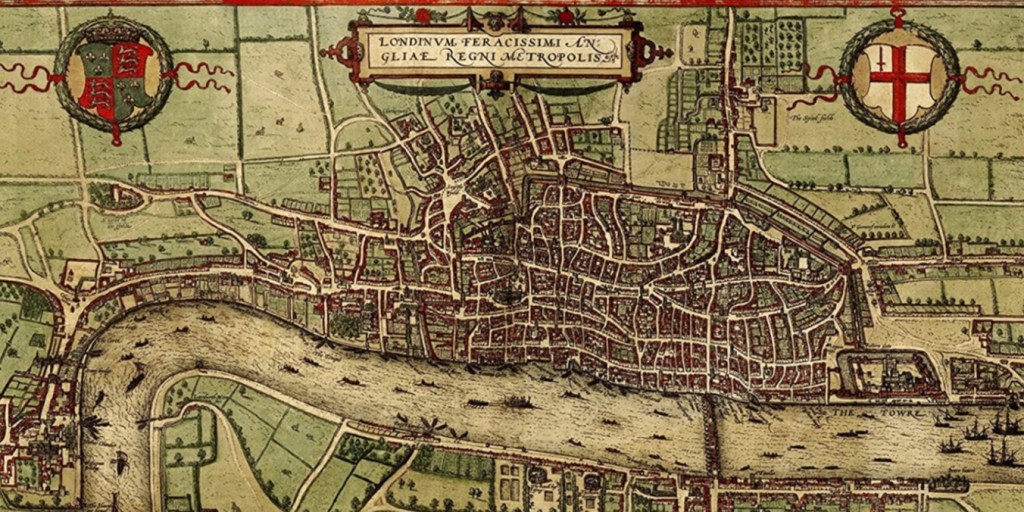
London, 1572. Those were the days.

Art 4 Life

Article 4 directions are a small but essential cog in the complicated machine that is the English planning system. With the more widespread reliance by Government on permitted development rights, it falls to local planning authorities to make article 4 directions to disapply, where appropriate, those rights in relation to specific types of developments and/or in specific areas.

From 1 August 2021, we are potentially approaching a breakdown in this machine in the face of the proposed class E to class C3 permitted development right which I wrote about in my 4 December 2020 blog post E = C3.

But first a few basic points to note about the way these cogs work:

1. Article 4 directions do not have to be approved by the Secretary of State but he can intervene where he considers that a direction is inappropriate.

2. Unless an article 4 direction takes effect at least a year after it was first publicised, in certain circumstances the authority can be liable to claims for compensation where someone can show they incurred abortive expenditure or otherwise suffered loss or damage as a result of the direction.

3. For permitted development rights where prior approval of certain matters is required before the right can be relied upon, the prior approval needs to be secured before the direction takes effect and needs to be completed within three years of prior approval.

The role of article 4 directions has increased with the gradual spread of “resi conversion” permitted development rights since 2013.

The office to residential permitted development right was first introduced in May 2013. At that time the legislation included a specific list of “excepted areas” within which the right did not apply, for instance London’s central activities zone. The Government was not adverse to threatening intervention where authorities sought to introduce blanket article 4 directions in relation to other areas, for instance its well publicised spat at the time with the London Borough of Islington.

In 2016 the right was made permanent. The list of excepted areas was scrapped but only as from 30 May 2019 so as to give affected authorities time to put article 4 directions in place as appropriate (see Lichfields’ 14 March 2016 blog post Office to Residential Permitted Development Right Made Permanent.

There is now indeed a patchwork of article 4 directions across the country, disapplying “resi conversion” permitted development rights in relation to many areas of the country. Focusing on central London, here is how the “offices to resi” rights is disapplied in RBKC and in Westminster for instance.

When Class E was introduced from 1 September 2020 (see my 24 July 2020 blog post E Is For Economy for more detail) existing permitted development rights were kept in place until 31 July 2021 (applying to what the uses would have been categorised as prior to the creation of Class E) so as to give the Government time to introduce new permitted development rights that apply to Class E.

The consultation period on the proposed new development rights closed on 28 January 2021 and the Government has come under fire from many quarters for the intended breadth of the new rights (for instance, here is the British Property Federation’s response). The statutory instrument to introduce the new rights (and in part replace the old rights, which will expire) has not seen the light of day and we are now around six months away from what might be termed PD-Day, 1 August 2021.

Some big questions arise and discussions within Town with Duncan Field and other partners and colleagues have been really useful. I’m not going to give away for free our entire Town “house view” but I’m just going to state the obvious:

⁃ the existing permitted development rights that attached to uses now within Class E will fall away after 31 July 2021, the end of the “material period” in the Town and Country Planning (Use Classes) (Amendment) (England) Regulations 2020, unless secondary legislation extends the material period for those purposes, as a stop gap.

⁃ it is questionable whether existing article 4 directions would restrict the operation of any new permitted development rights that are introduced, even where the change is still, say, offices to residential (and some changes that, according to the Government’s consultation proposals, will now be possible are entirely new, e.g. restaurant, indoor sports hall or creche to residential).

⁃ As a matter of principle an article 4 direction cannot be made in relation to a future permitted development right, so authorities’ hands are tied until the statutory instrument containing the new rights is actually made.

⁃ plainly there is no time for authorities to give a year’s advance notice in relation to any new article 4 direction that is to take effect from 1 August 2021, so any more immediate restrictions would expose authorities to the risk of compensation claims (unless there is some specific transitional arrangement in the new rights, for instance if the new rights would permit development that before 1 August 2021 have been restricted by an article 4 direction, but that will not be straight-forward at all).

It is interesting that when the “excepted areas” system was abolished in 2016 authorities were given sufficient time to put article 4 directions in place. In the rush this time round, either this issue has been overlooked or the Government is seeking to sidestep the article 4 direction process and create some kind of gold rush for prior approvals before directions can be introduced and take effect. After all its antipathy towards article 4 directions in the “resi conversions” area, save where exceptionally justified, is plain from its recent consultation on proposed changes to the NPPF:

Article 4 directions

“We also propose clarifying our policy that Article 4 directions should be restricted to the smallest geographical area possible. Together these amendments would encourage the appropriate and proportionate use of Article 4 directions.”

“The use of Article 4 directions to remove national permitted development rights should

• where they relate to change of use to residential, be limited to situations where this is essential to avoid wholly unacceptable adverse impacts

• [or as an alternative to the above – where they relate to change of use to residential, be limited to situations where this is necessary in order to protect an interest of national significance]

• where they do not relate to change of use to residential, be limited to situations where this is necessary to protect local amenity or the well-being of the area (this could include the use of Article 4 directions to require planning permission for the demolition of local facilities)

• in all cases apply to the smallest geographical area possible.”

The flexibility introduced by permitted development rights is necessary and welcome but let’s not focus on that lever without making sure that there isn’t going to be an almighty crunch when it is pulled. What am I missing here folks?

Simon Ricketts, 27 February 2021

Personal views, et cetera

PS If you’re on Clubhouse, I’ll be joined by some other friendly planning solicitors, barristers and planners to talk about this and other topical planning law issues at 6pm on Tuesday 2 March, details here. Do join us!

Arc

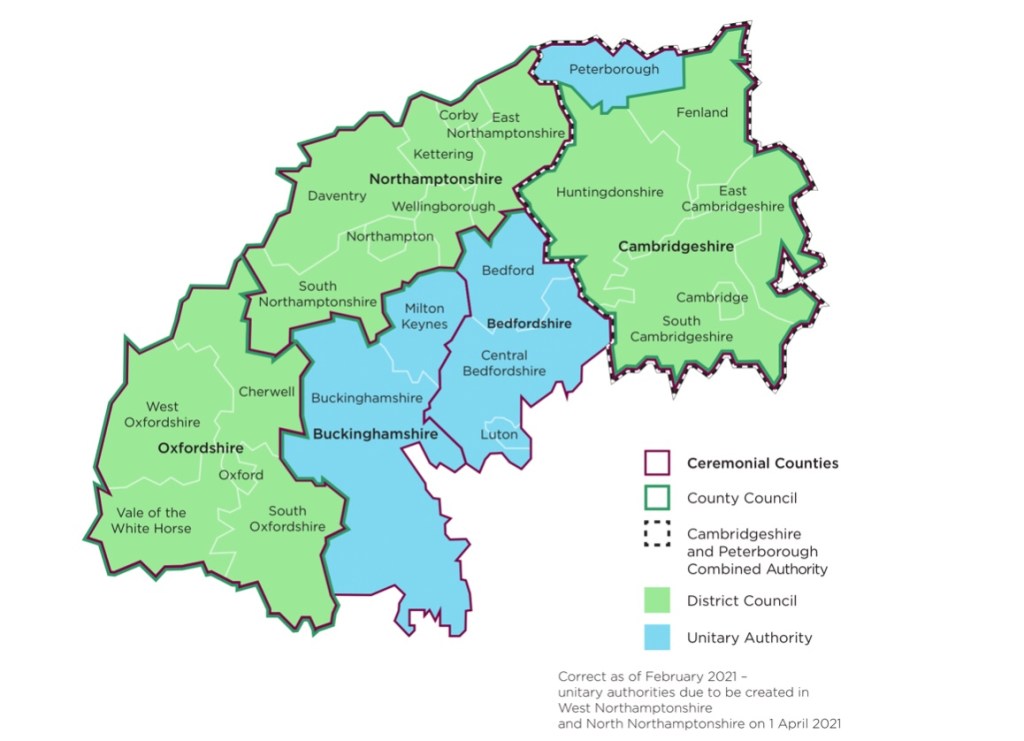
Well here’s an interesting R number: regional planning for the Oxford-Cambridge Arc.

Last week MHCLG published Planning for sustainable growth in the Oxford- Cambridge Arc: An introduction to the Oxford-Cambridge Arc Spatial Framework (18 February 2021). “Spatial framework” is a regional plan by any other name. The document is only a precursor to the plan itself. A (fast) timeline is set out, as follows:

The accompanying statement indicates that the Government’s ambition for the Arc is expressed in cautiously generic language:

“There is an opportunity, recognised by government and local partners, to build a better economic, social and environmental future for the area. With high-quality, well-connected and sustainable communities making the Arc an even more beautiful place to live, work and visit.”

“To achieve this ambition, the government alongside local partners, is going to:

• Develop a Spatial Framework for the Arc; a long-term regional plan to help coordinate the infrastructure, environment and new developments in the area. We are committed to working with local communities throughout so we can create beautiful and sustainable places for residents and workers to enjoy.

• Explore the creation of an Arc Growth Body; that would be a clear economic leadership voice for the Arc, championing its talent and assets internationally, supporting businesses, and fostering innovation.”

Government announcements these days invariably comprise a series of related statements and documents. So for completeness there was also a separate MHCLG press statement on the same day, Government plan to transform Oxford-Cambridge Arc into UK’s fastest growing economic region (18 February 2021)

The documents say this about the likely nature and governance of the Arc Growth Body and of its likely delivery structure:

To realise the full opportunities – and overcome the challenges – will require coordination of planning functions across the region. Local councils cannot do this on their own because of the level of coordination needed across the area, and because they do not have all the levers needed to develop a genuinely integrated plan. Government needs to play a supporting role to bring together a strategic approach at the Arc level to support better planning and ultimately better outcomes for the economy, environment and communities.”

“Over the next two and a half years, a specialist team in the Ministry of Housing, Communities and Local Government will work with communities and local partners to develop a robust, evidence-based Spatial Framework. “

“The nature and content of the Spatial Framework will be subject to the outcome of both detailed consultation and sustainability appraisal.”

We will seek to implement the Spatial Framework as spatially specific national planning policy. Local planning authorities preparing local development documents (including local plans) will have to have regard to the Spatial Framework, as they do with other national policies and guidance.”

“We have […] made a commitment to examine the case for development corporations, linked to the new transport hubs around East West Rail stations.”

“Specifically, the Spatial Framework will:

• provide an assessment of existing employment land, planned growth and anticipated future need

• set policies to support local planning authorities in allocating these as Strategic Business Zones or Strategic Industrial Locations, as appropriate

• set policies to support different land uses for different sectors and sizes of business”

“The Spatial Framework will also outline policies to enable sustainable, transport-led development. This will include policies to enable:

• new settlements to come forward at the scale and speed needed

• new development to support habitat recovery, delivery of Local Nature Recovery Strategies, and provision of good-quality green space within schemes

brownfield redevelopment and densification, and expansion of existing settlements, in sustainable locations or locations that can be made more sustainable by enhanced access to sustainable transport modes

housing needs to be met in full, including delivery of much-needed affordable housing”

To put a little flesh on the bones, it’s worthwhile looking back what was said in its March 2020 budget policy paper:

The OxCam Arc

2.128 The government has designated the corridor of land connecting Oxford, Milton Keynes, Bedford and Cambridge (the OxCam Arc) as a key economic priority. Earlier this year, the government announced the East West Rail Company’s preferred route for the new line between Bedford and Cambridge. The government will also, subject to planning consents, build a new rail station at Cambridge South, improving connectivity to the world-leading research facilities of the Cambridge Biomedical Campus – the largest cluster of medical and life sciences research in Europe.

2.129 The Budget announces plans to develop, with local partners, a long-term Spatial Framework to support strategic planning in the OxCam Arc. This will support the area’s future economic success and the delivery of the new homes required by this growth up to 2050 and beyond. The government is also going to examine and develop the case for up to four new Development Corporations in the OxCam Arc at Bedford, St Neots/Sandy, Cambourne and Cambridge, which includes plans to explore the case for a New Town at Cambridge, to accelerate new housing and infrastructure development.”

Indeed, earlier this month, MHCLG started a tender process for a “planning/engagement specialist to support the Government in developing an approach to engaging local audiences (both stakeholder groups and the public) throughout the process of developing up to four new or expanded settlements in the Oxford-Cambridge Arc (OxCam Arc) aligned with new stations along the East West Rail (EWR) Central Section. The specific locations under consideration are Bedford, St Neots/Tempsford, Cambourne and Cambridge.”

“3.5 The objectives of this commission are […] to:

3.5.1 develop an evidence-based engagement strategy for the programme that sets out the phases and methods of activity until delivery vehicles have been established at the chosen locations (~mid 2022);

3.5.2 clearly set out a route for the programme to meet any statutory requirements for consultation across the area and specifically each of the four potential development sites Bedford, St Neots/Tempsford, Cambourne and Cambridge; and

3.5.3 secure local buy-in for the strategy by working with local partners to build on established channels of engagement and recommending methods to engage hard to reach groups.”

[Statement of Requirements, 5 February 2021].

There are so many interesting elements to what is proposed:

⁃ The Government, through the Arc Growth Body, is going to prepare the framework itself and take it through to adoption. Who is going to lead the body and what will be its make-up?

⁃ It will have equivalent status to the NPPF in relation to plan making and decision making.

⁃ The Government has accepted that there will be stages of consultation and the sustainability appraisal (opening itself up to the rigours of the legal requirements in relation both to consultation and strategic environmental assessment) but it appears that there will be no independent examination of the draft framework.

⁃ Success is inevitably going to be dependent on securing a sufficient level of support or acceptance from local politicians and communities, meaning that it is important that the 2019 joint declaration holds firm, “entered into between the Government, local authorities across the Oxford to Cambridge Arc, Cambridgeshire and Peterborough Combined Authority, the Arc’s four local enterprise partnerships (LEPs), and England’s Economic Heartland.

⁃ We can expect to see up to four development corporations.

⁃ the document references the Government’s Planning For The Future proposals and I am sure we will see the process used in part as a showcase as to its proposed approach to plan making, for instance:

“3.12 First, we will use data and digital technology to support our policy-making. We intend to support development of an open source, digital platform for data and evidence to support collaboration between government, businesses, local councils and communities in decision-making. We will work with local partners to create an accessible digital platform for economic, planning and environmental data, and easy-to-use tools so that people – including the public and businesses – can engage meaningfully in the process.

3.13 Second, it means using digital engagement processes to make it easy for people to raise their views about proposals in the spatial framework, including on smartphones.

3.14 Third, it means the spatial framework will be visual and map-based, standardised, and based on the latest digital technology, so that it is easy to access and understand.”

Neil Young and Crazy Horse once released a terrific, if noisy album: Arc-Weld. Civil servants’ welding skills will certainly be needed to build the structure so far outlined, at the pace identified.

Simon Ricketts, 20 February 2021

Personal views, et cetera

Local Zoomocracy

My team has proved capable of losing 9-0 in any conditions but, because it is another angle on what I was going to write this morning, I was still interested to see this piece yesterday: Premier League’s home edge has gone in pandemic era: The impact of fan-less games in England and Europe (ESPN, 12 February 2021).

Wouldn’t it be interesting to see some statistics on the impacts of virtual local authority meetings and PINS hearings and inquiries on decision making outcomes?

Would that Handforth Parish Council meeting have been any less chaotic if Aled’s iPad, guitars man or Handforth PC Clerk had all been sitting around the same table? A subsequent letter from Land Promoters and Developers Federation policy director John Acres in Planning magazine The Handforth debacle shows that local democracy is too often placed in the wrong hands (registration only) seeks to draw wider conclusions.

I mentioned in my 23 January 2021 blog post Temporary Covid Measures – Planning, Traffic, Local Government: There May Be Trouble Ahead that after 6 May 2021 local authorities may not be able to hold virtual meetings given the expiry on that date of temporary freedom provided by Regulation 5 of the Local Authorities and Police and Crime Panels (Coronavirus) (Flexibility of Local Authority and Police and Crime Panel Meetings) (England and Wales) Regulations 2020 , pursuant to section 78 of the Coronavirus Act 2020.

In response to that blog post, Hugh Richards (No 5 Chambers) rightly, and probably rhetorically, asked whether local authorities need statutory authority to hold virtual meetings in any event. Well, I took it as a rhetorical question and didn’t reply at the time after I disappeared down a legal rabbit hole trying to arrive at an answer.

I’m pleased to see that the Lawyers in Local Government and Association of Democratic Services Officers are taking urgent steps to try to avoid what would be an unfortunate hiatus – they have obtained an opinion from James Strachan QC, a summary of which is reported as follows:

“(1) There are forceful arguments that can be made that the pre-existing legislation governing local authority meetings under Schedule 12 of the Local Government 1972 Act, and meetings of an executive or a committee of an executive under the Local Authorities (Executive Arrangements (Meetings and Access to Information) (England) Regulations 2012, enable local authorities to hold meetings remotely.

(2) For the present situation to continue after 7 May 2021 with the use of remote meetings, the optimum position would be for further legislation to be passed to make the position clear.

(3) In the absence of such legislation, one resolution would be to obtain a declaration from the courts to obtain clarity as to the legal position under the pre-existing legislation.

(4) The Secretary of State does have (a) power under section 16 of the 1999 Act to make an Order to modify or disapply those restrictions for best value authorities and (b) power under the 2000 Act to make regulations governing executive decision-making bodies to hold remote meetings.”

(LLG & ADSO Obtain Legal Opinion on Virtual Meeting Provisions, 5 February 2021).

The LLG and ADSO intend to seek a declaration from the High Court. Without such a declaration (or legislation) there is inevitably going to be a question-mark over the lawfulness of any local authority resolution passed on or after 7 May by way of a virtual meeting. This is a risk that most applicants would wish to avoid in relation to any contentious planning application.

6 May is of course an important date because local government elections will definitely be proceeding (as far as “definitely” is a word that any of us can still use). The Local Government Association has published much information and guidance relating to the May 2021 local government elections.

Ahead of those elections will be the usual period (previously known as the “purdah period”, now simply and dully, “pre-election period”) when there is heightened sensitivity over decision making. The period will start at the latest on 27 March (22 March for the London elections). Again, the Local Government Association has published detailed guidance.

The period is shorter when it comes to actions and decisions taken being by central Government. As set out in the Commons Library research briefing Pre-election period of sensitivity (23 November 2020), the relevant civil service guidance is as follows:

“The period of sensitivity for UK Government civil servants preceding scheduled local and mayoral elections each May is not fixed to any particular date, but the general convention is that particular care should be taken in the three weeks preceding the elections.”

Applying that ESPN Premier League analysis, it will be fascinating to see the influence of the current restrictions upon election outcomes. Fortunately I don’t have a team. Simon’s iPad will not be making its first appearance at my local parish council meeting this Spring.

Simon Ricketts, 13 February 2021

Personal views, et cetera
Tilt!

Tilt” in pinball is an example of a good rule: in order to discourage an unwanted outcome (cheating), transgression (sloping the table) leads to a predictable penalty (game over).

The purposes of the NPPF’s “tilted balance” (the phrase just being planners’ jargon) are to discourage local planning authorities from:

⁃ relying on out of date local plans

⁃ not maintaining (potentially with an additional buffer) at least five years’ housing land supply (now watered down to a minimum of three years’ housing supply if there is an up to date neighbourhood plan that allocates land for housing development) and

⁃ (since the introduction of the housing delivery test) not ensuring that a defined number of homes are delivered each year.

Where the tilted balance applies, it should in many circumstances be easier for developers to secure planning permission which is not in accordance with the relevant local plan and/or neighbourhood plan, in that paragraph 11 (d) of the NPPF provides as follows:

“(d) where there are no relevant development plan policies, or the policies which are most important for determining the application are out-of-date, granting permission unless:

i. the application of policies in this Framework that protect areas or assets of particular importance provides a clear reason for refusing the development proposed; or

ii. any adverse impacts of doing so would significantly and demonstrably outweigh the benefits, when assessed against the policies in this Framework taken as a whole.

There is a footnote to “out-of-date”: “This includes, for applications involving the provision of housing, situations where the local planning authority cannot demonstrate a five year supply of deliverable housing sites (with the appropriate buffer, as set out in paragraph 73); or where the Housing Delivery Test indicates that the delivery of housing was substantially below (less than 75% of) the housing requirement over the previous three years.

There is another crucial footnote, to (d)i: “The policies referred to are those in this Framework (rather than those in development plans) relating to: habitats sites (and those sites listed in paragraph 176) and/or designated as Sites of Special Scientific Interest; land designated as Green Belt, Local Green Space, an Area of Outstanding Natural Beauty, a National Park (or within the Broads Authority) or defined as Heritage Coast; irreplaceable habitats; designated heritage assets (and other heritage assets of archaeological interest referred to in footnote 63); and areas at risk of flooding or coastal change.

Already, that description surely begins to raise obvious questions:

⁃ Is the rule sufficiently clear and understood, such that the risk of the penalty actually influences council members’ and officers’ decision making so as to discourage those unwanted outcomes: to encourage up to date plans, the maintenance of an adequate housing land supply, sufficient homes being built? If the public doesn’t understand it, it’s going to have no effect at the ballot box – so how do we expect it to influence councillors, for whom being seen to protect their local areas from change will usually be a more potent vote winner?

⁃ To what extent can the authority avoid those unwanted outcomes in any event, given for instance the slowness of the local plans system even for a authority wishing to make swift progress and given the reliance on the private sector not only to promote suitable sites but then proceed to build them out?

⁃ The footnote to (d)i reduces the impact of the rule in constrained areas which usually turn out to be those where the documented need for housing is greatest.

⁃ Should there be a different penalty other than to make it more likely that development will take place in a way which is unplanned for and often unpopular? What are the most direct “carrots and sticks” that could be deployed?

Four years ago this month my thoughts were wandering in these directions, while sitting in the Supreme Court in the Suffolk Coastal case, acting for Richborough Estates (thank you Paul Campbell and Chris Young). The case was a turning point in the consideration of how the tilted balance is intended to work. It relates to the original 2012 version of the NPPF but the principles still hold true. The judgment in Suffolk Coastal District Council v Hopkins Homes Limited, Richborough Estates Partnership LLP v Cheshire East Borough Council (Supreme Court, 10 May 2017) is a masterpiece in cutting through what had been a series of conflicting rulings by the lower courts as to how the tilted balance was to be interpreted in order to pull us all back to the basic principles. I tried to summarise them in a blog post at the time, but for instance:

⁃ Let’s not overstate the influence of the test: the NPPF is no more than “guidance” and is no more than a “material consideration” for the purposes of section 70(2) of the 1990 Act: “It cannot, and does not purport to, displace the primacy given by the statute and policy to the statutory development plan. It must be exercised consistently with, and not so as to displace or distort, the statutory scheme”. (Lord Carnwath, paragraph 21) (i.e. there’s a get-out so that a decision maker can determine that, notwithstanding the tilted balance, planning permission should not be granted).

⁃ Deprecation of the “over-legalisation of the planning process, as illustrated by the proliferation of case law on [the tilted balance]. This is particularly unfortunate for what was intended as a simplification of national policy guidance, designed for the lay-reader.” (Lord Carnwath, para 23) (i.e. the court will always be reluctant to interfere with the judgment arrived at by the decision maker).

⁃ As long as decision makers apply it lawfully (which means they first have to understand it – not easy!) the application of the tilted balance test engages matters of planning judgement, not legal interpretation. (i.e. legal challenges to the decision maker’s judgment, have to be based on unlawful or irrational reasoning on the part of the decision maker – never easy).

⁃ the basis for the test arises from the importance that the NPPF places on boosting the supply of housing. “The message to planning authorities is unmistakeable”. (Lord Gill, paragraph 77). He refers to “the futility of authorities’ relying in development plans on the allocation of sites that have no realistic prospect of being developed within the five year period”. (paragraph 78). (i.e. the test has a real world objective which we must not lose sight of – boosting the supply of housing).

⁃ “If a planning authority that was in default of the requirement of a five-years supply were to continue to apply its environmental and amenity policies with full rigour, the objective of the Framework could be frustrated”. (Lord Gill, paragraph 83). (i.e. the outcome of the test may well be that planning permissions are granted notwithstanding an authority’s policies – that’s the whole point of it).

The cases have kept coming. Already, in 2021, there have been no fewer than three rulings from the Court of Appeal – on a test in a non statutory policy document – this is surely ridiculous. Does this arise from its unnecessary complexity and “angels dancing on the head of a pin” abstractions, or from the way that in practice the so-called tilted balance hardly seems to provide any tilt at all, even in areas with a severe under-supply of housing, perhaps contrary to the original objective?

Three 2021 Court of Appeal cases:

Gladman Developments Limited v Secretary of State (Court of Appeal, 3 February 2021)

The case raised “two main issues: first, whether a decision-maker, when applying the “tilted balance” under paragraph 11d)ii, is required not to take into account relevant policies of the development plan; and second, as a connected issue, whether it is necessary for the “tilted balance” and the duty in section 38(6) of the Planning and Compulsory Purchase Act 2004 to be performed as separate and sequential steps in a two-stage approach. There is a further issue: whether the “tilted balance” under paragraph 11d)ii excludes the exercise indicated in paragraph 213 of the NPPF, which requires that policies in plans adopted before its publication should be given due weight, “according to their degree of consistency with [it]“.

Answers from the court: no, no and (on the further issue) no.

R (Monkhill Limited) v Secretary of State (Court of Appeal), 27 January 2021)

The case raised “one principal issue […]: whether the inspector was wrong to interpret the first sentence of paragraph 172 of the NPPF, which says “great weight should be given to conserving and enhancing landscape and scenic beauty” in an AONB, as a policy whose application is capable of providing “a clear reason for refusing” planning permission under paragraph 11d)i of the NPPF.

Answer from the court: no.

Paul Newman New Homes Ltd v Secretary of State (Court of Appeal, 12 January 2021)

Ever since a NPPF was first introduced in March 2012, the interpretation of its provisions has provided a fertile hunting ground for planning lawyers. The 2018 version was intended to produce greater clarity and simplicity, but unfortunately it has not been entirely successful. The effect of the appellant’s argument was that if there is only one relevant policy in the local plan, the developer gets the benefit of the tilted balance (absent the operation of one of the exceptions). Mr Lockhart-Mummery eschewed any suggestion that this was a “numbers game” but he also very fairly accepted that it is virtually unknown for a single policy in a local plan to embrace all the material considerations that would suffice to enable a decision-maker to determine a planning application, especially if that application is to build houses.”

Answer from the court: no. (“… at the end of the day there is nothing inherently unfair to an applicant or contrary to the overall scheme of the NPPF or the 2004 Act, both of which afford primacy to the local plan, about the balancing exercise being carried out under section 38(6) in circumstances where an experienced Planning Inspector has found that there is a policy in the development plan that is relevant, important and up-to-date. For those reasons I would uphold the interpretation of Paragraph 11d) adopted by the Judge and applied by the Inspector).”

Housing delivery test:

The Government has now published the results of its 2020 housing delivery test measurement (19 January 2021). The figures are important, because if the housing delivery test indicates that the delivery of housing was less than 85% of the housing supply requirement over the last three years, a buffer of 20% has to be added to that requirement. If delivery was less than 75% of the housing requirement over the previous three years, that is a trigger for the application of the tilted balance.

As an adjustment to recognise at least to some extent to effects of Covid this past year, authorities’ requirements this year were reduced by a month.

This year there are (by my count) 55 authorities for whom the tilted balance applies following these latest measurements.

Has that featured in the relevant local press? What are authorities doing about it? I would be pleased to hear.

And what of the obvious flaw, highlighted by Zack Simons in his 21 January 2021 blog post Elephants in the Room: Green Belts vs. the Housing Delivery Test – the obvious correlation between green belt authorities and those that are failing the delivery test?

I just wonder whether it might not be better to sweep all of this complexity away and replace it with a policy that provides for an enhanced presumption in favour of development if relevant housing land supply figures are not met: the higher the shortfall, the more weighty the presumption? Leave the detail to decision makers, including to inspectors on appeal – attempts at greater prescription are doomed to fail and are not understood by the public.

There should also be additional consequences for authorities that fail to meet these targets, and their councillors – but also a new transparency on the part of the Government as to (1) the basis for its national target and (2) the need for frank annual reporting to Parliament as to its performance as against that target.

To encourage desirable outcomes, we need rules that everyone understands. Plan positively = great places. A failure to plan positively = intervention, remedial steps.

But enough of this quixotic tilting.

Simon Ricketts, 6 February 2021

Personal views, et cetera
Beautiful Day

I threw those curtains wide, drinking in the morning emails and there it was: MHCLG press release 30 January 2021, All new developments must meet local standards of beauty, quality and design under new rules.

Consultation is now running until 27 March 2021 on:

National Planning Policy Framework and National Model Design Code: consultation proposals

National Planning Policy Framework Draft text for consultation

Draft national design code

Guidance notes on design codes

The proposals seek to give effect to the Building Better Building Beautiful Commission’s recommendations that I summarised in my 1 February 2020 blog post Beauty Duty.

“The National Model Design Code is intended to form part of the government’s planning practice guidance. It is not a statement of national policy. However, once finalised, the government recommends that the advice on how to prepare design codes and guides is followed.”

I will leave others to comment on the draft national design code and the proposed “beauty” related changes to the NPPF (the consultation proposals identify the changes and the draft revised text is helpfully marked-up to show all the textual changes).

However, you should note that the draft NPPF changes go wider:

“We have also taken this opportunity to make a number of environment-related changes, including amendments on flood risk and climate change. The amendments also include a small number of very minor changes arising from legal cases, primarily to clarify the policy. A few minor factual changes have also been made to remove out-of-date text (for example, the early thresholds for the Housing Delivery Test), to reflect a recent change made by Written Ministerial Statement about retaining and explaining statues, and an update on the use of Article 4 directions.

As summarised in the consultation proposal, the draft revised text:

Implements policy changes in response to the Building Better Building Beautiful Commission recommendations

• Makes a number of changes to strengthen environmental policies – including those arising from our review of flood risk with Defra

• Includes minor changes to clarify policy in order to address legal issues

• Includes changes to remove or amend out of date material

• Includes an update to reflect a recent change made in a Written Ministerial Statement about retaining and explaining statues.

• Clarification on the use of Article 4 directions

Some points that immediately leapt out (this is not a comprehensive list):

Overarching objectives of the planning system

Paragraph 8 of the NPPF has been amended to refer to refer to “beautiful, well-designed and safe places” (previously “a well-designed and safe built environment”).

The presumption in favour of sustainable development

Paragraph 11 (a) has been amended to read:

“all plans should promote a sustainable pattern of development that seeks to: meet the development needs of their area; align growth and infrastructure; improve the environment; mitigate climate change (including by making effective use of land in urban areas) and adapt to its effects”.

(The previous wording was “plans should positively seek opportunities to meet the development needs of their area, and be sufficiently flexible to adapt to rapid change”).

Article 4 directions

“We also propose clarifying our policy that Article 4 directions should be restricted to the smallest geographical area possible. Together these amendments would encourage the appropriate and proportionate use of Article 4 directions.”

This is really interesting, particularly in the context of the proposed class E to C3 permitted development right. The proposed wording is pretty tight:

The use of Article 4 directions to remove national permitted development rights should

• where they relate to change of use to residential, be limited to situations where this is essential to avoid wholly unacceptable adverse impacts

• [or as an alternative to the above – where they relate to change of use to residential, be limited to situations where this is necessary in order to protect an interest of national significance]

• where they do not relate to change of use to residential, be limited to situations where this is necessary to protect local amenity or the well-being of the area (this could include the use of Article 4 directions to require planning permission for the demolition of local facilities)

• in all cases apply to the smallest geographical area possible.”

Larger scale residential proposals

There is an amendment to paragraph 73 to require that these should include “a genuine choice of transport modes”.

Isolated homes in the countryside

The design should now be “outstanding”. The “or innovative” is gone.

Affordable home ownership

“Paragraph 64 has been amended to clarify that, where major development involving the provision of housing is proposed, planning policies and decisions should expect at least 10% of the total number of homes to be available for affordable home ownership. This is to address confusion as to whether the 10% requirement applies to all units or the affordable housing contribution.”

Neighbourhood plan allocations

Paragraph 69 has been amended to remove any suggestion that neighbourhood plans can only allocate small or medium sites. This was not the policy intention, so the wording has therefore been amended to clarify that neighbourhood planning groups should also give particular consideration to the opportunities for allocating small and medium-sized sites (of a size consistent with paragraph 68a) suitable for housing in their area.

Trees

A new paragraph 130:

“Trees make an important contribution to the character and quality of urban environments, and can also help mitigate and adapt to climate change. Planning policies and decisions should ensure that new streets are tree-lined [Unless, in specific cases, there are clear, justifiable and compelling reasons why this would be inappropriate], that opportunities are taken to incorporate trees elsewhere in developments (such as community orchards), that appropriate measures are in place to secure the long- term maintenance of newly-planted trees, and that existing trees are retained wherever possible. Applicants and local planning authorities should work with local highways officers and tree officers to ensure that the right trees are planted in the right places, and solutions are found that are compatible with highways standards and the needs of different users.”

The “well-designed” test

Paragraph 133:

“133. Development that is not well designed should be refused, especially where it fails to reflect local design policies and government guidance on design, taking into account any local design guidance and supplementary planning documents which use visual tools such as design guides and codes. Conversely, significant weight should be given to:

a) development which reflects local design policies and government guidance on design, taking into account any local design guidance and supplementary planning documents which use visual tools such as design guides and codes; and/or

b) outstanding or innovative designs which promote high levels of sustainability,, or help raise the standard of design more generally in an area, so long as they fit in with the overall form and layout of their surroundings.”

Development affecting the setting of national parks and AONBs

“New paragraph 174 has been amended in response to the Glover Review of protected landscapes, to clarify that the scale and extent of development within the settings of National Parks and Areas of Outstanding Natural Beauty should be sensitively located and designed so as to avoid adverse impacts on the designated landscapes.”

Historic statues, plaques and memorials

(which was going to be the subject of this week’s blog post until the curtains/drinking in the emails moment)

“New paragraph 196 has been added to clarify that authorities should have regard to the need to retain historic statues, plaques or memorials, with a focus on explaining their historic and social context rather than removal, where appropriate.”

This of course supplements Robert Jenrick’s statement to the House of Commons (18 January 2021) and MHCLG’s 17 January 2021 press statement, New legal protection for England’s heritage.

As a draft for consultation in my view the consultation material so far has only limited weight for decision makers and, as is usually and appropriately the case, the final documents may be subject to change. However, there is much for us all to get to grips with – and comments on the national design code are for another day.

Simon Ricketts, 30 January 2021

Personal views, et cetera

Temporary Covid Measures – Planning, Traffic, Local Government: There May Be Trouble Ahead

So friends, here we are, still in the most tedious sequel in the whole franchise: Lockdown 3. Of course, the vaccines will be the eventual way out 💪 this year but can anyone predict how many more months will go by before, in England, we are free from some level of restrictions on our ability to go about our lives?

The planning system has kept going through all of the restrictions of the last ten months, thanks to the determination of local authority staff and councillors, thanks to technology and thanks to the Government in providing for a number of temporary procedural relaxations last Spring. The relaxations were summarised in my 16 May 2020 blog post Stay Alert! A Quick Guide To All Those MHCLG Announcements.

However, there is no reason to be complacent:

⁃ Some temporary measures are due to expire and there is no certainty that they will be extended.

⁃ Covid does not give carte blanche to local authorities to cut corners in their approach to decision making – I deal below with last week’s High Court ruling in relation to Transport for London’s Streetspace plan.

⁃ If initially temporary measures are to be made permanent (rather than just extended to see us through this current saga), that should surely be after careful review and reflection.

I’m going to deal with that last point first. On 16 December 2020 and without prior consultation the Government laid two statutory instruments (Environmental Assessment of Plans and Programmes (Amendment) Regulations 2020 and Infrastructure Planning (Publication and Notification of Applications etc.) (Amendment) Regulations 2020) before Parliament, the effect of which was to make permanent the ability for plan makers and promoters to dispense with making copies of documents physically available for inspection, instead providing them on a website to which consultees are directed, in relation to strategic environmental assessment (i.e. , basically, sustainability appraisals in relation to plans) and in relation to nationally significant infrastructure projects.

As summarised in the explanatory memorandum accompanying the first set of Regulations:

“In addition to publishing documents on a public website, responsible authorities (or the Secretary of State, as the case may be) will now be required to: make available a telephone number for the public to raise enquiries in relation to any documentation published; provide by mail hard copies of any documentation upon request, subject to a reasonable charge and provided it is reasonably practicable to do so given precautions and other measures relating to coronavirus; and provide copies of any documentation by email upon request. Guidance will set out that authorities may also offer electronic copies of documents available on USB flash drive to those with access to a computer but without access to the internet, and that they may wish to consider waiving any charge for hard copies of documents to members of the public who are unable to access the documentation electronically or find it difficult to do so.”

Making these changes permanent without consultation was strongly criticised by the House of Lords Secondary Legislation Scrutiny Committee in its 21 January 2021 report. This is the summary at the beginning of the report:

“These two instruments remove permanently publication and publicity requirements for certain planning matters that were suspended temporarily last year to assist authorities in taking forward relevant plans, programmes and projects during the pandemic. The Ministry of Housing, Communities and Local Government (MHCLG) says that it is not aware of any concerns about the changes and that the move to more digital processes has been broadly welcomed, though support for the changes seems to have come largely from those involved professionally in the planning process.

We regret that there was no formal public consultation, as the changes have the potential to reduce physical access to information and the ability to make representations for the general public and in particular for vulnerable or disadvantaged groups or those with poor or no internet connection, in relation to important infrastructure, housing or other projects that may impact on them. The House may wish to ask the Government to update Parliament on the impact of the changes. The possibility that requesting hard copies of potentially complex planning documents may incur an undefined ‘reasonable charge’ also gives cause for concern. Taken as a whole, these proposals seem likely to increase rather than narrow any gap between the planners and the people whose lives may be affected. We also regret that MHCLG has again used secondary legislation to make significant, permanent changes to planning legislation during the pandemic.”

In the body of the report:

“Asked why the instruments had not been extended, as other measures dealing with the impacts of the pandemic, MHCLG told us that, in addition to moving towards a digital planning system, making the changes permanent:

“avoided some uncertainty about whether it would be possible to make Regulations providing for a further extension of all of these measures in a timely way in due course. This is because the measures are made in part under the powers set out in section 2(2) of the European Communities Act 1972 and these powers were only available until the end of the EU Exit Implementation Period (11pm on 31 December 2020)”.

We are not convinced by MHCLG’s explanation. The instruments were laid and came into force before the expiry of relevant powers at the end of the Transition Period, suggesting that MHCLG could have chosen to legislate for a further extension, rather than making the changes permanent. The House may wish to press the Minister for further explanation of the Government’s approach.”

Whilst these specific, initially temporary, publicity relaxations have been made permanent, the wider temporary changes to publicity requirements for planning applications introduced through the Town and Country Planning (Development Management Procedure, Listed Buildings and Environmental Impact Assessment) (England) (Coronavirus) (Amendment) Regulations 2020 and the Town and Country Planning (Local Planning, Development Management, Listed Buildings etc) (England) Regulations 2020 are still due to expire on 30 June 2021 unless extended.

No doubt there will be an extension if it is needed (and let us hope that it isn’t). What is much more worrying is the imminent expiry on 6 May 2021 of the power for local authorities to hold virtual meetings, provided by Regulation 5 of the Local Authorities and Police and Crime Panels (Coronavirus) (Flexibility of Local Authority and Police and Crime Panel Meetings) (England and Wales) Regulations 2020 . The concern is that the basis for this temporary relaxation in local government law is Section 78 of the Coronavirus Act 2020. Sub-section (3) provides:

The regulations may make provision only in relation to local authority meetings required to be held, or held, before 7 May 2021.

MHCLG’s current view is apparently that power to hold virtual meetings cannot be extended without primary legislation to amend section 78 and this may not be possible – see ‘Councillors could be disenfranchised without remote meetings’ (Local Government Chronicle, 21 January 2021).

This could be a real problem and needs to be grappled with now. I would be very pleasantly surprised if normal life has resumed by 6 May to such an extent that everyone is available to attend planning committee and other meetings in the same way as before the pandemic. Let’s be clear, without virtual planning committee meetings, the planning system (at least on any democratic basis, as opposed to wholesale reliance on officers’ delegated powers) would have shut down for the last ten months.

Finally, on the subject of temporary powers and measures:

⁃ the emergency permitted development right for the NHS and local authorities to provide additional temporary health and local authority facilities introduced by the Town and Country Planning (General Permitted Development) (Coronavirus) (England) (Amendment) Order 2020 has been extended to 31 December 2021.

⁃ the additional allowance for temporary use of land expires on 31 December 2021 and the right for a local authority to hold a market for an unlimited number of days expires on 23 March 2022, both introduced by the Town and Country Planning (Permitted Development and Miscellaneous Amendments) (England) (Coronavirus) Regulations 2020 and then extended by the Town and Country Planning (General Permitted Development) (England) (Amendment) Regulations 2020.

⁃ I am not aware of any proposal for any extension of the duration of certain planning permissions and consents beyond that provided for in the Business and Planning Act 2020.

Surely it’s going to take some time and evidence-gathering to work out what the benefits of each of these measures have been, what problems may have arisen and which processes and rights (if any) should now be permanently adopted. For instance, for my part, I see great advantages to the inclusivity that has come with virtual planning committee meetings and indeed appeal inquiries and hearings and I hope that we do not return entirely to old ways. However, we should not be bumped into permanent change without that process of reflection.

The judgment deserves a blog post of its own, but the dangers that arise where decisions are made under the justification of Covid but which have more widespread effects which may not have been properly considered are illustrated starkly by the Streetspace case, R (United Trade Action Group & others) v Transport for London (Lang J, 20 January 2021)

This was a challenge by London taxi drivers to the London Streetspace Plan, the related Interim Guidance to Boroughs and the A10 GLA Roads (Norton Folgate, Bishopsgate and Gracechurch Street, City of London (Temporary Banned Turns and Prohibition of Traffic and Stopping) Order 2020.

As summarised by Lang J:

“The Mayor issued the Plan on 6 May 2020, in response to the COVID 19 pandemic. The Guidance was published by TfL on 15 May 2020. Broadly, the aim of the Plan and the Guidance is to facilitate walking and cycling by providing more dedicated road space for pedestrians and cyclists, and “suppressing” motor vehicle traffic, other than buses.”

“The A10 Order is a traffic management order (“TMO”) made by TfL on 16 July 2020, under section 14(1) of the Road Traffic Regulation Act 1984 (the “RTRA 1984”). It is a temporary measure, due to expire by 15 January 2022 at the latest. It imposes extensive restrictions on motor vehicles, other than buses, along the A10 at Bishopsgate and Gracechurch Street in the City of London, from 7 am to 7 pm on weekdays. There are limited exemptions, but not for taxis.”

The judgment contains a detailed account of the effects of Covid lockdown measures on traffic in the City of London and the traffic measures introduced by the Mayor during the period. The contentious nature of decisions which balance priorities as between the use of streets by through traffic and by communities has been one of the political themes of the pandemic, particularly in London. This judgment is going to be carefully scrutinised by all sides in that particular debate. This is an interesting OnLondon piece about the ruling and its implications, High Court ruling means major rethink for Mayor’s ‘seriously flawed’ Streetspace scheme (OnLondon, 21 January 2021) but here are Lang J’s conclusions:

“278. Ground 1: in making and promulgating the Plan and Guidance, the Mayor and TfL failed to distinguish taxis from “general traffic”. In doing so, they failed to have regard to relevant considerations, namely:

a) the distinct status of taxis as a form of public transport, reflected both in law and policy;

b) the role played by taxis in facilitating accessible public transport for those with mobility impairments.

However, Ground 1 did not succeed in respect of the A10 Order.

279. Ground 2: In making the Plan and Guidance and the A10 Order, TfL and the Mayor failed to have proper regard to the public sector equality duty, pursuant to section 149 of the Equalities Act 2010.

280. Ground 3: The economic benefits which taxi drivers derive from their statutory licences, which entitle them to ply for hire throughout London, are a “possession” within the meaning of A1P1 ECHR [article 1 protocol 1 of the European Convention on Human Rights], and so A1P1 is engaged. However, because of the way in which this challenge was formulated, and insufficient evidence, the Claimants failed to establish an interference with their possessions by control of use.

281. Ground 4: The Plan and Guidance and the A10 Order breached the Claimants’ legitimate expectation to pass and repass on London’s roads, and to use lanes reserved for buses.

282. Ground 5: The treatment of taxis in the Plan and Guidance and the A10 Order was irrational.

283. In my judgment, quashing orders rather than declarations are appropriate because of the nature and extent of the unlawfulness which I have identified, which affects not only taxi drivers, but also their passengers. The Plan, the Guidance and the A10 Order all need to be re-considered by the Defendants and substantially amended in the light of my judgment. To reduce disruption, the Defendants can turn their minds to this task now, on a provisional basis, as there will be a stay and a delay whilst they pursue their appeal. If the appeal is unsuccessful, they can apply for further time (if required) to finalise the proposed revised Plan, Guidance and Order before the quashing orders take effect.”

So, watch this (street)space.

In the meantime, another date that is of course looming is 6 May 2021, local government elections. The Government is not presently intending to delay them again. That was particularly clear from MHCLG minister Luke Hall’s 19 January 2021 letter to Croydon Council (again for an explainer about this – campaigners had been pushing the council for a referendum into whether there should be a directly-elected Mayor for Croydon, which the council had been seeking to delay on Covid grounds – see the OnLondon 19 January 2021 piece Croydon: Government tells council it should hold governance referendum on 6 May (OnLondon, 19 January 2021).

Wouldn’t it be fantastic if things were indeed sufficiently normalised by 6 May 2021?! (But, in small font, what if they are not?).

Simon Ricketts, 23 January 2021

Personal views, et cetera

courtesy TfL

Court Costs, Inquiry Costs

Jessie J is no judge and when it comes to litigation costs “forget about the price tag” is poor advice.

Aarhus cost caps

I last blogged about Aarhus Convention cost capping in my 22 June blog post No Time To Be 21: Where Are We With Aarhus Costs Protection? The detail is in that blog post but basically the regime allows a potential claimant in many planning and environmental cases to cap exposure to the other’s side’s costs (if the claim fails) to (subject to case by case variations) £5,000 for an individual and otherwise £10,000. As a quid pro quo, if the claimant succeeds, the claimant can only recover (subject to case by case variations) £35,000 from the other side towards its costs.

A big question, unanswered until this month, was whether these amounts are inclusive or exclusive of VAT. This only matters if the party seeking to recover the costs is not VAT-registered and cannot recover its VAT. But it matters a lot to most individuals and campaign groups.

The issue was decided following written submissions in R (Friends of the Earth) v Secretary of State for Transport (Court of Appeal, 13 January 2021). The background doesn’t matter much but is odd – Friends of the Earth were one of the parties in the Heathrow cases that won in the Court of Appeal against the Secretary of State for Transport, but the case only proceeded to the Supreme Court because interested party Heathrow Airport Limited appealed. Despite the Court of Appeal’s ruling being overturned, Secretary of State for Transport remained on the hook for Friends of the Earth’s costs from the Court of Appeal and, before then, the Divisional Court.

The relevant Aarhus Convention based costs order that had previously been made by the Court of Appeal in the main proceedings was:

The Defendant is to pay the costs of the Claimant in the Divisional Court and in this Court, subject to detailed assessment and a cap of £35,000 in respect of the costs in the Divisional Court, and a cap of £35,000 in respect of the costs in this Court.”

Friends of the Earth submitted that this meant they were due a contribution of £70,000 towards their costs, as well as the VAT element, i.e. £84,000. (Incidentally this is the express statutory position in Northern Ireland – in England and Wales the Civil Procedure Rules are silent on the issue). The Secretary of State submitted that the cap was inclusive of any VAT element.

The Court of Appeal sided with the Secretary of State for four reasons:

“First, that is the natural meaning of the words used in those provisions. The figures are set out as absolute amounts, without qualification.

Secondly, this construction is supported by the history of the consultation exercise and the response to it by the Government in the process which led up to the enactment of CPR 45.43.

Thirdly, it does not seem to us that this would impede or frustrate the implementation in domestic law of the Aarhus Convention. That Convention simply requires that the costs of environmental litigation such as this should not be prohibitive. It does not require a contracting State to specify a particular ceiling, still less to state whether it is inclusive or exclusive of VAT.

Fourthly, the fact that the regulations applicable in Northern Ireland expressly provide for the ceilings to be exclusive of VAT does not assist FoE. Indeed, it suggests that, when the relevant legislative body wished to make the point clear, it was able to, and did so.”

So the bottom line is that the £70,000 entitlement had become an entitlement to £58,333.33 plus the VAT element on that amount.

There is an element of unequal treatment in this – if the party claiming costs were able to recover VAT the cap would in practice apply to its net costs figure, the VAT element only being an issue where the party can’t recover its VAT. Time to amend the CPR to accord with the Northern Ireland position?

Incidentally, I recommend a short YouTube summary on the case by Kings Chambers’ Martin Carter. As I write, the video has had 36 views and Jessie J’s Price Tag has had 731 million views. Come on planoraks!

Other court costs awards

Stepping aside from Aarhus costs capping, the general principle is that “if a party who has been given leave to bring a judicial review claim succeeds in establishing after fully contested proceedings that the defendant acted unlawfully, some good reason would have to be shown why he should not recover his reasonable costs” (Lord Toulson in R (on the application of Hunt) v North Somerset Council (Supreme Court, 22 July 2015) but the court of course always has a wide discretion.

That discretion may well result in no award or a reduced award. Two examples which may serve to manage expectations:

In Tomkins v City of London Corporation (Lang J, 8 December 2020) the claimant challenged the making of an experimental traffic order in relation to Beech Street, which runs under the Barbican Estate. He won on three of eight grounds but was not awarded costs:

The Claimant’s application for the City to pay his costs is refused. Although he succeeded on three of the eight grounds, he did not succeed in quashing the [experimental traffic order]. The Council succeeded on five of the grounds, and the issues on which the Council succeeded occupied the majority of the hearing, and the post-hearing submissions. The City incurred significant costs in preparing and presenting those issues. Their costs far exceed the Claimant’s claim for costs in respect of the grounds on which he was successful. The City is not pressing for its costs, but has instead proposed that there should be no order for costs. In all the circumstances I consider that this is a just and appropriate order.”

(Town Legal’s Town Library summary is here).

In Flaxby Park Ltd v Harrogate Borough Council (Holgate J, 25 November 2020) the claimant had sought to challenge the adoption of part of the Harrogate local plan on three grounds and succeeded on part of one ground. To cut a long story short (literally), Holgate J did not allow the claimant to recover the costs of an original bundle which he considered to be disproportionately lengthy or of the preparation of a witness statement which he determined to be unnecessary, and awarded the claimant 15% of the balance of its costs:

“I do not accept HBC’s submissions that there should be no order as to costs. … It was necessary for FPL to bring proceedings, but they ought to have been on a much more limited scale. Taking into account also the unnecessary expenditure to which HBC has been put in order to resist the substantial parts of the claim where FPL was unsuccessful, FPL should be awarded only 15% of its costs…”

Appeal inquiry costs awards

In Swale Borough Council v Secretary of State (Sir Ross Cranston, 17 December 2020), Swale Council sought unsuccessfully to challenge a costs order made against it by a section 78 appeal inspector

The judgment includes a helpful review of the case law in relation to challenges to inspectors’ awards of costs, leading to the following conclusion by the judge:

“the authorities establish the following propositions:


(i) the Secretary of State is entitled to adopt a policy about costs and having done so his inspectors must apply it;


(ii) the policy is that costs may be awarded against a party for unreasonable behaviour resulting in unnecessary or wasted expense;


(iii) “unreasonable” means unreasonable in the ordinary sense of the word, not unreasonable in a Wednesbury sense;


(iv) a Council’s behaviour may be unreasonable if its refusal of planning permission could not be supported by substantial evidence, but that is not the only test and there may be other relevant factors;


(v) one example is if a developer signs a section 106 agreement; it is accepting that it is reasonable even though the inspector may not be persuaded that it is necessary
.”

The Council had sought to argue that it was wrong for it to be penalised for late withdrawal of its requirement for an affordable housing contribution and for the consequence of a late indication of particular highways concerns but the judge declined to interfere with the judgment of the inspector. For instance, on the second complaint:

In my view this is one of those cases where a different inspector may have reached a different conclusion. However, I cannot conceive that Mr Upton has surmounted the high hurdle necessary to establish that this inspector’s decision was flawed. The case which Mr Village QC put to the inspector was that the Council had not raised what became condition 19, or the further contribution to traffic calming in Darlington Drive/Parsonage Chase, until immediately before the exchange of evidence on 6 January 2020, too late to avoid the preparation of Attwood’s highways evidence. When these were raised as a way forward, Attwood agreed and it was an example of the Council’s failure to review the case promptly following the lodging of the appeal, one of the examples the PPG gives as indicating unreasonable behaviour (at para. 049, referred to earlier).

(Town Legal’s Town Library summary of the case is here).

Simon Ricketts, 16 January 2021

Personal views, et cetera

Judges & Climate Change

Over Christmas, I finally read Joshua Rozenberg’s 2020 book Enemies of the People? How Judges Shape Society.

The book examines the tension inevitably faced by judges in interpreting the law, particularly in areas of public controversy (constitutional issues; “right to death”; family; discrimination; religion; privacy; access to justice): when should the application of common law principles (i.e. rules developed over time by the courts through the doctrine of precedent, as to matters not resolved by legislation) and changing expectations in society as to minimum rights that we should enjoy (a question legitimised to some extent, and in relation to some issues, by principles of statutory interpretation required under the Human Rights Act) lead judges to “make” law? And can Parliament prevent the Judiciary from constraining the Executive’s actions and decision making on particular issues, by way of ouster provisions in legislation?

Rozenberg:

“Ultimately, the British constitution relies on a delicate balance between the executive, the legislature and the judiciary: all three powers of the state must demonstrate good judgment if we are to be governed under the rule of law”.

The book is also essential background to the current Faulks review of administrative law (see my 12 September 2020 blog post).

The squeals come from those on the wrong side of rulings (of course with litigation that goes with the territory) or who choose to see the issues in too simplistic terms.

Enemies of the people” was of course the infamous Daily Mail headline following the Supreme Court’s judgment in Miller (no 1). To my mind the press release by campaign group Plan B following R (Friends of the Earth Limited) v Heathrow Airport Limited (Supreme Court, 16 December 2020) was at least as bad:

“**Latest news – the Supreme Court betrays us all with its treasonous reversal of the Court of Appeal’s judgement.**

The next edition of Rozenberg’s book surely needs to include a chapter on environmental and climate change issues. The Supreme Court was not “treasonous”! It is appalling and Trumpian to suggest it.

Heathrow

I do not consider that the Supreme Court’s reversal of the Court of Appeal’s ruling – holding that at the time the Secretary of State for Transport designated the Airports National Policy Statement in June 2018 the emissions reductions targets in the Paris Agreement had not formed part of government policy on climate change – was at all unexpected. Its conclusion was based on a plain, detailed, analysis of the position as at that date. My 7 March 2020 blog post on the Court of Appeal ruling can now be consigned to the scrap heap but I did, perhaps too politely, describe the ruling as “surprising” and say that it was “not obvious to me that the Court of Appeal’s conclusions would be safe against an appeal to the Supreme Court”! The Supreme Court sided with the initial findings of Holgate J and Hickinbottom LJ, sitting as a Divisional Court, at first instance.

Planning Court liaison judge Holgate J has a central role in this developing area of case law, revolving around the application of emissions reduction targets in the Climate Change Act 2008 – both sitting alone and as part of a Divisional Court (Whilst usually High Court cases are presided over by a single judge, in particularly important or complex cases the High Court can choose to sit as a Divisional Court, with a High Court judge and a Court of Appeal judge sitting together).

HS2

Earlier in the year, Court of Appeal, in R (Packham) v Secretary of State (Court of Appeal, 31 July 2020) , upheld the first instance rejection by Holgate J and Coulson LJ (also sitting as a Divisional Court) of Chris Packham’s challenge to the Government’s decision to continue with the HS2 project following the review carried out by Douglas Oakervee.

The Court of Appeal:

“ground 3b is whether the Government erred in law by failing to take account of the effect of the project on greenhouse gas emissions between now and 2050, in the light of the Government’s obligations under the Paris Agreement and the Climate Change Act 2008.”

“In our view it is impossible to infer from the report any failure by the panel to have regard to the Government’s relevant statutory and policy commitments on climate change. And the Government did not demonstrably commit any such error in making its decision. On this point too, we agree with the Divisional Court. There is nothing to show that the Government either ignored or misunderstood the legal implications of proceeding with HS2 for its obligations relating to climate change, including those arising from the Paris Agreement and under the provisions of the Climate Change Act.”

“… the Oakervee review was not an exercise compelled, or even provided for, in any legislation relating to climate change, in any legislation relating to major infrastructure, or in any legislation at all. It finds no place in the arrangements set in place by the Climate Change Act. Nor does it belong to any other statutory scheme, such as the Planning Act, in which the consequences of major infrastructure development for climate change are explicitly provided for as a necessary feature of decision-making. The same goes for the Government’s own decision on the future of HS2.”

Drax

Following a hearing in November 2020, judgment is yet to be handed down by the Court of Appeal in ClientEarth v Secretary of State, where at first instance Holgate J rejected a challenge to the Drax power station DCO.

Horse Hill

Holgate J handed down judgment last month in another climate change case, R (Finch) v Surrey County Council (Holgate J, 21 December 2020).

This was a challenge to a planning permission granted by Surrey County Council to retain two oil wells at Horse Hill, Hookwood, Horley, Surrey and to drill four new wells, for the production of hydrocarbons over a period of 25 years.

The main issue was “whether a developer’s obligation under the Town and Country Planning (Environmental Impact Assessment) Regulations 2017 (SI 2017 No. 571) (“the 2017 Regulations”) to provide an environmental statement (“ES”) describing the likely significant effects of a development, both direct and indirect, requires an assessment of the greenhouse gas (“GHG”) emissions resulting from the use of an end product said to have originated from that development.” Should the environmental statement in relation to the project have assessed the greenhouse gases “that would be emitted when the crude oil produced from the site is used by consumers, typically as a fuel for motor vehicles, after having been refined elsewhere.” Was that an indirect effect of the development?

Holgate J:

The UK Government’s fundamental objective in relation to climate change is enshrined in s.1(1) of the Climate Change Act 2008 (“CCA 2008”) which, as amended with effect from 27 June 2019, imposes a duty on the Secretary of State to ensure that the net UK carbon account for 2050 is at least 100% lower than the 1990 baseline. This is generally referred to as “the net zero target“.

It goes without saying that the extraction of crude oil resulting in the supply of fuel will result in GHG emissions when that end product is used. It is common ground that that is addressed by Government policy on climate change and energy, aimed inter alia at reducing the use of hydrocarbons. The issue raised in the present challenge is whether, by virtue of the 2017 Regulations, it was necessary for the planning authority to go further than apply those policies in its decision on whether to grant planning permission for the development, by requiring those GHG emissions to be estimated and assessed as part of the Environmental Impact Assessment (“EIA”) of the development.”

“In my judgment, the fact that the environmental effects of consuming an end product will flow “inevitably” from the use of a raw material in making that product does not provide a legal test for deciding whether they can properly be treated as effects “of the development” on the site where the raw material will be produced for the purposes of exercising planning or land use control over that development. The extraction of a mineral from a site may have environmental consequences remote from that development but which are nevertheless inevitable. Instead, the true legal test is whether an effect on the environment is an effect of the development for which planning permission is sought. An inevitable consequence may occur after a raw material extracted on the relevant site has passed through one or more developments elsewhere which are not the subject of the application for planning permission and which do not form part of the same “project”.

The inevitability that the crude oil to be transported off site will eventually lead to additional GHG emissions when the end product is consumed is simply a response to the defendant’s point that when the oil leaves the site it becomes an indistinguishable part of the international oil market, so that the GHG emissions generated by combustion in vehicles cannot be attributed to any particular oil well or well site. Like the debate between the witness statements as to whether the oil produced on the site would only displace oil production elsewhere or would instead increase overall net consumption, these are forensic arguments about the market consequences of extracting oil at the site which do not address the real legal issues raised by ground 1(a).”

“Although it is not essential to my conclusions on this challenge, I should record in passing that I do not accept the proposition that there are no other measures in place within the UK for assessing and reducing GHG emissions from the combustion of oil products in motor vehicles. The measures include the net zero target in the CCA 2008, and the various matters referred to in [46] to [54] above. The overall responsibility for the economy-wide transition to a low carbon society is the responsibility of the UK Government (Packham at [87]). A range of measures is being pursued to achieve a reduction in the consumption of oil products including road pricing, taxation and future controls on the source of energy which may be used by vehicles. The object of these measures is to reduce substantially the demand for diesel and petrol from UK consumers.

The claimant fairly says that these measures do not affect the consumption of oil products by consumers in other countries. But, on the other hand, the Paris Agreement was signed by many countries throughout the world and it is the responsibility of each such country to determine its contribution to achieving the global target for 2050. Whether these issues are thought to be adequately addressed in other countries, or even in the UK, can provide no guide to the interpretation of our domestic legislation on EIA for the consenting of new development.”

“Essentially, development control and the EIA process are concerned with the use of land for development and the effects of that use. They are not directed at the environmental effects which result from the consumption, or use, of an end product, be it a manufactured article or a commodity such as oil, gas or electricity used as an energy source for conducting other human activities.”

A decision the other way clearly could have had very wide implications – a good example of the boundary between making law and interpreting it.

Campaign groups have of course long used litigation as a means of applying political pressure for change. That is a particular feature of the climate change area, with existing campaign groups such as Friends of the Earth, Greenpeace and ClientEarth, now joined by the likes of Plan B, the Good Law Project and Rights : Community : Action.

NPSs

The Good Law Project had brought legal proceedings seeking to require the Government to review its energy national policy statements to reflect current climate change targets. Whether or not as a result of those proceedings, the Government has now confirmed that it will do exactly that in its Energy white paper, Powering our net zero future (14 December 2020)

“We will complete a review of the existing energy National Policy Statements (NPS), with the aim of designating updated NPS by the end of 2021.

The suite of energy NPS establish the need for new energy infrastructure and set out a framework for the consideration of applications for development consent. We have decided that it is appropriate to review the NPS, to ensure that they reflect the policies set out in this white paper and that we continue to have a planning policy framework which can deliver the investment required to build the infrastructure needed for the transition to net zero. Work on this review will start immediately, with the aim of designating updated NPS by the end of 2021.

This white paper shows that the need for the energy infrastructure set out in energy NPS remains, except in the case of coal-fired generation. While the review is undertaken, the current suite of NPS remain relevant government policy and have effect for the purposes of the Planning Act 2008. They will, therefore, continue to provide a proper basis on which the Planning Inspectorate can examine, and the Secretary of State can make decisions on, applications for development consent. Nothing in this white paper should be construed as setting a limit on the number of development consent orders which may be granted for any type of generating infrastructure set out in the energy NPS. Other restrictions outside the planning regime (in particular the Emissions Performance Standard) mean that no new coal infrastructure projects can come forward.

Following the Supreme Court’s ruling in the Heathrow case, the Good Law Project’s focus immediately turned to the Airports National Policy Statement. On 18 December 2020 a pre-action protocol letter was sent to the Secretary of State for Transport, requesting that he:

“(i) considers whether it is appropriate to review the Airports National Policy Statement on new runway capacity and infrastructure at airports in the South East of England (NPS) pursuant to section 6 of the Planning Act 2008 (PA 2008); and

(ii) considers whether it is appropriate to suspend all or part of the ANPS pursuant to section 11 of the PA 2008”

in the light, amongst other things, of “significant changes in the science and domestic policy on Climate Change” since the designation of the policy statement in June 2018. A response was requested by 18 January 2021.

In the wake of the Heathrow judgment, Plan B was reported as considering bringing a claim in the European Court of Human Rights. That would in my view be an uphill struggle, particularly at this policy setting rather than development consent stage, although of course it is interesting to see how climate change human rights law has been developing – see for example the Dutch Supreme Court judgment in the Urgenda case (the background is set out in my 28 September 2019 blog post Urgent Agenda/Urgenda written after the Dutch Court of Appeal’s ruling in that case, upheld by the Dutch Supreme Court). Based on articles 2 and 8 of the European Convention on Human Rights, the court ordered that the state was to reduce greenhouse gases by the end of 2020 by at least 25% compared to 1990.

The Bingham road-map

I’ll end by quoting again from Rozenberg’s book, where he sets out Lord Bingham’s “road-map” of warning signs which should be heeded by judges who are considering making new law:

1. where reasonable and right-minded citizens have legitimately ordered their affairs on the basis of a certain understanding of the law;

2. where, although a rule of law is seen to be defective, its amendment calls for a detailed legislative code, with qualifications, exceptions and safeguards which cannot feasibly be introduced by judicial decisions;

3. where the question involves an issue of current social policy on which there is no consensus within the community;

4. where an issue is the subject of current legislative activity;

5. where the issue arises in a field far removed from ordinary judicial experience.

Discuss!

Simon Ricketts, 9 January 2021

Personal views, et cetera