Whitechapel Bell Foundry: Facts, Media, Politics

Government approves plan to turn Whitechapel Bell Foundry into boutique hotel (The Standard, 17 May 2021). Well, what do we think about that?

Bell foundry that cast Big Ben can be turned into boutique hotel, UK government says – Decision has drawn wave of criticism from culture and heritage professionals, accusing government of ‘money-grabbing philistinism’ (The Art Newspaper, 14 May 2021). Crumbs.

From the piece:

Andrew Wilson, a curator at Tate, wrote on Twitter that this is “another example of the normalisation of money-grabbing philistinism that this government promotes”. Writing on his blog, Charles Saumarez-Smith, the former chief executive of the Royal Academy of Arts in London, says that the government “is play-acting, [putting] a superficial veneer over rather brutal capitalists, who are happy to use British history for their own purposes… a hotel for foreign tourists is more important than a bit of living history”.

Saumarez-Smith also criticises the heritage body Historic England, which backed the boutique hotel project, saying: “I hope that the Commissioners of Historic England, who have so conspicuously failed in their public duty, might consider what went wrong: why they did nothing; why they have allowed this to happen in such a conspicuously supine way.” Historic England said in a statement: “We believe that the proposals have the makings of a successful heritage regeneration scheme, and would provide a sustainable future for this important group of listed buildings.”

Whitechapel Bell Foundry to be turned into a hotel, after Government greenlights plans (The Telegraph, 14 May 2021) – a piece that also quotes the tweets from Andrew Wilson and Charles Saumarez-Smith (Saumarez-Smith then writing a long piece in the same newspaper on 18 May 2021, If Robert Jenrick doesn’t act now, the Whitechapel Bell Foundry will be lost for good – A priceless piece of our heritage is on the brink of being turned into a hotel. Why won’t our public institutions protect it? ).

Bell tolls for historic Whitechapel foundry that created Big Ben (The Times, 14 May 2021), a piece which starts:

The housing secretary has ordered a review of planners’ approach to heritage after a decision was made to allow a 450-year-old bell foundry that cast Big Ben to be turned into a boutique hotel.”

Away from the traditional media, there has inevitably also been much tweeting and perhaps it is apt that the Secretary of State took to twitter to announce that review, the announcement so far taking the form just of the final sentence of this thread of tweets:

The one thing you get from the newspaper headlines is that the foundry is being turned into a hotel. Isn’t it interesting/worrying how these stories take on a life of their own, reduced to compelling headlines.? Of course, it’s inevitable – who has the time to read even the Secretary of State’s 13 May 2021 decision letter and accompanying inspector’s report, let alone any of the underlying documents? The foundry is not being turned into a hotel.

To take a step back…

First, what was the site? As described by the inspector:

“2.2 The entry in the statutory list provides a great deal of information about the Whitechapel (or what it terms the Church) Bell Foundry. It suffices to set out here that it is a Grade II* listed building. However, the situation is complicated, to a degree, by the fact that parts of the overall foundry site are specifically excluded from the listing.

2.3 Put simply, the application site has three main elements. Firstly, there is the front range (including 32 and 34 Whitechapel Road and 2 Fieldgate Street). Secondly, behind that front range, lie the courtyard and old stables and thirdly, beyond those, are the old foundry and former cottages. Together, these elements comprise the Grade II* listed building.

2.4 Beyond that lies what has been termed the 1980s building. This building is specifically excluded from the listing. Beyond and adjacent to the 1980s building are two areas of car park and hardstanding which were not part of the Whitechapel Bell Foundry but are parcels of land that have been assembled by the applicant.”

The foundry use had ceased in 2017.

What are the proposals by the applicant, Raycliff Whitechapel LLP? Again, as described by the inspector:

4.1 In simple terms, there are two main components of the proposals that can loosely be classified as the listed building and the new building. In terms of the listed building itself, it would play host to a modern foundry, interpretation spaces, a café and events space, workspaces and workshops. The proposed uses and improved circulation are intended to allow the maximum number of people to access and experience the building.

4.2 The new building would be home to a hotel, with 103 bedrooms, a restaurant, a bar, and a roof-top terrace and pool, and a workspace at ground floor level.

4.3 The ground floor across both the listed building and the new building would be open to the public, with the foundry, interpretation spaces and the café in the historic building, the restaurant bar and hotel reception in the new building. The main entrance to the buildings would be common to both.”

Tower Hamlets Council resolved to grant planning permission and listed building consent on the advice of its officers on 14 November 2019 and the Secretary of State then issued a holding direction on 2 December 2019.

Remember Rory Stewart’s campaign to be London Mayor? Back in December 2019, his campaigning included support for the Save the Whitechapel Bell Foundry campaign (Rory Stewart Declares His Support To Save The Whitechapel Bell Foundry, Spitalfields Life, 19 December 2019).

Photo courtesy of Spitalfields Life website

The applications were called in by the Secretary of State on January 2020. There was an early hiccup in the process when housing and planning minister Chris Pincher mistakenly told MPs in a debate on 11 June 2020 (seeking to defend the Secretary of State’s position in relation to another scheme in Tower Hamlets, Westferry – now incidentally back at inquiry for redetermination but that’s another story):

“I am obliged to the hon. Gentleman for his question. As I said, it is not unusual for Ministers to look at and call in significant applications, and for them to come to a different conclusion from that of the Planning Inspectorate. My right hon. Friend’s reasons for his decision were clearly outlined in his decision letter of 14 January. He makes it clear that one reason for his decision to allow the application was the very significant number of homes that were going to be built as a result of it, including affordable homes. I might say in response to the hon. Gentleman that in the same week, in an application to the same authority, my right hon. Friend came to a very different conclusion when he refused a planning application made by and supported by the local authority to demolish the Whitechapel Bell Foundry, the one that created Big Ben and the Liberty bell. The local authority, the well-known tribunes of the people in Tower Hamlets, wanted to demolish it and build a luxury boutique hotel. My right hon. Friend will always come down on an application based on its merits and in the interests of the people. That is what he did on this occasion and that is what he will always do.”

He later apologised for his mistake – it had only been called in by the Secretary of State, not refused, but an unhelpfully politically charged note in the process for sure.

An inquiry took place, which opened on 6 October 2020 and sat for nine days. The main objectors to the proposals were a group known as Re-Form Heritage, which appeared at the inquiry as a Rule 6 Party, represented by Rupert Warren QC and Matthew Dale-Harris, who called four witnesses including professional evidence on heritage and planning – no “David and Goliath” contest this). Tower Hamlets Council was in support of the proposals (Alexander Booth QC appearing), as was Historic England. David Elvin QC appeared for the applicant.

(Thanks to my Town Legal colleague Tom Brooks for much of the following summary, although any views expressed are mine).

Re-Form argued that:

– Raycliff’s proposals were unacceptable in heritage terms, and would cause, in the language of the NPPF (paras 193-196), “substantial harm” to the significance of the listed building; and

– Re-Form’s alternative vision for the future of the site, as a working foundry for casting both bells and other artistic commissions, was less harmful, so the applications should be refused.

Raycliff’s position was that only a low level of less than substantial harm would be caused by the proposals, that this would be outweighed by their public benefits (heritage and otherwise), and that Re-Form’s idea was undeliverable and unviable.

The inspector concluded that the listed building was “of profound significance” (IR 12.14), noting that all agreed there were elements of the proposals that would cause harm to that significance (IR 12.17), whether substantial (leading to NPPF 194-195) or less than substantial (leading to NPPF 196).

As spelt out by the inspector: the end of the bell foundry business in 2017 was unconnected to the present proposals (“Traditional bell founding on the site…ended for economic reasons mainly to do with a drop in demand for tower bells, and the difficulties, both operational and environmental, the business encountered in operating from a Central London address”); and therefore the starting point for the assessment was a “largely vacant Grade II* listed building that formerly housed traditional bell founding…It is not a situation where a traditional bell foundry is to be closed in order to be replaced by something else”. IR 12.23).

Following the inspector’s conclusion that the proposals cannot be taken to cause harm to the listed building as a result of the closure of the business, the only harm possible was any arising from the physical works now proposed. No harm was found to the other heritage asset in this case, the Whitechapel Conservation Area, and that the hotel extension was said by the inspector to be a “subtle and pleasingly understated” addition (IR 12.52).

The inspector concluded that the harm to the listed building “would be very much at the lower end of the scale of less than substantial” (IR 12.44), would be outweighed by the public benefits of the scheme (albeit with some non-consequential discussion as to how this balancing should be carried out – see below), and so planning permission and listed building consent should be granted.

This advice was accepted by the Secretary of State.

There are some interesting issues arising:

– Obviously, there is no planning control whatsoever to preserve as operational the specific use that was said to be significant in heritage terms – as a “large church bell foundry” (IR 8.46) – clearly the planning system cannot require a business to continue to operate or indeed to prevent other industrial uses of the site, or uses which may be possible by way of permitted development. The Secretary of State concluded that “the end of traditional bell making on the site has…nothing whatsoever to do with the proposals at issue”.

– Re-Form argued that that Raycliff needed to demonstrate that its scheme was the “optimum viable use” of the site (following the reference in NPPF 196). This suggestion was dismissed by the inspector: optimum viable use is an example of the public benefits that are to be weighed against harm in the balancing process, but in such “a situation where the heritage and other public benefits of the proposals so far outweigh the harm they would cause, it appears to me unnecessary” (IR 12.82).

– The inspector followed Bramshill at first instance (Waksman J, 16 December 2019) that not much detail of an alternative scheme for a heritage asset is needed for that scheme to be a relevant consideration. Nonetheless, he found Re-Form’s scheme to be “somewhat sketchy, and lacking in detail [with…] far too many uncertainties” (IR 12.92). Moreover, even if it had been shown to be viable, “the mere presence of an alternative scheme offers no justification to resist a proposal that is otherwise acceptable, and statute and policy compliant” (IR 12.77).

– One of the more surprising aspects of the decision is the inspector going out of his way to endorse the so-called “internal heritage balance” method of assessing heritage harm following Palmer (Court of Appeal, 4 November 2016), despite numerous subsequent judgments emphasising that such an approach should be used with caution (see recently the Court of Appeal judgment on Bramshill which I covered in my 12 March 2021 post).

While the inspector was at pains to make his view clear that such an “internal heritage balance” approach was “perfectly legitimate”, and this was endorsed in the Secretary of State’s letter, it actually made no difference to the conclusion reached.

The inspector thus carried out an initial balancing exercise of heritage harm against heritage benefits, prior to the NPPF 196 test considering the wider public benefits. In doing so, he found that “there would be no harm caused to the special architectural and historic interest of the listed building […and] no need to consider paragraphs 195 or 196 because considered in the round, the proposals would cause no harm to the significance of the designated heritage asset affected” (IR 12.75-12.76).

What the inspector had done, though, was exactly the same as carrying out the NPPF 196 test, and simply stopping after the heritage benefits because the scales were already tipped in their favour, and so there was no need to include the wider public benefits too. In fact, the inspector then carried out the NPPF 196 test doing this anyway (at IR 12.78-12.81), leaving it unclear as to why the “internal heritage balance” approach was taken in the first place.

It’s certainly a topical issue. In the middle of my writing this post, judgment was handed down in Juden v London Borough of Tower Hamlets (Sir Duncan Ouseley, 21 May 2021) – another social media cause celebre, the “mulberry tree” case. See discussion at paragraphs 59 to 87 on ground 3 (“inclusion of heritage benefits when assessing the level of heritage harm”).

– It is common, thanks partly to the shared application form these days, for applications for planning permission and listed building consent to share the same description of development. Unusually, in this case, the inspector sought during the inquiry to understand exactly which works should be the subject of each application, resulting in an amendment to the description for the listed building consent – a useful reminder of the proper scope of listed building consent in section 7 of the Act (for “works which would affect its character as a building of special architectural or historic interest”), and that despite their often parallel consideration by planning authorities, they are separate regimes with separate legislative and policy considerations.

Here was a proposal that was supported by Tower Hamlets officers and members, supported by Historic England, recommended for approval by an independent inspector and approved by the Secretary of State (the decision apparently taken by another minister but “on behalf of” the Secretary of State). In the meantime, commentary in social media and the broadsheet newspapers continues to attack the conclusions reached, repeating arguments that have already been rejected throughout this process.

There are plenty of participants to go at of course – the Secretary of State mentions the Planning Inspectorate (why?); Charles Saumarez-Smith (who appeared at the inquiry) alleges that Historic England “conspicuously failed in their public duty” (how?), and as always everyone has a go at the developer, without putting forward any realistic alternative proposals.

What has led to the Secretary of State’s announcement of a “review of how the Planning Inspectorate and planning policy considers and defends heritage”? An attempt to appease, without implementing substantive changes to the current system, those who wish that somehow a different decision could have been reached? Or something more fundamental? If the latter (and I’m struggling to visualise what form that might take), it needs to get hitched pretty quickly to the planning white paper bandwagon.

Finally, I of course recommend Zack Simons’ 19 May 2021 blog post Old buildings: what’s new in heritage planning? – a brilliant analysis as always.

Simon Ricketts, 21 May 2021

Personal views, et cetera

This week’s 6pm Tuesday 25 May #PlanningLawUnplanned Clubhouse session, provocatively titled, looks more widely at the treatment of planning issues in the media, already with a fascinating list of guest contributors in addition to our usual panel. Invitation to the app here (and, hooray, no longer limited to iphone users).

Have We Got No Planning Bill News For You

Nine months on from that planning white paper, we have seen no external signs of progress.

All eyes on the Queen’s Speech on 11 May 2021. Was there to be a narrowing down of previous options; a reflection on the consultation process; a programme set out of further work to be carried out ahead of the proposed Planning Bill, perhaps some new thinking following longer reflection?

Laws to modernise the planning system, so that more homes can be built, will be brought forward…

Turning to the background notes, there is literally nothing in the section on the proposed Planning Bill could not have been written back at the time of the white paper in August 2020 or that gives any indication as to ministers’ current thinking.

“The purpose of the Bill is to:

Create a simpler, faster and more modern planning system to replace the current one that dates back to 1947, and ensuring we no longer remain tied to procedures designed for the last century.

Ensure homes and infrastructure – like schools and hospitals – can be delivered more quickly across England.

Transform our planning system from a slow document-based one to a more efficient and easier to use digital and map-based service, allowing more active public engagement in the development of their local area.

Help deliver vital infrastructure whilst helping to protect and enhance the environment by introducing quicker, simpler frameworks for funding infrastructure and assessing environmental impacts and opportunities.

The main benefits of the Bill would be:

Providing more certainty for communities and developers, particularly smaller developers, about what is permitted where, through clear land allocations in local plans and stronger rules on design.

Simpler, faster procedures for producing local development plans, approving major schemes, assessing environmental impacts and negotiating affordable housing and infrastructure contributions from development.

Establishing a framework which focuses on positive outcomes, such as environmental opportunities and better designed places.

Digitising a system to make it more visual and easier for local people to meaningfully engage with.

The main elements of the Bill are:

Changing local plans so that they provide more certainty over the type, scale and design of development permitted on different categories of land.

Significantly decrease the time it takes for developments to go through the planning system.

Replacing the existing systems for funding affordable housing and infrastructure from development with a new more predictable and more transparent levy.

Using post-Brexit freedoms to simplify and enhance the framework for environmental assessments for developments.

Reforming the framework for locally led development corporations to ensure local areas have access to appropriate delivery vehicles to support growth and regeneration.

Territorial extent and application

The Bill will extend to the whole of the UK, however the majority of provisions will apply to England.”

In my view there can only be two possible reasons for this “no news” approach:

1. The Government may not yet have reached the necessary decisions – for instance as to how many zoning categories there will be, whether all land will be zoned or just parts of areas; or how this Infrastructure Levy will work. Quite possible. But come on! Nine months, and nothing?

2. Alternatively, the Government may not yet ready to take the political flak from its own that any specific proposals will attract. Despite the lack of any new information the reaction was surprisingly hostile, and even amongst the development industry I only hear at best muted, hedged and qualified support for elements of the white paper: are many politicians or business leaders prepared to be the cheer-leaders for these changes when, inevitably, the going gets politically tough? This will need a plan.

The only “new” element that caught my eye was that the long-flagged proposal to reform environmental assessment processes will now be within the Bill. It is another area where an announcement is overdue. Environment minister George Eustice indicated in his 20 July 2020 speech:

“Later this autumn we will be launching a new consultation on changing our approach to environmental assessment and mitigation in the planning system.”

The consultation never happened. Whether the legislation will indeed not only simplify but “enhance the EU derived framework of environmental assessments for developments” partly depends on what happens with a separate proposal within the forthcoming Judicial Review Bill:

Giving the courts the power to suspend quashing orders in Judicial Review cases, so as to allow defects to be remedied. This will enable the courts to have more flexibility in Judicial Review cases. This may help ensure that, for example, a large infrastructure project is not delayed because an impact assessment has not been properly done”

Steve Quartermain and Lord Matthew Taylor have written about what the Government could now be doing to deliver on many of the objectives of the white paper, without legislation, in their article Government’s Planning White Paper is a slow road to the future (The Independent, 24 March 2021) and I have written about the areas where planning law reform is genuinely needed (but overlooked in the white paper) in my article Please sir, please can we have more planning legislation? (Estates Gazette, 21 November 2020).

I hope we are not now faced with a Bill that is either a fait accompli, given the various areas which genuinely need a great deal more work and engagement, or (as likely) an empty legislative shell, leaving the difficult work for secondary legislation in due course.

Incidentally, as a topical reminder that how the system is operated is as important as how is how it is structured, in the same week as the traditional parading of the Government’s forthcoming legislative programme, we have seen yet another example of the delays to the system that are caused when the Government intervenes in relation to planning applications: the ministerial decision on 13 May 2021 to approve the Whitechapel Bell Foundry application called in on 22 January 2020. Almost 16 months’ unnecessary delay, not to mention much unnecessary cost. Never mind new laws: how much could be achieved by the Secretary of State simply deciding not to call in applications or recover appeals!

But I will leave more detailed commentary on that decision, and on the Secretary of State’s enigmatic subsequent statement on twitter this afternoon, until next week’s thrilling blog post.

Simon Ricketts, 15 May 2021

Personal views, et cetera

This Tuesday we held a #PlanningLawUnplanned Queen’s Speech Clubhouse session. If you attended I hope you found it useful. This Tuesday we’re going to run an essential session about the Clubhouse app itself and how to get the most out of it. All will become clear! Do join us (iphone invitation here if you are not yet a member).

Choiceplace, Wrong Place

Choiceplace Properties Limited v Secretary of State (Dove J, 27 April 2021) amounts to a short and sharp lesson for applicants and their advisers: make sure your application plans are accurate, not just in relation to your development proposals but as to the relationship of the proposals to the existing streetscape or landscape, particularly if a condition of the permission requires that development is to be carried out in accordance with those (scaled) plans.

Planning permission had been granted for a small block of flats to be built in north London. Condition 1 required the development to be carried out in accordance with a set of approved plans. The set included drawing “P.04, street elevations”.

This is an extract from the plan:

Courtesy of London Borough of Barnet planning portal

To quote from Dove J:

“Not long after the permission had been granted the claimant mobilised in order to implement the development. In December 2018, the claimant was advised by the architect that it had retained to prepare detailed construction drawings that the street scene drawing P.04 was inaccurate. In essence, the drawing, which was one of those listed in condition 1 along with the other drawings forming part of the pack accompanying the application, was in error in purporting to show that the proposed development would have a ridge height lower than the neighbouring building 159 Holden Road, when in fact the ridge height of the proposed building would be higher. Whereas the street scene in drawing P.04 showed the buildings stepping down in height from 159 via the proposal to 157, where the ridge height of 157 Holden Road was shown to be lower than the application site proposed building, in fact the proposed building was taller than both of them.”

I suspect that it is quite unusual that an error such as this is spotted pre-construction. The stakes are even higher for all concerned if the discrepancy is spotted at a later stage.

The local planning authority, London Borough of Barnet, took the position that the permitted development could not be lawfully implemented. The parties waved opposing counsel’s opinions at each other. The applicant, Choiceplace, made an application for a certificate of lawfulness of proposed use or development under section 192 of the Town and Country Planning Act 1990 to seek to make good its position. The application was refused by Barnet and the subsequent appeal was dismissed by an inspector.

Some extracts from the inspector’s decision letter:

“In my view the starting point is that when interpreting a condition it should be asked what a reasonable reader would understand the words to mean. In this case it clear to me the development should be built in accordance with the plans. At its simplest this is impossible because to build it in accordance with P.03 and P.06 the building will not look like the building shown in P.04. In other words the plans are inconsistent. The condition doesn’t require the development to be in accord with some of the plans, or parts of the plans, but with the approved plans, and I think it reasonable to imply the word “all” there, again on the basis that is what an ordinary reading of the condition implies.

Starting from this point, it could be argued that the P.04 is merely illustrative, the buildings either side could change shape or size or even be demolished, but that seems to me to be rather missing the point. Firstly, P.04 is clearly not illustrative, it is not a simple sketch purporting to show a view, but is an allegedly scale drawing with the heights of the neighbour at No 159 drawn on to specifically compare to the proposal. Secondly, whether the neighbours can change is irrelevant. The drawing shows the proposed building in a relationship to the neighbours at the time the application was made regardless of any theoretical future changes. That relationship should have been replicable on site on the date the permission was granted and it was not.

If we delve further into the extrinsic evidence to see if there is anything else to suggest that reliance on P.04 would be excessive or in some way unreasonable then it becomes clear, for the reasons given in the Council’s opinion, that the streetscene drawing was important in the determination of the application, which was only allowed by the committee by a narrow margin. Furthermore it is only by detailed analysis of various spot heights across several of the drawings that the errors are revealed. The Council should be able to rely on accurately scaled drawings, especially when the drawing in question is important to determining the acceptability of the proposal.”

Dove J agreed with the inspector:

“In my judgment, there is no reason why the depicted heights of the existing buildings should be regarded as illustrative or somehow excluded from the requirements of condition 1 on the planning consent. As was pointed out during the course of argument, a relationship between a proposed development and the existing height of either adjacent structures or indeed adjacent ground levels is a matter to be accurately depicted on plans accompanying planning permission for good reason. It is at the very least to be assumed to be an accurate depiction, in the absence of any specific text on the drawing indicating that elements of it are not to scale. The Inspector was correct in pointing out that the drawing showed a relationship between the proposed development and surrounding buildings which should have been capable of replication on the site at the time permission was granted and it was not. In short, the development is not capable of being implemented in accordance with the approved drawings because it is not capable of being implemented in a manner which replicates the street elevations both longitudinally and axially which are purported to be shown to scale on drawing P.04. To reach that conclusion does not involve any suggestion that the planning application granted might be capable of controlling the scale or appearance of adjacent dwellings beyond the application on site; it is simply a reflection of the inaccuracy in the plans leading to an inability to construct a development which accords with that which is depicted upon them.”

A simple case but with some potentially far-reaching conclusions for applicants:

1. Of course, be careful that all drawings, plans and written descriptions of your development proposal are accurate, are internally consistent and describe accurately the surrounding environment – particularly where by condition you are required to build in accordance with what has been set out. If there need to be caveats as to accuracy, include them.

2. To what extent has someone, at some remove from the detail, audited whether this is in fact the case and confirmed it, such that you can rely on that confirmation if an issue subsequently arises? It’s not the local planning authority’s job.

3. Always check that you will be able to comply with plans and other details that are set out in planning conditions. The condition here was all encompassing: “The development hereby permitted shall be carried out in accordance with the following approved plans: Site Location Plan; Drawing no. P.01 Rev C; Drawing no. P.02 Rev C; Drawing no. P.03 Rev B; Drawing no. P.04; Drawing no. P.05; Drawing no. P.06 Rev A; Landscaping Scheme Drawing no. TH/A3/1497/LS; Arboricultural Impact Assessment & Method Statement by Trevor Heaps Arboricultural Consultancy Ltd Ref: TH 1497 dated 11th December 2017 including drawing no. TH/A3/1497/TPP; Sustainability Statement by Henry Planning; Planning statement by Henry Planning; Document titled “Holden Road, London, N12 8SP – Part M4(2) Category 2 Accessible and Adaptable Dwellings”. I am always wary of such an approach. For instance, why were documents listed that were not even “plans” and precisely which elements of those statements were to be incorporated into the condition?

Simon Ricketts, 7 May 2021

Personal views, et cetera

NB Next Tuesday’s Queen’s Speech should be interesting, in terms of whether we will see any detail released as to the contents of the proposed Planning Bill and the Government’s proposed way forward, and what else is on the Government’s agenda impacting upon our little world. No surprise that this will be our main clubhouse #PlanningLawUnplanned topic for 6pm that evening. I hope you can join us – if you have an iPhone, here is an invitation.

Stephenicity

There will be no blog post this weekend, in memory of Stephen Ashworth.

I commend his Dentons partner Roy Pinnock’s LinkedIn post and the many wonderful comments it elicited.

Stephen – if only we could all cut through the nonsense like you could. You were the one I looked up to, always did.

My condolences to Stephen’s family and to his colleagues.

Simon

30 April 2021

M’lud On The Tracks: HS2

Great Bob Dylan album, almost.

This post collects together in one place some of the recent planning, environmental and compulsory purchase litigation in relation to the High Speed Two rail project.

R (Keir) v Natural England (16 April 2021, Lang J; further hearing before Holgate J, 23 April 2021, judgment reserved)

This is the interim injunction granted by Lang J preventing HS2 and its contractors from varying out works at Jones’ Hill Wood, Buckinghamshire, until either the disposal of the claim or a further order.

The claim itself has Natural England as the defendant and seeks to challenge its grant of a licence under the Conservation of Habitats Regulations 2017 in relation to works that may disturb a protected species of bat.

The question as to whether the injunction should be maintained came back to court yesterday, 23 April, before Holgate J, as well as whether permission should be granted in the claim itself, and he has reserved judgment until 2pm on 26 April.

Secretary of State for Transport v Curzon Park Limited (Court of Appeal hearing, 21 and 22 April 2021, judgment reserved)

This was an appeal by the Secretary of State for Transport against a ruling by the Upper Tribunal on 23 January 2020. My Town Legal colleagues Raj Gupta and Paul Arnett have been acting for the first respondent, landowner Curzon Park Limited, instructing James Pereira QC and Caroline Daly. Thank you Paul for this summary:

The case concerns certificates of appropriate alternative development (‘CAADs’) under the Land Compensation Act 1961. A CAAD is a means of applying to the local planning authority to seek a determination as to what the land could have been used for if the CPO scheme did not exist. Its purpose it to identify every description of development for which planning permission could reasonably have been expected to be granted on the valuation date if the land had not been compulsorily purchased. Importantly, subject to a right of appeal, the grant of a CAAD conclusively establishes that the development is what is known as ‘appropriate alternative development’. This is significant as:

• When compensation is assessed it must be assumed that planning permission for that development(s) in the CAAD either was in force at the valuation date or would with certainty be in force at some future date and

• Following reforms in the Localism Act 2001, where there is, at the valuation date, a reasonable expectation of a particular planning permission being granted (disregarding the CPO scheme and CPO) contained in a CAAD it is assumed that the planning permission is in force which converts the reasonable expectation into a certainty.

There are four adjoining sites, each compulsorily acquired by HS2 for the purposes of constructing the Curzon Street HS2 station terminus at Cuzon Street Birmingham – four different landowners and four different valuation dates (i.e. vesting dates under the GVD process). Each landowner applied for a CAAD for mixed use development including purpose-build student accommodation (PBSA). In the real world, the cumulative effects of the proposed adjoining developments (e.g. including but not limited to the proposed quantum and need for PBSA in light of a PBSA need in the local plan) would have been a material planning consideration. However, Birmingham City Council considered each CAAD application in isolation. The Secretary of State argued that they should have considered the other CAAD applications as notional planning applications and, therefore, as material considerations which would have been very likely to result in CAADs issued for smaller scale mixed-used development being issued leading to a lower total compensation award and bill for HS2. The preliminary legal issue to be determined by the Upper Tribunal and now the Court of Appeal is:

Whether, and if so how, in determining an application for a certificate of appropriate alternative development under section 17 LCA 1961 (CAAD) the decision-maker in determining the development for which planning permission could reasonably have been expected to be granted for the purposes of section 14 LCA 1961 may take into account the development of other land where such development is proposed as appropriate alternative development in other CAAD applications made or determined arising from the compulsory acquisition of land for the same underlying scheme’.

The Upper Tribunal had rejected the landowners’ argument that the scheme cancellation assumption (i.e. disregarding the CPO scheme) under the Land Compensation Act 1961 required CAAD applications on other sites to be disregarded. However, critically, the Tribunal agreed with the landowners’ that CAAD applications were not a material planning consideration and that there was no statutory basis for treating them as notional planning applications as the Secretary of State has argued. The Tribunal also disagreed with the Secretary of State that the landowners’ interpretation of the statutory scheme would lead to excessive compensation pointing out that the landowners’ ability to develop their own land in their own interests was taken away when their land was safeguarded for HS2 and from November 2013 when the HS2 scheme was launched until 2018 when the land interests were finally acquired by HS2 any planning permissions for these sites would have been determined in the shadow of the HS2 scheme and safeguarding of the land. The Secretary of State appealed the Upper Tribunal decision and the Court of Appeal granted permission to appeal in July 2020 noting that the appeal raises an important point on the principle of equivalence (i.e. the principle underpinning the CPO Compensation Code) that a landowner should be no worse off but no better off in financial terms after the acquisition than they were before) which may have widespread consequences for the cost of major infrastructure projects.

A judgment from the Court of Appeal (Lewison LJ, Lindblom LJ and Moylan LJ) is expected in the next month or so.

Sarah Green v Information Officer & High Speed Two Limited (First Tier Tribunal, 19 April 2021)

This was an appeal against the refusal by HS2 Limited to disclose, pursuant to the Environmental Information Regulations 2004, information as to the potential effect of its works on chalk aquifers in the Colne Valley. The information requested was as follows:

What risk assessments have taken place, of the potential increased risk to controlled waters as a result of imminent works by HS2 contractors along the Newyears Green bourne and surrounding wetland?

Are any of the risk assessments independent from the developers (HS2) and where are the risk assessment (sic) accessible to the public?

By the time of the hearing before the First Tier Tribunal, three reports had been disclosed, redacted. The Tribunal summarised the issues before it as follows:

“(1) whether HS2 correctly identified the three reports as being the environmental information which Ms Green requested and whether there was further material held which came within the request;

(2) whether at the time of Ms Green’s request the three reports were “still in the course of completion” or comprised “unfinished documents” and, if so, whether the public interest in maintaining the regulation 12(4)(d) exception outweighed that in disclosure;

(3) whether disclosure of those parts of the three reports which have been redacted in reliance on regulation 12(5)(a) would have adversely affected “public safety” and, if so, whether the public interest in maintaining the regulation 12(5)(a) exception outweighed the public interest in their disclosure.”

The Tribunal found, expressing its reasoning in strong terms, that the public interest in disclosure outweighed the public interest in maintaining any exemption.

“The reports in question in this case concern a major infrastructure project which gives rise to substantial and legitimate environmental concerns. They specifically relate to the risks of contamination to the drinking water supplied to up to 3.2 million people resulting from the construction of the HS2 line. This is clearly environmental information of a fundamental nature of great public interest.”

HS2 appeared to be concerned that “if the versions of the reports current in January 2019 were made public they “… could have been used to try and impact work undertaken in finalising the information”.

“It seems to us that such an approach almost entirely negates the possibility of the public having any input on the decision-making process in this kind of case, which goes against a large part of the reason for allowing public access to environmental information.

The suggestion that public officials concerned in making enquiries and freely discussing options to mitigate environmental problems might be discouraged or undermined by early disclosure of their work seems to us rather fanciful and was not supported by any kind of evidence; the case is not comparable in our view to that of senior officials indulging in “blue sky” thinking about policy options. We accept that the material is “highly technical” but we cannot see why a lack of understanding on the part of the public would have any negative impact on HS2’s work; if a member of the public or a pressure group wanted to contribute to the debate in a way that was likely to have any effect on the decision-making process they would no doubt have to engage the services of someone like Dr Talbot, who would be able to enter the debate in a well- informed and helpful way.”

“HS2’s second main point, that the Environment Agency will be approving and supervising everything, does not seem to us of great weight. Of course the Environment Agency is there to act in the public interest in relation to the environment but its involvement cannot be any kind of answer to the need for public knowledge of and involvement in environmental decisions. The EA is itself fallible and should be open to scrutiny. If the public could simply entrust everything to it there would be no need for the EIR.

HS2’s third main point is that if inchoate information is released it could be misleading and they would incur unnecessary expense correcting false impressions. We were not presented with any specific evidence or examples to illustrate how this problem might have been encountered in practice. It does not seem to us a very compelling point.”

R (Maxey) v High Speed 2 Limited (Steyn J, 10 February 2021)

This was an interim ruling in an application for judicial review, made only nine days previously, of the decision by HS2 Limited to extract the protesters that were occupying the tunnel under Euston Square Gardens and alleging a failure to safely manage Euston Square Gardens in a manner compatible with HS2 Limited’s obligations under the European Convention of Human Rights. It followed a rejection of an application by Mr Maxey for an interim injunction and followed an order made requiring him to cease any further tunnelling activity, to provide certain categories of information to HS2 Limited or others and to leave the tunnel safely, with which he had not complied.

At the hearing, Mr Maxey was renewing his “application for orders requiring (a) the cessation of operations to extract the protesters from the tunnel and (b) to implement an exclusion zone. In addition, the Claimant has expanded the interest relief he seeks to include provision forthwith by the Defendant of (a) oxygen monitoring equipment; (b) a hard-wired communication method; (c) food and drinking water for the Claimant and the protesters; and (d) to make arrangements for the removal of human waste from the tunnel.” He was also seeking to overturn the orders against him.

The judge rejected Mr Maxey’s arguments:

While I accept that the Defendant is (or at the very least there is a good argument that the Defendant is) currently under a duty to take all reasonable steps to protect those in the tunnel under the site (including the Claimant) from death or serious injury, on the evidence before me there is no realistic prospect of the Court finding that the Defendant is breaching its duty. In my judgment, the claim for interim relief does not meet the first test.

That suffices to dispose of the interim relief application. But if it were necessary to consider the balance of convenience, I would have to bear in mind the strong public interest in permitting a public authority’s decision (here a decision to proceed with the operation and a decision as to the necessary safeguards) to remain in force pending a final hearing of the application for judicial review, so the party applying for interim relief must make out a strong case for the grant of interim relief. The Claimant has not come close to establishing a strong enough case to justify the Court stopping the operations to remove those who are in the tunnel, given the compelling evidence as to how dangerous it is for them to remain there.”

R (Packham) v Secretary of State for Transport (Court of Appeal, 31 July 2020)

I summarised this case in my 9 January 2021 blog post Judges & Climate Change. It was Chris Packham’s failed challenge to the Government’s decision to continue with the HS2 project following the review carried out by Douglas Oakervee, the grounds considered by the Court of Appeal being “whether the Government erred in law by misunderstanding or ignoring local environmental concerns and failing to examine the environmental effects of HS2 as it ought to have done” and “whether the Government erred in law by failing to take account of the effect of the project on greenhouse gas emissions between now and 2050, in the light of the Government’s obligations under the Paris Agreement and the Climate Change Act 2008”.

R (London Borough of Hillingdon) v Secretary of State for Transport (Court of Appeal, 31 July 2020)

This case was heard consecutively with the Packham appeal. It related to Hillingdon’s challenge to the Secretary of State’s decision to allow (against his inspector’s recommendations) an appeal against Hillingdon’s refusal to grant HS2 Limited’s application for approval, under the Act authorising the relevant stage of the HS2 project, of plans and specifications for proposed works associated with the creation of the Colne Valley Viaduct South Embankment wetland habitat ecological mitigation. HS2 Limited had refused to provide Hillingdon with information so that an assessment could be made as to the effect of the proposed works on archaeological remains, HS2 Limited’s position being that it was “under no obligation to furnish such information and evidence. It says that this is because it will, in due course, conduct relevant investigations itself into the potential impact of the development upon any archaeological remains and take all necessary mitigation and modification steps. HS2 Ltd says that it will do this under a guidance document which forms part of its contract with the Secretary of State for Transport which sets out its obligations as the nominated undertaker for the HS2 Project.”

Lang J had upheld the Secretary of State’s decision but this was overturned by the Court of Appeal:

“The key to this case lies in a careful reading of Schedule 17 and the powers and obligations it imposes upon local authorities and upon HS2 Ltd. In our judgment, the duty to perform an assessment of impact, and possible mitigation and modification measures under Schedule 17, has been imposed by Parliament squarely and exclusively upon the local authority. It cannot be circumvented by the contractor taking it upon itself to conduct some non-statutory investigation into impact. We also conclude that the authority is under no duty to process a request for approval from HS2 Ltd unless it is accompanied by evidence and information adequate and sufficient to enable the authority to perform its statutory duty.”

[Subsequent note: Please also see London Borough of Hillingdon v Secretary of State for Transport (Ouseley J, 13 April 2021), “Hillingdon 2” where on the facts Ouseley J reached a different conclusion, holding that an inspector had not acted unlawfully in determining an appeal without information sought by the council from HS2 Limited as to the lorry routes to be used by construction lorries to and from the HS2 construction sites within its area].

R (Granger-Taylor) v High Speed Two Limited (Jay J, 5 June 2020)

This was a judicial review claim brought by the owner of a listed Georgian building near Regents Park. The property was separated by a large retaining wall, built in 1901, from the perimeter of the existing railway. “It rests approximately 17 metres from the front of the property and the drop from the level of the road to the railway below is approximately 10 metres. Unsurprisingly, given that the substrate is London clay, the wall has suffered periodic movement and shows signs of cracking. The Claimant’s expert says that it is “metastable”.”

The claimant was concerned as to the engineering solution arrived at for that section of the route, which was known as the Three Tunnels design. “This judicial review challenge is directed to the safety of the Three Tunnels design in the specific context of the outbound tunnel travelling so close to the base of the retaining wall. It is contended on the back of expert engineering evidence that this aspect of the design has engendered an engineering challenge which is insurmountable: in the result, the design is inherently dangerous. The risk is of catastrophic collapse of the retaining wall, either during the tunnelling works or subsequently, which would if it arose cause at the very least serious damage to the Claimant’s property. Consequently, the Claimant asserts a breach of section 6 of the Human Rights Act 1998 because her rights under Article 8 and A1P1 of the Convention have been violated.”

The judge boiled the questions down to the following:

has the Claimant demonstrated that she is directly and seriously affected by the implementation of the Three Tunnels design, given the risk of catastrophic collapse identified by Mr Elliff? In my view, that question sub-divides into the following:

(1) should I conclude on all the evidence that the Three Tunnels design is so inherently flawed in the vicinity of the retaining wall that no engineering solution could be found to construct it safely? and

(2) have the Defendants already committed themselves to implement the Three Tunnels design regardless of any further work to be undertaken under Stage 2?

After detailed consideration of expert engineering expert on both sides, the judge rejected the claim.

Anixter Limited v Secretary of State for Transport (Court of Appeal, 30 January 2020)

This was a compulsory purchase case, about whether an owner of four units on the Saltley Business Park in Birmingham, faced with compulsory purchase of one of them, had served counter-notices in time such as to trigger its potential ability to require acquisition of its interests in all four buildings. The court ruled that it had not.

It certainly seems an age since R (HS2 Action Alliance) v Secretary of State for Transport (Supreme Court, 22 January 2014) where in a previous law firm life I acted for the claimant, instructing David Elvin QC and Charlie Banner (now QC). The case concerned whether the publication by the Government of its command paper, “High Speed Rail: Investing in Britain’s Future – Decisions and Next Steps” engaged strategic environmental assessment requirements and whether the hybrid bill procedure would comply with the requirements of the Environmental Impact Assessment Directive (for more on the HS2 hybrid bill procedure, see my 30 July 2016 blog post HS2: The Very Select Committeehttps://simonicity.com/2016/07/30/hs2-the-very-select-committee/). The loss still grates. And in consequence of that ruling…

There’s a slow, slow train comin’.

Simon Ricketts, 24 April 2021

Personal views, et cetera

Thank you to my Town Legal colleague Lida Nguyen for collating a number of these cases.

Our clubhouse Planning Law, Unplanned session at 6pm on 27 April will follow a similar theme, so if you are interested in issues relating to HS2 or in wider questions as to judicial review, interim injunctions, access to information or compulsory purchase compensation, do join us, whether to contribute to the discussion or just listen in. As always, contact me if you would like an invitation to the clubhouse app (which is still iphone only I’m afraid).

Detail from Bob Dylan’s painting Train Tracks

Trent Won, Cil Nil

The community infrastructure levy system, in its application to lay individuals in particular, is monstrous, absurdly over-engineered, often badly administered and unfairly opaque.

Could anyone disagree after reading Lang J’s judgment handed down yesterday in R (Trent) v Hertsmere Borough Council (16 April 2021)? (Or for another example see my 19 January 2019 blog post CIL The Merciless).

Solicitor Alison Trent brought proceedings for judicial review, as a litigant in person, in order to quash a totally unjustified demand notice for £16,389.75 that she received on 21 April 2020 in relation to the construction of a dwelling in Radlett.

Her success represents a loud wake-up call for CIL collecting authorities.

Planning permission was issued on 10 February 2017 for demolition of a house and the construction of a replacement three bedroom dwelling.

Even with a project as simple as this, there is a complicated sequence of notices:

⁃ Under regulation 65(1) of the CIL Regulations 2010 “the collecting authority must issue a liability notice as soon as practicable after the day on which a planning permission first permits development”.

⁃ The person assuming liability for CIL then has to serve an assumption of liability notice and, if appropriate as here, a self build exemption claim form.

⁃ A commencement notice must then be served on the authority before development commences.

When something goes wrong in that sequence, matters invariably get messy.

Here:

⁃ There was no evidence that the necessary liability notice had been sent out in 2017 although a draft was on the council’s computer system.

⁃ Ms Trent had unwittingly jumped the gun by purporting to submit a self build exemption form ahead of planning permission being issued and had failed to submit an assumption of liability notice, both mistakes apparently at least partly due to misleading advice she had received from the authority.

⁃ The development took place and, when the authority realised, it issued a liability notice, demand notice and imposed surcharges for failing to submit an assumption of liability notice (surcharge of £50) and failure to submit a commencement notice to the Council (surcharge of £2,500).

Ms Trent had successfully appealed to the Planning Inspectorate against the imposition of the surcharges. The inspector found that (1) the council had failed to issue a liability notice and therefore she had never been in a position to serve an assumption of liability notice – the 2017 notice had never been served and the 2019 notice was not served “as soon as practicable” after planning permission had been issued – and that (2) the deemed commencement date on the demand notice was incorrect. She had also argued that the notices did not meet procedural formalities but the inspector did not need to consider that issue.

Unbelievably, the authority then issued a replacement demand notice, on 21 April 2020, relying on the 2019 liability notice which the inspector had considered not to be valid!

Ms Trent challenged the issue of that demand notice by way of judicial review, arguing as follows:

“In the light of the Inspector’s findings, and the Council’s material misunderstandings or errors of fact and/or errors of law and/or procedure, the Council’s decision to issue the 2020 demand notice, on the basis that the 2019 liability notice was valid, was manifestly improper and/or irrational and/or unfair and unreasonable.

…the Council’s decision to issue the 2020 demand notice, and to maintain its registration on the Land Charges Register for the Property in respect of the alleged CIL liability, was a breach of the Council’s duty under section 6 of the Human Rights Act 1998 in that it acted in a manner which was incompatible with her Convention rights under Article 1 of Protocol 1 to the European Convention on Human Rights (“ECHR”).”

The judge found as follows (extracts from judgment):

“In my judgment, the Defendant was required to issue and serve statutory notices which complied with the requirements in the CIL Regulations, and to do so in the prescribed sequence. In consequence, the Claimant was not under an obligation to pay the CIL, as required by the 2020 demand notice, unless and until the Defendant had issued and served a valid liability notice, in accordance with regulation 65 of the CIL Regulations.”

“Planning permission was granted on 10 February 2017. So the 2019 liability notice was issued 2 years and 6 months (less 5 days) after the grant of planning permission. I agree with the Inspector that such a long period of time cannot reasonably be described as “as soon as practicable” and this amounted to a breach of the requirement in regulation 65(1). The breach was not waived by the Claimant.

Regulation 65(1) imposes a mandatory requirement without any provision for extensions of time. Time starts to run from the date on which a planning permission first permits development. The phrase “as soon as practicable” gives an authority some flexibility, for example, if the recipients are not readily identifiable or their address known, or if there is an administrative backlog. But in the light of the statutory scheme and its purpose, the expectation must be that any delay would be measured in weeks or months, not years. I consider that the absence of any provision for extensions of time was deliberate, to ensure that authorities comply with the duty in a timely way.”

“In my judgment, it is of fundamental importance to the operation of the statutory scheme that the liability notice is issued and served soon after the grant of planning permission because of the key information it contains about the recipient’s liability to CIL, and the next steps which follow under the scheme. It is not the practice of this Council to provide this information in any other form or at any other time, and I assume that the same applies in other authorities.

I consider that the failure to issue and serve a valid liability notice on the Claimant within the prescribed time period was prejudicial. If the Claimant had received a timely liability notice, in February 2017, it would have alerted her to” the need to apply for exemptions.

In my judgment, as the liability notice is a formal legal document, which imposes a tax liability on the recipient, and places a land charge on the owner’s property, it is of fundamental importance that the recipient is correctly identified by their name. In this case, the liability notice should have been addressed and issued to “Alison Trent”. She should have been identified as the owner of the relevant land. Instead, the Defendant addressed and issued the liability notice to “C/O Alison Trent & Co”. “Alison Trent & Co.” is the Claimant’s business. It has no legal or beneficial interest in No. 40 and does not fall within any of the categories of recipients. I consider that the only plausible explanation for this error was incompetence on the part of the Defendant. As the liability notice was not addressed and issued to the correct person, it is invalid.

The regulations do not contain any provisions to save a non-compliant notice. The Claimant pointed out that this is in contrast to other regulatory schemes such as enfranchisement notices under section 13 of the Leasehold Reform, Housing and Urban Development Act 1993 which may be saved by paragraph 15(1) of Schedule 3.

As a general rule, failure to effect valid service of a liability notice would invalidate a notice. However, in this case, the notice was successfully served on the Claimant, care of the London business address, which was the second of the two addressees she provided on the Land Register. Therefore, despite the failure to serve the Claimant at No. 38 or No. 40, which was in breach of the requirements of the CIL Regulations, I do not consider the failure is of sufficient significance to invalidate the notice.”

Whilst the inspector could not formally quash the 2019 liability notice, “I would expect a responsible authority to have regard to the Inspector’s findings when deciding upon its next steps.”

The Claimant’s ground of challenge under Article 1 of Protocol 1 to the ECHR turned on the lawfulness of the 2019 liability notice, and the consequent 2020 demand notice, requiring her to pay the CIL as assessed. As I have found that the notices were not valid, it follows that there would be a breach of A1P1 if the Claimant was required to pay the CIL.”

“In conclusion, the Claimant’s claim for judicial review is allowed. The liability notice issued by the Council on 5 August 2019, and the demand notice issued by the Council on 21 April 2020, are invalid for the reasons set out in this judgment, and are to be quashed.”

So there we have it.

Woe betide any collecting authority that delays unreasonably in serving a liability notice (common in my experience) or addresses it incorrectly. The judgment would imply that the authority may lose the right to serve a liability notice at all (and thereby not be entitled to levy any CIL in relation to the development) if it delays unreasonably in serving a liability notice (in this case there was a delay of two and a half years, but in circumstances where the authority’s records had probably, although wrongly, shown that one had already been served). That had not previously been my understanding and it would be extremely risky for a developer to embark on construction in reliance on that approach, rather than (as is often currently the case) chasing down the late notice so that it can go on the merry-go-round of assumption of liability, securing exemptions and serving the commencement notice. But I can foresee arguments being raised in some situations.

And woe betide this Government if its proposed Infrastructure Levy is as unnecessarily complicated as CIL. First, why do we have a self build exemption in the first place? Secondly, given that we do, it should be obvious from the planning application that the development proposed is likely to qualify. Why the need for any forms at all? Under a properly constructed system, there would be no need for these reeling spools of, of, yes, of red tape – there I’ve said it.

Simon Ricketts, 17 April 2021

Personal views, et cetera

PS This week’s clubhouse Planning Law Unplanned session will be a careers special. 6pm, 20 April. As always, message me for more information.

How To Stay Out Of Trouble In The Planning Court

When cat herders describe their job to a friend, they probably say “It’s like editing a legal textbook written by 20 barristers from the same set of chambers, to an over-arching style guide, and a deadline”.

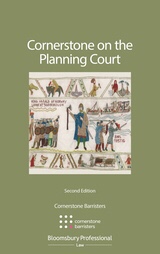
As editor of the new second edition of “Cornerstone on the Planning Court” (Bloomsbury Professional), Michael Bedford QC would make an excellent herder of cats. Or maybe Cornerstone Barristers are just a collaborative bunch. After all, “Cornerstone on the Planning Court” is part of a series that includes Cornerstone on “Anti-Social Behaviour”, on “Information Law” and on “Social Housing Fraud”.

The first edition of Cornerstone on the Planning Court (which shall I call COTPC1) was published in September 2015, just under 18 months after the Planning Court was created. Our office copy is well-thumbed, corner-folded and spine-broken. Beyond the Civil Procedure Rules and practice directions (which, folks, don’t tell you half of what you need to know!), it has provided the main source of rigorous but practical guidance as to the operation of this new forum, now the sharp end for most litigation of relevance to planners and planning lawyers but which structurally occupies an uncertain space as a specialist list within the Queen’s Bench Division of the High Court (see also my 8 July 2018 blog post, The Planning Court).

The Planning Court has proved remarkably popular. By traditional litigation standards, the permission stage is rapid, followed by a final hearing for those cases which have not been sieved out through that process. Cases earmarked as “significant” are allocated to judges who are particularly experienced in planning law matters. There has also been an enormous throughput.

With Landmark Chambers, we carried out some analysis last year of the cases which have come before the court, which I summarised in my 15 August 2020 blog post, Introducing The Planning Court Explorer. We also held a recorded webinar where Duncan Field and I were joined by John Litton QC, Jenny Wigley QC and Tim Buley QC – PC in 2020: Has the Planning Court proved a success?

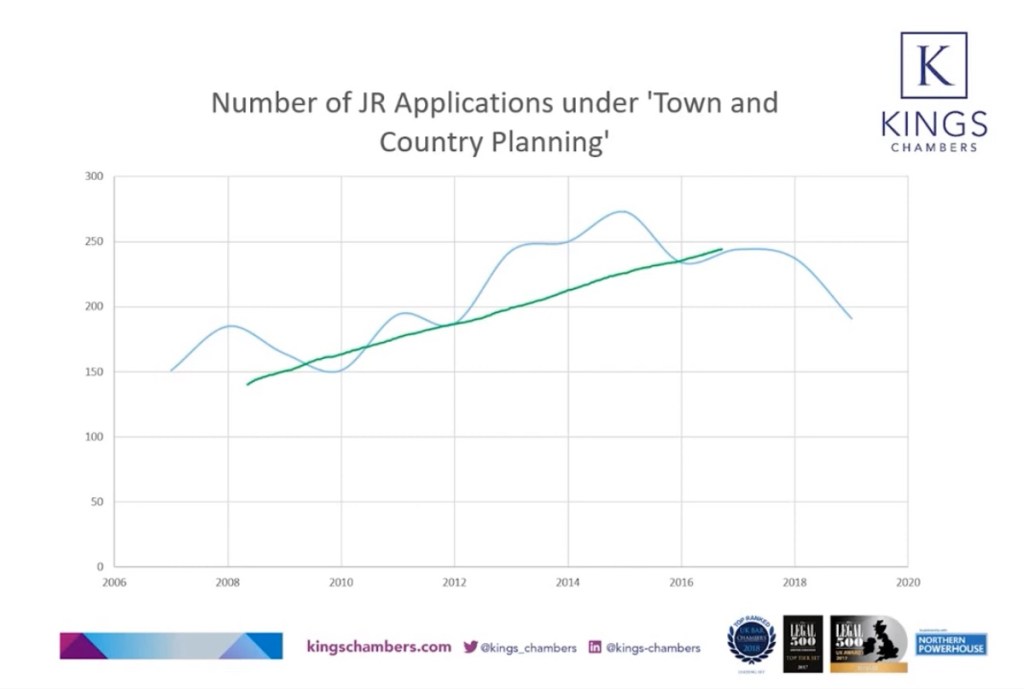
The nature of the court, separate but not separate from the wider judicial review functions of the Administrative Court, serves to obscure even basic statistics as to its overall caseload. So I was really taken by a video post last week from Mark Howells at Kings Chambers, Data and statistics of planning judicial reviews (6 April 2021) a deep dive into zipped files and data entries for information which surely should be made more easily available.

With so much new case law, together with changes to costs protection procedures, COTPC2 is a welcome update.

The second half of the book, pages 245 to 451, comprises the relevant Civil Procedure Rules themselves and related practice directions, protocols and forms. The first half of the book combines insightful summaries of the historical development of planning law and its current components, together with judicial review and statutory challenges (at a level which would be a good read even for those new to the subject) and of the many key legal principles arising in Planning Court claims, with detailed from-soup-to-nuts practical guidance for practitioners as to every aspect of the litigation process.

The foreword to COTPC2 is by Holgate J, who takes care to distinguish between decision-making procedures within the planning system which “determine the merits of the competing arguments in each case. The Court exists to deal solely with any public law issues that arise from those decisions and to do so as efficiently as possible, avoiding unnecessary delay”. He refers to “two of the fundamental foundations of our constitution: the rule of law and the separation of power between the courts, the legislature and the executive. These govern the Planning Court just as much as any other part of our legal system”. He quotes Lord Carnwath in the Suffolk Coastal case, one of the most influential cases since COTPC1:

“…the judges are entitled to look to applicants, seeking to rely on matters of planning policy in applications to quash planning decisions (at local or appellate level), to distinguish clearly between issues of interpretation of policy, appropriate for judicial analysis, and issues of judgment in the application of that policy; and not to elide the two”.

We have been warned.

The constitutional role of administrative law is of course a topical issue. My 12 September 2020 blog post, Faulks Review Of Administrative Law: Call For Evidence reported on the review instituted last year by the Government. Many of us were somewhat fearful as to what might emerge but the March 2021 report is to my mind an impressive, considered, piece of work.

My only disappointment is that the “no nonsense” approach of the Planning Court in many respects, particularly in relation to timescales, might have been endorsed as appropriate for wider adoption but instead we seem simply to have been acknowledged as operating in our own little world…

Particular congratulations should go to Celina Colquhoun (39 Essex chambers), as the only planning barrister on the review panel.

The Government has published a consultation document setting out proposed reforms to administrative law in response to the recommendations in the review, with a deadline of 29 April 2021. I noticed this week that ironically the Ministry of Justice has already received a threat of judicial review, from a solicitors’ firm, on the basis that the deadline is considered to be too short.

But I’ll pause there because this post was intended as a review of a book about Planning Court judicial review rather than a review of a proposed judicial review of a proposed review of judicial review.

There is one overwhelming selling point of COTPC2 for me: in the nicest possible way, it will help me sleep.

After all, who of us does not stay awake worrying about phantom missed deadlines, overlong bundles, unnecessary witness statements, late settlement notifications and everything else that can possibly go wrong?

We all want to stay out of trouble in the Planning Court, so thank you Michael and colleagues.

Simon Ricketts, 10 April 2021

Personal views, et cetera

PS This week’s Planning Law, Unplanned clubhouse session (6pm on 13 April) will have as its theme your most bizarre planning inquiry/court hearing/site visit/planning committee stories. We want to hear them on the night, with a prize to the best.

Forthcoming Commercial To Resi Rules Tightened After Consultation

I have taken care over the heading of this piece about the Town and Country Planning (General Permitted Development etc.) (England) (Amendment) Order 2021, laid before Parliament on 31 March 2021, which introduces a new class MA into the GPDO, granting deemed planning permission for change of use from commercial and business use (class E) to residential (class C3) from 1 August 2021.

I have taken care because so much of the noise this week was about how the Government hasn’t listened to the responses it received to its 3 December 2020 consultation paper, whereas for me the news is that it has listened to much of the criticism it received. The final form of the regime is significantly constrained compared to the consultation version. Give credit where credit’s due!

I summarised the initial proposal in my 4 December 2020 blog post, E = C3, expressing a number of concerns. Responses to the consultation from all quarters expressed equivalent concerns – some of course going further, in questioning more fundamentally the role of the permitted development rights process.

Aside from the Order itself which saw the light of day later on that day, we have the 31 March 2021 press statement (at the now traditional one minute past midnight) and the Government’s response to the consultation process.

The RTPI and others were tweeting their reactions before the Order had even been published on line (although to be fair the headlines were in the press statement). A joint letter was sent yesterday, 1 April 2021, to the prime minister by the RTPI, RIBA, RICS and CIOB. I acknowledge that many have “in principle” concerns about the availability of fast-track permitted development rights procedures but isn’t the letter somewhat of an over-reaction? What do members of those organisations think? Call me a defeatist pragmatist, but the proposals could have been so much worse!

These were the Government’s objectives, as they were stated in the December consultation document:

“In his ‘Build, Build, Build’ statement of 30 June 2020 the Prime Minister said that we would provide for a wider range of commercial buildings to be allowed to change to residential use without the need for a planning application. To meet this aim, support housing delivery and bring more residential use into our high streets and town centres, boosting footfall and creating additional demand, we propose to introduce a new national permitted development right for the change of use from the new Commercial, Business and Service use class to residential use. The new right would help support economic recovery, housing delivery and the regeneration of our high streets and town centres.”

The proposals were always intended to be introduced much more quickly than the proposals in last year’s planning white paper – after all existing permitted development rights expire on 31 July 2021 in relation to changes of use from the classes that went to form the new class E:

“While Planning for the future sets out our longer-term ambitions, we want at the same time to continue to explore more immediate changes to the planning system to provide greater planning certainty and flexibility to ensure that it can effectively contribute to some of the immediate challenges facing the country.”

It is also worth remembering that the rights which expire on 31 July already include rights to convert offices (no floorspace limit), light industrial (500 sq m floorspace limit) and retail (150 sq m floorspace limit). The rules to be introduced from 1 August allow greater flexibility in a number of respects but are also significantly tighter than the existing rights in various ways.

My colleague Tom Brooks has prepared a detailed client summary in relation to all of the PD changes within the Order (this blog post is only dealing with class MA rather than the other excitements within). If you message or email me I will send it to you next week, but for the purposes of this blog post I set out below the Government’s summary of the proposed changes:

“We will introduce a new national permitted development right to create new homes through the change of use from Commercial Business and Service uses. The right will:

• have effect from 1 August 2021

• be subject to a size limit of 1,500 sq m of floorspace changing use

• apply to buildings that have been in Commercial, Business and Service uses for two years, including time in former uses now within that class

• apply to buildings that have been vacant for at least three continuous months

• apply in conservation areas, but not in other article 2 (3) land such as National Parks and Areas of Outstanding Natural Beauty

• be subject to prior approval by the local planning authority on specific planning matters

• attract a fee of £100 per dwellinghouse.”

The consultation proposals had:

• no size limit (and this size limit cuts back on what can already be achieved via the existing office to resi PD right)

• no requirement that the relevant building should have been in commercial , business and service uses (i.e. any of the uses that now make up class E) for the two years leading up to the date of the application for prior approval (for offices to residential, the cut off point in the existing rules is 29 May 2013).

• no requirement that the building must have been vacant for the three months leading up to the date of the application for prior approval (a requirement which has not existed in relation to existing PD rights).

There is also now an express carry-forward to 1 August 2022 of existing article 4 directions that restrict office to residential permitted development rights – addressing what would have been a significant loophole (see e.g. my 7 February 2021 blog post Art 4 Life).

Prior approval requirements will still include transport, contamination, flooding, noise, and adequate natural light. As trailed in the consultation proposals, prior approval will be required, where relevant, as to the impact on the character or sustainability of a conservation area caused by the change of ground floor use of a building within a conservation area. Where relevant, prior approval will also be required as to the impact on the intended residential occupiers if the area is considered important for “general or heavy industry, waste management, storage and distribution, or a mix of such uses” and as to the impact on local provision if there is a loss of services provided by a registered nursery or health centre.

Prior approval applications will need to include a floor plan indicating “the total floor space in square metres of each dwellinghouse” (and remember that the Government’s nationally described minimum space standard applies to any schemes which are the subject of a prior approval application from 6 April 2021 in any event).

For the first time, notices will need to be served on on any adjoining owner or occupier and, where the proposed development relates to part of a building, on any owner or occupier of the other part or parts of the building.

Remember that there is no exemption from CIL for permitted development, the usual rules apply – although most commonly the in-use buildings exemption will apply if at least part of the building has occupied for a use which is lawful for at least six months continuously in the last three years.

Mitigation cannot be secured as to matters that are not the subject of the prior approval process, so PD residential development is still free from affordable housing and other social infrastructure commitments (e.g. contributions to the cost of education facilities), but remember that the scale of development now permitted, with the 1,500 square metres cap, is far lower than the scale of conversions of office buildings that we have previously seen. The horse has bolted on that one.

The new rights do not limit in any way the need for planning permission for external works to the building that materially affect its external appearance, so finger-pointing as against the Government’s “beauty” aspirations is misdirected in my view.

What concerns are we left with? Yes, the new rules will allow residential development in potentially unsustainable locations. Yes, the new rules will allow commercial frontages in high streets to be converted to residential use in a way which may harm the traditional function of town centres (although subject to the need for a separate planning permission for the external treatment of the building). Yes, the new rules do limit in practice the role of the local planning authority in determining what are appropriate uses for a particular area. Yes, there will still be room for uncertainty and “gaming” of the system, particularly around the vacancy requirement. Set against these concerns, are the Government’s objectives in terms of enabling more homes to be delivered quickly and in finding new uses for redundant commercial floorspace and is the need for us all to acknowledge the various protections that are now (at last) in place, seeking to ensure that accommodation is to be delivered to at least a minimum standard (e.g. size of homes, light) and seeking to reduce the potential for the new rights to lead to unintended outcomes (e.g the floorspace cap, vacancy requirement).

Where does the balance lie? Are there now sufficient checks and balances? Are we going to see a final rush to make prior approval applications under the existing rules? Join a number of us on Clubhouse for a discussion on this very subject – from 6pm on Tuesday 6 April.

Simon Ricketts, 2 April 2021

Personal views, et cetera

Plug Pulled On Local Authority Meetings

I pointed out in my 23 January 2021 blog post Temporary Covid Measures – Planning, Traffic, Local Government: There May Be Trouble Ahead that after 6 May 2021 local authorities may not be able to hold virtual meetings given the expiry on that date of the temporary freedom provided by Regulation 5 of the Local Authorities and Police and Crime Panels (Coronavirus) (Flexibility of Local Authority and Police and Crime Panel Meetings) (England and Wales) Regulations 2020 , pursuant to section 78 of the Coronavirus Act 2020.

Let’s be clear – the Government has had ample time to bring forward emergency primary legislation to extend that regime if it considered that the issue was sufficiently important. But it doesn’t.

Instead, even in the face of litigation from local government bodies which is heading to a High Court hearing next month, MHCLG minister Luke Hall wrote to local authority leaders on 25 March 2021 to confirm that the power will not be extended.

The suggestions in the letter appear to be somewhat of a sticking plaster, compared to the proven solution of allowing meetings to be remotely conducted; appear to be pushing at the bounds of what is advised to be prudent in the Government’s roadmap out of lockdown, and leave us all without any Plan B.

To be clear, what we are talking about is not whether meetings should be able to be watched online – the letter encourages that in any event “to minimise the need for the public to attend meetings physically until at least 21 June, at which point it is anticipated that all restrictions on indoor gatherings will have been lifted in line with the Roadmap”.

Rather, the issue is whether participants in the meeting, whether councillors or other parties, need to be in physical attendance in order for the meeting to be lawfully conducted.

Meetings between 7 May until 17 May (or later)

If we go by the roadmap, when 7 May comes life will still be relatively restricted even assuming that by then we will have moved to step 2 of the roadmap. Whilst public buildings will be open again, people will still not be able to gather in groups, and wherever possible people will still be advised to work from home. Further opening up via step 3 will not be until 17 May or later.

The letter advises that during this period “options would include use of your existing powers to delegate decision making to key individuals such as the Head of Paid Service, as these could be used these to minimise the number of meetings you need to hold if deemed necessary. Additionally, some of you will be able to rely on single member decision making without the need for cabinet meetings if your constitution allows.”

As for annual meetings, for authorities without elections on 6 May, the letter suggests that these be brought forward to be held before 6 May (so they can still be held remotely). Otherwise, given the need to hold the meeting within 21 days of the election, the meeting can (just about) be held after 17 May (assuming that date doesn’t slip).

What does this mean for planning committee meetings? Well, even for authorities without elections, meetings between 7 and 17 May would now appear unlikely. For authorities with elections the process of selecting committee meetings at the annual meeting is going to be elongated, with committees not formed until after 17 May.

Meetings from 17 May (or later) to 21 June (or later)

The letter states:

The Government’s roadmap proposes that organised indoor meetings (e.g. performances, conferences) are permitted from 17 May, subject to Covid secure guidelines and capacity rules.”

A few problems with this…

⁃ The roadmap actually says “no earlier than” 17 May. If we’ve learned anything from this pandemic it is that covid doesn’t respect deadlines!

⁃ What about individual councillors and other participants who may not by then have been vaccinated and therefore reluctant to attend in person (after all, the guidance as to working from home will apparently not be reviewed until some time during this step 3) or indeed may be shielding?

There is a real risk that authorities will be reluctant during this period to hold potentially controversial meetings which may attract significant numbers of members of the public. Indeed many authority buildings do not lend themselves well to such events on a socially distanced basis.

From the Local Government Association’s statement (25 March 2021):

Councils are already actively considering the options the minister has suggested, including looking at alternative larger meeting venues at significant extra cost. The proposal to delegate significant decisions to officers is likely to be viewed as undermining democratic accountability due to the fact that such decisions are not subject to direct member involvement. Given the circumstances authorities find themselves in due to the imminent loss of virtual meeting provision, they now face unpalatable decisions, which include restricting member attendance and a reduction in members roles in decision making, whilst attempting to keep the machinery of local government moving. LLG & ADSO remain fully committed to presenting our case at the High Court Hearing timetabled to be heard before the end of April 2021.”

See also the Lawyers in Local Government’s statement The letter to Council Leaders from Luke Hall MP received yesterday (25th March 2021) does not change the need for our court hearing, in fact if anything, it makes the need for it more pressing (26 March 2021).

More generally

More generally, why let go of the flexibility that the current legal regime gives to local authorities, not just for public health reasons (although this is important, it would be foolhardy to think that from 21 June there will be no further outbreaks or no longer any need for caution) but equally for reasons of efficiency and inclusion?

The Government recognises the potential case for virtual meetings but instead kicks the can down the road by “launching a call for evidence on the use of current arrangements and to gather views on the question of whether there should be permanent arrangements and if so, for which meetings. There are many issues to consider and opinions on the detailed questions vary considerably. This will establish a clearer evidence base of opinion and enable all the areas to be considered before further decisions are made. The Government will consider all responses carefully before deciding to how to proceed on this issue.”

Don’t hold your breath then.

Simon Ricketts, 26 March 2021

Personal views, et cetera

Blackbushe Curtilage Limits

A church house, gin house, a school house, outhouse

To what extent were Ike & Tina Turner also referring to the curtilage of any of those buildings?

There are some words or expressions which are like an elephant; its essence is difficult to put into words, but you know it when you see it. “Curtilage” is a word of that nature.” – Andrews LJ in this week’s free text book from the courts: Blackbushe Airport Limited v Hampshire County Council (Court of Appeal, 18 March 2021).

The c word appears regularly in legislation, without definition. The Court of Appeal has done us all rather a service by gathering together the previous case law and attempting to arrive at common principles.

For instance, look at section 1 of the Planning (Listed Buildings and Conservation Areas) Act 1990: the definition of “listed building” includes “any object or structure within the curtilage of [a listed] building which, although not fixed to the building, forms part of the land and has done so since before lst July 1948”.

And it even appears in the NPPF: the definition of “previously developed land” includes “land which is or was occupied by a permanent structure, including the curtilage of the developed land…”

But what on earth does it mean?

In the Blackbushe case the question arose in relation to the operation of the Commons Act. Land can be deregistered as a village green if it can be shown to be “within the curtilage of a building”. The question was, as the airport owner claimed, 115 acres forming the operational part of Blackbushe Airport, could be deregistered on the basis that it is in the curtilage of “a two-storey terminal building, with a footprint of about 360 m2 and an overall floor area of about 760 m2, which serves as the airport’s operational hub.

The inquiry inspector had accepted the airport’s argument but his decision was quashed by Holgate J. The Court of Appeal agreed with Holgate J:

“If what is meant by “the curtilage of a building” is understood correctly, and all relevant factors are taken into account when determining whether the statutory requirements were satisfied in this case, the answer is no. This extensive area of operational airfield cannot properly be described as falling within the curtilage of the relatively small terminal building.

That common sense conclusion flows inexorably from the correct interpretation of the relevant provisions of the 2006 Act set out above, and their application to the facts. It is also consistent with the approach taken in the authorities in which the question of what falls “within the curtilage of a building” has been considered in other contexts, although none of them was directly concerned with this statute.

In deciding that the statutory criteria were met, the Inspector applied the wrong test by asking himself whether the land and building together “formed an integral part of the same unit” because he found that there was “functional equivalence” between them. That error is perhaps best demonstrated in paragraph 83 of his decision letter, where he described the operational area as “part and parcel with the building and an integral part of the same unit” instead of asking whether the land should be treated as if it were “part and parcel of the building”. The difference is critical, and it led to the Inspector addressing the wrong question, namely, whether the land and building together fell within the curtilage of the airport, rather than whether the land fell within the curtilage of the building.”

“Since it is the building which is to be treated as wrongly registered, the inference can be drawn that the relationship of the land to the building must be sufficiently proximate that a reference to that building – in this case, the terminal building – could be treated, without artifice, as including the land as well. So, for example, a reference to “Keeper’s Cottage” would naturally be taken to include a reference to the cottage garden. A reference to the terminal building at Blackbushe Airport would not be naturally understood as referring to the whole airport, or to 115 acres of operational land of which the terminal building occupies a very small part.

Looking at the matter from another perspective, in order to achieve the deregistration of the terminal building which is deemed by Parliament to have been wrongly registered as common land, whilst it would be reasonable and appropriate to include some of the surrounding land that might be referred to figuratively as “part and parcel of” the building, or “belonging to” the building, it is plainly unnecessary to deregister the whole of the rest of the operational area of the airport.”

“…just as one can tell immediately that a giraffe is not an elephant, it is probably far easier to recognise that something is not within the curtilage of a building than it is to say how far the curtilage extends. The present case is a good illustration.

“As Holgate J recognised in his judgment at [73] to [76], although “curtilage” is not a term of art, but is to be given its ordinary and natural meaning, its meaning is not completely provided by the dictionary. The concept has its origins in a small piece of land attached to a dwelling-house. Holgate J quoted the Oxford English Dictionary (“OED”) definition:

“A small court, yard, garth or piece of ground attached to a dwelling-house, and forming one enclosure with it, or so regarded by the law; the area attached to and containing a dwelling-house and its out-buildings.”


That definition begs the question of what the law would regard as “forming one enclosure” with a dwelling-house, or what is the ambit of the “area” in question.

In any event, as the Judge pointed out, in the 2006 Act (as in other legislation in which the expression is used) the “building” whose curtilage is being considered does not have to be a dwelling-house. Moreover, as will be seen, although the size of the land will be a relevant consideration, the extent of the curtilage of a building may vary with the nature and size of the building. To refer to the area as “small” (or conversely “large”) is not particularly helpful in a context where size is relative. What falls within the curtilage of a manor house, or a large industrial mill, or a factory, may not be the same as what falls within the curtilage of a dwelling house. What falls within the curtilage of a dwelling-house may depend on the size and configuration of the dwelling-house. Even so, proportionality, whilst relevant, may not be definitive; a small cottage will sometimes have a large garden, whereas a large townhouse may have a tiny terrace.”

“… the test is not whether the terminal building could function without an operational airport, nor whether the Application Land was necessary for the functioning of the airport. Nor is the test whether the Application Land and the terminal building together form one part of an operational unit or whether they fall within a single enclosure. The question whether, by reason of the association between them, the law would treat them as if they formed one parcel, or as an integral whole, depends on the application of the “part and parcel” test to the facts of the particular case.”

Holgate J was right to hold that the phrase “the curtilage of a building” in the 2006 Act requires the land in question to form part and parcel of the building to which it is related. The correct question is whether the land falls within the curtilage of the building, and not whether the land together with the building fall within, or comprise, a unit devoted to the same or equivalent function or purpose, nor whether the building forms part and parcel of some unit which includes that land. He therefore correctly concluded that the Inspector’s decision was fatally flawed by material errors of law.”

In a supporting judgment Nugee LJ added some useful guidance:

“If we want to know what a word’s ordinary meaning is, it is to my mind more helpful to ask how it is used in practice. This is after all what we do with everyday words. We do not know what the word house means because we have looked it up in the dictionary; we know what a house is because we have experience of how the word house is used. In the same way if we want to know what curtilage means, it is helpful to look at examples of how it has been used in practice. Such an exercise may not indicate the outer edges of its meaning with precision, but it does help to illustrate its central meaning.

Fortunately the extensive array of authorities cited to us on this appeal enables us to do this. We find for example that in the case of modest houses, the curtilage would not on the face of it extend to the whole of 10 acres of pasture land let with a cottage (Trim v Sturminster RDC [1938] 2 KB 508); that a field used for keeping cows was not part of a house (Pulling v London, Chatham and Dover Railway Co (1864) 3 De G J & S 661); and that paddocks have been held not to be part of the curtilage of houses in both Methuen-Campbell and Burford v Secretary of State for Communities and Local Government [2017] EWHC 1493 (Admin). On the other hand the curtilage does include a wall enclosing a recently expanded part of the garden (Sumption v Greenwich LBC [2007] EWHC 2776 (Admin)).

In grander houses, the curtilage would extend to “the house, the stables and other outbuildings, the gardens and the rough grass up to the ha-ha if there was one”, but not to the 100 acre park surrounding a mansion house (Dyer at 358F-G per Nourse LJ); thus it would include a wall forming part of a ha-ha (Watson-Smyth v Secretary of State for the Environment (1992) 64 P&CR 156); and a stable block even some distance away from the main house (Skerritts); but not 64½ acres of a park, meadow land and pasture land (Buck d. Whalley v Nurton (1797) 1 B & P 53); nor a 650m long fence along the driveway (Lowe v First Secretary of State [2003] EWHC 537 (Admin)). Admittedly a devise of a mansion-house to the testator’s wife was held to include three meadows let for grazing in Leach v Leach [1878] WN 79, but in Methuen-Campbell at 543F Buckley LJ said that he did not think, unless there was some special context, that this very liberal construction adopted by Malins V-C was good law.

When one moves away from dwelling-houses we find that the purpose-built residence of a medical superintendent within the boundary of a lunatic asylum was within the curtilage of the asylum (Jepson v Gribble [1876] 1 Ex D 151); but firemen’s houses outside the boundaries of the yard to a fire station were not within the curtilage of the fire station (Barwick). A courtyard and access to a warehouse and mill was part of the curtilage (Caledonian Railway Co. v Turcan [1898] AC 256); as was a piece of ground in front of a public house used for access (Marson v London, Chatham and Dover Railway Co (1868) LR 6 Eq 101); and two small open spaces in an oil depot (Clymo); but not a large hardstanding massively in excess of what was necessary for an undertaking in a modest building (Challenge Fencing). To these can be added Calderdale, which concerned a terraced row of houses physically linked to a mill by a bridge and within its boundaries, and which is extensively considered by Andrews LJ above.

A survey such as this is neither scientific nor comprehensive. Nor does it give any indication why in any particular case the Court decided as it did: that requires a consideration of the explanations given by the judge(s) in any particular case. Nor does it take account of the different statutory contexts in which the question may arise. Nor is it any substitute for a careful analysis of the question when it does arise. But that does not mean that it has no value. To my mind it gives a good idea of the concept of what it is for a piece of land to be within the curtilage of a building; it illustrates the natural and ordinary meaning of the word. I will not attempt to define it, but these are all examples of bits of land that go with a building, of “relatively limited” extent (Skerritts), that are “intimately associated” with it (Methuen-Campbell)”

What is so interesting is that whilst the Court of Appeal upheld Holgate J’s first instance judgment, they differed from him in one important respect – he had accepted that “curtilage” could have a broader and more expansive definition for the purposes of listed buildings legislation:

“For the reasons I have already given, I do not consider that the use of “curtilage” in the extended definition of “listed building” is analogous to its use in the de-registration and non-registration provisions in schedule 2 to the 2006 Act. The 2006 Act takes a balanced approach to the protection of, on the one hand, rights of common and public access to commons and town or village greens and, on the other, the interests of the owners of buildings on such land. There is no justification for adopting for the 2006 Act the “broad approach” to defining curtilage which the court expressly employed in Calderdale in order to promote the efficacy of listed building control.”

Contrast with Andrews LJ: “I do not accept that the test in a listed building case is any different…”

The, previously understood, extended definition with regard to listed buildings is reflected in current Historic England guidance – see for example this example they set out:

Surely this approach needs to be viewed with caution in the light of the Court of Appeal’s judgment: an elephant is or is not an elephant, curtilage is or is not curtilage.

Simon Ricketts, 19 March 2021

Personal views, et cetera

(courtesy Hampshire County Council)