LURB Lords Latest

The Levelling-up and Regeneration Bill resumed its progress through Report stage in the House of Lords this week, with sessions on 4 and 6 September. This post seeks to identify the main amendments made in those sessions.

I know what you’re all asking – what about the Government’s late proposed amendment to address the nutrient neutrality issue (see my 29 August 2023 blog post The Government’s Big Move On Nutrient Neutrality – Now We Have Seen The Government’s LURB Amendment)? That will be debated at a further session next week, on 13 September 2023. The proposed amendment was in the meantime the subject of an urgent question tabled in the House of Commons by the Green Party’s Caroline Lucas on 5 September 2023. The debate is interesting as a hint of what awaits both in the Lords on 13 September but then once the Bill returns to the Commons for its final stages:

  • The Speaker agreed that the urgent question was appropriate notwithstanding the Secretary’s written ministerial statement the previous day: “I expect Ministers to come to the House, as I did not think a written ministerial statement was the way to inform the House.”
  • On being challenged that the amendment amounted to a regression from current standards of environmental protection, the minister, Rachel Mclean responded: “It is important to consider what we are talking about here, which is unblocking 100,000 homes that add very little in terms of pollution. To be clear, our approach means that there will be no overall loss in environmental outcomes. Not only do the measures that we are taking address the very small amount of nutrient run-off from new housing, but at the same time, we are investing in the improvement of environmental outcomes. We do not agree that this is regression on environmental standards. We are taking direct action to continue to protect the environment and ensure that housing can be brought forward in areas where people need it.”
  • A nuanced question from shadow minister Matthew Pennycook:

As a result of the Government’s failure over many years to make decisive progress in tackling the main sources of problem nutrients, namely farming and waste water treatment works, the requirements for nutrient neutrality in sensitive river catchments present a challenge to securing planning permission for new housing development. It is therefore right in Labour’s view that the operation of the rules around nutrient neutrality is reviewed with a view to addressing problematic delays and increasing the pace at which homes can be delivered in these areas.

However, we have serious concerns about the approach that the Government have decided on. Not only does it involve disapplying the Conservation of Habitats and Species Regulations 2017, but it does not legally secure the additional funding pledges to deliver nutrient management programmes and does not provide for a legal mechanism to ensure that housing developers contribute towards mitigation.

I put the following questions to the Minister: what advice did the Government receive from Natural England about potential reform of the laws around nutrient neutrality? Did it offer a view on the Government’s proposed approach? Given the amount of mitigation currently available in the pipeline, which is estimated at allowing for approximately 72,000 homes, did the Government consider an approach based on the habitat regulations assessment derogation and a revised credit mitigation system to front-load permissions and provide for future compensatory schemes? If so, why did they dismiss that option? What assessment have the Government made of the impact of their proposed approach on the nascent market in mitigation credits, and investor confidence in nature markets more generally? Why on earth do Ministers believe developers will voluntarily contribute to mitigation under the proposed approach?

Finally, the Government claim their approach will see 100,000 planning permissions expedited between now and 2030. Given that house building activity is falling sharply and the pipeline for future development is being squeezed—not least as a result of housing and planning policy decisions made by this Conservative Government—what assessment has the Department made of the number of permissions that its disruptive approach will unlock within the first 12 months of its operation?

  • A rather pithy summation of the position, from the chair of the Levelling Up, Housing and Communities Committee, Clive Betts:

This is hardly a new problem, is it? The Court decision was in 2018, yet last year we had the levelling-up Bill, which was really a planning Bill with a bit of levelling up added on—no mention of the issue there. In December we had major consultations on changes to the national planning policy framework—no mention of the issue there. The Committee wrote to the Minister and asked how many more consultations on planning issues there would be this year. We were given nine of them—no mention of the issue there. If it is such a serious issue, why has it taken the Government so long to act? It looks like the Government are making it up as they go along. This is a panicked response from the Government to the collapsing numbers of housing starts which the Minister simply wants to do something—anything—about.

Turning now to the Report sessions on 4 and 6 September 2023 , I set out below the main amendments agreed upon (subject to them surviving the return of the Bill to the Commons). The full list of amendments is much longer and for the detail you can click on the following:

Hansard debate 4 September 2023

Minutes to proceedings 4 September 2023

Hansard debate 6 September 2023 (Part 1)

Minutes to proceedings 6 September 2023 (Part 1)

Hansard debate 6 September 2023 (Part 2)

Minutes to proceedings 6 September 2023 (Part 2)

[Many thanks to my Town Legal colleague Amy Penrose for detailed work on all this].

Amendment 184A

This amendment clarifies that inserted subsection (5B) in section 38 of the Planning and Compulsory Purchase Act 2004 requires a determination under the planning Acts to be made in accordance with the development plan and any national development management policies, taken together.

So the replacement to section 38 (6) would now read: “the determination must be made in accordance with the development plan and any national development management policies taken together, unless material considerations strongly indicate otherwise”. What does “taken together“ add? Perhaps to avoid an interpretation that the determination needed to be both in accordance with the development plan and in accordance with any national development management policies – instead look at it all together in applying planning judgment as to whether the determination is in accordance? It’s great being a lawyer.

Amendment 190 (tabled by Baroness Thornhill) – voted through against the Government 186 – 180

The amendment requires the Secretary of State to carry out a sustainability appraisal before designating a national development management policy; it must comply with public consultation requirements and a process of parliamentary scrutiny based on processes set out in the Planning Act 2008 (as amended) for designating National Policy Statements, and it must contain explanations of the reasons for the policy, including an explanation of how the policy set out takes account of Government policy relating to the mitigation of, and adaptation to, climate change.

Amendment 191 (tabled by Lord Ravensdale) – voted through against the Government 182 – 172

The amendment places a duty on the Secretary of State and relevant planning authorities respectively to have special regard to the mitigation of, and adaptation to, climate change with respect to national policy, local plan-making and planning decisions.

Amendment 191A (tabled by Lord Crisp) – voted through against the Government 158 – 149

The amendment specifically places a duty on the Secretary of State to promote healthy homes and neighbourhoods – a huge success for the Town and Country Planning Association’s Campaign for Healthy Homes.

(see also a detailed Schedule to be inserted into the Bill setting out for instance what is meant by healthy homes principles – amendment 191B).

Amendment 193A (tabled by Lord Best) – voted through against the Government 173 – 156

The amendment requires local plans to “identify the local nature and scale of housing need in the local planning authority’s area and must make provision for sufficient social rent housing, to eliminate homelessness within a reasonable period as stipulated in the updated local plan, and to provide housing for persons registered on the local housing authority’s allocation scheme within the meaning of section 166A of the Housing Act 1996.” It would apply both “in relation to social housing provided both by the local housing authority where it retains its own housing stock and by private registered providers of social housing”.  The information would need to be updated at least annually.

These are all significant interventions. Let’s see the approach that the Government takes back in the Commons. A motion will also be needed to carry over the Bill to the next Parliamentary session, without which we will see (wait for the LURB pun, wait for it, wait) .. LURB’s labours lost.

Simon Ricketts, 9 September 2023

Personal views, et cetera

Photo courtesy of Peter Kostov via Unsplash

Quids No Pros

If you pay planning application fees, or are a planner whether private or public sector, you may feel somewhat cheated by the Government’s 25 July 2023 response to its February 2023 technical consultation Stronger performance of local planning authorities supported through an increase in planning fees.

The development sector has made it clear for a long time that it is generally willing to pay more to planning departments by way of increased planning application fees if the money enables those departments to be better resourced. Accordingly there was widespread support for most of the proposals within the consultation paper. The whole thrust of the consultation paper was that the government accepted that “local planning authorities need more resource in order to perform their critical social, economic and environmental functions on planning effectively”. Also that the government was “only prepared to introduce fee increases if planning performance also improves. We want to ensure that all applicants experience a high-quality and timely service. This consultation therefore also proposes a new approach to how the performance of local planning authorities is measured across a broader set of quantitative and qualitative measures. This will provide greater transparency of service delivery and earlier and more targeted support to local planning authorities where needed.”

Obviously significant increases in planning application fees would not be likely to lead to improvements in the operation of the system, and indeed would simply place a more onerous financial burden on applicants, if the additional income were not ringfenced to be spent on maintaining or improving planning services. Whilst improved performance may not all be about money, when it comes to significant hikes in planning application fees, more money, better services, that’s the quid pro quo.

The consultation document addressed the issue directly:

The purpose of planning application fees is to enable a local planning authority to perform the statutory function of processing planning applications. However, we recognise that planning budgets are not ringfenced which means that planning fees often can be diverted as part of a wider corporate budget priorities to support other council services. This can limit the benefit of any increase in planning fees.

To ensure that the proposed additional fee income directly supports increased resourcing of local authority planning departments, it is sometimes suggested that planning fees should be ringfenced to planning services only. This would enable direct improvements in service delivery but does undermine the general flexibility afforded to local authorities on their wider financial management. We are seeking views on whether the additional income arising from the proposed fee increase (35% for major applications, 25% for all other applications) should be ringfenced for spending within the local authority planning department. Past increases have required a written commitment from all local planning authorities in advance of implementation.”

The question was asked:

Question 7. Do you consider that the additional income arising from the proposed fee increase should be ringfenced for spending within the local authority planning department?

Yes/no/don’t know. Please give your reasons.”

The response document sets out the significant increases that are to be introduced by way of draft Regulations laid before Parliament on 20 July 2023 – basically:

  • Application fees for major development (broadly speaking 10 dwellings or more or if non-residential 1,000 sq m or more) to be increased by 35% and for other forms of development by 25%.
  • Annual inflation indexation from 1 April 2025.
  • Removal of the “free go” (for repeat application within 12 months).

The response document records that the responses to the consultation document were “generally very supportive of the measures to increase planning fees, recognising the importance of securing additional income for local planning authorities”. But hang on! Look at the response to question 7, as to whether the additional income should be ringfenced for spending within the local authority planning department:

A total of 457 respondents answered this question. There was strong support for this proposal to ringfence the additional income generated by the increase in fees. 88% agreed with the proposal, 8% did not and 4% didn’t know.

Respondents considered that ringfencing was needed to justify the increase in fees and to ensure the additional resources directly lead to improvements in performance. The extra income could be used to expand planning teams (by providing higher salaries to attract planners from private sector, training and development of planners) and improve IT systems. Many suggested that all fee income should be ringfenced for planning. On the implementation of ringfencing, others commented that resources were needed across other areas of the local authority which provided input into planning decisions, including highways, environmental health, ecology, design, drainage and heritage, so any ringfencing conditions needed to be flexible enough to allow these to be funded too.

Those who did not agree were concerned that ringfencing removed flexibility over spending decisions from local authorities. Some were concerned that ringfencing could be difficult to implement and monitor. Some considered that local planning authorities may not end up with more resources if the projected additional fee increase was netted off the baseline budget.”

88% per cent in favour. A no brainer in the circumstances one would think.

The Government’s response?

We welcome the strong support for this proposal. We want to ensure that the fee increase results in additional funds being available to local authority planning departments, but we will not take ringfencing forward through legislation as this would impose a restriction on local authorities when they are best placed to make decisions about funding local services, including planning departments. However, we would expect local planning authorities to protect at least the income from the planning fee increase for direct investment in planning services.”

No ring-fencing. It will be left to local authorities to make that decision..

This is hugely unfair. It is unfair on local authorities with severe financial constraints such that they will need to consider whether they can afford to ringfence these monies on a voluntary basis or to use them to maintain other statutory services. No doubt heads of planning will have a limited say in that particular tug of war. It is also unfair on applicants because this significant hike in fees was to secure stronger performance from local planning authorities (see the very name of the consultation document!) – that is the only reason why it was supported.

The other important element of the proposals consulted upon was the proposed introduction of a series of new detailed metrics against which local planning authority performance can be measured. Whilst I recognise that the information gathering in itself would have been onerous, we know that what’s measured does get valued and the statistics would be useful both internally within authorities (so as to make the case for better resourcing) and externally to drive better performance. The government’s response again is in my view rather a cop-out:

In relation to planning performance, we are grateful for the wide range of comments that have been received, relating to how we can better assess the speed of decision-making through both amending existing metrics and introducing new ones, and in response to proposed new quantitative metrics which could allow performance to be measured more widely across a range of important planning functions. We are also grateful to hear a range of feedback on our proposals to introduce qualitative metrics, including customer experience, which could capture a more holistic picture of the quality of service delivery within planning departments. This feedback is highly valued and will be drawn upon as we develop our proposals for a new planning performance framework.

We are clear that an increase in planning fee income and resourcing to local planning authorities must lead to improved performance. It is our intention to introduce a new planning performance framework once we have increased planning fees and invested in supporting the capacity and capability of planning departments. However, we recognise that local planning authorities need a period of adjustment to any new planning performance framework, and we would reiterate our commitment to consult further on detailed proposals, including thresholds, assessment periods and transitional arrangements from the current performance regime.”

There is no reason why performance measurement should not start now – let’s get to the bottom of how bad the problems currently are. It’s almost as if the Government doesn’t want to find out…

I know the Government will point to different funding streams it is making available to support capacity and capability in planning departments, for instance to the statement in Michael Gove’s long-term plan for housing 24 July 2023 announcement that the government is taking other steps to “unblock the bottlenecks in the planning system that are choking and slowing down development, and stopping growth and investment by:

  • Launching a new £24 million Planning Skills Delivery Fund to clear planning backlogs and get the right skills in place.
  • Establishing a new “super-squad” team of leading planners and other experts charged with working across the planning system to unblock major housing developments, underpinned by £13.5 million in funding. The team will first be deployed in Cambridge to boost our plans in the city, before also looking at sites across our eight Investment Zones in England, to provide high-quality homes to go alongside the high-quality jobs being created there.”

That is cautiously welcomed. But it does not change my three conclusions:

  • Personally I think that the “no ringfencing” decision should be re-considered.
  • Surely we need better performance metrics now, not some time in the indeterminate future
  • There really does appear to be little point in responding to Government consultation processes when a 88% response one way or the other ultimately counts for nothing (and when perhaps a substantial proportion of the 88% would have responded differently to the questions about application fee increases if the assumption had been that the increases would not be ringfenced).

Plenty of quids, no pros.

Final thought – the Government has previously floated, in Planning for the Future, the idea of introducing planning appeal fees. Personally, my view is that if the fees genuinely increased resources and sped up the system, why ever not? Nothing else comes free.

Simon Ricketts, 1 September 2023

Personal views, et cetera

Image courtesy of Christopher Bill via Unsplash

The Government’s Big Move On Nutrient Neutrality – Now We Have Seen The Government’s LURB Amendment

No-one should be playing party politics with the nutrient neutrality issue. It’s difficult. It needs to be fixed. This is a quick post just to try to head off some of the comments that I have seen on social media today because the urgent need for a solution is in danger of being subsumed by general scepticism of this Government, exacerbated by the way that water companies have been allowed to fail in relation to water supply and sewage discharges. I write this on the back of Nicola Gooch’s excellent blog post this morning, LURB Watch: Government confirms Nitrates’ amendments to be tabled in House of Lords shortly  but since then we now have the proposed amendments to the LURB.

First of all, the basics:

House building is not the reason why some rivers and coastal waters around the country, protected as special areas of conservation or special protection areas by way of EU-derived legislation, are at or beyond a tipping point for the ecological integrity of those areas. Instead this is largely due to the historic run off of nitrates and/or phosphate from farm land and the inadequacy of our water infrastructure.

But the consequences of outflows from new housing has been seen by Natural England as the straw that would break the camel’s back and therefore its advice to local planning authorities faced with planning applications in affected catchments has been, in summary, not to approve them (and not to approve reserved matters applications or discharge pre-commencement conditions) unless the particular scheme can be shown to be nutrient neutral, given that otherwise in its view the “appropriate assessment” test in the Conservation of Habitats Regulations 2017 cannot be met, ie that the proposal will not adversely affect the integrity of any protected area.

So housebuilding has in practice been halted in various areas of the country until solutions can be implemented that demonstrably deliver nutrient neutrality.

To underline, this is not mainly about the polluting effects of new homes – it is about pre-existing problems.

I’ve written about the issues on various occasions, eg most recently in my 26 November 2022 blog post Nutrient Neutrality: Possibly Good News & Possibly Bad News and in my 6 June 2023 blog post CG Fry: AA Post PP.

The Government plainly recognises that the problem needs to be addressed. The current position, where so many schemes are stalled, is ridiculous and out of proportion to the extent to which housebuilding is actually the issue.

Right, so what is the Government’s solution?

Following Michael Gove’s press statement today, 100,000 more homes to be built via reform of defective EU laws  (29 August 2023), the latest tranche of tabled amendments ( https://bills-api.parliament.uk/api/v1/Publications/52407/Documents/3872/Download ) to the Levelling-up and Regeneration Bill have now been published, which include a number of amendments to the Conservation of Habitats Regulations.

The key proposed amendment is to introduce a new regulation 85B into the 2017 Regulations (see pages 19 and 20 of the pdf). Sub-paragraphs (2) and (3) would read as follows:

(2) When making the decision, the competent authority must assume that nutrients in urban waste water from the proposed development, whether alone or in combination with other factors, will not adversely affect the relevant site.

(3) Accordingly, a potentially adverse effect on a relevant site caused by nutrients in urban waste water, whether alone or in combination with other factors, is not a ground for the competent authority to determine that

(a) an appropriate assessment is required by regulation 77(6), or

(b) the proposed development will adversely affect the integrity of the relevant site or otherwise have negative implications for the site.”

Strengthened duties on water companies by way of their environmental permitting processes are also proposed in the amendments, but this is radical!

If enacted, it would certainly enable permissions, reserved matters approvals and pre-commencement conditions to be unjammed. On balance in my view it is to be supported. However, the Government does need to be ready with answers to questions like these:

  1. Given that the Government has committed to no regression from the environmental protections that we enjoyed pre-Brexit (NB Mr Gove, don’t give me that “defective EU laws” politicking – it’s our water system and environmental permitting system that is defective not the underlying law!), why does this not amount to regression? In its defence no doubt the Government would point to the commitments in the press statement not just to “significantly expanding investment in and evolving the Nutrient Mitigation Scheme run by Natural England, doubling investment to £280m to ensure it is sufficient to offset the very small amount of additional nutrient discharge attributable to up to 100,000 homes between now and 2030” but also the package of longer term measures that are set out in detail in the statement. But if these commitments are solid enough to be relied upon, why can’t they just be taken into account in determining that there will not be an adverse effect on the integrity of the relevant protected area? Why isn’t the Government confident that this would be Natural England’s advice? Wouldn’t that be a more legally coherent strategy than simply taking nutrients issues out of the appropriate assessment process? And if Natural England can’t sign that position off in relation to any particular protected area, doesn’t that rather have the whiff of regression?
  1. What about developers who have signed up to expensive nutrient neutrality schemes or are negotiating at present if the Government is effectively now removing the issue from their plate? Or will Natural England and local authorities still raise the nutrients issue by way of objection to proposals in planning terms, even if no longer able to wave the Conservation of Habitats Regulations big stick? Is it indeed right (or even envisaged) that developers should be let entirely off the hook?
  1. What about the water neutrality issue in Sussex, which has led to an equivalent logjam, or issues as to recreation impacts in other areas of the country? Similar principles surely apply.
  1. Will Parliament allow the Government to get away with shoehorning this set of provisions into the Bill at this late stage (see the comments in Nicola’s post) and what does it mean for the timing of Royal Assent? How confident can we be that the provisions will (a) survive to Royal Assent and (b) be brought into force?

These are just initial thoughts. Better informed commentary very welcome.

Simon Ricketts, 29 August 2023

Personal views, et cetera
Local Plans System Fails Soundness Test

A vision softly creeping, left its seeds while I was sleeping:

Why don’t we test the whole local plans system against the soundness requirement in paragraph 35 of the National Planning Policy Framework?

Of course it’s not an exact fit but what’s sauce for the goose is sauce for the gander (an expression which also occurs to me whenever we have criticism from Government directed at local authorities for not moving faster). Is the current local plans system, for instance:

  • positively prepared
  • justified
  • effective
  • consistent with national policy?

Plainly not.

Is it a strategy which, as a minimum, seeks to meet the country’s objectively assessed needs? First of all, the 300,000 homes target, whilst undoubtedly being too low, has not been objectively assessed (so as, if nothing else, to reassure the sceptical) and secondly there is an increasing disconnect between that aspiration and local plan making reality.

Is it an appropriate strategy, taking into account the reasonable alternatives, and based on proportionate evidence? Reasonable alternatives? Evidence? Not how national policy-making seems to work.

Deliverable? Of course not.

Consistent with (other) national policy? Given the vital policy objectives to be delivered by proper forward planning – housing, economic growth, climate change mitigation, levelling up – again it’s a no.

I also query whether the proposed changes in the Levelling-up and Regeneration Bill and more detailed implementation proposals, currently being consulted upon, would get to the root of the problems.

This thought occurred when reading the Tandridge local plan inspector’s 10 August 2023  letter to the council’s chief executive, in which the inspector (Philip Lewis) concludes that his concerns as to the soundness of the plan are such that he invites the council to withdraw it, failing which he will write a report setting out his reasoning.

His letter follows a procedural meeting on 27 July 2023 which you can watch on line here . A detailed paper was provided for the inspector by the council ahead of that meeting as a final, unsuccessful, attempt to avoid this outcome. The council issued a statement on 22 August 2023 indicating that it will look to resolve its response to the inspector’s letter at a meeting of the council’s planning policy committee on 21 September 2023.

I was taken back to the opening day of that examination, 8 October 2019, on legal compliance. I’m not sure that I have ever been at a local plan examination session with quite so many lawyers in attendance (not a good thing).

Mr Lewis’ concerns include:

  • unresolved highway capacity issues following the subsequent refusal of HIF funding for transport infrastructure, including works to junction 6 of the M25 on which the deliverability of the south of Godstone new settlement option was predicated– together with the consequent need for further lengthy transport assessment and modelling work
  • the need for the sustainability appraisal to reconsider reasonable alternatives in the light of the change in circumstances
  • the need for the council’s 2017 Gypsy and Traveller Accommodation Assessment to be updated.
  • The fact that we are already half way through the plan period of the submitted plan which is 2013 to 2033 (incidentally is there anything more absurd than these plans which literally are planning for the past?)
  • The fact that much of the evidence base for the plan is now out of date, given for instance changes in the Use Classes Order.

Of course, it took time for the scale of the problems facing the council to become clear, particularly on the question of the deliverability of the south of Godstone new settlement proposal once the Government had refused HIF funding for the necessary infrastructure improvements. I know that it is in the public interest that plans generally should not be found unsound and that time should be given to enable plan-making authorities to do what may be needed to arrive at a sound plan, but was it necessary for the process to take almost four years before we finally get to a conclusion that has seemed on the cards for a long time now, sending the authority right back to the beginning?

I don’t want to make this a piece about the Tandridge plan and its site-specific issues. Because, if you have been out of the country for a few years I can reassure you that the York examination is also still underway – the first hearing session having been on 10 December 2019 – and indeed the Welwyn Hatfield examination is still underway – the first hearing session having been on 21 September 2017!

There is a common factor with all three examinations: these are authorities with large areas of green belt within their boundaries and where their local housing needs cannot be met without releasing land from the green belt, leading to politically-charged debates as to

  • the extent to which any planned shortfall is acceptable;
  • whether sufficiently exceptional circumstances can be demonstrated so as to justify release;
  • the selection of appropriate sites (including the extent to which there is reliance on new settlements rather than more dispersed patterns of growth); and as to
  • whether the selected sites are in fact deliverable.

In areas where housing supply is so constrained, and without any definitive Government guidance as to how these matters are to be resolved, or required timescale for so doing, or consistent, credible, penalties for not having an up to date plan in place, is it any wonder that we are where we are?

To the extent that the Government’s planning reforms would:

  • weaken the role of the standard method as a starting point for determining how many homes need to be planned for;
  • remove any requirement for authorities to review green belt boundaries to meet housing needs;
  • replace the duty to cooperate with an undefined “alignment” test, and
  • propose removing the “justified” limb of the soundness test

how precisely would these changes assist in say Tandridge, York or Welwyn Hatfield?  Would the idea be to allow the authority the freedom to plan to undershoot its local needs by a huge margin and simply accept the consequences of the lack of supply of homes for those needing to live in those areas – for family connections or work or for the sake of achieving balanced communities rather than the lucky few behind a raised drawbridge, perish the thought – to allow the situation to reach boiling point? The process improvements set out in the LURB will help at the margins but will not ease (1) the difficult local politics of arriving at a sensible plan for submission or (2) the difficult task of the inspector at examination (it’s not the local development management policies, or the lack of digital planning, or even the extent of supporting evidence required, which has held up these plans!).

Not only have we had these marathon local plan examinations, akin to the infamous (at the time, maybe now forgotten) Leeds local plan inquiry, the length of which I recall as one of the catalysts for the 2004 Act system in the first place, but we are also seeing authorities trying to read between the lines as to the latitude they perceive that they may now have.

For instance, take Three Rivers Council which has now torn up its draft plan and published a statement announcing that is starting work on an alternative plan that will “protect 98% of [its] precious green belt”, proposing that “the new housing figure for the district over the next 18 years should be 4,852 as opposed to the Government’s high target of 11,466.”

Or take Lichfield District Council which today (25 August 2023) announced that it was proposing to withdraw its submitted plan from examination:

Councillor Alex Farrell, Portfolio Holder for Housing and the Local Plan, says “It is clear to me that our proposed new Local Plan is not suitable, and I’d like to see a new approach to housing that suits our local communities. We want to explore the idea of a new settlement in the district, as opposed to the current approach that is suffocating local communities with a disproportionate amount of housebuilding without sufficient infrastructure.

He continues “It’s clear that the proposed new Local Plan 2040, which was submitted for examination last year, was not appropriate given both the changes that we have seen (and continue to see take place) in government national policy in the four years since it was initiated, plus the level of dissatisfaction we heard from residents about it in its current form.  It became evident that the proposed Local Plan no longer resonates with the evolving needs of our district, and we needed to change.  

We only have two options. One; progress with the currently submitted plan or two, regroup and build a strong, strategic vision for the district that people can support and adopt. We recommend that we take the second option to deliver a strategy that is appropriate for the district today, and in the future, and therefore our recommendation is to withdraw the current plan and work in consultation with our residents and stakeholders to develop a new approach.” 

When is the Government going to stabilise what, in local plan making terms, seems to me to be equivalent to a run on the markets? (Although in the world of planning that’s obviously a very slow walk rather than anything approaching a run).  I’ve previously described Michael Gove’s statements on planning reform as akin to Trussenomics in terms of the (presumably wholly unintended) effect that they have been having on plan making. How else to describe it? Doesn’t something need to be said…?

The sounds of silence.

Simon Ricketts, 25 August 2023

Personal views, et cetera

Second Staircases: Just One Specific Example Of How DLUHC’s Announcements Could Be Improved

I wrote about the impending changes to the Building Regulations in my 7 January 2023 blog post, Tall Buildings & Fire Safety. At that point the Government was proposing various amendments including a threshold whereby residential buildings above 30 metres in height should be designed and built with two staircases. A “very short” transition period was proposed:

“59. The transition period will allow time for schemes to be completed but should not allow the opportunity for developments to get off the ground ahead of the new requirements coming into effect.

60. We would encourage all developments to prepare for this change now.

Why 30 metres?

30 metres is an accepted threshold for increased safety measures such as increased fire resistance provisions and marks a recognised trigger representing an increase in the level of risks in buildings overall. We therefore propose to introduce a new trigger in Approved Document B making provisions such that new residential buildings more than 30 metres are provided with a second staircase.”

The Government when publishing the consultation paper will have been aware that that the National Fire Chiefs Council had sought an 18 metres threshold – already the threshold in Scotland.

Now I don’t know whether 30 metres is the appropriate height – I’m told it is roughly equivalent to 10 storeys and that 18 metres is roughly equivalent to six or seven storeys  – but that’s not the point of this blog post. Developers have amended their proposals to address what they understood to be the impending 30 metre requirement. Indeed they were specifically encouraged to by the consultation document! Of course there was no certainty pending the outcome of the consultation process but given the additional cost and consequent effect on viability of providing second staircases within buildings under 30 metres that was surely a reasonable stance to take.

Then, deep within Michael Gove’s 24 July 2023 long-term plan for housing press statement, is this statement:

This long-term plan for housing therefore builds on our existing progress by:

  • Confirming the intention to mandate second staircases in new residential buildings above 18m, following confirmation from expert bodies that they support this threshold. This responds to the call from the sector for coherence and certainty. This is a considered and gradual evolution of safety standards, which, when taken with our other fire safety measures and reforms ensures the safety of people in all tall buildings – both new and existing. The government is clear that this new regulation cannot jeopardise the supply of homes by disrupting schemes that have been planned for years. DLUHC will work rapidly with industry and regulators over the summer to design transitional arrangements with the aim of securing the viability of projects which are already underway, avoiding delays where there are other more appropriate mitigations.”

And in his actual speech the statement that the Government is “providing much-desired clarity to builders that 18m will be the threshold that we will introduce for new buildings requiring second staircases. And of course there will be transitional arrangements in place to make sure that there is no disruption to housing supply.”

So a significant u-turn:  18 metres after all rather than 30 metres.

The big practical questions are:

  • What will the specific transitional provisions be so as not to “jeopardise the supply of homes by disrupting schemes that have been planned for years“?
  • Will we have any clarity before the amended Regulations are laid before Parliament?
  • When is the earliest that the amended Regulations will take effect?
  • Should this likely change directly affect decisions on planning applications in any event, given separate operation of the Building Regulations regime? To what extent should planners have to second-guess what may or may not be acceptable under the Building Regulations and the nature of any transitional arrangements? And is stronger guidance needed to encourage authorities to treat positively any subsequent applications to amend permissions if amendments are required to meet Building Regulations changes (and potentially to take into account any consequent impact on viability)?

Surely, if DLUHC were seeking to give “much-desired clarity to builders” and avoid “jeopardising the supply of homes“, the 24 July announcement would have been accompanied by a formal reasoned response to the consultation process and certainty that regardless of the detail of the transitional arrangements, the amended Regulations would definitely not catch, for instance, planning applications submitted before that announcement.

Instead, whenever any of us engaged with these issues bump into each other this summer, the topic of conversation – after holidays, the weather and the Government – will continue to be “have you heard anything as to the likely 18 m transitional arrangements?

Simon Ricketts, 12 August 2023

Personal views, et cetera

Relativity by M.C. Escher, courtesy of Wikipedia

Does The Government Have An Environmental Strategy Or Is It More Of A Tactic?

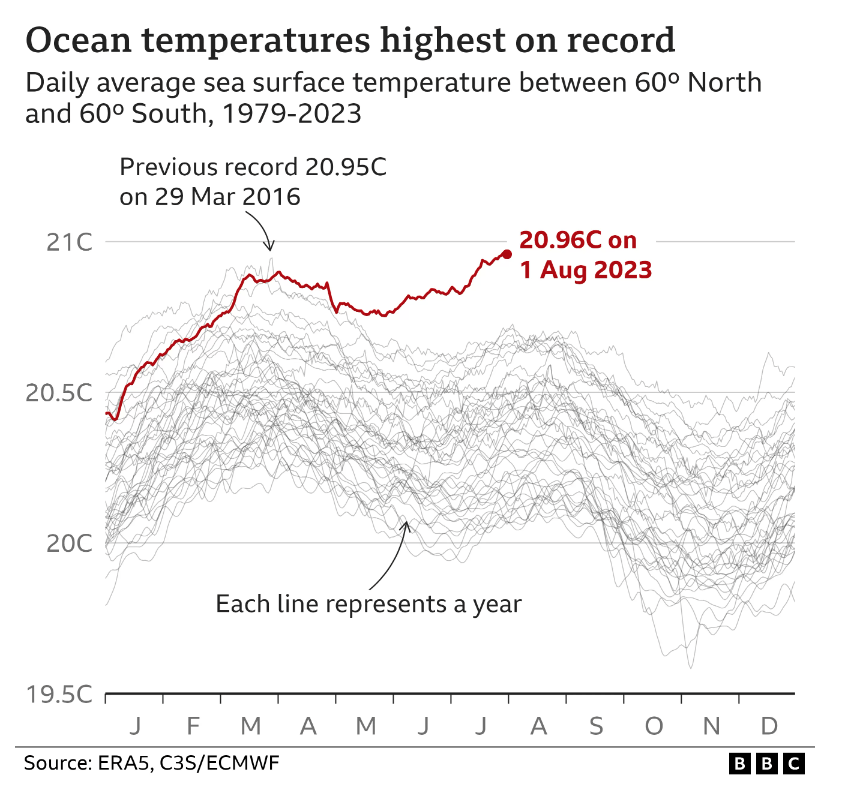
First, a scary graph:

(Source: BBC news piece, Ocean heat record broken, with grim implications for the planet)

The extent of the climate crisis is becoming plainer by the month. The UN Secretary General Antonio Guterres was reported on 27 July 2023 as saying that the era of global warming had ended and that the era of “global boiling” had arrived. July 2023 was the world’s hottest month on record. I saw a retired housebuilder scoff on LinkedIn that he had never heard anything as ridiculous as “global boiling”. I found that quite triggering in the current context and so apologies that I am not writing this week about any interesting planning law cases.

Instead, not in any way as an expert, but instead as a confused citizen, I’m asking myself…

What is the government’s current strategy on climate change and the environment, in the light of, for instance, the Prime Minister’s comments in the Telegraph on 29 July 2023 about being on the side of motorists and announcing on 31 July 2023 hundreds of new North Sea oil and gas licences to boost British energy independence and grow the economy?

I’m reminded of the “Be a strategist” chapter in Alastair Campbell’s book But What Can I do? Strategy = OST:

O = Objective (what you want to achieve)

S = Strategy (‘the big how’: your definition of the overall approach)

T = Tactics (the detailed plans required to execute the strategy)

Surely, the objective is, and should remain, to do all that we can do as a leading developed nation to encourage the world to combat the climate crisis.

I thought the Government’s strategy was well-documented, set out in its Net Zero Strategy: Build Back Greener (updated 5 April 2022) (reviewed earlier this year by Chris Skidmore – see my 21 January 2023 blog post Mission Zero Needs Planning) and by way of its longstanding commitments set out in the Climate Change Act 2008 , policed by the Climate Change Committee which was established for that purpose, including the objective of achieving net zero by 2050. You can question whether the strategy is ambitious enough but there it is.

The tactics to be deployed to achieve the objective are all of those individual measures set out and flowing from the strategy, including those set out in the Government’s 2023 carbon delivery plan.

However, I’m sensing that the prime minister’s OST instead may currently look like this:

O = Secure re-election or at least not too heavy a defeat

S = Win votes via populist “culture war” issues; have any sort of positive economic narrative come election time

T = Noise about eg being on the side of the motorist; prioritising economic growth over the net zero programme.

Of course, any debate on these issues gets bogged down in complexity. Argue about the stats, the projections and promised protections (carbon capture and storage etc etc), anything but just Don’t Look Up!

Perhaps let’s turn to that body that was set up by the 2008 Act. The Climate Change Committee published its 2023 Progress Report to Parliament on 28 June 2023). Reviewing the Government’s March 2023 Carbon Budget Delivery Plan  and the Government’s wider policy development, the CCC’s key messages are:

  • A lack of urgency. While the policy framework has continued to develop over the past year, this is not happening at the required pace for future targets.
  • Stay firm on existing commitments and move to delivery. The Government has made a number of strong commitments, these must be restated and moved as swiftly as possible towards delivery.
  • Retake a clear leadership role internationally. The UK will need to regain its international climate leadership.
  • Immediate priority actions and policies. Action is needed in a range of areas to deliver on the Government’s emissions pathway.
  • Develop demand-side and land use policies. The Government’s current strategy has considerable delivery risks due to its over-reliance on specific technological solutions, some of which have not yet been deployed at scale.
  • Empower and inform households and communities to make low-carbon choices. Despite some positive steps to provide households with advice on reducing energy use in the last year, a coherent public engagement strategy on climate action is long overdue.
  • Planning policy needs radical reform to support Net Zero. The planning system must have an overarching requirement that all planning decisions must be taken giving full regard to the imperative of Net Zero.
  • Expansion of fossil fuel production is not in line with Net Zero. As well as pushing forward strongly with new low-carbon industries, Net Zero also makes it necessary to move away from high-carbon developments.
  • The need for a framework to manage airport capacity. There has been continued airport expansion in recent years, counter to our assessment that there should be no net airport expansion across the UK.”

Alongside the report the following supporting research was published:

This all pre-dated last week’s oil and gas licensing announcement. Is there any case in 2023 for further extraction of fossil fuels? The CCC’s outgoing chair Lord Deben however made his views clear in a 3 August 2023 article for New Statesman: North Sea licences tell big oil we’re not serious about net zero.

And what about this stuff about being on the side of the motorist? It’s surely all adding up to a growing, tactical, culture war around climate issues. By-elections can unexpectedly become policy inflexion points – as we saw with the Chesham and Amersham by-election result in June 2021 that effectively scuppered a previous attempt to reform the planning system. Both main parties took from the 20 July 2023 Uxbridge and South Ruislip result that the Conservative candidate’s achievement in narrowly holding onto the seat was down to the unpopularity of London Mayor Sadiq Khan’s programme to extend the Ultra Low Emission Zone to outer London. Hence Keir Starmer’s disappointing wobble the next day but also, in spades, the Tory response. Here was an issue to rally behind, supposedly in support of those not able to afford to replace their older vehicles with ones which would be ULEZ compliant (although that fox has probably been shot by Khan’s 4 August Mayor announces massive expansion of scrappage scheme to all Londoners) but more widely an opportunity to mine a “pro-car”/anti- regulation seam – hence also the prime minister’s announced review on low traffic neighbourhoods. The Local Government Association’s view is clear: Councils best placed to make decisions with communities (30 July 2023). But this is a culture war – if local government folk (and probably people like you and me too) object, so much the better, is likely to be some political strategists’ thinking. And of course, along with all the political brouhaha come the inevitable legal challenges – on 28 July 2023 Hillingdon, Bexley, Bromley, Harrow and Surrey Councils failed in their judicial review of the proposed ULEZ expansion.

Let me throw in here some commentary more rooted in planning law. I was interested to receive a comment on my recent blog post about the M&S Oxford Street decision letter. The comment was along the lines of whether there was anything to stop M&S in any event demolishing the building, unlisted, not in a conservation area, relying on the prior approval right to do that in the General Permitted Development Order. This really does illustrate the lack of joined up thinking in planning legislation. Should demolition be more closely regulated? Why, when there is current consultation on possible changes to the General Permitted Development Order, and if minimising the loss of embodied carbon is now a Government objective (no clear policy on that, we are left reading between the lines), is there still, for instance, the demolition and rebuild (with 1,000 sq m cap)  commercial to residential right, only introduced in 2020?!

Finally, to hear views and debate on the Government’s recent announcements on planning reform that were the subject of my blog post last week The Message, you can listen back to our two hour-long Clubhouse sessions on the issues – here for the discussion of Michael Gove’s 24 July statement as to his long-term plan for housing and here for detail on proposed reforms to plan-making, the GPDO and application fees. And although I’m not wedded to the idea unless there is real interest, if anyone would like to speak at a future Clubhouse session about the issues in this blog post then let me know.

And final final plug – there’s a very small but growing planning community on Threads, which is certainly improving as a more wholesome alternative to Twix (they have largely sorted out the issues which initially were so annoying for people). Feel free to join by downloading the app via Apple’s App Store or Google Play for Android – still only by mobile device, although that will change in the next few weeks. An interesting time lies ahead and I’m feeling that we are going to need to share our thinking…

Simon Ricketts, 5 August 2023

Personal views, et cetera

Image courtesy of Don’t Look Up (Netflix)

The Message

Double-digit inflation. Can’t take the train to the job, there’s a strike at the station.

Don’t push me cause I’m close to the edge.

I’m trying not to lose my head.

It’s like a jungle sometimes.

The House of Commons rose on Thursday 20 July 2023, and only then did we have a spate of DLUHC announcements from the following Monday onwards.

This blog post simply aims to keep track of it all. For the actual analysis, you will need to tune into two Clubhouse sessions (Clubhouse! It’s a bit like when people talk about “old-school hip hop” – nod appreciatively, high five, lockdown vibes, those were the days were they not?):

– 5 pm, 2 August – Gove’s “long-term plan” – RSVP here

– 5 pm, 3 August – plans, GPDO, fees – RSVP here

I’ll be joined by my rock steady crew: Sam Stafford (HBF), the eponymous Catriona Riddell, Landmark’s summer signing Hashi Mohamed, Annie Gingell (Tetlow King), Claire Petricca-Riding and Nicola Gooch (Irwin Mitchell), my Town Legal partner Victoria McKeegan and also perhaps by you?

We’ll discuss:

Michael Gove’s long-term plan for housing speech and press statement (24 July 2023), preceded by the same day by Rishi Sunak’s “PM to build 1 million new homes over this Parliamentannouncement

A consultation paper on (more) changes to permitted development rights (24 July 2023)

A consultation paper on the implementation of plan-making reforms proposed in the Levelling-up and Regeneration Bill (25 July 2023)

The Government’s response to its consultation on increasing planning fees and performance (25 July 2023), following on from the draft Town and Country Planning (Fees for Applications, Deemed Applications, Requests and Site Visits) (England) (Amendment) Regulations 2023 (laid before Parliament on 20 July 2023)

(All the above are summarised in a Town Legal update, which also features an analysis of the Secretary of State’s recent M&S Oxford Street decision).

A consultation paper on operational reforms to the NSIP consenting process (26 July 2023)

Updates to the following sections of Planning Practice Guidance (both 26 July 2023):

It makes me wonder how I keep from going under.

Simon Ricketts, 28 July 2023

Personal views, et cetera

M&S Mess

I never thought I would live to see a chief executive of Marks and Spencer plc (Marks and Spencer plc!) issue a statement such as this:

“After a two-year process where our proposals were supported at every stage, our investment in 2,000 jobs, building one of the most sustainable buildings in London, improving the public realm and creating a flagship store, is now effectively in the deep freeze. Today the Secretary of State has ignored his appointed expert David Nicholson who recommended approval of our scheme.

When 42 of the 269 shops on what should be our nation’s premier shopping street sit vacant, disregarding the expert opinion and approval of the appointed planning inspector and playing to the gallery by kiboshing the only retail-led regeneration proposal is a short-sighted act of self-sabotage by the Secretary of State and its effects will be felt far beyond M&S and the West End. It is particularly galling given there are currently 17 approved and proceeding demolitions in Westminster and four on Oxford Street alone, making it unfathomable why M&S’s proposal to redevelop an aged and labyrinthian site that has been twice denied listed status has been singled out for refusal. 

The suggestion the decision is on the grounds of sustainability is nonsensical. With retrofit not an option – despite us reviewing sixteen different options – our proposed building would have ranked in the top 1% of the entire city’s most sustainable buildings. It would have used less than a quarter of the energy of the existing structure, reduced water consumption by over half, and delivered a carbon payback within 11 years of construction. It is also completely at odds with the inquiry process where the analysis on sustainability, including from independent experts Arup, was accepted. 

We cannot let Oxford Street be the victim of politics and a wilful disregard of the facts. At a time when vacancy rates on what should be the nation’s premier shopping street are 13% higher than the average UK high street and Westminster Council is pleading for help in managing the growing proliferation of sweet shop racketeers, the Secretary of State has inexplicably taken an anti-business approach, choking off growth and denying Oxford Street thousands of new quality jobs, a better public realm and what would be a modern, sustainable, flag-bearing M&S store.

There is no levelling up without a strong, growing Capital city, but the ripple effect extends well beyond Oxford Street. Towns and cities up and down the country will feel the full effects of this chilling decision, with decaying buildings and brownfield sites now destined to remain empty as developers retreat. The nation’s fragile economic recovery needs Government to give confidence to sustainable regeneration and investment as well as following due process; in London and across the UK. Today the Secretary of State has signalled he is more interested in cheap shot headlines than facts and if it weren’t so serious it would be laughable.

We have been clear from the outset that there is no other viable scheme – so, after almost a century at Marble Arch, M&S is now left with no choice but to review its future position on Oxford Street on the whim of one man. It is utterly pathetic.” (Stuart Machin, 20 July 2023)

I last wrote about this saga in my 23 April 2022 blog post Does My Embodied Carbon Look Big In This?

Let’s remind ourselves of the route this application for planning permission has taken:

  • Application submission: 2 July 2021
  • Resolution to grant by Westminster City Council: 23 November 2021
  • Confirmation by the Mayor that he would not intervene by directing refusal or recovering the application for his own determination: 7 March 2022
  • U-turn by the Mayor – he would consider intervening after all
  • Re-confirmation by the Mayor that he would not intervene by directing refusal or recovering the application for his own determination: 4 April 2022
  • Call-in by the Secretary of State: 20 June 2022
  • Inquiry held by inspector David Nicholson between 25 October and 4 November 2022
  • Decision by the Secretary of State to refuse planning permission, contrary to inspector David Nicholson’s recommendations: 20 July 2023 (David Nicholson’s report having been delivered to the Secretary of State on 1 February 2023).

Throughout this process there has been ferocious opposition to the scheme by some prominent groups and individuals – with detailed representations made; lobbying at each stage, and commentary in the media and social media.

I have often criticised the process whereby the Secretary of State can call-in an application, or recover an appeal, for his own decision-making.

What is the point of local democracy? What is the point of a hugely expensive, lengthy, quasi-judicial process, and a 109 page report by one of our most experienced planning inspectors, when you arrive at this sort of outcome?

If Secretary of State didn’t like the scheme when he called it in, and was going to refuse it in any event, why even the pretence of due process?

To dip into the decision. First point: of course it’s written with an eye to being watertight against legal challenge, by way of making sure that the conclusions revolve around the degree of weight to be attached to specific material considerations and around ultimately subjective assessments as to harm and significance (albeit assessments made without the benefit of hearing the evidence, of accompanied site visits or the ability to ask questions of witnesses). Time will tell if that objective has been secured.

Given that some may think (I couldn’t possibly comment) that this is how the Secretary of State reached his decision, I’m going to start with the overall conclusions (paragraph 51 onwards).

The first set of subjective conclusions (paragraph 51) are findings as to “overall conflict with development plan policies D3 and 38 which deal with design, and partial conflict with heritage policies HC1 and 39”.

That enables him to take the position that the scheme is in conflict with the development plan overall. With the onus shifted, the question for him is accordingly “whether there are material considerations which indicate that the proposal should be determined other than in line with the development plan.”

In favour of the proposal are (paragraph 52)  “the advantages of concentrating development in such a highly accessible location, which attracts substantial weight; and the potential harm to the vitality and viability of the area which could follow from a refusal of permission, which attracts limited weight. The heritage benefits carry moderate weight, and the possibility of demolition attracts limited weight. The benefits to employment and regeneration through improved retail and office floorspace, and the benefits in terms of permeability and connectivity, safety and shopping experience and the public realm collectively carry significant weight.” As long as properly reasoned, the weight to be attached to each consideration is for the decision maker.

Against the proposal (paragraph 53) “is the Secretary of State’s finding that in terms of paragraph 152 of the Framework, the proposal would in part fail to support the transition to a low carbon future, and would overall fail to encourage the reuse of existing resources, including the conversion of existing buildings, which carries moderate weight. He has also found that harm arising from the embodied carbon carries moderate weight; and the future decarbonisation of the grid carries limited weight.”

In terms of assessing the heritage impacts of the proposal “the Secretary of State has taken into account the requirements of s.66 of the LBCA Act and the provisions of the Framework. He has found that in terms of paragraph 202 of the Framework, the harm to the settings, and so the significance, of the designated heritage assets would fall into the ‘less than substantial’ category. In respect of Selfridges and the Stratford Place CA, he has found the harm would be at the upper end of that category; in respect of the Mayfair CA it would be in the middle of that category; and in respect of the Portman Estate CA it would be at the lower end of the category. Overall he has found that the harm to the settings of, and significance of the designated heritage assets carries very great weight. He has further considered paragraph 202 of the Framework and has found that the public benefits of the proposal do not outweigh the harm to the significance of the designated heritage assets. The Secretary of State considers that harm from the loss of the nondesignated heritage asset of Orchard House attracts substantial weight and has considered paragraph 203 of the Framework in coming to this decision. In respect of paragraph 189 of the Framework, the Secretary of State considers that the proposal would overall fail to conserve the heritage assets in a manner appropriate to their significance, so that they can be enjoyed for their contribution to the quality of life of existing and future generations. He considers that the possibility of an Oxford Street CA attracts limited weight.

So what did the scheme in was its design, its less than substantial harm to designated heritage assets which he gives “very great” weight, not outweighed by public benefits; harm from the loss of unlisted Orchard House which he gives substantial weight, and, in terms of climate change issues, the failure to support the transition to a low carbon future (moderate weight), failure to encourage the reuse of existing resources (moderate weight), harm arising from the embodied carbon  (moderate weight) and future decarbonisation of the grid (limited weight).

Let’s look in more detail at how the Secretary of State reached some of those conclusions.

Design

His conclusion on non-compliance with policy D3 is said by him to follow from his conclusions on the impact on designated heritage assets (paragraph 43). Similarly policy 38 (paragraph 44). Aside from these conclusions, based on concerns as to heritage aspects, he reaches no conclusions on the design of the scheme.

Heritage

So let’s turn to heritage.

The Secretary of State agrees with the Inspector (paragraphs 12 to 15) as to the level of harm caused to designated heritage assets. However, he disagrees as to the weight to be given to any harm (paragraph 15): “Given the significance of Selfridges, and his conclusions in paragraphs 13-14 above, the Secretary of State considers that the harm to designated heritage assets in this case carries very great weight. He does not agree with the Inspector’s assessment that the harm to the setting and so to the significance of Selfridges, including with the additional harm to the settings of the CAs, carries only moderate weight (IR.13.11 and IR13.78).

The Secretary of State agrees with Historic England rather than the inspector as to the significance of Orchard House as a non-designated heritage asset (paragraph 16) and considers that its loss attracts substantial weight. He recognises, some heritage benefits of the scheme, to which he ascribes moderate weight.

Carbon

This is the area where we need to pay particularly careful attention.

First, to note that he reaches no concluded view on whether the redevelopment would over the life of the building use less carbon than any replacement: “the Secretary of State has also taken into account the applicant’s argument that over the life of the building it would use less carbon than any refurbishment, which would have to rely on an inefficient building envelope (IR13.38). He agrees with the Inspector, for the reasons given in IR13.37 and IR13.39, that the understanding of WLC Assessments and the tools available for calculations are still developing, and therefore it is no surprise that there was disagreement over the lifetime carbon usage for the proposals and, more particularly, for a refurbishment.” (paragraph 21).

That might be seen as surprising given that surely it is the core issue.

It was said by some that redevelopment should be delayed until the grid is decarbonised, when “the extent of embodied energy, particularly from manufacturing materials, and from vehicle emissions would be much lower or eliminated. He agrees that the proposed development now would result in far more carbon emissions than after the UK has achieved a net-zero grid (IR13.99), because a fully renewably sourced electricity grid should allow most construction vehicles, and the manufacture of concrete, steel and other materials, to be undertaken using renewable energy rather than fossil fuels (IR13.40).” However, he recognised that would not be a practical general principle: “An assessment of the weight to give to the fact that development now will give rise to far more carbon emissions than in the future with a net-zero grid depends on the facts of the case and the planning policy context. Evidence has been put before the Secretary of State that the existing store is currently assessed as failing (IR13.71), and M&S has stated that it will not continue to occupy and trade from the store for very much longer if permission is refused (IR13.46). The Secretary of State has also concluded that the development is supported by some current and up to date development plan policies which aim to support the regeneration and economic development of the area (paragraph 26 below). Overall he considers that this matter carries limited weight against the proposal.” (paragraph 22)

Strangely, although possibly because of the lack of empirical evidence on the point at the inquiry,  he gives no weight to any possible reduction in pressure for development elsewhere (paragraph 23).

Paragraph 24 is important:

The Secretary of State agrees with the Inspector at IR13.43 that there should generally be a strong presumption in favour of repurposing and reusing buildings, as reflected in paragraph 152 of the Framework. In the circumstances of the present case, where the buildings in question are structurally sound and are in a location with the highest accessibility levels, he considers that a strong reason would be needed to justify demolition and rebuilding. However, he agrees that much must depend on the circumstances of the case, including how important it is that the use of the site should be optimised, and what alternatives are realistically available. Like the Inspector, the Secretary of State has gone on to consider whether there is a reasonable prospect of an alternative scheme going ahead.”

The Secretary of State’s position as to the prospect of an alternative scheme going ahead is vital to his overall decision:

31. The Secretary of State considers that given the Inspector could not draw clear conclusions on this matter, and its importance in the determination of this application, a degree of caution ought to be exercised in drawing overall conclusions from the evidence, and considering the weight to be given to this issue. He finds the applicant’s evidence much less persuasive than the Inspector appears to have done in light of the gaps and limitations identified by the Inspector. He does not consider it appropriate to draw such firm and robust conclusions about this issue as the Inspector does (IR13.70- 13.75 and IR13.97). The Secretary of State is not persuaded that it is safe to draw the same conclusion reached by the Inspector, namely that ‘there is no viable and deliverable alternative’ (IR13.74), which leads to the Inspector’s overall conclusion that ‘there is unlikely to be a meaningful refurbishment of the buildings’ (IR13.97).

32. Overall, the Secretary of State concludes that the evidence before him is not sufficient to allow a conclusion as to whether there is or is not a viable and deliverable alternative, as there is not sufficient evidence to judge which is more likely. The Secretary of State also does not consider that there has been an appropriately thorough exploration of alternatives to demolition. He does not consider that the applicant has demonstrated that refurbishment would not be deliverable or viable and nor has the applicant satisfied the Secretary of State that options for retaining the buildings have been fully explored, or that there is compelling justification for demolition and rebuilding.

33. The Secretary of State notes that M&S has stated that it will not continue to occupy and trade from the store for very much longer if permission is refused (IR13.46). Whether or not M&S leave the store following the Secretary of State’s decision is a commercial decision for the company. However, taking into account the locational advantages of the site, the Secretary of State does not agree with the Inspector at IR13.75 that redevelopment is the only realistic option to avoid a vacant and/or underused site. He considers that there is potential for some harm to the vitality and viability of Oxford Street as suggested by the Inspector at IR13.46-47 and IR13.74. However, he does not agree with the Inspector that harm would be caused to the wider West End beyond Oxford Street (IR13.46) as he considers that this overstates the scale of the impact. He also does not agree with the Inspector’s conclusion that the harm would be substantial. The Secretary of State considers that potential harm to the vitality and viability of Oxford Street could arise from a refusal of permission but, unlike the Inspector, he considers that 8 the extent of any such harm would be limited. He attributes limited weight to this possibility.”

Time will tell if he is right.

I find his conclusion on the carbon which would go into construction materials unfathomable given that he failed to reach a conclusion on whether the new building would use less carbon than refurbishment of the existing building (paragraph 21 quoted earlier above):

45. In respect of paragraph 152 of the Framework, the Secretary of State agrees that a substantial amount of carbon would go into construction (IR13.32), and that this would impede the UK’s transition to a zero-carbon economy (IR13.87). He has found that there has not been an appropriately thorough exploration of alternatives to demolition (paragraph 32 above). He has also taken into account that the carbon impacts would be to an extent mitigated by the carbon offset payments secured via the s.106 Agreement, which would be used to deliver carbon reductions (albeit it has not been demonstrated that the carbon reductions would fully offset the embodied carbon arising from this proposal). He has also taken into account the sustainability credentials of the new building (paragraph 21 above). Overall he concludes that in terms of paragraph 152 of the Framework, the proposal would in part fail to support the transition to a low carbon future, and would overall fail to encourage the reuse of existing resources, including the conversion of existing buildings. The Secretary of State considers that this carries moderate weight against the scheme.

46. The Secretary of State has also considered the Inspector’s conclusion at IR13.99 that of the material considerations in this case, the extent of embodied energy weighs most heavily against the scheme. He has taken into account that a substantial amount of embodied carbon would go into construction. He has also taken into account at paragraph 21 above the sustainability credentials of the new building, and has further taken into account that the carbon offset payments secured via the s.106 Agreement would be used to deliver carbon reductions (albeit it has not been demonstrated that the carbon reductions would fully offset the embodied carbon arising from this proposal). Given his conclusions on these matters, he considers, unlike the Inspector at IR13.99, that in the particular circumstances of this case, the embodied carbon carries moderate weight.

Finally, a warning against treating this decision as too much of a precedent:

47. The Secretary of State has considered the Inspector’s comments at IR13.94 that there is a ‘growing principle that reducing climate change should generally trump other matters’; and his comments at IR13.99 that as climate change policy is still developing, the Secretary of State is entitled to use his judgement to give this consideration greater weight than the Inspector has attributed to it. Policy in this area will continue to develop and in due course further changes may well be made to statute, policy or guidance. This decision letter sets out the Secretary of State’s judgement on the weight which attaches to these matters in the circumstances of this particular case.

48. The Secretary of State has considered the Inspector’s comment at IR13.95 that fear of precedent could be a material consideration of sufficient weight to justify dismissing the application. However, he is confident that any future decision-maker would pay attention to the whole decision and the detailed reasoning and not just to the outcome of the decision. In any event, the decision turns on its own very specific facts, including the relevant development plan policy matrix, the Inspector’s report and the evidence which was before the inquiry, which are all unlikely to be replicated in other cases.”

Easy to say but of course there will be attempts to read across these findings to other projects.

My overall prediction? An important part of Oxford Street may well indeed become vacant or subjected to uses which will do nothing for this vulnerable commercial area – which is currently frankly a disgrace. A project has been first stalled, then killed, brought forward by one of the country’s most respected companies, for reasons which aren’t even based on any finding that demolition and rebuild will lead to greater release of carbon over the lifetime of the building than a hypothetical refurbishment of the existing building – and, in so far as they are heritage-based, on the one hand ascribe a surprising amount of weight to the moderate levels of harm arising and on the other ascribe little weight to the public benefits that would surely arise from a twenty first century flagship department store in Oxford Street.

Some of you will get very upset by this blog post I’m sure. But not as upset as Mr Machin is about Mr Gove.

Simon Ricketts, 21 July 2023

Personal views, et cetera

Get With The Project

The question as to “what is the project?” for the purposes of environmental impact assessment has been arising a lot since  R (Ashchurch Rural Parish Council) v Tewkesbury Borough Council (Court of Appeal, 7 February 2023), which I summarised in my 11 February 2023 blog post The Bridge To Nowhere Case. The facts in that case were stark but people have been worrying about how far to extrapolate the principle.

Perhaps this week’s ruling by the High Court in R (The Llandaff North Residents’ Association) v Cardiff Council (HHJ Jarman, 10 July 2023) may alleviate concerns.

Briefly, the Cardiff local development plan has allocated a large area north west of Cardiff for development, including at least 5,000 homes. Redrow Homes had been granted planning permission to build just under 6,000 homes on part of the allocation. To quote from the judgment:

The application was accompanied by an environmental statement (ES) which stated that Dŵr Cymru had confirmed that the significant volume of foul sewage which would be generated by the proposal could be accommodated on its network, but a hydraulic modelling assessment (HMA) would be needed before the extent of infrastructure improvements and storm water removal from the network could be finalised. Outline permission was granted on the application in March 2017, condition 24 of which required a HMA to be approved.

Dŵr Cymru [the statutory undertaker with the responsibility of providing a sewerage system under the Water Industry Act 1991] in November 2021 submitted an application to build a pumping station to serve the developer’s proposal. This would comprise a pumping station at the north end of a large open space called Hailey Park to the east of, and on the banks of, the River Taff. The site of the pumping station is about 1Km away from the site of the developer’s proposed development. Also included in the application is a valve kiosk on the other side of the river. What is not included is a pipe under the river to connect the two, as Dŵr Cymru proposes to use permitted rights to construct it. The authority granted that application in September 2022.

At the same time, the authority granted an application made by the developer to discharge condition 24 after a HMA had been obtained. Two applications were made, because of re-design, and each was granted by the authority, the latest one in September 2022.

The claimant is an association of residents of Llandaff North, which adjoins Hailey Park to the east. With permission granted by Steyn J, it challenges both decisions of the authority to grant planning permission for the pumping station and to discharge condition 24.

The application was accompanied by a planning statement by Dŵr Cymru’s consultants, Arup, which stated that the need for the proposed development “derives from” the grant of planning permission for 6000 homes at Plasdŵr. Arup submitted a screening request in relation to the sewage scheme which was being provided for that development, recognising that it was “effectively part of” that development on the basis that it would provide that additional capacity needed “to serve the increase in the local population size.” Arup considered the proposed development to be listed as Schedule 2 development and identified several potential impacts, including to protected sites of international significance such as those located on the Severn Estuary, but did not consider the impacts to be significant.

The authority issued a negative screening opinion on the basis that the sewage scheme and the residential development are stand-alone projects, and gave several reasons. The two schemes would not be located on adjacent land. The former was being undertaken by Dŵr Cymru and the latter by the developer. The former was being undertaken not only to serve the latter but also other existing and potential developments in the area so that there was a functional relationship between the two but no functional interdependence. The former was considered to be the project for EIA purposes and did not exceed the thresholds set out in Schedule 2. Accordingly, the authority did not consider whether any potential impacts would be significant. A separate screening opinion was issued in respect of the pumping station, which mirrored that in respect of the sewage scheme.

The claimant’s first two grounds of challenge were as follows:

“i) The authority failed to take into account that there is functional interdependence between the Plasdŵr development and Dŵr Cymru’s application and wrongly took into account that the pumping station will serve other developments in the area;

ii) The authority failed to consider an integral part of Dŵr Cymru’s proposal, namely a scheme to remove surface water from its network thus increasing its capacity for foul sewerage. So considered, the scheme as a whole would amount to Schedule 2 development under the Town and Country Planning (Environmental Impact Assessment) (Wales) Regulations 2017 (the EIA Regulations) requiring an environmental statement (ES)”.

So, we are back to the question of “what is the project?” Did the pumping station proposal require EIA because it was part of a larger project (the Redrow development) which had been the subject of EIA?

His Honour Judge Jarman summarised the caselaw:

In R (Ashchurch Rural Parish Council) v Tewkesbury BC [2023] EWCA Civ 101, Andrews LJ, giving the lead judgment, said at [74] that the term “project” should be interpreted “broadly, and realistically”. At [80], she added that the identification of the project is based on a fact-specific inquiry.

What constitutes the project is a matter of judgment for the planning authority, subject to challenge on grounds of rationality or other public law error. Lang J in R (Wingfield) v Canterbury City Council [2019] EWHC 1975 (Admin) at [64] after a review of the authorities, identified four criteria against which that judgment may be made: (i) whether two sites are owned or promoted by the same person; (ii) simultaneous determination; (iii) functional interdependence; and (iv) stand-alone projects. These were cited with approval in Ashchurch at [81] as “a non-exhaustive list of potentially relevant criteria, which serves as a useful aide-memoir.”

These criteria were recently considered by Holgate J in R (Together against Sizewell C Ltd) v SSESNZ [2023] EWHC 1526 (Admin). At [73-4], he said:

The weight to be given to them will depend upon the circumstances of each case and is a matter for the decision maker.

Interdependence would normally mean that each part of the development is dependent on the other, as, for example, in Burridge v Breckland District Council [2013] JPL 1308 at [32] and [42].

At [70], Holgate J pointed out that an irrationality challenge presents a high threshold:

The threshold for irrationality in the making of such a judgment is a difficult obstacle to surmount (see e.g. Newsmith Stainless Limited v Secretary of State for the Environment, Transport and the Regions [2017] PTSR 1126).

Although two sets of proposed works may have a cumulative effect on the environment, this does not make them a single project for these purposes. Two potential projects but with cumulative effects may need to be assessed, see R (Larkfleet Ltd) v South Kesteven DC [2015] EWCA Civ 887, Sales LJ (as he then was) at [36]…

If I can pause there, the recent Sizewell case cited by HHJ Jarman was an interesting example of the courts’ regular attempts to avoid EIA becoming an impossible obstacle course. There the argument by the claimants was that the Sizewell C nuclear power project should be defined for the purposes of the Conservation of Habitats Regulations as encompassing proposals by  Northumbrian Water Limited to provide the significant amounts of potable water required during the construction, commissioning and operational phases of Sizewell C

Holgate J had this to say:

The claimant’s argument has much wider implications. The need for the supply of utilities such as water is common to many, if not all, forms of development. A utility company’s need to make additional provision so as to be able to supply existing and new customers in the future does not mean that that provision (or its method of delivery) is to be treated as forming part of each new development which will depend upon that supply. The consequence would be that where a new supply has yet to be identified by the relevant utility company, decisions on those development projects would have to be delayed until the company is able to define and decide upon a proposal. That approach would lead to sclerosis in the planning system which it is the objective of the legislation and case law to avoid (R (Forest of Dean (Friends of the Earth)) v Forest of Dean District Council [2015] PTSR 1460 at [18]).

By way of a side-bar on this whole EIA sclerosis question, we all of course also await the Supreme Court’s ruling in R (Finch) v Surrey County Council on the question of whether it was unlawful for a local planning authority not to require the environmental impact assessment for a project of crude oil extraction for commercial purposes to include an assessment of the impacts of downstream greenhouse gas emissions resulting from the eventual use of the refined products of the extracted oil. The hearing took place on 21 and 22 June and if you have a couple of days spare (maybe you are between projects), you can watch it all here. By way of reminder, this was the Court of Appeal’s ruling, dated 17 February 2022.

Back to the Cardiff case. What did HHJ Jarman conclude on the facts? He found that the council’s planning officer was entitled to deal with the issue in the way that they had. “The fact that the pumping station is needed for the Plasdŵr development does not mean that it will not also serve other existing and potential developments in the area, and the officer and the authority were entitled to have regard to those matters. The high threshold of irrationality in this approach has not been surmounted.”

This is a helpful reminder both of how extreme the facts need to be (as they were with the bridge to nowhere) in order for a decision maker not to be able to conclude that works are not an integral part of a larger project and of the reluctance of the courts to interfere with the planning judgment reached on such issues by the decision maker.

I hope that calms some nerves.

I’m not sure nerves will have been calmed at DLUHC by publication on 14 July 2023 by the House of Commons Levelling Up, Housing and Communities Committee of its Reforms to National Planning Policy report. Let’s just say that when it comes to the Government’s proposed reforms, the Committee has not been getting with the project…

More on the report’s findings from the rest of your social media I am sure.

Finally, I’ve reluctantly got with another project. Having decided not to use Twitter since last November, I have signed up with the Meta alternative, Threads. It’s not perfect but if it places real pressure on Twitter to retreat from the harmful changes made since Elon Musk acquired that company, so much the better.  There are already plenty of familiar names on the Threads app and, if you can bear being subject to yet another mutant algorithm, it’s very easy to use (suspiciously similar to Twitter’s interface in fact). If you’re passing, I’m on it as @sricketts101.

Simon Ricketts, 15 July 2023

Personal views, et cetera

Euston We Have A Problem

I have been commuting into Euston station for over twenty years, experiencing increasing frustration: at the past we have lost; the future that we are losing, and at the tatty and graceless perma-temp arrangement we have today.

I’m not sure that this week’s Public Affairs Committee report, HS2 Euston (7 July 2023), has yet had the attention it deserves and I’ll come back to that. But first:

The past

The beauty of transport blog is good on the subject of the original 19th century station; see Lost Beauty #9: Hardwick’s Hall (the Old Euston Station, London, UK) with these wonderful images:

It must have been quite something.

But then so was the 1968 modernist version of Euston when it opened:


This 1968 British Rail brochure gushed with excitement at the wonders of the grill room, party catering room, “high class toilets with showers and baths” and underground car park, showing no regret for the previous building that had been swept away.

Since then, the modernist lines of the new station have of course long been lost by way of multiple interventions. It’s frankly a mess. And for the last few years, as you pull into the station by rail, to the right is a swathe of HS2 construction activity. If you walk out of the station towards Euston Square, via that unsignposted corridor past the left luggage place, through the door into the between the bicycle racks area, across Melton Street you have hoardings either side as you walk past where businesses have been acquired and demolished at the eastern end of Drummond Street – this really is HS2World.

Screenshot courtesy Google

The future

HS2 was going to be the future.  Just as those in the 60s were seduced by the clean lines, the white heat of technology, the chance to wipe away the inefficiencies of the past, we were seduced by the idea of high speed rail, with Euston as its southern terminus.

From the Department for Transport’s March 2010 High Speed Rail command paper (foreword by then prime minister Gordon Brown and then Secretary of State for Transport Andrew Adonis):

“… HS2 Ltd’s recommended route for a London-Birmingham high speed line (‘High Speed Two’), which would run from a rebuilt Euston station in London to a new Birmingham City Centre station at Curzon/Fazeley Street, is viable, subject to further work on reducing specific impacts on the local environment and communities.

“…effective integration with London’s current and planned transport networks is crucial, and that this is best delivered through the combination of a Euston terminus and a Crossrail Interchange station sited between Paddington and Heathrow, which would also provide a link to the Great Western Main Line.”

“…the new British high speed rail network should be connected to the wider European high speed rail network via High Speed One and the Channel Tunnel, subject to cost and value for money. This could be achieved through either or both of a dedicated rapid transport system linking Euston and St Pancras and a direct rail link to High Speed One. HS2 Ltd will carry out further work to assess the viability and cost of each of these, including a full assessment of the business case, prior to any public consultation.”

From the coalition Government’s the Government’s January 2012 white paper, High Speed Rail: Investing in Britain’s Future – Decisions and Next Steps:

The HS2 Y network (so named due to its shape) will provide direct high capacity, high speed links between London, Birmingham, Leeds and Manchester, with intermediate stations in the East Midlands and South Yorkshire.”

The network will also provide improved links from the Midlands and the North to Heathrow Airport and the Channel Tunnel (via the existing High Speed 1 line). HS2 passengers will be able to travel directly to Heathrow and the Channel Tunnel without having to change trains.

Having reviewed the options again the Government’s conclusion remains that Euston is the right site for a London terminus, best serving passenger requirements and offering greater access to alternative onward travel networks than either Old Oak Common or Stratford. Any terminus other than Euston would offer a worse overall balance of costs and benefits.

These aspirations weren’t properly tested. The Supreme Court held in R (HS2 Action Alliance) v Secretary of State for Transport (22 January 2014) that the white paper was not subject to any requirement for strategic environmental assessment as it was not a plan that “set the framework” for subsequent decision making. This is still one of the most disappointing litigation outcomes of my career and indeed the court’s consideration of Parliamentary sovereignty versus the effect of EU Directives was a forerunner of much of the subsequent debate over Brexit. I’m not sure that Parliamentary sovereignty has helped us achieve a good outcome on HS2…

I re-read yesterday the House of Commons second reading debate (28 April 2014) in relation to what was at that point the High Speed Rail (London–West Midlands) Bill (short title: “A Bill to make provision for a railway between Euston in London and a junction with the West Coast Main Line at Handsacre in Staffordshire, with a spur from Old Oak Common in the London Borough of Hammersmith and Fulham to a junction with the Channel Tunnel Rail Link at York Way in the London Borough of Islington and a spur from Water Orton in Warwickshire to Curzon Street in Birmingham; and for connected purposes.”) . Patrick McLoughlin (now Lord McLoughlin) was Secretary of State for Transport:

…it is time to connect great cities such as Birmingham, Manchester, Sheffield and Leeds. It is time for better links between north and south and between east and west, and time to connect to world markets to make the most of their skills and talents. It is time for HS2; time for a new north-south railway line.”

With the benefit of hindsight, the two “on the money” contributions to the debate were from MPs from different sides of the political divide, now both sadly deceased, but both superb representatives of their constituents and true Parliamentarians:

Cheryl Gillan, then Conservative MP for Chesham and Amersham, focused on the implications of the choices as to route and extent of tunnelling for the Chilterns area of outstanding beauty, alternative horizontal and vertical alignments having been rejected for reasons which in my view would not have stood up to proper independent scrutiny (I’ve already mentioned the lack of strategic environment assessment at the white paper stage; the other issue was the Select Committee process for testing the detailed proposals in the Bill – see my 30 July 2016 blog post, HS2: The Very Select Committee)

Frank Dobson, then Labour MP for Holborn and St Pancras, focused on the implications for the area surrounding Euston station:

I should point out the ridiculous situation whereby the hybrid Bill before the House proposes major works in my constituency, none of which the Government now intend to carry out. The Bill also provides for a link from HS2 to HS1. That ridiculous proposal has been abandoned altogether. The Bill provides for the option 8 design of the station at Euston. That ridiculous proposal, we are told, is shortly to be abandoned, but the design, cost and construction timetable for the alternative to it have not yet been worked out, so there’s nowt to vote on.

The neighbourhoods to the east and west of Euston station and its railway approaches are densely populated with a variety of uses. Most of the streets are overwhelmingly residential. They are home to large numbers of residents living in high densities in settled and varied communities, with a wide range of incomes, housing tenures, jobs, ethnic origins and religions. Most of those residents want to continue to live there. They rightly resent patronising references to their neighbourhood by the much lauded chair of HS2 Ltd and have asked me to remind him and everyone else that where they live is not like the Olympic site. It is not a brownfield site, ripe for redevelopment.

The HS2 project as now proposed would wreak havoc on those neighbourhoods. It would expand Euston station by 75 metres to the west, demolish the homes of 500 people and subject 5,000 more to living for a decade next to the construction site or beside roads that will be made intolerable by the heavy goods vehicles servicing the main site and the 14 satellite construction compounds. No consideration has been given to the cumulative harm that all this would do to the quality of life of my constituents. The proposed working hours regime enables work to proceed at any hour of the day or night. Every little park and play space near the site is to be taken over. Small, locally owned and locally staffed businesses, especially cafes, shops and restaurants in Drummond street, face financial disaster. Between 40% and 70% of their business is passing trade from pedestrians going to and from Euston station, which, for the duration of the works—10 years—will be cut off by a solid, 3.6 metre-high security fence.

The people I represent believe that HS2 should not go ahead. Failing that, they believe that HS2 should terminate at Old Oak Common, at least temporarily, to test its capacity and permit the assessment of any capacity needed at Euston to be based on experience rather than the guesswork used so far.”

Of course the Bill was passed in due course. There have been successive plans unveiled for Euston Station and then effectively abandoned:

Department for Transport’s press statement, HS2 plans can unlock Euston potential (8 September 2015) unveiled Grimshaws’ “pringle” design.

Updated plans were then unveiled in March 2022 of a revised concept design by a design consortium made up of Arup, WSP, Grimshaw Architects, Haptic, and LDA Design, alongside HS2’s Station Construction Partner, Mace Dragados JV.

Despite nearly all of the disruption feared by Frank Dobson already having been caused by the construction works around Euston that are now well underway, Mark Harper, current Secretary of State for Transport, released a press statement on 9 March 2023, pausing new construction work at Euston for two years:

The Government is prioritising HS2’s initial services between Old Oak Common in London and Birmingham Curzon Street to provide delivery of passenger benefits as soon as possible. We remain committed to delivering HS2 services to Euston, and will address affordability pressures to ensure the overall spending profile is manageable. We will therefore take the time to ensure we have an affordable and deliverable station design, delivering Euston alongside high-speed infrastructure to Manchester.

There was then Transport minister Huw Merriman’s written statement on HS2 (19 June 2023)

We remain committed to delivering HS2 services to Euston. We have decided not to proceed with construction at Euston over the next 2 years both to reduce expenditure during that period and to address the affordability challenge set out in the recent National Audit Office report. We will use this time to develop a more affordable scheme design that delivers for passengers, the local community and taxpayers.

The government will not be proceeding to construction on Phase 2a (West Midlands to Crewe) in the next 2 years to reduce expenditure. We will use the time to develop mature designs and delivery approaches to ensure that this section is delivered in the most cost-effective way.”

As reported in the recent National Audit Office report on Euston, the latest proposed target price from the construction partner (Mace Dragados joint venture) is £4.8 billion – around £2.2 billion over HS2 Ltd’s budget and a higher cost than the previous design.

I visited the Euston site on 5 April 2023 and saw for myself the challenges of constructing a complex station in a dense urban environment that will integrate with the existing conventional station and London Underground and local transport, as well as enabling oversite development.

Nonetheless, the station is not affordable at this cost, nor in any case, does the government have the financial headroom to proceed with the construction over the next 2 years. We will, therefore, use the time to look again at the Euston station design to ensure it delivers for passengers, the local community and taxpayers. This will include considering how we might partner with the private sector to capture benefits for customers. It will require careful prioritisation of requirements and a willingness from stakeholders to compromise.

It’s way over budget and they don’t know how to build it. And what delay do we think “two years” will turn into? Bodes well doesn’t it?

Which takes us to yesterday’s excoriating Public Accounts Committee’s report,  HS2 Euston (7 July 2023).

 Its summary:

Despite being eight years into planning the High Speed 2 station at Euston, the Department for Transport (the Department) still does not know what it is trying to achieve with the station and what sort of regeneration it will support. It is clear now that the £2.6 billion budget HS2 Ltd set for the project was completely unrealistic, even before the impacts of inflation are considered. The Department will now need to reset the project for a second time in order to find a design that is realistic, affordable and provides value for money.

The Department does not know what the additional costs and impacts will be from its decision to pause construction at the station for two years. Working alongside HS2 Ltd, it now has a big task to identify what these costs and impacts are, including the impact on the supply chain and on local residents. It is essential for the Department to collect this information both to help it and HS2 Ltd manage the additional costs effectively and also to better inform any decisions in the future on whether to pause major projects.

Disappointingly, HS2 Euston station is yet another example of the Department making the same mistakes and failing to learn lessons from its management of other major rail programmes. Parliament has also not had the full transparency it needed on the likelihood of cost increases at Euston, despite the improvements the Department and HS2 Ltd have made in reporting on progress.”

My 27 November 2021 blog post Integrated Rail Plan, Unplanned? covered the downgrading of proposals to the north.

In the words of Johnny Rotten, ever get the feeling you’ve been cheated? This tax paying Euston commuter does.

Simon Ricketts, 8 July 2023

Personal views, et cetera