I’m picking up that the conclusion is reluctant. Clearly, it is helpful that the drought of new housing activity in London has been recognised. Clearly, it is appreciated that MHCLG and the London Mayor have worked hard at a co-ordinated package as between them which moves significantly, and no doubt with much internal organisational pain, from the previous policy position in terms of affordable housing expectations, in terms of the usual approach to CIL and in terms of some aspects of housing standards. There is also a dilemma on the part of the industry: this is an emergency; measures are needed now; if this set of proposals has to be ditched and replaced with a more effective package, we are just losing more time, unless the industry can point with some unanimity towards practical, easily implemented, improvements to what is on offer.
But the reality is that the current package (1) will not be enough and (2) is too caveated and conditional to provide the crucial reassurance that is needed to those who hold the strings in terms of funding or financing. From what I hear I’m not at all sure that the Mayor’s new time-limited route is even likely to be used, as opposed to continued reliance on viability testing.
Should there be more focus on stalled sites that already have planning permission?
Of course!
Why ignore the lowest hanging fruit? The opportunity has now passed for primary legislation to reintroduce section 106BA (which could have been a late bolt-on to the Planning and Infrastructure Bill). But why not by ministerial direction reduce the minimum period of five years for the purpose of being able to make applications under section 106A, which are capable of appeal, to say two years – and introduce guidance as to MHCLG’s interpretation of “useful purpose” (of course the courts’ legal interpretation ultimately will be what counts but guidance will still be useful!)? And in any event introduce firm guidance to local planning authorities that they should approach requests for deeds of variation on viability grounds positively where the case has been made (and set out in the guidance what will be sufficient to make that case)?
Is late stage (as opposed to early stage) review necessary in relation to the proposed “time-limited planning route”?
No!
The uncertainties caused to funders by the mere existence of any review mechanism the application of which is outside their control has a deadening effect on developers’ ability to fund schemes, utterly disproportionate to the likelihood that any review mechanism will ever deliver any material amount of additional affordable housing, schemes are so underwater. And unnecessary uncertainty has been created because the time-limited route envisages a different set of mechanisms to those which currently exist.
The simple change would be for the Mayor’s LPG to specify that for a time-limited period the fast-track thresholds will be reduced from 35% and 50% to 20% and 35% with the structure remaining exactly the same as to when review mechanisms will be required and how they will operate. A bucketload of uncertainty would be immediately removed.
Are there unnecessary difficulties with introducing a viability test into the proposed CIL relief?
Yes!
In fact, this whole new intended structure for 50 to 80% relief from borough CIL is going to be disproportionately complex given that it will rarely make the difference between a project going ahead or not (and with the prospect of later clawback, funders will always assume the worst in any event so it just won’t help bring them over the line). What I’m being told is that where CIL is a killer is on cash flow. On viability – the overall go/stop on development – it is of only marginal influence.
If there is going to be any tweaking of the Regulations:
Why not allow for payment at a later stage (you recall that when the infrastructure levy was touted by the previous government as replacement for CIL it was to be payable at upon completion of the development so would there be such a problem with it being paid, say, on occupation)? Boroughs don’t spend the monies upon receipt – timing isn’t critical to them! And Mayoral CIL is simply paying down long-term debt in relation to Crossrail.
Require all boroughs to switch on the potential for exceptional circumstances relief and see what can be done to simplify the process.
Ahead of any Regulations, just lean on the boroughs to switch on exceptional circumstances relief (if they refuse that is a warning sign in itself) and introduce advice as to the evidence that should normally be sufficient. Even that would help.
And incidentally this would actually also would help SMEs, currently shut out of the relief proposed in the consultation document by a combination of the £500,000 liability threshold and the proposed £25,000 application fee. And while we’re at it, extend this beyond residential C3 development.
Are the proposed additional powers to be given to the Mayor enough?
Probably, but…
It really would be useful if the Mayor could call in schemes of 50 units or more even before the borough is minded to refuse them, as long as the statutory determination period has passed – thereby reflecting the current arrangements in the Mayor of London Order 2008 for schemes of 150 units or more.
Final thoughts
Of course the proposed additional grant funding for affordable housing is welcome. But inevitably it isn’t enough.
Surely, we all agree that the thrust of all these measures is not good to the extent that, consistent with the operation of the existing system, it assumes that affordable housing, including social housing (for which there is such a desperate need in the capital) is what has to give in order to enable development to proceed. How can we move to a system where the delivery of social housing is not reliant on, effectively, an affordable housing tax imposed on residential development, given that the current model is not working?
To end on a positive note, I was really cheered to hear about Homes For People We Need campaign and to read their report Making Social Rent Homes Viable. Whilst it identifies that £18.83 billion is required to develop 90,000 social rent homes per year, there is a strong investment case for substantial government subsidy, given that temporary accommodation costs of £2.8 billion annually could in theory service index-linked bonds worth circa £160 billion. “In theory an investment by HM Treasury to build c.130,000 Social Rent homes for those families currently in temporary accommodation, assuming £209,000 subsidy per home and thus a total subsidy of £27.2bn, could reduce the current bill for Temporary Accommodation to zero”.
There are a number of strategic recommendations and suggested policy reforms in the report:
“• Social Housing Tax Credits represent a promising approach, enabling private capital deployment now in exchange for future tax relief.
• Section 106 Agreements should fix affordable housing values at the planning stage to improve market efficiency.
• Right to Buy should be further reformed to preserve the affordable housing stock.
• ‘Flex Rent’ approaches linking rents to household income should be considered to optimise revenue generation whilst maintaining affordability.
• The Housing Association sector desperately needs recapitalisation in addition to the recent 10-year rent settlement.”
In summary I hope that what is arrived at is fast, simple, measures to help meet the current housing and affordable housing emergency. But then I hope that there is a proper longer-term solution along the lines promoted by this report to help meet the underlying and remaining (national not just London) housing and affordable housing crisis. The current section 106 model is not working!
tl;dr summary: positive direction but concerns about potential complexities, uncertainties and as to whether it will all be in place speedily enough.
We’re all now waiting for the consultation to start “over six weeks from November” (fair play, at least no “by the end of Autumn” fudge).
There are plenty of detailed issues arising, and differing interests will want to re-prioritise the measures in different ways, but I thought I would set out four key asks that I have, which in my view should be specifically addressed in the consultation documents:
Should there be more focus on stalled sites that already have planning permission?
This is the lowest hanging fruit. And yet all we have (in paragraphs 33 and 34) is a reference to the potential for renegotiating previously agreed arrangements by way of deed of variation and discouragement as to the use of section 73.
This isn’t enough. I set out the current procedural constraints in my 18 October 2025 blog post London Stalling.
Procedurally, bar reintroducing section 106BA or, for a temporary period, amending section 106A to reduce the 5 years’ requirement, at the very least we need:
Specific encouragement for local planning authorities to accept developers’ requests to engage with the process of varying existing agreements where specific criteria (consistent with the direction of the policy note) are met, linked to some sort of oversight, monitoring and/or route for complaint where authorities refuse to engage (given that unless your section 106 agreement is at least five years’ old, or unless this is in the context of a section 73 application (of which more in a moment) there is no right of appeal on the part of the developer)
Not the current suggestion that the section 73 process “should no longer be used as an alternative means of reconsidering fundamental questions of scheme viability or planning obligations” but rather a proper recognition of the real challenge of keeping planning permissions, and associated planning obligations packages, up to date as against changing circumstances and the important role that section 73 plays in this. Attempts to make currently unviable schemes viable invariably involve an intertwined mix of scheme changes and changes to planning obligations. Section 73B, introduced by the Levelling-up and Regeneration Act 2023, is less useful as only the implications of the proposed changes are to be taken into account rather than considering the amended proposal holistically against the current development plan and other material considerations. This all needs to be connected up with the continuing problem that Hillside creates for amendments to projects (I was pleased to see Baroness Taylor confirm this week, on behalf of the government, in response to Lord Banner’s tabled amendment to the Planning and Infrastructure Bill, that the government will “explore with the sector” a “statutory role for drop-in permissions to deal with change to large-scale developments”. This is so important!).
Is late stage (as opposed to early stage) review necessary in relation to the proposed “time-limited planning route”?
In basic summary, this route is where a residential scheme can commit to at least 20% affordable housing with a 60/40 social rent/intermediate tenure split with planning permission issued by the end of March 2028. If the first floor of the scheme has not been built by 31 March 2030 (in the case of larger phased schemes, in the case of any phase where the first floor of buildings providing at least 200 dwellings has not been built by that date), “a late review will be undertaken once 75 per cent of homes within the scheme or the final phase are occupied to determine whether a higher contribution for affordable housing can be made”.
Why the late stage review mechanism in these circumstances, rather than the early stage review that is currently the case with fast track schemes that don’t achieve substantial implantation by the specified deadline under London Plan policy H5? Late stage reviews unnecessarily spook funders and lenders, leaving the eventual outcome too late in the process – and also having the public policy disbenefit of being too late to allow for any further affordable housing, that can be unlocked via the review, to be accommodated within the scheme. There is also inconsistency with paragraph 30 which suggests another approach for multi-phase schemes: “For multi-phase schemes, a review of the scheme will apply prior to the start of each phase for which the milestone in paragraph 27 has not been reached, to determine whether additional affordable housing can be provided in subsequent phases.”
Isn’t it better to keep things simple and follow, where possible, the existing mechanisms within policy H5, just with the thresholds temporarily reduced?
Are there unnecessary difficulties with introducing a viability test into the proposed CIL relief?
Permissions which are secured via the new time-limited planning route that commence after the relief is in place and but before December 2028 will qualify for at least 50% relief from borough CIL (NB is this 50% after reliefs and exemptions have been applied and what will be the calibration to work out the higher level of relief where the scheme is delivering more than 20% affordable housing?), but the relief would be “contingent upon meeting proportionate qualifying criteria to ensure relief is targeted at schemes which would otherwise remain stalled or fail to come forwards, with a lower relief applicable where the full available amount is shown not to be warranted.” This sounds complicated. With this hurdle in place, not only would the developer not know whether they will qualify for the relief until planning permission is granted and they receive their liability notice, but it means that the purported advantage with the time-limited planning route of not having to undertake viability assessment is illusory, because the work will be needed in any event to secure the CIL relief – and the requirement will surely be very hard to turn into workable legislative drafting – we know how difficult exceptional circumstances relief is to secure due to the various criteria and requirements built into that particular mechanism.
Are the proposed additional powers to be given to the Mayor enough?
Boroughs would be required to “refer planning schemes of 50 units or more where the borough is minded to refuse the application – this would be a more streamlined process operating alongside the existing referral threshold of 150 units which applies regardless of a borough’s intended decision, and would ensure that the Mayor was able to review whether the right decision had been reached in the context of the housing crisis.”
But there may well be cases where schemes are being held up at borough level, either pre-resolution or post resolution whilst for instance the section 106 agreement is being negotiated, and where securing planning permission by the end of March 2028 will be critical under this package of measures. Here, speedy intervention, or threatened intervention, by the Mayor could really help. So, for this time limited period at least, why not allow the Mayor to intervene at any time after the end of the statutory determination period in relation to any scheme comprising at least 50 dwellings? Otherwise, that absolute cut of the end of March 2028 for grant of planning permission will need to some flex built in to allow for the possibility of appeal etc.
I’ll confine myself to those four although I have others, and I know that you do too…
NB none of this is to be churlish as to the scale of the task that MHCLG and the GLA have before them. It is of course by no means easy to get this package right and to avoid unintended consequences.
Today’s Commons Housing Communities and Local Government Committee’s report Delivering 1.5 million new homes: Land Value Capture (28 October 2025) contains recommendations which are more wide-ranging than the report’s title would suggest: some practical and, one would hope, uncontroversial; others touching on some raw political nerves at MHCLG no doubt.
Starting with the latter, do turn to the “epilogue” which comments directly on what were at that stage just media reports as to the “package of support for housebuilding in the capital” announcement which the government and the Mayor of London issued on 23 October 2025. The Committee expresses itself to be “seriously concerned by media reports that London’s affordable housing target could be cut” and “the Secretary of State may be considering suspending local authorities’ powers to charge the Community Infrastructure Levy to address concerns about development viability. None of the evidence to our inquiry—including from representatives of developers—advocated abolishing CIL entirely as a means of addressing viability concerns. On the contrary, we heard that the Government should reform CIL to extend its coverage where it is viable.”
“The Ministry must continue its work with the Greater London Authority to deliver an acceleration package, so that London boroughs are delivering housing in line with their local housing need targets. In response to this Report, the Ministry must provide its assessment of how changes to London’s affordable housing target may deliver more affordable housing units, by increasing the number of new homes built overall. Any reduction to London’s affordable housing target must be accompanied by a clawback mechanism to ensure developers return a portion of their profits to the local authority, ringfenced for affordable housing delivery, if a development surpasses an agreed benchmark profit. If London’s affordable housing target is reduced and the number of affordable housing units delivered declines, the Ministry and the Greater London Authority must commit to reinstating the 35% target.”
Perhaps this epilogue is slightly premature, given the actual announcement proved only to be a prologue to a consultation process that will run “from November” (late November is my guess). Perhaps the Committee should hear further evidence on that back of the consultation material to be published – it is slightly odd to be responding just to a newspaper report, particularly given that the actual announcement has been made.
But that epilogue does point to the fundamental policy tension in the current economic environment: what matters most – affordable housing delivery by percentage, or by absolute numbers? See for instance its recommendation that the government’s “forthcoming reforms to its guidance on viability assessments must ensure developers reliably deliver on their agreed affordable housing commitments, with viability assessments only used to alter these commitments retrospectively in the most exceptional circumstances. To support this, we recommend that all local authorities in England must be encouraged to set a minimum percentage target for affordable housing in their local plan [NB what don’t?], with a ‘fast-track’ route planning route for developments which meet this local target.”
“Too often, site-specific viability assessments are used by developers to negotiate down affordable housing requirements in circumstances where this is completely unjustifiable. Affordable housing contributions are frequently the first provision to be cut following a viability assessment, even where a developer may be making other significant contributions through Section 106 agreements and CIL. In areas with high land values, viability assessments should only be used in this way in very exceptional circumstances. Currently, not all local authorities have their affordable housing requirements clearly set out in local policy. Greater clarity from local authorities would provide developers with the right incentives to avoid lengthy viability negotiations, and ensure more applications are meeting local affordable housing requirements from the outset.
As part of its ongoing review of the viability planning practice guidance, the Government must consider how different types of developer contribution could be re-negotiated following a viability assessment, to protect affordable housing contributions. The Government must also update national policy to encourage all local authorities to set a minimum percentage target for affordable housing in their Local Plan for all major developments that include housing. This figure should be based on a local need assessment for affordable housing in each local authority, with particular regard for the local need for Social Rent homes. Local authorities should be encouraged to offer a ‘fast-track route’ for developments which meet the local affordable housing target, by making those developments exempt from detailed viability assessments and re-assessments later in the development process. This would encourage developments with a high percentage of affordable housing and speed up the delivery of housing of all tenures.
The Government must continue to develop its proposal to publish indicative benchmark land values to inform viability assessments on Green Belt land across England. The Government must publish different benchmark land values for each region of England, to reflect variation in land values. The Government must also ensure that the viability planning practice guidance contains clear advice on the “local material considerations” that would warrant local adjustments. The Government should continually review the effectiveness of the policy and consider how it may be extended to development on land that is not in the Green Belt.”
On land value capture itself:
“There is scope to reform the current system of developer contributions in England to capture a greater proportion of land value uplifts from development to deliver affordable housing and public infrastructure. There is a compelling case for such reforms—especially in the context of a deepening housing crisis and with public finances currently under strain. However, a radical departure from the Section 106/Community Infrastructure Levy (CIL) regime, which currently constitute the existing mechanisms of land value capture in England, would risk a detrimental impact on the supply of land in the short-term. We recognise that this would be disruptive to the Government’s housebuilding agenda.
Reforms to land value capture should be iterative, starting with improvements to existing mechanisms. Therefore, the Government must immediately pursue the reforms to Section 106 and CIL outlined in the chapters below. These reforms must optimise the system’s capacity to capture land value uplifts and deliver infrastructure and affordable housing—particularly homes for Social Rent—in line with the Government’s wider policy ambitions. The Government must also trial additional mechanisms of land value capture in areas where there are significant uplifts in land value which current mechanisms may not capture effectively. Specifically, the New Towns programme discussed in Chapter 5 presents a vital opportunity to test new ways of financing infrastructure delivery on large developments and learn lessons for future reforms.
Any reforms to land value capture should also be considerate of the wider tax system, to balance public needs and equitable charges on development. To support this work, the Government should publish updated land value estimates, which were last published in August 2020. If the Government does not intend to do so, it must explain why it no longer publishes this data.”
In essence, the Committee sees any radical change as likely to be disruptive to the government’s current agenda. Instead, it is recommending a number of changes which in my view are “no brainers”, for instance better resources for local planning authorities and looking to simplify the approach to section 106 agreements and to CIL:
Reforms to section 106 agreements
“There is a strong case for the introduction of template clauses for aspects of Section 106 agreements across England, as was recommended by the National Audit Office and others. Templates would allow local authorities to focus negotiations on site-specific factors rather than legal wordings. Template clauses would also allow for greater standardisation and clarity of requirements across all local authorities, and in turn reduce the workload of local authorities and Small and Medium-sized Enterprise developers.
As part of the site thresholds consultation that will take place later this year, the Ministry must seek views on how standardised Section 106 templates could most effectively streamline the negotiation process across sites of all sizes. Based on the consultation responses, the Ministry must work with the Planning Advisory Service to develop a suite of Section 106 template clauses and publish these within six months of the consultation closing. Alongside their publication, the Ministry must also update its guidance to local authorities on Planning Obligations to encourage local authorities to adopt these template clauses.”
I covered the same ground in my 14 June 2025 blog post Why Does Negotiating Section 106 Agreements Have To Be Such A Drag? Not only that, but my firm has also been working on an actual template draft for small and medium sized schemes and a specific set of proposals for ironing out the pinch points that currently exist at every step of the sway from arriving at heads of terms through to agreement completion. This was there to be grasped – it is a national embarrassment. We held a workshop on 30 September 2025, attended by a selection of thirty or so lawyers and planners from the public and private sectors, developers and representatives of industry bodies with MHCLG present in an observer capacity. If you weren’t invited I apologise but we were limited by the size of our meeting room! The draft output from the workshop will be released next month. If there is an organisation out there which is willing to make a larger space available in late November for a launch event please let me know.
Section 106 dispute resolution scheme
This may be why I write blog posts…. The Committee picked up on a reference I made in the blog post mentioned above to section 158 of the Housing and Planning Act 2016 which has never been switched on, allowing for a dispute resolution procedure to be able to be invoked where necessary during the course of negotiations.
“Local planning authorities across England have expressed concern that protracted Section 106 negotiations are causing delays to housing delivery. Drawn out negotiations do not benefit public outcomes and cause undue delays to development, which may impede the Government’s housebuilding ambitions. Whilst we recognise the Minister for Housing and Planning’s concerns that introducing a dispute resolution scheme may add complexity to the system, we believe the potential benefits to affordable housing delivery and unlocking stalled development outweigh this risk.
The Government should introduce a statutory Section 106 dispute resolution scheme, under the provisions of the Housing and Planning Act 2016. If the Government does not intend to pursue this, it should set out a detailed explanation as to why the Ministry has chosen not to implement the provision legislated for by Parliament in the 2016 Act. This should include setting out any specific technical or legal barriers to implementation which the Ministry has identified.”
Community Infrastructure Levy
Again, nothing earth-shattering. Rather, calls for more transparency as to which authorities are charging CIL and at what rates; widening opportunities for authorities to pool receipts (and recognising the opportunity that the reintroduction of strategic planning will bring) and greater focus on infrastructure funding statements.
On new towns:
The Committee calls on the government to set out where the funding is to come from (“The Government’s New Towns programme is likely to require billions of pounds of public and private investment over several decades, including millions from HM Treasury to establish development corporations during this Parliament”); greater use should be enabled of tax increment funding to fund infrastructure in cities and new towns. Specifically on the role that land value capture might play:
“There is significant potential to use land value capture as part of funding the proposed New Towns, especially on green field sites. However, we are concerned that the Government has announced substantial detail of the 12 potential sites without a planning policy to protect land value, contrary to the recommendation of the New Towns Taskforce. It appears that the Government has not yet established any delivery body to purchase land or enter agreements with landowners, which risks allowing developers considerable time to acquire sites for speculative development and immediately push up land values. The Taskforce said that, in the worst-case scenario, this could “jeopardise New Town plans”.
The Government must immediately conduct an analysis of Existing Use Values (EUV) on each of the 12 sites to maximise the capture of future land value uplifts, and develop plans for using appropriate mechanisms for land value capture on each site. This must include the option of development corporations using Compulsory Purchase Orders to assemble land where ownership is fragmented or negotiations stall. The Government must ensure arrangements for the purchase of land on New Towns sites are in place before it announces its final decision on locations by spring 2026.”
“The Ministry is right to prioritise New Towns which have the greatest potential to boost housing supply in the short-term, but its plan to “get spades in the ground on at least three new towns in this Parliament” does not match the scale of the Government’s housebuilding ambition. The New Towns programme can and must make a contribution towards increasing housing supply during this Parliament.
The Government must immediately clarify how housing delivery in New Towns will interact with local authority housing need targets. In its final response in spring 2026, the Government must include a roadmap for the New Towns programme, to show when each development corporation will be established, when development will commence on each site, and the estimated development timeline for each New Town.”
So will the government meet its 1.5m homes target?
“The housing sector is eagerly awaiting the Government’s Long-Term Housing Strategy, which it first announced in July 2024. Originally, this was to be published alongside the Spending Review in spring 2025. The continuing lack of a cohesive plan to deliver 1.5 million new homes has left the sector in the dark. We are also deeply disappointed that the Government has been unwilling to engage with us on the development of the Strategy, or provide any updates on its delayed publication, other than to tell us that it will be published “later this year”.”
“The Government can only begin to make significant progress towards its 1.5 million target once the sum of local housing need targets in Local Plans add up to that figure. Whilst the Government’s reforms to the National Planning Policy Framework seek to plan for approximately 370,000 new homes per year, local authorities will take several years to transition to this national annual target, as the currently Local Plans take seven years to produce and adopt on average. The Government has stated its ambition to introduce a 30-month plan-making timeline, but the relevant provisions in the Levelling-up and Regeneration Act 2023 to speed up plan-making have still not been implemented.
The Government must immediately bring forward its Long-Term Housing Strategy without further delay. It must set out an ambitious, comprehensive, and achievable set of policies that will deliver 1.5 million new homes by July 2029. The Strategy must prioritise implementing reforms to the plan-making system to move towards a 30-month timeline. The Strategy document must include an annex to provide the Ministry’s assessment of how many net additional dwellings each policy change will contribute towards annual housing supply, adding up to 1.5 million new homes over the five-year Parliament. If the Ministry is unable to supply this, the Government must make an oral statement to the House to confirm how many new homes it will deliver by the end this Parliament.”
There we have it. If nothing else, that will all spur us on with the work on the template section 106 agreements work and, related to that, I’m very keen to discuss how section 158 of the Housing and Planning Act 2016 might provide an effective, light touch, procedure.
This one is about the current position with London (non) development and some thoughts about what procedural steps may be open to you if you are a London (non) developer with a planning permission for a scheme that is no longer viable to build out.
On 14 October 2025, Molior published figures for Q3 2025 construction starts and sales in relation to schemes in London with 25+ homes for private sale or rent. Apologies for the extensive quoting but their summary is clearer than anything I can write:
“Between 2015 and 2020, there were 60-65,000 homes for private sale or rent under construction in London at any given time.
Today, that number has fallen to 40,000 … and 5,300 of those are halted part-built.
With a surge of completions expected in 2026, Molior forecasts that just 15-20,000 new homes will be actively under construction on 1st January 2027.”
“London had just 5,933 new home sales in Q1-Q3 2025.
Sales rates are weak across all local markets and at every price point.
At prices up to £600 psf – the level at which most London owner-occupiers can buy – sales to individuals are virtually non-existent.”
“Build-to-rent completions are about to plunge.
Interest rates rose during 2022, then the Liz Truss budget pushed them higher.
This stopped new money from funding London multifamily development.
Completions are set to disappear after 2027 because construction starts fell in 2023 / 2024.”
“There were 3,248 private starts in Q1-Q3 2025.
London is now on track for fewer than 5,000 private construction starts in 2025.”
“Starts have been falling for a decade because sales rates and profitability have been falling for a decade.
Building Safety Regulator delays have made things worse in 2025.”
“Development is unviable across half of London.
Development costs are high, so it is unviable to build profitably in half of London – areas under £650 psf.
This is even if the land is provided free and there are no planning obligations like CIL and affordable housing.”
“London has 281,000 unbuilt permissions.
These numbers are private + affordable C3 permissions.
The numbers include outline consents, detailed consents and unbuilt phases of schemes partly under way.
Also included are projects successful at committee but still waiting S106 sign-off.”
Whilst I try not to wear out my two typing-fingers commenting on press speculation about forthcoming announcements, I think we can assume that the government and the Mayor of London will soon be announcing various measures to try to turn this around or at least provide some sort of jump-start (note to government press team, I suggest that we are in “jump-start” rather than “turbo-charge” territory). See for example the Guardian’s 17 October 2025 piece London developers to be allowed to reduce percentage of affordable homes.
The spectre in the press pieces of some temporary reduction in developers’ threshold for qualifying for the Mayor’s fast-track (i.e. basically avoiding the need for formal viability appraisal and a late stage viability review mechanism if they can commit to a level of affordable housing which is usually 35%, with a policy-compliant split of affordable housing tenure types within that – see policy H5 of the London Plan for more detail) down to perhaps 20% is being seen by some as amounting to an actual reduction in the amount of affordable (and particularly socially rented) housing that will be developed. But this analysis is unfortunately wrong: very few schemes are currently proceeding with 35% or more affordable housing. Viability appraisals either agreed or accepted after scrutiny on appeal (this is not developers cooking the books) are already coming out at way less than 20%, let alone 35% (which is why simply reducing the threshold alone wouldn’t be enough). See for instance the inspector’s decision in relation to the Stag Brewery appeal (summarised in my 4 May 2025 blog post (7.5% affordable housing) and the 29 May 2025 decision letter in relation to a proposed tower block in Cuba Street (16.6% affordable housing). Nor is this a purely London phenomenon, if you recall last month’s Brighton Gasworks decision (summarised in my 27 September 2025 blog post) (zero affordable housing).
20%, plus the other measures being whispered about such as increasing subsidies for socially rented housing and/or allowing councils not to charge CIL, may tip the balance so as to turn some non-developers back into being developers again and thereby deliver more affordable housing (including socially rented housing) in absolute numbers (which is what counts after all) than is currently the case.
If we look to amend existing, unviable, section 106 agreements, no longer do we have the benefit of section 106BA, a provision introduced in April 2013 via the Growth and Infrastructure Act 2013, to allow developers to apply to modify or discharge affordable housing obligations in Section 106 agreements where those obligations made a development economically unviable, and then repealed three years later in April 2016. That provision unlocked various stalled permissions at the time. Is it too late, or too unpalatable, for an amendment to the Planning and Infrastructure Bill simply to reintroduce it?
Instead, the main routes are:
If the section 106 planning obligation is at least five years’ old, a formal application to the local planning authority can be made under section 106 A of the Town and Country Planning Act 1990 on the basis that the relevant obligation, unless modified, “no longer serves a useful purpose”. The test is expressed very generally which is unhelpful but the case would be that if the obligation is causing development, otherwise beneficial, not to proceed, it cannot be serving a “useful purpose”. There is the right of appeal to the Planning Inspectorate.
Seeking variation of section 106 planning obligations in the slip-stream of an application made under section 73 of the Town and Country Planning Act 1990 (an application, of course, for planning permission for the development of land without complying with conditions subject to which a previous planning permission was granted – and which is to be assessed against the current development plan and other material considerations). This was the route taken in the Cuba Street appeal I mentioned above. Full planning permission had been granted in December 2022. A section 73 application was made to amend the approved floor plans set out in the schedule referenced in condition 2 of that permission, to “provide an increase in the residential units from 421 to 434, and a reduction in the affordable housing (AH) provision from 100 (71/29 affordable rented to intermediate split as a ratio) to 58 (66/44 affordable rented to intermediate split as a ratio). In percentage terms the change in AH would be from 30.15 % to 16.6%. A consequence of these changes would be amendments to conditions 24 and 29, with respect to wheelchair accessible homes and cycle storage, given that they relate to the quantum of development subject to the original permission.”
Negotiating a deed of variation to the section 106 planning obligation, outside these formal procedures, without any recourse to appeal if the authority is resistant.
A fresh application for planning permission – utterly the nuclear option in times of cost, time and risk.
If there is indeed some form of announcement from MHCLG and the Mayor of London, I will be interested to see:
What is said about existing stalled permissions and any advice that is to be given to boroughs as to the approach they should take when approached by way of any of these procedural routes.
More generally, how will any announced (presumably temporary) relaxations with regard to the London Plan policy H5 threshold approach or any other policy requirements sit as regards section 38 (6) of the Planning and Compulsory Purchase Act 2004 (“If regard is to be had to the development plan for the purpose of any determination to be made under the planning Acts the determination must be made in accordance with the plan unless material considerations indicate otherwise”)? Where there’s a will there’s a way but this is all another reminder, as if we needed it, that the process for reviewing and updating the London is so slow as not to be fit for purpose.
Oh and we still await MHCLG’s updated planning practice guidance on viability.
The election for the first London Mayor took place 25 years today, 4 May 2000. I learned this via a piece by Nick Bowes in LCA’s latest LDN newsletter.
It is a topical weekend to think back as to the influence of the three very different political figures who have been London Mayor: Ken Livingstone, Boris Johnson and Sadiq Khan. Even without the extent of devolved powers available to their counterparts in other world cities, they have been able to exert significant influence over the shape and operation of our capital city, particularly in relation to transportation and in relation to strategic planning, including in relation to individual development projects of “potential significant importance”.
As Labour rolls out its vision for Mayoral strategic authorities across the country, what are going to be the political consequences over time and for the shaping of those areas? My 18 January 2025 blog post Viva La Devolution sought to summarise what lies ahead in terms of devolution and the introduction of strategic planning, modelled (in legislative form at least) on the spatial development strategy (aka London Plan) model, with equivalent intervention powers to the London Mayor in relation to applications of potential strategic importance (the power to direct refusal or to take over as decision maker).
For example, Greater Lincolnshire is now of course a combined county authority, covering the Lincolnshire County Council, North East Lincolnshire Council and North Lincolnshire Council’s areas. On 1 May 2025, Reform party politician Dame Andrea Jenkyns was elected Mayor and will lead the authority, the other members being:
Constituent members: Six members appointed by the constituent councils. Agreed at the first GLCCA meeting on 6 March, these are:
Councillor Martin Hill OBE – Leader of Lincolnshire County Council
Councillor Patricia Bradwell OBE – Lincolnshire County Council Councillor
Philip Jackson – Leader of North East Lincolnshire Council
Councillor Stan Shreeve – North East Lincolnshire Council
Councillor Rob Waltham MBE – Leader of North Lincolnshire Council
Councillor Richard Hannigan – North Lincolnshire Council
Non-constituent members: Four people nominated by the district councils within the area. Agreed at the first GLCCA meeting on 6 March, these are:
Councillor Richard Wright – Leader of North Kesteven District Council
Naomi Tweddle – Leader of City of Lincoln Council
Craig Leyland – Leader of East Lindsey District Council
Nick Worth – Leader of South Holland District Council
Additional non-constituent or associate members: Up to two further members, including one of the police and crime commissioners for the area and another from a business background. Agreed at the first GLCCA meeting on 6 March, these are:
Marc Jones – Police and Crime Commissioner for Lincolnshire
Aside from a whole page on scrapping the government’s net zero policies, this is all there is on planning, on housing:
“Review the Planning System
Fast-track planning and tax incentives for development of brownfield sites. ‘Loose fit planning’ policy for large residential developments with pre-approved guidelines and developer requirements.
Reform Social Housing Law
Prioritise local people and those who have paid into the system . Foreign nationals must go to the back of the queue. Not the front”.
It will be interesting to see how the new authority engages with the process of preparing a spatial development strategy in due course and the extent to which the process will be used a wider political platform. Social media posts from Reform’s deputy leader and MP for Boston and Skegness (Lincolnshire of course) and from Dame Andrea Jenkyns perhaps give a flavour of what is in store:
Conflict with the government on national policy issues:
Influence in relation to wider political/cultural issues:
Of course it must be said that each of our London Mayors have used their role from time to time in equivalent ways!
Turning back to London, one long-running east-west scar across the centre of the capital has been Oxford Street. I wrote in my 21 September 2024 blog post Street Robbery about the Mayor’s 17 September 2024 announcement that he is to create a Mayoral Development Corporation to “transform Oxford Street, including turning the road into a traffic-free pedestrianised avenue” so that it can “once again become the leading retail destination in the world”. Since then a public consultation process was launched on 28 February 2025 which closed on 2 May 2025. For a detailed, authoritative account of the last hundred years of managing transport on Oxford Street, which puts the current proposals into context, I strongly recommend you read an On London blog post published today, 4 May 2025, by Paul Dimoldenberg, long serving Westminster City Council member. How much progress will be made towards at least partial pedestrianisation before the end in 2028 of Sadiq Khan’s current term? One to watch.
We are also watching and waiting for the Mayor’s high level Towards a London Plan consultation document, initially expected last month but now delayed to May. Adoption is not expected of the final document until 2027, a year from the next Mayoral election. These slow time periods are crazy.
As we wait for those documents, the inspector’s decision letter dated 2 May 2025 in relation to the Stag Brewery proposed development in Mortlake, Richmond-on-Thames, makes for interesting reading – and a reminder of how financially challenging it is to bring forward large-scale brownfield development. I need to declare an interest in that my Town Legal colleagues Elizabeth Christie and Aline Hyde acted for the successful appellant, Reselton Properties Limited. The proposals entail the redevelopment of the site for residential and mixed use purposes (including up to 1,075 new homes), together a new secondary school. The decision letter follows a lengthy saga, with a previous scheme on the site having been the subject of refusal by the Mayor in May 2021 following resolution to grant by the London Borough of Richmond-on-Thames in January 2020. The local planning authority had similarly resolved to approve this latest scheme; the main issue, again, was with the Mayor, primarily in relation to viability and the approach to affordable housing.
The appellant and local planning authority agreed that viability testing had demonstrated that the viable position would be zero affordable housing, and that, against this technical position, the offer of 7.5% affordable housing (split 80% social rented, 20% intermediate), with viability review mechanism to capture future uplifts in viability, was a benefit. The Mayor disagreed that this represented the maximum viable provision required by policy, questioning some of the viability inputs, namely on private residential sales values, developer return (appellant’s and council’s position: 17.2%, Mayor’s position 15%) and growth and review potential. However, the inspector accepted the appellant’s and council’s position, indeed rejecting an alternative offer by the appellant of 12% affordable housing if the inspector were to have found against the appellant and council on elements of the viability case. In the context of the council having marginally less than five years’ housing land supply; the additional presumption to be given to brownfield development, and other benefits including the opportunity for delivery of a new secondary school as required by the local plan allocation and wider economic benefits flowing from the development, planning permission was granted.
Two sad stories, presented without further comment.
Fire 1
Everyone will remember the case of the Crooked House pub in Dudley.
For a summary of the relevant facts, I turn to Mould J, in the opening passages of his judgment in ATE Farms Limited v Secretary of State (Mould J, 5 February 2025):
“The Crooked House used to operate as a public house well known for its tilted appearance both within and outside. The causes of the differential settlement resulting in that appearance and evident in the building are possibly various, including the underlying natural geology and the impact of historic mining activity. The pub closed in July 2023 apparently following a burglary which had caused considerable and costly damage. The appellant purchased the land on 21 July 2023.
On 5 August 2023 the building was seriously damaged by fire, the cause of which, and in particular whether it was caused deliberately by criminal action, are currently the subject of a police investigation. On 7 August 2023 the fire-damaged building was demolished by contractors acting on the instruction of the appellant.”
South Staffordshire Council issued an enforcement notice on 27 February 2024, alleging that without planning permission the Crooked House, an unlisted building, was demolished and that this was unauthorised development constituting a breach of planning control. “The appellant’s case is that those demolition works were initially agreed to by the second respondent, but that they led to an urgent risk of collapse and justified the immediate demolition of the remaining structure.”
“The enforcement notice requires the Crooked House to be rebuilt effectively so as to reinstate it in facsimile.”
“On 27 September 2024 the [council] requested that the appeal inquiry be adjourned until after the police investigation into the fire had been concluded, because the cause of the fire and whether it had occurred through human agency could be a key issue for the inquiry to resolve. On 18 October 2024 the Crown Prosecution Service wrote to the inspector notifying him that their current expectation was that the criminal investigation and any decisions on prosecution would be completed by the end of 2024. That letter included the following:
“As the Appeal touches upon an issue a criminal court may be asked to determine, we request that consideration be given to adjourning the appeal to allow time for the CPS to conclude its review. While we appreciate a decision not to charge a person with any criminal offence will not assist either party to the Appeal, a decision to prosecute may have a bearing on the Appeal and could also impact the criminal proceedings should the appeal be held in tandem.”
“On 15 November 2024 the appellant requested that the inspector postpone the start date for the inquiry on the grounds of fairness and prejudice to the criminal proceedings and pending completion of any criminal process.”
Following further representations by both parties, the inspector issued a note:
“As I am sure you understand, the Inspectorate has a duty to determine appeals in a timely manner, in particular where there is considerable local interest, hence our reluctance to postpone the inquiry. Timescales for the outcome of investigations and any subsequent Court proceedings are uncertain. If there is a court case this could take several years before we even began to consider the planning merits of the demolition of the building. Such a delay also ignores the question, how relevant is the issue of responsibility to the determination of the various grounds of appeal? This is still a matter of dispute between the parties.
In this regard, before I consider who was responsible for the fire, should that become necessary, there are a number of more fundamental questions to answer:
1.Can a fire be an act of demolition for the purposes of the 1990 Act?
2. If it can, does it matter who was responsible for the fire in so far as this may be relevant to the grounds of appeal?
3. Is there a difference between a genuine accident (an act of God) and a deliberate act – regardless of who carried out the deliberate act in so far as it relates to the considerations under appeal?
The three questions above are essentially legal and interpretational issues (and I have already had your outline views on them) which should, I would suggest, be dealt with by way of submissions. Consequently, in order to continue with the current, agreed, timetable, I suggest the following process is followed. Both parties provide submissions on the above questions which will cover grounds (b) [whether the matters have occurred which are alleged to be in breach of planning control] and (c) [whether, if they did occur, they amounted to a breach of planning control] at the same time as proofs are submitted. Proofs of evidence should then be limited to grounds (a) and (g) which will be the only matters examined at the inquiry.
Without prejudice to my determination of the appeal, I consider, at this stage, that there are three likely outcomes of grounds (b) and (c). Firstly, that ground (b) succeeds so there has been no demolition in which case the notice will be quashed. Secondly that ground (b)/(c) succeeds to the extent that the allegation needs to be corrected so that demolition is restricted to the part of the building that remained after the fire; and, thirdly, the grounds fail and it is unnecessary to correct the notice. This last outcome is the main component of ground (a), should planning permission be granted for the demolition of the building?
For the inquiry ground (a) should be considered on the basis of either the second or third outcomes.
Should you consider any additional outcomes may arise from grounds (b) or (c), relevant to ground (a), these should also be addressed in your submissions and proofs of evidence. Having heard the evidence on grounds (a) and (g) [whether a longer period for compliance should be allowed] and discussed conditions I will then discuss how best to proceed.
At present I consider the best way forward would be to adjourn the inquiry to allow me to consider the written and oral evidence. If it turns out that further evidence is required concerning the identity of those responsible for the fire this can either be dealt with by way of further written representations or I can re-open the inquiry. It may be possible to reach a decision without further evidence in which case I could close the inquiry and issue the decision letter. I will ensure both main parties have an opportunity to address me on this before I adjourn the inquiry and before any final decision is issued.”
The appellant argued that the inquiry should be postponed pending the outcome of the criminal investigation but the inspector issued a final ruling, confirming that the inquiry would start on 11 March 2025.
The appellant challenged the inspector’s ruling by way of judicial review and Mould J agreed that it should be quashed and remitted to the inspector for reconsideration:
“Firstly, it is the appellant’s case that the question whether they were responsible for the fire which occurred on 5 August 2023 is central not only to the determination of the enforcement appeal generally, but in particular to the evaluation of, and the determination of, the issue raised under ground (a). Whether the fire was accidental or was caused by human agency, their case is that they are innocent of its occurrence. They therefore, understandably, contend that it would be grossly disproportionate to their rights protected under Article 1 of the First Protocol of the European Convention of Human Rights to require them to reinstate the building at very considerable cost, in the event that the answer to that first question was in their favour. The appellant says that would be a powerful material consideration in support of the grant of planning permission retrospectively for the demolition of the building.”
“There is simply no realistic possibility that consideration of the ground (a) appeal at the forthcoming inquiry, let alone its determination, will be able to proceed without the inspector grappling with those questions of fact and causation. In my view, the inspector clearly misdirected himself in proceeding on the basis that he may be able to determine the enforcement appeal on ground (a) or at all, independently of inquiring into and finding facts as to the cause of the fire, on a true understanding of the evidence.”
“I have considerable sympathy for the inspector in his desire to avoid unnecessary delay and postponement of the inquiry. Not only does that objective flow from the Procedure Rules, as I have indicated, but it was in any event an entirely reasonable and understandable objective for him to pursue. The question though is whether he has misdirected himself in seeking to achieve that.
It seems to me, for the reasons that I have given, that the approach that he has followed cannot, in truth, avoid delay in relation to the determination of the ground (a) appeal. In order to determine the ground (a) appeal, it is inevitable that the inspector will have to hear evidence and make findings of fact on the cause of the fire: in particular, as to whether the appellant was responsible for it. He must do so in order to establish the true factual matrix against which to determine whether retrospective planning permission is merited in vindication of the appellant’s Article 1 Protocol 1 rights. On a true analysis of the position, there is no proper basis upon which the inspector can avoid hearing such evidence in the context of the ground (a) appeal.”
And so the appeal remains in abeyance, pending the outcome of the criminal investigations.
The appeal was for a mixed use scheme at Old Sarum Airfield including 315 dwellings and was allowed, albeit with the inspector rejecting the appellant’s case that the development could not viably support any affordable housing, instead concluding that the proposed development could viably deliver 25%. Condition 17 imposed a restriction on occupation of more than 160 dwellings until hangar 3 had been restored. There were no awards of costs.
For a more personal narrative (which I am in no position to verify), you may be interested to read Hashi Mohammed’s recent LinkedIn post, Hashi having appeared for Wiltshire Council at the inquiry.
Congratulations Sir Sadiq Khan, Mayor of London, and Christopher Katkowski CBE KC on your respective new year’s honours.
CK CBE KC of course led work on a report published in January 2024 for the last government which considered any changes to the London Plan which might facilitate housing delivery on brownfield sites in London. The report lays bare the undersupply of new homes in London, which has not kept pace with increases in jobs, population and housing demand.
Sir SK’s Greater London Authority published on 19 December 2024 Accelerating Housing Delivery: Planning and Housing Practice Note. I summarise the document later in this post and would welcome reactions as to whether the document – non-statutory, intended as practical guidance and a material consideration in the determination of planning applications and, in part, renegotiation of existing section 106 agreements – really goes far enough, given where we currently are.
The need for additional housing in London, at all price points, both subsidised (“affordable”) housing and general market housing, has never been more acute. It is in fact much worse now than when CK CBE KC wrote that report. The statistics back that up, with planning approvals and housing starts both down sharply last year.
Annual housing completions have been falling short of the policy target in the 2021 London Plan of 522,870 net housing completions from (2019/20 -2028/29). Everyone knows that the viability position for developers is increasingly difficult, faced with build cost inflation, high interest rates and the costs and uncertainty of, for example, additional building safety requirements. Similarly everyone knows that there is an absence of registered providers willing to take on the affordable housing, leading to stalled schemes (a national problem – see the HBF’s December 2024 press statement 17,000 Affordable Homes stalled by lack of bids from Housing Associations and accompanying report).
We have the London Plan’s 50% affordable housing requirement – and with a relatively rigid and formulaic system of early stage and late stage viability review mechanisms where that cannot be met (the late stage review not being required where the “fast track” applies, i.e. if the developer commits to at least 35% affordable housing – 50% on industrial or public sector land), all in accordance with London Plan Guidance on affordable housing and on development viability which have remained in draft since May 2023.
“London is home to both the fastest and slowest-growing local housing stocks in England. The number of homes in Kensington and Chelsea grew by 2% over the last decade, compared to 26% in Tower Hamlets (chart 2.1). Using data on new Energy Performance Certificates to track completions of new homes, it looks like new supply in 2024 is following the trend of 2022 and 2023, two of the lowest years in the last five years (chart 2.2).
The quarterly number of planning approvals is falling, and they are concentrated on fewer, larger sites (chart 2.4). Increasing construction on small sites might be key to increasing overall delivery, with 65,000 new build homes completed on small sites between 2012/ 13 and 2021/ 22 (chart 2.3). Sales of new market homes in London peaked in 2022 and then fell considerably, partly due to lower demand from Build to Rent (BTR) providers and the end of Help to Buy (chart 2.6). The BTR sector, which completed 44,585 new homes in London between 2009 and 2023 is nevertheless still growing (chart 2.7).
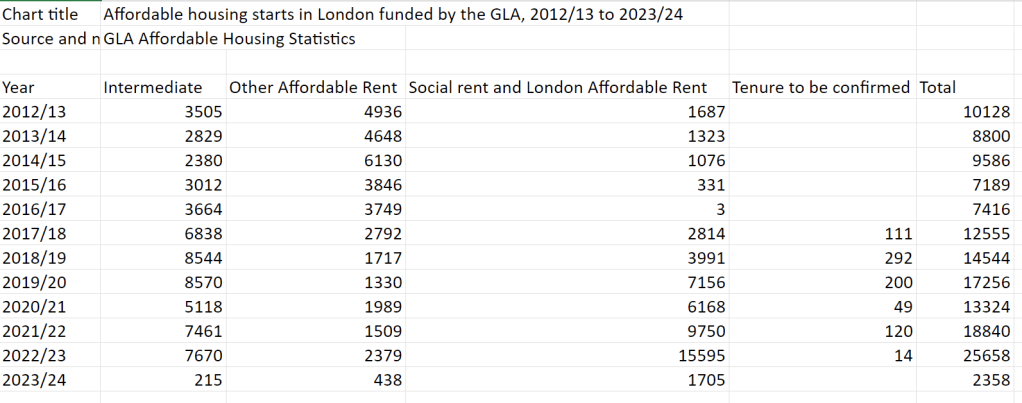
38% of homes and 46% of habitable rooms recommended for approval by the Mayor in 2023 were affordable, with both of these figures a record high (chart 2.5). Affordable housing starts funded by the GLA fell sharply between 2022/ 23 and 2023/ 24 (charts 2.8 and 2.9), as registered providers and local authorities have diverted resources away from new supply in response to increased remediation and refurbishment costs and the costs of adapting to changing regulations. Completions are also down, but not as much. Of the affordable homes started with GLA support in 2023/ 24, 72% were for social rent. Affordable completions from all funding sources also rose to a recent high of 15,768 in 2022/ 23 (chart 2.10), with data for 2023/ 24 not yet available.
Social housing landlords in London owned just under 800,000 affordable homes for rent in 2023, the highest total since 2002 (chart 2.12). Sales of council homes through the Right to Buy (RTB) scheme have been on a downward trend since their peak in the 1980s, totalling 1,080 in 2023/ 24 (chart 2.11).
Council tax data showed that 2.3% of homes in London were empty in 2023, with only 1% empty longer than 6 months (chart 2.13). These are much lower levels than in the 1980s and 90s, when around 5% of homes used to be empty.
1.34 million homes in London, or 36% of its stock were leasehold homes in 2022/ 23, over half of which were privately rented (chart 2.15). In 2023, there were 22,770 homes in multiple occupation (HMOs) with mandatory licences in London. This is the highest of any region (chart 2.14).”
This is chart 2.8 referred to in that text:
This is an extract from chart 2.4, showing the annualised trend per quarter in the number of new homes approved, and the number of projects:
Ahead of the awaited review of the London Plan, what can be done? The sorts of specific, practical, issues that currently come up again and again relate to the operation of the viability review mechanisms in particular. Since the new Building Safety Act regime came into force on 1 October 2023 the early stage review mechanism, kicking in if substantial implementation (usually defined as construction of the foundations and ground or first floor) hasn’t taken place within two years of permission, is increasingly unworkable for higher-risk buildings given how long the gateway two stage is taking in practice. The contingent liability that the late stage review mechanism represents is unattractive in principle to funders, which is a big challenge in a weak market.
For measures that could have had an immediate positive impact, what about, for instance, introducing suitable flexibility into the triggering of the early stage review? Potentially a temporary “holiday” from the late stage review for schemes that committed to proceed to completion within an agreed timescale? A willingness to accept renegotiation of section 106 agreements on schemes which are now unviable? Some pragmatism as to commuted payments towards off-site delivery where a registered provider cannot be found?
Whilst the document does include some measures which may help at the margins, there’s certainly no “big bang” of that nature. It is in fact curious how little fanfare the practice note has been given. I can’t even find it on the GLA website, let alone any press release. Nor was any formal consultation or indeed feedback invited.
Anthony Lee at BNP Paribas did this good summary on LinkedIn before Christmas but I have seen little else.
I draw out some of the measures as follows:
Allowing the fast track threshold to be reduced, both for new and current applications and also for consented schemes, where the tenure split provides proportionately more social rent than the policy requirement, in accordance with a formula that appears to seek to avoid any financial advantage to the developer in so doing – the only advantage being if that unlocks more GLA funding and/or more willingness on the part of registered providers.
Estate regeneration schemes will be able to qualify for the “fast track” if at least 50% of the additional housing will be delivered as affordable.
The GLA will consider accepting supported housing and accommodation for homeless households, with nomination rights for the relevant borough, as a like for like alternative for intermediate housing, again both for new and current applications and also for consented schemes.
The cost of any meanwhile accommodation for homeless households, with nomination rights given to the relevant borough, may be taken into account in the operation of viability review mechanisms.
With the late stage review, the developer currently retains 40% of any surplus profit. In certain circumstances this can now increase to 70%. However, the criteria are tight. “To qualify for this, the application must provide at least 25 per cent onsite affordable housing by habitable room for schemes with a 35 per cent threshold, and 35 per cent onsite for schemes with a 50 per cent threshold, at the relevant local plan tenure split, and be certified as reaching practical completion within three years of the date of this document.” “For larger phased schemes that provide at least 25 per cent affordable housing across the scheme as a whole that are granted planning permission after the date of this practice note, if the initial or a subsequent phase is certified as reaching practical completion within three years of the date of this document, the GLA will consider allowing the applicant to retain 70 per cent of any surplus profit identified in that phase when the late review is undertaken. The relevant phase must include at least 100 residential units.”
There is this enigmatic sentence: “The GLA will also work with boroughs to identify sites that have been allocated for development or that have been granted consent but that have not come forward for development for many years, or where limited progress has been made, and will assess the nature of interventions required to facilitate this.”
Great flexibility is announced as to the permissible inputs into review mechanisms. The formulae currently focus on changes in gross development value and build costs. “However, in some cases it may be more appropriate to allow for a full viability review to be undertaken which reconsiders all development values and a greater scope of development costs, including professional fees and finance costs.”
The Mayor’s housing design guidance should not be applied mechanistically, in relation to, for instance, the reference to the need to submit “fully furnished internal floorplans” and the objective that new homes should be dual aspect.
Various grant funding measures but I’ll look to others to comment as to the extent they will move the dial.
The Valentine Brothers original version obviously, rather than Simply Red.
In fact, pardon me if this post feels a little like the extended 12” remix, but I wanted to work out for myself some of the long-running arguments that are out there as to the role of financial viability testing in planning.
The subject has been made topical by the “viability in relation to green belt release” annex to the consultation draft revised National Planning Policy Framework, as well as Labour’s proposals in relation to “no hope value” CPOs (mentioned in my 21 July 2024 blog post Hope/No Hope). But the discussion is vital anyway in present circumstances where, in order to deliver and/or fund necessary housing development (and indeed many other forms of development), the state largely relies on the private sector, which is inevitably motivated by profit.
It’s difficult to have a sensible discussion without trying to establish some basic principles. So here goes…
We want an acceptable environment around us: sufficient social housing for those who need it, health and education facilities, biodiversity and open space, good public transport, footpaths and cycleways.
We no longer seem prepared to pay for this fully through direct taxation or indeed charitable benevolence.
Instead, over the last 25 years or so of my career, Government policy has increasingly supported the indirect taxation of development activity (primarily by way of section 106 agreement planning obligations and the community infrastructure levy) to help pay for all these good things, even where it is not the development itself that is leading to the need for the particular infrastructure or facilities (and before you raise it, regulation 122 of the Community Infrastructure Levy Regulations only provides cover against the most egregious of LPA “asks”).
Affordable housing is the classic example of what I mean by indirect taxation. As I set out in my 28 May 2017 blog post Affordable Housing Tax:
“In requiring the developers of private housing schemes to contribute to the provision of affordable housing, the planning system has become a tax collection system, and an inefficient, opaque one at that.
[…]
“The provision of market housing does not in any way increase the need for affordable housing, indeed over time by increasing supply if anything it should decrease it. It may be said that mixed use communities can only be achieved by requiring the inclusion of affordable housing within market residential schemes, but that in itself does not justify the state putting the cost of the affordable housing at the door of the developer.”
[Think how odd it would be for car makers to be required to sell a large proportion of their product at below market rate, in fact at a loss – or indeed for supermarket chains to be so required – nice as that thought might be. Why is housing so different?]
Add to this the much-reduced availability of grant funding.
You see the same indirect taxation in the case, for instance, of schools: whether or not a particular housing scheme is built, children need schooling somewhere in the country. And yet the cost of delivery of new schools is regularly met in large part by way of contributions and obligations extracted via the planning system.
Most recently, the 10% biodiversity net gain requirement. Laudable – but another indirect tax on development via the planning system.
All of this appears to be implicitly accepted as in the public interest, presumably on the basis that:
It’s a victimless crime – assumed to be paid for out of (a) the receipts the land-owner receives for sale of the land, as long as the requirements are flagged sufficiently far in advance that they can be built into the contractual arrangements between the land owner and developer and can generally manage the land-owner’s expectations; and/or (2) the developer’s profit (for whom the return needs to outweigh the risk).
It sugars the pill for local communities, which is important given the general antipathy towards development (or maybe that’s just my village’s Facebook group….).
It would be politically impractical to meet these costs via the national public purse.
This is all fine if the numbers work out – if the contributions required by policy can be paid for, whilst leaving enough money in the project to ensure that it will still proceed i.e. that between them:
The land-owner receives enough money to persuade them to sell the land, rather than hold onto it or sell it for other purposes
The developer concludes that there is a sufficient slice of profit left to make it worthwhile as a business proposition to proceed to carry out the development, having regard to the availability, and likely cost over time, of development finance and/or of funding partners, and the range of development risks such as the costs of construction, other regulatory costs and uncertainties over time, unforeseen problems along the way and as to the financial return likely to be achieved at the end of it all
The purchaser or renter of the home is protected by operation of market forces against the cost simply being passed onto them.
What happens when the contributions requested in return for planning permission don’t work out? That is where the viability appraisal process comes in.
The Planning Practice Guidance https://www.gov.uk/guidance/viability advises that local plans “should set out the contributions expected from development. This should include setting out the levels and types of affordable housing provision required, along with other infrastructure (such as that needed for education, health, transport, flood and water management, green and digital infrastructure).
These policy requirements should be informed by evidence of infrastructure and affordable housing need, and a proportionate assessment of viability that takes into account all relevant policies, and local and national standards, including the cost implications of the Community Infrastructure Levy (CIL) and section 106. Policy requirements should be clear so that they can be accurately accounted for in the price paid for land.”
Obviously, it is sensible for local plans to give as much certainty as possible as to what contributions will be sought from developers and thereby to serve to dampen the expectations of land-owners. But the reality is that viability assessments at the local plan making stage are inevitably broad-brush, often based on typical development typologies. They become out of date. There is often insufficient push-back from developers – either because they do not yet have a relevant project in mind at the time the plan is being consulted upon and examined, or because they are nervous about losing the potential allocation of their site for development. And so policy aspirations are set high.
When an application for planning permission comes forward for development which is in accordance with the local plan or otherwise in the public interest, save that the full range of policy requirements cannot be met without rendering the project unachievable, what happens then?
To quote paragraph 58 of the current NPPF (which paragraph is not proposed to be amended in the consultation draft):
“Where up-to-date policies have set out the contributions expected from development, planning applications that comply with them should be assumed to be viable. It is up to the applicant to demonstrate whether particular circumstances justify the need for a viability assessment at the application stage. The weight to be given to a viability assessment is a matter for the decision maker, having regard to all the circumstances in the case, including whether the plan and the viability evidence underpinning it is up to date, and any change in site circumstances since the plan was brought into force. All viability assessments, including any undertaken at the plan-making stage, should reflect the recommended approach in national planning guidance, including standardised inputs, and should be made publicly available.”
A decision-maker can decide to grant planning permission without commitments on the part of the developer to all of the contributions normally required by policy, if the developer has justified that the development would otherwise be unviable demonstrating that by way of a viability assessment carried out in accordance with the methodology set out in the Government’s Planning Practice Guidance.
The guidance these days is tighter than it was, although there is still much room for debate and disagreement as between the developer’s surveyor and the surveyor engaged by the local planning authority (invariably at the developer’s cost). There is much public discussion about “benchmark land value” in this exercise, i.e. in estimating the costs of carrying out the development, what cost should be assumed for the land itself? But that is by no means the only factor when it comes to viability. In many situations, development may be unviable even assuming little or no land value, simply because of, for instance, the large infrastructure costs which would need to be met by the developer, financing costs and/or low value of the completed development – and this is all made more complicated in relation to longer-term projects, where an internal rate of return model may be more appropriate. But for I’m going to focus here on the land value issue.
It’s been clear for many years that the benchmark land value to be plugged into the viability appraisal is not the price that the developer has actually paid for the land – see for example Parkhurst Road Limited v Secretary of State (Holgate J, 27 April 2018). Instead, the usual approach, according to the Planning Practice Guidance, should be EUV+, i.e. to take the existing use value (ignoring, for example, any development potential) and then to apply a premium. Oh dear, one of the big questions is how big should that premium be? The guidance says this:
“The premium should provide a reasonable incentive for a land owner to bring forward land for development while allowing a sufficient contribution to fully comply with policy requirements.
Plan makers should establish a reasonable premium to the landowner for the purpose of assessing the viability of their plan. This will be an iterative process informed by professional judgement and must be based upon the best available evidence informed by cross sector collaboration. Market evidence can include benchmark land values from other viability assessments. Land transactions can be used but only as a cross check to the other evidence. Any data used should reasonably identify any adjustments necessary to reflect the cost of policy compliance (including for affordable housing), or differences in the quality of land, site scale, market performance of different building use types and reasonable expectations of local landowners. Policy compliance means that the development complies fully with up to date plan policies including any policy requirements for contributions towards affordable housing requirements at the relevant levels set out in the plan. A decision maker can give appropriate weight to emerging policies. Local authorities can request data on the price paid for land (or the price expected to be paid through an option or promotion agreement).”
There are some examples of where a premium of many times the EUV has been found to be appropriate. For example:
Long Marston, Pebworth (APP/H1840/S/16/3158916, 16 May 2017): In the particular circumstances there, the inspector found that a premium of around 15 times the EUV was appropriate. (The appeal pre-dated the PPG but turned on a similar earlier concept of EUV+).
Parkhurst Road, Islington (APP/V5570/W/16/3151698, 19 June 2017): The appeal site was a former Territorial Army barracks in north London. The inspector found that the EUV was £2.4m but EUV+ was £6.75m (still less than the developer had paid for the site) . In the subsequent High Court challenge I refer to above, Holgate J the judge said this about EUV+: “Some adherents appear to be promoting a formulaic application of ‘EUV plus.’ But as the RICS advised its members in its 2012 Guidance Note, an uplift of between 10 and 40% on existing use value is an arbitrary number and the method does not reflect the workings of the market…”.
Old Oak and Park Royal local plan examination in public, Inspector’s Interim Finding on Viability (10 September 2019) : In relation to the Car Giant site forming most of the plan area, a very large brownfield site in north London, the inspector found the EUV to be £5.3m. The Old Oak and Park Royal Development Corporation’s surveyors suggested a premium of 20% would be appropriate. The inspector found that the characteristics of the site, including in particular Car Giant’s significant relocation costs, would justify a far larger premium, concluding that EUV+ was “clearly in excess of £240m”.
On the one hand, this sort of exercise may be seen as sensible in that it is seeking to get to the number that can be taken to be the tipping point at which a land-owner might rationally choose to sell rather than stay put. But of course, on the other, the potential range is so wide that the outcome of the process can be very unpredictable and result in high numbers – true but what is the alternative that enables or persuades land-owners (who are often in fact reluctant to sell in any event – their heads only turned by a financial offer they can’t refuse) actually to make their land available, unless there is a market intervention such as compulsory purchase (but (1) that obviously needs careful justification and (2) a careful look is needed at how the compulsory purchase compensation principles work), some targeted form of tax credits or in fact (never thought I’d say this and I still only think this works in theory rather than reality) community land auctions?
I’ll throw in another complication here: the figures in a viability appraisal are in part theoretical. We know that the actual price paid for the land isn’t plugged into the equation. The actual price may have been far higher, meaning that the developer is always going to be struggling to get the project off the ground. It may have been lower – the land may have been held for generations, with a very low current book value, or be held by a body that is prepared to make the land available at an under-value. Similarly as to the efficiencies in construction or financing that a particular developer may be able to bring to the process (versus the greater challenges in this respect an SME may have than a national housebuilder), or preparedness to take a reduced profit, or even a loss with this development, given wider objectives. If we want an objective scrutiny of the financial position, not tied to a particular developer who may of course in any event sell on, this is probably right. But it does mean that there may be two processes underway: (1) what is the objective agreed assessment as to the viability of the project and (2) is this developer for some reason prepared to offer more than what is objectively viable on the basis of that agreed assessment?
Can we at least agree that this subject is not easy, either in macro policy terms or in its detailed application? And that whilst it may be tempting for some to say “get rid of viability testing, development must simply meet all policy requirements”, can we agree that this is unrealistic without (1) up to date realistic local plan policies (unlikely) or (2) an acknowledgement that effect would less development coming forward, particularly in the areas where it is most needed?
At which point I turn to the Government’s proposals.
A new annex is included in its draft revised NPPF, headed “viability in relation to green belt release”, but one of the only two new elements of the proposed approach set out in that annex is what I have put in bold in the following paragraph:
“To determine land value for a viability assessment, a benchmark land value should be established on the basis of the existing use value (EUV) of the land, plus a reasonable and proportionate premium for the landowner. For the purposes of plan-making and decision- taking, it is considered that a benchmark land value of [xxxx] allows an appropriate premium for landowners. Local planning authorities should set benchmark land values informed by this, and by local material considerations.“
These are the key associated paragraphs in the consultation document which explain the “[xxxx]“:
“29. Approaches that government could take to ensure the appropriate use of viability include the following options.
a. Government sets benchmark land values to be used in viability assessments. When assessing whether a scheme is viable, it is necessary to make an allowance for the amount of money to be paid to the landowner. This should currently be set by the local planning authority. Government could set indicative benchmark land values for land released from the Green Belt through national policy, to inform the policies developed on benchmark land value by local planning authorities. These should be set at a fair level, allowing for a premium above the existing use, but reflecting the need for policy delivery against the golden rules. Different approaches to benchmark land value are likely to be appropriate for agricultural land, and for previously developed land.
b. Government sets policy parameters so that where land transacts at a price above benchmark land value, policy requirements should be assumed to be viable. As part of this approach, Government sets out that if land has been sold (or optioned) at a price which exceeds the nationally set benchmark land value, viability negotiation should not be undertaken. Under this approach, the planning authority should not be seeking higher contributions (e.g. 60 per cent affordable housing), but equally the developer should not be seeking lower contributions (e.g. 40 per cent affordable housing), as this would represent a transfer of value from the public to private landholders. Therefore, planning permissions would not generally be granted for proposed developments where land transacts above benchmark land value, and cannot comply with policy.
c. Government sets out that where development proposals comply with benchmark land value requirements, and a viability negotiation to reduce policy delivery occurs, a late-stage review should be undertaken. This would build on the approach to be taken by the Greater London Authority, and tests actual costs and revenues against the assumptions made in the initial viability assessment. If, for example, the development is more viable than initially assumed, due to a rise in house prices, then additional contributions can be secured, to bring the development closer to or up to policy compliance.
30. Benchmark land values are generally set as a multiple of agricultural use values, which are typically in the region of £20,000 – £25,000 per hectare, and as a percentage uplift on non-agricultural brownfield use values. We also note that views of appropriate premia above existing use values vary: for agricultural land, a recent academic paper[footnote 6 ] suggested BLVs of three times existing use value; the Letwin Review of Build Out [footnote 7] suggested ten times existing use value; Lichfields found that local planning authorities set BLVs of between 10- and 40-times existing use value [footnote 8 ]. These BLVs do not necessarily relate to Green Belt land, which is subject to severe restrictions on development, and Government is particularly interested in the impact of setting BLV at the lower end of this spectrum.
31. The Government considers that limited Green Belt release, prioritising grey belt, will provide an excellent opportunity for landowners to sell their land at a fair price, while supporting the development of affordable housing, infrastructure and access to nature. Where such land is not brought forward for development on a voluntary basis, the Government is considering how bodies such as local planning authorities, combined authorities, and Homes England could take a proactive role in the assembly of the land to help bring forward policy compliant schemes, supported where necessary by compulsory purchase powers, with compensation being assessed under the statutory no-scheme principle rules set out in Part 2 of the Land Compensation Act 1961.
32. In such cases, these rules would operate to exclude any increases or decreases in value of land caused by the compulsory purchase scheme, or by the prospect of it, and valuation of the prospect of planning permission (‘hope value’) for alternative development would reflect the golden rules outlined in the NPPF. Use of compulsory purchase powers may also include use of directions to secure ‘no hope value’ compensation where appropriate and justified in the public interest. A comprehensive justification for a no hope value direction (e.g., which includes a high proportion of vital affordable housing being delivered) will strengthen the argument that a direction is in the public interest. This would align with the Government’s aspiration for high levels of affordable housing to be delivered on these sites.”
That emboldening is in the document itself. So, we are looking at a potential approach where, for the purposes of viability appraisals on green belt sites (where there will be the policy requirement of “at least 50% affordable housing, with an appropriate proportion being Social Rent”) the Government caps the potential premium on existing use value more towards 3x than between 10 and 40x. That would provide some clarity, and would in the long term (beyond the gestation of current promotion agreements, option agreements and the like which will have baked in potentially higher figures) dampen land-owner expectations. However, the outcome may be that some potential sites are not released by land-owners because the resultant return is simply not worth it for them – they would prefer to hold the land for its current purposes, or make it available for non-residential development which may result in a higher premium, or wait for a more liberal policy climate to open up in future decades – and in the meantime battle against any threat of compulsory purchase. This is particularly the case at the moment where, as another risk to factor in, there is a dearth of registered providers even willing to build-out or take on the affordable housing element in some areas. The impacts of the approach will also particularly be felt in areas with weaker housing markets, where 50% affordable housing (including, importantly, an as yet unknown proportion of socially rented housing) will be a big drag on viability – and those areas are often the same areas where housing targets will be going up most steeply under the proposed revised standard method.
This proposal to set a blanket cap on existing use values really does need to be stress-tested during the current consultation period. I would particularly urge those with market knowledge to review those papers referred to in paragraph 30 quoted above – I have included the links. For instance, I couldn’t immediately see the workings for 3x EUV in that first paper.
The other change which that annex proposes is in its last line:
“Where a viability negotiation to reduce policy delivery has been undertaken, a late-stage review should be conducted to assess whether further contributions are required.”
Remember, this annex only relates to development in the green belt, but its effect is to advise that where policy compliant development (eg 50% affordable housing), cannot be delivered due to lack of viability, a provision should be included in the section 106 agreement, providing for a review at a later stage, or at later stages, of the development to see whether that is still the position or whether the project is now able to afford to meet those policy commitments, in full or at least in part. Obviously, in London, this has been relatively standard for some time (see eg the Mayor’s May 2023 draft development viability London Plan Guidance), and is often used in negotiations across the country. But the negotiation is never straight-forward, even in London where the provisions are so standardised. What should be the triggers; what is opened up on the review (and is it just a review of what has been developed so far or is it also an updated estimate of what has not yet been built); what proportion of the surplus should be retained by the developer so as to provide any incentive; what should be the cap on what can be secured on review (vital, as all of this is very sensitive to funders and lenders); what should any surplus be applied towards and what say does the developer has in this?
The threat of compulsory purchase in the case of recalcitrant landowners? That takes us back to the issues I covered in that Hope/No Hope blog post. In some cases, perhaps so, but of course as I have mentioned above, even acquisition of land at existing use value (which obviously would lead to protracted wrangling in many cases) does not always guarantee project viability.
Whether tis nobler in the mind to suffer the slings and arrows of outrageous fortune. Or to take arms against a sea of troubles by amending your permission to reflect current market or occupier requirements? Because, of course, in the equally timeless words of Gary Barlow, everything changes.
The main part of this blog post is a detailed examination by my Town Legal colleague Susie Herbert of the potential opportunities arising from use of section 73B of the 1990 Act, introduced by way of the Levelling-up and Regeneration Act 2023, and its potential limitations and ambiguities versus section 73. It’s an important part of DLUHC’s current consultation as to an accelerated planning system which I said I would come back to in my 9 March 2024 post that covered the rest of the proposals.
But first, an interesting appeal decision letter from last week. You may remember that for a temporary period (2013 to 2016) there was a specific statutory procedure, section 106BA, which allowed developers to apply to modify or discharge planning obligations in a section 106 agreement on the basis that they made the development unviable.
Since the repeal of section 106BA the question often arises as to how we might still achieve the same ends. After all, an application under section 106A to amend a section 106 agreement can only be made if the agreement is at least five years’ old. Otherwise, in proposing a deed of variation to the existing agreement, you are in the local planning authority’s hands with no right of appeal.
The alternative options would be to make an entirely fresh application for planning permission (an onerous process) or, conceivably, to make an application under section 73 for removal or variation of a condition attached to the previous planning permission and to use the application as a vehicle for proposing an amended form of planning obligation. The section 73 route was accepted by an inspector in a decision letter dated 25 March 2024 in relation to a proposed development in Thornton Heath, Croydon. There is an existing planning permission for 57 new dwellings , with a section 106 agreement requiring 35% of the homes to be delivered as affordable housing. A Section 73 application was made to amend condition 2 attached to the permission which set out a list of the approved drawings, proposing amended drawings increasing the proportion of three bedroom homes and external alterations to fenestration and elevations. A section 106 unilateral undertaking was put forward proposing no affordable housing, on the basis of a viability appraisal, which had been reviewed and accepted by the local planning authority. The application was not determined within the statutory period and the developer appealed. The authority resisted the appeal on the basis that a section 73 application was not the appropriate means to reduce the level of affordable housing previously secured.
Having reviewed the relevant case law in relation to section 73, the inspector allowed the appeal:
“In this instance, a change in policy has not made it appropriate or essential to amend the obligation. However, there has been a significant change in circumstances relating to the viability of the scheme. It seems to me that it is a matter of planning judgment whether the change in circumstances makes it appropriate, essential or desirable to enter into a planning obligation in different terms to the original. Given the case law outlined above, the terms of a new obligation may be connected to or intertwined with the amendments sought to the drawings, but there is nothing of substance to suggest they must. Consequently, it would be going too far to suggest an amended obligation must be a consequence of, or directly related to, changes flowing from the proposed alterations detailed on the new drawings.
There is no dispute between the Council and appellant that since the original permission was approved, and the evidence underpinning it prepared, construction costs have rapidly risen whilst house prices have remained static. This has had a significant impact on the viability of the scheme. As mentioned above, the situation is so altered that the Council and appellant agree the scheme can no longer provide affordable housing and remain viable. Moreover, there is also common ground that the provision of affordable housing is not a benefit, alone or taken with other factors, which is required to outweigh any harmful impacts emulating from the scheme. Indeed, the Council has only identified limited harm in respect of the housing mix, which is outweighed by other considerations in any event. In these circumstances, altering the level of affordable housing would not be a fundamental change to the proposal.
Therefore, the current circumstances are such that there is a need for a planning obligation in different terms to the original to facilitate delivery. The altered terms of the planning obligation would be consistent with the development plan taken as a whole. The consequence being that the change would not have a bearing on whether the scheme would be acceptable. Thus, the amended planning obligation is necessary, reasonable, supported by development plan policy and proportionate in the context of the prevailing circumstances. Therefore, it is desirable, essential and appropriate to consider a planning obligation in different terms to the original, namely the provision of 0% affordable housing with a review mechanism as required by the LP. In conclusion, the s73 application is an appropriate means in this instance to reduce the level of affordable housing relative to that previously secured.”
The case is another example of the potential flexibility of the existing section 73 procedure, notwithstanding the constraints imposed by the courts – particularly by way of Finney (the inability to use section 73 where the desired changes would be inconsistent with the description of development on the face of the existing permission (leading to a workaround in practice, with a willing authority, by way of use of section 96A in conjunction with section 73 – see my previous blog post here for more information).
Section 73B
So will the new section 73B procedure be the solution. Over to my colleague Susie Herbert for the detail…
On Budget Day, 6 March 2024, DLUHC launched a consultation on accelerating the planning system which closes on 1 May 2024. As well as proposals relating to the application process, this includes a consultation on the implementation of section 73B to vary planning permissions and on the treatment of overlapping permissions. This post concentrates on the proposals concerning variations to planning permissions via the new section 73B and the proposals for overlapping permissions.
Section 73B was introduced by the Levelling-up and Regeneration Act 2023 (“LURA”). The provision is headed “Applications for permission not substantially different from existing permission”. It is not yet in force and secondary legislation is required to specify the application procedure including consultation arrangements, information requirements and the application fee as well as amendments to the CIL regulations. The government proposes to implement section 73B following the consultation “as soon as parliamentary time allows”.
The consultation asks questions on:
The scope of the proposed Planning Practice Guidance relating to section 73B;
Procedural arrangements for a section 73B application;
Application fees for section 73B applications;
CIL and section 73B applications.
As background, the introduction to this section of the consultation notes “The ability to vary planning permissions in a proportionate, transparent and timely manner is an important feature of the development management system. It is common for developments, particularly if they are large, to require variations to the planning permission in response to further detailed design work, new regulatory requirements, and changing market circumstances. Without this flexibility, development risks being delayed or abandoned as the only option would be the submission of a brand new application for the development which would create uncertainty, delay and further costs.”
The consultation notes that the current legislative routes to varying planning permissions are section 73 and section 96A. In 2009, guidance was introduced on “Greater Flexibility for Planning Permission”. It was at this point that section 96A was introduced into the legislation to allow for “non-material” amendments to existing planning permissions. The guidance envisaged that section 73 could be used for “minor-material” amendments by varying a condition that listed the approved plans by substituting new plans that showed the varied scheme.
However, in 2020, the Courts confirmed that section 73 cannot be used to amend the description of development (Finney). Therefore, the scope to use section 73 to make “minor material amendments” by varying a condition which lists the approved plans is limited.
Although not expressly explained in the consultation document, the reason that the inability to use section 73 to amend the description of development causes such difficulties in practice is because the case law has established that a permission granted under section 73 cannot introduce a condition which creates a conflict or is inconsistent with the description of development. It has therefore become standard practice to minimise the level of detail provided in the description of development and thereby reduce the potential for future scheme amendments to conflict with the description. In some cases an original description of development can be amended via s96A to remove detail from the description of development into a condition and thereafter amend this condition via section 73.
Section 73B is intended to deal with this issue by allowing both the description of development and the conditions to be varied in a single process. The restriction on the use of section 73B is that the amended development cannot be “substantially different” from the existing development.
“Subtantially different”
A key point in the consultation is that the Government does not propose to provide prescriptive guidance on is what is meant by “substantially different”. The consultation notes that section 73B does not provide a definition of the test and that it will depend on the scale of the changes required in the context of the existing permission. Factors that could be relevant are location and the scope of the existing permissions and the proposed changes.
It is not clear where “substantially different” will sit on the scale of potential changes. We note that this term was used in the 2009 guidance on flexible planning permissions in respect of what was meant by a “minor material amendment” which stated:
“We agree with the definition proposed by WYG: “A minor material amendment is one whose scale and nature results in a development which is not substantially different from the one which has been approved.” This is not a statutory definition.”
This suggests that the intention may have been that section 73B was intended to align with the minor material amendments that the guidance envisaged to be made under section 73 with the additional ability to amend the description of development (to make “non-substantial” changes).
However, since this drafting was introduced into the Levelling Up and Regeneration Bill, the Armstrong and Fiske cases have confirmed that section 73 is not restricted to minor material amendments. It is helpful that at footnote 4, the document expressly states that “the department acknowledges that section 73 is not limited in scope to minor material amendments” following the recent cases of Armstrong and Fiske. The judge in Fiske held that there is a restriction on the scope of section 73 which is whether the alteration is fundamental (while in Armstrong the judge had considered that even this restriction did not apply and the only restriction is consistency with the description of development).
Therefore, if the scope of changes allowed by section 73B is intended to be similar to “minor material amendments”, there is the possibility that section 73 would actually allow more flexibility as it extends to “not fundamental” amendments (provided always that it is possible to remain within the description of development).
While it is understandable that the Government does not propose to provide prescriptive guidance on the meaning of “substantially different” because it will be a matter of judgement dependent on the context (as for section 96A), it is clear that the application and interpretation of this provision by each LPA is going to be a key to how useful this provision is in practice.
The consultation states that the government’s proposed objective is for the section 73B route to replace the use of section 73 to deal with proposals for general material variations while the use section 73 would return to focus on the variation of specific conditions and that it proposes to introduce guidance to this effect.
It would therefore be helpful if the scope of changes allowed under section 73B was not less that the scope of changes that could be made via a section 73/ section 96A approach: otherwise the end result of the changes would be more complexity but less flexibility. It does not seem that it would be overly prescriptive for the Government to provide guidance to this effect. It would also be consistent with the general proposed approach of treating a section 73B application in a similar way to a section 73 application in terms of procedure (as detailed below).
Features of section 73B
The consultation summarises the key legal features of section 73B as follows:
a section 73B application must identify the existing permission (which cannot be a section 73, section 73A or other section 73B permission, or permission granted by development order), and can propose conditions for the new permission;
as an application for planning permission to a local planning authority, the determination of a section 73B application is subject to section 70 and other decision making duties. But the local planning authority cannot grant permission for a section 73B application if the effect of the section 73B permission would be substantially different from the existing permission, and when determining the application, they must limit their consideration to the variation between the application and the existing permission; and
like a section 73 permission, a section 73B permission is a separate permission to the existing permission (and any other section 73 or 73B permissions related to the existing permission) so the granting of a section 73B permission does not affect the validity of the existing permission (or other section 73 or 73B permissions).
The provision also applies to applications for permission in principle.
Proposed general approach
As noted above, the Government’s proposed objective is for the section 73B route to replace the use of section 73 to deal with proposals for general material variations while the use section 73 would return to focus on the variation of specific conditions. The consultation notes that because section 73 cannot be used to amend the description of development, it has become common practice to submit generic descriptions of development which do not specify key feature such as the number of dwellings with those details set out in conditions to allow them to be varied via section 73. The consultation identifies that a benefit of using section 73B would be to allow a return to clear and more specific descriptions which would help improve the transparency of development proposals for local communities.
The Government therefore proposes to use Planning Practice Guidance to encourage the use of clearer, more transparent descriptors of development and the use of section 73B to deal with general material changes to development granted planning permission. The consultation asks “do you agree that guidance should encourage clearer descriptors of development for planning permissions and section 73B to become the route to make general variations to planning permissions (rather than section 73)? (Question 26)” and “also for any further comments on the scope of the guidance (Question 27)”. This includes the question of whether the guidance should discourage the use of the, now standard, condition which lists approved plans which was introduced to facilitate minor-material amendments via section 73. The consultation states that they are not minded to discourage the use of this condition and that it is beneficial to help support effective planning enforcement, particularly in relation to design.
Procedural arrangements
The aim is for the procedural requirements set out in regulations for a section 73B application to be “proportionate reflecting the position that the development proposed in the application is a material variation to an existing permission while still ensuring there is transparency about the proposed variation” and that “Local communities should be aware of proposed variations so they can make representations: the section 73B route is not a mechanism to undermine scrutiny.”
The proposal is:
information requirements will be generally the same as other applications for planning permission but certain requirements (such as a design and access statement) will not be required.
publicity requirements will be the same as other applications for the type of development (i.e. if it is a variation to major development, the major development publicity requirements would apply).
Consultation with statutory consultees would follow the approach of section 73 applications where there is a duty on the local planning authority to consult a statutory consultee if they consider appropriate (reflecting the position that a proposed variation may only engage specific issues which of an interest to only some statutory consultees and so it would be disproportionate to require those statutory consultees without an interest to respond) although the footnote states that applications would automatically be in scope of the consultation duty between counties and district LPAs, the consultation arrangements for parishes and neighbourhood forums and the arrangements for applications of potential strategic importance under section 2A TCPA 1990 for the Mayor of London and those combined authorities which have section 2A powers.
EIA and HRA requirements would apply as for section 73 permissions and a similar approach would be taken to Biodiversity Net Gain.
The consultation asks whether consultees agree with this proposed approach to procedural requirements.
Fees
The proposal is to align the fee for a section 73B application with the fee for a section 73 application. The alternative approach of setting a higher fee for a section 73B application was considered on the basis that the section 73B route could be the default route for general material variations while section 73 focuses on the variation of a specific condition. However, the higher fee could encourage applicants to continue to use section 73, undermining the purpose of the reform.
However, it is proposed to change the current flat fee approach for a section 73 application (£293) so that there would be three separate fee bands for householder, non-major development and major development.
The householder fee would be reduced to £86 (double the fee for discharge of condition and removing the anomaly that an original householder application fee is lower than the section 73 fee). The non-major development fee would remain at £293.
For major development, there would be a higher fee which would be less than the fee for the original application and proportionate to the work necessary to consider the proposed variation (without exceeding full cost recovery). The consultation asks for views about where this fee should be set, including evidence from local planning authorities for the typical work which is involved dealing with an average section 73 application for a major development.
CIL
It is proposed that CIL would apply to section 73B in the same way that it applies to section 73 permissions. This would mean that “if the section 73B permission does not change the CIL liability, the chargeable amount is that shown in the most recent liability notice issued in relation to the previous permission. But if the section 73B permission does change the CIL liability, the most recently commenced or re-commenced scheme is liable for the levy.”
Overlapping permissions and section 73B
The consultation refers to the recent Hillside and Dennis cases on overlapping permissions [see previous simonicity blog posts respectively here and here] and how these judgments have questioned the ability to use ‘drop in’ permissions where a subsequent permission is granted for an alternative development on a section of a larger development previously granted permission and still being implemented.
It summarises Hillside as confirming existing caselaw that “full planning permissions are not usually severable. That is to say, parts of the permission cannot be selectively implemented and that, if a new permission which overlaps with an existing permission in a material way commences, should the carrying out of the new permission make it physically impossible to carry out the rest of the existing permission, it would be unlawful to continue further development under the existing permission. The Court then went on to say, if someone wanted to change part of the development, they should seek to amend the entire existing permission.” And notes that Dennis considered the implications for outline planning permissions and the question of severability further.
It notes that “drop in permissions have often been used during the implementation of outline planning permissions for large scale phased residential and commercial developments where a new development is proposed through a separate application for a phase outside the scope of the outline planning permission while the rest of the phases continue to be implemented under the outline permission. This approach has provided a flexible way of enabling changes to a specific phase to be managed through planning without having to seek a new planning permission for the entire development, particularly when the scale of change is outside the scope of a section 73 application.”
In terms of section 73B, “The government believes that the new section 73B route provides a new way of dealing with such changes to a specific phase of a large scale development granted through outline planning permission in many cases. While the use of section 73B is constrained by the substantively different test, these changes often continue to fit within the existing masterplan which underpins the outline permission and do not necessarily fundamentally change this permission – for instance, changing a phase of commercial development (use class E) to a cinema (use class – sui genesis) where the outline permission only allows class E uses. In this case, the section 73B application would provide details of the proposed variation to the outline planning permission and the consideration by the local planning authority would focus on the merits of this variation.”
However it is recognised that “there could be circumstances where the section 73B route may not be appropriate – for instance, if the change could be considered to be substantially different or there are wider financial and legal relationships between the master developer, land owners and investors which makes the preparation of a section 73B application difficult.”
The consultation asks for views about the extent to which the section 73B route could be used to grant permission for changes for outline planning permission in practice and what the constraints are.
It is clearly helpful that the consultation acknowledges that a new use could be introduced via section 73B which gives more potential flexibility and simplicity than a section 73 approach. However, as noted, changes may well be considered “substantially different” even if they allow the remainder of a masterplan to be developed without amendment. There are also undoubtably complications in obtaining a new planning permission (even a section 73B) for an entire site where development has started and different plots are being developed by different developers, particularly if a section 106 agreement is required to be varied.
The final section of the consultation is a proposal to create a framework through a new general development order to deal with circumstances that cannot be addressed via section 73B. This general development order would deal with overlapping permissions in certain prescribed circumstances. It notes that the Secretary of State has broad powers under section 59 of the Town and Country Planning Act to provide for the granting of planning permission through an order, including classes of development. This may be for a specific development or for a class of development.
The consultation asks for views on whether the focus of such an approach should be on outline permissions for largescale phased development or whether there are any other categories of development which could benefit from an alternative approach.
The consultation questions are:
Question 33. Can you provide evidence about the use of the ‘drop in’ permissions and the extent the Hillside judgment has affected development?
Question 34. To what extent could the use of section 73B provide an alternative to the use of drop in permissions?
Question 35. If section 73B cannot address all circumstances, do you have views about the use of a general development order to deal with overlapping permissions related to large scale development granted through outline planning permission?
It is not clear what the general development order proposal would entail but it is clear that an alternative approach for circumstances where section 73B cannot be used would be valuable and it is encouraging that the government is exploring further options to address the Hillside issue.
Thanks Susie for the above. Given ongoing concerns that I suspect many of us have both as to the need for a proportionate procedure for amending permissions but also more specifically to find a solution to the unnecessary complexities we all face by way of Hillside and Dennis, this is going to be an important consultation process.
The uncertainties as to whether “minor material” “substantially different” and “fundamental alteration” also bring to mind the consideration given recently by the Planning Court to whether, in the NPPF, “substantial” has a different meaning to “significant“, in Ward v Secretary of State (Lang J, 25 March 2024) (answer, after lengthy and unnecessary confusion which could have been prevented by accurate language used at the outset: nope).
Simon Ricketts, 1 April 2024
Personal views, et cetera
Edwin Booth as William Shakespeare’s Hamlet, circa 1870, courtesy Wikipedia
Hey let’s get Joan Armatrading on the Walkman. We’re going back – way back…
The Levelling-up and Regeneration Bill had its first reading in the House of Commons over a year ago on 11 May 2022. It’s not just intervening political chaos which has caused this slow-moving caravan of disparate policy notions to lurch from side to side with occasional abrupt halts Along the way additional bright notions have been loaded onto it, impeding progress still further.
One of those notions is the old chestnut of community land auctions. Clauses 127 to 137 were added to the Bill in November 2022 without prior consultation, once Michael Gove became Secretary of State, so as to allow community land auctions to be piloted for ten years.
CLAs are of course catnip to many political types and economists, for instance supported by Policy Exchange (see eg Alex Morton’s 2013 paper A Right To Build) and the YIMBY Alliance, as part of the wider thinking on land value capture (see eg my 20 May 2017 blog post Money For Nothing? CPO Compensation Reform, Land Value Capture). My conclusion remains that the introduction of community land auctions would inevitably be harmful to the principled operation of the planning system – it’s just too darned complicated – and to the delivery of development in the right places – for instance it introduces a huge conflict of interest for the local planning authority as between whether to plan for the best places or the best returns. In my view primary legislation to allow for a pilot is premature. If there are excess unearned gains for the state (in addition to what is already extracted via the planning system), why not just openly tax them rather than embark on this three cup trick?
“A “community land auction arrangement” means an arrangement provided for in CLA regulations under which—
(a) a local planning authority is to invite anyone who has a freehold or leasehold interest in land in the authority’s area to offer to grant a CLA option over the land, with a view to the land being allocated for development in the next local plan for the authority’s area,
(b) any CLA option granted under the arrangement ceases to have effect if the land subject to the option is not so allocated when that plan is adopted or approved (unless the option has already been exercised or been withdrawn or otherwise ceased to have effect), and
(c) the local planning authority may—
(i) exercise the CLA option and dispose of the interest in the land to a person who proposes to develop the land,
(ii) exercise the CLA option with a view to developing the land itself, or
(iii) dispose of the CLA option to a person who proposes to exercise it and then develop the land.”
Clause 128: “Power to permit community land auction arrangements
(1) This section applies where—
(a) the Secretary of State directs that a local planning authority which is to prepare a local plan may put in place a community land auction arrangement in relation to that plan,
(b) the local planning authority resolves to do so (and that resolution has not been rescinded), and
(c) the community land auction arrangement has not come to an end.
(2) The local plan may only allocate land in the authority’s area for development—
(a) if the land is subject to a CLA option or a CLA option has already been exercised in relation to it, or
(b) in circumstances which are prescribed by CLA regulations.
(3) Any financial benefit that the local planning authority has derived, or will or could derive, from a CLA option may be taken into account—
(a) in deciding whether to allocate land which is subject to the option, or in relation to which the option has been exercised, for development in the local plan;
(b) in deciding whether the local plan is sound in an examination under Part 2 of PCPA 2004.
(4) CLA regulations may make provision about how, or to what extent, any financial benefit may be taken into account under subsection (3) (including provision about how any financial benefit is to be weighed against any other considerations which may be relevant to whether the land should be allocated for development in the local plan or to whether the plan is sound).”
Receipts are to be used to support development in an area by funding infrastructure and paying for the administration of the community land auctions process.
The provisions were debated in House of Lords Committee on 18 May 2023 (the relevant part of the debate starts from amendment 364B) and it might put some flesh on the bones to see how a Government minister, Earl Howe, explains how it is all intended to work:
“Community land auctions are an innovative process of identifying land for allocation for development in a local planning authority’s area in a way that seeks to optimise land value capture. Their aim is to introduce transparency and certainty by allowing local planning authorities to know the exact price at which a landowner is willing to sell their land. The crux of our approach is to encourage landowners to compete against each other to secure allocation of their land for development in the local plan by granting a legally binding option over their land to the local planning authority.
The competitive nature of community land auction arrangements incentivises landowners to reveal the true price at which they would willingly part with their land. If the land is allocated in the local plan upon its adoption, the local planning authority can sell the CLA option, keeping the amount that the successful bidder has paid and capturing the value that has accrued to the land as a result of the allocation. The successful bidder must then pay the price set out by the original landowner in the option agreement to purchase the land. The detailed design of community land auction arrangements will be set out in regulations that will be subject to the affirmative procedure.”
“…sustainable development remains at the heart of our approach. Piloting authorities will decide which land to allocate in their emerging local plans by considering a range of factors, which the Government will set out in guidance. Unlike conventional local plans, when allocating sites, local planning authorities will be able to consider the financial benefits that they are likely to accrue from each site. How, and the extent to which, financial benefits may be taken into account will be determined in regulations. Importantly, the existing requirement to prepare local plans, with the objective of contributing to the achievement of sustainable development under Section 39 of the Planning and Compulsory Purchase Act 2004, will remain.
We are not altering the existing local plan consultation and examination process. Piloting authorities will still be required to consult on the proposed land allocations in their draft local plans, before they are submitted and independently examined in public in accordance with the local plan preparation procedures, as modified by Schedule 7 to the Bill.
… the Secretary of State is required to lay a report before each House of Parliament on the effectiveness of the pilot within the timeframe set out in Clause 134(2). There is a requirement to publish this report, which means that it will be publicly accessible and available to any combined authority that was involved in the pilot.
The noble Baroness, Lady Taylor, asked about whether there had been prior consultations. We will consult on community land auctions shortly, and taking part in the pilot will be voluntary for local authorities. We need the powers in the Bill to enable the pilot to happen.
I appreciate the thought behind my noble friend’s Amendment 366. However, as community land auctions are a new and innovative process for identifying land for allocation for development, our view is that it is right that the Bill makes provision for them to be piloted on a strictly time-limited basis.
If community land auction arrangements are deemed successful, and if there is ambition to extend the approach, further primary legislation would be required to implement them on a permanent basis. As we do not have the evidence about their effectiveness yet, we think it right that the Bill does not include provisions that could make CLAs a permanent fixture. Instead, the Government will take a decision at the relevant point in the future, based on the evidence.”
“The simplest way I can describe this is that community land auctions will be a process of price discovery. In the current system, local planning authorities have to make assumptions about the premium required by a reasonable landowner to release their land for development. For Section 106 agreements, this manifests itself through viability negotiations between the local planning authority and a developer. As these can be negotiated, there is a higher risk that, in effect, higher land prices lead to reduced developer contributions, rather than contributions being fully priced by developers into the amount that they pay for land.
For the community infrastructure levy and the proposed infrastructure levy, a levy rate is set for all development within certain parameters. When setting rates, the local planning authority has to calculate how much value uplift will occur on average, and has to make assumptions about landowner premiums and set a levy rate on that basis. The actual premium required by individual landowners will not be available to local planning authorities and will vary depending on individual circumstances. If the local planning authority makes an inaccurate assumption about landowner premiums, they may either make a lot of sites unviable by setting too high a levy rate, or else they will collect much less than they might have done otherwise by setting too low a levy rate.
Under the CLA process, landowners bid to have their land selected for allocation in an emerging local plan, as I have described, by stating the price at which they would willingly sell their land to the LPA for development. The offer from the landowner, once an option agreement is in place with the LPA, becomes legally binding. The LPA can either exercise it themselves, thereby purchasing the land, or auction it to developers. The competitive nature of CLAs incentivises landowners to reveal the true price at which they would willingly part with their land. If they choose to offer a higher price, they risk another piece of land being allocated for development, in which case they will not secure any value uplift at all.”
But if you’re regularly involved in local plan making and/or the promotion of land for development, obvious points arise, none of which are addressed in the above – or anywhere as far as I can see:
the nature, terms and timing of these “options”. They would need to be investment-grade binding commitments on the owner (or owners – many potential allocations are a patchwork of interests knotted together by land promoters) and the owner’s successors in title, with all those with relevant interests (eg mortgagees, tenants) having consented, legally binding for a very long period of time, until drawdown which would be way past local plan adoption, with no get out if any owner changes its plans.
The above means heavy-duty conveyancing input on the part of the owner but also on the part of the local authority, all within the necessary local plan preparation window. Given the number of sites proposed in any local authority’s “call for sites” this is a truly massive amount of work to be resourced by the authority, even with terms as standardised as possible.
The proposed option price by the land owner is going to be influenced by whether best values are to be achieved (1) blind via this route, (2) by in some way bringing forward a scheme outside the process (if this is ruled out the system is utter nationalisation and state control of development – if that’s what you voted for, fine, but I suspect it’s not) or (3), as has happened with other forms of development land tax, by just waiting it out for a less restrictive regime.
Say two pieces of land are put forward as alternative locations for the expansion of a town, one less sustainable than the other (eg it may be greenfield rather than brownfield, remote from public transport connections). The owner of the less sustainable site may offer to make its land available for a lower price. To what extent can or should the authority take into account the additional monies to be extracted from on-sale of the less sustainable site in deciding which to allocate? My early years as a planning lawyer were in the out of town supermarket wars, where the common situation was the local authority seeking to promote a supermarket on its own, worse, site in opposition to better proposals by others, for obvious reasons that at the time of course had to remain unspoken because having regard to the authority’s potential financial returns was obviously verboten. Just think how this would play out under what is proposed – and with much of the decision making inevitably taking place behind closed doors due to inevitable commercial confidentiality.
How is commercial and mixed used development to be approached and dealt with in valuation terms? Is this how we are going to allocate land for major logistics or industry? It’s a cookie cutter approach as presented: housing, housing, housing.
The local authority is envisaged to be the ring master and banker of the whole processes. Whilst this may be welcome in some ways, capacity building would be required on a huge scale.
In any event, the current system already minimises land values, and will increasingly do that if relatively recent changes to the viability process are allowed to bed down. Every time development comes forward with less affordable housing than required by policy, that is because the authority, or inspector on appeal, has been satisfied, on the basis of valuation advice, that no more affordable housing could be extracted and the scheme still proceed, based on an appraisal that doesn’t feed in the price the developer may actually have paid for the land but, usually, just existing use value with a premium set at the minimum that the valuers agree would have been necessary to persuade the owner to sell. I would like to see an explanation of why the option price offered by a land owner would be likely to be lower than EUV+.
Oh and there’s nothing “community” about it.
That’s just the outcome 15 minutes’ thought at the kitchen table on a Saturday morning with Joan Armatrading on in the background.
Some people seem to think that the planning system can be used as a sandbox for trying out these over-complicated, theoretical constructs. I set out my brief thoughts on the infrastructure levy last week and see also the “no hope value” thinking. We’re barking up the wrong tree folks. Drop the pilot. We don’t have the time. Get the existing system to work, now, with more resources and less complexity, better guidance and – perish the thought – some political consistency. Use the local plans system for planning and the tax system for taxation rather than creating something which sounds more like a complicated board game. In my humble opinion.
Simon Ricketts, 19 May 2023
Personal views, et cetera
The phrase to “drop the pilot” means to abandon a trustworthy adviser. This 1890 Punch cartoon depicts the dismissal of Otto von Bismarck from the Chancellorship of the German Empire by Wilhelm II.