Commons Select Committee: Land Value Capture

Today’s Commons Housing Communities and Local Government Committee’s report Delivering 1.5 million new homes: Land Value Capture (28 October 2025) contains recommendations which are more wide-ranging than the report’s title would suggest: some practical and, one would hope, uncontroversial; others touching on some raw political nerves at MHCLG no doubt.

Starting with the latter, do turn to the “epilogue” which comments directly on what were at that stage just media reports as to the “package of support for housebuilding in the capital” announcement which the government and the Mayor of London issued on 23 October 2025. The Committee expresses itself to be “seriously concerned by media reports that London’s affordable housing target could be cut” and “the Secretary of State may be considering suspending local authorities’ powers to charge the Community Infrastructure Levy to address concerns about development viability. None of the evidence to our inquiry—including from representatives of developers—advocated abolishing CIL entirely as a means of addressing viability concerns. On the contrary, we heard that the Government should reform CIL to extend its coverage where it is viable.”

The Ministry must continue its work with the Greater London Authority to deliver an acceleration package, so that London boroughs are delivering housing in line with their local housing need targets. In response to this Report, the Ministry must provide its assessment of how changes to London’s affordable housing target may deliver more affordable housing units, by increasing the number of new homes built overall. Any reduction to London’s affordable housing target must be accompanied by a clawback mechanism to ensure developers return a portion of their profits to the local authority, ringfenced for affordable housing delivery, if a development surpasses an agreed benchmark profit. If London’s affordable housing target is reduced and the number of affordable housing units delivered declines, the Ministry and the Greater London Authority must commit to reinstating the 35% target.”

Perhaps this epilogue is slightly premature, given the actual announcement proved only to be a prologue to a consultation process that will run “from November” (late November is my guess). Perhaps the Committee should hear further evidence on that back of the consultation material to be published – it is slightly odd to be responding just to a newspaper report, particularly given that the actual announcement has been made.

But that epilogue does point to the fundamental policy tension in the current economic environment: what matters most – affordable housing delivery by percentage, or by absolute numbers? See for instance its recommendation that the government’s “forthcoming reforms to its guidance on viability assessments must ensure developers reliably deliver on their agreed affordable housing commitments, with viability assessments only used to alter these commitments retrospectively in the most exceptional circumstances. To support this, we recommend that all local authorities in England must be encouraged to set a minimum percentage target for affordable housing in their local plan [NB what don’t?], with a ‘fast-track’ route planning route for developments which meet this local target.”

Too often, site-specific viability assessments are used by developers to negotiate down affordable housing requirements in circumstances where this is completely unjustifiable. Affordable housing contributions are frequently the first provision to be cut following a viability assessment, even where a developer may be making other significant contributions through Section 106 agreements and CIL. In areas with high land values, viability assessments should only be used in this way in very exceptional circumstances. Currently, not all local authorities have their affordable housing requirements clearly set out in local policy. Greater clarity from local authorities would provide developers with the right incentives to avoid lengthy viability negotiations, and ensure more applications are meeting local affordable housing requirements from the outset.

As part of its ongoing review of the viability planning practice guidance, the Government must consider how different types of developer contribution could be re-negotiated following a viability assessment, to protect affordable housing contributions. The Government must also update national policy to encourage all local authorities to set a minimum percentage target for affordable housing in their Local Plan for all major developments that include housing. This figure should be based on a local need assessment for affordable housing in each local authority, with particular regard for the local need for Social Rent homes. Local authorities should be encouraged to offer a ‘fast-track route’ for developments which meet the local affordable housing target, by making those developments exempt from detailed viability assessments and re-assessments later in the development process. This would encourage developments with a high percentage of affordable housing and speed up the delivery of housing of all tenures.

The Government must continue to develop its proposal to publish indicative benchmark land values to inform viability assessments on Green Belt land across England. The Government must publish different benchmark land values for each region of England, to reflect variation in land values. The Government must also ensure that the viability planning practice guidance contains clear advice on the “local material considerations” that would warrant local adjustments. The Government should continually review the effectiveness of the policy and consider how it may be extended to development on land that is not in the Green Belt.”

On land value capture itself:

There is scope to reform the current system of developer contributions in England to capture a greater proportion of land value uplifts from development to deliver affordable housing and public infrastructure. There is a compelling case for such reforms—especially in the context of a deepening housing crisis and with public finances currently under strain. However, a radical departure from the Section 106/Community Infrastructure Levy (CIL) regime, which currently constitute the existing mechanisms of land value capture in England, would risk a detrimental impact on the supply of land in the short-term. We recognise that this would be disruptive to the Government’s housebuilding agenda.

Reforms to land value capture should be iterative, starting with improvements to existing mechanisms. Therefore, the Government must immediately pursue the reforms to Section 106 and CIL outlined in the chapters below. These reforms must optimise the system’s capacity to capture land value uplifts and deliver infrastructure and affordable housing—particularly homes for Social Rent—in line with the Government’s wider policy ambitions. The Government must also trial additional mechanisms of land value capture in areas where there are significant uplifts in land value which current mechanisms may not capture effectively. Specifically, the New Towns programme discussed in Chapter 5 presents a vital opportunity to test new ways of financing infrastructure delivery on large developments and learn lessons for future reforms.

Any reforms to land value capture should also be considerate of the wider tax system, to balance public needs and equitable charges on development. To support this work, the Government should publish updated land value estimates, which were last published in August 2020. If the Government does not intend to do so, it must explain why it no longer publishes this data.”

In essence, the Committee sees any radical change as likely to be disruptive to the government’s current agenda. Instead, it is recommending a number of changes which in my view are “no brainers”, for instance better resources for local planning authorities and looking to simplify the approach to section 106 agreements and to CIL:

Reforms to section 106 agreements

“There is a strong case for the introduction of template clauses for aspects of Section 106 agreements across England, as was recommended by the National Audit Office and others. Templates would allow local authorities to focus negotiations on site-specific factors rather than legal wordings. Template clauses would also allow for greater standardisation and clarity of requirements across all local authorities, and in turn reduce the workload of local authorities and Small and Medium-sized Enterprise developers.

As part of the site thresholds consultation that will take place later this year, the Ministry must seek views on how standardised Section 106 templates could most effectively streamline the negotiation process across sites of all sizes. Based on the consultation responses, the Ministry must work with the Planning Advisory Service to develop a suite of Section 106 template clauses and publish these within six months of the consultation closing. Alongside their publication, the Ministry must also update its guidance to local authorities on Planning Obligations to encourage local authorities to adopt these template clauses.”

I covered the same ground in my 14 June 2025 blog post Why Does Negotiating Section 106 Agreements Have To Be Such A Drag? Not only that, but my firm has also been working on an actual template draft for small and medium sized schemes and a specific set of proposals for ironing out the pinch points that currently exist at every step of the sway from arriving at heads of terms through to agreement completion. This was there to be grasped – it is a national embarrassment. We held a workshop on 30 September 2025, attended by a selection of thirty or so lawyers and planners from the public and private sectors, developers and representatives of industry bodies with MHCLG present in an observer capacity. If you weren’t invited I apologise but we were limited by the size of our meeting room! The draft output from the workshop will be released next month. If there is an organisation out there which is willing to make a larger space available in late November for a launch event please let me know.

Section 106 dispute resolution scheme

This may be why I write blog posts…. The Committee picked up on a reference I made in the blog post mentioned above to section 158 of the Housing and Planning Act 2016 which has never been switched on, allowing for a dispute resolution procedure to be able to be invoked where necessary during the course of negotiations.

Local planning authorities across England have expressed concern that protracted Section 106 negotiations are causing delays to housing delivery. Drawn out negotiations do not benefit public outcomes and cause undue delays to development, which may impede the Government’s housebuilding ambitions. Whilst we recognise the Minister for Housing and Planning’s concerns that introducing a dispute resolution scheme may add complexity to the system, we believe the potential benefits to affordable housing delivery and unlocking stalled development outweigh this risk.

The Government should introduce a statutory Section 106 dispute resolution scheme, under the provisions of the Housing and Planning Act 2016. If the Government does not intend to pursue this, it should set out a detailed explanation as to why the Ministry has chosen not to implement the provision legislated for by Parliament in the 2016 Act. This should include setting out any specific technical or legal barriers to implementation which the Ministry has identified.”

Community Infrastructure Levy

Again, nothing earth-shattering. Rather, calls for more transparency as to which authorities are charging CIL and at what rates; widening opportunities for authorities to pool receipts (and recognising the opportunity that the reintroduction of strategic planning will bring) and greater focus on infrastructure funding statements.

On new towns:

The Committee calls on the government to set out where the funding is to come from (“The Government’s New Towns programme is likely to require billions of pounds of public and private investment over several decades, including millions from HM Treasury to establish development corporations during this Parliament”); greater use should be enabled of tax increment funding to fund infrastructure in cities and new towns. Specifically on the role that land value capture might play:

There is significant potential to use land value capture as part of funding the proposed New Towns, especially on green field sites. However, we are concerned that the Government has announced substantial detail of the 12 potential sites without a planning policy to protect land value, contrary to the recommendation of the New Towns Taskforce. It appears that the Government has not yet established any delivery body to purchase land or enter agreements with landowners, which risks allowing developers considerable time to acquire sites for speculative development and immediately push up land values. The Taskforce said that, in the worst-case scenario, this could “jeopardise New Town plans”.

The Government must immediately conduct an analysis of Existing Use Values (EUV) on each of the 12 sites to maximise the capture of future land value uplifts, and develop plans for using appropriate mechanisms for land value capture on each site. This must include the option of development corporations using Compulsory Purchase Orders to assemble land where ownership is fragmented or negotiations stall. The Government must ensure arrangements for the purchase of land on New Towns sites are in place before it announces its final decision on locations by spring 2026.”

“The Ministry is right to prioritise New Towns which have the greatest potential to boost housing supply in the short-term, but its plan to “get spades in the ground on at least three new towns in this Parliament” does not match the scale of the Government’s housebuilding ambition. The New Towns programme can and must make a contribution towards increasing housing supply during this Parliament.

The Government must immediately clarify how housing delivery in New Towns will interact with local authority housing need targets. In its final response in spring 2026, the Government must include a roadmap for the New Towns programme, to show when each development corporation will be established, when development will commence on each site, and the estimated development timeline for each New Town.”

So will the government meet its 1.5m homes target?

The housing sector is eagerly awaiting the Government’s Long-Term Housing Strategy, which it first announced in July 2024. Originally, this was to be published alongside the Spending Review in spring 2025. The continuing lack of a cohesive plan to deliver 1.5 million new homes has left the sector in the dark. We are also deeply disappointed that the Government has been unwilling to engage with us on the development of the Strategy, or provide any updates on its delayed publication, other than to tell us that it will be published “later this year”.”

“The Government can only begin to make significant progress towards its 1.5 million target once the sum of local housing need targets in Local Plans add up to that figure. Whilst the Government’s reforms to the National Planning Policy Framework seek to plan for approximately 370,000 new homes per year, local authorities will take several years to transition to this national annual target, as the currently Local Plans take seven years to produce and adopt on average. The Government has stated its ambition to introduce a 30-month plan-making timeline, but the relevant provisions in the Levelling-up and Regeneration Act 2023 to speed up plan-making have still not been implemented.

The Government must immediately bring forward its Long-Term Housing Strategy without further delay. It must set out an ambitious, comprehensive, and achievable set of policies that will deliver 1.5 million new homes by July 2029. The Strategy must prioritise implementing reforms to the plan-making system to move towards a 30-month timeline. The Strategy document must include an annex to provide the Ministry’s assessment of how many net additional dwellings each policy change will contribute towards annual housing supply, adding up to 1.5 million new homes over the five-year Parliament. If the Ministry is unable to supply this, the Government must make an oral statement to the House to confirm how many new homes it will deliver by the end this Parliament.”

There we have it. If nothing else, that will all spur us on with the work on the template section 106 agreements work and, related to that, I’m very keen to discuss how section 158 of the Housing and Planning Act 2016 might provide an effective, light touch, procedure.

Simon Ricketts, 28 October 2025

Personal views, et cetera

Court of Appeal Cuts Down Epping Forest

It was interesting YouTube viewing this afternoon (29 August 2025) wasn’t it? A press summary has been released, which is what Bean LJ read out. A longer full text judgment will be published later today or Monday.

I cover Eyre J’s first instance ruling in my 20 August 2025 blog post Planning Law Is Being Used For Politicking About Asylum Seekers. But we can now forget about that ruling. The Court of Appeal has overturned it, with robust criticism both of Eyre J’s approach and, it must be said, that of Epping Forest District Council.

Kemi Badenoch, leader of the Conservative Party, has subsequently issued a statement urging council’s seeking similar injunctions to “KEEP GOING!”. That is reckless advice.

Nigel Farage, leader of Reform, has Xed:

The government has used ECHR against the people of Epping.

Illegal migrants have more rights than the British people under Starmer

Again, recklessly wrong, inflammatory even. And, as you will see, the rights of asylum seekers (not “illegal”, not “migrants”) under the European Convention on Human Rights played no part in the Court of Appeal’s reasoning.

Eyre J’s rulings in Epping Forest District Council v Somani Hotels Limited (19 August 2025) were:

  • To refuse to allow the Home Secretary to be joined as a party to the proceedings
  • To grant an interim injunction requiring the hotel to be vacated of asylum seekers by 12 September, until a final ruling in the proceedings at a full hearing which will take place in mid-October 2025
  • To refuse an interim declaration that the use of the hotel for asylum seekers’ accommodation is a breach of planning control (Epping Forest District Council subsequently, wrongly, represented in its subsequent press statement that the declaration had been granted but had to retract that when contacted by Planning magazine!).

Today’s appeals by the Home Secretary and Somani Hotels Limited were in respect of the first two matters and were successful.

Home Secretary to be joined as a party

From the press summary of the Court of Appeal’s judgment:

“The judge denied himself the opportunity to consider the wider range of public interest factors which would be relevant to this application; these, in our view, rendered it more than just merely ‘desirable’ that the Home Secretary be enabled to participate in the court process.  The judge needed to put himself in a position to determine the application from the most informed perspective.”

Grant of the temporary injunction

The Court of Appeal found that although the question of  whether to grant an interim injunction is a matter for the discretion of the judge, only to be set aside where the appeal court identifies “a flaw or flaws in the judge’s treatment of the question to be decided, such as an error of law, a gap in logic, or a failure to take account of some material factor, which undermines the cogency of the conclusion”, the judge had made “a number of errors of principle which undermine his decision.”:

(from the press summary:)

  • The provision of accommodation for asylum seekers pursuant to the Home Secretary’s statutory duty is a national issue requiring a structured response. Ad hoc interim injunction applications seeking closure of particular sites may each have some individual merit, but the judge’s approach ignores the obvious consequence that closure of one site means that capacity needs to be identified elsewhere in the system, and may incentivise local planning authorities who wish to remove asylum accommodation from their area to apply to the court urgently before capacity elsewhere in the system becomes exhausted. The potential cumulative impact of such ad hoc applications was a material consideration within the balance of convenience, but was not considered by the judge, perhaps because he did not have the advantage in reaching his decision of evidence and submissions from the Home Office.”

Incidentally, the Court of Appeal goes on to describe as “unattractive” an argument raised by the Home Secretary as to a hierarchy of human rights with particular weight to be given to the fact that “the Home Secretary’s statutory duty is a manifestation of the UK’s obligations under Article 3 of the European Convention on Human Rights”. Even if in Farage language the government “used ECHR”, this is no basis for the Court of Appeal’s ruling.

  • The fact that the judge gave even limited weight to the fact of protests occurring, including unlawful protests, outside the hotel, were “worrying aspects of the judgment. If an outbreak of protests enhances the case for a planning injunction, this runs the risk of acting as an impetus or incentive for further protests, some of which may be disorderly, around asylum accommodation. At its worst, if even unlawful protests are to be treated as relevant, there is a risk of encouraging further lawlessness. The judge does not appear to have considered this risk, again perhaps because he had denied himself the advantage of hearing submissions on the merits from counsel for the Home Secretary.”

By judicial standards this again is trenchant criticism by the Court of Appeal of Eyre J’s approach.

  • Epping’s previous delays in taking any steps whatsoever:

For much of the period of four years from 2020-2024 Somani had been running the Hotel as accommodation for asylum seekers without enforcement action from the Council.  When, in 2023, Somani sought planning consent to change its use, for over a year Epping did not process the application, notwithstanding the statutory duty upon it to do so within eight weeks.   The Council was aware by February 2025 that the Hotel was once again to be used to house asylum seekers, and by its letter of 15 May 2025 Somani made clear that it had been advised by the Home Office that a planning application was unnecessary.

The Council took no steps in response to this letter whether by issuing an enforcement notice or otherwise.  There was no threat of court proceedings.

Somani was first made aware of any step of this kind when it received the court papers and a court bundle running to over 1600 pages together with a detailed skeleton argument prepared by leading and junior counsel.  The tactics used on the Council’s behalf in this regard were not only procedurally unfair to Somani,  but ought to have reinforced the argument that the delay was a significant factor in the balance against the grant of interim relief.”

  • The hotel’s actions were wrongly characterised as “deliberate”:

The judge found as a fact that Somani had acted “deliberately” in declining to seek change of use permission under planning law after April 2025; he was critical of them for taking this line.  He was wrong in both respects.  Those undeserved criticisms (which were repeated several times in the judgment) plainly played a material part in the judge’s ultimate decision. If the Council had considered Somani to be in breach of planning laws, it could have taken enforcement measures provided for within the 1990 Act.  It did not do so.  In short, the judge’s exercise of discretion in this case was seriously flawed by his erroneous reliance on the “deliberate breach” as a significant factor in favour of the grant of an interim injunction.”

  • The temporary nature of the injunction

We emphasise here, as we did at the outset, that the issue for the judge in August was whether to grant a temporary injunction until the trial in October.  The judge appears to have given very little weight to the desirability of preserving the status quo until that point.  The risk of injustice to the residents of the Hotel by being dispersed by 12 September, when the trial of the claim was to take place only some six weeks later, seems to have had oddly little resonance with the judge.”

What now?

We now await the full hearing of the case in mid-October, where a central issue will be whether there is a breach of planning control in the first place. For the avoidance of doubt that question is not addressed by the Court of Appeal in its judgment – and did not need to be at this stage. Of course, it is conceivable that there will never be a full hearing if the Home Office decides no longer to use the Bell Hotel in any event.

It is inconceivable that any council would now succeed with an application for an interim injunction, save in the most extreme circumstances, ahead of a ruling following that final hearing, or a final hearing in any future case that is brought. There would be significant cost risks for any council that took that “KEEP GOING!” advice seriously.

Finally, as the court made clear, this case (like this blog post) is “not concerned with the merits of Government policy in relation to the provision of accommodation for asylum seekers, in hotels or otherwise.”

Simon Ricketts, 29 August 2025

Personal views, et cetera
Planning Law Is Being Used For Politicking About Asylum Seekers

The sheer extent of coverage, and speculation as to the implications, of Eyre J’s ruling in Epping Forest District Council v Somani Hotels Limited (19 August 2025) has a whiff of the silly season about it: the principles in the case law have not moved on substantively since my 14 January 2024 blog post Accommodating Asylum Seekers: Some Recent Planning Law Cases.

Eyre J’s judgment is a useful analysis of familiar principles. Why is it headline news then?

A whiff of the silly season but an even more pungent and worrying whiff of political opportunism – the Conservative party leader tonight (20 August 2025) encouraging all Tory-led local authorities to follow Epping Forest’s lead (despite the previous Government having set up this whole arrangement in the first place whereby hotels are block-booked by the Home Office via intermediary companies) and the Reform party leader encouraging more protests.

My personal view is that I’m not at all sure that we in the planning world should accept the planning system being used by politicians like this – whether to bash the government or to pursue largely misguided or misdirected campaigns against those who beyond doubt are vulnerable and in need. This is an issue for government to address, rather than to be fought out hotel by hotel via arguments about whether there has been a material change of use, based on old and inadequate case law. Particularly given that, if the statistics are to be believed, the use of hotels for asylum seeker accommodation is being reduced in any event and, to state the obvious, whilst the processing of asylum claims still needs to be sped up, these people need to be accommodated somewhere!

For those wanting to rely on the case, I draw attention to three key points:

This judgment is about an application for an interim injunction

The issue before Eyre J, as was the position in the Great Yarmouth and other cases mentioned in that January 2024 blog post, was whether to grant an interim injunction ahead of a full hearing of the case – and it is crucial to remember that the question of whether an interim injunction is to be ordered is down to the judge determining the “balance of convenience” on the specific facts of the particular case. Lawyers will be familiar with the American Cyanamid [1975] AC 396 test, which Eyre J summarises by reference to the later Sabmiller Africa v East African Breweries case [2009] EWHC 2140: “If the court is satisfied that there is a serious question to be tried, it must go on to consider whether the claimant would be adequately compensated in damages and whether the defendant would be in a financial position to pay them. If the answer to both of those questions is in the affirmative, no injunction should normally be granted. If not the court must consider whether the defendant would be adequately compensated under the claimants undertaking as to damages in the event of his succeeding at trial. If the answer to that question is “yes” the fact that the defendant may succeed at trial is no bar to the grant of an injunction. Where there is doubt as to the adequacy of damages for both parties the court must determine where the balance of convenience lies. If matters are evenly balanced it may be wise to take such measures as are calculated to preserve the status quo…A fundamental principle is that the court should take whatever course appears to carry the lower risk of injustice if it should turn out to have been the “wrong” course – in the sense that the court either grants an injunction which should have been refused or refuses to grant an injunction that should have been granted.”

Eyre J weighs up the factors in favour of an interim injunction at paragraphs 105 to 112 and those against at 114 to 116. The factors that weighed in favour included that the defendant hotel company had not made an application for planning permission or for a certificate of lawful use. The judge gave limited weight to “the fear of crime resulting from the use of the Bell; the need to address lawful protests; and the consequences of the actions taken to address unlawful activity.”

There is no final judgment as to whether there was a material change of use requiring planning permission

The court has expressly not reached any final judgment as to whether the accommodation of asylum seekers at the hotel amounted to a material change of use. Indeed, the council sought an interim declaration to that effect, which the court refused: “Although, as will be seen below, there is considerable force in the Claimant’s arguments that there has been a change of use the Defendant has counter-arguments which cannot simply be dismissed out of hand. In addition, as I have already explained, the question of the proper characterization of the use is fact-sensitive and for that reason alone this is not a case where an interim declaration is appropriate. Further, the second element of the proposed declaration, namely that the current use is not a permitted use, does not follow from the first element, namely that the current use is not use as a hotel. As Holgate J explained in Ipswich there will only have been development if there has not only be a change of use but if that change of use has been material. It follows that a declaration that the current use was not use as a hotel would not resolve matters and the court is not in a position at this stage to make a declaration that any change has been material.”

Eyre J does embark upon some analysis, although subject to this health warning:

In doing so I am mindful that the case remains at the interim stage where there is limited evidence (and markedly less detailed evidence than could be expected at a final hearing and even more so than would be available if the matter were being considered at a planning appeal before an inspector); where the parties have had limited opportunity to advance detailed arguments; where the court’s opportunity for mature reflection is limited; and where the issues involve questions not only of fact but also of planning judgement.”

There are a number of factors which operate against a finding that there has been a change of use. The principal ones are:

i) There have been no internal structural changes in the Bell.

ii) The external appearance of the Bell is unaltered – the presence of security fencing erected to address recent unlawful hostile activity is to be disregarded for these purposes.

iii) The Defendant’s staff continue to operate the facilities at the Bell and to provide the services there.

iv) Catering, cleaning, and related services are provided for those accommodated at the Bell in the same way as they previously were for hotel guests.”

There are, however, other factors which would support a finding of a change of use namely:

i)Those accommodated are all of one category of person namely single male asylum seekers.

ii) The entirety of the Bell is devoted to providing accommodation for those persons pursuant to an agreement with CTM and is to be so devoted for a significant period of time (it is the latter element which distinguishes the situation from that of a block booking of a hotel for conference or training course).

iii) Those accommodated have no choice in the location of the premises in which they are placed. They did not choose to come to the Bell and have no control over how long they are to stay there.

iv) None of those accommodated are paying for themselves.

v) Those accommodated have no choice as to their rooms nor as to those with whom they are to share. In most cases they will be sharing rooms with persons with whom they were not previously acquainted.

vi) None of those accommodated in the Bell has anywhere else to live in the United Kingdom.

vii) The Defendant is required to follow the instructions of the Home Office (presumably mediated through CTM) as to the room in which and with whom the asylum seekers are to be placed. The Defendant is expressly prohibited from agreeing to any requests for an upgrade of accommodation.

viii) Those accommodated in the Bell may come and go as they please but any of them who intends to leave for more than one day must obtain prior authorisation from the Home Officer. In addition if any resident is not seen for more than one day the Defendant is required to notify CTM and the Home Office. The Defendant is also required to obtain a signature from each resident each day.

ix) Security staff and a welfare officer are present to protect the residents and to attend to their welfare needs.

x) None of the facilities of the Bell are available for use by non-residents.

In considering the strength of the Claimant’s case on this question I have had regard to Holgate J’s reminder that the Court of Appeal has said that the distinction between hotel and hostel use is a fine one. Although a fine one the distinction is a real one and I come back to the point that the question is not whether the current use is as a hostel but whether there has been a change from use as a hotel. In light of the factors I have just set out there is very considerable force in the contention that there has been such a change here. Mr Coppel’s point that “the Bell is not a hotel for those who are placed there” is a powerful one.

I turn to the question of whether such change of use as there has been was material for the relevant planning purposes. In that regard it is “relevant to consider not only the on- site but also the off-site effects of the character of the use of the land” (Holgate J in Ipswich at [69]. There are a number of factors which support the Claimant’s contention that the change was a material one:

i) The nature of the on-site operation has changed in the extensive ways I have set out above.

ii) The opportunity for use of the Bell by members of the wider community has gone. It no longer provides a resource for dining, receptions, functions, and the like. I do not overlook the fact that such use has been very markedly reduced for a number of years but any scope for such use has totally gone for the duration of the use of the Bell under the contract with CTM.

iii) In addition, it is at least arguable that the contribution which those currently resident at the Bell can make to the local community will be different from that which could have been made by visitors to a hotel. Those currently resident there are all single males who will be resident for a significant period of time; who are resident there without choice; and who ex hypothesi are destitute or at risk of destitution (otherwise the Secretary of State would not be under a duty to accommodate them). Through no fault of theirs the contribution they can make (particularly in the form of the use of local services) and the role they can play in the community is different from that of those visiting a hotel in a particular place for business or leisure purposes.

I remind myself of the limitations of the material before me and of the need for considerable caution in making an assessment of the prospects at the interim stage. Nonetheless, the strength of the Claimant’s contention that there has been a material change of use is such that it operates as a factor in favour of the grant of an injunction in assessing where the balance of convenience falls.”

Each case is to be approached on its own facts

“… the outcome of this application turns on technical issues about the rules of Planning law and on the application of the established principles governing the circumstances in which a court should grant or refuse interim relief. It will be seen from the analysis I set out below that the application of those rules and principles to particular circumstances is acutely fact sensitive.”

The hotel and the Home Office (which sought to participate in this case at a late stage) are reportedly applying for permission to appeal to the Court of Appeal.

Will we now see other local planning authorities seeking to take similar action? Politics, politics. Will they succeed? Whether or not Eyre J’s interim injunction is allowed to stand, we still await the final High Court ruling later this year (assuming the case does not become academic in the meantime).

Simon Ricketts, 20 August 2025

Personal Views, et cetera

Now Build

Another MHCLG planning reform working paper this fine Sunday morning (25 May 2025), Speeding Up Build Out together with accompanying technical consultation (deadline for responses: 7 July 2025).

After the various policy changes and measures in the Planning and Infrastructure Bill aimed at seeking to encourage local planning authorities to plan for more homes and to encourage decision makers (whether local planning authorities or planning inspectors) to grant planning permission for more homes, this paper turns the spotlight onto developers.

We know that slow build out is of great frustration to many local planning authorities and communities that rightly expect homes, infrastructure and services that have been promised as part of a planning approval to be delivered as quickly as possible. We also know that developers are responsive to commercial incentives and build out homes at a rate that is beneficial to their business and reflective of the wider economic environment. 

This paper therefore invites views on options the government could pursue to ensure the right incentives exist in the housing market, and local planning authorities have the tools they need, to encourage homes to be built out more quickly. In addition to the transparency and accountability measures set out in the technical consultation, this includes incentivising and supporting models of development that build out faster, such as partnership models, greater affordable housing, public sector master-planned sites, and smaller sites. We also invite views on giving local authorities the ability – as a last resort – to charge developers a new ‘Delayed Homes Penalty’ when they fall materially behind pre-agreed build out schedules.”

The paper unpacks the issues; land banks (to the limited extent that option agreements may be a barrier to entry for SME developers); delayed or stuck sites (to which the New Homes Accelerator initiative is aimed, as well as further potential reforms to the CPO process) and slow build out. The paper focuses on how to:

a) overcome absorption constraints to get more homes built more quickly

b) continue to strengthen the local authority toolkit to unblock stalled and stuck sites.

The government intends to bring into force various provisions contained in the Levelling-up and Regeneration Act 2023, namely:

  • The requirement to submit a build out statement (in LURA a “development progress report” –  section 90B Town and Country Planning Act 1990 as introduced by section 1154 of LURA) with prescribed categories of planning applications
  • To notify LPAs before development is commenced through a commencement notice (section 93G of the TCPA as introduced by section 111 of LURA)
  • To report annually to LPAs on housing delivery via a development progress report (see above)
  • To give LPAs the power to decline to determine planning applications made by persons who applied for, or who are connected to, an earlier planning permission for the development of land in the LPA’s area which has not been built out at a reasonable rate (section 70D of the TCPA as introduced by section 113 of LURA)
  • To simplify the process for LPAs to issue completion notices “to require developers to complete their development within a certain period of time if the LPA considers it will not be completed in a reasonable time, otherwise the planning permission will cease – a form of “use it or lose it”.” (section 93H of the TCPA as introduced by section 112 of LURA).

The government is consulting on introducing in policy a “site size threshold above which sites must deliver on a mixed tenure basis”.

On CPO, the government intends to bring forward secondary legislation later this year to implement provisions in LURA “to allow the conditional confirmation of CPOs. This will allow the compelling case for use of CPOs to be established earlier in the land assembly process on sites where alternative proposals have been put forward by landowners.

The conditional confirmation of CPOs could be used to ensure landowners progress their alternative proposals within certain timescales, which would be made clear when an individual CPO is conditionally confirmed. Where they fail to do so, CPO powers could then be switched on. We believe the conditional confirmation power will de-risk use of CPOs on stalled sites because the existence of alternative proposals will no longer carry the same weight in the decision-making process.”

So far, the above proposals go no further legislatively than was proposed by the previous government.

However, the government has announced in today’s documents that it is “exploring the possibility of introducing a new tool for local authorities: the “Delayed Homes Penalty”. This would effectively be a last resort measure, which we hope not to have to implement, but may be needed if industry does not sufficiently adapt and fulfil their commitment to deliver homes more quickly. 

The Delayed Homes Penalty would be available to local authorities for development which falls materially behind pre-agreed build out schedules, as set out through the transparency measures. While subject to further work, including drawing on responses to this working paper, we are considering the following framework for the Delayed Homes Penalty.

a. The Penalty would apply only to sites over a threshold size and only where there is evidence of a developer falling substantially behind a build out schedule, pre-agreed with the LPA. 

b. Agreement and monitoring of build out rates would be aligned to the new transparency measures, which will require developers to pre-agree a build out schedule with the local planning authority before consent, provide a commencement notice before the development begins and then annual development progress reports.

c. If a site falls substantially behind the pre-agreed build out schedule in a given year (to 90% or less of the agreed delivery), then the developer would be required to justify the slower build out rate to the planning authority. If this cannot be shown to have been caused by an external factor – such as unusually severe weather, or an unexpected site issues – the developer could become liable for the Delayed Homes Penalty.

d. The relevant external factors would be nationally set out in guidance and could be informed by those already used in contracts between Homes England and developers under the ‘build lease’ model. 

e. If the Delayed Homes Penalty were applied, the relevant party (developer or landowner) would be charged for each home behind the pre-agreed build out schedule. Penalties could be based on a percentage of the house price, or via reference to local Council Tax rates, given the loss of income that a local authority incurs when homes are not built and occupied at the expected rate (although this would not be applied via the Council Tax system itself). 

It would be important in the introduction of any Delayed Homes Penalty that industry was confident in when and how this would be applied, to ensure that they did not disincentivise land being brought forward for development. We therefore intend to use all views expressed in response to this working paper to inform further policy development, and if the government decided to take this proposal forward, we would propose to undertake further consultation.”  

In my personal view, none of this should be regarded as controversial by the private sector. The quid pro quo for the policies and initiatives introduced to seek to ease the allocation of land for housing, and the approval of development proposals, has to be a recognition on the part of those who promote development or seek planning permission that this is not a one-way street and that participation in the system brings with it certain responsibilities. Of course, we do need to make sure that measures of last resort (compulsory purchase of stalled sites, penalties) do not unnecessarily spook funders and investors so as to ensure that the measures are not counter-productive – which will need for there to be appropriate protections in the legislation and clear communication from ministers as to the limited circumstances in which the government envisages that these sticks should actually be applied.

It was disappointing to read, in the BBC’s online coverage this morning, New rules may take unfinished housing sites off developers (in itself a bit of a tabloid-style headline – not a new rule, just the previous government’s legislation being brought into force), the quoted response from Conservative shadow Secretary of State Kevin Hollinrake. Being charitable, perhaps he hadn’t had time to be briefed or understand the policy context or indeed read his previous government’s legislation) but what about this for dogwhistle politics (and nothing on what is actually proposed)?

Shadow housing secretary Kevin Hollinrake claimed that “many hardworking Brits will be shut out of the housing market forever” as “Labour’s open door border policy” meant “many of these houses will end up going to migrants”.

He added: “In the same week that Angela Rayner has been caught red-handed plotting to raise everyone’s taxes, it’s clear she doesn’t have the interests of working people at heart.”

(This in a week where net migration was reported to have halved in 2024).

What planning reform needs so desperately is cross-party consensus. This week’s 50 Shades of Planning Shades of Planning podcast episode , Sam Stafford’s recent 45 minutes long interview one-on-one with Lord Michael Gove is a must-listen – not just for Gove’s honest and detailed reflection on what went wrong under his tenure but also for his fair assessment as to the current government’s direction of travel in terms of planning reform. Does every policy proposal really have to be a pawn in a now multi player chess game?

I hope that there is wide engagement with the government’s technical consultation, particularly: “Are there wider options you think worth worthy of consideration that could help speed up build out of housing?”

Until this morning’s announcement I was going to focus on various discussions I had in Leeds this week, which were exactly on the theme as to the nature of some of those “wider options”. Sam Stafford (now as of this week the new LPDF chief executive – congratulations) has been calling for a development management “snagging list”. There are so many incremental improvements to be made – now is the opportunity with that 7 July 2025 response deadline – and wouldn’t it be good if there were as much private/public sector consensus as possible in coming up with that list. Watch this space for some of the items on mine…

Simon Ricketts, 25 May 2025

Personal views, et cetera

Bank Holiday Weekend Special: Mayors, Oxford Street, Stag Brewery

The election for the first London Mayor took place 25 years today, 4 May 2000. I learned this via a piece by Nick Bowes in LCA’s latest LDN newsletter.

It is a topical weekend to think back as to the influence of the three very different political figures who have been London Mayor: Ken Livingstone, Boris Johnson and Sadiq Khan. Even without the extent of devolved powers available to their counterparts in other world cities, they have been able to exert significant influence over the shape and operation of our capital city, particularly in relation to transportation and in relation to strategic planning, including in relation to individual development projects of “potential significant importance”.

As Labour rolls out its vision for Mayoral strategic authorities across the country, what are going to be the political consequences over time and for the shaping of those areas? My 18 January 2025 blog post Viva La Devolution sought to summarise what lies ahead in terms of devolution and the introduction of strategic planning, modelled (in legislative form at least) on the spatial development strategy (aka London Plan) model, with equivalent intervention powers to the London Mayor in relation to applications of potential strategic importance (the power to direct refusal or to take over as decision maker).

For example, Greater Lincolnshire is now of course a combined county authority, covering the Lincolnshire County Council, North East Lincolnshire Council and North Lincolnshire Council’s areas. On 1 May 2025, Reform party politician Dame Andrea Jenkyns was elected Mayor and will lead the authority, the other members being:

Constituent members: Six members appointed by the constituent councils. Agreed at the first GLCCA meeting on 6 March, these are:

  • Councillor Martin Hill OBE – Leader of Lincolnshire County Council
  • Councillor Patricia Bradwell OBE – Lincolnshire County Council Councillor
  • Philip Jackson – Leader of North East Lincolnshire Council
  • Councillor Stan Shreeve – North East Lincolnshire Council
  • Councillor Rob Waltham MBE – Leader of North Lincolnshire Council
  • Councillor Richard Hannigan – North Lincolnshire Council

Non-constituent members: Four people nominated by the district councils within the area. Agreed at the first GLCCA meeting on 6 March, these are:

  • Councillor Richard Wright – Leader of North Kesteven District Council
  • Naomi Tweddle – Leader of City of Lincoln Council
  • Craig Leyland – Leader of East Lindsey District Council
  • Nick Worth – Leader of South Holland District Council

Additional non-constituent or associate members: Up to two further members, including one of the police and crime commissioners for the area and another from a business background. Agreed at the first GLCCA meeting on 6 March, these are:

  • Marc Jones – Police and Crime Commissioner for Lincolnshire
  • Neal Juster- Interim Associate Member

What will all this mean for planning?

I had a brief look at Reform UK’s policy documents:

Aside from a whole page on scrapping the government’s net zero policies, this is all there is on planning, on housing:

Review the Planning System

Fast-track planning and tax incentives for development of brownfield sites. ‘Loose fit planning’ policy for large residential developments with pre-approved guidelines and developer requirements.

Reform Social Housing Law

Prioritise local people and those who have paid into the system . Foreign nationals must go to the back of the queue. Not the front”.

It will be interesting to see how the new authority engages with the process of preparing a spatial development strategy in due course and the extent to which the process will be used a wider political platform. Social media posts from Reform’s deputy leader and MP for Boston and Skegness (Lincolnshire of course) and from Dame Andrea Jenkyns perhaps give a flavour of what is in store:

  • Conflict with the government on national policy issues:
  • Influence in relation to wider political/cultural issues:

Of course it must be said that each of our London Mayors have used their role from time to time in equivalent ways!

Turning back to London, one long-running east-west scar across the centre of the capital has been Oxford Street. I wrote in my 21 September 2024 blog post Street Robbery about the Mayor’s 17 September 2024 announcement that he is to create a Mayoral Development Corporation to “transform Oxford Street, including turning the road into a traffic-free pedestrianised avenue” so that it can “once again become the leading retail destination in the world”. Since then a public consultation process was launched on 28 February 2025 which closed on 2 May 2025. For a detailed, authoritative account of the last hundred years of managing transport on Oxford Street, which puts the current proposals into context, I strongly recommend you read an On London blog post published today, 4 May 2025, by Paul Dimoldenberg, long serving Westminster City Council member.  How much progress will be made towards at least partial pedestrianisation before the end in 2028 of Sadiq Khan’s current term? One to watch.

We are also watching and waiting for the Mayor’s high level Towards a London Plan consultation document, initially expected last month but now delayed to May. Adoption is not expected of the final document until 2027, a year from the next Mayoral election. These slow time periods are crazy.

We are also still waiting for the final versions, following consultation in May 2023 (see my 6 May 2023 blog post New Draft London Guidance On Affordable Housing/Viability) of non-statutory London Plan Guidance on affordable housing and on development viability. All we have had so far is a December 2024 “practice note” on accelerating housing delivery (see my 11 January 2025 blog post Is The London Mayor Doing Enough In Practice To Accelerate Housing Delivery?)

As we wait for those documents, the inspector’s decision letter dated 2 May 2025 in relation to the Stag Brewery proposed development in Mortlake, Richmond-on-Thames, makes for interesting reading – and a reminder of how financially challenging it is to bring forward large-scale brownfield development. I need to declare an interest in that my Town Legal colleagues Elizabeth Christie and Aline Hyde acted for the successful appellant, Reselton Properties Limited. The proposals entail the redevelopment of the site for residential and mixed use purposes (including up to 1,075 new homes), together a new secondary school. The decision letter follows a lengthy saga, with a previous scheme on the site having been the subject of refusal by the Mayor in May 2021 following resolution to grant by the London Borough of Richmond-on-Thames in January 2020. The local planning authority had similarly resolved to approve this latest scheme; the main issue, again, was with the Mayor, primarily in relation to viability and the approach to affordable housing.

The appellant and local planning authority agreed that viability testing had demonstrated that the viable position would be zero affordable housing, and that, against this technical position, the offer of 7.5% affordable housing (split 80% social rented, 20% intermediate), with viability review mechanism to capture future uplifts in viability, was a benefit. The Mayor disagreed that this represented the maximum viable provision required by policy, questioning some of the viability inputs, namely on private residential sales values, developer return (appellant’s and council’s position: 17.2%, Mayor’s position 15%) and growth and review potential. However, the inspector accepted the appellant’s and council’s position, indeed rejecting an alternative offer by the appellant of 12% affordable housing if the inspector were to have found against the appellant and council on elements of the viability case. In the context of the council having marginally less than five years’ housing land supply; the additional presumption to be given to brownfield development, and other benefits including the opportunity for delivery of a new secondary school as required by the local plan allocation and wider economic benefits flowing from the development, planning permission was granted.

Simon Ricketts, 4 May 2025

Personal views, et cetera
It Was The “Rushed And Incoherent” Jibe That Got Me

The House of Lords Built Environment Committee published its conclusions from its inquiry on grey belt on 5 February 2025, by way of a letter from Lord Moylan (its chair until 30 January 2025 since when he has been succeeded by Lord Gascoigne).

The stated purpose of the inquiry, which was commenced in September 2024, was to “to gain a better understanding of what Grey Belt land is, how it can contribute to housing targets and what sustainable Grey Belt development looks like.”

Obviously, this was in the context of the 30 July 2024 draft revised NPPF which introduced the “grey belt” concept, the idea having been specifically part of the Labour Party’s June 2024 manifesto:

Labour is committed to preserving the green belt which has served England’s towns and cities well over many decades. Under the Conservatives, greenbelt land is regularly released for development but haphazardly and often for speculative housebuilding. Without changing its purpose or general extent, Labour will take a more strategic approach to greenbelt land designation and release to build more homes in the right places. The release of lower quality ‘grey belt’ land will be prioritised and we will introduce ‘golden rules’ to ensure development benefits communities and nature.”

The party had of course been floating the proposal well before that (eg my 20 April 2024 blog post Labour’s Green Belt Grey Areas/Sadiq Khan’s London Manifesto).

The proposals in the draft July NPPF have since been refined but I had summarised them in my 2 August 2024 blog post 50 Shades of Grey Belt. The final version of the NPPF was of course published on 12 December 2024.  Links to the various relevant documents are set out in my 14 December 2024 blog post I Love It When A National Planning Policy Framework Comes Together and Zack Simons posted a brilliantly readable blog post if you don’t simply want to read section 13 of the NPPF and the definition of “grey belt” contained in its glossary.

We still await updated planning practice guidance green belt and on the identification of grey belt (expected this month) and on viability assessment (relevant to the application of the so-called green belt golden rules).

The Built Environment Committee inquiry was an important opportunity to review the “grey belt” refinement to existing green belt policy, in the context of government’s objective: (quoting from that manifesto) to “get Britain building again, creating jobs across England, with 1.5 million new homes over the … parliament” whilst not changing the “purpose or general extent” of green belt. This was a chance to recommend some improvements to its formulation and operation.

In my view that opportunity was missed, in favour of some political point scoring (Labour peers being in a minority on the Committee). Here are the Committee’s main conclusions:

The fact that the NPPF has been finalised at the same time as so many other complementary and interconnected policies are being developed raises significant concerns about the extent to which we can be confident that any of the individual policies contained within the NPPF will be successful. This is particularly the case for grey belt land, the benefits of which we now believe will be marginal, at best. Moreover, in the absence of any clear understanding of how the success of the policy will be measured or monitored, we cannot see how the policy can be implemented or developed in a robust and coherent way.

Ultimately, our assessment is that the grey belt policy has been implemented in a somewhat rushed and incoherent manner, and we do not believe that it is likely to have any significant or lasting impact on planning decision-making or on achieving your target of 1.5 million new homes by the end of this Parliament.”

Surely any proper examination of the issues should have started with a reflection on the operation of green belt policy itself prior to the introduction of the grey belt concept; its ad hoc, unplanned, growth both in extent and purposes and its incoherence in terms of the public’s conception of it as serving more than as a means of containing urban growth but as an indicator of environmental or landscape quality. That examination could have considered the subjective and politised nature of the existing tests in policy – the requirement for “exceptional circumstances” to justify release by way of local plans and “very special circumstances” to justify planning permission for so called inappropriate development.

Against that background and the Government’s various commitments flowing from that manifesto (including the reintroduction of strategic planning) it is a bit rich for the Committee to be complaining at the pace and extent of policy change! Whether you support individual policies or not, many will regard the business-like and speedy delivery by MHCLG, largely without surprises or u-turns, of what was promised as a breath of fresh air after previous regimes (remembering the instant dismantling by Eric Pickles in 2010 of regional planning with nothing in its place) or the constant yo-yoing of recent years: The 2020 Planning White Paper left to wither on the vine, followed by the Gove-led, changed priorities, December 2022 draft NPPF, only finalised a full twelve months later (despite Spring 2023 having been the promised publication date). And were any of the policy changes “robust and coherent”? Hmm.

Yes we still do not have a fully coherent system for determining what land should be released from the green belt, but I would argue that we now have more coherence than simply relying on those “exceptional circumstances” and “very special circumstances” tests. We’re also dealing with revisions to a policy which itself is incoherent, within a planning system which is incoherent. Against a pressing national need for homes and economic development, I suppose the choice is between “rushed and incoherent” or “delayed and incoherent”; you takes your choice.

It seems that part of the Committee’s thinking as to why the concept of “grey belt” is “largely redundant” (to use its own words) is that “more significant changes to other aspects of the NPPF…will be likely to result in Green Belt land being released through existing channels instead”, by way of green belt reviews via local plans and in due course spatial development strategies. If that turns out to be the case in the longer term, that is surely a good outcome. But the harder edged function of the concept in the meantime is to enable a consenting outlet that is not dependent on the much more uncertain “very special circumstances” test, where there is need that is not being accommodated in accordance with up to date plans and where delivery is falling short.

One only has to see (James Maurici KC’s LinkedIn posts are my usual source but you will no doubt have your own) the stream of appeal decision letters emanating from the Planning Inspectorate to have a sense of how often schemes are being promoted at present on the basis that they fall within the definition of “grey belt”, with “very special circumstances” as the fall-back, with many of those appeals being allowed. Surely, this has been exactly the sort of policy intervention that has been needed, albeit of course no overall panacea.

I have one final point to make in what has turned out to be a mini-rant, for which apologies (and of course I look forward to the happy sound of my phone buzzing as your rebuttal comments come in). I corrected Lord Moylan when I gave evidence to the Committee on 29 October 2024 and to my surprise at the time he appeared to be under the assumption that grey belt policy is only relevant to residential development. This was the exchange:

“The Chair:  Take an old abandoned industrial site inside the green belt. There could be strong arguments that a proper and effective use would be as a new industrial site. This policy is focused entirely on housing. Are you saying that you could still apply for that to be a new industrial site, but you would have to use the very special circumstances route to do so; grey belt simply would not apply to that?

Simon Ricketts: No. In fact, grey belt applies to commercial development as well as to residential development. It is a great problem with discussion about the planning system at the moment that everything is about housing. Allowing for logistics, industrial, life sciences and other development is just as important. The draft policy says that “housing, commercial and other development in the Green Belt should not be regarded as inappropriate where … “, and then sets out the criteria for grey belt that I have previously indicated.

There is a problem in that, if you are bringing forward housing development, it is easy to see whether there is an unmet housing need, because you apply the methodology that is in the public domain. However, in relation to commercial development, you have to show that “there is a demonstrable need for land to be released for development of local, regional or national importance”. There is no real guidance as to what the methodology would be for demonstrating that.

The Chair: That is under the very special circumstances test, or under the grey-belt test.

Simon Ricketts: Under the grey-belt test, if you consider that there is an unmet need for logistics development in your area and there is a piece of green belt that you consider to be grey belt because it makes a limited contribution to the purposes of the green belt, you can apply for planning permission if you can show that there is a demonstrable need for that land to be released for that form of development. That is inevitably more complicated than when you are dealing with housing development, because you will need to arrive at the right methodology.

The Chair: But it would be doable.

Simon Ricketts: Yes, absolutely.

The Chair: So it is perfectly possible that the grey-belt route could be used for non-housing development.

Simon Ricketts: Yes.”

Notwithstanding this exchange, is there anything in his letter to the Secretary of State which makes any reference whatsoever about anything other than housing? Nope.

 Simon Ricketts, 8 February 2025

Personal views, et cetera

I realised I’m currently wearing just the right t-shirt this morning.

Growth Mindset

Do you have a growth mindset? It’s increasingly a challenge just to keep up but, if we don’t, who will? Today’s blog post does no more than try to keep track of some of the latest announcements.

Does the government have a growth mindset? Well, if “growth” isn’t written in big letters on a white board in the Cabinet Room I’ll be surprised.

In terms of planning reforms, the current pace and focus is growth, growth, growth.

Before Christmas the latest version of the NPPF (see my 14 December 2024 blog post I Love It When A National Planning Policy Framework Comes Together), proposals in relation to local government reform (together with strategic planning) and  CPO compensation changes (both covered in my 21 December 2024 blog post And Now Take A Deep Breath… ).

Then changes to judicial review procedure in relation to nationally significant infrastructure projects (see my 25 January 2025 blog post DCO JR Changes, #silkyplanoraks).

Finally, last week we had:

  • The Chancellor’s speech , headlined “Chancellor vows to go further and faster to kickstart economic growth”.

The Chancellor’s speech was certainly a very clear mood board as to where she (“I have been genuinely shocked about how slow our planning system is”) and the government are at. In fact it was a smogasbord of specific announcements (listed in Nicola Gooch’s excellent 1 February 2025 blog post) including

  • delivery of the Lower Thames Crossing (ahead of any formal decision in relation to the current DCO application…)
  • measures to unlock the potential of the Oxford-Cambridge growth corridor (noting that there have already been “18 submissions for sizeable new developments” along the route of the East West Rail project) and
  • (the focus of much media attention) support for a third runway at Heathrow.

Stating the obvious, all of these measures will only work with both (1) a sufficiently stable economy and political environment as a basis for business to make long-term investment decisions (Heathrow’s owner will no doubt be deciding whether finally to press the button on the application process, assessing how long-term this political commitment is likely to be and whether the changes announced to DCO and judicial review procedures have gone far enough in practice to avoid another quagmire of legal challenges) and (2) with the necessary resources and experience available to local authorities, the Planning Inspectorate and statutory consultees. And in addition, another reason why “our planning system is so slow” is because there are always fresh legal pitfalls to avoid (eg see Campaigners hail “important victory” in protection of England’s national parks (Guardian, 1 February 2025).

Of course, there are always calls for the government to go even further. Someone brought to my attention Times’ columnist Emma Duncan’s piece this week, Time for Starmer to cut out the planning lawyers, which ends “What Reeves is doing to the bats she now needs to do to the planning lawyers”. No more living in a £100 million bat tunnel for me. 😥

Simon Ricketts. 2 February 2025

Personal views, et cetera

Viva La Devolution!

Perhaps it’s more like revolution, certainly rapid evolution, and possibly even in some respects the reverse of devolution…

In my 21 December 2024 blog post And Now Take A Deep Breath… I set out what there was in the 16 December 2024 English Devolution White Paper as to the proposed introduction of spatial development strategies across the whole of the country by the end of this Parliament with which local plans will need to be in general conformity. Aside from setting minimum housing requirements for each member authority, SDSs will identify infrastructure needs and strategic locations for development, presumably including where appropriate high level reviews of green belt boundaries.

SDSs will be produced by strategic authorities and in some instances, to begin with, other groupings of local authorities directed by the Secretary of State via powers to be included in the Planning and Infrastructure Bill which is to be published in March.

Strategic authorities will fall into one of two categories:

  • Foundation Strategic Authorities: these include non-mayoral combined authorities and combined county authorities automatically, and any local authority designated as a Strategic Authority without a Mayor.
  • Mayoral Strategic Authorities: the Greater London Authority, all Mayoral Combined Authorities and all Mayoral Combined County Authorities will automatically begin as Mayoral Strategic Authorities. Those who meet specified eligibility criteria may be designated as Established Mayoral Strategic Authorities. This unlocks further devolution, most notably an Integrated Settlement.

The government’s strong preference is for partnerships that bring more than one local authority together over a large geography. In exceptional circumstances the Secretary of State will have the power to designate an individual local authority as a Foundation Strategic Authority only. Our ambition remains for all parts of England to ultimately have a Mayoral (and eventually Established Mayoral) Strategic Authority.”

Much of the detail is yet to emerge, for instance:

  • What will be the necessary evidence base to support these SDSs and how will they be examined and will there be a refined version of the current “soundness” test?
  • Will SDSs have to divide out for the constituent member authorities as minimum housing requirements the collective total local housing need for the SDS area and will each local plan need to accept that figure as its minimum housing target?
  • What will be the tramlines as to what may, must and must not and may be included in SDSs?
  • How will internal political differences between member authorities be contained where real tensions arise over, for instance, the allocation of housing numbers?
  • How and to what extent will strategic authorities be required to coordinate with their neighbours?

Of course, core to the government’s reform proposals is not just the universal coverage of the country by strategic authorities (the default assumption being for each to have a combined population of 1.5 million or above), but, below that level, unitary rather than two tier authorities:

We will expect all two tier areas and smaller or failing unitaries to develop proposals for reorganisation. We will take a phased approach to delivery, taking into account where reorganisation can unlock devolution, where areas are keen to proceed at pace or where it can help address wider failings. However, we are clear that reorganisation should not delay devolution and plans for both should be complementary.

New unitary councils must be the right size to achieve efficiencies, improve capacity and withstand financial shocks. For most areas this will mean creating councils with a population of 500,000 or more, but there may be exceptions to ensure new structures make sense for an area, including for devolution, and decisions will be on a case-by-case basis.”

In terms of the creation of strategic authorities, many councils have already expressed interest in becoming part of the Government’s Devolution Priority Programme, which is for areas wishing to pursue establishment of a Mayoral Strategic Authority. This will be with a view to inaugural mayoral elections in May 2026. The Local Government Association has published a list.

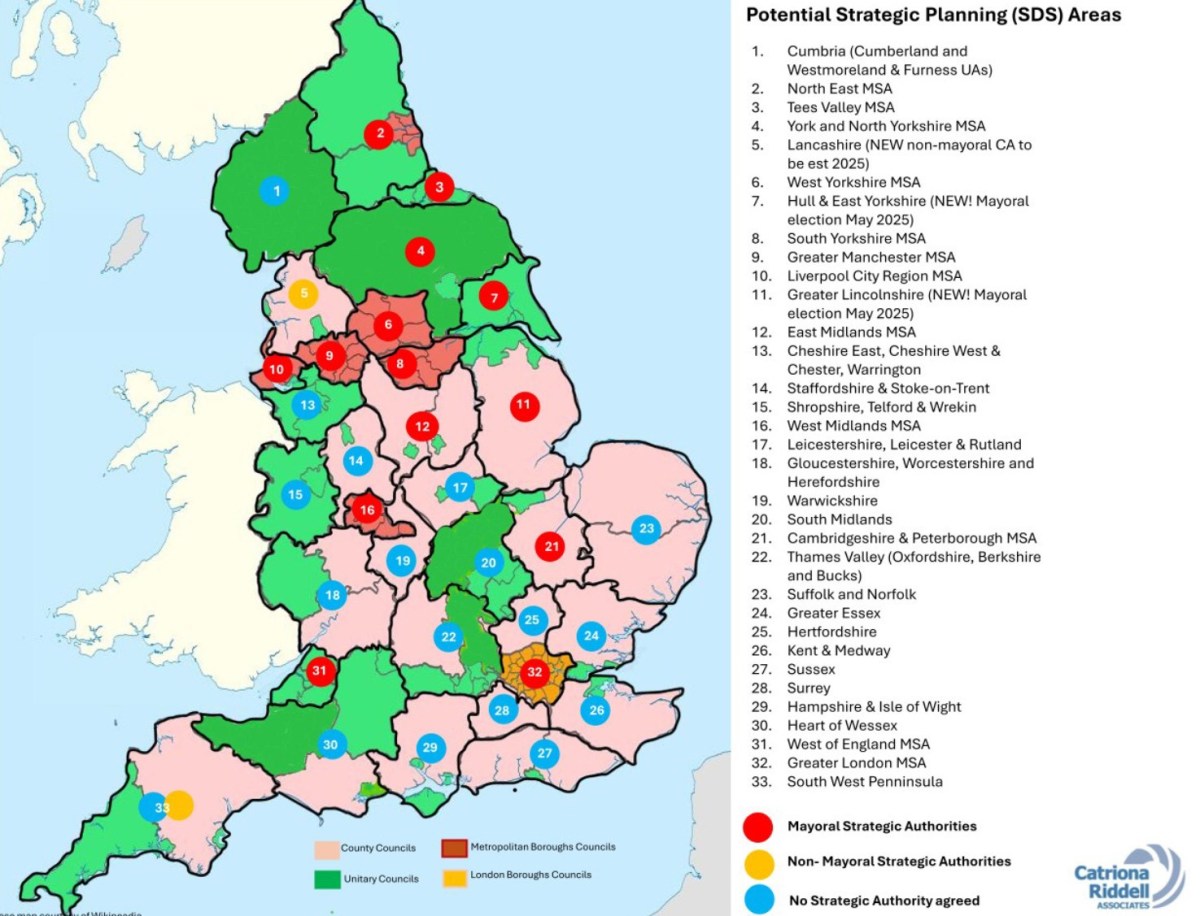
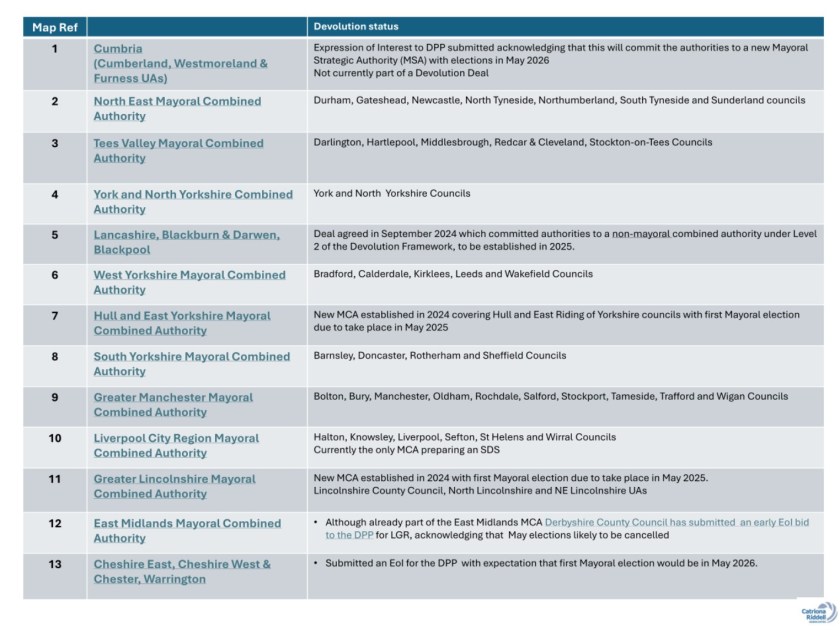
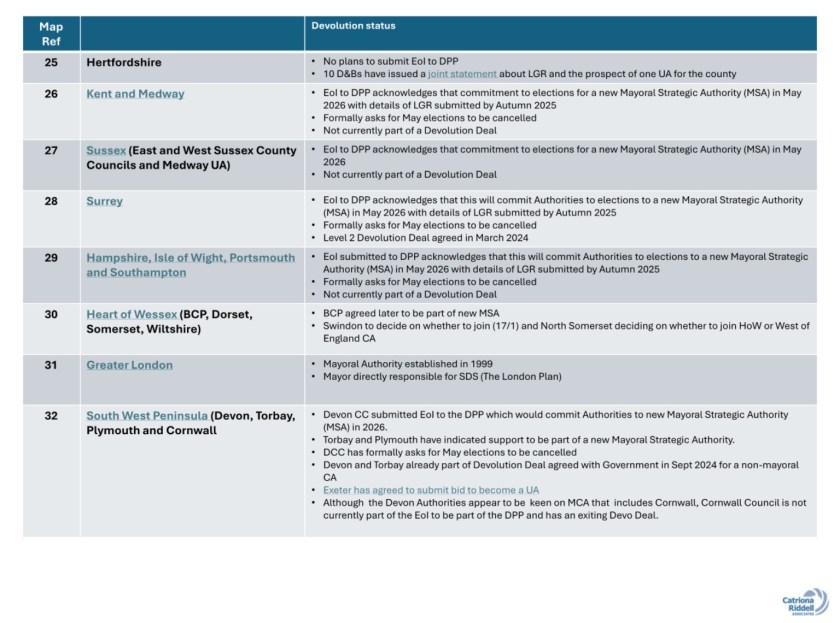
What could this all mean in terms of what the areas will be for SDSs? Catriona Riddell yesterday posted her current understanding as below:

In terms of the move towards unitary authorities, local government minister Jim McMahon wrote to two tier authorities on 16 December 2024:

As set out in the White Paper, new unitary councils must be the right size to achieve efficiencies, improve capacity and withstand financial shocks. For most areas, this will mean creating councils with a population of 500,000 or more. However, there may be exceptions to ensure new structures make sense for an area, including on devolution.”

“We will take a phased approach and expect to deliver new unitary authorities in April 2027 and 2028.”

“I have heard from some areas that the timing of elections affects their planning for devolution, particularly alongside reorganisation. To help manage these demands, alongside our objectives on devolution, and subject to meeting the timetable outlined in this letter, I am minded-to lay secondary legislation to postpone local council elections from May 2025 to May 2026.

However, I will only do this where this will help the area to deliver both reorganisation and devolution to the most ambitious timeframe – either through the Devolution Priority Programme or where reorganisation is necessary to unlock devolution or open up new devolution options.”

“To lay the relevant legislation to postpone elections, I will need a clear commitment to devolution and reorganisation aims from upper-tier councils in an area, including a request from the council/s whose election is to be postponed, on or before Friday 10 January.”

Again, the Local Government Association’s list is helpful – of counties and unitaries which have made requests, involving postponing their election from 2025 to 2026.

Whilst the government’s advice is that none of this should slow down current local plan making it is going to be interesting to see what transpires – and the local political implications more generally of postponed elections (who knows, perhaps the potential for longer term decision making?).

The pace of change ahead of publication of either the Planning and Infrastructure Bill or the English Devolution Bill is certainly impressive.

There’s an interesting quote from Arthur C Clarke about revolution – and possibly it extends to devolution as well:

Every revolutionary idea seems to evoke three stages of reaction. They may be summed up by the phrases: (1) It’s completely impossible. (2) It’s possible, but it’s not worth doing. (3) I said it was a good idea all along.”

Simon Ricketts, 18 January 2025

Personal views, et cetera

James Bond…Or Mission Impossible?

Below each of the Government’s “missions” we now have a set of “measurable milestones” – although if a milestone isn’t measurable isn’t it just a stone?

See the prime minister’s speech at Pinewood Studios (hence his James Bond quip) on 5 December 2024, the Delivering change: our road-map for a mission-led government plan and press statement, PM sets out blueprint for decade of national renewal.

This may be a shallow comment to make upfront but as always (it’s not just this government) the organisational cliché bingo is so disappointing:

  • kickstarting
  • turbo-charge
  • driving through
  • breaking down barriers

I’d be run out of a partners’ meeting if I used such language I suspect.

Missions…

I always liked that intro to Mission Impossible where the hidden tape recorder is found and the recording starts: “Good morning [X], your mission, should you choose to accept it….”

The missions of this government are not easy to keep in mind. There were five at the time of the general election. There are now six:

  • Strong Foundations
  • Kickstarting Economic Growth
  • An NHS Fit for the Future
  • Safer Streets
  • Break Down Barriers to Opportunity
  • Make Britain a Clean Energy Superpower

From the press statement:

The milestones for change set out in the plan will track the government’s progress against each of the missions by the end of the parliament, ensuring accountability to the public.”

“These include a new commitment to fast track planning decisions on at least 150 major economic infrastructure projects, and the biggest housebuilding and infrastructure push in 50 years to turbocharge economic growth across the country.”

In the plan itself, the “kickstarting economic growth” mission has two milestones:

  • Milestone: Raising living standards in every part of the United Kingdom
  • Milestone: Rebuilding Britain

As to the second milestone (I have emboldened the key passages):

“The failure of the planning regime has not just left us without the homes we need. Britain also lacks other key infrastructure that we should be able to rely on such as transport and energy, or gigafactories and data centres needed for industries of the future.

It is slower and more costly to build economic infrastructure in England than other major countries like France and Italy. No new reservoir has been built since 1992.

The time it takes to secure planning permission for major economic infrastructure projects has almost doubled in the last decade to more than 4 years. Our growth mission will change this: fast-tracking infrastructure delivery and home building and enabling businesses to invest.”

“Our milestone

We must make the dream of home ownership a reality for people across the country. New homes must be supported with the right infrastructure, from roads to reservoirs. 

So, through the growth mission, the government has a hugely ambitious milestone of building 1.5 million safe and decent homes in England this Parliament.

A boost in new homes must deliver for aspiring owners and renters, and provide secure, affordable and quality housing.

We will do this while delivering the infrastructure the country needs – not simply through investment, but by reforming planning rules and fast-tracking 150 planning decisions on major infrastructure by the end of this Parliament – more than double the number decided in the previous Parliament.

In building 1.5 million homes, we will measure progress through the number of net additional dwellings built in England over the course of this Parliament.”

“…we will publish ten-year strategies for housing and infrastructure next spring, with clear priorities, plans to deliver, and a pipeline of projects for investors and supply chains. These will reflect our next steps – reform, investment, supply. We will:

  • Reform the planning system so that it is pro-growth and pro-infrastructure. We will publish a new National Planning Policy Framework by the end of 2024 and update all relevant National Policy Statements by next summer. We will make improvements to planning at a local level, modernising planning committees and increasing local planning capacity.
    We will use the Planning and Infrastructure Bill to create a win-win for development and nature; and streamline processes for critical infrastructure.
    For the first time we will strategically join up decisions on housing, business growth and infrastructure at both a national and local level, with the Westminster government’s industrial, housing and infrastructure strategies aligning with the local growth plans and strategic development plans led by mayors. Only by delivering these reforms will we unlock investment and delivery.”
  • “Work in partnership with local leaders, housebuilders and infrastructure developers to deliver investment into these sectors”
  • “Increase supply and deliver the biggest boost to social and affordable housing in a generation

As far as “measurable milestones” go we have the government doubling down on its 1.5 million new homes commitment; we have this “150 planning decisions on major infrastructure” commitment (NB perhaps don’t assume that only NSIPs count – I refer below to decisions this week in relation to a proposed data centre and to a proposed prison, both under the Town and Country Planning Act); the promised new NPPF (all betting now is on 12 December), and updated “relevant” national policy statements by next summer.

Given that come the next general election the government will undoubtedly be held to account, is it right for it to stick with that 1.5m new homes pledge when it is not likely to be met (albeit that the Conservatives’ pre-election pledge, ridiculously, was even higher at 1.6M)? Is a single target such as this the right approach, or (as may be the case with the milestone adopted in relation to the “NHS fit for the future” mission of reducing average waits for planned hospital care to 18 weeks) might it unhelpfully skew organisational behaviour and focus?

Almost more important than all this was the tone of the prime minister’s speech itself – many people picking up on his colourful references to civil servants “comfortable in the tepid bath of managed decline” and to “the nimbys, the regulators, the blockers and bureaucrats…the alliance of naysayers”. I’m not sure that he could be more clear as to the direction that this government will be taking in order to deliver on those milestones.

I set out sections of his speech below because it is interesting to see the tone: this is fighting talk.

“There’s no investment in our public services, without difficult decisions. 

No solution to the housing crisis, without approving controversial development… “

“Clearly if we don’t turbocharge housebuilding with reform… 

We’re won’t meet that milestone.”

“I do think too many people in Whitehall are comfortable in the tepid bath of managed decline.”

“take our planning system… 

A blockage in our economy that is so big…

It obscures an entire future… 

Stops this country building roads, grid connections, laboratories, trainlines, warehouses, windfarms, power stations…

You name it. 

A chokehold on the growth our country needs…

Suffocating the aspirations of working families. 

I mean – you walk around our country…

You look at our infrastructure…  

And it is clear almost immediately…  

That we have long freeloaded off the British genius of the past. 

Because we won’t build a future… 

We haven’t built a reservoir for over 30 years… 

And even the projects we do approve…

Are fought tooth and nail… 

Nail and tooth… 

Until you end up

With the absurd spectacle of a £100m bat tunnel… 

Holding up the country’s single biggest infrastructure project. 

Driving up taxes and the cost of living, beyond belief. 

I tell you now…

This Government will not accept this nonsense anymore. 

We will streamline the approval process in the forthcoming Planning and Infrastructure Bill… 

And driving through that reform – I can announce another new target… 

Not just 1.5 million homes…

But also 150 major infrastructure projects… 

A milestone that will triple the number of decisions on national infrastructure compared with the last Parliament.  

And just as important… 

Will send a very clear message…

To the nimbys, the regulators, the blockers and bureaucrats… 

The alliance of naysayers… 

The people who say no “Britain can’t do this”… 

We can’t get things done in our country.  

We say to them – you no longer have the upper hand…

Britain says yes.”

Of course, actions speak louder than words. This week we have seen M&S’ Oxford Street project finally approved following the quashing of the previous government’s decision (see my 2 March 2024 blog post M&S Mess 2: “The SoS Appears To Have Become Thoroughly Confused On This Point”); a green belt data centre project allowed on appeal, the appeal having been recovered for the Secretary of State’s decision-making very soon after the July 2024 election, and a prison project approved against the inspector’s recommendations (see my 10 June 2024 blog post New Prisons https://simonicity.com/2024/06/10/new-prisons/ for more general context).

This tape will now self-destruct in five seconds. Good luck.”

Simon Ricketts, 7 December 2024

Personal views, et cetera

Intervention

As the saying almost goes, necessity is the mother of intervention.

Remember Rachel Reeves’ 8 July 2024 speech?

“…if we are to put growth at the centre of our planning system, that means changes not only to the system itself, but to the way that ministers use our powers for direct intervention.

The Deputy Prime Minister has said that when she intervenes in the economic planning system, the benefit of development will be a central consideration and that she will not hesitate to review an application where the potential gain for the regional and national economies warrant it.”

Let’s look at the new Government’s interventions so far in relation to planning applications (by way of Angela Rayner calling in applications for her own determination) and in relation to planning appeals (by way of Angela Rayner recovering appeals for her own determination rather than that of planning inspectors – NB outside world, please don’t call these recoveries call-ins!). (And for a basic procedural primer see this House of Commons research briefing).

Quinn/Sittingbourne call-in

It’s topical because of the big news this week – that Rayner has called in Quinn Estates’ two applications for planning permission for a total of up to around 8,400 homes with significant infrastructure and associated development near Sittingbourne – a scheme known as Highsted Park. The call-in letter is dated 7 November 2024 and landed less than three hours before Swale Borough Council’s Planning Committee was due to consider both applications, both of which were recommended for refusal.

The applications will now be determined by her following a public inquiry – as no doubt would have been the case, via appeal, if the Planning Committee had proceeded to determine the applications, so the timing is interesting. Was the call-in partly a political statement of intent, partly just accelerating timescales and/or partly a recognition of the difficulties arising from local determination of schemes of this sheer scale (particularly where the LPA in question has a local plan which is now over seven years old)?

I do sympathise with Swale over the timing (see their press statement ) but I do not agree with complaints on social media from some that Rayner’s letter is in some ways “subverting local democracy”. I would place money on the fact that were it not for Rayner’s intervention (1) if Swale had resolved to approve the applications, there would have been demands for call-in from those against the proposals and (2) if Swale had refused the applications, Quinn would have appealed. So I regard that as a somewhat hollow complaint, particularly given the new (if we can still call it that) Government’s explicit stance in relation to using its powers of intervention.

There isn’t one publicly accessible resource setting out the decisions which the Secretary of State has made to call in or recover applications or appeals respectively (as opposed to the Secretary of State’s final decisions, for which this is a useful resource).

From my research, I think these are the other ones so far since the election:

Chinese Embassy/Royal Mint Court, Tower Hamlets – call-in

Again called in prior to the LPA’s determination of the application, although against the background of Tower Hamlets Council having refused a previous application.

This one is whatever the phrase is in Cantonese for a massive political hot potato. See this 5 November 2024 Guardian piece for a flavour: China blocking UK plans in Beijing amid east London mega-embassy dispute.

SOG Group/Runcorn – call-in

This might be said to be a more traditional call-in situation, following as it did Halton Council’s resolution to approve the application for planning permission for 545 homes (see for example this 18 October 2024 piece by North West Place Rayner calls in SOG’s 545 Runcorn homes. It seems there may be an HSE objection. An inquiry starts 4 February 2025.

Marlow Film Studio – appeal recovered

See eg the Guardian’s 9 October 2024 piece Angela Rayner reconsiders rejected application for Marlow film studio.

Data centre proposals in Iver (Buckinghamshire) and Abbots Langley (Hertfordshire) – appeals recovered

Both inquiries have now taken place, with the outcomes awaited with interest. The decisions to recover were made within a week of Labour coming into government and indeed were referred to in that Reeves speech I mention above.

Have I missed any?

Of course it is also interesting to see where the Secretary of State has decided not to intervene, for instance in relation to the Wimbledon All England Tennis Club’s expansion proposals approved by the London Mayor in September, and indeed in relation to Peel’s proposals for Chatham Docks.

The politics in relation to these decisions as to whether to intervene or not in local decision making is definitely going to be as important to watch as the detailed proposed changes to the NPPF.

Simon Ricketts, 9 November 2024

Personal views, et cetera

Extract from Quinn Estates website, courtesy of Quinn Estates