The Up Right

In his speech to the Conservative party conference on 1 October 2018, James Brokenshire announced that the Government will consult “in due course” on “introducing a new permitted development right to allow property owners to extend certain buildings upwards, while maintaining the character of residential and conservation areas and safeguarding people’s privacy“.

Not that one again?!

My second ever blog post, on 15 June 2016, Permitted Development: What Next? summarised the February 2016 consultation paper jointly published by DCLG and the previous Mayor of London, which sought views on proposals “to increase housing supply in the capital by allowing a limited number of additional storeys to be built up to the roofline of an adjoining building through permitted development rights, local development orders or development plan policies”. The paper set out in some detail the criteria and prior approval requirements which would apply.

Nothing then happened, perhaps due to the change in Mayor and the ministerial changes that followed the June 2016 referendum, or perhaps it was always going to be a difficult piece of legislation to draft in a way that arrived at a mechanism that would be simpler for developers than a traditional planning application but which secured necessary amenity protections.

My 17 March 2018 blog post Permitted Development: À La Recherche Du Temps Perdu reported on the conflict between on the one hand a ministerial policy statement on 5 February 2018 which appeared to make it clear that the initiative (now across England, not just London) would be dealt with by policy, within the NPPF and then on the other hand Sajid Javid’s speech launching the draft revised NPPF on 5 March 2018 which had this passage:

And there are also other areas in which we’re ready to go further to take the delivery of housing up a gear.

Including a new permitted development right for building upwards to provide new homes”.

Paragraph 118 (e) of the new NPPF does specifically address upwards extensions: Planning policies and decisions should “support opportunities to use the airspace above existing residential and commercial premises for new homes. In particular, they should allow upward extensions where the development would be consistent with the prevailing height and form of neighbouring properties and the overall street scene, is well- designed (including complying with any local design policies and standards), and can maintain safe access and egress for occupiers.”

In the light of the Javid speech, the Brokenshire announcement was not a big surprise but I do wonder how the permitted development will be drafted so as to avoid the obvious issues that arise and why that NPPF statement isn’t considered to be sufficient.

The RTPI’s response to the announcement on 2 October 2018 was surely right, in which its chief executive, Victoria Hills, said:

Densification of built-up areas can bring about much needed housing supply, but quality is as important as numbers. Blanket height extensions come with issues that have potentially serious impact on streetscape and people’s access to light. National policy can provide a favourable steer, but local communities should be able to set standards which enable higher buildings to make a positive contribution to housing supply.”

There is no indication as to when the consultation will take place. For instance, is the Chancellor’s 29 October Autumn budget statement too soon?

It is interesting that Brokenshire did not take the opportunity at the party conference also to reheat the Autumn 2017 budget policy paper announcement that “the government will consult on introducing… a permitted development right to allow commercial buildings to be demolished and replaced with homes“.

In the meantime, the existing office to residential permitted development right continues to be controversial.

Earlier this year, the RICS published a research paper, Extending permitted development rights in England: the implications for public authorities and communities (1 May 2018)

The study estimated that “between 86,665 and 95,045 dwellings (depending on how student accommodation is classified) might potentially have been created under the extended PD rights between 2010 and 2017. The bulk of these additional dwellings arises from small-scale (less than 10 units created) conversions from commercial uses (including offices) to residential use and from agricultural buildings use to residential use.

These small schemes have been broadly distributed (largely in locations with relatively low property values) through cities and towns without any marked regional patterning. The large-scale conversions of office and other commercial uses to residential use that are a key matter of concern to policy makers are less important with regard to the overall number of dwellings delivered and are overwhelmingly concentrated near the cores of major urban areas. These large scale office conversions (excluding student accommodation) are concentrated in the South East. The scale of PD occurring entirely within the industrial and commercial use classes is relatively modest.

Cost-Benefit Analysis (CBA) compared the direct costs and benefits to local authorities of extended PD rights with the outcomes of an identical development that had obtained formal planning permission. The key findings were that:

The largest estimated financial impact is the loss in affordable housing contributions. This amounted to about £42.5m.

The benefits arising from savings in staffing costs within planning departments (£14m) are not enough to offset the loss of fees (£22m).

Overall, this part of the analysis estimates that the direct financial impact of the extension of PD rights is a net loss to all the Local Authorities across England of around £50m.”

The research indicates that office to residential conversions under PD have also produced a higher amount of poor quality housing than schemes governed through full planning permission.”

But the mechanism still has its cheer leaders. Conservative MP Nick Herbert wrote a piece in the Standard, Permitted development is key to race to build homes on 8 October criticising the London Mayor for encouraging, in the draft London Plan, boroughs to use article 4 directions to remove the permitted development right.

Then a penny dropped. Nick Herbert is chairman of a think tank, called The Project for Modern Democracy. Who should be the research director for the “Planning Change” strand of the think tank’s work but Alex Morton? As set out on the Project for Modern Democracy’s website:

“Alex was Special Adviser to then Prime Minister (David Cameron) for two and a half years, focused on housing, planning, and local government. He also drafted the Conservative 2015 Manifesto on those areas. Prior to working in No.10, he led on housing and planning at the Policy Exchange think tank.”

He was lobbying for a permitted development right to convert offices to residential as long ago as 2011 in a Policy Exchange paper, More Homes: Fewer Empty Buildings.

Morton has now published a short paper, A backwards step on Permitted Development (26 September 2018) on which the Nick Herbert article was based. The piece seeks to rebut criticisms of the office to residential permitted development right, particularly that it has led to shortages of business space, lower affordable housing and “unsuitable homes“. Read it for yourself but I found it a pretty weak analysis. I also found it strangely inconsistent with a comment piece he had written in the Independent in 2013, which contained passages like this:

Finally, there are unnecessary and unhelpful side-shows like the extensions debacle last week, which stripped immediate neighbours of their powers to object to major changes next door, and which even most supporters of planning liberalisation felt went too far.

I wonder what the Project for Modern Democracy thinks about the proposed Up Right?

Simon Ricketts, 13 October 2018

Personal views, et cetera

OAN Goal

The Government’s goal remains as per Philip Hammond’s 22 November 2017 Autumn budget statement:

So today we set out an ambitious plan to tackle the housing challenge.

Over the next five years we will commit a total of at least £44 billion of capital funding, loans and guarantees to support our housing market.

To boost the supply of skills, resources, and building land.

And to create the financial incentives necessary to deliver 300,000 net additional homes a year on average by the mid-2020s.”

Will that number be reached? What pressure will the Government be under from its supporters, at next week’s party conference and subsequently, to resile from that 300,000 target in the light of the Office of National Statistics’ statistical bulletin, household projections in England published this month?

After topdown targets for individual authorities, derived from regional plans directly overseen by government, were abolished by the incoming 2010 coalition government, the 2012 NPPF has required each local authority to work out for itself, without any centrally prescribed methodology, what the objectively assessed need for housing is in its area. That quickly proved to be a recipe for complexity, uncertainty, local politicking and delay.

So the Government has been trying since 2015 to arrive out how to arrive at a simpler system that isn’t seen as centrally prescribed. As set out in my 20 September 2017 blog post Housing Needs: Assessed Or Assumed?, the Government decided to consult on a new “standard method” which would provide authorities with a minimum figure, desired from a formula based on household projections, local affordability and a cap on the extent of any increase deriving from the new formula.

Alongside its 14 September 2017 consultation document it published a spreadsheet showing “indicative” figures that would result for each authority from the new method, draft figures which it warned should be “treated with caution“. The total number totted up to 266,000 – a number that made the 300,000 look like a decent stretch target.

All admirably transparent and fascinating at the time, but surely in retrospect it was not helpful to publish those figures, particularly given that it was also stated that the new standard method would apply to local plans that weren’t submitted for examination by the later of 31 March 2018 and publication of the new NPPF?

Numbers drive actions. For some authorities there was clearly an immediate incentive to rush to submit their plan before the standard method was imposed, for others quite the reverse. We have seen corners cut by some authorities in their haste and the position became even more confused once (1) the possible 31 March 2018 deadline became, once the new NPPF was published containing a six months’ grace period, 24 January 2019 and (2) it became clearer that the figures and methodology were liable to change in any event.

The numbers were always likely to change given that the September 2017 household formation projections were arrived at by MHCLG using date going back to 1971 and the task for arriving at the final numbers was to be given to the Office of National Statistics, who would use the 2016-based population projections published in May 2018. When the ONS published its proposed methodology in June 2018 it became clear that ONS would only use trends in household formation back to 2001. Lichfields were expressing concerns about the likely consequences in a 27 June 2018 blog post:

We know that in the decade 2001-11 housebuilding fell to its lowest level and household formation amongst young adults changed significantly. If the new household projections only draw upon this (relatively) short term trend for projecting future household growth, is there a significant risk of ‘baking-in’ trends which are not reflective of future ‘need’ but simply an illustration of what the number would be if we continued more of what has been before?

ONS had consulted on its approach in 2017, and many respondents (including Lichfields) pointed out the need for the methodology to reflect not just a ‘purist’ demographic approach, but reflect on the real-world implications for housing need. Suggestions were made that ONS might wish to consider producing local ‘variant’ projections (as DCLG used to do at a national level) with modified formation rates as the basis for the standard methodology. It does not appear ONS intends to follow this advice.”

To be fair, the Government was not blind to what was likely to happen. As I set out in my 5 August 2018 blog post Housing Needs, Housing Shortfalls, when it published the final version of the NPPF on 24 July 2018, it published on the same dayits response document to the consultation on the draft, with this passage:

A number of responses to this question provided comment on the proposed local housing need method. The government is aware that lower than previously forecast population projections have an impact on the outputs associated with the method. Specifically it is noted that the revised projections are likely to result in the minimum need numbers generated by the method being subject to a significant reduction, once the relevant household projection figures are released in September 2018.

In the housing white paper the government was clear that reforms set out (which included the introduction of a standard method for assessing housing need) should lead to more homes being built. In order to ensure that the outputs associated with the method are consistent with this, we will consider adjusting the method after the household projections are released in September 2018. We will consult on the specific details of any change at that time.

It should be noted that the intention is to consider adjusting the method to ensure that the starting point in the plan-making process is consistent in aggregate with the proposals in Planning for the right homes in the right places consultation and continues to be consistent with ensuring that 300,000 homes are built per year by the mid 2020s.”

So, as at July the position was that updated household projection figures would be released in September and the Government would then “consider adjusting the method after the household projections” and would “consult on the specific details of any change at that time.

The updated figures were indeed then published, on 20 September, and show significant downward movements in the projections for individual authorities and an overall decrease in the total required, from 266,000 to 213,000. There has been a quick succession of excellent blog posts from planning consultancies, going into the statistical detail and likely implications, including (with apologies to those I don’t mention) Bidwells, Barton Willmore, Turley and Lichfields. There have inevitably also been many calls from objectors to housing numbers within emerging local plans for those numbers to be reviewed in the light of the new figures.

But the goalposts haven’t moved (yet). I assume that the Government will now indeed consult on changes to the standard method to increase numbers back within spitting distance of the 300k. There is surely no point in any authority taking any steps in reliance on the September 2018 ONS figures, but then again the September 2017 MHCLG figures have a large question mark against them. If you are an authority looking to make progress with your plan with a view to submission after 24 January 2019 you really have very little to go on as to the approach to be adopted.

So it is urgent that the Government consults as to proposed changes to its methodology and what that is likely to mean for individual authorities – although that consultation paper is going to end up running very close up to the 24 January 2019 date, leaving very little time for, er, planning.

Furthermore, I’m not sure that the ONS numbers are going to be standing still. As Planning magazine have identified in their useful coverage of the new numbers, ONS’ analysis that accompanies their figures makes it clear that it is aware of some of the deficiencies in the data. It refers to responses to consultation on its proposed methodology:

There was a view that only using the 2001 and 2011 Censuses would result in a downward trend in household formation for the younger age groups, which in turn would downplay the need for housing for younger people. With these views in mind, Section 8 shows the results of sensitivity analysis in which 2014-based HRRs (projected using 1971 to 2011 Census data) are applied to the 2016-based subnational population projections (SNPPs), should users wish to investigate the impact of the change of HRR methodology on the household projections.”

ONS is also “planning to publish a set of variant 2016-based household projections in which household formation rates for younger adults (those aged 25 to 44 years) are higher – provisionally scheduled for 3 December 2018. The purpose of this variant would be to illustrate the uncertainty in the projections around the future household formation patterns of this age group.”

You numbers people will know better than me whether this is also likely to have an appreciable effect on the numbers, at least in some areas.

But it does seem odd that in order to gauge the level of housing need, in order finally to look to put right the increasing shortage and unaffordability of housing, the starting point has been to look at the rate at which people have been able to form households in particular areas, during that very period where lack of supply and high prices have led to them sharing with others or not moving from the parental home – or, in areas of particularly high demand and/or restraint, not having a hope of living near their family or job (or the job that they would seek were suitable affordable accommodation available).

There is now the dilemma at a national level that echoes the dilemma that local plan inspectors have had to grapple with at an individual authority level: whether to accept a coarse, hypothetical approach that can be implemented with relative ease or whether to insist on getting to a “pure” statistical answer. The latter may in my view be unrealistic: we need targets, with consequences if they are not met and we need to avoid giving convenient excuses for delay. Those targets need to be based on the best evidence but are ultimately political choices where national leadership is essential – this is not a local issue where individual authorities can operate without regard for wider consequences.

I would be disappointed if the Government, faced in any event with the prospect of not meeting its current target (which conveniently is expressed in any event by reference to a time frame, the “mid-2020s“, that takes it past the next election), were to see this current position, which should be a surprise to no-one, as an excuse to retreat from the 300k commitment. But they won’t get an easy ride from some I’m sure.

Simon Ricketts, 29 September 2018

Personal views, et cetera

Let A Million New Homes Bloom

It is financially, legally and politically challenging to deliver new communities but without them the gap will continue to widen as between the quantity – and quality – of homes that the country needs and those that are built.

Credit should be given to the Government for continuing to push. Are its efforts too diffuse and/or insufficiently strategic, in terms of being within a clear framework, or is it simply being pragmatic in encouraging locally-supported proposals without specifying locations or indeed the process for delivery? That is for others to judge but this blog post is intended to serve as a reminder of where we stand by way of ministerial statements, and particularly focuses on where we are with the Cambridge-Milton Keynes-Oxford arc.

NPPF

The July 2018 NPPF continues, by way of paragraph 72, to support locally-led new settlements, with a change from the March 2018 draft in the reintroduction of the reference from the 2012 NPPF to garden city principles:

The supply of large numbers of new homes can often be best achieved through planning for larger scale development, such as new settlements or significant extensions to existing villages and towns, provided they are well located and designed, and supported by the necessary infrastructure and facilities. Working with the support of their communities, and with other authorities if appropriate, strategic policy-making authorities should identify suitable locations for such development where this can help to meet identified needs in a sustainable way. In doing so, they should:

a)  consider the opportunities presented by existing or planned investment in infrastructure, the area’s economic potential and the scope for net environmental gains;

b)  ensure that their size and location will support a sustainable community, with sufficient access to services and employment opportunities within the development itself (without expecting an unrealistic level of self-containment), or in larger towns to which there is good access;

c)  set clear expectations for the quality of the development and how this can be maintained (such as by following Garden City principles), and ensure that a variety of homes to meet the needs of different groups in the community will be provided;

d)  make a realistic assessment of likely rates of delivery, given the lead-in times for large scale sites, and identify opportunities for supporting rapid implementation (such as through joint ventures or locally-led development corporations); and

e)  consider whether it is appropriate to establish Green Belt around or adjoining new developments of significant size.”

Garden Communities Prospectus

MHCLG published on 15 August 2018 its Garden Communities prospectus, inviting “bids for ambitious, locally supported, proposals for new garden communities at scale. In return for tailored assistance to help design and deliver the vision for these places, we expect local areas to deliver significant housing and economic growth. We will look to assist as many as we can, in locations where there is sufficient demand for housing.

Bids are due by 9 November 2018. The prospectus sets out the necessary criteria as follows:

Scale

The Government “will prioritise proposals for new Garden Towns (more than 10,000 homes), but will consider proposals for Garden Villages (1,500-10,000 homes) which are particularly strong in other aspects. For instance, demonstrating exceptional quality or innovations, development on predominantly brownfield sites, being in an area of particularly high housing demand, or ability to expand substantially further in the future.”

Strategic fit

All proposals must demonstrate how the new garden community fits with the housing need for the housing market area, including expected future population growth. We will prioritise proposals which respond to housing need in high demand areas. We also particularly welcome proposals which release more land through local plans to meet local housing need, and / or go above local housing need.

All proposals should demonstrate how the new garden community fits with wider strategies to support economic growth and increase productivity. We expect to see ambitious proposals which create a variety of new jobs and the timely delivery of infrastructure necessary to underpin this.”

Locally-led

Strong local leadership is crucial to developing and delivering a long-term vision for these new communities. All proposals should have the backing of the local authorities in which they are situated, including the county council in two-tier areas. We are particularly interested in proposals which demonstrate collaboration across local authority boundaries. To ensure that the potential local growth benefits have been considered, it will be desirable for proposals to have the support of the Local Enterprise Partnership, where the area has one.

Proposals should set out how the local community is being, or will be, engaged and involved at an early stage, and strategies for continued community engagement and involvement. We are clear that local communities – both current and future residents – must have a meaningful say in developing the proposal from design to delivery.”

Garden community qualities

High quality place-making is what makes garden communities exemplars of large new developments, and all proposals must set out a clear vision for the quality of the community and how this can be maintained in the long-term, for instance by following Garden City principles.”

Deliverability and viability

Proposals should address:

⁃ delivery models and timescales

⁃ infrastructure requirements

⁃ opportunities to capture land value

⁃ access to finance and private sector investment

(NB this post is not intended to be an update to my 20 May 2017 blog post Money For Nothing? CPO Compensation Reform, Land Value Capture. However, I would note first the specific advice in the new NPPF that local planning authorities’ role in identifying and helping to bring forward land for development should “include identifying opportunities to facilitate land assembly, supported where necessary by compulsory purchase powers, where this can help to bring more land forward for meeting development needs and/or secure better development outcomes” and secondly the open letter, Sharing land value with communities dated 20 August 2018 from 16 campaign groups to the Secretary of State, which included the request that Parliament “should reform the 1961 Land Compensation Act to clarify that local authorities should be able to compulsorily purchase land at fair market value that does not include prospective planning permission, rather than speculative “hope” value.” It is interesting to see the broadness of consensus between a variety of organisations but these issues are not at all straight-forward! More in due course.)

Delivery timescales and accelerated delivery

We will prioritise proposals that offer a strong prospect of early delivery and a significant acceleration of housing delivery. They should consider the scope for innovative ways to deliver new homes, such as off-site construction, custom build and self-build, as well as providing opportunities for a diverse range of house builders. Priority will be given to proposals that can demonstrate how build out will be achieved at pace, whilst maintaining quality.”

In terms of delivery vehicles, the prospectus says this:

Whilst we are not prescribing any particular model, for proposals at scale, a Development Corporation may be an appropriate vehicle to consider. We have taken action to enable the creation of new locally accountable New Town Development Corporations. These vehicles can help provide long-term certainty to private investors, resolve complex co-ordination challenges, invest directly in infrastructure that unlocks development, and use compulsory purchase powers to help lay out a new town.

(The reference to “new locally accountable New Town Development Corporations” is a reference to the new mechanism available for designating new towns by way of the New Towns Act 1981 (Local Authority Oversight) Regulations 2018 which were made and came into force on 23 July 2018. Guidance as to their operation was published in June 2018.)

Who can apply?

The support of the relevant local planning authority or authorities is a prerequisite:

Proposals are invited from local authorities and private sector partners (such as master developers or land owners). Proposals submitted by private sector partners must be expressly supported by the local authority.

We particularly welcome joint proposals from one or more local authorities, as well as proposals which demonstrate support from developers and / or landowners.”

Cambridge-Milton Keynes-Oxford corridor

There is specific paragraph in relation to the CaMKOx corridor (or whatever we are meant to call it):

For proposals within the Cambridge – Milton Keynes – Oxford corridor, Government will continue to work with local partners to consider how the delivery of new homes and settlements can best support the overarching vision for the axis. This includes the contribution these places can make to the National Infrastructure Commission’s finding that up to 1 million homes will need to be built in the corridor by 2050, if the area is to maximise its economic potential.”

CaMKOx

There are a number of related Government-sponsored initiatives in relation to the Cambridge-Milton Keynes-Oxford corridor.

The Government published in November 2017 its vision for the corridor, Helping the Cambridge, Milton Keynes and Oxford corridor reach its potential, alongside the Autumn budget and the National Infrastructure Commission’s report Partnering for Prosperity: A new deal for the Cambridge- Milton Keynes-Oxford Arc. The NIC report sets out its conclusion that:

The Cambridge-Milton Keynes-Oxford arc must be a national priority. Its world-class research, innovation and technology can help the UK prosper in a changing global economy. But success cannot be taken for granted. Without urgent action, a chronic undersupply of homes could jeopardise growth, limit access to labour and put prosperity at risk.

The Commission’s central finding is that rates of house building will need to double if the arc is to achieve its economic potential. This requires a new deal between central and local government – one which aligns public and private interests behind the delivery of significant east-west infrastructure and major new settlements, and which seeks commitment to faster growth through a joined-up plan for jobs, homes and infrastructure. Any deal must give local areas the certainty, freedoms and resources they need to create well-designed, well-connected new communities.”

Two significant transport infrastructure projects were seen by the NIC as critical to unlocking development: the East West Rail scheme connecting Oxford and Cambridge by rail and the Oxford-Cambridge Expressway road proposal. But the report also makes important recommendations as to necessary governance, seeking

• “New powers giving councils greater certainty over future investments, and allowing them to fund and raise finance for major infrastructure improvements that deliver new homes

• A jointly agreed plan for new and expanded housing settlements, supported by New Town Development Corporations and new infrastructure design panels

• New statutory spatial plans and investment strategies for each sub-region should be developed, as part of a 50-year vision for the arc as a whole

The Government’s vision states:

1.7 The government welcomes the NIC’s finding that up to 1 million homes will need to be built in the corridor by 2050, if the area is to maximise its economic potential.

1.8 The government has agreed a housing deal with Oxfordshire, committing to a target of 100,000 homes in the county by 2031 in return for a package of support for infrastructure and economic growth, which could include supporting the growth of employment sites across the county such as Science Vale, one of the most successful science and technology clusters in the UK. This rate of housing delivery would be consistent with a corridor-wide ambition for 1 million new homes by 2050.

1.9 The government pledges to build on the Oxfordshire deal by working with the central and eastern parts of the corridor in 2018, to realise its housing ambitions.

1.10 As the NIC has recommended, the government will also consider opportunities for one or more major new settlements in the corridor. It will do so by bringing together public and private capital to build new locally-proposed garden towns, using appropriate delivery vehicles such as development corporations. The government will work closely with the Homes and Communities Agency and local partners to explore such opportunities further.”

In terms of governance:

1.15 The government invites local partners to work with it through 2018 to agree a long term vision for the whole corridor up to 2050. This will set out how jobs, homes and infrastructure across the corridor will be planned together to benefit existing and new residents, while balancing economic growth with the protection and enhancement of the area’s historic and environmental assets.

1.16 The government believes this long-term vision should be underpinned by a series of joint statutory plans across the corridor which would deliver the vision through the planning system. As a first step, Oxfordshire has agreed, through its housing deal with government, to bring forward for adoption a joint statutory plan across the whole county. The government urges other areas in the corridor to propose how they will work together with a view to adopting a small number of joint statutory plans at the earliest opportunity to ensure that planning for business and housing is coordinated with the delivery of strategic and local infrastructure.”

In terms of capturing increases in land value:

1.18 The government will be consulting on changes to the mechanisms currently available to local authorities (the Community Infrastructure Levy (CIL) and Section 106 agreements) to make them easier to use and more flexible. This will enable local authorities to capture land value uplift taking place in the corridor more effectively. For example, the government will consult on changes to CIL that would make it easier for authorities to capture land value increases around new railway stations.

1.19 As a starting point, the government expects authorities and delivery bodies in the Cambridge – Milton Keynes – Oxford corridor to use existing mechanisms of land value capture, and the potential new mechanisms announced at Autumn Budget 2017 (subject to consultation) to capture rising land values from the additional public investment in a fair way, having regard to the announcements made at Budget 2017.

1.20 The government will also encourage authorities to explore the introduction of a Strategic Infrastructure Tariff, in addition to CIL, supported by appropriate governance arrangements. These approaches will require developers to baseline their contribution towards infrastructure into the values they pay for land.”

East West Rail

Network Rail made an application to the Secretary of State for Transport for a Transport and Works Act Order in relation to phase 2 of its East West Rail scheme on 27 July 2018, which is the central section of the line, including track and signalling upgrades between Bicester, Bedford, Aylesbury and Milton Keynes, including the reinstatement of a ‘mothballed’ section of railway between Bletchley and Claydon Junction. The deadline for representations is 7 September 2018. Phase 1, the western section between Oxford and Bicester, is already complete.

Oxford-Cambridge Expressway

Highways England is expected to announce its preferred route for the Oxford-Cambridge Expressway this Autumn. The three potential corridors are:

– Option A – southern, via Aylesbury, linking to the M1 south of Milton Keynes

– Option B – central, following the east-west rail corridor

– Option C – northern, roughly following the existing A421 to the south of Bicester and via Buckingham to the east of Milton Keynes

The local authorities and communities affected of course all have differing views as to the route that should be selected. A critical (you might guess from its title) piece about the project by George Monbiot, This disastrous new project will change the face of Britain, yet no debate is allowed was published by the Guardian on 22 August 2018. The scheme will be promoted in due course as a Nationally Significant Infrastructure Project. Given that the selected route will not be the subject of a Planning Act 2008 national policy statement it is inaccurate to suggest that “no debate is allowed“, although of course, as with other elements of the planning for CaMKOx, it has been iterative, without any form of Government framework that might be argued to require strategic environmental assessment.

Given the 9 November 2018 deadline for bids in the Garden Communities Prospectus, it is curious to note that Planning minister Kit Malthouse wrote to local authorities across the Cambridge-Milton Keynes-Oxford corridor on 26 July 2018, inviting them “to bring forward ambitious proposals for transformational housing growth, including new settlements” with a much earlier deadline of 14 September 2018:

The National Infrastructure Commission has stated that realising its full potential as a world class economic hub would require delivery of up to 1 million new homes here by 2050. The Government welcomes this ambition. Last year, we set out a significant programme of investment in infrastructure, housing and business to support it.

Realising the ambition of 1 million homes here will require additional action from central and local partners. This action includes Government’s planning reforms, our national programmes such as the Housing Infrastructure Fund, the forthcoming national prospectus inviting proposals for locally-led new garden communities, and further work to understand the potential for housing growth across the corridor.

Government will also soon begin detailed analysis to explore potential locations for new settlements across the corridor, their alignment with transport infrastructure, and any environmental considerations.”

The precise choreography as between these calls for proposals, a decision as to the final route the Oxford-Cambridge Expressway (which in itself will be relevant to the identification of potential sites) and what local planning authorities should be doing in the meantime in relation to their emerging and submitted plans is also causing some concern within affected local authorities, if the letter dated 14 August 2018 from the leader of Vale of White Horse District Council, in response to the Malthouse letter, is anything to go by. And is the one million homes in addition to authorities’ current growth proposals?

In promoting what will be significant change for many in the Cambridge-Milton Keynes-Oxford arc and what will be of vital importance to the country as a whole (in terms of the potential that is there to be unlocked in terms of homes and economic growth) the Government is treading a fine line. Its strategy appears to be not to go down the route of one set-piece consultation document (along the lines of the much maligned HS2 white paper) but rather to promote (without the commitments to a fast-track through the planning system that were so controversial in relation to the ecotowns programme) a range of interventions, some ostensibly voluntary (hold up your hands if your authority wants growth – against the backdrop of likely combined authorities and joint plans), some inevitably less so.

Will local planning authorities and communities rise to the challenge? The notion of new community NSIPs appears to remain off the table, probably for good reason given the practical good sense in successful proposals being locally driven. But what if that one million homes figure is simply unachievable on a locally led basis?

Simon Ricketts, 24 August 2018

Personal views, et cetera

Housing Needs, Housing Shortfalls

We’ve got five years, my brain hurts a lot

We’ve got five years, that’s all we’ve got

(David Bowie)

The new NPPF introduces the requirement for local planning authorities to use a standard method to arrive at their local housing needs assessment, “unless exceptional circumstances justify an alternative approach which also reflects current and future demographic trends and market signals. In addition to the local housing need figure, any needs that cannot be met within neighbouring areas should also be taken into account in establishing the amount of housing to be planned for.”

However, the precise methodology and authority by authority figures are still a moving target. The Government said this in its “response to consultation” document, published alongside the new NPPF:

A number of responses to this question provided comment on the proposed local housing need method. The government is aware that lower than previously forecast population projections have an impact on the outputs associated with the method. Specifically it is noted that the revised projections are likely to result in the minimum need numbers generated by the method being subject to a significant reduction, once the relevant household projection figures are released in September 2018.

In the housing white paper the government was clear that reforms set out (which included the introduction of a standard method for assessing housing need) should lead to more homes being built. In order to ensure that the outputs associated with the method are consistent with this, we will consider adjusting the method after the household projections are released in September 2018. We will consult on the specific details of any change at that time.

It should be noted that the intention is to consider adjusting the method to ensure that the starting point in the plan-making process is consistent in aggregate with the proposals in Planning for the right homes in the right places consultation and continues to be consistent with ensuring that 300,000 homes are built per year by the mid 2020s.”

Inevitably, with change comes uncertainty as to how the new policies will be applied to applications and plans which are currently in the pipeline. There are three key transitional arrangements:

⁃ “The policies in the previous Framework will apply for the purpose of examining plans, where those plans are submitted [for examination] on or before 24 January 2019” (paragraph 214)

⁃ “The Housing Delivery Test will apply from the day following the publication of the Housing Delivery Test results in November 2018” (paragraph 215)

⁃ “The policies in this Framework are material considerations which should be taken into account in dealing with applications from the day of its publication” [ie 24 July 2018] (paragraph 212).

I want to look at a few specific issues of interest (to me at least):

The application of the new NPPF to the draft London Plan

The footnote to paragraph to paragraph 214 is more specific than the draft, in making it clear that the equivalent cut-off date for the London Plan is “the point at which the Mayor sends to the Panel copies of all representations made in accordance with regulation 8(1) of the Town and Country Planning (London Spatial Development Strategy) Regulations 2000“, meaning that the current Draft London Plan, for which a Panel of three inspectors has been appointed to hold an examination in public late this year, will be tested against the 2012 NPPF.

As underlined in his 27 July 2018 letter to the London Mayor, even when it is tested against the 2012 NPPF the Secretary of State is “not convinced” that the assessment of need in the current draft “reflects the full extent of housing need in London to tackle affordability problems.” He is looking to see modifications on a series of matters:

⁃ “A number of policy areas in the draft that are inconsistent with national policy, such as your policies allowing development on residential gardens and your policy on car parking. [NB whilst these might be areas of political difference they are not areas where the MHCLG’s approach would drive up numbers – far from it]

The detail and complexity of the policies within the draft London Plan have the potential to limit accessibility to the planning system and development.

⁃ The draft Plan strays considerably beyond providing a strategic framework.

⁃ The draft Plan does not provide enough information to explain the approach you will take to ensure your targets are delivered, including collaboration with boroughs and neighbouring areas.

⁃ There are a number of policies in the draft Plan which seek to deal with matters relating to building standards and safety. It is important that there is a consistent approach to setting building standards through the framework of Building Regulations

But, presumably as a quid pro quo for not sending the plan back to the drawing board to be tested against the methodology for assessing housing need in the new NPPF (which would arrive at significantly higher need figures than the basis for the draft plan), the Secretary of State is looking for the Mayor to review and revise the plan as soon as it is adopted:

It remains crucial however that you bring forward a revised London Plan that has regard to new national policies at the earliest opportunity. You will want to note paragraph 33 and annex 1 of the revised National Planning Policy Framework, which sets out that the Government expects plans to be reviewed early where all identified housing need is not being met and to ensure a plan is in place which reflects current national policy. I would therefore expect you to review the London Plan to reflect the revised National Planning Policy Framework immediately once the London Plan has been published. I remind you that if this is not forthcoming, I have powers to direct the review to ensure London delivers the plan and homes that communities need.”

Of course, since the current draft is not likely to be adopted until late 2019 and Sadiq Khan’s current term ends in May 2020, this will presumably increase the potential for politicking as between candidates and parties. Not good for consensus building, or perhaps other kinds of building, although if a new plan does not come forward presumably we can expect to see more MHCLG intervention in relation to major applications in London.

Other plans submitted for examination before 24 January 2019

Nothing in planning is of course black and white. Paragraph 214 of the new NPPF says that plans submitted for examination before 24 January 2019 will still be tested against the 2012 NPPF, but of course the 2012 NPPF allowed significant room for argument as to what the appropriate methodology might be for any authority “to use their evidence base to ensure that their Local Plan meets the full, objectively assessed needs for market and affordable housing in the housing market area, as far as is consistent with the policies set out in this Framework“. To what extent might inspectors allow the new standard method to be used for plans submitted before 24 January 2019?

Already since the publication of the new NPPF we have seen the East Cambridgeshire local plan inspector, Louise Nurser, issue her preliminary findings in a letter dated 30 July 2018 in which she accepts that the use of the new standard methodology is appropriate “in the particular circumstances of East Cambridgeshire” even though the plan was plainly submitted well before the relevant date. I set out her reasoning below:

“I conclude that it is a sound approach for the standard method to be used to set the OAN for housing within East Cambridgeshire at a minimum of 11,960 dwellings between 2016 and 2036. Indeed, in the context of a Strategic Housing Market Assessment (PE05) of considerable vintage (2013), which had already been used as the primary evidence base for the development strategy which is to be superseded by the Plan before me, it would not have been appropriate to update the evidence base in isolation of the wider HMA, so that it could be used a second time. Ideally, for the purposes of this plan, the housing needs of the wider Housing Market Area would have been thoroughly considered through a new Housing Market Assessment.

However, it is clear from the different stages in which the constituent plan making bodies find themselves that such a scenario would be unrealistic, particularly in the context of the clear indication from the recently published Framework that the standard method should be used in plan making in the future, and as a consequence, it is highly improbable that a completely new HMA would ever be commissioned.

I draw particular comfort from the fact that the annual dwelling requirement using the revised OAN figure of October 2016, for the district, which is based on the SHMA, is 586 dwellings per annum (PE06). This is comparable with the figure of 598 dwellings per annum, using the standard method (PE07). As such, the use of the standard method to determine East Cambridge’s housing needs is an acceptable and a pragmatic approach to determining the district’s needs. In coming to this conclusion, I must stress that my conclusions relate to the particular circumstances of East Cambridgeshire, which has already adopted a plan on the basis of the 2013 SHMA evidence.

I can see that there does not seem to be a significant difference in the case of East Cambridgeshire as to the outcome under the two approaches, but is her reasoning essentially, as she says, pragmatic – it would have been impractical to expect the 2013 strategic housing market assessment to have been updated as a base for the new plan? Might this be a position that various other authorities find themselves in? Does the new standard method amount to an appropriate evidence base for these purposes?

What now of the tilted balance?

Paragraph 11 of the new NPPF of course contains an amended form of what was paragraphs 14 and 49 of the 2012 document, the presumption in favour of sustainable development (or the “tilted balance” in the jargon) which applies where there is a shortfall in housing supply.

There is a shortfall where:

⁃ the “local planning authority cannot demonstrate a five year supply of deliverable housing sites” (with a 5 to 20% buffer – see paragraph 73); or where

⁃ (for decisions after the publication of the Housing Delivery Test results in November 2018) the Housing Delivery Test indicates that the delivery of housing was substantially below the housing requirement over the previous three years (with “substantially below” defined in paragraph 215 – starting at 25% of what is required and ratcheting up first to 45% and then to 75%).

Where there is a shortfall, the “policies which are most important for determining the application” are deemed to be out of date, meaning that planning permission should be granted unless (i) the application of policies in the NPPF that protect a defined list of categories of areas or assets of particular importance provides a clear reason for refusing the development proposed or (ii) “any adverse impacts of doing so would significantly and demonstrably outweigh the benefits, when assessed the policies in this Framework taken as a whole“.

In my view this wording is clearer than the 2012 NPPF and should be easier to apply.

However, the effects of a shortfall are much reduced where there is a neighbourhood plan (which, after 11 December 2018, must be less than two years old) which contains policies and allocations to meet its identified housing requirement, the local planning authority has at least a three year supply of deliverable housing sites and the authority’s housing delivery was at least 45% of that required over the previous three years (25% until December 2019). (See paragraphs 14 and 216). In these circumstances, “the adverse impact of allowing development that conflicts with the neighbourhood plan is likely to significantly and demonstrably outweigh the benefits“.

Relevance of degree of shortfall

In deciding an appeal against the refusal of planning permission for housing development, how far does the decision-maker have to go in calculating the extent of any shortfall in the five-year supply of housing land? That was precisely the question considered last week by the Court of Appeal in Hallam Land Management Limited v Secretary of State (Court of Appeal, 31 July 2018). The case concerns the policies within the 2012 NPPF but the principles are just as applicable to the new NPPF.

In his decision letter dated 9 November 2016 the Secretary of State had dismissed an appeal by Hallam Land against refusal of planning permission by Eastleigh Borough Council for a development of up to 225 dwellings, a 60-bed care home and 40 care units together with associated development in Hamble.

His conclusions as to the degree of shortfall in housing supply simply stated this:

The Secretary of State notes the Inspector’s comment (IR108) that at the time of inquiry the Council were not able to demonstrate more than a four and a half years supply of deliverable housing land, and that there is evidence of an existing need for affordable housing. Whilst the Secretary of State notes that the Council are now of the view that they are able to demonstrate a 4.86 year supply...”

Weighing this shortfall into the balance he dismissed the appeal on the basis that the adverse impacts of the proposal would significantly and demonstrably outweigh its benefits.

Had he reached a properly reasoned decision on the housing supply question or had he just ducked it? At the inquiry there had been much argument as to the extent of housing supply. Hallam asserted that it was between 1.78 and 2.92 years. In post inquiry representations, the council asserted that the figure was now 4.86 years. However two inspectors’ appeal decisions in the borough had concluded otherwise. In the 24 May 2016 Bubb Lane decision letter the inspector had found that the council had a “considerable way to go to demonstrate a five year supply of deliverable sites”. In the 7 October 2016 Botley Road decision letter the inspector had concluded that there were 4.25 years of supply.

It is not necessary for the decision maker to arrive at a precise conclusion as to the level of shortfall. As Lindblom LJ states:

Relevant authority in this court, and at first instance, does not support the proposition that, for the purposes of the appropriate balancing exercise under the policy in paragraph 14 of the NPPF, the decision-maker’s weighting of restrictive local plan policies, or of the proposal’s conflict with such policies, will always require an exact quantification of the shortfall in the supply of housing land.

Accordingly, Lindblom LJ did not “think that in this case the Secretary of State could fairly be criticized, in principle, for not having expressed a conclusion on the shortfall in the supply of housing land with great arithmetical precision. He was entitled to confine himself to an approximate figure or range – if that is what he did. Government policy in the NPPF did not require him to do more than that. There was nothing in the circumstances of this case that made it unreasonable for him in the “Wednesbury” sense, or otherwise unlawful, not to establish a mathematically exact figure for the shortfall. It would not have been an error of law or inappropriate for him to do so, but if, as a matter of planning judgment, he chose not to do it there was nothing legally wrong with that.”

It was not clear “whether the Secretary of State reached any concluded view on the scale of the “acknowledged shortfall”. His reference in paragraph 17 to “the limited shortfall in housing land supply” suggests he had not found it possible to accept Hallam Land’s case at the inquiry, as recorded by the inspector in paragraph 62 of his report, that the supply of housing land was as low as “2.92 years, or 1.78 years if the need for affordable housing is included”, or even the “material shortfall” to which the inspector had referred in paragraph 108, in the light of the council’s concession that it was “not able to demonstrate more than a four and a half years supply of deliverable housing land”. A “limited shortfall” could hardly be equated to a “material shortfall”. It would have been a more apt description of the shortfall the council had now acknowledged in conceding, or contending, that it was able to demonstrate a supply of 4.86 years – the figure to which the Secretary of State referred in paragraphs 19 and 30 of his decision letter.”

If he did adopt, or at least assume, a figure of 4.86 years’ supply of housing land, or even a range of between four and half and 4.86 years, his approach could not, I think, be stigmatized as unlawful in either of those two respects. It could not be said, at least in the circumstances of this case, that he erred in law in failing to calculate exactly what the shortfall was. In principle, he was entitled to conclude that no greater precision was required than that the level of housing land supply fell within a clearly identified range below the requisite five years, and that, in the balancing exercise provided for in paragraph 14 of the NPPF, realistic conclusions could therefore be reached on the weight to be given to the benefits of the development and its conflict with relevant policies of the local plan. Such conclusions would not, I think, exceed a reasonable and lawful planning judgment.”

However, “even if that assumption is made in favour of the Secretary of State, there is in my view a fatal defect in his decision in his failure to engage with the conclusions on housing land supply in the recent decisions in the Bubb Lane and Botley Road appeals.”

In both decision letters the shortfall was characterized as “significant”, which plainly it was. This was more akin to saying that it was a “material shortfall”, as the inspector in Hallam Land’s appeal had himself described it in paragraph 108 of his decision letter. Neither description – a “significant” shortfall or a “material” one – can be squared with the Secretary of State’s use of the adjective “limited”. They are, on any view, quite different concepts.”

“Quite apart from the language they used to describe it, the inspectors’ findings and conclusions as to the extent of the shortfall – only “something in the order of four year supply” in the Bubb Lane appeal and only “4.25 years’ supply” in the Botley Road appeal – were also substantially different from the extent of the shortfall apparently accepted or assumed by the Secretary of State in his decision in this case, which was as high as 4.86 years’ supply on the basis of evidence from the council that had been before the inspector in the Botley Road appeal and rejected by him.”

“One is left with genuine – not merely forensic – confusion on this important point, and the uncomfortable impression that the Secretary of State did not come to grips with the inspectors’ conclusions on housing land supply in those two very recent appeal decisions.”

In a short judgment, agreeing with the lead judgment of Lindblom LJ, Davis LJ makes the position plain:

I have the greatest difficulty in seeing how an overall planning judgment thereafter could properly be made without having at least some appreciation of the extent of the shortfall. That is not to say that the extent of the shortfall will itself be a key consideration. It may or not be: that is itself a planning judgment, to be assessed in the light of the various policies and other relevant considerations. But it ordinarily will be a relevant and material consideration, requiring to be evaluated.

The reason is obvious and involves no excessive legalism at all. The extent (be it relatively large or relatively small) of any such shortfall will bear directly on the weight to be given to the benefits or disbenefits of the proposed development.”

The decision was quashed.

Was David Bowie writing for the Secretary of State, or for all of us?

My brain hurt like a warehouse, it had no room to spare

I had to cram so many things to store everything in there

Simon Ricketts, 5 August 2018

Personal views, et cetera
The NPPF & Eleven Other Documents Published By MHCLG On 24 July 2018

I declare after all there is no enjoyment like reading!” (Jane Austen)

Happily the House of Commons did not after all rise a few days early, because on the last day before the summer recess the revised NPPF was duly published as the Secretary of State James Brokenshire had promised.

We have since all been busy getting to grips with what it all means – an urgent task given that its policies have immediate effect in relation to the determination of planning applications and appeals (whilst for plan-making the document is only relevant in relation to plans submitted for examination after 24 January 2019). I have already seen many good online summaries and blog posts as to the substance of the document and there are plenty of issues to delve into in coming months. The purpose of this post is simply to provide links to the various documents that were published by MHCLG alongside the NPPF.

Alongside the publication of the NPPF itself, there was a press release, “Government’s new planning rulebook to deliver more quality, well-designed homes“, as well as James Brokenshire’s short written ministerial statement, entitled “housing policy” (although the NPPF is of course about far more than housing and is hardly a “rulebook”).

There is no official marked up version showing the changes that have been made to the 2012 version or to the March 2018 draft, although various of us have our own internal versions – after all the detailed wording matters. Whilst the Government has published its response to the draft revised National Planning Policy Framework consultation, setting out its summary of consultation responses received to the March draft and “the Government’s view on the way forward“, the document only identifies the main substantive changes (not for instance the expunging of references to European Union directives – of no substantive relevance but an interesting reminder that the new NPPF may outlive our membership of the European Union).

The response document is interesting for some of the pointers it provides as to further guidance that may be on the way. For instance, in relation to:

⁃ ensuring the vitality of town centres: “The support for the policy changes is welcomed and the Government intends to implement the changes as set out in the consultation. On the specific request for clarity in relation to ‘reasonable period’, further advice will be set out in updated national planning guidance to assist with the application of the policy. ”

⁃ making effective use of land: “We will publish national planning guidance to enable local authorities to maximise opportunities that arise from delivering increased densities.

⁃ the implications of the European Court of Justice’s People Over Wind judgment, bearing in mind that the draft NPPF (substantively unchanged in the final version) disapplies the presumption in favour of sustainable development where appropriate assessment is required, which will more frequently be the case as a result of the judgment): “The Government notes representations it has received on the impact of the People Over Wind judgement. The Government notes that this judgement concerns both the Habitats Regulations and the Framework. The Government is examining the implications of this judgement closely and is not proposing any changes to the Framework at this stage. ”

⁃ conserving and enhancing the historic environment: “We have also revised the reference to ‘optimum viable use’ and will set out in guidance where its use could be appropriate. We note the concerns about clarifying the policy approach to the assessment of the impact of proposed development on the significance of heritage assets and we will consider this issue further in revising national planning guidance.”

⁃ the definition of “deliverable” in the light of recent case law: “The Government has considered whether the definition of ‘deliverable’ should be amended further, but having assessed the responses it has not made additional changes. This is because the wording proposed in the consultation is considered to set appropriate and realistic expectations for when sites of different types are likely to come forward.”

So, plainly, work is still very much in hand in updating the Planning Practice Guidance and other advice. So far, two main sections have been updated, namely those relating to:

housing and economic development needs assessments (albeit with further guidance to come); and

viability

MHCLG has also published its “Housing Delivery Test Measurement Rule Book“, setting out its method “for calculating the Housing Delivery Test result“.

Aside from the above summer reading we have also been given some homework. MHCLG has now published a call for evidence in relation to the Independent Review of Planning Appeal Inquiries chaired by Bridget Rosewell. The deadline for responses is 18 September 2018.

The call for evidence is accompanied by some fascinating additional material which will no doubt be the subject of a future blog post, namely:

Key appeal statistics

Planning appeal statistics

Planning appeals inquiries process timeline (illustrative)

Annex – Case Studies which provide illustrations of when delays in the process can occur

What is right to be done cannot be done too soon.” (Jane Austen)

Simon Ricketts, 25 July 2018

Personal views, et cetera

The Loneliness Of The Long Distance Planning Inspector: Courts Support Approach To Setting & Valued Landscape

Two cases last week reminded me as to how difficult the role of the planning inspector is. The two inspectors in question, architect John Gray and solicitor Karen Ridge, both faced conflicting evidence and submissions on issues which were largely matters of evaluation and judgment, albeit within narrow policy tramlines, at inquiries lasting six and eight days respectively. Congratulations are due to them both given that their decisions survived legal challenges – or, following Lord Carnwath’s approach in Suffolk Coastal (“the courts should respect the expertise of the specialist planning inspectors, and start at least from the presumption that they will have understood the policy framework correctly“) and the regular judicial criticism as to “excessive legalism” on the part of claimants, is it simply that the hurdle for a successful challenge is nowadays higher?

In Catesby Estates Limited and Secretary of State v Steer (Court of Appeal, 18 July 2018) at first instance Lang J had quashed John Gray’s decision letter in which he had allowed two appeals by Catesby, one relating to a proposal for up to 400 dwellings and a convenience store and the other for up to 195 dwellings, both on land about a mile away from the grade 1 listed Kedleston Hall.

The arguments at inquiry and subsequently revolved around the extent to which the site should be treated as within the setting of the hall and other designated heritage assets. Since the 1960s, views of the site from the hall and vice versa had been blocked by a belt of trees known as the “Derby Screen”, planted at the time to obstruct views of the expanding suburbs of Derby. Given the protection given to the setting of listed buildings by way of section 66 (1) of the Listed Buildings Act 1990 and the NPPF, supported by Historic England guidance, much turned on that question.

Lang J had agreed with submissions of the claimant and Historic England that “the Inspector adopted an artificially narrow approach to the issue of setting which treated visual connections as essential and determinative. In adopting this approach, the Inspector made an error of law.

However, the Court of Appeal undertook a close examination of the inspector’s reasoning and overturned Lang J’s ruling. They found that the inspector had correctly considered two potential ways of looking at the setting of the hall, one considering visual and physical connections and the other looking at wider historical, social and economic connections. The court determined that he had then gone on to consider all the relevant issues before, in the particular circumstances, arriving at a narrower interpretation. His conclusions did not “betray an unlawful approach, in which considerations other than the visual and physical were disregarded“.

In reaching that conclusion, McFarlane LJ’s judgment in the Court of Appeal does usefully set out the approach to setting that should be taken by decision makers:

Although the “setting” of a listed building is a concept recognized by statute, it is not statutorily defined. Nor does it lend itself to precise definition (see R. (on the application of Williams) v Powys County Council [2017] EWCA Civ 427, at paragraphs 53 to 58). Implicit in section 66 of the Listed Buildings Act, however, is that the setting of a listed building is capable of being affected in some discernible way by development, whether within the setting or outside it. Identifying the extent of the setting for the purposes of a planning decision is not a matter for the court, but will always be a matter of fact and planning judgment for the decision-maker. And as Sullivan L.J. said in R. (on the application of The Friends of Hethel Ltd.) v South Norfolk District Council [2011] 1 W.L.R. 1216, “the question whether a proposed development affects, or would affect the setting of a listed building is very much a matter of planning judgment for the local planning authority” (paragraph 32 of the judgment).”

As McFarlane LJ had set out previously in the Williams case, “the circumstances in which the section 66(1) duty has to be performed for the setting of a listed building will vary with a number of factors – typically, “the nature, scale and siting of the development proposed, its proximity and likely visual relationship to the listed building, the architectural and historic characteristics of the listed building itself, local topography, and the presence of other features – both natural and man- made – in the surrounding landscape or townscape”, and possibly “other considerations too”, depending on “the particular facts and circumstances of the case in hand” (paragraph 53). To “lay down some universal principle for ascertaining the extent of the setting of a listed building” would be, I thought, “impossible”. But – again in the particular context of visual effects – I said that if “a proposed development is to affect the setting of a listed building there must be a distinct visual relationship of some kind between the two – a visual relationship which is more than remote or ephemeral, and which in some way bears on one’s experience of the listed building in its surrounding landscape or townscape” (paragraph 56).

This does not mean, however, that factors other than the visual and physical must be ignored when a decision-maker is considering the extent of a listed building’s setting. Generally, of course, the decision-maker will be concentrating on visual and physical considerations, as in Williams (see also, for example, the first instance judgment in R. (on the application of Miller) v North Yorkshire County Council [2009] EWHC 2172 (Admin), at paragraph 89). But it is clear from the relevant national policy and guidance to which I have referred, in particular the guidance in paragraph 18a-013-20140306 of the PPG, that the Government recognizes the potential relevance of other considerations – economic, social and historical. These other considerations may include, for example, “the historic relationship between places“.”

The judge drew out three points:

First, the section 66(1) duty, where it relates to the effect of a proposed development on the setting of a listed building, makes it necessary for the decision- maker to understand what that setting is – even if its extent is difficult or impossible to delineate exactly – and whether the site of the proposed development will be within it or in some way related to it.”

Secondly, though this is never a purely subjective exercise, none of the relevant policy, guidance and advice prescribes for all cases a single approach to identifying the extent of a listed building’s setting. Nor could it. In every case where that has to be done, the decision- maker must apply planning judgment to the particular facts and circumstances, having regard to relevant policy, guidance and advice. The facts and circumstances will differ from one case to the next.

Thirdly, the effect of a particular development on the setting of a listed building – where, when and how that effect is likely to be perceived, whether or not it will preserve the setting of the listed building, whether, under government policy in the NPPF, it will harm the “significance” of the listed building as a heritage asset, and how it bears on the planning balance – are all matters for the planning decision-maker, subject, of course, to the principle emphasized by this court in East Northamptonshire District Council v Secretary of State for Communities and Local Government [2015] 1 W.L.R. 45 (at paragraphs 26 to 29), Jones v Mordue [2016] 1 W.L.R. 2682 (at paragraphs 21 to 23), and Palmer (at paragraph 5), that “considerable importance and weight” must be given to the desirability of preserving the setting of a heritage asset. Unless there has been some clear error of law in the decision-maker’s approach, the court should not intervene (see Williams, at paragraph 72). For decisions on planning appeals, this kind of case is a good test of the principle stated by Lord Carnwath in Hopkins Homes Ltd. v Secretary of State for Communities and Local Government [2017] 1 W.L.R. 1865 (at paragraph 25) – that “the courts should respect the expertise of the specialist planning inspectors, and start at least from the presumption that they will have understood the policy framework correctly“.”

In CEG Land Promotions II Ltd v Secretary of State (Ouseley J, 18 July 2018), inspector Karen Ridge had dismissed an appeal in relation to a scheme for up to 175 dwellings and associated development on land adjoining Wendover in Buckinghamshire.

The challenge revolved around two issues:

⁃ Whether the inspector was correct to conclude that there would be “the irrevocable loss of part of a valued landscape” for the purposes of paragraph 109 of the NPPF (which sets out the principle that the planning system should protect and enhance valued landscapes) given that the appeal site itself was not “valued landscape” but rather formed part of a wider “valued landscape”

⁃ whether the inspector had double counted the effects on landscape in weighing up the considerations against grant of planning permission, by taking into taking into account breach of paragraph 109 separate from breach of relevant local plan policies in relation to landscape, together with related points as to whether paragraph 109 amounts to “specific policies” that “indicate that development should be restricted“, to be taken into account in the paragraph 14 “tilted balance”.

Ouseley J introduces consideration of the NPPF with a note of caution as to its status:

In relation to development control, despite some of its language, it is no more than a material consideration, to be taken into account in deciding planning applications under s70 of the Town and Country Planning Act 1990. It is a material consideration which may indicate that a decision should be made which does not accord with the development plan; s38(6) Planning and Compulsory Purchase Act 2004.

After a detailed analysis, Ouseley J found no evidence of “double-counting” harm:

There is a danger of over-analysing decision letters, with the risk that in doing so, error is found where none exists.”

He similarly found nothing wrong with the inspector’s “valued landscape” conclusion:

It would be […] bizarre to adopt a wholly artificial approach to landscape evaluation where, in most cases, a development site is but part of a wider landscape. In my judgment, the Inspector, in the case before me now, has analysed the issue very well and come to the entirely correct conclusion.”

Both judgments, together with the inspectors’ decision letters under challenge, would make good case studies for the current independent review chaired by Bridget Rosewell into the planning appeal inquiry process. Neither development proposal was particularly large but both led to relatively long inquiries. Against the context of unclear, multiple layers of policy and guidance and the predictable dissection by each of the main parties as to policy meaning and application, is there really any room for shortening the process without affecting its quality? Controversial question: Are the layers of abstraction, and the lonely task of sitting down to write a lengthy decision that is bullet-proof in its reasoning, necessary for a high quality process, or simply impeding it?

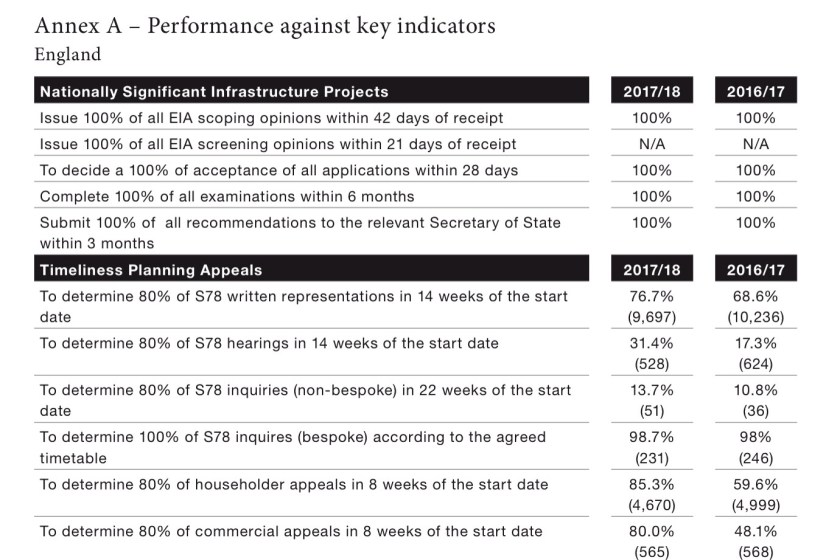
And regardless of the answer to that question, let us recall that only 2% of planning appeals proceed by way of inquiry and it should surely be at least as important that the Planning Inspectorate urgently reduces its timescales for processing appeals that are conducted by way of written representations or hearings, as well as by way of simpler (ie “non-bespoke”) inquiries, given the statistics set out its latest annual report (12 July 2018).

Simon Ricketts, 20 July 2018

Personal views, et cetera

Challenging Plans Before They Are Hatched

Can you challenge a draft local plan in the High Court before it is submitted to the Secretary of State for examination? When does the ouster in section 113 of the Planning and Compulsory Purchase Act 2004 kick in, which prevents development plan documents from being “questioned in any legal proceedings” except by way of an application for leave made before the end of six weeks beginning with the date that the document is adopted by the local planning authority?

These ouster provisions in legislation cause problems. For instance, in my 4 February 2017 blog post Hillingdon JR: Lucky Strike Out?, I reported on a case where the equivalent provision in relation to challenges to national policy statements under the NSIPs regime was relied upon to strike out a challenge to the Government’s announcement of a decision to publish a draft airports NPS.

R (CK Properties (Theydon Bois) Limited) v Epping Forest District Council (Supperstone J, 29 June 2018) concerned a challenge by a developer to Epping Forest District Council’s decision on 14 December 2017 to proceed with regulation 19 consultation of the submission version of its draft local plan prior to its submission to the Secretary of State for examination.

For those not familiar with the process, in summary authorities first have to carry out consultation in relation to their proposed development plans under Regulation 18 of the Town and Country Planning (Local Planning) (England) Regulations 2012 and take that consultation into account in preparing a revised version either for further Regulation 18 consultation or, if they consider that the document is ready for examination, for submission to the Secretary of State – in which case they must then carry out further consultation, under Regulation 19, before submitting the plan along with the representations received in response to that further consultation.

Remember back when many local planning authorities were racing to submit their local plans before a deadline of 31 March 2018, when the Government was indicating that its proposed standardised methodology for assessing housing needs would need to be used for plans submitted after that date? Of course that date then slipped with the delays to the draft revised NPPF to a date which will now be six months after the new NPPF is published but that’s another story.

Epping Forest was one of those authorities rushing to submit its plan, a district where the new standardised methodology would apparently increase the required housing provision over the plan period from some 11,400 to 20,306 homes. Some difference.

CK Properties have a site which was not allocated for residential development. Its complaint in the legal proceedings was that the appendix to the council’s site selection report that assessed the various sites considered for allocation and explaining its reasoning was not available at the time the council made its decision to consult on the submission version of its plan, despite assurances in its statement of community involvement that such background documents would be made available. The claimant secured an order from the Planning Court on 20 March 2018 restraining the council from submitting the plan for examination until the claim had been determined.

At the full hearing, the council sought to argue that regardless of the position in relation to the matters complained of, the effect of section 113 was that any challenge would have to await adoption of the plan.

It’s an important issue – can those aggrieved by a decision by a local planning authority to submit its plan to the Secretary of State for examination, challenge that decision by way of judicial review or do they have to store up their complaint until the plan is finally adopted?

The High Court had previously considered a challenge to a decision taken at an earlier stage in the development plan process in The Manydown Company Limited v Basingstoke and Deane Borough Council (Lindblom J, 17 April 2012), allowing judicial review proceedings to be brought of a decision by a council to approve a pre-submission draft core strategy for consultation (the equivalent of what is now the regulation 18 stage under the 2012 Regulations). The judge postulated that the position might be different in relation to the submission draft of a plan but considered that section 113 did not preclude challenges to pre-submission drafts.

Indeed the judge saw good sense not closing out the potential for an early challenge:

In a case such as this, an early and prompt claim for judicial review makes it possible to test the lawfulness of decisions taken in the run-up to a statutory process, saving much time and expense – including the expense of public money – that might otherwise be wasted. In principle it cannot be wrong to tackle errors that are properly amenable to judicial review, when otherwise they would have to await the adoption of the plan before the court can put them right.”

The High Court had also considered in IM Properties Development Limited v Lichfield District Council (Patterson J, 18 July 2014) the different question as to whether judicial review proceedings could be brought in relation to main modifications to a local plan or whether the challenge could only be brought post plan adoption by way of section 113. The court determined that the latter position was correct:

Once a document becomes a Development Plan document within the meaning of section 113 of the 2004 Act the statutory language is clear : it must not be questioned in any legal proceedings except in so far as is provided by the other provisions of the section. Sub-section (11)(c) makes it clear that for the purposes of a Development Plan document or a revision of it the date when it is adopted by the Local Planning Authority is the relevant date from when time runs within which the bring a statutory challenge.

It is quite clear, in my judgment and not inconsistent with the Manydown judgment, that once a document has been submitted for examination it is a Development Plan document. The main modifications which have been proposed and which will be the subject of examination are potentially part of that relevant document. To permit any other interpretation would be to give a licence to satellite litigation at an advanced stage of the Development Plan process.”

Having considered the scope of section 113 and these two previous authorities (neither covering the situation of an authority’s decision to proceed with a submission draft plan), Supperstone J concluded that the authority’s decision to prepare for submission of the plan could indeed be challenged by way of judicial review and was not closed out by section 113.

Whilst the claim ultimately failed because the judge did not find any of the grounds of challenge to be made out, the potential implications of the ruling are significant. There is very clearly now a window for judicial review of a local planning authority’s decision to embark on regulation 19 consultation (the formal precursor to submission of the plan for examination). The window closes when the plan is submitted for examination and any subsequent challenge can only be brought once the plan has been adopted. If there are clear grounds for challenge (for instance on the basis of procedural failings in the process to that date) why wait for submission of the plan and its eventual adoption? Indeed, might claimants challenging an adopted plan be criticised and even denied relief if they could have brought proceedings at the earlier stage?

Whilst there is something to be said for the Lindblom LJ (as he now is) view, expressed in Manydown, that early challenge (rather than having potential challenges stored up) can be a good thing, it can surely also be a bad thing if it slows down the process, particularly if, as is so often the case, the challenge is ultimately dismissed.

I assume that one reason why the claimant brought the early challenge in Epping Forest, and secured the interim order obtained from the court preventing submission of the plan until the full hearing had taken place into the challenge, was to seek to ensure that the plan was not submitted until the deadline had passed after which the Government’s standardised methodology for assessing housing needs had been introduced – given that the new methodology would require additional housing sites to be found. However, such have been the delays with the introduction of that methodology and such has been the speed of the court process to date (I do not know whether permission to appeal is being sought) it is very likely that the council will still be in a position to submit its plan on the basis of the old methodology.

Simon Ricketts, 30 June 2018

Personal views, et cetera

You’ve Been Frameworked!

By the Government’s 10 May deadline, over 20,000 responses were received to the draft revised NPPF, albeit apparently almost half of them duplicated campaign responses (for example the TCPA-led campaign to reinstate the express support for garden city principles that is in the current framework). The final version is expected in the week beginning 16 July. As many have pointed out, there surely is not enough time for any detailed consideration of all of that thinking, in the sliver of time between the initial process of collation and the final process of sign-offs and proofing?

Given that for development control purposes the policies in the revised framework will have immediate effect, perhaps it is as well if there are few surprises in the final version.

In England the 2012 NPPF has become a familiar (sometimes irritatingly vague) friend, but this is an appropriate point perhaps to remind ourselves of the peculiarities of the concept, born of the reforms introduced by the incoming coalition government in 2010, that swept away centrally approved regional spatial strategies and a mass of existing national policy statements and guidance, in the name of a Conservative version of localism as well as less prescriptive ways of working across local authority boundaries (the duty to cooperate, LEPs). The extent to which that system is or is not delivering is analysed well in this month’s interim report of the Raynsford Review of planning in England, but six years on we now take for granted the various oddities of the document, in that it is:

⁃ non-statutory – with no formal prescriptions as to its content or the procedure for its preparation and review – and with an uncertain formal status: in development control matters its principles are very much subsidiary to any relevant policies in an up to date development plan

⁃ determinedly non-spatial, with of course not a whisper of the “regional” word, not a whisper of where in the country growth might be more or less appropriate, or as to differences of approach in London and the core cities as opposed to rural communities- and, as a consequence of that lack of spatial policy making, the lack of any formal sustainability appraisal of policy options given that strategic environmental assessment requirements are not engaged.

⁃ devoid of top-down targets, in relation to housing numbers for example, which are left to percolate up from a myriad of contentious local plan processes, with until now no standardised approach as to any methodology for assessing local housing needs

⁃ not co-ordinated in any way with national economic or infrastructure investment priorities

⁃ immutable in the face of difficulties of interpretation and changed priorities, whilst shadowed by much more detailed planning practice guidance that has been subject to constant tinkering

⁃ despite its best intentions, relatively impenetrable I’m sure to non-planners.

I only practise in England. It is sometimes a shock to look at differing approaches being taken in other parts of the United Kingdom, as well as in Ireland. Whether as part of the NPPF or as a separate document, our unique choice is not to have any form of spatial plan for our country. Odd isn’t it?

Scotland

In Scotland, the National Planning Framework (NPF) is currently reviewed every five years and guides the preparation of Scottish planning policy, by setting out a strategy for Scotland’s spatial development and the priorities for that development. It is prepared pursuant to the Planning etc. (Scotland) Act 2006.

The current Planning (Scotland) Bill would have the effect of incorporating Scottish planning policy into the NPF, which would then only be reviewed every ten years, and thereby putting Scottish planning policy, in addition to the NPF, on a statutory footing. The NPF would become part of each local authority’s development plan

The Scottish Parliament’s Local Government and Communities Committee published its stage 1 report on the Bill on 17 May 2018, broadly supporting the proposals whilst seeking for the Scottish Parliament to be consulted on NPF changes and for the NPF to have a “clear read across to funding arrangements“.

The next version of the NPF, NPF4, is expected in June 2019, once the new arrangements have come into law. NPF3, “Ambition – Opportunity – Place”, was published in 2014. It is entirely different in character to the English NPPF, particularly in its spatial focus, and was the subject of detailed strategic environmental assessment.

Wales

The framework for Welsh land use planning policy comprises Planning Policy Wales (Edition 9, November 2016) supplemented by a series of Technical Advice Notes (TANs) and Minerals Technical Advice Notes (MTANs). There is also the Wales Spatial PlanPeople, Places, Futures, last updated in 2008.

The Welsh Planning Directorate has begun work on the production of a National Development Framework (NDF). The NDF will set out a 20 year land use framework for Wales and will replace the current Wales Spatial Plan.

Northern Ireland

Northern Ireland has its Strategic Planning Policy Statement for Northern Ireland -Planning for Sustainable Development (SPPS) (September 2015), published by its Department of the Environment, alongside its Development Strategy 2035 (March 2012), published by its Department for Regional Development.

The SPPS reflected the new tier-tier system which had been introduced, devolving various planning functions to local authorities whilst retaining for the Department of the Environment responsibility for regional planning policy, the determination of regionally significant and called-in applications, and planning legislation.

However, best laid plans and all that. Following the current dissolution (effectively since January 2017) of the Northern Ireland Assembly, its Departments have no minister in charge of them. As a result of the ruling of the Northern Irish High Court this month in the Colin Buick case, the full ramifications are now plain: absent a minister a Department is not in a position lawfully to exercise the powers specifically given to it.

In Buick, the decision of the Department for Infrastructure to grant planning permission for a major waste disposal incinerator, promoted by the Arc21 consortium of local authorities, was quashed:

“I have also noted the argument made in the papers that the delay in concluding a determination of the Arc21 planning application is impacting upon the implementation of public waste and environmental development at national, European and international level. However, the entire programme for government is on hold whilst the current impasse continues. This is extremely unfortunate. However, I do not consider that the exigencies of the current situation are an adequate justification for the course that has been taken. The commendable motivation and aims I refer to cannot override the proper construction of the statutory regime which this case requires.”

This presents a major constitutional and political dilemma. Until such time as the assembly can resume its work, how are significant decisions, both as to plans and projects, to be progressed in Northern Ireland? The Northern Irish planning system is currently broken, in a way which (for all the doom and gloom of the Raynsford review analysis) the English system is not.

Ireland

Finally, the Irish government has published its strategic planning and development framework, Ireland 2040, which comprises a national planning framework alongside its national development plan 2018 – 2027.

Its framework is very definitely spatial, unlike its 2002 predecessor document. The document refers to “…the situation that had arisen by the end of the 2000’s, when there was enough land zoned for a population of 10 million people in Ireland, but not located where required. We cannot continue with such a lack of focus.”

It directs the relative levels of growth it expects for its regions and its gestation has been far more controversial than has been the English draft revised NPPF, no doubt because it tackles difficult questions. There is a good summary of the document by Roger Milne in The Planner https://www.theplanner.co.uk/news/news-analysis-ireland’s-npf-sets-out-its-stall-on-joined-up-planning-and-development (19 February 2018). It will have a statutory basis once the Planning and Development (Amendment) Bill currently before the Seanad is enacted.

Lastly, it should be noted that there is a Framework for Co-operation – Spatial strategies of Northern Ireland and the Republic of Ireland (24 June 2010).

Back to England, with ad hoc national interventions and initiatives, seemingly little structured coordination as between on the one hand what the planning system can achieve and one the other hand any strategic approach to investment and funding, and reliance on many permutations of local alliances and forms of joint working. I certainly agree with many of the criticisms set out in Nick Raynsford’s interim report (whilst the direction and practicality of the solutions flagged may be open to question).

Let’s see how we get on shall we? Special, but determinedly not spatial.

Plans that either come to naught or half a page of scribbled lines

Hanging on in quiet desperation is the English way
The time is gone, the song is over
Thought I’d something more to say
.” *

Simon Ricketts, 19 May 2018

Personal views, et cetera

*Mason, Walters, Wright, Gilmour

Pointers From Parkhurst?

Parkhurst Road Limited v Secretary of State (Holgate J, 27 April 2018) is a complex analysis by the High Court of issues relating to viability appraisal. Indeed Holgate J concludes an unusual postscript (paragraph 142 onwards) to his judgment by expressing the hope that “the court is not asked in future to look at detailed valuation material as happened in these proceedings“.

The Parkhurst Road dispute has indeed been protracted, to say the least.

Parkhurst Road Limited had purchased the site in May 2013 for £13.25m from the Ministry of Defence, the site having been allocated by Islington Council as a “site for intensification for residential accommodation to help meet housing need in the Borough“.

An initial development proposal for 150 homes, reduced to 116 homes, was refused by Islington in October 2014 and an appeal was dismissed on design grounds in September 2015 following a six day inquiry. There had been dispute about viability issues at that inquiry but the inspector had been satisfied with the appellant’s benchmark land value position of £13.26m, which would have led to a 14% affordable housing commitment (16 homes). He considered that market comparables relied on by PRL showed that the price paid by PRL for the site “was not of a level significantly above a market norm“. Islington had not accepted the inspector’s approach to viability (pointing to a circularity inherent in relying on market evidence of comparable transactions to the extent it may not have been adjusted to reflect the requirements of relevant planning policies) but had not challenged it, given that the appeal had been dismissed in any event.

A revised scheme was then brought forward in January 2016, for 96 homes, with the design issues resolved, but with no affordable homes, on the basis that the viability of the scheme could no justify it. Again the application was refused, effectively solely on viability grounds, due to an asserted failure to maximise provision of affordable housing as against the council’s borough wide strategic target of 50%. PRL again appealed and by the time the inquiry closed in March 2017 after nine sitting days, the position was that PRL were arguing for a reduced benchmark land value of £11.9m and proposing that 10% of the homes should be affordable housing. Islington was arguing for a benchmark land value of £6.75m, leaving headroom for 34% affordable housing. The council’s case was based on an approach of relying on a low existing use value with a premium added (EUV+). PRL’s case was based on using market signals from other transactions, disregarding transactions “which are significantly above the market norm“.

Holgate J was told “that the two decision letters on the Parkhurst Road site have generated a good deal of interest amongst planning professionals, as if either decision could be taken as laying down guidance of more general application on the approach to be followed where development viability and affordable housing contributions are in issue.”

He throws cold water on that suggestion:

It is important to emphasise that that is not normally the function of a decision letter. The Inspector’s task is to resolve the issues which have been raised on the evidence produced in that appeal. The Inspector is not giving guidance on what course should generally be followed, even in cases raising the same type of issue. First, the application of policy often involves a good deal of judgment and second, the circumstances of an appeal (and the evidence produced) may differ quite considerably from one case to another (see eg. St Albans DC v Secretary of State for Communities and Local Government [2015] EWHC 655 (Admin)). There is a risk of attaching too much importance to the decisions of individual Inspectors, particularly where their conclusions were heavily dependent upon the circumstances of the cases before them and the nature of the evidence and submissions they received, with all their attendant strengths and weaknesses specific to that appeal. Reliance upon such decisions may take up a disproportionate amount of time and may distract parties from preparing suitable and sufficient information to deal with the circumstances and issues which arise in their own case.”

I summarised the inspector’s decision letter dismissing the appeal in my 24 June 2017 blog post Viability & Affordable Housing: Update.

The appellant challenged the decision on three grounds:

Ground 1 – the inspector erred in concluding that the council’s case was based on the EUV plus approach.

Ground 2 – the inspector did not address flaws which had been shown in the council’s valuer’s approach, applied the consultant’s method in a manner which was inconsistent with his understanding of it and failed to recognise substantial changes in the council’s case by the time the end of the inquiry was reached.

Ground 3 – criticisms of the way in which the inspector treated certain comparable transactions when arriving at his decision to accept the council’s benchmark land value figure.

Holgate J is not a judge to be cowed by disputes involving matters of valuation. He is after all President of the Lands Chamber in the Upper Tribunal and Planning Liaison Judge (ie basically the lead Planning Court judge).

He summarises Government policy on viability, quoting from paragraph 173 of the NPPF (with an interesting reference to compulsory purchase compensation principles when referring to the concept of a “willing seller”) and paragraphs 1, 19, 23 and 24 of the viability section of the Government’s planning practice guidance, asserts that the guidance places the onus on the developer to demonstrate non-viability, before summarising relevant local policies.

He addresses the RICS professional guidance, “Financial Viability In Planning“, in paragraphs 50 to 58, without criticism – noting for instance the fact that the guidance note discourages reliance upon EUV+ “as the sole basis for arriving at site value, because the uplift is an arbitrary number and the method does not reflect the workings of the market. Furthermore, the EUV Plus method is not based upon the value of the land if the redevelopment involves a different land use (eg. an office building redeveloped for a residential scheme)”.

The Secretary of State and Islington resisted the grounds but submitted that, in any event, PRL’s criticisms “do not vitiate the essential conclusion of the inspector that, contrary to local policy, the appeal proposal failed to provide “the maximum reasonable amount of affordable housing“”.

After a lengthy analysis of the decision letter as well as the arguments that had been put forward by the parties, the judge rejected grounds 1 and 3. He accepted in part PRL’s arguments in relation to ground 2, there had indeed been flaws in the council’s valuer’s approach which were not addressed properly by the inspector. However that error, in the judge’s view, did not vitiate the basis upon which the inspector rejected PRL’s case that a 10% affordable housing provision represented the maximum reasonable level and was not therefore a basis for quashing the decision.

The claim was accordingly dismissed.

Which takes us to that postscript in paragraphs 141 to 147. It is an intriguing read for what is says about, for instance the following:

⁃ The importance of overcoming uncertainty as to how viability assessment should properly be carried out, which is “making it difficult for practitioners and participants in the planning process to predict the likely outcome and to plan accordingly. It also leads to a proliferation of litigation“.

⁃ The tension that has arisen in the application of paragraph 23 of the viability passages in the PPG, which should mean reflecting and not bucking relevant planning policies when arriving at a benchmark land value, but on the other hand ensuring that the application of those policies should be informed by and not bucking an analysis of market evidence.

⁃ Data on comparables should be adjusted properly but on the other hand there are drawbacks in a simple requirement to conform to EUV+, by way of formulaic application, especially via local authority documents which have not been subjected to independent statutory examination prior to adoption.

Finally, in the context of the Government’s consultation proposals in relation to standardised inputs to viability assessments (see my 10 March 2018 blog post Developer Contributions, CIL, Viability: Are We Nearly There Yet the judge offers a suggestion:

It might be thought that an opportune moment has arrived for the RICS to consider revisiting the 2012 Guidance Note, perhaps in conjunction with MHCLG and the RTPI, in order to address any misunderstandings about market valuation concepts and techniques, the “circularity” issue and any other problems encountered in practice over the last 6 years, so as to help avoid protracted disputes of the kind we have seen in the present case and achieve more efficient decision-making.”

That would indeed be welcome.

Simon Ricketts, 28 April 2018

Personal views, et cetera

[Colleagues at Town acted for PRL but these are, as always, my personal views].

Green Belt Developments

This month’s green belt news: two Court of Appeal rulings, a Secretary of State decision letter and of course the draft revised NPPF.
Brown v London Borough of Ealing (Court of Appeal, 23 March 2018) was a judicial review of a local authority’s grant of planning permission for a first team training and academy facility for Queen’s Park Rangers, sports pitches, community facilities and associated development at Warren Farm Ealing, on metropolitan open land (where of course green belt policy tests apply).

One of the two grounds of challenge was “whether the officer’s conclusion, accepted by the committee, that “very special circumstances” existed to justify the grant of planning permission for “inappropriate development” on Metropolitan Open Land was bad in law“. 
Paragraph 88 of the current NPPF states:
When considering any planning application, local planning authorities should ensure that substantial weight is given to any harm to the Green Belt. ‘Very special circumstances’ will not exist unless any potential harm to the Green Belt by reason of inappropriateness, and any other harm, is clearly outweighed by other considerations.”
Following Redhill Aerodrome Ltd. v Secretary of State for Communities and Local Government (Court of Appeal, 24 October 2014), it is well established that the expression “any other harm” does not just mean any other harm to the green belt but takes in non- green belt factors as well. The question for the court in Brown was whether the officer had taken this correctly on board. It was submitted by the claimant that the structure of the officer’s conclusions suggested that she had either excluded non green belt harm such as loss of public access or that she had double-counted by concluding that the proposed improvements to community facilities would balance out that harm, when she had already taken into account the same factor as part of the “very special circumstances” arising. The court disagreed. The report had to be interpreted “with reasonable benevolence and realism, and not in an overly legalistic way“. The officer had properly applied the approach that the Redhill judgment requires and on the double-counting point:

“In principle, it is possible for a particular factor to be relevant, and to carry appropriate weight, in the consideration of more than one planning issue. It may serve to avoid or overcome or, at least, outweigh some real or potential planning harm, and it may also satisfy some planning need that would otherwise go unmet”

“This was not, in any sense, “double-counting”. Rather, the officer’s conclusions point up the two-fold relevance of the improvement to recreational facilities at Warren Farm as a material consideration – to which appropriate weight had to be given in two respects, not merely in one. The officer was entitled to conclude, as a matter of planning judgment, that in the context of “Public Access”, given the availability of other publicly accessible open space nearby, the balance of relevant benefit – improved sports facilities for the local community – against disadvantage – the “loss” of public access for recreation – fell in favour of the development. I do not accept that this benefit was immaterial in that particular context; it was, I think, plainly a relevant consideration there. The officer was also entitled to conclude, again as a matter of planning judgment, that in the “very special circumstances” balance itself, the ability of the development to meet a need identified in development plan policy – the general need for investment in improved sports facilities, and specifically the need for such investment at Warren Farm – was a consideration to which weight should be given on the positive side of that balance. These conclusions were not in tension or conflict with each other. They were distinct from each other, but mutually consistent. They do not show a material consideration being given double weight, only a single factor being given due weight in two different respects: first, outweighing a “loss” that would be caused by the development itself; second, meeting an existing need that would not be satisfied without the development.”
Samuel Smith Old Brewery (Tadcaster) Limited v North Yorkshire CC (Court of Appeal, 16 March 2018) was the latest piece of litigation instigated by Yorkshire brewer and serial litigator Humphrey Smith. This time the target of Mr Smith’s attention was a planning permission granted for the extension of a limestone quarry in the green belt about a mile from Tadcaster. The claimant argued that the council had misapplied paragraph 90 of the NPPF, which states mineral extraction is not “inappropriate development” in the green belt if it preserves the openness of the green belt. 
The officer had approached the question of “openness” in this way:
“It is considered that the proposed development preserves the openness of the Green Belt and does not conflict with the purposes of including land within the Green Belt. Openness is not defined, but it is commonly taken to be the absence of built development. Although the proposed development would be on existing agricultural land, it is considered that because the application site immediately abuts the existing operational quarry, it would not introduce development into this area of a scale considered to conflict with the aims of preserving the openness of the Green Belt.

In terms of whether the proposed development does not conflict with the purposes of including land within the Green Belt, the proposed quarrying operations are not considered to conflict with the purposes of including land within the Green Belt. Equally, it is not considered that the proposed development would undermine the objective of safeguarding the countryside from encroachment as it should be considered that the site is in conjunction with an operational quarry which will be restored. The proposed development is a temporary use of land and would also be restored upon completion of the mining operations through an agreed DRMP.

The purposes of including land within the Green Belt to prevent the merging of neighbouring towns and impacts upon historic towns are not relevant to this site as it is considered the site is adequately detached from the settlements of Stutton, Towton and Tadcaster. It is also important to note that the A64 road to the north severs the application site from Tadcaster.”
The court found that this was indeed a misinterpretation of paragraph 90:
“The concept of “the openness of the Green Belt” is not defined in paragraph 90. Nor is it defined elsewhere in the NPPF. But I agree with Sales L.J.’s observations in Turner to the effect that the concept of “openness” as it is used in both paragraph 89 and paragraph 90 must take its meaning from the specific context in which it falls to be applied under the policies in those two paragraphs. Different factors are capable of being relevant to the concept when it is applied to the particular facts of a case. Visual impact, as well as spatial impact, is, as Sales L.J. said, “implicitly part” of it. In a particular case there may or may not be other harmful visual effects apart from harm in visual terms to the openness of the Green Belt. And the absence of other harmful visual effects does not equate to an absence of visual harm to the openness of the Green Belt.

As a general proposition, however, it seems to me that the policy in paragraph 90 makes it necessary to consider whether the effect of a particular development on the openness of the Green Belt can properly be gauged merely by its two-dimensional or three-dimensional presence on the site in question – the very fact of its being there – without taking into account the effects it will have on the openness of the Green Belt in the eyes of the viewer. To exclude visual impact, as a matter of principle, from a consideration of the likely effects of development on the openness of the Green Belt would be artificial and unrealistic. The policy in paragraph 90 does not do that. A realistic assessment will often have to include the likely perceived effects on openness, if any, as well as the spatial effects. Whether, in the individual circumstances of a particular case, there are likely to be visual as well as spatial effects on the openness of the Green Belt, and, if so, whether those effects are likely to be harmful or benign, will be for the decision-maker to judge. But the need for those judgments to be exercised is, in my view, inherent in the policy.

The first part of the question posed by the preamble in paragraph 90 – whether the development would “preserve” the openness of the Green Belt – cannot mean that a proposal can only be regarded as “not inappropriate in Green Belt” if the openness of the Green Belt would be left entirely unchanged. It can only sensibly mean that the effects on openness must not be harmful – understanding the verb “preserve” in the sense of “keep … safe from harm” – rather than “maintain (a state of things)” (Shorter Oxford English Dictionary, 4th edn.). There may be cases in which a proposed development in the Green Belt will have no harmful visual effects on the openness of the Green Belt. Indeed, there may be cases in which development will have no, or no additional, effect on the openness of the Green Belt, either visual or spatial. A good example might be development of the kind envisaged in the fourth category of development referred to in paragraph 90 of the NPPF – “the re-use of buildings provided that the buildings are of permanent and substantial construction”. But development for “mineral extraction” in the Green Belt, the category of development with which we are concerned, will often have long-lasting visual effects on the openness of the Green Belt, which may be partly or wholly repaired in the restoration phase – or may not. Whether the visual effects of a particular project of mineral working would be such as to harm the openness of the Green Belt is, classically, a matter of planning judgment.

In my view, therefore, when the development under consideration is within one of the five categories in paragraph 90 and is likely to have visual effects within the Green Belt, the policy implicitly requires the decision-maker to consider how those visual effects bear on the question of whether the development would “preserve the openness of the Green Belt”. Where that planning judgment is not exercised by the decision-maker, effect will not be given to the policy. This will amount to a misunderstanding of the policy, and thus its misapplication, which is a failure to have regard to a material consideration, and an error of law.”
Or as Zack Simons summarised:

The planning permission was quashed.
Aside from these two Court of Appeal rulings, throwing light on paragraphs on paragraphs 88 and 90 of the NPPF respectively, it was also interesting to see this month the Secretary of State allow an appeal by Berkeley Homes (Southern) Limited and Howard Partnership Trust for substantial development in the green belt, comprising 258 homes and replacement secondary school in Effingham, Surrey. In his decision letter (21 March 2018) the Secretary of State’s findings included that:

– There is a need for additional school places in the area, “the existing school premises are not fit for the purpose of meeting modern educational and social need and that the replacement of the school in order to facilitate this carries very substantial weight“. Furthermore, “there are very significant issues with the fabric of the school and the ongoing funding of its repair and maintenance in the current budgetary context. He further agrees that in seeking to address condition as well as suitability and sufficiency, the least expensive option is the rebuilding of the school on the only other available identified site, and that these matters carry very substantial weight.”
– An Autism Centre “optimally located within the new complex to maximise its effectiveness for the students who will use it, … is a clear benefit of the scheme and to deepening the educational and community inclusivity of the school.”

– Guildford Borough Council only has a 2.1 year housing land supply. Against this the Secretary of State considered that the delivery of dwellings, 20% of which will be affordable, carries very substantial weight. 

He concluded that the benefits arising from the scheme “clearly outweigh harm to the Green Belt by reason of inappropriateness and any other harm, and so very special circumstances exist” for the purposes of paragraphs 87 and 88 of the NPPF. 
The inclusion of reference to the extent of unmet housing need in Guildford as part of the very special circumstances relied upon is encouraging, but the need to replace the school and provide more school places was a crucial component, given that the Government has indicated since 2013 that unmet housing need alone is not sufficient to amount to very special circumstances, a stance that is presently unlikely to change. Indeed, at the end of a House of Commons debate debate on 6 February 2018 on housing, planning and the green belt, there was this exchange between Dominic Raab and a backbench Conservative MP:

This was of course followed by publication on 5 March of the draft revised NPPF (NPPF 2.0 for hipster-planners). Has it made any difference to any of what I have set out above? Well, slightly:
– paragraph 88 is now paragraph 143 and after the words “any other harm” is added “resulting from the proposal“. This is an additional pointer towards the Court of Appeal’s wider interpretation of that phrase as per Redhill and now Brown. 
– paragraph 90 is now paragraph 145 with unchanged wording, although within paragraph 144 there is an important extra category of development that is not “inappropriate” and where “very special circumstances” therefore do not need to be shown”: “where the development would re-use previously developed land and contribute to meeting an identified local affordable housing need, not cause substantial harm to the openness of the Green Belt. ” – this “not cause substantial harm” is going to be the new battleground I’m sure. There is also a clarification of the previous statement that “the provision of appropriate facilities for outdoor sport, outdoor recreation” etc is not “inappropriate development”. The wording is now “the provision of appropriate facilities (in connection with the existing use of land or a change of use) for” those uses”, following the approach already adopted by the courts, eg in R (Timmins) v Gedling Borough Council (Court of Appeal, 22 January 2015).
The “exceptional circumstances” test for changing green belt boundaries in plans has been embellished (as flagged since the February 2017 housing white paper) by requiring that “the strategic plan-making authority should have examined fully all other reasonable options for meeting its identified need for development. This will be assessed through the examination of the plan, which will take into account the preceding paragraph, and whether the strategy; 

* a)  makes as much use as possible of suitable brownfield sites and underutilised land; 


* b)  optimises the density of development, including whether policies promote a significant uplift in minimum density standards in town and city centres, and other locations well served by public transport; and 


* c)  has been informed by discussions with neighbouring authorities about whether they could accommodate some of the identified need for development, as demonstrated through the statement of common ground.”


“Where it has been concluded that it is necessary to release Green Belt land for development, plans should give first consideration to land which has been previously-developed and/or is well-served by public transport. They should also set out ways in which the impact of removing land from the Green Belt can be offset through compensatory improvements to the environmental quality and accessibility of remaining Green Belt land.”

Will this embellishment raise the threshold materially for green belt release? I’m not sure that the additional criteria do anything more than articulate the matters that would be examined in any event. The removal of some brownfield proposals, which will not cause substantial harm to the openness of the green belt, from the definition of inappropriate development is on the other hand potentially significant (and surely wholly sensible). As for the constant flow of case law, it is certainly not going to dry up. 
Simon Ricketts, 30 March 2018
Personal views, et cetera