Money For Nothing? CPO Compensation Reform, Land Value Capture

To what extent might the state choose to tax land owners, through reducing their compensation entitlement, in order to facilitate the provision of housing or infrastructure, rather than subsidise that provision through more general tax raising? How can the state capture land value gains created by its own infrastructure provision, or due to its own strategic planning for development?
These questions are central to a number of current areas of public policy thinking, including:
– Using compulsory purchase 
– Land auctions and land value capture charges
– Benchmark land values in viability appraisal
– CIL reform
There are some confluences arising in this area between current Conservative party thinking, other political parties, Transport for London and Shelter to name but a few. I’m not sure that land owner interests have yet joined all the dots. Developers may wish to partner more closely and regularly with local authorities with compulsory purchase powers, but in other situations should also be aware of the risks ahead for their businesses if additional costs are not sufficiently predictable as to come off the land price or if they cause land owners simply to hold rather than sell. 
Using compulsory purchase

Compulsory purchase is already a practical mechanism for securing land where there is a compelling case in the public interest for interfering with private property rights. Of course it isn’t easy, and will never be. The power is draconian. The necessary procedural safeguards to protect against its abuse make for a slow, procedurally technical process and for uncertain outcomes.

Another disincentive for local authorities can be the significant compensation costs payable, given the fundamental principle that the land owner is entitled to what the value of his interest would have been were it not for the compulsory acquisition (the ‘equivalence’ principle). Even where compensation liability is being underwritten by a developer partner, the extent of compensation is:
– likely to affect whether the project is viable after all; and
– not ascertainable until all parties are too far in to back out due to the leisurely pace at which a compensation figure is determined (both pre- and post-reference to the Lands Tribunal, aka Lands Chamber of the Upper Tribunal). 
The Conservative manifesto, published on 17 May 2017, refers to compulsory purchase in this one paragraph:
“We will enter into new Council Housing Deals with ambitious, pro-development, local authorities to help them build more social housing. We will work with them to improve their capability and capacity to develop more good homes, as well as providing them with significant low-cost capital funding. In doing so, we will build new fix-term social houses, which will be sold privately after ten to fifteen years with an automatic Right to Buy for tenants, the proceeds of which will be recycled into further homes. We will reform Compulsory Purchase Orders to make them easier and less expensive for councils to use and to make it easier to determine the true market value of sites”

I am guessing that what is planned goes further than making the current system work better. Changes are being considered which would enable in some circumstances greater use of compulsory purchase and, in some circumstances, acquisition at lower values than the equivalence principle would suggest. 
The February 2017 Housing White Paper says this:
“2.43 Compulsory purchase law gives local authorities extensive powers to assemble land for development. Through the Housing and Planning Act 2016 and the Neighbourhood Planning Bill currently in Parliament we are reforming compulsory purchase to make the process clearer, fairer, and faster, while retaining proper protections for landowners. Local planning authorities should now think about how they can use these powers to promote development, which is particularly important in areas of high housing need. 

2.44 We propose to encourage more active use of compulsory purchase powers to promote development on stalled sites for housing. The Government will prepare new guidance to local planning authorities following separate consultation, encouraging the use of their compulsory purchase powers to support the build out of stalled sites. We will investigate whether auctions, following possession of the land, are sufficient to establish an unambiguous value for the purposes of compensation payable to the claimant, where the local authority has used their compulsory purchase powers to acquire the land.

2.45 [ ]

2.46 We will keep compulsory purchase under review and welcome any representations for how it can be reformed further to support development.”
Note the references to encouraging the use of compulsory purchase where development has stalled, and investigating the use of auctions to establish land value (more on that later in this blog post).
Revealingly, in the week before the publication of the manifesto there was a press release with this passage in its “notes to editors”:
“To further incentivise councils to build, the Conservatives also intend to reform compulsory purchase rules to allow councils to buy brownfield land and pocket sites more cheaply. At the moment, councils must purchase land at “market value”, which includes the price with planning permission, irrespective of whether it has it or not. As a result, there has been a more than 100% increase in the price of land relative to GDP over the last 20 years and the price of land for housing has diverged considerably from agricultural land in the last fifty years. Between 1959 and 2017, agricultural land has doubled in value in real terms from £4,300 per acre to £8,900 per acre, while land for planning permission has increased by 1,200%, from £107,000 to just over £1,450,000. Local authorities therefore very rarely use their CPO powers for social housing, leaving derelict buildings in town centres, unused pocket sites and industrial sites remain undeveloped.
I’m guessing at the following policy strands for a future Conservative government from these various statements:
1. Further encouragement for use of CPO powers in the right circumstances, including particular encouragement where a “Council Housing Deal” is in place (guaranteeing social housing with a fixed-term right to buy for tenants) and possibly where private sector development is shown to have stalled (link this and the “delivery” elements of the Housing White Paper and this could be quite a stick to wield).
2. Further process reform likely.
3. Reform likely of the process for determining the compensation price to be paid, so that (1) figures are known earlier on, (2) the land auctions model is followed (see later in this blog post) to determine values in appropriate circumstances and (if those ‘notes to editors’ are to believed) (3) in some circumstances authorities will be able to acquire land for less than it is worth (possibly ruling out hope value unless planning permission or a certificate of appropriate alternative development under section 17 of the Land Compensation Act 1961, has actually been obtained). 
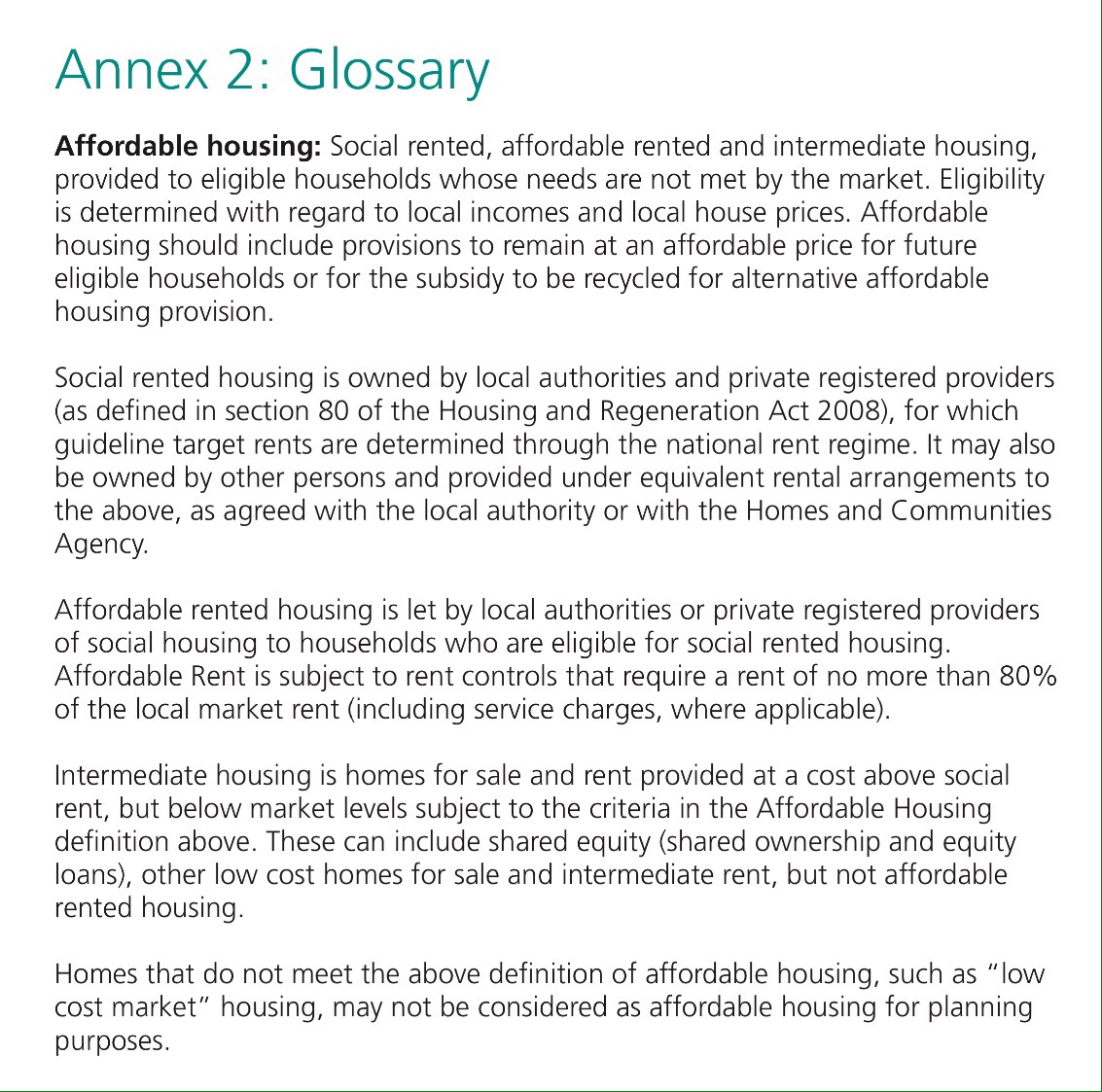
The last point (still speculation) has caused consternation and excitement in equal measure. The principle of equivalence is at stake, but equally this opens up the prospect of securing land for development at an undervalue so as to achieve affordable housing at no cost to the state. Money for nothing (unless you are the land owner). Shelter for example have been lobbying for a similar approach. Their May 2017 paper Financing the infrastructure and new homes of the future: the case for enabling acquiring authorities to purchase land for strategic development under a special CPO compensation code May 2017 lobbies for Government to:

enable acquiring authorities to purchase land for strategic development under a special CPO compensation code. This would involve three changes:

1)  An amendment to the National Planning Policy Framework to allow planning authorities to designate land for strategic development; 

2)  An amendment to Section 14 of the 1961 Land Compensation Act to disregard prospective planning permissions on land designated for strategic development; 


3)  An amendment to Section 17 of the 1961 Land Compensation Act to restrict the use of certificates of alternative development on land designated for strategic development.”

Shelter’s delight at the references in the Conservatives’ recent policy announcements is plain to see from their subsequent 16 May 2017 blog post Compulsory purchase and council homes – a new direction for housing policy?
Do the Conservatives really intend such a radical market intervention, or do they misunderstand how the compensation system currently works? The reference in the press release’s “notes to editors” that “councils must purchase land at “market value”, which includes the price with planning permission, irrespective of whether it has it or not” is of course wrong. The prospect of planning permission for development in the “no scheme world” is taken into account in arriving at a valuation but the existence of a planning permission is never assumed. 

However logically necessary the concept is, the “no scheme world” (or “Pointe Gourde”) rule been much criticised for being difficult to apply in practice. Its complexities were most recently explored by the Supreme Court in Homes & Communities Agency v JS Bloor (Wilmslow) Ltd  (22 February 2017), where Lord Carnwath said this:
The rule has given rise to substantial controversy and difficulty in practice. In Waters v Welsh Development Agency [2004] 1 WLR 1304; [2004] UKHL 19, para 2 (“Waters”), Lord Nicholls of Birkenhead spoke of the law as “fraught with complexity and obscurity”. In a report in 2003 the Law Commission conducted a detailed review of the history of the rule and the relevant jurisprudence, and made recommendations for the replacement of the existing rules by a comprehensive statutory code…”

Lord Carnwath had himself of course chaired that review. Too late for the litigants in Bloor, now finally, by virtue of section 32 of the Neighbourhood Planning Act 2017  (which introduces new sections 6A to E into the Land Compensation Act 1961) we have a codified version of the “no scheme world” rule. (The compulsory purchase provisions within the 2017 Act are well summarised by David Elvin QC in a paper  to the 2017 PEBA conference). 

New section 6E has refined the rule so that it is now more difficult for claimants to rely on increases in value of their land created by the transport project for which the land has been acquired, where regeneration or redevelopment was part of the justification for the transport project. 
The big question is whether a more radical manipulation of the “no scheme world” rule might be possible, even if it parted from the principle of equivalence. After all, if land for development could be secured at little more than agricultural value…?
It would be mightily difficult, indeed controversial to the extent of potentially being counter-productive, if land is to be acquired without prolonged legal wrangling. If in the real world your land has hope value for another form of development, why should that be ignored? However, in fact it’s not legally impossible.
Article 1 of the protocol to the European Convention on Human Rights states as follows:
Every natural or legal person is entitled to the peaceful enjoyment of his possessions. No one shall be deprived of his possessions except in the public interest and subject to the conditions provided for by law and by the general principles of international law. 

The preceding provisions shall not, however, in any way impair the right of a State to enforce such laws as it deems necessary to control the use of property in accordance with the general interest or to secure the payment of taxes or other contributions or penalties.”

(Incidentally, the Conservative manifesto confirms: “We will not repeal or replace the Human Rights Act while the process of Brexit is underway but we will consider our human rights legal framework when the process of leaving the EU concludes. We will remain signatories to the European Convention on Human Rights for the duration of the next parliament.“)
The European Court of Human Rights interprets Article 1 of the protocol so as to require compensation to be paid in relation to the confiscation of property. In Lithgow v UK  (European Court of Human Rights, 8 July 1986), a case arising from Labour’s nationalisation of various industries under the Aircraft and Shipbuilding Industries Act 1977, the court said:
“The Court further accepts the Commission’s conclusion as to the standard of compensation: the taking of property without payment of an amount reasonably related to its value would normally constitute a disproportionate interference which could not be considered justifiable under Article 1 (P1-1). Article 1 (P1-1) does not, however, guarantee a right to full compensation in all circumstances, since legitimate objectives of “public interest”, such as pursued in measures of economic reform or measures designed to achieve greater social justice, may call for less than reimbursement of the full market value”.


Whilst a distinction was drawn in the case between state nationalisation of industries and the compulsory purchase of property, the same basic principles apply. It is clear from this and other cases that individual states are given a margin of appreciation to determine what is in the public interest. For example:
Sporrong and Lönnroth v. Sweden  (22 September 1982) (a case about longterm blight caused by ‘zonal expropriation permits’)
 “…the Court must determine whether a fair balance was struck between the demands of the general interests of the community and the requirements of the protection of the individual’s fundamental rights…
James v UK  (21 February 1986) (a challenge brought by the trustees of the estate of the Duke of Westminster to leasehold enfranchisement under Leasehold Reform Act 1967):
“Because of their direct knowledge of their society and its needs, the national authorities are in principle better placed than the international judge to appreciate what is “in the public interest”. Under the system of protection established by the Convention, it is thus for the national authorities to make the initial assessment both of the existence of a problem of public concern warranting measures of deprivation of property and of the remedial action to be taken… Here as in other fields to which the safeguards of the Convention extend, the national authorities accordingly enjoy a certain margin of appreciation.” The Court went on to find that the aim of the Leasehold Reform Act 1967, namely greater social justice in the sphere of housing, was a legitimate aim in the public interest


Similarly, in theory a mechanism might be arrived at which in some way disentitled land owners in some circumstances from achieving a full market value for their land. But the circumstances would need to be carefully circumscribed and the reaction of most land owners would be to fight rather than one of flight. 
It is not as if compulsory purchase compensation is presently particularly generous, even with the additional loss payments (capped, even for owner-occupiers, at the lesser of 10% of the compensation payable and £100,000) that were introduced by the Planning and Compulsory Purchase Act 2004 specifically to sweeten the pill for land owners and make compulsory purchase less contentious! Do we really want more uncertain situations such has arisen at the Aylesbury Estate, with the Secretary of State rejecting  a CPO made by the London Borough of Southwark, on the basis of the prejudice that would be caused to leaseholders by the inadequate level of compensation payable to them, and now reportedly  having consented to judgment following a challenge by the council, such that all concerned now face a re-opened inquiry?
Furthermore, if these amended compensation principles are only to apply to, for example, Council Housing Deals, how will dispossessed owners be able to recover their property, or further compensation, if the land ends up not being used for the restricted purposes for which the land was taken?
Lastly, that manifesto reference to making it “easier to determine the true market value of sites”. Does this suggest a simplification of compensation principles? Or an overhaul of the timescales for determining compensation liability? Transport for London have recently suggested (in the paper referred to in the next section of this blog post) that the Government might make “the process of acquiring land through compulsory acquisition more transparent by:

* Introducing an independent valuation panel to determine the market value of the land based on the ‘no scheme’ principle set out in the Neighbourhood Planning Bill 2016 

* Establishing (early in the land acquisition process) an objective and transparent evidence base on alternative development potential in the absence of the scheme, for such a panel to determine ‘no scheme’ market values, for instance through the use of a modified section 17 certificate”.
Land auctions, land value capture charges

The passage quoted earlier from the Housing White Paper refers to “auctions”. Academic Tim Leunig has been promoting  the idea of “community land auctions” for a long time and indeed the idea was toyed with in the early years of the coalition government, whilst to a number of us it seemed naive in its assumption as to how planning actually works:
“The council first asks all landowners to name the price at which they are willing to sell their land. By naming a price, the landowner gives the council the right to buy the land for 18 months at that price. The council then writes a development plan. As now, they will take into account the suitability of the land offered for development, but will also consider the price of the land, and the likely financial return to the council.”
Transport for London has more recently been promoting a more sophisticated “development rights auction model” as a method of capturing land value increases created by transport infrastructure improvements. Their 20 February 2017 land value capture report , summarises it as follows:
“For zones with high development potential (particularly for housing) with multiple landowners, the Government, TfL and the GLA should consider the development rights auction model (DRAM), a new land value capture mechanism. 

The key features of the development rights auction model are: 

* The integrated planning and consenting of land use and density in a defined zone around a major new transport facility, in parallel with the planning of the transport scheme 
* The introduction of a periodic development rights auction, in which development rights over land put forward (voluntarily) by landowners are auctioned in assembled packages to a competitive field of developers. Gains above a reserve price are shared between the participating landowners and the planning/auctioning authority. No development taxes (such as CILs or s106 payments) are payable under this scheme. All non-operational but developable public sector-owned land within the zone is entered into the auction as part of a standard public sector land pooling arrangement 

* The introduction of a high zonal CIL for those landowners who wish to self- develop rather than participate in the auction 

* The use of reformed compulsory purchase order (CPO) powers (following successful passage of the Neighbourhood Planning Bill 2016) to deal with holdout problems that threaten to stall development, together with further consideration of other options as discussed in the report”.
The Government’s 8 March 2017 budget announcements included a memorandum of understanding  entered into with the GLA, that says this:
“At Budget 2016, the government invited Transport for London (TfL) to bring forward proposals for financing infrastructure projects from land value uplift. 

The government has agreed to establish a joint taskforce bringing together the GLA, TfL, London Councils, HM Treasury, Department for Transport (DfT) and Department for Communities and Local Government (DCLG) to explore the options for piloting a Development Rights Auction Model (DRAM) on a major infrastructure project in London.

Should a pilot of DRAM be agreed, it will be jointly evaluated by London and the government to review its effectiveness and determine whether a similar model could be applied to other infrastructure projects.”


I can’t presently relate the DRAM initiative to the reference in the Housing White Paper (quoted above) to establishing land value via auctions in CPO situations, following possession. What on earth is that a reference to?
TfL’s February 2017 paper has various other more radical policy suggestions to capture infrastructure-related land value increases, including changes to SDLT, to retention of business rates and a new “land value capture charge” This would “capture a proportion of the premium paid to landowners by new purchasers or tenants of residential property for access to new transport facilities“. (Shall we call a tax a tax though, folks?). 
There is also a current RTPI research project The Use of Alternative Land Value Capture Mechanisms to Deliver Housing in England and Wales.
Benchmark land values in viability appraisal

One of the most contentious issues in relation to developers’ project viability appraisals (carried out for the purposes of seeking to agree reductions in the scale of section 106 affordable housing and other obligations) is the benchmark land value that should be applied as a cost input. Clearly it should not be the actual market value (which would lead to circularity) but equally it should not be just the existing use value (EUV), which would not reflect reality and would result in schemes being assumed to be viable when in reality they would not be because the land would not be made available at the assumed benchmark value. 
The 2012 RICS guidance, Financial Viability In Planning  , advises that it is appropriate to take into account alternative use value (AUV):
“Site Value should equate to the market value subject to the following assumption: that the value has regard to development plan polices and all other material planning considerations and disregards that which is contrary to the development plan.”
As summarised in my 1.12.16 blog post  , the London Mayor is seeking to move away from accepting AUV, preferring an “EUV+” approach, ie existing use value “plus premium”, with the methodology for calculating the premium left undefined, and therefore a recipe for continuing debate. 
In practice, surely any attempt to pitch EUV+ at less than AUV is equivalent to restricting the application of the “no scheme world” rule – a policy intervention to apply that shortfall for public purposes. Except that with viability negotiations, it could of course lead to development simply not proceeding. Is there then a stalled scheme and grounds for compulsory purchase? The extent to which this sort of economic intervention is acceptable needs to be carefully limited and defined. 
CIL reform

There have been rumours that the reason why the Government parked in February any response to the CIL review team’s report was that the new ministerial team had started to think about whether in fact any replacement for CIL should encapsulate land value concepts (memories of the planning gain supplement anyone?). There is certainly no mention of CIL in the Conservative manifesto. Certainly the policy priorities as between CIL and affordable housing need to be reconsidered. 

If we weren’t in such dire straits, we could of course go back to a position where the state invested in social housing and funded public services without weighing the costs so heavily on land owners and developers. In the meantime, over the next five years we’ll definitely see answers emerge to those questions I posed back at the beginning of this overlong post. 
Simon Ricketts 20.5.17

Personal views, et cetera

Newmarket: Horses, Houses, Politics, Planning

Let’s please constrain the circumstances in which the Secretary of State can intervene in planning decision-making. Who is going to carry on investing in housing land promotion when, frankly, the outcome of betting on the horses can be more predictable?
The day before the Supreme Court’s ruling in Suffolk Coastal (where the Supreme Court justices examined the semantic intricacies of paragraphs 49 and 14 of the NPPF, extolled the virtues of expert inspectors and recognised the need to boost the supply of housing), judgment was handed down in Moulton Parish Council and the Earl of Derby v Secretary of State  (Gilbart J, 9 May 2017). 

The case concerned the controversial proposals by the Earl of Derby for residential development in Newmarket, in the heartland of the British horseracing industry. 
The Secretary of State had in 2012 dismissed an appeal against refusal by Forest Heath District Council of planning permission for mixed-use development including up to 1,200 dwellings, 36,000 sq m of B1 employment floorspace. Whilst various representatives of the horse-racing industry had argued the scheme would harm their interests, through the traffic and other effects arising, the appeal was only dismissed on the ground that the scheme was premature, in that due to its strategic implications, it should be considered through the development plan process. 
There had been a policy in the local plan that included an urban extension for 1,200 dwellings north east of Newmarket that included the appeal site. However, the grouping of horseracing interests had succeeded in quashing that policy and related housing provision policies in Save Historic Newmarket Limited v Forest Heath District Council  (Collins J, 25 March 2011). 
The Council carried out a “single issue review” of its housing policies, dealing with overall housing provision and distribution, and with site allocations and published a preferred options document for consultation. The review proposed a mixed use development, including 400 dwellings, on part of the previous site, and the Earl of Derby brought forward a planning application for that level of development. The application was resolved to be approved by the district council (after overcoming an attempted judicial review by objectors who sought unsuccessfully to overturn a negative EIA screening opinion) but it was called in by the Secretary of State on 11 July 2014. The inquiry took place in April and May 2015, the inspector’s report was dated 9 July 2015 and yet the Secretary of State didn’t issue his decision  until 31 August 2016. The Secretary of State rejected the application for a number of reasons, including concerns as to highway safety, raised again in no uncertain terms by those representing the horseracing industry.
So, a year for the Secretary of State to consider the inspector’s report and over two years since his intervention in the local decision-making process! One might think that the decision, which rejected the inspector’s recommendation that planning permission be granted, would be bullet-proof in its reasoning after such a delay. Hmm. The decision has been quashed by Gilbart J following a challenge brought by two parties, one unsurprisingly being the appellant, the Earl of Derby, but the other unusually being a parish council, Moulton, concerned at the additional pressure for development that would arise in its parish if the proposals do not proceed at the application site – after all, housing has to go in someone’s back yard, somewhere, sometime, doesn’t it?
The application will now have to be redetermined. 
I want to consider the following questions which arise out of this sorry but not unusual tale:
– what went wrong in the Secretary of State’s reasoning?

– why did his decision take so long?

– what is the role in practice of lobbying and political pressure in ministerial decision-making?

What went wrong in the Secretary of State’s reasoning?


The claimants’ successful grounds of challenge were that the Secretary of State:
– failed to apply his own policies set out in the NPPF; and

– failed to have regard to his own previous decision “where he had reached conflicting conclusions to those he now holds on matters relating to highway safety, or has reached a conclusion on safety without evidence, or which is irrational“.

A world away from the complexities facing the Supreme Court in Suffolk Coastal, the Secretary of State’s mistake on the first ground was an obvious one. The inspector reported that there were no up to date development policies in relation to housing provision and that therefore paragraph 14’s “tilted balance” in favour of sustainable development applied. However, the Secretary of State fails to address this material consideration at all in his decision letter. 
Gilbart J: “In this particular decision, it is plain that the effect of the tilted balance in NPPF [14] was of considerable importance. It was one of the eight main issues identified by the Inspector, and much debate between the parties. While the effect of the change in the housing supply position after the Inspector’s report had been received could have affected the weight to be given to the arguments about the 5 year supply, the issue relating to the important absence of housing policies remained. One of its particular contexts was that this site would meet important objectives of policy in terms of sustainability, as well as the fact that it was best and most versatile agricultural land. This is a local authority area where more land has to be found for housing, as suggested by the emerging local plan allocations.
In relation to the second ground, the inspector and Secretary of State had found in the case of the larger scheme that highway safety problems were not likely to arise. There was no explanation as to his volte face.

Gilbart J: “There is not a single reference by the SSCLG to the previous decision, let alone to the previous Inspector’s Report. In my judgement, the very least that was required of the SSCLG was to acknowledge the fact of the previous conclusions, and face up to the fact that he was being asked to reach conclusions which on any view were entirely at odds with the those he had reached in 2012. NHG had not held back in its case at inquiry that the first decision was wrong on this issue, with which contention the Claimants (and FHDC) disagreed, as did the Second Inspector. But despite that, it received no mention or consideration at all in the Decision Letter.”

How wasteful for such an important decision to fall at two basic hurdles – hardly Brecher’s Brook, were they? A single careful sentence in each case would in my view have saved the decision letter. 
Why did the Secretary of State’s decision take so long?


Call-in in this case led to a delay of over two years before his decision was received and the re-determination process will now add significantly to that delay, at no-one’s cost save for the Earl of Derby and indeed those in housing need. 
Gilbart J gives this explanation for the delays that occurred after the inspector’s report was received by the Secretary of State on 9 July 2015:
“About four months after the inquiry had finished the [Newmarket Horsemen’s Group] elected to make further representations in September 2015, as did the local member of Parliament the Rt Hon Matthew Hancock MP. The SSCLG circulated them for comment at the end of October 2015. He then circulated the comments he had received.

In February 2016, the Planning Consultants for the Claimant Lord Derby made representations, which were also circulated for comment. The responses received were also circulated. In April 2016, the SSCLG circulated the representations he had received, and also invited comment on the then recent Court of Appeal decision in Suffolk Coastal District Council v Hopkins Homes Ltd & Anor [2016] EWCA Civ 168, circulating the further responses on 5th May 2016.”

So we can see that the problem comes down to a combination of a slow decision-making process and the opportunities that gives third parties to seek to bolster their case with post-inquiry representations, relying on the inevitability of changing circumstances over time; indeed, the longer the decision-making takes, clearly the more vulnerable it is to such interventions. No doubt, the ministerial changes that followed the June 2016 referendum were another factor but my basic principle still holds, in my view. 

It may be said that the Secretary of State needs to be allowed sufficient time to make a considered decision. But the outcome of the challenge demonstrates that time does not ensure quality of outcome. A study as to what was happening week by week in relation to the decision, from July 2015 to August 2016 would surely be instructive. 
What is the role in practice of lobbying and political pressure in ministerial decision-making?

The principles to be applied by the Secretary of State in deciding to call in an application for his own determination have always been left extremely flexible. As summarised in a helpful July 2016 House of Commons library briefing paper on calling in planning applications , the 1999 ‘Caborn principles’ still apply:

“Such cases may include, for example, those which in his opinion: 

* may conflict with national policies on important matters; 


* [may have significant long-term impact on economic growth and meeting housing needs across a wider area than a single local authority]; 


* could have significant effects beyond their immediate locality; 


* give rise to substantial cross-boundary or national controversy; 


* raise significant architectural and urban design issues; or 
• may involve the interests of national security or of foreign Governments. 

However each case will continue to be considered on its individual merits “. 

The list of recent call-in decisions is a pretty long one.

A decision to call in or not to call in an application is barely justiciable in practice (as long as properly reasoned to a basic extent) given the breadth of the criteria. 
In this case the reasons stated in the inspector’s report as to why the Secretary of State had called in the application (for a relatively limited amount of development, against the background of an emerging supportive local development plan policy) were apparently:
“3.1  The proposal may have significant long-term impact on economic growth and meeting housing needs.

3.2  The proposal could have significant effects beyond its immediate locality.

…which tell us nothing.  
This obviously leads to speculation, however ill-founded. The Independent for instance inevitably ran a story, “Tory minister lines up with racing royalty against new homes”  on 16 August 2014. 

The political pressure being applied can surely not be doubted however. Recall as well that post-inquiry representations were being made against the scheme by the local MP,  Matthew Hancock. 
Even when these representations are made openly, one worries as to the further politicisation of this quasi-judicial process. But often there is suspicion that there are informal as well as formal attempts to influence ministerial decisions. The judiciary has recently of course in Broadview Energy Developments Limited v Secretary of State  (Court of Appeal, 22 June 2016) deprecated informal lobbying attempts by MPs, in that case Andrea Leadsom MP’s attempts to stop a wind farm scheme, with a conversation in the Commons tea-room and numerous emails from her to the minister, including one referring to her “badgering [him] in the lobby”. Longmore LJ in that case indicated that he “would not endorse that part of the judge’s judgment [at first instance] in which he said that lobbying of Ministers by MPs was part and parcel of the representative role of a constituency MP with its implication that such lobbying was permissible even when the Minister is making a quasi-judicial decision in relation to a controversial planning application. MPs should not, with respect, be in any different position from other interested parties.”

We have seen the influence that individual MPs can bring to bear on ministers, with MP for Sutton Coldfield, Andrew Mitchell MP, having brought about the Secretary of State’s holding direction (now lifted) in relation to the Birmingham development plan, as a result of his concerns as to proposed green belt housing allocations in his consistency. 

It may be said that planning cannot be separated from politics but it is depressing to see. It was also eyeopening to see that of the seven decisions issued by the Secretary of State in his last day before purdah, with the parties suddenly in pre-election mode, six were to refuse planning permission. When the decision as to whether a major scheme goes ahead is not to be taken at local level, with the promise of a quasi-judicial assessment, how do we ensure that the role of the inspector is respected: the careful evidence taking and testing at inquiry and neutral evaluation of that evidence as against the statutory criteria? Our role becomes that of guessers as to how the politics, against the deployed legal tactics on all sides, will play out.

This is how the next Secretary of State could make a difference: fewer call ins and fewer recovered decisions, but clearer guidance as well as renewed attempts to ensure that up to date local plans are in place. But what are the odds?
Simon Ricketts 13.5.17
Personal views, et cetera

NPPF Paras 49 & 14: So What Is The Supreme Court Really Saying?

The Supreme Court’s judgment in Suffolk Coastal District Council v Hopkins Homes and Richborough Estates v Cheshire East Borough Council, handed down on 10 May 2017, has been keenly anticipated but what does it mean for the development industry?
 The issue

 The issue at stake is subtle but crucial for promoters of residential development in areas that cannot show five years’ supply of deliverable housing sites. In such circumstances, paragraph 49 of the NPPF advises that “[r]elevant policies for the supply of housing should not be considered up-to-date” meaning that what is called the “tilted balance” in the second part of paragraph 14 applies: planning permission should be granted unless:

* “ any adverse impacts of doing so would significantly and demonstrably outweigh the benefits, when assessed against the policies in this Framework taken as a whole; or

* specific policies in this Framework indicate development should be restricted”.

 Footnote 9 of the NPPF gives examples of “specific policies”, such as green belt policies or policies relating to particular environmental designations.

 There have been various attempts by the courts to resolve what the phrase “relevant policies for the supply of housing” actually means:

* Should it be given a narrow interpretation, limiting it to policies that deal with the quantum and distribution of new housing, or a wider interpretation, including policies whose effect is to restrict housing development in certain parts of the authority’s area, for example gaps between settlements or land subject to particular landscape designations?

* Once those “relevant policies” have been identified, are they to be given limited weight, or no weight?

 The two cases

The Supreme Court (as did the Court of Appeal previously) had before it two separate cases raising these issues.

The Cheshire East case had first come before Lang J in the High Court. Richborough Estates had appealed against Cheshire East Borough Council’s non-determination of its planning application for 170 (later reduced to 146) homes between Willaston and Crewe. The inspector allowed the appeal. He concluded that the council was unable to demonstrate five years’ housing land supply and that policies in relation to “open countryside”, “green gap” and “housing in the open countryside” were relevant policies for the supply of housing to be given reduced weight by virtue of paragraph 49. Lang J quashed the decision, on the basis that the inspector had erred in treating the “green gap” policy as subject to paragraph 49.
 The Suffolk Coastal case had first come before Supperstone J in the High Court. Suffolk Coastal District Council had refused planning permission for a development of 26 houses in Yoxford. The developer, Hopkins Homes, had appealed and the inspector dismissed the appeal. Notwithstanding a relatively up to date local plan, the inspector had found that it was “very unlikely that a five years’ supply of housing land could now be demonstrated”. He considered that none of the policies in the plan relating to the boundary of settlements, landscape, townscape, settlement hierarchy and the character of key and local service centres were “relevant policies for the supply of housing”. He also found that the proposal would have an unacceptable effect on historic parkland. Supperstone J ruled that the inspector had erred in thinking that paragraph 49 only applied to “policies dealing with the positive provision of housing” and also considered he had failed properly to assess the significance or otherwise of the historic parkland as a non-designated heritage asset.

 The Court of Appeal

Both cases came before the Court of Appeal in January 2016 at a conjoined hearing. Lindblom LJ gave the judgment  of the court on 17 March 2016 and found for the developers in both cases. He gave the phrase in paragraph 49 the “wider” interpretation, construing the words as meaning relevant policies “affecting the supply of housing”. He considered that it was then for the decision maker to determine the weight that should be applied to these policies, deemed out of date.

 The Supreme Court

 The Supreme Court only hears cases that raise points of law of general public importance and this was the first time that issues concerning the NPPF had come before it, Sullivan LJ having granted permission on 1 May 2016. The case was heard by five Supreme Court justices, Lord Carnwath, Lord Neuberger, Lord Clarke, Lord Hodge and Lord Gill, at a hearing on 22 and 23 February 2017. Lord Carnwath gave the lead judgment for all of the justices save for Lord Gill who gave a separate judgment. 

Lord Carnwath and Lord Gill are the two justices most familiar with planning law south and north, respectively, of the border. Lord Gill indeed has been editor of the Scottish Planning Encyclopedia. This was his last case before retirement. His separate judgment provides a wider commentary on the proper role of the planning system in delivering sufficient housing, alongside that of Lord Carnwath, himself a former leading advocate at the planning bar. Carnwath, Gill, Sullivan, Lindblom: these are judges who understand our subject area and its particular complexities. 
As set out by Lord Carnwath at the beginning of his judgment, the appeals provided the opportunity for the court “not only to consider the narrow issues of interpretation of para 49, but to look more broadly at issues concerning the legal status of the NPPF and its relationship with the statutory development plan.”
 The following points may be of particular interest:

 Legal status of the NPPF

 There was some debate at the hearing as to the legal status of the (non-statutory) NPPF and as to the source of the Secretary of State’s power to issue national policy guidance as to the determination of applications and appeals, which could have led the court in an unanticipated direction. However’ despite the lack of any statutory basis (in relation to the determination of applications and appeals, as opposed to his role in relation to plan-making), the court pragmatically held that he did indeed have the power, which arose “expressly or by implication, from the planning Acts which give him overall responsibility for oversight of the planning system.” (Lord Carnwath, paragraph 19)

 Interpretation of the NPPF

 The court stressed that it is important not to overstate the scope of the Secretary of State’s policy-making role. The NPPF is no more than “guidance” and is no more than a “material consideration” for the purposes of section 70(2) of the 1990 Act: “It cannot, and does not purport to, displace the primacy given by the statute and policy to the statutory development plan. It must be exercised consistently with, and not so as to displace or distort, the statutory scheme”. (Lord Carnwath, paragraph 21)

 The distinction between interpreting the meaning of words (a matter for the courts) and the application of guidance (exclusively a matter for the planning authority and inspectors) is stressed in Lord Gill’s separate judgment.

 The interaction of law and policy

The Supreme Court had previously determined in Tesco Stores Limited v Dundee City Council  (2012) that “policy statements should be interpreted objectively in accordance with the language used, read as always in its proper context”. This has led to concerns (expressed by counsel appearing in these proceedings)  “about the over-legalisation of the planning process, as illustrated by the proliferation of case law on paragraph 49 itself…This is particularly unfortunate for what was intended as a simplification of national policy guidance, designed for the lay reader”. (Lord Carnwath, paragraph 23).

 The court made it clear that “it is important that the role of the court is not overstated”. There was a specific development plan policy under consideration in Tesco and “some policies in the development plan may be expressed in much broader terms, and may not require, nor lend themselves to, the same level of legal analysis”. (Lord Carnwath, paragraph 24). “It must be remembered that, whether in a development plan or in a non-statutory statement such as the NPPF, these are statements of policy, not statutory texts, and must be read in that light…Furthermore, the courts should respect the expertise of the specialist planning inspectors and start at least from the presumption that they will have understood the policy framework correctly” and the courts have “cautioned against undue intervention” in policy judgments within specialist tribunals’ areas of competence. (Lord Carnwath, paragraph 25). Applicants for judicial review should “distinguish clearly between issues of interpretation of policy, appropriate for judicial analysis, and issues of judgement in the application of that policy.” (Lord Carnwath, paragraph 26).

 The meaning of NPPF paragraph 14

 The court drew the analogy with a policy for the supply of employment land which may become out of date because of the arrival of a major new source of employment in the area. Whether it is out of date, and what should be the consequence, are matters of planning judgement, including any effect on other related policies, for example for transport. Other competing policies may need to be given less weight, but “again that is a matter of pure planning judgement, not dependent on issues of legal interpretation”. (Lord Carnwath, paragraph 55).  This should also be the approach in relation to housing policies deemed “out of date” under paragraph 49. “It also shows why it is not necessary to label other policies as “out of date” merely in order to determine the weight to be given to them under paragraph 14. As the Court of Appeal recognised, that will remain a matter of judgment for the decision-maker”. (Lord Carnwath, paragraph 56).

 This is vital stuff! It changes what has been the orthodox approach to the paragraph 49/14 conundrum, rendering less important the analysis of which policies are “relevant policies” and bringing us back to a sensible balancing of the issues and allowing the need to secure an adequate supply of housing land to be taken into account in determining the weight to be applied to a policy, even for those policies not specifically  caught by paragraph 49.

 Lord Gill’s separate judgment stresses the importance that the NPPF places on boosting the supply of housing. “The message to planning authorities is unmistakeable”. (Lord Gill, paragraph 77). He refers to “the futility of authorities’ relying in development plans on the allocation of sites that have no realistic prospect of being developed within the five year period”. (paragraph 78).

 In passing it should be noted that Lord Carnwath and Lord Gill both read into the footnote 9 examples of protective designations in the NPPF, references to the related development plan policies. Lord Gill notes that the “rigid enforcement of such policies may prevent a planning authority from meeting its requirement to provide a five-years supply” (paragraph 79).

 The meaning of NPPF paragraph 49

 The meaning of “relevant policies for the supply of housing” on this analysis becomes less important. The court preferred the “narrow” interpretation, namely “housing supply policies”. “However, this should not be seen as leading, as the lower courts seem to have thought, to the need for a legalistic exercise to decide whether individual policies do or do not come within that expression.” If there is a failure to provide for a five year housing land supply “it matters not whether the failure is because of the inadequacies of the policies specifically concerned with housing provision, or because of the overly-restrictive nature of other non-housing policies.” (Lord Carnwath, paragraph 59). The shortfall is enough to trigger the “tilted balance”.

 Lord Gill puts it like this: “If a planning authority that was in default of the requirement of a five-years supply were to continue to apply its environmental and amenity policies with full rigour, the objective of the Framework could be frustrated”. (paragraph 83).

 Application of the principles to the cases

 On this basis, the inspector was wrong to adopt a wider interpretation to the policies at issue in the Cheshire East case. However, “that did not detract materially from the force of his reasoning…He was clearly entitled to conclude that the weight to be given to the restrictive policies was reduced to the extent that they derived from “settlement boundaries that in turn reflect out-of-date housing requirements”. The permission was upheld.

 On this basis, the inspector in the Suffolk Coastal case had embarked on an “inappropriate and unnecessary” exercise in distinguishing between policies which affected the supply of housing and those which did not. He should not have given the weight that he did to the settlement boundary policy  given that it was “to an extent at least, no more than the counterpart of the housing policies.” The decision to dismiss the appeal was quashed and will need to be re-determined.

 Concluding thoughts

 This is the highest court in the land telling us to be less legalistic about the way we frame our arguments as to the application of national and local policies to development proposals. The exercise is not so much a close technical examination as to whether policies are “relevant policies” for the purposes of paragraph 49 but a weighing up of the consequences of a housing supply deficit against policies which are restricting that supply. In the Cheshire East case it is noteworthy that the court considered that it was right that the green gap policy was given less weight – not because it was a paragraph 49 policy (they found that it was not) but because it reflected out-of-date housing requirements. 

We have all perhaps been guilty, spurred on particularly by the Supreme Court itself in Tesco v Dundee, of seeking too often to reduce matters of planning judgment to narrow points of legal interpretation. It is a habit we need to break. 
The court stressed the expert role of inspectors. Of course not all decisions are taken by inspectors. Is the same latitude to be given to local planning authorities’ decisions, whether given on or against officers’ recommendations, or to those of the Secretary of State? The point is unaddressed, given that the only two situations before the court were decisions taken by inspectors. 
If the advice of the court leads to fewer judicial reviews and statutory challenges, that is surely to be welcomed.  
The previous Government has of course been consulting on potential revisions to the NPPF. I would suggest that the new Government reflects on the approach that it should take in the light of this judgment. The amendments that the Government had proposed to paragraph 14 may not give rise to undue concern but shouldn’t more thought be given to whether it is right or not further to complicate paragraph 49 with reference to a three years’ supply safety net where a neighbourhood plan is in place containing defined housing policies, as proposed in the December 2016 written ministerial statement? Isn’t this precisely the over-prescriptive approach being deprecated by the court – and one driven perhaps by a concern that communities were seeing local designations in some way “switched off” or automatically being given less weight through being treated as “relevant policies”? This should no longer be feared. Instead, a sensible balancing exercise will need to be undertaken. 
Lastly, the relationship, in the statutory presumption, as between the adopted development plan and other material considerations, has been sought by some judges to be rigidly applied, in a way which does not sit well with this ruling. I am thinking particularly of Green J’s judgment in East Staffordshire Borough Council v Secretary of State and Barwood Strategic Land  (22 November 2016) an appeal against which is due to be heard by the Court of Appeal (probably again with Lindblom LJ as the lead judge) on 25 May 2017. It will be fascinating to see this early application of the Supreme Court’s thinking. 
Simon Ricketts 10.5.17
Personal views, et cetera

(Town Legal LLP acted for Richborough Estates in this case. Special personal thanks from me to Christopher Young and James Corbet Burcher, both of No 5 Chambers, and to my colleague Ricardo Gama). 


Make No Little Plans: The London Plan 

“Make no little plans; they have no magic to stir men’s blood and probably themselves will not be realized. Make big plans; aim high in hope and work, remembering that a noble, logical diagram once recorded will never die, but long after we are gone be a living thing, asserting itself with ever-growing insistency” (Daniel Burnham)
The current version of the London Plan is no little plan, but fails the “magic to stir blood” and “noble, logical diagram” tests. It runs to over 400 pages, which is surely ridiculous – particularly since it is legally constrained only to deal with “matters which are of strategic importance to Greater London”. (Whilst no replacement for a formal document, New London Architecture’s 2015 summary of the document in a four minute video fronted by Peter Murray shows how the key messages can be got across in a more accessible and rousing style).

We are expecting initial non-statutory public consultation this autumn into a review of the current plan, so as to reflect the policy priorities of our third London Mayor, Sadiq Khan. Following this initial process, there would then need to be two formal consultation stages (the first with the London Assembly and GLA bodies, the second with the public) before an examination in public into the submitted document, which the Mayor projects for summer 2018, and perhaps adoption (his fingers still crossed) in autumn 2019. So even on a best case the Mayor will not have an adopted plan until over three quarters of his way through his four year term of office. 
His predecessors had the same problem. It took Ken Livingstone four years from election in 2000 to have in place the first London Plan (which ran to an even more thudding 420 pages) and it took Boris Johnson three years from election in 2008 to have in place his 2011 Replacement London Plan, which, subject to three sets of alterations, remains the current plan, supplemented by no fewer than adopted 21 SPGs with two further SPGs currently in draft (Culture and Night Time Economy (April 2017); Affordable Housing & Viability (November 2016)). The extent of reliance on SPGs is no doubt partly down to the exclusion of non-strategic matters from the plan itself (although the SPGs cover a whole range of strategic matters) but as much as anything is probably down to pragmatism, given the slowness of the statutory process. 
Strange and dysfunctional system isn’t it? Particularly when one recalls that the inspector, Anthony Thickett, concluded his report dated 18 November 2014 into the Further Alterations to the London Plan as follows:
“57. The evidence before me strongly suggests that the existing London Plan strategy will not deliver sufficient homes to meet objectively assessed need. The Mayor has committed to a review of the London Plan in 2016 but I do not consider that London can afford to wait until then and recommend that a review commences as soon as the FALP is adopted in 2015 (IRC3). In my view, the Mayor needs to explore options beyond the existing philosophy of the London Plan. That may, in the absence of a wider regional strategy to assess the options for growth and to plan and co-ordinate that growth, include engaging local planning authorities beyond the GLA’s boundaries in discussions regarding the evolution of our capital city. “
There are urgent and important issues to be grappled with, with implications far beyond London postcodes. Why do we put up with such slow processes?
The London Plan, or “spatial development strategy” to give it its statutory title, is a strange and unwieldy beast and, as we await consultation on its new incarnation, let’s remind ourselves of some of the curiosities arising from its statutory basis in sections 334 to 341 of the Greater London Authority Act 1999 and the Town and Country Planning (London Spatial Development Strategy) Regulations 2000.
The legal structure for the plan arrived at in the 1999 Act was at the time largely novel. The plan superseded the then Government’s non-statutory regional planning guidance (specifically, RPG3, the then regional planning guidance for London) and the procedure set out for the adoption of this new strategic regional plan echoed in part the examination-in-public process for structure plans of the time. (My recollection from then was that the emphasis on “strategic” was to mark a contrast from the over-prescriptive and slow plan-making of the previous Greater London Council – nice try!). 
When the development plans system (over-engineered in the extreme) was created by virtue of the Planning and Compulsory Purchase Act 2004 (which also introduced statutory regional spatial strategies for the rest of England), although the London Plan was not a “development plan document”, it was part of the statutory development plan alongside the boroughs’ development plan documents (ie core strategies etc). Under section 38(6) of the 2004 Act, planning applications therefore must be determined “in accordance with the plan unless material considerations indicate otherwise”. 
Increased powers were devolved to the Mayor, including, by way of the Mayor of London Order 2008, the ability to direct that he should be the local planning authority on a planning application of potential strategic importance and determine it himself. The plan’s policies are central to the call-in criteria in Article 7(1) of the Order, all of three of which must be met in order for the Mayor to be able to intervene:
“(a)  the development or any of the issues raised by the development to which the PSI application relates is of such a nature or scale that it would have a significant impact on the implementation of the spatial development strategy;

(b)  the development or any of the issues raised by the development to which the application relates has significant effects that are likely to affect more than one London Borough; and 


(c)  there are sound planning reasons for issuing a direction

The application of the criteria was tested in R (Spitalfields Historic Trust) v Mayor of London  (Gilbart J, 10 May 2016).

By way of the Localism Act 2011 the regional spatial strategies were abolished but the London Plan remained. The extent to which the London Plan was a development plan for the purposes of the new “duty to cooperate” that the 2011 Act introduced (by way of inserting a new section 33A into the 2004 Act) was left unclear. The plan also now sat not just above the boroughs’ individual local plans but also above potentially a tier of neighbourhood plans below those plans. 
When the Government’s National Planning Policy Framework (haiku-like little plan, in contrast to the swathes of guidance it replaced) was published in March 2012, it cancelled the guidance there had been in Circular 1/2008 as to the contents of the London Plan. There is now very little direct guidance for the Mayor in the NPPF or indeed in subsequent Planning Practice Guidance.
These are some of the key legal elements of the London Plan process:
What it must contain
The plan’s functions are unique:
As well as the Mayor’s “general policies in respect of the development and use of land in Greater London” (section 334(3)), it must deal with any “general spatial development aspects” of the other strategies, policies and proposals that he is responsible for, whether or not they relate to the development or use of land (section 334(4)). These other strategies include transport, bio-diversity, waste, air quality, noise and culture. 
The plan “must deal only with matters which are of strategic importance to Greater London” (section 334(5)). The meaning of “strategic” was tested in R (Mayor of London) v First Secretary of State (Forbes J, 7 April 2008). The then Mayor had directed that Brent Council should refuse planning permission for a student housing scheme on design grounds. The developer appealed against the refusal and in allowing the appeal the Secretary of State awarded costs against the Mayor on the basis that he should not have intervened on grounds that were not of strategic importance. The Mayor challenged the award of costs but the court held that the Secretary of State had been entitled to reach that conclusion. 
Co-operation
There has been legal argument as to the extent to which the formal “duty to co-operate” (for what it’s worth) is engaged in relation to the London Plan. This occupied time at the examination of the 2012 examination of “revised early minor alterations” to the plan and the 2014 examination of further alterations. 
Inspector Geoff Salter in his report dated 19 June 2012 concluded that the duty did not formally apply:
“Section 110 of the Localism Act introduced a new section (33A) of the Planning and Compulsory Purchase Act 2004 which imposes a duty on local planning authorities and other prescribed bodies to co-operate in a range of planning activities. The Mayor is a prescribed person for the purposes of the duty but the London Plan is in effect a regional strategy (RS), the preparation of which does not fall within the list of activities covered by the duty, such as preparation of Development Plan Documents (DPDs). Activities that can reasonably be described as preparing the way for activities such as DPD preparation fall within the duty. However, I do not agree with the South East Waste Planning Advisory Group and the East of England Waste Technical Advisory Body that the LP can be considered to meet this definition, since its production is an activity in its own right“. 
Whereas Inspector Anthony Thickett in his report dated 18 November 2014 appears to reach the opposite conclusion: 
“Section 33A(3) lists the activities to which the duty applies. The first activity is the preparation of development plan documents. The London Plan is part of the development plan for London but the Mayor points to Section 38(2) of the 2004 Act which defines the FALP as a spatial development strategy and not a development plan document. Section 33A(3)(d & e) apply the duty to any activities that can reasonably be considered to prepare the way for or support the preparation of development plan documents. The preparation of the FALP is an activity in its own right but it must, in my view, also prepare the way for and support the preparation of development plan documents.”
By the time of the most recent examination, into further minor alterations to housing and parking standards, inspector David Hogger’s report dated 15 December 2015 simply accepts the Mayor’s position that the duty does not formally apply, as set out in a procedural note submitted to him which contains the following passage:
“Although the duty applies to the Mayor in respect of other authorities’ plans, it is the Mayor’s view (upheld by Leading Counsel) that section 33A does not apply specifically to the activity of preparing or amending the London Plan. However, London Plan Policy 2.2 makes clear that the Mayor is strongly committed to working with authorities and agencies in the East and South East of England to secure sustainable development and the management of growth in the wider metropolitan area and to co-ordinate approaches to other strategic issues of common concern.” (paragraph 3.6)
The point may be a sterile one in part given that all three Inspectors found that in practice there had been sufficient co-operation in any event, in the context of specific duties in the 1999 Act for the Mayor to:

* consult on any alteration to or replacement of the spatial development strategy (the London Plan) with counties and districts adjoining London (section 335), and
* inform local planning authorities in the vicinity of London of his views concerning any matters of common interest relating to the planning or development of London or those areas (sections 339 and 348).

However, it is a point that needs urgently tidying up to avoid legal uncertainty in the context of the forthcoming plan. 

The previous Mayor established the Outer London Commission to consider how parts of outer London might better realise their economic potential. Given as well Anthony Thickett’s urging in his report of the need for a new approach given the pressures for housing, inter-relationships with surrounding areas outside London’s formal boundaries cannot be ignored. The Outer London Commission’s March 2016 report, Coordinating Strategic Policy And Infrastructure Investment Across The Wider South East, touches on the taboo subject of green belt review:

“3.24 […] a strategic review [of green belt boundaries] in London may raise legal issues. The NPPF is very clear that Green Belt reviews should be a local planning authority matter and the two London’s Mayors have so far accepted this. However, S30 of the GLA Act enables the Mayor to take action to further one or more of the authority’s principal purposes. Moreover, the London Plan is legally part of the Development Plan for any area of London and, more practically, the NPPF is clearly written with single tier planning authorities in mind. A case might well be constructed to justify Mayoral/strategic involvement in a review (he already addresses other issues to which the NPPF attributes responsibility to the local planning authority). A formal legal opinion on the admissibility of the Mayor leading a strategic review might inform this.”
No doubt, the new plan will duck the issue, but should it?
Relationship with the boroughs
Section 24(1)(b) of the Planning and Compulsory Purchase Act 2004 requires borough plans to be in general conformity with the London Plan. 
The content of the plan is clearly of critical importance to the boroughs and the sensitivity is heightened given that the Mayor does not have to accept an inspector’s recommendations. Differing political priorities between the Mayor and boroughs can lead to tensions, as we saw in relation to the affordable rented housing policies in “revised early minor modifications” introduced by Boris Johnson. Nine boroughs challenged the policy which had been adopted in the face of recommendations from inspector Geoff Salter in his report dated 19 June 2012. They argued that the policy would unlawfully preclude them from imposing borough-wide caps on rent for affordable rented housing at lower than a London-wide default level of 80% of market value.
The dispute reached the High Court in London Borough of Islington (& 8 other London boroughs) v Mayor of London (Lang J, 25 March 2014). The court dismissed the challenge:
“28. In my view, the Claimants have failed to establish that the Defendant’s strategy is contrary to the NPPF. The NPPF is a national policy framed in terms of broad policy objectives. Detailed decisions on how those objectives can be best achieved have to be made at a regional and local level. The only reference to rent caps for affordable rented housing is in the definition of affordable rented housing, which provides that the rent must be “no more than 80% of the local market rent”. Paragraph 47 of the NPPF does not speak either for or against local rent caps. Nor does it prevent the Defendant from adopting a London-wide policy against rent caps with which local boroughs must comply. There are other ways in which the Claimants can and should “use their evidence base” to ensure their local plans meet “objectively assessed needs” for affordable housing…”
The future
So, a plan is to be adopted in 2019 with a two year preparation process, within which period the environmental and other implications of emerging policies will need to be thoroughly tested. How will it point London forward in a certain and confident way given the various current uncertainties over such issues as Brexit (given the particularly internationally-facing role that Greater London plays, a clear priority for Khan will be to avoid a hard Glexit, regardless of the consistency of any Brexit); Heathrow; Crossrail 2; the Bakerloo Line extension and other infrastructure proposals, and whatever emerges as the (new) Government’s air quality plan? But perhaps above all of these uncertainties remains the continued desperate need for increased housing, with affordability a key component. 

What a challenging prospect the Mayor and his team have ahead of them in appropriately directing boroughs and developers with clarity and precision, retaining the good, snipping out the unnecessary or counter-productive. Let’s hope that, in every respect save its length, this turns out to be no little plan. 
Simon Ricketts 23.4.17
Personal views, et cetera
Great Expectations: Pip & The Brownfield Land Registers

“We changed again, and yet again, and it was now too late and too far to go back, and I went on“. (Charles Dickens, Great Expectations)
Permissions in principle will change our planning system significantly, mark my words. In my 11.6.16 blog post  I posed a series of questions arising from the legislative skeleton that is sections 150 and 151 of the Housing and Planning Act 2016. 
Victorian part-work style, we now have had the Housing and Planning Act 2016 (Permission in Principle etc) (Miscellaneous Amendments) (England) Regulations 2017  (made 6 March 2017, in force 27 March 2017), the Town and Country Planning (Brownfield Land Register) Regulations 2017  (made 20 March 2017, in force 16 April 2017) and the Town and Country Planning (Permission in Principle) Order 2017 (made 20 March 2017, 15 April 2017). The statutory instruments don’t yet give effect to all of what sections 150 and 151 enable, but we now have some answers. 
This blog post is not a full summary of how the regime will operate. There are various good summaries but I particularly recommend the Lichfields 27 March 2017 ‘essential guide‘.
A few headlines from the new regime:
1. Local planning authorities will be under a statutory duty to publish their brownfield land registers by 31 December 2017 and then maintain them, reviewing the entries at least annually. 
2. The registers will be in two parts:
– Part 1: previously developed land with an area of at least 0.25 hectares that is suitable and available for residential development and where residential development is achievable (all defined terms)
– Part 2: land in Part 1 where the local planning authority has exercised its discretion to enter the land in Part 2 and has decided to allocate the land for residential development having followed defined publicity, notification and consultation procedures. 

3. The information that must be recorded for each entry is specified and includes

– “the minimum and maximum net number of dwellings, given as a range, which in the authority’s opinion, the land is capable of supporting”

– “where the development includes non-housing development, the scale of any such development and the use to which it is to be put“. 

4. Part 2 will not include sites where the development would require environmental impact assessment. So, if the proposed development falls within Schedule 2 column 1 of the 2011 EIA regulations (for most purposes, more than 150 dwellings or on more than 5 hectares), a negative screening opinion or direction must first be obtained (but remember, indicative screening thresholds as to when significant environmental effects are likely to arise allow for the possibility of projects much larger than 150 dwellings). 

5. There are no statutory rights of appeal if the local planning authority refuses to include land on the register (ECHR article 6 compliant?). Judicial review would, as always with any decision of a public body, be available but the decision to include land on Part 2 is at the local planning authority’s discretion so that would not be easy.  

6. Once land is on Part 2 it has automatic “permission in principle” for five years. In order to be able to carry out the development, application for technical details consent is required, particularising “all matters necessary to enable planning permission to be granted”. The statutory determination period for technical details consent is ten weeks for major development and otherwise five weeks, so deliberately shorter than the equivalent periods in relation to “traditional” non-EIA planning applications (thirteen and eight weeks respectively). A section 106 agreement may be required if the usual tests are met. 

7. There is no defined limit on the extent of non-housing development that can benefit from the procedure, alongside residential development. 

8. The procedure applies to conversion and extension of existing buildings as well as development. 

For a wider overview of where this mechanism is heading, there are also useful references in DCLG Planning Update Newsletter March 2017, from which it is clear that further regulations will follow to (1) allow applications for permission in principle to be made for minor development (ie basically less than ten homes) for sites on part 1 of a brownfield land register and to (2) allow automatic permission in principle to stem from allocation in defined categories of statutory development plans rather than just from designation on a brownfield land register. Guidance is also in the offing (dovetailed with the revised NPPF? We can but hope). 
We also await the Government’s response to its February 2016 technical consultation on implementation of planning changes  chapter 2 (permission in principle) and chapter 3 (brownfield register). It was originally promised to be published alongside the regulations. In the meantime, a number of passages in the consultation document are useful in putting flesh on the bones:

“The result of a grant of permission in principle is that the acceptability of the ‘prescribed particulars’ cannot be re-opened when an application for technical details consent is considered by the local planning authority. Local planning authorities will not have the opportunity to impose any conditions when they grant permission in principle. It will therefore be important for the development granted in principle to be described in sufficient detail, to ensure that the parameters within which subsequent application for technical details consent must come forward is absolutely clear.”

“We expect that the parameters of the technical details that need to be agreed, such as essential infrastructure provision, will have been described at the permission in principle stage and will vary from site to site”

“We are proposing that local planning authorities should use existing evidence within an up to date Strategic Housing Land Availability Assessment as the starting point for identifying suitable sites for local brownfield registers. To support this, we will encourage authorities to consider whether their Assessments are up to date and, if not, to undertake prompt reviews. 


While sites contained within the Strategic Housing Land Availability Assessment are a useful starting point, we will encourage local authorities to ensure they have considered any other relevant sources if these are not included in their Assessments. This could include sites with extant planning permission and sites known to the authority that have not previously been considered (for example public sector land). 


We will also expect authorities to use the existing call for sites process to ask members of the public and other interested parties to volunteer potentially suitable sites for inclusion in their registers. We propose that this would be a short targeted exercise aimed at as wide an audience as is practicable. That will enable windfall sites to be put forward by developers and others for consideration by the authority. 

Authorities that have recently undertaken a full Strategic Housing Land Availability Assessment may not consider this to be necessary when initially compiling a register. However, in areas without up to date evidence and for all authorities completing subsequent annual reviews of their register, the process of volunteering potentially suitable sites will play an important role in refreshing the evidence base and help ensure all suitable sites, including windfall sites, are included.”

“We intend to introduce measures that will apply where additional action is needed to ensure that sufficient progress is being made. These measures could include a policy based incentive which would mean that local planning authorities that had failed to make sufficient progress against the brownfield objective would be unable to claim the existence of an up-to-date five year housing land supply when considering applications for brownfield development, and therefore the presumption in favour of sustainable development would apply.

“We propose that the measures we adopt would take effect fully from 2020, and would apply to any local planning authority that had not met the 90% commitment by that date. However, in light of the need for local planning authorities to make continuous progress towards the 90% commitment, we are also interested in views on any intermediate objectives and actions that might apply. “

Be in no doubt, eventually we will have a mechanism that:

– imposes hard statutory deadlines on authorities to publish and regularly update their registers
– whilst light on statutory recourses for developers whose land is not included, will be focused on by Government – woe betide authorities that do not play ball

– will in many cases provide a quicker route to development than the familiar allocation, outline permission, reserved matters approach

– will be potentially relevant for establishing the development credentials of a site even if in due course a traditional planning application is intended

If you have residential development or conversion in mind, the first step is to seek to ensure that your property is on Part 1 of the first round of brownfield land registers, to be published by 31 December 2017. Within the 73 authority pilot areas  this process is well underway. Although care is needed to secure reference to an appropriate scale of development, that’s a pretty immediate way to secure acceptance that your site is suitable for residential development!

Simon Ricketts 1.4.17
Personal views, et cetera

London Calling: Mayoral Interventions

Sadiq Khan is now 10 months into his role. How has he been using his Mayor of London Order 2008 powers to intervene in relation to strategic planning applications? The number one priority in his manifesto was, after all, to:
tackle the housing crisis, building thousands more homes for Londoners each year, setting an ambitious target of 50 per cent of new homes being genuinely affordable, and getting a better deal for renters.”


The consultation draft of the new London Plan is expected in August 2017, although we already have his draft affordable housing and viability SPG with its 35% affordable housing threshold approach (below which viability appraisal justification is required), covered in my 1.12.16 blog post. Ahead of the anticipated adopted version, a couple of items in the 14 March 2017 report to the London Assembly’s Planning Committee are of background interest:

– from page 9 a transcript of a discussion held on 1 February 2017 with James Murray, Jamie Ratcliff and private sector representatives in relation to the draft SPG

– from page 51 the Committee’s proposed response to the draft SPG.

Given that the Mayor’s intervention powers under the 2008 Order (to direct refusal of an application or call it in for his own determination) are the most direct levers that he can pull in relation to specific development proposals, it is perhaps surprising that so far we have not seen them used as much as under the last days of the Johnson regime.
This is how it stands as at 18 March 2017:
Flamingo Park, Bromley
Khan’s first intervention was in fact to direct refusal on 15 June 2016 of the Flamingo Park scheme in Bromley of a Green Belt scheme for a new stadium for Cray Wanderers FC along with 28 flats. (One for pub quizzes: Cray Wanderers claim to be the oldest football club in London – and second oldest in the world!). 
The London Borough of Bromley was minded to grant planning permission, but the Mayor considered that the ‘very special circumstances’ test for inappropriate development in the Green Belt had not been met. He added:
“Whilst writing I would take this opportunity to express my concern as to the lack of affordable housing and the effect the excess parking provision will have on the highway network in the vicinity of the site.”
Unusually, the Secretary of State promptly intervened and called in the application before the refusal was issued. The Mayor was preparing to defend the refusal direction but the applicant Cray Wanderers announced yesterday (17 March 2017) that it has withdrawn the application following legal advice and discussions with the Mayor and Bromley Council. It will resubmit a new application “in the next four to six weeks”. 
It will be interesting to see the extent to which the new scheme sees any increased housing component and the approach taken to affordable housing. 

Plough Lane, Merton

Khan’s next intervention also related to a proposed football stadium – this time Galliard Homes proposal for a new 20,000 seat football stadium for AFC Wimbledon and 602 residential units, on the Wimbledon Greyhound Stadium site, next to the site, now redeveloped for housing, of the old Wimbledon FC stadium in Plough Lane (Wimbledon FC now having of course having emigrated to Milton Keynes as MK Dons). (I hope you’re following this – I rather wish I had included Wimbledon and Cray Wanderers in my 7.1.17 blog post Level Playing Fields: Football Stadia & Planning).
The proposals included 9.6% affordable housing (all intermediate, shared ownership) with a review mechanism. The application was called in by previous Mayor Boris Johnson on 26 March 2016 (against GLA officers’ advice), but in an unusual twist, Mayor Sadiq Khan released it back to Merton on 19 August 2016 for Merton to approve. I had previously doubted (and possibly still do) whether it is lawful for a Mayor to release back an application which has previously been called in – there is certainly no express power to do so – but the Mayor’s reports set out the legal justification that he relies on. 
Bishopsgate Goodsyard, Hackney

There is one further Johnson hangover, the application for the mixed use redevelopment of Bishopsgate Goodsyard (including 1,356 residential units) which was called in by him on 23 September 2016 at the request of the applicant. Despite having been called in presumably with the intention of approving it, or at least reaching a determination more speedily than if it had been left with the London Borough of Hackney as local planning authority, the application then hit the buffers when a GLA officers’ report was published on 8 April 2016, recommending that he refuse it at the representation hearing arranged for 18 April 2016. The applicant decided to defer the hearing to address the issues and there it rests. The next twist is anyone’s guess. Will Khan even have to reach any decision or will we see withdrawal and resubmission?

We now come to two much more recent decisions, both on 10 March 2017. The Mayor’s draft SPG was obviously referred to in both cases and affordable housing review mechanisms imposed in both cases, with a cap of 50% – which is the borough-wide requirement applicable in both cases (albeit Haringey’s emerging local plan appears to be proposing a lower 40% borough wide target). 
Hale Wharf, Haringey
Haringey members had resolved, against officers’ recommendations, to refuse planning permission for this 505 residential unit scheme, within the Upper Lee Valley Opportunity Area and the Tottenham Housing Zone, on no fewer than eleven grounds. The Mayor called it in on 4 January 2017 and approved it on 10 March 2017 as recommended in his officers’ stage 3 report.
The position secured on affordable housing was as follows:
a minimum of 177 units (35% of overall units) to be affordable, with 20% affordable rent and 80% shared ownership by habitable room. 

Details of affordability will be secured. Review mechanisms as follows will secure the delivery of more affordable housing (up to 50% of the scheme or the level of grant funding) should it be viable: 
- 

Review mechanism (1): In the event that the development has not been substantially implemented within 2 years of the date of the decision, an updated viability assessment shall be submitted in order to establish if additional affordable housing can be provided and any such additional affordable housing shall be provided on site; 
- 

Review mechanism (2): A viability assessment shall be submitted prior to substantial completion of Phase 1 in order to establish if additional affordable housing can be provided and any such additional housing shall be provided on site; 
- 

Review mechanism (3): A viability assessment shall be submitted prior to substantial completion of Phase 3, to establish whether there is any surplus from the completed scheme which can be contributed towards off-site provision of affordable housing. 
- 

Review mechanism (4): Further review if development stalls for a period of more than 24 months.
It’s worth noting that there was already significant GLA funding being given for infrastructure for the scheme before the application was called in but the Mayor’s involvement appears to have secured £7.75m worth of affordable housing funding to a registered provider, so the review mechanism will be aimed at recovery and recycling of that grant funding.
Palmerston Road, Harrow

Harrow members resolved, again against their officers’ recommendations, to refuse an application by Origin Housing for a mixed use development within the Harrow and Wealdstone Opportunity Area and the Heart of Harrow Housing Zone to provide 187 residential units, within 5 buildings of between 1 and 17 storeys. Again, on 10 March 2017 the Mayor accepted the recommendations in his officers’ stage 3 report.
The affordable housing position secured is as follows: 
– a minimum of 74 homes (40% of overall units) on the site to be provided as affordable homes, with 30% affordable rent and 70% shared ownership (40% was proposed in the original application but the tenure mix is different);

– a viability review mechanism will secure the delivery of more affordable housing (up to a level of 50% of the scheme) should it be viable. 

 The affordable housing is with grant based on the Mayor’s Affordable Housing Programme 2016-21, with an early review mechanism if enabling works are not substantially commenced within two years. 

Conclusions

Of course the Mayor has to be selective as to how to use his powers. After all, the legal limits are clear from R (Spitalfields Historic Trust) v Mayor of London (Gilbart J, 10 May 2016), where Mayor Johnson’s use of the Mayoral call in power was tested and just about survived. However, so far, perhaps true to the man – and maybe no bad thing – we have seen a more cautious approach from Sadiq Khan:

– one direction of refusal where, who knows, a compromise may be on the cards

– one previously called in application returned to the borough to determine

– two applications called in and approved, but both schemes offering more than 35% affordable housing, with a review mechanism potentially to get to 50% – both schemes in opportunity areas and London housing zones where officers’ recommendations to approve had been overturned.

Administrations usually become more interventionist over time. I headed this piece London Calling, but with Mayor Khan we certainly haven’t yet seen The Clash. 
Simon Ricketts 18.3.17
Personal views, et cetera


Definitely Maybe: Defining Affordable Housing

Affordable housing is defined in the NPPF as follows:
The Government carried out a consultation  in December 2015, proposing that the definition be expanded so as to include

– low cost ownership models, which “would include products that are analogous to low cost market housing or intermediate rent, such as discount market sales or innovative rent to buy housing”
– starter homes (of which more later). 

Two further changes were proposed in the February 2017 response to consultation:  
* introduction of a household income eligibility cap of £80,000 (£90,000 for London) on starter homes. 

* introduction of affordable private rented housing

The Government is accordingly consulting until 2 May 2017 on the following replacement definition for the NPPF (long isn’t it?):


Starter homes

There were howls of anguish at the starter homes initiative as first unveiled by the Government, the key elements of which were (as set out in chapter 1 of the Housing and Planning Act 2016 and March 2016 technical consultation):
– a legal requirement that 20% of new homes in developments should be starter homes, ie
– to be sold at a discount of at least 20% to open market value to first time buyers aged under 40. 

– Price cap of £250,000 (£450,000 in London)

– The restriction should last for a defined number of years, the first suggestion being five years, replaced with the concept of a tapered restriction to potentially eight years

– Commuted sums in lieu of on site provision for specified categories of development, eg build to rent

The obvious consequence would have been a significant reduction in the potential for schemes to include a meaningful proportion of traditional forms of affordable housing. 
After all of last year’s battles over the Bill, it is now plain from the Government’s response to the technical consultation, that the starter home concept is now much watered down:
– There will be no statutory requirement on local planning authorities to secure starter homes, just a policy requirement in the NPPF, which is to be amended accordingly. 

– Rather than requiring that 20% of new homes be starter homes, the requirement will be that 10% of new homes will be “affordable housing home ownership products” so could include shared equity or indeed low cost home ownership. 

– maximum eligible household income of £80,000 a year or less (or £90,000 a year or less in Greater London 

– 15 year restriction

– No cash buyers, evidence of mortgage of at least 25% loan to value

– It will only be applicable to schemes of ten units or more (or on sites of more than 0.5h). 

There will be a transitional period of 18 months (to August 2018) rather than the initially intended 6 to 12 months. 
Whilst we now have a more workable arrangement, plainly all that Parliamentary work was a complete waste of time. There was no need for chapter 1 of the 2016 Act – the current proposals can be delivered without any need for legislation. 
We will need to see the degree to which LPAs embrace the starter homes concept in reviewing their local plans. We will also need to be wary that we may lose the only benefit of a national standardised approach, ie the hope that there might be a standard set of section 106 clauses defining the operation of the mechanism (which will not be straightforward – see my 21.6.16 blog post Valuing Starter Homes). 
Affordable Private Rent
One of the documents accompanying the Housing White Paper was a consultation paper: Planning and affordable housing for build to rent.
The term Affordable Private Rent is now used for what we have all previously been calling Discounted Market Rent. Changes to the NPPF are proposed (subject to consultation) advising LPAs to consider asking for Affordable Private Rent in place of other forms of affordable housing in Build to Rent schemes, comprising a minimum of 20% of the homes in the development, at a minimum of 20% discount to local market rent (excluding use of comparables within the scheme itself), provided in perpetuity. The Affordable Private Rent housing would be tenure blind and representative of the development in terms of numbers of bedrooms. Eligible income bands are to be negotiated between developer and LPA. Developers will be able to offer alternative approaches where appropriate (eg greater discount, fewer discounted homes – or different tenures). “Build to Rent” will be defined and it is acknowledged that developers should be able to cease to operate the property as Build To Rent subject to payment of a commuted sum reflecting the affordable housing requirement that would otherwise have been applicable. 
There is also recognition in the consultation paper that factors in London may be different, allowing for an amended response and recognition of Mayor of London’s November 2016 affordable housing and viability draft SPG.
There will be a transitional period of 6 months from the time that the NPPF changes are made. The possibility is held out of model section 106 clauses, which would help minimise unnecessary delays. 

The recognition that Build to Rent is a model that doesn’t sit well with ‘ownership’ forms of affordable housing is what that industry (largely self-defining through scale of scheme and extent of professional management) has been lobbying for. Nor is there any more any reference to off-site starter home provision.
Wider implications
The extensions to the meaning of ‘affordable housing’ are all in the direction of private sector provision. The definition is now very wide indeed. Battles lie ahead once LPAs consider the implications of the changes for their local plan affordable housing requirements against a backdrop of, for example:
– reduced levels of socially rented housing over the last six years or so following the introduction of affordable rent (minimum discount of at least 20% to market rent), vividly demonstrated in the Government’s affordable housing statistics published on 2 March 2017:

– restrictions on housing benefit, for instance ineligibility of 18-21 year olds from 1 April 2017 under the Universal Credit (Housing Costs Element for claimants aged 18 to 21) (Amendment) Regulations 2017  made on 2 March 2017. 
– the continuing, onerous, requirement on registered providers since 2015 to reduce rents by 1% a year for four years resulting in a 12% reduction in average rents by 2020-21. 
– Loss of stock via the Housing and Planning Act 2016’s voluntary right to buy scheme in relation to registered providers and the Act’s provisions requiring local authorities to sell vacant higher value housing (the Government’s most recent statistics on sales date from October 2016 but already show significant numbers). 
A debate took place in the House of Lords this week, on 2 March 2017, on the Economic Affairs Committee’s July 2016 report, Building More Homes  in the context of the Housing White Paper. Lord Young closed for the Government saying many of the right things but, after such a background of continuing changes (I believe it was Adam Challis at JLL who recently counted 180 housing initiatives since 2010), with further uncertainty for at least 18 months, surely we now just need to get on with the matter in hand – ensuring that there are enough homes to meet all social needs, whilst not killing the golden goose without which this will simply not happen under any foreseeable system, ie profitable development by the private sector.
Simon Ricketts 4.3.17
Personal views, et cetera

Completion Notices: More Pointy, Still Pointless?

Completion notices have always been a blunt tool, little used by local planning authorities. The Housing White Paper proposes sharpening them, but to what end?
If we blow the dust off a bit we can remind ourselves that the current completion notice procedure in sections 94 and 95 of the Town and Country Planning Act 1990 is as follows:
– Development must have been begun within the time limit on the planning permission and that time limit must have now expired. 

– If the LPA considers that the development “will not be completed within a reasonable period” they can serve a completion notice stating that the planning permission will cease to have effect after a period specified in the notice which must be at least 12 months. 

– Any notice is only effective if confirmed by the Secretary of State, who may extend the 12 months’ period. Any person served with a completion notice who objects within a time limit set out on the notice (must be at least 28 days) has a right to a hearing before the Secretary of State before he reaches his decision.

– If the notice takes effect, the planning permission becomes invalid at the end of the specified period, but this does not affect any development carried out under the permission before the end of the period. 

The procedure is very seldom used, for various reasons:
– It doesn’t do what it says on the tin. It does not secure completion of the development. If development has stalled, the developer is already having pretty fundamental problems. The threat of a completion notice is not going to lead to a developer finding significant amount of money to overcome those problems – indeed it could jeopardise a solution being found if funders are spooked.  

– Instead, use of the procedure is likely to lead to an uncompleted development – it should perhaps be called an uncompletion notice. Furthermore, the courts have resisted to date any notion that if, by the end of the specified completion deadline, only part of a building has been built, the part built is in any way no longer unauthorised (Cardiff County Council v National Assembly for Wales, Davis J, 22 June 2006 – in that case, an unsightly part-built garage, which the Council sought unsuccessfully to enforce against after the deadline in the completion notice). 

– The test as to whether the development “will be completed within a reasonable period” is too vague, particularly in relation to major projects. What is it to be judged against?

– The need for approval by the Secretary of State adds to the potential for delay and uncertainty. 

So what is the Government now proposing? As part of its collection of “Holding Developers And Local Authorities To Account” measures, the white paper contains the following:
“2.42 We want to ensure local planning authorities have more effective tools to deal with circumstances where planning permission has been granted but no substantive progress has been made. We propose to simplify and speed up the completion notice process, whereby if development on a site has stopped and there is no prospect of completion, the local authorities can withdraw planning permission for the remainder of the site. This would make it easier for local authorities to serve a completion notice, helping to stimulate building or clear unused permissions from their planned supply of land. “

Views are sought by 2 May on two proposals:

“A.107 The Government proposes to amend legislation to remove the requirement for the Secretary of State to confirm a completion notice before it can take effect. Local authorities know their circumstances best, and removing central government involvement will help shorten the process, and give authorities greater control and certainty. The opportunity for a hearing will be retained where there are objections. 

A.108 We also intend to amend legislation, subject to consultation, to allow a local authority to serve a completion notice on a site before the commencement deadline has elapsed, but only where works have begun. This change could dissuade developers from making a token start on site purely to keep the permission alive. However, it is important that this would not impact on the willingness of lenders to invest.”

These proposals are hardly radical. The Government published a report on completion notices back in July 2001, that it had commissioned from Cardiff University and Buchanan Partnership, no longer on the web as far as I know, which back then made these recommendations (to which it appears the Government never responded):
* Greater thought should be given to tailoring the time period in the standard condition relating to the commencement of development to fit the situation. In particular, the period could be reduced to two years for minor development.
* The Government’s advice, then in Circular 11/95, against including a condition requiring that the whole of an approved development be completed should be reviewed.

* No justification for referral to the Secretary of State, and this should be replaced by a right of appeal.

* Better publicity for the system could lead to its greater use.

The first recommendation in the white paper echoes the 2001 report and is hardly controversial. There should be no reason to require confirmation by the Secretary of State if objections to the notice haven’t been received. 
The second recommendation is more worrying, when looked at in conjunction with the separate proposals in the white paper, that:
– the applicant should “provide information about their estimated ‘start date’ (month/year when a substantive start would take place) and ‘build out rate’ (the number of homes built per financial year) for all proposals for or including housing development
– developers should “provide local authorities with basic information (in terms of actual and projected build out) on progress in delivering the permitted number of homes, after planning permission has been granted”

– large housebuilders should be required to publish “aggregate information on build out rates”

Owners and developers are normally vigilant to keep planning permissions alive by carrying out a material operation prior to the implementation deadline on the permission, reflecting the frequent reality that detailed architectural and engineering work post-permission, as well as the funding structure to underpin a development, often including necessary pre-lets in the case of commercial floorspace, take longer than the deadline for implementation (in relation to which the default period is now proposed to be reduced to two years). Missing the deadline means going down a very long snake to submit a fresh application for planning permission. 
The white paper proposal envisages that an LPA could serve a completion notice at any time after the developer has carried out a material operation, even before the implementation deadline has expired. What would there be to prevent an LPA serving completion notices as a matter of routine where development appears to be slower than was previously indicated, or than housebuilder averages? The white paper itself questions whether this would “impact on the willingness of lenders to invest”. The answer is that it surely would as there would be no certainty for a lender that if the borrower developer defaults on its loan the lender will have time to step in and secure the completion of the development under the same permission – or work through another solution with the borrower. The underpinning certainty of the permission is lost. Two years to implement a permission is no period at all and if relatively minor works within that period may not suffice to keep the permission alive, banks will undoubtedly want to consider the risk profile vis a vis particular authorities very carefully. 
Why not look at more constructive opportunities with the information to be provided about actual or projected build out rates? For example:
– Remember the section 106BC procedure? Revised section 106 arrangements alleviating affordable housing requirements ceased to apply to those parts of the development that had not been completed within three years. That sort of structure could be considered by LPAs in section 106 agreements where justified.

– Any viability review mechanism could be expressed as only operable if specified amounts of development had not been achieved by defined milestones.

– Encourage LPAs to tie any funding they control, eg use of CIL monies for the benefit of the scheme, to timely build out progress.

So much can be achieved by planning obligations and conditions, instead of spending time working out how to hack at the problem with what is hardly the sharpest tool in the box.


Simon Ricketts 25.2.17

Personal views, et cetera

Five Problems With Neighbourhood Plans

The real effects of neighbourhood plan making on housing delivery and on the efficient, democratic operation of the planning system are hard to pin down and yet the Government continues to champion its role. Are we really heading in the right direction? After all, despite the positivity of government sponsored initiatives such as mycommunity.org.uk  it isn’t all sweetness and light. Here is my personal worry list:
1. Neighbourhood Plans are usurping the role of local plans, whilst being subject to a lighter-touch examination process
The Court of Appeal, in R (DLA Delivery Ltd) v Lewes District Council  (10 February 2017), has now confirmed that a neighbourhood plan may be made without there being an up to date local plan. Until such time as the local plan comes forward, as the only up to date development plan, the neighbourhood plan’s policies will benefit from the statutory presumption in section 38(6) of the Planning and Compulsory Purchase Act 2004 and from paragraph 198 of the NPPF: “[where] a planning application conflicts with a neighbourhood plan that has been brought into force, planning permission should not normally be granted”.
This gives neighbourhood plans a role which was surely not foreseen by Parliament. Neighbourhood plans are intended to be in general conformity with the local plan’s strategic policies. But instead any policy vacuum can be filled by the neighbourhood plan’s own strategic policies. Whilst the Planning Practice Guidance urges collaborative working between neighbourhoods and local planning authorities, this does not prevent problems from arising which are exacerbated by two further factors:
–  in order to survive the ‘relatively limited‘ (Court of Appeal in DLA Delivery, para 5) examination process, neighbourhood plans only have to satisfy the ‘basic conditions’ set out in the paragraph 8(2) of Schedule 4B to the Town and Country Planning Act 1990 as applied to neighbourhood plans by section 38A of the Planning and Compulsory Purchase Act 2004, rather than the wider and more rigorous soundness test applicable to local plans. 
–  the Neighbourhood Planning Bill proposes to accelerate the process, by deeming post-examination pre-referendum neighbourhood plans to be a material consideration in the determination of planning applications (clause 1) and by deeming post-referendum neighbourhood plans to be treated as part of the statutory development plan ahead of formally being made by the district or borough council (clause 2). It will be easier for the Secretary of State to dismiss appeals on the basis of inconsistency with emerging neighbourhood plans (a sensitive subject for DCLG given for example Holgate J’s quashing in Woodcock Holdings Limited v Secretary of State, 1 May 2015 and a series of examples of the Secretary of State having consented to judgment in similar circumstances). 
2. The Neighbourhood Plan process is “complex and burdensome”
Not my words but a description given by participants, according to recent research by the University of Reading: Neighbourhood Planning Users Research Revisited.  
Any community embarking on a neighbourhood plan has to be ready for the long haul. Because policies within the plan can have real consequences for communities and developers alike, it is no surprise that the process can be litigious. 
R (Crownhall Estates Limited) v Chichester District Council  (Holgate J, 21 January 2016) was the third (third!) judicial review in relation to the Loxwood Neighbourhood Plan, with the claimant developer seeking unsuccessfully to challenge the plan’s provision for only 60 homes against a background of a failure of the district council to meet its obejectively assessed housing needs. 

I do not believe that there is a transcript of Dove J’s rejection in Swan Quay LLP v Swale Borough Council on 31 January 2017 of a challenge to the Faversham Creek Neighbourhood Plan which contained a policy preventing redevelopment of the claimant’s property on the basis that it would lead to ‘gentrification’. The ruling is summarised by the Faversham Creek Trust in a press release.  
Challenges commonly focus on whether there has been compliance with the requirements of the Strategic Environmental Assessment Directive, another unsuccessful ground of challenge in DLA Delivery. R (Stonegate Homes Limited) v Horsham District Council (the late, missed, Patterson J, 13 October 2016) was an example of a successful challenge on this basis. The Haddenham Neighbourhood Plan is another, where Aylesbury Vale District Council consented to judgment.
3. Neighbourhood Plans dissipate the local planning authority’s resources

Parish councils such as Haddenham are unlikely to have the resources to resist a legal challenge, leaving the responsibility to the local planning authority which, under the legislation, formally “makes” the plan. How much say will they have over the way in which the defence case is brought and, as importantly, why should the local planning authority’s resources be stretched in this way?

We also have of course dissipation of CIL proceeds, with 15% of CIL proceeds available to be spent by parish councils, increased to 25% where a neighbourhood plan is in place – proceeds that would otherwise have applied towards infrastructure projects required to deliver development. 
4. Neighbourhood Plans are unnecessary and marginalise the role of the local planning authority

District and borough councils are designed to operate down to ward level. We elect ward councillors to represent our local interests – that is to say, the things we care about in relation to our home environment, our neighbourhood. Local plans can and do include policies at neighbourhood level. Additionally, there is scope for area action plans to provide more detailed site-specific policies where justified. 

We should all engage more with local plan making. Does the distraction of neighbourhood planning fuel the inaccurate sense that what happens at district or borough level is remote and not to do with us? What if the energy that one sometimes sees expended on neighbourhood planning were to be properly harnessed at local planning authority level, with proper access to officers and with consistency of plan making over a strategically sensible area?
5. Neighbourhood Plans are not fit for the further roles that Government continues to give them
Neighbourhood planning is of course voluntary. It is more prevalent in affluent areas and its heartland is in the south east (Turley research, 2014). In unparished areas it is the preserve of unelected groups. And yet the Government intends it to play a grown up role alongside local plans. Indeed, given that they have statutory force, unlike the NPPF, have neighbourhood plans in fact become more important than the Government’s own planning policies?
Gavin Barwell’s 12 December 2016 written ministerial statement (see my blog post That Ministerial Statement) set out that relevant policies for the supply of housing in a neighbourhood plan that is part of the development plan should not be deemed to be ‘out-of-date’ under paragraph 49 of the National Planning Policy Framework where the following circumstances arise at the time a planning decision is made: 
* the written ministerial statement making the policy change on 12 December 2016 is less than 2 years old, or the neighbourhood plan has been part of the development plan for 2 years or less;

* the neighbourhood plan allocates sites for housing; and

* the local planning authority can demonstrate a three-year supply of deliverable housing sites. 

The statement is of course the subject of a judicial review. In the meantime, the Government’s Housing White Paper has added the further qualification that neighbourhoods should be able to demonstrate that their site allocations and housing supply policies will meet their share of local housing need and that the local planning authority should be able to demonstrate through the White Paper’s housing delivery test that, from 2020, delivery has been over 65% (25% in 2018; 45% in 2019) for the wider authority area (to ensure that delivery rates across the area as a whole are at a satisfactory level). 
 The White Paper also proposes changes to the NPPF to “highlight the opportunities that neighbourhood plans present for identifying and allocating small sites that are suitable for housing, drawing on the knowledge of local communities”.

Finally, local planning authorities will now be “expected to provide neighbourhood planning groups with a housing requirement figure, where this is needed to allow progress with neighbourhood planning. As part of the consultation on a new standard methodology for assessing housing requirements, we will seek views on whether a standard methodology could be developed for calculating housing need in a neighbourhood plan area“.
Let us remember that these are voluntary plans, prepared by parish councils and community groups. Are we not seeing, yet again, a relentless move towards process and complexity, in an effort to make running repairs to a mechanism that was not designed for this function? 
Simon Ricketts 19.2.17
Personal views, et cetera

From The White Paper Mountain, What Do We See?

After so long we have reached the top of the mountain: the white paper and accompanying documents have all been published today, 7 February 2017. However, now we see a series of further peaks on the horizon. 
A good way into the white paper itself, Fixing Our Broken Housing Market, is to start at the back end. From page 72 you have the detailed proposals listed, including a series of proposed changes to the NPPF and other policies which are now the subject of a consultation process from today until 2 May 2017. The consultation focuses on a series of 38 questions but some of the questions are potentially very wide-ranging. Further consultation is proposed on various matters, including 
– housing requirements of older people and the disabled

– Increasing local authorities’ flexibility to dispose of land at less than best consideration and related powers

– Potentially increasing fees for planning appeals (up to a maximum of £2,000 for the largest schemes, recoverable if the appeal is allowed)

– Changes to section 106 processes (with further consideration being given to dispute resolution “in the context of longer term reform”)

– Requiring housebuilders to provide aggregate information on build-out rates and, for large-scale sites, as to the relevance of the applicant’s track record of delivering similar schemes

– Encouragement of use of CPO powers to support the build out of stalled sites. 

There is a supplementary consultation paper on planning and affordable housing for build to rent  containing a further 26 questions, with a consultation deadline of 1 May 2017.
There are responses to previous consultation papers and reports:
– Summary of responses to the technical consultation on implementation of planning changes, consultation on upward extensions and Rural Planning Review Call for Evidence  (including a u-turn on the previous idea of an upwards extensions permitted development right in London, now to be addressed by policy). 
– Government response to the Communities and Local Government Select Committee inquiry into the report of the Local Plans Expert Group 
There is plenty to get to grips with, for example:
– the housing delivery test and new methodology for assessing objectively assessed need

– an understandable focus on whether the applicant will proceed to build out any permission and at what rate, although with a worrying reduction of the default time limit for permissions from three to two years

– Homes and Communities Agency to become “Homes England”. 

It is also reassuring to see the Government applying real focus to build to rent, reducing its emphasis on starter homes – and also reducing its reliance on permitted development rights. 

However, it is surprising how much still remains unresolved. We will apparently have a revised NPPF “later this year” but for much else the start date looks to be April 2018, for example a widened affordable housing definition including watered-down starter homes proposals (no longer a statutory requirement and with reference to a policy target of a minimum of 10% “affordable housing ownership units” rather than the requirement of 20% starter homes previously proposed) and a new methodology for assessing five year housing land supply. 

Liz Peace’s CIL review team’s review of CIL: “A new approach to developer contributions”  (October 2016 but only now published) remains untackled. The Government’s response will be announced at the time of the Autumn Budget 2017. 

Decision-makers will need to grapple very quickly with the question as to the weight they should give to the white paper as a material consideration, given the Government’s clear policy direction now on a range of issues. 


Simon Ricketts, 7.2.17
Personal views, et cetera