The Proposed London Housing Emergency Measures Package Is Underwhelming

That is the message I have been receiving in many discussions with developers and advisors since consultation started on MHCLG’s Proposed London Emergency Housing Package and The Mayor of London’s draft Support for Housebuilding London Plan Guidance, both documents published on 27 November 2025 for consultation until 22 January 2026.

I’m picking up that the conclusion is reluctant. Clearly, it is helpful that the drought of new housing activity in London has been recognised. Clearly, it is appreciated that MHCLG and the London Mayor have worked hard at a co-ordinated package as between them which moves significantly, and no doubt with much internal organisational pain, from the previous policy position in terms of affordable housing expectations, in terms of the usual approach to CIL and in terms of some aspects of housing standards. There is also a dilemma on the part of the industry: this is an emergency; measures are needed now; if this set of proposals has to be ditched and replaced with a more effective package, we are just losing more time, unless the industry can point with some unanimity towards practical, easily implemented, improvements to what is on offer.

But the reality is that the current package (1) will not be enough and (2) is too caveated and conditional to provide the crucial reassurance that is needed to those who hold the strings in terms of funding or financing. From what I hear I’m not at all sure that the Mayor’s new time-limited route is even likely to be used, as opposed to continued reliance on viability testing.

Following the initial joint announcement on 23 October 2025 I wrote a blog post on 1 November 2025 setting out 4 Key Asks For The London Housebuilding Support Package Consultation. None were taken on board in the consultation drafts. Let’s hope that there still is time before the package is finalised.

To follow the structure of my previous post:

Should there be more focus on stalled sites that already have planning permission?

Of course!

Why ignore the lowest hanging fruit? The opportunity has now passed for primary legislation to reintroduce section 106BA (which could have been a late bolt-on to the Planning and Infrastructure Bill). But why not by ministerial direction reduce the minimum period of five years for the purpose of being able to make applications under section 106A, which are capable of appeal, to say two years – and introduce guidance as to MHCLG’s interpretation of “useful purpose” (of course the courts’ legal interpretation ultimately will be what counts but guidance will still be useful!)?  And in any event introduce firm guidance to local planning authorities that they should approach requests for deeds of variation on viability grounds positively where the case has been made (and set out in the guidance what will be sufficient to make that case)?

Is late stage (as opposed to early stage) review necessary in relation to the proposed “time-limited planning route”?

No!

The uncertainties caused to funders by the mere existence of any review mechanism the application of which is outside their control has a deadening effect on developers’ ability to fund schemes, utterly disproportionate to the likelihood that any review mechanism will ever deliver any material amount of additional affordable housing, schemes are so underwater. And unnecessary uncertainty has been created because the time-limited route envisages a different set of mechanisms to those which currently exist.

The simple change would be for the Mayor’s LPG to specify that for a time-limited period the fast-track thresholds will be reduced from 35% and 50% to 20% and 35% with the structure remaining exactly the same as to when review mechanisms will be required and how they will operate. A bucketload of uncertainty would be immediately removed.

Are there unnecessary difficulties with introducing a viability test into the proposed CIL relief?

Yes!

In fact, this whole new intended structure for 50 to 80% relief from borough CIL is going to be disproportionately complex given that it will rarely make the difference between a project going ahead or not (and with the prospect of later clawback, funders will always assume the worst in any event so it just won’t help bring them over the line). What I’m being told is that where CIL is a killer is on cash flow. On viability – the overall go/stop on development – it is of only marginal influence.

If there is going to be any tweaking of the Regulations:

  • Why not allow for payment at a later stage (you recall that when the infrastructure levy was touted by the previous government as  replacement for CIL it was to be payable at upon completion of the development so would there be such a problem with it being paid, say, on occupation)? Boroughs don’t spend the monies upon receipt – timing isn’t critical to them! And Mayoral CIL is simply paying down long-term debt in relation to Crossrail.
  • Require all boroughs to switch on the potential for exceptional circumstances relief and see what can be done to simplify the process.

Ahead of any Regulations, just lean on the boroughs to switch on exceptional circumstances relief (if they refuse that is a warning sign in itself) and introduce advice as to the evidence that should normally be sufficient. Even that would help.

And incidentally this would actually also would help SMEs, currently shut out of the relief proposed in the consultation document by a combination of the £500,000 liability threshold and the proposed £25,000 application fee. And while we’re at it, extend this beyond residential C3 development.

Are the proposed additional powers to be given to the Mayor enough?

Probably, but…

It really would be useful if the Mayor could call in schemes of 50 units or more even before the borough is minded to refuse them, as long as the statutory determination period has passed – thereby reflecting the current arrangements in the Mayor of London Order 2008 for schemes of 150 units or more.

Final thoughts

Of course the proposed additional grant funding for affordable housing is welcome. But inevitably it isn’t enough.

Surely, we all agree that the thrust of all these measures is not good to the extent that, consistent with the operation of the existing system, it assumes that affordable housing, including social housing (for which there is such a desperate need in the capital) is what has to give in order to enable development to proceed. How can we move to a system where the delivery of social housing is not reliant on, effectively, an affordable housing tax imposed on residential development, given that the current model is not working?

To end on a positive note, I was really cheered to hear about Homes For People We Need campaign and to read their report Making Social Rent Homes Viable. Whilst it identifies that £18.83 billion is required to develop 90,000 social rent homes per year, there is a strong investment case for substantial government subsidy, given that temporary accommodation costs of £2.8 billion annually could in theory service index-linked bonds worth circa £160 billion. “In theory an investment by HM Treasury to build c.130,000 Social Rent homes for those families currently in temporary accommodation, assuming £209,000 subsidy per home and thus a total subsidy of £27.2bn, could reduce the current bill for Temporary Accommodation to zero”.

There are a number of strategic recommendations and suggested policy reforms in the report:

“• Social Housing Tax Credits represent a promising approach, enabling private capital deployment now in exchange for future tax relief.

• Section 106 Agreements should fix affordable housing values at the planning stage to improve market efficiency.

• Right to Buy should be further reformed to preserve the affordable housing stock.

• ‘Flex Rent’ approaches linking rents to household income should be considered to optimise revenue generation whilst maintaining affordability.

• The Housing Association sector desperately needs recapitalisation in addition to the recent 10-year rent settlement.”

Santa hat-tip to Thursday’s Planning After Dark Podcast episode Santa Hats, Social Rent and Squeaky Leather Trousers for the chat with Grainger’s Michael Keaveney which introduced me to this.

In summary I hope that what is arrived at is fast, simple, measures to help meet the current housing and affordable housing emergency. But then I hope that there is a proper longer-term solution along the lines promoted by this report to help meet the underlying and remaining (national not just London) housing and affordable housing crisis. The current section 106 model is not working!

Simon Ricketts, 13 December 2025

Personal views, et cetera

Announcements

Announcements from MHCLG are coming thick and fast ahead of this week’s budget and we had an announcement of our own at Town this week.

So, briefly, on 18 November 2025 there was:

Housebuilding around train stations will be given default “yes”

“Planning reforms to give greater certainty and strength for development around well-connected rail stations, including trains and trams, will be proposed through a new pro-growth and rules-based National Planning Policy Framework, which will be consulted on later this year.”

“The default “yes” will also apply equally across all local authorities, so that these benefits are seized across the country. The proposals will also include minimum housing density standards for these sites, expected to be exceeded in many cases, to make the most of sustainable growth opportunities for local housing, jobs, and businesses.”

This is all rolling the pitch for what will be in the consultation draft NDMPs next month (NB a convenient acronym – now that the NDMPs are to be non-statutory, I suspect that national development management policies may conveniently switch to national decision-making policies, perhaps less of a tongue twister or is that just me?).

What is “well-connected” and how will national minimum density standards be arrived at? We shall have to be patient and wait for the (large) pre-Christmas consultation package.

The announcement also included a separate proposal:

Measures will also require councils to inform government when they’re inclined to block applications of 150 homes or more so ministers can decide whether to step in and make the decision instead, making sure that good housing projects don’t get lost. 

Particular attention will be paid to those applications where a planning committee intends to refuse it contrary to the advice of planning officers.

Applications called in by ministers will also be sped up through the removal of the mandatory requirement for inquiries, with the option to consider matters through written representations before reaching a decision where appropriate.”

This is big and will require legislation. But it could have a significant effect. In my view the biggest effect would be to create a cooling-off period where a planning committee has resolved to refuse a scheme for 150 homes or more against officers’ recommendations. Not only would the risk of call-in arise before the refusal could be issued but that delay would also lead to the opportunity in practice for the application to return to committee, potentially with a different outcome.

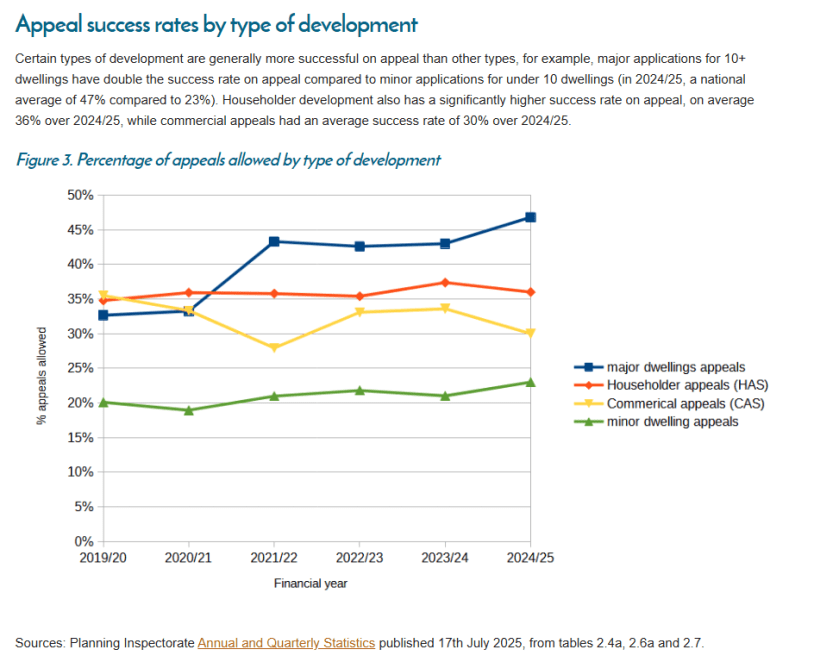
Given that almost 80% of appeals determined by inquiry are currently successful (possibly even higher when it comes to major residential appeals), this surely makes huge sense.

See the fascinating statistics published by Appeal Finder from which I have taken these screenshots:

Written representations determination of some call-ins is an interesting idea – a speedier call-in procedure would be so much more effective (see the way that the Mayor of London uses his call-in power for instance) but how many applicants, looking at these statistics will get nervous as to the prospect of their precious scheme being at the mercy of the written representations process?

Also on 18 November 2025, a consultation paper Reforms to the statutory consultee system was published, with responses due by 13 January 2026. Sport England, The Gardens Trust, and Theatres Trust are proposed no longer to be statutory consultees, with replacement “mitigations” put in place. The criteria are proposed to be tightened for consultation with seven national statutory consultees (see Anne1 for details): The Environment Agency, Natural England, Historic England, National Highways, the Health and Safety Executive, the Mining Remediation Authority and Active Travel England.

Lastly in terms of announcements, we at Town Legal seized that old 2010 concept of “open source planning” to publish our discussion document Simplifying & Standardising Section 106 Agreement Processes: Proposals for Reform which we were pleased to launch in the House of Commons this week through the auspices of the LPDF at an event sponsored by Mike Reader MP (and thank you Lord Charlie Banner for your supportive words too). What do you make of it? Do let us know. We are really keen to reduce the time it takes to conclude section 106 agreements, particularly in relation to small and medium sized schemes. I hope that MHCLG’s consultation package will touch on these issues as well. It is the unglamorous elements of the process that gum up the system, after all.

To quote always-glass-half-full Paul McCartney in that song from the Sergeant Pepper album: “It’s getting better all the time”. To quote John Lennon from the same song (maybe having seen MHCLG’ latest housing supply data on net additional dwellings – 6% decline in housing delivery from last year): “It can’t get no worse”.

Simon Ricketts, 22 November 2025

Personal views, et cetera

4 Key Asks For The London Housebuilding Support Package Consultation

Most chats this week have been about the 23 October 2025 homes for London policy note.

tl;dr summary: positive direction but concerns about potential complexities, uncertainties and as to whether it will all be in place speedily enough.

We’re all now waiting for the consultation to start “over six weeks from November” (fair play, at least no “by the end of Autumn” fudge).

There are plenty of detailed issues arising, and differing interests will want to re-prioritise the measures in different ways, but I thought I would set out four key asks that I have, which in my view should be specifically addressed in the consultation documents:

  1. Should there be more focus on stalled sites that already have planning permission?

This is the lowest hanging fruit. And yet all we have (in paragraphs 33 and 34) is a reference to the potential for renegotiating previously agreed arrangements by way of deed of variation and discouragement as to the use of section 73.

This isn’t enough. I set out the current procedural constraints in my 18 October 2025 blog post London Stalling.

Procedurally, bar reintroducing section 106BA or, for a temporary period, amending section 106A to reduce the 5 years’ requirement, at the very least we need:

  • Specific encouragement for local planning authorities to accept developers’ requests to engage with the process of varying existing agreements where specific criteria (consistent with the direction of the policy note) are met, linked to some sort of oversight, monitoring and/or route for complaint where authorities refuse to engage (given that unless your section 106 agreement is at least five years’ old, or unless this is in the context of a section 73 application (of which more in a moment) there is no right of appeal on the part of the developer)
  • Not the current suggestion that the section 73 process “should no longer be used as an alternative means of reconsidering fundamental questions of scheme viability or planning obligations” but rather a proper recognition of the real challenge of keeping planning permissions, and associated planning obligations packages, up to date as against changing circumstances and the important role that section 73 plays in this. Attempts to make currently unviable schemes viable invariably involve an intertwined mix of scheme changes and changes to planning obligations. Section 73B, introduced by the Levelling-up and Regeneration Act 2023, is less useful as only the implications of the proposed changes are to be taken into account rather than considering the amended proposal holistically against the current development plan and other material considerations. This all needs to be connected up with the continuing problem that Hillside creates for amendments to projects (I was pleased to see Baroness Taylor confirm this week, on behalf of the government, in response to Lord Banner’s tabled amendment to the Planning and Infrastructure Bill, that the government will “explore with the sector” a “statutory role for drop-in permissions to deal with change to large-scale developments”. This is so important!).
  1. Is late stage (as opposed to early stage) review necessary in relation to the proposed “time-limited planning route”?

In basic summary, this route is where a residential scheme can commit to at least 20% affordable housing with a 60/40 social rent/intermediate tenure split with planning permission issued by the end of March 2028. If the first floor of the scheme has not been built by 31 March 2030 (in the case of larger phased schemes, in the case of any phase where the first floor of buildings providing at least 200 dwellings has not been built by that date), “a late review will be undertaken once 75 per cent of homes within the scheme or the final phase are occupied to determine whether a higher contribution for affordable housing can be made”.

Why the late stage review mechanism in these circumstances, rather than the early stage review that is currently the case with fast track schemes that don’t achieve substantial implantation by the specified deadline under London Plan policy H5? Late stage reviews unnecessarily spook funders and lenders, leaving the eventual outcome too late in the process – and also having the public policy disbenefit of being too late to allow for any further affordable housing, that can be unlocked via the review, to be accommodated within the scheme. There is also inconsistency with paragraph 30 which suggests another approach for multi-phase schemes: “For multi-phase schemes, a review of the scheme will apply prior to the start of each phase for which the milestone in paragraph 27 has not been reached, to determine whether additional affordable housing can be provided in subsequent phases.”

Isn’t it better to keep things simple and follow, where possible, the existing mechanisms within policy H5, just with the thresholds temporarily reduced?

  1. Are there unnecessary difficulties with introducing a viability test into the proposed CIL relief?

Permissions which are secured via the new time-limited planning route that commence after the relief is in place and but before December 2028 will qualify for at least 50% relief from borough CIL (NB is this 50% after reliefs and exemptions have been applied and what will be the calibration to work out the higher level of relief where the scheme is delivering more than 20% affordable housing?), but the relief would be “contingent upon meeting proportionate qualifying criteria to ensure relief is targeted at schemes which would otherwise remain stalled or fail to come forwards, with a lower relief applicable where the full available amount is shown not to be warranted.” This sounds complicated. With this hurdle in place, not only would the developer not know whether they will qualify for the relief until planning permission is granted and they receive their liability notice, but it means that the purported advantage with the time-limited planning route of not having to undertake viability assessment is illusory, because the work will be needed in any event to secure the CIL relief – and the requirement will surely be very hard to turn into workable legislative drafting – we know how difficult exceptional circumstances relief is to secure due to the various criteria and requirements built into that particular mechanism.

  1. Are the proposed additional powers to be given to the Mayor enough?

Boroughs would be required to “refer planning schemes of 50 units or more where the borough is minded to refuse the application – this would be a more streamlined process operating alongside the existing referral threshold of 150 units which applies regardless of a borough’s intended decision, and would ensure that the Mayor was able to review whether the right decision had been reached in the context of the housing crisis.”

But there may well be cases where schemes are being held up at borough level, either pre-resolution or post resolution whilst for instance the section 106 agreement is being negotiated, and where securing planning permission by the end of March 2028 will be critical under this package of measures. Here, speedy intervention, or threatened intervention, by the Mayor could really help. So, for this time limited period at least, why not allow the Mayor to intervene at any time after the end of the statutory determination period in relation to any scheme comprising at least 50 dwellings? Otherwise, that absolute cut of the end of March 2028 for grant of planning permission will need to some flex built in to allow for the possibility of appeal etc.

I’ll confine myself to those four although I have others, and I know that you do too…

NB none of this is to be churlish as to the scale of the task that MHCLG and the GLA have before them. It is of course by no means easy to get this package right and to avoid unintended consequences.

Simon Ricketts, 1 November 2025

Personal views, et cetera

Commons Select Committee: Land Value Capture

Today’s Commons Housing Communities and Local Government Committee’s report Delivering 1.5 million new homes: Land Value Capture (28 October 2025) contains recommendations which are more wide-ranging than the report’s title would suggest: some practical and, one would hope, uncontroversial; others touching on some raw political nerves at MHCLG no doubt.

Starting with the latter, do turn to the “epilogue” which comments directly on what were at that stage just media reports as to the “package of support for housebuilding in the capital” announcement which the government and the Mayor of London issued on 23 October 2025. The Committee expresses itself to be “seriously concerned by media reports that London’s affordable housing target could be cut” and “the Secretary of State may be considering suspending local authorities’ powers to charge the Community Infrastructure Levy to address concerns about development viability. None of the evidence to our inquiry—including from representatives of developers—advocated abolishing CIL entirely as a means of addressing viability concerns. On the contrary, we heard that the Government should reform CIL to extend its coverage where it is viable.”

The Ministry must continue its work with the Greater London Authority to deliver an acceleration package, so that London boroughs are delivering housing in line with their local housing need targets. In response to this Report, the Ministry must provide its assessment of how changes to London’s affordable housing target may deliver more affordable housing units, by increasing the number of new homes built overall. Any reduction to London’s affordable housing target must be accompanied by a clawback mechanism to ensure developers return a portion of their profits to the local authority, ringfenced for affordable housing delivery, if a development surpasses an agreed benchmark profit. If London’s affordable housing target is reduced and the number of affordable housing units delivered declines, the Ministry and the Greater London Authority must commit to reinstating the 35% target.”

Perhaps this epilogue is slightly premature, given the actual announcement proved only to be a prologue to a consultation process that will run “from November” (late November is my guess). Perhaps the Committee should hear further evidence on that back of the consultation material to be published – it is slightly odd to be responding just to a newspaper report, particularly given that the actual announcement has been made.

But that epilogue does point to the fundamental policy tension in the current economic environment: what matters most – affordable housing delivery by percentage, or by absolute numbers? See for instance its recommendation that the government’s “forthcoming reforms to its guidance on viability assessments must ensure developers reliably deliver on their agreed affordable housing commitments, with viability assessments only used to alter these commitments retrospectively in the most exceptional circumstances. To support this, we recommend that all local authorities in England must be encouraged to set a minimum percentage target for affordable housing in their local plan [NB what don’t?], with a ‘fast-track’ route planning route for developments which meet this local target.”

Too often, site-specific viability assessments are used by developers to negotiate down affordable housing requirements in circumstances where this is completely unjustifiable. Affordable housing contributions are frequently the first provision to be cut following a viability assessment, even where a developer may be making other significant contributions through Section 106 agreements and CIL. In areas with high land values, viability assessments should only be used in this way in very exceptional circumstances. Currently, not all local authorities have their affordable housing requirements clearly set out in local policy. Greater clarity from local authorities would provide developers with the right incentives to avoid lengthy viability negotiations, and ensure more applications are meeting local affordable housing requirements from the outset.

As part of its ongoing review of the viability planning practice guidance, the Government must consider how different types of developer contribution could be re-negotiated following a viability assessment, to protect affordable housing contributions. The Government must also update national policy to encourage all local authorities to set a minimum percentage target for affordable housing in their Local Plan for all major developments that include housing. This figure should be based on a local need assessment for affordable housing in each local authority, with particular regard for the local need for Social Rent homes. Local authorities should be encouraged to offer a ‘fast-track route’ for developments which meet the local affordable housing target, by making those developments exempt from detailed viability assessments and re-assessments later in the development process. This would encourage developments with a high percentage of affordable housing and speed up the delivery of housing of all tenures.

The Government must continue to develop its proposal to publish indicative benchmark land values to inform viability assessments on Green Belt land across England. The Government must publish different benchmark land values for each region of England, to reflect variation in land values. The Government must also ensure that the viability planning practice guidance contains clear advice on the “local material considerations” that would warrant local adjustments. The Government should continually review the effectiveness of the policy and consider how it may be extended to development on land that is not in the Green Belt.”

On land value capture itself:

There is scope to reform the current system of developer contributions in England to capture a greater proportion of land value uplifts from development to deliver affordable housing and public infrastructure. There is a compelling case for such reforms—especially in the context of a deepening housing crisis and with public finances currently under strain. However, a radical departure from the Section 106/Community Infrastructure Levy (CIL) regime, which currently constitute the existing mechanisms of land value capture in England, would risk a detrimental impact on the supply of land in the short-term. We recognise that this would be disruptive to the Government’s housebuilding agenda.

Reforms to land value capture should be iterative, starting with improvements to existing mechanisms. Therefore, the Government must immediately pursue the reforms to Section 106 and CIL outlined in the chapters below. These reforms must optimise the system’s capacity to capture land value uplifts and deliver infrastructure and affordable housing—particularly homes for Social Rent—in line with the Government’s wider policy ambitions. The Government must also trial additional mechanisms of land value capture in areas where there are significant uplifts in land value which current mechanisms may not capture effectively. Specifically, the New Towns programme discussed in Chapter 5 presents a vital opportunity to test new ways of financing infrastructure delivery on large developments and learn lessons for future reforms.

Any reforms to land value capture should also be considerate of the wider tax system, to balance public needs and equitable charges on development. To support this work, the Government should publish updated land value estimates, which were last published in August 2020. If the Government does not intend to do so, it must explain why it no longer publishes this data.”

In essence, the Committee sees any radical change as likely to be disruptive to the government’s current agenda. Instead, it is recommending a number of changes which in my view are “no brainers”, for instance better resources for local planning authorities and looking to simplify the approach to section 106 agreements and to CIL:

Reforms to section 106 agreements

“There is a strong case for the introduction of template clauses for aspects of Section 106 agreements across England, as was recommended by the National Audit Office and others. Templates would allow local authorities to focus negotiations on site-specific factors rather than legal wordings. Template clauses would also allow for greater standardisation and clarity of requirements across all local authorities, and in turn reduce the workload of local authorities and Small and Medium-sized Enterprise developers.

As part of the site thresholds consultation that will take place later this year, the Ministry must seek views on how standardised Section 106 templates could most effectively streamline the negotiation process across sites of all sizes. Based on the consultation responses, the Ministry must work with the Planning Advisory Service to develop a suite of Section 106 template clauses and publish these within six months of the consultation closing. Alongside their publication, the Ministry must also update its guidance to local authorities on Planning Obligations to encourage local authorities to adopt these template clauses.”

I covered the same ground in my 14 June 2025 blog post Why Does Negotiating Section 106 Agreements Have To Be Such A Drag? Not only that, but my firm has also been working on an actual template draft for small and medium sized schemes and a specific set of proposals for ironing out the pinch points that currently exist at every step of the sway from arriving at heads of terms through to agreement completion. This was there to be grasped – it is a national embarrassment. We held a workshop on 30 September 2025, attended by a selection of thirty or so lawyers and planners from the public and private sectors, developers and representatives of industry bodies with MHCLG present in an observer capacity. If you weren’t invited I apologise but we were limited by the size of our meeting room! The draft output from the workshop will be released next month. If there is an organisation out there which is willing to make a larger space available in late November for a launch event please let me know.

Section 106 dispute resolution scheme

This may be why I write blog posts…. The Committee picked up on a reference I made in the blog post mentioned above to section 158 of the Housing and Planning Act 2016 which has never been switched on, allowing for a dispute resolution procedure to be able to be invoked where necessary during the course of negotiations.

Local planning authorities across England have expressed concern that protracted Section 106 negotiations are causing delays to housing delivery. Drawn out negotiations do not benefit public outcomes and cause undue delays to development, which may impede the Government’s housebuilding ambitions. Whilst we recognise the Minister for Housing and Planning’s concerns that introducing a dispute resolution scheme may add complexity to the system, we believe the potential benefits to affordable housing delivery and unlocking stalled development outweigh this risk.

The Government should introduce a statutory Section 106 dispute resolution scheme, under the provisions of the Housing and Planning Act 2016. If the Government does not intend to pursue this, it should set out a detailed explanation as to why the Ministry has chosen not to implement the provision legislated for by Parliament in the 2016 Act. This should include setting out any specific technical or legal barriers to implementation which the Ministry has identified.”

Community Infrastructure Levy

Again, nothing earth-shattering. Rather, calls for more transparency as to which authorities are charging CIL and at what rates; widening opportunities for authorities to pool receipts (and recognising the opportunity that the reintroduction of strategic planning will bring) and greater focus on infrastructure funding statements.

On new towns:

The Committee calls on the government to set out where the funding is to come from (“The Government’s New Towns programme is likely to require billions of pounds of public and private investment over several decades, including millions from HM Treasury to establish development corporations during this Parliament”); greater use should be enabled of tax increment funding to fund infrastructure in cities and new towns. Specifically on the role that land value capture might play:

There is significant potential to use land value capture as part of funding the proposed New Towns, especially on green field sites. However, we are concerned that the Government has announced substantial detail of the 12 potential sites without a planning policy to protect land value, contrary to the recommendation of the New Towns Taskforce. It appears that the Government has not yet established any delivery body to purchase land or enter agreements with landowners, which risks allowing developers considerable time to acquire sites for speculative development and immediately push up land values. The Taskforce said that, in the worst-case scenario, this could “jeopardise New Town plans”.

The Government must immediately conduct an analysis of Existing Use Values (EUV) on each of the 12 sites to maximise the capture of future land value uplifts, and develop plans for using appropriate mechanisms for land value capture on each site. This must include the option of development corporations using Compulsory Purchase Orders to assemble land where ownership is fragmented or negotiations stall. The Government must ensure arrangements for the purchase of land on New Towns sites are in place before it announces its final decision on locations by spring 2026.”

“The Ministry is right to prioritise New Towns which have the greatest potential to boost housing supply in the short-term, but its plan to “get spades in the ground on at least three new towns in this Parliament” does not match the scale of the Government’s housebuilding ambition. The New Towns programme can and must make a contribution towards increasing housing supply during this Parliament.

The Government must immediately clarify how housing delivery in New Towns will interact with local authority housing need targets. In its final response in spring 2026, the Government must include a roadmap for the New Towns programme, to show when each development corporation will be established, when development will commence on each site, and the estimated development timeline for each New Town.”

So will the government meet its 1.5m homes target?

The housing sector is eagerly awaiting the Government’s Long-Term Housing Strategy, which it first announced in July 2024. Originally, this was to be published alongside the Spending Review in spring 2025. The continuing lack of a cohesive plan to deliver 1.5 million new homes has left the sector in the dark. We are also deeply disappointed that the Government has been unwilling to engage with us on the development of the Strategy, or provide any updates on its delayed publication, other than to tell us that it will be published “later this year”.”

“The Government can only begin to make significant progress towards its 1.5 million target once the sum of local housing need targets in Local Plans add up to that figure. Whilst the Government’s reforms to the National Planning Policy Framework seek to plan for approximately 370,000 new homes per year, local authorities will take several years to transition to this national annual target, as the currently Local Plans take seven years to produce and adopt on average. The Government has stated its ambition to introduce a 30-month plan-making timeline, but the relevant provisions in the Levelling-up and Regeneration Act 2023 to speed up plan-making have still not been implemented.

The Government must immediately bring forward its Long-Term Housing Strategy without further delay. It must set out an ambitious, comprehensive, and achievable set of policies that will deliver 1.5 million new homes by July 2029. The Strategy must prioritise implementing reforms to the plan-making system to move towards a 30-month timeline. The Strategy document must include an annex to provide the Ministry’s assessment of how many net additional dwellings each policy change will contribute towards annual housing supply, adding up to 1.5 million new homes over the five-year Parliament. If the Ministry is unable to supply this, the Government must make an oral statement to the House to confirm how many new homes it will deliver by the end this Parliament.”

There we have it. If nothing else, that will all spur us on with the work on the template section 106 agreements work and, related to that, I’m very keen to discuss how section 158 of the Housing and Planning Act 2016 might provide an effective, light touch, procedure.

Simon Ricketts, 28 October 2025

Personal views, et cetera
London Stalling

This one is about the current position with London (non) development and some thoughts about what procedural steps may be open to you if you are a London (non) developer with a planning permission for a scheme that is no longer viable to build out.

On 14 October 2025, Molior published figures for Q3 2025 construction starts and sales in relation to schemes in London with 25+ homes for private sale or rent. Apologies for the extensive quoting but their summary is clearer than anything I can write:

Between 2015 and 2020, there were 60-65,000 homes for private sale or rent under construction in London at any given time.

Today, that number has fallen to 40,000 … and 5,300 of those are halted part-built.

With a surge of completions expected in 2026, Molior forecasts that just 15-20,000 new homes will be actively under construction on 1st January 2027.”

London had just 5,933 new home sales in Q1-Q3 2025.

Sales rates are weak across all local markets and at every price point.

At prices up to £600 psf – the level at which most London owner-occupiers can buy – sales to individuals are virtually non-existent.”

Build-to-rent completions are about to plunge.

Interest rates rose during 2022, then the Liz Truss budget pushed them higher.

This stopped new money from funding London multifamily development.

Completions are set to disappear after 2027 because construction starts fell in 2023 / 2024.”

“There were 3,248 private starts in Q1-Q3 2025.

London is now on track for fewer than 5,000 private construction starts in 2025.”

“Starts have been falling for a decade because sales rates and profitability have been falling for a decade.

Building Safety Regulator delays have made things worse in 2025.”

“Development is unviable across half of London.

Development costs are high, so it is unviable to build profitably in half of London – areas under £650 psf.

This is even if the land is provided free and there are no planning obligations like CIL and affordable housing.”

“London has 281,000 unbuilt permissions.

These numbers are private + affordable C3 permissions.

The numbers include outline consents, detailed consents and unbuilt phases of schemes partly under way.

Also included are projects successful at committee but still waiting S106 sign-off.”

Set all that alongside the homelessness and rough sleeping crises in London. The BBC reported yesterday that more than 132,000 households were living in temporary accommodation on 30 June 2025, up 7.6% from the same time last year. Aside from the human cost, this is of course at a huge financial cost for London boroughs: £740m ‘black hole’: London’s temporary accommodation crisis draining local resources (London Councils, 13 October 2025). And at the sharpest end: Number of people “living on the streets” of London increases by 26% (Crisis, 31 July 2025).

Whilst I try not to wear out my two typing-fingers commenting on press speculation about forthcoming announcements, I think we can assume that the government and the Mayor of London will soon be announcing various measures to try to turn this around or at least provide some sort of jump-start (note to government press team, I suggest that we are in “jump-start” rather than “turbo-charge” territory). See for example the Guardian’s 17 October 2025 piece London developers to be allowed to reduce percentage of affordable homes.

The spectre in the press pieces of some temporary reduction in developers’ threshold for qualifying for the Mayor’s fast-track (i.e. basically avoiding the need for formal viability appraisal and a late stage viability review mechanism if they can commit to a level of affordable housing which is usually 35%, with a policy-compliant split of affordable housing tenure types within that – see policy H5 of the London Plan for more detail) down to perhaps 20% is being seen by some as amounting to an actual reduction in the amount of affordable (and particularly socially rented) housing that will be developed.  But this analysis is unfortunately wrong: very few schemes are currently proceeding with 35% or more affordable housing.  Viability appraisals either agreed or accepted after scrutiny on appeal (this is not developers cooking the books) are already coming out at way less than 20%, let alone 35% (which is why simply reducing the threshold alone wouldn’t be enough). See for instance the inspector’s decision in relation to the Stag Brewery appeal (summarised in my 4 May 2025 blog post (7.5% affordable housing) and the 29 May 2025 decision letter in relation to a proposed tower block in Cuba Street (16.6% affordable housing). Nor is this a purely London phenomenon, if you recall last month’s Brighton Gasworks decision (summarised in my 27 September 2025 blog post) (zero affordable housing).

20%, plus the other measures being whispered about such as increasing subsidies for socially rented housing and/or allowing councils not to charge CIL, may tip the balance so as to turn some non-developers back into being developers again and thereby deliver more affordable housing (including socially rented housing) in absolute numbers (which is what counts after all) than is currently the case.

But what about the many schemes consented on the basis of 35% or more, that simply aren’t proceeding, at least beyond basic operations to keep the permission alive (see my 7 September 2025 blog post The Stressful & Sadly Often Necessary Task Of Keeping Planning Permissions Alive)?

If we look to amend existing, unviable, section 106 agreements, no longer do we have the benefit of section 106BA, a provision introduced in April 2013 via the Growth and Infrastructure Act 2013, to allow developers to apply to modify or discharge affordable housing obligations in Section 106 agreements where those obligations made a development economically unviable, and then repealed three years later in April 2016. That provision unlocked various stalled permissions at the time. Is it too late, or too unpalatable, for an amendment to the Planning and Infrastructure Bill simply to reintroduce it?

Instead, the main routes are:

  • If the section 106 planning obligation is at least five years’ old, a formal application to the local planning authority can be made under section 106 A of the Town and Country Planning Act 1990 on the basis that the relevant obligation, unless modified, “no longer serves a useful purpose”.  The test is expressed very generally which is unhelpful but the case would be that if the obligation is causing development, otherwise beneficial, not to proceed, it cannot be serving a “useful purpose”. There is the right of appeal to the Planning Inspectorate.
  • Seeking variation of section 106 planning obligations in the slip-stream of an application made under section 73 of the Town and Country Planning Act 1990 (an application, of course, for planning permission for the development of land without complying with conditions subject to which a previous planning permission was granted – and which is to be assessed against the current development plan and other material considerations). This was the route taken in the Cuba Street appeal I mentioned above. Full planning permission had been granted in December 2022. A section 73 application was made to amend the approved floor plans set out in the schedule referenced in condition 2 of that permission, to “provide an increase in the residential units from 421 to 434, and a reduction in the affordable housing (AH) provision from 100 (71/29 affordable rented to intermediate split as a ratio) to 58 (66/44 affordable rented to intermediate split as a ratio). In percentage terms the change in AH would be from 30.15 % to 16.6%. A consequence of these changes would be amendments to conditions 24 and 29, with respect to wheelchair accessible homes and cycle storage, given that they relate to the quantum of development subject to the original permission.”
  • Negotiating a deed of variation to the section 106 planning obligation, outside these formal procedures, without any recourse to appeal if the authority is resistant.
  • A fresh application for planning permission – utterly the nuclear option in times of cost, time and risk.

If there is indeed some form of announcement from MHCLG and the Mayor of London, I will be interested to see:

  • What is said about existing stalled permissions and any advice that is to be given to boroughs as to the approach they should take when approached by way of any of these procedural routes.
  • More generally, how will any announced (presumably temporary) relaxations with regard to the London Plan policy H5 threshold approach  or any other policy requirements sit as regards section 38 (6) of the Planning and Compulsory Purchase Act 2004 (“If regard is to be had to the development plan for the purpose of any determination to be made under the planning Acts the determination must be made in accordance with the plan unless material considerations indicate otherwise”)? Where there’s a will there’s a way but this is all another reminder, as if we needed it, that the process for reviewing and updating the London is so slow as not to be fit for purpose.

Oh and we still await MHCLG’s updated planning practice guidance on viability.

“London calling, at the top of the dial.

And after all this, won’t you give me a smile?”

Simon Ricketts, 18 October 2025

Personal views, et cetera
Just What Is It About Today’s Planning System that Makes Appealing So … Appealing?

On 22 September 2025 the Secretary of State allowed two recovered appeals, granting planning permission for proposals which local authority members had refused against their professional officers’ opinions. In one of those cases, a full award of costs was ordered against the authority which I guess will amount to several hundred thousands of pounds. Development was unnecessarily held up in both cases for what turned out to be no good reason, in one case the decision to refuse having been in March 2024 following submission of the application in September 2022 and the other in May 2024 following submission of the application in November 2021. Both decisions were made in accordance with the relevant inspector’s recommendation.

I’m thinking back yet again to the Lichfields May 2025 research paper for the LPDF and Richborough Estates, How Long Is A Piece Of String? which found not only that applications for major development are taking twice as long to determine as 10 years ago but that it is now on average quicker to achieve permission via appeal than via the local planning authority.

I’m also thinking of the latest 50 Shades of Planning podcast episode Who’s In Control? (27 September 2025) where a number of us discuss, amongst other things, the ethical position of officers whose advice is overturned by councillors.

And I’m thinking that neither the proposed move to an increased number of applications being determined by way of delegated powers, and increased training for members, would have been likely to change the position with these two appeals. Do awards of costs influence behaviour? I would welcome your views. From the outside I’m not sure they really register either with councillors or, perhaps most importantly , with voters.

The two decisions were as follows:

Brighton Gasworks

Planning application submitted to Brighton and Hove Council in November 2021 by St William for a scheme that, following amendments,  included 495 residential units and 2,791 square metres of commercial space. It was recommended for approval in May 2024 but in the face of significant local opposition was resolved to be refused. The reasons for refusal (1) alleged the development would represent overdevelopment of the appeal site by virtue of excessive massing, density and height thereby harming the townscape of the area including its heritage assets; (2) related to the proposed housing mix (subsequently withdrawn) and (3) concerned the effect of the appeal scheme on the living conditions of future residents with particular regard to amenity and light.

St William appealed. The appeal was recovered by the Secretary of State. The inquiry sat for six days in March 2025. The Secretary of State’s decision letter accepted the inspector’s recommendations and allowed the appeal. The Secretary of State’s conclusions are worthy of note on issues such as character and appearance, density and height (paragraph 14),; the current negative effect of the “underused and despoiled” site on the “varied and robust urban townscape of east Brighton” (paragraph 15); daylight and sunlight and living conditions more generally (paragraphs24 to 28); and acceptance of the agreed position between the appellant and the council that the development would not be able to provide affordable housing given the high cost of remediating the site (paragraph 30).

In his accompanying costs decision letter, again accepting his inspector’s recommendation, he orders a full award of costs in favour of St William, on the basis that:

* the Council prevented or delayed development which should clearly be permitted, having regard to its accordance with the development plan, national policy and all other material considerations (CR48);

* the Council failed to produce evidence to substantiate each reason for refusal on appeal, made vague, generalised or inaccurate assertions about a proposal’s impact and failed to determine similar cases in a consistent manner (CR49); and

* there were substantial procedural failings on the Council’s part including an obstructive and untimely approach to the Statement of Common Ground, the submission of a Statement of Case which was bereft of meaningful detail and a failure to review.

When it comes to any councillor training programme I hope this appeal decision will be part of the study materials, including, verbatim, these conclusions from the inspector’s costs report:

Had the Council had proper regard to its own Development Plan, the NPPF, other material considerations and carried out a proper balancing exercise, the application would most likely have been approved notwithstanding the concerns raised by Members. The Council therefore prevented or delayed development which should clearly be permitted, having regard to its accordance with the development plan, national policy and all other material considerations.

The Council’s objections did not stand up to scrutiny and therefore I find that the Council failed to produce evidence to substantiate each reason for refusal on appeal, made vague, generalised or inaccurate assertions about a proposal’s impact and failed to determine similar cases in a consistent manner. It goes without saying that a decision to refuse planning permission on an allocated site against the professional advice of officers requires very careful consideration and highly robust reasoning.

There were also substantial procedural failings on the Council’s part including an obstructive and untimely approach to the SoCG, the submission of a Statement of Case which was bereft of meaningful detail and a failure to review its case promptly following a material change in national policy.

The above unreasonable behaviour resulted in unnecessary or wasted expense, as described in the PPG. I therefore conclude that a full award of costs is justified.

While I understand that the above will come as a bitter blow to the Council, it is right that I acknowledge the important work of officers during what was a long preapplication and determination period. That work culminated in the production of a Committee Report which was of the very highest order. Officers were also beyond reproach for the way they assisted the inquiry.”

Sky Studios Elstree expansion proposal

Planning application submitted in September 2022 for a film and television production studio (use Class E(g)(ii)) with ancillary floorspace, backlot, new access arrangements, car parking, landscaping, infrastructure and associated works in the green belt north of the existing Sky Studios Elstree complex. Hertsmere Borough Council members had resolved to refuse the application in March 2024 against officers’ recommendations, concluding that the “very special circumstances” test had not been made out for inappropriate development in the green belt.

Sky Studios appealed in October 2024 and the appeal was recovered by the Secretary of State. The inquiry sat for four days in March and April 2025. The Secretary of State’s decision letter accepted the inspector’s recommendations and allowed the appeal. Following the introduction of the grey belt policy designation into the NPPF in December 2024, the Secretary of State found that the site was indeed grey belt. The only real issue was whether there was unmet need for the development, on which issue his findings were as follows:

For the reasons given at IR14.20-IR14.23 and IR14.43, the Secretary of State agrees with the Inspector that Sky Studios Limited has identified a need to enlarge its current operation at SSE, that there is a reasonable and probable outcome that if the appeal is allowed, the type of development that would take place would be for an extension of the existing studio site at SSE, and that there is an unmet need for studio space related directly to the expansion of SSE (IR14.23).

In reaching this conclusion, the Secretary of State has taken into account that the description of development does not specify that the development would be used as an extension to the existing SSE site, and no condition requiring the development to be an extension has been put forward either (IR14.17). He acknowledges that it is conceivable that the proposed development could be operated as a standalone studio business separate to SSE without any restrictions imposed by the description and any planning conditions (IR14.19). However, taking into account the matters set out at IR14.20-14.23, the Secretary of State considers that the proposal is highly likely to be brought forward as an extension and that it is appropriate to proceed on this basis. He considers on that basis that unmet need has been demonstrated and carries substantial weight in favour of the proposal, and that the requirement in NPPF155(b) is met.

The Secretary of State has also considered what the need position would be on the basis of a standalone studio. He has noted the position set out at IR14.24-14.25, but like the Inspector considers that national and local economic policy seeking to grow the sector, and an increased spend in productions, do not in themselves equate to unmet need.”

“…if considered as a standalone studio, the Secretary of State considers that unmet need has not been demonstrated. On that basis, the requirement in NPPF155(b) would not be met, the proposal would therefore be inappropriate development in the Green Belt and very special circumstances would need to be demonstrated. As set out at paragraph 21 above, in that scenario the Secretary of State considers that the harm to the Green Belt in terms of inappropriateness, harm to openness and harm to purposes would have carried substantial weight. Although he has not proceeded on that basis, for the avoidance of doubt, he considers that the harm to the Green Belt and any other harm would be clearly outweighed by the benefits of the scheme such that very special circumstances would exist and development in the Green Belt would be justified.”

A textbook application of green belt principles. (Incidentally, in the unlikely event that you need a primer on grey belt I think you can still access a webinar I gave this week on that subject via Inside Housing – see here for more details).

Perhaps the outcome of the Sky Studios appeal only became obvious once we had the December 2024 NPPF but perhaps the big question for MHCLG should be, rather than further tweaks to law or policy, how to make sure that many more appeals like these two are not needed before the message gets through as to how the current legislation and policy framework is to be applied? Otherwise, whether through members’ overturns, or through non-determination appeals, schemes will be continuing to come before the Planning Inspectorate, with all the delay, expense and unnecessary risk thereby arising, that really should be determined appropriately at a local level. It’s reassuring that the appeal route is available but the relative attractiveness of that route versus waiting for a local outcome is not good in public policy terms – as I said at a breakfast discussion that we held at Town Legal this week alongside Shared Voice and Rupert Warren KC and attended by the interim chief planning inspector Rebecca Phillips (for which thanks for her participation), it’s the equivalent of people being unhappy with the service at their local GP and instead going straight to A&E…

Simon Ricketts, 27 September 2025

Personal views, et cetera
Just what is it that makes today’s homes so different, so appealing? 1956 collage by Richard Hamilton

Small Changes

I’ve mainly called this blog post “small changes” because that is the name of a beautiful, calming and rather lush album by Michael Kiwanuka released last year. Perhaps your social media timeline needs that sort of cleanse? Mine does regularly.

But I was also thinking of that old David Brailsford British Cycling philosophy about marginal gains (“The whole principle came from the idea that if you broke down everything you could think of that goes into riding a bike, and then improved it by 1%, you will get a significant increase when you put them all together”) and of the successive incremental changes that the government has been making to the planning system, most recently those measures flagged in the 28 May 2025 MHCLG press release as Government backs SME builders to get Britain building, measures which were the subject of three consultation documents published that day:

All of this follows last Sunday’s Speeding Up Build Out consultation (consultation closing 7 July 2025), which I summarised that day in my blog post Now Build.

It is an interesting, maybe theoretical, question as to whether system changes are better announced and delivered in one go (soaking up all the political heat at once) or in the current lapping waves. It is also interesting to see the political heat rising from different quarters in relation to different elements.

Concern has been expressed from environmental interest groups and a number of firms providing ecological services, as to Part 3 of the Planning and Infrastructure Bill (nature recovery – see my 11 May 2025 blog post Nature Recovery Position where I tentatively suggest a middle ground).

The Speeding Up Build Out announcement then led to an outcry from many in the development world – how dare the government threaten developers with being blacklisted, fined or having land compulsorily acquired if they delayed unreasonably in building out planning permissions etc etc? I explain in my 25 May 2025 Now Build piece why I don’t think that should be a real concern and why, if only for pragmatic political reasons, the government has to have basic protections along these lines in place. But that was based on me focusing on the working paper and consultation document, not on the government’s PR spin, which I think was unnecessarily overblown, particularly:

  • That tweet from the prime minister (NB what is the government doing still being on X in any event? Full marks to Matthew Pennycook and others for using Bluesky).

All that developer-demonisation (“Developers who repeatedly fail to build out or use planning permissions to trade land speculatively could face new ‘Delayed Homes Penalty’ or be locked out of future permissions by councils”), whereas I’m not sure anyone would disagree with what is actually said in the working paper itself:

The Competition and Markets Authority (CMA) and others have concluded that most homes in England are not built as fast as they can be constructed, once permission is granted, but only as fast as the developer expects to sell them at local second-hand market prices. This leads to a build out rate for large sites which can take decades to complete. While it is commercially rational for developers to operate in this way, the systemic impact is a lower level of housebuilding than we need. The government is therefore committed to taking firm action to ensure housebuilding rates increase to a level that makes housing more affordable for working people.  

In the public debate on housebuilding rates, 3 related concepts are often confused.

a. Land banks are, for the most part, a normal part of the development system. Developers hold a pipeline of sites at all stages of the planning process, to avoid stop/starts between schemes. In its 2024 study, the CMA found no evidence of current land banks systemically distorting competition between housebuilders. We do, however, have concerns that certain types of contracts over land prior to its entry into the planning system (which can be part of ‘strategic’ land banks) can be a barrier to entry for SME developers. We are therefore legislating to make Contractual Control Agreements (‘option agreements’) more transparent, to help diversify the industry and reduce barriers to entry for SME builders. 

b. Delayed or stuck sites are those at all stages of the planning and building process (including with full planning permission) that are delayed, not building out, or only building out very slowly due to a problem that the developer or landowner is struggling to resolve themselves. Often this is due to the discharge of a planning condition, an issue raised by a statutory consultee, a newly discovered site issue, or the developer running into financial difficulties. We have created the New Homes Accelerator to tackle this sort of blockage … and get stuck sites moving. In wider cases, sites may be stuck in negotiations over suitable S106 contributions, sometimes because the promoter has overpaid for the land not fully factoring in the policy requirements set out in planning policy. In this paper we consider further reforms to the Compulsory Purchase Order (CPO) process, relevant to stalled sites. 

c. Slow build out is where sites have full planning permission, are being built, but the pace of building is slower than it could be under different development models and incentives. Multiple market studies have found that most large housing sites are built at the pace the homes can be sold at current second-hand market prices, rather than the pace at which they could be constructed if pre-sold (i.e. to an institutional landlord). The rate of building consistent with selling at local second-hand market prices is known within the industry as the ‘absorption rate’. The Letwin Review concluded that local absorption rates were a “binding constraint” on build out rates. The CMA observed, that “the private market will not, on its own initiative, produce sufficient housing to meet overall housing need, even if it is highly competitive”.

So that was the furore earlier this week. And then when Wednesday’s announcements were made, environmentalists focused on the potential rolling back of the statutory BNG regime from smaller projects and opposition politicians turned on the (not new, but in my view improved) proposals to ensure that more applications are determined through use of planning officers’ delegated powers rather than Planning Committee.

You can’t please all the people all the time…

What is the thrust of the latest changes?

The starting point is to change the current categorisation of planning applications for residential development from those for “minor” development” and those for “major” development, so as to introduce a “medium” development category.

The categories would be:

  • Minor Residential Development – fewer than 10 homes /up to 0.5 ha (and within that a sub-category of 1b. Very small sites – under 0.1ha)
  • Medium Residential Development – between 10-49 homes/up to 1.0 ha
  • Major Residential Development – 50+ homes / 1+ hectare

In due course, consideration would be given to appropriate categories for non-residential development.

The following would apply to each category:

Minor

  • streamlining requirements on Biodiversity Net Gain (BNG) including the option of a full exemption
  • retaining the position that affordable housing contributions are not required on minor development
  • retaining the position that sites of fewer than 10 units are exempt from paying the proposed Building Safety Levy (BSL)
  • retaining the shorter statutory timeframe for determining minor development at 8 weeks “however we will take steps to improve and monitor performance so SMEs can expect a better service”
  • reducing validation requirements “through setting clearer expectations in national policy on what is reasonable, which could form part of the forthcoming consultation on national policies for development management”
  • requiring that all schemes of this size are delegated to officers and not put to planning committees as part of the National Scheme of Delegation.
  • reviewing requirements for schemes of this size for consultation with statutory consultees “instead making use of proportionate guidance on relevant areas. This forms part of our review of statutory consultees

On the “very small sites” sub-category:

The government will consult on a new rules-based approach to planning policy later this year through a set of national policies for development management. This will include setting out how the government intends to take forward relevant aspects of the proposals contained in the previous ‘Brownfield Passport’ working paper.”

The government is therefore proposing to further support the delivery of very small sites through:

  • providing template design codes that can be used locally for different site size threshold and typologies – which will take a rules-based approach to design to help identify opportunities and enable faster application processes
  • using digital tools to support site finding and checking compliance of design requirements on specific sites.

Medium

  • simplifying BNG requirements “reducing administrative and financial burdens for SME developers and making it easier for them to deliver BNG to help restore nature on medium sites by consulting on applying a revised simplified metric for medium sites. Further details are set out Defra’s consultation on potential BNG changes offering stakeholders the opportunity to give their views on this issue.”
  • exploring exempting these sites from the proposed Building Safety Levy “we intend to lay regulations for the Building Safety Levy in Parliament this year (as set out in our response to our technical consultation) and the Levy will come into effect in Autumn 2026. As part of this working paper, we are keen to explore whether, if introduced, medium sites should also be exempt from paying the Levy”
  • exempting from build out transparency proposals
  • maintaining a 13-week statutory time period for determination “in line with major development – but specifically tracking performance of these types of developments directly so SMEs can expect a better service”
  • including the delegation of some of these developments to officers as part of the National Scheme of Delegation
  • ensuring referrals to statutory consultees are proportionate “and rely on general guidance which is readily available on-line wherever possible. This forms part of our review of statutory consultees”.
  • uplifting the Permission in Principle threshold “allowing a landowner or developer to test for the principle of development for medium residential development on a particular site without the burden of preparing an application for planning permission. We recognise take up of Permission in Principle by application for minor residential development has been relatively limited since its introduction in 2017, and we would therefore like to gauge the appetite for this reform before exploring further”
  • minimising validation and statutory information requirements “through setting clearer expectations in national policy which could form part of the forthcoming consultation on national policies for development management”

There is also an important reference to streamlining section 106 agreement negotiations:

We … welcome views and evidence on:

1. the specific barriers facing SMEs in agreeing s.106 obligations – including availability of willing and suitable Registered Providers

2. what role national government should play in improving the process – including the merits of a standardised s.106 template for medium sites

3. how the rules relating to suitable off-site provision and/or appropriate financial payment on sites below the medium site threshold might be reformed to more effectively support affordable housing delivery, where there is sufficient evidence that onsite delivery will not take place within a suitable timeframe and noting the government’s views that commuted sums should be a last resort given they push affordable housing delivery timescales into the future.”

(I will be doing a separate blog post on that one).

Major

This working paper primarily considers targeted changes and easements to sites below 50 homes. Sites above 50 will benefit from overall government reforms to the planning system – including those set out in the revised National Planning Policy Framework published in December, the Planning and Infrastructure Bill, and future reforms to statutory consultees and through emerging national policies for development management.

Nevertheless – the government is interested in views in response to this working paper on:

  • applying a threshold for mixed tenure requirements on larger sites – as set out in the government’s working paper on speeding up build out, we are considering a range of options to set a threshold whereby mixed tenure development should apply – including at 500 units. We welcome further views on the right threshold – and on whether and how there should be some discretion for Local Planning Authorities – ahead of consulting on the policy as part of a consultation on national policies for development management and a revised National Planning Policy Framework later this year.”

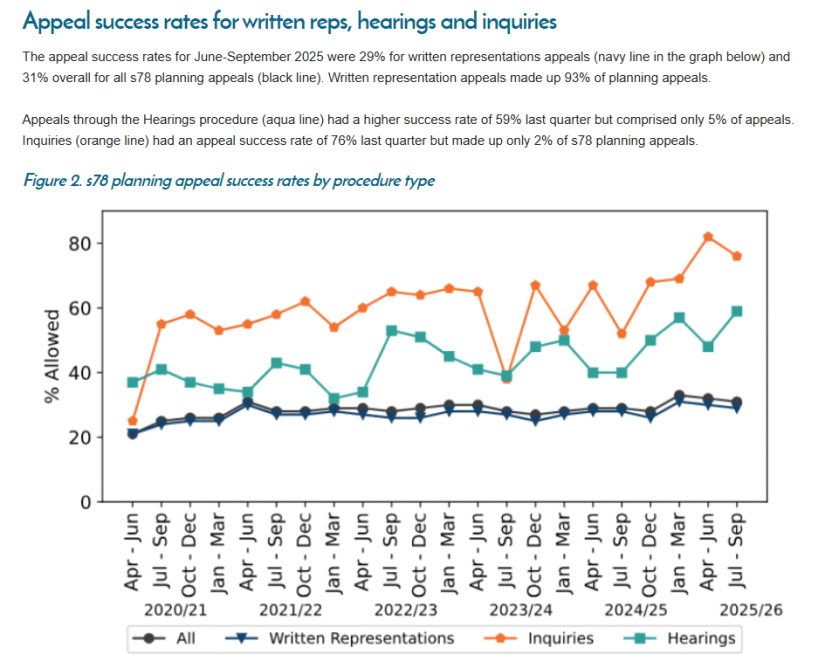
Turning to the paper on reforming planning committees, thankfully the thinking has moved away from taking into account whether or not a proposal is in compliance with the development plan (which would have led to endless arguments and disputes). Instead, the proposal is that a scheme of delegation would be introduced which would have two tiers:

Tier A which would include types of applications which must be delegated to officers in all cases; and

Tier B which would include types of applications which must be delegated to officers unless the Chief Planner and Chair of Committee agree it should go to Committee based on a gateway test.”

We propose the following types of applications would be in Tier A. This is in recognition that they are either about technical matters beyond the principle of the development or about minor developments which are best handled by professional planning officers:

  • applications for planning permission for:
    • Householder development
    • Minor commercial development
    • Minor residential development
  • applications for reserved matter approvals
  • applications for s96A non-material amendments to planning permissions
  • applications for the approval of conditions
  • applications for approval of the BNG Plan
  • applications for approval of prior approval (for permitted development rights)
  • applications for Lawful Development Certificates
  • applications for a Certificate of Appropriate Alternative Development

Note: “we are keen for views whether there are certain circumstances where medium residential developments could be included in Tier A. For instance, given the scale and nature of residential development in large conurbations such as London, we could specify medium residential development in these conurbations should be included in Tier A (as well as minor residential development), while in other areas, only minor residential development would fall within Tier A.”

Tier B:

There is also a proposal to limit the number of members of a planning committee to 11 and to introduce a national training certification scheme for planning committee members.

I will do a separate blog post on the BNG changes at some point but in the meantime Annex A to the DEFRA consultation paper is a good summary of the various proposals.

I think that’s enough for now…

Simon Ricketts, 31 May 2025

Personal views, et cetera

Small changes
Solve the problems
We were revolving in your eyes
Wait for me
All this time, we
Knew there was something in the air

(c) M Kiwanuka

Extract from album sleeve

Now Build

Another MHCLG planning reform working paper this fine Sunday morning (25 May 2025), Speeding Up Build Out together with accompanying technical consultation (deadline for responses: 7 July 2025).

After the various policy changes and measures in the Planning and Infrastructure Bill aimed at seeking to encourage local planning authorities to plan for more homes and to encourage decision makers (whether local planning authorities or planning inspectors) to grant planning permission for more homes, this paper turns the spotlight onto developers.

We know that slow build out is of great frustration to many local planning authorities and communities that rightly expect homes, infrastructure and services that have been promised as part of a planning approval to be delivered as quickly as possible. We also know that developers are responsive to commercial incentives and build out homes at a rate that is beneficial to their business and reflective of the wider economic environment. 

This paper therefore invites views on options the government could pursue to ensure the right incentives exist in the housing market, and local planning authorities have the tools they need, to encourage homes to be built out more quickly. In addition to the transparency and accountability measures set out in the technical consultation, this includes incentivising and supporting models of development that build out faster, such as partnership models, greater affordable housing, public sector master-planned sites, and smaller sites. We also invite views on giving local authorities the ability – as a last resort – to charge developers a new ‘Delayed Homes Penalty’ when they fall materially behind pre-agreed build out schedules.”

The paper unpacks the issues; land banks (to the limited extent that option agreements may be a barrier to entry for SME developers); delayed or stuck sites (to which the New Homes Accelerator initiative is aimed, as well as further potential reforms to the CPO process) and slow build out. The paper focuses on how to:

a) overcome absorption constraints to get more homes built more quickly

b) continue to strengthen the local authority toolkit to unblock stalled and stuck sites.

The government intends to bring into force various provisions contained in the Levelling-up and Regeneration Act 2023, namely:

  • The requirement to submit a build out statement (in LURA a “development progress report” –  section 90B Town and Country Planning Act 1990 as introduced by section 1154 of LURA) with prescribed categories of planning applications
  • To notify LPAs before development is commenced through a commencement notice (section 93G of the TCPA as introduced by section 111 of LURA)
  • To report annually to LPAs on housing delivery via a development progress report (see above)
  • To give LPAs the power to decline to determine planning applications made by persons who applied for, or who are connected to, an earlier planning permission for the development of land in the LPA’s area which has not been built out at a reasonable rate (section 70D of the TCPA as introduced by section 113 of LURA)
  • To simplify the process for LPAs to issue completion notices “to require developers to complete their development within a certain period of time if the LPA considers it will not be completed in a reasonable time, otherwise the planning permission will cease – a form of “use it or lose it”.” (section 93H of the TCPA as introduced by section 112 of LURA).

The government is consulting on introducing in policy a “site size threshold above which sites must deliver on a mixed tenure basis”.

On CPO, the government intends to bring forward secondary legislation later this year to implement provisions in LURA “to allow the conditional confirmation of CPOs. This will allow the compelling case for use of CPOs to be established earlier in the land assembly process on sites where alternative proposals have been put forward by landowners.

The conditional confirmation of CPOs could be used to ensure landowners progress their alternative proposals within certain timescales, which would be made clear when an individual CPO is conditionally confirmed. Where they fail to do so, CPO powers could then be switched on. We believe the conditional confirmation power will de-risk use of CPOs on stalled sites because the existence of alternative proposals will no longer carry the same weight in the decision-making process.”

So far, the above proposals go no further legislatively than was proposed by the previous government.

However, the government has announced in today’s documents that it is “exploring the possibility of introducing a new tool for local authorities: the “Delayed Homes Penalty”. This would effectively be a last resort measure, which we hope not to have to implement, but may be needed if industry does not sufficiently adapt and fulfil their commitment to deliver homes more quickly. 

The Delayed Homes Penalty would be available to local authorities for development which falls materially behind pre-agreed build out schedules, as set out through the transparency measures. While subject to further work, including drawing on responses to this working paper, we are considering the following framework for the Delayed Homes Penalty.

a. The Penalty would apply only to sites over a threshold size and only where there is evidence of a developer falling substantially behind a build out schedule, pre-agreed with the LPA. 

b. Agreement and monitoring of build out rates would be aligned to the new transparency measures, which will require developers to pre-agree a build out schedule with the local planning authority before consent, provide a commencement notice before the development begins and then annual development progress reports.

c. If a site falls substantially behind the pre-agreed build out schedule in a given year (to 90% or less of the agreed delivery), then the developer would be required to justify the slower build out rate to the planning authority. If this cannot be shown to have been caused by an external factor – such as unusually severe weather, or an unexpected site issues – the developer could become liable for the Delayed Homes Penalty.

d. The relevant external factors would be nationally set out in guidance and could be informed by those already used in contracts between Homes England and developers under the ‘build lease’ model. 

e. If the Delayed Homes Penalty were applied, the relevant party (developer or landowner) would be charged for each home behind the pre-agreed build out schedule. Penalties could be based on a percentage of the house price, or via reference to local Council Tax rates, given the loss of income that a local authority incurs when homes are not built and occupied at the expected rate (although this would not be applied via the Council Tax system itself). 

It would be important in the introduction of any Delayed Homes Penalty that industry was confident in when and how this would be applied, to ensure that they did not disincentivise land being brought forward for development. We therefore intend to use all views expressed in response to this working paper to inform further policy development, and if the government decided to take this proposal forward, we would propose to undertake further consultation.”  

In my personal view, none of this should be regarded as controversial by the private sector. The quid pro quo for the policies and initiatives introduced to seek to ease the allocation of land for housing, and the approval of development proposals, has to be a recognition on the part of those who promote development or seek planning permission that this is not a one-way street and that participation in the system brings with it certain responsibilities. Of course, we do need to make sure that measures of last resort (compulsory purchase of stalled sites, penalties) do not unnecessarily spook funders and investors so as to ensure that the measures are not counter-productive – which will need for there to be appropriate protections in the legislation and clear communication from ministers as to the limited circumstances in which the government envisages that these sticks should actually be applied.

It was disappointing to read, in the BBC’s online coverage this morning, New rules may take unfinished housing sites off developers (in itself a bit of a tabloid-style headline – not a new rule, just the previous government’s legislation being brought into force), the quoted response from Conservative shadow Secretary of State Kevin Hollinrake. Being charitable, perhaps he hadn’t had time to be briefed or understand the policy context or indeed read his previous government’s legislation) but what about this for dogwhistle politics (and nothing on what is actually proposed)?

Shadow housing secretary Kevin Hollinrake claimed that “many hardworking Brits will be shut out of the housing market forever” as “Labour’s open door border policy” meant “many of these houses will end up going to migrants”.

He added: “In the same week that Angela Rayner has been caught red-handed plotting to raise everyone’s taxes, it’s clear she doesn’t have the interests of working people at heart.”

(This in a week where net migration was reported to have halved in 2024).

What planning reform needs so desperately is cross-party consensus. This week’s 50 Shades of Planning Shades of Planning podcast episode , Sam Stafford’s recent 45 minutes long interview one-on-one with Lord Michael Gove is a must-listen – not just for Gove’s honest and detailed reflection on what went wrong under his tenure but also for his fair assessment as to the current government’s direction of travel in terms of planning reform. Does every policy proposal really have to be a pawn in a now multi player chess game?

I hope that there is wide engagement with the government’s technical consultation, particularly: “Are there wider options you think worth worthy of consideration that could help speed up build out of housing?”

Until this morning’s announcement I was going to focus on various discussions I had in Leeds this week, which were exactly on the theme as to the nature of some of those “wider options”. Sam Stafford (now as of this week the new LPDF chief executive – congratulations) has been calling for a development management “snagging list”. There are so many incremental improvements to be made – now is the opportunity with that 7 July 2025 response deadline – and wouldn’t it be good if there were as much private/public sector consensus as possible in coming up with that list. Watch this space for some of the items on mine…

Simon Ricketts, 25 May 2025

Personal views, et cetera

Bank Holiday Weekend Special: Mayors, Oxford Street, Stag Brewery

The election for the first London Mayor took place 25 years today, 4 May 2000. I learned this via a piece by Nick Bowes in LCA’s latest LDN newsletter.

It is a topical weekend to think back as to the influence of the three very different political figures who have been London Mayor: Ken Livingstone, Boris Johnson and Sadiq Khan. Even without the extent of devolved powers available to their counterparts in other world cities, they have been able to exert significant influence over the shape and operation of our capital city, particularly in relation to transportation and in relation to strategic planning, including in relation to individual development projects of “potential significant importance”.

As Labour rolls out its vision for Mayoral strategic authorities across the country, what are going to be the political consequences over time and for the shaping of those areas? My 18 January 2025 blog post Viva La Devolution sought to summarise what lies ahead in terms of devolution and the introduction of strategic planning, modelled (in legislative form at least) on the spatial development strategy (aka London Plan) model, with equivalent intervention powers to the London Mayor in relation to applications of potential strategic importance (the power to direct refusal or to take over as decision maker).

For example, Greater Lincolnshire is now of course a combined county authority, covering the Lincolnshire County Council, North East Lincolnshire Council and North Lincolnshire Council’s areas. On 1 May 2025, Reform party politician Dame Andrea Jenkyns was elected Mayor and will lead the authority, the other members being:

Constituent members: Six members appointed by the constituent councils. Agreed at the first GLCCA meeting on 6 March, these are:

  • Councillor Martin Hill OBE – Leader of Lincolnshire County Council
  • Councillor Patricia Bradwell OBE – Lincolnshire County Council Councillor
  • Philip Jackson – Leader of North East Lincolnshire Council
  • Councillor Stan Shreeve – North East Lincolnshire Council
  • Councillor Rob Waltham MBE – Leader of North Lincolnshire Council
  • Councillor Richard Hannigan – North Lincolnshire Council

Non-constituent members: Four people nominated by the district councils within the area. Agreed at the first GLCCA meeting on 6 March, these are:

  • Councillor Richard Wright – Leader of North Kesteven District Council
  • Naomi Tweddle – Leader of City of Lincoln Council
  • Craig Leyland – Leader of East Lindsey District Council
  • Nick Worth – Leader of South Holland District Council

Additional non-constituent or associate members: Up to two further members, including one of the police and crime commissioners for the area and another from a business background. Agreed at the first GLCCA meeting on 6 March, these are:

  • Marc Jones – Police and Crime Commissioner for Lincolnshire
  • Neal Juster- Interim Associate Member

What will all this mean for planning?

I had a brief look at Reform UK’s policy documents:

Aside from a whole page on scrapping the government’s net zero policies, this is all there is on planning, on housing:

Review the Planning System

Fast-track planning and tax incentives for development of brownfield sites. ‘Loose fit planning’ policy for large residential developments with pre-approved guidelines and developer requirements.

Reform Social Housing Law

Prioritise local people and those who have paid into the system . Foreign nationals must go to the back of the queue. Not the front”.

It will be interesting to see how the new authority engages with the process of preparing a spatial development strategy in due course and the extent to which the process will be used a wider political platform. Social media posts from Reform’s deputy leader and MP for Boston and Skegness (Lincolnshire of course) and from Dame Andrea Jenkyns perhaps give a flavour of what is in store:

  • Conflict with the government on national policy issues:
  • Influence in relation to wider political/cultural issues:

Of course it must be said that each of our London Mayors have used their role from time to time in equivalent ways!

Turning back to London, one long-running east-west scar across the centre of the capital has been Oxford Street. I wrote in my 21 September 2024 blog post Street Robbery about the Mayor’s 17 September 2024 announcement that he is to create a Mayoral Development Corporation to “transform Oxford Street, including turning the road into a traffic-free pedestrianised avenue” so that it can “once again become the leading retail destination in the world”. Since then a public consultation process was launched on 28 February 2025 which closed on 2 May 2025. For a detailed, authoritative account of the last hundred years of managing transport on Oxford Street, which puts the current proposals into context, I strongly recommend you read an On London blog post published today, 4 May 2025, by Paul Dimoldenberg, long serving Westminster City Council member.  How much progress will be made towards at least partial pedestrianisation before the end in 2028 of Sadiq Khan’s current term? One to watch.

We are also watching and waiting for the Mayor’s high level Towards a London Plan consultation document, initially expected last month but now delayed to May. Adoption is not expected of the final document until 2027, a year from the next Mayoral election. These slow time periods are crazy.

We are also still waiting for the final versions, following consultation in May 2023 (see my 6 May 2023 blog post New Draft London Guidance On Affordable Housing/Viability) of non-statutory London Plan Guidance on affordable housing and on development viability. All we have had so far is a December 2024 “practice note” on accelerating housing delivery (see my 11 January 2025 blog post Is The London Mayor Doing Enough In Practice To Accelerate Housing Delivery?)

As we wait for those documents, the inspector’s decision letter dated 2 May 2025 in relation to the Stag Brewery proposed development in Mortlake, Richmond-on-Thames, makes for interesting reading – and a reminder of how financially challenging it is to bring forward large-scale brownfield development. I need to declare an interest in that my Town Legal colleagues Elizabeth Christie and Aline Hyde acted for the successful appellant, Reselton Properties Limited. The proposals entail the redevelopment of the site for residential and mixed use purposes (including up to 1,075 new homes), together a new secondary school. The decision letter follows a lengthy saga, with a previous scheme on the site having been the subject of refusal by the Mayor in May 2021 following resolution to grant by the London Borough of Richmond-on-Thames in January 2020. The local planning authority had similarly resolved to approve this latest scheme; the main issue, again, was with the Mayor, primarily in relation to viability and the approach to affordable housing.

The appellant and local planning authority agreed that viability testing had demonstrated that the viable position would be zero affordable housing, and that, against this technical position, the offer of 7.5% affordable housing (split 80% social rented, 20% intermediate), with viability review mechanism to capture future uplifts in viability, was a benefit. The Mayor disagreed that this represented the maximum viable provision required by policy, questioning some of the viability inputs, namely on private residential sales values, developer return (appellant’s and council’s position: 17.2%, Mayor’s position 15%) and growth and review potential. However, the inspector accepted the appellant’s and council’s position, indeed rejecting an alternative offer by the appellant of 12% affordable housing if the inspector were to have found against the appellant and council on elements of the viability case. In the context of the council having marginally less than five years’ housing land supply; the additional presumption to be given to brownfield development, and other benefits including the opportunity for delivery of a new secondary school as required by the local plan allocation and wider economic benefits flowing from the development, planning permission was granted.

Simon Ricketts, 4 May 2025

Personal views, et cetera

Building Safety Levy Latest

You will remember that the Building Safety Act 2022 introduced powers to impose a levy on new residential buildings requiring certain building control approvals in England, to raise revenue to be spent on building safety. The levy is now planned to come into effect in Autumn 2026 and we will see the necessary regulations laid before Parliament later this year. The levy is targeted to raise £3.4 billion.

On 24 March 2025 the Government published an updated version of a response to the technical consultation that had been carried out by the previous government from 22 November 2022 to 7 February 2023 and initially responded to by the previous government and further informed by a further technical consultation that was carried out from 23 January 2024 to 20 February 2024. This has all been a long time coming.

The 2022 Act empowers the Secretary of State to make regulations which will apply to a “relevant building”, payable to the Secretary of State or their nominee and applied in relation to applications or notices filed for building control approval. The Act defines “relevant building” as one, in England, consisting of or containing one or more dwellings or other accommodation (“including temporary accommodation, for example in a hotel or hospital”, although the Government now intends to exclude hotels and hospitals from the levy, as well as, for instance care homes and all types of affordable housing as defined in the NPPF).

To quote from the 24 March 2025 version of the government’s technical response to consultation:

The levy charge will depend on the floorspace of the development. Rates per square metre will be set per local authority area to capture the geographical variation in house prices, so that levy rates will be highest in those areas with the highest house prices, and lowest in low-house-price areas. This measure is designed to protect the viability of house building across England. There will be a discounted levy rate of 50% for developments built on previously developed land (PDL), also known as ‘brownfield’ land.”

Certain residential buildings which provide important community facilities and certain types of communal accommodation will be exempt from the levy charge, so as not to deter their development. These include affordable housing, non-social homes built by not-for-profit registered providers, NHS hospitals, care homes, supported housing, children’s homes, domestic abuse shelters, accommodation for armed services personnel, criminal justice accommodation, and developments of fewer than 10 units (as a protection for small and medium-sized sites and enterprises).

The sanction for non-payment of the levy will be the withholding of a building control completion certificate, or rejection of a final certificate. As completion certificates are a legal requirement for buildings over 18m in height, and are required by many mortgage lenders, this means that the developer will struggle to sell and occupy that building upon completion if the levy is not paid.”

Annex A to the document sets out the relevant levy rate per square metre of chargeable development for each local authority area, with separate columns for the previously developed land rate and the non-previously developed land rate.  The highest I could see was £50.17 and £100.35 respectively for the Royal Borough of Kensington and Chelsea; the lowest that I could see was for County Durham: £6.35 and £12.70 respectively. Annex A starts with this worked example:

“For example, a building control application is submitted for 20 identical houses in Dover. Each house has a gross internal area of 100m2, so the total chargeable floorspace for the building control application is 2000m2. The houses are being constructed on previously developed land. The levy rate for works on previously developed land in Dover is £15.19. To calculate the total levy liability for the building control application, the total chargeable floorspace (2000m2) is multiplied by the levy rate for works on previously developed land (£15.19). The total levy liability for the building control application is £30, 380.“

There will be no indexation although the rates will be subject to review by the Secretary of State on a three-yearly basis (but it can be more frequent than that).

What about any transitional provisions, you may ask? The November 2022 consultation document indicated that the previous Government was minded to make transitional provisions which apply to the first year of operation of the Levy and will be dependent on the stage within the building regulations processed that the development has reached at the time that the Levy comes into effect. The Government response to that consultation provided that a development which had begun the building control process as at the launch date of the levy would be exempt. Developments which enter the building control process after the levy is launched will be subject to it. There is no mention of any transitional provisions in the more recent consultation, or in the Government’s latest response.

How do you work out whether a site amounts to previously developed land? The NPPF definition of previously developed land is to be used. “Where 75% or more of the land within the planning permission redline boundary falls within the definition of PDL all levy-chargeable development on the site will qualify for the discount rate. We propose a 75% threshold as this will mean that sites which have a clear majority of land that constitutes PDL qualify for the discount. The developer will apply for the discount rate as part of the levy information provided as part of the first commencement notice and will submit supporting evidence to illustrate the site falls within the levy definition of PDL.“

The levy is to be payable to the local authority and passed onto the government. Local authorities’ role as tax collector continues to expand.

The developer will need to file information with their building control application or notice. At the initial notice stage, the developer will need to include reference to the planning permission pursuant to which the development is being carried out and the number of dwellings which will be created as a result of the development. At the stage of filing a commencement notice, the developer will need to confirm:

(a)          whether in its view any exemptions from payment apply;

(b)          whether the development is on previously developed land; and

(c)           the gross internal area of the chargeable floorspace.

Supporting evidence will need to be filed at both stages, but exactly what is required is not yet known. The Government has indicated that it will prepare guidance to assist on this point. If insufficient evidence is provided, the local authority will be empowered to reject the application or notice. The local authority will not verify all information provided to it but will carry out spot checks.

Having received the information from the developer (and subject to a spot check) the local authority will issue a levy liability notice to confirm the amount payable. The amount will then need to be paid before a completion certificate is issued or final certificate is approved. The Government does not intend to provide for phasing of payments.

In the event that an amendment notice is filed, or a further application is made for building control approval, the developer must provide information which reflects any change of consequence for the levy liability calculation – i.e. an increase or decrease in chargeable floorspace. The developer may also file updated information if they believe that the development has become eligible for an exemption from the Levy. Where the levy liability changes:

  • if the original liability sum has been paid, the payment already made will be credited against the new total; and
  • where the levy liability decreases as a result of a change, the developer will be entitled to a refund within 2 weeks of the issue of the updated Levy liability notice.

The regulations will provide for a review procedure and subsequent appeal where there is a dispute between the developer and the local authority as to the levy liability amount.

Many thanks to my Town Legal colleague Aline Hyde for much of the above detail. There is a lot here for us all to start to take in, both in terms of the additional regulatory requirements but also, for clients (whilst we should not forget the human tragedies that led to the need for this levy in the first place) the potentially significant financial implications of the levy for current and future development projects.

Simon Ricketts, 5 April 2025

Personal views et cetera