Some Week, Some Thoughts

This post will mostly be about judicial review but if instead you have come here for a summary of the implications arising from the joint government/Mayor of London package of support for housebuilding in London (23 October 2025) why not listen to my interview with Concilio’s Nick Dines and we’ll see you back here in 35 minutes?

Judicial review…

Depends which side you’re on doesn’t it.

There have been at least two interesting judgments in the last couple of weeks, interesting for different reasons which nothing to do with the substantive issues involved. I’m not going to summarise the actual cases because they are both covered well (by my Town Legal colleagues Archie Hunter and Adam Choudhury respectively) in Town Legal’s latest weekly planning judgments update (you can subscribe gratis via the button at the foot of the update):

All I wanted to say about CG Fry, given all the excellent summaries that are already out there (including Archie’s), was:

  • Fortune favours the brave. This is a case which was lost by CG Fry at first instance and in the Court of Appeal (all this of course following an unsuccessful planning appeal at which the same arguments were run). Who might have given up rather than carry on, with the exposure to costs arising? Great credit is due to Lord Charlie Banner KC. Would you in that position be resilient enough to hold to your initial opinion and to retain the trust of those relying on it? I’m thinking back to Richard Harwood KC in Dill v Secretary of State (Supreme Court, 20 May 2020) – where the stats were the same: LLW. I’m thinking back also to Estelle Dehon KC in R (Finch) v Surrey County Council (Supreme Court , 20 June 2024) – ruled unarguable on the papers, unarguable at renewal hearing, arguable by the Court of Appeal on two grounds, dismissed then by the High Court and then by the Court of Appeal before success in the Supreme Court: LLWLLW. Within boundaries (some cases are sure-fire losers), litigation is inherently uncertain. Judgments of lower courts may be overturned on appeal. It isn’t over till it’s over. I’ll come back to that theme in my comments on HyNot.
  • Isn’t it interesting that the outcome of the case turned upon the decision of a previous government that the “easy” way to give Ramsar sites the same protection as habitat sites that are protected under the Conservation of Habitats Regulations (special areas of protection and special protection areas) was simply to set that out in national policy rather than by way of amending the relevant legislation? That is now being rectified, belatedly, by way of a government amendment to the Planning and Infrastructure Bill. But isn’t there a lesson when it comes to the NPPF itself or rather the proposed National Development Management Policies, envisaged by mechanisms set out in the Levelling-up and Regeneration Act 2023 as being statutory documents with equivalence to statutory local development plans. Parliament clearly considered that it would not be enough for NDMPs to be given weight through policy-expression but we are all waiting to see in what form these NDMPs are finally going to emerge.
  • Lastly, it’s nice to read a Supreme Court judgment that is so straightforward and clear in its expression – and descriptive of the planning system in a way that any of us would recognise. It’s not always the case (mentioning no names, *coughs* Hillside).

Now to HyNot, again some excellent summaries out there (including Adam’s) so I just wanted to focus on the judge’s comments about “promptness” in bringing judicial review proceedings and on whether the “arguability” threshold should be higher in some cases:

  • This was a permission hearing, where the claimant simply needed to persuade the judge that the claim was arguable.
  • What was under challenge was the grant of consent by Secretary of State for Energy Security and Net Zero of the “HyNet Carbon Dioxide Transportation and Storage Project – Offshore” The project “comprises 3 geological gas storage sites in the Liverpool Bay Area beneath the East Irish Sea. The proposal is designed to store 109 million tonnes of carbon dioxide and is a core part of the Government’s legal commitment to Net Zero. It is expected to create 2,000 construction jobs. The Development (called the Liverpool Bay CCS project) is part of a nationally significant infrastructure development in the North West which will have a very significant regional and national economic impact.”
  • The second paragraph of the judgment describes the claimant as follows: “The Claimant company and the group of individuals behind it do not like CCS in relation to power generation. They oppose it because they believe that CCS in relation to power generation and ‘blue’ hydrogen production is a costly and time-consuming distraction that will lock society into continued fossil fuel use and prevent investment in other more proven climate solutions. The Claimant is a Company Limited by Guarantee which was incorporated the day before this claim was filed. The name chosen by the incorporators of their company, “HyNot”, reveals the nature of its opposition to what, as appears below, is loosely known as the “HyNet Cluster”. The Claimant represents a campaign group which its director, Nicky Crosby, describes as being a loose group of campaigners from different environmental and climate campaign backgrounds, such as Frack Free Dee, Friends of the Earth, Extinction Rebellion, Chester Sustainability Forum, and CAFOD.”
  • Unlike more usual planning cases where there is now a six weeks’ deadline for bringing judicial review proceedings, this was a claim where the traditional judicial review deadline applied that the claim must be brought “promptly … and in any event not later than 3 months after the grounds to make the claim first arose”. The claim was brought on the last day within the three months’ deadline.
  • After finding the claim to be unarguable, the judge found that he would also have refused permission on the basis that the claimant failed to act “promptly”: “challenges to major infrastructure call for particular urgency. Whilst the volume of documentation was substantial, that did not in my judgment justify the delay, especially in circumstances where the Claimant ultimately filed only on a protective basis, without a pleaded case. I consider that the Claimant was aware of all of the information it required to enable it to bring proceedings on the grounds pleaded approximately 8 weeks before it filed its ‘protective’ claim. Certainly, by the end of April 2025 it was aware of the essential substance of the grounds that would have been available to it, and that is all that was required (see British Gas at paras. [141]-[145]). Detailed disclosure normally follows the grant of permission for judicial review, which is the trigger for the duty of candour and cooperation with the court and is not necessary before a claim can be brought (see British Gas at [145]). There is no reason why the Claimant could not have filed (whether ‘protectively’ or with proper pleadings, to be amended if required) much sooner. It is apparent, however, that the Claimant took the position that it could simply wait until the last day of the three-month period to file. The courts have stated emphatically that that is not the case.”
  • Whilst Saini J found the claim to be unarguable, there is an interesting concluding passage in the judgment recording that counsel for the government had urged the judge in submissions “to apply a more demanding test of the Claimant at the hearing than the traditional arguability test familiar at the permission stage”, relying on case law starting with the 1994 Mass Energy case. Counsel (Charles Streeten) “argued that the Claimant must satisfy a heightened test described as a “reasonably good prospect of succeeding” at a substantive hearing. The following facts were said to justify this more onerous hurdle: (1) the urgency (illustrated both by the categorisation of this claim as Significant under CPR 54D paras. 3.1 and 3.2 and by the measure of expedition ordered by Mould J); (2) the fact that a decision on permission has been adjourned to a hearing listed for half a day; (3) that the Court will have the benefit of extensive written and oral submissions from all three active parties; and (4) that the claim substantially affects the interests of a third party (the Developer).”  Whilst this proved unnecessary for his reasoning, Saini J went on to consider this argument “obiter” as lawyers like to say, i.e. even though it was not determinative and therefore less binding in terms of creating any legal precedent, although in my view still interesting. He considered “that there was substantial force in Mr Streeten’s submissions. A court does retain the discretion to require more of a claimant in establishing the merits of its case at a hearing of the type convened before me concerning an urgent matter of national importance, where there has been substantial pre-reading, detailed skeletons and oral submissions over half a day from all relevant parties. The grant of permission in a planning case on the type of facts before me is in itself highly likely to cast a long shadow over a development of national interest, with substantial financing and construction arrangements involving many third parties. I can see the force of an argument that much more than mere arguability of a claim (such as establishing that the claim is more likely than not to succeed) should be required in circumstances where such prejudice will be caused. Uncertainty as to the legal position is itself highly prejudicial in commercial arrangements.”

All this is relevant in the light of continuing thinking by the government as to ways of closing down unmeritorious judicial review cases. I referred in my 25 January 2025 blog post to the government’s announcement as to changes to be made to procedures governing legal changes of development consent order decisions in relation to nationally significant infrastructure projects (now the subject of provisions within the Planning and Infrastructure Bill), following first the report by Lord Banner KC and subsequent consultation that I summarised in my 28 October 2024 blog post Banner Review Into Legal Challenges of NSIPs (NB there really are other barristers out there I feel sure, I’m not being sponsored or anything). Lord Banner had recommended that there may be a case for raising the permission threshold for judicial review claims challenging DCOs (“There is much to be said for raising the threshold for permission to apply for judicial review of DCOs, to the heightened Mass Energy threshold, so that only those claims likely to succeed are allowed to proceed to a substantive hearing. There is no right, either under UK constitutional principles or international law, for an arguable but weak or mediocre claim to proceed to a full hearing rather than being weeded out beforehand)”, but the government was not inclined to accept this; perhaps the courts are beginning to get there of their own volition in relation to challenges of nationally significant projects? (Although what is the risk that a claim such as that in Finch is prematurely ruled out?). The big question is of course: if these measures are appropriate for challenges to nationally strategic infrastructure projects, why should they not be introduced in relation to planning-related challenges more generally?

To my mind, it is good to see the tough line taken by Saini J on promptness. Given the six weeks’ deadline for planning-related judicial review cases, why is there even still the traditional “prompt but in any event within three months” test, which can be so uncertain in its practical application? I’m currently dealing with a case, in relation to a proposed commercial development, where the claimant (a public authority) filed a day out of time, the challenge delaying significantly a development project, resulting in, according to my client’s evidence, several million pounds of lost rental income. The court has taken over three months before finally allowing the claim to be filed out of time. What sort of signal does this send? Is there some sort of institutional bias towards large infrastructure developments?

And on the question of court delays, is anyone else experiencing unusually long delays before securing decisions at the permission stage on the papers? I have one case where we filed on 6 May. Still… nothing.

Getting the balance right in relation to sieving out unmeritorious judicial review cases is so important given the implications not just for the project under challenge but in terms of giving reassurance to all those operating in the planning system that every document does not need to be “gold plated” as an insurance against even unmeritorious challenge. The fear of a claim for judicial review (successful or otherwise) is skewing every stage of the system!

Finally,  as a result of an amendment to the Planning and Infrastructure Bill tabled by a conservative peer, also a working planning KC (*checks notes* him again!!), the government is put forward its own amendment which will build on the current provisions in the Town and Country Planning Act 1990 which allow for an extension of the time for implementing a planning permission which has been challenged by way of judicial review. At present, under section 91 (3), if proceedings are brought to challenge the validity of a planning permission, the deadline for implementation is extended by one year.  The amendment will extend the deadline by a further year if the proceedings have permission to go to the Court of Appeal and by two years if they have permission to go to the Supreme Court. In the case of outline planning permissions, reserved matters submissions will be extended by equivalent periods.

All good and necessary but any steps to speed up judicial proceedings, and to sieve out doomed claims as at early as stage as possible, would of course be more likely to address the root problem.

Simon Ricketts, 24 October 2025

Personal views, et cetera

Picking Up The Bill: What Are We Now Thinking About Part 3?

As in the Planning and Infrastructure Bill. And as in how much is the bill and who pays it?

There has been much noise over Part 3 of the Planning and Infrastructure Bill (“development and nature recovery”) since the Bill was introduced into Parliament on 11 March 2025. For what it’s worth (maybe not a lot), I’ve been trying to work out what I think.

If you would like a summary of Part 3 as introduced, please see colleague Susie Herbert’s 13 March 2025 guest blog post PI Bill Guest Post – Some Early Thoughts On The Bill’s Nature Recovery Provisions. I then summarised some of the criticism of Part 3 in my 11 May 2025 blog post, Nature Recovery Position.

On the day that the Lords Committee stage started, 17 July 2025, the Government tabled a series of amendments to Part 3, seeking to strengthen it – see Summary: Planning and Infrastructure Bill, Government Amendments to Part 3 (Lords Committee Stage) (17 July 2025) and the amendments themselves tabled for Committee on 17 September (those tabled by Baroness Taylor relating to clauses 55 to 85).

The amendments had followed discussions with conservation groups and environmental bodies (see e.g. UK government putting pressure on nature groups to drop opposition to planning bill (16 July 2025)). The Office for Environmental Protection welcomed the proposed amendments in a statement  published that same day, 17 July 2025:

“The Office for Environmental Protection (OEP) has written to government to welcome its proposed changes to the Planning and Infrastructure Bill. 

In advice to government on the Bill in May, the OEP identified a number of areas where it advised environmental protections should be strengthened, while recognising the government’s intent to secure ‘win-win’ outcomes for development and for nature. 

Government has now published details of a series of proposed amendments to the Bill. 

OEP Chair Dame Glenys Stacey said: “The government’s amendments go a long way towards addressing the issues we raised in our advice. 

“I have written to Matthew Pennycook, Minister for Housing and Planning, to acknowledge the significant extent to which government has taken positive steps in response to our advice. 

“The Bill sets out government’s intention to strike a different balance between risk and opportunity for nature protection and for development. 

“While it is our view that, even after the material amendments the government proposes, the Bill would, in some respects, lower environmental protection on the face of the law, we think that, in the round, the additional safeguards proposed today make government’s intended “win-win” for nature and the economy a more likely prospect.

“Should the Bill receive Royal Assent, the practical implementation of the new measures will be key. We will continue to watch closely and to scrutinise how this significant change in environmental law is implemented.” 

That may be said to be a rather limp thumbs-up, but it is certainly a thumbs-up. Given that the Environment Act 2021 gave the OEP the principal objective, in exercising its functions, of contributing to environmental protection and the improvement of the natural environment, and given that its role includes giving advice as to proposed changes in environmental law, and given that the OEP will, I have no doubt, scrutinise implementation every step of the way, one might take some comfort from that position.

However, the amendments haven’t completely quelled concerns. For example, see the statement by CIEEM (i.e. the Chartered Institute of Ecology and Environmental Management) published on 18 July 2025:

We believe that the Government’s proposed amendments still fall short. They fail to guarantee the vital safeguards nature needs, fail to preserve hard-won protections for species and habitats, and overall, still represent a step backwards for environmental standards in England.  And let us not forget that these environmental standards deliver significant economic, health and wellbeing benefits for us all. This battle has not just been about protecting nature for nature’s sake, but also protecting the vital benefits and services that nature provides.

While the proposed improvements to Environmental Delivery Plans (EDPs) are a step in the right direction, major flaws do remain.

Most notable is the glaring absence of the mitigation hierarchy – a cornerstone of current environmental protections. Without it – and the imperative to avoid adverse impacts on biodiversity from occurring in the first place – the Bill opens the door to the devastation of some of our most important natural sites and species. And whilst we note the Ministerial Statement recognises the use of the mitigation hierarchy in EDP development, such Statements are too easily reversed and do not have the strength of primary legislation.

Equally important, is the need for EDPs to guarantee that environmental compensation and enhancement happen before any damage is done – so as to avoid a dangerous nature deficit and to protect vulnerable species from local extinctions.”

One of the Part 3’s most vocal critics is solicitor Alexa Culver, legal counsel at RSK Wilding, a company which uses “habitat restoration as a means of offsetting clients’ biodiversity and carbon impacts while concurrently generating other environmental and social benefits”. Alexa certainly knows her stuff and posted on LinkedIn on 18 July 2025 her “Legal Analysis of Government’s Proposed Concessions to Part 3 of the Planning and Infrastructure Bill”. It is worth a read but in summary her concerns assert the lack of “any legally meaningful protections for habitats and species, or our environment”;  that Part 3 would “override any requirement for a “mitigation hierarchy”; that “irreplaceable habitats remain unprotected”, that there “remains no legal liability on any party to deliver compensation measures under an EDP”, creating “unacceptable risks for developers, who may see planning permissions refused because EDPs are failing”, and that in the case of a failing EDP “remedial action may not take place until 10 years after unmitigated harms to nature have occurred”.

The Chancellor possibly didn’t calm the debate by then positing the issue as people in housing need versus snails; Rachel Reeves defends retreat over planning bill as tactical move to speed up reforms (FT, 22 July 2025):

Chancellor Rachel Reeves has claimed the UK government made a tactical retreat over its flagship planning bill in an attempt to speed it on to the statute book.

Ministers have been accused of watering down provisions in the bill, but Reeves on Tuesday said she hoped that the concessions would help “shave off a couple of months” of parliamentary wrangling in the House of Lords.

“I care more about the young family getting on the housing ladder than I do about protecting some snails,” she told an end-of-term hearing of the Lords economic affairs committee.”

The Lords Committee stage hasn’t yet reached Part 3; this will not be until September.

It’s interesting and, I would say positive, that the OEP posits that the “the additional safeguards proposed … make government’s intended “win-win” for nature and the economy a more likely prospect.” The truth is surely that without these measures we just carry on in a lose-lose position? We’re not really protecting or improving the environment; we’re not building homes.

Bear with me:

First of all, what is the issue which I think that the government is trying to solve by way of Part 3, or at least what I think Part 3 should be focusing on?

There is a lot of abstract talk, but surely at the heart of it all is the specific “appropriate assessment” test in regulation 63 of the Conservation of Habitats and Species Regulations 2017: basically prohibiting an authority from approving “a plan or project that is likely to have a significant effect (either alone or in combination with other plans or projects)” on a European site or a European offshore marine site (i.e. basically a special area of conservation or special protection area) unless it has “ascertained that it will not adversely affect the integrity of the European site or the European offshore marine site (as the case may be).”  The only exception is almost impossible to meet – if the authority:

is satisfied that, there being no alternative solutions, the plan or project must be carried out for imperative reasons of overriding public interest (which, subject to paragraph (2), may be of a social or economic nature), it may agree to the plan or project notwithstanding a negative assessment of the implications for the European site or the European offshore marine site (as the case may be).

(2) Where the site concerned hosts a priority natural habitat type or a priority species, the reasons referred to in paragraph (1) must be either—

  1. reasons relating to human health, public safety or beneficial consequences of primary importance to the environment; or
  1. any other reasons which the competent authority, having due regard to the opinion of the appropriate authority, considers to be imperative reasons of overriding public interest.”

So (1) we have a test which, unusually, is substantive rather than just procedural – there is no such “pass/fail” test in relation to anything to do with, say, approving projects which may endanger human health or the most precious and unique of heritage assets.

(2) We have a test which has come to be interpreted extremely strictly by way of European and domestic case law – see e.g. the 2018 CJEU Dutch nitrates deposition cases (concerning authorisations for schemes for schemes for agricultural activities in sites protected by the Habitats Directive and where nitrogen deposition levels already exceeded the critical load) and all that has followed.  

(3) Largely due to systematic under-investment and mismanagement by successive governments in relation to the regulation of the water industry, of farming processes and of the use of fossil fuels, the ecological integrity of various special areas of conservation and special protection areas is already at or beyond tipping point, leading to the various de facto recommended vetoes on development by way of advice from English Nature: nutrient neutrality requirements in some areas, water neutrality requirements in others (NB the Chancellor’s “homes vs snails” comment is directly relevant to the north Sussex situation), restrictions on additional traffic generating development due to issues of nitrogen deposition in others and in yet others restrictions on homes due to the risk of additional recreational pressure on specific protected sites.

(4) Due to organisational inertia and possibly the lack of prioritised resources, authorities, often working with Natural England and/or the Environment Agency and other bodies, have been slow (at best – sometimes AWOL) in arriving at strategic schemes to mitigate or avoid adverse effects, meaning these vetoes on house building  as well as, often, other forms of development, stay in place for years, with only the largest of individual projects able to arrive at a site-specific means of passing the “appropriate assessment” test, often with a consequent hit to viability affecting for instance the level of affordable housing that can be provided. Maybe – local politics – it even suits some local authorities to have those vetoes remaining in place?

I have written about this repeatedly. Stuck record.

29 June 2019 Another Green World: The South Coast Nitrate Crisis

9 October 2021 Development Embargos: Nitrate, Phosphate & Now Water

18 March 2022 New NE Nutrient Neutrality & Recreational Impact Restrictions (+ DEFRA Nature Recovery Green Paper)  

26 March 2022 More On That Natural England Advice

16 July 2022 Neutrality

All this time, a lose-lose.

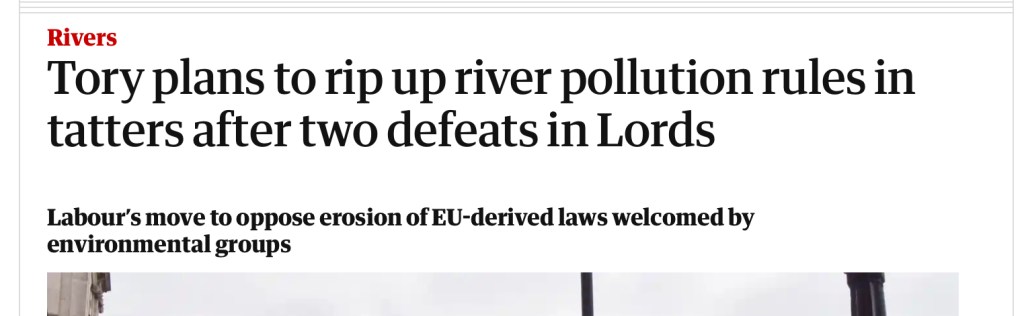
The previous government snatched at a solution to the nutrients issue, which I described in my 29 August 2023 blog post The Government’s Big Move On Nutrient Neutrality – Now We Have Seen The Government’s LURB Amendment – which envisaged simply excluding from the “appropriate assessment” test any “potentially adverse effect on a relevant site caused by nutrients in urban waste water, whether alone or in combination with other factors.” This was so much more radical – and environmentally regressive – than anything proposed within Part 3 of the current Bill. Of course, it was decisively defeated in the Lords – see my 16 September 2023 blog post NN No.

We do need a solution! The Conservatives’ solution was never going to work. To the extent that Part 3 would enable the Secretary of State to give Natural England the role of coming up with tested plans, with strategic solutions to secure the recovery of special areas of conservation and special protection areas and to arrive at mechanisms for securing contributions from developers towards those measures – allowing individual developers having diffuse off-site impacts of the ecological condition of those sites to know that the “appropriate assessment” test is not for them to address (unless they want to embark on a site-specific solution) and that they can simply pay their way – I am supportive of Part 3. As OEP concludes, a win-win.

My concerns are probably coming from a different place to some of the opponents to Part 3:

  • I have deep scepticism as to how quickly or pragmatically these plans will in fact be delivered by Natural England, without a significant ramping-up of the organisation’s capacity and capability. And notwithstanding environmental campaigners’ concerns that Natural England will in some way, without specific legal duties, be soft as to what they require, the reality is surely that, far from for instance not applying the mitigation hierarchy or allowing irreplaceable habitats to be harmed, there is surely as much of a risk that they will “gold plate” what is required.
  • Is the Government being too ambitious in its framing of Part 3 as enabling EDPs not just to address these specific “diffuse off-site impacts” situations I have focused on in this post, but enabling them to address the ecological value of the particular development site itself, reducing the amount of on-site assessment required? For myself, I do still wonder whether this goes too far and whether, in any event, this will not in practice be the focus of initial EDPs.

Agree or disagree? Planning lawyer blog writers are certainly not a species with any form of protection so please do your worst.

Simon Ricketts, 3 August 2025

Personal views, et cetera

Nature Recovery Position

Part 3 of the Planning and Infrastructure Bill is possibly facing the most criticism. Do its provisions with regard to the preparation of environmental delivery plans, enabling a nature restoration levy to be set which is to be paid by developers in lieu of some of the site-specific assessment and mitigation measures they currently have to carry out, go too far and amount to a regression in environmental protection?  

First, as a way into the issues, I do recommend my colleague Susannah Herbert’s summary and initial critique of the provisions published the week that the Bill was introduced into Parliament:  PI Bill Guest Post – Some Early Thoughts On The Bill’s Nature Recovery Provisions (13 March 2025)

The government has published a fact sheet.  It summarises the five key phases of the nature recovery fund as follows:

  1. Framing the EDP – EDPs will define the environmental impacts they cover, such as nutrient pollution or the impact development might have on a protected species. EDPs will be spatially specific with clear maps setting out where development is covered by an EDP and what scale of development the EDP can support.
  2. Designing the measures – EDPs will set out the suite of conservation measures that will be deployed to more than address the impact of development across a given area. For example, an EDP covering nutrient pollution will set out how the combined effect of the conservation measures will go beyond the current expectations of nutrient neutrality and lead to an improvement in water quality.
  3. Setting the levy rate – A simple charging schedule, sufficient to cover the costs of the conservation measures, will be payable by developers to meet the relevant legal obligation associated with the impacts addressed by the EDP.
  4. Consultation and approval – in developing an EDP, Natural England will benefit from views captured through consultation before the EDP is submitted to the Secretary of State for approval. When considering the EDP, the Secretary of State will be bound by a new legal test to ensure that the conservation measures outweigh the negative effect of development.
  5. Delivering on the EDP – once the EDP is in place, Natural England will the necessary powers to use funds collected to implement the conservation measures. They will then monitor the impact of the measures to ensure they are working as expected and make any amendments to the EDP that may be necessary.

The Bill is currently at Committee stage. Marian Spain, chief executive of Natural England, gave evidence on 24 April 2025, supportive of the proposals in the Bill. However, there are many who are expressing concern.

Instructed by NatureSpace Partnership, which delivers strategic licensing in relation to great crested newts and other species, David Elvin KC has provided a masterly and detailed (45 page) opinion dated 23 April 2025. He concludes that the proposals as they currently stand would amount to a weakening or reduction in current levels of environmental protection: the proposed test of “overall improvement” in environmental protection is “lax” and “generalised”.

The Office for Environmental Protection’s advice to the government on the Bill  (2 May 2025) echoes this concern: The OEP is “concerned by several aspects of the bill which undermine its potential to deliver intended win-win outcomes. We recognise that the EDP system is intended to be a different approach, not a direct comparator to existing environmental law. There are, though, fewer protections for nature written into the bill than there are under that existing law. Creating new flexibility without sufficient legal safeguards could see environmental outcomes lessened over time. And aiming to improve environmental outcomes overall, whilst laudable, is not the same as maintaining in law high levels of protection for specific habitats and species.

In our considered view, the bill would have the effect of reducing the level of environmental protection provided for by existing environmental law. As drafted, the provisions are a regression. This is particularly so for England’s most important wildlife – those habitats and species protected under the Habitats Regulations.

We summarise two particular concerns below, and provide further detail on these matters and other aspects of the bill in the annex to this letter.

A principal area of concern lies with the framing of the bill’s ‘overall improvement test’ for adopting EDPs. This test rests on a balancing exercise to decide whether negative environmental effects of development are likely to be outweighed by conservation measures taken under an EDP. As drafted at the moment, that exercise would allow considerably more subjectivity and uncertainty in decision-making than under existing environmental law. We advise that the overall improvement test should be strengthened to address this.

The bill as drafted also allows for conservation measures to be located away from the protected sites affected by development. Currently, this is only permissible in limited circumstances and where the overall coherence of the protected site network is maintained. Such safeguards are absent from the bill. Undermining the network of protected sites could affect the Government’s ability to meet its legally binding biodiversity targets and ‘30 by 30’ objectives. We advise that the lack of safeguards for the overall sites network is rectified, given the role they play in efforts to meet statutory nature targets.”

The OEP sets out, in an Annex to the letter, various detailed recommended changes to what is proposed.

More recently, the government has now published its impact assessment  in relation to the Bill (6 May 2025).  Section 7.2 is relevant for our purposes (NPSV = “Net Present Social Value (NPSV) in 2025 prices with 2026 base year across the 10-year appraisal period 2026-35”), EANDCB = “Equivalent Annual Net Direct Cost to Business” and EANDCH = “Equivalent Annual Net Direct Cost to Households”):

Incidentally, some groups and media pieces (eg UK government admits almost no evidence nature protections block development (The Guardian, 7 May 2025)) have misconstrued that reference to “limited data availability”. I agree that the statement is somewhat of a cop-out (and the range given absurdly wide) but the footnote makes it clear that the figure is expected to be a significant underestimate. For the real effects arising from nutrient neutrality alone see eg the work by the HBF and as for water neutrality see the recent failure at examination for instance of the Horsham local plan and many individual stalled schemes.

Is there a middle ground here? Should EDPs and the nature restoration funds, rather than ambitiously seeking to remove the need for developers to assess and address the specific effects likely to arise as a consequence of the species and habitats on their development sites themselves, in fact focus on those off-site issues which have indeed been causing so much delay and uncertainty: nutrient neutrality, water neutrality and issues relating to recreational pressure?  After all it is these aspects which the impact assessment focuses on:

The Nature Restoration Fund is expected to deliver benefits to areas where particular environmental obligations apply, for example, nutrient neutrality catchment areas. While some urban areas are in nutrient neutrality catchments (Southampton, Portsmouth, Norwich and Middlesborough), the majority of land area covered by nutrient neutrality catchments is rural. In some cases entire LPA areas are within nutrient neutrality catchments, where obligations limit ability to deliver those LPAs’ housing targets. The largest nutrient neutrality catchments (by hectare) are Solent, River Eden Special Area of Conservation (SAC), Somerset Levels & Moors Ramsar. The location of the interventions secured under the NRF will be determined by the scale of the delivery plan area.” (Paragraph 69)

I can see that in some circumstances nature recovery objectives can be secured more efficiently and effectively on a coordinated basis. The impact assessment says this:

“…the Nature Restoration Fund measures aim to improve environmental outcomes by requiring developers to contribute towards nature recovery. By shifting to a strategic approach to addressing environmental obligations, coordinated by a single delivery body, action will be more efficient and effective – achieving more with the same cost to developers. It is therefore expected that these measures will contribute to meeting the Government’s wider environmental targets and help secure the benefits derived from biodiversity and ecosystem services more effectively. For example: wetlands can effectively regulate flow of water which enhances resilience to flooding; forests, oceans and healthy soils sequester carbon, reducing greenhouse gases in the atmosphere; peatlands act as carbon stores; restored vegetation stabilises soils reducing erosion and improving water quality; and natural landscapes offer spaces for outdoor recreational activities like hiking and birdwatching. These activities promote physical and mental well-being and provide benefits through tourism-related revenue. This policy is also designed to speed up the delivery of net zero infrastructure (alongside other development), and in doing so support decarbonisation.” (paragraph 77)

But should any of this replace on-site assessment and on-site mitigation, save where it can be shown that off-site mitigation will in fact be as effective? And wouldn’t this also be fairer, rather than, presumably, some developers having to over-pay to compensate for others seeking to develop more ecologically sensitive sites?

Simon Ricketts, 11 May 2025

Personal views, et cetera

Neutrality Rules – CG Fry

Five years ago today (five years!) I was one of the first to blog about nutrient neutrality – the de facto veto on house building in some areas – in Another Green World: The South Coast Nitrate Crisis  (29 June 2019)

Since then the current Government has achieved nothing by way of legislation to unlock the issue. Instead the public and private sectors have gradually had to work up bespoke or locally strategic solutions and work-arounds.

What now are the two main parties promising in their manifestos?

The Conservative party proposes “abolishing the legacy EU ‘nutrient neutrality’ rules to immediately unlock the building of 100,000 new homes with local consent, with developers required in law to pay a one-off mitigation fee so there is no net additional pollution.”

The Labour party promises to “implement solutions to unlock the building of homes affected by nutrient neutrality without weakening environmental protections.”

In the interests of political neutrality I would describe these as two equally empty promises. No legislative solution will be both fast and environmentally robust. The Conservative attempt to shoehorn a provision into the then Levelling-up and Regeneration Bill last year of course flopped – see my 16 September 2023 blog post NN No. And five years on from Brexit (five years!) it is rather weak still to be pinning this problem on the EU!!

As well as delaying housebuilding, the issue has of course been grossly unfair for many developers and landowners who had obtained planning permission before Natural England had raised nutrient concerns and then find that they cannot achieve reserved matters approval or discharge pre-commencement conditions.

It was hoped by some that the courts might provide a solution to that particular position, by way of the litigation commenced by CG Fry. Unhappily their case was unsuccessful in the High Court – see my 30 June 2023 blog post CG Fry: AA Post PP. Even more unhappily, that ruling has now been upheld in the Court of Appeal (28 June 2024). 

The Court of Appeal held that “the inspector was right to conclude, and the judge to accept, that on their true interpretation regulations 63 and 70 of the Habitats Regulations could require an appropriate assessment to be undertaken at the stage when the discharge of conditions was being considered. This conclusion not only reflects the proper construction of the Habitats Regulations but also accords with the case law, both European and domestic, bearing on this question.”

“What, then, is the correct interpretation of the provisions of the Habitats Regulations with which we are concerned? We must begin with the domestic legislation as it is drafted. Applying normal principles of statutory interpretation, there is nothing in the relevant provisions to exclude the requirement for an appropriate assessment to be undertaken either when reserved matters are being approved or when conditions are being discharged, if the “authorisation” in question is necessary to enable the project to be lawfully implemented.

Given their natural and ordinary meaning, the words of regulation 63 clearly admit that possibility. The obligation imposed on a competent authority by regulation 63 is framed in broad terms. It makes necessary the carrying-out of an “appropriate assessment” before the authority decides to give “any consent, permission or other authorisation” for a plan or project. This formulation is clearly designed to capture a wide range of “authorisations”, of differing kinds; hence the use of the expression “or other authorisation”. It displays the essential purpose of the assessment provisions, which is to avoid any risk of harm to the integrity of a protected site. On a straightforward reading of the language used, having regard to that legislative purpose and to the underlying precautionary principle, the range of authorisations embraced in the provision extends, in our view, beyond the initial stage in the relevant process of decision-making. Any other interpretation would, we think, be incompatible with the words of the provision, inconsistent with the legislative purpose, and inimical to the precautionary principle.

Understood in this way, regulation 63 allows an appropriate assessment to be undertaken when the authority is making the final decision in a sequence authorising the development to proceed. Where that process involves the granting of outline planning permission for the proposed development and the subsequent submission and approval of reserved matters or the discharge of conditions, regulation 63 does not prevent the appropriate assessment of the project being carried out at that later stage as an exercise required before the decision is taken. In principle, it is not too late for such an assessment to be undertaken either when an approval of reserved matters is applied for or when the authority is called upon to discharge “pre-commencement” conditions, whose effect is that development carried out in breach would not be authorised by the planning permission.”

Nor in determining the relevant pre-commencement condition application or application for reserved matters is the decision-maker restricted to considering only the subject matter of the applications themselves, rather than the wider ecological issues.

And the principle applies equally to Ramsar sites as to other sites protected under the Conservation of Habitats Regulations.

I have no insight as to whether CG Fry will apply for permission to appeal to the Supreme Court but, regardless, it is clear that the courts will not be providing even a partial solution to the current crisis any time soon. My eyes turn to the incoming Government – where will we be in another five years I wonder?

Simon Ricketts, 29 June 2024

Personal views, et cetera

I know that some people only read this blog in the hope of references to old music (they regularly tell me that) so obviously here is an extract from the sleeve to Brian Eno’s wonderful 1975 album and everyone of a certain age will remember the theme music to the BBC’s Arena programme taken from it. Repeated references to Five Years in this post will also lead many back to David Bowie’s Ziggy Stardust album. Finally, in the interests of musical neutrality, I would like to point out that I also thought that Dua Lipa was quite good at Glastonbury last night.

The Storrington Appeal Decision: A Small Neutrality Breakthrough?

A Side: Bridge Over Troubled Water

Thank you, Heather Sargent, for sharing this appeal win on LinkedIn. This is what I turn to LinkedIn for, rather than for posts about legal directory rankings!

This decision letter dated 6 October 2023 is a must-read for anyone grappling with Conservation of Habitats Regulations issues in relation to nutrient/water neutrality or recreational impact issues.

In summary, the Inspector, Michael Hayden was faced with two identical appeals against the refusal of planning permission relating to proposed residential development  (up to 78 homes). The site straddles the South Downs National Park Authority and Horsham District Council areas.

There were various issues to be determined by the inspector but I just want to focus on one:

the effect of the proposed development on the integrity of the Arun Valley Special Area of Conservation, Special Protection Area and Ramsar sites, with particular reference to water abstraction, taking account of the proposed water neutrality measures.

I first covered the north Sussex water neutrality issue in my 19 October 2021 blog post Development Embargos: Nitrate, Phosphate & Now Water. This is equivalent to the nutrients issue which of course has recently been so much in the news – and where we await a fresh Bill to re-present the legislative fix rejected by the House of Lords in its report stage debate on the Levelling up and Regeneration Bill (see eg my 16 September 2023 blog post NN No).

One of the frustrations surrounding the neutrality veto has been with the approach of Natural England and local planning authorities, which have been disinclined to accept that, given that any adverse effect on the integrity of the relevant SAC or SPA only occurs when the homes are occupied, in appropriate circumstances planning permission can still lawfully be granted, and reserved matters applications and pre-commencement condition discharge applications approved, with a Grampian condition preventing occupation until a satisfactory solution is in place to ensure no adverse effect. Whilst it is said that this just kicks the can down the road – who will build if there is no certainty as to occupation? – in some circumstances it can assist, where for instance there will in any event be a long development lead time and the developer is prepared to take the risk that in due course a strategic solution will have been arrived at and implemented – and is prepared to contribute to the costs of that solution and generally seek to ensure that it is achieved.

So what is so interesting about the Storrington decision letter is that the appellant took this issue head-on. And the inspector accepted its approach. See paragraphs 67 to 109 of the decision letter. If your work involves neutrality issues, it’s worth reading them in their entirety.

The appellant’s position was that its scheme incorporated various measures to reduce the increased demand for mains water from the proposed development:

76. In order to achieve water neutrality, the appellant proposes to mitigate the increased demand for mains water from the proposed development through a combination of on-site water reduction measures and an off-site offsetting scheme. In terms of on-site measures, it is proposed to install water efficient fixings, and greywater recycling and rainwater harvesting systems into each dwelling. It is common ground that these measures would reduce potable water consumption from the residential development to 8,129.07 litres per day, subject to suitable management and maintenance to ensure they are effective.

77. The signed and executed UU contains obligations requiring an On-Site Water Neutrality Scheme to be submitted to, and approved by, the LPAs and implemented prior to first occupation, which would include a regime for the management and maintenance of greywater recycling and rainwater harvesting systems by a management company. I am satisfied this would provide a legally binding mechanism for the LPAs to ensure the long term effectiveness of the measures to reduce potable water use to the required level within the proposed residential development. This position was confirmed by the Council’s witness in oral evidence at the Inquiry.”

Over and above these measures:

79. The appellant seeks to rely on one of two alternative means of offsetting the residual water demand of the proposed development:

payment of a fee or tariff into an LPA-led offsetting scheme for the Sussex North WRZ as a financial contribution towards an equivalent reduction in mains water demand elsewhere in the WRZ (the strategic offsetting scheme); or

• installation of a rainwater harvesting scheme at a garden centre in Horsham that would deliver an equivalent reduction in mains water use (the site specific offsetting scheme).

80. The strategic offsetting scheme is not yet in place, but how it would operate is explained in the Mitigation Strategy prepared for the Sussex North WRZ45. The first element of the Strategy is a programme being implemented by Southern Water to reduce water demand across the network by reducing leakages and household water consumption. This is expected to mitigate a large part of the increase in demand from committed and planned housing growth in the WRZ in the period 2021-2039.

81. The balance of the increased water demand is proposed to be mitigated through an LPA-led offsetting scheme, comprising a series of measures to reduce water demand in social housing and property under LPA control, which would be funded by a tariff on all new development per litre of mains water required to be offset. The most significant measure would be a programme for retrofitting flow regulators into existing social housing stock within the WRZ managed by local authorities or registered social landlords (RSLs), the effectiveness of which has already been demonstrated in trials.

“83. On the question of prioritisation, the Mitigation Strategy recommends that priority should be given to sites allocated in local plans or identified in the associated housing trajectories, such as through the allowance for windfall, albeit not strategic-scale windfall49. In this case, around two-thirds of the proposed residential part of the appeal site is allocated for housing in the SSWNP. The housing proposed on the part of the site allocated for allotments would count as windfall provision, not at a strategic scale, for which an allowance is included in the housing trajectory for Horsham district from 2024/25 onwards50. If allowed therefore, the appeal site should be a candidate for priority of access to water neutrality via a payment to the offsetting scheme, given that it forms part of the planned and projected housing growth in Horsham district.

84. I recognise that the governing body for the strategic offsetting scheme is likely to have choices to make in terms of an order of priority for permissions to access the scheme, particularly early on in its operation. However, if the appeal proposals were allowed, the appellant confirmed that they would not need to rely on the strategic offsetting scheme for a period of 18 months from the grant of planning permission, whilst reserve matters were dealt with, the allotments relocated and site infrastructure laid. By that time (early 2025), the LPA-led offsetting scheme would have been operating for around 12 months and offsetting capacity from the SW programme is likely to be available to contribute to water neutrality in planned housing schemes. Furthermore, under the suggested standard time limit condition, the appellant would have up to 5 years from the grant of planning permission for the outline residential component of the proposed development to be implemented. By then (mid-2028), the strategic scheme would have been operating for over 4 years, with further offsetting capacity added to the scheme by both the LPA-led and Southern Water programmes.

85. Therefore, there is firm evidence that the proposed development would be able to access offsetting capacity within the strategic scheme to mitigate its residual water demand. However, case law establishes that in order for a competent authority to reach a conclusion under Regulation 63 of the Habitats Regulations that a project will not adversely affect the integrity of the European site, there must be no reasonable scientific doubt. In order to provide the necessary degree of certainty, the appellant has proposed a ‘Grampian’ condition and an obligation in the S106 UU, the effect of which would be to prevent implementation of the proposed development until a payment is made to HDC under the strategic offsetting scheme and water neutrality secured.”

The inspector noted that the threshold for imposition of a Grampian condition is simply that it would not be the case that there are “no prospects at all” of the action in question being performed within the time-limit imposed by the condition. “The Council’s evidence is that there is a very slim, 5%53 prospect of the appeal proposal being able to offset its water demand through the strategic scheme during the lifetime of any permission. A slim prospect does not amount to no prospect at all. Therefore, the condition would be reasonable in terms of the likelihood of access to the strategic offsetting scheme.”

The council was worried about the precedent effect but the inspector considered that each application needs to be determined on its own merits.  “In this case, I have established above that a large part of the residential component of the appeal site is included in the planned housing growth in Horsham District, and the remainder would contribute to the windfall allowance in the housing trajectory, both of which the Mitigation Strategy recommends should be priorities for the strategic offsetting scheme. Accordingly, the condition would not be unreasonable on this count either.”

He considered that the measures set out in the section 106 unilateral undertaking would be workable in practice and met the requirements of Regulation 122 and of section 106 itself.

But what about Natural England’s objection?

“93. NE’s position with regard to the strategic offsetting scheme remains that whilst the mitigation strategy is evolving, decisions on planning applications should await its completion or demonstrate water neutrality by other means. Whilst the advice of NE as the expert national agency on this matter carries significant weight, case law establishes that, as the competent authority, I may lawfully depart from this advice, provided I have cogent reasons for doing so.

After analysis he considered that he did.

The appeal was allowed. The relevant planning condition reads as follows:

“16. No development shall commence that results in an increased use of potable water when compared with the existing baseline water usage at the site until either:

(1) Water neutrality mitigation has been secured via the Council’s adopted Offsetting Scheme (in line with the recommendations of the Sussex North Water Neutrality Study: Part C – Mitigation Strategy, Final Report, December 2022) as set out in the Planning Obligation that accompanies this planning permission and this has been confirmed in writing by the Local Planning Authority; or

(2) The site specific Water Neutrality Mitigation Scheme set out in the Planning Obligation that accompanies this planning permission has been implemented in accordance with the requirements set out in the Planning Obligation and the Local Planning Authority has given its written confirmation of the same.

Horsham District Council had applied for costs, partly on the basis that “the Appellant did not submit their full case on water neutrality with the appeals, delayed the provision of key information on their revised water neutrality strategy until 31 January 2023, and presented information on rainwater yield coefficients in an inaccurate and misleading way, leading Natural England and the Council to misinterpret the case, and the Council to incur unnecessary and wasted expense in terms of counsel’s advice and officer time redrafting its evidence.”

That costs application was refused.

This is a decision which will cause ripples but in my view is wholly in line with the regime set out in the Conservation of Habitats Regulations and potentially applicable to issues relating to, for instance, nutrient neutrality or recreational impact (eg Chiltern Beechwoods SAC).

B Side: Keep The Customer Satisfied

Phew, no politics in this blog post. After my midweek Drive Time post I was politely asked by a reader to keep politics out of my comments on planning. I think it was felt that simonicity had become simon15minicity. All reaction is good, and thank you for it, but the request is difficult, given that the whole of the planning system is a political construct and given that every legislative stub that we have to navigate around is the result of an often short-term political decision in the past. We arrive at a better planning system by seeking to ensure that those political decisions are as considered as they need to be. I also had push-back from a couple of people at my characterisation of the prime minister’s comments on 15 minute cities as “bizarre”. I would simply refer readers to the numerous fact-check pieces out there (see eg Full Fact). Whether wilful or in ignorance, I don’t think there really is an excuse for mixing up the 15 minute city concept (previously supported by the Government – see eg this 31 March 2023 statement) with traffic management measures in cities such as Oxford to ration use of road space and prioritise active travel. At the recent Oxford Joint Planning Law Conference, that hotbed of woke radicalism, Jonathan Porritt spoke of the dangers of each of us being a WeWeBe: a well-informed, well-intentioned, bystander. Let’s not be that. We can avoid that whilst maintaining party political neutrality. If people who know about something don’t say something, who will?

The neutrality concept needn’t mean that nothing at all can be done – or said.

Simon Ricketts, 7 October 2023

Personal views, et cetera

Simonandgarfunkelicity

NN No

I may have been one of the first to blog on the nutrient neutrality issue in my 29 June 2019 blog post Another Green World: The South Coast Nitrate Crisis

To quote from what I wrote over four years ago:

I’m not sure that anyone can blame the EU, or lawyers, or local authorities, or developers, but no doubt they will. Rather, the problem arises from the apparent lack of adequate measures to ensure that, by virtue of its nitrate content, sewage generated as a result of new development does not harm the integrity of coastal waters protected as special areas of conservation and special protection areas under the Habitats and Birds Directives. Nitrate enrichment causes green algae, harmful to protected habitats and birds, through a process known as eutrophication. The chickens … are coming home to roost following a lack of priority for too long on the need by the Government and water companies to ensure that we have adequately funded and operated waste water treatment processes”

Of course the issue subsequently spread in terms of geography and by way of concerns as to phosphates as well as nitrates, hence references now to “nutrients”. (There are also related situations in relation to water neutrality in Sussex and in relation to recreational pressures on particular SACs – see my 9 October 2021 blog post Development Embargos: Nitrate, Phosphate & Now Water – and in relation to nitrogen deposition on protected areas caused by traffic, eg see my 8 April 2017 blog post Heffalump Traps: The Ashdown Forest Cases – but the rest of this post focuses on nutrients). 

This Government failed for far too long to grasp the nettle and now, when it has, it has been badly stung. Surprise surprise. 

My 29 August 2023 blog post The Government’s Big Move On Nutrient Neutrality – Now We Have Seen The Government’s LURB Amendment set out the way in which the Government belatedly looked to neutralise the nutrient neutrality problem for housebuilders and others who are stuck unless and until acceptable strategic or bespoke mitigation solutions are in place, by way of an amendment to the Levelling up and Regeneration Bill. The proposal was to take to remove nutrient pollution, by way of urban waste water, out of the ambit of the “harm to protected sites” integrity test. Subtle it wasn’t. 

The Lords report stage debate on what became Amendment 247YYA took place on 13 September 2013. We all know what happened: the amendment was rejected 192 – 161. 

As I set out in my 29 August 2023 blog post on the day the amendment was published, on balance I supported it – the need for a solution now is almost overwhelming – but I identified some questions to which the Government needed to be ready with answers. 

The brutal reality is that their answers weren’t good enough, particularly on the key question – whether this amounted to a regression from current environmental standards. The day after the amendment was published, the Office Of Environmental Protection sent the Government a letter making clear its expert view that the proposal would indeed amount to regression. Nature conservation bodies rose up as one notwithstanding Therese Coffey’s response (31 August 2023)

This may be a Government that still on paper retains a majority but boy it is on the ropes. The media and public opinion joyfully conflated the nutrient neutrality issue with its justified disgust as to the poor performance of water companies in allowing the discharge of untreated sewage to rivers and coastal waters (and the failure of the Government to hold those companies properly to account). I set out in my 9 September 2023 blog post LURB Lords Latest the kicking that the Government received on the proposal in the Commons on 5 September. 

As at 5 September Labour appeared to be sitting on the fence as to whether it would support the proposal but once they came out against it on 12 September 2023 (proposing an alternative amendment which was subsequently withdrawn during the debate without a vote) I would suggest that the writing was on the wall. As a sign perhaps of the Government’s desperation,  DLUHC published a late lobbying document in the form of the nutrient neutrality announcement: explanatory paper (11 September 2023).

The Government amendment was rejected 192 votes to 161. And that folks is that. Procedurally it cannot be reintroduced into the Bill when it returns to the Commons. Nor in my view is there time for a fresh Bill. 

What lessons to draw?

  • The Government moved far too slowly. Clive Betts nailed in it the 5 September 2023 debate: “This is hardly a new problem, is it? The Court decision was in 2018, yet last year we had the levelling-up Bill, which was really a planning Bill with a bit of levelling up added on—no mention of the issue there. In December we had major consultations on changes to the national planning policy framework—no mention of the issue there. The Committee wrote to the Minister and asked how many more consultations on planning issues there would be this year. We were given nine of them—no mention of the issue there. If it is such a serious issue, why has it taken the Government so long to act? It looks like the Government are making it up as they go along. This is a panicked response from the Government to the collapsing numbers of housing starts which the Minister simply wants to do something—anything—about.”
  • As a result of moving too slowly, it brought forward a proposal which had not been tested by way of any consultation whatsoever. Nor plainly had it been the subject of any cross-party agreement. Nor it seems had the Office for Environmental Protection been asked to advise ahead of the amendment being tabled, nor indeed Natural England. Indeed Natural England have not made any public statement in support of the proposal! Isn’t this all politics 101?
  • There was no clear narrative that explained the precise nature of the eutrophication issue so as to separate it from other justified concerns over water quality. 

What now should happen?

  • Plainly the Government should re-double its efforts to work with affected authorities and with the water industry to introduce strategic measures to reduce nutrient deposition into watercourses which are protected as SACs and SPAs. 
  • Plainly it should be working with Natural England to ensure that Natural England is in a position where its advice to authorities can be that, due to its confidence that these reductions will take place within the required timescale, there will not be an adverse effect on the integrity of the relevant SPA/SAC as a result of the particular proposal. With that assurance, and perhaps with guidance that any effects arise largely from occupation rather than construction and that therefore there is a role for planning conditions which at least allow developers to get on with construction if they are prepared to take the risk that reductions will take place in time for occupation, there is no need whatsoever for legislation. 
  • Other neutrality issues should receive equivalent focus. It’s not all about nutrients. 
  • Why don’t I finish with a controversial idea? If, in the face of expert advice to the contrary, planning applications are still held up, why doesn’t the Secretary of State call in the relevant application, in which case he becomes the competent authority in place of the local planning authority when it comes to determining whether there is an adverse effect on the integrity of the relevant SPA/SAC?

This coming week’s Lords Built Environment Committee report on the impact of environmental regulations on development will make interesting reading. We haven’t really even started to talk about environmental outcomes reports…

Simon Ricketts, 16 September 2023

Personal views, et cetera

The Guardian, 14 September 2023

LURB Lords Latest

The Levelling-up and Regeneration Bill resumed its progress through Report stage in the House of Lords this week, with sessions on 4 and 6 September. This post seeks to identify the main amendments made in those sessions.

I know what you’re all asking – what about the Government’s late proposed amendment to address the nutrient neutrality issue (see my 29 August 2023 blog post The Government’s Big Move On Nutrient Neutrality – Now We Have Seen The Government’s LURB Amendment)? That will be debated at a further session next week, on 13 September 2023. The proposed amendment was in the meantime the subject of an urgent question tabled in the House of Commons by the Green Party’s Caroline Lucas on 5 September 2023. The debate is interesting as a hint of what awaits both in the Lords on 13 September but then once the Bill returns to the Commons for its final stages:

  • The Speaker agreed that the urgent question was appropriate notwithstanding the Secretary’s written ministerial statement the previous day: “I expect Ministers to come to the House, as I did not think a written ministerial statement was the way to inform the House.”
  • On being challenged that the amendment amounted to a regression from current standards of environmental protection, the minister, Rachel Mclean responded: “It is important to consider what we are talking about here, which is unblocking 100,000 homes that add very little in terms of pollution. To be clear, our approach means that there will be no overall loss in environmental outcomes. Not only do the measures that we are taking address the very small amount of nutrient run-off from new housing, but at the same time, we are investing in the improvement of environmental outcomes. We do not agree that this is regression on environmental standards. We are taking direct action to continue to protect the environment and ensure that housing can be brought forward in areas where people need it.”
  • A nuanced question from shadow minister Matthew Pennycook:

As a result of the Government’s failure over many years to make decisive progress in tackling the main sources of problem nutrients, namely farming and waste water treatment works, the requirements for nutrient neutrality in sensitive river catchments present a challenge to securing planning permission for new housing development. It is therefore right in Labour’s view that the operation of the rules around nutrient neutrality is reviewed with a view to addressing problematic delays and increasing the pace at which homes can be delivered in these areas.

However, we have serious concerns about the approach that the Government have decided on. Not only does it involve disapplying the Conservation of Habitats and Species Regulations 2017, but it does not legally secure the additional funding pledges to deliver nutrient management programmes and does not provide for a legal mechanism to ensure that housing developers contribute towards mitigation.

I put the following questions to the Minister: what advice did the Government receive from Natural England about potential reform of the laws around nutrient neutrality? Did it offer a view on the Government’s proposed approach? Given the amount of mitigation currently available in the pipeline, which is estimated at allowing for approximately 72,000 homes, did the Government consider an approach based on the habitat regulations assessment derogation and a revised credit mitigation system to front-load permissions and provide for future compensatory schemes? If so, why did they dismiss that option? What assessment have the Government made of the impact of their proposed approach on the nascent market in mitigation credits, and investor confidence in nature markets more generally? Why on earth do Ministers believe developers will voluntarily contribute to mitigation under the proposed approach?

Finally, the Government claim their approach will see 100,000 planning permissions expedited between now and 2030. Given that house building activity is falling sharply and the pipeline for future development is being squeezed—not least as a result of housing and planning policy decisions made by this Conservative Government—what assessment has the Department made of the number of permissions that its disruptive approach will unlock within the first 12 months of its operation?

  • A rather pithy summation of the position, from the chair of the Levelling Up, Housing and Communities Committee, Clive Betts:

This is hardly a new problem, is it? The Court decision was in 2018, yet last year we had the levelling-up Bill, which was really a planning Bill with a bit of levelling up added on—no mention of the issue there. In December we had major consultations on changes to the national planning policy framework—no mention of the issue there. The Committee wrote to the Minister and asked how many more consultations on planning issues there would be this year. We were given nine of them—no mention of the issue there. If it is such a serious issue, why has it taken the Government so long to act? It looks like the Government are making it up as they go along. This is a panicked response from the Government to the collapsing numbers of housing starts which the Minister simply wants to do something—anything—about.

Turning now to the Report sessions on 4 and 6 September 2023 , I set out below the main amendments agreed upon (subject to them surviving the return of the Bill to the Commons). The full list of amendments is much longer and for the detail you can click on the following:

Hansard debate 4 September 2023

Minutes to proceedings 4 September 2023

Hansard debate 6 September 2023 (Part 1)

Minutes to proceedings 6 September 2023 (Part 1)

Hansard debate 6 September 2023 (Part 2)

Minutes to proceedings 6 September 2023 (Part 2)

[Many thanks to my Town Legal colleague Amy Penrose for detailed work on all this].

Amendment 184A

This amendment clarifies that inserted subsection (5B) in section 38 of the Planning and Compulsory Purchase Act 2004 requires a determination under the planning Acts to be made in accordance with the development plan and any national development management policies, taken together.

So the replacement to section 38 (6) would now read: “the determination must be made in accordance with the development plan and any national development management policies taken together, unless material considerations strongly indicate otherwise”. What does “taken together“ add? Perhaps to avoid an interpretation that the determination needed to be both in accordance with the development plan and in accordance with any national development management policies – instead look at it all together in applying planning judgment as to whether the determination is in accordance? It’s great being a lawyer.

Amendment 190 (tabled by Baroness Thornhill) – voted through against the Government 186 – 180

The amendment requires the Secretary of State to carry out a sustainability appraisal before designating a national development management policy; it must comply with public consultation requirements and a process of parliamentary scrutiny based on processes set out in the Planning Act 2008 (as amended) for designating National Policy Statements, and it must contain explanations of the reasons for the policy, including an explanation of how the policy set out takes account of Government policy relating to the mitigation of, and adaptation to, climate change.

Amendment 191 (tabled by Lord Ravensdale) – voted through against the Government 182 – 172

The amendment places a duty on the Secretary of State and relevant planning authorities respectively to have special regard to the mitigation of, and adaptation to, climate change with respect to national policy, local plan-making and planning decisions.

Amendment 191A (tabled by Lord Crisp) – voted through against the Government 158 – 149

The amendment specifically places a duty on the Secretary of State to promote healthy homes and neighbourhoods – a huge success for the Town and Country Planning Association’s Campaign for Healthy Homes.

(see also a detailed Schedule to be inserted into the Bill setting out for instance what is meant by healthy homes principles – amendment 191B).

Amendment 193A (tabled by Lord Best) – voted through against the Government 173 – 156

The amendment requires local plans to “identify the local nature and scale of housing need in the local planning authority’s area and must make provision for sufficient social rent housing, to eliminate homelessness within a reasonable period as stipulated in the updated local plan, and to provide housing for persons registered on the local housing authority’s allocation scheme within the meaning of section 166A of the Housing Act 1996.” It would apply both “in relation to social housing provided both by the local housing authority where it retains its own housing stock and by private registered providers of social housing”.  The information would need to be updated at least annually.

These are all significant interventions. Let’s see the approach that the Government takes back in the Commons. A motion will also be needed to carry over the Bill to the next Parliamentary session, without which we will see (wait for the LURB pun, wait for it, wait) .. LURB’s labours lost.

Simon Ricketts, 9 September 2023

Personal views, et cetera

Photo courtesy of Peter Kostov via Unsplash

The Government’s Big Move On Nutrient Neutrality – Now We Have Seen The Government’s LURB Amendment

No-one should be playing party politics with the nutrient neutrality issue. It’s difficult. It needs to be fixed. This is a quick post just to try to head off some of the comments that I have seen on social media today because the urgent need for a solution is in danger of being subsumed by general scepticism of this Government, exacerbated by the way that water companies have been allowed to fail in relation to water supply and sewage discharges. I write this on the back of Nicola Gooch’s excellent blog post this morning, LURB Watch: Government confirms Nitrates’ amendments to be tabled in House of Lords shortly  but since then we now have the proposed amendments to the LURB.

First of all, the basics:

House building is not the reason why some rivers and coastal waters around the country, protected as special areas of conservation or special protection areas by way of EU-derived legislation, are at or beyond a tipping point for the ecological integrity of those areas. Instead this is largely due to the historic run off of nitrates and/or phosphate from farm land and the inadequacy of our water infrastructure.

But the consequences of outflows from new housing has been seen by Natural England as the straw that would break the camel’s back and therefore its advice to local planning authorities faced with planning applications in affected catchments has been, in summary, not to approve them (and not to approve reserved matters applications or discharge pre-commencement conditions) unless the particular scheme can be shown to be nutrient neutral, given that otherwise in its view the “appropriate assessment” test in the Conservation of Habitats Regulations 2017 cannot be met, ie that the proposal will not adversely affect the integrity of any protected area.

So housebuilding has in practice been halted in various areas of the country until solutions can be implemented that demonstrably deliver nutrient neutrality.

To underline, this is not mainly about the polluting effects of new homes – it is about pre-existing problems.

I’ve written about the issues on various occasions, eg most recently in my 26 November 2022 blog post Nutrient Neutrality: Possibly Good News & Possibly Bad News and in my 6 June 2023 blog post CG Fry: AA Post PP.

The Government plainly recognises that the problem needs to be addressed. The current position, where so many schemes are stalled, is ridiculous and out of proportion to the extent to which housebuilding is actually the issue.

Right, so what is the Government’s solution?

Following Michael Gove’s press statement today, 100,000 more homes to be built via reform of defective EU laws  (29 August 2023), the latest tranche of tabled amendments ( https://bills-api.parliament.uk/api/v1/Publications/52407/Documents/3872/Download ) to the Levelling-up and Regeneration Bill have now been published, which include a number of amendments to the Conservation of Habitats Regulations.

The key proposed amendment is to introduce a new regulation 85B into the 2017 Regulations (see pages 19 and 20 of the pdf). Sub-paragraphs (2) and (3) would read as follows:

(2) When making the decision, the competent authority must assume that nutrients in urban waste water from the proposed development, whether alone or in combination with other factors, will not adversely affect the relevant site.

(3) Accordingly, a potentially adverse effect on a relevant site caused by nutrients in urban waste water, whether alone or in combination with other factors, is not a ground for the competent authority to determine that

(a) an appropriate assessment is required by regulation 77(6), or

(b) the proposed development will adversely affect the integrity of the relevant site or otherwise have negative implications for the site.”

Strengthened duties on water companies by way of their environmental permitting processes are also proposed in the amendments, but this is radical!

If enacted, it would certainly enable permissions, reserved matters approvals and pre-commencement conditions to be unjammed. On balance in my view it is to be supported. However, the Government does need to be ready with answers to questions like these:

  1. Given that the Government has committed to no regression from the environmental protections that we enjoyed pre-Brexit (NB Mr Gove, don’t give me that “defective EU laws” politicking – it’s our water system and environmental permitting system that is defective not the underlying law!), why does this not amount to regression? In its defence no doubt the Government would point to the commitments in the press statement not just to “significantly expanding investment in and evolving the Nutrient Mitigation Scheme run by Natural England, doubling investment to £280m to ensure it is sufficient to offset the very small amount of additional nutrient discharge attributable to up to 100,000 homes between now and 2030” but also the package of longer term measures that are set out in detail in the statement. But if these commitments are solid enough to be relied upon, why can’t they just be taken into account in determining that there will not be an adverse effect on the integrity of the relevant protected area? Why isn’t the Government confident that this would be Natural England’s advice? Wouldn’t that be a more legally coherent strategy than simply taking nutrients issues out of the appropriate assessment process? And if Natural England can’t sign that position off in relation to any particular protected area, doesn’t that rather have the whiff of regression?
  1. What about developers who have signed up to expensive nutrient neutrality schemes or are negotiating at present if the Government is effectively now removing the issue from their plate? Or will Natural England and local authorities still raise the nutrients issue by way of objection to proposals in planning terms, even if no longer able to wave the Conservation of Habitats Regulations big stick? Is it indeed right (or even envisaged) that developers should be let entirely off the hook?
  1. What about the water neutrality issue in Sussex, which has led to an equivalent logjam, or issues as to recreation impacts in other areas of the country? Similar principles surely apply.
  1. Will Parliament allow the Government to get away with shoehorning this set of provisions into the Bill at this late stage (see the comments in Nicola’s post) and what does it mean for the timing of Royal Assent? How confident can we be that the provisions will (a) survive to Royal Assent and (b) be brought into force?

These are just initial thoughts. Better informed commentary very welcome.

Simon Ricketts, 29 August 2023

Personal views, et cetera

CG Fry: AA Post PP

CG Fry v Secretary of State (Sir Ross Cranston, 30 June 2023) is a difficult case with a perhaps unsurprising answer, although one that is disappointing to many.

I’ve often written about the ongoing problems arising from Natural England’s advice that in certain areas, due to potential harm to Special Areas of Conservation and Special Protection Areas by way of nutrients (nitrates or phosphates), water abstraction pressures or recreational pressure, schemes should not be permitted to proceed without demonstrating (through the local planning authority carrying out “appropriate assessment” under the Conservation of Habitats Regulations 2017), that there will not be an adverse effect on the integrity of the relevant protected area. See for example my 18 March 2022 blog post New NE Nutrient Neutrality & Recreational Impact Restrictions (+ DEFRA Nature Recovery Green Paper).

The stage at which appropriate assessment is usually carried out is when an application for outline or full planning permission is being determined in circumstances where it is likely that the development will have a significant effect on an SPA or SAC. But one of the most frustrating aspects for developers about the introduction, usually without notice on the part of Natural England, of these controls is Natural England’s position, supported by the Government, that appropriate assessment is required even if planning permission has already been obtained and where what is being sought is reserved matters approval or discharge of a pre-commencement condition. I mentioned the problem in my 26 March 2022 blog post More On That Natural England Advice. As I said then:

This of course cuts across the traditional planning law tenet that the planning permission stage is the point at which the principle of the development is determined to be acceptable, with subsequent approvals serving to define the detailed scale and disposition of development within the tramlines of what has been authorised by way of the permission. The authorities’ stance means that planning permission no longer gives any certainty as far as purchasers and funders are concerned and is a real impediment to market certainty and confidence. Who knows what equivalent restrictions lie ahead, after all? Even if your area is not affected at present, this should be of concern.”

I asked:

Is anyone aware of this issue having been tested, on appeal or in litigation post 1 January 2021? Or is everyone being terribly British and waiting patiently for strategic solutions to be found to all of these neutrality issues before their reserved matters and pre-commencement conditions can be signed off? I suspect that some permissions will expire in the meantime. In my view this is not acceptable, or warranted, but am I a voice in the wilderness here?

Well, the point now has been tested.

In CG Fry, outline planning permission had been granted for a residential development of 650 houses, community and commercial uses, a primary school and associated infrastructure. Reserved matters approval was secured. Natural England then published its advice to Somerset authorities on development in the Somerset Levels and Moors Ramsar Site, advising that  greater scrutiny was required of plans and projects that would result in increased nutrient loads which may have an effect on SPAs, SACs and sites designated under the Ramsar Convention. CG Fry then sought to discharge various pre-commencement conditions but the Council withheld approval on the basis that an appropriate assessment was required before the conditions could be discharged. CG Fry appealed and the inspector dismissed the appeal. To quote from the judgment:

He determined that it was legitimate to apply paragraph 181 of the NPPF to give the Ramsar site the same protection in all respects as a European site under the Habitats Regulations 2017. That was because the discharge of the conditions would be an authorising act, as part of the wider consent process, that would allow the realisation of potential effects on the Ramsar site which the Natural England advice note sought to manage. Considering the overarching nature of paragraph 181, this applied regardless of the specific subject matter of the conditions themselves: DL24-26. The Inspector considered that the grant of outline planning permission and reserved matters approval did not have an effect on the scope of any necessary appropriate assessment; the validity of the planning permission was not in question: DL41.

The inspector then determined that the requirement for an appropriate assessment in the Habitats Regulations 2017 applied to the discharge of conditions stage. He rejected the claimant’s argument that inclusion of specific provisions relating to the grant of planning permission, including outline planning permission, at regulation 70 of the Habitats Regulations 2017, did not diminish the applicability of regulation 63, which was simply a sweep up provision: DL44. Even adopting the claimant’s approach that the permission in relation to “consent, permission or other authorisation” in regulation 63 is the planning permission referred to in regulation 70, the concept of “other authorisation” was a broad one. The claimant’s approach would create loopholes counter to a purposive approach to the Habitats Regulations 2017: DL45-47.

As the competent authority, the Inspector said, he was unable to carry out the necessary appropriate assessment to agree the conditions: DL71. He said that he had considered the other relevant planning considerations, in particular the impact on housing delivery: DL72, 74. However, the unfulfilled requirement for an appropriate assessment was an issue of material significance: DL77. In other words he conducted the balancing exercise and concluded that in this case the delay in housing delivery was outweighed by the need to protect the Ramsar site.”

“The claimant’s case in general terms is that the effect of additional phosphate loading resulting from its proposed development was not a material consideration to the determination of the conditions at issue in the case. It was legally irrelevant because it fell outside the specific parameters of what the outline planning permission and the reserved matters approval had left over for consideration under these conditions. The material for the discharge of these conditions was satisfactory, and the only thing preventing their discharge was whether an appropriate assessment of the impact of phase 3 of the development on the Ramsar site from additional phosphate loading was required. There was no nexus between the conditions in relation to phosphates, even with the condition relating to waste water. Nor, on the claimant’s case, does the combination the Habitats Regulations 2017 and paragraph 181 of NPPF change that. The Inspector was wrong in his analysis and conclusions.”

In broad terms ground 1 is firstly, that the Inspector wrongly construed the Habitats Regulations 2017 and should not have applied regulation 63, as he did, to the discharge of conditions on a reserved matters approval. Mr Banner KC contended that regulation 70 was the relevant provision, and it is confined to planning (including outline planning) permission.

The judge rejected the ground: “While on a strict reading of the Habitats Regulations 2017 the assessment provisions of regulation 63 do not cover the discharge of conditions, in my view they do apply as a result of firstly, article 6(3) of the Habitats Directive, secondly, a purposive interpretation of their provisions and thirdly, case law binding on me

Mr Banner contended that the Habitats Directive had no status in the UK legal system, except through regulation 9(3) of the Habitats Regulations 2017. The provisions of the European Union (Withdrawal) Act 2018 do not take the argument any further, he submitted, because there is no CJEU pre-existing case law which interprets the Habitats Directive as imposing a requirement to conduct an appropriate assessment at subsequent stages, such as the discharge of conditions on a reserved matters approval. He submitted that Harris concerned whether the claimed obligation under article 6(2) had been recognised by the court before Brexit, and it had. By contrast there is no CJEU or domestic case preceding exit day which supports the view that article 6(3) of the Habitats Directive can be relied upon to impose a requirement for an appropriate assessment at the discharge of conditions stage. Unlike Harris section 4(2)(b) of the Withdrawal Act 2018 is not engaged in this case given the absence of relevant pre-exit case-law.

In my view article 6(3) of the Habitats Directive continues to have effect in domestic law as a result of section 4(2)(b). Johnson J explained in Harris that the requirements of article 6(3) were accepted as binding by the CJEU in Waddenzee: [90]. Articles 6(2) and 6(3) of the Habitats Directive are closely related, so as to be “of a kind” with one another for the purposes of section 4: [91]. The demands of section 4(2)(b) are therefore met. The section is explicit that the recognition in the case law does not have to be by way of the ratio of a case “(whether or not as an essential part of the decision in the case)“.

Consequently, the requirements of article 6(3) of the Habitats Directive remain part of UK law. That article requires that the competent authorities should not agree a project until an appropriate assessment has been undertaken and it shows that it will not adversely affect the integrity of a site. A planning consent is part of agreeing a project when it is necessary to implement a development. In this case the discharge of pre-commencement conditions was a necessary step in the implementation of the development. An appropriate assessment had not been undertaken up to that point, so consequently the Inspector determined that he could not discharge the conditions prior to one being undertaken. His conclusion was consistent with article 6(3) of the Habitats Directive.”

Secondly, the Habitats Regulations 2017 demand a purposive interpretation so that the appropriate assessment provisions of regulation 63 apply to a subsequent consent stage including reserved matters applications and the discharge of conditions. A broad and purposive interpretation of the regulations flows from the strict precautionary approach which the CJEU has adopted to the assessment provisions of the Habitats Directive…

In my view Wingfield and Swire are authority for the proposition that an appropriate assessment can apply at the reserved matters or discharge of condition stage even if there has been a grant of outline planning permission where the subsequent approval is the implementing decision. There is support, as Lang J found in Wingfield, in the case law concerning the EIA multi-stage consenting procedure such as Barker. There, as we saw, Lord Hope recognised that a material change in circumstances could require an assessment at the reserved matters stage. It will be recalled that in Friends of the Irish Environment Ltd the CJEU stated that the meaning of “development consent” was relevant to defining the equivalent term “agree” in the Habitats Directive. All this is retained case law under the Withdrawal Act 2018 concerning the interpretation of the Habitats Directive and the Habitats Regulations 2017. That the facts in Wingfield and Swire were different is no basis for undermining the principle they established. The common law system would not survive if this were the case, since there will always be a variation, even if slight, in the facts of later cases. That does not preclude the continued application of principle.”

The upshot is that the Habitats Directive and Habitats Regulations 2017 mandate that an appropriate assessment be undertaken before a project is consented. That is irrespective of whatever stage the process has reached according to UK planning law. The basal fact in this case is that neither at the permission, reserved matters, or conditions discharge stage has there has been an appropriate assessment. Application of the Habitats Directive and a purposive approach to the interpretation of the Habitats Regulations 2017 require the application of the assessment provisions to the discharge of conditions. The strict precautionary approach required would be undermined if they were limited to the initial – the permission – stage of a multi-stage process.”

Ground 2: “For the claimant Mr Banner contended that paragraph 181 of the NPPF did not enable the Inspector to take into account considerations which were legally irrelevant to those conditions.” [Paragraph 181 states that Ramsar sites should be given the same protection as SPAs and SACs].

The judge: “The impacts on the Somerset Levels and Moors Ramsar Site and paragraph 181 of the NPPF cannot be said to be irrelevant considerations in this development. The issue is the read-across of the Habitats Regulations 2017 to Ramsar sites as provided by the NPPF in circumstances where the Council’s shadow appropriate assessment shows that if the project if permitted it will cause harm to the Ramsar site.”

Ground 3: “Mr Banner submitted that even if regulation 63 applies to the discharge of conditions, it ought to be interpreted in such a way that the scope of the appropriate assessment reflects the scope of the conditions being considered. Thus, for example, in the context of an application to discharge a condition relating to root protection zones for trees, an appropriate assessment would concern any effects on site integrity arising from the range of choices the decision-maker has in relation to root protection zones, given the permission granted (and any conditions already discharged). The appropriate assessment would not consider the effects of the scheme as a whole on the habitat in question.

The judge: “Regulation 63 requires an appropriate assessment to consider the implications of the project, not the implications of the part of the project to which the consent relates. […]  As Mr Wilcox for the Council put it, the thing which is to be the subject of the appropriate assessment is the thing which will be permitted by the authorisation, so that where the decision is the final stage in granting authorisation for a development, it is the development which is to be assessed.

It was a certainly an issue to be tested and, whilst Richard Moules and Nick Grant (for the Government) and Luke Wilcox (for Somerset Council) may have been on the winning side, well done to Charlie Banner KC and Ashley Bowes for arguing it (and to CG Fry for being prepared to put its head above the parapet). I hope Charlie won’t mind me quoting his subsequent LinkedIn post in its entirety:

Judgment in CG Fry has been delivered this morning . Key headlines:

1) The Court agreed with the Claimant that on a natural and ordinary reading of the Habitats Regulations they do not require appropriate assessment at the reserved matters or discharge of conditions stages

2) However, CJEU case law to the effect that the EIA Directive’s requirements apply at the reserved matters stage was to be read across to the Habitats context and to discharge of non-RM conditions, as well as first instance domestic case-law upholding the legality of a *voluntary* AA at reserved matters stage.

3) This is an EU “obligation… identified by a court” pre-Brexit which is preserved by the EU Withdrawal Act 2018 ss4&6, because the direct effect of Article 6(3) of the Habitats Directive had been recognised by the CJEU pre-Brexit.

4) Therefore the Habitats Directive continues to apply directly and overcomes the natural and ordinary meaning of the Regulations.

The judge has indicated he is minded to grant permission to appeal his judgment and the parties are discussing the potential for a leapfrog appeal to the Supreme Court.

The judgment will present Department for Levelling Up, Housing and Communities with some challenges for any future legislative solution for the nutrients issue given the Court’s approach to considering whether s4 of the Withdrawal Act preserves post-Brexit the force of EU “obligations… of a kind recognised by a court “ pre Brexit. The Claimant said that this meant the Courts had to have recognised an obligation for AA at discharge of conditions stage, which they hadn’t. The judgment suggests that the relevant obligation is article 6(3) generally. The potential effect of this is that it will be open to anyone to apply to court to set aside legislation on the basis it is contrary to article 6(3) *even if based upon an interpretation of article 6(3) that hasn’t previously been made by the Courts*

The Home Builders Federation’s evidence to court was that 44,000 already consented homes in England are currently blocked because of this issue. The Land Promoters and Developers Federation has also been very active on this issue.

Watch this space!

A final couple of wry comments from me:

  1. If anyone voted for Brexit thinking that these sorts of problems would become a thing of the past, more fool them.
  1. Let’s not forget that the root of much of the issues over neutrality – whether in relation to nutrients and water abstraction – is the appalling lack of investment on the part of the privatised water companies.

As the judge says at the beginning of his judgment: “In broad terms, this issue relates to the phosphate loading of protected water habitats, leading to eutrophication. This is caused by reasons including agricultural practices and under-investment in water infrastructure. There is a risk of the problem being exacerbated by water generated by new developments which contain phosphates, principally from foul water. The Home Builders Federation states that, due to the unavailability of mitigation options, this issue is holding up the building of no fewer than 44,000 homes in England which already have planning permission.” (my emboldening)

Until the CG Fry judgment landed this morning, I had been intending to pull together some wider thoughts on the implications for planning and the environment of the poor state of our privatised water industry, provoked by articles such as UK government looks at nationalising Thames Water as crisis deepens (FT, 28 June 2023) where delayed housebuilding, aka providing people with homes,  is just part of the collateral damage.

Simon Ricketts, 30 June 2023

Personal views, et cetera

Pic courtesy Towfiqu barbhuiya via Unsplash

Nutrient Neutrality: Possibly Good News & Possibly Bad News

The Government appears to be in negotiation with Tory MPs (46 of them at least) who may be prepared to wreck the Levelling-up and Regeneration Bill unless it includes a provision abolishing housebuilding targets for local authorities and abolishing the policy in the NPPF as to the maintenance of a five years’ supply of housing land. No doubt this will end up with some fudged solution adding further (1) uncertainty, (2) complexity and (3) hurdles in the way of housing provision. 

But in another part of the forest, assuming they will overcome that local difficulty (aka huge chasm), the Government has brought forward a further set of amendments to the Bill to seek to address the nutrient neutrality problem which has amounted to a de facto veto on housebuilding in many areas of the country (see eg my 23 July 2022 blog post Neutrality: Government Clambers Off The Fence).

This is what I am categorising as the possible good news. See DLUHC’s 25 November  2022 press statement Government sets out plan to reduce water pollution.

Government plans announced today will see:

  • A new legal duty on water companies in England to upgrade wastewater treatment works by 2030 in ‘nutrient neutrality’ areas to the highest achievable technological levels.
  • A new Nutrient Mitigation Scheme established by Natural England, helping wildlife and boosting access to nature by investing in projects like new and expanded wetlands and woodlands. This will allow local planning authorities to grant planning permission for new developments in areas with nutrient pollution issues, providing for the development of sustainable new homes and ensuring building can go ahead. Defra and DLUHC will provide funding to pump prime the scheme.”

The new legal duty on water and sewerage companies in England to upgrade certain wastewater plants will be introduced via a Government amendment to the Levelling Up and Regeneration Bill. We want these improvements to be factored in for the purposes of a Habitats Regulation Assessment.

The nutrient mitigation scheme “will be open to all developers, with priority given to smaller builders who are most affected. Developers can also continue to put their own mitigation schemes in place should they choose. Natural England will work with, not crowd out, new and existing private providers and markets for nutrient offsets wherever they exist.

The scheme is due to open in the Autumn. All affected areas can continue to access practical support from the government and Natural England in meeting nutrient neutrality requirements. Natural England will deliver the scheme by establishing an ‘Accelerator Unit’, with the support of Defra, DLUHC, the Environment Agency and Homes England.

This announcement will support the delivery of the tens of thousands of homes currently in the planning system, by significantly reducing the cost of mitigation requirements. The mitigation scheme will make delivering those requirements much easier for developers.”

The possible bad news? Not so much bad news but an inspector’s appeal decision letter which confirms that the Habitats Regulations’ assessment requirements do not just apply when an application for planning permission is determined but, if an assessment was not carried out at that stage, at reserved matters/ conditions discharge stage. This is of course one of the huge current frustrations. 

The decision letter, dated 24 November 2022, is here and is summarised by Landmark Chambers here.  

Charlie Banner KC was for the appellant and his submissions were in line with an opinion previously provided for the HBF and widely circulated. The issues are not straight-forward and we wait to see whether the  question will now come before the courts. 

Short blog post this week – too busy, and to0 much football to watch. 

Simon Ricketts, 26 November 2022

Personal views, et cetera

Pic courtesy Four Four Two