Long Players: Time & Money

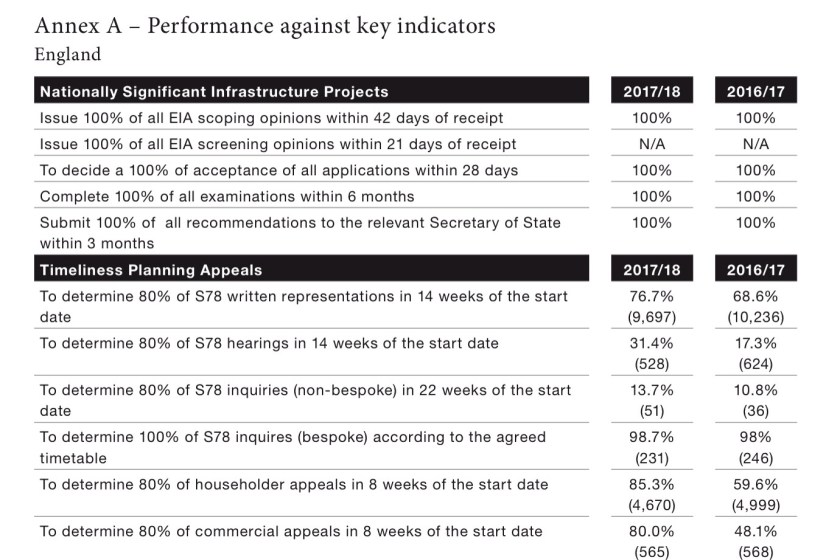
Is there more that can be done to encourage timely resolution of issues that arise at planning application stage?

Two prompts for this blog post:

1.Provectus Remediation Limited v Derbyshire County Council (Sir Wyn Williams, 8 June 2018), which considered the circumstances in which an applicant for planning permission is entitled to a full fee refund if the application is not determined within 26 weeks.

2. The Secretary of State’s Lotmead Farm, Swindon decision dated 13 June 2018 to accept his inspector’s recommendation to award the local authority its costs against the appellant for unreasonable behaviour in relation to two appeals – on the basis that the appeal process had been used to “evolve the schemes“, contrary to the Planning Inspectorate’s procedural guide (the Secretary of State having dismissed the appeals in a separate decision letter of the same date).

Planning application refunds

In our ridiculous legislative patchwork you need to look at the Town and Country Planning (Fees for Applications, Deemed Applications, Requests and Site Visits) (England) (Amendment) Regulations 2013 which amended the 2012 Regulations from 1 October 2013 so as to introduce, as Regulation 9A, the right for an applicant to have its application fee refunded “in the event that the local planning authority fail, or the Secretary of State, in relation to an application made under section 62A of the 1990 Act fails, to determine the application within 26 weeks of the date when a valid application was received by the local planning authority or the Secretary of State, as the case may be.

Regulation 9A (2) provides that the right does not apply where “the applicant and the local planning authority, or, in the case of an application under section 62A of the 1990 Act, the Secretary of State, have agreed in writing that the application is to be determined within an extended period“, the application has been called in, is the subject of an appeal or of judicial review.

In the Provectus case, the claimant had submitted its planning application on 14 September 2014, paying an application fee of £44,000, withdrew the application and resubmitted the application on 22 December 2015 (no additional fee payable due to Regulation 9 of the 2012 Regulations), which was registered by the local planning authority on 25 January 2016. Further environmental information was requested by the authority in April 2016, which was provided (following an extension of time requested by the claimant) in July 2016. On 3 August 2016 the authority requested an extension of time for determining the application and an extension to 7 November 2016 was agreed. Further environmental information was then sought by the authority during the period, the claimant’s agent agreed to that and then was replaced by another agent, which no longer agreed to provide the information, arguing that it had in part already been provided and in part was unnecessary. In December 2016 the claimant appealed on the basis of non-determination and in March 2017 requested that the authority refund the fee.

So in short, a real mess but unfortunately not an unusual sequence of events. From a limited knowledge of events gained solely from the account in the judgment, I would guess that neither side particularly smelt of roses.

The claimant judicially reviewed the decision of the authority to refuse to refund the application fee. The authority took the position that Regulation 9A (2) disapplies the right where the applicant and authority have agreed an extended period for determining the application. The claimant argued that this should not be the case if the application is not then determined within the agreed extended period. To assist their respective stances, both parties’ counsel sought to rely on different parts of the explanatory memorandum that accompanied the 2013 Regulations.

Wholly unsurprisingly, the judge rejected any purposive interpretation:

A refund of a fee paid at the time of a planning application should be made only if a period of 26 weeks has elapsed from the receipt of a valid application and that application has not been determined by the local planning authority. In my judgment, if the applicant and the local planning authority agree in writing that the 26 week period should be extended the planning fee paid by the applicant does not fall to be refunded even if the local planning authority fails to determine the application within the extended period.”

So the claimant did not recover its £44,000 and now faces not only a costs bill from its own lawyers but liability to pay the authority’s costs in relation to the litigation.

The case does highlight a few things:

1. Don’t forget about the right to a refund.

2. Take it into account in your decision making as to whether to agree a time extension.

3. The Regulations plainly risk giving rise to perverse incentives: (1) it is so much safer for an authority if it can agree an extension of time, after which it is not at risk of a fee refund however poor its performance and (2) canny applicants may decline to agree time extensions where an application is running into the sand.

I did wonder to myself why the argument wasn’t made by the claimant that at least 26 weeks had already passed between the submission of a valid application in December 2015 and the agreed time extension but I assume that this wouldn’t have worked given that the formal request under the EIA Regulations for further environmental information would have had the effect of stopping the clock running until the information had been provided and/or that the agreed extension of time for providing that additional environmental information may have itself disapplied Regulation 9A? As ever reality is more complicated than legislation envisages.

Using the appeal system to “evolve” a scheme

Where there is lack of engagement on the part of a local planning authority, what real remedy is there aside from an appeal? And yet Annexe B of the Planning Inspectorate’s procedural guide seeks to encourage resolution of issues before an appeal has been submitted, reflecting the advice in the Planning Practice Guidance:

Before making any appeal the party seeking permission should first consider re-engaging with the local planning authority to discuss whether any changes to the proposal would make it more acceptable and likely to gain permission. It is possible that a further planning application may be submitted without charge. However, this will depend on the circumstances of each case, so parties should ask the local planning authority for further details.”

Annexe M of the PINS procedural guide states:

M.2.1 If an appeal is made the appeal process should not be used to evolve a scheme and it is important that what is considered by the Inspector is essentially what was considered by the local planning authority, and on which interested people’s views were sought.

M.2.2 Where, exceptionally, amendments are proposed during the appeals process the Inspector will take account of the Wheatcroft Principles when deciding if the proposals can be formally amended. In the ‘Wheatcroft’ judgment22 the High Court considered the issue of amendments in the context of conditions and established that “the main, but not the only, criterion on which… judgment should be exercised is whether the development is so changed that to grant it would be to deprive those who should have been consulted on the changed development of the opportunity of such consultation”. It has subsequently been established that the power to consider amendments is not limited to cases where the effect of a proposed amendment would be to reduce the development.

M.2.3 Whilst amendments to a scheme might be thought to be of little significance, in some cases even minor changes can materially alter the nature of an application and lead to possible prejudice to other interested people.

M.2.4 The Inspector has to consider if the suggested amendment(s) might prejudice anyone involved in the appeal. He or she may reach the conclusion that the proposed amendment(s) should not be considered and that the appeal has to be decided on the basis of the proposal as set out in the application.”

The position in which the developer found itself at the Lotmead Farm appeals was that it had sought pre-application advice from Swindon Borough Council over a period from December 2013 to May 2015 in relation to a proposal for up to 2,600 homes together with associated development, on a site with a strategic allocation in the local plan. An application for outline planning permission for the whole scheme as well as an application for outline permission for an initial phase of 200 homes were made on 30 April 2015. The council made a series of requests for further information and for extensions of time. The council refused the applications on 30 June 2016 at a point where the developer was seeking to resolve or at least narrow the issues.

After submitting appeals against the refusals the developer then made a series of amendments to the proposals to seek to address the reasons for refusal. At a pre-inquiry meeting the developer indicated the scope of the amendments that would be made and that an ES addendum would shortly be publicised. The inspector postponed the inquiry to allow participants in the inquiry to have sufficient preparation time. The amendments apparently were then more significant than had been identified. The changes included an additional 2 form entry primary school, an increase in the red line area, changes to the transport proposals, to all of the parameter plans and to the illustrative masterplan and green infrastructure parameter plans. “Moreover, over the following months additional amendments and information were submitted by the appellant and corrections were made to submitted documents“. The ES addendum entailed six of the topic areas being superseded.

In his report on the appeals, the inspector sets out the amendments in detail before stating at paragraph 10.14:

In conclusion, the amended schemes are very significantly different to those determined by the Council and have evolved considerably during the course of the appeals. To use the appeal process in this way is contrary to Procedural Guidance and does not sit comfortably with the Wheatcroft principle. There are no exceptional circumstances to justify this approach. No specific case of prejudice has been highlighted but compliance with the Procedural Guidance is the best way to ensure no-one is disadvantaged through the appeal process.”

She considered that it was appropriate to consider the appeals on the basis of the originally submitted proposals, although (since the appeals had been recovered for the Secretary of State’s own determination) she considered the proposed revisions in detail as well in case the Secretary of State took a different approach. She recommended that the appeals be dismissed, whether or not the revised proposals were considered.

In his decision letter, the Secretary of State accepted the recommendation that the revised proposals should not be considered:

13. The Secretary of State has given careful consideration to the Inspector’s analysis at IR10.1-10.15. The Secretary of State has taken into account that all parameter plans and the illustrative masterplans were amended (IR10.6). The Secretary of State has further taken into account that the ES also was substantially reviewed, with six of the topic chapters being superseded. The Secretary of State has further taken into account at IR10.7 that further amendments were made including proposals for access, surface water management, trees and landscaping. For the reasons given at IR10.6-10.7, the Secretary of State agrees with the Inspector at IR10.7 that the evolution of the proposals results in an overall very considerable change to the schemes and to the quality of the supporting information.

14. For the reasons given at IR10.6-10.7, the Secretary of State agrees with the Inspector at IR10.8 that the amended schemes are not the schemes determined by the local planning authority in June 2016 and on which interested people’s views were sought (IR10.8). The Secretary of State agrees with the Inspector that the narrowing of the areas of dispute was of assistance to the efficient running of the inquiry but was carried out very late in the day. He further agrees that the approach adopted by the appellant during the course of the appeals has not been in accordance with procedural guidance (IR10.8).

15. As such, the Secretary of State agrees with the Inspector at IR10.9 that the changes to the proposals in the Masterplan and the Phase 1 appeals are sufficiently material that consultation on the amendments would be essential.

16. The Secretary of State has taken into account the Inspector’s conclusions on consultation at IR10.10-10.13. The Secretary of State agrees with the Inspector at IR10.14 that the amended schemes are very significantly different to those determined by the Council and have evolved considerably during the course of the appeals. He further agrees that to use the appeal process in this way is contrary to procedural guidance and does not sit comfortably with the Wheatcroft principle and there are no exceptional circumstances to justify this approach; and agrees that no specific case of prejudice has been highlighted but compliance with the procedural guidance is the best way to ensure no-one is disadvantaged through the appeal process (IR10.14). He concludes, in agreement with the Inspector, that the appeals should be determined on the basis of the original proposals (IR10.15).”

A separate report and decision letter addressed an application for costs that was made by the borough council. The inspector recommended that a full award of costs be allowed:

Unreasonable behaviour resulting in unnecessary or wasted expense, as described in the Planning Practice Guidance, has been demonstrated in that:

• appeals were made on the original schemes when there was no reasonable prospect of success, and

• the appeal process was used to evolve the schemes, which was contrary to Procedural Guidance.”

She noted that if amendments to the proposals had been pursued through another application “there would be a greater probability of compromise on both sides, outside of the adversarial appeal process. The normal development management process has been avoided.”

The Secretary of State agreed.

Perhaps here the circumstances were exceptional but I do worry whether this is the right direction for the planning system to be heading in – although I appreciate that the Government and the Planning Inspectorate would prefer a clean, front-loaded appeal process that is only used as a last resort. If anything may conceivably focus a local planning authority on resolving matters with an applicant, it is the risk that its position may come under scrutiny at inquiry. I do not know if this was the case at Lotmead Farm but sometimes it is impossible to ascertain what the authority’s position is, or what changes to a scheme may be considered acceptable. If the developer has to wait for a refusal notice and start again with a further application before appealing, without the ability to bring matters to a head by way of the appeal and changes made as part of the appeal process, appealing becomes increasingly impractical as an option (and the authority knows it).

Of course there has to be a limit to the scale of any amendments made at the appeal stage. But as long as the amendments are fully consulted upon is there really such a problem if they improve the scheme and ensure that permission can be granted by the inspector or Secretary of State rather than a further application being required? Not only do we now have an appeal process that is increasingly slow, we have a process that is increasingly impractical in relation to complex schemes, where interation is inevitable and surely no bad thing.

At least through its appeal, notwithstanding not achieving permission and having an expensive adverse award of costs against it, the Lotmead Farm developer did manage to narrow various issues with the authority and third parties, and secure detailed comments from the inspector on various elements of its proposals, some negative, some negative, but sufficient presumably now to form the firm basis for a further application. The inspector even identified a series of elements of the section 106 package that did not comply with regulation 122 and which presumably will not be included next time round (which will save a substantial sum). It is just a shame that there is not the ability to secure, more nimbly, equivalent independent expert input during the application stage itself so as to resolve differences – rather than tie everyone up in a slow, expensive and adversarial process.

Simon Ricketts, 15 June 2018

Personal views, et cetera

Judicious Review?

It’s the examination season: daughter, university finals; son, A levels; me, asked by a journal for my thoughts on the interim report published by the Raynsford Review (Planning 2020: Interim report of the Raynsford review of Planning in England May 2018). I’m sharing my first thoughts with you so please set me right, because I really don’t want just to write a piece damning the whole process with faint praise.

I wrote a blog post on 28 August 2017, Another Review when the review was announced, instigated by the Town and Country Planning Association “to identify how the Government can reform the English planning system to make it fairer, better resourced and capable of producing quality outcomes, while still encouraging the production of new homes.”

The review’s chair, Nick Raynsford, is the right person for the role. His professional life inside and outside Parliament has focused on planning and housing issues.

However, I was sceptical as to the governmental appetite for further significant reform of the planning system and queried the role of any recommendations without endorsement from the major political parties. That scepticism increased when the next month the Labour party announced its own review of the planning system (see my 30 September 2017 blog post Mending The Planning System (Has Anyone Tried Switching It Off And On Again?). I also queried the role of any fundamental review of the planning system outside any wider political vision:

The planning system is a machine, big cogs, little cogs, to deliver the government of the day’s social, economic and environmental objectives. Unless the review is just to be about process, what objectives are to be assumed in framing recommendations?

Turning to the interim report published last month. It’s all to play for because a “final round of feedback” is sought by 16 July 2018.

The 71 page document is strong on the evolution of the modern planning system from 1947, previous reviews and on summarising the current system. It recounts the numerous public events and meetings held by the review team and the 197 submissions of evidence received, before setting out seven “emerging policy themes“, nine “basic questions which define the direction of reform” and, provisionally, nine “propositions for a new planning system“.

So we have (each accompanied in the document by explanatory text):

Emerging policy themes

• the degree to which the current system is delivering on
its objectives;

• how much power spatial planning should have
(positive and negative);

• how the balance of planning powers should be
distributed between central and local government;

• the right spatial structure for planning, including local
government structure and boundaries;

• the degree to which communities should have
meaningful control over their own local environment,
and the nature of community rights; and

• issues of betterment and fair land taxation.

Basic questions which define the direction of reform

What is the justification for a spatial planning system in

a market economy?

What is purpose of a spatial planning system, and how should this be expressed?

What should the scope and powers of the spatial planning system be?

What should the governance arrangements for these structures and institutions be, and what role, and how much power, should there be for the citizen in decision-making?

What are the basic outcomes that people can expect from the planning process?

Can we simplify the legal structures of planning?
What institutional structures are required to support

spatial planning?
What taxation or charging measures are necessary to

deal with the economic impact of land use regulation?

What sorts of skills, practice and culture do planners

need to support the system?

Propositions for a new planning system

Proposition 1: Planning in the public interest

Proposition 2: Planning with a purpose

Proposition 3: A powerful, people-centred planning system

Proposition 4: A new covenant for community participation

Proposition 5: A new commitment to meeting people’s basic needs

Proposition 6: Simplified planning law

Proposition 7: Alignment between the agencies of English planning

Proposition 8: A fairer way to share land values

Proposition 9: A new kind of creative and visionary planner

The conclusion of the analysis in the work so far is that planning is “at a historically low ebb“. It is in a worse state than it has been for 75 years and that “the last thing that is needed is more short-term tinkering with the nuts and bolts. Instead, what is required is a deep and hard look at the fundamentals – what should be the purpose of planning, how can it best be structured to deliver the outcomes that the country needs, and how can all parties be engaged most constructively in the process?

You begin to see the breadth and ambition of the project. But if wholesale change is to be prompted by a process that is not sponsored by government or government-in-waiting, there is a huge job of work to be done by the review panel between now and the final report, which is to be published in the Autumn for the party conferences.

First, avoid generalities. Set out with quantified evidence why and where the planning system is not delivering. What detailed points were made in the responses and do they reflect the views of all participants in the planning process?

Secondly, bring the issues to life. The interim review in tone is part academic, part old-fashioned tub-thumping, empty of people, empty of place. If you want to see how to do it, read The Secret Barrister’s devastatingly detailed critique of the modern criminal justice system.

Thirdly, set the problems and gripes that we have with our planning system in context. The planning system may appear at times and in places to be on its knees, or dysfunctional in the way that it operates. But in comparison with areas of public administration, whisper it quietly, it may not be so bad. I have mentioned the criminal justice system, but the health service, benefits, the rating system even (having just read Jerry Schurder’s 8 June 2018 blog post What we could learn from the rest of the world – if only the Government was interested). I have practised under every iteration of the planning system since 1985. If there was a golden age, it was before then I assure you. And yet, by and large, outcomes are fair (if slow), people have their say, development happens or doesn’t happen. Let’s also set our system in an international context – how is our English system performing as compared to the rest of the United Kingdom or Europe?

Fourthly, recognise and reflect on the inherent contradictions. The interim report talks of giving the public a greater say in decision-making but then of a new commitment to meeting people’s basic needs such as the right to a home and of the “deployment of modernised Development Corporations to deal with particularly demanding issues such as flood risk, economic renewal, and population change“. It talks of simplified planning laws but then of a four tier system of neighbourhood, local, regional and national alongside development corporations and of new interventions to share land values.

Fifthly, give appropriate emphasis to the need to encourage the production of new homes, specifically referred to in the remit of the review. So far I see little in the interim report that would give that encouragement. Indeed, the document strongly criticises the current permitted development right to convert office uses to residential, without any detailed analysis of whether the disbenefits do indeed outweigh the benefit acknowledged in the report (between 86,665 and 95,045 units delivered between 2010 and 2017).

Sixthly, explain how we are going to get from here to there. The document reports the planning system as having “been in an almost constant state of flux over the past decade and a half” but how would we reform the system to Version Raynsford without equivalent upheavals? And if we assume that there is no prospect of wholesale change within the shelf life of the report, what might be less ambitious, but still helpful, interventions?

Seventhly, acknowledge that the next ten years will see enormous changes, whether economic-political (Brexit, possibly), social (how we live, work, shop) and technological (spatial implications but also the changes that plantech will bring to the very processes of planning and public engagement).

In the meantime, utopian thinking shouldn’t deflect us from events which may have more immediate implications.

First, Sir Oliver Letwin’s build-out review is continuing at pace. It is looking to “explain the significant gap between housing completions and the amount of land allocated or permissioned in areas of high housing demand, and make recommendations for closing it”. Sir Oliver has indicated that he will publish “analytical work by the end of June in the form of a Draft Analysis. This will contain only a description of the problem and of its causes

Secondly, MHCLG will be publishing this month a consultation paper in relation to further potential widening of permitted development rights. The review panel won’t enjoy that I’m sure.

Thirdly, practical thinking continues on land value capture. Commons HCLG Committee on Land Value Capture held an oral evidence session on 4 June 2018 (read the transcript) with a further session on 11 June at which the TCPA’s Hugh Ellis (who should take huge credit for the work that he has put into the Raynsford review process) will appear, alongside others including lawyers Barry Denyer-Green, Stephen Ashworth and Vicky Fowler.

Fourthly, the Labour party continues to announce policy reviews, most recently in April, Housing For The Many.

All of this is interesting of course (and, despite my carping, the Raynsford interim report is an impressive and illuminating piece of work) but until there is a very different political climate (with the time and power to think about big, complicated changes for the public good – and even then town and country planning should take its place in the queue), we plainly will need to carry on making the best of the current system. It creaks, but it isn’t broken. Of course, at the very least, consolidation of the legislation would be helpful, but at present even that seems an impractical dream.

Views?

Simon Ricketts, 9 June 2018

Personal views, et cetera

Community Benefits

The road to the High Court is paved with good intentions. Who doesn’t want development to deliver all manner of gains to a community? But at the planning application or appeal stage, the developer and decision maker need to be clear in their thinking as to whether each commitment made is material to the decision-making process and, if documented by way of section 106 agreement, meets the statutory tests.

This piece was initially prompted by the High Court’s ruling in Good Energy Generation Limited v Secretary of State (Lang J, 25 May 2018) and the earlier ruling of the Court of Appeal in R (Wright) v Forest of Dean District Council (Court of Appeal, 14 December 2017), which is now heading to the Supreme Court.

I then saw this piece in the Standard on the way home last night which got me thinking as to how blurred the lines are in all of this.

As you might expect, the position is dealt with in a more upfront way in the United States, where the practice has grown up of developers negotiating “community benefits agreements” with local communities to build support for, or at least reduce opposition to, major development projects. There is a good paper published by the New York City Bar, The Role of community benefit agreements in New York City’s land use process (8 March 2010). The scope of the agreements referred to, in relation to projects such as Hudson Yards and the relocation of the Mets and Yankees stadia, sounds remarkably similar to many English section 106 agreements but the agreements are negotiated direct with the communities affected. An additional complication does of course arise as to determining which groups should be included in the negotiation, as well as to how the agreement is to be enforced, but for good or bad the process does not appear to lead to the intellectual agonising engaged in by our courts as to whether particular commitments are or are not to be taken into account in the decision making process.

The traditional position in England, Scotland and Wales is represented by the Supreme Court’s judgment last year in Aberdeen City and Shire Strategic Development Planning Authority v Elsick Development Company Limited (25 October 2017):

“A planning obligation, which required as a pre-condition for commencing development that a developer pay a financial contribution for a purpose which did not relate to the burdened land, could be said to restrict the development of the site, but it would also be unlawful. Were such a restriction lawful, a planning authority could use a planning obligation in the context of an application for planning permission to extract from a developer benefits for the community which were wholly unconnected with the proposed development, thereby undermining the obligation on the planning authority to determine the application on its merits. Similarly, a developer could seek to obtain a planning permission by unilaterally undertaking a planning obligation not to develop its site until it had funded extraneous infrastructure or other community facilities unconnected with its development. This could amount to the buying and selling of a planning permission.”

Furthermore:

The inclusion of a policy in the development plan, that the planning authority will seek such a planning obligation from developers, would not make relevant what otherwise would be irrelevant.”

(For further detail see my 28 October 2017 blog post Aberdeen: Supreme Court, Planning Obligations).

However, that traditional position is now overlaid, in England and Wales, with the additional restriction contained in regulation 122 of the Community Infrastructure Levy Regulations 2010, which provides that a “planning obligation may only constitute a reason for granting planning permission for the development if the obligation is—
(a) necessary to make the development acceptable in planning terms;
(b) directly related to the development; and
(c) fairly and reasonably related in scale and kind to the development.

The two most recent cases that examine the appropriateness of developers’ commitments as to benefits for the local community both involve wind farm projects. That’s probably no surprise because, against the background of frequent local hostility, the Government has encouraged promoters to bring forward community benefits packages (see for example the 2014 DECC guidance, Community Benefits from Onshore Wind Developments: Best Practice for England). The PPG also encourages “community led renewable energy developments” and “community based initiatives“. However the principles from the case law of course apply equally to all types of development.

R (Wright) v Forest of Dean District Council (Court of Appeal, 14 December 2017) considered the “issue of whether, on an application for development proposed to be undertaken by a community benefit society, a proposed donation to the community of a proportion of the turnover derived from the development is a material consideration.” In that case, which concerned a scheme for a single community-scale 500kW wind turbine, it was “proposed that the turbine would be erected and run by a community benefit society, and the application included a promise that an annual donation would be made to a local community fund based on 4% of turnover from the operation of the turbine over its projected life of 25 years, to be achieved by way of a condition that the development be undertaken by such a society with the donation as part of the scheme.” The commitment was not to be delivered by way of section 106 agreement (and so regulation 122 was not relevant) but by way of a condition requiring that the development be undertaken by a community benefit society, details of which were to be provided to the authority prior to commencement.

The local planning authority took that commitment (which looks a pretty loose one to me!) into account as a material consideration in granting planning permission. A local resident challenged the decision on the basis that it was not a material planning consideration. Dove J upheld the challenge and the local planning authority and promoter appealed to the Court of Appeal.

In front of the Court of Appeal, counsel for the local planning authority and the promoter both “accepted that, on a planning application, it would be unlawful for a planning authority to take into consideration a donation to a community benefit fund by a commercial wind farm developer, because such a donation would not be a material consideration. For similar reasons, they accepted that an authority could not require such a donation as a planning obligation, whoever the developer might be. However, they each submitted that the circumstances of this case, notably the voluntary donation derived from a community-led project and made to benefit the community, were materially different“.

Hickinbottom J disagreed, commenting as follows:

where a financial contribution that is not a material consideration is put forward as part of an application for proposed development, it is sometimes said that that is an attempt to “buy” planning permission. In my view, that terminology (or even more pejorative terms such as “bribe”) is generally unhelpful. In respect of materiality, the proper focus is upon the Newbury criteria. No matter how well-intentioned the proposed donor might be (and I accept that, here, Resilient Severndale is well-intentioned), and no matter how publicly desirable such a donation might be (and I accept that, here, the proposed community benefit fund would benefit the community), such a donation will not be material for planning purposes unless it satisfies those criteria.

As I have indicated (paragraph 28(ii) above), a planning purpose is one which relates to the character or use of the land. It is proposed that the donation by the developer here will be put into a community benefit fund, administered by local people for the benefit of the community, but without any other restriction, e.g. a restriction to use it for a planning purpose. I have set out some of the beneficiaries of the similar fund set up in respect of the St Briavels Wind Farm (see paragraph 22 above). I accept that all these are worthy community causes, but the provision of waterproofs for young people, and lunch for older people, do not seem to address any obvious planning purpose. As Dove J found (at [48] of his judgment), “beyond being of some benefit to the local community, as recognised or defined by the local people administering the fund, there is no limitation on how the money might be used”.

He concluded:

In my view, for the reasons I have given, Dove J, who referred to and applied the relevant authorities, was right to proceed on the basis that the nature of the community benefit fund donation, and the vehicle it was proposed would provide it, were not such as to preclude examination of the contributions associated with it to see whether they satisfied the legal requirements of being a material consideration in the planning decision. He was entitled to conclude that “the community donation is an untargeted contribution of off-site community benefits which is not designed to address a planning purpose” (see [55] of his judgment). He was also entitled to conclude that there is “no real connection between the development of a wind turbine and the gift of monies to be used for any purpose which appointed members of the community consider their community would derive benefit” (see [56]). Indeed, he was in my view, undoubtedly right to draw such conclusions: and to conclude that, consequently, the Council was not entitled to take into account as a material consideration the offer of the community benefit fund donation made as part of Resilient Severndale’s proposal, as it did.”

That case will ultimately be considered by the Supreme Court, so watch this space. In the meantime, the High Court last month handed down its judgment in Good Energy Generation Limited v Secretary of State (Lang J, 25 May 2018). Here, an appeal had been dismissed by the Secretary of State (following the recommendations of an inspector) in relation to the proposed development of a wind farm in Cornwall. The promoter challenged the decision on two grounds but for present purposes I am only focusing on the first ground, namely:

The Claimant submitted that, in assessing the planning balance, the Secretary of State and the Inspector erred in law in disregarding the benefits offered by the Claimant in a unilateral undertaking made under section 106 TCPA 1990, as these were material considerations, which were not excluded by regulation 122 of the CIL Regulations 2010.

In summary, the main benefits offered by the Claimant were:


i) financial contributions to a community benefit fund;
ii) a community investment scheme open to local residents; and
iii) a reduced electricity tariff, open to local residents.

The Claimant’s pleaded case was that all three of these community benefits were material planning considerations. They were for a planning purpose since they furthered the Government’s legitimate planning policy objectives of encouraging local community involvement in renewable energy schemes and providing positive local benefit from renewable energy development. They also complied with specific aspects of local development plan policy. Furthermore, the benefits were directly related to, and derived from, the use of the land for the operation of the development.

However, after the claim was issued, the Court of Appeal decided in R (on the application of Peter Wright) v Forest of Dean District Council & Resilient Energy Serverndale Limited [2017] EWCA Civ 2102 that the local planning authority had erred in taking into account a proposed donation to the community (4% of turnover) from the operators of a wind turbine development as a material consideration weighing in favour of the grant of planning permission. It did not serve a planning purpose, nor did it fairly and reasonably relate to the development proposed.

In the light of the decision in Wright, at the hearing before me, the Claimant abandoned its challenge in respect of the community benefit fund, but continued with the challenge in respect of the community investment scheme and the reduced electricity tariff scheme open to local residents.

The Claimant further submitted that, in applying regulation 122 of the CIL Regulations 2010, the Inspector and the Secretary of State failed to exercise their planning judgment in deciding whether or not the obligations were “necessary” on the facts of the case. If they did exercise their planning judgment, they failed to give adequate reasons for their conclusions.”

The community benefits set out in the section 106 agreement included:

“(a) a £5,000 per megawatt of installed capacity community benefit contribution to be paid into a community benefit fund;
(b) a community investment scheme open to local residents; and
(c) a reduced electricity tariff, also open to local residents
.”

Lang J set out the case law and stated that the tests in regulation 122 are “more stringent than the common law tests“. She found that “the inspector and the Secretary of State were entitled to conclude, in the exercise of their judgment, that no weight could be attached to the local tariff and the community investment scheme in determining the appeal as they were not material considerations which complied with regulation 122 of the CIL Regulations 2010.”

She rejected any suggestion that the local tariff (amounting to at least a 20% reduction in electricity bills, funded by the community benefit fund) could be said to be a community-led initiative within the meaning of the PPG: “the local tariff was essentially an inducement to make the proposal more attractive to local residents and to the local planning authority. The scheme was not necessary to make the development acceptable in planning terms under regulation 122 of the CIL Regulations 2010.

She found that the terms of the community investment scheme were uncertain. The section 106 unilateral undertaking simply committed the developer to its establishment within six months of first generation.

The lack of any specific details, combined with uncertainty about the scheme’s commencement and long-term future, meant that the connection between the benefit and the development was remote and uncertain, rather than real.

…It was merely a potential investment opportunity“.

What lessons do we draw?

There is nothing at all wrong with developers making commitments to deliver community benefits. However, be careful to ensure that these are only taken into account in decision making if they are material planning considerations and meet the strict requirements of regulation 122.

Can we do things differently? There is nothing to prevent developers negotiating community benefits agreements, perhaps labelled indeed as such, with communities as long as matters which are not material planning considerations are not taken into account in decision making (although I accept that the position can become pretty artificial, where committee members are asked for the sake of form in their decision making to close their eyes to what is plainly on offer).

At present section 106 agreement negotiations, particularly in relation to major projects, can become somewhat of a fudge, where it can be difficult to separate those commitments which are genuinely required to make the development acceptable from those which are required in practice to secure political and community acceptance. To the extent to which regulation 122 has either introduced an additional JR trip hazard (as it has) or, through leading to caution on the part of promoter and authority alike, discouraged commitments to what would have been worthwhile public benefits, better for all, is regulation 122 causing more harm than good?

Finally, the way in which all of this to be reported to committee will be tidied up as and when section 155 of the Housing and Planning Act 2016 is brought into force, in that “financial benefits information” will need to be included in officers’ reports, including “a list of any financial benefits (whether or not material to the application) which are local finance considerations or benefits of a prescribed description, and which appear to the person making the report to be likely to be obtained” by the authority or third parties within a description to be prescribed, as a result of the proposed development, together with “in relation to each listed financial benefit, a statement of the opinion of the person making the report as to whether the benefit is material to the application” as well as any other prescribed information about each listed financial benefit.

Whether or not section 155 is brought into force, this approach would be a useful discipline and may provide a safer basis for developers who do indeed for a range of reasons (reputation, securing quality outcomes in the longer term, building support and reducing suspicion with local communities and, in some cases such as renewable energy, shale and major transportation projects, seeking to address the perceived unfairness of expecting one community to take all of the adverse effects of development for the wider good) wish to deliver community benefits without unnecessarily adding to the risk of judicial review.

Simon Ricketts, 2 June 2018

Personal views, et cetera

So Who Did Win The SPG JR?

Isn’t it heartwarming when the opposing parties in litigation all claim to have won? He said wryly.

Ouseley J’s judgment in McCarthy & Stone Retirement Lifestyles Limited, Churchill Retirement Living Limited, Pegasus Life Limited and Renaissance Retirement Limited v Mayor of London was handed down at 10.30 am on 23 May.

The Mayor rapidly issued a press release that morning, Judge rules in favour of Mayor’s threshold approach to housing.

However, the subsequent press releases by McCarthy & Stone Judge rules in favour of retirement consortium’s judicial review of the Mayor of London’s SPG and by Renaissance Retirement later that day seemed to tell a different story.

So that they can be checked for factual, typographical or grammatical errors or ambiguities, Planning Court judgments are usually issued in draft to the parties at least 24 hours ahead of being handed down, under conditions of strict confidentiality. Disclosure beyond the lawyers and parties themselves is a contempt of court and can bring criminal sanctions. However, what that advance sight does mean is that, by the time that the judgment is formally handed down (often with the parties not needing to be present and with submissions about remedies, costs orders and so on dealt with separately by email), the parties have got to grips with the often complex analysis within it and are ready to influence the way in which the narrative appears in traditional and social media, particularly the breaking online news items in the specialist press.

Planning law can be difficult in its abstractions and it can take time and strong coffee to arrive at a full understanding of the implications of a judgment (particularly without a familiarity with the evidence presented and submissions made to the court). This blog always includes links to the judgment transcripts because, however detailed the summary, there is no substitute for reading the document itself, but even then it can be hard. All credit to Holgate J in Parkhurst for appending parts of the inspector’s report to provide readers with the necessary context, but that was still a complex judgment (there have been some glib summaries!) and always of course watch for the political spin (Cheshire East Council’s “Cheshire East wins landmark legal judgement for residents in fear of housing sprawl” press release, following its loss in the Supreme Court in Suffolk Coastal , with ultimately an award of costs against it, being a classic of the genre!).

Back to the case in hand. So who really did win?

The claimants are all developers of specialist housing for the elderly. Their main concern with the Mayor’s 2017 affordable housing and viability SPG was that their schemes, usually on small sites, are caught by its requirement for a late stage viability review but were not caught under the adopted London Plan, which refers to the mechanism in the context of schemes which “in whole or in part…are likely to take many years to implement“.

[I summarised the SPG in my 20 August 2017 blog post 20 Changes In The Final Version Of The London Mayor’s Affordable Housing & Viability SPG. (Warning: the Mayor of London’s SPGs are not subject to the same legal regime that applies to local planning authorities in preparing SPDs, summarised in the first part of my 1 December 2017 blog post What’s For The Plan, What’s Supplementary?)]

The claimants’ evidence was that they developed smaller sites – “usually brownfield, higher build costs, significant communal facilities and spaces which were not for sale – making them more costly per square metre than most market housing, and particularly so in London. These schemes were constructed in a single phase, and could not meet affordable specialist housing accommodation requirements on-site, as had been accepted for years; they always provided viability appraisals to justify off-site contributions to affordable housing, and always had to be completed as a whole before any elderly occupiers moved in; they had a markedly slower selling rate. This made the Claimants less able to compete with general house builders in site acquisition.”

Their evidence was that “the acute pressures, on the viability of specialist housing schemes, made it essential that the risk of the development’s returns falling significantly below expectations was reduced to a minimum. They relied on various forms of borrowing to fund site purchases. The standard but notional 20 percent development return used in such appraisals was the bare minimum “on the basis that the risk associated with the affordable housing cost is known…If there is a risk that [that] cost might rise significantly, the risk profile becomes unacceptable….” Mr Warren emphasised that it is the risk which matters when deciding on what price to pay for a site. And it is that extra risk which Mr Burgess said affected them more than those in the general market. The effect of the late stage review was felt by the Claimants at the stage of bidding for the sites in the first place; the uncertainty about the amount of money which might have to be paid over at the late stage review affected the calculation of risk for borrowing, in such a way as to make the funding impossible.”

The judge made no ruling as to whether these concerns were justified and they were not accepted by the Mayor but this was the claimants’ explanation as to why the issues mattered to them.

[I note at this point that the proceedings were brought in the knowledge that the emerging new London Plan would in any event be proposing an equivalent late stage review mechanism. The parameters of that mechanism will no doubt be considered as part of the examination into the draft Plan (rumoured as likely to take place from November 2018 to February 2019)].

So the claimants’ objective plainly was to challenge that requirement for a late stage review of viability in relation to schemes like theirs which could not be said to be “likely to take many years to implement” (although the claimants sought to argue that it was single phase schemes that should not be caught).

In order to demolish that requirement, they contended that the SPG was unlawful and in so doing relied on three grounds:

(1) it constitutes policy which should only be in the London Plan, which is currently being revised; the SPG was also inconsistent with that Plan;

(2) the SPG is a “plan or programme” which required a Strategic Environmental Assessment, SEA, under the Environmental Assessment of Plans and Programmes Regulations, SI 2004 No.1633 but which had not been undertaken; and

(3) it was produced without due regard being had to the constituent parts of the public sector equality duty, PSED, in s149 Equality Act 2010.”

Ouseley J rejected grounds 2 and 3 as unarguable and I’ll say no more about them.

In relation to ground 1, Rupert Warren QC for the claimants first argued that the SPG contained policies which could only be within the London Plan itself, namely “the 35 percent threshold, the fast-track, and the viability tested route, with three viability appraisals, (initial, early stage and late stage), the deliberately slow-track.”, all of which are indeed now proposed as policy in the draft London Plan.

The judge largely sidestepped this issue: “I do not want this judgment to be misread as holding that the SPG, and at this level of detail, must as a matter of law be in the London Plan or alternatively that the SPG cannot lawfully be included in the Plan as policy“. He did not interfere with the Mayor’s decision to treat the matters as appropriate for an SPG.

He commented that whether the emerging policies that reflect those SPG requirements are appropriately strategic for the Plan will be a matter for the inspector to determine following his or her examination of it: “They may contain a level of detail for the control of negotiations in quite small forms of development, and larger non-PSI developments, which excludes them from s334, though I do not doubt that the levels of affordable housing developed on new housing sites, can be seen as a strategic matter. In particular, when the draft London Plan goes for public examination, the question of whether draft policy H6, which takes the SPG into the draft Plan, is “strategic” and “general” may be one on which the inspector after the examination in public expresses a view. I would not want what I say to resolve the content of the draft London Plan, in advance of any inspector’s consideration and report.”

Rupert Warren QC’s second argument under ground 1 was that the SPG was inconsistent with the adopted London Plan. The judge stated:

I am not prepared to hold that conflict with development plan policy of itself makes a non-statutory document unlawful. If it states that it is in conflict with the development plan because that plan is now out of date, for example because of changes in Government policy as might be found in the NPPF, or because the review of the Plan was delayed for proper reasons, I see no basis for it to be unlawful. The weight to be given to it is quite another in the light of s38(6), but the NPPF contains advice which conflicts with development plans up and down the country, and is not on that account unlawful. If an authority seeks to put forward some policy to cover the period when it is out of date, which could happen very quickly with new government policy, I see no reason to hold its actions unlawful. The plan-led system is supported by the proper application of s38(6), which can readily accommodate expressions of policy in conflict with the development plan. It does so often when a new draft plan is issued.”

So, inconsistency of itself does not lead to an SPG being unlawful. However, as identified by the judge:

Here the Mayor clearly did not intend to produce SPG in conflict with the London Plan, let alone to avoid the development plan process. The Executive Summary of the SPG at [4] states that it is “guidance to ensure that existing policy is as effective as possible…it does not and cannot introduce new policy.” Indeed, the consistency of the SPG with the London Plan was a theme of the Defendant’s response to Grounds 2 and 3, SEA and PSED. It is inherent in the concept of SPG that it purports to supplement and not to contradict development plan policy. In so far as he did produce SPG in conflict with the London Plan, he would have misdirected himself as to the meaning and effect of either the Plan or the SPG and so failed, in promulgating it, to have regard to a material consideration. ”

So, inconsistency may well lead to an SPG being unlawful, if the policy-maker did not intend there to be any inconsistency, as was the case with this SPG.

Mr Warren is reported as pointing to two inconsistencies: “(1) the most important, is the introduction by the SPG of a late stage review to single phase sites where the London Plan only envisaged those for phased developments; (2) the adoption of a 35 per cent affordable housing on-site threshold at which no viability information was required, whereas the London Plan required each site to provide the maximum reasonable amount of affordable housing, which could be greater than 35 percent.”

The judge did not find that the 35% threshold was inconsistent with the adopted Plan (hence the focus of the Mayor’s press release!) but he did find there was inconsistency in relation to the requirement for a late stage review:

By contrast, the language of the London Plan does not permit the imposition of a requirement for all sites over 10 homes, of a specific requirement to produce at least three viability appraisals, and more if the phases so turn out. Nor does it permit it exceptionally. It permits it only where, in general, the timescale or scale of development means that it is likely to take many years to complete a phase or the whole.”

So, he found for the claimants on the issue which had led them to bring the claim in the first place.

The judgment indicates that he will now “hear submissions on the appropriate remedy, if any, for the inconsistency I have found to exist“. But it seems to me that whether the relevant parts of the SPG are formally quashed or not is neither here nor there – the effect of the ruling is that the Mayor cannot lawfully rely on the SPG in requiring a late stage viability review in relation to the sorts of schemes that they promote.

Of course, that may be a Pyrrhic victory. As the judge goes on to comment:

The status of SPG matters little now that the draft London Plan has been published and consulted upon, containing H6. Draft plans often are inconsistent with their predecessors and are given increasing weight as they progress, as outlined in the NPPF. Once the Mayor has considered the consultation responses to the draft Plan, the period for delivering which has expired, and has amended the Plan as he sees fit, it will have no lesser weight than the SPG. Giving some weight to draft policy which is inconsistent with the development plan is not uncommon. The NPPF contains material which is not consistent with developmental plans. The issue about the status and consistency of the SPG is not one of continuing importance.”

That may be so, but presumably the claimants went into the litigation with their eyes open, given the emerging draft London Plan. This will indeed be a temporary win if they do not persuade the inspector that late stage reviews are not appropriate in relation to smaller, usually single phased, schemes. But that will be an issue to be debated without pre-existing support in the form of the SPG.

Who won? The claimants on the point that I suspect they cared most about. The Mayor on the point that I suspect he cared most about: avoiding collateral damage from the proceedings, in the form of any wider adverse ruling on other matters such as the 35% threshold or the validity of the document as a whole.

Simon Ricketts, 26 May 2018

Personal views, et cetera

You’ve Been Frameworked!

By the Government’s 10 May deadline, over 20,000 responses were received to the draft revised NPPF, albeit apparently almost half of them duplicated campaign responses (for example the TCPA-led campaign to reinstate the express support for garden city principles that is in the current framework). The final version is expected in the week beginning 16 July. As many have pointed out, there surely is not enough time for any detailed consideration of all of that thinking, in the sliver of time between the initial process of collation and the final process of sign-offs and proofing?

Given that for development control purposes the policies in the revised framework will have immediate effect, perhaps it is as well if there are few surprises in the final version.

In England the 2012 NPPF has become a familiar (sometimes irritatingly vague) friend, but this is an appropriate point perhaps to remind ourselves of the peculiarities of the concept, born of the reforms introduced by the incoming coalition government in 2010, that swept away centrally approved regional spatial strategies and a mass of existing national policy statements and guidance, in the name of a Conservative version of localism as well as less prescriptive ways of working across local authority boundaries (the duty to cooperate, LEPs). The extent to which that system is or is not delivering is analysed well in this month’s interim report of the Raynsford Review of planning in England, but six years on we now take for granted the various oddities of the document, in that it is:

⁃ non-statutory – with no formal prescriptions as to its content or the procedure for its preparation and review – and with an uncertain formal status: in development control matters its principles are very much subsidiary to any relevant policies in an up to date development plan

⁃ determinedly non-spatial, with of course not a whisper of the “regional” word, not a whisper of where in the country growth might be more or less appropriate, or as to differences of approach in London and the core cities as opposed to rural communities- and, as a consequence of that lack of spatial policy making, the lack of any formal sustainability appraisal of policy options given that strategic environmental assessment requirements are not engaged.

⁃ devoid of top-down targets, in relation to housing numbers for example, which are left to percolate up from a myriad of contentious local plan processes, with until now no standardised approach as to any methodology for assessing local housing needs

⁃ not co-ordinated in any way with national economic or infrastructure investment priorities

⁃ immutable in the face of difficulties of interpretation and changed priorities, whilst shadowed by much more detailed planning practice guidance that has been subject to constant tinkering

⁃ despite its best intentions, relatively impenetrable I’m sure to non-planners.

I only practise in England. It is sometimes a shock to look at differing approaches being taken in other parts of the United Kingdom, as well as in Ireland. Whether as part of the NPPF or as a separate document, our unique choice is not to have any form of spatial plan for our country. Odd isn’t it?

Scotland

In Scotland, the National Planning Framework (NPF) is currently reviewed every five years and guides the preparation of Scottish planning policy, by setting out a strategy for Scotland’s spatial development and the priorities for that development. It is prepared pursuant to the Planning etc. (Scotland) Act 2006.

The current Planning (Scotland) Bill would have the effect of incorporating Scottish planning policy into the NPF, which would then only be reviewed every ten years, and thereby putting Scottish planning policy, in addition to the NPF, on a statutory footing. The NPF would become part of each local authority’s development plan

The Scottish Parliament’s Local Government and Communities Committee published its stage 1 report on the Bill on 17 May 2018, broadly supporting the proposals whilst seeking for the Scottish Parliament to be consulted on NPF changes and for the NPF to have a “clear read across to funding arrangements“.

The next version of the NPF, NPF4, is expected in June 2019, once the new arrangements have come into law. NPF3, “Ambition – Opportunity – Place”, was published in 2014. It is entirely different in character to the English NPPF, particularly in its spatial focus, and was the subject of detailed strategic environmental assessment.

Wales

The framework for Welsh land use planning policy comprises Planning Policy Wales (Edition 9, November 2016) supplemented by a series of Technical Advice Notes (TANs) and Minerals Technical Advice Notes (MTANs). There is also the Wales Spatial PlanPeople, Places, Futures, last updated in 2008.

The Welsh Planning Directorate has begun work on the production of a National Development Framework (NDF). The NDF will set out a 20 year land use framework for Wales and will replace the current Wales Spatial Plan.

Northern Ireland

Northern Ireland has its Strategic Planning Policy Statement for Northern Ireland -Planning for Sustainable Development (SPPS) (September 2015), published by its Department of the Environment, alongside its Development Strategy 2035 (March 2012), published by its Department for Regional Development.

The SPPS reflected the new tier-tier system which had been introduced, devolving various planning functions to local authorities whilst retaining for the Department of the Environment responsibility for regional planning policy, the determination of regionally significant and called-in applications, and planning legislation.

However, best laid plans and all that. Following the current dissolution (effectively since January 2017) of the Northern Ireland Assembly, its Departments have no minister in charge of them. As a result of the ruling of the Northern Irish High Court this month in the Colin Buick case, the full ramifications are now plain: absent a minister a Department is not in a position lawfully to exercise the powers specifically given to it.

In Buick, the decision of the Department for Infrastructure to grant planning permission for a major waste disposal incinerator, promoted by the Arc21 consortium of local authorities, was quashed:

“I have also noted the argument made in the papers that the delay in concluding a determination of the Arc21 planning application is impacting upon the implementation of public waste and environmental development at national, European and international level. However, the entire programme for government is on hold whilst the current impasse continues. This is extremely unfortunate. However, I do not consider that the exigencies of the current situation are an adequate justification for the course that has been taken. The commendable motivation and aims I refer to cannot override the proper construction of the statutory regime which this case requires.”

This presents a major constitutional and political dilemma. Until such time as the assembly can resume its work, how are significant decisions, both as to plans and projects, to be progressed in Northern Ireland? The Northern Irish planning system is currently broken, in a way which (for all the doom and gloom of the Raynsford review analysis) the English system is not.

Ireland

Finally, the Irish government has published its strategic planning and development framework, Ireland 2040, which comprises a national planning framework alongside its national development plan 2018 – 2027.

Its framework is very definitely spatial, unlike its 2002 predecessor document. The document refers to “…the situation that had arisen by the end of the 2000’s, when there was enough land zoned for a population of 10 million people in Ireland, but not located where required. We cannot continue with such a lack of focus.”

It directs the relative levels of growth it expects for its regions and its gestation has been far more controversial than has been the English draft revised NPPF, no doubt because it tackles difficult questions. There is a good summary of the document by Roger Milne in The Planner https://www.theplanner.co.uk/news/news-analysis-ireland’s-npf-sets-out-its-stall-on-joined-up-planning-and-development (19 February 2018). It will have a statutory basis once the Planning and Development (Amendment) Bill currently before the Seanad is enacted.

Lastly, it should be noted that there is a Framework for Co-operation – Spatial strategies of Northern Ireland and the Republic of Ireland (24 June 2010).

Back to England, with ad hoc national interventions and initiatives, seemingly little structured coordination as between on the one hand what the planning system can achieve and one the other hand any strategic approach to investment and funding, and reliance on many permutations of local alliances and forms of joint working. I certainly agree with many of the criticisms set out in Nick Raynsford’s interim report (whilst the direction and practicality of the solutions flagged may be open to question).

Let’s see how we get on shall we? Special, but determinedly not spatial.

Plans that either come to naught or half a page of scribbled lines

Hanging on in quiet desperation is the English way
The time is gone, the song is over
Thought I’d something more to say
.” *

Simon Ricketts, 19 May 2018

Personal views, et cetera

*Mason, Walters, Wright, Gilmour

All About That Base

Good planning relies on good baselines. Determining the correct baseline or fallback position is the vital starting point for determining the effects that a development proposal would have, but is not easy – often involving the need for judgment as to what can be done in any event without planning permission or what the position would be in any event in terms of, for instance air quality, highways movements or the effect on the level of daylight and sunlight that existing properties enjoy.

In Wiltshire Waste Alliance Limited v Secretary of State (Sir Ross Cranston, 10 May 2018), an inspector had granted permission on appeal for the extension of a waste recycling plant.

Before him the company’s case was that if the appeal was dismissed the appeal site would continue to operate pursuant to a series of admittedly complicated planning permissions which, in any event, would allow a significant number of uses. The appeal was advanced on the basis of these “no project” baselines being in existence. No other grounds were advanced for the grant of planning permission. Essentially the claimant’s case against the appeal was that these baseline activities were not in fact permitted under the permissions operating. Further, for practical reasons what was permitted was limited and in any event could not take place.

In his decision letter the inspector had identified that it was crucial to the proper determination of the appeal that the effects of generated HGV traffic on the highway network and air quality were calculated “on a precautionary basis and compared with any planning fall-back position from which realistic baseline positions are drawn. It is established law that for a fall-back position to be taken into account it must be legally possible with respect to existing permitted land uses and also likely to occur on available evidence.”

The planning permission for the existing facility did not include any condition restricting the amount of waste that could be treated, but the application for it had indicated a figure of up to 25,000 tonnes per annum for one area, whereas the fallback position being relied upon by the operator at the appeal had assumed that this could be increased to 75,000 tonnes without the need for planning permission. It argued that the 25,000 figure was no limitation (applying the I’m Your Man case, recently approved of by the Court of Appeal in Lambeth LBC v Secretary of State). The claimant argued that the inspector had not considered whether such an increase in the quantity of material treated would have amounted to a material change of use by way of intensification. Retired High Court judge Sir Ross Cranston accepted the claimant’s argument, but also determined, as had been conceded by the Secretary of State, that the inspector had also wrongly noted that the application document referring to the 25,000 tonnes figure had not been incorporated by reference into the permission. Sir Ross Cranston’s summary of the arguments and reasoning is brief. (In the light of the Lambeth case I don’t see how incorporation by reference of the application document is relevant.)

As well as meaning that the inspector had made a legal error in the way that he had considered the fallback position, the judge accepted that the approach that had been taken “has the potential to infect the conclusions regarding the baseline scenarios” for the purposes of assessment of likely significant environmental effects in the environmental impact assessment.

It is a cautionary tale – ensure that you can justify any fallback or baseline position that you rely upon.

Whilst it didn’t matter for the purposes of the judgment, I assume that the proposal was assessed under the 2011 EIA Regulations. The 2017 Regulations are more prescriptive. EIA now needs to include a “description of the relevant aspects of the current state of the environment (baseline scenario) and an outline of the likely evolution thereof without implementation of the development as far as natural changes from the baseline scenario can be assessed with reasonable effort on the basis of the availability of environmental information and scientific knowledge“.

The more far-reaching and longer-term the effects of a project, the more complex the analysis ends up being, as can be seen from the Secretary of State’s decision dated 10 May 2018 to authorise the development consent order applied for by Transport for London in relation to the proposed Silvertown twin-bore road tunnel under the Thames (a scheme which also was promoted under the previous EIA legislation). The task of analysing what would be the position in terms of issues such as congestion and air quality is complex. There will be much focus on his conclusion on air quality effects in particular, namely that “greater weight needs to be placed on the impact of the Development on the zone [for the Greater Urban London area as a whole] rather than at individual receptors. The Secretary of States therefore places weight on the fact that whilst some receptors will experience a worsening in air quality as a result of the Development, overall the Development should have a beneficial impact on air quality and that the Development is not predicted to delay compliance with the [Air Quality Directive] in the timeframes that the Updated [Air Quality Plan], including the zone plan for the Greater Urban London area, sets out as being the quickest possible time.”

We have seen recently how assumptions as to air quality levels can be proved wrong in ways that are unexpected, such as the VW emissions scandal that threw into question the degree to which air quality levels would improve as newer vehicles replaced older ones on the road, or ways which are possibly less unexpected, such as the Government’s delayed compliance with the Air Quality Directive.

Accurate analysis is of course equally necessary with more routine non-EIA projects: that is, accurate analysis both in the relevant technical assessment, whatever it may be, and accurate analysis by the decision maker in taking it into account in reaching a decision. R (Rainbird) v London Borough of Tower Hamlets (Deputy Judge John Howell QC, 28 March 2018) was a recent example of a planning permission being quashed (that the council had granted to itself for an affordable housing development) because of incorrect conclusions being drawn from a report on sunlight and daylight issues, that in itself was held to be significantly misleading in a number of respects, both in relation to the relevant baseline position and in its analysis of compliance with the relevant BRE guidelines that had been incorporated into the council’s local plan. However, every case inevitably turns on its own facts and, as the judge identified, the threshold for challenge is high:

⁃ Baroness Hale in Morge v Hampshire County Council (Supreme Court, 19 January 2011: “reports obviously have to be clear and full enough to enable [members] to understand the issues and make up their minds within the limits that the law allows them. But the courts should not impose too demanding a standard upon such reports, for otherwise their whole purpose will be defeated: the councillors either will not read them or will not have a clear enough grasp of the issues to make a decision for themselves

⁃ Lindblom LJ in Mansell v Tonbridge and Malling Borough Council(Court of Appeal, 8 September 2017): “The question for the court will always be whether, on a fair reading of his report as a whole, the officer has significantly misled the members on a matter bearing upon their decision, and the error goes uncorrected before the decision is made. Minor mistakes may be excused. It is only if the advice is such as to misdirect the members in a serious way—for example, by failing to draw their attention to considerations material to their decision or bringing into account considerations that are immaterial, or misinforming them about relevant facts, or providing them with a false understanding of relevant planning policy—that the court will be able to conclude that their decision was rendered unlawful by the advice they were given.


Where the line is drawn between an officer’s advice that is significantly or seriously misleading—misleading in a material way—and advice that is misleading but not significantly so will always depend on the context and circumstances in which the advice was given, and on the possible consequences of it. There will be cases in which a planning officer has inadvertently led a committee astray by making some significant error of fact.., or has plainly misdirected the members as to the meaning of a relevant policy… There will be others where the officer has simply failed to deal with a matter on which the committee ought to receive explicit advice if the local planning authority is to be seen to have performed its decision-making duties in accordance with the law…. But unless there is some distinct and material defect in the officer’s advice, the court will not interfere
.”

⁃ Section 31 (2A) of the Senior Courts Act 1981 provides that the High Court “must refuse to grant relief on an application for judicial review…if it appears to the court to be highly likely that the outcome for the applicant would not have been substantially different if the conduct complained of had not occurred” unless it is appropriate to disregard this “for reasons of exceptional public interest.”

Simon Ricketts, 12 May 2018

Personal views, et cetera

We Are The Village Green Preservation Society

“God save Donald Duck, vaudeville and variety

We are the Desperate Dan Appreciation Society

God save strawberry jam and all the different varieties

(R. Davies)

There have been two important cases in the last month where the courts have considered the circumstances in which land may be registered as a village green. The subject matter sounds quaint but registration has massive consequences for developers and landowners, effectively sterilising permanently the land that is registered, to protect the uses by the relevant neighbourhood that were the basis of the registration application. Of course, there is another side to the coin: registration also provides a backstop for neighbourhoods to ensue that there is legal protection for rights that have arisen, by way of customary use rather than in a documented way, over time. Given other protections for communities by way of the planning process and the Localism Act 2011’s asset of community value process (albeit much weaker in effect) – and the many years that communities have now had to stake their claims – is there really still a place for this sledgehammer of a concept? Or is the need as great as ever? I am sure you will make your views known in reactions to this post.

The potential scope of such applications can be wide, for instance the application (my idea, I confess) to register as a village green the undercroft area used by skateboarders beneath the Queen Elizabeth Hall on London’s south bank (an application which, together with litigation as to its validity, was withdrawn in the light of agreement that was subsequently reached as to the future use of the area), or the application to register six hectares of a beach in Newhaven (of which more later).

Before dealing with the cases, I need to set out some basic legal context.

Section 15 of the Commons Act provides that any person may apply to the relevant commons registration authority to register land as a town or village green “if a significant number of the inhabitants of any locality, or of any neighbourhood within a locality, have indulged as of right in lawful sports and pastimes on the land for a period of at least 20 years“. If the use has now ceased, the application must be made within one year of cessation if the land is in England and within two years if the land is within Wales. For the purposes of calculating the 20 years “any period during which access to the land was prohibited to members of the public by reason of any enactment” is to be disregarded.

In an attempt by Parliament to prevent the use of village green applications to seek to thwart or at least delay development proposals, the Growth and Infrastructure Act 2013 included a series of trigger events. If a trigger event has occurred, an application cannot be made. They include the making of a planning application in relation to the land and publication of the “draft of a development plan document which identifies the land for potential development“. For each trigger event there is a corresponding terminating event, for instance, in relation to that first one, withdrawal of the application, its refusal without a successful appeal, or the revocation, quashing or expiry of the resulting permission.

Whilst the 2006 Act refers to “town or village green” there is no legal distinction, which is why for ease, and to get down with the Kinks, I just refer to the latter.

There has been much litigation as to the precise meaning of many of the words and phrases within section 15, including: “significant number of the inhabitants“, “locality, or of any neighbourhood within a locality“, “as of right“, “lawful sports and pastimes” and “any period during which access to the land was prohibited to members of the public by reason of any enactment“. The Supreme Court, in R (Newhaven Port and Properties Limited) v East Sussex County Council (Supreme Court, 25 February 2015), has also held that, whilst land in public as well as private ownership can be registered as a village green, section 15 cannot be interpreted so as to enable registration if registration would be incompatible with any other statutory function to which the land was to be put (in legal shorthand, the “statutory incompatibility” test).

Contested applications are usually determined following an inquiry held by an examiner (often a barrister) appointed by the relevant commons registration authority (usually the relevant county council, unitary authority or London borough). The examiner makes recommendations to the authority which it may or may not accept. In some “pilot” areas, applications can be determined by inspectors. Challenges on points of law fall to be determined by the High Court.

So now to the latest two cases.

R (Lancashire County Council) v Secretary of State (12 April 2018) followed a hearing by the Court of Appeal of two separate cases which were conjoined on appeal:

⁃ in the first one, Lancashire County Council, as education authority, faced applications for registration as a village green of five areas of land it owns next to one of its primary schools. The inspector appointed to determine the application concluded (after a hearing lasting eight days) that four of the five areas should be added to the register. The County Council challenged the registration by way of judicial review, lost in front of Ouseley J and appealed.

⁃ in the second one, NHS Property Services Limited faced an application for registration as a village green of land it owns next to Leatherhead Hospital. The NHS persuaded the inspector (after a five day inquiry) to recommend to Surrey County Council that the application be refused on the ground of “statutory incompatibility“, amongst others. The county council had rejected the recommendation and registered the land. The NHS succeeded before Gilbart J in quashing the registration on the basis that the council had failed to consider properly the question of “statutory incompatibility”. The county council appealed.

The two cases gave rise to a number of overlapping legal issues, including the extent of application of the “statutory incompatibility” test. After all, Lancashire County Council holds its relevant land for educational purposes and the NHS (or rather, at the time of the application, the relevant primary care trust) held its land for the provision of primary medical services. Were these statutory purposes sufficiently specific to trump the registration of the land as a village green?

The Court of Appeal reviewed the principles set out by the Newhaven case by the Supreme Court, where the court had found that there was an incompatibility between the use of the harbour company’s statutory functions in relation to the harbour and registration of the beach as a village green. The Court of Appeal distinguished this from the Lancashire position:

“41. The statutory powers and duties relied upon here were general in their character and content, comprising a local education authority’s functions in securing educational provision in its area. There was no statutory obligation to maintain or use the land in question in a particular way, or to carry out any particular activities upon it. The basis of the asserted incompatibility between section 15 of the 2006 Act and the provisions of the Education Acts on which the county council sought to rely could only be that the carrying out of its general obligations to provide schools in its area – its compliance with a “target duty” – might be or become more difficult or less convenient, not that it would be prevented from carrying out any particular statutory function relating specifically to the land whose registration as a town or village green had been applied for. There was no statutory duty to provide a school on the land, or to carry out any particular educational activity on it. There were no proposals to develop it for a new school. The fact that the county council, as owner of the land, had statutory powers to develop it was not sufficient to create a “statutory incompatibility” (see paragraph 101 of the judgment of Lord Neuberger and Lord Hodge in Newhaven Port and Properties). Nor was the fact of its having been acquired and held for such purposes – if, indeed, it was. The relevant statutory purposes were capable of fulfilment through the county council’s ownership, development and management of its property assets as a local education authority without recourse to the land in question – notwithstanding that, on its own contention, it had owned that land for “educational purposes” for many years. The registration of the land as a town or village green would not be at odds with those statutory purposes.”

The Court of Appeal reached the same conclusion in relation to the NHS appeal:

“45. The statutory functions on which NHS Property Services relied, and the statutory purposes underlying them, were also general in character and content: the general functions of a clinical commissioning group to provide medical services to the public, and, under section 3(1) of the National Health Service Act 2006, the duty to arrange for the provision of hospital accommodation, as well as various other healthcare services and facilities. The registration of the land as a green under section 15 of the 2006 Act would not, in itself, have any material effect on NHS Property Services’ function under section 223(1) of the National Health Service Act 2006, to hold land for the NHS Surrey Downs Clinical Commissioning Group. Nor would it prevent the performance by the clinical commissioning group, or any other NHS body, of any of statutory function relating specifically to the land in question. Beyond their general application to land and property held by NHS Property Services, none of those statutory functions could be said to attach in some specific way to this particular land. Parliament had not conferred on NHS Property Services or on the clinical commissioning group, any specific power, or imposed any specific duty, in respect of the land whose registration was sought. There was, for example, no statutory duty to provide a hospital or any other healthcare service or facility on the land.

46. As in the Lancaster case, therefore, the circumstances did not correspond to those of Newhaven Port and Properties. The land was not being used for any “defined statutory purposes” with which registration would be incompatible. No statutory purpose relating specifically to this particular land would be frustrated. The ownership of the land by NHS Property Services, and the existence of statutory powers that could be used for the purposes of developing the land in the future, was not enough to create a “statutory incompatibility”. The clinical commissioning group would still be able to carry out its statutory functions in the provision of hospital and other accommodation and the various services and facilities within the scope of its statutory responsibilities if the public had the right to use the land at Leach Grove Wood for recreational purposes, even if the land itself could not then be put to use for the purposes of any of the relevant statutory functions. None of those general statutory functions were required to be performed on this land. And again, it is possible to go somewhat further than that. Although the registration of the land as a village green would preclude its being developed by the construction of a hospital or an extension to the existing hospital, or as a clinic or administrative building, or as a car park, and even though the relevant legislation did not include a power or duty to provide facilities for recreation, there would be nothing inconsistent – either in principle or in practice – between the land being registered as a green and its being kept open and undeveloped and maintained as part of the Leatherhead Hospital site, whether or not with access to it by staff, patients or visitors. This would not prevent or interfere with the performance of any of the relevant statutory functions. But in any event, as in the Lancaster case, the two statutory regimes were not inherently in conflict with each other. There was no “statutory incompatibility“.

So we take it from this that to trump village green registration the statutory functions for which land is held must pretty specific, and the carrying out of them must be inherently inconsistent with the use of the land for the purposes for which village green registration is sought.

In the Lancashire case, the county council also argued, unsuccessfully, that the relevant local ward could not comprise the “locality” because it had been subject to boundary changes over the 20 years, as well, also unsuccessfully, that there should be a sufficient geographical spread of users across the locality.

Result: sterilisation of land that could one day have been used to extend a primary school and/or provide additional medical facilities respectively.

R (Cotham School) v Bristol City Council (Sir Wyn Williams, 3 May 2018) concerned an application for registration as a village green of 22 acres of land owned by Bristol City Council (which is also the relevant commons registration authority).

Large parts of the land are laid out as playing fields. “There have been football and rugby pitches on the land in the winter and a cricket field and an athletics track in the summer for many years. Until about 2000 these pitches were used as school playing fields for Fairfield School; thereafter Cotham School became the user of the pitches. Over many years the pitches were also used by local sports clubs under arrangements made with the schools and/or the local education authority.” The land is extensively used for dog walking and informal recreation.

The inspector considering the registration application recommended, after an inquiry lasting nine days, that the application be rejected because the user had not been “as of right“, in view of signs warning people not to trespass on the playing fields and that the land was private. However, following lobbying by the applicant and others, the council disagreed and resolved that the land be registered, considering that the signs were not sufficiently clear. The school challenged the decision.

The court’s judgment usefully contains a detailed review of case law as to the meaning of “as of right“. The court concluded that the inspector was correct “when he concluded that the use of land by local inhabitants would be made contentious by the erection of sufficient and suitably placed signs which were visible to users of the land and which had been seen by a significant number of persons using the land.” The council committee had no basis for coming to a different conclusion without a proper analysis of the facts, which they had not carried out as part of their decision making. Nor was the council committee’s reasoning adequate.

Amongst the other grounds of challenge was an assertion that there were in any event periods when local inhabitants were excluded from the land, when organised sports were being played as well as during formal sports days. The inspector did not agree that this in itself would have prevented registration and considered that the use by local residents and the sporting uses co-existed, following the approach of the Supreme Court in R (on the application of Lewis) v Redcar and Cleveland BC (No 2) (3 March 2010) (a case about a golf club).

Finally, the question of “statutory incompatibility” was considered, but in the light of the recent ruling of the Court of Appeal in the other case considered in this post, the court determined that the inspector was correct when he “concluded that the duties and functions of the landowner (as education authority in respect of educational provision) can be carried out – albeit with difficulty (including financial difficulty) in some instances – even if registration takes place.” A specific issue as to whether registration would be incompatible with a restriction in the Academies Act 2010 as to the disposal of land was side-stepped on the basis that registration was not considered by the court to amount to a disposal for the purposes of the Act.

So the court found that the council’s decision to register the land was unlawful. It has now called for submissions by the parties as to what should be the relief, ie whether the decision to register should be quashed, but flagged that it will be “a very difficult task” to persuade the court that there should be no relief.

As a post script I would note that another issue frequently arising in applications for village green registration is whether registration can succeed in relation to land which is public highway. Whilst there is no specific statutory restriction and no specific judicial precedent, in any event, the lawful sports or pastimes relied upon would need to be such as would not be inconsistent with use of the highway by right. For example in a report to Cheshire East Council dated 25 July 2017 in relation to land in Somerford, an inspector (barrister Timothy Jones), after a detailed review of the case law, concluded that the activities relied upon by the applicant in that case, “equine, informal games, overnight camping, dog walking and training, jogging, collecting wild fruit, conkers and fungi, observing nature and stargazing” were all ones that could lawfully be carried out on a public highway in any event:

None of the activities are of a sort that are unexpected on a highway verge, a nuisance, an impediment to normal use of the highway or otherwise unreasonable. It would be regrettable if highway authorities had to stop such activities in order to prevent verges becoming a village green.”

So, what does the future hold for village green applications? The trigger events introduced by the 2013 Act have certainly constrained their use in relation to land where development is contemplated, although I am sure that we will see litigation as to, for instance, how specific a development plan policy needs to be in order to identify land for potential development. But applications will continue to be made, particularly where access to land by the public has not been properly controlled, or allowed on a properly documented basis – and recent cases have shown that underused public sector land (precisely those categories of land which the Government is keen to see developed for housing and other uses) is particularly vulnerable.

Do we have the balance right? Are the activities by local inhabitants that are often relied upon really those which were intended to be protected? The 2006 Act is the most recent statutory expression of a legal framework which has its basis in customary rights over open spaces in towns and villages that historically were used for communal activities. Has there been an element of “mission creep“, and a lack of political attention, when we look at the list of activities relied upon in the Somerford case (not uncommon for these applications), or consider the impact on publicly owned land affected by the Lancashire and Leatherhead applications that were the subject of the Court of Appeal’s ruling last month?

That Kinks song continues, aptly:

Preserving the old ways from being abused

Protecting the new ways, for me and for you

What more can we do?

Simon Ricketts, 5 May 2018

Personal views, et cetera

Photo courtesy of the Bristol Post

Pointers From Parkhurst?

Parkhurst Road Limited v Secretary of State (Holgate J, 27 April 2018) is a complex analysis by the High Court of issues relating to viability appraisal. Indeed Holgate J concludes an unusual postscript (paragraph 142 onwards) to his judgment by expressing the hope that “the court is not asked in future to look at detailed valuation material as happened in these proceedings“.

The Parkhurst Road dispute has indeed been protracted, to say the least.

Parkhurst Road Limited had purchased the site in May 2013 for £13.25m from the Ministry of Defence, the site having been allocated by Islington Council as a “site for intensification for residential accommodation to help meet housing need in the Borough“.

An initial development proposal for 150 homes, reduced to 116 homes, was refused by Islington in October 2014 and an appeal was dismissed on design grounds in September 2015 following a six day inquiry. There had been dispute about viability issues at that inquiry but the inspector had been satisfied with the appellant’s benchmark land value position of £13.26m, which would have led to a 14% affordable housing commitment (16 homes). He considered that market comparables relied on by PRL showed that the price paid by PRL for the site “was not of a level significantly above a market norm“. Islington had not accepted the inspector’s approach to viability (pointing to a circularity inherent in relying on market evidence of comparable transactions to the extent it may not have been adjusted to reflect the requirements of relevant planning policies) but had not challenged it, given that the appeal had been dismissed in any event.

A revised scheme was then brought forward in January 2016, for 96 homes, with the design issues resolved, but with no affordable homes, on the basis that the viability of the scheme could no justify it. Again the application was refused, effectively solely on viability grounds, due to an asserted failure to maximise provision of affordable housing as against the council’s borough wide strategic target of 50%. PRL again appealed and by the time the inquiry closed in March 2017 after nine sitting days, the position was that PRL were arguing for a reduced benchmark land value of £11.9m and proposing that 10% of the homes should be affordable housing. Islington was arguing for a benchmark land value of £6.75m, leaving headroom for 34% affordable housing. The council’s case was based on an approach of relying on a low existing use value with a premium added (EUV+). PRL’s case was based on using market signals from other transactions, disregarding transactions “which are significantly above the market norm“.

Holgate J was told “that the two decision letters on the Parkhurst Road site have generated a good deal of interest amongst planning professionals, as if either decision could be taken as laying down guidance of more general application on the approach to be followed where development viability and affordable housing contributions are in issue.”

He throws cold water on that suggestion:

It is important to emphasise that that is not normally the function of a decision letter. The Inspector’s task is to resolve the issues which have been raised on the evidence produced in that appeal. The Inspector is not giving guidance on what course should generally be followed, even in cases raising the same type of issue. First, the application of policy often involves a good deal of judgment and second, the circumstances of an appeal (and the evidence produced) may differ quite considerably from one case to another (see eg. St Albans DC v Secretary of State for Communities and Local Government [2015] EWHC 655 (Admin)). There is a risk of attaching too much importance to the decisions of individual Inspectors, particularly where their conclusions were heavily dependent upon the circumstances of the cases before them and the nature of the evidence and submissions they received, with all their attendant strengths and weaknesses specific to that appeal. Reliance upon such decisions may take up a disproportionate amount of time and may distract parties from preparing suitable and sufficient information to deal with the circumstances and issues which arise in their own case.”

I summarised the inspector’s decision letter dismissing the appeal in my 24 June 2017 blog post Viability & Affordable Housing: Update.

The appellant challenged the decision on three grounds:

Ground 1 – the inspector erred in concluding that the council’s case was based on the EUV plus approach.

Ground 2 – the inspector did not address flaws which had been shown in the council’s valuer’s approach, applied the consultant’s method in a manner which was inconsistent with his understanding of it and failed to recognise substantial changes in the council’s case by the time the end of the inquiry was reached.

Ground 3 – criticisms of the way in which the inspector treated certain comparable transactions when arriving at his decision to accept the council’s benchmark land value figure.

Holgate J is not a judge to be cowed by disputes involving matters of valuation. He is after all President of the Lands Chamber in the Upper Tribunal and Planning Liaison Judge (ie basically the lead Planning Court judge).

He summarises Government policy on viability, quoting from paragraph 173 of the NPPF (with an interesting reference to compulsory purchase compensation principles when referring to the concept of a “willing seller”) and paragraphs 1, 19, 23 and 24 of the viability section of the Government’s planning practice guidance, asserts that the guidance places the onus on the developer to demonstrate non-viability, before summarising relevant local policies.

He addresses the RICS professional guidance, “Financial Viability In Planning“, in paragraphs 50 to 58, without criticism – noting for instance the fact that the guidance note discourages reliance upon EUV+ “as the sole basis for arriving at site value, because the uplift is an arbitrary number and the method does not reflect the workings of the market. Furthermore, the EUV Plus method is not based upon the value of the land if the redevelopment involves a different land use (eg. an office building redeveloped for a residential scheme)”.

The Secretary of State and Islington resisted the grounds but submitted that, in any event, PRL’s criticisms “do not vitiate the essential conclusion of the inspector that, contrary to local policy, the appeal proposal failed to provide “the maximum reasonable amount of affordable housing“”.

After a lengthy analysis of the decision letter as well as the arguments that had been put forward by the parties, the judge rejected grounds 1 and 3. He accepted in part PRL’s arguments in relation to ground 2, there had indeed been flaws in the council’s valuer’s approach which were not addressed properly by the inspector. However that error, in the judge’s view, did not vitiate the basis upon which the inspector rejected PRL’s case that a 10% affordable housing provision represented the maximum reasonable level and was not therefore a basis for quashing the decision.

The claim was accordingly dismissed.

Which takes us to that postscript in paragraphs 141 to 147. It is an intriguing read for what is says about, for instance the following:

⁃ The importance of overcoming uncertainty as to how viability assessment should properly be carried out, which is “making it difficult for practitioners and participants in the planning process to predict the likely outcome and to plan accordingly. It also leads to a proliferation of litigation“.

⁃ The tension that has arisen in the application of paragraph 23 of the viability passages in the PPG, which should mean reflecting and not bucking relevant planning policies when arriving at a benchmark land value, but on the other hand ensuring that the application of those policies should be informed by and not bucking an analysis of market evidence.

⁃ Data on comparables should be adjusted properly but on the other hand there are drawbacks in a simple requirement to conform to EUV+, by way of formulaic application, especially via local authority documents which have not been subjected to independent statutory examination prior to adoption.

Finally, in the context of the Government’s consultation proposals in relation to standardised inputs to viability assessments (see my 10 March 2018 blog post Developer Contributions, CIL, Viability: Are We Nearly There Yet the judge offers a suggestion:

It might be thought that an opportune moment has arrived for the RICS to consider revisiting the 2012 Guidance Note, perhaps in conjunction with MHCLG and the RTPI, in order to address any misunderstandings about market valuation concepts and techniques, the “circularity” issue and any other problems encountered in practice over the last 6 years, so as to help avoid protracted disputes of the kind we have seen in the present case and achieve more efficient decision-making.”

That would indeed be welcome.

Simon Ricketts, 28 April 2018

Personal views, et cetera

[Colleagues at Town acted for PRL but these are, as always, my personal views].

EU Court Ruling: Ignore Mitigation Measures In Habitats Screening

POW, indeed. The People Over Wind ruling (Court of Justice of the EU, 12 April 2018) is short but striking.

The issue is an important one. There are two steps that a decision maker must follow in determining whether a plan or project is likely to affect a Special Area of Conservation under the Habitats Directive or a Special Protection Area under the Birds Directive (given domestic effect by the Conservation of Habitats and Species Regulations 2017).

The first step is what is commonly called “screening”, although it is not a formal procedural process as there is with EIA. At this stage the question is whether the plan or project is likely to have a significant effect on an SAC or SPA (either alone or in combination with other plans or projects). “Likelihood” is a low threshold – as summarised in People Over Wind:

In the light, in particular, of the precautionary principle, such a risk exists if it cannot be excluded on the basis of objective information that the plan or project will have a significant effect on the site concerned“.

If the risk of a significant effect can be excluded at this stage, no further work is required under the Birds or Habitats Directive.

If the risk of a significant effect cannot be excluded, “appropriate assessment” is required to determine that the plan or project will not adversely affect the integrity of the SAC or SPA. If the answer at this stage is other than that it will not, the plan or project is in problems as there are only limited circumstances which would then allow it still to proceed.

Screening out the need for appropriate assessment is important to promoters of plans and projects:

⁃ it reduces the amount of work, time and cost spent, particularly in relation to smaller schemes if the screening stage can be relatively standardised for similar types of development (for instance residential developments in the vicinity of SPAs such as the Thames Basin Heaths).

⁃ paragraph 119 of the NPPF provides that the “presumption in favour of sustainable development (paragraph 14) does not apply where development requiring appropriate assessment under the Birds or Habitats Directives is being considered, planned or determined.” (This is carried over into paragraph 174 of the draft revised NPPF).

The English courts have long taken the position that proposed mitigation measures can be taken into account at the screening stage. Indeed Sullivan J’s ruling almost exactly ten years ago in R (on the application of Hart District Council) v Secretary of State for Communities and Local Government (Sullivan J, 1 May 2008) was crucial in establishing the practicality of local authorities relying on the funding or provision of Suitable Alternative Natural Greenspace (SANGS) rather than requiring appropriate assessment in relation to each housing project that might lead to an increase in people wishing to use the nearby SPA for recreational purposes. He held that there was no reason why a commitment to provide mitigation in the form of SANGs could not be taken into account at screening stage:

…if the competent authority is satisfied at the screening stage that the proponents of a project have fully recognised, assessed and reported the effects, and have incorporated appropriate mitigation measures into the project, there is no reason why they should ignore such measures when deciding whether an appropriate assessment is necessary. Under Regulation 48(2), the competent authority may ask the proponent of a plan or project for more information about the plan or project, including any proposed mitigation, not merely for the purposes of carrying out an appropriate assessment, but also in order to determine whether an appropriate assessment is required in the first place. If for any reason the competent authority is still not satisfied, then it will require an appropriate assessment. As a matter of common sense, anything which encourages the proponents of plans and projects to incorporate mitigation measures at the earliest possible stage in the evolution of their plan or project is surely to be encouraged“.

That has remained the domestic law, as can be seen in R (Champion) v North Norfolk District Council (Supreme Court, 22 July 2015), where the reason why the permission was quashed was that at the screening stage the mitigation measures relied upon had not been fully identified.

However, the European Court of Justice has now driven somewhat of a bulldozer through this approach in its ruling this month in relation to a reference from the Irish High Court in relation to proceedings which had been brought by the People Over Wind campaign group and campaigner Peter Sweetman (not his first visit to the Luxembourg court, see Sweetman v. An Bord Pleanala (CJEU, 11 April 2013)) to seek to quash permission for a project to lay a cable connecting a wind farm to the electricity grid, potentially affecting rivers constituting a habitat for the “Nore pearl mussel”. According to the judgment, the consultants’ screening report for the project concluded as follows:

“a)      In the absence of protective measures, there is potential for the release of suspended solids into waterbodies along the proposed route, including directional drilling locations

b)      With regards to [the Nore pearl mussel], if the construction of the proposed cable works was to result in the release of silt or pollutants such as concrete into the pearl mussel population area of river through the pathway of smaller streams or rivers, there would be a negative impact on the pearl mussel population. Sedimentation of gravels can prevent sufficient water flow through the gravels, starving juvenile [Nore pearl mussels] of oxygen.’

18      It is apparent from the file before the Court that ‘protective measures’ were also analysed by that report.

19      Subsequently, on the basis of that report, the following recommendation was drawn up for Coillte by the ‘programme manager’:

As set out in detail in the … appropriate assessment screening report, on the basis of the findings of that report and in light of the best scientific knowledge, the grid connection works will not have a significant effect on the relevant European sites in light of the conservation objectives of the European sites, alone or in combination with the Cullenagh wind farm and other plans or projects, and an appropriate assessment is not required. This conclusion was reached on the basis of the distance between the proposed Cullenagh grid connection and the European sites, and the protective measures that have been built into the works design of the project.’”

The Irish High Court referred the following question to the European Court of Justice for a preliminary ruling:

“Whether, or in what circumstances, mitigation measures can be considered when carrying out screening for appropriate assessment under Article 6(3) of the Habitats Directive?’”

Even for the CJEU the resulting judgment is brief.

…it is settled case-law that Article 6(3) of the Habitats Directive makes the requirement for an appropriate assessment of the implications of a plan or project conditional on there being a probability or a risk that the plan or project in question will have a significant effect on the site concerned. In the light, in particular, of the precautionary principle, such a risk exists if it cannot be excluded on the basis of objective information that the plan or project will have a significant effect on the site concerned (judgment of 26 May 2011, Commission v Belgium, C‑538/09, EU:C:2011:349, paragraph 39 and the case-law cited). The assessment of that risk must be made in the light inter alia of the characteristics and specific environmental conditions of the site concerned by such a plan or project (see, to that effect, judgment of 21 July 2016, Orleans and Others, C‑387/15 and C‑388/15, EU:C:2016:583, paragraph 45 and the case-law cited).”

35      As the applicants in the main proceedings and the Commission submit, the fact that, as the referring court has observed, measures intended to avoid or reduce the harmful effects of a plan or project on the site concerned are taken into consideration when determining whether it is necessary to carry out an appropriate assessment presupposes that it is likely that the site is affected significantly and that, consequently, such an assessment should be carried out.

36      That conclusion is supported by the fact that a full and precise analysis of the measures capable of avoiding or reducing any significant effects on the site concerned must be carried out not at the screening stage, but specifically at the stage of the appropriate assessment.

37      Taking account of such measures at the screening stage would be liable to compromise the practical effect of the Habitats Directive in general, and the assessment stage in particular, as the latter stage would be deprived of its purpose and there would be a risk of circumvention of that stage, which constitutes, however, an essential safeguard provided for by the directive.

38      In that regard, the Court’s case-law emphasises the fact that the assessment carried out under Article 6(3) of the Habitats Directive may not have lacunae and must contain complete, precise and definitive findings and conclusions capable of removing all reasonable scientific doubt as to the effects of the proposed works on the protected site concerned (judgment of 21 July 2016, Orleans and Others, C‑387/15 and C‑388/15, EU:C:2016:583, paragraph 50 and the case-law cited).”

It is a frustrating judgment. There are so many unasked and unanswered questions arising from it, for instance:

1. Why does reference to mitigation measures presuppose that without the measures there is likely to be a significant effect?

2. Why is it assumed that there can be no certainty as to the effectiveness of proposed mitigation measures?

3. Why is there no dividing line between mitigation on the one hand and avoidance/reduction on the other (a distinction raised by Sullivan J in Hart, where he didn’t necessarily accept that the SANGs mechanism amounted to mitigation as opposed to avoiding effects in the first place) and where is the dividing line between mitigation and components of the project itself? If an inherent part of the project (say soundproof walls) also serves a mitigation function, surely it is not to be ignored. In which case, what is included in the project and what is mitigation that is not an integral or inherent part of the project is a crucial question.

It is going to be interesting to see how UK practice adapts in relation to the ruling and how soon the issue comes before the courts. Will attempts be made to distinguish it (that is possible) or will plan and project promoters take a more cautious approach of proceeding more frequently to appropriate assessment? Will this be the sort of issue where, post- Brexit, the domestic courts will begin to take an increasingly differing stance to Luxembourg?

There is a potentially wider question, as to whether the same “ignore mitigation” principle will begin to infect the EIA process where, again, the relevance of proposed mitigation measures at screening stage has long been accepted (see eg Gillespie v Secretary of State for Transport Local Government and the Regions(Court of Appeal, 27 March 2003)).

There is no reference to the EIA Directive in People Over Wind but it will be one to watch. It would be quite a step, given that the EIA Regulations specifically require that a negative screening opinion or direction should “state any features of the proposed development and measures envisaged to avoid, or prevent what might otherwise have been significant adverse effects on the environment“!

Lastly, on the subject of screening under the Habitats and Birds Directives, R (Mynnydd y Gwynt Limited) v Secretary of State (Court of Appeal, 22 February 2018) is another recent case worth reading, which demonstrates the difficulties of challenging any decision by a competent authority that appropriate assessment is required. The claimant, promoting a wind farm by way of a DCO, was perhaps entitled to feel rather sore. National Resources Wales had first taken the view that appropriate assessment was not required but then changed its position, saying that more information was required. The examiner was on balance satisfied but in the light of NRW’s concerns advised the Secretary of State that she might decide that an appropriate assessment was necessary, which indeed in due course she did. Back to the drawing board.

The Secretary of State’s determination was challenged, alleging that she had erred by:

“1)  Requiring certainty in relation to each element of the data, instead of using the available information and making a reasoned judgement, always taking the precautionary approach.

2)  Reaching an inconsistent conclusion about the in-combination level of risk to the red kite population in this SPA to those reached in relation to other Mid-Wales windfarm proposals.

3)  Not referencing or showing that she had considered the Appellant’s December 2014 response to NRW’s concerns about survey methodology

The court rejected the challenge:

For this appeal to succeed, it must be shown that the judge was wrong not to have concluded that the Secretary of State’s decision was unlawful on Wednesbury principles – that she had taken account of irrelevant matters or failed to take account of relevant matters, or that her decision was so unreasonable that no reasonable authority could have made it.

For my part, I am not persuaded that the Secretary of State’s decision was unlawful, nor that the judge’s careful review of the decision was wrong. The Secretary of State was required to exercise a judgement at the junction between two important social objectives – renewable energy and species protection. She was faced with a conflict of views between her statutory conservation adviser and her examiner. She asked for further assistance: NRW responded, the Appellant did not. I accept that the Secretary of State might have been persuaded by the arguments that found favour with the examiner, but in the overall circumstances I consider that she was entitled to accept the advice of NRW and conclude that she did not have the information necessary to enable her to grant the application.”

Whilst it may be frustrating for clients and professional teams alike, these cases demonstrate the care that needs to go into the promotion strategy for any scheme (including the definition of the project itself) where there is a potential impact on an SAC or SPA, and the importance of resolving matters with the relevant conservation bodies – as well as the degree of scientific work required, which often feels like an endless search to prove a negative which may ultimately be unprovable. Mitigation or not, life isn’t as certain as the legislation requires it to be.

I just wish I understood the rationale for that People Over Wind ruling. If you do I would be delighted to hear it.

Simon Ricketts, 20 April 2018

Personal views, et cetera

Telephone Kiosks vs Homes

Does the flap of a butterfly’s wings in Brazil set off a tornado in Texas?” (Edward Lorenz)

Congratulations to Trudi Elliott for her well-deserved appointment as independent chair of the Planning Inspectorate’s board of directors on 1 April 2018. She is uniquely qualified for the role and it is such a crucial time for the Planning Inspectorate.

As far as I’m concerned PINS has been one of the country’s most impressive bodies, truly independent in its decision-making, rigorous and non partisan in its approach and in recent years increasingly open as to the targets it is working to and the challenges it faces. Sarah Richards appears to be a competent chief executive and in the best traditions of the organisation.

However, I am worried that all is not well. Current average performance timescales for appeals by way of written representations, informal hearings and inquiries are reported to be as follows, as at 20 March 2018:

– written representations are taking 24 weeks overall (with the first ten weeks being to start date)

– hearings are taking 36 weeks overall (with the first 17 weeks being to start date)

– inquiries are taking 49 weeks overall (with the first five weeks being to start date).

Whilst the numbers do not appear to be worsening materially over the last year or so, they are certainly not materially improving, at a time when you would think that the Government should be pulling every lever. Furthermore the most frustrating delays are between validation of the appeal and receipt of the ‘start date’ letter, which sets the procedural deadlines for the appeal process itself. Until the start date, you’re just sitting in the in-tray.

Whilst individual experiences are inevitably anecdotal, we are acting on one appeal, in relation to a scheme for around 70 apartments (refused by members against the officers’ recommendation), where an appeal was submitted on 14 December 2017, with the written representations appeal procedure requested, validated on 9 January and yet still no start date.

Not quite the flap of a butterfly’s wing, but I posted a frustrated tweet on 20 March commenting on the delay.

Various people responded to the tweet with their own similar recent experiences, which led Mark Wilding to write a good piece in Planning magazine on 28 March Why new inspectorate data substantiates complaints about lengthening appeal delay. That in turn for instance led to a former inspector writing to the magazine with his own speculation as to the reasons for the current problems.

After the Mark Wilding piece, I wrote on 3 April to Sarah Richards to provide more details about the particular appeal in case something could be done to unlock the continuing delay in obtaining a start date. Sarah responded very quickly on 6 April. She made clear that of course she could not intervene in the particular appeal but she took the opportunity to set out the challenges which PINS is currently facing. As she said in her response that she would do, she adapted the response into an open letter to Planning magazine which it published online on 12 April.

One particular passage in her letter was news to me:

The demand on our resources has been compounded by the unexpected receipt of more than 1,000 prior approval appeals for phone kiosks, and that number is likely to increase. Currently these have been absorbed into our normal planning appeal work, with consequent delays. We are now adopting a different model to process these appeals which will use our non-salaried inspectors, and this should release capacity back to mainstream work. This will have a positive impact on the overall time taken to determine appeals over the coming months.”

So one of the reasons that there are currently delays in the processing of appeals for housing and no doubt other forms of development is a deluge of prior approval appeals for phone kiosks??

Who uses a phone kiosk any more, I naively thought. Well of course advertising companies do, for a start.

I did a little digging and I now see that there is this huge drain on the resources of local planning authorities as well as PINS caused by somewhat of a gold rush.

The Local Government Association raised a concern earlier this year, LGA: call for crackdown on ‘trojan’ telephone boxes amid 900 per cent rise in some areas (27 January 2018).

Councils have been under sustained attack for some time from a variety of, usually pretty anonymous, companies, each with a licence to operate under the electronic communications code, each seeking approval for the erection of a large number of new style telephone kiosks. The main companies include such household names (not) as Maximus Networks Limited, Infocus Public Networks Limited, Euro Payphone Limited and New World Payphones.

Electronic communications code operators benefit from deemed planning permission for the installation of their telephone kiosks under Schedule 2, Part 16, Class A of the Town and Country Planning (General Permitted Development) Order 2015, subject to prior approval by the local planning authority of siting and appearance. Need, or the lack of it, is irrelevant (see for example a decision letter dated 14 November 2017 relating to an appeal in Hackney by Euro Payphone Limited).

Operators then have deemed consent under the Advertisement Regulations for non-illuminated advertisements on the kiosks, but often apply for express consent for illuminated advertisements (see for example a decision letter dated 12 January 2018 in relation to an appeal in Eltham by New World Payphones).

Councils often understandably seek to resist these proposals but it is clearly difficult. The BBC reported last June Westminster City Council’s rejection of 80 proposals by Maximus Networks Limited as well as proposals by other companies:

Councils block ‘ugly and unwanted advert space’ phone boxes.

Whilst the issue has raised concern in local areas and provoked comment, I have not tracked down any recent Parliamentary debate when plainly something is not quite right is it?

This from the ChiswickW4 website about Infocus Public Networks Limited (I haven’t verified its accuracy):

The phone boxes, which are wheelchair accessible, have been rejected by a number of local authorities, and critics say their primary purpose is for the display of advertising rather than making phone calls.

The Warwickshire-based company, Infocus Public Networks Ltd, applied for ‘prior approval’ to site the phone boxes on the pavement at 120, 96, 135 Chiswick High Road (outside Insider Dealings Interior Design , Sainsbury Local, and the former Ballet Rambert) .

Local authorities, including Hammersmith & Fulham, Kensington & Chelsea, and Westminster have all said ‘No’ to the kiosks on grounds of siting and appearance – the only grounds on which a local authority can refuse ‘prior approval’. Councils are not allowed to consider any advertising benefits which may accrue from the phone boxes as they are already the beneficiaries of ‘deemed consent’ from the regulatory body Ofcom.

Infocus, which describes itself as the UK’s third public payphone operator, has challenged a number of local authorities for refusing to allow the phone boxes in their area. An attempt by the company to install fifteen phone boxes in Swindon, which was turned down by Wiltshire council, was partly overturned by the Planning Inspector who ruled that nine phone boxes could be sited in the town streets.

The payphone kiosks use mobile telephony for connection to other networks and the company says there are no invasive pavement works involved. They say the large windows deter the use of the kiosks for antisocial and criminal activity, and that there is still a need for public payphones for tourists, and ethnic minorities and those in wheelchairs.

The old-style kiosks are not allowed to be installed because they do not comply with disability regulations from Ofcom. BT has also removed hundreds of kiosks from UK streets due to the growth of mobile phone use.

Wiltshire Council has asked the government to give local authorities greater powers over the control of advertising on public payphones, following the Inspector’s reversal of its decision, according to the Swindon Advertiser. The City of London also lost its attempt, on appeal, to prevent seven similar boxes in the Lambeth area.

Critics of the scheme say the phone boxes are a lucrative method of attracting commercial advertising to the company which installs them, and are not of any public benefit to disabled users as they take up more pavement surface than traditional kiosks and add to ‘street clutter’.

Incidentally Infocus has possibly the world’s least informative website.

These kiosks are prime advertising space as is clear from Clearchannel’s website.

Do these payphones serve a legitimate function? If they aren’t “for the purpose of the operator’s electronic communications network” the permitted development right doesn’t apply in the first place.And what of some data privacy concerns (according to a piece in Wired, Stop replacing London’s phone boxes with corporate surveillance which might be considered alarmist if we weren’t currently highly sensitised by the Facebook data mining scandal)? Doesn’t the Government need to form a view and quickly? In the meantime these applications and appeals (1,000 appeals!) risk jamming up the system, quite apart from unnecessarily cluttering our streets. Of course PINS needs to do what it can to avoid the problem contaminating its mainstream caseload but why should it be forced to employ external consultants, at taxpayer cost? If ever there were a case for appeal fees!

One of the roles of the PINS board is “ensuring the Planning Inspectorate delivers against its strategic objectives and ensuring sufficient resources are available to achieve those objectives”. A brief scroll through previous minutes of its meetings will demonstrate the level of scrutiny given to every aspect of its performance, although no reference yet to these wretched kiosk appeals! Trudi, you have a crucial role to play in ensuring that resources are correctly prioritised.

Simon Ricketts, 14 April 2018

Personal views, et cetera