Views On Design – Three Recent Decisions

It is interesting to consider what the Secretary of State has said about design matters in three recent decisions, subsequent to the July 2021 revisions to the NPPF and new national model design code (see my 27 July 2021 blog post Beauty & The Beach).

Westferry Printworks

Image courtesy of Westferry Developments

Following the quashing of his predecessor’s decision to allow the appeal by Westferry Developments Limited in relation to the non-determination by the London Borough of Tower Hamlets of its application for planning permission for 1,524 dwellings and associated development on the former Westferry Printworks site (see my 23 May 2020 blog post) the Secretary of State has now dismissed the appeal in a decision letter dated 18 November 2021.

On design he says this:

“The Secretary of State has given careful consideration to the Inspector’s analysis at IR.A.420-435 and IR.B.235-240 and IR.B.302 in relation to the effect of the scale, height and massing of the proposed development on the character and appearance of the surrounding area. For the reasons given at IR.B.235-236 and IR.B.302 the Secretary of State agrees that the appeal scheme would be harmful to the character and appearance of the area (IR.B.302).

The Secretary of State agrees with the Inspector’s assessment at IR.A.436 that the spacing between the proposed towers and the way materials and the detailed design of the facades would bring texture and variety to the appearance of the buildings. However, for the reasons given at IR.B.235-236, the Secretary of State further agrees that the appeal scheme would result in a proposal of excessive height, scale and mass which would fail to respond to the existing character of the place. He further agrees that it would not enhance the local context by responding positively to local distinctiveness and, like the Inspector, considers that the proposal would conflict with LonP 2021 Policy D3 (IR.B.236).

For the reasons given at IR.A.436-438 and IR.B.237, the Secretary of State agrees that although the site is within a Tall Buildings Zone (TBZ) as identified in the development 6 plan, the scale, height and mass of the proposal is such that it would not make a positive contribution to the skyline nor the local townscape or achieve an appropriate transition in scale to buildings of significantly lower height. He further agrees that it would not reinforce the spatial hierarchy of the local and wider context, and would cause harm to the significance of heritage assets, would harm the ability to appreciate a World Heritage Site (WHS) and would compromise the enjoyment of an adjoining water space (IR.B.237). He further agrees at IR.A.436 that the proposal would not be well related to the street scene of Westferry Road (IR.A.436). For the reasons given, he agrees that the proposal would conflict with LonP Policy D9. He also agrees at IR.B.238 that the proposal would conflict with LP 2031 Policy S.DH1 because it would not be of an appropriate scale, height, mass, bulk and form. He further agrees, for the reasons given at IR.B.239, that the proposal would conflict with Policy D.DH6.

The Secretary of State further agrees that for the reasons given at IR.B.240, the proposal would not accord with the design principles set out in site allocation 4.12 (Westferry Printworks) of the LP 2031 and would therefore conflict with site allocation 4.12.

For the reasons given, the Secretary of State agrees with the Inspector at IR.B.302 that overall, the proposal would not represent high quality design which responds to its context. He further agrees that significant weight should be attached to the harm to the character and appearance of the area because of the degree of harm that would be caused and the wide area over which that harm would be experienced (IR.B.302).

The Secretary of State has taken in to consideration the appellant’s representation of 27 August 2021, including that the proposal is representative of the highest quality design and appearance and that the development would deliver an attractive well-designed landscape masterplan that is easily accessible for pedestrians and cyclists; that trees are integral to the proposed streetscape; and that the proposals will deliver a safe, secure and attractive environment. The appellant considers that the proposed development is compatible with the emphasis in the revised Framework for building and places to be beautiful and sustainable. The Secretary of State has also taken into account the Council’s representation of 26 August 2021. This considers that the amended Framework and the requirement to consider the National Design Guide further reinforces and strengthens the Council’s case, and sets out where the Council considers that the proposal does not align with the principles in the National Design Guide.

For the reasons given in this letter, the Secretary of State considers that overall, the appeal scheme does not reflect local design policies or government guidance on design, and is not in accordance with paragraph 134 of the Framework. This view is further reinforced by his conclusions on heritage issues, below. He considers that the shortcomings of the proposal in terms of the failure to accord with the provisions of the revised Framework carry significant weight against the proposal.”

The Tulip, 20 Bury Street, London EC3

Image courtesy of Bury Street Properties

On behalf of the Secretary of State, the Minister for Housing, Christopher Pincher, dismissed an appeal by Bury Street Properties against the refusal by the City of London Corporation for planning permission for a 304 metre high visitor attraction in the City of London. His decision letter dated 11 November 2021 and inspector’s report make fascinating reading.

Zack Simons gave a great summary of the decision on clubhouse last Tuesday and you can listen again here.

There are some fascinating passages both in the decision letter and in inspector’s David Nicholson’s elegantly written report. Aside from his conclusions on heritage impact (particularly the effect of the proposal on the setting of the Tower of London world heritage site), there is a detailed analysis at paragraphs 32 to 41 of the six criteria for good design set out in paragraph 130 of the NPPF (the six criteria are unchanged from the previous version of the NPPF but it is interesting to see them used in this way):

Function

“…the Secretary of State agrees that the scheme would function properly with regard to delivering a very high level viewing experience together with some exciting fairground-style additions. He further agrees with the Inspector’s comments about the level of skill and effort which has been put into resolving the entrance and exit requirements in such a tight space and the quality of the detailing. However, he agrees with the Inspector’s concerns that the number of visitors would need to be limited to prevent overcrowding at ground level. Overall, he agrees with the Inspector that the extent to which the design would overcome the constraints (of the site) and function well is a matter which should be given moderate weight (IR14.72).

For the reasons given in IR14.73, the Secretary of State agrees with the Inspector that little if any thought has been given to how the building would function over its extended lifetime. He notes that there are no plans for its re-use when it has served its purpose as a viewing tower, or for its demolition. He agrees that if the owner were disinclined with little incentive, it would leave either an unmaintained eyesore or a large public liability, and this counts heavily against its design quality.

• Visually attractive

The Secretary of State agrees with the Inspector, for the reasons given at IR14.74, that while the quality of the presentation materials is of an exceptional standard, achieving the highest architectural quality goes well beyond the level of detailing and presentation. While he recognises that the quality of the presentation materials has made it easier to appreciate how the scheme is designed and how it impacts on its surroundings, he considers that the quality of the presentation materials is not directly relevant to the quality of the design and does not carry weight in this matter.

The Secretary of State agrees with the Inspector that there is some comfort that the attention to detail would be followed through into the finished article (IR14.83). For the reasons given at IR14.75-14.83, he agrees with the Inspector that however carefully detailed, in terms of aesthetics the result would be visually compromised, being neither a continuous flowing object, as with the Gherkin, nor a structure of three distinct parts, as with the Monument (IR14.77). He also shares the Inspector’s reservations about the finish to the concrete of the Tulip (IR14.78-14.79). In terms of symmetry, the Secretary of State agrees with the Inspector that while there have obviously been considerable effort and architectural dexterity employed in modelling the top of the building, the way the gondolas, slide and skywalk have been incorporated into the viewing areas has produced a compromised design that is neither a flamboyant expression nor a consistent elegance (IR14.81).

In terms of overall appearance, the Secretary of State, like the Inspector, finds too many compromises to amount to world class architecture. He considers that taking into account his conclusions in paragraphs 35-36 above and paragraph 46 below, the 8 proposal does not draw support from paragraph 126 of the Framework, which promotes the creation of ‘high quality, beautiful and sustainable buildings and places’.

Sympathetic to local character and history

“…the Secretary of State agrees with the Inspector that the form and materials of the Tulip at its proposed height and location would be a poor and unsympathetic response to the historical context. He considers that this weighs very heavily against the quality of the design, and has reflected this in the very considerable weight attributed to the heritage harm.”

Strong sense of place

“The Secretary of State agrees with the Inspector, for the reasons given at IR14.88 to 14.90, that the base of the Tulip and the Pavilion would create distinctive spaces and the double height arches between the buttresses would be attractive and welcoming alongside the green wall. He further agrees that the sense of drama and expression of structural forces at the base of the Tulip would be striking, and that the Pavilion would be a bright new building with an exciting roof garden at high level. However, he also agrees that the space around the entrances might feel uncomfortable and shares the Inspector’s reservations about the treatment of the Pavilion’s street elevation and how the ground level functions would be achieved. Overall, he agrees with the Inspector’s conclusions that while the scheme would enhance detailed elements of the existing context it would do so at a cost to openness (IR14.90).”

• Optimise the potential of the site

For the reasons given at IR14.91, the Secretary of State agrees with the Inspector that while the scheme would develop this windfall site to the full, and considerable skill has gone into overcoming the functional requirements within such a tight site and turning these into attractively detailed elements, nevertheless, this would not overcome the loss of open space and part of the backdrop to the Gherkin.”

• Inclusive and accessible

“…while the scheme would be generally accessible to all, its inclusivity would be limited by the cost of the main attractions.”

The Secretary of State concludes on design that he “agrees with the Inspector that the approach would be a muddle of architectural ideas and would be compromised, and that the unresolved principles behind the design would mean that in many regards it would fall between two stools. He further agrees that the development would not amount to a design of outstanding quality, and that the quality of design would not be nearly high enough as to negate its harm to the settings of heritage assets.”

“The Secretary of State has gone on to consider these findings against the revised design policies in the Framework. He concludes that those design elements set out above which weigh against the scheme, both in terms of design process and outcome, have greater weight than the positive elements which have been identified. Overall, the Secretary of State agrees with the Inspector at IR14.106 that the proposal would not amount to a design of outstanding quality.”

“In particular, The Secretary of State considers that the revisions to the Framework make clear that the creation of high quality, beautiful and sustainable buildings and places is fundamental to what the planning and development process should achieve (Framework paragraph 126) and he considers this emphasis on design quality to be an important material consideration in this case.”

The Secretary of State has further considered whether there is conflict with government guidance on design. In the light of his conclusions above, and for the same reasons, he considers that the proposal is not in accordance with aspects of the National Design Guide, in particular those elements of the Guide dealing with context and resources. He has taken into account the representation of 7 September made on behalf of the appellant which refers to the National Design Guide and the evidence submitted to the inquiry. However, as above, because of significance of the areas of conflict, and the resultant degree of harm, overall he considers that that the proposal does not reflect government guidance on design. He considers that design as a whole carries significant weight against the proposal.”

It is well worth reading the more detailed analysis in inspector David Nicholson’s report. Given public discourse about the “beauty” agenda, reflected in the revised NPPF and national model design code, he makes this interesting comment:

“I did not pursue the notion of beautiful found in the draft NPPF. It is evident, for all the reasons that they set out, that the Appellant and its supporters consider that the scheme would be beautiful while objectors think it would not. While I certainly accept that innovative designs can be beautiful, in other regards I consider that the concept of beauty or otherwise for this appeal is in the eye of the beholder and that any further discussion is unlikely to be helpful”.

Amen to that.

Brighton Marina

Image courtesy of the Outer Harbour Development Company Partnership

The Secretary of State dismissed an appeal by the Outer Harbour Development Company Partnership in relation to the non-determination by Brighton and Hove City Council of an application for planning permission for phase two of a phased residential-led mixed use development at Brighton Harbour Outer Harbour. On design, the decision letter dated 11 November 2021 includes the following:

For the reasons given he agrees with the Inspector that the various spaces want for discipline and overall there are not enough ‘events’ or ‘signposts’ to make for a properly legible route across the site (IR11.17). Furthermore, he agrees with the Inspector that in terms of the regularity of the façade treatments, and the homogenous mass that would be created, together with the failure to provide a proper landmark or bookend, the scheme lacks the exuberance and ambition that the best of Brighton’s seaside buildings exhibit. He also agrees that it would not, therefore, be a positive contributor to its context and in many respects, it would fail to take the great opportunity the appeal site presents (IR11.22).

“The Secretary of State agrees with the Council that the updated NPPF gives even stronger weight to the need to follow local design guidance. For the reasons given in this letter, he agrees with the Council’s assessment of the areas of conflict with the UDF. He has taken into account the Appellant’s representations on the matter. However, given the significance of the areas of conflict, and the resultant degree of harm, particularly in respect of heritage, harm to the setting of the National Park and living conditions, he considers that overall there is conflict with the newly adopted UDF, this being a material consideration in its own right. In the light of this conclusion, he considers that overall the proposal fails to reflect local design policies, as required by paragraph 134 of the Framework. He further considers that it fails to reflect the elements of paragraph 130 relating to layout, the requirement to be sympathetic to local character and history, establishing a strong sense of place and providing a high standard of amenity.

The Secretary of State has further considered whether the proposal reflects government guidance on design. In the light of his conclusions above, and for the same reasons, he considers that the proposal is not in accordance with the aspects of the National Design Guide dealing with context, layout, form, appearance, external appearance and public spaces. He has taken into account the appellant’s statement in their representation of 5 August that the provisions set out in paragraph 134 of the revised Framework are covered within Mr Aspland’s POE, which sets out how the landscape design proposals meet the relevant objectives of the National Design Guide. However, as above, because of significance of the areas of conflict, and the resultant degree of harm, overall he considers there is conflict with the National Design Guide. He therefore agrees with the conclusion in the Council’s representation of 24 August that the proposal does not reflect government guidance on design.

Overall, the Secretary of State considers that the shortcomings in terms of the failure to accord with the provisions of the revised Framework carry significant weight against the proposal.”

Taken together, it is clear that care is needed to ensure that proposals are indeed consistent with the revised chapter 12 (“achieving well-designed places”) of the NPPF. But how? On Tuesday 23 November 2021 at 4.30 pm I’m participating in a Montagu Evans webinar: “Planning for beauty, or the “provably popular”. A new urban design agenda?” which I hope will explore the practical implications. I will be joining Chris Miele (Montagu Evans), Charles Banner QC (Keating Chambers) and leading architect Deborah Saunt, one of the founding directors of DSDHA. If of interest please do register here.

In consequence, there will be no Planning Law Unplanned session on Tuesday. You will have to make do with listening back to last week’s session – featuring Zack Simons, as mentioned above, along with Kate Olley, who discussed last month’s Sage case.

Simon Ricketts, 19 November 2021

Personal views et cetera

Stonewater – Paper – Scissors

We all had a good, evidence-based, moan about CIL on clubhouse last week.

Stonewater (2) Limited v Wealden District Council (Thornton J, 15 October 2021) is of course only the latest example of the complexities and uncertainties that arise – in particular on the question of application of reliefs and exemptions (the importance and number of which has been driven by the fact that CIL liability is in most cases so significant) but also on the question of how to mesh the operation of the CIL regime with the operation of the planning system without jamming the whole thing up.

There are plenty of good summaries and critiques of the judgment by now (for instance this Town Library summary by my colleague Safiyah Islam, or this 18 October 2021 blog post by Nicola Gooch, CIL, S.106 Agreements & Affordable Housing Relief: What happens when the housing crisis hits political reality).

This is my take:

Land with planning permission for 169 houses was acquired by Stonewater, a registered provider of affordable housing. The section 106 agreement provided for 59 dwellings within the development to be affordable housing, with a specified tenure mix. The number of affordable housing units was to “comprise 35% of the Dwellings within the Phase (which shall be rounded up to the nearest whole unit”.

Stonewater’s model was more enlightened than that of the developer which had secured the permission. Stonewater “regularly acquires sites which are subject to a section 106 agreement which secure a low or policy compliant level (35%) of affordable housing, with a view to increasing affordable housing delivery to 100%. The Court was told that this is not unusual, and the Claimant is not alone in doing so. Grants from Homes England are based on the principle that registered social housing providers provide additional affordable housing over and above the levels secured in planning obligations.”

Relief from CIL is available for affordable housing via social housing relief. There are criteria set out in regulation 49 of the CIL Regulations which do not include any requirement that the affordable housing is secured by way of section 106 agreement or condition. After all, if there is a clawback period of seven years within which CIL has to be paid with interest if the occupation no longer meets the criteria for relief.

Unsurprisingly, Stonewater sought social housing relief for the whole development, given that it proposed to deliver it all as affordable housing meeting the criteria in regulation 49. The council refused relief on the basis that a varied section 106 agreement would first be required, committing in the agreement for all the dwellings to be delivered as affordable housing. The council later additionally argued that the existing section 106 agreement was to be interpreted as rendering it unlawful for more than 35% of the dwellings to be delivered as affordable housing.

It might be asked why Stonewater didn’t simply enter into the section 106 agreement required – but of course that would have been likely to destroy its entitlement to Homes England funding given that on the face of it there would then be no additionality, and why should it enter into a further agreement if that was not required by the Regulations? Stonewater challenged the council’s decision by way of judicial review. The first issue melted away once the Secretary of State was joined as an interested party and the council conceded that a section 106 agreement obligation that a dwelling be delivered as affordable housing is not a prerequisite to a claim for social housing relief (although it can be useful evidence that the dwellings will be used in a way that meets the criteria for relief) – as did any notion that the relief is discretionary on the part of the authority rather than mandatory. So the only question was whether delivery of more than 35% of the homes would be in breach of the section 106 agreement.

The judge saw the 35% requirement as fixed, not a minimum:

“In my assessment, the language of the document points to an interpretation that the agreement controls the amount of affordable housing that can come forward, by fixing a specific requirement of 59 dwellings or 35% affordable housing. Paragraph 2(iii) of Schedule 1 says that precisely 35% of the units in any phase must be affordable. Accordingly, if the development proceeds in multiple phases, there must be 35% in each phase and thus, inevitably, as a matter of maths, 35% in aggregate. This specific requirement permeates the definitions, which draw a clear distinction between the ‘Affordable Housing Units’ which are “the 59 Dwellings … which shall be for use as affordable housing” and ‘the Private Dwelling Units’ which means everything other than the 59 Dwellings. Paragraph 3 of Schedule 1 provides the mechanism whereby the Council can exercise control in all cases (not just multiple phases) over the provision of affordable housing. The, broadly defined, Affordable Housing Scheme must be submitted for approval and development may not commence until the Council has approved it.

Accordingly, a scheme which provides less, or more units, of affordable housing would not comply with the section 106 requirement to provide 59 units and hence would be contrary to its terms and to that extent unlawful, albeit the Council would have a discretion to vary the Section 106 agreement or enter into a new agreement.”

I must say I find this a strained interpretation. As the claimant pointed out, there would be no reason in policy to restrict the amount of affordable housing in the scheme – why should the developer not be free to dispose of any of the dwellings at less than market value? Indeed, although not I think mentioned in the judgment, how would such a restriction meet the test in regulation 122? Would an authority really succeed in arguing that a developer was in breach of its section 106 agreement if it disposed of market units at less than market value? Of course not.

The judge asserted that “whilst affordable housing is generally desirable in policy terms, it does not follow that more affordable housing is always desirable without limit. There may be proper planning reasons to prefer a mixed scheme. For example, in this case, the Court’s attention was drawn to extracts from the Planning Officer’s report which suggest the expected CIL receipts from a scheme with 35% affordable housing were relevant to the decision making. The highways authority had expressed concern about the potentially severe impact from the development on the local highway network and considered mitigation was required. It was common ground that the necessary mitigation was to be funded by the CIL receipts from the development. However, it is neither necessary nor appropriate for this court to evaluate any preference for a mixed scheme on the facts of this case. It is sufficient to say that it is in accord with the statutory planning context, and / or “common sense”, to have a section 106 agreement which retains control over the provision of affordable housing. This does not defeat the achievement of more affordable housing since the Council, in the exercise of its planning judgment, may vary the Section 106 to permit this, if persuaded of its desirability.” However, how does this sit with the council’s position that it would grant the relief simply if Stonewater entered into a section 106 agreement varying the previous arrangements and requiring all the dwellings to be affordable?

Surely, instead, this was an overly prescriptive reading of the Regulations on the part of the authority and a strained interpretation of the section 106 agreement on the part of the judge? It is truly depressing to think about how long commencement of development is held up on schemes until disputes such as this are resolved – and how so much money has been wasted on all sides.

Simon Ricketts, 13 November 2021

Personal views et cetera

This week’s Planning Law Unplanned delicacies on clubhouse, at 6pm on Tuesday 16 November, will be Sage and Tulip. We’ll be hearing from Kate Olley, who appeared for Mr Sage in the recent High Court case on the important and topical question as to when planning permission is needed to run a business from home, and we’ll be discussing the Secretary of State’s refusal of planning permission for the Tulip in the City of London. Aside from Kate, our guests include arch-planorak, barrister Zack Simons. Thoughts on the decisions? Then join us, to listen or participate. Link to app here.

Courtesy wikipedia

Live/Work, Repeat

Do you get that blurry feeling too?

I could have been dictating this piece for the overnight typing pool, slipping into the firm’s library to check the case references and tricky spellings, being brought printouts of drafts by a messenger in a firm-logo-branded shirt before the desktop publishing department do their weird stuff on The Firm’s Only Apple Mac.

Those were the days, working in a law factory, as we used dismissively to call our daytime workplace over an overpriced drink in a city bar after hours, incommunicado until the next morning.

Or I could be writing it at home in an hour or two of self-discipline away from an overnight stream of emails and an intertwined social media timeline of planning, law, politics, music, football and hopefully an amusing cat video or ten.

I don’t even know whether writing this blog is work or not.

We’re all grappling more than ever before with questions such as:

⁃ Where are the boundaries between work and home?

⁃ What is the continuing role for formal workspaces when the necessary components for core “office” work are simply a laptop, mobile phone and quiet space; for lockup shops when everyone can be their own etsy or e-bay business, or for studios and workshops where the work carried out may largely rely on nothing more than manual dexterity plus some tech?

⁃ In an age where the average household is having multiple home deliveries of all sorts of goods, what level of business activity is to be regarded as normal or appropriate for a residential area? Can you even generalise – or does it depend on the nature of the area and its dwellings?

⁃ Is this all a Good thing or a Bad thing and to what extent is it any business of the planning system? If it was the industrial revolution that brought about such a sharp delineation between where we live and where we work, are we now in a post-industrial revolution and are there indeed environmental, social and economic benefits to a greater degree of community, as opposed to commuter, living? How to reinvent the office so that it is about unique human communication, rather than as a left behind place, its complex physical functions, systems and gadgets long outsourced to laptop and phone?

Two recent cases led to these thoughts. The main one was Sage v Secretary of State (Sir Duncan Ouseley, 28 October 2021) (I know, one planning law Sage case was confusing enough and here comes another). I very much recommend and won’t repeat our Town Library case summary written by my colleague Stephanie Bruce-Smith (work-related plug: you can still subscribe for free to these brilliant weekly summaries by the Town Legal team of all Planning Court and relevant appellate judgments here).

Sir Duncan Ouseley in his ruling considers whether the advice in the Government’s Planning Practice Guidance is correct as to when planning permission is needed “to homework or run a business from home”. The guidance says this:

Planning permission will not normally be required to home work or run a business from home, provided that a dwelling house remains a private residence first and business second (or in planning terms, provided that a business use does not result in a material change of use of a property so that it is no longer a single dwelling house). A local planning authority is responsible for deciding whether planning permission is required and will determine this on the basis of individual facts. Issues which they may consider include whether home working or a business leads to noticeable increases in traffic, disturbance to neighbours, abnormal noise or smells or the need for any major structural changes or major renovations.”

Sound sensible to you? Then be wary, because the judge disagreed. He considered that the passage in brackets at the end of the first sentence is expressed too widely and also that the question of environmental impact (the matters referred to in the second sentence) is of limited relevance.

The facts as summarised by the judge were as follows:

Mr Sage, lives in a two-storey semi-detached house with a garden, about 20 metres deep, in a residential street in a primarily residential area of Beckenham in the London Borough of Bromley. At the rear of his garden is a timber out-building, with windows, which is used in part as a garden shed, and in part as a gym. Mr Sage keeps gym equipment there including a treadmill, cross-trainer, weights, balls, bench, and punch bag. It has no toilet or showering facilities. The garden, and the shed, can be accessed via a passage to the side of the house, shared with the neighbouring property. Mr Sage uses the gym himself and he permits family and friends to use it. He has used the gym part of the shed since 2016 for his business as a personal trainer, for paying clients, who attend at the premises.”

Bromley had refused Mr Sage’s application for a certificate of lawful use, disagreeing that either the use was ancillary to the primary residential use of his property or that that the use fell within section 55 (2)(d) of the Town and Country Planning Act 1990: “the use of any buildings or other land within the curtilage of a dwellinghouse for any purpose incidental to the enjoyment of the dwellinghouse as such;…

(In passing, it’s not just about working from home, be careful about your hobbies: “Wallington v Secretary of State for Wales (1991) 62 P&CR 150, CA, concerned an enforcement notice alleging that the keeping of 44 dogs as a hobby was not incidental to the use of a dwelling house “as such”, that is as a dwellinghouse. The notice was upheld and the dogs limited to 6. The fact that the owner genuinely regarded this as a hobby “cannot possibly suffice to prove by itself” that the purpose was incidental to the enjoyment of the dwelling house as a dwellinghouse. Significance had to be given to the words “as such”.”)

An inspector dismissed Mr Sage’s appeal and he challenged that decision.

“This latter Guidance suffers from two main problems. The first question is what use is being made of the land, including its ancillary uses, and, in the case of a dwelling house, whether any purposes to which it is put are reasonably incidental to its use as a dwelling house. The passage in brackets at the end of the first sentence of this guidance is correct but too readily capable of leading to the concept, of a material change of use or a purpose incidental to the use of dwellinghouse as such, being misunderstood. This is because a business use in a dwellinghouse may well be secondary to the primary residential use of the dwellinghouse; but may still create a material change of use, be for a non-incidental purpose. A secondary use will involve a material change of use of the dwellinghouse to a mixed or composite use, as was found to have occurred here, unless it is so secondary that it is merely ancillary to the residential use as a dwelling house such that there is still just that one use; or in the case of a dwelling house, the purpose at issue is reasonably incidental to the enjoyment of the dwelling house as such. This is a crucial point which the Guidance ignores or blurs badly.

Second, a material change of use can be made without any adverse environmental impact at all. Treating environmental impact as the seemingly crucial issue for the judgment as to whether a material change of use has occurred, or a purpose is reasonably incidental is not consistent with clearly established law. The crucial test is whether there has been change in the character of the use. Environmental impact can be relevant as evidence that a material change has occurred, because a use of the new character may be capable of yielding environmental impacts or have done so already. The Guidance as written is apt to mislead as to what the real question is, and as to the true but limited relevance of environmental impact.

Once the use of the outbuilding for the business of a personal training studio for paying visitors is accepted as an ancillary to or reasonably incidental to the use of a dwellinghouse as such, the difficulty of measuring the materiality of a change in the scale of the activities or their mode of operation points to the limitations of using environmental impact as the measures not of impact but of materiality of the change of use. It appears quite difficult to contend that using the garden for exercise, warming up and warming down, post-exercise conversation, refreshment, or using the outbuilding with the doors open in hotter weather or if the air-conditioning is inadequate, or enabling visitors to traipse to the lavatory and back, involves a material change of use, when use of the outbuilding for 6 days a week for personal training did not. This is the more so if others, who are not commercial clients, do so. It is difficult to see that an increase in numbers and disturbance would be of itself a material change of use. The neighbours might change; a new owner of the house could intensify the use. There could be, as here, a local difference of view about the effect of the business. This all is grist to the mill of the limitations of the role of environmental impact in resolving the materiality of a change in use and the incidental nature of the additional use. The Guidance is far too loose to reflect the true focus of the question at issue.”

There is then this final fascinating passage:

I also appreciate that there are many forms of service offered within a dwelling house, from private tuition, including in music or singing, child minding, medical services. I accept that what is normal or reasonably incidental now may have shifted with changes in work habits as a result of Covid. This is not relevant to this particular case. And an important distinction would have to be drawn between working from home, where work-related visitors were few and far between, and working from home which took the form of routine and frequent work-related visitors, notably customers. However, the question of how much actual noise the music or maths teacher and pupil make, how much actual disturbance is generated by young children or dogs being minded, is not the touchstone of the materiality of the change of use, although it may point to a nature or degree of use which is materially different from that of a dwellinghouse or its incidental purposes. One is a residential use, and the other is a residential and commercial use. Of course, they both may vary in their intensity and impact, but one cannot be controlled through the need for planning permission and the other can and should be.

How is this distinction really to be drawn, clearly, in practice?

The second case is a judgment of the Central London County Court. AHGR Ltd v Kane Laverack (HHJ Johns QC, 27 September 2021). The judgment is unreported but summarised in County Court at Central London considers Live/Work units (Landmark chambers, 27 October 2021). Nostalgia time for some of us – “live/work units” are now a rather outmoded concept but were once given favourable policy status by certain London authorities in specific areas.

In leafing through books in the library (ok, by googling) I came across this excellent 2005 report by Andrew Lainton prepared for the London Borough of Hammersmith and Fulham, Does Live/work? Problems and Issues concerning Live/Work Development in London:

“ The concept took off in London during the late 1990s. The concept was initially welcomed by many planning officers as they saw it meeting multiple employment and housing objectives. Initially proposals were by individual and artists, however developers soon became involved as it became seen as a means of securing planning permission in areas where existing zonings made development difficult.

There was a gradual disillusionment with the concept and many planners began to see the concept as a ‘fig leaf’ for primarily housing schemes. Policies in most boroughs have significantly tightened.

Some developers are quite open that Live/Work is simply a ruse for securing planning permission. There is widespread evidence of large scale residential reversion and little evidence of continued employment occupancy, other than in areas where there is a strong market for small offices where units are more likely to revert to employment use. The search for examples of good ‘work/ live’ practice has proven a largely barren one.”

AHGR was a landlord and tenant case which concerned the proper interpretation of a user clause in a lease required use “as a live/work unit in accordance with the terms and conditions of the planning permission”.

Excitingly for us lawyers, but leading to a rather curious outcome, it revolved around the interpretation of “/“: does “live/work” means “live and work” or “live and/or work”? A salutary lesson for users of the dreaded slash…

To quote from the summary:

The live/work unit had been built out as a flat, without apparent regard to the requirements set out in building regulations for commercial premises at the time. The user clause required use “as a live/work unit in accordance with the terms and conditions of the planning permission”. The Defendants (a barrister and doctor) had resided in the live/work unit primarily as their home, albeit that they had undertaken various work-related activities in their open-plan living space and spare room, such as writing books, publishing papers, and undertaking triaging and consultation of patients by phone. There was no designated work space in the unit and despite inspections over the years, no objections had been raised by the landlord’s agents to such use.”

After a 4 day trial, HHJ Johns QC dismissed the claim. He concluded the planning permission meant “live and/or work”. The construction of the planning permission was central to the construction of the leasehold covenant and particular regard was had to: (i) the planning policy background to the permission, (ii) the absence of conditions, (iii) the fact that the plans marked the whole area as live/work, (iv) the fact that other plans referred to in the permission used a “/” to indicate “and/or”, (v) the planning framework (including the fact that a breach of planning control can have criminal sanctions) (vi) the fact that a “live and/or work” construction still serves a purpose of allowing a business to be run from the premises; and (vii) how the planning permission had been implemented. A 1999 Supplementary Planning Guidance document, which was relied on by the Claimant, did not alter that interpretation.

The Judge also held that if the clause had mandated work, the planning permission did not require running a business from the unit and the activities undertaken by the Defendants were sufficient.”

Given that the whole purpose of “live/work units” was to require an element of employment use, rather than just use for residential purposes the judgment does not sit well with any purposive approach to interpretation of the documents but life, and the nature of work, has certainly moved on.

I wrote a long time ago about the many definitional problems within the Use Classes Order C-classes, in my 1 July 2016 blog post Time To Review The “C” Use Classes? Those problems are multiplying. What new boundary lines do we need, if any?

Simon Ricketts, 6 November 2021

Personal views, et cetera

Our clubhouse session this Tuesday at 6pm will be another good one: CIL horror stories. Story tellers will include Tom Dobson, Zenab Hearn, Claire Petricca-Riding, Professor Samer Bagaeen and Graham Cridland. Link here.

Simonicity Towers

To The Centre Of The City, In The Night

Live arts should be the throbbing heartbeat of any city.

Cultural opportunities, the creative arts and a vibrant night-life are obviously a big reason why those who are the basis of the local economy and its growth, particularly young professionals, choose to put down their roots in a place.

Venues and studios for independent creative arts – for bands, performers and artists to play, rehearse, create – are the petri dish from which something grows that comes to define a city, that may become a mainstream business, employer and exporter in its own right (and we are increasingly in a world where the creative arts and tech are intertwining, making this even more likely).

I’m not talking of dead cultural artefacts, Government money for another Beatles attraction in Liverpool, I’m talking about the between-spaces, the meanwhile-uses, the forgotten-buildings, the spaces-set-aside-by-enlightened-owners – where (at low cost and with a looser set of constraints), from apparently unpromising seeds, flowers bloom.

This is personal for me – it may be for you too. I grew up in Southampton and it was all about the local music venues – seeing people like me 12 feet away on a foot-high stage, then trying it myself, amateur hour or what? – and then about choosing London as my university town, yes for the music and culture – got to confess it wasn’t at that point for the employment opportunities. Where I then stayed, for decades.

As I’ve gradually moved away in time and distance from all this, I’ve realised more and more how important grassroots/independent culture is – not just in the way that it provides a channel for young people to express the raw creativity that we all have before it’s schooled and worked out of us and which often is the most powerful (for being honest) form of artistic expression – but also how important it is for cities and towns themselves. Nowhere should end up as a husk, an artefact, a collection of once interesting buildings and not much else.

We’re going to have a discussion about all of this at a Clubhouse session at 5pm on Monday 1 November, at which I’m so glad that I will be joined by people who know much more than me about how to make culture thrive in cities. Clara Cullen is venue support manager at the Music Venue Trust, which exists to help protect, secure and improve grassroots music venues across the UK. Tom Clarke is national planning advisor at the Theatres Trust, which seeks to protect the future of live performance (of all kinds), by protecting and supporting theatre buildings which meet the needs of their communities (he’s also a live music nut). Stacey Adamiec is a strategic place maker, working with agents, landlords and authorities to create flexi and creative spaces. And most poignantly for me, we have Richard Williams. Richard at one time was leader of Southampton City Council but this is nothing to do with that. In 1981 he released a compilation album of tracks recorded by Southampton bands, called City Walls. It was my last year at home before heading to London – I loved that album as a snapshot in time and place. He then wrote a book about the process of getting it together, “A Curry With John Peel”, and then, this year, 40 years on (40 years!) he released another album of tracks by today’s Southampton bands, City Walls 2. To compare and contrast is fascinating. I am so looking forward to the discussion and very much hope that you can join us – details at the end of this blog post.

It’s been tough for grassroots venues. With conflicting needs for land, given the understandable pressure for brownfield sites to secure housing and employment development; with  less and less public funding, nationally or locally, and then in this recent time of pandemic, fear and lockdown.

But in recent years there have at least been some signs of light.

The “asset of community value” designation process introduced by the Localism Act 2011 has helped many venues (eg Heaven, Brixton’s Club 414, Guildford’s Boileroom, the Birds Nest in Deptford, Half Moon in Herne Hill and the After Dark club in Reading to name just a few) but of course the designation ultimately is more of a nudge than providing any absolute protection.

To have the “agent of change” principle included within national planning policy back in July 2018 was a big step forward. In the current NPPF this is paragraph 187:

Planning policies and decisions should ensure that new development can be integrated effectively with existing businesses and community facilities (such as places of worship, pubs, music venues and sports clubs). Existing businesses and facilities should not have unreasonable restrictions placed on them as a result of development permitted after they were established. Where the operation of an existing business or community facility could have a significant adverse effect on new development (including changes of use) in its vicinity, the applicant (or ‘agent of change’) should be required to provide suitable mitigation before the development has been completed.

Last year, in response to the pandemic, work by the Theatres Trust and others secured two important additional protections for concert halls, venues for live performance and theatres:

• A ministerial statement on 14 July 2020 confirming that venues should be protected, at least for a temporary period, against land owners seeking to argue lack of viability based on the then precarious financial position that many were in:

The Government recognises that the temporary closure of theatres, concert halls and live music performance venues due to Covid-19 has the potential to lead to permanent loss of important cultural and economic assets, and is determined that otherwise viable facilities are not lost forever.

The purpose of this Written Ministerial Statement, is to set out how local planning authorities should approach decision-making to prevent the unnecessary loss of these venues. With immediate effect, local planning authorities should have due regard to their current circumstances when considering whether to grant planning permission for a change of use or demolition of a theatre, concert hall or live music performance venue that has been made temporarily vacant by Covid-19 business disruption.

Where an alternative use or demolition for a long-term vacant theatre, concert hall or live music performance venue is proposed, local planning authorities should consider the application in the normal way. The Theatres Trust is a statutory consultee under the Town and Country Planning (Development Management Procedure) (England) Order 2015 (S.I 2015/595) for applications seeking to develop any land where there is a theatre and will have an opportunity to comment on any application relating to theatres.

This policy remains in place until 31 December 2022 unless superseded by a further statement.”

• A change to the General Permitted Development Order on 9 November 2020, meaning that planning permission is now needed for their demolition, in the same way as had previously been introduced for pubs.

I’ll leave others to comment on whether the measures in this week’s Autumn Budget and Spending Review were sufficient but obviously there were various announcements which are potentially relevant:

• “£1.7 billion worth of projects to upgrade local infrastructure through the first bidding round of the £4.8 billion Levelling Up Fund

• “the first 21 projects to benefit from the £150 million Community Ownership Fund – which will help communities across the UK protect and manage their most treasured assets. This investment puts community priorities at its core and will improve the local infrastructure crucial to everyday life, such as transport and town centres.”

• “Tax reliefs for museums, galleries, theatres and orchestras will further support the cultural life of towns and cities across the UK”.

• “a new temporary business rates relief for eligible retail, hospitality and leisure properties for 2022-23. Eligible properties will receive 50% relief, up to a £110,000 per business cap

• “funding the £800 million Live Events Reinsurance Scheme

The Government’s long-awaited Levelling Up White Paper will apparently provide additional proposals. I’m conscious that in many ways this shouldn’t all be about the Government, whose most important role may simply be to “do no harm”. There are an increasing number of important voices and organisations – aside from the Music Venue Trust and Theatres Trust and many other groups, in London of course since 2016 Amy Lamé has been our first “night czar” and able to cast a light on important underlying issues – including the safety of women out at night, and the return of the night tube (from 27 November).

But what more do we need to see, across the country (and in towns as well as cities)?

Do join us at 5pm on Monday – we can chew over all of this, led by our special guests, but hopefully share our own stories about how important grassroots live venues and indie city culture more generally are/have been for us, our families and communities. Just talking about the music is also fine! Link to app here.

Simon Ricketts, 28 October 2021

Personal views, et cetera

Extract from photo by Sebastian Ervi , courtesy of Unsplash.

Net Zero Strategy: We Can Have Cake & Eat It

For years, going green was inextricably bound up with a sense that we have to sacrifice the things we love. But this strategy shows how we can build back greener, without so much as a hair shirt in sight. In 2050, we will still be driving cars, flying planes and heating our homes, but our cars will be electric gliding silently around our cities, our planes will be zero emission allowing us to fly guilt-free, and our homes will be heated by cheap reliable power drawn from the winds of the North Sea. And everywhere you look, in every part of our United Kingdom, there will be jobs. Good jobs, green jobs, well-paid jobs, levelling up our country while squashing down our carbon emissions.”

More cakeism from our prime minister, this time in his foreword to the Government’s Net Zero Strategy: Build Back Greener (19 October 2021).

The document is of course hugely important. Together with the Government’s heat and buildings strategy published the same day, this is the detailed plan, presented to Parliament pursuant to the Climate Change Act 2008, which sets out how our country will achieve its net zero carbon target by 2050. But it has a wider role ahead of next month’s COP 26 event in Glasgow, both pour encourager les autres and, more formally, to be “submitted to the United Nations Framework Convention on Climate Change (UNFCCC) as the UK’s second Long Term Low Greenhouse Gas Emission Development Strategy under the Paris Agreement.

It’s a detailed document, 368 pages – full of initiatives, science, business exhortation, more acronyms than you could shake a stick at and a fair degree of management consultancy/policy wonk speak (for instance, repeated use of “no regrets” and “low regrets” options terminology). After an evening’s scrolling I’m in no place to determine whether it’s brilliant or bonkers in its world-leading optimism. In fact, as someone always in need of a mental map as to how these sorts of strategy fit into the wider international and national legislative and policy framework, it was a relief to get to the technical annex (from page 306) and the client science annex (from page 362), which made for refreshingly clear if bracing reading.

The document largely dismisses any idea that there are any hard choices ahead. We have all seen the media gossip as to internal differences of view within the Conservative party, for instance UK meat tax and frequent-flyer levy proposals briefly published then deleted (Guardian, 20 October 2021) and Tempers fray as Tories fail to unite for Cop26 climate talks (The Times, 23 October 2021). The withdrawn BEIS research paper Net Zero: principles for successful behaviour change initiatives – key principles from past government-led behavioural change and public engagement initiatives makes interesting reading but is hardly any smoking gun.

The lack of any emphasis being given to the planning system as a mechanism for helping to deliver change and regulate against unwelcome outcomes is telling. I was dutifully gathering the snippets but I then read this very good piece by Michael Donnelly which pieces them together very much how I would have liked to have done: Net zero strategy promises to ’embed’ transport decarbonisation in spatial planning and reiterates NPPF review (Planning magazine, 20 October, behind paywall).

The fullest and most direct reference to planning in the whole strategy is probably on page 267:

National planning policies already recognise the importance of sustainable development and make clear that reducing carbon emissions should be considered in planning and decision making. The National Model Design Code provides tools and guidance for local planning authorities to help ensure developments respond to the impacts of climate change, are energy efficient, embed circular economy principles, and reduce carbon emissions. The government is considering how the planning system can further support our commitment to reaching net zero. We will make sure that the reformed planning system supports our efforts to combat climate change and help bring greenhouse gas emissions to net zero by 2050. For example, as part of our programme of planning reform we intend to review the National Planning Policy Framework to make sure it contributes to climate change mitigation and adaptation as fully as possible.”

There is no indication of how the planning system can help, or when the NPPF is to be reviewed. Of course the twin dangers are of, on the one hand, a set of changes in the near future that address net zero and then a further set of changes to reflect whichever changed direction planning reform more generally is to embark upon following the pause to the white paper thinking, and, on the other hand, a long long wait, whilst everything is knitted together.

The role of the planning system is of course intertwined with the various proposals within the Environment Bill, given plenty of airtime in the document, and, after all this is policy bingo, there are plenty of references to levelling up.

The present vacuum ahead of any hard news on the NPPF or wider reforms is of course being filled with noise, suggestions, exhortations (see eg There’s a climate emergency, and the planning system is not helping (Andrew Wood, CPRE, 18 October 2021) and, particularly recommended, joint guidance published on 19 October 2021 by the RTPI and TCPA on planning and climate change). You’re at a gig and the lights have gone down, the background music has been killed and there’s the occasional roadie scuttling across the stage.

Normal people can stop reading at this point and jump to the end. But for the cut and paste junkies, here are some other quotes from along the way:

Deliver four carbon capture usage and storage (CCUS) clusters, capturing 20-30 MtCO2 across the economy, including 6 MtCO of industrial emissions, per year by 2030

Following the Phase 1 of the Cluster Sequencing process, the Hynet and East Creating the skilled workforce to deliver net zero and putting UK Coast Clusters, will act as economic hubs for green jobs in line with our ambition supply chains at the forefront of global markets to capture 20-30 MtCO2 per year by 2030. This puts Teesside and the Humber, Merseyside and North Wales, along with the North East of Scotland as a reserve cluster, among the potential early SuperPlaces which will be transformed over the next decade.”

“We will also take a place-based approach to net zero, working with local government to ensure that all local areas have the capability and capacity for net zero delivery as we level up the country. And Government is leading the way – embedding climate into our policy and spending decisions, increasing the transparency of our progress on climate goals, and providing funding to drive ambitious emissions reductions in schools and hospitals.”

“These opportunities show that net zero and levelling up go hand in hand. Delivering net zero allows us to boost living standards by supporting jobs and attracting investment in the green industries of the future, which can be in areas that need this the most. Crucially, delivering net zero also involves supporting workers employed in high carbon industries that will be affected by the transition, by giving them the skills they need to make the most of new opportunities in the green economy. But the link between net zero and levelling up is wider than just the economy, net zero can deliver wider benefits for people and communities across the UK by helping spread opportunity and restore pride in place.

We are already taking action to make the most of these opportunities. We have embedded a net zero principle in our levelling up funding initiatives, such as the Levelling Up Fund and the Towns Fund, so that these schemes can contribute to meeting our net zero targets and help places to reduce their carbon impacts. Later this year, we will publish a Levelling Up White Paper. This will build on the actions the government is already taking to both deliver net zero and level up across the country, including the ones set out in this strategy, and set out new interventions to improve livelihoods and drive economic growth in all parts of the UK.”

The characteristics of the net zero challenge – requiring action by multiple parties across the public and private sectors, delivery at pace, and management of large uncertainties – underline the need for strong coordination in policy development and clear signalling to markets. Government taking a systems approach to policy will help to navigate this complexity. We must consider the environment, society, and economy as parts of an interconnected system, where changes to one area can directly or indirectly impact others. This will help to ensure we design policy to maximise benefits, account for dependencies, mitigate conflicting interests and take account of learning as we go. It reduces the risk of unintended consequences, ensuring individual decisions designed to help achieve net zero do not end up hindering it or other important objectives.

New standards and regulation.

In certain areas government will need to support and complement market-led decarbonisation with standards and regulation to ensure that, where appropriate, green options are pursued, while high carbon options are phased out. This will help to accelerate low regrets areas like energy efficiency, such as ensuring our homes are built to new standards, and high impact areas like zero emission vehicles. It will also ensure suppliers of higher-carbon technologies and fuels provide low carbon alternatives, driving deployment at scale.

Planning and infrastructure.

Low carbon solutions rely on transforming the infrastructure needed to deliver them. Increasing electricity generation needs to be accompanied by building out a flexible grid. Alongside dedicated hydrogen infrastructure, new CO2 transport and storage infrastructure is needed for the use of CCUS which will require investment of around £15 billion from now to the end of the Carbon Budget 6 period. We need to ensure that low carbon energy generation can be connected to sources of demand geographically, which means improving knowledge of local circumstances and opportunities for generation. We also recognise the importance of the planning system to common challenges like combating climate change and supporting sustainable growth.

Sustainable use of resources.

Net zero will mean maximising the value of resources within a more efficient circular economy. It will need a significant increase in the use of certain types of resources – critical minerals like lithium, graphite, and cobalt, as well an increased demand on resources like copper and steel – from manufacturing green technologies to building large-scale infrastructure. This will require new robust supply chains and provide economic opportunities, but there will be environmental trade-offs, and potential negative impacts on habitats, biodiversity, and water resources to be managed carefully. For example, ammonia emissions from anaerobic digestion, which can use waste as a feedstock, can also affect biodiversity and health.

Understanding land use trade-offs.

Like other resources, our land is finite and competition for it will need to be managed as we rely on natural resources and use land for multiple new purposes, such as perennial energy crops and short rotation forestry for energy generation, while allowing for afforestation and peatland restoration to sequester and avoid emissions. We will also need to ensure net zero is compatible with wider uses of land such as agriculture, housing, infrastructure, and environmental goals. These land use challenges are exacerbated by the impact of climate change on the availability of productive land and water in future.”

“New Buildings. We will introduce regulations from 2025 through the Future Homes Standard to ensure all new homes in England are ready for net zero by having a high standard of energy efficiency and low carbon heating installed as standard. This should mean that all new homes will be fitted with a low carbon heat source such as a heat pump or connected to a low carbon heat network. To reinforce this, we will consult on whether it is appropriate to end new gas grid connections, or whether to remove the duty to connect from the Gas Distribution Networks. As an interim measure to the Future Homes Standard, we plan to introduce an uplift in standards, effective from June 2022, for England that would result in a 31% reduction in carbon emissions from new homes compared to current standards. We will also respond to our consultation for the Future Buildings Standard for new non-domestic buildings.”

“47. We are driving decarbonisation and transport improvements at a local level by making quantifiable carbon reductions a fundamental part of local transport planning and funding. Local Transport Plans (LTPs) – statutory requirements that set out holistic place-based strategies for improving transport networks and proposed projects for investment – will need to set out how local areas will deliver ambitious carbon reductions in line with carbon budgets and net zero.

48. We will embed transport decarbonisation principles in spatial planning and across transport policy making. Last year, the government set out proposals for a new and improved planning system, central to our most important national challenges, including combating climate change and supporting sustainable growth. The National Model Design Code, published in July this year, guides local planning authorities on measures they can include within their own design codes to create environmentally responsive and sustainable places. The National Model Design Code provides tools and guidance for local planning authorities to help ensure developments respond to the impacts of climate change, are energy efficient, embed circular economy principles and reduce carbon emissions.”

The UK has a limited amount of land and delivering net zero will require changes to the way this land is used, for example, for afforestation, biomass production, and peat restoration. Opportunities for land to be used for multiple purposes, such as agroforestry will help to make sure land use for decarbonisation purposes is balanced with other demands, such as housing development and food production. These changes are likely to have varying effects on wider environmental outcomes and may completely alter the character of some landscapes and rural livelihoods (see section below). Land use change must be designed in a systemic, geographically targeted way with appropriate local governance and delivery structures which consider the complex range of interacting social, economic, and demographic factors. To support this, government is developing a Net Zero Systems Tool which aims to allow key decision makers to gain new insights and understanding, by highlighting dependencies and trade-offs within the land use system, as well as by demonstrating the knock-on effects of proposed policies. In addition, through the Environment Bill, the Government is introducing Local Nature Recovery Strategies (LNRS), a spatial planning tool for nature, allowing local government and communities to identify priorities and opportunities for nature recovery and nature-based solutions across England. The Bill includes a specific duty on all public authorities to “have regard” to relevant LNRSs and the spatial information they provide will support the development of local plans and other land use change incentives. Delivery of priorities and opportunities identified in LNRS will be supported by a range of delivery mechanisms including our environmental land management schemes, and in particular, the Local Nature Recovery scheme. By 2028, Defra’s current plans are for total spend to be evenly split between farm-level, locally tailored, and landscape-scale investment within ELM.”

“Local green infrastructure and the environment

34. Government will launch a new National Framework of Green Infrastructure Standards in 2022. This will support local areas and regions to deliver well-designed green infrastructure where it is most needed to deliver multiple benefits. These networks of green and blue spaces and other natural features, including trees, provide an opportunity to benefit local economies and bring about long-term improvements in people’s health and wellbeing. At the same time, it can help us to mitigate and adapt to climate change, through capturing and storing carbon, shading and cooling, and reducing flooding.

35. The Environment Bill is also creating a new system of spatial strategies called Local Nature Recovery Strategies to target action for nature and to drive the use of nature-based solutions to tackle environmental challenges like climate change. It is expected that there will be approximately 50 Local Nature Recovery Strategies covering the whole of England with no gaps and no overlaps. Preparation of each Strategy will be locally led and collaborative, with local government taking a critical role. This will provide local government with a new tool through which they can work with local partners to identify where effort to create or restore habitat would have greatest benefit for climate mitigation, whilst also having positive benefits for nature and the wider environment. Between 2021 and 2027, we will be doubling our overall investment in flooding and coastal erosion to £5.2 billion.

36. In addition, £200 million will be invested in the Innovative Flood and Coastal Resilience Innovation Programme. This will help over 25 local areas over six years to take forward wider innovative actions that improve their resilience to flooding and coastal erosion. The Environment Agency is also working with coastal authorities on a £1 million refresh of Shoreline Management Plans.”

Normal people you can start reading again…

I hope that was at least a taster and I recommend that you dip into the document itself. Whatever happens to the planning system, the initiatives set out in the document are undoubtedly going to be central to our lives and work over the years to come.

We’re going to be discussing all this for an hour or so from 6 pm on Tuesday 26 October 2021 on clubhouse. I’ve never been to a book club session but maybe it’ll be a bit like that, without the tortilla chips or wine. Join us. Link to the app here.

Simon Ricketts, 23 October 2021

Personal views, et cetera

Extract from photo by Angèle Kamp , courtesy Unsplash.

For All The Posts I’ve Blogged Before…

There’s now an ask.

The blog posts, clubhouse events, any webinars you might have sat through in desperation through the last 18 months, they are all free, no charge.

Weirdly enough, planning lawyers just love talking about planning law.

Why did we become lawyers? Not so weirdly, but maybe we don’t talk about it enough, it wasn’t just for the sheer joy of sometimes winning an argument, completing a cryptic-crossword-puzzle of an agreement or working out what some statutory provision actually means. It wasn’t just because for us in the private sector of course there’s the money. It was because, maybe just a bit, maybe sometimes forgotten in the thrill of the CIL Regulations, at the root of it all we know that…

law matters.

It’s the law that protects those who find themselves homeless through no fault of their own, in a financial tangle not of their own making, discriminated against, exploited or needing legal protection from those around them.

And if you have a problem like that, you don’t need a well-paid planning lawyer, you need a proper hero of a lawyer, often just working as an unpaid volunteer, within a law centre or pro bono agency.

My ask is that, if you have got any value out of any of this stuff – the blog posts, the on line events – in all conscience please do consider clicking on this link and donating £10, or whatever you think fit, to the London Legal Support Trust. It’s never been more necessary.

I’m doing the London Legal Walk on Monday with 22 colleagues. 10 km is no big deal as an endurance event, this is no marathon but it’s still a big deal in terms of the hundreds of thousands of pounds that it raises. In previous years there have been 15,000 or so lawyers taking part. Perhaps a good afternoon to stay away from EC4.

We are walking with the Lord Chief Justice and thousands of lawyers to raise funds for the London Legal Support Trust which funds Law Centres and pro bono agencies in and around London.

Two-thirds of the UK population don’t know how to get legal advice and 14 million people who live in poverty can’t afford to pay for it. The London Legal Walk raises vital funds to ensure access to justice for some of our communities’ most poor and vulnerable people.

Your support is needed now more than ever with the long-term challenges brought on by the Covid-19 pandemic. Reduced funding in the charity sector means advice agencies are doing all they can to meet rising need despite a drastically restricted income.

The event supports over 100 legal advice agencies in London and the South East. We know that these agencies do a fantastic job in preventing homelessness, resolving debt problems, gaining care for the elderly, fighting discrimination and exploitation.

Please sponsor our walkers as generously as you are able.

Many thanks for your support.

Sorry that there’s no planning law in this post. More round the corner I’m sure! And be sure to tune into Clubhouse at 6 pm this Tuesday 19 October 2021 , when Charles Banner QC will be leading a session on all things Hillside – it’s been almost a year since the Court of Appeal’s judgment. Now that the dust has settled (has it?) and while we still wait to see whether the Supreme Court will grant permission to appeal, what are its practical implications? Link to app here.

Simon Ricketts, 15 October 2021

Personal views, et cetera

Extract from photograph by Craig Whitehead, courtesy Unsplash

Development Embargos: Nitrate, Phosphate & Now Water

Just as solutions are beginning to emerge to unlock the development embargos that have been in place in many areas due to the nutrient neutrality issue, areas of Sussex now have a new problem: water.

For over two years now, where the integrity of special areas of conservation or special protection areas (areas of nature conservation importance previously protected at EU level) are already under stress due to nitrate or phosphate pollution (usually due to historic farming practices), Natural England has been advising local planning authorities that an appropriate assessment cannot be reached under regulation 63 of the Conservation of Habitats and Species Regulations 2017 to the effect that further development, causing additional sewage or surface water run-off will not affect the integrity of nearby SACs and SPAs unless measures will are secured to achieve neutrality, either on or off site. Under the 2017 Regulations, unless a development can pass that appropriate assessment test it’s stuffed, no go.

I first wrote about the nitrates issue over two years ago in my 29 June 2019 blog post Another Green World: The South Coast Nitrate Crisis.

Developers on large sites have increasingly looked for suitable onsite measures and some authorities have been able to make available offsite measures to allow development to proceed.

Natural England’s advice on achieving nutrient neutrality for development in the Solent region (5th edition, June 2020) survived a legal challenge from campaigners who argued that it was not stringent enough (see R (Wyatt) v Fareham Borough Council (Jay J, 28 May 2021)) and Turley’s Peter Home and James Cording provided a useful update as to progress in finding solutions to what is otherwise a complete bar to development: Solent nitrogen neutrality: 18 months on, where are we now? (Turley, 11 November 2020).

Natural England’s initial advice in relation to nitrate neutrality was then followed by advice as to the need for phosphate neutrality, for instance in certain areas of Somerset and Cornwall, eg this is Natural England letter dated 15 April 2021 in relation to potential effect of phosphates on the River Camel Special Area of Conservation

Topically, HBF’s director for cities, James Stevens, has written an article Wading through the effluent in the October 2021 edition of Housebuilder magazine as to the problems being caused to housebuilders by needing to achieve nutrient neutrality, even where a technical solution can be found – the average costs being apparently over £5,000 per dwelling.

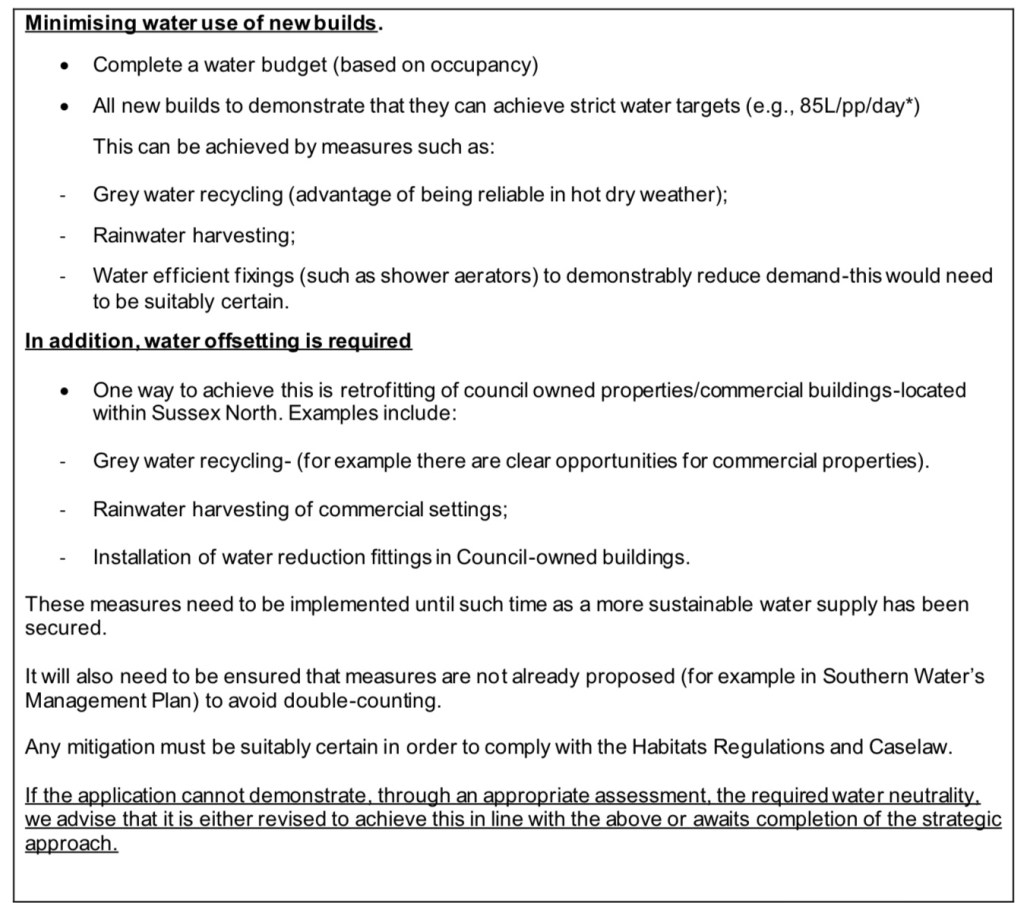
But those involved with development in Horsham, Crawley and Chichester, which fall within the Sussex North Water Supply Zone, are all now faced with an even more challenging issue: the potential need to demonstrate water neutrality. Natural England has become increasingly concerned as to the impact of groundwater abstraction on the Arun Valley SPA, SAC and Ramsar site. It has recently published its Position Statement for Applications within the Sussex North Water Supply Zone – interim approach (September 2021):

Natural England has advised that this matter should be resolved in partnership through Local Plans across the affected authorities, where policy and assessment can be agreed and secured to ensure water use is offset for all new developments within Sussex North. To achieve this Natural England is working in partnership with all the relevant authorities to secure water neutrality collectively through a water neutrality strategy.

Whilst the strategy is evolving, Natural England advises that decisions on planning applications should await its completion. However, if there are applications which a planning authority deems critical to proceed in the absence of the strategy, then Natural England advises that any application needs to demonstrate water neutrality. We have provided the following agreed interim approach for demonstrating water neutrality:

The relevant authorities are now advising applicants accordingly. Crawley Borough Council’s website for instance now says this:

Developers / planning applicants who can demonstrate water neutrality such as having significant water efficiency measures built into their development and by providing offsetting measures to reduce water consumption from existing development, and who are able to enter into legal obligations to secure these measures, would be able to proceed, subject to the planning process. The onus is on developers and planning applicants to demonstrate that they can deliver water neutrality for their proposals. For applications in these circumstances which are not able to do this, the Local Planning Authority [the council] when determining a decision, would unfortunately have no choice but to refuse them, as a matter of law, in light of the Natural England Statement.

The Local Planning Authority [the council] has written urgently to agents of affected applicants advising them of Natural England’s position and advising them that, for the time being, all applications where a positive decision / recommendation was / is to be made on an application will have to be delayed if they are within the Southern Water supply zone, until the matter of water neutrality can be addressed.”

Without speedy solutions, this is going to create real problems both for individual developers in the area and for authorities in bringing forward deliverable local plans.

No doubt there will be solutions in due course (and questions do have to be asked as to whether the issue really lies with the water abstraction licences, which presumably were the subject of appropriate assessment under the 2017 Regulations and their statutory predecessors, rather than with those who are seeking to have access the abstraction of which has already been licensed!) but how long will that take and at whose cost?

In the meantime, what an unplanned mess.

Simon Ricketts, 9 October 2021

Personal views, et cetera

Talking of Planning Law Unplanned…our clubhouse session will tackle this subject in more detail with practical, authoritative, input from special guests including Peter Home (mentioned above), Tim Goodwin, Charlie Banner QC, Richard Turney and others. Do join us at 6 pm on Tuesday 12 October. Link to app here.

Ecology By Numbers: Biodiversity Net Gain In The Environment Bill

We’re probably all increasingly familiar with the basic principles of biodiversity net gain. Even ahead of the statutory system being introduced which is the focus of this post, there is a growing policy basis for authorities to use at least a basic version of what is set out in the Environment Bill (although without any formal national prescription yet as to, for instance, the extent of net gain required or national process for the purchasing of credits).

The Environment Bill is reaching its final stages – report stage in the House of Lords is on 13 October 2021 and it then finally returns to the Commons (subject to the possibility of there then being some ping ponging between the Houses in relation to the Lords amendments I referred to in my 17 September 2021 blog post On Reshuffle Day, In Another Part Of The Forest) before receiving Royal Assent.

DEFRA indicated back in 2019 that once the Bill is enacted there will be a two year transitional period before the provisions on biodiversity net gain come into effect, but in that period there is going to be a lot of important stuff happening (and with the delays to the Bill whilst progress has been made on other aspects of the system might there be a prospect of that two years being abbreviated?). The robustness, and workability, of the system depends on:

⁃ sensible and efficient, but water-tight, administrative processes being set out in secondary legislation by way of regulations, for instance in relation to the pricing, availability and use of biodiversity credits

⁃ the availability of good data and methodologies (in relation to which Natural England has made good progress)

⁃ standardised, arrangements for securing long term (30 years plus) management arrangements by way of conservation covenants (not covered in this post but another crucial element of the Bill) and, our old friend, section 106 agreements

⁃ a workable system of monitoring and enforcement.

Before I briefly summarise the provisions on BNG in the Bill, given that the BNG system is going to live on for some time on a purely policy basis, I thought it was worth setting out that policy basis.

First of all there are relatively general references in the NPPF (extracts below showing amendments from the 2019 version).

There is more useful detail in the “net gain” passages within the natural environment section of the Government’s planning practice guidance.

Local authorities are under a general duty under Section 40 of the Natural Environment and Rural Communities Act 2006 to have regard, in the exercise of their functions, to the purpose of conserving biodiversity, but the level to which they can prescribe particular approaches to BNG and the level of net gain required depends on whether they have policies in place addressing these matters – with the weight to be attached to the policy depending on the nature of the document.

Pre-legislation we already of course have Natural England’s biodiversity metric 3.0 to work from, with much accompanying guidance, including guidance on using the calculation tool.

Turning to the Bill itself, the provisions on biodiversity net gain comprise clauses 99 to 104 and schedules 14 and 15

In brief:

Standard condition on planning permissions

Clause 99 introduces schedule 14, the effect of which I briefly summarise as follows:

• “The biodiversity gain objective is met in relation to development for which planning permission is granted if the biodiversity value attributable to the development exceeds the pre-development biodiversity value of the onsite habitat by at least the relevant percentage” which is 10% or such other percentage as is set out in regulations.

• The biodiversity value attributable to a development is “the post-development biodiversity value of the onsite habitat, (b) the biodiversity value, in relation to the development, of any registered offsite biodiversity gain allocated to the development”, and (c) the biodiversity value of any biodiversity credits purchased for the development”.

• The biodiversity metric is a document for measuring biodiversity value and it is to be published and updated from time to time by the Secretary of State.

• Pre-development biodiversity value for the site is measured as at the date of an application for planning permission (or the applicant and local planning authority may agree an earlier date). If activities are carried out on the land on or after 30 January 2020 without planning permission which reduce the biodiversity value of the onsite habitat, the biodiversity value is to be taken to be that which was the case immediately before those activities (a measure to avoid land owners intentionally reducing the pre-development biodiversity value).

• Post-development biodiversity value is “the projected value of the onsite habitat as at the time the development is completed”. There must be a condition or planning obligation requiring the habitat enhancement to be maintained for at least 30 years.

• Registered offsite biodiversity gain means any habitat enhancement where there is a legal commitment to carry it out and the enhancement is recorded in the biodiversity gain site register (see below).

• “Every planning permission granted for the development of land in England shall be deemed to have been granted subject to the condition” that a biodiversity gain plan has been submitted to and approved by the relevant planning authority.

• The biodiversity gain plan must show how the biodiversity gain objective is to be met either through on site enhancement by registered offsite biodiversity gain or by purchase of biodiversity credits. Regulations will set out the procedure the planning authority is to follow in determining whether to approve a biodiversity gain plan and the factors to be taken into account. At the moment there is no prioritising as between on-site, off-site and the purchasing of credits.

• The standard condition does not apply to development approved under a development order, on Crown land or any type of development which is specified within regulations as exempted.

• Regulations may modify or exclude these provisions for “irreplaceable habitat” and “must make provision requiring, in relation to any such development, the making of arrangements for the purpose of minimising the adverse effect of the development on the biodiversity of the onsite habitat”.

• There will be provisions in regulations to deal with the outline planning permissions, retrospective planning permissions and so on.

NSIPs

Clause 100 introduces schedule 15, which sets out how BNG works with in relation to nationally significant infrastructure projects, and the effect of which I briefly summarise as follows:

• If there is a national policy statement covering the type of development, it will be down to whether the national policy statement contains a biodiversity gain statement, in which case the biodiversity gain objective contained in the statement must be met.

• If there is no national policy statement covering the type of development, it will be down to whether the Secretary of State has made a biodiversity gain statement for that type of development, in which case the biodiversity gain objective contained in the statement must be met.

Biodiversity gain register

Clause 101 enables the Secretary of State to make regulations providing for a register of biodiversity gain sites – land which is legally required by conservation covenant (a binding mechanism provided for elsewhere in the Bill) or planning obligation to be maintained for habitat enhancement for at least 30 years and the “enhancement is made available to be allocated (conditionally or unconditionally, and whether for consideration or otherwise) in accordance with the terms of the covenant or obligation to one or more developments for which planning permission is granted”. The regulations will provide for the register to be open to the public, who should maintain it (the Secretary of State, Natural England “or any other person”), the information it includes and the procedure to be followed for a site to be placed on the register.

Biodiversity credits

Clause 102 allows the Secretary of State to “make arrangements under which a person who is entitled to carry out the development of any land may purchase a credit from the Secretary of State for the purpose of meeting the biodiversity gain objective”, including the biodiversity value of a credit, its pricing and procedural arrangements, including “reimbursement for credits purchased for development which is not carried out”. “In determining the amount payable under the arrangements for a credit of a given value the Secretary of State must have regard to the need to determine an amount which does not discourage the registration of land in the biodiversity gain sites register.” Payments must only be used by the Secretary of State for the carrying out of habitat enhancement works on land in England, purchasing the necessary land and operating the arrangements. He must report annually on payments received/used.

This is such a big subject and it’s only going to get bigger.

Some further reading:

Natural England’s blog post Biodiversity Net Gain – more than just a number (21 September 2021)

Explanatory notes on the Bill as it stood on 26 May 2021.

Net gain: summary of responses and government response (DEFRA, July 2019)

My 30 March 2019 blog post Biodiversity Net Gain: A Ladybird Guide.

Simon Ricketts, 2 October 2021

Personal views, et cetera

👋 For some further listening and discussion on this very subject, do join our clubhouse Planning Law Unplanned event at 6 pm on 5 September. Join the app here.

Levelling Up Is…

I’m reminded of those interminable “love is…” cartoons.

Levelling Up is…

…regenerating high streets?

… tackling obesity?

…investing in culture?

…increasing numbers of police officers?

…funding roads?

…establishing freeports?

…local devolution?

et cetera.

Maybe it would be easier to define what it isn’t?

From the ITV website today (24 September 2021): 58% of Brits don’t know what ‘levelling up’ policy is while ministers also unclear, reports find.

See also these tweets today from the Daily Telegraph’s chief political correspondent Christopher Hope (thank you for alerting me, Mike Best):

Congratulations to the 42% in the ITV poll but for the rest of us this is all no surprise. The House of Commons BEIS Committee’s 22 July 2021 report Post-pandemic economic growth: Levelling up lays it bare:

From the introduction:

“On his appointment as Prime Minister in July 2019, Rt Hon Boris Johnson MP said in a speech, on the steps of Downing Street, that he would “answer the plea of the forgotten people and the left behind towns” and “level up across Britain” by unleashing the “the productive power not just of London and the South East but of every corner of England, Scotland, Wales and Northern Ireland””.

From the summary:

Levelling up—meaning, in our view, the spreading of economic and social opportunities more evenly across the country—is laudable and should be a priority for any Government.

However, whilst recognising the understandable impact the pandemic has had on Government capacity, we are disappointed at how little detail has been put forward to explain what the Government sees levelling up to mean and how it will be delivered.”

As such, we have made several recommendations to Government, including recommendations to:

Urgently publish the Levelling Up White Paper, so that we are clear on what the Government defines levelling up to mean and what its priorities are.

Work with the Office for National Statistics, the Cities and Local Growth Unit in the Business Energy and Industrial Strategy department and the National Audit Office to agree a set of metrics for the routine reporting of progress in delivering levelling up priorities.

Establish the functioning of a Cabinet Committee on levelling up, that collaborates with devolved, regional, and local leaders.

Recognise that inequalities exist across the whole of the UK, including within cities, and that levelling up priorities should therefore not be focussed on only some regions or sub-regions of the UK.

Ensure that each region in England has the capacity to competitively bid for Government funding, given that some areas in England have a greater capacity to engage with Whitehall than other areas.

The levelling up agenda has been described by the Government as its ‘most important mission’. It is now imperative for Ministers to translate this from a political promise into a deliverable programme for Government. The forthcoming Levelling Up White Paper, which we understand will now include the previously announced Devolution White Paper, gives the Government the opportunity to be bold and progressive. We look forward to its publication and, in future, engagement with Ministers on their delivery of levelling up.

From the main part of the report:

“Giles Wilkes, former industrial and economic special adviser to former Prime Minister Rt Hon Theresa May MP, noted that the Government’s use of the phrase levelling up was so widespread that it had become nothing more than a generic term for “make things better”. Rafael Behr of the Guardian referred to levelling up as a “rhetorical zeppelin”, which was “floating on the political horizon, carrying no cargo of policy”.

“The current available documents on the policy instruments the Government aims to use to level up—the Conservative Party Manifesto, its submission to this inquiry and the 2021 Queen’s Speech—show a wide ranging and disjointed programme of random policies from an obesity strategy, an increase in police officers, to funding on A roads and the creation of Freeports. Although these policies are all very interesting and welcome, it is difficult to see how they all tie together under one over-arching strategy. The cohesion of the whole has not been well described to identify how these fit together. If the Government is serious about levelling up and for it to be a substantive strategy rather than merely a slogan, it must spell out a coherent ‘plan’ as a matter of urgency”

Is this unfair? Possibly not. Motherhood is good and it’s clear from the Conservative 2019 manifesto that levelling up is good:

“Our plan means making sure people have access to world-class public services, that they feel safe on the streets, that working families get to keep more of their own money, and that we help with cost of living pressures.

But it also means making sure that we share prosperity across the country, addressing the longstanding economic challenges in parts of the country. We will invest responsibly and prudently in the infrastructure that can make a difference, and ensure communities in every corner of the United Kingdom are pleasant, safe and prosperous. And we will invest far more in helping workers train and retrain for the jobs and industries of the future. Investing in people, restoring the fabric of our towns and cities, building the homes we need, supporting science and industry, strengthening the great Union between the United Kingdom’s four nations – that is how we will unleash our country’s full potential.”

“…in his first months as Prime Minister, Boris Johnson has set out an agenda for levelling up every part of the UK – not just investing in our great towns and cities, as well as rural and coastal areas, but giving them far more control of how that investment is made. In the 21st century, we need to get away from the idea that ‘Whitehall knows best’ and that all growth must inevitably start in London. Because we as Conservatives believe you can and must trust people and communities to make the decisions that are right for them.

There is of course the £4.8 billion Levelling Up Fund, announced as part of the 2020 Spending Review. As set out in the March 2021 Levelling Up Fund Prospectus:

The Fund will focus on capital investment in local infrastructure thereby building on and consolidating prior programmes such as the Local Growth Fund and Towns Fund. It will have a visible, tangible impact on people and places, and support economic recovery. In doing so, it will also create opportunity across the country, prioritising bids that invest in regeneration and growth in places in need and areas of low productivity and connectivity.

The first round of the fund is focusing on smaller transport projects; regeneration and town centre investment, and cultural investment : £4 billion for England for the next four years to 2024-2025 and at least £800,000 for Scotland, Wales and Northern Ireland. Save in Northern Ireland, funding will be delivered via local authorities. The fund is jointly managed by HMT, DLUHC and DfT.

The prospectus was published alongside a list of local authorities by priority category. There is also a June 2021 prioritisation of places methodology note. The Good Law Project secured permission from Bourne J on 19 August 2021 to take to a full hearing its judicial review of the methodology, which is reported to be based on its allegations that (according to the news piece) “the Government is using the £4.8bn fund to funnel money into regions and towns of political benefit to the Conservative Party. The not-for-profit legal group alleges that the Government is guilty of ‘pork barrel politics’. They cite, for example, the fact that 22 of 26 places that received funds from the Towns Fund are represented by Conservative MPs.”

I won’t comment on that allegation but do note that there is an unusual bidding criterion for local authorities, which gives MPs an important role in the allocation of monies:

We expect bidding authorities to consult local Members of Parliament as part of their bid; though such support from local MPs is not a necessary condition for a successful bid. MPs can have a positive role in prioritising bids and helping broker local consensus. When considering the weighting given to bids, the expectation is that an MP will back one bid which they see as a priority, and any bid may have priority backing from multiple MPs and local stakeholders. But Members of Parliament may also want to support any or all schemes that would have a benefit to their constituencies in the usual way.

The levelling up agenda is currently a potent political theme for Conservative MPs, 40 of whom formed a “Levelling Up Taskforce” in September 2020, the launch of which was marked by the publication by Onward of a report by MP Neil O’Brien, Measuring up for levelling up.

Neil O’Brien was subsequently appointed in May 2021 by the prime minister as Levelling Up Adviser. The announcement was made within a 4 May 2021 government press statement which referred to a “landmark” levelling up white paper “later this year, articulating how bold new policy interventions will improve opportunity and boost livelihoods across the country as we recover from the pandemic.” “The White Paper – which will be led by the Prime Minister – will focus on challenges including improving living standards, growing the private sector and increasing and spreading opportunity.” This white paper of course will partly be a rebadged version of the white paper which was originally promised for publication last year on “devolution and local recovery”. As of the date of the press statement, a “new No10 – Cabinet Office Unit [was to] be set up to drive through work on the White Paper.”

I am not sure how much “driving through” has since taken place but Neil O’Brien of course has been now appointed as a minister within the new Department for Levelling Up, Housing and Communities. In the Government’s 19 September 2021 press statement announcing the name of the new Department (massively symbolic in itself) and make-up of its ministerial team it was stated that former Bank of England chief economist (and incoming chief executive of the RSA) Andy Haldane has been appointed as a permanent secretary in the Cabinet Office for six months to “head up the Levelling Up Taskforce that will report jointly to the Prime Minister and the Secretary of State for Levelling Up, Housing and Communities.

“The Prime Minister, Boris Johnson MP, said:

This government is committed to uniting and levelling up every part of the UK and I am determined that as we build back better from the pandemic we are geared up with the teams and expertise to deliver on that promise.

Andy is uniquely qualified to lead our efforts to raise living standards, spread opportunity, improve our public services and restore people’s sense of pride in their communities. I look forward to working with him, and with my new ministerial team, to deliver the opportunities this country needs.”

Andy Haldane is a serious individual and it is a significant appointment, if only for a short period of time – blink and it’s gone.

I’m sure I’m not the only person utterly frustrated that the main engine of government in our specialist area of interest is now named, for party political reasons, after such an amorphous concept. I’m still not clear as to what levelling up is (or, rather, what it isn’t) but I sense that for the Government it is at the very heart of its political agenda in a way that will define its priorities in terms of housing and economic growth (and therefore its thinking in relation to reform of the planning system). I’m sorry to reduce it to this because the aspirations are, as the BEIS Committee said, laudable but… is it about any less than “making things better” in such a general sense as to be meaningless, or about any more than focusing on issues are relevant to voters in marginal seats in such tactical ways as have no strategic coherence?

Insights very welcome.

Simon Ricketts, 24 September 2021

Personal views, et cetera

For our Planning Law Unplanned clubhouse event at 6pm on Tuesday 28 September, we are picking up on a comment made by DLUHC minister Eddie Hughes this week that there would be a “full review” of the NPPF. Our theme is NPPF “full review”: what to expect in reality/your dreams? and our special guests will include Steve Quartermain, Nicola Gooch and Mike Best as well as our usual stellar panel. Link to app here.

On Reshuffle Day, In Another Part Of The Forest

If a tree falls in a forest and no one is around to hear it, does it make a sound?

Maybe the biggest news this week wasn’t the replacement of Robert Jenrick by Michael Gove as Secretary of State for Housing, Communities and Local Government and the consequent likely pause of the still-paused-anyway planning law reforms.

Maybe it was the difficulties which the Government is having with its Environment Bill (original progenitor one M Gove). Aspirations of enactment by the time of November’s COP26 are surely fading fast in the light of a series of defeats for the Government at the report stage of the Bill in the House of Lords. On Monday (13 September 2021) it was already being reported in a Green Alliance blog post, on the back of a Daily Telegraph story, that the Government was reluctant to accept the amendments which had been passed which could ultimately lead to the Bill entering into a period of ping pong (less fun than it sounds) between the Lords and Commons.

The amendments at that stage were reported in this piece: Environment Bill: The 10 government defeats in the Lords (ENDS Report, 14 September 2021). They include:

– making interim targets for nature, air, water and waste legally binding;

– requiring the Government to make a formal declaration of a biodiversity and climate emergency;

– a more ambitious approach to targets in air pollution;

– making soil health a priority;

– removing exemptions for the Treasury and Ministry of Defence from taking into account environmental principles in policy making.

However, on the day of the reshuffle, 15 September 2021 the Lords continued its scrutiny of the Bill and inflicted a further four defeats by way of voting for amendments which in various ways seek to introduce greater environmental protections. Two of the issues are intertwined with matters to do with planning and development and I thought I would give them a bit of airtime – after all, these days can you be a planning lawyer without being an environmental lawyer? And surely DEFRA and MHCLG are going to have to work with each other in ever closer ways.

Habitats Regulations: limits on powers to amend

Baroness Young, chair of the Woodland Trust and former chief executive of the Environment Agency, moved an amendment to ensure “that powers to amend the Habitats Regulations may only be used for the purposes of environmental improvement following consultation. It ensures that the level of environmental protection that must be maintained includes protection for important habitats, sites and species as well as overall environmental protection

It was passed 201 to 186.

The amendment provides that the Secretary of State may only amend the regulations

for the purposes of—

(a) securing compliance with an international environmental obligation, or

(b) contributing to the favourable conservation status of species or habitats or the favourable condition of protected sites;

(c) if the regulations do not reduce the level of protection provided by the Habitats Regulations, including protection for protected species, habitats or sites; and

(i) following public consultation and consultation with—

(ii) the Office for Environmental Protection,

(iii) Natural England,

(iv) the Joint Nature Conservation Committee, and

(v) other relevant expert bodies.”

Duty to implement an enhanced protection standard for ancient woodland in England

Baroness Young moved an amendment “intended to address the more than 800 ancient woodlands in England that are currently threatened by development. As a large number of these threats result from indirect effects of development next to ancient woodland, these changes will improve the weight afforded to protecting these irreplaceable habitats in planning policy.”

It was passed 193 to 189.

The amendment introduces the following additional clause into the Bill:

(1) The Government must implement an enhanced protection standard for ancient woodland, hereafter referred to as the “ancient woodland standard” in England as set out in subsections (2), (3) and (4) and this must have immediate effect.

(2) The ancient woodland standard must set out the steps necessary to prevent further loss of ancient woodland in England.

(3) The ancient woodland standard commits the Government to adopting a Standard of protection which must be a requirement for all companies, persons or organisations involved in developments affecting ancient woodlands in England.

(4) This standard must be that—

(a) any development that causes direct loss to ancient woodland or ancient woodland and ancient and veteran trees must be refused unless there are wholly exceptional reasons and, in addition, a suitable compensation strategy must be in place prior to development commencing,

(b) any development adjacent to ancient woodland must incorporate a minimum 50-metre buffer to provide protection, reduce indirect damage and provide space for natural regeneration,

(c) any ancient or veteran trees must be retained within a development site, including a root protection area and appropriate buffer zone.

(5) This buffer zone must be whichever is greater of—

(a) an area which is a radius of 15 times the diameter of the tree with no cap, or

(b) 5 metres beyond the crown.”

The debate is here and Parliament’s summary of the House of Lords report stage is here.

(Incidentally, Ruth Keating (39 Essex Chambers) gave a very clear summary of the Environment Bill at today’s (virtual) Joint Planning Law Conference. Watch out for the paper in due course.)

As a further indication of how environmental matters are going to take centre stage in coming months, Duncan Field brought to my attention yesterday that Lord Frost made a statement to the House of Lords (16 September 2021) as to the Government’s approach in relation to various areas of retained EU law. A supporting paper, Brexit opportunities: regulatory reforms contains references which may be of interest to those in the planning and environmental areas:

Environmental Licencing [sic] and Permitting – Defra is continuing to rationalise the existing Environmental licensing and permitting (ELP) regimes so they are more streamlined and easier for businesses and users to navigate, whilst maintaining and even enhancing environmental protections.

Promote a flexible, market-based trading system for biodiversity offset credits – Biodiversity Net Gain (BNG) is a critical part of Defra’s strategy for enhancing the natural environment and promoting sustainable growth. Defra will shortly be publishing a consultation on our plans for implementing BNG. This consultation will include proposals for a market-based approach to delivery of biodiversity offset units.

That latter is interesting in the context of the biodiversity net gain provisions within the Environment Bill, which do not currently refer explicitly to any notion of a structured “market-based trading system for biodiversity offset credits”.

Keep your ears open is all I’m saying…

Simon Ricketts, 17 September 2021

Personal views, et cetera

And on the theme of ears, do join our clubhouse Planning Law Unplanned event at 6pm this Tuesday 21 September 2021, whether to listen or participate. We will be returning to the big news story and associated question – “ALL SYSTEMS GOVE! What to expect from our new Secretary of State?”. We have a planoply of leading commentators lined up to give their views including Catriona Riddell, Matthew Spry, Zack Simons, Wyn Evans and Nick Cuff as well as our usual planel. Link to app here.

Photograph by Michael Aleo courtesy of unsplash

Thanks to my colleague Stephanie Bruce-Smith for some background research. All errors mine.