AA PA CAB

There was a customarily short and clear judgment from Holgate J this week as to how decision makers should approach applications for prior approval for the upward extension of buildings under the General Permitted Development Order: CAB Housing Limited v Secretary of State (3 February 2022)

So I’m saying nothing, you will be pleased to hear, about the 2 February 2022 Levelling Up white paper There are plenty of summaries available – and you do need a summary! Or listen to the Planning Law Unplanned clubhouse event we held, featuring Catriona Riddell (linkedin piece here), Iain Thomson (linkedin piece here) and Victoria Hutton (linkedin piece here).

Nor anything about mythical Bob, the Government’s 31 January 2022 Benefits of Brexit paper, which seemed to have little new to say in terms of the subject matter of this blog.

Nor anything about the energy price cap – although that does give additional topicality to our our next Planning Law Unplanned clubhouse event plugged at the end of this post.

Nor anything about the continuing NIMBY vs YIMBY noise that I got drawn into on twitter this week – although there is at least some link between Holgate J’s judgment & all that: someone came out with the usual trope that a planning system with a large discretionary element to decision making is “good for the lawyers”. I didn’t respond, but thought to myself that a less discretionary system, whether based on zoning or permitted development rights, is of course even better for the lawyers – because it all becomes about where the legal boundary lines are.

When Parliament amended the General Permitted Development Order to allow upwards extensions, subject to defined criteria and limitations together with the need to seek prior approval for certain aspects of the proposals, the description of the matters in relation to which prior approval is required was far too vague. What do matters such as “impact on amenity” and “external appearance” actually mean? Do you take as a given the right to extend up to two storeys upwards and in that context consider external appearance, akin to considering reserved matters with the equivalent of outline planning permission already having been granted for the two storeys, or can issues of principle as to the acceptability of that upwards extension be considered, as long as they relate to amenity or external appearance,? Obviously this is a particularly critical question where the local planning authority may be resistant in principle to upwards extensions – these new rights trumpeted by the Government become rather less meaningful.

The Cab Housing case related to three appeal decisions where the relevant inspector had dismissed appeals in relation to proposals under Class AA of Part 1 of the GPDO (upwards extensions to detatched houses).

Over to Holgate J to explain:

These challenges raise important issues regarding the true interpretation of Class AA of Part 1. First, are the claimants correct in saying that a planning authority’s control of impact on amenity limited to effects on properties contiguous with, or abutting, the subject property and are those effects limited to overlooking, privacy and loss of light? Alternatively, does that control embrace impact upon all aspects of the amenity of neighbouring premises, as the Secretary of State contends? Second, is the authority’s control of the external appearance of the subject dwelling limited to the “design and architectural features” of its principal elevation and any side elevation fronting a highway, and is it further limited to the effects of those matters upon the subject dwelling itself? The claimants contend for that interpretation and they say that the authority is not allowed to consider the effects of external appearance upon any property outside the subject dwelling. Alternatively, is the correct interpretation, as the Secretary of State contends, that the control covers (1) all aspects of the external appearance of the proposed development, and not simply the two elevations specifically referred to in AA.2(3)(a)(ii)) and (2) impact upon other premises, and not simply the subject dwelling itself?

In the decisions challenged in these proceedings, the Inspectors took the broader approach in relation to external appearance and, in two cases, to amenity. It is common ground that if the claimants’ construction of the GPDO 2015 is correct, then each of the decisions must be quashed as ultra vires. The decisions would have been taken outside the ambit of the powers exercisable by the Inspector. But, if the defendant’s interpretation is correct, then it is also common ground that each of the three Inspectors reached decisions which fell within their powers, their decisions are not otherwise open to legal challenge and the applications for statutory review must be dismissed.

The claimants point out that other Inspectors have taken a different view upon the scope of the controls exercisable in the determination of an application for prior approval under Class AA of Part 1. It has been said that the decision-maker is not allowed to assess the impact of the external appearance of a proposed addition of 1 or 2 storeys on any area outside the subject building, for example, the streetscape. It has also been said that the principle of an upwards extension of up to 2 storeys is “established” by the permitted development right itself, so that the decision on the application for prior approval should not frustrate, or resile from, that principle. Such statements have even been made in relation to other permitted development rights where the GPDO 2015 requires “external appearance” to be controlled, without going on to refer to specific elevations (see e.g. the decision letter dated 6 July 2021 on Kings Gate, 111, The Drive, Hove). If the Secretary of State’s interpretation of the GPDO 2015 is correct, then all these decisions were potentially liable to be quashed on an application under s.288 brought within time. Plainly there are differences of interpretation which need to be resolved. There is also the question: to what extent is it correct to say that the principle of development is established where a permitted development right is subject to prior approval?

The issues in this case also affect the proper construction and ambit of permitted development rights granted by GPDO 2015 under Classes ZA, A, AA, AB, AC and AD of Part 20. These provide for up to two storeys of multiple units of residential units to be erected on top of an existing purpose-built block of flats, or on top of detached or terraced buildings in commercial or mixed use or residential use.

The claimants’ narrower approach to the legal scope of prior approval in these Classes also has implications for non-residential permitted development rights. For example, the right to erect or extend an agricultural building under Class A of Part 6 of Schedule 2 to the GDPO 2015 is potentially subject to control by prior approval in respect of the “external appearance” of the building proposed. If, as some decision-makers have said, that control is limited to assessing the effects of that appearance on the building itself, then it would follow, for example, that the effects of that external appearance on the setting of a listed building nearby could not be controlled. Can this really be right?”

His conclusion was that this was not right:

“(i) Where an application is made for prior approval under Class AA of Part 1 of Schedule 2 to the GPDO 2015, the scale of the development proposed can be controlled within the ambit of paragraph AA.2(3)(a);


(ii) In paragraph AA.2(3)(a)(i) of Part 1, “impact on amenity” is not limited to overlooking, privacy or loss of light. It means what it says;


(iii) The phrase “adjoining premises” in that paragraph includes neighbouring premises and is not limited to premises contiguous with the subject property;


(iv) In paragraph AA.2(3)(a)(ii) of Part 1, the “external appearance” of the dwelling house is not limited to its principal elevation and any side elevation fronting a highway, or to the design and architectural features of those elevations;


(v) Instead, the prior approval controls for Class AA of Part 1 include the “external appearance” of the dwelling house;


(vi) The control of the external appearance of the dwelling house is not limited to impact on the subject property itself, but also includes impact on neighbouring premises and the locality.”

The judge seeks to downplay the significance of these conclusions:

The decision of each Inspector was entirely lawful. That is as far as the Court’s function permits this judgment to go. Individual decision-makers will make their own planning judgments applying the prior approval controls, correctly interpreted, to the materials before them. This judgment does not mean that individual decision-makers would be bound to determine the appeals on the three properties the subject of these proceedings in the way that in fact occurred. That is always a matter of judgment for the person or authority taking the decision. I would also add that there is no evidence before the Court to show that the correct interpretation of Class AA of Part 1, along with the related Classes in Part 20, will in practice make it impossible or difficult for developers to rely upon these permitted development rights.

As it is, given their inherent restrictions and limitations, these new GPDO rights have not yet delivered substantially more homes. Holgate J is of course right that his interpretation will not make it impossible for developers to rely on them – but surely it will make it more difficult in many cases. Despite the analysis in the judgment as to what was said in consultation documents in relation to the new rights, I’m left wondering whether the Government appreciated what confusion these changes would cause and, ultimately, their potentially limited advantages over an application for full planning permission?

As trailed earlier, this week’s Planning Law Unplanned clubhouse event will be all about reducing energy use and increasing renewables, with a sparky collection of guests I assure you… 6 pm, Tuesday 8 February 2022, link to app and event here.

Simon Ricketts, 5 February 2022

Personal views, et cetera

Extract from Genesis, Abacab

Planning Appeal Timescales: Better Faster (But Harder?)!

I tried DLUHC in wordle but the app didn’t accept it.

Never mind – there was one significant announcement from the Department this week which I thought would cause more of a stir than it did, an announcement which could be really positive news for all of us who have been anxious for a long time that one of the operational failings of the current planning system is how long appeals take, such that in many instances, no matter how difficult it may be to make progress with the local planning authority, appeal is not a practical remedy (and perversely the delays are currently worse for smaller schemes than for schemes where any appeal is likely to be determined by way of inquiry).

The Department has now announced by way of a letter from housing minister Christopher Pincher to Sarah Richards, chief executive of the Planning Inspectorate dated 20 January 2022 (but published on 26 January 2022) that:

As an initial milestone in making more consistent, timely decisions The Planning Inspectorate should be working towards consistently achieving decisions in these ranges:

· Appeals decided entirely using writing evidence in 16 – 20 weeks

· Appeals decided including at least some evidence through hearing or inquiry 24 – 26 weeks (30 weeks to recommendation for called in or recovered cases)”

These targets for written representations appeals and hearings are new.

Detailed measures are set out for:

• The proportion of appeals which are valid on first submission

• How long appeal decisions take from valid receipt to decision

• Customer satisfaction.

These measures apply regardless of the legislative basis for the appeal, for example whether it is in relation to enforcement or resulting from the refusal of a planning application.

These targets and measures should make a real difference.

But there is a much more radical coda to the letter:

“As you know, the Government is also committed to improving and modernising the planning system. The work you are undertaking to develop twenty-first century digital public services is an important part of this. I would welcome you complementing that by identifying what steps might be necessary to achieve a further significant consistent improvement in appeal timescales beyond those above so that most appeals could be consistently decided in 4 – 8 weeks, or faster, whilst maintaining good standards of decision. Consideration can then be given to whether these steps might be appropriate.”

Yes, you read that correctly – an aspirations that “most appeals could be consistently decided in 4 – 8 weeks, or faster”. PINS director operations Graham Stallwood spoke at a Clubhouse session last week about what steps PINS is taking towards digitalising its processes (a replay of the whole event is here and Graham’s comments are from 53 minutes in). It will be interesting to see what further changes will be recommended to procedures to achieve anything like those timescales.

The Planning Inspectorate’s response dated 27 January 2022 welcomes the new measures. PINS will “start reporting on them to ministers and customers straight away as part of our monthly statistical release and performance updates.”

There is this statement from Sarah Richards:

“I welcome the minister’s request to report to him on what would be necessary to support a further significant improvement in appeals. This recognises the importance of a fair appeal system to the nation’s economy and is an important opportunity to reflect on how the appeal system can be reframed to operate sustainably for the future. We will engage with key stakeholders on this in due course before we report to the minister.”

My understanding is that PINS is likely to be starting that process this Spring. There will be no Bridget Rosewell overseeing it all this time round. No doubt it will in part be an equivalent series of pragmatic incremental gains in terms of efficiencies and timescales but I would have thought that some statutory timescales set out within secondary legislation may need to be revisited. And let’s not be under any illusion: “4-8 weeks appeal timescales” are going to need significant changes in terms of processes but also behaviour:

• (As discussed by Graham at the Clubhouse event) how can we get to a position where on appeal a link can simply be provided to the documents on the LPA’s planning portal rather than starting a wholly new paper chase, and appeal submission can be pass/fail in terms of submission of the correct documents, as if you were applying for a passport?

• What fresh evidence should be allowed to be submitted at the appeal stage (and what does this mean in practice for those preparing their applications – at application stage your documents will need to be forensically prepared so as to be “appeal ready”)?

• What should decision letters look like?

• How do we avoid unintended consequences given that on these timescales, it will usually be quicker to appeal as soon as you can rather than engage in protracted negotiations with the LPA – and so will the appeal system very quickly get clogged up?

• Will any necessary trade-offs as between on the one hand an element of procedural flexibility and on the other hand speed prove counter-productive for prospective appellants? Is there a point at which appeals become too quick? And what resources will be required on the part of LPAs and third parties to be able to participate effectively?

• Not mentioned, but are we going to see appeal fees introduced, at least for some types of appeal?

This is all a long way from the current performance statistics (20 January 2022):

We will be talking about all of this at our Clubhouse session at 6 pm on Tuesday 1 February. At this session we don’t have any special guests because we want to hear from you. Your current experiences of the system, good and bad, and what you think of these proposals. Whether you are a planning consultant, local authority planner, community group representative, advocate or developer, what do you think? Link to app here.

Simon Ricketts, 28 January 2022

Personal views, et cetera

PS I know there have been distractions around those parts recently but it is still startling to see a ministerial letter with a phrase such as “until such time as me or my successors agree new measures”. Yuck. (Or should that be YUHC?).

Courtesy Daft Punk

“Planning Powers” A Pawn In Unsafe Cladding Negotiation

It’s a scandal that leaseholders, through no fault of their own, have been exposed to potentially massive liabilities in relation to building defects for which obviously they were in no way responsible.

Isn’t it obvious that where buildings have been constructed unsafely, in breach of legal standards at the time, then those responsible for that work should be liable (with speedy resolution of that issue and gap funding for works in the interim), but that where the work was done to legal standards at the time we as taxpayers should pick up that burden?

In terms of arriving at a solution, has Michael Gove’s 10 January “developers must pay” announcement made things worse or will it prove to be a turning point?

We’re all guilty of swimming along in our separate lanes. I’m a planning lawyer, not a construction lawyer, property litigator or tax lawyer. But I wanted to understand the basics of what exactly is happening here, particularly since the Secretary of State was reported as threatening to use the planning system to make life more difficult for developers if they don’t agree a “fully funded plan of action”.

Since February 2021, we have known that the Residential Property Developer Tax will apply from 1 April 2022 in relation to residential property development recognised in accounting periods ending on or after that date. It will apply to companies or groups of companies undertaking UK residential property development with annual profits in excess of £25 million and is a new 4% tax on profits they make on UK residential property development. As set out in HMRC’s 27 October 2021 policy paper, “the tax forms part of the government’s Building Safety Package aiming to bring an end to unsafe cladding, provide reassurance to homeowners and support confidence in the housing market. Given the significant costs associated with the removal of unsafe cladding, the government believes it is right to seek a fair contribution from the largest developers in the residential property development sector to help fund it.” The Government’s aim is to raise £2bn of revenue over a ten year period.

We have also known that the Building Safety Bill is currently going through the House of Lords. Clause 57 of the Bill would enable the Secretary of State to impose a building safety levy “for the purpose of meeting any building safety expenditure”. As explained in a November 2021 DLUHC building safety levy factsheet:

“This is a new levy on developers. In addition to the new Residential Property Developer Tax (which will tax the profits of larger developers for at least 10 years), the levy will contribute towards fixing historical fire safety defects, including unsafe cladding.

We will establish three regulatory “Gateways” at key stages in design and construction, and introduce new requirements during construction, that will apply to higher-risk buildings:

· Planning Gateway one – at the planning application stage

· Gateway two – before building work starts

· Gateway three – when building work is completed

These are stop/go decision points that must be passed before a development can proceed to the next stage, strengthening regulatory oversight of design and construction. At Gateway two, construction cannot begin until the Building Safety Regulator approves the building control application.

There will be sanctions for failure to pay the levy which will be defined in regulations. This will result in the Gateway two application not being approved by the Building Safety Regulator.”

The levy will apply to developments within scope of the Gateway 2 regulatory process, unless otherwise excluded. That means residential buildings or care homes over 18m or 7 storeys – but subject to exclusions, which we are consulting on.”

Consultation has been carried out as to the design of the levy but we have been waiting for the Government’s response and the quantum of the levy has not yet been determined.

The Secretary of State has been faced with the dilemma of how to relieve leaseholders from their unjustified burden at as little cost to the public purse as possible, presumably recognising that the building safety levy is not going to be able to achieve anything like what is needed .

It was revealed via a 7 January 2022 tweet from the BBC’s Lewis Goodall that Michael Gove had sought clearance from the Treasury “to make a statement resetting the Government’s approach to building safety ahead of Commons Report Stage of the Building Safety Bill”.

The tweet included a screenshot of the response from HM Treasury which authorises DLUHC to seek to secure £4bn funding from developers:

You may use a high-level “threat” of tax or legal solutions in discussions with developers as a means of obtaining voluntary contributions from them.”

“…the taxpayer should not be on the hook for further costs of remediation”.

DLUHC budgets are a backstop for funding these proposals (in full i.e. the £4bn if required) should sufficient funds not be raised from industry. You must prioritise building safety oversupply”.

Lenders and insurers are not included in the “polluter pays” piece – and no contributions should be sought from them”.

Formal announcements were then made by the Secretary of State in the form of:

• a press statement, Government forces developers to fix cladding crisis (DLUHC, 10 January 2022)

Mr Gove has today written to industry giving them a deadline of early March to agree a fully funded plan of action including remediating unsafe cladding on 11-18 metre buildings, currently estimated to be £4 billion.

He warns he will take all steps necessary to make this happen, including restricting access to government funding and future procurements, the use of planning powers and the pursuit of companies through the courts. He adds that if industry fails to take responsibility, the government will if necessary impose a solution in law.

• The “Dear Residential Property Developer Industryletter referred to in the announcement:

I am sure you are as committed as I am to fixing a broken system. I want to work with you to deliver the programme I have set out. But I must be clear, I am prepared to take all steps necessary to make this happen, including restricting access to government funding and future procurements, the use of planning powers, the pursuit of companies through the courts and – if the industry fails to take responsibility in the way that I have set out – the imposition of a solution in law if needs be.”

• A statement to the House of Commons “…we will press ahead with the building safety fund, adapting it so that it is consistent with our proportionate approach. We will now set a higher expectation that developers must fix their own buildings, and we will give leaseholders more information at every stage of the process.”

Note the references in the announcement and letter to “the use of planning powers”. Remember that reference in the Treasury letter to high-level threats?

Tory cladding shift leaves relations with UK developers in tatters (FT, 18 January 2022)

On 20 January the Secretary of State met with “senior executives from 20 building firms” but according to the Guardian:

Stuart Baseley, the executive chairman of the Home Builders Federation, said the industry lobby group had made its position clear at the meeting and would continue to engage constructively with the government. “We absolutely agree that leaseholders should not have to pay to remediate buildings. However we firmly believe that any further solutions must be proportionate.”

He said the bill should be shared with “other companies, sectors and organisations”, including “freeholders and the materials providers who designed, tested and sold materials that developers purchased in good faith”.

As we made clear to the government, we do not believe it should fall to responsible UK housebuilders to fund the remediation of buildings built by foreign companies, developers no longer trading, or other parties.”

Another piece, Others must help pay for cladding work, developers tell Gove following talks (Inside Housing, 21 January 2022) quotes Gove:

We have made a start through the residential property developer tax and the building safety levy, both announced last February, but will now go further. I will today write to developers to convene a meeting in the next few weeks, and I will report back to the House before Easter. We will give them the chance to do the right thing. I hope that they will take it. I can confirm to the House today that if they do not, we will impose a solution on them, if necessary, in law.”

In the meantime, the House of Commons Levelling Up, Housing and Communities Committee announced an inquiry into building safety funding on 19 January 2022, with this statement from chair Clive Betts:

The Secretary of State’s announcements on 10 January were a welcome step towards finally addressing the question of meeting the costs of making residential blocks safe rather than dumping the burden on flat-owners. Leaseholders should not be liable for the costs of removing hazardous cladding from their buildings nor the additional work necessary to make their flats safe.

In our new inquiry, we want to examine the effectiveness and impact of the Government’s planned measures to make developers and industry pay. We also wish to scrutinise whether the Secretary of State’s approach goes far enough to finally fix this crisis and examine what the funding arrangement to be agreed with industry should look like. We will also want to examine the risk to the Department’s budget, particularly around social housing, if it is not able to secure sufficient funds from industry.

The public evidence sessions for this inquiry are scheduled take place shortly and will conclude ahead of the Secretary of State’s planned report back to the House of Commons before Easter.”

How is all this going to play out? Who knows. If the development industry (a ridiculously loose term) doesn’t reach agreement with DLUHC, what really could we see in terms of the impacts on planning processes? Of course neither in law nor in practice could the Secretary of State discriminate in planning decision-making against any specific companies holding out from a deal but surely it will influence the priority or not that he gives to measures to increase housing supply by way of planning reform and/or his inclination or not to intervene with authorities where plan making has again stalled and surely it will influence the level at which the building safety levy is set, discriminating hugely against those bringing forward development proposals as against those companies which are responsible for past failings.

No-one should be under any illusion that these issues are easy. Is a “Dear Residential Property Developer Industry” letter accompanied by threats, in order to extract money from companies regardless of culpability, really the answer? We shall find out soon enough.

Meanwhile, this week’s clubhouse Planning Law Unplanned session is entitled “What do we mean by “digitising planning”? Possible futures”. We have five amazing guests: Euan Mills (digital planning lead, DLUHC), Graham Stallwood (director of planning, Planning Inspectorate), Mary Elkington, director, Figura Planning), Stefan Webb (place director, FutureGov) and Shelly Rouse, principal consultant, Planning Advisory Service). Join the app and event here.

Simon Ricketts, 21 January 2022

Personal views, et cetera

MAD World: Mapped Appeal Decisions

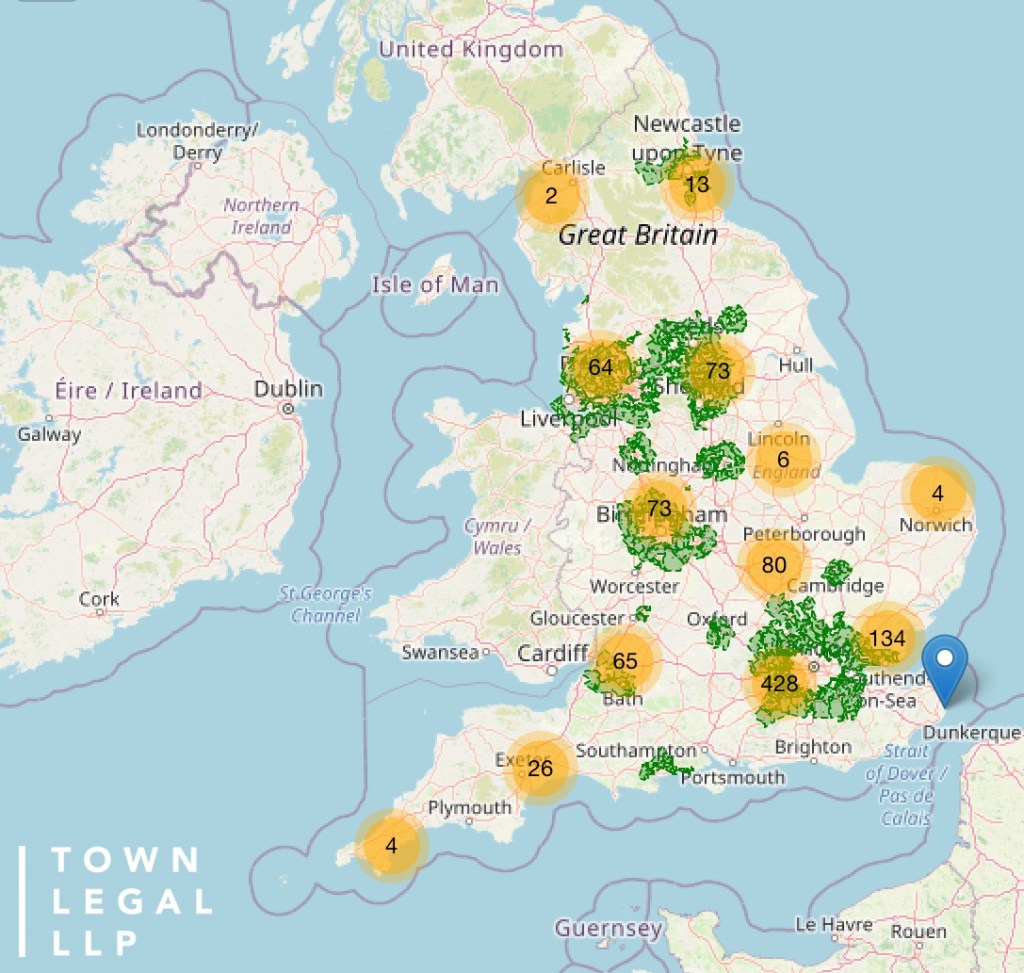
We launched Mapped Appeal Decisions today.

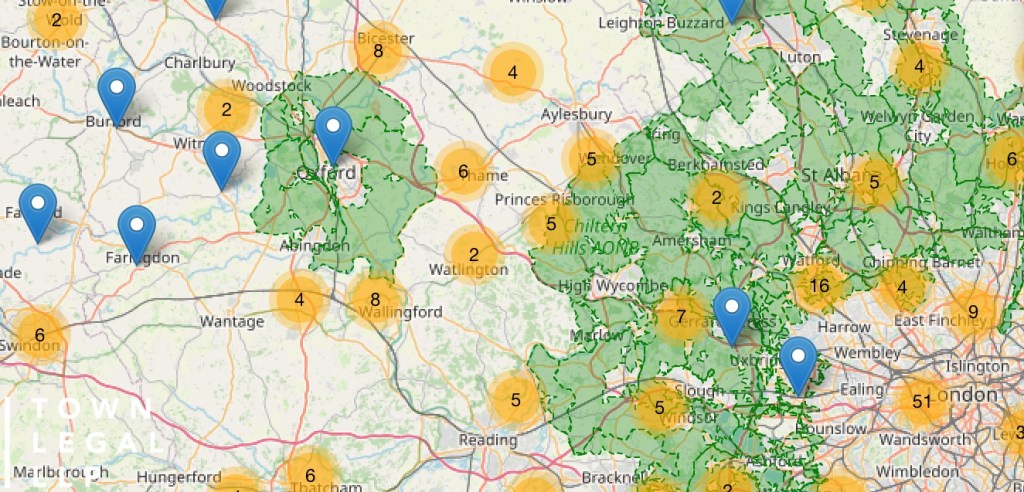
It’s a click-through interactive map that seeks to show the location of every planning appeal decision in England made between 1 January 2017 and 12 December 2021 following a public inquiry, with links to the relevant decision letter. Best viewed on a proper screen!

The data is drawn from our weekly Town Library planning appeal decisions updates over the period (free subscription still available via the link) and for all this work we at Town Legal are very grateful both to the Planning Inspectorate for the information publicly available on its website, which makes these sorts of applications possible, to OpenStreetMap for the base mapping and of course to our friends Simmons Wavelength for the legal engineering (in particular Joy Bradley for pitching the initial idea to me last year).

Any feedback would be very helpful. So far the extent of Green Belt across the country is shown on the map base but of course the possibilities are almost limitless.

Health warning: there are some decision letters where a postcode is not shown for the relevant site – they are not currently shown on the map. If you spot any other glitches do let me know.

Feel free to share the link or indeed this post with colleagues.

The only other thing I am going to mention in this week’s very short blog post is, as always, clubhouse Planning Law Unplanned. This Tuesday, 18 January at 6pm, the subject is SECRET WORLD OF BARRISTERS’ CHAMBERS, with as our guests, Paul Coveney (senior clerk, Francis Taylor Building), Marie Sparkes (head of business development and marketing, Keating Chambers), Gary Smith (chief clerk, Kings Chambers) and Mike Gooch (senior practice manager, Landmark Chambers). Everything you ever wanted to know but never dared to ask…

A link to the clubhouse app and event is here.

Simon Ricketts, 14 January 2022

Personal views, et cetera

Just What Is It That Makes First Homes So Different, So Appealing?

First Homes have been stuck onto the “affordable housing policy” collage, not as net additional affordable housing but as a replacement, mandated by policy, for other forms of affordable housing which would have been secured by local planning authorities in any event.

I summarised the 24 May 2021 government announcement and how the first homes mechanism is meant to operate in my 28 May 2021 blog post Moving Into First Homes: 3 Key Deadlines (TL;DR: at least 25% of all affordable housing secured on a development should be first homes; must be for first time buyers; must carry at least 30% discount in perpetuity; household income cap of £80,000, or £90,000 in London).

The House of Commons Library first homes information page (3 November 2021) is also useful for its links to the relevant announcements and documents.

As I summarised in the blog post, there were three key dates to implementation of the new regime:

28 June 2021

From the guidance: “ Local plans and neighbourhood plans submitted for examination before 28 June 2021, or that have reached publication stage by 28 June 2021 and subsequently submitted for examination by 28 December 2021, will not be required to reflect the First Homes policy requirement”

(However: “Planning Inspectors should consider through the examination whether a requirement for an early update of the local plan might be appropriate.”)

28 December 2021

From the guidance: “The new First Homes policy requirement does not apply for the following:

sites with full or outline planning permissions already in place or determined (or where a right to appeal against non-determination has arisen) before 28 December 2021”

28 March 2022

It also does not apply to “applications for full or outline planning permission where there has been significant pre-application engagement which are determined before 28 March 2022”.

So if you wish to avoid the new requirement and you are not in an area where a plan has been adopted under the transitional arrangements, you need to have submitted your application so that it will be determined (or so that that the statutory right to appeal on the basis of non-determination has arisen) by 28 December 2021 and if there is any doubt as to whether you will meet that deadline it would be prudent to have engaged in “significant pre-application engagement” such that the deadline for achieving permission is 28 March 2022.”

The first two dates have now passed. I have not yet seen examples of first homes being secured as part of a section 106 agreement. What experience is there out there?

As originally promised in the May 2021 announcement, on 23 December 2021 DLUHC published model section 106 clauses for first homes. At the same time it updated its planning practice guidance. It is really good to see the model clauses, which will be a useful starting point.

Stuart Tym from Shoosmiths wins the “working over Christmas” prize with his excellent 5 January 2022 Local Government Lawyer article First Homes: model Section 106 agreement (although I’m going to deduct a point for his conclusion that “the devil remains in the detail” – when is the devil not in the detail?!).

The first clubhouse Planning Law Unplanned session for 2022 is at 6pm on Tuesday 11 January and will be another really key event, particularly if you have any interest in the survival of theatre and live arts in the face of this pandemic: “MAKING DRAMA OUT OF A CRISIS: theatre vs covid”, featuring Broadway theatre producer (and ex US environmental lawyer) David Siesko; chair of Shakespeare’s Globe (and former planning lawyer) Margaret Casely-Hayford CBE, and theatre manager/Theatres Trust cultural policy manager Tom Stickland. Link to app here.

Simon Ricketts, 7 January 2022

Personal views, et cetera

Just What Is It That Makes Today’s Homes So Different, So Appealing? by Richard Hamilton (1956)

Imagine Being In A Constant State of Twixmas

This uncomfortable feeling of in-betweenness is familiar to anyone engaged with the planning system in 2021.

No real progress on planning reform, on local government reform (save for now being branded as “levelling up”) or on reform of EU-derived environmental legislation.

In the meantime, we have all been experiencing slower decision making on the part of local planning authorities (Planning consents issued within statutory 13 weeks fall to lowest levels since 2016 (Michael Donnelly, Planning Resource, 20 December 2021)), plan-making has slowed (with spurious excuses on the part of some authorities it must be said – Why the PM’s suggestion that greenfield housebuilding is unnecessary could further delay councils’ plan-making (David Blackman, Planning Resource, 4 November 2021)) and the Planning Inspectorate’s statistics have worsened (Number of appeals cases on PINS’ books rises again but decision numbers increase (Michael Donnelly, Planning Resource, 22 December 2021)). Sam Stafford’s 50 Shades Of Planning 14 December 21 blog post Life On The Front Line is unmissable reading, with its first hand accounts by local authority officers faced with an unprecedented resourcing crisis. I don’t care what our government department is called – it needs to be reading the dashboard and acting accordingly.

All year we have all been running hard on our individual hamster-wheels, working to each short-term deadline within these elongated processes. The policy twists and turns, to which our work has to respond, have been as dizzying as ever.

There has invariably been something new to write about as I’ve approached the end of the week and thank you all as ever for continuing to read and provide your feedback.

The four most popular Simonicity posts this year were:

1. Beautiful Day (30 January 2021)

2. I’m Sorry I Haven’t A CLEUD (12 June 2021)

3. Plug Pulled On Local Authority Meetings (26 March 2021)

4. Sad When Our Planning System Is Media Laughing Stock (10 September 2021).

I’ve already mentioned Sam’s 50 Shades of Planning. Clenched fist in solidarity as well to Zack Simons’ #Planoraks blog and to Nicola Gooch’s LinkedIn blog posts. I often read what they’ve written and think that I can probably get away that weekend with just posting a link to it and “I agree”.

Zack, Nicola and so many of you have also been generous with your time in appearing on or tuning into the weekly Planning Law Unplanned rooms that I started on the clubhouse app in February, aided and abetted of course by Paul, Charlie, Caroline, Victoria, Jonathan, Jo, Jon, Spencer and George. I have been keen to give a voice to as many people as possible and, through being fleet of foot, to use the slots to explore themes in a way which isn’t possible on other platforms.

The clubhouse app first allowed sessions to be recorded in November. Since then these have been the most popular (do give them a listen):

1. Zack Simons and Kate Olley on the Tulip appeal decision and the High Court ruling in Sage respectively

2. Catriona Riddell and other guests on the County Councils Network “Future of Strategic Planning” report

3. Scott Stemp and other guests on the strange world of planning enforcement

4. Many of my colleagues in “START ME UP: How Town Legal started up – and why”

We haven’t yet decided whether we’ll have a session on 4 January but at 6 pm on 11 January we have a fascinating discussion lined up: “MAKING DRAMA OUT OF A CRISIS: theatre vs covid”, featuring Broadway theatre producer (and ex US environmental lawyer) David Siesko; chair of Shakespeare’s Globe (and former planning lawyer) Margaret Casely-Hayford CBE, and theatre manager/Theatres Trust cultural policy manager Tom Stickland. Link to app here.

Here’s to 2022.

Simon Ricketts, 30 December 2021

Personal views, et cetera

Strong Beer: London Tall Buildings & The Master Brewer Case

If you are dealing with any proposal for a building of six storeys or more in London, R (London Borough of Hillingdon) v Mayor of London (Lang J, 15 December 2021) is a vital case, because it resolves for now the question of how the relevant policy in the London Plan, policy D9, is to be interpreted. Is it right, as have some have contended, that tall buildings may only be developed in locations identified as suitable in boroughs’ local plans? Lang J says no.

The three relevant parts of the policy for the purposes of this issue, as quoted in the case, read as follows:

Definition

A

Based on local context, Development Plans should define what is considered a tall building for specific localities, the height of which will vary between and within different parts of London but should not be less than 6 storeys or 18 metres measured from ground to the floor level of the uppermost storey.

Locations

B

1) Boroughs should determine if there are locations where tall buildings may be an appropriate form of development, subject to meeting the other requirements of the Plan. This process should include engagement with neighbouring boroughs that may be affected by tall building developments in identified locations.

2) Any such locations and appropriate tall building heights should be identified on maps in Development Plans.

3) Tall buildings should only be developed in locations that are identified as suitable in Development Plans.

Impacts

C

Development proposals should address the following impacts:

1) visual impacts […]

2) functional impact […]

3) environmental impact […]”

(there is also a fourth part – as to provision for public access).

The big question has been whether the first and second parts of the policy have to be passed before a scheme can be judged as against the detailed criteria in part C.

The text underlined had been added pursuant to a direction by the Secretary of State dated 10 December 2020 before the plan was then adopted on 2 March 2021.

Quoting from the judgment:

The Secretary of State’s covering letter, dated 10 December 2020, said as follows:

“….. I am issuing a new Direction regarding Policy D9 (Tall Buildings). There is clearly a place for tall buildings in London, especially where there are existing clusters. However, there are some areas where tall buildings don’t reflect the local character. I believe boroughs should be empowered to choose where tall buildings are built within their communities. Your draft policy goes some way to dealing with this concern. In my view we should go further and I am issuing a further Direction to strengthen the policy to ensure such developments are only brought forward in appropriate and clearly defined areas, as determined by the boroughs whilst still enabling gentle density across London. I am sure that you share my concern about such proposals and will make the required change which will ensure tall buildings do not come forward in inappropriate areas of the capital.”

DR12 set out a “Direction Overview” as follows:

The draft London Plan includes a policy for tall buildings but this could allow isolated tall buildings outside designated areas for tall buildings and could enable boroughs to define tall buildings as lower than 7 storeys, thus thwarting proposals for gentle density.

This Direction is designed to ensure that there is clear policy against tall buildings outside any areas that boroughs determine are appropriate for tall buildings, whilst ensuring that the concept of gentle density is embodied London wide.

It retains the key role for boroughs to determine where may be appropriate for tall buildings and what the definition of tall buildings are, so that it is suitable for that Borough.”

The ‘statement of reasons’ for DR12 stated inter alia:

“……The modification to policy D9 provides clear justification to avoid forms of development which are often considered to be out of character, whilst encouraging gentle density across London.”

The issue had come before the court in the context of planning permission granted by the Mayor of London for the redevelopment of the former Master Brewer Motel site in Hillingdon – a development promoted by Inland Homes for a series of buildings of up to 11 storeys in height. Hillingdon Council had resolved to refuse planning permission on the basis that tall buildings in this location would be contrary to its local plan but the Mayor had recovered the application for his own determination and approved it on 30 March 2021.

There were three grounds to the judicial review brought by the Council:

i) The Defendant misinterpreted Policy D9 of the London Plan 2021 by concluding that, notwithstanding conflict with Part B of that policy, tall buildings were to be assessed for policy compliance against the criteria in Part C.

ii) The Defendant erred in failing to take into account a material consideration, namely, the Claimant’s submissions and accompanying expert evidence as to air quality.

iii) The Defendant acted unlawfully and in a manner which was procedurally unfair in that he failed to formally re-consult the Claimant or hold a hearing, prior to his re-determination of the application, following the adoption of the London Plan 2021.”

I am only focusing on the first ground but the third ground may also be of interest on the question of when an application needs to be re-consulted upon or re-considered in the light of changes in policy.

The analysis carried out by the judge is interesting.

First of all she considers whether the meaning of the policy was “clear and unambiguous” such that under legal principles of interpretation, the courts should not have regard to extrinsic materials to assist in interpretation. She recorded that “[a]ll parties contended that the meaning of Policy D9 was clear and unambiguous, despite the differences in their interpretation of it. In those circumstances, applying the principles set out above, I consider that I ought not to have regard to the letter from the Secretary of State to the Defendant dated 10 December 2020 (paragraph 46 above) as it is not a public document which members of the public could reasonably be expected to access when reading Policy D9. Furthermore, it is of limited value as, taken at its highest, it sets out the Secretary of State’s intentions, whereas the Court must consider the meaning of the words actually used in Policy D9, as amended by DR12, which in my view did not give effect to the expressed intentions in the letter.”

(I’m scratching my head as to how the various parties to litigation can be arguing as to the meaning of a policy but can agree that the meaning of the policy is “clear and unambiguous”. In saying that the Secretary of State’s direction letter “was not a public document which members of the public could reasonably be expected to access when reading Policy D9”, I take it that she was not saying that it was not a “public document”, which of course it was, but that a member of the public should not be expected to go searching for such documents to assist with interpretation of a policy if it is indeed clear and unambiguous).

She then concludes that the council’s interpretation of the policy “cannot be correct”:

Read straightforwardly, objectively and as a whole, policy D9:

i) requires London Boroughs to define tall buildings within their local plans, subject to certain specified guidance (Part A);

ii) requires London Boroughs to identify within their local plans suitable locations for tall buildings (Part B);

iii) identifies criteria against which the impacts of tall buildings should be assessed (Part C); and

iv) makes provision for public access (Part D).

There is no wording which indicates that Part A and/or Part B are gateways, or pre-conditions, to Part C. In order to give effect of Mr Howell Williams QC’s interpretation, it is necessary to read the words underlined below into the first line of Part C to spell out its true meaning:

Development proposals in locations that have been identified in development plans under Part B should address the following impacts.”

But if that had been the intention, then words to that effect would have been included within the policy. It would have been a straightforward exercise in drafting. It is significant that the Secretary of State’s direction only required the addition of the word “suitable” to Part B(3). It did not add any text which supports or assists the Claimant’s interpretation, even though the Secretary of State had the opportunity to do so.

In my view, the context is critical to the interpretation. Policy D9 is a planning policy in a development plan. By section 70(2) TCPA 1990 and section 38(6) PCPA 2004, there is a presumption that a determination will be made in accordance with the plan, unless material considerations indicate otherwise. Thus, the decision-maker “will have to decide whether there are considerations of such weight as to indicate that the development plan should not be accorded the priority which the statute has given to it”: per Lord Clyde in City of Edinburgh at 1459G. Furthermore, the decision-maker must understand the relevant provisions of the plan “recognising that they may sometimes pull in different directions”: per Lindblom LJ in BDW Trading Ltd at [21], and extensive authorities there cited in support of that proposition. As Lord Reed explained in Tesco Stores Ltd v Dundee City Council, “development plans are full of broad statements of policy, many of which may be mutually irreconcilable, so that in a particular case one must give way to another”.

The drafter of Policy D9, and the Defendant who is the maker of the London Plan, must have been aware of these fundamental legal principles, and therefore that it was possible that the policy in paragraph B(3) might not be followed, in any particular determination, if it was outweighed by other policies in the development plan, or by material considerations. It seems likely that policy provision was made for such cases, given the importance of the issue.

In considering whether to grant planning permission for a tall building which did not comply with paragraph B(3), because it was not identified in the development plan, it would surely be sensible, and in accordance with the objectives of Policy D9, for the proposal to be assessed by reference to the potential impacts which are listed in Part C. The Claimant’s interpretation leads to the absurd result that a decision-maker in those circumstances is not permitted to have regard to Part C, and must assess the impacts of the proposal in a vacuum.”

Therefore:

Notwithstanding the non-compliance with Part B of Policy D9, the Defendant determined that the proposal accorded with the provisions of the development plan when read as a whole. That was a planning judgment, based on the benefits of the proposal, such as the contribution of much-needed housing, in particular affordable housing, and the suitability of the Site (brownfield and sustainable, with good transport). The Defendant was satisfied, on the advice of the GLA officers, that sufficient protection from air quality impacts would be achieved. The Defendant was entitled to make this judgment, in the exercise of his discretion.”

Accordingly, boroughs do not have a veto, by virtue of their local plans, as to where tall buildings may be located in their boroughs – policy D9 is not to be interpreted in a way automatically treats proposals for tall buildings as contrary to the development plan where they are not supported in the local plan.

Whether or not this is what the previous Secretary of State intended with his direction may be another matter but of course the London Plan is adopted and free from the possibility of legal challenge (and, pragmatically, the Secretary of State could have course chosen to call in the application but did not) – and if parts A and B were indeed to be a necessary gateway there would be the immediate issue that any development of buildings of six storeys or more would be stymied as contrary to the development plan until boroughs’ plans had caught up with, and been examined in the context of, the new policy approach – hardly consistent with the Secretary of State’s urging for London to achieve a significant increase in housing delivery.

To mark the end of 2021 and, self-indulgently, the 5th anniversary of my firm, we have a unique Clubhouse event planned for 6 pm this Tuesday 21 December: “START ME UP: how Town Legal started 5 years ago – & why”. There will be a stageful of “day one” Townies: Clare Fielding, Patrick Robinson, Meeta Kaur, Benita Wignall, Spencer Tewis-Allen, our former chairman (and ex Herbert Smith Freehills COO) John Mullins and former associate Ricky Gama (now Leigh Day) as well as our good friends, without whom…, Drew Winlaw (Simmons Wavelength) and Beau Brooke (Kindleworth). If you ever wondered what it takes to create a professional services firm from scratch, do tune in. Link to app here.

Simon Ricketts, 17 December 2021

Personal views, et cetera

Photo by Jon Parry courtesy Unsplash

Devolver

Tomorrow never knows. The Levelling Up white paper was due to be published next week but won’t now appear until early 2022.

Here, there and everywhere. If the leaks are to be believed, we may be in line for some radical reforms, indeed sounding much like proposals from the Centre for Cities that I referred to in my 25 September 2020 blog post The Devolution Dance: The Planning White Paper & Local Government Reorganisation, Neighbourhood Planning.

Ministers plan sweeping changes to local government as part of levelling up agenda, leaked paper reveals (Independent, 10 December 2021)

The government plans to radically alter local government in England, replacing it with a single-tier mayoral-style system.”

The ambition is to strip back layers of local government and replace them with a single-tier system, as in Northern Ireland, Wales and Scotland, but the government is already braced for a backlash to the plans, according to one senior official.”

The plans proposed in the draft paper would mean a huge overhaul of local government, and either scrapping or merging England’s 181 district councils and 24 county councils.”

The step towards single tier local government would need to be under way by 2023 in order to coincide with changes in funding for regions. A new Local Growth Funding Roadmap detailing how this will work will be released in 2022, and then enforced in 2023, according to the paper.

The document lays out 13 missions with which to “anchor” the agenda, which the prime minister has described as the central purpose of his administration, and all come with a 2030 deadline.”

Several parts of the draft paper show that key decisions from the levelling up cabinet committee and the Treasury have yet to be signed off.”

Ministers examine shake-up of regional development in England (FT, 7 December 2021)

Local Enterprise Partnerships (LEPs) appear to be for the chop.

American-style Governors could level up England (The Times, 4 December 2021)

Is the concept of a “governor” going to be any more attractive for local electorates than that of a Mayor?

County deals” (see this Institute for Government explainer) seem to be the reported carrot/stick.

There is also, groan, the possibility of a “statutory levelling-up quango”.

For no-one. I reported in my 24 September 2021 blog post Levelling Up Is… on the BEIS Commons Committee’s 22 July 2021 report Post-pandemic economic growth: Levelling up. On 3 December 2021 the Government published its response, which, ahead of publication of the white paper, is largely unspecific.

I want to tell you. With interesting timing, the County Councils Network published on 8 December 2021 its report prepared with assistance from Catriona Riddell, the future of strategic planning in England: effective decision making and robust governance, with proposals for an accountable strategic planning body which would prepare a strategic growth plan and a strategic planning advisory body to test and advise as to whether its vision is being delivered.

She said she said. Even though she has admitted that she doesn’t like the Beatles, I’m delighted that Catriona has agreed to be our special clubhouse Planning Law Unplanned guest at 6pm this Tuesday 15 December 2021, which will be a great opportunity to see if all of this thinking can come together. Do we need to get back to strategic or at least county level planning, and in place of LEPs something more resembling the old RDAs? I would love you to join us, link to app here.

Got to get you into my life. Do also listen back to our planning enforcement chat last week, now available on replay. Given how the conversation ended up, yes of course we should have called it “Everybody’s got something to hide, except me and my monkey”.

Good day sunshine.

Simon Ricketts, 11 December 2021

Personal views, et cetera

What Are Conservation Covenants?

The Environment Act 2021 was born on 9 November 2021, over 22 months after the first version of the Bill received its first reading on 30 January 2020 – a gestation period equalled in the animal kingdom only by the African elephant.

One of the less controversial but potentially most useful elements of the Act is Part 7, namely the introduction of a mechanism for land owners to enter into “conservation covenants”. What is this new beast?

In simple terms, a conservation covenant is a private voluntary agreement between a land owner and a local authority or other responsible body designated by the Secretary of State with commitments given by the land owner, enforceable against successors in title, to do or not do specified things on the land that have a “conservation purpose”.

The Law Commission first recommended in a 2014 report that this regime be introduced in legislation, given that existing legal mechanisms each have significant legal and/or practical limitations, for instance planning obligations need to fall within the types of commitment specified in section 106(1) of the Town and Country Planning Act 1990 and regulation 122 of the CIL Regulations will often be a constraint on the authority’s ability to take the obligation into account in its decision making; restrictive covenants more generally carry with them the constraint of requiring the party with the benefit of the covenant to have an interest in land that will take the benefit of the covenant (the “dominant tenement” as any legal fule kno) and with the covenant having to be a negative obligation in order to be automatically enforceable against successors.

The Commission gave three examples of how conservation covenants might be used:

• “protecting woodland over the generations

“Example: The owner of an extensive family estate, much of which is forested and used by the public for hiking, intends to leave the land to her children. She wants to ensure that the forest is maintained and that public access continues, but she is not sure that her children – or future generations – would share those priorities”

• “selling heritage property”

Example: A heritage group has invested funds in buying and restoring a Tudor house. The organisation wishes to sell the property, but wants to ensure that the work it has undertaken, and the heritage value of the property, is preserved.

• “”protecting a biodiversity offsetting site”

Example: A local planning authority is faced with a planning application for an affordable housing development. The proposed development site is a wild flower meadow. If the development were to go ahead the meadow would be destroyed completely. In this instance the planning authority is willing to grant planning permission, provided the damage caused to the meadow is offset by the creation and long-term maintenance of a similar site elsewhere.

(Of course there has since been significant progress in relation to the principle of biodiversity net gain – see the provisions in Part 6 of the Act summarised in my 2 October 2021 blog post Ecology By Numbers: Biodiversity Net Gain In The Environment Bill).

DEFRA then carried out a consultation in 2019. Its subsequent response to the consultation process confirmed that it would proceed with legislation, by way of the Environment Bill, and would develop guidance.

The provisions in Part 7 of the Act the provisions do indeed give effect to what was proposed. For a good summary I recommend that you look at the explanatory notes to the Act (pages 132 to 141). Some highlights from that summary:

• It must be apparent from the agreement that the parties intend to create a conservation covenant.

• Any provision must be of a “qualifying kind”, which can take one of two forms. “First, it may require the landowner to do, or not to do, something on specified land in England, or require the landowner to allow the responsible body to do something on such land. Second, it may require the responsible body to do something on such land.” The agreement can also include ancillary provisions.

• The land owner must have a “qualifying estate” in the land – namely a freehold interest or a leasehold estate of more than seven years.

• A conservation purpose “extends to the natural environment of the land, such as plants and animals and their habitats; the land’s natural resources, such as water on the land; the land as a place of archaeological, architectural, artistic, cultural or historic interest; and the setting of the land. The reference to setting provides for the protection of land around a conservation site, which may affect its conservation status. For example, the architectural or artistic value of a country house could derive in part from the landscape in which it is set.” This is important! Conservation covenants are not just about nature conservation but can also be used in relation to, for instance, heritage conservation (see back to that second example from the Law Commission report).

• Bodies (including local authorities) need to apply to the Secretary of State to be designated by the Secretary of State to be a responsible body. If not a local body, the applicant body “will, additionally, have to satisfy the Secretary of State that at least some of its main purposes, functions or activities relate to conservation”. Criteria will need to be published by the Secretary of State. (Interesting that local authorities are not automatically designated).

• A conservation covenant is a local land charge and once registered is effective against subsequent owners of the land. It has indefinite effect unless otherwise stated in the agreement (and subject to the length of the relevant lease if entered into by a leaseholder). Enforcement will usually be by way of seeking an injunction or order for specific performance. It can be discharged or modified by agreement or by application to the Upper Tribunal.

• Section 135 (1) “gives the High Court, the county court or the Upper Tribunal, on application of any person interested, the power to make a declaration as to the validity of a conservation covenant, whether land is subject to an obligation under a conservation covenant, who is bound by or has the benefit of such an obligation, and the true construction (that is, meaning) of such an obligation. It will be for the court or the Upper Tribunal to decide whether an applicant has sufficient interest to make an application. The power to make a declaration extends to any agreement or order that modifies a conservation covenant. A person might seek a declaration under subsection (1) in circumstances where they needed to know the status of a conservation covenant – for example, in order to resist an action enforcing a breach or because the land was wanted for a different use.”

There is no news yet as to when the Regulations will be made to bring Part 7 into force. The biodiversity net gain provisions are likely to be a couple of years away from being switched on. Let’s hope that conservation covenants are not that far off, although of course we do need some good guidance to accompany what could prove to be a well-used procedure, because the opportunities for use of conservation covenants are wide: commitments to provide biodiversity net gain off-site are an obvious example but think also about commitments in relation to offsetting to address nitrate, phosphate or water neutrality for instance, as well as commitments which might previously have involved transferring land to a conservation or heritage group – the land will now be able to be retained with long term commitments given by way of a CC.

This week’s Clubhouse session (6pm 7 December) will be a descent into the strange world of planning enforcement. Whatever your perspective, Scott Stemp and Nicola Gooch will be leading us through the murky depths. Stories welcome. Link to app here.

Simon Ricketts, 3 December 2021

Personal views, et cetera

Extract from photo by Hu Jiarui , courtesy Unsplash

Integrated Rail Plan, Unplanned?

Wouldn’t it be good if Government plans were proper plans, subject to detailed assessment of their environmental effects, including formal assessment of reasonable alternatives and with the requirement for further assessment of material changes? But we lost that argument a long time ago, in R (HS2 Action Alliance) v Secretary of State for Transport (Supreme Court, 22 January 2014). The Supreme Court held that the Government’s January 2012 white paper “High Speed Rail: Investing in Britain’s Future – Decisions and Next Steps” was not subject to any requirement for strategic environmental assessment as it was not a plan that “set the framework” for subsequent decision making.

As per the judgment press summary:

“DNS is an elaborate description of the HS2 project, including the thinking behind it and the government’s reasons for rejecting alternatives. However, it does not constrain the decision-making process of the authority responsible, which is Parliament. Formally, and in reality, Parliament is autonomous, and not bound by any “criteria” contained in previous Government statements.

So we were to take it all with a pinch of salt, including images such as this, showing the proposed “Y” route, to Manchester (and ultimately Glasgow) and Leeds (and ultimately Edinburgh via Newcastle):

Department for Transport, January 2012

Bear all this in mind when you read the Department for Transport’s Integrated Rail Plan for the North and Midlands published on on 18 November 2021. The plan “confirms” £54bn of spending on rail and local transport in the Midlands and North in addition to the £42bn already included for HS2 Phases 1 and 2a between London, the West Midlands and Crewe and has these images showing the journey time savings proposed:

What an opportunity to make good promises as to Levelling Up and Building Back Better.

The accompanying press statement summarises the proposals as follows:

“It is a £96 billion plan that outlines how major rail projects, including HS2 Phase 2b, Northern Powerhouse Rail and Midlands Rail Hub, will be delivered sooner than previous plans so that communities, towns and cities across the North and Midlands are better connected with more frequent, reliable and greener services and faster journey times.

The plan confirms that the government will:

• build 3 new high-speed lines including:

HS2 from Crewe to Manchester

HS2 from the West Midlands to East Midlands Parkway, enabling HS2 trains to join existing lines to serve Nottingham and Derby city centres (unlike original plans)

• a new high-speed line between Warrington, Manchester and Yorkshire, as part of Northern Powerhouse Rail

electrify and/or upgrade 3 existing main lines including:

• the Transpennine Main Line between Manchester, Leeds and York

• the Midland Main Line between London St Pancras, the East Midlands, and Sheffield

upgrading and improving line speeds on the East Coast Main Line

The plan also confirms that the government will progress options to complete the Midlands Rail Hub and spend £100 million to look at how best to take HS2 trains to Leeds, including assessing capacity at Leeds station and starting work on the West Yorkshire mass transit system.”

Piecing together the implications one sees that the previous commitment to build HS2 to Leeds in accordance with that 2012 plan has now become simply an extension to East Midlands parkway with HS2 trains then able to go on existing lines to Nottingham and Derby. The long anticipated “Y” becomes a “\”. As recently as 28 May 2021, New Civil Engineer had reported the Transport Secretary saying exactly the opposite: DfT commits to HS2 eastern leg after months of uncertainty.

There is much else to unpack. Those maps stress journey time reductions (which is of course not the only factor at all in securing an improved rail network) but so much is down to the detail: routes, specifications, delivery timescales and of course (HS2 to Leeds being a perfect example) the risk of elements subsequently simply being lopped off. Any supporting assessment work is simply unavailable (see my opening comments).

Let’s go back to New Civil Engineer: The integrated rail plan is a half-baked plan which fails rail passengers (New Civil Engineer, 22 November 2021 – a piece incidentally which accepts the logic of the decision not to extend HS2 to Leeds).

Then let’s turn to the knowledgable Jonathan Stott at Gateley Hamer: Integrated Rail Plan: Midlands wins by country mile and North West in 2nd as Yorkshire handed mass-transit consolation (22 November 2021).

As Jonathan identifies, Yorkshire is potentially the biggest loser, with also a retreat from the proposals for Northern Powerhouse Rail, a new-build high speed line between Leeds and Manchester. The regional press had a field day:

West Yorkshire Mayor Tracy Brabin has written to Grant Shapps setting out the various failings of the proposals, saying that she and other West Yorkshire leaders “are angry and frustrated by the promises that have been seemingly broken. Our communities feel betrayed”. (26 November 2021).

Transport for the North: Integrated Rail Plan branded ‘woefully inadequate’ (18 November 2021)

The reconsideration (not yet a final scrapping) of HS2 between the East Midlands and Leeds brings little relief incidentally to those whose homes and businesses have long been blighted – safeguarding of the route will remain whilst further analysis is done.

How HS2 U-turn has sent £115 million down the drain after it was spent buying houses on abandoned route – and we can’t even sell them off yet (Mail Online, 19 November 2021)

HS2: Housing estate in limbo after eastern leg axed (BBC, 18 November 2021)

Manchester of course still gets HS2, but with proposals for a terminus station there, with an above ground, rather than tunnelled, route – long a cause for concern on the part of Andy Burnham: Government planning ‘to put HS2 on stilts through Manchester’ (Guardian, 19 November 2021). Fat chance incidentally of any extension of HS2 to Scotland any more it would appear. The Transport Secretary hardly oozes sympathy in his reactions to Burnham’s concerns:

“If we spend £6bn or £7bn building the station underground at Manchester, we will take away from Liverpool, Leeds, Hull or some of the other places that are calling for money … Manchester is a principal beneficiary of this entire programme and we wish his constituents well in their new journey times.”

Journey times, journey times.

Meanwhile, whilst London is certainly suffering in terms of the unrelieved financial pressures upon Transport for London (see eg Nick Bowes’ Centre for London 10 November 2021 blog post Mind the gap: What’s next for the funding crisis at the heart of London’s transport system), there is at least finally some good news around the corner: Crossrail starts final testing phase ahead of opening (IanVisits, 22 November 2021).

The integrated rail plan and what it does or doesn’t do for levelling up is going to be the topic for this week’s clubhouse Planning Law Unplanned session. Guest speakers cover all the bases: from Birmingham the aforementioned Jonathan Stott, from Manchester Urbed’s Vicky Payne, from Leeds barrister Stephanie Hall and from London my Town partner Raj Gupta. Join us via this link.

Courtesy the Bash Mash and JonLawton10