As Zack Simons noted in his LinkedIn post this morning (27 July 2024), there was a detailed story in today’s Times as to what will be in the consultation draft revised NPPF. As Zack summarises:
“- Tuesday’s the day.
– 8 week consultation, new NPPF adopted late September.
– “Mandatory housing targets” going up by 50%.
– That’s a circa 100,000 home national increase to what we now call “local housing need”. Changes include: (i) “toughened” affordability ratios “to take account of how many people might move into an area if housing was cheaper”, and (ii) no use of “previous oversupply of housing to reduce future targets”.
– Councils “must review protections for the green belt if they cannot meet their housing need on brownfield land”.”
It’s such a detailed story that depressingly the new Government is obviously continuing the previous Government’s routine practice of trailing imminent significant announcements in the weekend newspapers as unattributed news stories rather than first announcing them in Parliament. Easy spin, easy journalism.
However, the story is totally and deliberately useless as anything that can yet be relied upon.
Here are some of the things I’ll be looking to understand on Tuesday (no surprise it’s Tuesday: that’s when the House of Commons rises for the summer):
I assume that the consultation document will be accompanied by a ministerial statement setting out the Government’s policy objectives underlying the document. This is important because, subject to anything specified to the contrary, then the statement and at least the direction of travel demonstrated by the draft is capable of being a material consideration in the determination of planning applications and appeals, with the weight to be given to it a matter for the decision maker. Depending on its potential relevance to current applications and appeals, the decision maker may choose to invite representations as to the implications for the particular application or appeal of what has been published, and, indeed, in some circumstances decisions may be susceptible to legal challenge if such an announcement is “obviously material” and not taken into account. So as much as its content, what will be important will be the tone of the consultation (is the consultation just about detailed wording or is it more open-minded, testing alternative potential approaches?) and of the accompanying statement or statements (particularly, what is said about its immediate intended effect). (And incidentally what we don’t want is for decision-makers to conclude that they need to wait for the final version!)
What transitional arrangements, if any, are proposed in relation to emerging and adopted local plans before their policies are to be treated as out of date by virtue of the new policies and targets? After all, we still have a plan-led system.
To what extent will the requirement that councils “must review protections for the green belt if they cannot meet their housing need on brownfield land” simply be a peeling back of the December 2023 revision to the NPPF?
If local housing targets are going to be increased, does this mean that the consultation process will include (long awaited) proposed revisions to the standard method? If so, how extensive will the changes be? For instance will the 35% uplift remain for England’s 20 largest towns and cities?
Is this going to be a “big bang” set of NPPF changes delivering on all that has been previously trailed by Labour, for instance giving some reality to the “grey belt” notion, or (possibly more pragmatically) are we to expect a further set of revisions before long, possibly alongside a proposed initial set of national development management policies and/or alongside guidance to reflect the amended local plans system enabled by the Levelling-up and Regeneration Act?
What about anything other than housing?
When really will we see the final version? Eight weeks’ consultation takes us to the end of September. To avoid an obvious legal challenge, the Government will need to consider properly the representations received (and there will be many). My bet is that the final version will be October at the earliest (12 October is the 100th day after the election and they will be going very fast to publish by then…).
Anyone else remember the annual Beaujolais Nouveau races? That used to be how the industry routinely did business development, for better or worse, before we all became amateur journalists. These days its more sober and less fun replacement is the “who can get their NPPF text mark-up up first on LinkedIn” game. But that’s a young person’s sport. I’ll be truffle-hunting instead for the answers to those seven questions.
On 16 December 2020 the Government abruptly abandoned its proposed revised standard method for calculating local housing need, in the face of political and media pressure from those who saw the method increasing substantially the figure for their particular areas. I covered the consultation as to the proposed revised method in my 29 August 2020 blog post, asking whether we might see a fudged outcome.
So the Government has decided to stick to its previous 2017 method (just as much of an algorithm, equally “mutant”), one based on out of date household formation figures from 2014 (2014!), but with a heavy handed readjustment of the figures to ensure that they still add up to 300,000 homes (a number which itself has no empirical basis – but reflective of the extent of the, plain to see, housing crisis). The heavy handed-adjustment? To increase the relevant figure by 35% for England’s 20 largest towns and cities, including London.
Imagine if a local planning authority attempted to include housing numbers in its plan in such a way, without evidence! (Or indeed if it introduced a blanket “approve it all” policy equivalent to the effect of the new class E to C3 PD right!).
If anyone knows about planning and housing, it’s Chris Young QC. He had put forward constructive suggestions for improving the proposals given the unduly low numbers the draft revised method would have achieved for much of the north. His subsequent LinkedIn post was incandescent:
“- Confused about the “new” Standard Method?
– Baffled why it fails to address levelling up across the North?
– Mystified why in an economic crisis, Govt would focus on the largest cities where apartment prices are falling?
– Troubled by the urban focus, when overcrowded housing is a key factor for the UK having the highest Covid 19 death rate in Europe?
Well, here’s what just happened
Govt introduced Standard Method 1 in 2017 to make housing targets simpler. But it added up to less than its own 300,000 annual target, and collapsed housebuilding in the North
In August, Govt consulted on a revised version. But it contained a double affordability uplift which piled the numbers into the Shires, causing a Tory revolt
Then experts in this field came up with a more appropriate set of numbers focussing on achieving 300,000 and levelling up the North.
And then Ministers bottled it
They decided to leave the formula, which they know doesn’t work, the same. But add 35% to the major constrained cities nearly all of which are Labour controlled, pinning their hopes on a collapse in the office market and town centres and the use of PD rights
Housing policy in this country is not about housing people. Its now 100% about politics”
I’ve no problem with an urban focus, but what really is the point when those higher numbers will not be achieved, meaning an inevitable failure to achieve the overall target?
Let’s take a step back (watch out for the Christmas tree though).
The Government’s NPPF tells local planning authorities this:
“To determine the minimum number of homes needed, strategic policies should be informed by a local housing need assessment, conducted using the standard method in national planning guidance – unless exceptional circumstances justify an alternative approach which also reflects current and future demographic trends and market signals. In addition to the local housing need figure, any needs that cannot be met within neighbouring areas should also be taken into account in establishing the amount of housing to be planned for.” (paragraph 60).
The new standard method is incredibly important, both for this purpose, and because it will form the basis for the new plan-making system proposed in the white paper, where local planning authorities will have to plan, without deviation, for the numbers handed down to them (numbers which will be based on this standard method and then tweaked by government by way of an as yet undevised process).
To understand the detail what has now been introduced, and the justifications given, there are four relevant documents, all published on 16 December 2020:
The response document tries to downplay the role of the numbers – making them out not to be a “target” but a “starting point”:
“Many respondents to the consultation were concerned that the ‘targets’ provided by the standard method were not appropriate for individual local authority areas. Within the current planning system the standard method does not present a ‘target’ in plan-making, but instead provides a starting point for determining the level of need for the area, and it is only after consideration of this, alongside what constraints areas face, such as the Green Belt, and the land that is actually available for development, that the decision on how many homes should be planned for is made. It does not override other planning policies, including the protections set out in Paragraph 11b of the NPPF or our strong protections for the Green Belt. It is for local authorities to determine precisely how many homes to plan for and where those homes most appropriately located. In doing this they should take into account their local circumstances and constraints. In order to make this policy position as clear as possible, we will explore how we can make changes through future revisions to the National Planning Policy Framework, including whether a renaming of the policy could provide additional clarity.”
Weaselly words! Of course they are a target. This methodology can no longer be said to be a proper methodological assessment of local need based on demographics and household formation rates – if nothing else, the 35% uplift for the major towns and cities puts paid to that. The justification given for the uplift is a policy justification:
“”First, building in existing cities and urban centres ensures that new homes can maximise existing infrastructure such as public transport, schools, medical facilities and shops. Second, there is potentially a profound structural change working through the retail and commercial sector, and we should expect more opportunities for creative use of land in urban areas to emerge. Utilising this land allows us to give priority to the development of brownfield land, and thereby protect our green spaces. And third, our climate aspirations demand that we aim for a spatial pattern of development that reduces the need for unnecessary high-carbon travel.”
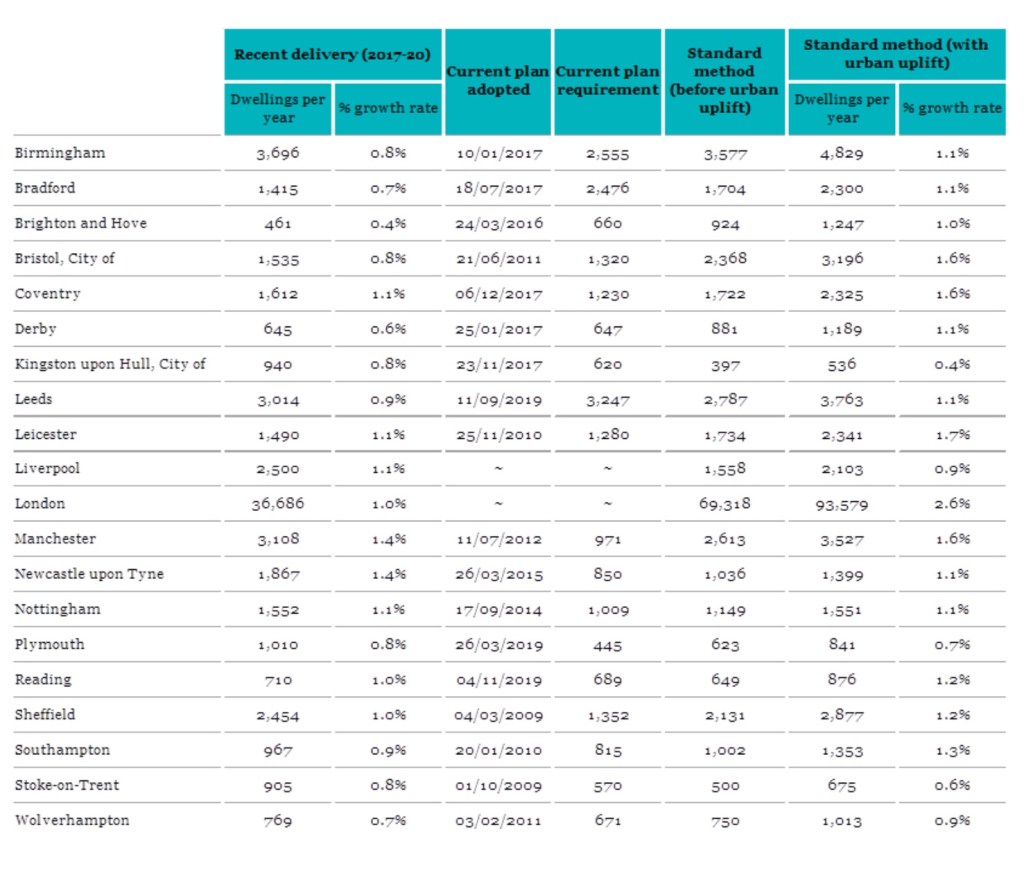
I quoted Chris Young earlier. For an equally brilliant, expert and authoritative analysis how about Lichfields? This is a superb post by Matthew Spry and Bethan Hayes Mangling the mutant: change to the standard method for local housing need on the day of the announcement, including indications as to what the new numbers will mean for the 20 largest towns and cities:
Courtesy of Lichfields
How quickly will the changes come into effect? The Government’s response document says this:
“From the date of publication of the amended planning practice guidance which implements the cities and urban centres uplift, authorities already at Regulation 19, will have six months to submit their plans to the Planning Inspectorate for examination, using the previous standard method. In recognition that some areas will be very close to publishing their Regulation 19 plan, these areas will be given three months from the publication date of the revised guidance to publish their Regulation 19 plan, as well as a further six months from the date they publish their Regulation 19 plan to submit their plan to the Planning Inspectorate for examination, to benefit from the transition period.
The standard method has a role not only in plan-making, but is also used in planning decisions to determine whether an area has identified a 5 year land supply for homes and for the purposes of the Housing Delivery Test (where strategic policies are more than five years old). Where this applies, the revised standard method (inclusive of the cities and urban areas uplift) will not apply for a period of six months from the publication of the amended planning practice guidance. After 6 months, the new standard method will apply.”
For London:
“It is clear that in London, in the medium term, there will need to be a much more ambitious approach to delivering the homes the capital needs. The Secretary of State for Housing, Communities and Local Government expects to agree the London Plan with the Mayor shortly. This new plan, when adopted, will set London’s housing requirement for the next 5 years. The local housing need uplift we are setting out today will therefore only be applicable once the next London Plan is being developed. In order to support London to deliver the right homes in the right places, the government and Homes England are working with the Greater London Authority to boost delivery through the Home Building Fund. Homes England has been providing expertise and experience to support the development of key sites in London. Sites like Old Oak Common, Nine Elms and Inner East London provide opportunities to deliver homes on significant brownfield sites. The Secretary of State for Housing, Communities and Local Government will consider giving Homes England a role in London to help meet this challenge, working more closely with the Greater London Authority, boroughs and development corporations to take a more direct role in the delivery of strategic sites in London and the preparation of robust bids for the new National Homebuilding Fund.”
A final musing for the lawyers. It has become a bit of a knee jerk reaction to proposals to question whether strategic environmental assessment was in fact required but…was it?
“From the statutory framework it can be seen that a plan or programme is only required to be the subject of an environmental assessment if all four of the following requirements are satisfied:-
(1) The plan or programme must be subject to preparation or adoption by an authority at national, regional, or local level, or be prepared by an authority for adoption, through a legislative procedure by Parliament or Government;
(2) The plan or programme must be required by legislative, regulatory or administrative provisions;
(3) The plan or programme must set the framework for future development consents of projects; and
(4) The plan or programme must be likely to have significant environmental effects.”
It was held in that case that the GPDO and Use Classes Order changes did not require SEA because they do not set the framework for future development consents.
The previous challenge to NPPF changes in Friends of the Earth v Secretary of State (Dove J, 6 March 2019) had also failed. Dove J held that, whilst it did set the framework for subsequent development consents, the NPPF was not a measure “required by legislative regulatory or administrative provisions“.
But what is wrong with the following analysis?
⁃ criterion 1 – standard method = a plan prepared by government
⁃ criterion 2 – standard method = a plan required by administrative provisions, i.e. required by NPPF paragraph 60
⁃ criterion 3 – standard method sets framework for local plans and for decision making – e.g. onus on the major towns and cities in their next plans to plan for 35% more homes or suffer consequences via the tilted balance and housing delivery test – indeed geographically specific in a way which the NPPF and PPG has previously largely avoided
⁃ criterion 4 – standard method likely to have significant environmental effects – of course.
In any event, wouldn’t some evidence be helpful, as well as a proper assessment of impacts and alternatives, before lurching to a new system that has moved a long way further away from being any methodological assessment of local housing need?


 SIMONICITY