The application of the flood risk sequential approach to development proposals has been watered down this week.
From being part of a sensible risk-based assessment as to where it is safe to locate development, the process has (like so much that we deal with) grown over time to become a technocratic obstacle course with plenty of traps for the unwary. See for instance my 19 July 2025 blog post A PPG Change Could Easily Mop Up This Surface Water Flood Risk Sequential Test Mess. As of 17 September 2025 we now have that revised planning practice guidance.
My Town Legal colleague Tom Brooks provided a mark up of the changes from the previous guidance. They are as follows:
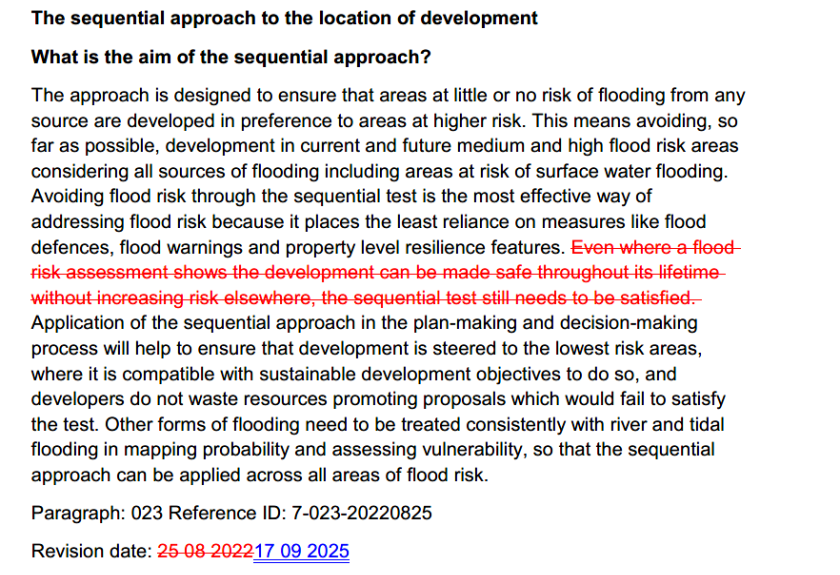
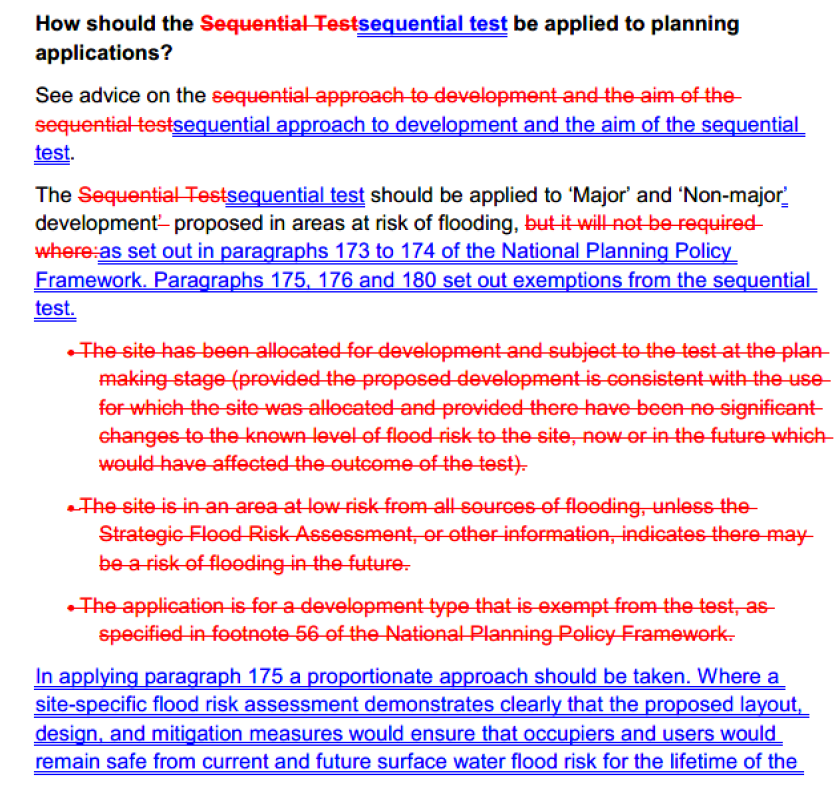

The important change is that we move from a position where the sequential approach is still required where the site is currently at risk of flooding, even where that risk would be removed as a result of development, to a position where it is not required as long as “a site-specific flood risk assessment demonstrates clearly that the proposed layout, design, and mitigation measures would ensure that occupiers and users would remain safe from current and future surface water flood risk for the lifetime of the development (therefore addressing the risks identified e.g. by Environment Agency flood risk mapping), without increasing flood risk elsewhere.” So, if your flood risk consultant is in a position to reach such a conclusion, no longer does there need to be a wide trawl for other sites, currently at lower risk of flooding, where the development might be situated. Might developers still hedge their bets and engage in a sequential testing just in case an issue arises? I suspect so, but this change is certainly going to simplify applicants’ case as to flood risk matters in many instances – particularly, I suspect, where the only potential risk arising is by way of the accumulation on site of surface water.
Whilst not stated in the revised guidance, I note that disapplication of the need to follow the sequential approach also has the effect of relieving developers as well from complying with the two limbs of the “exception test” that have to be followed once the sequential approach has been navigated:
“a) the development would provide wider sustainability benefits to the community that outweigh the flood risk; and
b) the development will be safe for its lifetime taking account of the vulnerability of its users, without increasing flood risk elsewhere, and, where possible, will reduce flood risk overall.“
The reference in the revised guidance to the fact that, if a sequential approach is followed, housing considerations, including housing supply, should be weighed in the balance against the outcome of that process, is helpful express recognition of the approach already taken by various appeal inspectors (see again my July blog post): planning permission may still be granted even if the test is failed – if there are sufficient weighty counterveiling considerations.
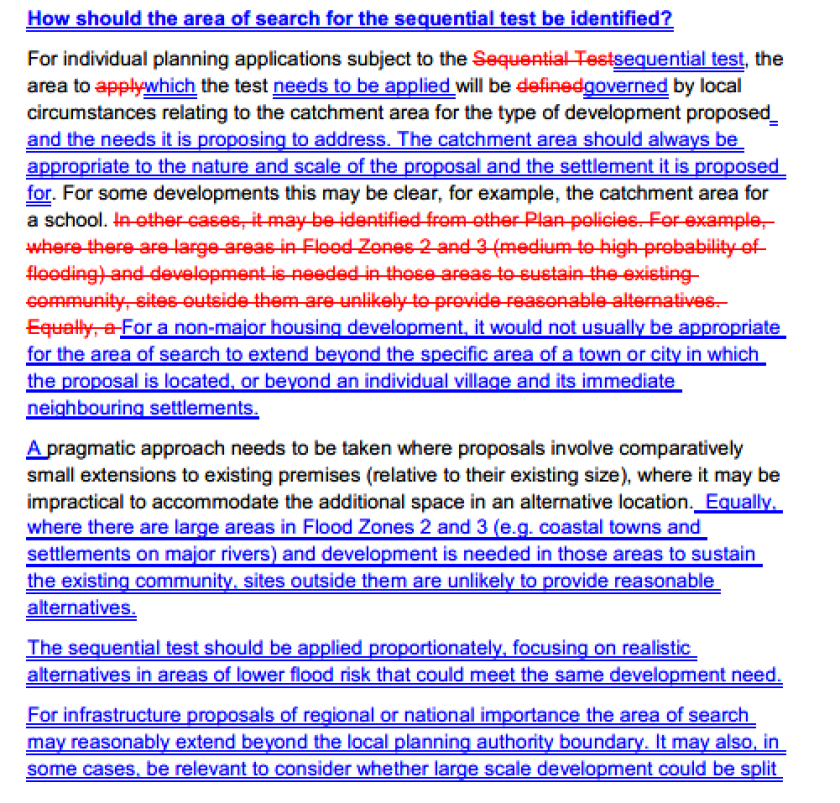
The other amendments to the guidance give further clarity to the parameters of the search for alternative sites to be carried out under the sequential approach:

As with MHCLG’s February 2025 planning practice guidance on grey belt, at a time where the need to simplify and rationalise our current sprawling system is so acute and urgent, isn’t it interesting how pragmatic changes can still be be made without recourse to legislation or indeed even lengthy consultation processes?
Simon Ricketts, 21 September 2025
Personal views, et cetera
 SIMONICITY