First, a scary graph:
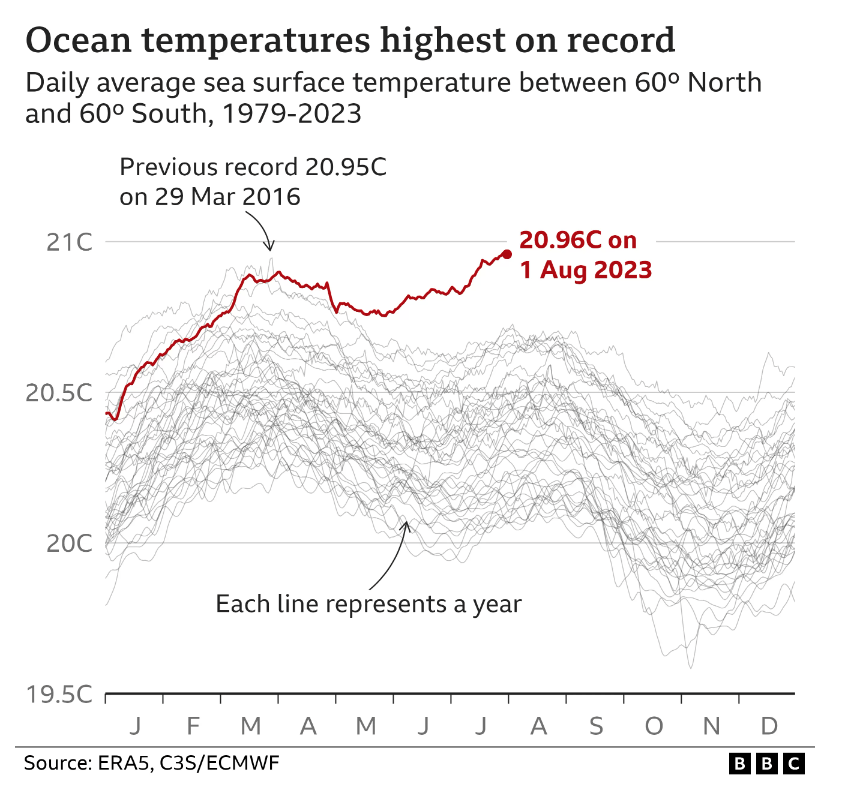
(Source: BBC news piece, Ocean heat record broken, with grim implications for the planet)
The extent of the climate crisis is becoming plainer by the month. The UN Secretary General Antonio Guterres was reported on 27 July 2023 as saying that the era of global warming had ended and that the era of “global boiling” had arrived. July 2023 was the world’s hottest month on record. I saw a retired housebuilder scoff on LinkedIn that he had never heard anything as ridiculous as “global boiling”. I found that quite triggering in the current context and so apologies that I am not writing this week about any interesting planning law cases.
Instead, not in any way as an expert, but instead as a confused citizen, I’m asking myself…
What is the government’s current strategy on climate change and the environment, in the light of, for instance, the Prime Minister’s comments in the Telegraph on 29 July 2023 about being on the side of motorists and announcing on 31 July 2023 hundreds of new North Sea oil and gas licences to boost British energy independence and grow the economy?
I’m reminded of the “Be a strategist” chapter in Alastair Campbell’s book But What Can I do? Strategy = OST:
“O = Objective (what you want to achieve)
S = Strategy (‘the big how’: your definition of the overall approach)
T = Tactics (the detailed plans required to execute the strategy)“
Surely, the objective is, and should remain, to do all that we can do as a leading developed nation to encourage the world to combat the climate crisis.
I thought the Government’s strategy was well-documented, set out in its Net Zero Strategy: Build Back Greener (updated 5 April 2022) (reviewed earlier this year by Chris Skidmore – see my 21 January 2023 blog post Mission Zero Needs Planning) and by way of its longstanding commitments set out in the Climate Change Act 2008 , policed by the Climate Change Committee which was established for that purpose, including the objective of achieving net zero by 2050. You can question whether the strategy is ambitious enough but there it is.
The tactics to be deployed to achieve the objective are all of those individual measures set out and flowing from the strategy, including those set out in the Government’s 2023 carbon delivery plan.
However, I’m sensing that the prime minister’s OST instead may currently look like this:
O = Secure re-election or at least not too heavy a defeat
S = Win votes via populist “culture war” issues; have any sort of positive economic narrative come election time
T = Noise about eg being on the side of the motorist; prioritising economic growth over the net zero programme.
Of course, any debate on these issues gets bogged down in complexity. Argue about the stats, the projections and promised protections (carbon capture and storage etc etc), anything but just Don’t Look Up!
Perhaps let’s turn to that body that was set up by the 2008 Act. The Climate Change Committee published its 2023 Progress Report to Parliament on 28 June 2023). Reviewing the Government’s March 2023 Carbon Budget Delivery Plan and the Government’s wider policy development, the CCC’s key messages are:
- “A lack of urgency. While the policy framework has continued to develop over the past year, this is not happening at the required pace for future targets.
- Stay firm on existing commitments and move to delivery. The Government has made a number of strong commitments, these must be restated and moved as swiftly as possible towards delivery.
- Retake a clear leadership role internationally. The UK will need to regain its international climate leadership.
- Immediate priority actions and policies. Action is needed in a range of areas to deliver on the Government’s emissions pathway.
- Develop demand-side and land use policies. The Government’s current strategy has considerable delivery risks due to its over-reliance on specific technological solutions, some of which have not yet been deployed at scale.
- Empower and inform households and communities to make low-carbon choices. Despite some positive steps to provide households with advice on reducing energy use in the last year, a coherent public engagement strategy on climate action is long overdue.
- Planning policy needs radical reform to support Net Zero. The planning system must have an overarching requirement that all planning decisions must be taken giving full regard to the imperative of Net Zero.
- Expansion of fossil fuel production is not in line with Net Zero. As well as pushing forward strongly with new low-carbon industries, Net Zero also makes it necessary to move away from high-carbon developments.
- The need for a framework to manage airport capacity. There has been continued airport expansion in recent years, counter to our assessment that there should be no net airport expansion across the UK.”
Alongside the report the following supporting research was published:
This all pre-dated last week’s oil and gas licensing announcement. Is there any case in 2023 for further extraction of fossil fuels? The CCC’s outgoing chair Lord Deben however made his views clear in a 3 August 2023 article for New Statesman: North Sea licences tell big oil we’re not serious about net zero.
And what about this stuff about being on the side of the motorist? It’s surely all adding up to a growing, tactical, culture war around climate issues. By-elections can unexpectedly become policy inflexion points – as we saw with the Chesham and Amersham by-election result in June 2021 that effectively scuppered a previous attempt to reform the planning system. Both main parties took from the 20 July 2023 Uxbridge and South Ruislip result that the Conservative candidate’s achievement in narrowly holding onto the seat was down to the unpopularity of London Mayor Sadiq Khan’s programme to extend the Ultra Low Emission Zone to outer London. Hence Keir Starmer’s disappointing wobble the next day but also, in spades, the Tory response. Here was an issue to rally behind, supposedly in support of those not able to afford to replace their older vehicles with ones which would be ULEZ compliant (although that fox has probably been shot by Khan’s 4 August Mayor announces massive expansion of scrappage scheme to all Londoners) but more widely an opportunity to mine a “pro-car”/anti- regulation seam – hence also the prime minister’s announced review on low traffic neighbourhoods. The Local Government Association’s view is clear: Councils best placed to make decisions with communities (30 July 2023). But this is a culture war – if local government folk (and probably people like you and me too) object, so much the better, is likely to be some political strategists’ thinking. And of course, along with all the political brouhaha come the inevitable legal challenges – on 28 July 2023 Hillingdon, Bexley, Bromley, Harrow and Surrey Councils failed in their judicial review of the proposed ULEZ expansion.
Let me throw in here some commentary more rooted in planning law. I was interested to receive a comment on my recent blog post about the M&S Oxford Street decision letter. The comment was along the lines of whether there was anything to stop M&S in any event demolishing the building, unlisted, not in a conservation area, relying on the prior approval right to do that in the General Permitted Development Order. This really does illustrate the lack of joined up thinking in planning legislation. Should demolition be more closely regulated? Why, when there is current consultation on possible changes to the General Permitted Development Order, and if minimising the loss of embodied carbon is now a Government objective (no clear policy on that, we are left reading between the lines), is there still, for instance, the demolition and rebuild (with 1,000 sq m cap) commercial to residential right, only introduced in 2020?!
Finally, to hear views and debate on the Government’s recent announcements on planning reform that were the subject of my blog post last week The Message, you can listen back to our two hour-long Clubhouse sessions on the issues – here for the discussion of Michael Gove’s 24 July statement as to his long-term plan for housing and here for detail on proposed reforms to plan-making, the GPDO and application fees. And although I’m not wedded to the idea unless there is real interest, if anyone would like to speak at a future Clubhouse session about the issues in this blog post then let me know.
And final final plug – there’s a very small but growing planning community on Threads, which is certainly improving as a more wholesome alternative to Twix (they have largely sorted out the issues which initially were so annoying for people). Feel free to join by downloading the app via Apple’s App Store or Google Play for Android – still only by mobile device, although that will change in the next few weeks. An interesting time lies ahead and I’m feeling that we are going to need to share our thinking…
Simon Ricketts, 5 August 2023
Personal views, et cetera

Image courtesy of Don’t Look Up (Netflix)
 SIMONICITY