I’ve written before about the need to Keep It Simple Stupid.
The restructuring of the English planning system, as described in my 19 December 2025 blog post Framework Good Work, might turn out to be one of the lasting achievements of this government – a coherent tiered structure with the opportunity for faster, simpler, plan-making with all the benefits and efficiencies which flow from that predictability – but that good work may be undone, not least at the ballot box, if it is not widely understood or supported. Or if elected positions are secured primarily for the purposes of pursuing politics, providing a platform, rather than positive planning.
Further progress has been made this month, with the consultation until 26 March 2026 on areas for producing spatial development strategies (MHCLG, 12 February 2026), which accompanied the planning and housing minister’s written ministerial statement that day and letter to council leaders. In particular we now have the draft map:
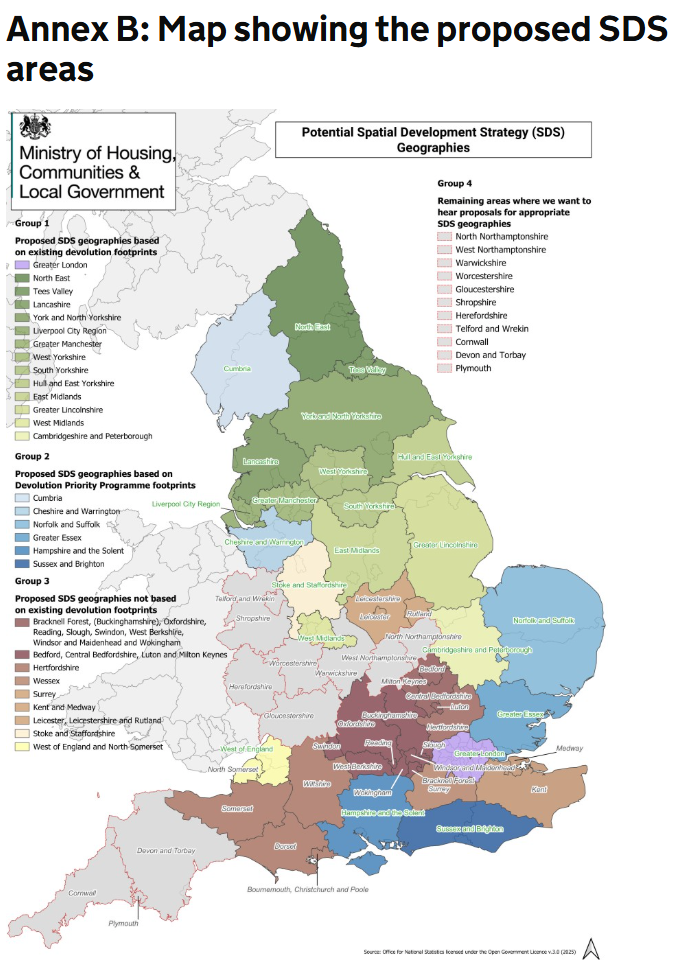
Secondary legislation is expected to be laid before Parliament breaks for the Parliamentary summer recess in mid July, with the spatial development strategy (SDS) provisions in the Planning and Infrastructure Act 2025 also to be switched on, meaning that the duty to produce an SDS will then immediately become active. The secondary legislation will provide for the setting up (possibly in more than one wave) of strategic planning boards (SPBs) in those areas where the SDS will be prepared by a combination of authorities.
The big question though is how can this emerging structure be made understandable and relevant to people, particularly alongside the complexities and uncertainties caused in many areas by the separate process of local government reorganisation?
I would like to see a “plain English” campaign as to the benefits, in terms of devolved powers, of Mayoral strategic authorities; of the power that strategic authorities’ spatial development strategies will have in directing areas for growth, infrastructure and investment; spelling out to people how quickly all of this will be coming down the track; the benefits that will flow from the new larger unified authorities sitting beneath the strategic tier, and public reassurance as to how the local, neighbourhood, voice will not be lost.
Some great work has been done, including by the Strategic Planning Group led by Prior + Partners and chaired by Catriona Riddell which led to the May 2025 paper Planning Positively For the Future (by coincidence the group, in which I was pleased to be a member of, met again on 12 February, the day of those announcements. Nice forward planning as always Shaun and Catriona…).
However, uncertainties remain. Would it be useful to have a “dummy” example of how straightforward and visual an SDS might be? I do worry about mission creep – you planners love words more than even lawyers do.
And do we need some greater clarity on “nuts and bolts” questions such as:
- what will the starting point be for each SDS in terms of housing numbers? For the purpose of apportioning numbers between the local plan-making authorities within the SDS area, will it simply be the overall number for the SDS area derived from the standard method, subject to the opportunity to reach agreements with other strategic authorities? The challenges are well articulated in a Lichfields blog post Spatial Development Strategy Geographies – Will the map change the landscape? (Edward Clarke, Dominic Bowers & Matthew Spry, 16 February 2026):
“Analysis of recent housing delivery rates shows that for many SDS areas, housing delivery over the last three years is less than 60% of the local housing need (Figure 3) indicating that new strategies will need to demonstrate a real step change in provision, most likely pursuing spatial approaches to land release that the local plans of the last 15 years did not consider.
Across the South East those preparing SDSs will face some of the greatest challenges in meeting housing need. London, Hertfordshire, and Surrey will require building at between 120-150% of the current rates (over the last three years). A similarly big task faces much of the South West of England including Cornwall and Plymouth, Devon and Torbay, where the Government says it awaits to “hear proposals for appropriate SDS geographies”.
“A particular challenge will arise in the more tightly defined SDS areas such as the West Midlands Combined Authority where the SDS has an acute challenge (one with which the wider West Midlands RSS tried and failed to grapple) accommodating its own development needs within its current administrative boundary. Across the WMCA SDS area, recent delivery is around 65% of the aggregate housing need, but three quarters of the land area is either already built-up or subject to national planning restrictions or the green belt.
In this, and many other SDS areas, reviewing green belts will be critical to achieve sustainable patterns of development. But the big questions remain as to how effective will be the SDS process in engaging with overlapping housing market or functional economic areas without falling into (a larger-scale version of) the local duty to cooperate trap.”
- Will SDSs have a role in setting targets for levels of affordable housing? And if so, how do we avoid the slippery slope into viability appraisal?
I know it hasn’t been an easy ride, politically or administratively: on 16 February 2026 under the pressure of litigation from Reform, it was announced that local government elections will be taking place after all in 30 areas this May which had previously been postponed by the government due to imminent reorganisation in those areas. By contrast, in relation to emerging strategic authority areas under the devolution priority programme (DPP), in December 2025 MHCLG announced that inaugural Mayoral elections which were due to take place in May 2026 would be delayed by a year in some areas, and by two in others – leading to the prospect of incoming Mayors finding that that the SDS is already underway with limited scope to withdraw or influence it.
How to explain this complicated new system to non-planners? Indeed, what can we call each of these SDSs for a start, as per the London Plan? We need to avoid the democratic deficit that ultimately sunk the regional assemblies, or worst of all the system faltering before it has been embedded across the country and had a chance fully to prove itself.
Simon Ricketts, 22 February 2026
Personal views et cetera
 SIMONICITY