Some Blue Sky Thinking On Brown Field

MHCLG is seeking responses by 28 February 2025 to its planning reform working paper, Brownfield Passport: Making the Most of Urban Land (22 September 2024). I summarised the paper and set out some of the challenges in my 28 September 2024 blog post Brownfield Passports…To What? When? How?).

It is very difficult to think of a “one size fits all” policy intervention that would achieve what the government is looking for, namely “further action that we could take through the planning system to support the development of brownfield land in urban areas.”  The paper “proposes options for a form of ‘brownfield passport’, which would be more specific about the development that should be regarded as acceptable, with the default answer to suitable proposals being a straightforward “yes”. It seeks views in particular on the following questions:

  • Could national policy be clearer if it were explicit that development on brownfield land within urban settlements is acceptable unless certain exclusions apply?
  • What caveats should accompany any general expectation that development on brownfield land within urban settlements is acceptable?
  • How best can urban areas be identified and defined if this approach is pursued?
  • Could national policy play a role in setting expectations about the minimum scale of development which should be regarded as acceptable in accessible urban locations?
  • What parameters could be set for both the scale of development and accessibility?
  • Could more use be made of design guidance and codes to identify specific forms of development that are acceptable in particular types of urban area?
  • What sort of areas would be most suited to this approach, and at what geographic scale could such guidance and codes be used?
  • How could Local Development Orders be best used with these proposals?
  • Are there any other issues that we should consider if any of these approaches were to be taken forward, in particular to ensure they provide benefits as early as possible?
  • In addition to streamlining permissions on urban brownfield sites, where else do you consider this type of policy could be explored to support economic growth?”

Passport” is undoubtedly over-optimistic branding, but I suppose even one of those Easyjet speedy boarding passes would be helpful.

Published after the paper, on 12 December 2024, the final revised version of the NPPF does of course contain a strengthened presumption in favour of brownfield development in paragraph 125 (c):

Planning policies and decisions should:

(c) give substantial weight to the value of using suitable brownfield land within settlements for homes and other identified needs, proposals for which should be approved unless substantial harm would be caused, and support appropriate opportunities to remediate despoiled, degraded, derelict, contaminated or unstable land


Substantial weight”;  approval “unless substantial harm would be caused”: a strong signal one might think. However, it is interesting to see how the policy has been taken into account by appeal inspectors. Perhaps to state the obvious, it is not a “get out of jail free” card and in any event you do need to make sure you fit within the definition. We have found four examples but you may be aware of others:

  • Appeal reference APP/L1765/W/24/3344776 – decision letter dated 31 December 2024 dismissing an appeal for the demolition of existing office and ancillary buildings on site, conversion of an existing industrial warehouse and the construction of 9 residential properties in Denmead, Winchester. “…whilst the site comprises previously developed land, I do not find conflict with the substantial weight given within the Framework to the value of using suitable brownfield land within settlements for homes and other identified needs (Paragraph 125 c)) given the countryside location of the site and the market housing nature of the residential development proposed.”
  • Appeal reference APP/N5090/W/24/3345445 – decision letter dated 15 January 2025 dismissing an appeal for a proposed care home in Barnet. “In addition to outlining the […] benefits of the proposed development, the appellant has drawn my attention to NPPF paragraph 125 c) which states that planning decisions should give substantial weight to the value of using suitable brownfield land within settlements for homes and other identified needs, proposals for which should be approved unless substantial harm would be caused, and support appropriate opportunities to remediate despoiled, degraded, derelict, contaminated or unstable land. Furthermore, the appellant has highlighted the removal from the NPPF of what was paragraph 130 in the 2023 NPPF, which made reference to the possibility that significant uplifts in the average density of residential development may be inappropriate if the resulting built form would be wholly out of character with the existing area.” However, the inspector “found that there would be harm to the character and appearance of the area resulting from the proposed development. That harm stems from both the bulk and massing of the proposed development in a sensitive context, but also in relation to the retention of trees along the site’s frontage.”
  • Appeal reference APP/F2605/W/24/3344783 – decision letter dated 30 January 2025 dismissing an appeal for a single detached dwelling in Breckland. “The appellant has identified that the site, as part of the garden of 1 Sandfield Lane, constitutes brownfield land. The Framework, at paragraph 125 c) states that planning decisions should give substantial weight to the value of using suitable brownfield land within settlements for homes and other identified needs, proposals for which should be approved. The site, as identified above, lies outside of any defined development boundary. It does, however, lie within a grouping of buildings focussed around the pedestrian level crossing. However, I have identified that the proposal would rely almost totally on the private car for transport. Thus, the site is not suitable, as it would, through the generation of greenhouse gasses, have an adverse effect on the natural environment.”
  • Appeal reference APP/W3520/W/24/3352607 – decision letter dated 4 February 2025 dismissing an appeal for 11 dwellings and a commercial unit in Mid Suffolk. “In line with paragraph 125c of the Framework I give the housing, in this context, substantial weight. Although not in a settlement, it is in an accessible location.” However, the “proposal would be contrary to the Council’s spatial strategy with houses of an unacceptable mix, would fail to secure 10% BNG together with appropriate affordable housing, infrastructure requirements, habitat mitigation and has not demonstrated that it would not increase or cause flooding elsewhere. Consequently, it conflicts with the development plan as a whole.”

Given the range of questions raised by MHCLG, what might be additional appropriate interventions look like? Because I’m sure there will need to be various interventions. This is the part where I can plug last week’s Homes for Britain publication, Brownfield Planning Passports: The Fast Track To Growth, sponsored by Berkeley Group, which contains 14 essays with practical ideas from a wide range of public and private sector people (including me, returning to some of the themes of my 5 January 2025 blog post,  How About A Five Yearly Review Of The Use Classes Order & GPDO, Starting This Year?). As you prepare your responses by 28 February, do have a read and it may spark some additional, or perhaps better, ideas.

PS I couldn’t mention blue sky without mentioning Blue Sky again. If you’re still looking for a replacement for whatever the present unpleasant tense of Twitter may be, come join. Link here.

Simon Ricketts, 17 February 2025

Personal views, et cetera

It Was The “Rushed And Incoherent” Jibe That Got Me

The House of Lords Built Environment Committee published its conclusions from its inquiry on grey belt on 5 February 2025, by way of a letter from Lord Moylan (its chair until 30 January 2025 since when he has been succeeded by Lord Gascoigne).

The stated purpose of the inquiry, which was commenced in September 2024, was to “to gain a better understanding of what Grey Belt land is, how it can contribute to housing targets and what sustainable Grey Belt development looks like.”

Obviously, this was in the context of the 30 July 2024 draft revised NPPF which introduced the “grey belt” concept, the idea having been specifically part of the Labour Party’s June 2024 manifesto:

Labour is committed to preserving the green belt which has served England’s towns and cities well over many decades. Under the Conservatives, greenbelt land is regularly released for development but haphazardly and often for speculative housebuilding. Without changing its purpose or general extent, Labour will take a more strategic approach to greenbelt land designation and release to build more homes in the right places. The release of lower quality ‘grey belt’ land will be prioritised and we will introduce ‘golden rules’ to ensure development benefits communities and nature.”

The party had of course been floating the proposal well before that (eg my 20 April 2024 blog post Labour’s Green Belt Grey Areas/Sadiq Khan’s London Manifesto).

The proposals in the draft July NPPF have since been refined but I had summarised them in my 2 August 2024 blog post 50 Shades of Grey Belt. The final version of the NPPF was of course published on 12 December 2024.  Links to the various relevant documents are set out in my 14 December 2024 blog post I Love It When A National Planning Policy Framework Comes Together and Zack Simons posted a brilliantly readable blog post if you don’t simply want to read section 13 of the NPPF and the definition of “grey belt” contained in its glossary.

We still await updated planning practice guidance green belt and on the identification of grey belt (expected this month) and on viability assessment (relevant to the application of the so-called green belt golden rules).

The Built Environment Committee inquiry was an important opportunity to review the “grey belt” refinement to existing green belt policy, in the context of government’s objective: (quoting from that manifesto) to “get Britain building again, creating jobs across England, with 1.5 million new homes over the … parliament” whilst not changing the “purpose or general extent” of green belt. This was a chance to recommend some improvements to its formulation and operation.

In my view that opportunity was missed, in favour of some political point scoring (Labour peers being in a minority on the Committee). Here are the Committee’s main conclusions:

The fact that the NPPF has been finalised at the same time as so many other complementary and interconnected policies are being developed raises significant concerns about the extent to which we can be confident that any of the individual policies contained within the NPPF will be successful. This is particularly the case for grey belt land, the benefits of which we now believe will be marginal, at best. Moreover, in the absence of any clear understanding of how the success of the policy will be measured or monitored, we cannot see how the policy can be implemented or developed in a robust and coherent way.

Ultimately, our assessment is that the grey belt policy has been implemented in a somewhat rushed and incoherent manner, and we do not believe that it is likely to have any significant or lasting impact on planning decision-making or on achieving your target of 1.5 million new homes by the end of this Parliament.”

Surely any proper examination of the issues should have started with a reflection on the operation of green belt policy itself prior to the introduction of the grey belt concept; its ad hoc, unplanned, growth both in extent and purposes and its incoherence in terms of the public’s conception of it as serving more than as a means of containing urban growth but as an indicator of environmental or landscape quality. That examination could have considered the subjective and politised nature of the existing tests in policy – the requirement for “exceptional circumstances” to justify release by way of local plans and “very special circumstances” to justify planning permission for so called inappropriate development.

Against that background and the Government’s various commitments flowing from that manifesto (including the reintroduction of strategic planning) it is a bit rich for the Committee to be complaining at the pace and extent of policy change! Whether you support individual policies or not, many will regard the business-like and speedy delivery by MHCLG, largely without surprises or u-turns, of what was promised as a breath of fresh air after previous regimes (remembering the instant dismantling by Eric Pickles in 2010 of regional planning with nothing in its place) or the constant yo-yoing of recent years: The 2020 Planning White Paper left to wither on the vine, followed by the Gove-led, changed priorities, December 2022 draft NPPF, only finalised a full twelve months later (despite Spring 2023 having been the promised publication date). And were any of the policy changes “robust and coherent”? Hmm.

Yes we still do not have a fully coherent system for determining what land should be released from the green belt, but I would argue that we now have more coherence than simply relying on those “exceptional circumstances” and “very special circumstances” tests. We’re also dealing with revisions to a policy which itself is incoherent, within a planning system which is incoherent. Against a pressing national need for homes and economic development, I suppose the choice is between “rushed and incoherent” or “delayed and incoherent”; you takes your choice.

It seems that part of the Committee’s thinking as to why the concept of “grey belt” is “largely redundant” (to use its own words) is that “more significant changes to other aspects of the NPPF…will be likely to result in Green Belt land being released through existing channels instead”, by way of green belt reviews via local plans and in due course spatial development strategies. If that turns out to be the case in the longer term, that is surely a good outcome. But the harder edged function of the concept in the meantime is to enable a consenting outlet that is not dependent on the much more uncertain “very special circumstances” test, where there is need that is not being accommodated in accordance with up to date plans and where delivery is falling short.

One only has to see (James Maurici KC’s LinkedIn posts are my usual source but you will no doubt have your own) the stream of appeal decision letters emanating from the Planning Inspectorate to have a sense of how often schemes are being promoted at present on the basis that they fall within the definition of “grey belt”, with “very special circumstances” as the fall-back, with many of those appeals being allowed. Surely, this has been exactly the sort of policy intervention that has been needed, albeit of course no overall panacea.

I have one final point to make in what has turned out to be a mini-rant, for which apologies (and of course I look forward to the happy sound of my phone buzzing as your rebuttal comments come in). I corrected Lord Moylan when I gave evidence to the Committee on 29 October 2024 and to my surprise at the time he appeared to be under the assumption that grey belt policy is only relevant to residential development. This was the exchange:

“The Chair:  Take an old abandoned industrial site inside the green belt. There could be strong arguments that a proper and effective use would be as a new industrial site. This policy is focused entirely on housing. Are you saying that you could still apply for that to be a new industrial site, but you would have to use the very special circumstances route to do so; grey belt simply would not apply to that?

Simon Ricketts: No. In fact, grey belt applies to commercial development as well as to residential development. It is a great problem with discussion about the planning system at the moment that everything is about housing. Allowing for logistics, industrial, life sciences and other development is just as important. The draft policy says that “housing, commercial and other development in the Green Belt should not be regarded as inappropriate where … “, and then sets out the criteria for grey belt that I have previously indicated.

There is a problem in that, if you are bringing forward housing development, it is easy to see whether there is an unmet housing need, because you apply the methodology that is in the public domain. However, in relation to commercial development, you have to show that “there is a demonstrable need for land to be released for development of local, regional or national importance”. There is no real guidance as to what the methodology would be for demonstrating that.

The Chair: That is under the very special circumstances test, or under the grey-belt test.

Simon Ricketts: Under the grey-belt test, if you consider that there is an unmet need for logistics development in your area and there is a piece of green belt that you consider to be grey belt because it makes a limited contribution to the purposes of the green belt, you can apply for planning permission if you can show that there is a demonstrable need for that land to be released for that form of development. That is inevitably more complicated than when you are dealing with housing development, because you will need to arrive at the right methodology.

The Chair: But it would be doable.

Simon Ricketts: Yes, absolutely.

The Chair: So it is perfectly possible that the grey-belt route could be used for non-housing development.

Simon Ricketts: Yes.”

Notwithstanding this exchange, is there anything in his letter to the Secretary of State which makes any reference whatsoever about anything other than housing? Nope.

 Simon Ricketts, 8 February 2025

Personal views, et cetera

I realised I’m currently wearing just the right t-shirt this morning.

Growth Mindset

Do you have a growth mindset? It’s increasingly a challenge just to keep up but, if we don’t, who will? Today’s blog post does no more than try to keep track of some of the latest announcements.

Does the government have a growth mindset? Well, if “growth” isn’t written in big letters on a white board in the Cabinet Room I’ll be surprised.

In terms of planning reforms, the current pace and focus is growth, growth, growth.

Before Christmas the latest version of the NPPF (see my 14 December 2024 blog post I Love It When A National Planning Policy Framework Comes Together), proposals in relation to local government reform (together with strategic planning) and  CPO compensation changes (both covered in my 21 December 2024 blog post And Now Take A Deep Breath… ).

Then changes to judicial review procedure in relation to nationally significant infrastructure projects (see my 25 January 2025 blog post DCO JR Changes, #silkyplanoraks).

Finally, last week we had:

  • The Chancellor’s speech , headlined “Chancellor vows to go further and faster to kickstart economic growth”.

The Chancellor’s speech was certainly a very clear mood board as to where she (“I have been genuinely shocked about how slow our planning system is”) and the government are at. In fact it was a smogasbord of specific announcements (listed in Nicola Gooch’s excellent 1 February 2025 blog post) including

  • delivery of the Lower Thames Crossing (ahead of any formal decision in relation to the current DCO application…)
  • measures to unlock the potential of the Oxford-Cambridge growth corridor (noting that there have already been “18 submissions for sizeable new developments” along the route of the East West Rail project) and
  • (the focus of much media attention) support for a third runway at Heathrow.

Stating the obvious, all of these measures will only work with both (1) a sufficiently stable economy and political environment as a basis for business to make long-term investment decisions (Heathrow’s owner will no doubt be deciding whether finally to press the button on the application process, assessing how long-term this political commitment is likely to be and whether the changes announced to DCO and judicial review procedures have gone far enough in practice to avoid another quagmire of legal challenges) and (2) with the necessary resources and experience available to local authorities, the Planning Inspectorate and statutory consultees. And in addition, another reason why “our planning system is so slow” is because there are always fresh legal pitfalls to avoid (eg see Campaigners hail “important victory” in protection of England’s national parks (Guardian, 1 February 2025).

Of course, there are always calls for the government to go even further. Someone brought to my attention Times’ columnist Emma Duncan’s piece this week, Time for Starmer to cut out the planning lawyers, which ends “What Reeves is doing to the bats she now needs to do to the planning lawyers”. No more living in a £100 million bat tunnel for me. 😥

Simon Ricketts. 2 February 2025

Personal views, et cetera

DCO JR Changes, #silkyplanoraks

Congratulations to those in our planning world who have been recommended to be appointed as King’s Counsel in the latest round – Zack Simons (presumably now #silkyplanoraks), Sasha Blackmore and Harriet Townsend.

It occurs to me that belated congratulations are also due to Sarah Sackman KC MP, who many of us know primarily as a superb planning and public law advocate, first at Francis Taylor Building and then Matrix Chambers, but who of course became MP for Finchley and Golders Green in July 2024. She took silk on being appointed as Solicitor General on entering the House of Commons and since 2 December 2024 has been Minister of State in the Ministry of Justice.

I mention Sarah’s background because it is important: we have one of our own, who understands the practical nuances of planning and public law and the operations of the judicial review process, at the heart of government.

There has been much press attention this week on the Prime Minister’s announcement on 23 January 2024, Prime Minister clears path to get Britain building as to changes to be made to procedures governing legal changes of development consent order decisions in relation to nationally significant infrastructure projects, following first the report by Lord Banner KC and subsequent consultation that I summarised in my 28 October 2024 blog post Banner Review Into Legal Challenges of NSIPs.

However, the proposals themselves were announced in more detail in a written statement to the House of Commons that day by Sarah Sackman: Infrastructure Planning and Judicial Review Reform. Working through that statement, first of all the background is set out:

The delivery of major infrastructure projects is central to the Government’s mission to drive growth and unlock clean power. The largest and most complex of these projects currently require a Development Consent Order (DCO) under the Nationally Significant Infrastructure Projects (NSIPs) regime established by the Planning Act 2008.

The number of legal challenges against DCOs has spiked in recent years, with 58% of decisions being subject to legal challenge. Delays to these major projects have serious implications, including holding back the delivery of essential benefits to the country and imposing considerable additional costs on development.

Despite 30 challenges being brought against major infrastructure projects, only four decisions to approve a project have been overturned by the courts. It comes as research shows that, on average, each legal challenge takes 1.4 years to reach a conclusion and the courts have spent over 10,000 working days handling these cases. Such cases impact upon the use of public money, with major road projects paying up to £121 million per scheme due to delays in legal proceedings. Whilst it is fundamental that the public can challenge the lawfulness of government decisions, there is scope for rebalancing the judicial review process to improve efficiency and reduce delays to NSIPs.”

Few of us would disagree with this.

The statement then sets out the specific changes that are to be introduced in relation to claims for judicial review in relation to DCOs:

  • Once the claim is made, there will not be an initial High Court stage where a judge considers “on the papers” whether the case is arguable, instead the issue of arguability and as to whether the case should proceed to a full hearing will be considered by a judge at a short hearing. (This is already the case in relation to applications to challenge inspectors’ decision letters in relation to enforcement notice appeals under section 289 of the Town and Country Planning Act 1990, where indeed there is no subsequent right to apply to the Court of Appeal for permission to proceed if the High Court judge finds the challenge to be unarguable,. Indeed, the deadline for bringing such challenges is four rather than six weeks!).

This change follows Lord Banner’s recommendation. The government’s consultation paper had floated the possibility of extending the change to all judicial reviews but this week’s announcement is entirely limited to DCO judicial reviews.

  • If the judge at that short permission hearing deems the case to be “totally without merit” (i.e. bound to fail), it will not be possible to ask the Court of Appeal to reconsider. At present if the judge considers “on the papers“ that a case is totally without merit, the claimant cannot renew its application for permission before a judge at a short hearing, but can only appeal to a Court of Appeal judge who will determine the appeal on the papers. So, there will be one bite at the cherry – at a short hearing before a High Court judge – rather than two paper stages with no hearing. Given that “totally without merit” grounds are not difficult to identify, is this really very radical?
  • non-mandatory” case management conferences will be introduced – sensible and reflecting one of Lord Banner’s recommendations.
  • All DCO judicial reviews will be designated as significant planning law claims. This is important because specific timescale targets then apply at the High Court stage (not the Court of Appeal) as to how speedily they should be dealt with. However, the issue is somewhat academic given that according to Lord Banner’s report all DCO judicial reviews to date have in practice been treated as significant planning law claims!
  • The government will “work with the judiciary to introduce target timescales for NSIP judicial reviews in the Court of Appeal and in the Supreme Court”. Given the delays that do happen at these later stage this would be very welcome.

Unsurprisingly the announcement has generated flak on the one hand from those who see the changes as reducing access to justice (see e.g. the Law Society’s position, Society counsels caution over JR curbs (25 January 2025), with comments from Law Society president Richard Atkinson that “Removing the paper permission stage could increase both the cost and length of permission hearings”. “‘It is possible that the certainty of higher costs – especially so early in the case, before permission is even granted – could discourage a claimant to the extent that it raises concerns for access to justice”. “Requiring oral hearings for all permission applications may also lengthen these proceedings, as it prevents those that could be easily dealt with from progressing more quickly.”) and on the other hand from those primarily acting for promoters who see the measures as not going far enough (see e.g. Judicial review reform ‘one step’ to enabling UK infrastructure development (24 January 2025) where infrastructure planning law guru Robbie Owen is quoted as saying that “these changes to judicial review are a step in the right direction but they are relatively minor and do not move the dial nearly enough. The government should be providing for any nationally significant infrastructure project that is a critical national priority to be immune from judicial review altogether, by the DCO for the project being confirmed by parliament through a one clause bill after it has been through the DCO process successfully”)

I don’t agree with either extreme. Mr Atkinson is wrong in what he says: any judicial review claimant at the moment needs to factor in the likely need for a permission hearing in any event (of the 27 challenges determined at the time of the Banner report, only 7 had received permission on the papers – and only 2 did not renew after being refused on the papers. 8 proceeded to a full or rolled-up hearing in any event). Robbie’s approach in my view goes too far the other way and takes away the necessary backstop that is needed by way of judicial review.

However, I do think there is more that could be done by way of changes in due course, in some cases not limited to DCO judicial reviews:

  • Why not reduce the challenge deadline for DCO judicial reviews from six weeks to four weeks, but at the same time take the opportunity to rectify the issue frequently arising on statutory challenges of all kinds as regards the current need to serve on the parties within that period, by allowing claimants seven days to serve on the defendant and interested parties, after the claim has been filed? By the time the DCO decision has been issued, any claimant will have been engaged for a long time in the process and will have secured access to legal advice. All that remains to be scrutinised is the Secretary of State’s reasoning for the decision – follow the precedent set in the case of enforcement notice appeals.
  • In the case of non DCO judicial reviews within the remit of the Planning Court, tighten up the requirement for pre-action protocol letters, such that the guidance makes clear that they should be sent as soon as grounds for potential judicial review are considered by a potential claimant to arise, for instance when a local planning authority has resolved to grant planning permission but ahead of the permission being issued. Presently, most potential claimants store up their potential grounds of challenge until the permission has been issued and there is nothing in practice that the local planning authority can do to remedy the position even if it accepts the position set out in the PAP letter. There could be the warning that non-compliance with this guidance may be taken into account in decisions as to the award of costs and as to cost-capping.
  • Much litigation in this field nowadays is crowdfunded. The Government might give thought as to whether greater controls are required as to the use of crowdfunding in relation to litigation and particularly whether sufficient information is given to potential contributors as to the precise nature of the action contemplated, its prospects of success and the implications of a successful outcome (i.e. usually simply resulting in redetermination) and how funds are used if no action is lodged.
  • More information should be made available by the courts, particularly the orders made at permission stage so as to inform decisions taken by subsequent claimants and as to the High Court’s and Court of Appeal’s performance as against timescale targets.

Lastly, what possible basis is there for not extending the changes announced to cover legal challenges to the adoption of local plans and in due course spatial development strategies?

There is always a need for judicial overview of decision making. But there is also always a need for speed – justice delayed is justice denied. Bridget Rosewell’s review was an important catalyst for improvement in relation to the Planning Inspectorate’s administration of planning appeal inquiries, at no cost to the quality or fairness of the process itself. The DCO judicial review changes announced this week to my mind are in a similar vein, although I do agree with Robbie that they are relatively minor. Let’s not give up looking for those incremental gains.

Simon Ricketts, 25 January 2025

Personal views, et cetera

Viva La Devolution!

Perhaps it’s more like revolution, certainly rapid evolution, and possibly even in some respects the reverse of devolution…

In my 21 December 2024 blog post And Now Take A Deep Breath… I set out what there was in the 16 December 2024 English Devolution White Paper as to the proposed introduction of spatial development strategies across the whole of the country by the end of this Parliament with which local plans will need to be in general conformity. Aside from setting minimum housing requirements for each member authority, SDSs will identify infrastructure needs and strategic locations for development, presumably including where appropriate high level reviews of green belt boundaries.

SDSs will be produced by strategic authorities and in some instances, to begin with, other groupings of local authorities directed by the Secretary of State via powers to be included in the Planning and Infrastructure Bill which is to be published in March.

Strategic authorities will fall into one of two categories:

  • Foundation Strategic Authorities: these include non-mayoral combined authorities and combined county authorities automatically, and any local authority designated as a Strategic Authority without a Mayor.
  • Mayoral Strategic Authorities: the Greater London Authority, all Mayoral Combined Authorities and all Mayoral Combined County Authorities will automatically begin as Mayoral Strategic Authorities. Those who meet specified eligibility criteria may be designated as Established Mayoral Strategic Authorities. This unlocks further devolution, most notably an Integrated Settlement.

The government’s strong preference is for partnerships that bring more than one local authority together over a large geography. In exceptional circumstances the Secretary of State will have the power to designate an individual local authority as a Foundation Strategic Authority only. Our ambition remains for all parts of England to ultimately have a Mayoral (and eventually Established Mayoral) Strategic Authority.”

Much of the detail is yet to emerge, for instance:

  • What will be the necessary evidence base to support these SDSs and how will they be examined and will there be a refined version of the current “soundness” test?
  • Will SDSs have to divide out for the constituent member authorities as minimum housing requirements the collective total local housing need for the SDS area and will each local plan need to accept that figure as its minimum housing target?
  • What will be the tramlines as to what may, must and must not and may be included in SDSs?
  • How will internal political differences between member authorities be contained where real tensions arise over, for instance, the allocation of housing numbers?
  • How and to what extent will strategic authorities be required to coordinate with their neighbours?

Of course, core to the government’s reform proposals is not just the universal coverage of the country by strategic authorities (the default assumption being for each to have a combined population of 1.5 million or above), but, below that level, unitary rather than two tier authorities:

We will expect all two tier areas and smaller or failing unitaries to develop proposals for reorganisation. We will take a phased approach to delivery, taking into account where reorganisation can unlock devolution, where areas are keen to proceed at pace or where it can help address wider failings. However, we are clear that reorganisation should not delay devolution and plans for both should be complementary.

New unitary councils must be the right size to achieve efficiencies, improve capacity and withstand financial shocks. For most areas this will mean creating councils with a population of 500,000 or more, but there may be exceptions to ensure new structures make sense for an area, including for devolution, and decisions will be on a case-by-case basis.”

In terms of the creation of strategic authorities, many councils have already expressed interest in becoming part of the Government’s Devolution Priority Programme, which is for areas wishing to pursue establishment of a Mayoral Strategic Authority. This will be with a view to inaugural mayoral elections in May 2026. The Local Government Association has published a list.

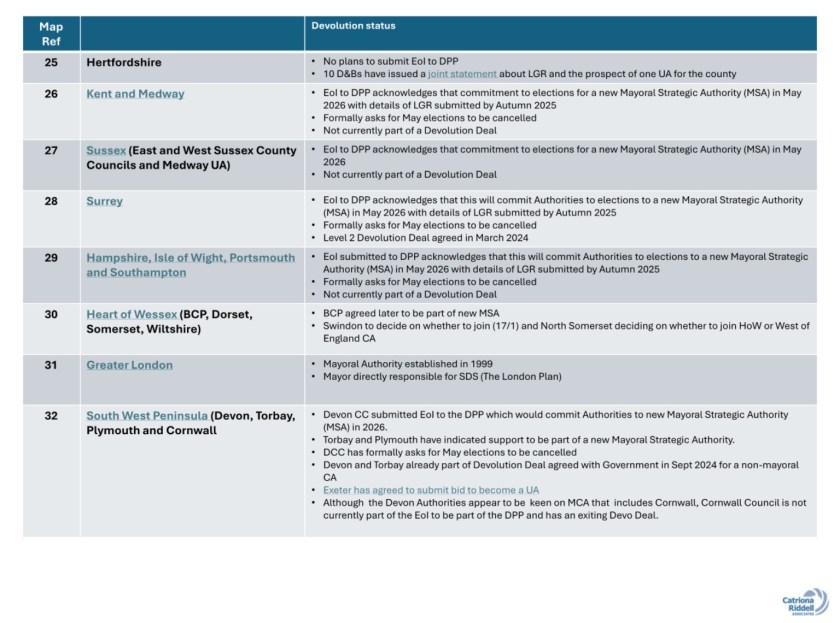
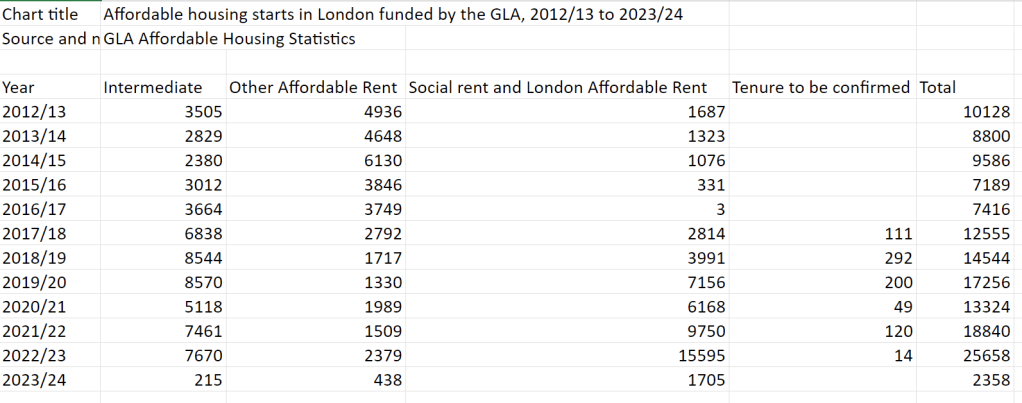
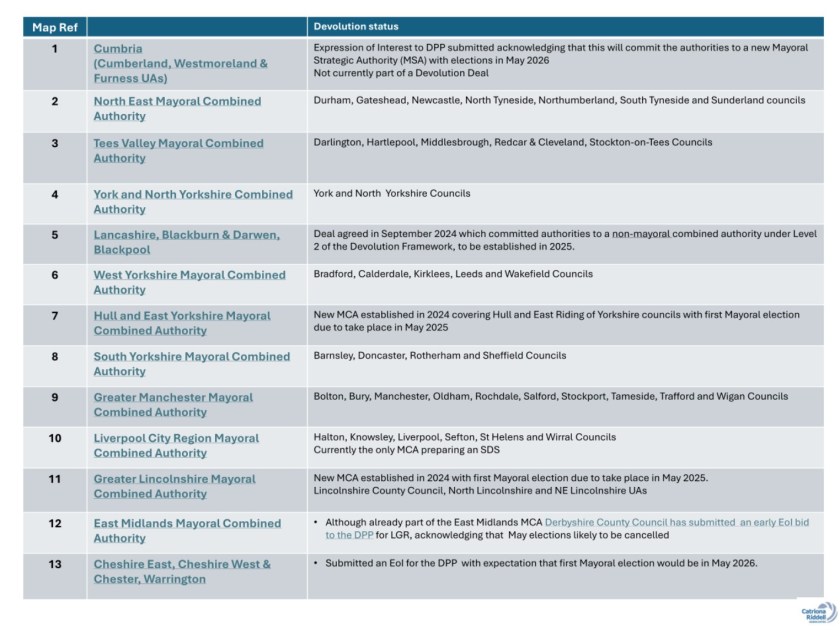
What could this all mean in terms of what the areas will be for SDSs? Catriona Riddell yesterday posted her current understanding as below:

In terms of the move towards unitary authorities, local government minister Jim McMahon wrote to two tier authorities on 16 December 2024:

As set out in the White Paper, new unitary councils must be the right size to achieve efficiencies, improve capacity and withstand financial shocks. For most areas, this will mean creating councils with a population of 500,000 or more. However, there may be exceptions to ensure new structures make sense for an area, including on devolution.”

“We will take a phased approach and expect to deliver new unitary authorities in April 2027 and 2028.”

“I have heard from some areas that the timing of elections affects their planning for devolution, particularly alongside reorganisation. To help manage these demands, alongside our objectives on devolution, and subject to meeting the timetable outlined in this letter, I am minded-to lay secondary legislation to postpone local council elections from May 2025 to May 2026.

However, I will only do this where this will help the area to deliver both reorganisation and devolution to the most ambitious timeframe – either through the Devolution Priority Programme or where reorganisation is necessary to unlock devolution or open up new devolution options.”

“To lay the relevant legislation to postpone elections, I will need a clear commitment to devolution and reorganisation aims from upper-tier councils in an area, including a request from the council/s whose election is to be postponed, on or before Friday 10 January.”

Again, the Local Government Association’s list is helpful – of counties and unitaries which have made requests, involving postponing their election from 2025 to 2026.

Whilst the government’s advice is that none of this should slow down current local plan making it is going to be interesting to see what transpires – and the local political implications more generally of postponed elections (who knows, perhaps the potential for longer term decision making?).

The pace of change ahead of publication of either the Planning and Infrastructure Bill or the English Devolution Bill is certainly impressive.

There’s an interesting quote from Arthur C Clarke about revolution – and possibly it extends to devolution as well:

Every revolutionary idea seems to evoke three stages of reaction. They may be summed up by the phrases: (1) It’s completely impossible. (2) It’s possible, but it’s not worth doing. (3) I said it was a good idea all along.”

Simon Ricketts, 18 January 2025

Personal views, et cetera
Is The London Mayor Doing Enough In Practice To Accelerate Housing Delivery?

Congratulations Sir Sadiq Khan, Mayor of London, and Christopher Katkowski CBE KC on your respective new year’s honours.

CK CBE KC of course led work on a report published in January 2024 for the last government which considered any changes to the London Plan which might facilitate housing delivery on brownfield sites in London. The report lays bare the undersupply of new homes in London, which has not kept pace with increases in jobs, population and housing demand.

Sir SK’s Greater London Authority published on 19 December 2024 Accelerating Housing Delivery: Planning and Housing Practice Note. I summarise the document later in this post and would welcome reactions as to whether the document – non-statutory, intended as practical guidance and a material consideration in the determination of planning applications and, in part, renegotiation of existing section 106 agreements – really goes far enough, given where we currently are.

The need for additional housing in London, at all price points, both subsidised (“affordable”) housing and general market housing, has never been more acute. It is in fact much worse now than when CK CBE KC wrote that report. The statistics back that up, with planning approvals and housing starts both down sharply last year.

Annual housing completions have been falling short of the policy target in the 2021 London Plan of 522,870 net housing completions from (2019/20 -2028/29). Everyone knows that the viability position for developers is increasingly difficult, faced with build cost inflation, high interest rates and the costs and uncertainty of, for example, additional building safety requirements. Similarly everyone knows that there is an absence of registered providers willing to take on the affordable housing, leading to stalled schemes (a national problem – see the HBF’s December 2024 press statement 17,000 Affordable Homes stalled by lack of bids from Housing Associations and accompanying report).

We have the London Plan’s 50% affordable housing requirement – and with a relatively rigid and formulaic system of early stage and late stage viability review mechanisms where that cannot be met (the late stage review not being required where the “fast track” applies, i.e. if the developer commits to at least 35% affordable housing – 50% on industrial or public sector land), all in accordance with London Plan Guidance on affordable housing and on development viability which have remained in draft since May 2023.

Before we look at the practice note, let’s see what some of the evidence is saying, for instance the GLA’s own November 2024 document, Housing in London 2024: The evidence base for the London Housing Strategy (the charts referred to are here):

London is home to both the fastest and slowest-growing local housing stocks in England. The number of homes in Kensington and Chelsea grew by 2% over the last decade, compared to 26% in Tower Hamlets (chart 2.1). Using data on new Energy Performance Certificates to track completions of new homes, it looks like new supply in 2024 is following the trend of 2022 and 2023, two of the lowest years in the last five years (chart 2.2).

The quarterly number of planning approvals is falling, and they are concentrated on fewer, larger sites (chart 2.4).  Increasing construction on small sites might be key to increasing overall delivery, with 65,000 new build homes completed on small sites between 2012/ 13 and 2021/ 22 (chart 2.3). Sales of new market homes in London peaked in 2022 and then fell considerably, partly due to lower demand from Build to Rent (BTR) providers and the end of Help to Buy (chart 2.6). The BTR sector, which completed 44,585 new homes in London between 2009 and 2023 is nevertheless still growing (chart 2.7).

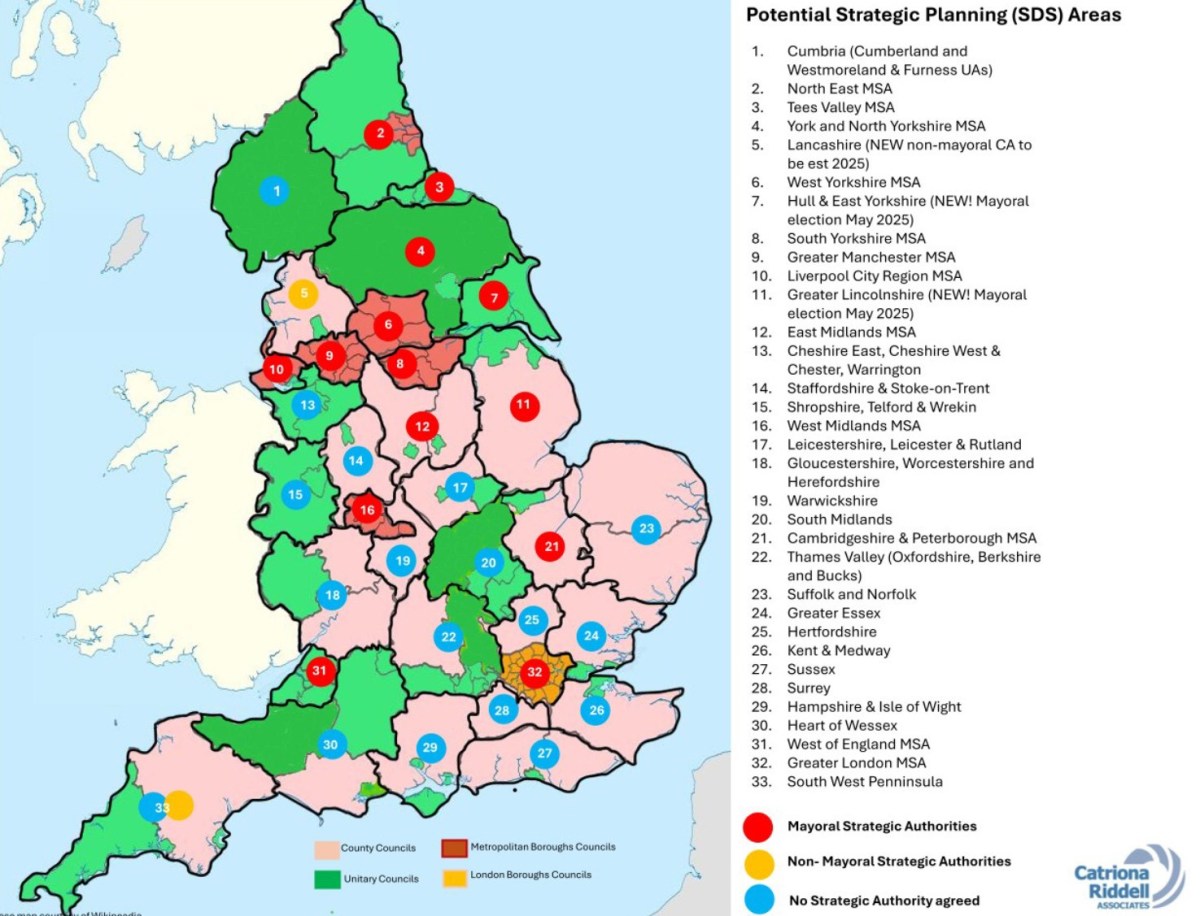
38% of homes and 46% of habitable rooms recommended for approval by the Mayor in 2023 were affordable, with both of these figures a record high (chart 2.5). Affordable housing starts funded by the GLA fell sharply between 2022/ 23 and 2023/ 24 (charts 2.8 and 2.9), as registered providers and local authorities have diverted resources away from new supply in response to increased remediation and refurbishment costs and the costs of adapting to changing regulations. Completions are also down, but not as much. Of the affordable homes started with GLA support in 2023/ 24, 72% were for social rent. Affordable completions from all funding sources also rose to a recent high of 15,768 in 2022/ 23 (chart 2.10), with data for 2023/ 24 not yet available.

Social housing landlords in London owned just under 800,000 affordable homes for rent in 2023, the highest total since 2002 (chart 2.12). Sales of council homes through the Right to Buy (RTB) scheme have been on a downward trend since their peak in the 1980s, totalling 1,080 in 2023/ 24 (chart 2.11).

Council tax data showed that 2.3% of homes in London were empty in 2023, with only 1% empty longer than 6 months (chart 2.13). These are much lower levels than in the 1980s and 90s, when around 5% of homes used to be empty.

1.34 million homes in London, or 36% of its stock were leasehold homes in 2022/ 23, over half of which were privately rented (chart 2.15).  In 2023, there were 22,770 homes in multiple occupation (HMOs) with mandatory licences in London. This is the highest of any region (chart 2.14).”

This is chart 2.8 referred to in that text:

This is an extract from chart 2.4, showing the annualised trend per quarter in the number of new homes approved, and the number of projects:

Ahead of the awaited review of the London Plan, what can be done? The sorts of specific, practical,  issues that currently come up again and again relate to the operation of the viability review mechanisms in particular. Since the new Building Safety Act regime came into force on 1 October 2023 the early stage review mechanism, kicking in if substantial implementation (usually defined as construction of the foundations and ground or first floor) hasn’t taken place within two years of permission, is increasingly unworkable for higher-risk buildings given how long the gateway two stage is taking in practice. The contingent liability that the late stage review mechanism represents is unattractive in principle to funders, which is a big challenge in a weak market.

For measures that could have had an immediate positive impact, what about, for instance, introducing suitable flexibility into the triggering of the early stage review?  Potentially a temporary “holiday” from the late stage review for schemes that committed to proceed to completion within an agreed timescale?  A willingness to accept renegotiation of section 106 agreements on schemes which are now unviable? Some pragmatism as to commuted payments towards off-site delivery where a registered provider cannot be found?

Whilst the document does include some measures which may help at the margins, there’s certainly no “big bang” of that nature. It is in fact curious how little fanfare the practice note has been given. I can’t even find it on the GLA website, let alone any press release. Nor was any formal consultation or indeed feedback invited.

Anthony Lee at BNP Paribas did this good summary on LinkedIn before Christmas but I have seen little else.

I draw out some of the measures as follows:

  • Allowing the fast track threshold to be reduced, both for new and current applications and also for consented schemes, where the tenure split provides proportionately more social rent than the policy requirement, in accordance with a formula that appears to seek to avoid any financial advantage to the developer in so doing – the only advantage being if that unlocks more GLA funding and/or more willingness on the part of registered providers.
  • Estate regeneration schemes will be able to qualify for the “fast track” if at least 50% of the additional housing will be delivered as affordable.
  • The GLA will consider accepting supported housing and accommodation for homeless households, with nomination rights for the relevant borough, as a like for like alternative for intermediate housing, again both for new and current applications and also for consented schemes.
  • The cost of any meanwhile accommodation for homeless households, with nomination rights given to the relevant borough, may be taken into account in the operation of viability review mechanisms.
  • With the late stage review, the developer currently retains 40% of any surplus profit. In certain circumstances this can now increase to 70%.  However, the criteria are tight. “To qualify for this, the application must provide at least 25 per cent onsite affordable housing by habitable room for schemes with a 35 per cent threshold, and 35 per cent onsite for schemes with a 50 per cent threshold, at the relevant local plan tenure split, and be certified as reaching practical completion within three years of the date of this document.” “For larger phased schemes that provide at least 25 per cent affordable housing across the scheme as a whole that are granted planning permission after the date of this practice note, if the initial or a subsequent phase is certified as reaching practical completion within three years of the date of this document, the GLA will consider allowing the applicant to retain 70 per cent of any surplus profit identified in that phase when the late review is undertaken. The relevant phase must include at least 100 residential units.”
  • There is this enigmatic sentence: “The GLA will also work with boroughs to identify sites that have been allocated for development or that have been granted consent but that have not come forward for development for many years, or where limited progress has been made, and will assess the nature of interventions required to facilitate this.”
  • Great flexibility is announced as to the permissible inputs into review mechanisms. The formulae currently focus on changes in gross development value and build costs. “However, in some cases it may be more appropriate to allow for a full viability review to be undertaken which reconsiders all development values and a greater scope of development costs, including professional fees and finance costs.”
  • The Mayor’s housing design guidance should not be applied mechanistically, in relation to, for instance, the reference to the need to submit “fully furnished internal floorplans” and the objective that new homes should be dual aspect.
  • Various grant funding measures but I’ll look to others to comment as to the extent they will move the dial.

Thoughts?

Simon Ricketts, 11 January 2025

Personal views, et cetera

How About A Five Yearly Review Of The Use Classes Order & GPDO, Starting This Year?

Changes in the law relating to e.g. tripe shops, maggot breeding and bone grinding were my special subject as a late 80s young lawyer so please hear me out, because this is all central in my view to thinking with regard to the government’s (currently rather all shades of grey) “brownfield passports” concept (see my 28 September 2024 blog post Brownfield Passports…To What? When? How? ).

Two things I find interesting about the UK (now, for the purposes of this post, English and Welsh) town and country system:

  1. The stability of its underlying structure: Many of the provisions of the Town and Country Planning Act 1947  are there, as the kernel of the current, much amended, 1990 Acts. Compare for instance section 12 of the 1947 Act (defining “development”) with section 55 of the Town and Country Planning Act 1990 or section 13 of the 1947 Act with section 59 of the Town and Country Planning Act 1990 (“development orders”).
  1. The continual sets of amendments, large and small,  that have been made, within that framework, to reflect differing political priories and economic and social pressures. Drafting by committee? What we have now is the almost impenetrable result of many generations of that. It always helps to understand who added, amended or removed what, when and why.

The tension for law makers is always the same: how to retain what works but ensure, without unnecessary complexity, that the system remains fit for purpose.

Maybe nowhere is this more so than in relation to the concepts of use classes (changes of use within a use class not amounting to “development” requiring planning permission) and permitted development (classes of development which have the benefit of automatic, deemed, planning permission).

When I first studied planning law (at bar school in 1984-85: course run by Victor Moore, as of “A Practical Approach To Planning Law”), we were all operating under the Use Classes Order 1972 (which was largely in the same form as the first Use Classes Order in 1950) and under the General Development Order 1977 (again largely in the form of the first General Development Order in 1948). This truly makes me feel old. These were the 1972 Use Classes Order use classes, dominated by all of those special industrial groups, and with those references to tripe shops, cats-meat shops and the like.

The categories of permitted development rights in the 1977 Order will look very familiar:

The brevity of the “changes of use” category, less familiar:

Conservative governments have been responsible for two major revisions of the system.

The first was shortly after I qualified, with the introduction of the (now amended many times) Town and Country Planning (Use Classes) Order 1987 the main functions of which do not nowadays appear very controversial: (1) lumping together office, light industrial and research and development uses within a new use class B1 and (2) abolishing the use classes containing all those old special industrial groups. Alongside this was the Town and Country Planning General Development Order 1988.

That system then survived without major reform for around quarter of a century.

The second set of changes to the system has been the multiple waves of deregulatory changes made between 2013 and 2024, particularly the creation of class E for a wide range of commercial uses in 2020 (see my 24 July 2020 blog post E Is For Economy) and the various new permitted development rights enabling residential conversion and demolition/rebuild in relation to commercial (and in some instances agricultural) buildings. The Town and Country Planning (General Permitted Development) (England) Order 2015 (as amended) is a shape-shifting monster.

The system is in desperate need of reform:

  • what should be the core objectives behind removing the need for planning permission for certain categories of use and works, given the Government’s missions?
  • How can the system operate with simplicity but also appropriate flexibility and reflecting local circumstances where appropriate?
  • What areas of the current system need modernising to reflect current economic or social pressures, priories and ways of living and working?

Depressingly, my 1 July 2016 blog post Time To Review The C Use Classes remains more relevant than ever. It’s still time! The nettle has not been grasped.

As for permitted development rights, perhaps the big political question is whether the concept of automatic planning permission for the conversion of certain types of commercial buildings to residential use should be rejected outright, based on the experience since May 2013, or can be made to work acceptably.

In 2023-24 8,825 of England’s 198,610 new dwelling completions were by way of permitted development rights . Between 2015/16 and 2022/23, 102,830 new homes were delivered by way of permitted development rights, around 6% of new homes. This is a not insignificant contribution, by numbers at least.

To this we add the Government’s drive towards brownfield development in urban areas (that brownfield passports document I mentioned); the extent to which commercial space is surplus to market requirements, and the carbon benefits of finding new uses for existing buildings (although query how this squares with the “demolish commercial and rebuild as residential” permitted development right).

Of course a big problem is that much of the resulting accommodation has not been of a decent standard (see e.g. Research into the quality standard of homes delivered through change of use permitted development rights by Dr Ben Clifford, Dr Patricia Canelas, Dr Jessica Ferm and Dr Nicola Livingstone Bartlett School of Planning, UCL and Professor Alex Lord and Dr Richard Dunning, Department of Geography and Planning, University of Liverpool, July 2020, published by MHCLG in 2020, strangely alongside yet further deregulatory measures). The Town and Country Planning Association is lobbying for a “Healthy Homes Bill”, describing permitted development rights as creating “slums for the future”.

Is there a middle ground? Do permitted development rights have a role in delivering homes, in the quantity needed but also to the necessary quality – decent, healthy?

The previous government consulted on further changes to permitted development rights in February 2024 . The outcome of that process was never published. We await Labour’s next steps.

What went wrong with commercial to residential permitted development rights?

For a start the measure seemed to be seen by ministers as a short-term tactical intervention rather than based on any longer-term strategy or analysis. In May 2013 the right was first introduced (initially just for three years) to allow changes from office use to residential use, the twin objectives being to boost housing and to help regeneration by way of putting vacant or under-utilised office space to productive use. The “prior approval” requirements were minimal, with no minimum space standards, no minimum standards for daylight and no protection in relation to noise, for instance. As is still the case, local planning authorities could not impose requirements as to affordable housing or require contributions towards for instance education or health facilities. Authorities could make “article 4” directions limiting the areas within which the permitted development right would apply but at risk of these being cancelled or amended by the government (as has frequently happened).

The right was extended to shops and to financial and professional services uses in April 2014 and made permanent in Autumn 2015. Adequacy of daylight was introduced as a prior approval requirement in August 2020 and minimum space standards in April 2021. Initially buildings of any size could be converted to residential. A 1,500 sq m cap was introduced in September 2020 (at the same time that there was the separate but related de-regulation measure of gathering together most commercial uses within a single use class, the new class E) and then that cap was removed in March 2024. Similarly, a requirement was also introduced that the building should have been vacant for at least three months before the application was made, only for that also to be removed. Are you keeping up? (Incidentally, I am grateful to my colleague Gregor Donaldson for reminding me of some of these twists and turns).

One might conclude from this chopping and changing that from the outset the process has lacked a proper strategic foundation, core objectives and a commitment to ensure that resulting development is not of poorer quality, or having a free ride at the expense of development achieved by way of the traditional planning application route.  Care is needed with criticism of outcomes: to what extent did these result from the initial wave of conversions, before additional prior approval safeguards had been introduced? Also remember that these developments do have to comply with the Building Regulations and with housing legislation. Not every failing is down to the GPDO.

Before we give up on removing unnecessary matters from the planning application process and on this streamlined route for delivering new accommodation on urban brownfield land, surely there is an urgent need to examine whether the system can indeed ensure, by way of objective criteria, that:

–              (possibly by way of an article 4 direction process following better national guidance and the opportunity for public consultation) development locations are sustainable for their residents, with access to public transport, schools, health and community facilities;

–              schemes should pay their way in terms of affordable housing and other section 106 agreement requirements in the same way as schemes delivered by way of planning application.

But more widely, surely we need to embed a rhythm within government of reviewing the operation of the Use Classes Order and General Permitted Development Order regularly, in an orderly rather than ad hoc way, so as to ensure that we have both a reasonable level of stability but also a proper regular process for reflecting emerging economic, social and indeed technological trends?

Happy new year!

Simon Ricketts, 5 January 2025

Personal views, et cetera
And Now Take A Deep Breath…

Can I share with you that there have been times this year when the pace of announcements in terms of changes to the planning system, when taken with some significant case law to digest, has led me to wonder how I am meant to keep up?

Even in the last month, no sooner than the new National Planning Policy Framework and associated announcements (see my 14 December 2024 blog post I Love It When A National Planning Policy Framework Comes Together) was published, there were pre-Christmas sucker punches in the form of:

I’m not complaining; change is needed. However, now is not the time for deep dives into either topic, other than to say this:

  • The English Devolution white paper is necessary, if complex, reading. Aside from heralding significant local government reorganisation and devolution of power to sub-national levels, for us the most key paragraph 3.5, housing and strategic planning, which concludes with this summary of what is proposed:

 “Box A: Universal system of strategic planning

The government has been clear that it will implement a universal system of strategic planning within the next five years. The model that is proposed is the Spatial Development Strategy (SDS), which is well established in London, the London Plan having been produced and continually reviewed over 20 years.  As set out at 3.5, where Strategic Authorities exist, they will be responsible for producing or agreeing the SDS for their areas.

While it is our ambition for every area of England to be covered by a Strategic Authority, this will be a gradual process. We want to move quickly on strategic planning. This means that where no Strategic Authority is in place or is planned to be in place, the government will take a power through the forthcoming Planning and Infrastructure Bill to direct defined groupings of upper-tier county councils, unitary councils, and in some cases Foundation Strategic Authorities to deliver an SDS. Given the intention to have all SDSs produced by Strategic Authorities in due course, the government believes it makes sense in the first instance for these groupings of local authorities to be guided by the sensible geography criteria that have been set out for agreeing new devolution deals (see 2.2.1). The arrangements for agreeing a SDS in areas without a Strategic Authority will follow the same principles as Foundation Strategic Authorities.

In all areas, SDSs will guide development for the Local Planning Authorities in the area, and their local plans will need to be in general conformity with the SDS. However, Local Planning Authorities should not delay development of Local Plans while they await the adoption of an SDS. Relevant Local Plans should continue to be updated or developed alongside the SDS process.

Areas will be able to set a SDS to enable their area to grow, identify the infrastructure that is needed and strategic locations for development. This will include an obligation to apportion an assessment of the housing need of the Strategic Authority across its constituent members. The government intends for that assessment to be the cumulative total of the local housing need of each constituent member, as determined by the Standard Method set out in national planning policy. The apportioned figure set for each constituent member in the SDS will then be the minimum housing requirement for the purposes of each member authority’s next Local Plan. Agreement on the precise distribution of housing need will be agreed through the SDS development process. We also expect that the authorities producing SDSs will be able to encourage the pooling of resources and prioritising of efforts across their constituent authorities to meet housing need.

The content of SDSs will be kept deliberately high level with the dual purpose of preserving detailed policy and site allocations for local planning authorities through their local plans, and for enabling strategic plans to be produced quickly, with the intention of achieving national coverage by the end of this Parliament. The government expects high levels of collaboration to be demonstrated between the Strategic or upper-tier local authorities who are responsible for the SDSs and local planning authorities in the area. There will be a formal duty for responsible authorities to consult district councils on the development of the SDS and a route for district councils to raise concerns with the planning inspectorate.

Across all areas, these arrangements will encourage partnership working and we envisage that there will be genuine opportunities for efficiencies by sharing research, evidence and expertise that can support both the SDS and Local Plans. However, the government is determined to ensure that, whatever the circumstances, SDSs can be concluded and adopted in a reasonable time period. In order to ensure universal coverage of strategic plans, we will legislate for intervention powers, which will enable the government to intervene where plans are not forthcoming to the timeframe. These will include directing on timetables or particular policy content such as the distribution of housing need, through to taking over the preparation of an SDS and adopting it on behalf of strategic planning authorities.”

The intention of achieving national coverage by the end of this Parliament”! The necessary legislative changes will be introduced in part via the forthcoming Planning and Infrastructure Bill and partly through the forthcoming English Devolution Bill. I’m pleased to be part of the strategic planning working group chaired by Catriona Riddell and founded by Prior + Partners which is looking to help lay the groundwork to ensure that strategic planning can work effectively. Three half days sessions have been held so far, with two to follow in January.

But there will be plenty more to explore in the white paper beyond the introduction of strategic development strategies. For instance, once the relevant strategic development strategy is in place, Mayoral Strategic Authorities will have equivalent development management powers as the London Mayor, enabling them to intervene with applications of potential strategic importance and will have the power to raise a Mayoral Community Infrastructure Levy to support the delivery of strategic infrastructure projects.

There are other nuggets hidden away in the text, for instance the proposed replacement of the community “right to bid” for assets of community value by a strengthened “right to buy”.

  • As for the Government’s compulsory purchase compensation proposals, the big news is of course the potential widening of the scope for “no hope value” CPOs, to include acquisitions of “brownfield land in built-up areas, suitable for housing delivery, but with no extant planning permission for residential development” and “land allocated for residential development in an adopted plan but which has not come forward for development.” I speculated as to what might be proposed, and as to the potential implications, in my 21 July 2024 blog post, Hope/No Hope. Although you may prefer just to try my Spotify playlist, A Deep Dive Into Land Value Capture.

Can I end on a more serious note? I started this post wondering how people are meant to keep up. I’ve also been wondering what the best role is for blogs like this. I started writing it for my own benefit – just to join the dots on what is happening week by week , as well as for amusement – I like writing! It’s brilliant that many of you regularly read what I do but I never meant to replace more reliable sources of CPD. Indeed just preparing summaries of documents is not what this blog is about. It hit me hard when I learned that EG (formerly the Estates Gazette) will be closing next year. Those are proper journalists. My gratitude goes out to all of those in the specialist press (particular shout-outs to Planning and the Planner) and also those in the sensible end of mainstream media who are all trained, and paid, to report and analyse on what is happening. I can only provide amateur snapshots. The day job – practising, rather than pontificating on, all this stuff – is always my bigger focus. This is a golden age for planning  and planning law blogs (I’m always in awe of eg Zack, Nicola, Sam Stafford, Philip Barnes, Paul Smith and others – oh no who have I offended by omission?) but we need to keep professional journalism alive too!

Related thought: this week there was a fascinating The Lawyer Podcast: Christmas Special — is someone you know a workaholic? Do listen – it is equally relevant for planners as lawyers! The evening I listened to it I was going to go back to my desk to read one of the documents I mentioned above but, taking in its message, I stopped and deliberately closed my eyes and listened to some music instead. Our professional area of interest is so intertwined with public policy, industry gossip etc that I find it difficult sometimes to work out whether what I am doing is work. Maybe LinkedIn needs that gambling industry warning: “When the Fun Stops, Stop”.

Now stop and have fun! Merry Christmas.

Simon Ricketts, 21 December 2024

I’m dreaming of a white cat Christmas…

I Love It When A National Planning Policy Framework Comes Together

As John “Hannibal” Smith never quite said on The A-Team.

You’ve read the various summaries of the 12 December 2024 NPPF and accompanying announcements.

This is just a set of links to the various documents and a summary of what they tell us as to what is to come.

I give you:

  • The following revised elements of the government’s planning practice guidance:

Local plan intervention

The Secretary of State has wide-ranging plan-making intervention powers under the Planning and Compulsory Purchase Act 2004. What are the policy criteria that apply to certain intervention decisions?

Decisions on intervention will be taken in line with relevant legal tests and should have regard to plan progress and local development needs. The Secretary of State may also consider other matters that they deem relevant to the case, including sub regional or regional or national development needs. 

These criteria will be used by the Secretary of State to inform decisions on exercising local plan intervention powers set out in sections 27 and 27A of the 2004 Act. They will also be used to inform decisions on local plan and minerals and waste plan intervention taken under sections 15HA and 15HD of the 2004 Act (when amended by the Levelling-up and Regeneration Act 2023). They replace the previous criteria in the 2017 Housing White Paper.

Planning authorities will be invited to put forward any exceptional circumstances that they think that the Secretary of State should consider in relation to any plan-making intervention action

  • Viability – the only revision being to include this new passage:

Golden Rules for Green Belt development 

Where development takes place on land situated in, or released from, the Green Belt and is subject to the ‘Golden Rules’ set out in paragraph 156 of the National Planning Policy Framework, site specific viability assessment should not be undertaken or taken into account for the purpose of reducing developer contributions, including affordable housing. The government intends to review this Viability Guidance and will be considering whether there are circumstances in which site-specific viability assessment may be taken into account, for example, on large sites and Previously Developed Land.

Prior to development plan policies for affordable housing being updated in accordance with paragraph 67 in the National Planning Policy Framework, the amount of affordable housing contributions required are subject to an overall cap of 50% (see paragraph 157 of the NPPF). This 50% cap does not prevent a developer from agreeing to provide affordable housing contributions which exceed the 50% cap, in any particular case.

In paragraph 157, the highest existing affordable housing requirement that would otherwise apply means the highest requirement that the local planning authority could seek in line with its existing policy. For example, (a) if a policy is framed as “up to 30%” then the uplift is applied to 30%; and (b) if a policy is framed as “30% subject to viability” then the uplift should be applied to 30% regardless of viability. The percentage uplift should be applied to the proportion of affordable housing that would otherwise be delivered on site.”

What is still to come? Well, we can glean at least the following from the above:

From the Government’s response document:

  • Whilst of course we are expecting a paper on strategic planning before Christmas, ahead of a Devolution Bill, the response document says this: “Given that government has committed to introduce a universal system of strategic planning, specific wording to address how strategic plans are tested will be considered in a future revision to the National Planning Policy Framework. No changes to the National Planning Policy Framework will be made at this point.”
  • Possible further measures in relation to brownfield development: “Following the launch of the consultation, the government published a paper on ‘Brownfield Passports – Making the Most of Urban Land’. The purpose of the paper is to consider whether there are opportunities to go further in terms of providing faster and more certain routes to permission for urban brownfield land. Although not a formal consultation, the paper is intended to inform further discussions on this issue. The government will take into account the views received in deciding what further action could be taken, with the intention that any changes to policy would be incorporated as part of future planning changes to deliver a set of national policies for decision making.”
  • “We will also be publishing further guidance on Green Belt reviews in January 2025, to ensure a more consistent approach to the identification of grey belt land. This will assist in ensuring inappropriate or high performing land is not identified for release or development and will set out how the performance of Green Belt should be assessed. This guidance will also provide guidance on how to ensure that parcels of land identified for development do not fundamentally undermine the purpose of the wider Green Belt.” This will also include further guidance on the identification of grey belt.
  • “…we intend to publish planning practice guidance on Local Nature Recovery Strategies as soon as possible in January 2025. This will further clarify the role of Local Nature Recovery Strategies when it comes to enhancing the Green Belt and provide greater certainty for stakeholders when it comes to the role of Local Nature Recovery Strategies in the planning decision making process and the plan-making system.”
  • “In the context of our wider reforms to planning policy, we will review the Planning Policy for Traveller Sites next year.”
  • As regards viability assessment in relation to green belt sites: “To make sure that the viability system works to optimise developer contributions, allowing negotiations only where genuinely necessary, the government intends to update viability planning practice guidance. Prior to new viability guidance being published, site specific viability assessment should not be used. As part of the review, government will consider the circumstances in which site specific viability assessment is allowed, with specific reference to large sites and Previously Developed Land.” “Overall, the government still believes there is merit in providing more guidance on benchmark land values. However more work is required to review and then implement the approach. The government is therefore considering the treatment of benchmark land values as part of a review into the viability planning practice guidance in 2025.”
  • “The government is considering making reforms to the compulsory purchase process and compensation rules to improve land assembly, speed-up site delivery and lower costs of development delivered through compulsory purchase powers to ensure benefits are delivered for communities. Any government reforms to the compulsory purchase process and compensation rules will be considered as part of the changes to be made in the Planning and Infrastructure Bill and will be subject to the consultation process for that Bill.”
  • The government will consider further the approach to exception sites and will also take further steps to encourage the delivery of mixed tenure developments “including setting a site size threshold above which sites must deliver a mix of tenures”. It will consider what further steps it can take to support social and affordable housing as part of its national development management policies promised for next year.
  • In relation to measures to encourage build out of permitted schemes:

“To bring greater transparency and accountability we will go further, and take the steps necessary to implement build out reporting. We will implement the following provisions in the Levelling–up and Regeneration Act 2023, following technical consultation:

Housing developers will be required to formally notify  local planning authorities before they commence development (via development commencement notices) and then report annually to them on their actual housing delivery (via development progress reports). This will ensure that local planning authorities can clearly identify where delays occur, enabling them to work more effectively with developers to tackle the issue.

We will also be bringing forward a measure to provide local planning authorities with the power to decline future planning applications made by developers who fail to build out earlier planning permissions granted on land in the authority’s area at a reasonable rate.”

  • Updated policy guidance will be published on how the ‘vision-led’ approach to transport planning should apply in practice.
  • “After considering the comments received requesting further clarity on terminology and the application of policy for renewable and low carbon energy development, we will shortly be updating planning practice guidance to support these changes in practice.”
  • “The government plans to publish a 12-week consultation on land use early in the New Year. The consultation will inform the development of a Land Use Framework for England, to be published in 2025. This will set out the government’s vision for long-term land use change and focus on the principles for land use decision making and priority areas for policy change.”
  • On energy standards for developments:

The government will bring forward future standards next year which will set our new homes and buildings on a path that moves away from relying on volatile fossil fuels and ensures they are fit for a net zero future. We will also keep building regulations under review to ensure that new buildings are built to mitigate the risk of climate change, including through a potential review of Part O, which seeks to mitigate the risk of overheating, and water efficiency options.” “…we intend to update planning practice guidance to assist local authorities in considering carbon emissions within the plan-making process, and to support developers in using carbon accounting to reduce carbon emissions as part of their development proposals.”

  • “We will consider whether further changes are required to manage flood risk, coastal change and sustainable drainage systems provision through the planning system when we consult on further planning reform, including a set of national policies related to decision making.”
  • On planning application fees:

“The government intend to bring forward regulations to implement the increase of householder application fees at the earliest opportunity, subject to Parliamentary procedures. The charge for prior approvals notifications will also be increased at a similar rate to the increase for householder application fees. Through these regulations the government also intend to increase fees for applications to discharge conditions and to introduce a new banded fee structure for S73 applications to reflect different development types. The previous government consulted on this proposal in the consultation ‘An Accelerated Planning System’ in March 2024.

The government have announced their intention to take forward measures in the proposed Planning and Infrastructure Bill to introduce a power for local planning authorities to be able to set their own fees. As part of these proposals, we will conduct a comprehensive review of all national fees in order to establish a robust baseline for full cost recovery of fees and to inform a national default fee.”

“The government intends to take forward measures in the proposed Planning and Infrastructure Bill to introduce a power for local planning authorities to be able to vary or set their own fees. The government intends to pursue a model that would enable local variation from a national default fee. In varying or setting their own fees, local authorities will not be able to be set fees above costs. The government will provide guidance on fee setting, including what costs can be recovered. Where local planning authorities set their own fees, or vary from a national fee, they will have to consult and publish their schedule of fees. The Secretary of State will have the power to intervene where it is considered fees are excessive or unjustified. The government will continue to monitor the performance of local planning authorities. These measures are all subject to Parliamentary procedures.

The detail of fee localisation will be set out in affirmative regulations and supported by guidance. We will also undertake a benchmarking exercise to establish a robust baseline for full cost recovery of fees and to inform a national default fee. We will consult further on the details of local fee setting model and the benchmarking of costs in due course.”

From the minister’s statement to the House of Commons:

  • As part of the Government’s plans to deliver much needed affordable homes, Homes England is today launching a new clearing service to help unblock the delivery of section 106 affordable housing. This follows reports in recent months of developers experiencing greater difficulty in selling section 106 affordable homes for which they have planning permission. This new service will help improve the functioning of the market for affordable housing, by supporting buyers and sellers to find each other more effectively – with developers able to share details of unsold section 106 affordable homes for registered providers and local authorities to search. The service aims to facilitate dialogue and partnerships that allow homes to be delivered in line with the originally agreed tenure mix set out in section 106 agreements. It will also provide new data and insight into the section 106 market. The Government is calling on all developers with uncontracted section 106 affordable homes, including small and medium builders, to proactively and pragmatically engage with the new clearing service, and on registered providers and local planning authorities to engage positively as providers and enablers of affordable housing. This is an important step in unlocking these homes and driving delivery.”

(Details of Homes England’s new Section 106 Affordable Housing Clearing Service are on its website). 

  • “As proposed in the summer, we will bring onshore wind back into the Nationally Significant Infrastructure Projects consenting regime, and raise the threshold of projects for both onshore wind and solar to 100MW. We will follow through with prescribing data centres, gigafactories and laboratories as types of business or commercial development capable of being directed into the Nationally Significant Infrastructure Projects consenting regime, depending on the scale of the project.”

That’s all for now, until the next door on MHCLG’s advent calendar opens.

Simon Ricketts, 14 December 2024

Personal views, et cetera

Fundamental (Or Helpful At Least) Alteration To Scope Of Section 73 Applications?

I want to share with you my colleague Susannah Herbert’s summary today of yesterday’s Court of Appeal judgment, Test Valley Borough Council v Fiske . It will form part of our next weekly case update (subscribe for free here).

What follows is all Susicity rather than Simonicity:

The Court of Appeal has clarified the scope of variations that can be made by an application under section 73 of the Town and Country Planning Act 1990.  Lord Justice Holgate’s leading judgment also contains guidance on the Wheatcroft principle as well as the scope of section 96A.

In the High Court, Morris J had held that the use of section 73 was subject to two restrictions and that conditions imposed under section 73 would be unlawful if:

(1) they are inconsistent in a material way with the operative part of the original permission (“restriction 1“);

(2) if they make a “fundamental alteration” of the development permitted by the original permission, reading that permission as a whole (“restriction 2“).

This was in contrast to the case of Armstrong v Secretary of State for Levelling Up, Housing and Communities [2023] EWHC 176 (Admin) decided earlier that year which had concluded that the only restriction on the use of section 73 was restriction 1 and that there was no “fundamental alteration” test.

The Court of Appeal has confirmed that restriction 1 does apply to section 73 permissions and restriction 1 is the correct test (paragraph 121) and that restriction 2 does not apply (paragraph 126).

Restriction 1

In respect of the scope of restriction 1, paragraph 130 explains that “Restriction (1) is not limited to conditions which fundamentally or substantially alter the operative part of the earlier planning permission. Whilst a de minimis alteration of an operative part may not be ultra vires s.73 (see Lane J in R (Atwill) v New Forest National Park Authority [2023] EWHC 625 (Admin); [2023] PTSR 1471 at [64]), that concept only refers to trifling matters which are ignored by the law. It would not apply, for example, to the alteration of that part of a grant which relates to incidental or ancillary development.”

It was accepted that Finney v Welsh Ministers [2019] EWCA Civ 1868; [2020] PTSR 455 had decided that the operative part of a planning permission granted under s.73 cannot differ from the operative part of an extant permission.  The planning permission that was the subject of this case stated in the operative part that original 2017 full planning permission was granted for “for the above development in accordance with the approved plans listed below” and the section 73 planning permission also used this formulation.  The ”above development” included reference to a substation and the effect of the plans approved pursuant to the section 73 permission was to exclude the substation from the development authorised by the permission.  This therefore breached restriction 1 because this exclusion of the substation means that the conditions of the section 73 permission are inconsistent with the operative part of that consent (paragraph 36).

Extent of the operative part of the permission

In terms of what is to be considered the extent of the operative part of the permission, the judgment also notes (at paragraph 37), that there were various other changes made to the plans that had been referred to in the operative part of the permission which would “At first sight … appear to infringe the [Finney] principle”.  The court did not hear argument on this point so this was not elaborated on.  However, this suggests that where plans are listed or directly referred to in the description of development, such plans would be included in the scope of the operative part of the permission and therefore, it would not be possible to amend them by way of a section 73 application.

Wheatcroft

The judgment also addressed the relevance of the Wheatcroft principle that had been cited in many of the relevant cases.  The judgment explains “The important point here is that the Wheatcroft principle is concerned with the effects of altering a development proposal on the process for assessing and determining the merits of a planning application (or appeal), including procedural effects on parties participating in that process. By contrast, the limits of the power conferred by s.73 are concerned with the relationship between the alteration of conditions in an existing planning permission and the protection of substantive development rights granted by that permission. This is a completely different matter, which is subject to the express language of s.73.”

Restriction 2

In respect of restriction 2, paragraph 126 states that “Provided that a s.73 permission does not alter the operative part of an extant permission, there is nothing in Finney to suggest that conditions imposed under s. 73 may not have the effect of substantially or fundamentally altering the earlier planning permission.”.  The reasoning (paragraph 129) explains that:

(1) Section 73 is limited to applications to develop land without complying with conditions attached to a permission previously granted (s.73(1)). Parliament has empowered a LPA to grant a s.73 permission without any of the conditions to which the original permission was subject. What the planning authority may consider is limited by s.73(2). Parliament has expressly provided for specific situations where the power may not be used (s.73(4) and (5)). But it has not restricted the power to vary or remove conditions previously imposed to non-substantial or non-fundamental alterations;

(2) Parliament has inserted s.96A into the TCPA 1990, allowing for an application to be made to alter both a grant of planning permission and the conditions imposed, subject to a restriction to non-material amendments. In addition, the new s.73B will allow for the grant of a new permission “not substantially different” from an existing permission. If Parliament had wished to prohibit the imposition under s.73 of conditions which make a “fundamental” or “substantial” alteration to a permission without changing the operative part, it would have said so in the legislation;

(3) The power in s.73 is subject to the restriction that it may not result in a permission, the operative part and/or the conditions of which are inconsistent with the operative part of the earlier permission, either in terms of the language used or its effect. No justification has been identified for imposing restriction (2) as an additional limitation on the power of s.73, in the light of the statutory purpose of that provision;

(4) Parliament has provided what it considers to be adequate procedural protections for the consideration of s.73 applications, including consultation and an opportunity for representations to be made;

(5) Although a substantial or fundamental alteration may be sought under s.73, that does not dictate the outcome of the application. The planning authority has ample jurisdiction to determine the planning merits of any such application

This is also helpful in confirming that s96A allows for non-material amendments to both the description of development and the conditions attached to a permission.  Points 4 and 5 are also a helpful reminder that the LPA does have discretion in deciding whether a section 73 application is acceptable in planning terms.

Conclusions

A section 73 permission cannot be granted if it would conflict with the operative part of the permission in a way that is more than de minimis (restriction 1).

There is no test of “fundamental alteration” applicable to section 73, and therefore, provided that the conditions are not in conflict with the operative part of the permission, a section 73 permission may include conditions that allow for a development that would otherwise be considered a fundamental alteration to the original permission.

The operative part of a planning permission may be considered to include plans referred to in that part of the permission which may reduce the scope of potential section 73 applications depending on the specific wording of the permission.

It is also important to note that section 73 applications are still subject to consultation and they should be decided in accordance with the development plan and any material considerations.

The government has not confirmed a timetable for bringing section 73B into force.  This would allow local planning authorities to grant permission under this section if they are satisfied that its effect will not be “substantially different” from that of the existing permission.  Section 73B will allow for amendments to both the operative part of the permission and the conditions which should allow for a more straightforward process in many cases, but subject to that “not substantially different” limitation.

Thanks Susannah. Back to me for a final brief comment: Dear MHCLG, this is all unnecessary complexity and a significant cause of delay in the delivery of development. Yes to bringing section 73B into force but it could be improved upon (whisper the additional complication of “Hillside” for scheme amendments) and the forthcoming Planning and Infrastructure Bill would surely be an early opportunity!

Simon Ricketts, 11 December 2024

Personal views, et cetera