All About That Base

Good planning relies on good baselines. Determining the correct baseline or fallback position is the vital starting point for determining the effects that a development proposal would have, but is not easy – often involving the need for judgment as to what can be done in any event without planning permission or what the position would be in any event in terms of, for instance air quality, highways movements or the effect on the level of daylight and sunlight that existing properties enjoy.

In Wiltshire Waste Alliance Limited v Secretary of State (Sir Ross Cranston, 10 May 2018), an inspector had granted permission on appeal for the extension of a waste recycling plant.

Before him the company’s case was that if the appeal was dismissed the appeal site would continue to operate pursuant to a series of admittedly complicated planning permissions which, in any event, would allow a significant number of uses. The appeal was advanced on the basis of these “no project” baselines being in existence. No other grounds were advanced for the grant of planning permission. Essentially the claimant’s case against the appeal was that these baseline activities were not in fact permitted under the permissions operating. Further, for practical reasons what was permitted was limited and in any event could not take place.

In his decision letter the inspector had identified that it was crucial to the proper determination of the appeal that the effects of generated HGV traffic on the highway network and air quality were calculated “on a precautionary basis and compared with any planning fall-back position from which realistic baseline positions are drawn. It is established law that for a fall-back position to be taken into account it must be legally possible with respect to existing permitted land uses and also likely to occur on available evidence.”

The planning permission for the existing facility did not include any condition restricting the amount of waste that could be treated, but the application for it had indicated a figure of up to 25,000 tonnes per annum for one area, whereas the fallback position being relied upon by the operator at the appeal had assumed that this could be increased to 75,000 tonnes without the need for planning permission. It argued that the 25,000 figure was no limitation (applying the I’m Your Man case, recently approved of by the Court of Appeal in Lambeth LBC v Secretary of State). The claimant argued that the inspector had not considered whether such an increase in the quantity of material treated would have amounted to a material change of use by way of intensification. Retired High Court judge Sir Ross Cranston accepted the claimant’s argument, but also determined, as had been conceded by the Secretary of State, that the inspector had also wrongly noted that the application document referring to the 25,000 tonnes figure had not been incorporated by reference into the permission. Sir Ross Cranston’s summary of the arguments and reasoning is brief. (In the light of the Lambeth case I don’t see how incorporation by reference of the application document is relevant.)

As well as meaning that the inspector had made a legal error in the way that he had considered the fallback position, the judge accepted that the approach that had been taken “has the potential to infect the conclusions regarding the baseline scenarios” for the purposes of assessment of likely significant environmental effects in the environmental impact assessment.

It is a cautionary tale – ensure that you can justify any fallback or baseline position that you rely upon.

Whilst it didn’t matter for the purposes of the judgment, I assume that the proposal was assessed under the 2011 EIA Regulations. The 2017 Regulations are more prescriptive. EIA now needs to include a “description of the relevant aspects of the current state of the environment (baseline scenario) and an outline of the likely evolution thereof without implementation of the development as far as natural changes from the baseline scenario can be assessed with reasonable effort on the basis of the availability of environmental information and scientific knowledge“.

The more far-reaching and longer-term the effects of a project, the more complex the analysis ends up being, as can be seen from the Secretary of State’s decision dated 10 May 2018 to authorise the development consent order applied for by Transport for London in relation to the proposed Silvertown twin-bore road tunnel under the Thames (a scheme which also was promoted under the previous EIA legislation). The task of analysing what would be the position in terms of issues such as congestion and air quality is complex. There will be much focus on his conclusion on air quality effects in particular, namely that “greater weight needs to be placed on the impact of the Development on the zone [for the Greater Urban London area as a whole] rather than at individual receptors. The Secretary of States therefore places weight on the fact that whilst some receptors will experience a worsening in air quality as a result of the Development, overall the Development should have a beneficial impact on air quality and that the Development is not predicted to delay compliance with the [Air Quality Directive] in the timeframes that the Updated [Air Quality Plan], including the zone plan for the Greater Urban London area, sets out as being the quickest possible time.”

We have seen recently how assumptions as to air quality levels can be proved wrong in ways that are unexpected, such as the VW emissions scandal that threw into question the degree to which air quality levels would improve as newer vehicles replaced older ones on the road, or ways which are possibly less unexpected, such as the Government’s delayed compliance with the Air Quality Directive.

Accurate analysis is of course equally necessary with more routine non-EIA projects: that is, accurate analysis both in the relevant technical assessment, whatever it may be, and accurate analysis by the decision maker in taking it into account in reaching a decision. R (Rainbird) v London Borough of Tower Hamlets (Deputy Judge John Howell QC, 28 March 2018) was a recent example of a planning permission being quashed (that the council had granted to itself for an affordable housing development) because of incorrect conclusions being drawn from a report on sunlight and daylight issues, that in itself was held to be significantly misleading in a number of respects, both in relation to the relevant baseline position and in its analysis of compliance with the relevant BRE guidelines that had been incorporated into the council’s local plan. However, every case inevitably turns on its own facts and, as the judge identified, the threshold for challenge is high:

⁃ Baroness Hale in Morge v Hampshire County Council (Supreme Court, 19 January 2011: “reports obviously have to be clear and full enough to enable [members] to understand the issues and make up their minds within the limits that the law allows them. But the courts should not impose too demanding a standard upon such reports, for otherwise their whole purpose will be defeated: the councillors either will not read them or will not have a clear enough grasp of the issues to make a decision for themselves

⁃ Lindblom LJ in Mansell v Tonbridge and Malling Borough Council(Court of Appeal, 8 September 2017): “The question for the court will always be whether, on a fair reading of his report as a whole, the officer has significantly misled the members on a matter bearing upon their decision, and the error goes uncorrected before the decision is made. Minor mistakes may be excused. It is only if the advice is such as to misdirect the members in a serious way—for example, by failing to draw their attention to considerations material to their decision or bringing into account considerations that are immaterial, or misinforming them about relevant facts, or providing them with a false understanding of relevant planning policy—that the court will be able to conclude that their decision was rendered unlawful by the advice they were given.


Where the line is drawn between an officer’s advice that is significantly or seriously misleading—misleading in a material way—and advice that is misleading but not significantly so will always depend on the context and circumstances in which the advice was given, and on the possible consequences of it. There will be cases in which a planning officer has inadvertently led a committee astray by making some significant error of fact.., or has plainly misdirected the members as to the meaning of a relevant policy… There will be others where the officer has simply failed to deal with a matter on which the committee ought to receive explicit advice if the local planning authority is to be seen to have performed its decision-making duties in accordance with the law…. But unless there is some distinct and material defect in the officer’s advice, the court will not interfere
.”

⁃ Section 31 (2A) of the Senior Courts Act 1981 provides that the High Court “must refuse to grant relief on an application for judicial review…if it appears to the court to be highly likely that the outcome for the applicant would not have been substantially different if the conduct complained of had not occurred” unless it is appropriate to disregard this “for reasons of exceptional public interest.”

Simon Ricketts, 12 May 2018

Personal views, et cetera
We Are The Village Green Preservation Society

“God save Donald Duck, vaudeville and variety

We are the Desperate Dan Appreciation Society

God save strawberry jam and all the different varieties

(R. Davies)

There have been two important cases in the last month where the courts have considered the circumstances in which land may be registered as a village green. The subject matter sounds quaint but registration has massive consequences for developers and landowners, effectively sterilising permanently the land that is registered, to protect the uses by the relevant neighbourhood that were the basis of the registration application. Of course, there is another side to the coin: registration also provides a backstop for neighbourhoods to ensue that there is legal protection for rights that have arisen, by way of customary use rather than in a documented way, over time. Given other protections for communities by way of the planning process and the Localism Act 2011’s asset of community value process (albeit much weaker in effect) – and the many years that communities have now had to stake their claims – is there really still a place for this sledgehammer of a concept? Or is the need as great as ever? I am sure you will make your views known in reactions to this post.

The potential scope of such applications can be wide, for instance the application (my idea, I confess) to register as a village green the undercroft area used by skateboarders beneath the Queen Elizabeth Hall on London’s south bank (an application which, together with litigation as to its validity, was withdrawn in the light of agreement that was subsequently reached as to the future use of the area), or the application to register six hectares of a beach in Newhaven (of which more later).

Before dealing with the cases, I need to set out some basic legal context.

Section 15 of the Commons Act provides that any person may apply to the relevant commons registration authority to register land as a town or village green “if a significant number of the inhabitants of any locality, or of any neighbourhood within a locality, have indulged as of right in lawful sports and pastimes on the land for a period of at least 20 years“. If the use has now ceased, the application must be made within one year of cessation if the land is in England and within two years if the land is within Wales. For the purposes of calculating the 20 years “any period during which access to the land was prohibited to members of the public by reason of any enactment” is to be disregarded.

In an attempt by Parliament to prevent the use of village green applications to seek to thwart or at least delay development proposals, the Growth and Infrastructure Act 2013 included a series of trigger events. If a trigger event has occurred, an application cannot be made. They include the making of a planning application in relation to the land and publication of the “draft of a development plan document which identifies the land for potential development“. For each trigger event there is a corresponding terminating event, for instance, in relation to that first one, withdrawal of the application, its refusal without a successful appeal, or the revocation, quashing or expiry of the resulting permission.

Whilst the 2006 Act refers to “town or village green” there is no legal distinction, which is why for ease, and to get down with the Kinks, I just refer to the latter.

There has been much litigation as to the precise meaning of many of the words and phrases within section 15, including: “significant number of the inhabitants“, “locality, or of any neighbourhood within a locality“, “as of right“, “lawful sports and pastimes” and “any period during which access to the land was prohibited to members of the public by reason of any enactment“. The Supreme Court, in R (Newhaven Port and Properties Limited) v East Sussex County Council (Supreme Court, 25 February 2015), has also held that, whilst land in public as well as private ownership can be registered as a village green, section 15 cannot be interpreted so as to enable registration if registration would be incompatible with any other statutory function to which the land was to be put (in legal shorthand, the “statutory incompatibility” test).

Contested applications are usually determined following an inquiry held by an examiner (often a barrister) appointed by the relevant commons registration authority (usually the relevant county council, unitary authority or London borough). The examiner makes recommendations to the authority which it may or may not accept. In some “pilot” areas, applications can be determined by inspectors. Challenges on points of law fall to be determined by the High Court.

So now to the latest two cases.

R (Lancashire County Council) v Secretary of State (12 April 2018) followed a hearing by the Court of Appeal of two separate cases which were conjoined on appeal:

⁃ in the first one, Lancashire County Council, as education authority, faced applications for registration as a village green of five areas of land it owns next to one of its primary schools. The inspector appointed to determine the application concluded (after a hearing lasting eight days) that four of the five areas should be added to the register. The County Council challenged the registration by way of judicial review, lost in front of Ouseley J and appealed.

⁃ in the second one, NHS Property Services Limited faced an application for registration as a village green of land it owns next to Leatherhead Hospital. The NHS persuaded the inspector (after a five day inquiry) to recommend to Surrey County Council that the application be refused on the ground of “statutory incompatibility“, amongst others. The county council had rejected the recommendation and registered the land. The NHS succeeded before Gilbart J in quashing the registration on the basis that the council had failed to consider properly the question of “statutory incompatibility”. The county council appealed.

The two cases gave rise to a number of overlapping legal issues, including the extent of application of the “statutory incompatibility” test. After all, Lancashire County Council holds its relevant land for educational purposes and the NHS (or rather, at the time of the application, the relevant primary care trust) held its land for the provision of primary medical services. Were these statutory purposes sufficiently specific to trump the registration of the land as a village green?

The Court of Appeal reviewed the principles set out by the Newhaven case by the Supreme Court, where the court had found that there was an incompatibility between the use of the harbour company’s statutory functions in relation to the harbour and registration of the beach as a village green. The Court of Appeal distinguished this from the Lancashire position:

“41. The statutory powers and duties relied upon here were general in their character and content, comprising a local education authority’s functions in securing educational provision in its area. There was no statutory obligation to maintain or use the land in question in a particular way, or to carry out any particular activities upon it. The basis of the asserted incompatibility between section 15 of the 2006 Act and the provisions of the Education Acts on which the county council sought to rely could only be that the carrying out of its general obligations to provide schools in its area – its compliance with a “target duty” – might be or become more difficult or less convenient, not that it would be prevented from carrying out any particular statutory function relating specifically to the land whose registration as a town or village green had been applied for. There was no statutory duty to provide a school on the land, or to carry out any particular educational activity on it. There were no proposals to develop it for a new school. The fact that the county council, as owner of the land, had statutory powers to develop it was not sufficient to create a “statutory incompatibility” (see paragraph 101 of the judgment of Lord Neuberger and Lord Hodge in Newhaven Port and Properties). Nor was the fact of its having been acquired and held for such purposes – if, indeed, it was. The relevant statutory purposes were capable of fulfilment through the county council’s ownership, development and management of its property assets as a local education authority without recourse to the land in question – notwithstanding that, on its own contention, it had owned that land for “educational purposes” for many years. The registration of the land as a town or village green would not be at odds with those statutory purposes.”

The Court of Appeal reached the same conclusion in relation to the NHS appeal:

“45. The statutory functions on which NHS Property Services relied, and the statutory purposes underlying them, were also general in character and content: the general functions of a clinical commissioning group to provide medical services to the public, and, under section 3(1) of the National Health Service Act 2006, the duty to arrange for the provision of hospital accommodation, as well as various other healthcare services and facilities. The registration of the land as a green under section 15 of the 2006 Act would not, in itself, have any material effect on NHS Property Services’ function under section 223(1) of the National Health Service Act 2006, to hold land for the NHS Surrey Downs Clinical Commissioning Group. Nor would it prevent the performance by the clinical commissioning group, or any other NHS body, of any of statutory function relating specifically to the land in question. Beyond their general application to land and property held by NHS Property Services, none of those statutory functions could be said to attach in some specific way to this particular land. Parliament had not conferred on NHS Property Services or on the clinical commissioning group, any specific power, or imposed any specific duty, in respect of the land whose registration was sought. There was, for example, no statutory duty to provide a hospital or any other healthcare service or facility on the land.

46. As in the Lancaster case, therefore, the circumstances did not correspond to those of Newhaven Port and Properties. The land was not being used for any “defined statutory purposes” with which registration would be incompatible. No statutory purpose relating specifically to this particular land would be frustrated. The ownership of the land by NHS Property Services, and the existence of statutory powers that could be used for the purposes of developing the land in the future, was not enough to create a “statutory incompatibility”. The clinical commissioning group would still be able to carry out its statutory functions in the provision of hospital and other accommodation and the various services and facilities within the scope of its statutory responsibilities if the public had the right to use the land at Leach Grove Wood for recreational purposes, even if the land itself could not then be put to use for the purposes of any of the relevant statutory functions. None of those general statutory functions were required to be performed on this land. And again, it is possible to go somewhat further than that. Although the registration of the land as a village green would preclude its being developed by the construction of a hospital or an extension to the existing hospital, or as a clinic or administrative building, or as a car park, and even though the relevant legislation did not include a power or duty to provide facilities for recreation, there would be nothing inconsistent – either in principle or in practice – between the land being registered as a green and its being kept open and undeveloped and maintained as part of the Leatherhead Hospital site, whether or not with access to it by staff, patients or visitors. This would not prevent or interfere with the performance of any of the relevant statutory functions. But in any event, as in the Lancaster case, the two statutory regimes were not inherently in conflict with each other. There was no “statutory incompatibility“.

So we take it from this that to trump village green registration the statutory functions for which land is held must pretty specific, and the carrying out of them must be inherently inconsistent with the use of the land for the purposes for which village green registration is sought.

In the Lancashire case, the county council also argued, unsuccessfully, that the relevant local ward could not comprise the “locality” because it had been subject to boundary changes over the 20 years, as well, also unsuccessfully, that there should be a sufficient geographical spread of users across the locality.

Result: sterilisation of land that could one day have been used to extend a primary school and/or provide additional medical facilities respectively.

R (Cotham School) v Bristol City Council (Sir Wyn Williams, 3 May 2018) concerned an application for registration as a village green of 22 acres of land owned by Bristol City Council (which is also the relevant commons registration authority).

Large parts of the land are laid out as playing fields. “There have been football and rugby pitches on the land in the winter and a cricket field and an athletics track in the summer for many years. Until about 2000 these pitches were used as school playing fields for Fairfield School; thereafter Cotham School became the user of the pitches. Over many years the pitches were also used by local sports clubs under arrangements made with the schools and/or the local education authority.” The land is extensively used for dog walking and informal recreation.

The inspector considering the registration application recommended, after an inquiry lasting nine days, that the application be rejected because the user had not been “as of right“, in view of signs warning people not to trespass on the playing fields and that the land was private. However, following lobbying by the applicant and others, the council disagreed and resolved that the land be registered, considering that the signs were not sufficiently clear. The school challenged the decision.

The court’s judgment usefully contains a detailed review of case law as to the meaning of “as of right“. The court concluded that the inspector was correct “when he concluded that the use of land by local inhabitants would be made contentious by the erection of sufficient and suitably placed signs which were visible to users of the land and which had been seen by a significant number of persons using the land.” The council committee had no basis for coming to a different conclusion without a proper analysis of the facts, which they had not carried out as part of their decision making. Nor was the council committee’s reasoning adequate.

Amongst the other grounds of challenge was an assertion that there were in any event periods when local inhabitants were excluded from the land, when organised sports were being played as well as during formal sports days. The inspector did not agree that this in itself would have prevented registration and considered that the use by local residents and the sporting uses co-existed, following the approach of the Supreme Court in R (on the application of Lewis) v Redcar and Cleveland BC (No 2) (3 March 2010) (a case about a golf club).

Finally, the question of “statutory incompatibility” was considered, but in the light of the recent ruling of the Court of Appeal in the other case considered in this post, the court determined that the inspector was correct when he “concluded that the duties and functions of the landowner (as education authority in respect of educational provision) can be carried out – albeit with difficulty (including financial difficulty) in some instances – even if registration takes place.” A specific issue as to whether registration would be incompatible with a restriction in the Academies Act 2010 as to the disposal of land was side-stepped on the basis that registration was not considered by the court to amount to a disposal for the purposes of the Act.

So the court found that the council’s decision to register the land was unlawful. It has now called for submissions by the parties as to what should be the relief, ie whether the decision to register should be quashed, but flagged that it will be “a very difficult task” to persuade the court that there should be no relief.

As a post script I would note that another issue frequently arising in applications for village green registration is whether registration can succeed in relation to land which is public highway. Whilst there is no specific statutory restriction and no specific judicial precedent, in any event, the lawful sports or pastimes relied upon would need to be such as would not be inconsistent with use of the highway by right. For example in a report to Cheshire East Council dated 25 July 2017 in relation to land in Somerford, an inspector (barrister Timothy Jones), after a detailed review of the case law, concluded that the activities relied upon by the applicant in that case, “equine, informal games, overnight camping, dog walking and training, jogging, collecting wild fruit, conkers and fungi, observing nature and stargazing” were all ones that could lawfully be carried out on a public highway in any event:

None of the activities are of a sort that are unexpected on a highway verge, a nuisance, an impediment to normal use of the highway or otherwise unreasonable. It would be regrettable if highway authorities had to stop such activities in order to prevent verges becoming a village green.”

So, what does the future hold for village green applications? The trigger events introduced by the 2013 Act have certainly constrained their use in relation to land where development is contemplated, although I am sure that we will see litigation as to, for instance, how specific a development plan policy needs to be in order to identify land for potential development. But applications will continue to be made, particularly where access to land by the public has not been properly controlled, or allowed on a properly documented basis – and recent cases have shown that underused public sector land (precisely those categories of land which the Government is keen to see developed for housing and other uses) is particularly vulnerable.

Do we have the balance right? Are the activities by local inhabitants that are often relied upon really those which were intended to be protected? The 2006 Act is the most recent statutory expression of a legal framework which has its basis in customary rights over open spaces in towns and villages that historically were used for communal activities. Has there been an element of “mission creep“, and a lack of political attention, when we look at the list of activities relied upon in the Somerford case (not uncommon for these applications), or consider the impact on publicly owned land affected by the Lancashire and Leatherhead applications that were the subject of the Court of Appeal’s ruling last month?

That Kinks song continues, aptly:

Preserving the old ways from being abused

Protecting the new ways, for me and for you

What more can we do?

Simon Ricketts, 5 May 2018

Personal views, et cetera

Photo courtesy of the Bristol Post

Pointers From Parkhurst?

Parkhurst Road Limited v Secretary of State (Holgate J, 27 April 2018) is a complex analysis by the High Court of issues relating to viability appraisal. Indeed Holgate J concludes an unusual postscript (paragraph 142 onwards) to his judgment by expressing the hope that “the court is not asked in future to look at detailed valuation material as happened in these proceedings“.

The Parkhurst Road dispute has indeed been protracted, to say the least.

Parkhurst Road Limited had purchased the site in May 2013 for £13.25m from the Ministry of Defence, the site having been allocated by Islington Council as a “site for intensification for residential accommodation to help meet housing need in the Borough“.

An initial development proposal for 150 homes, reduced to 116 homes, was refused by Islington in October 2014 and an appeal was dismissed on design grounds in September 2015 following a six day inquiry. There had been dispute about viability issues at that inquiry but the inspector had been satisfied with the appellant’s benchmark land value position of £13.26m, which would have led to a 14% affordable housing commitment (16 homes). He considered that market comparables relied on by PRL showed that the price paid by PRL for the site “was not of a level significantly above a market norm“. Islington had not accepted the inspector’s approach to viability (pointing to a circularity inherent in relying on market evidence of comparable transactions to the extent it may not have been adjusted to reflect the requirements of relevant planning policies) but had not challenged it, given that the appeal had been dismissed in any event.

A revised scheme was then brought forward in January 2016, for 96 homes, with the design issues resolved, but with no affordable homes, on the basis that the viability of the scheme could no justify it. Again the application was refused, effectively solely on viability grounds, due to an asserted failure to maximise provision of affordable housing as against the council’s borough wide strategic target of 50%. PRL again appealed and by the time the inquiry closed in March 2017 after nine sitting days, the position was that PRL were arguing for a reduced benchmark land value of £11.9m and proposing that 10% of the homes should be affordable housing. Islington was arguing for a benchmark land value of £6.75m, leaving headroom for 34% affordable housing. The council’s case was based on an approach of relying on a low existing use value with a premium added (EUV+). PRL’s case was based on using market signals from other transactions, disregarding transactions “which are significantly above the market norm“.

Holgate J was told “that the two decision letters on the Parkhurst Road site have generated a good deal of interest amongst planning professionals, as if either decision could be taken as laying down guidance of more general application on the approach to be followed where development viability and affordable housing contributions are in issue.”

He throws cold water on that suggestion:

It is important to emphasise that that is not normally the function of a decision letter. The Inspector’s task is to resolve the issues which have been raised on the evidence produced in that appeal. The Inspector is not giving guidance on what course should generally be followed, even in cases raising the same type of issue. First, the application of policy often involves a good deal of judgment and second, the circumstances of an appeal (and the evidence produced) may differ quite considerably from one case to another (see eg. St Albans DC v Secretary of State for Communities and Local Government [2015] EWHC 655 (Admin)). There is a risk of attaching too much importance to the decisions of individual Inspectors, particularly where their conclusions were heavily dependent upon the circumstances of the cases before them and the nature of the evidence and submissions they received, with all their attendant strengths and weaknesses specific to that appeal. Reliance upon such decisions may take up a disproportionate amount of time and may distract parties from preparing suitable and sufficient information to deal with the circumstances and issues which arise in their own case.”

I summarised the inspector’s decision letter dismissing the appeal in my 24 June 2017 blog post Viability & Affordable Housing: Update.

The appellant challenged the decision on three grounds:

Ground 1 – the inspector erred in concluding that the council’s case was based on the EUV plus approach.

Ground 2 – the inspector did not address flaws which had been shown in the council’s valuer’s approach, applied the consultant’s method in a manner which was inconsistent with his understanding of it and failed to recognise substantial changes in the council’s case by the time the end of the inquiry was reached.

Ground 3 – criticisms of the way in which the inspector treated certain comparable transactions when arriving at his decision to accept the council’s benchmark land value figure.

Holgate J is not a judge to be cowed by disputes involving matters of valuation. He is after all President of the Lands Chamber in the Upper Tribunal and Planning Liaison Judge (ie basically the lead Planning Court judge).

He summarises Government policy on viability, quoting from paragraph 173 of the NPPF (with an interesting reference to compulsory purchase compensation principles when referring to the concept of a “willing seller”) and paragraphs 1, 19, 23 and 24 of the viability section of the Government’s planning practice guidance, asserts that the guidance places the onus on the developer to demonstrate non-viability, before summarising relevant local policies.

He addresses the RICS professional guidance, “Financial Viability In Planning“, in paragraphs 50 to 58, without criticism – noting for instance the fact that the guidance note discourages reliance upon EUV+ “as the sole basis for arriving at site value, because the uplift is an arbitrary number and the method does not reflect the workings of the market. Furthermore, the EUV Plus method is not based upon the value of the land if the redevelopment involves a different land use (eg. an office building redeveloped for a residential scheme)”.

The Secretary of State and Islington resisted the grounds but submitted that, in any event, PRL’s criticisms “do not vitiate the essential conclusion of the inspector that, contrary to local policy, the appeal proposal failed to provide “the maximum reasonable amount of affordable housing“”.

After a lengthy analysis of the decision letter as well as the arguments that had been put forward by the parties, the judge rejected grounds 1 and 3. He accepted in part PRL’s arguments in relation to ground 2, there had indeed been flaws in the council’s valuer’s approach which were not addressed properly by the inspector. However that error, in the judge’s view, did not vitiate the basis upon which the inspector rejected PRL’s case that a 10% affordable housing provision represented the maximum reasonable level and was not therefore a basis for quashing the decision.

The claim was accordingly dismissed.

Which takes us to that postscript in paragraphs 141 to 147. It is an intriguing read for what is says about, for instance the following:

⁃ The importance of overcoming uncertainty as to how viability assessment should properly be carried out, which is “making it difficult for practitioners and participants in the planning process to predict the likely outcome and to plan accordingly. It also leads to a proliferation of litigation“.

⁃ The tension that has arisen in the application of paragraph 23 of the viability passages in the PPG, which should mean reflecting and not bucking relevant planning policies when arriving at a benchmark land value, but on the other hand ensuring that the application of those policies should be informed by and not bucking an analysis of market evidence.

⁃ Data on comparables should be adjusted properly but on the other hand there are drawbacks in a simple requirement to conform to EUV+, by way of formulaic application, especially via local authority documents which have not been subjected to independent statutory examination prior to adoption.

Finally, in the context of the Government’s consultation proposals in relation to standardised inputs to viability assessments (see my 10 March 2018 blog post Developer Contributions, CIL, Viability: Are We Nearly There Yet the judge offers a suggestion:

It might be thought that an opportune moment has arrived for the RICS to consider revisiting the 2012 Guidance Note, perhaps in conjunction with MHCLG and the RTPI, in order to address any misunderstandings about market valuation concepts and techniques, the “circularity” issue and any other problems encountered in practice over the last 6 years, so as to help avoid protracted disputes of the kind we have seen in the present case and achieve more efficient decision-making.”

That would indeed be welcome.

Simon Ricketts, 28 April 2018

Personal views, et cetera

[Colleagues at Town acted for PRL but these are, as always, my personal views].

EU Court Ruling: Ignore Mitigation Measures In Habitats Screening

POW, indeed. The People Over Wind ruling (Court of Justice of the EU, 12 April 2018) is short but striking.

The issue is an important one. There are two steps that a decision maker must follow in determining whether a plan or project is likely to affect a Special Area of Conservation under the Habitats Directive or a Special Protection Area under the Birds Directive (given domestic effect by the Conservation of Habitats and Species Regulations 2017).

The first step is what is commonly called “screening”, although it is not a formal procedural process as there is with EIA. At this stage the question is whether the plan or project is likely to have a significant effect on an SAC or SPA (either alone or in combination with other plans or projects). “Likelihood” is a low threshold – as summarised in People Over Wind:

In the light, in particular, of the precautionary principle, such a risk exists if it cannot be excluded on the basis of objective information that the plan or project will have a significant effect on the site concerned“.

If the risk of a significant effect can be excluded at this stage, no further work is required under the Birds or Habitats Directive.

If the risk of a significant effect cannot be excluded, “appropriate assessment” is required to determine that the plan or project will not adversely affect the integrity of the SAC or SPA. If the answer at this stage is other than that it will not, the plan or project is in problems as there are only limited circumstances which would then allow it still to proceed.

Screening out the need for appropriate assessment is important to promoters of plans and projects:

⁃ it reduces the amount of work, time and cost spent, particularly in relation to smaller schemes if the screening stage can be relatively standardised for similar types of development (for instance residential developments in the vicinity of SPAs such as the Thames Basin Heaths).

⁃ paragraph 119 of the NPPF provides that the “presumption in favour of sustainable development (paragraph 14) does not apply where development requiring appropriate assessment under the Birds or Habitats Directives is being considered, planned or determined.” (This is carried over into paragraph 174 of the draft revised NPPF).

The English courts have long taken the position that proposed mitigation measures can be taken into account at the screening stage. Indeed Sullivan J’s ruling almost exactly ten years ago in R (on the application of Hart District Council) v Secretary of State for Communities and Local Government (Sullivan J, 1 May 2008) was crucial in establishing the practicality of local authorities relying on the funding or provision of Suitable Alternative Natural Greenspace (SANGS) rather than requiring appropriate assessment in relation to each housing project that might lead to an increase in people wishing to use the nearby SPA for recreational purposes. He held that there was no reason why a commitment to provide mitigation in the form of SANGs could not be taken into account at screening stage:

…if the competent authority is satisfied at the screening stage that the proponents of a project have fully recognised, assessed and reported the effects, and have incorporated appropriate mitigation measures into the project, there is no reason why they should ignore such measures when deciding whether an appropriate assessment is necessary. Under Regulation 48(2), the competent authority may ask the proponent of a plan or project for more information about the plan or project, including any proposed mitigation, not merely for the purposes of carrying out an appropriate assessment, but also in order to determine whether an appropriate assessment is required in the first place. If for any reason the competent authority is still not satisfied, then it will require an appropriate assessment. As a matter of common sense, anything which encourages the proponents of plans and projects to incorporate mitigation measures at the earliest possible stage in the evolution of their plan or project is surely to be encouraged“.

That has remained the domestic law, as can be seen in R (Champion) v North Norfolk District Council (Supreme Court, 22 July 2015), where the reason why the permission was quashed was that at the screening stage the mitigation measures relied upon had not been fully identified.

However, the European Court of Justice has now driven somewhat of a bulldozer through this approach in its ruling this month in relation to a reference from the Irish High Court in relation to proceedings which had been brought by the People Over Wind campaign group and campaigner Peter Sweetman (not his first visit to the Luxembourg court, see Sweetman v. An Bord Pleanala (CJEU, 11 April 2013)) to seek to quash permission for a project to lay a cable connecting a wind farm to the electricity grid, potentially affecting rivers constituting a habitat for the “Nore pearl mussel”. According to the judgment, the consultants’ screening report for the project concluded as follows:

“a)      In the absence of protective measures, there is potential for the release of suspended solids into waterbodies along the proposed route, including directional drilling locations

b)      With regards to [the Nore pearl mussel], if the construction of the proposed cable works was to result in the release of silt or pollutants such as concrete into the pearl mussel population area of river through the pathway of smaller streams or rivers, there would be a negative impact on the pearl mussel population. Sedimentation of gravels can prevent sufficient water flow through the gravels, starving juvenile [Nore pearl mussels] of oxygen.’

18      It is apparent from the file before the Court that ‘protective measures’ were also analysed by that report.

19      Subsequently, on the basis of that report, the following recommendation was drawn up for Coillte by the ‘programme manager’:

As set out in detail in the … appropriate assessment screening report, on the basis of the findings of that report and in light of the best scientific knowledge, the grid connection works will not have a significant effect on the relevant European sites in light of the conservation objectives of the European sites, alone or in combination with the Cullenagh wind farm and other plans or projects, and an appropriate assessment is not required. This conclusion was reached on the basis of the distance between the proposed Cullenagh grid connection and the European sites, and the protective measures that have been built into the works design of the project.’”

The Irish High Court referred the following question to the European Court of Justice for a preliminary ruling:

“Whether, or in what circumstances, mitigation measures can be considered when carrying out screening for appropriate assessment under Article 6(3) of the Habitats Directive?’”

Even for the CJEU the resulting judgment is brief.

…it is settled case-law that Article 6(3) of the Habitats Directive makes the requirement for an appropriate assessment of the implications of a plan or project conditional on there being a probability or a risk that the plan or project in question will have a significant effect on the site concerned. In the light, in particular, of the precautionary principle, such a risk exists if it cannot be excluded on the basis of objective information that the plan or project will have a significant effect on the site concerned (judgment of 26 May 2011, Commission v Belgium, C‑538/09, EU:C:2011:349, paragraph 39 and the case-law cited). The assessment of that risk must be made in the light inter alia of the characteristics and specific environmental conditions of the site concerned by such a plan or project (see, to that effect, judgment of 21 July 2016, Orleans and Others, C‑387/15 and C‑388/15, EU:C:2016:583, paragraph 45 and the case-law cited).”

35      As the applicants in the main proceedings and the Commission submit, the fact that, as the referring court has observed, measures intended to avoid or reduce the harmful effects of a plan or project on the site concerned are taken into consideration when determining whether it is necessary to carry out an appropriate assessment presupposes that it is likely that the site is affected significantly and that, consequently, such an assessment should be carried out.

36      That conclusion is supported by the fact that a full and precise analysis of the measures capable of avoiding or reducing any significant effects on the site concerned must be carried out not at the screening stage, but specifically at the stage of the appropriate assessment.

37      Taking account of such measures at the screening stage would be liable to compromise the practical effect of the Habitats Directive in general, and the assessment stage in particular, as the latter stage would be deprived of its purpose and there would be a risk of circumvention of that stage, which constitutes, however, an essential safeguard provided for by the directive.

38      In that regard, the Court’s case-law emphasises the fact that the assessment carried out under Article 6(3) of the Habitats Directive may not have lacunae and must contain complete, precise and definitive findings and conclusions capable of removing all reasonable scientific doubt as to the effects of the proposed works on the protected site concerned (judgment of 21 July 2016, Orleans and Others, C‑387/15 and C‑388/15, EU:C:2016:583, paragraph 50 and the case-law cited).”

It is a frustrating judgment. There are so many unasked and unanswered questions arising from it, for instance:

1. Why does reference to mitigation measures presuppose that without the measures there is likely to be a significant effect?

2. Why is it assumed that there can be no certainty as to the effectiveness of proposed mitigation measures?

3. Why is there no dividing line between mitigation on the one hand and avoidance/reduction on the other (a distinction raised by Sullivan J in Hart, where he didn’t necessarily accept that the SANGs mechanism amounted to mitigation as opposed to avoiding effects in the first place) and where is the dividing line between mitigation and components of the project itself? If an inherent part of the project (say soundproof walls) also serves a mitigation function, surely it is not to be ignored. In which case, what is included in the project and what is mitigation that is not an integral or inherent part of the project is a crucial question.

It is going to be interesting to see how UK practice adapts in relation to the ruling and how soon the issue comes before the courts. Will attempts be made to distinguish it (that is possible) or will plan and project promoters take a more cautious approach of proceeding more frequently to appropriate assessment? Will this be the sort of issue where, post- Brexit, the domestic courts will begin to take an increasingly differing stance to Luxembourg?

There is a potentially wider question, as to whether the same “ignore mitigation” principle will begin to infect the EIA process where, again, the relevance of proposed mitigation measures at screening stage has long been accepted (see eg Gillespie v Secretary of State for Transport Local Government and the Regions(Court of Appeal, 27 March 2003)).

There is no reference to the EIA Directive in People Over Wind but it will be one to watch. It would be quite a step, given that the EIA Regulations specifically require that a negative screening opinion or direction should “state any features of the proposed development and measures envisaged to avoid, or prevent what might otherwise have been significant adverse effects on the environment“!

Lastly, on the subject of screening under the Habitats and Birds Directives, R (Mynnydd y Gwynt Limited) v Secretary of State (Court of Appeal, 22 February 2018) is another recent case worth reading, which demonstrates the difficulties of challenging any decision by a competent authority that appropriate assessment is required. The claimant, promoting a wind farm by way of a DCO, was perhaps entitled to feel rather sore. National Resources Wales had first taken the view that appropriate assessment was not required but then changed its position, saying that more information was required. The examiner was on balance satisfied but in the light of NRW’s concerns advised the Secretary of State that she might decide that an appropriate assessment was necessary, which indeed in due course she did. Back to the drawing board.

The Secretary of State’s determination was challenged, alleging that she had erred by:

“1)  Requiring certainty in relation to each element of the data, instead of using the available information and making a reasoned judgement, always taking the precautionary approach.

2)  Reaching an inconsistent conclusion about the in-combination level of risk to the red kite population in this SPA to those reached in relation to other Mid-Wales windfarm proposals.

3)  Not referencing or showing that she had considered the Appellant’s December 2014 response to NRW’s concerns about survey methodology

The court rejected the challenge:

For this appeal to succeed, it must be shown that the judge was wrong not to have concluded that the Secretary of State’s decision was unlawful on Wednesbury principles – that she had taken account of irrelevant matters or failed to take account of relevant matters, or that her decision was so unreasonable that no reasonable authority could have made it.

For my part, I am not persuaded that the Secretary of State’s decision was unlawful, nor that the judge’s careful review of the decision was wrong. The Secretary of State was required to exercise a judgement at the junction between two important social objectives – renewable energy and species protection. She was faced with a conflict of views between her statutory conservation adviser and her examiner. She asked for further assistance: NRW responded, the Appellant did not. I accept that the Secretary of State might have been persuaded by the arguments that found favour with the examiner, but in the overall circumstances I consider that she was entitled to accept the advice of NRW and conclude that she did not have the information necessary to enable her to grant the application.”

Whilst it may be frustrating for clients and professional teams alike, these cases demonstrate the care that needs to go into the promotion strategy for any scheme (including the definition of the project itself) where there is a potential impact on an SAC or SPA, and the importance of resolving matters with the relevant conservation bodies – as well as the degree of scientific work required, which often feels like an endless search to prove a negative which may ultimately be unprovable. Mitigation or not, life isn’t as certain as the legislation requires it to be.

I just wish I understood the rationale for that People Over Wind ruling. If you do I would be delighted to hear it.

Simon Ricketts, 20 April 2018

Personal views, et cetera

Telephone Kiosks vs Homes

Does the flap of a butterfly’s wings in Brazil set off a tornado in Texas?” (Edward Lorenz)

Congratulations to Trudi Elliott for her well-deserved appointment as independent chair of the Planning Inspectorate’s board of directors on 1 April 2018. She is uniquely qualified for the role and it is such a crucial time for the Planning Inspectorate.

As far as I’m concerned PINS has been one of the country’s most impressive bodies, truly independent in its decision-making, rigorous and non partisan in its approach and in recent years increasingly open as to the targets it is working to and the challenges it faces. Sarah Richards appears to be a competent chief executive and in the best traditions of the organisation.

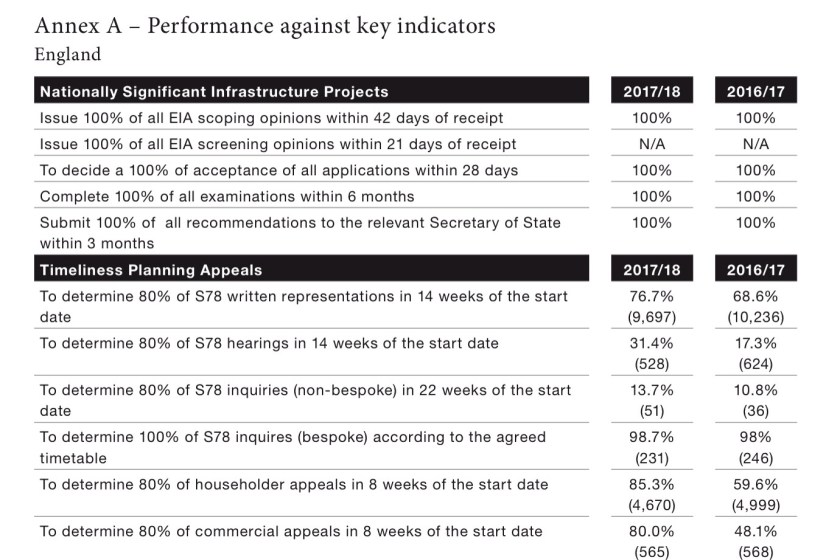
However, I am worried that all is not well. Current average performance timescales for appeals by way of written representations, informal hearings and inquiries are reported to be as follows, as at 20 March 2018:

– written representations are taking 24 weeks overall (with the first ten weeks being to start date)

– hearings are taking 36 weeks overall (with the first 17 weeks being to start date)

– inquiries are taking 49 weeks overall (with the first five weeks being to start date).

Whilst the numbers do not appear to be worsening materially over the last year or so, they are certainly not materially improving, at a time when you would think that the Government should be pulling every lever. Furthermore the most frustrating delays are between validation of the appeal and receipt of the ‘start date’ letter, which sets the procedural deadlines for the appeal process itself. Until the start date, you’re just sitting in the in-tray.

Whilst individual experiences are inevitably anecdotal, we are acting on one appeal, in relation to a scheme for around 70 apartments (refused by members against the officers’ recommendation), where an appeal was submitted on 14 December 2017, with the written representations appeal procedure requested, validated on 9 January and yet still no start date.

Not quite the flap of a butterfly’s wing, but I posted a frustrated tweet on 20 March commenting on the delay.

Various people responded to the tweet with their own similar recent experiences, which led Mark Wilding to write a good piece in Planning magazine on 28 March Why new inspectorate data substantiates complaints about lengthening appeal delay. That in turn for instance led to a former inspector writing to the magazine with his own speculation as to the reasons for the current problems.

After the Mark Wilding piece, I wrote on 3 April to Sarah Richards to provide more details about the particular appeal in case something could be done to unlock the continuing delay in obtaining a start date. Sarah responded very quickly on 6 April. She made clear that of course she could not intervene in the particular appeal but she took the opportunity to set out the challenges which PINS is currently facing. As she said in her response that she would do, she adapted the response into an open letter to Planning magazine which it published online on 12 April.

One particular passage in her letter was news to me:

The demand on our resources has been compounded by the unexpected receipt of more than 1,000 prior approval appeals for phone kiosks, and that number is likely to increase. Currently these have been absorbed into our normal planning appeal work, with consequent delays. We are now adopting a different model to process these appeals which will use our non-salaried inspectors, and this should release capacity back to mainstream work. This will have a positive impact on the overall time taken to determine appeals over the coming months.”

So one of the reasons that there are currently delays in the processing of appeals for housing and no doubt other forms of development is a deluge of prior approval appeals for phone kiosks??

Who uses a phone kiosk any more, I naively thought. Well of course advertising companies do, for a start.

I did a little digging and I now see that there is this huge drain on the resources of local planning authorities as well as PINS caused by somewhat of a gold rush.

The Local Government Association raised a concern earlier this year, LGA: call for crackdown on ‘trojan’ telephone boxes amid 900 per cent rise in some areas (27 January 2018).

Councils have been under sustained attack for some time from a variety of, usually pretty anonymous, companies, each with a licence to operate under the electronic communications code, each seeking approval for the erection of a large number of new style telephone kiosks. The main companies include such household names (not) as Maximus Networks Limited, Infocus Public Networks Limited, Euro Payphone Limited and New World Payphones.

Electronic communications code operators benefit from deemed planning permission for the installation of their telephone kiosks under Schedule 2, Part 16, Class A of the Town and Country Planning (General Permitted Development) Order 2015, subject to prior approval by the local planning authority of siting and appearance. Need, or the lack of it, is irrelevant (see for example a decision letter dated 14 November 2017 relating to an appeal in Hackney by Euro Payphone Limited).

Operators then have deemed consent under the Advertisement Regulations for non-illuminated advertisements on the kiosks, but often apply for express consent for illuminated advertisements (see for example a decision letter dated 12 January 2018 in relation to an appeal in Eltham by New World Payphones).

Councils often understandably seek to resist these proposals but it is clearly difficult. The BBC reported last June Westminster City Council’s rejection of 80 proposals by Maximus Networks Limited as well as proposals by other companies:

Councils block ‘ugly and unwanted advert space’ phone boxes.

Whilst the issue has raised concern in local areas and provoked comment, I have not tracked down any recent Parliamentary debate when plainly something is not quite right is it?

This from the ChiswickW4 website about Infocus Public Networks Limited (I haven’t verified its accuracy):

The phone boxes, which are wheelchair accessible, have been rejected by a number of local authorities, and critics say their primary purpose is for the display of advertising rather than making phone calls.

The Warwickshire-based company, Infocus Public Networks Ltd, applied for ‘prior approval’ to site the phone boxes on the pavement at 120, 96, 135 Chiswick High Road (outside Insider Dealings Interior Design , Sainsbury Local, and the former Ballet Rambert) .

Local authorities, including Hammersmith & Fulham, Kensington & Chelsea, and Westminster have all said ‘No’ to the kiosks on grounds of siting and appearance – the only grounds on which a local authority can refuse ‘prior approval’. Councils are not allowed to consider any advertising benefits which may accrue from the phone boxes as they are already the beneficiaries of ‘deemed consent’ from the regulatory body Ofcom.

Infocus, which describes itself as the UK’s third public payphone operator, has challenged a number of local authorities for refusing to allow the phone boxes in their area. An attempt by the company to install fifteen phone boxes in Swindon, which was turned down by Wiltshire council, was partly overturned by the Planning Inspector who ruled that nine phone boxes could be sited in the town streets.

The payphone kiosks use mobile telephony for connection to other networks and the company says there are no invasive pavement works involved. They say the large windows deter the use of the kiosks for antisocial and criminal activity, and that there is still a need for public payphones for tourists, and ethnic minorities and those in wheelchairs.

The old-style kiosks are not allowed to be installed because they do not comply with disability regulations from Ofcom. BT has also removed hundreds of kiosks from UK streets due to the growth of mobile phone use.

Wiltshire Council has asked the government to give local authorities greater powers over the control of advertising on public payphones, following the Inspector’s reversal of its decision, according to the Swindon Advertiser. The City of London also lost its attempt, on appeal, to prevent seven similar boxes in the Lambeth area.

Critics of the scheme say the phone boxes are a lucrative method of attracting commercial advertising to the company which installs them, and are not of any public benefit to disabled users as they take up more pavement surface than traditional kiosks and add to ‘street clutter’.

Incidentally Infocus has possibly the world’s least informative website.

These kiosks are prime advertising space as is clear from Clearchannel’s website.

Do these payphones serve a legitimate function? If they aren’t “for the purpose of the operator’s electronic communications network” the permitted development right doesn’t apply in the first place.And what of some data privacy concerns (according to a piece in Wired, Stop replacing London’s phone boxes with corporate surveillance which might be considered alarmist if we weren’t currently highly sensitised by the Facebook data mining scandal)? Doesn’t the Government need to form a view and quickly? In the meantime these applications and appeals (1,000 appeals!) risk jamming up the system, quite apart from unnecessarily cluttering our streets. Of course PINS needs to do what it can to avoid the problem contaminating its mainstream caseload but why should it be forced to employ external consultants, at taxpayer cost? If ever there were a case for appeal fees!

One of the roles of the PINS board is “ensuring the Planning Inspectorate delivers against its strategic objectives and ensuring sufficient resources are available to achieve those objectives”. A brief scroll through previous minutes of its meetings will demonstrate the level of scrutiny given to every aspect of its performance, although no reference yet to these wretched kiosk appeals! Trudi, you have a crucial role to play in ensuring that resources are correctly prioritised.

Simon Ricketts, 14 April 2018

Personal views, et cetera

Fawlty Powers: When Is A Permission Safe From Judicial Review?

A case last month arising from a howler of a permission for the erection of three marquees in the grounds of a hotel, a permission that was intended to be temporary but was issued without any condition to that effect, has potentially created a real mess. 
Pretty much the main thing that the commercial and financial world always wants from any consenting or licensing system, and certainly the planning system, is certainty as to when any necessary consent or licence, such as a planning permission, is free from legal challenge. Central to the legal due diligence work in relation to any operational business with a bricks and mortar presence, for instance in connection with its financing or acquisition, and certainly in relation to any property or development financing or acquisition, will be the need to report on the operative planning permissions and whether they are now beyond risk of being quashed by the courts. Once the judicial review period has passed, it is assumed that a permission can safely be relied upon, money can be lent or invested, properties or companies can be acquired. If the judicial review period has not yet expired, transactions will often be made conditional on its expiry without proceedings having been commenced. 

Judicial review periods are deliberately short so that we can all safely rely on public bodies’ decisions after a relatively short period. Compared with the six or twelve years’ limitation periods that are common in private law, the traditional principle in relation to judicial review is that proceedings must be brought promptly and in any event not later than three months after the grounds upon which the claim is based first arose (Civil Procedure Rules Part 54.4). 

In our planning world, time limits are usually even tighter:
– In relation to statutory challenges, for instance under section 288 of the Town and Country Planning Act 1990 for challenges of decisions of the Secretary of State and his inspectors on planning appeals and called-in planning applications, or under section 113 of the Planning and Compulsory Purchase Act 2004 for challenges of adopted development plans, the relevant time limit is six weeks. 
– Since 2013, the deadline for bringing judicial review proceedings in relation to other matters arising under the Planning Acts (care needed over that definition) is six weeks. 

But it isn’t quite as easy as assuming that, if these deadlines have passed, the relevant decision is free from any risk of judicial review. CPR rule 3.1 (2) (a) gives judges some discretion. Except where the rules provide otherwise, the court may “extend or shorten the time for compliance with any rule, practice direction or court order (even if an application for extension is made after the time for compliance has expired)“. 
A separate form needs to be submitted with the claim, asking for a time extension and explaining why it is justified. The Administrative Court Judicial Review Guide states:
The Court will require evidence explaining the delay. The Court will only extend time if an adequate explanation is given for the delay, and if the Court is satisfied that an extension of time will not cause substantial hardship or prejudice to the defendant or any other party, and that an extension of time will not be detrimental to good administration.
The Court of Appeal last year in Connors and others v Secretary of State (17 November 2017) stressed the extent to which the onus is on the claimant to justify being allowed to bring a claim out of time and waiting to learn the outcome of another case was not a sufficient ground:
“In the context of planning decision-making, this court has made it very clear that the exercise of judicial discretion to permit very late challenges to proceed by way of claims for judicial review will rarely be appropriate – regardless of whether the claimant has had available to him and acted upon legal advice (see the judgment of Sales L.J., with whom Lord Dyson M.R. and Tomlinson L.J. agreed, in R. (on the application of Gerber) v Wiltshire Council [2016] 1 W.L.R. 2593, at paragraphs 45 to 58).”
R (Gerber) v (1) Wiltshire Council (Court of Appeal, 23 February 2016) was a case I mentioned in my 24 March 2018 blog post Once More Unto The Breach Of Legitimate Expectation, Dear Friends. The claimant sought to challenge a planning permission for a solar farm project over a year after the permission had been issued. At first instance, Dove J had been persuaded to allow the claim, accepting that the delay was justified first because there had been a breach of legitimate expectation, established by the council’s statement of community involvement, that he would be consulted at application stage about the proposal and so had an excuse for not knowing about the permission being granted and secondly that part of the delay had been caused by a first firm of solicitors having given ‘incomplete’ advice as to his potential remedies. The parties all accepted that there were in fact errors with the permission which made it unlawful. 

The Court of Appeal rejected on the facts the SCI breach of legitimate expectation argument and thought that the abortive approach to the first firm of solicitors was not a sufficient excuse for the delay. Refusing to allow the claim to be brought out of time it took on board took into account that “substantial hardship or prejudice” would be caused to the solar farm operator, which in the meantime had built its facility:
“On 23 July 2014 Terraform completed an Initial Public Offering on the NASDAQ Global Select Market based on a prospectus listing Norrington as a project generating cash flow in the United Kingdom. Terraform and Norrington make the point in these proceedings that if the planning permission is quashed, that will harm the ability of companies seeking to invest in green energy generation in the United Kingdom to attract investors to fund such projects, because of the uncertainty whether they will be able to rely on planning permissions granted by planning authorities to carry out such developments even though they have gone without challenge within the time provided for in CPR Part 54.5 and indeed, as in this case, for a considerably longer period.”

“The evidence for Norrington and Terraform, the substance of which was accepted by the judge, is that if the planning permission is quashed and they are required to dismantle the solar farm, the cost of dismantling it and restoring the Site to agricultural use would be around £1.5 million. In addition, the cost of installing the solar farm of about £10.5 million would have been wasted and lost. In addition, a premium of £2000 paid for an option to take the lease and locked-in rental payments of approximately £36,300 under the lease would also be wasted.
Sales LJ  concluded: 

“In my judgment, where proper notice of an application for planning permission has been given pursuant to the 2010 Order it is not appropriate to extend time for bringing a legal challenge to the grant of such permission simply because an objector did not notice what was happening. Extending time in such a case so that a legal objection could be mounted by someone who happened to remain unaware of what was going on until many months later would unfairly prejudice the interests of a developer who wishes to rely upon a planning permission which appears to have been lawfully granted for the development of his land and who has prudently waited for a period before commencing work to implement the permission to ensure that no legal challenge is likely to be forthcoming, as happened here. Prompt legal action after grant of a planning permission to challenge its lawfulness will be required in all cases, unless very special reasons can be shown of a kind which are wholly absent in this case. Especial speed will be expected in the case of objectors who have been involved in the planning process throughout, as emphasised by Keene LJ in Finn-Kelcey at [24], but it does not follow that the strong requirement of prompt action will be substantially relaxed in the case of someone who, despite a planning authority’s compliance with the notification rules laid down in law, remained in ignorance.
The Court of Appeal did extend the time for bringing a claim in Croke v Secretary of State (Court of Appeal, 6 June 2017) which was, as so often, somewhat of a comedy of errors. Given that the deadline for lodging the claim was 23 March 2016, this is what happened:
“The Applicant, who is acting in person, wished to challenge the Inspector’s decision. He proposed to do so by issuing a section 288 claim in the Administrative Court Office at the Royal Courts of Justice, in person, on 23 March 2016. However, that day, he missed his train. Therefore, he emailed the relevant documents to a friend, Mr Miller, who was apparently located only a few minutes from the court; and he asked him to file the claim. It is the Applicant’s case, accepted by the judge below for the purposes of the application before her and by Mr Mills for the Secretary of State today, that Mr Miller arrived at the Royal Courts of Justice at 4.25pm; but, although the advertised closing time for the court was 4.30pm, he was refused entry at the main front entrance of the building, the security guard there informing Mr Miller that the counters were closed.

The following day, Thursday 24 March, the Applicant personally attended the Administrative Court Office, where he arrived at 3.30pm. It was Maundy Thursday and, for the court office, the last working day before the Easter break. Due to the volume of people in the queue, he was not seen until about 5pm, when he was informed by a member of staff that he had used an out-of-date claim form, and he would need to complete a different form. He was given a copy of the new form, and he asked if he could complete it there and then. He was told that he would have to return the next working day. The following day was Good Friday, and the next day upon which the court office was open was Tuesday 29 March. The Applicant attended the Administrative Court Office that day, and filed the claim.”


The court at first instance struck out the claim as out of time. The Court of Appeal however granted permission to Mr Croke to appeal, taking into account that there did not appear to be any legal authority applying to these precise facts:
“Having considered the ground of appeal with particular care – and not without some hesitation – I am persuaded that this appeal is arguable, particularly given the absence of authority on this point. It is also noteworthy that this issue affects not just section 288 claims, but a variety of proceedings where there are strict time limits. Therefore, although the Applicant himself accepts that the merits of his particular case may not be the strongest or attract great sympathy, the issue of principle involved does or may have some broader importance.”
(I don’t know what then happened with Poor Mr Croke’s claim. Deadlines, the risk of missing or incorrect paperwork (or an incorrectly drawn cheque), reduced court hours for filing out of court terms and the current long queues at the Royal Courts of Justice to file claims all combine to give solicitors nightmares – clients, please don’t leave it to the last moment!). 
All this brings us to last month’s case, R (Thornton Hall Hotel Limited) v Wigan Metropolitan Council (Kerr J, 23 March 2018).
The claimant operates Thornton Hall Hotel and the interested party, Thornton Holdings Limited, operates Thornton Manor. The hotels are competitors for wedding bookings and other functions. 

On 7 September 2011 Wigan Council’s planning committee resolved to grant planning permission for three marquees to be erected in the grounds of Thornton Manor. The hotel is in the green belt (as well as being listed grade II* – any Fawlty Towers references in this blog post are by the way wholly inappropriate as will be seen from the above image, courtesy of hitched.co.uk). According to the judgment the committee resolved that very special circumstances existed to allow for the erection of the marquees for a limited period of five years so as to secure “the “generation of an income stream” to enable restoration of the gardens, which were in decline and at risk“. The proposed permission with appropriate conditions was drafted. Indeed, a draft in that form was annexed to a section 106 agreement that was entered into on 11 November 2011. However, the actual permission that was issued on 20 December 2011 and placed on the council’s website omitted any conditions whatsoever, no restriction to five years, no nothing. 
The agent for Thornton Holdings cottoned onto this immediately and said nothing. However the problem was it seems not apparent to the council until the five years period expired and the marquees were not dismantled. The council took a report to committee in July 2017 accepting that a mistake had occurred. A little over a month later (and almost six years after the decision complained of, ie the issue of the incomplete permission) Thornton Hall Hotel Limited brought its proceedings, which were not opposed by the council – so the hearing was purely hotel versus competitor hotel. 
Kerr J allowed the late challenge, and quashed the permission, for nine reasons:
1. The error had been made in issuing the flawed permission. 
2. Permanent permission would not granted and would not have been in the public interest. 
3. “If the marquees are now allowed to stay permanently, the proper operation of the planning process will have been subverted.”
4. That would be contrary to the public interest. 

5. The interested party was aware of the error. 

6. “it follows that the interested party ran its commercial operation at Thornton Manor from 22 December 2011 knowing that the presence of the marquees after 19 December 2016 would be, at the very least, a matter of possible controversy and possible legal challenge. It was not, in my judgment, realistic to rely on expiry of the three month limitation period without also bringing the issue into the open, which the interested party decided not to do.”

7. It follows that the interested party cannot say that it would be prejudiced by the quashing due to lost bookings. 

8. “it is said by the interested party that it would be detrimental to good administration if the marquees have to be removed. Normally, detriment to good administration in public law cases relates to the undesirability of interfering with the provision of public services rather than commercial interests. I see no detriment to good administration in rectifying the error. I think it is detrimental to good administration that the marquees are still there. Good administration includes correct implementation of planning decisions.”

9. “the interested party signed the section 106 agreement embodying the omitted conditions including the five year time limit. Yet, it proceeds in this litigation as if it were not bound by the terms of that agreement. That seems to me only to compound the unconscionability of its position. It undertook in private law the same obligations as it denies in public law.”

As they say, hard cases make bad law. Whilst clearly no-one should have any sympathy for the interested party, which saw that it had by luck gained something it never deserved, there are really serious repercussions and I can’t see that other factors were taken on board by the judge, for instance:
1. There is no discussion of the public interest in being able to rely on permissions once free from legal challenge. When acting on the acquisition of properties or businesses, what do we now need to do to ensure that our client isn’t going to find that its permission is similarly flawed? Sometimes it will not be at all obvious. Does the permission, even if many years old, need to be checked against the resolution to grant? What about other latent flaws in it?
2. Surely, the council should have sought a revocation or modification order. No doubt it would have had to pay substantial compensation to Thornton Holdings but is that relevant? The permission was on the website and could have been challenged within the deadline. No-one challenged it (and why indeed should it be down to a competitor to spend money at risk on a challenge? What if it hadn’t?). It used to be considered that authorities, in considering whether to make a revocation or modification order, couldn’t take their potential compensation liability into account. To my mind it was a sad day when that changed as a result of the Supreme Court’s ruling in Health & Safety Executive v Wolverhampton City Council (Supreme Court, 18 July 2002). As a result, revocation and modification orders are almost unused. 

3. There are of course many examples of flawed permissions which authorities issued in error where hitherto the possibility of a late challenge does not appear to have been considered. (See some of them in my 14 October 2017 blog post Flawed Drafting: Interpreting Planning Permissions). Is this ruling, even if only slightly, going to open the floodgates, particularly in relation to the errors that most frequently occur on section 73 permissions where it turns out that previous restrictive conditions have been lost, for example as to the types of goods that may be sold from a retail park?

Does anyone knows whether an application for permission to appeal has been made? I would welcome views as to how we all take on board the practical implications of this case. Or do we simply regard it as turning on fairly extreme facts? I’m not so sure. 

Simon Ricketts, 7 April 2018

Personal views, et cetera


No conditions, you say?”

Green Belt Developments

This month’s green belt news: two Court of Appeal rulings, a Secretary of State decision letter and of course the draft revised NPPF.
Brown v London Borough of Ealing (Court of Appeal, 23 March 2018) was a judicial review of a local authority’s grant of planning permission for a first team training and academy facility for Queen’s Park Rangers, sports pitches, community facilities and associated development at Warren Farm Ealing, on metropolitan open land (where of course green belt policy tests apply).

One of the two grounds of challenge was “whether the officer’s conclusion, accepted by the committee, that “very special circumstances” existed to justify the grant of planning permission for “inappropriate development” on Metropolitan Open Land was bad in law“. 
Paragraph 88 of the current NPPF states:
When considering any planning application, local planning authorities should ensure that substantial weight is given to any harm to the Green Belt. ‘Very special circumstances’ will not exist unless any potential harm to the Green Belt by reason of inappropriateness, and any other harm, is clearly outweighed by other considerations.”
Following Redhill Aerodrome Ltd. v Secretary of State for Communities and Local Government (Court of Appeal, 24 October 2014), it is well established that the expression “any other harm” does not just mean any other harm to the green belt but takes in non- green belt factors as well. The question for the court in Brown was whether the officer had taken this correctly on board. It was submitted by the claimant that the structure of the officer’s conclusions suggested that she had either excluded non green belt harm such as loss of public access or that she had double-counted by concluding that the proposed improvements to community facilities would balance out that harm, when she had already taken into account the same factor as part of the “very special circumstances” arising. The court disagreed. The report had to be interpreted “with reasonable benevolence and realism, and not in an overly legalistic way“. The officer had properly applied the approach that the Redhill judgment requires and on the double-counting point:

“In principle, it is possible for a particular factor to be relevant, and to carry appropriate weight, in the consideration of more than one planning issue. It may serve to avoid or overcome or, at least, outweigh some real or potential planning harm, and it may also satisfy some planning need that would otherwise go unmet”

“This was not, in any sense, “double-counting”. Rather, the officer’s conclusions point up the two-fold relevance of the improvement to recreational facilities at Warren Farm as a material consideration – to which appropriate weight had to be given in two respects, not merely in one. The officer was entitled to conclude, as a matter of planning judgment, that in the context of “Public Access”, given the availability of other publicly accessible open space nearby, the balance of relevant benefit – improved sports facilities for the local community – against disadvantage – the “loss” of public access for recreation – fell in favour of the development. I do not accept that this benefit was immaterial in that particular context; it was, I think, plainly a relevant consideration there. The officer was also entitled to conclude, again as a matter of planning judgment, that in the “very special circumstances” balance itself, the ability of the development to meet a need identified in development plan policy – the general need for investment in improved sports facilities, and specifically the need for such investment at Warren Farm – was a consideration to which weight should be given on the positive side of that balance. These conclusions were not in tension or conflict with each other. They were distinct from each other, but mutually consistent. They do not show a material consideration being given double weight, only a single factor being given due weight in two different respects: first, outweighing a “loss” that would be caused by the development itself; second, meeting an existing need that would not be satisfied without the development.”
Samuel Smith Old Brewery (Tadcaster) Limited v North Yorkshire CC (Court of Appeal, 16 March 2018) was the latest piece of litigation instigated by Yorkshire brewer and serial litigator Humphrey Smith. This time the target of Mr Smith’s attention was a planning permission granted for the extension of a limestone quarry in the green belt about a mile from Tadcaster. The claimant argued that the council had misapplied paragraph 90 of the NPPF, which states mineral extraction is not “inappropriate development” in the green belt if it preserves the openness of the green belt. 
The officer had approached the question of “openness” in this way:
“It is considered that the proposed development preserves the openness of the Green Belt and does not conflict with the purposes of including land within the Green Belt. Openness is not defined, but it is commonly taken to be the absence of built development. Although the proposed development would be on existing agricultural land, it is considered that because the application site immediately abuts the existing operational quarry, it would not introduce development into this area of a scale considered to conflict with the aims of preserving the openness of the Green Belt.

In terms of whether the proposed development does not conflict with the purposes of including land within the Green Belt, the proposed quarrying operations are not considered to conflict with the purposes of including land within the Green Belt. Equally, it is not considered that the proposed development would undermine the objective of safeguarding the countryside from encroachment as it should be considered that the site is in conjunction with an operational quarry which will be restored. The proposed development is a temporary use of land and would also be restored upon completion of the mining operations through an agreed DRMP.

The purposes of including land within the Green Belt to prevent the merging of neighbouring towns and impacts upon historic towns are not relevant to this site as it is considered the site is adequately detached from the settlements of Stutton, Towton and Tadcaster. It is also important to note that the A64 road to the north severs the application site from Tadcaster.”
The court found that this was indeed a misinterpretation of paragraph 90:
“The concept of “the openness of the Green Belt” is not defined in paragraph 90. Nor is it defined elsewhere in the NPPF. But I agree with Sales L.J.’s observations in Turner to the effect that the concept of “openness” as it is used in both paragraph 89 and paragraph 90 must take its meaning from the specific context in which it falls to be applied under the policies in those two paragraphs. Different factors are capable of being relevant to the concept when it is applied to the particular facts of a case. Visual impact, as well as spatial impact, is, as Sales L.J. said, “implicitly part” of it. In a particular case there may or may not be other harmful visual effects apart from harm in visual terms to the openness of the Green Belt. And the absence of other harmful visual effects does not equate to an absence of visual harm to the openness of the Green Belt.

As a general proposition, however, it seems to me that the policy in paragraph 90 makes it necessary to consider whether the effect of a particular development on the openness of the Green Belt can properly be gauged merely by its two-dimensional or three-dimensional presence on the site in question – the very fact of its being there – without taking into account the effects it will have on the openness of the Green Belt in the eyes of the viewer. To exclude visual impact, as a matter of principle, from a consideration of the likely effects of development on the openness of the Green Belt would be artificial and unrealistic. The policy in paragraph 90 does not do that. A realistic assessment will often have to include the likely perceived effects on openness, if any, as well as the spatial effects. Whether, in the individual circumstances of a particular case, there are likely to be visual as well as spatial effects on the openness of the Green Belt, and, if so, whether those effects are likely to be harmful or benign, will be for the decision-maker to judge. But the need for those judgments to be exercised is, in my view, inherent in the policy.

The first part of the question posed by the preamble in paragraph 90 – whether the development would “preserve” the openness of the Green Belt – cannot mean that a proposal can only be regarded as “not inappropriate in Green Belt” if the openness of the Green Belt would be left entirely unchanged. It can only sensibly mean that the effects on openness must not be harmful – understanding the verb “preserve” in the sense of “keep … safe from harm” – rather than “maintain (a state of things)” (Shorter Oxford English Dictionary, 4th edn.). There may be cases in which a proposed development in the Green Belt will have no harmful visual effects on the openness of the Green Belt. Indeed, there may be cases in which development will have no, or no additional, effect on the openness of the Green Belt, either visual or spatial. A good example might be development of the kind envisaged in the fourth category of development referred to in paragraph 90 of the NPPF – “the re-use of buildings provided that the buildings are of permanent and substantial construction”. But development for “mineral extraction” in the Green Belt, the category of development with which we are concerned, will often have long-lasting visual effects on the openness of the Green Belt, which may be partly or wholly repaired in the restoration phase – or may not. Whether the visual effects of a particular project of mineral working would be such as to harm the openness of the Green Belt is, classically, a matter of planning judgment.

In my view, therefore, when the development under consideration is within one of the five categories in paragraph 90 and is likely to have visual effects within the Green Belt, the policy implicitly requires the decision-maker to consider how those visual effects bear on the question of whether the development would “preserve the openness of the Green Belt”. Where that planning judgment is not exercised by the decision-maker, effect will not be given to the policy. This will amount to a misunderstanding of the policy, and thus its misapplication, which is a failure to have regard to a material consideration, and an error of law.”
Or as Zack Simons summarised:

The planning permission was quashed.
Aside from these two Court of Appeal rulings, throwing light on paragraphs on paragraphs 88 and 90 of the NPPF respectively, it was also interesting to see this month the Secretary of State allow an appeal by Berkeley Homes (Southern) Limited and Howard Partnership Trust for substantial development in the green belt, comprising 258 homes and replacement secondary school in Effingham, Surrey. In his decision letter (21 March 2018) the Secretary of State’s findings included that:

– There is a need for additional school places in the area, “the existing school premises are not fit for the purpose of meeting modern educational and social need and that the replacement of the school in order to facilitate this carries very substantial weight“. Furthermore, “there are very significant issues with the fabric of the school and the ongoing funding of its repair and maintenance in the current budgetary context. He further agrees that in seeking to address condition as well as suitability and sufficiency, the least expensive option is the rebuilding of the school on the only other available identified site, and that these matters carry very substantial weight.”
– An Autism Centre “optimally located within the new complex to maximise its effectiveness for the students who will use it, … is a clear benefit of the scheme and to deepening the educational and community inclusivity of the school.”

– Guildford Borough Council only has a 2.1 year housing land supply. Against this the Secretary of State considered that the delivery of dwellings, 20% of which will be affordable, carries very substantial weight. 

He concluded that the benefits arising from the scheme “clearly outweigh harm to the Green Belt by reason of inappropriateness and any other harm, and so very special circumstances exist” for the purposes of paragraphs 87 and 88 of the NPPF. 
The inclusion of reference to the extent of unmet housing need in Guildford as part of the very special circumstances relied upon is encouraging, but the need to replace the school and provide more school places was a crucial component, given that the Government has indicated since 2013 that unmet housing need alone is not sufficient to amount to very special circumstances, a stance that is presently unlikely to change. Indeed, at the end of a House of Commons debate debate on 6 February 2018 on housing, planning and the green belt, there was this exchange between Dominic Raab and a backbench Conservative MP:

This was of course followed by publication on 5 March of the draft revised NPPF (NPPF 2.0 for hipster-planners). Has it made any difference to any of what I have set out above? Well, slightly:
– paragraph 88 is now paragraph 143 and after the words “any other harm” is added “resulting from the proposal“. This is an additional pointer towards the Court of Appeal’s wider interpretation of that phrase as per Redhill and now Brown. 
– paragraph 90 is now paragraph 145 with unchanged wording, although within paragraph 144 there is an important extra category of development that is not “inappropriate” and where “very special circumstances” therefore do not need to be shown”: “where the development would re-use previously developed land and contribute to meeting an identified local affordable housing need, not cause substantial harm to the openness of the Green Belt. ” – this “not cause substantial harm” is going to be the new battleground I’m sure. There is also a clarification of the previous statement that “the provision of appropriate facilities for outdoor sport, outdoor recreation” etc is not “inappropriate development”. The wording is now “the provision of appropriate facilities (in connection with the existing use of land or a change of use) for” those uses”, following the approach already adopted by the courts, eg in R (Timmins) v Gedling Borough Council (Court of Appeal, 22 January 2015).
The “exceptional circumstances” test for changing green belt boundaries in plans has been embellished (as flagged since the February 2017 housing white paper) by requiring that “the strategic plan-making authority should have examined fully all other reasonable options for meeting its identified need for development. This will be assessed through the examination of the plan, which will take into account the preceding paragraph, and whether the strategy; 

* a)  makes as much use as possible of suitable brownfield sites and underutilised land; 


* b)  optimises the density of development, including whether policies promote a significant uplift in minimum density standards in town and city centres, and other locations well served by public transport; and 


* c)  has been informed by discussions with neighbouring authorities about whether they could accommodate some of the identified need for development, as demonstrated through the statement of common ground.”


“Where it has been concluded that it is necessary to release Green Belt land for development, plans should give first consideration to land which has been previously-developed and/or is well-served by public transport. They should also set out ways in which the impact of removing land from the Green Belt can be offset through compensatory improvements to the environmental quality and accessibility of remaining Green Belt land.”

Will this embellishment raise the threshold materially for green belt release? I’m not sure that the additional criteria do anything more than articulate the matters that would be examined in any event. The removal of some brownfield proposals, which will not cause substantial harm to the openness of the green belt, from the definition of inappropriate development is on the other hand potentially significant (and surely wholly sensible). As for the constant flow of case law, it is certainly not going to dry up. 
Simon Ricketts, 30 March 2018
Personal views, et cetera


Once More Unto The Breach Of Legitimate Expectation, Dear Friends

Life can be tough. A public authority may have complied with the letter of the law but by its actions you feel that you have been treated unfairly. 
Of course, complying with what the legislation strictly requires is not the limit of an authority’s legal responsibilities. The authority also must comply with wider principles of administrative law, which include:
– not making a decision which is irrational (very difficult to persuade a court that a decision is irrational)
– not having a closed mind (challenges of local planning authorities these days on that ground have been made more difficult by section 25 of the Localism Act 2011)

– a basic duty of procedural fairness, which includes a “duty of consultation…where there is a legitimate of such consultation, usually arising from an interest which is held to be sufficient to found such an expectation, or from some promise or practice of consultation.” (Lord Reed in R (Moseley) v London Borough of Haringey (Supreme Court, 24 October 2014).

Given that estoppel (eg holding a planning officer to an assurance that they may have given you) really has very little place in the planning system since R v East Sussex County Council, ex parte Reprotech (Pebsham) Ltd (House of Lords, 28 February 2002), there have inevitably been many attempts to persuade the courts that there has been procedural unfairness – that there has been a breach of a legitimate expectation that you would be consulted before the authority takes a particular decision. 
The purpose of this blog post is simply to make the obvious point that it isn’t that easy. The courts draw the concept very tightly. 
The most comprehensive recent summary of the principles of procedural and substantive legitimate expectation in our little planning law world is set out by Dove J in Richborough and others v Secretary of State (12 January 2018), the written ministerial statement case, where various house builders and land promoters sought to argue that on the basis of the Government’s “regular past practice, there was a legitimate expectation that the defendant would consult the house building industry in relation to:


a. any change to National Planning Policy for housing, or alternatively, 


b. any major change for National Policy for housing or, alternatively,


c. any major change to the policy pertaining to five year housing supply in national policy.”

Dove J reviewed the case law and identified from a Court of Appeal ruling, Bhatt Murphy v Independent Assessor (2008), that for procedural legitimate expectation (the right to be consulted before a decision or policy change) there has to be “an unequivocal assurance, whether by means of an express promise or an established practice, that it will give notice or embark upon consultation...”. For substantive legitimate expectation (the right to compel the authority to continue a policy rather than change or abolish it) there is the additional requirement that the court will have to “decide whether to frustrate the expectation is so unfair that to take a new and different course will amount to an abuse of power“. 
Unequivocal” is a high threshold. In Richborough, Dove J found that “the evidence does not establish that there has been an unequivocal assurance on the basis of practice that a WMS in relation to national planning policy for housing would not be issued without prior consultation. It is clear that on at least two occasions the defendant has issued WMS without consultation affecting national planning policy for housing. Thus I am unconvinced on the evidence that the claimants have established a legitimate expectation that they would be consulted on the WMS.”
This month, procedural legitimate expectation was sought to be relied upon as a ground of challenge in Kebbell Developments Limited v Leeds City Council (Court of Appeal, 14 March 2018). Here, the challenge was to Leeds City Council’s modifications made, without consultation, to a neighbourhood plan following receipt of the inspector’s report and before putting it to a referendum. The unfortunate owners of a development site potentially prejudiced by the additional wording introduced sought to argue without success that there was a legislative requirement for consultation with an additional argument that not to consult would in any event be procedurally unfair. The Court of Appeal rejected all grounds. Lindblom LJ gave the main judgment but Singh LJ (elevated to the Court of Appeal last year and with a formidable public law background) gave an additional judgment, which includes a useful analysis of the duty to consult, dividing it into two types:
– “procedural fairness in the treatment of persons whose legally protected interests may be adversely affected” (which is what we have been looking at so far in this blog post). He doesn’t see this strictly as a duty of consultation:
Procedural fairness in the former context is really the modern term for what used to be called “natural justice”, in particular the limb of it which used to be called audi alteram partem (“hear the other side”). Public law no longer talks of “judicial” or “quasi-judicial” disputes and so even the notion of a “hearing” seems inapt now but the fundamental requirement of procedural fairness is to give an opportunity to a person whose legally protected interests may be affected by a public authority’s decision to make representations to that authority before (or at least usually before) the decision is taken. To refer to “consultation” in that context is not wrong as a matter of language but I think it would be better to avoid using it in that context, so as to avoid confusion with the sense in which it is used in the context of public participation in a public authority’s processes for making policy or perhaps some form of legislation such as rules.”
– “public participation in a public authority’s decision-making process“, where the source of the authority’s obligation will very often be legislation. (Although not always, it seems to me, eg cases in relation to authorities’ statement of community involvement – authorities fail to comply with their SCI at their peril). 
It seems to me that this constrains the ambit of the breach of legitimate expectation principle even further. 
The Court of Appeal may conceivably return to the question of legitimate expectation before long, given that according to Landmark Chambers the court has given permission for an appeal in R (Save Britain’s Heritage) v Secretary of State (Lang J, 29 November, 2017). This was the challenge to the Secretary of State’s decision not to call in the Paddington Cube application for his own determination. As set out in the judgment, Save argued that the “decision was unlawful because he failed to give reasons for not calling in the applications, in breach of the Claimant’s legitimate expectation that reasons would be given. The legitimate expectation arose from a change in practice, announced in a Green Paper and in Parliament in December 2001. Thereafter, ministers began to give reasons for not calling in planning applications, when previously they had not done so.
Lang J had rejected the claim:
“In this case, in 2001, a new practice of giving reasons for non-intervention was introduced by the then minister, and it was clearly and unequivocally announced in the Green Paper, and in Parliament. In my view, this could well have given rise to a legitimate expectation that reasons would be given for non-intervention, if it had remained in operation. A failure to give reasons in accordance with the established practice could have been a potential breach of the legitimate expectation, and thus unlawful unless justified. 


However, by the date of the Claimant’s application to the Defendant in December 2016 and the Defendant’s decision in March 2017, there was no longer an established practice that reasons would be given for a decision not to call in an application. On the contrary, the established practice was that reasons would not be given. I consider that the earlier statements and practice relied upon by the Claimant had been superseded by 2016/2017 and so could no longer found an expectation that reasons would be given. If any such expectation was held, it had ceased to be a legitimate one, because of the change in practice.”

Despite permission to appeal having been given, I wonder whether Save will proceed. According to the Landmark summary it seems that the court has made clear that even if the challenge is successful it will not result in the quashing of the permission which Westminster City Council has now issued. What is sought is also a classic example of a substantive rather than procedural legitimate expectation – ie not that the claimant should have been consulted, but that the defendant should not have changed its policy, which engages the additional test I set out earlier. 
Two earlier failed claims by way of example:
In R (Leicestershire Police and Crime Commissioner) v Blaby DC (Foskett J, 27 May 2014) a police force tried to argue that it had a legitimate expectation of further consultation in relation to planning obligations, from which it would benefit, before a section 106 agreement was completed. 
The judge said this:
“There is, of course, a good deal of authority on the issue of legitimate expectation. I am quite prepared to accept for present purposes that a course of dealing between two parties in the kind of context with which this case is concerned can in some circumstances give rise to a legitimate expectation that some particular process will be followed by the public authority the subject of the challenged decision before the decision is taken. The course of dealing can be on such a basis that the necessarily “clear and unambiguous” representation upon which such an expectation is based may arise.

Did anything of that nature arise in this case? I do not think so. What one can see from the communications to which I have referred is a pattern of negotiation, in effect between the Claimant and the developers with the Defendant as the intermediary, where no unequivocal representation was made by the Defendant that could have led to an expectation that it would be consulted “on the level of and timing of the delivery of the contribution”. That having been said, however, there can be little doubt that the Defendant was aware of the Claimant’s view on the timing of the premises contribution which, in one sense, was the most significant part of what was required by way of infrastructure funding. The equipment contribution was discussed and the police could have given “chapter and verse” on that if they had chosen to do so prior to the final discussions between the Defendant and the developers. However, I do not see any basis for a specific obligation on the Defendant’s part to inquire about that.”
A second failed example, this time as to substantive legitimate expectation, in R (on the application of Godfrey) v Southwark LBC (Court of Appeal, 24 April 2012):
The claim is based on the council’s failure to give effect to an understanding in relation to the provision of a community centre as a part of the proposed development. It was submitted that the council has failed to take account of a material planning consideration, the project brief, and that the council has not implemented its own policy 7P. Further, there was a substantive legitimate expectation that better facilities would be provided than have been provided by the permission. Reliance is placed on documents issued by the council in 2002 and 2003 and discussions which took place at that time between council officers and local residents.

Again, on the facts the claim was rejected. 

All of this is not to say that a breach of legitimate expectation claim will never succeed. In R (Majed) v London Borough of Camden (2010), the Court of Appeal held that a local planning authority‘s statement of community involvement gave rise to a legitimate expectation that the consultation set out in it (which was additional to the statutory minimum) would be carried out. The Court held that legitimate expectation came into play when there was a promise or a practice to do more than that which was required by statute and that the statement of community involvement issued by the local authority was a “paradigm example” of such a promise and practice.

This was revisited in R (Gerber) v Wiltshire Council (Court of Appeal, 23 February 2016), although, as so often, the claim failed on the facts:
“40. With respect to the judge, I accept the submission of the appellants that he erred in his ruling that on its proper interpretation the SCI contained an unambiguous promise to consult Mr Gerber directly about the application for planning permission, which the Council failed to honour. The judge arrived at this conclusion by running together para. 5.6 of the SCI with the summary of the position in Appendix 1 to the SCI, set out above. In my judgment, however, on a proper interpretation of the SCI the relevant policy is that set out in para. 5.6, and it cannot be said that it is possible to read that in conjunction with Appendix 1 in order to spell out a clear and unambiguous promise in accordance with the relevant standard in MFK Underwriting Agencies that any neighbour affected by an application for planning permission would be consulted directly by the Council.
41. Paragraph 5.6 of the SCI is clearly set out within that document as the relevant policy for consultation of neighbours. It is expressly directed to consultation of the owners of properties adjoining sites for proposed development. Gifford Hall does not adjoin the Site in the present case, so Mr Gerber could not bring himself within the scope of para. 5.6.

42. In my view, it is not possible to say that the text in Appendix 1 leads to the conclusion that the SCI contains a clear and unambiguous promise that anything more extensive will be done by the Council by way of consultation: (i) para. 5.6 is drafted in precise terms which conflict with the wider interpretation which the judge sought to spell out of the SCI, so at best (from Mr Gerber’s point of view) there is an ambiguity in the SCI; but in any event, (ii) para. 5.6 is highlighted in the main text of the SCI and clearly identifies the content of the relevant policy in the SCI, so it must be regarded as setting out the definitive statement of what the Council promises to do; and (iii) Appendix 1 to the SCI, although poorly drafted, is not part of the main text of the document and does not purport to set out definitive policy promises or to qualify the main text of the SCI, but only sets out a summary of different options to make broad comparisons between them. 

43. Although the proper interpretation of the SCI is an objective matter for the court and the way in which the parties may have read the SCI is in no way definitive, I think it is fair to point out that in the letter of 22 April 2014 Mr Gerber and his then solicitors identified para. 5.6 in the SCI, and not Appendix 1, as containing the relevant statement of policy by the Council. In my opinion, they were correct to do so.

44. There was, therefore, no breach of legitimate expectation by the Council. Mr Gerber says that other non-adjoining properties received individual notifications of the application for planning permission, but the Council has given an explanation why that happened which appears reasonable. The important point for present purposes, however, is that whether the Council’s explanation is accepted or not, this feature of the case does not support Mr Gerber’s legitimate expectation submission, founded as it is on what he maintains the Council promised in the SCI itself.”

When you feel wronged, as undoubtedly all of these claimants did, it can be tempting to expect your lawyer to raise sword of justice above head and invoke the spirit of Henry V, Act III, Scene 1, and not very Shakespearean to be talking of proceeding with caution, but what you definitely need is unequivocal assurance in more ways than one. 

Simon Ricketts, 24 March 2018
Personal views, et cetera

Permitted Development: À La Recherche Du Temps Perdu

Feeling a little Proustian après MIPIM? Where did that time go?
Some minor changes have been made this month to PD rights, more significant changes are possibly still to come and some existing PD rights remain controversial.
The minor changes
The Town and Country Planning (General Permitted Development) (England) (Amendment) Order 2018 was made on 8 March 2018 and comes into force on 6 April 2018. It makes various detailed amendments to the existing regime, the most significant ones being:

– Extending the existing temporary right to change use of a building from a storage or distribution centre to a dwellinghouse, which was shortly to expire. The prior approval date must be by 10 June 2019 and the change of use must be completed within three years of the prior approval date. 
– Expansion of the permitted development right to change the use of agricultural buildings to dwellinghouses such that the maximum amount of floorspace that may be converted is increased from 450 sq m to 465 sq m and up to five dwellinghouses may be created from that floorspace rather than three. 

– Enabling the Secretary of State to pause the 28 day period for prior approval where he is considering calling in an application for his own determination. 

The more significant possible further changes
In my 15 June 2016 blog post Permitted Development: What Next? I speculated as to whether two further permitted development rights would be created, which the Government had previously contemplated, namely:

– Office demolition and residential rebuild
– Upward extensions in London
21 months later, the position is still uncertain in relation to both proposals. If they are introduced their scope could well be wider than initially envisaged, but will they? More lost time if they are introduced and prove to be successful in increasing housing supply. 
We had heard nothing on office demolition and residential rebuild since Brandon Lewis’ October 2015 announcement, and it was assumed that the idea was dead, until the unexpected announcement in the Autumn 2017 budget policy paper that “the government will consult on introducing… a permitted development right to allow commercial buildings to be demolished and replaced with homes“. 
Was the reference to “commercial buildings” intentionally wider in scope than just offices? What would be the prior approval requirements? Would there be a floorspace cap? I had hoped for an update alongside the draft revised NPPF announcements in February or alongside the Spring budget statement this month but still we wait. 
Similarly, we had heard nothing about the proposed PD right for upward extensions in London since a joint Mayor of London/DCLG consultation paper in February 2016. The ministerial policy statement on 5 February 2018 appeared to make it clear that the initiative (now across England, not just London) would be dealt with by policy, within the NPPF. But then Sajid Javid’s speech launching the draft revised NPPF on 5 March 2018 had this passage:
And there are also other areas in which we’re ready to go further to take the delivery of housing up a gear.

Including a new permitted development right for building upwards to provide new homes.”
I’m left scratching my head in relation to both proposals, frankly. 

Office to residential and other existing PD rights
The office to residential permitted development right remains controversial. Undoubtedly it has delivered in terms of increasing housing stock, although with a free ride for developers in terms of affordable housing and other contributions and in some areas jeopardising the stock of office floorspace. Quality of the conversions has been variable. But, in a housing crisis, has the end justified the means?
The Local Government Association published some campaigning research One in 10 new homes was a former office against the right on 18 January 2018.  

The current areas exempted from the right will lose that exemption from 31 May 2019 and many authorities are taking steps to remove it in any event by way of Article 4 Direction, for instance recently Westminster City Council (see its 26 January 2018 report to cabinet). Indeed, policy SD5 F of the draft London Plan supports that approach:
The Mayor will work with boroughs and support them to introduce Article 4 Directions to remove office to residential permitted development rights across the whole of the CAZ and the Northern Isle of Dogs (and those parts of Tech City and Kensington & Chelsea lying outside the CAZ)
It will be interesting to see how this tension with national policy is addressed at the examination into the draft plan.
In the meantime, inevitably given the complexity now of the PD rights regime and its advantages for developers in many situations over the traditional planning applications procedure, we have seen an increase in litigation as to the nuts and bolts of the prior approval procedure. 

Most recently, in R (Marshall) v East Dorset District Council (Lang J, 13 February 2018), prior approval for the erection of an agricultural building was quashed on the basis that the PD right excluded buildings for the accommodation of livestock, whereas the application for prior approval had indicated that one of the proposed uses of the building was to “winter house 45 ewes and their lambs through the winter period“!
Last year’s decision in Keenan v Woking Borough Council (Court of Appeal, 16 June 2017) is also interesting, on a similar theme, making clear that where the authority fails to respond to an application for prior approval within 28 days, such that there is a deemed prior approval, if the proposed development did not fall within the criteria of the relevant part of the General Permitted Development Order it does not as a result of the deemed approval become “permitted development”. 
Accordingly, whether or not you have prior approval, or deemed prior approval, your proposed development still needs to fit within all of the relevant restrictions and thresholds within the Order. 
To end with M Proust:
“...loopholes opened by disappointment. Dreams are not to be converted into reality, that we know; we would not form any, perhaps, were it not for desire, and it is useful to us to form them in order to see them fail and to be instructed by their failure.”
Simon Ricketts, 17 March 2018
Personal views, et cetera

Developer Contributions, CIL, Viability: Are We Nearly There Yet?

Bookends to this last week:
On Monday 5 March 2018 the draft revised NPPF , accompanying consultation proposals document and the Government’s response to the housing white paper consultation were all published, as well as the two documents I’ll focus on in this blog post:
Supporting housing delivery through developer contributions: Reforming developer contributions to affordable housing and infrastructure (which also addresses proposed reform to CIL); and 

Draft Planning Practice Guidance for Viability 
On Friday 9 March 2018 Draft Planning Practice Guidance: Draft updates to planning guidance which will form part of the Government’s online Planning Practice Guidance was published. 

The draft revised NPPF itself says very little on developer contributions, CIL and viability. 
On contributions, paragraph 34 of the draft (headed, in contrast to the “developer contributions” document, “development contributions” – consistency of terminology would be good!) states:
Plans should set out the contributions expected in association with particular sites and types of development. This should include setting out the levels and types of affordable housing provision required, along with other infrastructure (such as that needed for education, health, transport, green and digital infrastructure). Such policies should not make development unviable, and should be supported by evidence to demonstrate this. Plans should also set out any circumstances in which further viability assessment may be required in determining individual applications.”

On viability:

58. Where proposals for development accord with all the relevant policies in an up-to- date development plan, no viability assessment should be required to accompany the application. Where a viability assessment is needed, it should reflect the recommended approach in national planning guidance, including standardised inputs, and should be made publicly available.”
The Developer Contributions consultation document (responses sought by 10 May) addresses both contributions by way of section 106 planning obligations and by way of CIL. The document is accompanied by a research report commissioned from the University of Liverpool, The Incidence, Value and Delivery of Planning Obligations and Community Infrastructure Levy in England in 2016-17 which has some interesting statistics, underlining for me the scale of monies already being secured from development, over £6bn in 2016/2017:

It is clear from the consultation document that we are still on a journey to an unknown destination:
“The reforms set out in this document could provide a springboard for going further, and the Government will continue to explore options to create a clearer and more robust developer contribution system that really delivers for prospective homeowners and communities accommodating new development. 

One option could be for developer contributions [towards affordable housing as well as infrastructure] to be set nationally and made non negotiable. We recognise that we will need to engage and consult more widely on any new developer contribution system and provide appropriate transitions. This would allow developers to take account of reforms and reflect the contributions as they secure sites for development. 

The proposals in this consultation are an important first step in this conversation and towards ensuring that developers are clear about their commitments, local authorities are empowered to hold them to account and communities feel confident that their needs will be met.”
First step in a conversation??
Contributions via section 106 planning obligations
The document sets out perceived disadvantages of relying on section 106 planning obligations, including:
– delays (but there is no mention of how these could easily be reduced by prescriptive use of template drafts and more robust guidance and the Government’s previous proposal for an adjudication process to resolve logjams in negotiations has been dropped)
– the frequency of renegotiations, most frequently changing the type or amount of affordable housing (but with no analysis of why this is so – often in my experience for wholly necessary reasons, often linked to scheme changes or reflection of changed government affordable housing priorities or funding arrangements)

– a concern that they may “only have captured a small proportion of the increase in value” that has occurred over the time period covered by the University of Liverpool research report (but, aside from where the scale of contributions has been depressed from a policy compliant position due to lack of viability, why is this relevant? Planning obligations should be about necessary mitigation of the impacts from development, not about capture of uplifts in land value ). 

– lack of transparency. 

– lack of support for cross boundary planning. 

Despite these criticisms, the document does not propose significant changes to the section 106 process (or provide any timescale for the further review it alludes to) save for proposing to remove the pooling restriction (Regulation 123 of the CIL Regulations 2010) in areas:

* “that have adopted CIL; 


* where authorities fall under a threshold based on the tenth percentile of 
average new build house prices, meaning CIL cannot feasibly charged; 


* or where development is planned on several strategic sites

The Government is consulting on what approach should be taken to strategic sites for this purpose, the two options being stated as:
“a) remove the pooling restriction in a limited number of authorities, and across the whole authority area, when a set percentage of homes, set out in a plan, are being delivered through a limited number of large strategic sites. For example, where a plan is reliant on ten sites or fewer to deliver 50% or more of their homes; 

b) amend the restriction across England but only for large strategic sites (identified in plans) so that all planning obligations from a strategic site count as one planning obligation. It may be necessary to define large strategic sites in legislation.”
I would prefer to see the pooling restriction dropped across the board. If authorities choose not to adopt a CIL charging schedule but to rely on section 106 planning obligations to make contributions towards infrastructure then why not let them, subject to the usual Regulation 122 test? I thought we wanted a simpler system?
There are sensible proposals for summaries of section 106 agreements to be provided in standard form (although we do not yet have the template), so that information as to planning obligations can be more easily made available to the public, collated and monitored. 
Contributions via CIL
The Government’s thinking on CIL continues along the lines set out alongside the Autumn 2017 budget and summarised in my 24 November 2017 blog post CIL: Haven’t Found What I’m Looking For ie wandering dangerously away from the CIL review panel’s ideas of a simpler, more uniform but lower charge regime. The proposed ability for authorities to set different CIL rates based on the existing use of land is inevitably going to make an overly complex system even worse, introducing another uncertainty, namely how the existing use of the land is to be categorised. The Government recognises that risk:

Some complex sites for development may have multiple existing uses. This could create significant additional complexity in assessing how different CIL rates should be apportioned within a site, if a charging authority has chosen to set rates based on the existing use of land. 

In these circumstances, the Government proposes to simplify the charging of CIL on complex sites, by: 

* encouraging the use of specific rates for large strategic sites (i.e. with a single rate set for the entire site) 


* charging on the basis of the majority use where 80% of the site is in a single existing use, or where the site is particularly small; and 


* other complex sites could be charged at a generic rate, set without reference to the existing use of the land, or have charges apportioned between the different existing uses.”

One wonders how this would play out in practice. 

It seems that the requirement for regulation 123 lists (of the infrastructure projects or types of infrastructure which the authority intends to fund via CIL – and which therefore cannot be secured via section 106) is to be removed, which is of concern since regulation 123 lists (the use of which should be tightened rather than loosened) serve at least some degree of protection for developers from being double-charged. 
 The Government is proposing to address one of the most draconian aspects of the CIL process – the current absolute requirement for a commencement notice to be served ahead of commencement of development, if exemptions and the right to make phased payments (where allowed by the authority) are not to be lost, is to be replaced by a two months’ grace period. However, this does not avoid all current problems as any exemptions would still need to be secured prior to commencement.

A specific problem as to the application of abatement provisions to pre-CIL phased planning permissions is to be fixed. These flaws in the legislation continue to emerge, a function of the complexity and artificiality of the whole edifice, which the panel’s proposals would significantly have reduced. In the meantime, we are some way away from actual improvements to the system we are all grappling with day by day, with no firm timescale for the next set of amending Regulations. 
Viability
The thrust of the draft planning practice guidance for viability is understood and reflects what had been heralded in the September 2017 Planning for the right homes in the right places consultation document – focus viability consideration at allocation stage, standardise, make more transparent – but there are some surprising/interesting passages:
– Is the Government contemplating review mechanisms that don’t just ratchet upwards? Good if so:
It is important that local authorities are sufficiently flexible to prevent planned development being stalled in the context of significant changes in costs and values that occur after a plan is adopted. Including policies in plans that set out when and how review mechanisms may be included in section 106 agreements will help to provide more certainty through economic cycles. 

For all development where review mechanisms are appropriate they can be used to amend developer contributions to help to account for significant changes in costs and values over the lifetime of a development. Review mechanisms can be used to re- apportion or change the timing of contributions towards different items of infrastructure and affordable housing. This can help to deliver sites that would otherwise stall as a result of significant changes in costs and values of the lifetime of a development.”
– Review mechanisms are appropriate for “large or multi phased development” in contrast to the ten homes threshold in draft London Plan policy H6 (which threshold is surely too low). 
– The document advises that in arriving at a benchmark land value, the EUV+ approach (ie existing use value plus premium) should be used. The London Mayor will have been pleased to see that but will then have choked on his cornflakes when the Government’s definition of EUV+ is set out. According to the Government, EUV is not only “the value of the land in its existing use” (reflecting the GLA approach) but also “the right to implement any development for which there are extant planning consents, including realistic deemed consents, but without regard to other possible uses that require planning consent, technical consent or unrealistic permitted development” (which is more like the GLA’s approach to Alternative Use Value!). 
Then when it comes to assessing the premium, market comparables are introduced:
When undertaking any viability assessment, an appropriate minimum premium to the landowner can be established by looking at data from comparable sites of the same site type that have recently been granted planning consent in accordance with relevant policies. The EUV of those comparable sites should then be established. 

The price paid for those comparable sites should then be established, having regard to outliers in market transactions, the quality of land, expectations of local landowners and different site scales. This evidence of the price paid on top of existing use value should then be used to inform a judgement on an appropriate minimum premium to the landowner.”

I am struggling to interpret the document as tightening the methodologies that are currently followed, or indeed introducing any material standardisation of approach. 

The EUV+ position is covered in more detail by George Venning in an excellent blog post.
– There is a gesture towards standardisation in the indication that for “the purpose of plan making an assumption of 20% of Gross Development Value (GDV) may be considered a suitable return to developers in order to establish viability of the plan policies. A lower figure of 6% of GDV may be more appropriate in consideration of delivery of affordable housing in circumstances where this guarantees an end sale at a known value and reduces the risk.” However, there is no certainty: “Alternative figures may be appropriate for different development types e.g. build to rent. Plan makers may choose to apply alternative figures where there is evidence to support this according to the type, scale and risk profile of planned development.
More fundamentally, I am sceptical that viability-testing allocations at plan-making stage is going to deliver. At that stage the work is inevitably broad-brush, based on typologies rather than site specific factors, often without the detailed input at that stage of a development team such that values and costs can be properly interrogated and without an understanding of any public sector funding that may be available. If the approach did actually deliver, significantly reducing policy requirements, so much the better, but that isn’t going to happen without viability arguments swamping the current, already swamped, local plan examination process.
Indeed, as was always going to be the case with the understandable drive towards greater transparency, the process is becoming increasingly theoretical (think retail impact assessment) and further away from developers opening their books to demonstrate what the commercial tipping point for them is in reality, given business models, funding arrangements, actual projected costs (save for land), and actual projected values. “Information used in viability assessment is not usually specific to that developer and thereby need not contain commercially sensitive data“. 
The document contains more wishful thinking:
A range of other sector led guidance on viability is widely available which practitioners may wish to refer to.”
Excellent. Such as?
Topically, this week, on 6 and 7 March, Holgate J heard Parkhurst Road Limited’s challenge to the Parkhurst Road decision letter that I referred to in my 24 June 2017 blog post Viability & Affordable Housing: Update. The challenge turns on the inspector’s conclusions on viability. Judgment is reserved. 

We also should watch out for Holgate J’s hearing on 1 and 2 May of McCarthy and Stone & others v Mayor of London, the judicial review you will recall that various retirement living companies have brought of the Mayor of London’s affordable housing and viability SPG. 
The great thing about about writing a planning law blog is that the well never runs dry, that’s for sure. (Nothing else is). 
Simon Ricketts, 10 March 2018
Personal views, et cetera