Biodiversity Net Gain: A Ladybird Guide

Whoops I did it again: agreed to give a talk on a subject before researching it. These are no more than my notes but I hope the links at least are useful.

The Chancellor announced in his Spring Statement that “following consultation, the government will use the forthcoming Environment Bill to mandate biodiversity net gain for development in England, ensuring that the delivery of much-needed infrastructure and housing is not at the expense of vital biodiversity.”

A DEFRA blog post was published the same day, quoting Michael Gove:

Mandating biodiversity net gain will ensure wildlife thrives at the same time as addressing the need to build new homes. Whether it’s through planting more trees or creating green corridors, developers will now be required to place the environment at the heart of new developments.

This new approach will not only improve habitats for wildlife and create healthier places to live and work, but is central in our ambition to leave the environment in a better state for future generations.

This is what we have committed to do in any event so as to comply with our obligations under the UN Convention on Biological Diversity which we ratified in 1994. In order to seek to meet the Aichi 2015 – 2020 biodiversity targets the UK has committed as one of its “priority actions“, that it will, “through reforms of the planning system, take a strategic approach to planning for nature within and across local areas. This approach will guide development to the best locations, encourage greener design and enable development to enhance natural networks. We will retain the protection and improvement of the natural environment as core objectives of the planning system.”

The UK’s Joint Committee for Nature Conservation reported on progress in its 6th National Report to the Convention on Biological Diversity (January 2019), submitted to the Convention’s Secretariat on 11 March 2019.

The principle of requiring biodiversity net gain is supported not just by environmental groups but by development industry bodies – see for instance UK Green Building Council open letter dated 1 March 2019 to the Chancellor:

We […] look to the Government to establish the long-term legal framework needed to fulfil its pledge to “leave the environment in a better state than we found it” – and the proposed Environment Bill is the opportunity to do so. The Bill can provide the foundation for a shift from an economy in which business aims to limit its impact on the environment towards an economy that is restorative and regenerative by design.

We are calling on the Government to use the Bill to set legally binding targets for the achievement of environmental objectives – including tackling biodiversity loss, improving water and air quality and cutting down resource use and waste. By setting binding targets, the Government can give the construction and property sector the confidence and certainty we need to help drive nature’s recovery, and set a level playing field that enables businesses who do the right thing to be rewarded.”

The letter was signed by representatives of the following organisations (a pretty good list!):

Argent (Property Development) Services LLP

Atelier Ten

BAM Construct UK

BAM Nuttall Ltd

Barratt Developments Plc

Bennetts Associates

Berkeley Group Holdings

BRE

British Land

Clarion Housing Group

Colliers International

GS8

Hoare Lea

Interface

JLL

Kingspan Insulation Ltd

Lendlease

Linkcity

Redrow plc

Telford Homes Plc

William Hare Ltd

Willmott Dixon

WSP

So what lies ahead? This is an initiative which has real momentum, but requires careful implementation if it is not on the one hand to be adding unreasonably to the burden of applicants and authorities (in terms of what further documentation and analysis is required and/or in terms of placing the hurdle for an acceptable scheme impossibly high) or on the other hand to be so lax as to be providing nothing over and over present policy requirements.

DEFRA published on 2 December 2018 its Net gain: consultation proposals document, giving a deadline for responses of 10 February 2019.

The document defines net gain as follows:

Net gain is an approach to development that aims to leave the natural environment in a measurably better state than beforehand. This means protecting existing habitats and ensuring that lost or degraded environmental features are compensated for by restoring or creating environmental features that are of greater value to wildlife and people. It does not change the fact that losses should be avoided where possible, a key part of adhering to a core environmental planning principle called the mitigation hierarchy. Net gain is not a new concept. Several countries around the world have already adopted biodiversity net gain policies and net gain for biodiversity is already supported through national planning policy.”

A footnote to passage notes:

NPPF paragraph 170 states that planning policies and decisions should minimise impacts on and provide net gains for biodiversity; paragraph 174 requires plans to pursue opportunities for securing measurable net gains; paragraph 175 requires planning decisions to encourage biodiversity improvements in and around developments and paragraph 118 states that the planning system should take opportunities to secure net environmental gains“.

The consultation document is a detailed document, but this inset within it summarises the proposed role of biodiversity net gain in the planning system:

Our proposal is that biodiversity net gain will be delivered within the existing planning and development process. This summary is illustrated in the infographic that follows.

When assessing potential development sites, habitat surveys will identify habitats and their condition as is already done for much development. Surveys help identify opportunities for enhancement as part of green infrastructure as well as possible constraints.

Development design will proceed as normal, but better informed by figures for biodiversity losses and gains. A standard biodiversity metric will be populated with habitat information from the site assessment and landscape plans. This will help demonstrate at an early stage that harm has been avoided as far as possible and that new green infrastructure will be of good environmental quality. The metric could also help to anticipate the costs of achieving net gain to factor these into land purchase where possible. No existing planning protection for the environment will be weakened and the principle of avoiding harm first (known as the “mitigation hierarchy”) will continue to ensure that preventing damage to nature will always be prioritised, wherever possible.

If net gain cannot be achieved on site, the metric would provide the right information to discuss habitat enhancement or creation with local providers or with the local authority during pre-application negotiations. The tariff rate would offer a guide for the upper limit of habitat compensation costs, alongside information from growing habitat creation markets.

When preparing local plans, local authorities are able to identify opportunities for habitat improvement that would benefit local people and support nature recovery. They would be able to choose to bring improvement sites forward themselves or work with other providers.

When developers and local planning authorities are consulting with the local community prior to submitting a planning application, it will be possible to use biodiversity net gain figures and habitat enhancement measures to explain the benefits and costs of a development proposal more transparently.

With clearer expectations, developers will be able to submit planning applications with greater confidence that proposals can be supported on biodiversity grounds.

For local authorities, transparent figures for biodiversity losses and gains can be quickly checked and provide confidence that impacts will be positive. Figures will also indicate the environmental quality of green infrastructure as part of development design.

As part of the planning permission, developers would sign up to predictable conditions, obligations or a tariff payment to secure biodiversity net gain. The availability of a tariff would prevent planning permission from being delayed by net gain requirements, and local authorities will be able to demonstrate that positive impacts to help improve the environment for local communities have been secured.”

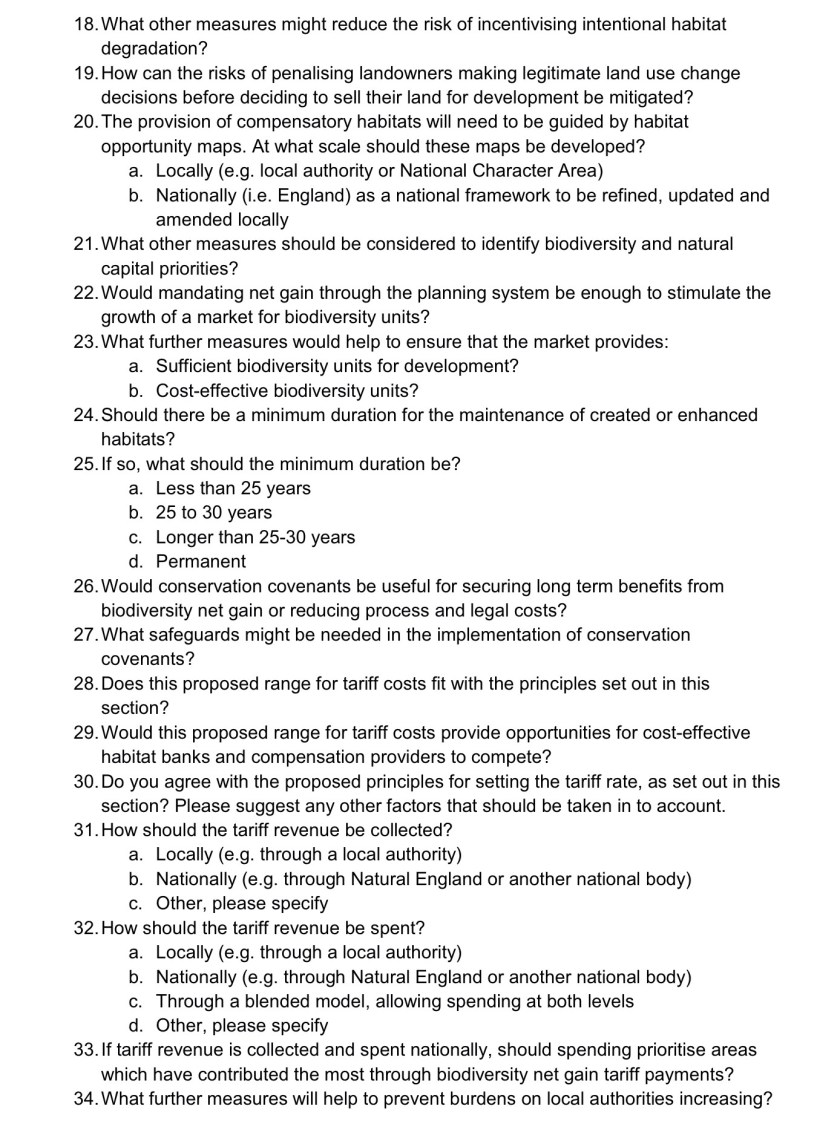
The full list of the 45 consultation questions within the document demonstrates the potential complexity of what is proposed:

From a practical perspective, key issues are plainly going to include

⁃ establishing a robust ‘biodiversity unit’ metric

⁃ determining what would the required level of improvement (where does 10% come from?)

⁃ determining the circumstances in which a tariff or other off-site arrangement is appropriate and calculating its quantum

⁃ arriving at practical delivery mechanisms, by way of planning conditions, section 106 obligations and/or CIL, that meet relevant legal and policy requirements.

What I would love to understand is really how “mandated” the proposed requirements will be in practice. Does the Government envisage that the detailed regime can be bolted into the existing planning system by way of amendments to the PPG (which seems implausible given the potential nature of the tariff measures in particular) or will the Environment Bill be prescriptive in terms of what precisely will be required?

DEFRA is apparently due to respond to the consultation shortly, with the Bill likely to be published before the summer recess but, dear reader from the near future, you are possibly looking back at this blog post thinking “well that didn’t age well…”

Simon Ricketts, 30 March 2019

Personal views, et cetera

We Have Standards

Will we soon see minimum space standards for PD residential conversions? There was a hint in that James Brokenshire written statement on 13 March 2019.

I set out below in full the parts of his statement relating to PD resi and I have emboldened the relevant sentence:

The consultation, Planning Reform: Supporting the high street and increasing the delivery of new homes closed on 14 January 2019. As confirmed in the Spring Statement it is our intention to bring forward a range of reforms. To support the high street we intend to introduce additional flexibilities for businesses. This will be to amend the shops use class to ensure it captures current and future retail models, which will include clarification on the ability of (A) use classes to diversify and incorporate ancillary uses without undermining the amenity of the area, to introduce a new permitted development right to allow shops (A1), financial and professional services (A2), hot food takeaways (A5), betting shops, pay day loan shop and launderettes to change use to an office (B1) and to allow hot food takeaways (A5) to change to residential use (C3). Additionally, to give businesses sufficient time to test the market with innovative business ideas we will extend the existing right that allows the temporary change of use of buildings from 2 to 3 years and enable more community uses to take advantage of this temporary right, enabling such premises to more easily locate on the high street. I will also shortly publish “Better Planning for High Streets”. This will set out tools to support local planning authorities in reshaping their high streets to create prosperous communities, particularly through the use of compulsory purchase, local development orders and other innovative tools.

We will take forward a permitted development right to extend upwards certain existing buildings in commercial and residential use to deliver additional homes, engaging with interested parties on design and technical details. We would want any right to deliver new homes to respect the design of the existing streetscape, while ensuring that the amenity of neighbours is considered. We will also make permanent the time-limited right to build larger single storey rear extensions to dwellinghouses and to introduce a proportionate fee. I do not intend to extend the time-limited right for change of use from storage to residential. This right will lapse on 10 June 2019. Alongside I intend to review permitted development rights for conversion of buildings to residential use in respect of the quality standard of homes delivered. We will continue to consider the design of a permitted development right to allow commercial buildings to be demolished and replaced with homes. We will also develop a ‘Future Homes Standard’ for all new homes through a consultation in 2019 with a view, subject to consultation, to introducing the standard by 2025.

[…]

I intend to implement an immediate package of permitted development right measures in the spring, with the more complex matters, including on upward extensions, covered in a further package of regulations in the autumn.”

The lack of minimum space standards in relation to residential conversions secured under permitted development rights is surely a significant flaw in the GPDO and the nature of some of the schemes that have come forward has certainly provided easy pickings for the press:

Is Harlow being used to ‘socially cleanse’ London? (Guardian, 16 March 2019)

Will these be the worst new ‘rabbit hutch’ flats in Britain? (Guardian, 2 March 2019)

This is a small part of the development industry but these stories are reputationally terrible.

The change would surely be pretty straight forward: either to require that all PD schemes where prior approval has not been obtained by a transitional date should comply with the nationally described space standard or perhaps only to require this in areas where the standard has been adopted in an up to date local plan.

The standard itself is a bit of an oddity. It was first announced by Eric Pickles in March 2015 as part of what was basically a deregulation package – a series of optional technical standards for local authorities to apply, in lieu of authorities not being able any longer to include in their plans “any additional local technical standards or requirements relating to the construction, internal layout or performance of new dwelling, such as for instance the code for sustainable homes“. The standard’s curious wording (“described” not “prescribed“) is because the present function of the standard is for it to be able to be adopted by local planning authorities in their plans “where the need for an internal space standard can be justified” (NPPF, footnote 27), so that it becomes a policy requirement against which planning applications are assessed. It is not a legal requirement, and only relevant in areas where it has been adopted as policy.

In areas which have adopted the standard it is particularly egregious that PD schemes can simply bypass it. (It is equally egregious that PD schemes are also able to bypass the affordable housing and other policy requirements that are triggered by residential conversions requiring planning permission – see the open letter from Shelter and the Local Government Association to the Secretary of State dated 21 January 2019 – and I have directly experienced some authorities then wrongly try secure those requirements by the back door when an application for planning permission for re-cladding or extra floors of development is sought).

The Government indicated in its February 2017 housing green paper that the standard was to be reviewed, to allow some greater flexibility in its operation:

1.55 The use of minimum space standards for new development is seen as an important tool in delivering quality family homes. However the Government is concerned that a one size fits all approach may not reflect the needs and aspirations of a wider range of households. For example, despite being highly desirable, many traditional mews houses could not be built under today’s standards. We also want
to make sure the standards do not rule out new approaches to meeting demand, building on the high quality compact living model of developers such as Pocket Homes. The Government will review the Nationally Described Space Standard to ensure greater local housing choice, while ensuring we avoid a race to the bottom in the size of homes on offer
. ”

Perhaps it is right that some flexibility is required, I don’t know. See for example the recent Adam Smith Institute paper Size doesn’t matter https://static1.squarespace.com/static/56eddde762cd9413e151ac92/t/5c41d02f0ebbe8aa256c361c/1547817061183/Size+Doesn%27t+Matter+—+Vera+Kichanova.pdf in which Vera Kichanova puts forward the case for micro housing.

But in any revised system we arrive at, whatever the standards that may be justified in relation to homes designed to be occupied as long-term self-contained living accommodation, care is needed before equivalent requirements are read across to other forms of living that don’t fall within use class C3, such as serviced apartments and co-living, if the baby isn’t to be thrown out with the bath water in terms of what makes these different types of living attractive and affordable for those with differing requirements or priorities.

There appears to be no sign of the review of the nationally described space standards that had been promised (although in October 2018 minimum bedroom sizes were introduced for HMOs pursuant to the Licensing of Houses in Multiple Occupation (Mandatory Conditions of Licences) (England) Regulations 2018).

Perhaps the review will be part of the “Future Homes Standard” consultation to be carried out this year, according to that James Brokenshire statement, although that does not appear to be the intended focus, if the statement made on 21 March 2019 to the House of Lords by Lord Bourne, Parliamentary Under-Secretary for Housing, Communities and Local Government, is anything to go by:

The Government will consult later this year on our plans to introduce the future homes standard for new-build homes to be future-proofed with low-carbon heating and world-leading levels of energy efficiency. Separately, the Government are currently working on a review of accessibility standards for new homes.”

As always, piecing together what is planned is like putting together a jigsaw, the picture for which is in parts just fog.

Finally, a plug for the best book on the subject, freely available via this link: One Hundred Years of Housing Space Standards: What Now? by Julia Park (January 2017).

Simon Ricketts, 23 March 2019

Personal views, et cetera

Accelerated Planning

James Brokenshire’s 13 March 2019 written statement, made alongside the Chancellor’s Spring Statement, includes some important, if sometimes vague, pointers as to how the Government intends to speed up development management processes and housing delivery, although already we have a good sense of what lies ahead in relation to planning appeals that proceed by way of inquiry.

Delivery

My 3 November 2018 blog post covered Sir Oliver Letwin’s recommendations to Government following his review into the “build out of planning permissions into homes“.

The Secretary of State has now confirmed that the Government will “shortly publish additional planning guidance on housing diversification – to further encourage large sites to support a diverse range of housing needs, and help them to build out more quickly“.

He agrees “with the principle that the costs of increased housing diversification should be funded through reductions in residual land values. The Government is committed to improving the effectiveness of the existing mechanisms of land value capture, making them more certain and transparent for all developments. My focus is on evolving the existing system of developer contributions to make them more transparent, efficient and accountable and my department is gathering evidence to explore the case for further reform.”

I will keep the need for further interventions to support housing diversification and faster build out, including amendments to primary legislation, under review. My department will also work closely with Homes England to identify suitable sites and will look for opportunities to support local authorities to further diversify their large sites.”

Development management

My priority now is to ensure faster decision-making within the planning system. My department will publish an Accelerated Planning Green Paper later this year that will discuss how greater capacity and capability, performance management and procedural improvements can accelerate the end-to-end planning process. This Paper will also draw on the Rosewell Review, which made recommendations to reduce the time taken to conclude planning appeal inquiries, whilst maintaining the quality of decisions. I will also consider the case for further reforms to the compulsory purchase regime, in line with our manifesto commitment.”

We wait to see what detailed proposals the green paper will include for the planning application stage and indeed for appeals that proceed by way of written representations or hearings.

Bridget Rosewell’s independent review of planning appeal inquiries was published on 12 February 2019. The executive summary sets out the current statistics as follows:

8. “On average, about 315 planning appeals each year are the subject of an inquiry (inquiry appeals), comprising 2% of the total number of planning appeal decisions. Around 81% of inquiry appeals are decided by planning inspectors on behalf of the Secretary State. The remaining 19% of cases (recovered appeals and called-in applications) are decided directly by the Secretary of State, having regard to an inspector’s report.

9. Although relatively small in number the scale of development, particularly housing development, that is determined through inquiry appeals is significant. In 2017/18 over 42,000 residential units were included in inquiry appeal schemes, of which just over 18,600 units were allowed/approved. This represents 5.4% of the 347,000 total approved residential units in the year 2017-18.

10. In 2017/18, it took an average of 47 weeks for inspector-decided cases from receipt of the appeal to a decision letter being issued. On average, it took 60 weeks from the point of validation of an appeal to the submission on an inspector’s report to the Secretary of State for recovered appeals and 50 weeks (from validation to submission of the inspector’s report) for called-in applications. It then took, on average, a further 17 weeks after the inspector’s report had been submitted for the Secretary of State to issue a decision for recovered appeals and a further 26 weeks for called-in applications. In 2017/18, 111 inquiry appeals were withdrawn before a decision was made.”

MHCLG updated its website page Appeals: how long they take on 14 March 2019. That 47 weeks average referred to in paragraph 10 has now slipped to 50 weeks (if that 50 weeks figure excludes recovered appeals and call-ins).

Bridget Rosewell had 22 recommendations as to how the planning appeal inquiry process can be improved and decisions made quickly:

1.The Planning Inspectorate should ensure the introduction of a new online portal for the submission of inquiry appeals by December 2019, with pilot testing to start in May 2019.

2.The Planning Inspectorate should work with representatives of the key sectors involved in drafting statements of case to devise new pro formas for these statements which can then be added to the new portal and include, where appropriate, the introduction of mandatory information fields and word limits.

3.The process of confirming the procedure to be used should be streamlined. Where an inquiry is requested, appellants should notify the local planning authority of their intention to appeal a minimum of 10 working days before the appeal is submitted to the Planning Inspectorate. This notification should be copied to the Inspectorate.

4.The Planning Inspectorate should ensure that only complete appeals can be submitted and ensure that a start letter is issued within 5 working days of the receipt of each inquiry appeal. The start letter should include the name of the inspector who will conduct the appeal.

5.The practice of the Planning Inspectorate leading on the identification of the date for the inquiry should be restored, with all inquiries commencing within 13 to 16 weeks of the start letter.

6.The Ministry of Housing, Communities and Local Government (MHCLG) should consult on the merits of appellants contributing towards the accommodation costs of the inquiry.

7.MHCLG and the Planning Inspectorate should substantially overhaul the approach to the preparation of statements of common ground.

8.a) In every inquiry appeal case, there should be case management engagement between the inspector, the main parties, Rule 6 parties and any other parties invited by the inspector, not later than 7 weeks after the start letter.
(b) Following the case management engagement, the inspector should issue clear directions to the parties about the final stages of preparation and how evidence will be examined, no later than 8 weeks after the start letter.

9.The inspector should decide, at the pre-inquiry stage, how best to examine the evidence at the inquiry and should notify the parties of the mechanism by which each topic or area of evidence will be examined, whether by topic organisation, oral evidence and cross-examination, round-table discussions or written statements.

10.The Planning Inspectorate should ensure all documents for an inquiry appeal are published on the new portal, in a single location, at the earliest opportunity following their submission.

11.The Planning Inspectorate should ensure the timely submission of documents. It should also initiate an award of costs where a party has acted unreasonably and caused another party to incur unnecessary or wasted expense.

12.The Planning Inspectorate should amend guidance and the model letter provided for local planning authorities to notify parties of an appeal, to make it clear that those interested parties who want Rule 6 status, should contact the Inspectorate immediately.

13.The Planning Inspectorate should consult with key stakeholder groups, to update its procedural guidance to set out clear expectations on the conduct of inquiries, based on a consistent adoption of current best practice and technology. Updated guidance should encourage and support inspectors in taking a more proactive and directional approach.

14.The Planning Inspectorate should ensure that its programme for improving operational delivery through greater use of technology fully exploits the opportunities available to enhance the efficiency and transparency of the inquiry event, such as the use of transcription technology for inspectors and publishing webcasts of proceedings.

15.Alongside other recommendations that will improve the transparency and clarity of the process (Recommendations 10, 12, 13 and 14), the Planning Inspectorate should develop a more effective and accessible guide to the inquiry process for interested parties, including members of the public.

16.Programming of inspector workloads should ensure there is enough time to write up the case immediately after the close of the inquiry.

17.a) To minimise the number of cases that need to be decided by the Secretary of State, MHCLG should keep their approach to the recovery of appeals and called- in applications under review. b)The Planning Inspectorate should work with MHCLG to identify ways that technology can be used to speed up the process of preparing the inspector’s report to the Secretary of State.

18.The Planning Inspectorate should submit an action plan to the Secretary of State by April 2019. The action plan should set out how it will ensure that the necessary organisational measures are put in place to deliver the proposed timescale targets and wider improvements by no later than June 2020. This should include the mechanisms by which sufficient inspectors can be made available. The action plan should also set out challenging, but realistic, intermediate milestones to be achieved by September 2019.

19.The Planning Inspectorate should review the issue of withdrawn appeals and consider how this impact on its work can be minimised. To deliver this the Inspectorate should:

(a)  always collect information from appellants about why an appeal is withdrawn

(b)  initiate an award of costs where there is evidence of unreasonable behaviour by a party in connection with a withdrawn appeal

(c)  with the benefit of more detailed information, review whether further steps can be taken to reduce the impact of withdrawals on its resources and other parties.

20.The Planning Inspectorate and MHCLG should regularly discuss the practical impact of new policy and guidance on the consideration of evidence at inquiries, with those parties who are frequently involved in the planning appeal inquiry process.

21.The Planning Inspectorate should adopt the following targets for the effective management of inquiry appeals from receipt to decision

(a) Inquiry appeals decided by the inspector
Receipt to decision – within 24 weeks – 90% of cases Receipt to decision – within 26 weeks – remaining 10% of cases

(b) Inquiry appeals decided by the Secretary of State
Receipt to submission of inspector’s report – within 30 weeks – 100% of cases

22.The Inspectorate should regularly report on its performance in meeting these timescales and what steps it is taking to expedite any cases that take longer.

(a)  The Planning Inspectorate should use its Transformation Programme to ensure there is robust and comprehensive management and business information, which is regularly collected and reported, on all aspects of their operation.

(b)  In developing an improved suite of information the Inspectorate should also:

ensure their digital case management record system records information on key variables in a consistent way

agree with MHCLG a new set of key performance indicators to effectively monitor the inquiry appeal process from end to end, including the availability of senior inspectors. “

These tables give a sense of what we might expect:

The Planning Inspectorate announced on 13 March 2019 that it is carrying out a trial of accelerating a small number of inquiry appeals as part of a pilot of holding inquiries much earlier than at present. For these appeals it will move away from its “bespoke” process whereby PINS invites the parties to agree a programme, including an inquiry date.

Before long we will all have to adapt our approaches to individual appeals in the interests of a more generally speedy process. It will be increasingly difficult to seek to negotiate a later date than PINS proposes (even when the main parties have no objections) in order to accommodate particular team members’ availability.

For the Inspectorate, it’s certainly going to be a period of change. It was announced today, 15 March 2019, that Graham Stallwood, currently chief planning officer at the Royal Borough of Kensington and Chelsea and chairman of the board of trustees of the RTPI, has accepted a position as PINS’ Director of Operations, commencing in May. Graham – you will be excellent!

For those of us who lodge and coordinate appeals for developer clients, well we are going to need to get to grips with a new IT interface for the submission of appeals and new case management processes but above all find the strength to tell our clients the news that, having been at the heart of strategic thinking in relation to a decision to invest in an appeal and having shaped the statement of case, their favourite QC may not in fact be available for that crucial inquiry…

Simon Ricketts, 15 March 2019

Personal views, et cetera

Speedy Delivery, Richland, Washington, MA

NPPF & PPG In Court

Hanging over me all week was a deadline for preparing a legal update about the NPPF. Then, thank you judges, just like London buses but with more barristers on board, along came three interesting cases.

Is the NPPF subject to the requirements of SEA?

The question as to whether the latest version of the NPPF required strategic environmental assessment was the question before Dove J in Friends of the Earth v Secretary of State (Dove J, 6 March 2019).


You will recall that requirements of the SEA Directive apply to plans and programmes which are “required by legislative, regulatory or administrative provisions” and which “set the framework for future development consent of projects”.


The Government argued that neither applied in the case of the NPPF. It was always going to be a stretch to argue that the, er,  Framework does not set the framework for the future development consent of projects and the judge wasn’t going to accept that. But he did conclude that due to the Framework’s curious, non-statutory, legal basis it could not be said to be required by legislative, regulatory or administrative provisions and therefore SEA was not required: “there is in reality nothing by way of any formal provisions which might be said to govern or regulate the production of the Framework“.

Incidentally, I had always assumed that fear of being caught by SEA requirements was one reason why the NPPF has remained so determinedly non-spatial but, on Dove J’s reasoning, even an NPPF with spatial policies would not require SEA.

Was consultation on the draft NPPF legally inadequate in relation to fracking?

The hearing in relation to Stephenson v Secretary of State (Dove J, 6 March 2019), a claim brought on behalf the Talk Fracking campaign group, immediately followed the Friends of the Earth hearing and one of its grounds (ground 3) was covered by the previous case. The other grounds focused on the new NPPF’s pro-fracking paragraph 209(a):

Minerals planning authorities should:
a) recognise the benefits of on-shore oil and gas development, including unconventional hydrocarbons, for the security of energy supplies and supporting the transition to a low-carbon economy; and put in place policies to facilitate their exploration and extraction
.”

Ground 1 contended that “the Defendant unlawfully failed to take into account material considerations, namely scientific and technical evidence, which had been produced following the adoption of a Written Ministerial Statement by the Secretary of State for Business and Energy and Industrial Strategy and the Defendant on 16th September 2015 (“the 2015 WMS”)

Ground 2 contended that “the Defendant failed, in publishing the policy in paragraph 209(a) of the Framework, to give effect to the Government’s long-established policy in relation to the obligation to reduce green-house gas emissions under the Climate Change Act 2008“.

Ground 4 contended that “the Defendant failed to carry out a lawful consultation exercise in relation to the revisions to the Framework which were published on 24th July 2018.”

Dove J started with ground 4, because “at the heart of the dispute” was the questions as to “what the Defendant was doing when incorporating paragraph 209(a) into the Framework or, more particularly in relation to Ground 4, what a member of the public engaging in the consultation process and reading the publicly available material as a reasonable reader, would have concluded the Defendant was doing“. The issues “cannot be disposed of by simply considering the Defendant’s private intentions“. In the documentation there was no suggestion that the merits or substance of the policy represented by the 2015 WMS were outside the scope of the consultation.

By contrast with what the reasonable reader would have discerned from the publicly available material, the Defendant had a closed mind as to the content of the policy and was not undertaking the consultation at a formative stage. The Defendant had no intention of changing his mind about the substance of the revised policy. Further, the Defendant did not conscientiously consider the fruits of the consultation exercise in circumstances where he had no interest in examining observations or evidence pertaining to the merits of the policy. This had the effect of excluding from the material presented to the Minister any detail of the observations or evidence which bore upon the merits of the policy. Given my conclusion as to what the reasonable reader would have concluded from the publicly available documentation the consultation exercise which was undertaken was one which involved breaches of common law requirements in respect of consultation and which was therefore unfair and unlawful.

Ground 1 accordingly also succeeded: it was unlawful to fail to take the Talk Fracking material into account in decision making as to the final form of the NPPF, given that it was clearly relevant to the questions posed. “The fact that the Defendant believed that he was taking a far more narrow and restricted decision from that which he had advertised to the public does not provide a basis for avoiding that conclusion.

Ground 2 failed, but on the basis of reasoning which may be helpful to the anti-fracking community, in that the judge accepted the Secretary of State’s submission that “in individual decisions on plans or applications the in principle support for unconventional hydrocarbon extraction, provided by paragraph 209(a) of the Framework, will have to be considered alongside any objections and evidence produced relating to the impact of shale gas extraction on climate change. These are conflicting issues which the decision-maker will have to resolve.”

The judge has not yet determined the appropriate relief (ie what should be done) to give effect to his judgment. But surely we are now likely to see further consultation as to paragraph 209(a) and potentially another tweaked NPPF in due course. NPPFs are also now coming along like buses.

What is the legal status of Planning Practice Guidance?

This question was relevant in Solo Retail Limited v Torridge District Council (Lieven J, 4 March 2019) as it went to complaints about the approach taken by a local planning authority to retail impact assessment, in a challenge by one value retailer to a planning permission granted to a competitor. The complaint was that the guidance in the PPG has not properly been followed.

Of course if there is doubt as to the legislative, regulatory or administrative basis for the National Planning Policy Framework, that doubt is accentuated in the case of the Government’s subsidiary Planning Practice Guidance.

The judge found that the NPPF and the local development plan were not prescriptive as to the form of retail impact assessment required to be carried out. The claimant therefore had to fall back on the detailed steps for assessment set out in the PPG.

However:

In my view the NPPG has to be treated with considerable caution when the Court is asked to find that there has been a misinterpretation of planning policy set out therein, under para 18 of Tesco v Dundee. As is well known the NPPG is not consulted upon, unlike the NPPF and Development Plan policies. It is subject to no external scrutiny, again unlike the NPPF, let alone a Development Plan. It can, and sometimes does, change without any forewarning. The NPPG is not drafted for or by lawyers, and there is no public system for checking for inconsistencies or tensions between paragraphs. It is intended, as its name suggests, to be guidance not policy and it must therefore be considered by the Courts in that light. It will thus, in my view, rarely be amenable to the type of legal analysis by the Courts which the Supreme Court in Tesco v Dundee applied to the Development Policy there in issue.

These points are illustrated the paragraphs of the NPPG that are most relevant in this case. Paragraph 015 says that “the impact test should be undertaken in a proportionate and locally appropriate way…” However, paragraph 017 says “The following steps should be taken in applying the impact test…”. Taken at face value these words would seem to suggest that the following elements are mandatory where there is a policy requirement for any form of impact test. However, in my view that cannot be the case. There is a judgement for the LPA as to what level of scrutiny of possible impact is appropriate in the particular circumstances of the proposal, taking into account the need to be proportionate. Paragraph 017 therefore cannot and should not be interpreted and applied in an overly legalistic way as if it was setting out mandatory requirements.”

A reminder not to interpret the PPG legalistically. There may be internal inconsistencies within it. Guidance means guidance.

Simon Ricketts, 9 March 2019

Personal views, et cetera

Trial By Instagram: Privacy & Planning

Photo-sharing social media apps, weaponised by the smartphone camera, are changing our experience and expectations of place. Is the planning system, and the law of private nuisance, keeping up?

The London Evening Standard had a story for our times last night: Please stop ‘influencing’ on our doorsteps, Notting Hill residents tell ‘unapologetic’ Instagrammers.

At a personal level we have all become artists, influencers, curators, with our instant pics, filtered, composed, annotated. Fomo for you = dopamine for me. But zoom out and through endlessly snapping, sharing, liking and commenting, we are of course the product, the hive mind, the crowd source, working for the data mine, adding to the geo-cache, mapping ceaselessly where the sugar is in the city.

In this context, what sells a place? From outside in: a glimpse of the life style, the life, that could be yours. From inside out: unique views out onto a city. The two ugly i words: iconic, instagrammable.

Which all makes the parable of Fearn & others v The Board of Trustees of the Tate Gallery (Mann J, 11 February 2019) so perfect.

On one side, the residents of Neo Bankside, housed from floor to ceiling in glass so as to achieve spectacular views out and having paid no doubt precisely to be able to enjoy that experience.

On the other side, at its closest point 34 metres to the north of Block C of Neo Bankside, the viewing gallery on the tenth floor of the Blavatnik Building extension to Tate Modern, from which visitors also have spectacular views, including, to the south, of those residents in their transparent homes.

Plan A from the judgment (extract)

The people in the glass houses threw an expensive stone at their large neighbour, in the form of proceedings for an injunction to prevent overlooking from the viewing gallery, on the basis that it amounted to a breach of their rights to privacy, both under the law of private nuisance and, if the Trustees of the Tate were to be considered to be a public body, under Article 8 of the European Convention on Human Rights.

What makes the situation particularly unusual is that the full implications of the juxtaposition of the two developments had not been appreciated by anyone, including the local planning authority (the London Borough of Southwark). The Tate proposals went through various design iterations. The judge found:

On the balance of probabilities it is not likely that the planning authority did consider the extent of overlooking. It is more than plausible in all the circumstances that it did not, and I find that it was not given any focused attention by the planning authority.

So far as the developers of Neo Bankside are concerned, there is very little material on which to make a finding as to their awareness of the consequences of the viewing gallery. The developers were plainly aware of the nature of the Blavatnik development from time to time, and I accept Mr Hyslop’s evidence that there was consultation between the two sides. It is plain that the developers were aware of a viewing gallery because concerns were expressed as to the effect the flats would have on the viewing gallery (not the other way round). It is very likely that the developer was aware of the plans for the gallery during the concurrent planning process. However, I do not think that the developer foresaw the level of intrusion alleged by the claimants, and therefore to that extent did not foresee the consequences of its co-operation or its knowledge.

The end result of this analysis is that, so far as relevant, I find that all relevant parties were eventually aware of the viewing gallery in its present form, and aware of its function, but (so far as relevant) they did not think through the consequences of overlooking, and looking into, the flats in Block C.”

Whilst the planning system’s role does not extend to closing off all risks of nuisance actions from those affected by development, it is a shame that the full consequences of the juxtaposition of the viewing gallery and the flats were not appreciated at the time that the application for planning permission was determined so that the issue could have been considered as against Southwark’s planning policies that seek to protect residential amenity and the issue might have been pragmatically nipped in the bud.

One further complication appears to have been that the Neo Bankside development ended up being occupied other than visualised as at when planning permission was granted, with “winter garden balconies” ending up being subsumed as part of residents’ living space. Again, to what extent is it the role of the planning system to foresee issues of privacy and overlooking that may arise in consequence of internal changes such as this?

The judgment sets out the numbers of visitors that use the viewing gallery, potentially as many as 500,000 to 600,000 a year. The Tate has posted notices on the southern gallery asking visitors to respect the privacy of the gallery’s neighbours and has instructed security guards to stop people taking photographs of the flats and occupants. The judgment then describes the activities of the visitors and it is apparent that many take photographs of the flats.

The claimants also rely on reports on social media as demonstrating a photographic and “peering” interest in the flats. They, and Mr May, produced in evidence a large number of photographs from social media, some accompanied by comments, which indicate that people have been to the gallery, noted that one can see into the flats, and commented in such a way as to acknowledge that there was a surprising intrusion into privacy arising as a result of that.

The first batch of postings were all dated in a period shortly after the Mail on Sunday wrote a piece about the issue in 2016. They are 14 Instagram posts which feature various photographs of the interiors of the Block C flats with some reflections on the lack of privacy in the flats. Some juxtapose the sign asking for respect for privacy with the view into the flats themselves; another has the rubric “Invading me some privacy”; another refers to the “Birds eye view directly into the neighbouring apartments. No wandering around in pj’s” with the hashtag (among others) “#noprivacy”. The general impression from that collection of posts, which caused upset to some of the occupants, was that those visitors were interested in peering into the flats when that view was on display.

This was supplemented by investigations into social media carried out by Mr May as part of his expert functions. A member of his firm carried out a check on Instagram and found 124 posts with photographs of Neo Bankside, apparently taken from the viewing gallery, in the period between June 2016 and April 2018. It was estimated by that member that they reached an estimated audience of 38,600, but there is a certain element of intelligent guesswork in that figure. Many of photographs show the interiors of the flats. Judging by their attached comments and hashtags, many of the photographs are taken because of the architectural interest of Block C, or because of the photogenic interest of the subject matter (not always the block by itself), and some comment on the fact that you can see right into the flats. Various conclusions can be drawn from this study, depending on one’s point of interest, but I consider that they support the case of the claimants that part of the interest on the part of at least some posters was in the view of Block C flat interiors from the gallery. For others the interiors are irrelevant, and for yet others it is noted and incidental, but there is a significant discrete interest in what one can see by looking into the flats.”

The judge’s conclusions on the level of intrusion were as follows:

(a) A very significant number of visitors display an interest in the interiors of the flats which is more than a fleeting or passing interest. That is displayed either by a degree of peering or study, with or without photography, and very occasionally with binoculars.

(b) Occupants of the flats would be aware of their exposure to that degree of intrusion.

(c) The intrusion is a material intrusion into the privacy of the living accommodation, using the word “privacy” in its everyday meaning and not pre-judging any legal privacy questions that arise.

(d) The intrusion is greater, and of a different order, from what would be the case if the flats were overlooked by windows, either residential or commercial. Windows in residential or commercial premises obviously afford a view (as do the windows lower down in the Blavatnik Building) but the normal use of those windows would not give rise to the same level of study of, or interest in, the interiors of the flats. Unlike a viewing gallery, their primary (or sole) purpose is not to view.

(e) What I have said above applies to the upper three flats in this case. It applies to a much lesser extent to flat 1301, because that is rather lower down the building and the views into the living accommodation are significantly less, and to that extent the gallery is significantly less oppressive in relation to that flat
.”

It is interesting that the judge does not comment as to whether what is done with the photographs taken, frequently uploaded and shared on social media, adds to the degree of intrusion.

After detailed legal analysis, the judge rejected the Article 8 claim on the basis that the Board of Trustees of the Tate Gallery is not exercising functions of a public nature.

He also rejected the claim in nuisance, but again after interesting analysis:

1. He finds that as a matter of principle there are situations where the law of nuisance can protect privacy, at least in a private home, both under traditional common law but also by giving effect to Article 8 by extending existing causes of action.

2. “That does not mean, of course, that all overlooking becomes a nuisance. Whether anything is an invasion of privacy depends on whether, and to what extent, there is a legitimate expectation of privacy. That inquiry is likely to be closely related to the sort of inquiry that has to take place in a nuisance case into whether a landowner’s use of land is, in all the circumstances and having regard to the locality, unreasonable to the extent of being a nuisance…”

3. The planning process is not by itself a sufficient mechanism for protecting against infringement of all privacy rights.

4. “The question is whether the Tate Modern, in operating the viewing gallery as it does, is making an unreasonable use of its land, bearing in mind the nature of that use, the locality in which it takes place, and bearing in mind that the victim is expected to have to put up with some give and take appropriate to modern society and the locale. Although there is an overall assessment to be made in order to comply with the tests referred to above, I shall approach the question by first breaking the consideration down into three elements – location, the use of the defendant’s property and the nature and use of the claimants’ properties.”

5. Tate’s legal submissions sought to place reliance on the fact that planning permission had been granted, drawing upon a statement by Lord Carnwath in Lawrence v Fen Tigers (Supreme Court, 26 February 2014):

“...a planning permission may be relevant in two distinct ways: (i) It may provide evidence of the relative importance, in so far as it is relevant, of the permitted activity as part of the pattern of uses in the area; (ii) Where a relevant planning permission (or a related section 106 agreement) includes a detailed, and carefully considered, framework of conditions governing the acceptable limits of a noise use, they may provide a useful starting point or benchmark for the court’s consideration of the same issues.”

6. In this case however the planning permission “provides little or no assistance…The level of consideration given to the overlooking, if there was any at all, is not apparent from the evidence that was placed before me.

7. Nor were the planning policies for the area relevant as they did not “really engage with the important factors which have to be considered in considering a nuisance claim“.

8. “The other way in which Lord Carnwath suggested that the planning permission might be relevant is in providing evidence of the relative importance of the activity to the area. Since the planning permission in this case did not really address the viewing gallery, as opposed to the building as a whole, it is not possible to draw any conclusions from it as to the views of the planning authority on this point, so the permission is of no evidential use here either.”

9. The character of the locality is a significant relevant factor:

“The locality is, as appears above, a part of urban south London used for a mixture of residential, cultural, tourist and commercial purposes. That usage, thus described, does not say much about the privacy of high-rise glass-walled residential buildings. However, the significant factor is that is an inner city urban environment, with a significant amount of tourist activity. An occupier in that environment can expect rather less privacy than perhaps a rural occupier might. Anyone who lives in an inner city can expect to live quite cheek by jowl with neighbours. That is implicitly acknowledged by the claimants when they say they do not object to the fact that they are overlooked from the windows of the Blavatnik Building.”

Planning policies for the area “are of little or no assistance in determining what the current nature of the locality is. If they reflect the current usage, then they are irrelevant and add nothing. If they reflect a desire to move the area along to a different usage then they reflect the aspirations of the planners, but they do not affect what the nature of the locality should be treated as being for the purposes of the law of nuisance. In Fen Tigers the Supreme Court considered the question of whether the grant of planning permission could be taken to affect the character of a neighbourhood, and rejected the suggestion that that could be the case. The Justices considered the proposition that it might affect the character of the neighbourhood if it covered a large area but not a small area, and rejected that too (see eg Lord Neuberger at paras 86-88). If an actual planning decision cannot affect the character of the locality for the purposes of the law of nuisance, then the aspirations of a local authority for an area, as expounded in a local plan, should not be able to do it either. It therefore seems to me that the plans for the area do not bear on the character of the locality in this case.

Second, if I am wrong about that, then even if (as seems to be the case) there is an emphasis on cultural matters, and the benefits of a vibrant Tate Modern, it does not seem to me that that leads to the conclusion that this is an area in which a viewing platform should necessarily be actually expected in that context.

Third, while such generalised planning matters might be capable of resolving a conflict between a residential use and a cultural use (at least so far as planning is concerned), they do not assist in resolving the question of a conflict between a viewing platform (which is a particular subset of the cultural activities of the Tate Modern) and some residential accommodation.

10. The operation of a viewing gallery is not an inherently objectionable activity in the neighbourhood.

11. Turning to what it is that the claimants complain about:

They complain that their everyday life in the flats is on view because of the nature of the view. The nature of the view is the complete (or largely complete) view that one has of the living accommodation from the viewing gallery. It is that that is commented in one or two the Instagram postings. That arises (obviously) because of the complete glass walls of the living accommodation. I have considered whether the claimants would have had had a complaint if they had lived in flats designed with more wall and less window. If the owner/occupier/developer of such a flat would still have a complaint in nuisance, then so must the claimants. If he/she would not then I have to consider whether the claimants in this case would nonetheless have a cause of action themselves, arising out of the glass construction.”

The claimants would not have a nuisance claim if they lived in flats with more wall and less window.

The developers in building the flats, and the claimants as successors in title who chose to buy the flats, have created or submitted themselves to a sensitivity to privacy which is greater than would the case of a less-glassed design. It would be wrong to allow this self-induced incentive to gaze, and to infringe privacy, and self-induced exposure to the outside world, to create a liability in nuisance. Other architectural designs would have reduced the invasion of privacy to levels which should be tolerated; that is the appropriate measure in my view. If the claimants have a design which raises the privacy invasion then they have created their own sensitivity and will have to tolerate what the design has created. I remind myself that the first designs for these flats did have some privacy protection built in.

In making that determination I am not indulging in any criticism of the claimants or the developers; nor am I criticising the architectural design. I am aware that is no part of the law of nuisance to discourage architectural adventure. However, the architectural style in this case (including the more striking design of the block as a whole) has the consequence of an increased exposure to the outside world for all the reasons contained in this judgment. That should not be allowed to alter the balance which would otherwise exist.”

The winter gardens also have to be considered. A very material part of the perceived intrusion into privacy comes from the fact that the occupiers can be viewed in the winter gardens, which they treat as an extension of their living accommodation. Furthermore, the glass of the winter gardens allows a view to the glass of the internal double-glazed door, which in turn allows a further view into the living accommodation.

Those areas were not originally intended as part of the living accommodation. The planning documents make clear that they were conceived as a form of internal balconies, which the occupiers could enjoy as an additional amenity to their living accommodation. The experts both agreed on that. That is why the areas were single glazed, and not double glazed. The flooring was also intended to be different, to reflect that. They were not intended to be heated, though the developers did actually extend the under-floor heating into them. Had the occupiers operated their flats in that way then in my view they could have expected less privacy in respect of that part of their flats – one does not expect so much privacy in a balcony, even one as high as these. I agree with Mr Rhodes’ evidence to that effect.

In that respect, too, the owners and occupiers of the flat have created their own additional sensitivity to the inward gaze. They have moved more of their living activities into a quasi-balcony area and provided more to look at. Had they not done that, there would have been less worth looking at – less to attract the eye – and fewer living activities to be intruded upon. It is true that to a degree there would still have been a view through the winter gardens and through the double-glazed doors, and to that extent the privacy of the living accommodation would still have been compromised by something more usual (extensive glass doors giving on to a balcony-equivalent) but the whole package would have been a less sensitive one.”

12. Remedial steps could be taken, for instance by lowering solar blinds, installing privacy film or installing net curtains.

Recommendations for further reading

In true online tradition, if you liked this post [in fact whether or not you liked it] you will like Barbara Rich’s beautiful and reflective 15 February 2019 blog post Curtains For The Zeitgeist.

Simon Ricketts, 2 March 2019

Personal views, et cetera

Delivery!

MHCLG’s announcements this week have clarified three separate issues which go to whether the “tilted balance” in paragraph 11(d) of the NPPF applies in relation to applications for planning permission for housing development.

Where the tilted balance applies, Government policy is of course that planning permission should be granted unless:

(i) the application of policies in this Framework that protect areas or assets of particular importance [being specific categories of policies set out in footnote 6 to the NPPF] provides a clear reason for refusing the development proposed; or

(ii) any adverse impacts of doing so would significantly and demonstrably outweigh the benefits, when assessed against the policies in this Framework taken as a whole.”

Two situations where the tilted balance applies are:

⁃ “where the local planning authority cannot demonstrate a five year supply of deliverable housing sites” with an appropriate buffer percentage of 5%, 10% or 20% calculated by reference to paragraph 73 of the NPPF; and

⁃ “where the Housing Delivery Test indicates that the delivery of housing was substantially below [a defined percentage of] the housing requirement over the previous three years” the defined percentage being 25% in the case of Housing Delivery Test results published in November 2018, 45% in the case of results published in November 2019 and 75% in the case of results published in November 2020 and thereafter. (Additionally, the authority needs to publish an action plan where the delivery percentage is less than 95%, “to assess the causes of under-delivery and identify actions to increase delivery in future years“).

Paragraph 177 of the 2018 NPPF disapplies the presumption in favour of sustainable development (and therefore the possibility of the tilted balance applying) where the project requires appropriate assessment under the Conservation of Habitats Regulations, which has proved problematic following the Court of Justice of the European Union’s judgment in People Over Wind, which led to far more projects requiring appropriate assessment.

This week’s announcements have clarified three things:

1. How “deliverable” is defined for the purposes of that first situation.

2. The presumption in favour of sustainable development is no longer disapplied if there is a negative appropriate assessment.

3. What the November 2018 Housing Delivery Test results are for in relation to each English local planning authority (the results not having been, er, delivered on time by MHCLG).

After a long wait, and initial indications that this would all be done before Christmas, on 19 February MHCLG published:

Government response to technical consultation on updates to national planning policy and guidance

housing delivery test 2018 measurement

further revised NPPF

The revisions to the NPPF are limited but care will be needed when referring to decisions and court rulings to be clear as to the relevant policy basis: the 27 March 2012 NPPF, the 24 July 2018 NPPF or the 19 February 2019 NPPF.

What is deliverable?

Footnote 11 to the 2012 NPPF defined “deliverable” as follows:

To be considered deliverable, sites should be available now, offer a suitable location for development now, and be achievable with a realistic prospect that housing will be delivered on the site within five years and in particular that development of the site is viable. Sites with planning permission should be considered deliverable until permission expires, unless there is clear evidence that schemes will not be implemented within five years, for example they will not be viable, there is no longer a demand for the type of units or sites have long term phasing plans.”

The degree of probability required, given the words “realistic prospect“, was considered by the Court of Appeal in St Modwen Developments Ltd v Secretary of State (Court of Appeal, 20 October 2017), where Lindblom LJ said this:

35…Deliverability is not the same thing as delivery. The fact that a particular site is capable of being delivered within five years does not mean that it necessarily will be. For various financial and commercial reasons, the landowner or housebuilder may choose to hold the site back. Local planning authorities do not control the housing market. NPPF policy recognises that…


37… Had the Government’s intention been to frame the policy for the five-year supply of housing land in terms of a test more demanding than deliverability, this would have been done…


38 The first part of the definition in footnote 11—amplified in paras 3–029, 3–031 and 3–033 of the PPG—contains four elements: first, that the sites in question should be ” available now”; second, that they should “offer a suitable location for development now”; third, that they should be ” achievable with a realistic prospect that housing will be delivered on the site within five years”; and fourth, that “development of the site is viable ” (my emphasis). Each of these considerations goes to a site’s capability of being delivered within five years: not to the certainty, or—as Mr Young submitted—the probability that it actually will be. The second part of the definition refers to “[sites] with planning permission”. This clearly implies that, to be considered deliverable and included within the five-year supply, a site does not necessarily have to have planning permission already granted for housing development on it. The use of the words “realistic prospect” in the footnote 11 definition mirrors the use of the same words in the second bullet point in paragraph 47 in connection with the requirement for a 20% buffer to be added where there has been “a record of persistent under delivery of housing”. Sites may be included in the five-year supply if the likelihood of housing being delivered on them within the five-year period is no greater than a “realistic prospect”—the third element of the definition in footnote 11 (my emphasis). This does not mean that for a site properly to be regarded as “deliverable” it must necessarily be certain or probable that housing will in fact be delivered upon it, or delivered to the fullest extent possible, within five years.”

The wording in glossary to the 2018 NPPF was made more specific:

“”Deliverable: To be considered deliverable, sites for housing should be available now, offer a suitable location for development now, and be achievable with a realistic prospect that housing will be delivered on the site within five years. Sites that are not major development, and sites with detailed planning permission, should be considered deliverable until permission expires, unless there is clear evidence that homes will not be delivered within five years (e.g. they are no longer viable, there is no longer a demand for the type of units or sites have long term phasing plans). Sites with outline planning permission, permission in principle, allocated in the development plan or identified on a brownfield register should only be considered deliverable where there is clear evidence that housing completions will begin on site within five years.”

Due to concerns as to potential ambiguity (which I didn’t really see) as to the treatment of non-major development (ie developments of less than ten homes, with a site area of less than 0.5 hectares), the wording has now been changed in the 2019 NPPF to read as follows

“Deliverable: To be considered deliverable, sites for housing should be available now, offer a suitable location for development now, and be achievable with a realistic prospect that housing will be delivered on the site within five years. In particular:

a)  sites which do not involve major development and have planning permission, and all sites with detailed planning permission, should be considered deliverable until permission expires, unless there is clear evidence that homes will not be delivered within five years (for example because they are no longer viable, there is no longer a demand for the type of units or sites have long term phasing plans).

b)  where a site has outline planning permission for major development, has been allocated in a development plan, has a grant of permission in principle, or is identified on a brownfield register, it should only be considered deliverable where there is clear evidence that housing completions will begin on site within five years

But there will remain room for argument: “realistic prospect” inevitably requires judgement and the local planning authority’s assessment as to the position of individual sites will always be potentially controversial given its interest (and/or that of objectors to development) in demonstrating an adequate supply so as to avoid the tilted balance. We will no doubt still see cases such as East Cheshire Council v Secretary of State (Deputy Judge Justine Thornton QC, 1 November 2018), East Bergholt Parish Council v Babergh District Council (Sir Ross Cranston, 7 December 2018) and (no transcript available but the link is to a useful Cornerstone summary) R (Chilton Parish Council) v Babergh District Council (Deputy Judge Robin Purchas QC, 2 February 2019.

There has also previously been much uncertainty as to the circumstances in which the new standard method for assessing local housing need should be used as the basis for assessing whether a five year supply of specific deliverable sites exists in the case of a plan with strategic policies which are more than five years old (unless those strategic policies had been reviewed and found not not to require updating). Footnote 37 in the 2019 NPPF makes clear that the standard method should indeed be used (which reflects the 5 February 2019 decision of the Secretary of State in relation to the Edenthorpe Doncaster called in application, blogged about by Lichfields on 21 February 2019).

Appropriate assessment

Hooray, paragraph 177 now reads:

The presumption in favour of sustainable development does not apply where the plan or project is likely to have a significant effect on a habitats site (either alone or in combination with other plans or projects), unless an appropriate assessment has concluded that the plan or project will not adversely affect the integrity of the habitats site.

The Housing Delivery Test

Well, the results are finally in. The housing delivery test 2018 measurement. According to analysis by Savills:

⁃ no authority is subject this time round to the tilted balance by virtue of delivering less than 25% of its housing requirement over the last three years

⁃ 86 out of 326 authorities are subject to the requirement of a 20% buffer on their five year housing land supply figure as a result of having delivered less than 85% of their housing requirement over the last three years

⁃ 107 out of 326 authorities have to prepare an action plan as a result of having delivered less than 95% of their housing requirement over the last three years.

A future blog post will deal with the “need” side of the equation…

Simon Ricketts, 23 February 2019

Personal views, et cetera

Dual Purpose

I need to declare an interest as I’ve recently been acting for an electronic communications code operator but…

Ouseley J’s ruling in Westminster City Council v Secretary of State & New World Payphones Limited (5 February 2019) raises more questions than some of the media headlines would suggest.

Background

New World Payphones is the operator of an electronic communications network for the purposes of the Communications Act 2003 and the Town and Country (General Permitted Development) (England) Order 2015.

It proposed replacing two existing telephone boxes with a single new kiosk on Marylebone Road. It had made two applications to Westminster City Council: an application under the GPDO for a determination as to whether its prior approval was required for the new kiosk and at the same time an application for express consent under the Town and Country Planning (Control of Advertisements) (England) Regulations 2007 for the “display of illuminated digital advertisement panel…as part of new telephone kiosk“. The panel was to be on the rear of the proposed kiosk.

Westminster City Council refused both applications. New World Payphones appealed. The inspector allowed the appeal against refusal of prior approval under the GPDO and refused the appeal against refusal of express consent under the Control of Advertisements Regulations.

Westminster City Council then challenged the decision to allow the prior approval appeal.

The legislation

In brief summary, Class A of Schedule 2 Part 16 of the GPDO gives deemed permission for:

A. Development by or on behalf of an electronic communications code operator for the purpose of the operator’s electronic communications network in, on , over or under land controlled by that operator or in accordance with the electronic communications code consisting of –
(a) the installation, alteration or replacement of any electronic communications apparatus
….”

If the apparatus comprises a public call box, a determination is required from the local planning authority as to whether prior approval is needed for the siting and appearance of the development.

It should also be noted that whilst an illuminated advertisement needs express consent under the Control of Advertisements Regulations, there is automatic deemed consent for a non-illuminated advertisement on one glazed surface of a telephone kiosk, subject to certain restrictions.

Westminster City Council’s submissions

Ouseley J summarised Westminster’s grounds of challenge as follows:

⁃ “the grant of prior approval was outside the powers conferred by the GPDO because the new kiosk was not “for the purpose” of the operator’s electronic communication network, but instead was primarily for the purpose of advertising via the illuminated panel.”

⁃ “the Inspector had ignored an issue which it raised, namely that there was no need for the proposed kiosk. There had to be a need for the proposal before it could come within the scope of permitted development in Class A of Part 16 of the GPDO, and before consideration of its siting and appearance could be relevant. Third, as a form of belt and braces, it contended that the Inspector’s approach to the need for and purpose behind the proposed kiosk was irrational or inadequately reasoned.”

Ground 1

The judge didn’t accept the council’s formulation that that the “provision of communications facility had to be the dominant or primary purpose in order for the development to come within the scope of Part 16” and that the “operator’s purpose was to be identified by the reason for which he proposed the development.” According to the council:

A differently designed and smaller communications facility could be provided were it not for the advertising panel component of the design. This also showed what its dominant purpose was, as did New World Payphones’ statement in its written representations that a kiosk would only be replaced if both prior approval and advertisement consent were granted. The dominant purpose could not be the provision of the electronic communications facility if, in the absence of the advertising panel, the electronic communications facility would not be provided.”

The judge approached the issue in a different way, starting by considering the nature and purpose of the GPDO. “If there were no GPDO, a specific planning application would have to be made for all the developments which benefit from the general permission it gives. A whole array of different types of development, are regarded as fit for permission, subject to specific conditions. For some, and Part 16 Class A is one of them, the relevant material considerations are taken into account in the grant of the general permission, provided that certain specific material considerations are resolved through a specific decision-making process. Those specific considerations vary from one type of development to another. That restricted range of considerations is established because the others have already been resolved in favour of the type of development proposed. The restricted range is clearly tailored to the specific type of development at issue. However, the general range of considerations have not been resolved in relation to a development which does not come within the Class relied on, and the issues for specific consideration have not been tailored to such a development. The definition of the Class has to be interpreted in that light.

In my view, that means that the whole development for which prior approval is sought must fall within the Class relied on, and no part of it can fall outside it. Otherwise, the general permission in the GPDO, and the restricted range of considerations would be applied to development which falls outside the scope of the permission.”

A development therefore falls outside the scope of Class A Part 16 if it is not “for the purpose” of the operator’s network. That means, at least in the specific context of a GPDO permission, that a proposed development falls outside it, if part of it falls outside it. It cannot be said that the whole falls within the GPDO. The benefits of the GPDO, a quicker process, the limited range of material considerations, and the restricted range of conditions would be used for a development, part of which they were not intended for, and which had not been judged to merit permission on that basis. A development which is partly “for the purpose” of the operator’s network, and partly for some other purpose, is not a development “for the purpose” of the operator’s network, precisely because it is for something else as well. The single dual purpose development must be judged as a whole.”

I do not consider that the question is whether the dominant purpose is for the operator’s network, although for certain purposes that is how a statutory purpose is judged. In the context of planning law, the concept of dual or mixed uses does not turn on dominant or secondary purposes: thus a farm, when a farm shop was added, would be used for mixed purpose of agriculture and retail; similarly a house with an office use in a part of it, would not be “residential” but a mixed use. The other use would create a mixed or dual use unless it was incidental or ancillary to the identified use, which would mean that it was part of that use and not a separate use at all, or was legally so small as to be of no significance, de minimis. I consider that the GPDO should be analysed by reference to concepts with which planning law is familiar, rather than by dominant or primary /secondary considerations.”

I do not consider that the evidence here could permit of any conclusion other than that the kiosk served a dual purpose. Part of its purpose was for the operator’s network, as a telephone kiosk. Part of it was to be the electrified advertising panel. The panel was for the purpose of displaying advertisements. It was not ancillary or incidental to the kiosk, nor legally insignificant. It does not matter whether it would have been lit if no advertisements were displayed. No relative significance has to be attributed to either part of the dual purpose; it is sufficient if the two purposes exist without the advertising use being ancillary or incidental or of no legal significance.

Ground 2

The judge rejected the council’s argument that it was relevant for a decision maker to consider whether there was a “need” for the kiosk.

The text of Class A was intended to be quite simple, and would not have been intended to import some objective “need” test, or to involve the local authority questioning precisely why the operator “required” the kiosk, and judging how good a reason that was. This would contradict the essential feature of the GPDO which is to narrow the range of considerations which a decision-maker has to consider, in order to streamline certain aspects of the planning system.”

It’s not straight-forward

I say that for a few reasons:

1. The ruling was based on the facts of the case: a proposed illuminated/digital advertisement panel and two applications having been made, one being for the display of an illuminated advertisement. Plainly the ruling can’t read across to every telephone kiosk, even those that allow for a facility to display a non-illuminated advertisement with the benefit of deemed consent under the Control of Advertisement Regulations. After all, what purpose would the deemed consent mechanism (specifically directed at telephone kiosks) serve if any kiosk that allowed for such an advertisement, by definition, did not have prior approval under the GPDO? Kiosks such as the BT image below have long been a familiar part of the UK street scene for many years (ah London 2012…)

The idea that some advertising on the surface of telephone kiosks can be considered to be inherent or ancillary, and indeed specifically is controlled by a code within the Control of Advertising Regulations that has specific criteria as to what advertisements on telephone kiosks should have automatic consent and therefore legally irrelevant at prior approval stage, is surely reflected in previous rulings such as Infocus Public Networks Limited v Secretary of State (Foskett J, 17 December 2010) (a different Infocus case to that which is cited in Ouseley J’s judgment):

As I have indicated, it is this part of the Inspector’s reasoning that I find difficult. If the primary issues for consideration, once the principle of this kind of development is acknowledged, are the siting and appearance of any kiosk, then “appearance” (though apt to include anything attached to the surface of the kiosk) would ordinarily be thought to be the intrinsic appearance of the kiosk itself. The fact that a telephone kiosk is something of a magnet for advertising material is obvious to anyone who walks along a street where telephone kiosks are situated. It has been recognised in a formal sense by the promulgation of the 2007 Regulations. Those Regulations give what would certainly seem to be a self-contained code for the regulation of advertising material generally and, in this particular context, of advertising materials attached to the surface of a telephone kiosk.

Against that background, it seems to me that a Local Planning Authority has ample powers to ensure the discontinuance of advertising that represents a “substantial injury to the amenity of the locality or a danger to members of the public”. There is a right of appeal for the owner or occupier of the site to the Secretary of State. To that extent and upon that basis, I do not consider that the existence of advertising material on a telephone kiosk that is otherwise sited appropriately in the planning context and has an intrinsically acceptable appearance is a material consideration in deciding whether prior approval should or should not have been given to the erection of that kiosk.”

2. Ouseley J rejects the dominant or primary purpose test proposed by the council, in favour of “concepts with which planning law is familiar” in the form of his “dual purpose” test which, as far as I’m concerned, is without any precedent. But then the test seems to come back in his statement that “it is sufficient if the two purposes exist without the advertising use being ancillary or incidental or of no legal significance“. Is this acknowledging the points in my paragraph 1 above?

3. To what extent is the motive of an operator relevant? Perhaps it is straight-forward in the New World Payphones type situation where the operator is making a specific application for the display of advertising alongside the application for the kiosk, but what about in other circumstances where motives can only be discerned from secondary evidence? And taking a step back, do we apply such considerations in relation to other industry business models that are dependent on advertising or sponsorship? Is the London Evening Standard a newspaper? Is Channel 4 News a news programme?

4. What are the implications for other parts of the GPDO? For instance, close to the pockets of local authorities, there is Part 12:

“A.  The erection or construction and the maintenance, improvement or other alteration by a local authority or by an urban development corporation of—

(a) any small ancillary building, works or equipment on land belonging to or maintained by them required for the purposes of any function exercised by them on that land otherwise than as statutory undertakers;

(b) lamp standards, information kiosks, passenger shelters, public shelters and seats, telephone boxes, fire alarms, public drinking fountains, horse troughs, refuse bins or baskets, barriers for the control of people waiting to enter public service vehicles, electric vehicle charging points and any associated infrastructure, and similar structures or works required in connection with the operation of any public service administered by them.”

So presumably one implication of the ruling, on the broad interpretation that some might give it, is that there no longer deemed permission for any bus shelter, refuse bin or seat that allows for advertising? If not, why not?

Permission to appeal

Ouseley J granted the Secretary of State permission to appeal, the test for which is that either (a) the court considers that the appeal would have a real prospect of success; or (b) there is some other compelling reason for the appeal to be heard.

So his judgment is unlikely to be the last word on this subject.

MHCLG consultation paper

I covered MHCLG’s consultation paper Planning Reform: Supporting the high street and increasing the delivery of new homes in my 8 December 2018 blog post Permitted Development: Painting By Numbers Versus Painting The Sistine Chapel?, at the time not saying much about the proposal to “remove the existing right that allows the installation of, and advertising on, new public call boxes“, because the proposed restriction seemed to me not to fit well with all of the other proposals, which are for extensions of permitted development rights, nor with the theme of supporting the high street and increasing the delivery of new homes.

It would be helpful if MHCLG were to reflect, with DCMS and Ofcom, on what comes from the Court of Appeal’s thinking when any appeal comes before it, before considering further, on the back of a specific consultation paper, whether any legislative change is in fact needed, and if so what. As I mentioned in my previous blog, in my view what is really needed is an updating of the permitted development rights in Part 16 of Schedule 2 to the GPDO to reflect the role of streetside furniture in relation to 3/4G (soon to be 5G and all that 5G will facilitate in terms of smart city functions) and wifi. The “public call box” terminology is certainly old fashioned and misleading. But, to use other old fashioned terminology, there is a big risk of throwing out the baby with the bath water.

Simon Ricketts, 16 February 2019

Personal views, et cetera

Dual porpoises

VIP, Biscuits: 2 More Refusals For Major Projects In London

Getting messy isn’t it?” was how I ended my 26 January 2019 blog post The Secretary Of State & London.

Two more decisions to note since that blog post:

VIP Trading Estate and VIP Industrial Estate, Charlton

I suspect that this is the first example of a London Mayor calling in an application for his own determination and refusing it. In the final month of his mayorality in April 2016, Boris Johnson had agreed to defer a decision in relation to Bishopsgate Goodsyard, faced with an officer’s recommendation to refuse the application (it ended up never being determined). But Sadiq Khan’s flip flopping over Leopard Guernsey Anchor Propco Limited’s application to the London Borough of Greenwich for planning permission to redevelop the VIP Trading Estate and VIP Industrial Estate, Charlton has been quite something else.

This is a scheme that started off as comprising 975 dwellings , together with non-residential floorspace, in buildings ranging from nine to 28 storeys. Following consultation responses and comments from the Mayor in his stage 1 referral report, the 28 storey tower was removed and the amount of housing reduced to 771.

Greenwich officers recommended approval but on 9 July 2018 committee members resolved to refuse it on five grounds, namely overdevelopment, insufficient proportion of family sized housing, lack of a safe access to the business premises next door (a building known as Imex House that houses Squeeze’s Glenn Tilbrook’s studio) and introduction of noise sensitive uses, failure to make appropriate replacement employment floorspace provision and daylight/sunlight deficiencies.

Having considered his officers’ stage 2 report dated 13 August 2018, the Mayor called in the application for his own determination. The report sets out the various improvements that would be sought to the proposals as part of the call in process.

Various amendments were negotiated and secured. Officers’ stage 3 report was published for the representation hearing held on 29 January 2019. The report recommended approval.

But then the bombshell at the end of the representation hearing. Despite having intervened to prevent Greenwich members refusing the application against their officers’ recommendations six months previously, and despite amendments to the scheme proposals having been negotiated to officers’ satisfaction, presumably in line with the Mayor’s instructions (if not, was he not paying attention or something?), the Mayor then announces that he is refusing the application. His reasons for refusal published a few days later on 4 February 2019 in part bear a marked resemblance to those of Greenwich’s planning committee: poor design; unsatisfactory relationship with Imex House and introduction of noise sensitive uses; failure to make appropriate replacement employment floorspace provision, and absence of a section 106 agreement to secure affordable housing and other obligations (I’m not sure whether this is a purely procedural reason for refusal or he was actually not satisfied with the affordable package negotiated by his officers: 35%, rising to 40% with grant).

I have no views on the scheme itself, and I accept that of course he must have an open mind during the representation hearing, but what a waste of six months! He says in the letter setting out his reasons for refusal that he “called in this application to subject it to further scrutiny” but that is a poor excuse. He was surely looking to use the particularly useful Mayoral call in power in order to squeeze some further enhancements from the scheme so that, when that had been done by his officers to his satisfaction, he could approve it. In turning it down, where does that leave his officers? And given that applicants are unable to engage with the man himself, can they now be sure that what they are being told by his team is necessary to secure approval will indeed be sufficient?

Bermondsey Biscuit Factory and Bermondsey Campus Site

The decision of the London Borough of Southwark at its planning committee meeting on 6 February 2019 to refuse planning permission for Grosvenor’s 1,342 dwelling build to rent scheme in Bermondsey is another one to be aware of. Members followed the recommendations in the officers’ report, the main reason being that Grosvenor’s affordable housing package was unacceptable, comprising, in summary, that 27.37% of the habitable rooms would be let at an average discount of 25% below market rents, with usual early and late stage viability review mechanisms. (The application indicated that “the depth of discount across the affordable units could vary, with greater discounts offered on some units, but this would require higher rents (up to 80% of market rents) on others to ensure that the overall level of discount does not exceed 25% overall. Grosvenor has described the sum equating to a 25% discount as the ‘subsidy pot’ and suggested whilst this could be distributed in a variety of ways, the impact of the DMR cannot exceed the financial value of that ‘subsidy pot’ “).

The Mayor of London had flagged in his stage 1 report: “Whilst the proposed increase in housing supply is strongly supported, in the absence of an independently verified viability position the proposed 27% provision of affordable housing is unacceptable. The applicant must deliver deeper DMR discounts, including London Living Rent

Southwark took an equivalent position but the report to committee is interesting in the way that it (1) transparently sets out the differences between the viability work carried out by the parties’ respective viability consultants (GVA – in old money, now Avison Young – having advised the council after the publication of the Mayor’s stage 1 report) and (2) highlights the differences in build to rent (referred to as PRS, private rental sector, in the committee report) affordable housing policy approach in two dimensions: at GLA vs borough level, and as between adopted and emerging plans. Not an unfamiliar position for any developer but particularly difficult for those promoting build to rent (which is, after all, strongly supported in principle by MHCLG and the Mayor of London) as a relatively new product in terms of determining the appropriate approach to affordable housing.

The viability differences are nicely summarised by Mike Phillips (ex Property Week editor) in his 4 February 2019 Bisnow piece Grosvenor’s Bermondsey Rejection Is A Microcosm Of London’s Affordable Housing Quandary.

As to the complexities arising from varying policy approaches to build to rent, a few extracts from the committee report:

⁃ “London Plan policies 3.11 and 3.12 and draft London Plan Policy H5 seek to maximise the delivery of affordable housing, with the draft London Plan seeking delivery against a strategic target of 50%. Policy H6 of the draft London Plan and the Affordable Housing and Viability SPG prescribe a threshold approach to affordable housing to incentivise swift delivery, and draft London Plan Policy H13 applies this principle to ‘build to rent’ products. In this case, a minimum of 35% affordable housing threshold applies.

⁃ The Mayor’s affordable housing and viability SPG “recognises that Discount Market Rent is an appropriate tenure within PRS developments and considers that the rent level for DMR should be pegged at London Living Rent levels, for households with incomes up to £60,000. The guidance requires affordable housing to be secured in perpetuity, and in addition requires a clawback mechanism if the wider PRS homes are sold out of the Build to Rent sector within 15 years. The clawback is intended to respond to the different financial model applied to the PRS sector and to ensure the developer does not benefit financially if the homes are converted to market sale.”

⁃ The borough’s core strategy “requires that a minimum 35% affordable housing is provided on all residential developments of 10 or more units, with a tenure split in the Bermondsey area of 70:30 social rent: intermediate homes. Applications would be subject to viability assessments if policy compliance is not being offered, with the expectation that as much affordable housing will be provided as is financially viable. The Core Strategy makes no specific reference to PRS housing.”

⁃ The submission version of the New Southwark Plan “requires the affordable ‘DMR’ housing to be secured in perpetuity, and the overall housing development to be secured within the rental sector for at least 30 years” [contrast with the Mayor’s 15 year requirement] with a changed tenure split of 15% social rent and 20% DMR at London Living Rent [contrast to GLA position where it can all be London Living Rent DMR]

Clearly it is going to be key for the parties to resolve their difficulties over viability, whether that requires changes to the scheme or an appeal. This was a decision taken against up to date government guidance on the approach to viability appraisals, the work was relatively transparent and there was not a major difference of principle over benchmark land value. The reality is that the process is not straightforward; there are issues of judgment, particularly when dealing with a relatively untested business model and the need to estimate the rents that will be achievable in an area that will have been significantly changed by way of development. After that, the tenure split question is surely economically subsidiary, although clearly on-site social rented housing will come at greater cost to the scheme’s viability in a number of ways and so there are political choices to be made.

More widely

I’m not sure whether the Secretary of State had either scheme specifically in mind, when he threw his own political pebble into the pond, as reported in the Planner on 31 January 2019: Brokenshire tells GLA to step up (https://www.theplanner.co.uk/news/brokenshire-tells-gla-to-‘step-up’ ). People in glass houses…

In the meantime, the examination continues into the draft London Plan. Hearing sessions are currently considering housing issues, with MHCLG participating. The Just Space website is a useful unofficial resource in relation to the examination, with links to each written statement for each session together with thumbnail-sketch type notes of the session itself.

Lastly, as a postscript to my 26 January 2019 blog post, it has now been reported that Croydon Council as well as possibly the Mayor are supporting Thornsett Group’s challenge of the Secretary of State’s Purley Baptist Church call-in decision.

Still messy, isn’t it?

Simon Ricketts

Personal views, et cetera

Peek Frean biscuits, from Bermondsey.

What To Do About Poor Air Quality? The Shirley Case

In this week of all Brexit weeks it was interesting to see the approach of the Court of Appeal in a case, R (Shirley) v Secretary of State (Court of Appeal, 25 January 2019), which turned on the practical extent of the Secretary of State’s duty to give effect to the objectives of the Air Quality Directive. The UK is under binding commitments in the Air Quality Directive to improve air quality, transposed into domestic law by way of the Air Quality Standards Regulations 2010. Was he required to call in for his own determination a planning application for development that would worsen or prolong breaches of limit values in an Air Quality Management Area (“AQMA”) for nitrogen dioxide or PM10?

Before we turn to the ruling, a quick update may be useful on the continuing saga of the Government’s continued failure to prepare a lawful Air Quality Plan in compliance with its duties under the Air Quality Directive (its deadline having been 1 January 2010) since my 4 November 2016 blog post The UK Government & Air Quality (ahem). At the point I wrote the blog post, the Supreme Court had ordered in April 2015 that the Government should prepare a legally compliant Air Quality Plan by the end of 2015, the Government had purported to publish compliant proposals on 17 December 2015 which were then found to be legally inadequate by Garnham J in his judgment in ClientEarth v Secretary of State (No. 2) (Garnham J, 2 November 2016). He gave the Government a further deadline of 31 July 2017.

The Government purported to comply by that deadline but Garnham J held that attempt too was deficient in a number of respects, in R (ClientEarth) v Secretary of State (No. 3) (Garnham J, 21 February 2018). He made a declaration as to the deficiencies as against the requirements of the Directive and Regulations, ordered the urgent production of a supplement to rectify the deficiencies and that the balance of the plan should remain in force in the meantime to avoid any delay in its implementation. His judgment concluded:

I end this judgment where I began, by considering the history and significance of this litigation. It is now eight years since compliance with the 2008 Directive should have been achieved. This is the third, unsuccessful, attempt the Government has made at devising an AQP which complies with the Directive and the domestic Regulations. Each successful challenge has been mounted by a small charity, for which the costs of such litigation constitute a significant challenge. In the meanwhile, UK citizens have been exposed to significant health risks.

It seems to me that the time has come for the Court to consider exercising a more flexible supervisory jurisdiction in this case than is commonplace. Such an application was made to me when the November 2016 judgment was handed down. I refused it on that occasion, opting for a more conventional form of order. Given present circumstances, however, I would invite submissions from all parties, both in writing and orally, as to whether it would be appropriate for the Court to grant a continuing liberty to apply, so that the Claimant can bring the matter back before the court, in the present proceedings, if there is evidence that either Defendant is falling short in its compliance with the terms of the order of the Court”.

The Government published a supplement to its plan on 5 October 2018 and as far as I know there has been no legal challenge to it or application back to Garnham J pursuant to his liberty to apply. So we may finally now have a legally compliant Air Quality Plan?

In the meantime, the European Commission has commenced infringement proceedings against the UK and other member states for delays in implementing the Directive.

To bring the narrative right up to date, the Government published its Clean Air Strategy on 14 January 2019, setting out proposed measures that will in due course form part of the forthcoming Environment Bill. On an initial reading there seems to be a deliberate shift away from the areas where the Government has found it difficult to comply with the Air Quality Directive, particularly in relation to polluting emissions from vehicles. From the foreword by Michael Gove:

We often think of air pollution as a problem caused by road transport and industrial level burning of fossil fuels. These are two of the central sources of pollution, but industry and government have worked together to remedy many of the worst problems by incentivising the use of clean fuels and investing in new technology. We have already secured a significant reduction in emissions since the 1970s. But now this trajectory has slowed.

Now we need to tackle other sources of air pollutants that damage human health and the environment. Air pollution can be caused by intensive agricultural food production, heating our homes or even cleaning with certain solvents

Whether that is well based is for others to judge.

But perhaps more of that another day and now back to Shirley. The appeal before the Court of Appeal concerned an application by Corinthian Mountfield Limited for planning permission for 4,000 dwellings and associated development that had been resolved to be approved by Canterbury Borough Council.

Dove J had rejected the appellants’ claim for judicial review of the Secretary of State’s decision not to call in the application. The Court of Appeal considered three grounds of appeal:

(1) whether the preparation and implementation of an air quality plan complying with Article 23 of the Air Quality Directive would be a sufficient response to breaches of limit values (ground 1 in the appellant’s notice);


(2) whether the Secretary of State had a duty as “competent authority” to use his planning powers to avoid the worsening or prolongation of breaches of the limit values, and was therefore obliged to call in Corinthian Mountfield’s application for planning permission (ground 2); and


(3) whether it was irrational for the Secretary of State to assume that any errors in the city council’s approach could be put right if it reconsidered the application, or could be brought before the court in a claim for judicial review if planning permission were granted (ground 3)
.”

The point is an important practical one – if a project is likely to increase exceedances of pollutant limit values, does that by itself lead to the risk of call in or legal challenge?

“Is the preparation and implementation of an air quality plan complying with article 23 of the Air Quality Directive a sufficient response to breaches of limit values?

Article 13 of the Directive, transposed by Regulation 17 of the Regulations, requires the Secretary of State to ensure that levels of specified pollutants do not exceed defined limit values. In zones where levels are below the limit values the Secretary of State must “ensure that levels are maintained below those limit values and must endeavour to maintain the best ambient air quality compatible with sustainable development“.

Article 23 of the Directive, transposed by Regulation 26 of the Regulations, requires that where exceedances of annual mean limit values of specified pollutants occur, the Secretary of State must draw up and implement an air quality plan to achieve the limit value.

Dove J had “concluded that when the limit values in the Air Quality Directive are exceeded, if article 13 is read with articles 22 and 23, the preparation and implementation of an air quality plan with a view to overcoming those exceedances and keeping their duration as short as possible is the “specific and bespoke remedy”. There was, he said, “no room within the scheme” of the Air Quality Directive for any “freestanding responsibility” to take any specific action on “permits” or “development consents”. He was “unable to read into the legislation any requirement to take particular actions in relation to permits or development consents”.

For the appellants, Mr Robert McCracken Q.C. submitted that the judge had erred in his understanding of the Air Quality Directive and the 2010 regulations. He had failed to adopt a suitably purposive approach, failed to recognize the high level of environmental protection required by EU law, and failed to follow the approach taken by the Court of Justice of the European Union in relevant authority. He had not grasped that the Air Quality Directive requires the taking of action, not merely the preparation of air quality plans, and that the adoption and implementation of an air quality plan is a necessary but not a sufficient response to breaches of limit values…”

As referred to in my 4 November 2016 blog post, this has been Robert McCracken QC’s position for a long time – indeed in my blog post I included a link to his 2015 legal opinion to that effect.

Lindblom LJ examines in detail the Court of Justice of the European Union case law before agreeing with Dove J and rejecting the “purposive approach” argument:

Dove J.’s description of article 23 as providing the “specific and bespoke remedy” for a breach of article 13 therefore seems apt. This does not mean that Member States may not also adopt other measures to address a breach of article 13, in addition to preparing and putting into effect an air quality plan complying with article 23. But nor does it mean that Member States are compelled by any provision of the Air Quality Directive to do that. A demonstrable breach of article 13 does not generate some unspecified obligation beyond the preparation and implementation of an air quality plan that complies with article 23. The case law does not suggest, for example, that in such circumstances a Member State must ensure that land use planning powers and duties are exercised in a particular way – such as by imposing a moratorium on grants of planning permission for particular forms of development, or for development of a particular scale, whose effect might be to perpetuate or increase exceedances of limit values, or by ensuring that decisions on such proposals are taken only at ministerial level“.

Did the Secretary of State have a duty as “competent authority” to use his planning powers to avoid the worsening or prolongation of breaches of limit values?

Again, the answer was no:

I cannot accept that argument. It finds no support in relevant case law. In my view, as Mr Maurici and Mr Pereira submitted, it is not possible to construe the provisions of the Air Quality Directive and the 2010 regulations as constraining the Secretary of State’s very wide discretion either to call in or not to call in an application for planning permission when the limit values under article 13 have not been complied with, or when an air quality plan under article 23 has not yet been put in place or has proved to be deficient or ineffective. The air quality legislation does not do that. It does not have the effect of narrowing the Secretary of State’s call-in discretion in such circumstances, let alone of transforming that discretion into a duty, or of requiring a particular application for planning permission to be refused. None of the provisions of the Air Quality Directive engages with the process of making decisions to authorize individual projects of development. If a proposed development would cause a limit value to be breached, or delay the remediation of such a breach, or worsen air quality in a particular area, neither the Air Quality Directive nor the 2010 regulations states that planning permission must be withheld or granted only subject to particular conditions. These may of course be material considerations when an application or appeal is decided, and so too the measures in an air quality plan for the relevant zone, if there is one, or in an action plan prepared under the Environment Act 1995. But the Air Quality Directive and the 2010 regulations do not, in those or any other circumstances, compel the decision-maker to refuse planning permission, or impose on the Secretary of State an obligation to make the decision himself.”

Was the Secretary of State’s decision not to call in the application irrational?

Given that planning permission had not yet been granted by the city council, it was open to the council to take the application back to committee if it was not called in.

Lindblom LJ held that the Secretary of State’s freedom to exercise his call-in discretion is considerable. “The Secretary of State also knew that if he did not call in the application, the city council would be able to consider it again, taking account of any further representations made to it, and, with the advice of its officers and professional consultants, revisiting the committee’s resolution to grant planning permission. And if planning permission were to be granted, it could be challenged by a claim for judicial review. It was not perverse for the Secretary of State to have these considerations in mind when he made his decision not to call in.”

Lastly, the Court of Appeal considered and rejected for four reasons the appellants’ submission that a reference should be made on the first ground of appeal to the Court of Justice of the European Union:

⁃ the appeal failed in any event on the other grounds so a decision on the questions in the reference would not be necessary to enable this court to give judgment;

⁃ the issue was in the court’s view “acte clair” (ie reasonably clear and free from doubt)

⁃ a reference would cause unjustifiable delay in a case where the decision under challenge was procedural, not substantive

⁃ a reference was opposed by all four respondents.

Concluding thoughts

The case is an interesting example of the way in which EU law has become so familiar to the lawyers and judges of our domestic courts. Nearly all of our environmental law is EU-derived. Post-Brexit, when EU-derived legislation such as the Air Quality Standards Regulations will continue to apply (unless and until amended or revoked) on a free-standing basis and without the backing of the Directive, it is inconceivable to imagine that we will not all in practice still draw upon the CJEU’s case law to assist in matters of interpretation.

Over time this may change, once our legislation starts to diverge with that of the EU (we see already the deliberately differing objectives and approaches of DEFRA’s Clean Air Strategy) and once differing strands of judicial interpretation start slowly to open up. It’s going to get complicated. Our judges will always be more resistant to the purposive approach to interpretation – legislation should mean what it says – which is why in our common law system it is so important that our laws are precise rather than broad statements of principle in the way that has led to so much litigation in relation to EU Directives.

The case also illustrates the scale of the hurdles to be cleared in persuading our courts to refer issues to the Court of Justice of the European Union. If there had been a reference in Shirley, could we have completely ruled out the prospect of a surprise finding, à la People Over Wind? I’m still grumbling, five years on, about the Supreme Court’s refusal in the HS2 Action Alliance case to refer the Strategic Environmental Assessment issues that we raised to the CJEU. The risk/prospect of referral is generally a low one.

The earlier ClientEarth sequence of cases (within which there was in fact a reference) raises the separate question as to whether it is sufficient for responsibility for compliance with environmental targets to remain with Parliament and whether the proposed Office for Environmental Protection would have sufficient power as against a future Government that is dragging its heels. Would the OEP be able to fulfil that supervisory role that Garnham J has had to take in the ClientEarth litigation?

But in the meantime, it is helpful to have the Court of Appeal’s clarification that non-compliance by the Government with its international responsibilities does not lead to what would effectively been an embargo on any form of development where it could be argued that there might be an adverse effect on air quality in an AQMA, regardless of the local improvement measures to which the relevant local authorities had committed under the Directive and Regulations, and regardless of the usual statutory requirement for decision makers to determine applications in accordance with the development plan unless material considerations indicate otherwise. It would have led to decision-making chaos.

But that shouldn’t let anyone off the hook. The onus really must continue to rest with the Government and local authorities to take the necessary steps to ensure that roadside emissions are reduced to acceptable levels, no matter how politically unpopular the implications (eg further charging zones, making it more expensive and less convenient to use a polluting vehicle and the reverse for users of public transport – and priority being given to pedestrians and cyclists in our cities). The onus must also rest with developers to seek to ensure that their proposals are, in the language of the draft London Plan, air quality neutral or positive.

Clean air may be invisible but surely, one day, it will be seen as a vote winner?

Simon Ricketts, 2 February 2019

Personal views, et cetera

The Secretary Of State & London

The Secretary of State wrote last year to the Mayor of London: “I am not convinced your assessment of need reflects the full extent of housing need in London to tackle affordability problems. I have listened carefully to yours, and others, representations, and I am clear that the public interest lies with ensuring you deliver the homes London needs, including in the short term, as quickly as possible.”

Do we see this same message being delivered in his recent interventions?

None of this is news to regular readers of Planning magazine but I give you:

Purley Baptist Church site, Croydon

A scheme by Thornsett Group and Purley Baptist Church for the “demolition of existing buildings on two sites; erection of a 3 to 17 storey development on the ‘Island Site’ (Purley Baptist Church, 1 Russell Hill Road, 1-4 Russell Hill Parade, 2-12 Brighton Road, Purley Hall), comprising 114 residential units, community and church space and a retail unit; and a 3 to 8 storey development on the ‘South Site’ (1-9 Banstead Road) comprising 106 residential units, and associated landscaping and works.”

Supported by the London Borough of Croydon and by the Mayor. But opposed by, amongst others, Conservative MP Chris Philp (Croydon South). The application was called in on 12 April 2017 and, despite inspector David Nicholson recommending approval, refused by the Secretary of State in his decision letter dated 3 December 2018, essentially on design and heritage grounds:

26. Given his serious concerns about the design of the scheme as set out above at paragraphs 13 to 15, for the reasons given above the Secretary of State does not consider that the application is in accordance with the development plan overall. He has gone on to consider whether there are material considerations which indicate that the proposal should be determined other than in accordance with the development plan.

27. In favour, the scheme will provide 220 new homes which he considers should be given significant weight. The Secretary of State also affords significant weight to the benefits to Purley District Centre arising as a result of the regeneration of the site. The provision of a new church and greatly enhanced community facilities are also benefits, to which the Secretary of State gives moderate weight. He considers the level of affordable housing and the potential effects on air quality to be neutral in the planning balance.

28. Against the scheme, however, the Secretary of State gives substantial weight to the poor design of the South Side proposals, and to the height and proportions of the tower set out in paragraphs 13 to 15 above, which he considers not to be in accordance with relevant policies in the development plan.

29. The Secretary of State has also considered whether the identified ‘less than substantial’ harm to the significance of Purley Library and surrounding Conservation Areas is outweighed by the public benefits of the proposal. In accordance with the s.66 LBCA duty, he attributes considerable weight to the harm the significance of Purley Library. However, he considers that the benefits of the scheme, as set out in Paragraph 22 of this letter, are insufficient to outbalance the identified ‘less than substantial’ harm to the significance of Purley Library and surrounding conservation areas. He considers that the balancing exercise under paragraph 196 of the Framework is therefore not favourable to the proposal.”

It always feels slightly odd when the Secretary of State, on a desk-based examination of a set of papers, and following a public inquiry, considers it appropriate to overrule the judgment of local planning authority, Mayor and inspector in relation to these sorts of issues

I understand that the decision has been challenged in the High Court by the applicants.

Sir William Sutton Estate, Royal Borough of Kensington and Chelsea

By contrast, a scheme opposed both by RBKC (which refused permission) and by the Mayor for “demolition of the existing [Sir William Sutton] estate (Blocks A-K, N and O) and ancillary office; delivery of 343 new residential homes comprising of 334 apartments and 9 mews within buildings of 4-6 storeys; provision of Class D1 community floorspace with associated café; new Class A1-A5 and B1 floorspace; creation of new adopted public highway between Cale Street and Marlborough Street; new vehicular access from Ixworth Place; creation of new basement for car parking, cycle parking and storage; new energy centre fuelled by CHP, and works to adjacent pavement“.

The developer, Clarion Housing Group (formerly Affinity Sutton Homes Limited), appealed. Curiously, the appeal was only recovered by the Secretary of State for his own determination on 1 May 2018, just over a week before the start of the inquiry. By his decision letter dated 18 December 2018 the Secretary of State accepted his inspector’s recommendation and dismissed the appeal.

The main issue was in relation to the level of affordable housing proposed. After the appeal was submitted, the appellant had attempted to improve the position with changes to the scheme:

The key changes relate to the quantum of social rented housing and the number of mews houses. The Revised Scheme proposes 2,825 m2 more social rented floorspace, an increase from 237 to 270 social rented homes. The 9 private mews houses would be removed and replaced with social rented flats. Elements of the building design would be changed. The Revised Scheme results in an increase in the overall number of homes from 343 to 366.

The non-residential floorspace in the Appeal Scheme and the Revised Scheme would be the same in respect of Classes A1-A3 and B1 workspace, but there would be a decrease in the community floorspace in the Revised Scheme.”

However, applying ‘Wheatcroft‘ principles (“the main, but not the only, criterion on which… judgment should be exercised is whether the development is so changed that to grant it would be to deprive those who should have been consulted on the changed development of the opportunity of such consultation”) the Secretary of State, agreeing with the recommendation of his inspector, refused to consider the revised scheme due to concerns as to the adequacy of the consultation that had been carried out. (One legitimate criticism was of “skewed” questioning of the public in a Feedback Form which asked “Do you support the proposals to amend the scheme to provide 33 additional homes for social rent?“, although I have seen similarly skewed questioning in MHCLG consultation documents…).

The Secretary of State did not accept the appellant’s position as to whether there was existing affordable housing on the site:

vacation of a property by a Registered Provider as a preliminary step towards estate renewal cannot reasonably be a basis for disregarding that floorspace for the purposes of affordable housing policy. He further agrees, for the reasons given at IR206-218, that the AS fails to comply with the ‘no net loss’ element of development plan policy.”

He considered that for the same reason the benchmark land value for the purposes of viability appraisal should be “based on the current situation, that is based on social housing development, as the Council contends.”

He concluded that the appeal scheme failed “to satisfy the policy aims of no net loss of social housing and maximum reasonable provision, largely for reasons related to the way in which the exiting [sic] vacant units of social housing are treated.”

Newcombe House, Notting Hill

Still in RBKC and back to the saga of Newcombe House. As summarised in my 18 June 2017 blog post, an appeal in relation to the proposed development of the site had been rejected by inspector David Nicholson (as of the Purley Baptist Church site case above). The refusal had partly been on similar grounds to the dismissal of the Sir William Sutton Estate appeal.

A new scheme was brought forward by the developer, Notting Hill KCS Limited, for “demolition of existing buildings and redevelopment to provide office, 46 residential units, retail uses, and a flexible surgery/office use, across six buildings (ranging from ground plus two storeys to ground plus 17 storeys), with two-storey basement together with landscaping to provide a new public square, ancillary parking and associated works.”

RBKC resolved to refuse the new application on 31 January 2018, on townscape, heritage and affordable housing grounds. On 26 March 2018 the Mayor of London intervened and took over the application. The applicant varied the scheme to increase the humber of homes and amount of affordable housing and the Mayor resolved to approve it on 18 September 2018 subject to completion of a section 106 agreement.

However, following representations by RBKC, the local residents group and Emma Dent Coad MP, the Secretary of State has issued a holding direction so that he can consider whether to call in the application for his own determination.

Kensington Forum Hotel

Another RBKC saga. An application by Queensgate Bow Propco Limited for the redevelopment of the Kensington Forum Hotel for “comprehensive redevelopment and erection of a part 30, part 22 and part 7 storey building comprising hotel bedrooms and serviced apartments (Class C1) with ancillary bar, restaurants, conferencing and dining areas, leisure facilities and back of house areas; residential accommodation (Class C3); with associated basement, energy centre, plant, car parking, cycle parking, refuse stores, servicing areas; associated highway works and creation of new publicly accessible open space with associated hard and soft landscaping“. The scheme included 46 homes.

On 27 September 2018 RBKC resolved to refuse planning permission – as with Newcombe House on townscape, heritage and affordable housing grounds. As with Newcombe House, the Mayor of London intervened and took over the application, on 5 November 2018.

This time however RBKC has issued proceedings for judicial review, seeking to quash the Mayor’s decision to take over the application. From the 7 December 2018 pre-action letter it appears that the grounds are (1) alleged errors of fact as to the number of homes which RBKC has recently delivered and (2) a failure to take into account RBKC’s programme for building new homes (including homes for social rent).

In the meantime it is reported that the Secretary of State has, again as with Newcombe House, issued a holding direction so that he can consider whether to call in the application for his own determination.

Getting messy isn’t it?

Simon Ricketts, 26 January 2018

Personal views, et cetera

The Purley scheme, image from inspector’s report