SOx On The Run

What a mess in South Oxfordshire, with the council now on a collision course with MHCLG over its submitted local plan, which it would dearly love to withdraw.

One of the last things that the previous Conservative administration at South Oxfordshire District Council did before purdah kicked in ahead of the May 2019 local elections was to submit its local plan to the Secretary of State for examination, on 29 March 2019.

The housing numbers in the plan were part of a funding deal that the Oxfordshire authorities had struck with MHCLG last March. Part of the deal was that the plan be submitted for examination by 1 April.

So far so good.

The Lib Dems and Greens fought the election on an anti housing growth ticket, seeking the withdrawal of the plan.

Be careful what you wish for. The council is now in Lib Dem control. As with a number of local authorities which changed political control in May, it has been placed with a dilemma, once political promises meet reality.

Its cabinet considered a report from its officers on 3 October 2019. Some highlights:

In March 2018, the Council and the other authorities in Oxfordshire signed the Oxfordshire Housing and Growth Deal (Deal). This committed the Councils to support the delivery of 100,000 new homes across Oxfordshire between 2011 and 2031. In return, over a period of five years, Government offered £215 million of funding; £150 million for infrastructure projects, £60 million for affordable housing, and £2.5 million for the preparation of a Joint Statutory Spatial Plan and £2.5 million for wider administrative costs associated with the Deal. The Deal committed the Oxfordshire authorities to submitting outstanding local plans for examination by 1 April 2019 (South Oxfordshire & Oxford City).

Paragraph 010 of the Guidance states that where a Deal is in place, it is appropriate for the Council to consider whether the Deal justifies uplifting our housing need beyond the standard method. The emerging Local Plan considered that the Deal justified an uplift in need to 775 homes per annum (in line with the SHMA recommendations for South Oxfordshire).

In March 2019, Oxfordshire County Council (OCC) was successful in bidding for £218 million of funding from the Government’s Housing and Infrastructure Fund (HIF). It is intended this will contribute toward providing new infrastructure costing £234 million across South Oxfordshire and the Vale of White Horse districts. OCC are finalising an agreement with Homes England (on behalf of Government) before they will secure any of the offered funding.”

“On 26 August 2019, the leader of the council received a letter (Appendix 13) from the Secretary of State for Housing, Communities and Local Government setting out his view that “the HIF is contingent on identified housing sites coming forward in an adopted Local Plan and, as the previous Housing Minister set out, the government expects progress on your Local Plan in order to access this funding”.”

Following further discussions, MHCLG wrote again. As summarised in the report:

“In the letter of 20 September 2019, it states that should the council choose to withdraw the plan “it would immediately put at risk the significant investment that the Government has made available to South Oxfordshire and the wider County, including jeopardising the £218m recently allocated through the HIF (Didcot Garden Town)”. The letter also says, “this is because the funding is dependent on the delivery of specific sites”.

However, the letter of 20 September 2019 is less categoric in relation to the Deal compared to the HIF, stating that “withdrawing the plan will also undermine the wider ambitions and commitments of the Housing and Growth Deal and therefore potentially impact future investment to support ambitions either directly or as part of the Growth Deal of Oxford-Cambridge Arc.”

The report put forward three options:

Option A) Allow the emerging Local Plan to continue through its examination. Any modifications proposed during the examination will be considered at the sole discretion of the Inspectors.

Option B) Withdraw the Local Plan from examination and make changes to it ahead of a further regulation 19 consultation and resubmission to the Inspectorate for examination. The extent of the changes to the Plan that would be possible under Option B would be limited to no significant changes, in comparison to those that could be made under Option C. Any representations made at that Regulation 19 would be reported to and considered by the Inspector and would not be within the control of the Council.

Option C) Withdraw the Local Plan from examination. The Council would commence work on a new Local Plan. This will allow the Council to prepare a significantly different plan (subject to compliance with the law, and national policies and guidance). The Council would need to undertake at least two rounds of public consultations (Regulation 18 and 19) before submitting the new plan for examination

Officers examined the advantages and risks of each option, together with the financial and legal implications, before concluding that “there are clear advantages over the disadvantages and officers therefore recommend Option A.

The Cabinet voted down the recommendation in favour of a resolution that reflected option C:

“MOTION

That Cabinet recommends Council to:

(a) withdraw the emerging South Oxfordshire Local Plan 2034,

for the following reasons:

the uplift above the standard method from 627 homes to 775 homes a year is excessive, and the existence of the Growth Deal should not be used as a justification for this uplift

the overall supply of homes in the Local Plan period is considered excessive as it is over 5,000 homes greater than the need identified for South Oxfordshire, even allowing provision for Oxford City’s unmet housing need.

the Local Plan does not give sufficient weight to responding to the climate emergency that we face as recognised by the decision of Council of 11 April 2019

concerns about site selection issues including:

that the scale of Green Belt release is not justified

flawed site selection having regard to the sustainability and deliverability of strategic allocations

concerns about the impact of the housing mix delivery and density policy

(b) withdraw from the Oxfordshire Statements of Common Ground linked to the emerging South Oxfordshire Local Plan 2034

(c) agree to commence work as soon as practicable on a new ambitious Local Plan, to seek to address the above concerns

(d) request a report on the merits of a joint Local Plan with neighbouring authorities

(e) request the Ministry of Housing, Communities and Local Government to provide financial support to support a new ambitious Local Plan

(f) explore other opportunities for funding

(g) bring forward revenue expenditure on a new Local Plan currently estimated at £2 million into the next Medium-Term Financial Plan period, representing the most cost-effective option

(h) ask officers to prepare a new Local Development Scheme and work programme and bring this to Cabinet for approval.”

The full council meeting to consider the resolution was to take place on 10 October 2019. If ratified, the submitted plan would be immediately withdrawn, as an authority is empowered to do at any stage prior to adoption pursuant to section 22 of the Planning and Compulsory Purchase Act 2004.

MHCLG was clearly rattled by the prospect of the plan being torn up and its consequences for Oxfordshire housing and infrastructure planning more generally. The Secretary of State wrote to the leader of the council on 9 October 2019 in these terms:

Following South Oxfordshire District Council Cabinet’s decision on 3 October to recommend withdrawing the emerging South Oxfordshire Local Plan (“the Plan”), I am considering whether to give a direction to South Oxfordshire District Council in relation to the Plan under section 21 of the Planning and Compulsory Purchase Act 2004 (“the 2004 Act”).

The government remains committed to making sure every community has an up-to-date and sufficiently ambitious Local Plan. Withdrawing the Plan at this stage is instead likely to create uncertainty and expose communities to speculative planning applications.

Therefore, in exercise of the powers under section 21A of the 2004 Act (inserted by section 145(5) of the Housing and Planning Act 2016), I hereby direct South Oxfordshire District Council not to take any step in connection with the adoption of the Plan, while I consider the matter further. This direction will remain in force until I withdraw it or give a direction under section 21 of the 2004 Act in relation to the Plan.

I would like to work constructively with you to ensure that South Oxfordshire is able to deliver the high-quality homes and infrastructure required to support jobs and growth in the local community. As I set out in my letter to you on 26 August 2019, progressing the Plan is an essential step to delivering the Oxfordshire Housing and Growth Deal. I have therefore asked my officials to get in touch with your officers to discuss next steps and will keep you updated while I consider this matter further.”

The council’s chief executive responded the next morning, on 10 October in uncompromising terms:

As you are aware, s.21A gives you the power to make a holding direction only where you are considering making a direction under s.21 of the Act. Importantly, section 21 gives you the following powers:

(i) Where you think a local development document is unsatisfactory, to direct the local planning authority to modify the document in accordance with that direction (s.21(1)(a));

(ii) To direct the Local Planning Authority to submit the local development document to you for your approval (s.21(4)). In circumstances where (as here) the Plan has already been submitted for examination, the Inspectors would have to report to you (s.21(5)); or

(iii) To direct that the Plan be withdrawn (s.21(9)).

We cannot see how you could properly consider that any of the directions that you could make under s.21 would accord with your clearly stated view that it is essential that the plan should be progressed. In particular, we do not understand that you consider the plan to be unsatisfactory in any way (s.21(a)); that there is anything in the Plan that needs your approval (s.21(4)); or that you think the Plan should be withdrawn (s.21(9)). Section 21A does not give you the power to make a general holding direction – it must be tied to a proper consideration of whether you intend to make a direction under s.21. Given that it would be inconsistent with your stated position for you to issue a direction under any of the powers available to you under s.21, it appears that there was no proper basis for your decision to issue the direction under s.21A.

Given the importance of this matter we require a response to this letter no later than 3pm today, either explaining the basis on which you consider it might be appropriate for you to issue a direction under s.21, or (assuming you accept that there would be no basis for issuing such a direction) withdrawing the s.21A Direction.

The Secretary of State did indeed respond that day:

You are correct that a holding direction made pursuant to s.21A of the 2004 Act requires the Secretary of State to be considering whether to give a direction under s.21 of that Act. As your Cabinet have stated they wish to withdraw the plan, the Secretary of State is considering whether to give a direction under s.21(4) of the 2004 Act for the plan (or any part of it) to be submitted to him for his approval instead of the Council.

In summary, this was not an attempt to issue a ‘general’ holding direction but to allow time for the Secretary of State to consider whether to give a direction under s21(4) of the 2004 Act.

I hope this has clarified the situation for you.”

The council meeting went ahead, but the local plan item was pulled from the agenda.

So what next?

The leader has issued this statement:

Surely, the council’s reading of the legislation is correct – under section 21 the intervention power applies if “the Secretary of State thinks that a local development document is unsatisfactory”. I doubt whether section 21 can be relied up to prevent a plan from being withdrawn, which would mean that the holding power in section 21A is also not available.

However, I’m not sure that this assist the council in practice. Whilst the Secretary of State may be reluctant to take this step, if the council were to seek to challenge the lawfulness of the purported direction, wouldn’t he simply use his default power in section 27, available where the “Secretary of State thinks that a local planning authority are failing or omitting to do anything it is necessary for them to do in connection with the preparation, revision or adoption of a development plan document”? He may “a) prepare or revise (as the case may be) the document, or (b) give directions to the authority in relation to the preparation or revision of the document”. Does this cover the current circumstances? If it doesn’t then the Government certainly missed a trick when extending the Secretary of State’s intervention powers by way of the Housing and Planning Act 2016.

The section 27 procedure is referred to in my 18 November 2017 blog post Local Plan Interventions. Reasons need to be given, but it is pretty plain that other Oxfordshire authorities are not impressed at all at the South Oxfordshire volte face, evidenced for instance by a letter from West Oxfordshire District Council dated 10 October 2019.

With a nod to my 17 August 2019 blog post Gestation Of An Elephant: Plan Making, what is better: to let nature take its course, or intervention?

Simon Ricketts, 12 October 2019

Personal views, et cetera

Beauty & The Beast; Wheat & The Chaff

Mike Best at Turley made the point most concisely in a tweet this week:

Two themes to this blog post:

⁃ the, partly inconsistent, changes to the planning system announced over the last week;

⁃ the difficulty of sieving out from this a lot more media chaff.

The pre Conservative party conference briefings in relation to planning reforms started last week with stories in the Sun, Mail and Telegraph. What a textbook example of choosing the media (Tory), the language (middle aged “turbo charged” concept) and the interests emphasised (home-owning families):

BUILD BOOST Tories to unveil revolution in planning rules next week to turbo-charge house building in Britain (The Sun, 27 September 2019)

Communities will get legal right to fight ugly buildings in their towns (Telegraph, 29 September 2019)

Families may be able to add two storeys to their home WITHOUT planning permission, under new government reforms (Daily Mail, 30 September 2019).

EXTRA SPACE Families could add two storeys to homes WITHOUT planning permission, under new government plans (The Sun, 30 September, updated 1 October 2019 – drawing heavily on the Mail piece above – do people get paid to write these pieces? I would do it WITHOUT payment).

Robert Jenrick’s conference speech on 30 September 2019 says very little as to the detail:

“…I will simplify the system.

I’m announcing new freedoms, including to build upward so that your home can grow as your family does too.

Reducing conditions, speeding up consent. Better funded local planning in return for efficient service. The beginning of a planning revolution.

Thirdly, no new home will be built in the country from 2025 without low carbon heating and the highest levels of energy efficiency.

We want better homes – and a better planet to match.

And fourthly, these new homes must be well-designed, safe, and rooted in places to which people can belong.

I am announcing the first national design guide and asking every community to produce their own. Empowering people to make sure that development works for them, in keeping with the local heritage and vernacular, with each new street lined with trees.

So, under the Conservatives, more environmentally-friendly homes, more beautiful homes, faster and simpler planning, and a leg up on to the property ladder.”

Motherhood is still good.

The next day we have his formal announcement:

Housing Secretary unveils green housing revolution (1 October 2019). The announcement includes:

Consultation on The Future Homes Standard: changes to Part L and Part F of the Building Regulations for new dwellings, (following on from his predecessor’s March 2019 commitment):

This consultation sets out our plans for the Future Homes Standard, including proposed options to increase the energy efficiency requirements for new homes in 2020. The Future Homes Standard will require new build homes to be future-proofed with low carbon heating and world-leading levels of energy efficiency; it will be introduced by 2025.

This document is the first stage of a two-part consultation about proposed changes to the Building Regulations. It also covers the wider impacts of Part L for new homes, including changes to Part F (ventilation), its associated Approved Document guidance, airtightness and improving as-built performance of the constructed home.”

Update as to the proposed Accelerated Planning green paper:

The government has also confirmed proposals to speed up the planning system, including the potential for more fees to be refunded if councils take too long to decide on specific planning applications.”

“Local residents will no longer have to contend with a complicated and outdated planning system, but a more user-friendly approach designed to simply the process. Small developers will similarly benefit from the simplification of guidance, with the introduction of a new tiered planning system.

Application fees will also be reviewed to ensure council planning departments are properly resourced, providing more qualified planners to process applications for new homes and other proposals.”

“The accelerated planning green paper will be published in November 2019. Government has also set out its ambition to reduce planning conditions by a third, and will take forward proposals to allow homes to be built above existing properties as well as seeking views on demolishing old commercial buildings for new housing, revitalising high streets in the process.”

So what can we expect?

Further reform of the application fees system

Greater use of technology in the application process

reduce planning conditions by a third”? Search me. Sensibly framed conditions are a crucial mechanism both in ensuring timely approval of applications without requiring unnecessary details at a premature stage and in ensuring that what is approved is what is built.

That there will be further work on the very difficult and not at all new ideas, supported by successive ministers, to expand permitted development rights “to allow homes to be built above existing properties” and “demolishing old commercial buildings for new housing”. I have covered the problems in various blog posts, for instance Permitted Development: Painting By Numbers Versus Painting The Sistine Chapel? (8 December 2018) and The Up Right (13 October 2018).

What is quite interesting is the additional detail in one of the Mail’s stories, although who knows whether any of it has any factual basis:

The right will be afforded first to purpose-built blocks of flats, but will eventually be rolled out to all detached properties.” [This right was originally framed around the creation of additional homes, not about home extensions. What possible justification is there for a massive extension in domestic permitted development rights?]

Ministers will also try to accelerate the conversion of disused and unsightly commercial properties into residential homes.” [except that we know that the criteria will not include whether the commercial properties are indeed “disused” and “unsightly” – see equivalent terminology before the existing office to residential permitted right was introduced]

Under a ‘permission in principle’ system, developers will not have to get detailed planning permission before the bulldozers can move in.“ [Interesting use of terminology – do we think that the changes might in fact be introduced by way of the “permission in principle” procedure rather than by amendments to the General Permitted Development Order? Even so, I don’t see that the problems would be reduced – how to arrive at a light-touch procedure which properly addresses legitimate and inevitable concerns as to for instance design, townscape, daylight and sunlight, overlooking and section 106 requirements such as affordable housing]

Announced publication of the MHCLG National Design Guide: Planning Practice Guidance for Beautiful, Enduring & Successful Places and update to the planning practice guide Design: process and tools.

The purpose of the national design guide is to address “the question of how we recognise well- designed places, by outlining and illustrating the Government’s priorities for well-designed places in the form of ten characteristics.

It is based on national planning policy, practice guidance and objectives for good design as set out in the National Planning Policy Framework. Specific, detailed and measurable criteria for good design are most appropriately set out at the local level. They may take the form of local authority design guides, or design guidance or design codes prepared by applicants to accompany planning applications.

This is how the ten characteristics are introduced, before being addressed in turn:

Well-designed places have individual characteristics which work together to create its physical Character. The ten characteristics help to nurture and sustain a sense of Community. They work to positively address environmental issues affecting Climate. They all contribute towards the cross-cutting themes for good design set out in the National Planning Policy Framework.”

Part 3 of the national design guide, a “national model design guide”, is “to follow”.

In the meantime of course the Building Better, Building Beautiful Commission is working on its final report, anticipated in December 2019, following on from its interim recommendations that I covered in my 27 July 2019 blog post New Cabinet, Poor Doors, No Windows.

Christopher Hope in the Telegraph should also know better than describe planning practice guidance (that’s all it is, guidance, not even policy) as a “legal right”.

The inevitable challenge, obvious but so far unacknowledged by Government, is how to reconcile this earnest work that seeks to improve the quality of our places, with its continued attachment to deregulation via expanded permitted development rights.

Is it any wonder the public are confused and sceptical as to the planning system operates? They are continually being misled.

Simon Ricketts, 5 October 2019

Personal views, et cetera

Urgent Agenda/Urgenda

There appears to be a new domestic political urgency about climate change (to the extent that there is space for anything other than the B word). After saying as little as possible about the politics, the focus of this blog post is on law, and specifically, climate change litigation, although as can be the case with some constitutional law cases (not to mention judicial reviews in our little Planning Court world), climate change law is an area where the purpose of the proceedings, succeed or fail, is often simply to change the politics.

The politics

Party members backed a radical “Green New Deal” motion at last week’s Labour party conference Labour set to commit to net zero emissions by 2030 (Guardian, 24 September 2019). If that is to form part of the next manifesto, some serious thinking is going to be required as to how to turn headlines into costed, politically and socially acceptable reality, but the starting gun has perhaps been fired.

Ahead of the Conservative party conference this week, as I write this morning we are waiting for a series of Government announcements, trailed overnight in pieces such as ‘21st Century Conservatism’: Tories unveil fresh wave of net zero measures (Business Green, 28 September 2019) and Tories ignore tough climate change recommendations in 2050 net zero plan, but promise nuclear fusion instead (Independent, 28 September 2019), which follows Theresa May’s June 2019 tightening of the minimum 80% reduction against 1990 levels figure in the Climate Change Act 2008 Act to 100% ie net zero greenhouse emissions by 2050, with an announcement on 12 June 2019 and the making of the Climate Change Act 2008 (2050 Target Amendment) Order 2019 on 26 June 2019. The amended target excluded international aviation and shipping pending further analysis and international engagement. The Committee on Climate Change on 24 September 2019 published advice to the Secretary of State for Transport as to how emissions from these sectors could be brought within the 2050 target.

UN

It was of course also the UN Climate Action Summit last week, with a series of actions announced, trackable via this detailed portal.

Convention on the Rights of the Child petition

Greta Thunberg announced at the UN that proceedings were being brought under the UN Convention on the Rights of the Child against Argentina, Brazil, France, Germany and Turkey, as G20 countries which are alleged not to have kept previously made pledges in international climate change conventions and agreements. The detailed petition (96 pages of reasoned argument, with evidence) to the Committee on the Rights of the Child (which monitors states’ compliance with the Convention) alleges that:

⁃ “each respondent has failed to prevent foreseeable human rights harms caused by climate change by reducing its emissions at the “highest possible ambition.” Each respondent is delaying the steep cuts in carbon emissions needed to protect the lives and welfare of children at home and abroad.”

⁃ “as members of the G20, which makes up 84% of all global emissions, each respondent has failed to use all available legal, diplomatic, and economic means to protect children from the life-threatening carbon pollution of the major emitters (China, the U.S., the E.U., and India) and other G20 members. As G20 members, the respondents have diplomatic, legal, and economic tools at their disposal. Yet, none of the respondents have used, much less exhausted, all reasonable measures to protect children’s rights from the major emitters”.

By recklessly causing and perpetuating life-threatening climate change, the respondents have failed to take necessary preventive and precautionary measures to respect, protect, and fulfill the petitioners’ rights to life (Article 6), health (Article 24), and culture (Article 30) and are thus violating the Convention. Under the Convention, states must “limit ongoing and future damage” to these rights, including those caused by environmental threats.”

The five states were selected as the five largest emitters of carbon that are signatories to the Convention. China, USA, Saudi Arabia and Russia are not signatories.

Obviously, steps like these are taken for a variety of motives – direct legal redress is unlikely, but it all adds to the political pressure and of course shines a more direct light publicly on the relevant issues. It also made me realise that I should perhaps write this follow up to my 10 August 2019 climate change blog post The Big CC (which, I’m sorry, was a bit of a monster) to reference some of the other climate change litigation that we have been seeing.

Heathrow

The appeals from the Heathrow court rulings that I summarised in my 4 May 2019 blog post Lessons From The Heathrow Cases will be heard by the Court of Appeal on 17, 18, 22, 23, 24 & 25 October 2019. They will be live streamed.

Whilst the attacks by the various claimants to the Secretary of State’s decision to designate the Airports National Policy Statement were wide-ranging, challenges brought by Plan B Earth and Friends of the Earth focused on climate change arguments.

Plan B Earth sought to establish that “government policy” to be taken into account in designating the NPS included a commitment to the Paris Agreement limit in temperature rise to 1.5oC and “well below” 2oC. The Secretary of State acted unlawfully in not taking into account that commitment; and in taking into account an immaterial consideration, namely the global temperature limit by 2050 of 2oC above the pre-industrial level which, by the time of the designation, had been scientifically discredited as recognised by the UK Government as a party to the Paris Agreement and other announcements of support for the 1.5oC limit upon which the Paris Agreement was based (Plan B Earth Ground 1).

However, the Divisional Court held that “the Secretary of State was not obliged to have foreshadowed a future decision as to the domestic implementation of the Paris Agreement by way of a change to the criteria set out in the CCA 2008 which can only be made through the statutory process; and, indeed, he may have been open to challenge if he had proceeded on a basis inconsistent with the current statutory criteria. Nor was he otherwise obliged to have taken into account the Paris Agreement limits or the evolving knowledge and analysis of climate change that resulted in that Agreement.”

Plan B Earth also sought to argue that the “Secretary of State erred and failed to act in accordance with section 3 of the Human Rights Act 1998, which requires legislation to be read and given effect in a way which is compatible with the ECHR rights, by failing to read and give effect to the phrase in section 5(8) of the PA 2008, “Government policy relating to the mitigation of, and adaptation to, climate change”, as including the Paris Agreement” and that “in any event, irrespective of the terms of the PA 2008, the Secretary of State acted irrationally in taking into account the discredited 2oC limit and not taking into account the 1.5oC limit to which, by the time of the designation, the Government was committed.” Both grounds were also rejected.

Friends of the Earth argued, unsuccessfully, that the NPS did not adequately explain how the 2050 carbon target as set out in section 1 of the Climate Change Act 2008 had been taken into account and /or that in a number of respects the NPS was “internally contradictory or otherwise unclear” as to its compatibility with the 2050 emissions target.

They also argued that section 10 of the Climate Change Act 2008 “requires the Secretary of State, on the basis of up to date information and analysis, to take into account the ability of future generations to meet their needs, which includes taking into account international agreements such as the Paris Agreement and the underlying science of climate change which bear upon that question.” However, the court held that “international commitments were a consideration in respect of which he had a discretion as to whether he took them into account or not.

It is well-established that where a decision-maker has a discretion as to whether to take into account a particular consideration, a decision not to take it into account is challengeable only on conventional public law grounds. In our view, given the statutory scheme in the CCA 2008 and the work that was being done on if and how to amend the domestic law to take into account the Paris Agreement, the Secretary of State did not arguably act unlawfully in not taking into account that Agreement when preferring the NWR Scheme and in designating the ANPS as he did. As we have described, if scientific circumstances change, it is open to him to review the ANPS; and, in any event, at the DCO stage this issue will be re-visited on the basis of the then up to date scientific position.

Lastly, Friends of the Earth argued unsuccessfully that the obligations of the Paris Agreement should have been taken into account in the environmental report that was prepared for the purposes of the strategic environmental assessment that informed the Secretary of State’s decision to designate the NPS.

Generally, the passages in the judgment in relation to climate change (paragraphs 558 to 660) are well worth reading. Will the Court of Appeal hold to the same line?

Plan B Earth “carbon target” litigation

Plan B Earth had previously brought a challenge to the Secretary of State’s refusal to revise the 2050 carbon target under the 2008 Act, on the basis that he was obliged to do so following the Paris Agreement.

The proceedings, Plan B Earth v Secretary of State (Supperstone J, 20 July 2018), were dismissed as unarguable.

One of the grounds of challenge was that the Secretary of State’s refusal to amend the 2050 target constitutes a violation of the claimants’ human rights. “The Claimants rely on the rights conferred by Articles 2 and 8 of the ECHR, and by Article 1 of the First Protocol, both individually and in conjunction with Article 14. Mr Crow submits that in so far as the Secretary of State is acting inconsistently with his Treaty obligations and with general principles of international law, he is in breach of his positive obligations to uphold the Claimants’ Convention rights. This ground, Mr Crow acknowledges, raises a novel issue under the HRA 1998. However he observes that it is difficult to conceive of any issue that would be of greater significance to each member of the British public than the threat of climate change, which the Government has acknowledged as constituting an “existential threat”. In this context, he submits that the Government’s delay is inexcusable (Ground 4).

Mr Palmer submits that the decision not to amend the 2050 target at this time does not amount to an interference with any identifiable victim’s rights under any of the Articles relied upon. Mr Crow accepts there is no interference with any identifiable victim’s rights, but submits that there has been a violation of those rights, which have an environmental dimension. The Claimants do not identify any interference to which that decision gives rise, but only to the effects of climate change generally. The violation arises, it is said, because of the failure of the Secretary of State to take proper preventive measures. I reject this submission. The Government is committed to set a net zero emission target at the appropriate time. I agree with Mr Palmer that this is an area where the executive has a wide discretion to assess the advantages and disadvantages of any particular course of action, not only domestically but as part of an evolving international discussion. The Secretary of State has decided, having had regard to the advice of the Committee, that now is not the time to revise the 2050 carbon target. That decision is not arguably unlawful, and accordingly the human rights challenge is not sustainable.”

Permission to appeal was refused by the Court of Appeal on 22 January 2019.

Urgenda

It is interesting to contrast these two rulings with the Dutch proceedings brought by campaign group, Urgenda. As summarised by the LSE/Grantham Research Institute on Climate Change and the Environment, the Hague Court of Appeal ruled (unofficial English translation, 9 October 2018) “that by failing to reduce greenhouse gas emissions by at least 25% by end-2020, the Dutch government is acting unlawfully in contravention of its duty of care under Articles 2 and 8 of the ECHR. The court recognized Urgenda’s claim under Article 2 of the ECHR, which protects a right to life, and Article 8 of the ECHR, which protects the right to private life, family life, home, and correspondence. The court determined that the Dutch government has an obligation under the ECHR to protect these rights from the real threat of climate change. The court rejected the government’s argument that the lower court decision constitutes “an order to create legislation” or violation of trias politica and the role of courts under the Dutch constitution. In response to these appeals, the court affirms its obligation to apply provisions with direct effect of treaties to which the Netherlands is party, including Articles 2 and 8 of the ECHR. Further, the court found nothing in Article 193 of the Treaty on the Functioning of the European Union that prohibits a member state from taking more ambitious climate action than the E.U. as a whole, nor that adaptation measures can compensate for the government’s duty of care to mitigate greenhouse gas emissions, nor that the global nature of the problem excuses the Dutch government from action.

An appeal was heard by the Dutch Supreme Court in May 2019 and its ruling is anticipated before the end of the year.

The end of the year? I think they need a Lady Hale.

Simon Ricketts, 28 September 2019

Personal views, et cetera

Clean Air: Promises, Promises

Lindblom LJ gave a short speech this week at drinks hosted by Cornerstone Barristers to mark the publication of Ashley Bowes’ A Practical Approach To Planning Law 14th edition. He made a nice joke about how many of the footnote references were to articles by one Dr Ashley Bowes.

No doubt Lindblom LJ’s judgment in Gladman Developments Limited v Secretary of State (Court of Appeal, 12 September 2019), where Ashley appeared for the successful third respondent, CPRE Kent, will now get a good airing in the 15th edition.

The case is an important addition to the growing jurisprudence in relation to the relevance of air quality issues to decision making on planning applications and appeals – and indeed is of wider relevance.

I last summarised the case law, as it was then, in my 2 February 2019 blog post What To Do About Poor Air Quality? The Shirley Case, supplemented by references to the High Court’s rulings in the Heathrow cases in my 4 May 2019 blog post Lessons From The Heathrow Cases.

In Gladman the developer had challenged an inspector’s decision letter which had dismissed its appeal in relation to a proposed residential and extra care development at Pond Farm, Newington, near Sittingbourne. The challenge was to the inspector’s conclusion as to the “effect of the appeal proposals, including any proposed mitigation measures, on air quality, particularly in the Newington and Rainham Air Quality Management Areas”.

The claim was rejected at first instance. The grounds of appeal raised “three broad issues: first, whether the inspector erred in failing to grasp the significance of Garnham J.’s decision in the ClientEarth proceedings, and the policy in paragraph 122 of the NPPF (grounds 1 and 2); second, whether he failed to deal properly with the proposed mitigation, whether he should have considered a condition preventing the development going ahead until effective mitigation had been secured, and whether his decision is vitiated by procedural unfairness (grounds 3, 4 and 5); and third, whether he failed properly to explain how Gladman’s approach to mitigation departed from the air quality action plans (ground 6).”

Or, perhaps, more plainly: was the inspector more sceptical than was legally permissible as to whether national air quality targets will be met and as to whether the developer’s proposed mitigation measures would be effective?

National air quality targets

Garnham J in the ClientEarth proceedings had ordered that the Secretary of State publish a modified air quality plan and aim to achieve compliance with the Air Quality Directive by the soonest date possible, must choose a route to that objective which reduces exposure to non-compliant air quality levels as quickly as possible and must take steps which mean that meeting the value limits is not just possible but is likely.

The inspector considered the air quality improvement objectives within Swale Borough Council’s action plans for the two relevant air quality management areas. He thought it “optimistic… to expect that NO2 concentrations will fall by the amount” predicted by Gladman in a “without development” scenario.

“The sensitivity scenarios are probably too pessimistic: as the appellants’ witness pointed out, tightening of emission standards for new vehicles should, over time, bring about substantial further reductions in NO2 emissions from traffic. But I was given no firm data on the rate at which this is likely to occur. In the absence of any conclusive evidence on this point, I consider it would be unsafe to rely on emission levels falling between 2015 and 2020 to the extent that informed the modelling of original Scenarios 2 to 5. My view is reinforced by the High Court’s finding on the excessive optimism of future emissions modelling. This means that original Scenarios 3 and 5 cannot be taken as reliable projections of the likely impacts of the appeal proposals on air quality.”

The judge at first instance did not accept Gladman’s submissions that this approach by the inspector was unlawful in that he did not take into account the extent of the duty on the Secretary of State to secure that air quality value limits were likely to be met as soon as possible. The inspector “was not required to assume that local air quality would improve by any particular amount within any particular timeframe”. The Court of Appeal agreed:

It was not known what measures the new draft national air quality plan would contain, let alone what the final version would contain following public consultation. The inspector did not know how any new national measures would relate to local measures, nor what would be “the soonest date possible” by which the new national air quality plan would aim to achieve compliance. He could not reach any view on whether the measures in the new national air quality plan were likely to be effective in securing compliance by any particular date (paragraph 31 of the judgment). In the judge’s view, the inspector had “properly engaged with the ClientEarth (No.2) decision”; had “understood what the judgment required”; had “carefully analysed the evidence that was presented before him (DL 99-106)”; had “formed a judgment as to what the air quality is likely to be in the future on the basis of that evidence”; and was “entitled to consider the evidence and not simply assume that the UK will soon become compliant with [the Air Quality Directive]” (paragraph 32).

I can see no error in any of those conclusions of the judge. In my view, as was submitted to us by Mr Richard Moules on behalf of the Secretary of State and Dr Ashley Bowes for CPRE Kent, the inspector did see the true significance and effect of Garnham J.’s judgment in ClientEarth (No.2). In deciding Gladman’s appeals, he had to consider the evidence before him, in the particular circumstances of the local area, including local air quality. That is plainly what he did. He was not obliged to embark on predictive judgments about the timing and likely effectiveness of the Government’s response to the decision in ClientEarth (No.2), and the requirement to produce a national air quality plan compliant with the Air Quality Directive.”

“It was not within the inspector’s duty as decision-maker to resolve the “tension”, as Mr Kimblin put it, between the Government’s responsibility to comply swiftly with the limit values for air pollutants and the remaining uncertainty over the means by which, and when, the relevant targets would be met. In different circumstances, and on different evidence, an inspector might be able to assess the impact of a particular development on local air quality by taking into account the content of a national air quality plan, compliant with the Air Quality Directive, which puts specific measures in place and thus enables a clear conclusion to be reached on the effect of those measures. But that was not so here.”

The Court of Appeal also held that Supperstone J at first instance was right to reject the submission that “the inspector failed to apply the principle that the planning system assumes other schemes of regulatory control will operate effectively. This policy, in his view, was directed at a situation where there is a parallel system of control…, the essential principle being that the planning system should not duplicate those other regulatory controls, but should generally assume they will operate effectively. As the judge saw it, the Air Quality Directive was “not a parallel consenting regime to which paragraph 122 is directed”. There was “no separate licensing or permitting decision that will address the specific air quality impacts of [Gladman’s] proposed development.

As Mr Moules and Dr Bowes submitted, the Air Quality Directive and the 2010 regulations are not a licensing or permitting regime of that kind. The Air Quality Directive is “programmatic in nature”. It imposes obligations on the state to comply with the relevant limit values within the shortest possible time, and by the means chosen to achieve compliance. In the United Kingdom the approach adopted by the Government is to promulgate an air quality plan for the relevant zones or agglomerations. Paragraph 122 of the NPPF, properly understood, did not contemplate any assumption being made about that process. It does not require a planning decision-maker to assume that the Government will have acted expeditiously to take the action required to discharge its own responsibilities under the legislative scheme for air quality.”

Proposed mitigation measures

Gladman submitted that “the inspector, in finding Gladman’s financial contribution to mitigation was unlikely to be effective, failed to grapple properly with its approach to mitigation, which was based on DEFRA’s “damage cost analysis”.”

The first instance judgment goes into more detail as to the mitigation measures. They amounted to a financial contribution of £311,018.80. There was no detail as to how the money was to be effectively spent.

The judge at first instance referred to Gladman’s expert witness’s own acknowledgement as to “the difficulty in predicting the effectiveness of the mitigation. The likely effectiveness of that mitigation was a “live issue” at the inquiry. The inspector had to reach his own conclusion on the matter, exercising his planning judgment – as did the Secretary of State in Shirley and the inspector in Secretary of State for Communities and Local Government v Wealden District Council [2017] EWCA Civ 39 (paragraph 50 of the judgment). In paragraphs 104 to 106 of his decision letter he had reached a conclusion on the evidence that he was entitled to reach, and he had explained what was wrong with the proposed mitigation. As the judge put it, the “contributions had not been shown to translate into actual measures likely to reduce the use of private petrol and diesel vehicles and hence reduce the forecast NO2 emissions …”

The Court of Appeal agreed:

It was not the methodology that was in contention. It was the likely effectiveness of the financial contributions themselves when translated into practical measures. The thrust of the objection by CPRE Kent, which the inspector accepted, was that it could not be demonstrated that the financial contributions would produce practical mitigation sufficient to overcome the likely effects of the development on local air quality.

This was a classic matter of planning judgment. The inspector did not have to accept that because an appropriate arithmetical method had been used in calculating the level of financial contributions, the mitigation measures themselves would be effective. It was for him to consider, in the exercise of his planning judgment, whether the mitigation would be effective. He was not confident that it would. Disagreement with this conclusion is not a proper basis for complaint in proceedings such as these.”

Lastly, should the inspector have imposed a Grampian-style condition of his own volition, to address his concerns, rather than simply dismiss the appeal?

The Court of Appeal disagreed:

There is no statutory requirement, or principle of law, to the effect that in determining an appeal under section 78 of the 1990 Act, the Secretary of State, or his inspector, must always – and even if entirely unprompted by any of the parties – seek to make an unacceptable proposal acceptable by imposing a planning condition in “Grampian” form to prevent the development going ahead until a particular objection to it is overcome.

Nor is there any statement of national planning policy creating such a requirement.”

Concluding remarks

An interesting case, the relevance of which goes beyond air quality matters:

⁃ a decision maker, in determining what is the baseline position, is not required to assume that targets in Government policy will actually be met.

⁃ a decision maker can of course decide not to have regard to proposed mitigation measures if the decision maker is not confident that they will achieve their intended objective.

Finally, a procedural point. CPRE Kent had been a rule 6 party at the inquiry. They chose to become an interested party in the litigation, given their particular interest in the issues and, quite possibly, a concern that the Secretary of State might not hold the position in terms of validity of the inspector’s approach (after all, the local planning authority was not represented at either stage of the proceedings). It’s a brave step for an NGO – unlikely to recover its costs for participating and indeed at risk of an adverse costs award in some circumstances – but no doubt here vindicated.

Simon Ricketts, 22 September 2019

Personal views, et cetera

Lindblom LJ & (in written form) Ashley Bowes

Pound Land: Government & Towns

I wanted to gather together for myself the steps that the Government has recently been taking, by way of funding commitments or planning interventions, in the face of the problems being faced by so many town centres. After all, the position is dire, with multiple threats: economic, social and technological. See for instance this Guardian piece from 11 September 2019, Retailers call for action as high street store closures soar, the House of Commons MHCLG Select Committee report High streets and town centres in 2030 (21 February 2019) (to which the Government responded in May 2019) or indeed the December 2018 High Street Report by the High Streets Expert Panel, chaired by Sir John Timpson.

Funding

Sometimes, tracking Government funding announcements can be like trying to win at the three cups game.

However, let’s have a go.

In response to the Timpson report, on 29 October 2018 the Government announced the future high streets fund as follows:

“In July this year, the Secretary of State for Housing, Communities and Local Government asked Sir John Timpson to consider these issues and make recommendations how to support local areas to respond to these changes. In the run-up to the Budget, he made two main recommendations to the Chancellor and the Secretary of State: to set up a High Streets Taskforce to support local leadership and to establish a new fund to support the renewal and reshaping of high streets and town centres.

The Chancellor and the Secretary of State agree with Sir John’s diagnosis and recommendations. Therefore, to respond, a new £675 million Future High Streets Fund will be set up to help local areas to respond to and adapt to these changes. It will serve two purposes: it will support local areas to prepare long-term strategies for their high streets and town centres, including funding a new High Streets Taskforce to provide expertise and hands-on support to local areas. It will also then co-fund with local areas projects including:

• investment in physical infrastructure, including improving public and other transport access, improving flow and circulation within a town / city centre, congestion-relieving infrastructure, other investment in physical infrastructure needed to support new housing and workspace development and existing local communities, and the regeneration of heritage high streets; and

• investment in land assembly, including to support the densification of residential and workspace around high streets in place of under-used retail units”

It was clear from the call for proposals that “£55m of the Fund has been allocated to the Department for Digital, Culture, Media and Sport to support the regeneration of heritage high streets. This has two elements: helping to restore historic high street properties through Historic England, and equipping communities with their own resources to put historic buildings back into economic use – for example as residential buildings, new work spaces or cultural venues, supported by the Architectural Heritage Fund.“

The Government then launched the £1.6bn Stronger Towns Fund on 4 March 2019 “to boost growth and give communities a greater say in their future after Brexit.”

A total of £1 billion will be allocated using a needs-based formula. More than half this share (£583 million) will go to towns across the North with a further £322 million allocated to communities in the Midlands. Communities will be able to draw up job-boosting plans for their town, with the support and advice of their Local Enterprise Partnerships.

Another £600 million will be available through a bidding process to communities in any part of the country.”

So that made a total of £2.275bn.

In his first week in office, the new prime minister gave a speech in Manchester, referring to a £3.6bn “towns fund”:

Our post-industrial towns have a proud, great heritage – but an even greater future. Their best years lie ahead of them.

So we are going to put proper money into the places that need it.

We will start by ensuring there is investment from central government – by bringing forward plans on the UK Shared Prosperity Fund – and we have growth deals as well for Scotland, Wales and Northern Ireland.

And we’re now going to have a £3.6 billion Towns Fund supporting an initial 100 towns. So that they will get the improved transport and improved broadband connectivity that they need.

A subsequent MHCLG press statement 100 places to benefit from new Towns Fund (6 September 2019) made it clear that the £3.6bn represented an additional commitment of £1.325bn over the previous commitment:

The 100 places invited to develop proposals for a new generation of multi-million-pound Town Deals have today (6 September 2019) been announced by Local Government Secretary Rt Hon Robert Jenrick MP.   

The towns eligible for support from the £3.6 billion Towns Fund include places with proud industrial and economic heritage but have not always benefitted from economic growth in the same way as more prosperous areas.”

Today’s announcement follows the Prime Minister’s confirmation in July of an additional £1.325 billion to support towns as part of a renewed vision to level up our regions, which took the total value of the Towns Fund to £3.6 billion.”

The 100 towns are being invited to bid for funding. A total of £241m is available to support towns in 2020-2011, and the 100 towns can bid for up to £25m each. We await the prospectus and eligibility criteria. The basis on which the towns have been selected has also not been published (as far as I know). I assume that this shortlisting represents a merging of the previous future high streets fund and stronger towns fund but if you are on the outside of these processes, frankly it is not easy to follow!

Today there was a further announcement: £95 million to revive historic high streets (14 September 2019).

£92 million will be provided by the Government and overseen by Historic England to create 69 new High Street Heritage Action Zones.

£3 million will be provided by the National Lottery Heritage Fund to support a cultural programme to engage people in the life and history of their high streets.

The initiative will be funded by combining £40 million from the Department for Digital, Culture Media and Sport’s Heritage High Street Fund with £52 million from the Ministry of Housing, Communities and Local Government’s Future High Street Fund. £3 million will be provided by the National Lottery Heritage Fund to support a cultural programme to engage people in the life and history of their high streets.”

The £52m is from the existing £3.6bn commitment.

What do I take from this? The Government is certainly directing additional funding to selected towns. The criteria for selecting the towns is not wholly transparent. Of the headline £3.6bn number, the short term commitment in 2020/2021 appears to be circa £250m.

Planning

What planning measures have been introduced?

Well the previous Secretary of State James Brokenshire announced in his 13 March 2019 written statement proposed changes to the GODO so as to allow “(A) use classes to diversify and incorporate ancillary uses without undermining the amenity of the area, to introduce a new permitted development right to allow shops (A1), financial and professional services (A2), hot food takeaways (A5), betting shops, pay day loan shop and launderettes to change use to an office (B1) and to allow hot food takeaways (A5) to change to residential use (C3). Additionally, to give businesses sufficient time to test the market with innovative business ideas we will extend the existing right that allows the temporary change of use of buildings from 2 to 3 years and enable more community uses to take advantage of this temporary right, enabling such premises to more easily locate on the high street.”

The Town and Country Planning (Permitted Development, Advertisement and Compensation Amendments) (England) Regulations 2019, giving effect to this, came into force on 25 May 2019

Revised planning practice guidance on town centres and retail was published on 22 July 2019, replacing the previous “ensuring the vitality of town centres” guidance in the PPG. The main changes were

• Consistent with other changes in the PPG, the guidance refers to up to date policies rather than up to date plans.

• The sequential and impact tests remain but there is in paragraph 013 recognition that town centre development can be more expensive and complicated than development elsewhere so that authorities are advised they need to be realistic and flexible when applying the sequential test.

• There is new guidance on the need for local planning authorities to plan for town centres and their vitality and viability, for the need for local planning authorities to take a leading role and consider in particular structural changes in the economy, changing shopping and leisure patterns and formats and the impact that these are having on individual town centres.

• There are new paragraphs which explain the role of the new permitted development rights.

What of recent decisions?There have been no recovered appeal or call in decisions yet by the new Secretary of State raising town centre issues. The previous Secretary of State considered three called in applications for out of town retail and leisure development in Handforth, Cheshire in a decision letter dated 12 June 2019.

There were three applications, only the first of which was approved, the others refused:

Phase 1b – application reference 16/3284M, dated 4 July 2016, seeking outline consent for the erection of 2320m2 of retail floorspace.

• Phase 2 – application reference16/0802M, dated 26 November 2015, seeking outline consent for the erection of four restaurants and three drive-thru restaurant/cafes, along with associated car parking, servicing and landscaping.

• Phase 3 – application reference 16/0138M, dated 8 January 2016 (amended 16 March 2017), seeking outline consent for construction of 23,076m2 of class A1 retail floorspace, 2,274m2 of class A3/A5 floorspace, along with associated car parking, access and servicing arrangements and landscaping.”

The Secretary of State considers that, due to its small-scale and limited nature, Phase 1b can take place in isolation of Phases 2 and 3, and subsequently cannot be seen as having the negative effects that Phases 2 and 3 would have on Macclesfield and Stockport town centres.”

James Brokenshire announced in his March 2019 written statement that he would “also shortly publish “Better Planning for High Streets”. This will set out tools to support local planning authorities in reshaping their high streets to create prosperous communities, particularly through the use of compulsory purchase, local development orders and other innovative tools.”

I assume that this will be published in due course by his successor. Initiatives and funding announcements are great as long as everything is of course properly targeted and, above all, leads to some early positive outcomes. A lot of talk, a lot of money being dangled, but it is going to take much more than that to give many of our high streets a new reason for being, and local people a new reason to use them. We’re falling out of the habit fast.

Simon Ricketts, 14 September 2019

Personal views, et cetera

Money Money Money: Accounting For CIL

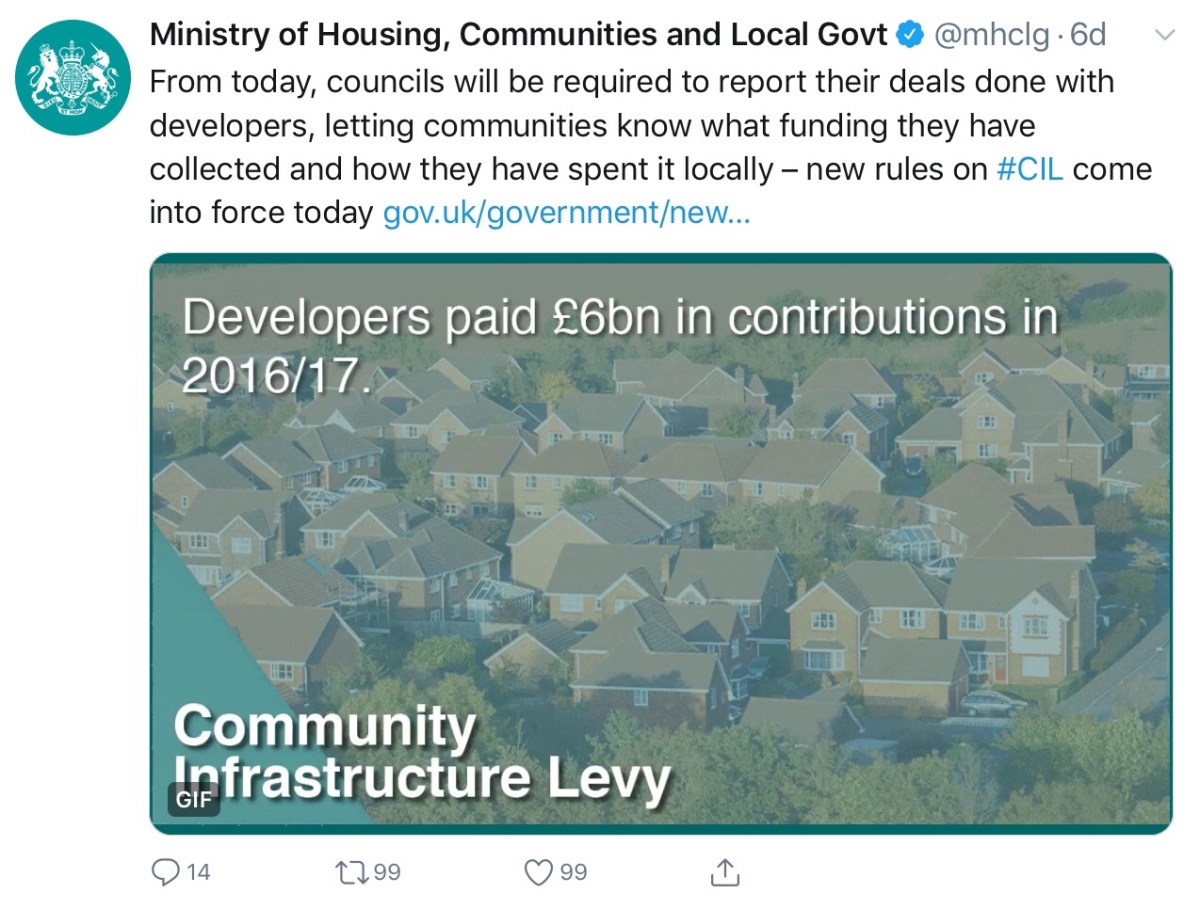
This tweet from MHCLG has been nagging away at me for a few days:

The announcement of course was in relation to the 1 September 2019 commencement date in the Community Infrastructure Levy (Amendment) (England) (No. 2) Regulations 2019 and the Government’s updated planning practice guidance in relation to CIL , planning obligations and viability.

I covered the background to the changes in my 8 June 2019 blog post The Bottom Line: Updates On CIL And Viability.

There was quite a splash on 1 September, with a MHCLG press statement Communities to see how housing developers cash benefits them thanks to new planning rules (1 September 2019) and media briefings by planning minister Esther McVey, duly reported in the professional press eg Councils forced to spell out details of CIL deals (Housing Today, 2 September 2019):

McVey said builders “spent a whopping £6bn towards local infrastructure in 2016/17” but councils had not been required to report on the total amount of funding they had received or how it was spent, “leaving residents in the dark”.

She went on: “The new rules … will allow residents to know how developers are contributing to the local community when they build new homes, whether that’s contributing to building a brand new school, roads, or a doctor’s surgery that the area needs.”

What has been nagging away at me in the tweet was the gif image: “Developers paid £6bn in contributions in 2016/2017…Community Infrastructure Levy”.

Huge if true.

But it’s not.

I have tracked the £6bn figure back to a research report The Incidence, Value and Delivery of Planning Obligations and Community Infrastructure Levy in England in 2016-17 by Dr Alex Lord, Dr Richard Dunning and Dr Bertie Dockerill (University of Liverpool), Dr Gemma Burgess (University of Cambridge), Dr Adrian Carro (University of Oxford) Professor Tony Crook and Professor Craig Watkins (University of Sheffield) and Professor Christine Whitehead (London School of Economics) published by MHCLG in March 2018.

From the executive summary:

There has been an increase in the aggregate value of planning obligations agreed and CIL levied since 2011/12, up 61% from £3.7bn to £6.0bn in 2016/17 (50% after adjusting for inflation).

So the £6bn is the total of the value of section 106 planning obligations agreed (not paid) and “CIL levied”. This is the table in the research document:

⁃ “The estimated value of planning obligations agreed and CIL levied in 2016/17 was £6.0 billion. This central valuation is premised upon the assumptions identified in the appendix, corresponding to survey validity, respondent representation and the distribution of values.

⁃ When adjusted to reflect inflation the total value of developer obligations in real terms is almost identical to the peak recorded in 2007/08 (£6.0 billion), but significantly higher than in 2011/12 (£3.9 billion). These changes coincide with changes in the number of dwellings granted planning permission over time.

⁃ 68% of the value of agreed developer obligations was for the provision of affordable housing, at £4.0 billion. 50,000 affordable housing dwellings were agreed in planning obligations in 2016/17.

⁃ The value of CIL levied by LPAs was £771 million in 2016/17, with a further £174 million levied by the Mayor of London.

⁃ The geographic distribution of planning obligations and CIL is weighted heavily towards the south of England. The South East and London regions account for 58% of the total value.

⁃ Direct payment contributions continue to provide a large proportion of the total contribution value for non-affordable housing obligations

But I am pretty sure there is a confusion over “CIL levied” too. The table shows that of the £6bn, £771m was LPA CIL and £174m was Mayoral CIL. As with the money attributed to planning obligations, I suspect that these CIL figures represent the amount of CIL that is calculated to be payable if development eventually proceeds pursuant to permissions issued in 2016/2017. After all we can cross-check the £174m against the MCIL monies actually collected by the Mayor from the boroughs in 2016/2017 which this GLA table shows to be only £137m.

There is something else important. Over two thirds of the “whopping £6bn towards local infrastructure” that developers allegedly spent in 2016/2017 was not even towards “local infrastructure” as defined by the Government – it was towards affordable housing!

So it’s not that developers are not committing huge sums towards local infrastructure, and even greater sums towards affordable housing.

And it’s not that CIL will not over time secure increasing contributions towards the provision of local infrastructure.

It’s the inaccuracies and exaggeration. £6bn was not received by local authorities in 2016/2017 to be spent on local infrastructure. Local authorities did not even accrue the right to that amount in the future. The reality is that planning permissions were issued which, could, in due course , deliver (subject to the application of CIL exemptions and reliefs in the case of the £945m CIL component) up to around £2bn.

The minister accuses authorities of “leaving residents in the dark” as to funding received and spent. Greater transparency from MHCLG on the numbers it uses would be equally helpful.

Simon Ricketts, 7 September 2019

Personal views, et cetera

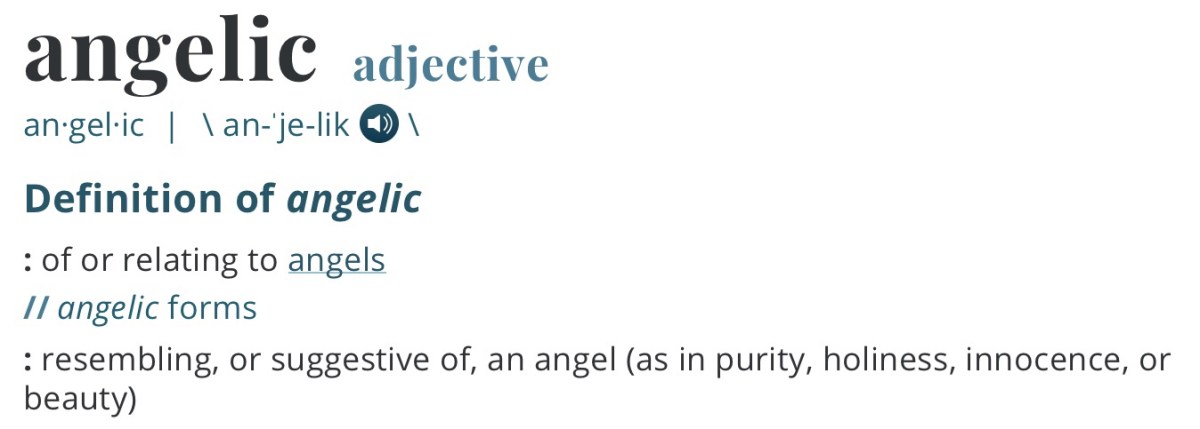
Angelic: Public Benefits Of Unlawful Demolition In Conservation Area

There was an interesting piece this week by Sarah Townsend on the Planning Resource website: Why planning enforcement notices have dropped to their lowest-ever level (subscription only, 29 August 2019).

There was also an interesting ruling from the High Court, London Borough of Tower Hamlets v Secretary of State and Angelic Interiors Limited (in administration) (Kerr J, 27 August 2019), which will have made every enforcement officer, and indeed conservation officer, blink. Although perhaps the facts are unusual.

In June 2016, enforcement officers at the London Borough of Tower Hamlets were tipped off that the buildings comprising 2, 4 and 6 East Ferry Road London E14, within the Coldharbour conservation area, had been demolished without planning permission. It is of course a crime, as well as a breach of planning control, to cause or permit demolition of a building in a conservation area without planning permission.

The council wasn’t certain who had done it, although an individual has since admitted responsibility, and it did not prosecute.

As was reported at the time (BBC website, 27 September 2017), the council served various enforcement notices, requiring that within 18 months the owner was to “rebuild the building so as to recreate in facsimile the building as it stood immediately prior to its demolition on 26 June 2016 with reference to the photographs and plans (LBTH file reference PA/84/00512 & PA/81/00497 originals of which are available at the Tower Hamlets Council’s Town Hall)

In fact there had been a long-running dispute as to who owned the property, which was only resolved in October 2018, in favour of a company called, ironically, Angelic Interiors Limited, which had been in administration since July 2016. Angelic’s administrators appealed against the enforcement notices.

Enforcement appeal decision letter

The inspector, Simon Hand, allowed the appeals in a decision letter dated 17 December 2018.

In order to place Kerr J’s judgment this month into context, it is illuminating to read the decision letter.

Here are some key passages:

Nos 2-6 were the last surviving remnant of the once large area of Victorian workers housing in Cubitt Town which occupied the whole of the south-eastern side of the Isle of Dogs.”

There is […] no dispute the removal of the buildings causes less than substantial harm to the Coldharbour conservation area. The conservation area is a designated heritage asset and paragraph 193 of the NPPF makes it clear that great weight should be given to any less than substantial harm to the significance of a heritage asset. Paragraph 194 goes on to say that any loss of significance to a heritage asset should require clear and convincing justification (my emphases). Paragraph 196 explains that where there is less than substantial harm to a heritage asset is should be weighed against the likely public benefits arising from that harm.”

If they were to be rebuilt then they would undoubtedly be very nice, but the issue is what role do they play in the significance of the conservation area and the answer would seem to me to be very little.”

Had the demolished buildings been of historic interest in their own right they would have been worth preserving simply for that reason, but they would still have told us little or nothing about Cubitt Town, its development, or its morphology. The development of Cubitt Town does not seem to have been unusual in any way, nor any of its buildings particularly special, it is not until this Inquiry that anyone at the Council has made any mention of it at all. To my mind the dwellings were not the last fragment of a historically significant but now lost development. They were simply three remnant buildings in a sea of modern development. To suggest that this makes it all the more important to preserve them is to adopt a collector’s mentality, particularly as they seemed to have no great historic significance themselves due to the substantial modern changes they had undergone.”

Both parties accepted the loss of the buildings had caused less than substantial harm to the significance of the conservation area, and I would not like to suggest their loss causes no harm at all, but I consider that the harm is very much at the lowest end of that scale. It was argued that if the site is left vacant or redeveloped there would be no reason to retain it in the conservation area and this would seem to be true, but it does call into question the motivation for extending the conservation area in the first place. Had it been deliberately to protect this remnant of Cubitt Town, then I would have expected somewhere for this to have been explained. I accept the conservation area appraisal is lacking in detail, but if Cubitt Town was of such importance as Mr Froneman argued, then I find it hard to believe the reason for the extension to this allegedly key part of the Isle of Dogs is deliberately not mentioned as the appraisal explains only that the extension was in order to protect Glen Terrace. It seems to me more likely the Council just saw these Victorian looking buildings and took the opportunity to include them, as there was nothing else of any historic interest in the area. Whatever the truth of the matter whether or not the vacant site remains worthy of conservation area status is of little importance in this case.”

The inspector found this to be an area of high housing need and “there would appear to be no constraints that would prevent a housing scheme of significantly greater density than 3 units from being successful on the site.”

it would seem highly likely that a suitable development proposal could be found and there are no obvious reasons why the landowner would not want to realise the development potential of the site.”

Paragraph 196 of the NPPF requires that the harm should be weighed against any public benefits. In this case those benefits are the redevelopment of the site with a much larger number of dwellings than would be the case if the demolished houses were rebuilt, including much needed affordable housing, all of which would be in accord with the prevailing policy ethos for the area. I accept these benefits are speculative, but in my view there is a good chance they would be realised. It seems likely to me that even had the buildings still been in place, given their poor condition and lack of any historic significance, they would have been demolished to make way for a comprehensive redevelopment scheme. Consequently, I consider these benefits outweigh the harm identified. The demolition of the three dwellings is thus in accord with the NPPF and the development plan for the area and so I shall grant planning permission accordingly.

So he found that the potential for redevelopment for housing purposes of the unlawfully cleared site amounted to a sufficient public benefit to outweigh the “great weight” to be attached to the (very much) less than substantial harm that had been caused to the character or appearance of the conservation area.

High Court

The council challenged the decision letter.

Kerr J identified the main issue before him as “whether the “public benefits of the proposal” (in the words of NPPF paragraph 196) should extend to likely benefits of new development of a site, facilitated by demolition of buildings on the site, where there is no current application for planning permission to develop the site; or whether those words are restricted to the public benefits of demolishing the buildings, without considering any likely future development.

The judge did not find this to be an easy case:

It is counter-intuitive to propose that unlawful (and criminal) demolition of buildings forming part of a conservation area, harming the significance of that conservation area, can do more good than harm. No sensible planning application to demolish would be made on that basis and a planning consultant suggesting such an application would soon be short of clients.

Still, for the inspector’s decision to be lawful, and for the challenges to fail, it has to be a defensible conclusion that demolition without replacement, leaving the site razed to the ground and vacant, without any replacement development, and doing harm to the significance of the conservation area, is more good than bad. Baldly stated in that way, the proposition is remarkable.

My first thought on hearing argument was that the proposition cannot be correct. If only demolition is on the table, and demolition is harmful, how then can it do more good than harm? Can it be good and bad at the same time, and more good than bad?

The judge concluded that it was simply a matter for factual evaluation for the inspector.

I accept the respondents’ interpretation of the heritage provisions in the NPPF with a degree of hesitation. I am conscious that it is a liberal construction and not a strict pro-heritage construction such as the council is advocating. Nevertheless, on balance I think the respondents’ is the correct one, bearing in mind that the NPPF provisions are statements of policy not law and the language of the provisions is not restricted in the way the council contends.”

He considered whether the inspector’s decision could be said to have been irrational:

I reject the council’s free standing contention that, quite apart from the interpretation of the NPPF provisions, it was irrational to decide that the market would produce suitable and beneficial housing development soon. It is true that the inspector could not say what type of development that would be, nor that it would certainly occur; but those were points he was entitled to weigh when considering the public benefit side of the balance.

I do not see any want of rationality in reasoning that the site would soon attract developers like flies to a honeypot and that this would probably have led to demolition of the three houses soon anyway. The circumstantial evidence supporting that finding was not lacking: the prime location, the pressing need to build housing in the borough, the appetite shown by other housing developments nearby, the indicative Turner scheme and the intention to sell and strong likelihood of sale of the site for development.”

Lastly, he considered whether the inspector’s decision was adequately reasoned:

As for the reasons challenge, did the inspector properly set out his thinking? Manifestly, he did. The reasoning need not be discursive. It is commendably succinct but clear and full. He explained exactly why he was confident that delivery of the public benefit he anticipated could be left to the market. He made all the points I have just mentioned, in support of his conclusion. The council cannot complain that it does not know why it lost the appeals.

I did consider carefully whether the reasoning touches adequately on the possibility of a development scheme that would leave the three houses intact, whereby the developer would build round them and keep them in place. If the inspector had simply assumed, without considering the issue properly, that the public benefits derived from anticipated development would be lost unless the demolition were permitted, that could have been a flaw in the reasoning.

However, I have concluded that the inspector did adequately, though briefly, consider this point and that it was a matter for his planning judgment. His consideration of likely development proposals such as the one illustrated by the Turner scheme (involving 22 new dwellings) included the council’s 2005 discussions which would have involved demolition of the three houses.”

He dismissed the challenge, albeit with a final bit of judicial hand-wringing:

I do so without much enthusiasm, reminding myself that the enforcement system is remedial not punitive. I must put aside the affront to the rule of law and criminal activity seen in this case, as well as the loss of the three houses and their contribution to our historic environment, however limited some may consider it. My discomfort does not make the inspector’s decision unlawful and I must and do uphold it.”

Implications

Plainly, unlawful actions should in principle not go unpunished and it is disappointing that there have been no prosecutions.

Plainly also, Angelic’s administrators now have an unearned windfall by virtue of a cleared site for development with no obligation to reconstruct the buildings that others had unlawfully demolished on the site.

That is not to say that the enforcement notices should have stood and that replicas of these apparently unexceptional buildings should have been required, simply to discourage others from similar conduct, but what is there in this unfortunate chain of events to encourage appropriate behaviour on the part of future Angelics?

Simon Ricketts, 31 August 2019

Personal views, et cetera

Prior Approval Deadlines: An Important Judgment

Your planning law question for today is:

Where the General Permitted Development Order 2015 provides that you have deemed planning permission for a category of development within Schedule 2 of the Order, subject to your applying to the local planning authority for a determination as to whether its prior approval is required as to specified matters, and the Order sets out a specific deadline for that determination (failing which development may proceed), can you agree an extended deadline with the local planning authority?

When you look at Schedule 2, Part 3 (changes of use) for instance, paragraph W specifies as follows:

(11) The development must not begin before the occurrence of one of the following –

(a) the receipt by the applicant from the local planning authority of a written notice of their determination that such prior approval is not required;

(b) the receipt by the applicant from the local planning authority of a written notice giving their prior approval; or

(c) the expiry of 56 days following the date on which the application under sub-paragraph (2) was received by the local planning authority without the authority notifying the applicant as to whether prior approval is given or refused.”

There is no hint of any power for the parties to agree an extended time period.

But then you look at Article 7 of the Order:

7. Prior approval applications: time periods for decision

Where, in relation to development permitted by any Class in Schedule 2 which is expressed to be subject to prior approval, an application has been made to a local planning authority for such approval or a determination as to whether such approval is required, the decision in relation to the application must be made by the authority –

(a) within the period specified in the relevant provision of Schedule 2,

(b) where no period is specified, within a period of 8 weeks beginning with the day immediately following that on which the application is received by the authority, or

(c) within such longer period as may be agreed by the applicant and the authority in writing.

Does this enable that 56 day period to be extended? Most commentators have previously assumed so. My experience is that agreed extensions are not uncommon. After all, a developer would often rather allow the authority further time to determine an application (perhaps on the basis of further information being provided to assist in its consideration of the issues) rather than to face a 56th day refusal and the need to re-apply and/or appeal.

It’s a binary question. The High Court in R (Warren Farm (Wokingham) Limited v Wokingham Borough Council (Mr C M G Ockelton, 31 July 2019) has ruled that article 7 (c) does not enable specific deadlines in schedule 2 to be extended.

In Mr Ockleton’s view (Mr Ockleton is Vice President of the Upper Tribunal but regularly sits as a High Court judge), article 7 (c) only enables extension of time in relation to categories of prior approval application which fall under article 7 (b) ie where Schedule 2 does not specify a deadline and therefore article (b) imposes a deadline of eight weeks.

He goes on to say this:

There is of course a certain artificiality in the discussion: I was not shown any provision of the GPDO to which article 7(b) applies and it follows from the view that I have reached that if there is (at present) none, there is also no provision to which article 7(c) applies. But that does not impact on my conclusion. Where a period is specified, the deemed grant of planning permission takes place at the end of that period, so the authority’s decision must be before that. If no period be specified, the deemed grant takes place only when a decision is made, and there is therefore scope for agreeing a time within which the authority has to make a decision. Article 7(c) is to be read as an alternative to article 7(b) only, not to article 7 (a).”

(Obviously I took that as a challenge to go rooting through the Order. For a prior approval procedure in schedule 2 without a specified deadline for the prior approval process you need to go 200 or so pages into the document to classes B and following classes in Part 17 (“mining and minerals operations”)).

I am not at all sure that Parliament intended article 7 (c) to have such limited effect. I would suggest that MHCLG review the implications as a matter of urgency. Particularly if we are going to see further or amended permitted development processes in due course with additional matters for prior approval, are the current determination deadlines appropriate if they can’t be extended by agreement?

Furthermore, what are the implications for existing applications? The claimant in the Warren Farm case had agreed an extended period of determination for its prior approval application in connection with a proposal to use an agricultural building as a dwelling. The application was subsequently refused but it successfully challenged the refusal on the basis that in fact the purported agreement to extend time had not been legally effective and that there was therefore an automatic deemed approval at the end of the 56 days.

There may be other decisions in the same circumstances, subject to the usual judicial review deadline.

However, isn’t there legal uncertainty as to what is the case in any event, if there was a purported agreement to extend the time period and then an (as it now transpires) unlawful refusal? Even if the issue of that refusal is not (or cannot now be) challenged by way of judicial review, does (in the case for instance of changes of use) paragraph W (11) (c) allow the development to be carried out in any event because there has been “the expiry of 56 days following the date on which the application under sub-paragraph (2) was received by the local planning authority without the authority notifying the applicant as to whether prior approval is given or refused”. The 56 days expired without any refusal and is that sufficient, even if there was subsequently a refusal? Open question – what do you think?

I think we shall be seeing further litigation. In any case, the wording of the Order needs to be clarified.

Simon Ricketts, 24 August 2019

Personal views, et cetera

Gestation Of An Elephant: Plan Making

Keith Hill, then housing and planning minister, once described the process to Royal Assent of what became the Planning and Compulsory Purchase Act 2004 as “the gestation of an elephant”. It took 17 months. Given that the average gestation period for an Asian elephant is 18 to 22 months he wasn’t far off.

However, he would have been more accurate using the metaphor in relation to the local plan examination processes that were conceived by way of the Act. Lichfields’ January 2019 statistical report Planned up and be counted: Local Plan-making since the NPPF 2012 concludes that the average examination length under the 2012 NPPF has been 18 months.

My 13 July 2019 blog post Less Than Best Laid Plans: Political Pragmatism attempted to go into some of the reasons for that.

15 years on from the 2004 Act, it is interesting to set what the aspirations of the Government of the time were, as against some examples of current examination processes up and down the country.

Barbara Roche in the House of Commons on 17 December 2002, introducing the Bill for a second reading:

We want to make the system fairer, faster and more predictable and to bring to planning clarity, certainty and more strategic direction.”

Lord Rooker in the House of Lords 6 January 2004:

“…the Bill sets out a reform planning system for this new century that will help us to deliver sustainable communities faster and more fairly—it is no good being faster unless it is fairer.”

What will the Bill do? It simplifies the plan-led process by abolishing the middle tier of planning—the structure plans—that exists in some areas; that is to say, areas where there are county councils and two-tier local government. The new system will have two linked levels of planning: regional spatial strategies and local development frameworks. The local development frameworks will be made up each of a set of local development documents, which each authority will be required to prepare. Together, these documents will replace local plans and unitary development plans. They will set out development proposals and have a clear map so that everyone can see what goes where.”

The Conservative peer Lord Hanningfield in response:

In introducing the legislation, the Minister pointed out that the Government seek to make the planning system simpler and quicker, aims which we support. However, we believe that the proposals risk achieving the opposite outcomes. This legislation will unleash regional spatial strategies, local development schemes, local development frameworks, local development documents, action area plans, simplified planning zones and statements of community involvement. How will all these plans and schemes, with their different timetables, consultations, inspections and appeals, make the system more transparent or streamlined? This level of complexity and fragmentation will accelerate public disenchantment with the system. It will lead to uncertainty, delay and planning by appeal.”

Looking back at the scrutiny of the Bill in Public Bill Committee on 23 October 2003 for instance, Geoffrey Clifton-Brown, then shadow spokesman for Communities and Local Government, responding to planning and housing minister Keith Hill, also pretty much called it right (but it was what we all said at the time):

I accept a lot of what the Minister said in his long speech about the deficiencies in the existing system, such as the inflexibility as well as the time and difficulty in getting a revision due to the need to revise the whole plan. We feel that the existing system with amendments could have been made to work and that tearing it up and replacing it with a highly complicated new system will make a paradise for lawyers. We will see judicial reviews and all manner of case law created as a result of the Bill, which will add to the delay that it will bring.”

I accept absolutely, however, what the Minister said about the existing system being inadequate, in that it is too slow and that 31 authorities do not have a plan in place. The Committee will not be surprised to learn that a number of practitioners and large developers who use the planning system have been through my offices in the last few weeks. The one thing they all say is, ”For goodness’ sake, we hope that this new system is going to be quicker and clearer, but we don’t think it is.” The test of time will prove that, but we need to ensure that the system will operate.”

Time will tell whether that new system works, but I have a new acronym— CHAOS, which stands for ”Can Hill’s Alternative Objectives Succeed?” I submit that they will not.”

Nothing is black and white in planning. It is not that there is chaos, but, guess what, the system is no quicker or clearer. We no longer have lengthy adversarial local plan inquiries but we are seeing increasingly lawyer-heavy local plan examinations (cross-examination having been replaced by duelling legal opinions), that can turn into utter sagas of successive rounds of inspectors’ preliminary findings, further work, further consultation and rescheduled hearing sessions. Outcomes are unpredictable. There is a lack of statistical transparency across the piece as to how the system is performing.

It took 28 months from submission of the Cambridge and South Cambridgeshire local plans for examination on 28 April 2014 to publication of the inspectors’ final report on 3 September 2018. Is that a record?

If so, it won’t be for long. From those plan examinations that I am immediately aware of:

Welwyn Hatfield will soon overtake that. Its plan was submitted for examination on 15 May 2017. During the course of the hearing sessions, the inspector was not satisfied that the council had allocated sufficient housing sites and the council embarked on a further call for green belt sites for possible release but misjudged how long the process would take, or simply failed to manage the process properly, leading the inspector to issue his 8 August 2019 letter to the council. You can sense the frustration in his tone. There is now no likelihood that the examination will be completed by May 2020, as the council had suggested back in March. If the council is not able to revise the timetable, “putting forward realistic time periods and milestones for the conclusion of all the outstanding tasks, including the hearings…or slippage continues to occur [beyond April 2020] then I think we should consider the option of you withdrawing the plan with a view to re-submitting it for Examination when the work is finally completed and there are no obvious soundness issues accompanying it”.

The North Essex Authorities section 1 local plan will run and run. The plan was submitted for examination on 9 October 2017. The inspector was not satisfied with the sustainability appraisal work underpinning identification of three new garden cities and raised concerns as to soundness in his 8 June 2018 letter. He gave the options of removing the garden cities from the plan on the basis of a commitment to an early review, or doing further working and undertaking further consultation. The authorities chose the latter course. Consultation starts on Monday until 30 September 2019 before further hearing sessions are then arranged, according to the inspector’s August 2019 update.

The Windsor and Maidenhead local plan was submitted for examination on 31 January 2018. The council has had to do various strands of further work since the stage 1 hearings which took place last year. Another frustrated inspector – her letter dated 21 June 2019 presses the council for “as much detail as possible” as to the likely implications for the plan of each strand and the number and nature of changes that it is likely to propose:

In making this assessment, please consider whether continuing with the examination of the submitted Plan is the most prudent course of action in light of the work you are doing and of the potential issues reported in our previous correspondence. If you remain of the view that the examination should continue, please set out clearly the steps necessary before hearings can resume along with a realistic timetable for the process. I would also ask you to consider whether a procedural hearing might be a useful means of clarifying the process for all parties and, if so, when it could take place.”

The St Albans local plan was submitted to the Secretary of State for examination in March 2019, following the failure of the previously submitted plan on the basis of the inspector finding that the duty to cooperate had not complied with. The hearing sessions were due to begin in October 2019 but already the examination has run into the sand. The council responded in detail on 31 July 2019 to initial questions from the inspectors. When I say “in detail”, their response as to its approach to proposed green belt releases runs to over 70 pages (an explanation that should surely have been available when the plan was initially submitted). The council has now confirmed that the stage hearing sessions will not be taking place until January and February 2020.

The York local plan was submitted for examination in May 2018, following years of delay and political disagreements. 15 months on, there is no sign of any hearing sessions. Consultation closed on 22 July 2019 in relation to a proposed revised housing need figure and other documents as well as a number of proposed consequent modifications to the plan.

And so it goes on. The North Warwickshire local plan was submitted for examination in March 2018. The inspector’s letter dated 24 June 2019 following the hearing sessions sets out various unresolved issues, the main one being the plan’s reliance on a HIF funding bid of around £58m which has not yet been awarded. The inspector puts forward three possible options for the council and recommends that in the first instance the council pursues option (a), which “may mean suspending the examination for a short period”:

a. await the outcome of the HIF bid and unambiguously identify the likely source(s) of funding for the dualling of the A5; or

b. put forward alternative sites that do not rely on highways improvements for which funding is not certain or unknown; or

c. withdraw the plan

The inspectors’ approach with the West of England joint spatial plan (submitted for examination in April 2018) – to recommend, after the first hearing sessions, withdrawal of the plan, in their letter dated 1 August 2019 – was perhaps a more realistically decisive response than the make-do-and-mend pragmatism that is leading time and time again to these prolonged examination processes, although equally unsatisfactory for the participants. They will provide more detailed reasoning later this month, but the inspectors have a series of concerns as to how the “strategic development locations” in the plan were selected against reasonable alternatives. They question whether further work could be carried out “with the necessary objectivity, rather than being an exercise to justify a predetermined spatial strategy.

It would obviously be better for all concerned if work is done to the necessary standard before plans are submitted. Why isn’t it? The problems can’t all be laid at the door of the 2012 NPPF and the uncertainties arising from the 2012 system of assessing housing need. Or of the prescriptive requirements of strategic environmental assessment.

Is it a lack of guidance, too many fudged compromises pre-examination or simply a system that is not fit for purpose?

Or, to mix mammalian metaphors, is it that, if the system was an elephant, perhaps now it is a camel? For example, crucial components of the 2004 brave new world were (1) the setting of numbers by way of regional spatial strategies (a process that proved slow and difficult, with little public appetite for directly elected regional assemblies), abolished once the coalition government took control in 2010, and (2) the concept that the local development scheme would comprise a variety of development plan documents, being updated at different times, but now encouraged to be bundled back together as local plans and thereby as cumbersome as the complex documents the 2004 system sought to replace. Tinkering has not necessarily improved.

An elephant would never forget the meandering way in which we ended up with our present planning system.

One hump or two?

Simon Ricketts, 17 August 2019

Personal views, et cetera

Pic courtesy of Wikipedia

The Big CC

I’m on holiday and it’s hot. There was going to be no blog post this week.

But the hotel room world news channels were covering the latest IPCC report, published on Thursday, and I realised I needed to join some dots for myself on climate change. So here is another blog post after all, before I lose the thread again.

I’m no expert but I hope the links at least are helpful. Many of you will know all this and more, and will find my summarising simplistic. I have tried to remain factual, or at least evidence-based, but there is inevitably some subjectivity in selecting passages to quote from long reports.

Some preliminary thoughts:

⁃ Allowing average global temperatures to rise more than 1.5 degrees C above pre-industrial levels is not a sensible option. The implications have now been mapped out to a high level of scientific certainty.

⁃ Through an unprecedented amount of international effort, ground work has been done to work out how temperature rises can be contained. But achieving international consensus is slow, lagging behind the science, and given the absence, pretty much, of any international supervisory regime, it is

now for each country to work out how, and whether it wants, to play its part.

⁃ It is not that successive UK governments have done nothing. But have they done enough? How best do we move forward at the right pace, potentially no longer in coordination with our nearest trading partners (in the way that many measures to date have been) and given that this Government, and governments to come, are focused on Brexit and its practical and economic implications?

⁃ Business will not be as usual, but if we get it right, many outcomes will be beneficial in any event – more pleasant places to live, healthier lifestyles.

⁃ The challenge will inevitably increasingly influence much of national policy-making as well as our funding and taxation regimes – the only arguments are about how hard and how fast the measures should be. If we are not very careful, those arguments will become increasingly entrenched and politicised.

⁃ Much of our approach to infrastructure and planning will be affected.

⁃ All of this will help to define what it means to be a planning lawyer for the rest of my career.

Think Global

Some important stepping stones.

Creation of the IPCC, 1988

The Intergovernmental Panel on Climate Change was established in 1988 by the World Meteorological Organisation and United Nations Environment Programme. As set out in its principles:

The role of the IPCC is to assess on a comprehensive, objective, open and transparent basis the scientific, technical and socio-economic information relevant to understanding the scientific basis of risk of human-induced climate change, its potential impacts and options for adaptation and mitigation. IPCC reports should be neutral with respect to policy, although they may need to deal objectively with scientific, technical and socio-economic factors relevant to the application of particular policies.”

The IPCC does not carry out its own original research but bases its extremely detailed assessment reports (of which there now have been five, as well as a special report last year which I’ll come to in a moment) on peer-reviewed analysis, by thousands of scientists, working on a voluntary basis, of published scientific literature.

The IPCC has proved essential to climate change thinking, where the science is liable be hijacked by those with their own agendas.

Rio, 1992

The United Nations Framework Convention on Climate Change was adopted at the Rio Summit in 1992.

Article 2 sets out that the “ultimate objective” of the Convention is “to achieve, in accordance with the relevant provisions of the Convention, stabilization of greenhouse gas concentrations in the atmosphere at a level that would prevent

dangerous anthropogenic interference with the climate system. Such a level should be achieved within a time-frame sufficient to allow ecosystems to adapt naturally to climate change, to ensure that food production is not threatened and to enable economic development to proceed in a sustainable manner.”

Developed countries agreed that they would stabilise their greenhouse gas emissions at verified 1990 benchmark levels by 2000.

Kyoto, 1997

The Kyoto Protocol extended the scope of the Convention. Whilst negotiated in 1997, it did not come into force until 2005. Its parties, which included the UK and the EU, were committed to reducing emissions of six identified greenhouse gases from the 1990 benchmark in the initial commitment period of 2008 to 2012, each by an identified percentage, that for the UK being 12.5%.

Doha, 2012

An amendment to the Kyoto Protocol was adopted by a number of states, including the UK and EU, in 2012. It covers the second commitment period under the Kyoto Protocol, from 2013 to 2020, with commitments to more stringent reductions – 20% from 1990 levels for EU states.

Paris, 2016

The Paris agreement was negotiated in 2015 and signed by almost 200 participating countries in 2016.

For the first time there was a defined target in an international treaty, of holding global warming below 2 degrees above pre-industrial levels, despite there being a large amount of international consensus well before that this was an appropriate target (for example, this was an outcome of a 1996 Council of the European Union conference in Luxembourg, as well as 2009 and 2010 UN Copenhagen climate change conferences in Copenhagen and Cancún respectively). However, understanding of the science was moving on: the evidence in the IPCC’s Fifth Assessment Report, published in 2014, implied that 2 degrees might not be an adequate target.

The objectives of the agreement are set out in Article 2:

1. This Agreement, in enhancing the implementation of the Convention, including its objective, aims to strengthen the global response to the threat of climate change, in the context of sustainable development and efforts to eradicate poverty, including by:

(a) Holding the increase in the global average temperature to well below 2 °C above pre-industrial levels and pursuing efforts to limit the temperature increase to 1.5 °C above pre-industrial levels, recognizing that this would significantly reduce the risks and impacts of climate change;

(b) Increasing the ability to adapt to the adverse impacts of climate change and foster climate resilience and low greenhouse gas emissions development, in a manner that does not threaten food production; and

(c) Making finance flows consistent with a pathway towards low greenhouse gas emissions and climate-resilient development.

2. This Agreement will be implemented to reflect equity and the principle of common but differentiated responsibilities and respective capabilities, in the light of different national circumstances.”

Cutting and pasting from Wikipedia (I’m on holiday):

Under the Paris Agreement, each country must determine, plan, and regularly report on the contribution that it undertakes to mitigate global warming. No mechanism forces a country to set a specific target by a specific date, but each target should go beyond previously set targets. In June 2017, U.S. President Donald Trump announced his intention to withdraw the United States from the agreement. Under the agreement, the earliest effective date of withdrawal for the U.S. is November 2020, shortly before the end of President Trump’s current term. In practice, changes in United States policy that are contrary to the Paris Agreement have already been put in place.”

IPCC special report, October 2018

The sixth IPCC assessment report is not due until 2022, but as part of the Paris agreement negotiations the IPCC was requested to publish a special report on the impact of global warming of 1.5°C above pre-industrial levels . The evidence in the report sets out plainly the relative implications and likelihoods of a 1.5 or 2 degrees rise in global warming and the consequences, largely projected with a stated high degree of certainty. The evidence inevitably points to the need for the current Paris agreement cap of 2 degrees being reduced to a cap of 1.5 degrees – just a more ambitious longterm target of 1.5 degrees in the agreement.

Global warming is likely to reach 1.5°C between 2030 and 2052 if it continues to increase at the current rate. (high confidence).”

Climate-related risks for natural and human systems are higher for global warming of 1.5°C than at present, but lower than at 2°C (high confidence). These risks depend on the magnitude and rate of warming, geographic location, levels of development and vulnerability, and on the choices and implementation of adaptation and mitigation options (high confidence).”

Climate models project robust differences in regional climate characteristics between present-day and global warming of 1.5°C, and between 1.5°C and 2°C. These differences include increases in: mean temperature in most land and ocean regions (high confidence), hot extremes in most inhabited regions (high confidence), heavy precipitation in several regions (medium confidence), and the probability of drought and precipitation deficits in some regions (medium confidence).

By 2100, global mean sea level rise is projected to be around 0.1 metre lower with global warming of 1.5°C compared to 2°C (medium confidence). Sea level will continue to rise well beyond 2100 (high confidence), and the magnitude and rate of this rise depend on future emission pathways. A slower rate of sea level rise enables greater opportunities for adaptation in the human and ecological systems of small islands, low-lying coastal areas and deltas (medium confidence).

On land, impacts on biodiversity and ecosystems, including species loss and extinction, are projected to be lower at 1.5°C of global warming compared to 2°C. Limiting global warming to 1.5°C compared to 2°C is projected to lower the impacts on terrestrial, freshwater and coastal ecosystems and to retain more of their services to humans (high confidence).

Limiting global warming to 1.5°C compared to 2°C is projected to reduce increases in ocean temperature as well as associated increases in ocean acidity and decreases in ocean oxygen levels (high confidence). Consequently, limiting global warming to 1.5°C is projected to reduce risks to marine biodiversity, fisheries, and ecosystems, and their functions and services to humans, as illustrated by recent changes to Arctic sea ice and warm-water coral reef ecosystems (high confidence).

Climate-related risks to health, livelihoods, food security, water supply, human security, and economic growth are projected to increase with global warming of 1.5°C and increase further with 2°C.

Most adaptation needs will be lower for global warming of 1.5°C compared to 2°C (high confidence). There are a wide range of adaptation options that can reduce the risks of climate change (high confidence). There are limits to adaptation and adaptive capacity for some human and natural systems at global warming of 1.5°C, with associated losses (medium confidence). The number and availability of adaptation options vary by sector (medium confidence).”

IPCC special report, climate change and land, 8 August 2019

As part of the Paris agreement negotiations, the IPCC was also asked to prepare a special report on Climate Change, Desertification, Land Degradation, Sustainable Land Management, Food Security, and Greenhouse gas fluxes in Terrestrial Ecosystems”. Its report was published on 8 August 2019.

First of all, it sets out its findings as to the present position:

A1.1. People currently use one quarter to one third of land’s potential net primary production for food, feed, fibre, timber and energy. Land provides the basis for many other ecosystem functions and services, including cultural and regulating services, that are essential for humanity (high confidence). In one economic approach, the world’s terrestrial ecosystem services have been valued on an annual basis to be approximately equivalent to the annual global Gross Domestic Product (medium confidence). {1.1, 1.2, 3.2, 4.1, 5.1, 5.5, Figure SPM.1}

A1.2. Land is both a source and a sink of greenhouse gases (GHGs) and plays a key role in the exchange of energy, water and aerosols between the land surface and atmosphere. Land ecosystems and biodiversity are vulnerable to ongoing climate change and weather and climate extremes, to different extents. Sustainable land management can contribute to reducing the negative impacts of multiple stressors, including climate change, on ecosystems and societies (high confidence). {1.1, 1.2, 3.2, 4.1, 5.1, 5.5, Figure SPM.1}

A1.3. Data available since 1961 show that global population growth and changes in per capita consumption of food, feed, fibre, timber and energy have caused unprecedented rates of land and freshwater use (very high confidence) with agriculture currently accounting for ca. 70% of global fresh-water use (medium confidence). Expansion of areas under agriculture and forestry, including commercial production, and enhanced agriculture and forestry productivity have supported consumption and food availability for a growing population (high confidence). With large regional variation, these changes have contributed to increasing net GHG emissions (very high confidence), loss of natural ecosystems (e.g. forests, savannahs, natural grasslands and wetlands) and declining biodiversity (high confidence). {1.1, 1.3, 5.1, 5.5, Figure SPM.1}

A1.4. Data available since 1961 shows the per capita supply of vegetable oils and meat has more than doubled and the supply of food calories per capita has increased by about one third (high confidence). Currently, 25-30% of total food produced is lost or wasted (medium confidence). These factors are associated with additional GHG emissions (high confidence). Changes in consumption patterns have contributed to about 2 billion adults now being overweight or obese (high confidence). An estimated 821 million people are still undernourished (high confidence). {1.1, 1.3, 5.1, 5.5, Figure SPM.1}

A1.5. About a quarter of the Earth’s ice-free land area is subject to human-induced degradation (medium confidence). Soil erosion from agricultural fields is estimated to be currently 10 to 20 times (no tillage) to more than 100 times (conventional tillage) higher than the soil formation rate (medium confidence). Climate change exacerbates land degradation, particularly in low-lying coastal areas, river deltas, drylands and in permafrost areas (high confidence). Over the period 1961-2013, the annual area of drylands in drought has increased, on average by slightly more than 1% per year, with large inter-annual variability. In 2015, about 500 (380-620) million people lived within areas which experienced desertification between the 1980s and 2000s. The highest numbers of people affected are in South and East Asia, the circum Sahara region including North Africa, and the Middle East including the Arabian peninsula (low confidence). Other dryland regions have also experienced desertification. People living in already degraded or desertified areas are increasingly negatively affected by climate change (high confidence). {1.1, 1.2, 3.1, 3.2, 4.1, 4.2, 4.3, Figure SPM.1}

As to future risks:

Climate change creates additional stresses on land, exacerbating existing risks to livelihoods, biodiversity, human and ecosystem health, infrastructure, and food systems (high confidence). Increasing impacts on land are projected under all future GHG emission scenarios (high confidence). Some regions will face higher risks, while some regions will face risks previously not anticipated (high confidence). Cascading risks with impacts on multiple systems and sectors also vary across regions (high confidence). {2.2, 3.5, 4.2, 4.4, 4.7, 5.1, 5.2, 5.8, 6.1, 7.2, 7.3, Cross-Chapter Box 9 in Chapter 6, Figure SPM.2}”.

What can be done?

Sustainable land management, including sustainable forest management, can prevent and reduce land degradation, maintain land productivity, and sometimes reverse the adverse impacts of climate change on land degradation (very high confidence). It can also contribute to mitigation and adaptation (high confidence). Reducing and reversing land degradation, at scales from individual farms to entire watersheds, can provide cost effective, immediate, and long-term benefits to communities and support several Sustainable Development Goals (SDGs) with co-benefits for adaptation (very high confidence) and mitigation (high confidence). Even with implementation of sustainable land management, limits to adaptation can be exceeded in some situations (medium confidence). {1.3.2, 4.1.5, 4.8, Table 4.2}.

Response options throughout the food system, from production to consumption, including food loss and waste, can be deployed and scaled up to advance adaptation and mitigation (high confidence). The total technical mitigation potential from crop and livestock activities, and agroforestry is estimated as 2.3-9.6 GtCO2e.yr-1 by 2050 (medium confidence). The total technical mitigation potential of dietary changes is estimated as 0.7-8 GtCO2e.yr-1 by 2050 (medium confidence). {5.3, 5.5, 5.6}”

“Future land use depends, in part, on the desired climate outcome and the portfolio of response options deployed (high confidence). All assessed modelled pathways that limit warming to 1.5oC or well below 2°C require land-based mitigation and land-use change, with most including different combinations of reforestation, afforestation, reduced deforestation, and bioenergy (high confidence). A small number of modelled pathways achieve 1.5oC with reduced land conversion (high confidence) and, thus, reduced consequences for desertification, land degradation, and food security (medium confidence). {2.6, 6.4, 7.4, 7.6; Cross-Chapter Box 9 in Chapter 6; Figure SPM.4}.

Policies that operate across the food system, including those that reduce food loss and waste and influence dietary choices, enable more sustainable land-use management, enhanced food security and low emissions trajectories (high confidence). Such policies can contribute to climate change adaptation and mitigation, reduce land degradation, desertification and poverty as well as improve public health (high confidence). The adoption of sustainable land management and poverty eradication can be enabled by improving access to markets, securing land tenure, factoring environmental costs into food, making payments for ecosystem services, and enhancing local and community collective action (high confidence). {1.1.2, 1.2.1, 3.6.3, 4.7.1, 4.7.2, 4.8, 5.5, 6.4, 7.4.6, 7.6.5}.

“The effectiveness of decision-making and governance is enhanced by the involvement of local stakeholders (particularly those most vulnerable to climate change including indigenous peoples and local communities, women, and the poor and marginalised) in the selection, evaluation, implementation and monitoring of policy instruments for land- based climate change adaptation and mitigation (high confidence). Integration across sectors and scales increases the chance of maximising co-benefits and minimising trade-offs (medium confidence). {1.4, 3.1, 3.6, 3.7, 4.8, 4.9, 5.1.3, Box 5.1, 7.4, 7.6}.”

There is a third special report that remains to be published, on “The Ocean and Cryosphere in a Changing Climate”.

Act Local

So what of the UK, in this international context?

It is striking to read this 1989 speech by then prime minister Margaret Thatcher, with her expressed concerns as to the risks of climate change and support for the work of the nascent IPCC.

In 2005, then Chancellor Gordon Brown commissioned economist Nicholas Stern to carry out a Review on the Economics of Climate Change. Published in 2006, the review sets out the economic benefits of acting sooner rather than later in combatting climate change.

The Climate Change Act 2008 received Royal Assent in November 2008. From its explanatory notes, a summary of the mechanisms in the Act:

The Act sets up a framework for the UK to achieve its long-term goals of reducing greenhouse gas emissions and to ensure steps are taken towards adapting to the impact of climate change. Its main elements are as follows:

Setting emissions reduction targets in statute and carbon budgeting. The Act establishes an economically credible emissions reduction pathway to 2050 and beyond by putting into statute medium and long-term targets. In addition, the Act introduces a system of carbon budgeting which constrains the total amount of emissions in a given time period. Carbon budget periods will last five years, beginning with the period 2008–2012, and must be set three periods ahead. The Secretary of State is required to give indicative ranges for the net UK carbon account in each year of a budgetary period, to set a limit on use that can be made of international carbon credits in each budgetary period and to develop and report on his proposals and policies for meeting carbon budgets.

A new reporting framework. The Act provides for a system of annual reporting by the Government on the UK’s greenhouse gas emissions. The new Committee on Climate Change will have a specific role in reporting annually on progress, with the Government required to lay before Parliament a response to this progress report.

The creation of an independent advisory body. The Act creates a new independent body, “the Committee on Climate Change”, to advise the Government and devolved administrations on how to reduce emissions over time and across the economy and, on request, on any other matter relating to climate change, including adaptation to climate change. This expert body will advise on the optimum trajectory to 2050, the level of carbon budgets, and on how much effort should be made by the part of the economy covered by trading schemes and by the rest of the economy, as well as reporting on progress.

Trading scheme powers. The Act includes powers to enable the Government and the devolved administrations to introduce new domestic trading schemes to reduce emissions through secondary legislation. This increases the policy options which the Government could use to meet the medium and long-term targets in the Act.

Adaptation. The Act sets out a procedure for assessing the risks of the impact of climate change for the UK, and a requirement on the Government to develop an adaptation programme on matters for which it is responsible. The programme must contribute to sustainable development. The Act also gives powers to direct other bodies to prepare risk analyses and programmes of action, and advisory and progress-reporting functions to the Committee on Climate Change.

Policy measures which reduce emissions. The Act will be used to support emissions reductions through several specific policy measures: amendments to improve the operation of the Renewable Transport Fuel Obligations; a power to introduce charges for single use carrier bags; a power to pilot local authority incentive schemes to encourage household waste minimisation and recycling; amendments relating to the Certified Emissions Reductions Scheme; powers and duties relating to the reporting of emissions by companies and other persons; a duty to make annual reports on the efficiency and contribution to sustainability of buildings on the civil estate.”

Section 1(1) provided as follows:

It is the duty of the Secretary of State to ensure that the net UK carbon account for the year 2050 is at least 80% lower than the 1990 baseline.”

That duty was formulated after intense debate, against the context of the global objective of an average mean temperature rise of no more than 2 degrees. A 60% target was originally proposed before the minimum 80% target was introduced. Section 30 provides that the target excludes include greenhouse gases from international aviation or international shipping “except as provided by regulations made by the Secretary of State.

Immediately following the October 2018 IPCC special report, the government commissioned a report from the Committee on Climate Change:

This advice will inform consideration of the UK’s long term targets, and should include options for the date by which the UK should achieve a) a net zero greenhouse gas target and/or b) a net zero carbon target in order to contribute to the global ambitions set out in the Paris Agreement, including whether now is the right time for the UK to set such a target. Your advice should also provide options for:

• the range which UK greenhouse gas emissions reductions would need to be within, against 1990 levels, by 2050 as an appropriate contribution to the global goal of limiting global warming to well below 2°C above pre-industrial levels, and

• the range which UK greenhouse gas emissions reductions would need to be within, against 1990 levels, by 2050 as an appropriate contribution towards global efforts to limit the increase to 1.5°C above pre-industrial levels.

Your report should provide evidence on:

• how reductions in line with your recommendations might be delivered in key sectors of the economy; and

• the expected costs and benefits across the spectrum of scenarios in comparison to the costs and benefits of meeting the current target.”

The CCC published its report Net Zero – The UK’s contribution to stopping global warming on 2 May 2019. It advised as follows:

The UK should legislate as soon as possible to reach net-zero greenhouse gas emissions by 2050. The target can be legislated as a 100% reduction in greenhouse gases (GHGs) from 1990 and should cover all sectors of the economy, including international aviation and shipping

The report’s key findings are that:

• The Committee on Climate Change recommends a new emissions target for the UK: net-zero greenhouse gases by 2050.

• In Scotland, we recommend a net-zero date of 2045, reflecting Scotland’s greater relative capacity to remove emissions than the UK as a whole.

• In Wales, we recommend a 95% reduction in greenhouse gases by 2050.

A net-zero GHG target for 2050 will deliver on the commitment that the UK made by signing the Paris Agreement. It is achievable with known technologies, alongside improvements in people’s lives, and within the expected economic cost that Parliament accepted when it legislated the existing 2050 target for an 80% reduction from 1990.

However, this is only possible if clear, stable and well-designed policies to reduce emissions further are introduced across the economy without delay. Current policy is insufficient for even the existing targets.”

The report sets out in some details the options available to meet the 80% or 100% reduction targets, categorising them as follows:

Core options are those low-cost low-regret options that make sense under most strategies to meet the current 80% 2050 target. They also broadly reflect the Government’s current level of ambition (but not necessarily policy commitment).

• Further Ambition options are more challenging and on current estimates are generally more expensive than the Core options.

• Speculative options currently have very low levels of technology readiness, very high costs, or significant barriers to public acceptability. It is very unlikely they would all become available.

The report then analyses various business sectors individually. I set out some selective passages from the document, focusing on identified potential delivery mechanisms, ie what we may well see in practice by way of legislative and policy changes in due course:

Power

We find that emissions from the UK’s electricity system can be reduced to almost zero whilst meeting increased electricity demands from the transport and heat sectors, potentially doubling the size of today’s electricity system. Our findings in part reflect new research on the impact of heat pumps and electric vehicles on the UK’s electricity system.

Reducing electricity emissions close to zero will require sustained and increased deployment of renewables and possibly nuclear power and the decarbonisation of back-up generation. Improvements in system flexibility – such as battery storage, interconnection and flexible demands – can help accommodate large volumes of variable renewables in the system at low cost. However some flexible power generation will continue to be required and will need to be decarbonised, probably via carbon capture and storage (CCS) and hydrogen.

Hydrogen (as either hydrogen or ammonia) can be used as a low-carbon fuel in the buildings, industrial, transport (including shipping) and power sectors. Producing hydrogen at low cost can be done with low emissions, by the development of advanced methane reformation facilities with CCS. Our hydrogen analysis draws mainly on our 2018 hydrogen report.”

(See also the subsequent Department for Business, Energy and Industrial Strategy announcement Innovative funding models and technologies to drive investment in new wave of low carbon energy (23 July 2019)).

Buildings

Near-full decarbonisation of heat for buildings is one of the biggest challenges in reducing emissions from the energy system to net zero by 2050. The policies put in place to drive the required changes will determine how the costs of this decarbonisation are allocated between consumers and taxpayers. Government must review the plan for the distribution of these costs as an early priority to ensure that the wider transition – for workers and energy bill payers – is perceived to be fair.

It is critical that measures to reduce emissions are not viewed in isolation. A holistic approach is required to deliver buildings which are low-carbon, thermally-efficient, better adapted to a changing climate, with safe moisture levels and excellent indoor air quality”.

Industry

The Government must urgently establish an overall framework to support long- term industrial decarbonisation, as committed to in the Government’s Clean Growth Strategy, if it is to enable decarbonisation towards the Committee’s recommended net-zero target. Delay will mean less decarbonisation of industry is possible or a greater role for scrapping assets.

‒ The design of the policy framework to reduce UK industry emissions must ensure it does not drive industry overseas, which would not help to reduce global emissions, and be damaging to the UK economy. This will require either consumers or taxpayers to bear much of the cost of decarbonisation of industrial subsectors or sites so long as they are at risk of carbon leakage.

‒ Policies should include a funding mechanism for industry decarbonisation, to support near-zero emission technologies, including use of hydrogen, electrification and CCS (including BECCS), a mechanism to support CO2 transport and storage infrastructure by the end of 2019, and support for energy and resource efficiency.

‒ CO2 transport and storage infrastructure should be operational in at least one industrial cluster by 2026 and available to all major industrial clusters soon afterwards, alongside hydrogen for all clusters where it is the best fuel-switching option for some sites. A network to provide hydrogen to industry outside the main industrial clusters should be established by 2035, or potentially slightly later if ‘hydrogen-ready’ appliances can be deployed in industry prior to this.

‒ By providing an attractive investment environment, including stable policy, the UK can become a leader in production of low-carbon goods, attract increased investment in new and existing industries, and develop new businesses and products. This should involve encouraging subsectors and technologies where the UK may have a competitive advantage.”

Transport

The following priority actions should be taken as soon as possible to support the transition to zero emission technologies across road transport:

‒ Commit to end the sale of conventional cars and vans by 2035, including ending the sale of hybrid and plug-in-hybrid vehicles. End the use of petrol and diesel vehicles (including hybrid and plug-in-hybrid vehicles) on UK roads by 2050.

‒ Announce plans for the continuation of financial incentives for electric vehicles, through a commitment to continued grant schemes or through greater differentiation in the tax system, e.g. vehicle excise duty (VED), VAT and fuel duty, which will still be required in the near-term to support the early market.

‒ Continue development of charging infrastructure provision, especially improving reliability of current provision and rolling out of chargers in towns and cities to provide for people without off-street parking.

‒ Trials of zero emission HGVs with associated infrastructure within the UK

Aviation and shipping

A mix of UK and international policies will be required to deliver the Further Ambition scenarios in ways that avoid perverse outcomes (e.g. carbon leakage).

‒ Both aviation and shipping will need to strengthen the current internationally agreed policies. Aviation should set a global long-term objective for emissions. Shipping should put in place a policy framework to deliver the agreed target for 2050. A more ambitious global target in shipping would be needed to deliver the technical potential that exists in the Further Ambition scenario.

‒ The Government should ensure their forthcoming Aviation Strategy and Clean Maritime Plan support innovation, research and deployment to ensure new technologies are brought to market in a timely fashion. The Aviation Strategy will also need to set out an approach to limiting growth in aviation demand. We will set out our recommended approach for aviation in follow-up advice to DfT later in 2019.”

Agriculture, land use, land-use change and forestry

The following actions should be taken to support deep emissions reduction in agriculture and the LULUCF sectors:

‒ Develop a post-Common Agricultural Policy (CAP) framework that incentivises the take- up of low-carbon farming practices and promotes transformational change in land use that rewards land owners and managers for deep emissions reduction and removals and delivering wider ecosystem benefits.

‒ Continued investment in R&D, testing and piloting of options to deliver agricultural productivity improvements and enhanced forest productivity. Develop low-carbon agricultural machinery and robotics with artificial intelligence.

‒ Provide support to help land managers transition to alternative land uses through skills, training and information. Along with financial support for alternative land uses with high up-front costs and long pay-back periods.

‒ Government should introduce consumer-focused policies to encourage healthier diets and reduce food waste more proactively. The public sector should take a strong lead for example, by providing plant-based and lower-meat options in schools and hospitals.”

Waste

The following priority actions should be taken as soon as possible to support the transition to zero emissions across waste management:

‒ Government and the DAs [devolved administrations] should legislate a mandatory ban on biodegradable waste from key waste streams going to landfill by 2025 at the latest. In order to achieve this, separate waste collection should be introduced by 2023 and supporting measures to increase municipal recycling rates to 70% by 2030 at the latest.

‒ Policies and measures should be introduced to achieve a 20% reduction in avoidable food waste by 2025 including more proactive waste avoidance measures.

‒ Government and the DAs should work with waste water companies to develop a strategy to reduce non-CO2 emissions from waste water handling by at least 20% by 2050.”

Theresa May acted on the CCC’s recommendation that the minimum 80% reduction figure in the 2008 Act be amended to 100% ie net zero greenhouse emissions by 2050, with an announcement on 12 June 2019 and the making of the Climate Change Act 2008 (2050 Target Amendment) Order 2019 on 26 June 2019.

The target still excludes greenhouse gases from international aviation or international shipping. There is this statement in the explanatory notes to the Order:

The Government recognises that international aviation and shipping have a crucial role to play in reaching net zero emissions globally. However, there is a need for further analysis and international engagement through the appropriate frameworks. For now, therefore, we will continue to leave headroom for emissions from international aviation and shipping in carbon budgets to ensure that emissions reduction strategies for international aviation and shipping can be developed within International Maritime Organisation and International Civil Aviation Organisation frameworks at the appropriate pace, and so that the UK can remain on the right trajectory for net zero greenhouse gas emissions across the whole economy.

Finally, the CCC has reacted (8 August 2019), to the IPCC’s land use and climate change report, referring back to its November 2018 report Land use: Reducing emissions and preparing for climate change, which made the recommendation that “land use policy should promote transformational land uses and reward land- owners for public goods that deliver climate mitigation and adaptation objectives. New policies should also reflect better the value of the goods and services that land provides. The key measures that have clear, multiple benefits are: afforestation and forestry management; restoration of peatlands; low-carbon farming practices; improving soil and water quality; reducing flood risks and improving the condition of semi-natural habitats. These measures should be rewarded if they go beyond a minimum standard that land-owners should already be delivering.”

The net zero greenhouse gas emissions by 2050 target is of course, save in relation to international aviation and shipping, in line with the CCC’s recommendations but there has been intense lobbying for more stringent measures.

The Extinction Rebellion campaign group has three published aims:

1. “Government must tell the truth by declaring a climate and ecological emergency, working with other institutions to communicate the urgency for change.”

2. “Government must act now to halt biodiversity loss and reduce greenhouse gas emissions to net zero by 2025.

3. “Government must create and be led by the decisions of a Citizens’ Assembly on climate and ecological justice.”

Almost half the local authorities in the country have formally declared a “climate emergency.” The Campaign Against Change Change website has a list of authorities that have made a formal declaration and an indication of the contents of each declaration.

What do these declarations look like? Here is Cornwall’s, by way of example:

On the 22nd January 2019, a motion was passed by Cornwall Councillors to declare a climate emergency. The minutes of that meeting are available online for you to view. The motion resolved that the council would:

1. Declare a climate emergency

2. Call on Westminster to provide the powers and resources necessary to achieve the target for Cornwall to become carbon neutral by 2030 and commit to work with other Councils with similar ambitions

3. Provide adequate staff time and leadership to prepare a report within six months to establish how Cornwall can sufficiently reduce carbon emissions through energy and other Council Strategies, plans and contracts within a timescale which is consistent with an ambition to restrain Global Warming to 1.5oC. This will draw together the actions Cornwall Council is already and will continue to take; and where possible, outline partners’ commitments to move towards a carbon neutral Cornwall by 2030

No doubt we will be seeing statements such as these feed through into emerging policy. So what is it likely to mean for planning? The TCPA’s Planning for climate change: a guide for local authorities (May 2018) provides useful advice, but against the backdrop of the previous 80% reduction in net greenhouse gas emissions by 2050 target, not the new “net zero” target or the even more ambitious targets that these declarations would imply.

So, returning from holiday, plenty of practical questions:

1. What prospects for a new or amended international agreement reflecting a 1.5 degree target, particularly given the current stance of the US and others?

2. What will be the approach of Boris Johnson’s government, in its precarious, preoccupied, state, to the immediate challenges ahead?

3. What will be in the government’s aviation strategy, expected later this year?

4. How rapidly will business grasp some of the opportunities set out in some detail in the CCC’s May 2019 report and what will the government be doing to facilitate the necessary measures?

5. What will come of these local authority “climate emergency” declarations and to what extent will the Government seek to constrain individual authority stances, where they run contrary to other planning objectives?

Simon Ricketts, 10 August 2019

Personal views, et cetera