Time is money. Time is unmet needs. Time is unrealised public benefits.
I just wanted to capture some of the current, frankly depressing, data that is out there on application and appeal timescales.
The purpose of this post is to underline that there is a significant problem to be addressed. What to do about it will be for another post – there is certainly much that can be done that does not require (1) legislation (2) additional resources or (3) any procedural shortcuts.
Applications
A piece from yesterday’s Planning daily online: Council signs off 2,380-home urban extension almost four years after committee approval (£). Four years is certainly going it some but I can confirm from constant first-hand experience how difficult it can be to move a project from resolution to grant to permission at any speed. The larger or more complex the project, the longer those negotiations over the section 106 agreement and associated aspects can end up taking.
My colleague Lida Nguyen has been looking at the position in London. She has looked at all applications for planning permission which were referred to the Mayor between 3 January and 11 December 2020, so applications of potential strategic importance as defined in the Mayor of London Order 2008 and, for those which were then approved by the relevant borough (without intervention by the Mayor or secretary of State), she has looked at the average time that the application took from validation to the borough’s resolution to approve and from the borough’s resolution to approve to permission being issued. Discarding a few anomalous cases, this left 88 to be analysed.
In my humble view the statistics are appalling, but not surprising:
Application submission to resolution to approve
Median: 228.5 days
Mean: 269 days
Resolution to approve to grant of permission
Median: 218.5 days
Mean: 259 days
It’s rather deflating for applicants and (when you stand back from the detail) surely absurd that resolution to grant in reality only marks the halfway point to a permission in relation to significant projects in London. Wouldn’t it be a start for boroughs, the Mayor and those acting for applicants to set a target of halving each of those figures and agreeing the necessary steps to achieve that reduction?
Appeals
My 25 May 2019 blog post Pace Making: Progress At PINS reported on Bridget Rosewell’s recommendation, adopted by the Planning Inspectorate, that inquiry appeals decided by an inspector (i.e. not recovered by the Secretary of State) should be decided within 24 weeks of receipt and that where the Secretary of State is to be the decision-maker, inspectors’ reports should be submitted to the Secretary of State within 30 weeks of receipt of the appeal. Initial progress was really impressive – until the first lockdown struck in March 2020. After a slow start (see my 2 May 2020 blog post There Is No E In Inquiry), PINS of course eventually, to the massive credit of all involved, embraced virtual hearings, inquiries and examinations and the risk of an impossible backlog was averted. However, it is clear from the latest Planning Inspectorate statistical update (19 August 2021) that there is still much work to do:
“The mean average time to make a decision, across all cases in the last 12 months (Aug 20 to Jul 21), was 27 weeks. The median time is 23 weeks.
The median time to decide a case decreased by 0.6 weeks between June and July 21, with the median being 21.4 weeks.
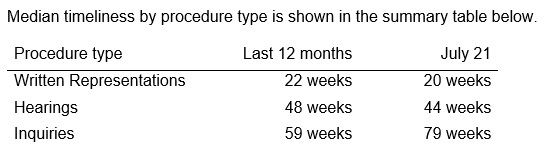
Median timeliness by procedure type is shown in the summary table below.
Performance since April 21 against the median measure has only varied by 0.7 weeks, between 21.4 weeks and 22.1 weeks. Performance had been improving between November 20 and March 21. For inquiries, in the last two months, cases have taken longer to decide as a result of very old enforcement inquiry cases being decided.
Enforcement decisions made in the last 12 months had a median decision time of 34 weeks. Looking at the annual totals, the median and mean time to decision for specialist decisions have been broadly the same as for enforcement decisions, and longer than the median for planning decisions. Since February 21 there has been a change in this trend, with Specialist cases being quicker than Enforcement.
The median time for planning appeals decided by inquiry under the Rosewell Process over the 12 months to July 21 is 35 weeks. This is quicker than other types of casework decided by inquiry.”
Whilst the extent of statistical information provided these days is welcome, it is difficult sometimes to track the figures through the different tables so as to work out what the likely timescale outcome for a prospective appellant will turn out to be. I have also looked in vain within the statistics for any information as the time being taken between appeal receipt and validation – a traditional black hole when it comes to appeal timescales. I’m also struggling to see any breakdown as to what the “Rosewell” inquiries were (35 weeks average) as compared to inquiries overall (79 weeks!).
That overall 27 weeks average is deceptively encouraging for anyone looking at anything other than a written representations appeal. Because those appeals make up 95% of the total of course they massively skew the mean figure. But even then, although not reflected in these statistics, my own anecdotal impression is that validation of appeals which proceed by way of written representations or hearing is very slow indeed, raising a large question mark over the overall statistics. Possibly something to do with the focus on Rosewell inquiry appeal targets. Am I being unfair? What solid information on this is there out there? If there isn’t any, why not??
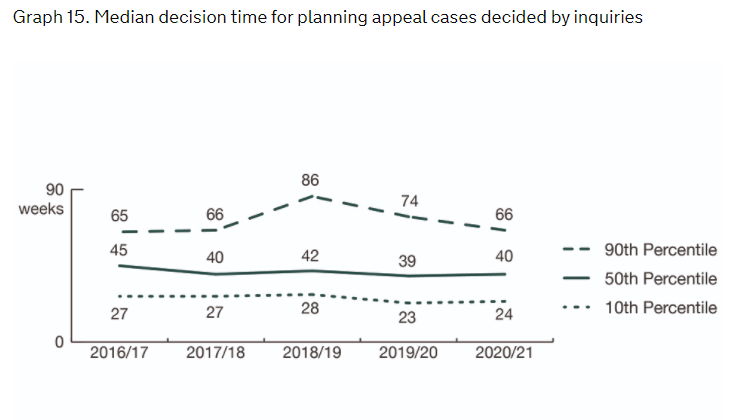
The Planning Inspectorate Annual Report and Accounts (July 2021) contains further statistical information, with tables such as these looking back at the changing position over the last five years:
In order to meet Rosewell targets, surely on that last table the 90th percentile needs to come down from 66 weeks to 24 weeks – and to be measured from receipt of appeal rather than validation?
Again, as with timescales for major applications in London, with appeal inquiries, surely we are looking at the need to more than halve current timescales?
All tables above have been taken from PINS documentation, for which thanks.
Simon Ricketts, 20 August 2021
Personal views, et cetera
Planning Law Unplanned is having a summer break this week, before returning at 6pm on Tuesday 31 August for somewhat of a BECG/DP9 special, London Elections 2022: Politics Meets Planning. Join the club here for notifications of this and future clubhouse Planning Law Unplanned events.
Westminster City Council’s deputy leader Councillor Melvyn Caplan resigned yesterday (12 August 2021) over the summer fiasco of the temporary viewing platform that has been built next to Marble Arch, in the middle of the gyratory roundabout where Park Lane meets Oxford Street. From WCC’s press statement Westminster City Council update on Marble Arch Mound:
“The Mound opened too early, and we have apologised for that. It has become clear that costs have risen more than anticipated and that is totally unacceptable. Our original forecast cost was £3.3m. Total costs are now £6m, covering every aspect of the project: construction, operation and eventual removal.”
All credit to Councillor Caplan for taking that honourable step. However, so many questions arise from this:
• On the one hand, is it right for one person to carry the can, but, on the other hand, why don’t we see more examples of leadership like this in local or national government when bigger things go wrong?
• Doesn’t the Council deserve at least some credit for being innovative, in the face of the challenges faced by Oxford Street and the west end? There’s surely nothing wrong with “off the wall” projects as a matter of principle as long as behind the scenes they are as de-risked as possible and it will be a shame if the crushing “computer says no” answer to every idea will now be “remember the mound”.
• When is it appropriate for a public authority to take on this sort of project and when should it de-risk via the private sector? Didn’t it in fact ring alarm bells that a private operator wasn’t prepared to speculate on the project, or weren’t they even given the opportunity?
• Did the computer generated imagery serve to oversell the initial experience?
This project did seem to get an exceptionally easy ride.
The application for planning permission was resolved to be approved on 30 March 2021 and planning permission issued later that day, with the application only having been submitted on 19 February (which was the first time, as far as I know, the project entered the public domain). So applications can be determined quickly (in less than six weeks) under the current system then, even for an eight storey high temporary structure on metropolitan open land next to a grade 1 listed building and with the lead-in to a committee meeting! We’ll all have some of that please.
“The location of the structure is sensitive due to its setting adjacent to the Grade 1 Listed Marble Area [sic] and location on Metropolitan Open Land (MOL). However, the provision of a temporary visitor is aimed at attracting visitors back to the Oxford Street District by increasing footfall, and supporting economic recovery following the Covid -19 pandemic. This is a clear planning benefit which is considered to outweigh the less than substantial harm that would be caused to the designated heritage assets.”
I don’t particularly quibble with the fact that planning permission was granted (and I note that it did have much business support – after all it really wasn’t in principle a bad idea), although it is interesting to see the light touch applied to the sustainability of the project in the officer’s report:
“Sustainability:
“Relocation of trees, grass, wood and soil. The proposal is that elements used in the construction of the structure, namely wood, soil, grass, and trees will all find new uses in nearby gardens and parks. The submission refers to ‘a co-ordinated dismantling programme to enable the transplanting of the numerous plants and trees used in landscaping of the hill to other projects in and beyond the Oxford Street District for the benefit of its communities’.
The focus will be on greening school environments, community spaces, and housing amenity areas. The planting used on this project will meet the City Council’s priorities for health and wellbeing. It is envisaged that the project as a whole can then contribute to the development and illustration of the Council’s Green Infrastructure Strategy.
The Head of Arboricultural Services advises that there are limitations on suitable space available for such material and attempting to transplant living plant material is likely to result in a high mortality rate. Therefore, this is unlikely to be a practical proposition. In the circumstances whilst the intention to re-use as much of the structure as possible is welcomed and encouraged. Given potential practical difficulties highlighted it is not recommended that this is secured by condition.”
After planning permission was granted, the final go-ahead for the project was given by cabinet in May 2021.
This what was said about costs:
“The current indicative construction costs for the mound are approximately £1.998m. These will be met from the £150m investment in Oxford Street District approved by Full Council in March 2019. Capital expenditure of c£522k will ensure a number of permanent legacy improvements are delivered across the district and this will be met from the approved Highways capital budgets. The potential for significant income generation has been further developed. This will be offset against operational and construction costs to reduce the overall net cost.”
To these costs were to be added the costs of the operator contract.
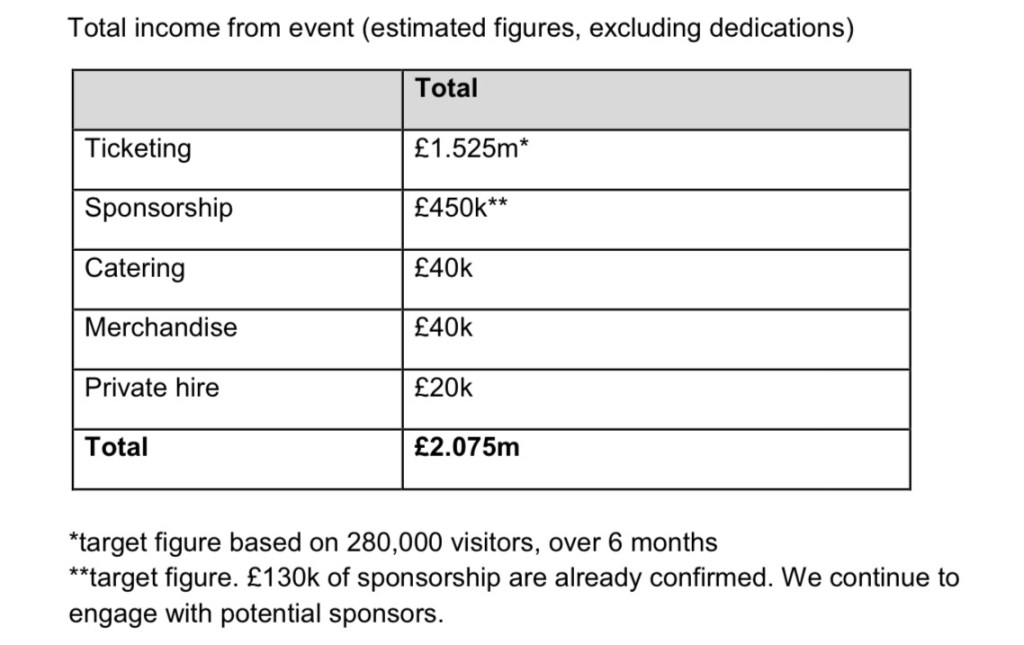
Cabinet were informed as to the prospect of income in the order of £2m being generated by the attraction.
Given that entrance is now going to be free for the duration of August, sadly the figures currently look on the optimistic side.
Why wasn’t there more scrutiny of the budget? Was everyone just caught up in the moment and conscious of the narrow window for pressing the “go” button? After all, warning bell surely, the architects, MVRDV, had previously proposed a very similar scheme for the Serpentine Gallery in 2004, which was abandoned for financial and health and safety reasons (see MVRDV’s proposed 2004 Serpentine Gallery Pavilion was “a heroic failure” (Dezeen, 8 November 2015) ).
My final question was as to the computer generated imagery used to “sell” the project. It looks instagram-amazing – and with a project like this the detail was always going to make the difference between success and failure. It is always going to be about that initial opening day wow factor: wasn’t the real problem (as per the first part of that WCC press statement) just that it really wasn’t ready to be unveiled? Worse things have happened, but it’s obviously difficult when you make a false, and unusual, step in such a high profile location.
Picture courtesy Westminster City Council
Who knows, it might turn out largely as illustrated (just late, like everything) and after all (although perhaps a stretch in this instance), perhaps all publicity is indeed good publicity. I’ll pay a visit to see what all the fuss is about, with maybe a little retail therapy en route (which after all is what it’s all about). Overall it is obvious that mistakes have been made, but (1) (oldest of sayings) let who is without sin cast the first stone and (2) (newest of sayings) don’t you just hate to see a combined media and social media pile-on?
Simon Ricketts, 13 August 2021
Personal views, et cetera
Our Planning Law Unplanned clubhouse event this Tuesday 17 August (6 to 7.15 pm) should be fascinating: “An End To Ugly? The Office for Place & National Model Design Code unpacked”, with special guests Nicholas Boys-Smith, Chris Miele and Vicky Payne. Sign up to the app here.
A personal rant, with apologies. Did you see that quote in the Daily Mail about the long awaited Planning Bill?
“A Government source said ministers would be in ‘listening mode’ on the issue when Parliament returns in September, adding: ‘We’ll listen and we’ll move.
‘We can take some of the edges off that are upsetting people and still get some important changes through.
‘The bottom line is we have got to get more houses built. The average age of a first-time buyer is 34. We have to get that down and give younger people a chance to get a stake in society.’”
Listening to whom, do we think? Backbench Conservative MPs of course and voters in relevant constituencies of course. Anyone else? Shrugging shoulders emoji.
Does the Government really believe that it can make changes that materially accelerate the delivery of homes, without upsetting voters and therefore backbench Conservative MPs? (I’m only focusing on the Conservative party because it is in Government – Labour MPs are hardly falling over themselves either to support development in their constituencies, and as for the Liberal Democrats…). I see it all around me, the social norm/knee jerk reaction to a development proposal being to object and being to assume that everyone else will want to object too – whether green field development (it should be on a brown field site) or the development of a brown field site (oh not there, too high, setting, infrastructure etc etc). Of course it is hoped that exhortations as to design will make a difference in making development less unpopular, but, even travelling optimistically, that is going to take a long long time.
So what are the “edges” that are going to be taken off the white paper proposals?
It’s obvious isn’t it? No doubt the idea that national housing targets will actually, perish the thought, have to be planned for by each local authority on a local basis, let alone find their way through to consents and development, isn’t just out of the window, it’s jumped down onto the pavement and skipped half way down the street by now.
“One leading rebel said: ‘If this ends up being a developers’ free-for-all, it will be utterly toxic for Tory MPs everywhere – not just in the South East.
‘If ministers get this wrong we can kiss goodbye to our new electoral success.
‘We will be doing the Lib Dems’ job for them across the Midlands, the South and the suburbs where we’ve had massive growth in recent years.
‘People are fed up. Being seen as the party concreting over our countryside or ramming housing estates into suburban green spaces will be electoral suicide. Boris needs to get a grip on this.’ Rebels want the idea of mandatory house-building targets replaced with voluntary ones.
They also want ministers to drop ‘growth zones’ in which planning applications would be automatically approved.”
Can we be clear: no-one I know in the development and planning world wants a fudged, bodged, old failed ideas re-branded, camel of a Planning Bill. Forget the whole thing rather than waste valuable time on a set of reforms based on political trade-offs and trying to be all things to all people. If as a politician you can’t focus on the objectives – climate change, providing everyone with a decent home, a functioning economy – because you’re just worrying about holding onto power and a job, forget it, don’t even start: with that frame of mind you will make things worse not better.
Without (1) a clear articulation of how many homes need to be built across the country, with a published evidence base to support that number (whether that’s 300,000 a year, or lower, or – probably – higher) and (2) those numbers somehow being divided out across the country without local opportunities for prolonged delays, obfuscation and special pleading (a year on from the white paper it is still really difficult to work out how this can be done), the system will continue to meander on its way – through the interminable plan making local politics, through the lengthy, unpredictable, too detailed and yet too light touch, examinations and through the inevitable court challenges.
The incoming coalition government in 2010 tore up top-down planning, in the form of the regional strategies, before the system even had time to prove itself. Yes it was an slow and over-engineered process, but there was at least the opportunity for democracy at the regional level in setting and apportioning numbers. The return to a bottom up approach, together with the let’s cross our fingers and rely on the duty (not really) to co-operate, and with a semi voluntary, almost unmappable, ad hoc patchwork of local authority combinations and alliances, has led to local plans being mired in endless debates as to numbers. Even with a supposedly standard method for calculating local housing need, those endless debates continue in every green belt local authority area – see Cherwell Development Watch Alliance v Cherwell District Council & Secretary of State (Thornton J, 30 July 2021) for the most recent example.
How are we going to get out of that mire, plan quickly and positively, stabilise spiralling house prices, reduce the age at which adult working offspring can leave the parental home to live somewhere convenient (let alone buy their own home – that’s a first world problem compared to the need for an affordable home in the first place), if local housing numbers are going to be left for local authorities and communities to determine?
Pray tell, “Government source”.
Simin Ricketts, 6 August 2021
Personal views, et cetera
Two great clubhouse Planning Law Unplanned events coming up:
⁃ 6pm Tuesday 10 August: Stonehenge road tunnel consent quashed: why, how, what next – discussion led by junior counsel to Save Stonehenge, Victoria Hutton. Link to invitation here.
⁃ 6pm Tuesday 17 August: AN END TO UGLY: The Office for Place & NMDC unpacked – special guests Nicholas Boys-Smith (chair, Office for Place), Dr Chris Miele (Montagu Evans) and Vicky Payne (URBED). Link to invitation here.

The court has quashed the decision of the Secretary of State (“SST”), against his examining authority’s recommendations, to “grant a development consent order (“DCO”) […] for the construction of a new route 13 km long for the A303 between Amesbury and Berwick Down which would replace the existing surface route. The new road would have a dual instead of a single carriageway and would run in a tunnel 3.3 km long through the Stonehenge part of the Stonehenge, Avebury and Associated Sites World Heritage Site (“WHS”)“. I had written about the SST’s decision to grant the DCO in my 14 November 2020 blog post, Minister Knows Best (It is interesting to look back – all three of the DCO decisions I mentioned in that post have now been quashed, the others being Norfolk Vanguard Windfarm (also by Holgate J, in R (Pearce) v Secretary of State for Business, Energy and Industrial Strategy (18 February 2021) and also in February 2021 the quashing by consent order of the Manston Airport DCO).
The SST’s decision to grant the A303 (Amesbury to Berwick Down) Development Consent Order 2020, to give it its formal title, was challenged on five grounds, some of those with sub-grounds. They were, in full:
Ground 1
(i) The SST failed to apply paragraph 5.124 of the NPSNN (see [43] above) to 11 non-designated heritage assets;
(ii) The SST failed to consider the effect of the proposal on 14 scheduled ancient monuments (i.e. designated heritage assets);
(iii) The SST failed to consider the effect of the proposal on the setting of the heritage assets, as opposed to its effect on the OUV of the WHS as a whole;
(iv) The SST’s judgment that the proposal would cause less than substantial harm improperly involved the application of a “blanket discount” to the harm caused to individual heritage assets.
Ground 2– lack of evidence to support disagreement with the Panel
“The claimant submits that the SST disagreed with the Panel on the substantial harm issue without there being any proper evidential basis for doing so. Mr. Wolfe QC advances this ground by reference to the SST’s acceptance of the views of IP2 in DL 34, 43, 50 and 80. He submitted that IP2’s representations did not provide the SST with evidence to support his disagreement with the Panel on “substantial harm” in two respects. First, he said that HE only addressed the spatial aspect of the third main issue and did not address harm to individual assets or groups of assets. Second, he submitted that SST had misunderstood IP2’s position: it had never said that the harm would be less than substantial.”
Ground 3 – double-counting of heritage benefits
“The claimant submits that the SST not only took into account the heritage benefits of the scheme as part of the overall balancing exercise required by para. 5.134 of the NPSNN, but also took those matters into account as tempering the level of heritage disbenefit. It is said that this was impermissible double-counting because those heritage benefits were placed in both scales of the same balance.”
Ground 4 – whether the proposal breached the World Heritage Convention
“The claimant contends that the SST’s acceptance that the scheme would cause harm, that is less than substantial harm, to the WHS involved a breach of articles 4 and 5 of the Convention and therefore the SST erred in law in concluding that s.104(4) of PA 2008 was not engaged. It was engaged and so, it is submitted, the presumption in s.104(3) should not have been applied in the decision letter.”
Ground 5
(i) The SST failed to take into account any conflict with Core Policies 58 and 59 of the Wiltshire Plan and with policy 1d of the WHS Management Plan;
(ii) The SST failed to take into account the effect of his conclusion that the proposal would cause less than substantial harm to heritage assets on the business case advanced for the scheme;
(iii) The SST failed to consider alternative schemes in accordance with the World Heritage Convention and common law.
The 39 Essex chambers press statement (this being a case well represented by barristers from that chambers: five of the seven appearing!) summarises the outcome as follows:
“The claim was allowed on two grounds:
· Part of ground 1(iv): that the Minister did not receive a precis of, or any briefing on, heritage impacts where the Examining Authority agreed with Highways England but did not summarise in their report. He therefore could not form any conclusion upon those heritage assets, whether in agreement or disagreement;
· Ground 5(iii): The Examining Authority and the Minister limited their concluded consideration of alternatives to whether an options appraisal had been carried out and whether there was information on alternatives. However, they did not go on to consider the relative merits of the scheme and alternatives, in particular extending the proposed tunnel farther westwards. Mr Justice Holgate considered it was irrational not to have drawn conclusions in relation alternatives, particularly given that third parties had raised them and the Examining Authority had addressed the information about them in its Report. The Judge held that the circumstances were wholly exceptional. In this case the relative merits of the alternative tunnel options compared to the western cutting and portals were an obviously material consideration which the Minister was required to assess and draw conclusions upon.
The Court rejected other grounds of challenge holding:
· There was no failure to consider whether certain archaeological sites were of national importance;
· The effects on certain individual scheduled monuments had been considered;
· The examining authority and the Minister had considered the effect on scheduled monuments and other heritage assets in addition to the World Heritage Site;
· The Minister had correctly understood Historic England’s advice;
· Discussing the recent Court of Appeal judgment in Bramshill the judge considered that in some cases a decision maker could consider the harm and benefits to a particular heritage asset before deciding whether there was net harm to it and that harm could be assessed for different purposes in different parts of guidance. In Stonehenge the court held that there had been no improper double counting or consideration;
· Articles 4 and 5 of the World Heritage Convention confers obligations on member states towards World Heritage Sites. The Court considered that the Convention does not impose an absolute requirement of protection, but that a balance can be drawn against harm and public benefits.
· The Minister had also lawfully considered the development plan, the World Heritage Site Management Plan and the business case.”
For those who may misunderstand the supervisory role of the courts, there was this warning from Holgate J:
“Plainly, this is a scheme about which strongly divergent opinions are held. It is therefore necessary to refer to what was said by the Divisional Court in R (Rights: Community: Action) v Secretary of State for Housing, Communities and Local Government [2021] PTSR 553 at [6]:- “It is important to emphasise at the outset what this case is and is not about. Judicial review is the means of ensuring that public bodies act within the limits of their legal powers and in accordance with the relevant procedures and legal principles governing the exercise of their decision-making functions. The role of the court in judicial review is concerned with resolving questions of law. The court is not responsible for making political, social, or economic choices. Those decisions, and those choices, are ones that Parliament has entrusted to ministers and other public bodies. The choices may be matters of legitimate public debate, but they are not matters for the court to determine. The Court is only concerned with the legal issues raised by the claimant as to whether the defendant has acted unlawfully.”
The present judgment can only decide whether the decision to grant the DCO was lawful or unlawful. It would therefore be wrong for the outcome of this judgment to be treated as either approving or disapproving the project. That is not the court’s function.”
I thought it might be interesting to pick out some of the passages where Holgate J sets out his reasoning for finding the decision to have been unlawful:
Ground 1(iv)
“Here, the SST did receive a precis of the ES [environmental statement] and HIA [heritage impact assessment] in so far as the Panel addressed those documents in its report. But the SST did not receive a precis of, or any briefing on, the parts of those documents relating to impacts on heritage assets which the Panel accepted but did not summarise in its reports. This gap is not filled by relying upon the views of IP2 in the Examination because, understandably, they did not see it as being necessary for them to provide a precis of the work on heritage impacts in the ES and in the HIA. Mr Wolfe QC is therefore right to say that the SST did not take into account the appraisal in the ES and HIA of those additional assets, and therefore did not form any conclusion upon the impacts upon their significance, whether in agreement or disagreement.
In my judgment this involved a material error of law. The precise number of assets involved has not been given, but it is undoubtedly large. Mr Wolfe QC pointed to some significant matters. To take one example, IP1 assessed some of the impacts on assets and asset groupings not mentioned by the Panel as slight adverse and others as neutral or beneficial. We have no evidence as to what officials thought about those assessments. More pertinently, the decision letter drafted by officials (which was not materially different from the final document – see [67] above) was completely silent about those assessments. The draft decision letter did not say that they had been considered and were accepted, or otherwise. The court was not shown anything in the decision letter, or the briefing, which could be said to summarise such matters. In these circumstances, the SST was not given legally sufficient material to be able lawfully to carry out the “heritage” balancing exercise required by paragraph 5.134 of the NPSNN and the overall balancing exercise required by s.104 of the PA 2008. In those balancing exercises the SST was obliged to take into account the impacts on the significance of all designated heritage assets affected so that they were weighed, without, of course, having to give reasons which went through all of them one by one.”
Ground 5 (iii)
“The focus of the claimant’s oral submissions was that the defendant failed to consider the relative merits of two alternative schemes for addressing the harm resulting from the western cutting and portal, firstly, to cover approximately 800m of the cutting and secondly, to extend the bored tunnel so that the two portals are located outside the western boundary of the WHS.”
“The relevant circumstances of the present case are wholly exceptional. In this case the relative merits of the alternative tunnel options compared to the western cutting and portals were an obviously material consideration which the SST was required to assess. It was irrational not to do so. This was not merely a relevant consideration which the SST could choose whether or not to take into account. I reach this conclusion for a number of reasons, the cumulative effect of which I judge to be overwhelming. “
Holgate J goes on to set out in detail nine reasons on which he relies (see paragraphs 278 to 288 of the judgment).
The Secretary of State has an uneasy summer ahead: whether or not he seeks permission to appeal, is this a scheme he is still wedded to, cheek by jowl with his transport decarbonisation plan and promised review of the National Networks NPS? Awkwardly, the prime minister had only recently referred to the project in his 15 July 2021 levelling up speech as “critical and overdue”.
Can you make a u-turn on a trunk road?
Simon Ricketts, 30 July 2021
Personal views, et cetera
We will be discussing the case on clubhouse on 10 August (link here), our regular Planning Law, Unplanned panellist Victoria Hutton having appeared for the successful claimant. However, this coming Tuesday, 3 August 2021, our topic will be ££ affordable workspace in section 106 agreements: Why? how?££ led by my Town Legal colleague Lucy Morton and leading economist Ellie Evans (Volterra) plus other special guests. Join us! Link here.

My Town colleague Victoria McKeegan has written a piece for Estates Gazette on the changes, Government parades beauty in revised NPPF (23 July 2021, subscription only).
Various of us, including Victoria, will be discussing the documents in detail at our clubhouse Planning Law Unplanned session from 6pm on Tuesday 27 July 2021. Do join us, either to listen or to make your views known. A link is here.
The Judicial Review and Courts Bill
The Bill was introduced to Parliament on 21 July 2021. We covered the Government’s March 2021 consultation document on judicial review reform in a recent clubhouse Planning Law Unplanned event, with guest speakers including Celina Colquhoun (39 Essex Street, member of the Lord Faulks Committee which had previously carried out its Independent Review of Administrative Law) and Joshua Rozenberg. The Bill appears not to be as radical as the consultation document, the main proposal of interest being the potential for suspended, or non-retrospective, quashing orders. For more information see Richard Harwood QC’s 22 July 2021 blog post The rise of Incrementalism or Joshua Rozenberg’s 22 July 2021 blog post Fettering the courts’ discretion. The Ministry of Justice’s response to consultation document was published alongside the Bill.
The House of Commons HCLG Committee report on permitted development rights
The Committee’s report was published on 22 July 2021.
I recommend reading the report itself. But some extracts from the summary:
“Whilst we understand the intention behind the recent changes, we have concerns about their impact, including on local planning authorities (LPAs) and the critical role they play in place-making. The ability of LPAs to control permitted development is limited to certain prescribed matters, principally those set out in the prior approval process. We support the use of prior approval and other conditions to control the quality of permitted development, but we heard the regime had become so complicated it was now little different from the full planning system. Furthermore, the Government has not explained how its approach to PDR fits with its proposed reforms in the planning White Paper. In particular, the recent changes appear to contradict the increased focus in the White Paper on plan-led development and local democratic involvement.
For these reasons, we recommend the Government pause any further extensions of permitted development rights for change of use to residential, including the new class MA right, which is due to take effect on 1 August, and conduct a review of their role within the wider planning system. As part of that review, we recommend it set out its long-term vision for permitted development for change of use to residential and explain how it plans to retain the benefits of these PDRs whilst not also sacrificing the ability of LPAs to shape their communities.
We broadly welcome the new use class E, as we can see the advantages of greater flexibility, but we are concerned it allows out-of-town premises, such as office blocks, to convert to retail without having first gone through the sequential test.”
The House of Commons and House of Lords both rise on 22 July 2021 and are due to return on 6 September 2021, which means that each year this week and next we always see many documents published and announcements made. Much festivity.
This week last year the Planning White Paper was eagerly awaited of course but ran late, eventually being published in the first week of August. At one stage we had expected an update by the Government on progress by now, including its response to last year’s consultation process but Robert Jenrick announced back at the beginning of the month that we will not see this until the Autumn and there will be no Bill until some time after that. (For a summary of MHCLG’s current priorities, see his 6 July 2021 speech to the Local Government Association, or indeed Nicola Gooch’s 16 July 2021 blog post on the speech).
But there have already been various other announcements and publications and in this post I will just pick randomly from them, Quality Street style.
Of particular interest is the Department for Transport’s Transport Decarbonisation Plan (14 July 2021) which sets out the road map (no, wrong expression) for reducing transport’s greenhouse gas emissions to net zero. It is a turbo-charged (no, wrong expression), “high ambition”, plan covering all modes of transport. There is a wide-ranging series of commitments over 220 pages of text.
What is there that directly refers to the planning system? Aside from confirmation that the Government will be reviewing the National Networks National Policy Statement, there is a wider commitment to “embed transport decarbonisation principles in spatial planning and across transport policymaking“. Pages 156 to 160 address this in detail and I am going to no more than set out below large sections of this section:
“…The planning system has an important role to play in encouraging development that promotes a shift towards sustainable transport networks and the achievement of net zero transport systems.
Traffic issues have often caused opposition to housebuilding. There is a legacy of developments that give people few alternatives to driving, are difficult to serve efficiently by public transport and are laid out in ways which discourage walking and cycling. Developments which are planned to minimise car use, promote sustainable transport choices, and are properly connected to existing public transport could help make new building more publicly acceptable.
The National Planning Policy Framework (NPPF) makes clear we already expect sustainable transport issues to be considered from the earliest stages of plan-making and development proposals, so that opportunities to promote cycling, walking and public transport are pursued. Planning policies should already provide for high quality cycling and walking networks and supporting facilities such as cycle parking (drawing on Local Cycling and Walking Infrastructure Plans). The NPPF also outlines that new developments should promote sustainable transport, taking opportunities to promote walking, cycling and public transport. However, while many local plans already say the right things, they are not always followed consistently in planning decisions. Developments often do little or nothing meaningful to enable cycling and walking, or to be properly and efficiently accessible by public transport. Sometimes they make cycling and walking provision worse. We can and must do better.
Last summer, the Government set out its vision for a new and improved planning system in the Planning for the Future White Paper, a vision to make good on the Government’s pledge to build back better, build back faster and build back greener. The White Paper set out how the planning system is central to our most important national challenges, including combating climate change and supporting sustainable growth.
A reformed planning system can assist in achieving the ambition of a zero emission transport future. The planning reforms will provide an opportunity to consider how sustainable transport is planned for and importantly how it is delivered to support sustainable growth and drive more sustainable use of our existing built environment e.g. planning for new development around existing transport hubs, for all developments to be easily and safely accessible and navigable by foot and cycle, and to make existing cycling and walking provision better. Through good design and proper consideration of the needs of our communities, we can better connect people, making communities more accessible, inclusive, safe, and attractive as well as promoting the principles of 20-minute neighbourhoods. We are working with the Ministry of Housing, Communities & Local Government and the Local Government Association to place cycling, walking and public transport provision at the heart of local plan making and decision taking for new developments. In doing so, we recognise the particular challenges faced by rural and remote areas in this regard, and will work, including through the upcoming Future of Transport: Rural Strategy, to ensure policies recognise differing geographies.
The National Model Design Code sets out a process for developing local design codes and guides, with supporting design guidance on movement and public spaces including streets. It outlines an expectation that development should consist of a well-connected network of streets with good public transport and an emphasis on active travel modes including walking and cycling. Building on this, we will also ensure that an updated Manual for Streets aligns with these principles and is routinely used for plan making and decision taking to secure better outcomes for our streets and public realm. These documents can play a key role in delivering high quality, accessible, secure and safe cycle storage. We will work with Active Travel England and other key stakeholders to ensure that the importance of securing high quality cycling and walking provision is embedded within the planning system.
We recognise that the Government has a role in helping Local Planning and Highways Authorities to better plan for sustainable transport and develop innovative policies to reduce car dependency. We need to move away from transport planning based on predicting future demand to provide capacity (‘predict and provide’) to planning that sets an outcome communities want to achieve and provides the transport solutions to deliver those outcomes (sometimes referred to as ‘vision and validate’). We will continue to work with MHCLG to identify how we can best support local authorities to develop innovative sustainable transport policies as part of the planning process, how this can be used to better assess planning applications, and better monitor local transport outcomes to deliver on our ambitions for sustainable transport use.
Achieving these ambitions will require a long-term collective effort across government, local authorities, communities, businesses, and developers. We are exploring with MHCLG how the planning system can be designed to facilitate better collaboration and planning for growth across local authority boundaries, with all key stakeholders involved, to ensure that we align that growth with both strategic and local infrastructure delivery to make good on our manifesto commitment to put infrastructure first and drive growth sustainably.”
“New ‘County Deals’ to take devolution beyond the largest cities, offering the rest of England the same powers metro mayors have gained over things like transport, skills and economic support.
County Deals will be bespoke to the needs of individual places, bringing decisions closer to people and places, potentially allowing more places to benefit from strong, high profile local champions. County Deals will give places the tools they need to pilot new ideas, create jobs, drive growth and improve public services.
Further detail will be set out in the Levelling Up White Paper, but as the Prime Minister set out, county deals will not be one size fits all, and government will take a flexible approach to allow more places to agree devolution.”
The same day there was also the press statement Government strategy to regenerate high streets (MHCLG, 15 July 2021), with various announcements, including the publication of Build Back BHS – apologies: Build Back Better High Streets. Compulsory purchase practitioners will be interested to see this passage:
“We are […] encouraging councils to use Compulsory Purchase Orders (CPOs) for long-term empty properties and where property owners are stalling regeneration plans. We want to:
• Ensure councils have the right Compulsory Purchase Order enabling powers to support the transformation of high streets and other regeneration projects so that they can acquire vacant and derelict buildings in order to attract new private investment.
• Ensure as part of our planning reforms that Compulsory Purchase Orders can support more effective land assembly to facilitate the development of growth areas identified in the new-style local plans, particularly when they support town centre regeneration.
• Strengthen the capacity and support for local authorities to ensure they are able to use these new Compulsory Purchase Order powers and rights to support the transformation of high streets.”
As regards the conversion of high streets to homes, the following passage was eyebrow raising. So how would this work with the operation of permitted development rights then? And the provision of “green infrastructure” a justification for development intensification?
“Where high streets are being repurposed for homes, green infrastructure and improved public space should be integral. We will explore how reforms to the planning system can ensure green infrastructure is better incorporated into new development. Development of homes, businesses and community space could be intensified on parts of sites to free up land for green infrastructure provision.”
And just to keep practitioners on their toes, there was the Planning Inspectorate’s announcement Plans to resume in-person events (15 July 2021). In one part of the policy forest there’s the transport decarbonisation plan, in another part, brmm brmm, off we go back to in person inquiries from 13 September:
“For hearings and inquiries taking place from 13 September we will be reverting to the pre-pandemic approach of them being arranged by local authorities. In-person events will be possible, but where participants (including the inspector) need to present their evidence or participate virtually this will need to be facilitated by the local authority.
Where in-person elements are planned, the local authority will need to be prepared for the event to be held fully virtually in case pandemic restrictions change.”
Let’s see what more announcements the coming week brings…
Simon Ricketts, 16 July 2021
Personal views, et cetera
This week’s clubhouse Planning Law Unplanned session (6pm Tuesday 20 July) is on the theme “A Green Recovery”: what does it mean; what opportunities? Lucy Wood (Barton Willmore) will lead the session, which will take a good hard look at the government’s green policy agenda (including the transport decarbonisation plan) and what it means for business, councils and communities, alongside special guests including Neil Collar (Brodies) and others still to be confirmed. An invitation to the app and event is here.
“…in a taxing Act one has to look merely at what is clearly said. There is no room for any intendment. There is no equity about a tax. There is no presumption as to a tax. Nothing is to be read in, nothing is to be implied. One can only look fairly at the language used.”
This passage comes from a 1921 case, Cape Brandy Syndicate v IRC, and was quoted this week by Thornton J in the latest case about a self-builder who had unwittingly lost any right to an exemption from the community infrastructure levy: Gardiner v Hertsmere Borough Council (Thornton J, 6 July 2021). (For a previous unfortunate tale see my 19 January 2019 blog post CIL The Merciless).
The purpose of this post is simply to point out again as to how important, but difficult, it is to arrive at an accurate interpretation of the Community Infrastructure Levy Regulations.
This latest case raised “a point of principle as to whether the self-build exemption provided for in Regulation 54A of the Community Infrastructure Regulations (2010/948) (the CIL Regulations) applies to the grant of planning permission, pursuant to S73A TCPA, for development already carried out.”
Query why there is a self-build exemption in the first place for such large self-build schemes as those which end up in these sorts of disputes, but on a wider basis the case is certainly a warning of the CIL consequences of carrying out development in breach of planning control…
“The Claimant is a self- builder who obtained planning permission for partial demolition of, and extension to, his existing chalet bungalow at 59 Aldenham Avenue, Radlett, Hertfordshire, WD7 8JA (“the Site”). CIL was not payable as the Defendant exempts residential extensions from the levy. The Defendant’s planning officers visited the site during the course of the demolition work and considered that the works undertaken had gone beyond the works authorised by the planning permission. They were of the view that the development was unauthorised. In response the Claimant submitted a new planning application to regularise the demolition works undertaken and to permit the subsequent rebuild now required (as opposed to the former extension) of the house. Planning permission was subsequently granted, part-retrospectively, pursuant to s.73A TCPA for the demolition and the erection of a new detached 6-bed dwelling.
The Defendant [Hertsmere Borough Council] is the charging and collecting authority for CIL in the area of Radlett, Hertfordshire. The Interested Party [the Secretary of State] was joined by order of Mr Justice Holgate and directed to produce written submissions to assist the Court as the claim raises issues of interpretation of the CIL Regulations which may have wider implications.”
The case was despatched by Thornton J in short order:
“It is […] apparent, when the ‘strict criteria’ in Regulation 54B(2) are tested against the grant of planning permission, pursuant to Section 73A TCPA, for development already carried out, that they bar the availability of the exemption for such permission.
Firstly; the claim for an exemption must be made by a person who “intends to build, or commission the building of, a new dwelling” (Reg 54B(2)(a)). The references to ‘intends’ and ‘commission’ are forward looking. They are not consistent with an application by a person who has already built or begun to build a dwelling.
Secondly; the claim must be made by someone who has assumed liability to pay CIL in respect of the new dwelling’ (Regulation 54B(2)(a)(ii)). The assumption of liability is a prerequisite to obtaining the exemption. Yet this is not possible for retrospective planning permission granted under Section 73A TCPA, by virtue of Regulation 7(5) and 31 CIL Regulations. Regulation 31 governs the assumption of liability. It refers to “a person who wishes to assume liability in respect of a chargeable development”. The precise use of the words “a chargeable development” make clear that a chargeable development must exist in order for a person to assume liability to pay CIL in respect of it. In other words liability cannot be assumed under Regulation 31, in respect of a chargeable development, until such time as the chargeable development exists. This is necessarily after planning permission has been granted, by virtue of Regulation 9(1). Liability cannot be assumed for something that does not exist and may never exist (if planning permission is not granted).”
“The Claimant’s wife pointed out in correspondence that “our record of engagement with the Council clearly reflects our respect for the [planning] process and that we are exactly the type of residents to whom the CIL exemption is supposed to be available”. In response, the Defendant acknowledged that “the circumstances of this case that caused the CIL liability to be triggered may seem unfair”.
To which Thornton J’s response was the passage at the beginning of this post.
Thornton J handed down judgment in another CIL case at the end of May, London Borough of Lambeth v Secretary of State (Thornton J, 28 May 2021), with another tough outcome for the party liable to pay CIL.
The Lambeth case considered whether a surcharge for late payment of the levy is dependent on the service by a collecting authority of a liability and/or a demand notice and whether, where a revised liability and/or demand notice is issued or served, previously incurred late payment surcharges cease to be payable? In essence, if you were liable to pay CIL but failed to pay it & then only subsequently does the charging authority issue its liability or demand notice, is it fair that the authority can still levy a surcharge for non-payment?
“The Claimant [the London Borough of Lambeth] contends that liability for a late payment surcharge is: a. not contingent on the service of a Liability or Demand Notice; and b. the issue/service of a revised Liability and/or Demand Notice does not have the effect of extinguishing liability for a late payment surcharge which has already been incurred.
The Defendant [the Secretary of State] accepts that the Claimant’s interpretation of the CIL Regulations is correct and concedes the claim.
The Interested Party [Thornton Park (London) Limited] continues to contest the claim. The Interested Party’s case before the Inspector and this Court is that the effect of Regulation 65(9) is that the issue of a revised Demand Notice means that any previously served Demand Notices cease to have effect so a surcharge for late payment can only be imposed 30 days after service of the revised notice, as per Regulation 85(1).
“The essential factual background is as follows: the Claimant granted planning permission for development, for which the Interested Party assumed responsibility for payment of CIL and in respect of which the Claimant duly served a Liability Notice. On 23 November 2018, the Claimant served a Demand Notice stating the amount payable by the Interested Party to be £5,549,963.41 and that the amount was payable in two instalments: on 25 January 2019 and 24 July 2019. Those instalments were not paid. On 18 September 2019, the Claimant granted the Interested Party’s application for a non-material amendment to the planning permission resulting in a change of the chargeable amount. Revised Liability and Demand Notices were served to reflect the changes. On 15 October 2019, the Claimant issued a revised demand notice to include late payment surcharges. The Claimant issued a further revised Liability Notice on 27 November 2019 followed by a revised Demand Notice (including late payment surcharge [of £465,617.67]) on 10 December 2019, to account for further changes to the development and thus to the chargeable amount. In response the Interested Party appealed [successfully] against the payment of the surcharge on the basis that the breach which lead to the imposition of the surcharge had not occurred.”
The council challenged the inspector’s decision. Thornton J concluded that the inspector had “erred in finding that the Claimant had no lawful authority to impose a late payment surcharge with respect to unpaid CIL. Liability for a late payment surcharge is not contingent on the service of a Liability or Demand Notice. The issue/service of a revised Liability and/or Demand Notice does not have the effect of extinguishing liability for a late payment surcharge which has already been incurred.”
As stated by Thornton J in Gardiner, and stated in similar terms in Lambeth:
“The Community Infrastructure Levy is akin to a tax. The proper interpretation of tax legislation requires a close analysis of what, on a purposive construction, the statute actually requires”.
Forget about trying to what work out what might have been equitable. Just read the Regs.
Cheerful point for the future: CIL’s mooted replacement, the Infrastructure Levy, will also be “akin to a tax” and of course will contain a whole new set of trip hazards and uncertainties. Given that there can be little room for flexibility, or consideration of what may be an equitable outcome, at the point of liability, the legislation itself inevitably ends up having to allow, as best it can, for all permutations of situation and that’s where the complexity comes (and grows with every amendment).
Simon Ricketts, 10 July 2021
Personal views, et cetera
Two events coming up this week:
Our clubhouse Planning Law, Unplanned session at 6 pm on Tuesday 13 July, is entitled “JR = VAR? Reviewing judicial review & human rights protections”. What are the Government’s proposals for judicial review & human rights reform and what are the potential practical implications for the planning system in particular? The discussion will be led by Charlie Banner QC (Keating Chambers), Celina Colquhoun (39 Essex Chambers and former member of the Faulks review) and Joshua Rozenberg (honorary QC, leading legal commentator & author of “Enemies of the people: How Judges Shape Society”).
Please feel free to join us, whether to take part in the discussion or just to listen. Invitation to app & event here.
A joint Town Legal and 39 Essex Chambers webinar is also taking place, at 5 pm on Thursday 15 July: Judicial Review & The Planning System in 2021: Practical tips, current trends, what’s round the corner?
To what extent is human safety, and the safe construction of buildings, a matter for the planning system? It can be difficult to determine and this blog post just scratches the surface – there’s a book to be written by someone (not me!) on the subject.
Last week the High Court handed down judgment in Valero Logistics UK Limited v Plymouth City Council (Thornton J, 30 June 2021). Valero and another company operate distilled fuel storage depots, the closest of which is approximately 125m away from a helipad within the grounds of Victoria House, Plymouth. “The depots are “establishments” regulated under the Control of Major Accident Hazards Regulations (SI2015/483) (‘the COMAH sites’) because of the intrinsic dangers to human health and the environment which the products handled and stored there present. Highly flammable fuel is regularly unloaded at a dock approximately 400 metres south east of the site and conveyed by over-ground pipes to the Claimants’ depots, where it is stored in above-ground tanks.”
They were challenging the council’s grant of planning permission for commercial use of the helipad which is currently only used for purposes ancillary to use of the residential use of the house. They had the following five, inter-related, grounds of challenge:
“Ground 1 – the Defendant failed to consider a material consideration by not considering the risks posed by the development to the COMAH sites.
Ground 2 – the Defendant misunderstood the “fallback” position and, by relying on that misunderstanding, it skewed the process by which it made the decision.
Ground 3 – the Defendant acted irrationally by relying on the existence of other regulatory regimes in deciding to grant permission.
Ground 4 – the Defendant erred in law by granting permission to an application that conflicted with the development plan when no other material considerations justified such a decision.
Ground 5 – the decision was irrational.
The Claimants point to the potentially catastrophic consequences of a helicopter crashing onto highly flammable fuel and say that what unites the grounds is a decision-making process and decision that abdicates responsibility for the dangers created by the proposed development. In particular, the Defendant conspicuously failed to engage with the scale of the risk posed to the COMAH sites by commercially operated helicopters flying at low heights over large quantities of highly flammable fuel. To the extent the Defendant recognised any risk, it sought to off-load it onto the Civil Aviation Authority (CAA) even though the CAA did/does not have the mandate or the expertise to evaluate the consequences on the ground of crashing aircraft or to take land-based decisions accordingly. These remain the safety responsibilities of others including the Defendant who is said to have been, and remains, in denial about this.”
The claim failed on all grounds. I want just to point to the summary by Thornton J as to the approach to be taken to safety and other matters covered by other regulatory regimes:
“Where a regulatory regime exists to deal with an issue raised by a planning application, it is open to a Local Planning Authority to place reliance upon the effective operation of that regime in determining an application for planning permission. However, the Local Planning Authority cannot simply ignore the issues in question. It must satisfy itself that the other regulatory regime is capable of regulating the relevant issues..”
The safety concerns were indeed considered by the council’s planning committee. As summarised by the judge:
“It is clear from the [discussion at the planning committee] that the Planning Officer and Members recognised that the risks to the COMAH sites from a helicopter crash were a principal issue in their consideration of the planning application. Extensive consideration was given to the risks and their mitigation including: how the helicopter is operated (under regulatory controls imposed by the CAA); who operates it (professional pilots); type and class of helicopter (Performance Class 1); and where the helicopter is flown (precise flight paths to and from the Site, mainly over water and strictly enforced). In addition, the Members ensured direct communications between the Site Operator and COMAH sites (as well as the Harbour Commissioners) prior to flights. The Committee understood correctly that it must exercise its judgment to assess the risks of the proposal having taken account of the views of the HSE and Civil Aviation Authority. The planning judgment reached was that the current ancillary ad hoc private helicopter use from the Site was less safe than the increased regulation over and greater professionalism of, commercial flying operations from the Site.
The Claimants criticise the Committee’s understanding of risk analysis but they construe risk assessment and minimisation too narrowly to assert that the risks to the COMAH sites cannot be accounted for unless specifically addressed. This is to ignore the broader set of technical and organisational mitigation to reduce the risk of a helicopter crash. The Claimants submit that the Defendant should itself have gone to the helicopter accident statistics and done its own risk assessment to test the 1 in a billion chance of catastrophic helicopter failure set out in the Interested Party’s risk assessment but, as the Planning Officer said during the debate, the Planning Committee are not specialist risk assessors. The Committee heard representations from Valero on the safety risks at the Committee meeting. The Claimants’ submissions seek to hypercritically retest the merits of the decision. It is correct to say that the officer erred in reporting the risk of failure to the Committee as 1 in 9 billion not 1 in 1 billion. The risk was however correctly reported in the Officer’s written report. It is well established that the reports of Planning Officers must not be subject to hypercritical analysis. The same must apply with even greater force to the oral discussion at a Committee meeting where an officer is responding on his feet to questions from members without the luxury of contemplation allowed for in the production of a written document. It is apparent from a review of the transcript of the whole meeting that the Officer and Committee members understood (and were concerned) about the nature of the risks posed by the proposed development to the COMAH sites and further understood that it was ultimately a matter of planning judgment as to whether the risks and mitigation measures (general helicopter technical and organisational requirements, as well as specific COMAH site requirements and regulation by the CAA) were acceptable. They formed the view that they were acceptable, which was a view they were, in my judgment, entitled to come to on the evidence before them.”
So, a decision maker can rely on the effective operation of another regulatory regime, as long as it satisfies itself that the other regulatory regime is capable of regulating the relevant issues.
(Aside from issues of safety and major accidents, the “overlap with other regulatory regimes” question arose in R (Squire) v Shropshire Council (Court of Appeal, 24 May 2019) which I covered in my 1 June 2019 blog post Chickens**t EIA, where a planning permission was quashed on the basis that the decision maker had wrongly concluded that odour and dust issues arising from the proposed spreading of manure would be adequately policed by the Environment Agency via its IPPC permitting regime).
The following complications arise:
First of all, quite an onus is placed on the decision maker, given how complex it is to ascertain the nature of risks arising and how the regulatory regime operates, in the context of the possibly tragic consequences of making the wrong decision – and often in the face of vociferous detailed objections.
Secondly, the question of what is a material planning consideration is famously amorphous and over time issues as to building safety have been drawn into the planning system, which could be dealt with by way of other regulatory systems (or which are dealt with, but at a much later stage).
At a local level, think for example of some central London authorities’ detailed controls over subterranean development (see my 5 December 2016 blog post First World Problems: Basements).
At a national level, in response to the Grenfell tragedy and following commitments made in Building a Safer Future: Proposals for Reform of the Building Safety Regulatory System in the light of Dame Judith Hackitt’s Independent Review of Building Regulations and Fire Safety the Government has made the Town and Country Planning (Development Management Procedure and Section 62A Applications) (England) (Amendment) Order 2021, which introduces a requirement for a fire statement to be submitted with applications for planning permission for development involving a building (1) contains two or more dwellings or educational accommodation and (2) contains 7 or more storeys or is 18 metres or more in height. The fire statement is published on the planning register and the Health and Safety Executive must consulted before the grant of planning permission involving a high-rise residential building in certain circumstances. The new regime, known as “Planning Gateway One”, applies to planning applications made from 1 August 2021 onwards and the Government’s Planning Practice Guidance has been updated. “The changes are intended to help ensure that applicants and decision-makers consider planning issues relevant to fire safety, bringing forward thinking on fire safety matters as they relate to land use planning to the earliest possible stage in the development process and result in better schemes which fully integrate thinking on fire safety.”
This is obviously prudent, rather than for vital safety issues to be left for consideration through the Building Regulations and other requirements at a later stage in the process. But, again local planning authorities are increasingly being drawn into matters outside their traditional remit. What level of scrutiny will they need to give to the statements and on what basis are they justified in requiring further information, even if the HSE is satisfied?
The judge in Valero previously presided over another high profile case as to the extent of a local planning authority’s duties in relation to public safety. In Crest Nicholson Operations Limited v West Berkshire Council (Thornton J, 12 February 2021) Crest and others challenged West Berkshire Council’s designation of a Detailed Emergency Planning Zone (“DEPZ”) under the Radiation (Emergency Preparedness and Public Information) Regulations 2019, which were “part of an international, EU and national response to the meltdown of three reactors at the Fukushima Daiichi nuclear power plant in Japan in March 2011 following an undersea earthquake.”
“One of the key changes to emergency planning, reflected in the Regulations, is to require risk assessment and planning for events which have a low likelihood of occurrence but high impact in the event they do occur; as with the Fukushima disaster. Another change, specific to the Regulations, concerns a shift in responsibility for deciding on the extent of a geographical zone in which it is proportionate to plan for protective action in the event of a radiation emergency. The zone is referred to in the Regulations as a ‘Detailed Emergency Planning Zone’ (DEPZ). Responsibility used to lie with either the Office for Nuclear Regulation or the Health and Safety Executive but now rests with the relevant local authority, who must designate the zone on the basis of a recommendation from the site operator.
On 12 March 2020, West Berkshire District Council designated the DEPZ around the Burghfield Atomic Weapons Establishment with a minimum radius of 3160 m from the centre of the site. The site is of national strategic importance. Nuclear weapons are assembled, maintained and decommissioned there. Under the previous regime, the DEPZ was based on a minimum radius of 1600 metres. The extension covers much of the 700 hectares of land belonging to the Claimants and previously earmarked for the development of 15000 homes.”
“The Claimants contend that the rationale for the new and radically extended DEPZ on a recommendation by the privately run operator, AWE, is simply not known. The only publicly facing document contains, at best, a partial rationale for the designation, which is insufficient, as a matter of law, to meet the requirements of the Regulations. The document was not made available to the public until after the DEPZ was designated which was procedurally improper and in breach of statutory requirements. Regulatory oversight of the designation process has been deficient.”
The challenge failed. Those seeking to second-guess decisions that a public authority has reached on matters that fall within the authority’s technical expertise definitely face an uphill struggle:
“The Courts have recognised the need for judicial restraint where the issue under scrutiny falls within the particular specialism or expertise of the defendant public authority. In R(Mott) v Environment Agency Beatson LJ observed that “a regulatory body such as the [Environment] Agency is clearly entitled to deploy its experience, technical expertise and statutory mandate in support of its decisions, and to expect a court considering a challenge by judicial review to have regard to that expertise” (§63). In this case the defendant public authority is the local authority which does not itself hold the technical expertise itself to assess AWE’s work. Nonetheless it drew on assistance and advice from the ONR and PHE. I consider this to be akin to the position where the defendant public authority relies on experts, which the Courts have acknowledged entitles the public authority to a margin of appreciation (relevant that the defendant “had access to internal expert advice and the views of external bodies” in deciding whether there was material before the defendant on which it could rationally be decided that the approval should be made: R(Christian Concern) v Secretary of State for Health and Social Care [2020] EWHC 1546 (Admin)(Divisional Court) at §30 (Singh LJ)) (see also “Where a screening decision is based on the opinion of experts, which is relevant and informed, the decision maker is entitled to rely upon their advice”; Lang J in R (Swire) v Secretary of State for Housing Communities and Local Government [2020] EWHC 1298 (Admin) at §61).”
This all of course places much power in the hands of public bodies such as the Health and Safety Executive, Environment Agency, Public Health England and Office for Nuclear Regulation.
In practice not only does it become difficult for local planning authorities to do anything other than rubber-stamp the advice that they receive given that to do so without sufficient reasoning might not just render their decision liable to challenge but they also need to be aware of the potential for liability in common law negligence to arise. After all, in Kane v New Forest District Council (Court of Appeal, 13 June 2001) it was held that a pedestrian injured by a car when he had left a footpath to cross a road had a real prospect of success in a negligence claim against a local planning authority, given that the authority had required the path to be provided in relation to a development but had not done anything to make sure that the crossing point would be visible to drivers.
The court said this: “it was [the local planning authority] who required this footpath to be constructed. I cannot accept that in these circumstances they were entitled to wash their hands of that danger and simply leave it to others to cure it by improving the sightlines. It is one thing to say that at the time when the respondents required the construction of this footpath they had every reason to suppose that the improvements along The White Cottage frontage would ultimately allow it to be safely opened and used: quite another to say that they were later entitled to stand idly by whilst, as they must have known, the footpath lay open to the public in a recognisably dangerous state.”
The NPPF simply has references to the desirability of “safe communities” and “safe places” and these specific passages:
“Local planning authorities should consult the appropriate bodies when considering applications for the siting of, or changes to, major hazard sites, installations or pipelines, or for development around them.” (paragraph 45).
“Planning policies and decisions should promote public safety and take into account wider security and defence requirements by:
a) anticipating and addressing possible malicious threats and natural hazards, especially in locations where large numbers of people are expected to congregate. Policies for relevant areas (such as town centre and regeneration frameworks), and the layout and design of developments, should be informed by the most up-to-date information available from the police and other agencies about the nature of potential threats and their implications. This includes appropriate and proportionate steps that can be taken to reduce vulnerability, increase resilience and ensure public safety and security; and
b) recognising and supporting development required for operational defence and security purposes, and ensuring that operational sites are not affected adversely by the impact of other development proposed in the area.” (paragraph 95).”
As I say, I’ve only scratched the surface of an important subject.
Simon Ricketts, 3 July 2021
Personal views, et cetera
This week, from 6 to 7.15 pm on Tuesday 6 July we have another big clubhouse Planning Law Unplanned event, We Need To Talk About Green Belt, leading off with contributions from barristers Jonathan Easton and Zack Simons, who will give a first-hand insight into their recent Bolton and Colney Heath inquiry decisions. Free invite to the app and event here.
What are “very special circumstances” which may justify the grant of planning permission for inappropriate development in the green belt?
Of course there is no definitive answer to that question. As set out in the National Planning Policy Framework (this is about application of national policy, rather than a matter of legislation), it is for the decision maker to determine whether the potential harm to the green belt by way of inappropriate development (the NPPF defines what is “inappropriate”) is “clearly outweighed by other considerations”.
I highlighted the difficulties of calibrating terms such as “very special circumstances” and (the test for changing green belt boundaries by way of plan making) “exceptional circumstances” in my 9 May 2020 blog post Zen & The Art Of Very Special Circumstances and also referred to a number of recent decisions.
We have now had more.
Colney Heath
Much has of course been written about the inspector’s decision letter dated 14 June 2021 in relation to a proposed residential development in Colney Heath, Hertfordshire (see eg my 19 June 2021 blog post People In Houses…).
I thought I would briefly point to the following other examples:
Focus School, Stoke Poges
This was an inspector’s decision letter dated 24 May 2021 relating to proposed works to a listed school, comprising “erection of a multi-purpose space and ancillary rooms, removal of existing modular classrooms, creation of a new footpath link with Khalsa Academy, creation of temporary construction access on School Lane and related landscaping, SUDS and other drainage works and associated works to 6 no. TPO trees.”
These were the inspector’s conclusions on “very special circumstances”:
“33. The proposal would be inappropriate development in the Green Belt. The Framework establishes that substantial weight should be given to any harm to the Green Belt, and development should not be approved expect in very special circumstances. In addition, I have found that the scheme would also have a modest adverse impact on the openness of the Green Belt and the significance of the listed building. Very special circumstances will not exist unless the harm to the Green Belt and any other harm are clearly outweighed by other considerations.
34. The other considerations before me are substantial and carry significant weight. I am satisfied that the need for the proposal to provide additional accommodation at the school for exams, assemblies and PE has been clearly demonstrated. Paragraph 94 of the Framework gives great weight to the need to expand or alter schools and pupils at the school are currently severely disadvantaged by inadequate facilities at Pioneer House. I am satisfied that there are no alternative locations within the existing building or alternative development proposals that could satisfy this need but result in less Green Belt harm or other material harm.
35. The harm to the significance of the listed building would be less than substantial, with reference to paragraph 196 of the Framework. Paragraph 193 of the Framework establishes that great weight should be given to the conservation of a heritage asset. The statement of common ground establishes that the Council is satisfied that the harm to the listed building would be significantly outweighed by the public benefits that the proposal would bring to the Academy as an educational facility, through the improved facilities it would deliver and improvements to how the Academy operates, and the experience it provides for its pupils. I see no reason to take a contrary view. I am therefore satisfied that the benefits of the proposal, which are significant benefits of a public nature, clearly outweigh the less than substantial level of harm.
36. I find that the other considerations in this case clearly outweigh the harm that I have identified. Looking at the case as a whole, I consider that very special circumstances exist which justify the development.”
Land west of Wingates Industrial Estate, Wimberry Hill Road, Westhoughton, Bolton (ref: 3253244 – 21 June 2021)
This was a decision of the Secretary of State in relation to an application, that he had called in, for a large employment development which Harworth Group had made to Bolton Metropolitan Borough Council. Bolton had resolved to grant planning permission on 10 January 2020. As described by the inspectors, B J Sims BSc (Hons) CEng MICE MRTPI and D M Young JP BSc (Hons) MA MRTPI MIHE:
“The Part A outline development concept is to form an extension to the Wingates Industrial Estate where the stated intention of the Applicant Company is to create a high quality employment park incorporating the range of uses described in the application and providing 100,000sqm of floorspace.
The Part B full application is to first remove some timber animal shelters and then to create the site access and form development platforms. This is in anticipation of future proposals for buildings, including one very large scale, key storage and distribution warehouse and a number of smaller units in a range of sizes. The detailed Part B works would also include boundary landscaping works and the creation of an ecological enhancement area at the north western end of the site.”
Other proposals were considered by the same panel of inspectors at four separate inquiries including the Symmetry Park proposal referred to below.
These were the Secretary of State’s conclusions on “very special circumstances”:
“33.For the reasons given above, the Secretary of State considers that the application is not in accordance with Policies CG7AP, CG1,CG3 and OA3 of the development plan, and is not in accordance with the development plan overall. He has gone on to consider whether there are material considerations which indicate that the proposal should be determined other than in accordance with the development plan.
34.The material considerations which weigh against the proposal are the harm to the Green Belt and the landscape and visual impacts. The Secretary of State affords the Green Belt harm substantial negative weight and the landscape and visual harm significant negative weight.
35.The Secretary of State considers that the evident need for development of the type proposed carries substantial weight, and the economic benefits of the proposal carry very substantial weight in favour of the scheme. He considers that the benefits of effective landscape mitigation, a net gain in biodiversity, sustainable drainage to obviate flooding concerns, off site highway works to accommodate generated traffic, new or diverted footpaths where affected by the development, improved bus services and enhanced pedestrian and cycle access to the site each carry limited weight.
36.The Secretary of State has considered whether the harm to the Green Belt by reason of inappropriateness, and the other harms he has identified, are clearly outweighed by other considerations. Overall, the Secretary of State considers that the economic and other benefits of the proposal are collectively sufficient to outweigh the harm to the Green Belt and to the landscape such that very special circumstances exist to justify permitting the development.
37.For the reasons given above the Secretary of State considers that the material considerations in this case indicate a decision other than in accordance with the development plan.
38.The Secretary of State therefore concludes that planning permission should be granted.”
Symmetry Park, Junction 25 of the M6, Wigan (ref: 3253242 – 21 June 2021)
This was another call-in decision, following an inquiry held by the same inspectors, into proposals submitted by Tritax Symmetry Limited to Wigan Metropolitan Borough Council, “for the demolition of existing buildings and reprofiling of the site for development comprising:
• Full planning permission for the erection of 27,871 square metres of employment floor space (Use Class B8 with ancillary integral Use Class B1a floor space), comprising two units and the provision of associated infrastructure including sub-station, car parking, landscaping, access from the A49 roundabout and internal estate road; and
• Outline planning permission for the erection of up to 106,095 square metres of employment floor space (Use Class B8 with ancillary integral Use Class B1a floor space), including car parking, internal estate road and landscaping. All matters except for access are reserved, with access proposed from the A49 roundabout.”
Wigan had resolved to grant planning permission in January 2020.
These were the Secretary of State’s conclusions on “very special circumstances”:
“41.For the reasons given above, and in the light of his conclusion in paragraph 43 of this letter, the Secretary of State finds no conflict with development plan policies, and thus concludes that the application is in line with the development plan overall. He has gone on to consider whether there are material considerations which indicate that the proposal should be determined other than in accordance with the development plan.
42.The material considerations weighing against the proposal are the definitional harm to the Green Belt by virtue of inappropriate development, the limited and localised harm to Green Belt openness and the moderate harm from encroachment into the countryside. The Green Belt harm carries substantial weight. Also weighing against the proposal is the moderate visual and landscape harm, which carries moderate weight.
43.Weighing in favour of the proposal are the delivery of logistics floorspace which he accords very substantial weight. The locational benefits carry further significant weight. The socio-economic benefits also carry substantial weight. The biodiversity net gain and highway benefits collectively attract moderate weight.
44.The Secretary of State has considered whether the harm to the Green Belt by reason of inappropriateness, and the other harms he has identified, are clearly outweighed by other considerations. Overall, the Secretary of State considers that the economic and other benefits of the proposal are collectively sufficient to outweigh the harm to the Green Belt and to the landscape such that very special circumstances exist to justify permitting the development. As such he finds no conflict with CS Policy CP8 or Green Belt policy in Section 13 of the Framework.
45.Overall the Secretary of State considers that the material considerations in this case indicate a decision which is in line with the development plan – i.e. a grant of permission.
46.The Secretary of State therefore concludes that planning permission should be granted.”
We will continue to see decisions like this, and those referred to in my blog post last year, for so long as local plans do not properly meet the needs for development and/or manage green belt boundaries, although:
⁃ the value of call-ins versus the cost and delays arising may be another question, and
Meanwhile of course the rather dull debate continues as to whether there should be a proper reconsideration of green belt policy – dull only because it is clear how politically toxic (and therefore utterly hypothetical as an idea, whatever its merits) this would be. The HCLG Select Committee’s June 2021 report The future of the planning system in England recommended:
“We agree with evidence that called for the protection of the green spaces in the Green Belt; whilst also recognising that not all Green Belt land are green spaces. A review should examine the purpose of the Green Belt, including whether it continues to serve that purpose, how the public understand it, what should be criteria for inclusion, and what additional protections might be appropriate. The creation of new Local Plans also provides an opportunity for local reviews of Green Belts and the Government should help identify those local authorities where such reviews are particularly urgent. Local Plans can also relieve pressure on Green Belts by prioritising developments on brownfield sites. The Government should ensure there is sufficient funding provided to support their decontamination.”
That recommendation was roundly rejected by housing minister Christopher Pincher in the House of Commons on 14 June 2021:
“We are committed not only to protecting the green belt but to enhancing it, and those protections will remain in force when we bring in planning reforms. I can assure you, Mr Speaker, that we will not be taking the advice of the Select Committee, which suggested that we should undertake a wholesale reform of the green belt. We have committed to protect it, and so we shall, because only in exceptional circumstances may a local authority alter a green-belt boundary, using its local plan and consulting local people on where essential new housing should go, and it needs to show real evidence that it has examined all other reasonable options before proposing to release the green belt. We are committed to the green belt, and we will fight for it.”
i.e. , when it comes to any green belt reform, the Government will continue to…
Do Nothing.
Simon Ricketts, 25 June 2021
Personal views, et cetera
This week’s Clubhouse Planning Law Unplanned session will be at 5pm on Monday, so as not to draw too many people from the Tuesday evening football. We celebrate Pride month with Planning with Pride. There will be a series of special guests from the planning world, curated by my Town colleague Spencer Tewis-Allen. We would love your support. An invitation to the app and event is here.
…really don’t want other people to have houses, do they?
FT, 19 June 2021Times, 19 June 2021Telegraph, 19 June 2021
The prime minister can hardly be surprised when the affluent home-owning constituents of Chesham and Amersham register a protest vote against his plans for change, thinking that in some way he is coming for their beautiful part of the country, even though it bristles with statutory protections from development. First there has been the insensitivity with which HS2 has been forced through the Chilterns AONB with the case for longer tunnelling rejected (see my 30 July 2016 blog post HS2: The Very Select Committee) and secondly, as hitherto loyal Conservatives, they will have taken the prime minister at his word when with typical hyperbole he said in his foreword to last August’s white paper:
“Thanks to our planning system, we have nowhere near enough homes in the right places. People cannot afford to move to where their talents can be matched with opportunity. Businesses cannot afford to grow and create jobs. The whole thing is beginning to crumble and the time has come to do what too many have for too long lacked the courage to do – tear it down and start again.
That is what this paper proposes.
Radical reform unlike anything we have seen since the Second World War.
Not more fiddling around the edges, not simply painting over the damp patches, but levelling the foundations and building, from the ground up, a whole new planning system for England.”
“And, above all, that gives the people of this country the homes we need in the places we want to live at prices we can afford, so that all of us are free to live where we can connect our talents with opportunity.
Getting homes built is always a controversial business. Any planning application, however modest, almost inevitably attracts objections and I am sure there will be those who say this paper represents too much change too fast, too much of a break from what has gone before.
But what we have now simply does not work.
So let’s do better. Let’s make the system work for all of us. And let’s take big, bold steps so that we in this country can finally build the homes we all need and the future we all want to see.”
How easy it must be for other parties and for campaign groups to scaremonger when such coarse analogies are used – war, tearing things down, levelling foundations, building from the ground up.
The paper itself was not nearly as radical as the foreword would suggest and we have seen no further detail since. And so he is now on the defensive:
The Independent, 18 June 2021
“What we want is sensible plans to allow development on brownfield sites. We’re not going to build on greenbelt sites, we’re not going to build all over the countryside.”
[What does this even mean? Of course there will continue to be green field development, and of course some green belt development – as there is under the current system].
This is such an unnecessarily controversial issue, carelessly caused, cynically amplified. The planning system doesn’t need to be torn up and was never going to be torn up. But where have the ministers been to explain, to persuade, to engage? Instead, a resounding, almost embarrassed, silence since that August 2020 white paper. The news vacuum as to the form that changes are likely to take has of course been filled with media speculation and campaigners’ characterisations which have now served to make the whole question more political than it ever needed to be.
We all know that what is needed is for the current planning system to work better, largely through clearer carrot and stick policies, through specific process improvements and simplifications – and with better resourcing. So as to deliver, yes, more homes, yes economic growth, yes in a planned way, yes meeting environmental and social, not just economic, goals. But none of that’s going to happen now is it? Because politics is all about retaining power, and planning is dependent on politics. So if you are relying on the planning system to enable you to move out of your parents’ house or out of an HMO; to start a family, or to grow a business, you know what? Your needs don’t matter. Not against the needs of a politician who doesn’t want to be the next Peter Fleet.
All this of course means that the current system needs to continue to work as best it can. The good news is that at least this week we had that Colney Heath appeal decision letter to demonstrate that the entire system is in fact not in total meltdown. If an area is without an up to date plan, with a severe unmet housing need, with need for affordable housing and for sites for self build homes, planning permission may be granted even if the land is, horror of horrors, politicians look away, green belt. My firm Town (well, my colleague Paul Arnett) was pleased to play at least a small role in the appeal as planning solicitors for the appellant, negotiating a section 106 agreement with the St Albans and Welwyn Hatfield councils that secured a commitment that 45% of the 100 homes proposed would be affordable housing and 10% would be self-build, delivering a strategy first formulated by Chris Young QC and developed and implemented at the inquiry itself by Zack Simons (who kindly brought us onto the team). Russell Gray at Woods Hardwick was the lead planning witness and coordinated the team.
Inspector Christa Masters determined that the following were “very special circumstances” that justified inappropriate development in the green belt:
⁃ provision of market housing
“I am aware of the Written Ministerial Statement of December 2015 which indicates that unmet need is unlikely to clearly outweigh harm to Green Belt and any other harm so as to establish very special circumstances. However, in common with the appeal decision referred to, I note that this provision has not been incorporated within the Framework which has subsequently been updated and similar guidance within the Planning Practice Guidance has been removed. I can therefore see no reason to give this anything other than little weight as a material consideration.
It is common ground that neither SADC or WHBC can demonstrate a five year supply of deliverable homes. Whilst there is disagreement between the parties regarding the extent of this shortfall, the parties also agreed that this is not a matter upon which the appeals would turn. I agree with this position. Even taking the Councils supply positions of WHBC 2.58 years and SADC at 2.4 years, the position is a bleak one and the shortfall in both local authorities is considerable and significant.
There is therefore no dispute that given the existing position in both local authority areas, the delivery of housing represents a benefit. Even if the site is not developed within the timeframe envisaged by the appellant, and I can see no compelling reason this would not be achieved, it would nevertheless, when delivered, positively boost the supply within both local authority areas. From the evidence presented in relation to the emerging planning policy position for both authorities, this is not a position on which I would envisage there would be any marked improvement on in the short to medium term. I afford very substantial weight to the provision of market housing which would make a positive contribution to the supply of market housing in both local authority areas.”
⁃ provision of self-build
“In common with both market housing and affordable housing, the situation in the context of provision of sites and past completions is a particularly poor one. To conclude, I am of the view that the provision of 10 self build service plots at the appeal site will make a positive contribution to the supply of self build plots in both local planning authority areas. I am attaching substantial weight to this element of housing supply.”
⁃ provision of affordable housing
“The uncontested evidence presented by the appellant on affordable housing for both local authorities illustrates some serious shortcomings in terms of past delivery trends. In relation to WHBC, the affordable housing delivery which has taken place since 2015/16 is equivalent to a rate of 23 homes per annum. The appellant calculates that the shortfall stands in the region of 4000 net affordable homes since the 2017 SHMA Update, a 97% shortfall in affordable housing delivery. If the shortfall is to be addressed within the next 5 years, it would required the delivery of 1397 affordable homes per annum. In SADC, the position is equally as serious. Since the period 2012/13, a total of 244 net affordable homes have been delivered at an average of 35 net dwellings per annum. Again, this equates to a shortfall also in the region of 4000 dwellings (94%) which, if to be addressed in the next 5 years, would require the delivery of 1185 affordable dwellings per annum.
The persistent under delivery of affordable housing in both local authority areas presents a critical situation. Taking into account the extremely acute affordable housing position in both SADC and WHBC, I attach very substantial weight to the delivery of up to 45 affordable homes in this location in favour of the proposals.”
More decisions such as Colney Heath are inevitable where authorities, admittedly struggling at times with a sclerotic local plans system, fail to deliver, which of course makes this scaremongering about a new planning system so nonsensical.
Topically, at 6pm this Tuesday 22 June our Clubhouse Planning Law, Unplanned theme is “How can we build enough, affordable, housing?”. Our special guests are Chris Young QC, Nick Walkley (ex Homes England chief executive), Claire Dickinson (director, Quod) and Ric Frankland (founder, wudl.). Please join us. A free link to the app and event is here.