If you thought Hillside was an enigma wrapped in a mystery…
There is much to unpack in R (Finch) v Surrey County Council (Supreme Court, 20 June 2024) as to what it means for those carrying out environmental impact assessment; determining applications and appeals which have been subject to environmental impact assessment, or indeed objecting to such projects. To what extent should “downstream” (and indeed “upstream”) effects of the development applied for be assessed – whether those effects be by way of carbon emissions or otherwise?
Let’s not jump to simplistic conclusions. So far I have only read the case once, armed with a highlighter pen, two cups of Nespresso black coffee, on-line dictionary and a Wispa bar. That was not enough. Reinforcements hopefully by next week. Watch this space.
What you have is two diametrically opposed judgments – the majority judgment by Lord Leggatt, with which Lord Kitchen and Lady Rose agree (and which is now the binding statement of the law) and a dissenting judgment by Lord Sales, with which Lord Richards agrees. 3 – 2. And to quote from Matthew Fraser (who acted in the case for the developer, led by David Elvin KC): “Interesting to think that this claim for judicial review was originally found to be “unarguable” on the papers, and also “unarguable” at the oral renewal hearing, by two different High Court Judges. Permission to bring the claim for judicial review was then granted by the Court of Appeal, but then both the High Court and the Court of Appeal rejected the Claimant’s case (for different reasons).” (NB well done, including for what must have been incredible persistence in the face of judicial adversity in the courts below, to Estelle Dehon KC, Marc Willers KC and Ruchi Parekh, acting for the ultimately successful claimant).
The bare conclusion from the beginning of Lord Legatt’s judgment:
“It is agreed that the project under consideration involves the extraction of oil for commercial purposes for a period estimated at 20 years in quantities sufficient to make an EIA mandatory. It is also agreed that it is not merely likely, but inevitable, that the oil extracted will be sent to refineries and that the refined oil will eventually undergo combustion, which will produce GHG emissions. It is not disputed that these emissions, which can easily be quantified, will have a significant impact on climate. The only issue is whether the combustion emissions are effects of the project at all. It seems to me plain that they are.”
There is the clear dichotomy between the wider role for environmental impact assessment according to the majority judgment, potentially encompassing scope 3 activities (using the GHG Protocol categorisation) – consequences of the activities of the entity occurring from sources not owned or controlled by the entity (and in the case of carbon, usually controlled at a national level) – and the narrower role according to the judgments in the lower courts and according to Lord Sales’ dissenting judgment (“These are all “big picture” issues which a local planning authority such as the Council is simply not in a position to address in any sensible way… Further, it would be constitutionally inappropriate for a local planning authority to assume practical decision-making authority based on its own views regarding scope 3 or downstream emissions and how these should be addressed in a manner which would potentially be in conflict with central Government decision-making and its ability to set national policy.”)
What indeed is the development? Easy question for us planners and planning lawyers? Wait, here comes Lord Leggatt:
“Holgate J also said, at para 110, that “indirect effects” of the proposed development cover “consequences which are less immediate, but they must, nevertheless, be effects which the development itself has on the environment” (emphasis in original). Outside the realms of Kantian metaphysics, there is no such thing as “the development itself” which enjoys some sort of separate noumenal existence. There are only the human activities which constitute the physical development (or “project”, to use the terminology of the EIA Directive).”
(This was the on-line dictionary moment for me I confess).
Lord Sales’ dissenting judgment makes the case for caution (I’m two coffees down at this point so am ready):
“In relation to … the present case to enlist the EIA Directive in the worthy cause of combating climate change, by seeking to press it into service in relation to requiring EIA in respect of downstream or scope 3 greenhouse gas emissions, it is relevant to bear in mind the cautionary words of Lord Bingham of Cornhill in Brown v Stott [2003] 1 AC 681, 703, quoting from Hamlet in relation to the European Convention on Human Rights:
“The Convention is concerned with rights and freedoms which are of real importance in a modern democracy governed by the rule of law. It does not, as is sometimes mistakenly thought, offer relief from ‘The heart-ache and the thousand natural shocks That flesh is heir to.’”.
As Lord Bingham pointed out, that Convention had to be interpreted according to its terms, not in an effort to produce a remedy for every problem which might be identified in a particular situation. So, in the present context, the EIA Directive, interpreted according to its terms, has a valuable role to play in relation to mitigating greenhouse gas emissions associated with projects for which planning permission is sought, but it should not be given an artificially wide interpretation to bring all downstream and scope 3 emissions within its ambit as well. That has not been stipulated in the text of the EIA Directive, is not in line with its purpose and would distort its intended scheme.”
But these two quotes do set up the issues nicely. I would draw out these key questions:
What now is the necessary scope for a lawful environmental impact assessment process and does Finch have any material bearing on development projects more generally as opposed to those relating to, for instance, the extraction of fossil foils where there is an inevitability as to “downstream” effects (and where can a decision maker draw the line as to likelihood of downstream effects)?
What now is the breadth of the evaluative role of the decision-maker, with which the courts should not interfere?
What are the implications of the judgment for the formulation of the “environmental output report” process, which may one day replace environmental impact assessment?
There are already at least three camps with loud voices:
Great judgment, far-reaching effect, being the need for climate change to form a more central backdrop to decision-making in relation to particular applications and appeals; or
This is a judgment which calls for assessments to cover issues which the decision maker is not in a position to address in a sensible way (according to Lord Sales) and which are properly addressed at a national level; or
This is a judgment with narrower implications than people are assuming and which can be addressed in a straight-forward way within environmental impact assessment work where needed.
By next week perhaps I’ll have some tentative answers to those questions. If you are already in one of those three camps, I shall assume you are well ahead of me in your thinking. Respect.
Finally, I have mentioned him already: Mr Justice Holgate. Congratulations on his well-deserved appointment to the Court of Appeal.
There you have it as to the two overwhelming problems with the current planning system:
Stretched public sector resources.
An increasingly complex and legalistic regulatory framework.
I was reflecting on that second element this week at a really great “Planning Question Time” event in Exeter arranged by Carney Sweeney.
I’ve never been one to label all regulation as “red tape”. It’s not “red tape” if it serves a necessary purpose which is justified in the public interest. But this country is increasingly drowning in bureaucracy, and I stand before you as the living embodiment of it.
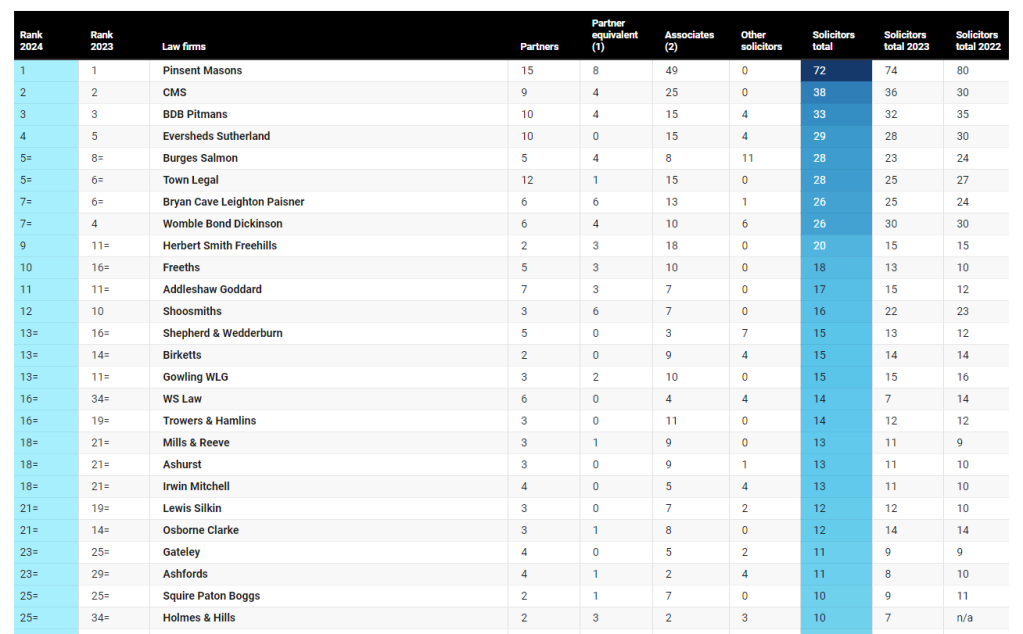
Town Legal has 12 partners, 28 qualified solicitors in total specialising in planning – and we are not the largest.
When I started as a lawyer in the 1980s I’m not sure there were too many more planning solicitors than that in the whole of the City! I don’t have 1980s figures, but going back just to say 2000-2001 the position in London is set out in the Chambers Directory table below. The largest team by far at that time was Berwin Leighton (now part of BCLP): 4 partners, 16 planning lawyers in total, followed by Denton Wilde Sapte (now Dentons): 3 partners, 13 planning lawyers in total – the bulwark of those firms’ practices at the time being work for their respective clients Tesco and Sainsbury’s. No other firms were in double figures. Now there are 25 firms with more than 10 planning solicitors!
Chambers Directory 2000-2001
Extract from Planning Resource survey, June 2024
According to the Planning Resource survey, the number of private sector planning solicitors increased by 8% just last year! This is not a good thing.
What on earth is keeping so many planning lawyers busy, even in an environment when the number of planning applications has been falling, and does it have to be this way?
These are some of the issues that keep me constantly busy, most of simply did not exist 20 or 30 years ago:
Advising on the procedural hurdles to amending schemes and the work-arounds to all that case law – Finney, Hillside, Dennis, Fiske and so on.
Advising as to how to keep permissions alive by way of token implementation works, partly a factor of constant issues in relation to viability.
Every aspect of the community infrastructure levy.
Procedurally rigid appeals, many of which could have been avoided, often generated either by members’ refusals against officers’ advice or by unacceptable delays in the application process (see the point as to stretched public sector resources above – including at statutory consultees such as the Environment Agency and Natural England as well as at local authorities).
Resisting (and sometimes promoting) judicial reviews that often turn out to be unsuccessful, partly fuelled by objectors’ expectation that rights have been infringed for which litigation will provide an adequate remedy – and the consequent now increasingly usual and time-consuming task, on more complex or contentious proposals, of carrying out a legal audit of draft application documents and committee reports to minimise legal challenge risk.
Unnecessarily repetitive negotiations in relation to section 106 agreements through the lack of national standard templates, alongside the widened scope of planning obligations and drafting sophistication that has arisen hand in hand with both item 10 below; the sheer scale of financial commitments now at play, and yes that public sector resourcing issue again, meaning that many authorities are simply not equipped to progress negotiations in a timely way, particularly in relation to more complex projects.
The increasingly labyrinthine complexities of the permitted development rights system.
Constantly changing legislation and policy and the case law arising from inherent ambiguities in how statutory and/or policy tests are to be applied.
Localism: neighbourhood plans, assets of community value and so on.
Topics that have been shoe-horned into the planning system to deliver on other government objectives eg
Embodied carbon – demolition versus refit (no clear national policy yet)
Biodiversity net gain (the latest over-engineered statutory regime)
The neutralities (nutrients, water, recreational pressure)
Building safety and the widening increasingly unclear overlap between the Building Regulations and the planning system.
(whispers it) Affordable housing requirements (building market homes doesn’t lead to an additional need for affordable housing – it’s just politically convenient government policy to require it) and contributions to other public services (which successive governments have increasingly chosen to fund in part via developers rather than by way of direct taxation).
Much of this of course is in the public interest and has value. Most schemes which come forward are far more considered and of higher quality than back when I started.
But I do wonder at what cost.
Here’s an idea for Planning Resource: How about publishing an annual metric, being the ratio of homes and square metres of floorspace delivered in England over the relevant year divided by the number of practising planning solicitors in the private sector? I’m not wanting to do us out of a job. It would just be nice to be more productive…
Lastly, nostalgia for some of us: commentary from the 1994/1995 Chambers Directory. The scary new thing that was direct professional access to the bar! And some names to conjure with – all those names were, and in some cases still are, bright stars in our once little planning law world.
Labour announced on 9 June 2024 that, if in power, it would:
“Take control of the planning process by classifying prisons as being of ‘national importance’ on public safety grounds, so the approval decision is in ministers’ hands.”
It made me smile, given that in practice recent decisions in relation to new prisons have already been in ministers’ hands by way of recovered planning appeals. Labour’s announcement is possibly pointing towards including prisons within the scope of the Planning Act 2008 nationally significant infrastructure projects regime, although it is of course carefully enigmatic.
Securing planning permission for new prisons is slow and difficult, given the usual extent of local objections. Three recent examples:
Proposed new category C prison (up to 67,000 sq m gross external area) within a secure perimeter fence adjacent to HMP Grendon and HMP Springhill, Grendon Underwood, Edgcott
This application was submitted to Buckinghamshire Council for approval in June 2021 and was refused by committee, on officers’ recommendations) in March 202. The Ministry of Justice appealed. An inquiry took place in January and February 2023, lasting for eight days. The appeal was allowed by the Secretary of State, on the inquiry inspector’s recommendation, on 20 January 2024.
I note in passing that the constituency MP, Greg Smith (Conservative), standing again in this election, has described Mr Gove’s decision on his website as “devastating and preposterous”:
“Needless to say, my faith in the whole Planning Inspectorate has now hit absolute zero. Local people said no, Buckinghamshire Council as the planning authority said no, but this potty system has walked all over local wishes. It’s not right.”
Proposed new category B prison (up to 82,555 sq m gross external area) within a secure perimeter fence adjacent to HMP Gartree, Market Harborough
This application was submitted to Harborough District Council in September 2021. It was refused at planning committee against officers’ recommendations in April 2022. The Ministry of Justice appealed. An inquiry took place in October 2022 and the appeal was allowed by the Secretary of State, contrary to the inquiry inspector’s recommendation, on 15 November 2023.
The constituency MP, Neil O’Brien (Conservative), standing again in this election, has been one of the objectors to the proposal.
Proposed new prison adjacent to HMP Garth and HMP Wymott, Leyland, Lancashire
This application was submitted to Chorley Borough Council and was refused, again against officers’ recommendations, in December 2021. Following an inquiry held in July 2022, the Secretary of State determined on 19 January 2023 (unusually) that notwithstanding the inquiry inspector having recommended dismissal, the Secretary of State was minded to allow the appeal, subject to giving the parties the opportunity to provide further evidence on highways matters. He then decided on 6 April 2023 to reopen the inquiry. It reopened in March 2024 and the outcome is awaited.
The constituency MP, Katherine Fletcher (Conservative), standing again in this election, has been one of the objectors to the proposal.
That tension between national politics versus local politics, time and time again.
What’s the answer? I’m not sure that it is to bring new prisons within the Planning Act 2008 regime, as nationally significant infrastructure projects. First, this would be likely to require primary legislation to bring prisons within the definition of “infrastructure” and secondly it is such a procedurally onerous process! Alternatives would be to use the special development order route under section 59 of the Town and Country Planning Act 1990 or to promote the projects as Crown development under section 293D of the 1990 Act. However, whichever the route and whichever the party in government, shall we start with some specific national policy guidance…?
…because surely much of their value lies in guiding participants in future appeals as to the conduct that is expected of them – whether appellants, local planning authorities or third parties?
Ironically, the thought occurred to me due to an unusual headline in yesterday’s Planning magazine update, Inspector awards costs against both housebuilder and objectors for ‘unreasonable behaviour’ after allowing 1,730-home appeal (30 May 2024, paywall). Following on from the news on 24 May 2024 that inspector Christina Downes had allowed Taylor Wimpey’s long-running appeal in relation to up to 1,730 dwellings and associated development at Wisley Airfield, Guildford, I hadn’t been aware of her decisions the same day in relation to an application for costs made by Wisley Action Group, Ockham Parish Council and RHS Wisley against Taylor Wimpey and an application for costs made by Taylor Wimpey against Wisley Action Group, Ockham Parish Council and RHS Wisley.
The inspector made a partial award of costs against Taylor Wimpey on the basis of an error in modelling contained in a transport assessment which was not addressed until it was the basis for cross-examination at the inquiry. The inspector found that the objectors were put to unnecessary expense identifying the error, preparing written notes and extra evidence, recalling their highway witness and preparing and delivering cross-examination which all took an extra inquiry day.
Going the other way, the inspector also made a partial award of costs against the objectors, finding that there had been “unreasonable behaviour in the following respects:
• In the ecology evidence insofar as it related to matters that had already been addressed by previous decision makers; and in raising issues about the surveys, other than in relation to bats.
• In the highway evidence insofar as it related to the difference between the TA and ES in respect of peak traffic flows.
• In the planning evidence insofar as it persisted in raising issues about the principle of the development, but the costs limited to the cross-examination of this point and its preparation.”
In the context of an inquiry which ran to (by my reckoning) 32 days this may all be small beer but is an interesting indication of the extent to which parties may be prepared to put the behaviour of their opponents under the microscope.
There is of course detailed Planning Practice Guidance as to the award of costs in planning appeals, the basic principle being that costs may be awarded, either on the application of any party or at the instigation of the inspector, where a party has behaved unreasonably and the unreasonable behaviour has directly caused another party to incur unnecessary or wasted expense in the appeal process. I often have to explain to clients that, no, they can’t cover their wider commercial losses caused by that unreasonable behaviour…
My colleague Jack Curnow ran a search of appeal decisions today – there have been around 93 costs award decisions in the last 12 months. How much more might we learn if the key findings were made available, in the way that the Local Government and Social Care Ombudsman provides a comprehensive database of its rulings?
A couple of other interesting costs decisions spotted in the wild (on LinkedIn that is):
First of all, as with that first costs award at Wisley, a reminder that a party may end up winning the appeal but being on the receiving end of an award of costs for unreasonable behaviour. On 16 May 2024 Bellway Homes lost a planning appeal for a proposed development of 148 dwellings in County Durham, but (perhaps small comfort) secured an award of costs against Durham County Council on the basis that it had not substantiated three of its reasons for refusal (on effect on countryside, unacceptable harm to the landscape and on design). In relation to the remaining reasons for refusal – on planning and transport, where the relevant LPA witnesses appear to have made significant concessions under cross-examination, there is an interesting passage:
“In my view, the concessions made by the sustainable transport and planning witnesses rather than being a deficiency in the Council’s case were the result of a series of subtly directed questions by a skilled advocate and the inability of the witnesses to grasp the direction of the examinations. That said concessions made by witnesses are material considerations in concluding on a proposal and I did not ignore them. However, as the decisionmaker, whether I am bound by them is not, in my view, a binary choice. As the various examples of Case Law referred to show, I am entitled to bring to bear my own judgement, both as a planning professional and an Inspector, to weigh the written and oral evidence before me. This is particularly so where, as in this case, the final decision turned on a matter of planning judgement i.e., whether the proposal represented sustainable development and the relevant witness’s failure to grapple with the basis of their own evidence. In this context, despite the direction that the cross-examinations took the witnesses, I consider the Council was able to substantiate its case in relation to the second main issue, sustainability. On this basis, I consider that, continuing the case in the face of the planning witness’s concessions, the Council did not act unreasonably.”
[Who might that “skilled advocate” be, Hashi…?]
Secondly, an example of an appeal in relation to non-determination of the application within the statutory period (in this case an appeal, which was allowed on 2 April 2024, for up to 540 dwellings and associated development at Yarnton, Oxfordshire, where both the local planning authority and county education and highways authority were the subject of full costs awards in favour of the appellant, through not having resolved matters, ultimately conceded in the immediate run-up to the inquiry, far earlier in the process.
“The concerns of the Council set out in the putative reasons for refusal should have been addressed early in the life of the application; some of them, in particular those relating to green infrastructure, could have been dealt with as conditions on a planning permission or as part of a planning obligation. The fact that all the objections were withdrawn by the Council prior to the opening of the inquiry demonstrates that there was nothing substantive in the Council’s reasons for refusal that could not have been agreed much earlier in the process. As it was, the applicant was forced to address these matters through an appeal, and to produce revised material and re-consult at the appeal stage. It had to produce evidence on the reasons for refusal and, given that this was an appeal against non-determination, it had to produce adequate evidence on all matters relevant to the planning application to enable the decision-maker to reach a decision.
Although costs can only be awarded in relation to unnecessary or wasted expense at the appeal, the behaviour and actions of the Council at the time of the planning application can be taken into account in the consideration ofwhether or not costs should be awarded. The Council acted unreasonably in its handling of the planning application and the application should not have needed to come to an appeal. The Council delayed development that should clearly have been permitted, failed to produce evidence that substantiated each putative reason for refusal, and issued putative reasons for refusal on grounds that were capable of being dealt with by planning condition or in an obligation. The Council’s unreasonable behaviour led the applicant to the unnecessary costs of an appeal with the consequent need to maintain an appeal team with legal representation and to produce evidence on a wide range of matters.
For the reasons given above, unreasonable behaviour resulting in unnecessary or wasted expense has occurred and an award of costs against Cherwell District Council is therefore warranted, covering all the costs relating to the appeal, with the exception of the two matters which are the subject of the costs claim against Oxfordshire County Council.”
From the award against Oxfordshire County Council:
“Costs should only be awarded against a third party in exceptional circumstances. In this case those circumstances exist. The County Council’s position was critical to the progress of the planning application and subsequent appeal because of its role as a main party to the s106 obligation, and it bears full responsibility for the delay and costs incurred in addressing the matters discussed above. The matter of the playing field access was capable of being addressed much earlier as part of the planning application if the County Council had taken a reasonable approach, and should never have had to come to appeal. The County Council did not defend its position at the inquiry. The request for a contribution for the Cassington Road to Peartree Interchange highways works should never have been made. The County Council behaved unreasonably in both respects and caused the applicant to incur unnecessary expense in addressing these issues in respect of legal representation, expert witnesses, the preparation of statements of case, proofs and rebuttals, and in having to seek information and prepare a legal opinion to inform the inquiry. A partial award of costs is therefore warranted.”
[NB the highways contribution point may be of wider interest: the county council had sought a contribution towards highways works “which were not dependent on the development and which had already been funded from the public purse and built”!]
Some other costs decisions this year that may be of interest:
An award in favour of Bellway Homes in relation to an appeal in Stroud, where planning permission was granted for 54 dwellings. In his decision letter dated 20 May 2024 the inspector awards costs against Stroud District Council largely through its failure to grapple properly with biodiversity net gain issues:
“In a large part, the reason for the appeal is because the Council failed to review, accept and liaise with the appellant on the Mitigation Hierarchy Review. In my view, this necessitated the submission of the appeal. In addition, the
Council’s lack of engagement added unnecessary time at the hearing and necessitated further time being given to the main parties to agree the wording of a Grampian condition after the close of the hearing.
I am cognisant that the position on the value of high value habitats has been clarified with the statutory metric coming into force and has confirmed the basis on which such units can be traded and that this has been a recent change that the Council has not been obliged to accept. However, given that the Council were not seeking to resist the principle of development, the absence of indication that the appellant had met the expectations of the hierarchical approach should have been provided at an earlier point in time to have paved the way for more meaningful negotiations on the mitigation package. This concession was only made at the hearing in person, with the written evidence still having largely maintained a defensive position.
In view of this, my conclusion is that the Council has behaved unreasonably, for reasons including its failure to determine a planning application based on an issue that was capable of being dealt with by condition and failing to review and clarify its case promptly following the lodging of an appeal.”
A full award of costs in favour of the promoter of a solar farm in Rayleigh. The appeal was allowed on 11 March 2024 and full costs were awarded against Rochford District Council. The decision to refuse the application had been made by members against officers’ recommendations. The inspector concluded:
“Overall, I consider that the Council has not produced relevant evidence at appeal stage to support their decision to refuse planning permission and has therefore delayed a development that should have been permitted, having regard to the development plan and other material considerations. It has also been inconsistent in its decision making. I therefore consider that the Council’s approach does represent unreasonable behaviour, and this has resulted directly in the need for this appeal.”
The council tried to make the case that it was difficult to find private sector consultants to support them. The inspector didn’t think much to that excuse!
“In the rebuttal to the cost claim it was suggested that it is difficult for members to provide a substantial evidence base as few consultancies will take on such work as it would be likely to lose them future work as they would be known as “Council lovers”. Whilst in my experience consultancies quite regularly support Council’s at appeal, even if that were the case this does not absolve the Council from the need to substantiate the reasons for refusal at appeal.”
Finally, a reminder to councils of the need to engage in pre-app discussions. An appeal in Mole Valley was dismissed on 28 February 2024, but with the appellant awarded its costs due to the council’s failure to engage at pre-application stage:
“In respect of the appellant’s attempt to engage with the Council at the pre-application stage, I note that the Council suspended these services due to resourcing limitations. Although not binding, this process, if it had been available, would have been an opportunity for the Council to raise any concerns at an early stage in respect of design, living conditions and affordable housing provision. The appellant, therefore, would have been well-informed and provided with the opportunity to amend the scheme as necessary.
The Council’s resourcing is not a matter for the appellant, who sought an effective, positive and pro-active approach at an early stage. Given that the Council has an established pre-application function, which was suspended for a time, and which did not allow the appellant to use it, amounts to unreasonable behaviour. This is my view, irrespective of the Council’s communications later in the process.
For the reasons given above, unreasonable behaviour resulting in unnecessary or wasted expense has occurred in respect of pre-application advice and a partial award of costs is therefore warranted.”
I could go on, and on. There are so many. There’s a lesson in each decision – whether as to how parties should behave or as to how the system itself, under-resourced as it is, may be failing us all. After all, perhaps penalising authorities with costs awards is simply adding to the resourcing problem – it certainly is if costs awards do not influence future behaviour. So as well as my suggestion that these decisions should be more widely publicised, I would go further: when an award is made against an authority and the amount of costs payable has been determined, by negotiation or following reference to a High Court costs judge, why shouldn’t authorities be under a duty to publicise to their members and to their local electorate the financial consequences of what has happened and why?
Shadow Secretary of State Angela Rayner’s speech at UKREiif in Leeds on 21 May 2024 was interesting, particularly on new settlements. I have emboldened some key passages below:
“New Settlements
And while we work with the grain of local communities and their character, we’ll also consider how urban regeneration and extension can play their part.
We want homes on these sites within the first term of a Labour government.
But these new large settlements must be built in the right place, in partnership with local people.
This is why an expert independent taskforce will be set up to help choose the right sites and a list of projects will be announced within our first 12 months of government, so we can start building the towns of the future within months, not decades.
Our next generation of New Towns will build homes fit for the future. Creating places where people want to live. Inspired by garden suburbs like Hale in Manchester, Roundhay in Leeds, and the Garden City project
But let me be clear – I will not simply demand “more units, at any cost”.
The reason many local communities resist new homes is often because the housing is of the wrong type, in the wrong place – it doesn’t come with the schools, GP surgeries and green spaces that make communities, not just streets.
Or the affordable and social housing local people need.
Our next generation of New Towns will build homes fit for the future. Creating places where people want to live. Inspired by garden suburbs like Hale in Manchester, Roundhay in Leeds, and the Garden City project.
We will set out a New Towns Code – criteria that developers must meet in these new settlements:
More social and affordable homes – with a gold standard aim of 40%
Buildings with character, in tree-lined streets that fit in with nearby areas
Design that pays attention to local history and identity
Planning fit for the future, with good links to town and city centres
Guaranteed public transport and public services, from doctors’ surgeries to schools
And access to nature, parks, and places for children to play “
New Towns are just one way we get good quality, affordable houses built in the national interest.
Our local housing recovery plan will reverse the Conservatives’ damaging changes to planning, getting stalled sites moving at speed.
We’ll give Mayors the tools they need to deliver homes in their areas, revitalising brownfield first, unlocking ugly, disused grey belt land for housebuilding and setting tough new conditions for releasing that land.
Our ‘golden rules’ will ensure any grey belt development delivers affordable homes, new public services, and improved green spaces.
This means more social and affordable homes and we will ensure that brownfield sites are approved quicker so homes get built fast.
Together, we will unleash the biggest wave of affordable and social housing in a generation.
Because a safe, secure, affordable home is the foundation of a good life.
We can see the consequences when that foundation is taken away.
Today, there is an epidemic of homelessness and rough sleeping in Britain.”
Some intriguing aspects here that go beyond the Labour Party’s Plan to Power-Up Britain that I covered in my 13 April 2024 blog post Powering Up Britain and beyond Sir Keir Starmer’s party conference speech in October 2023 (see 10 October 2023 BBC piece Keir Starmer promises to build new towns and 1.5m homes). Particularly intriguing that “an expert independent taskforce will be set up to help choose the right sites and a list of projects will be announced within our first 12 months of government, so we can start building the towns of the future within months, not decades.”.
The huge question will be how to avoid previous governments’ false starts and missteps. The last Labour government’s eco-towns programme was similarly ambitious, with preferred sites arrived at on the basis of criteria set out in a prospectus which became hotly contested by those whose sites were not selected and by local campaigners. A High Court challenge to the process failed but, given time slippages, the programme was ultimately overtaken by the 2010 General Election. The judgment in the case, Bard Campaign v Secretary of State (Walker J, 25 February 2009) makes for interesting reading as to the context. For a wider piece setting out subsequent proposals by the present government for “locally-led” new towns see my 11 July 2020 blog post The New Towns Question (Again) .
Full marks for ambition but how to balance speedy top-down decisions as to quantum, potential locations, scale and so on (however “independent” “expert” led) with ensuring that (1) there is a joined up plan to deliver the necessary infrastructure (2) schemes have sufficient local buy-in (3) schemes are commercially viable (4) there is a fit-for-purpose consenting process if building is to start “within months” (polite cough) and (5) all legal trip hazards in terms of, for instance adequate assessment and consultation can successfully be navigated? Those will be some of the questions.
And the “gold standard aim of 40%” affordable housing is an interesting political phrase!
This will be this blog’s third general election and may result in its seventh prime minister.
The Cabinet Office today published its General Election Guidance 2024 (23 May 2024), its guidelines as to what activities should and should not be undertaken by ministers, civil servants and non-departmental public bodies during the pre-election period to 4 July 2024, following the Prime Minister’s announcement yesterday. It comes into effect on 25 May 2024.
For commentary as to the implications for decision making on planning matters, at national and local levels, see my 1 November 2019 blog post Dial P For Purdah.
“The Planning Inspectorate always aims to issue decisions and recommendations promptly. However, in the run-up to the General Election we are concerned to ensure that decisions or recommendations relating to proposals which have raised sensitivities or interest in an area cannot be deemed to have influenced the election in any constituency or, more broadly, across the country, or have been used to electoral advantage by any interested body.
Whether a decision or recommendation should be held back until the election results have been announced is a judgement taken by senior managers in the Planning Inspectorate on the circumstances of the case. We shall of course ensure that any such delayed decisions or recommendations are issued promptly after the election.”
“All scheduled local plan examinations and hearing sessions will continue during the pre-election period and new examinations will also begin.
However, in order to avoid making announcements that could be politically sensitive, the Planning Inspectorate will not be issuing any letters regarding the soundness or legal compliance of local plans, or final reports (including for fact check), until after the election.”
I support grassroots music venues. I’ve blogged a few times in the past about the agent of change principle. And I’ve just read today’s report by the House of Commons Culture, Media and Sport Committee on the steps it recommends to halt the worrying rate at which these venues are closing (two a week and the total number in the country declining last year from 960 to 835), which includes recommendations to strengthen the agent of change principle. Music Venue Trust has played a vital role in drawing attention to the issue.
As with many public policy issues (housing, the economy, climate change, inequality, health disparities), we in our planning bubble need to remember that when it comes to protecting the conditions for grassroots culture to flourish, whether for its own sake or to grow the next stadium acts, the operation of the planning system is only one part of the problem – but the planning system does need to put its shoulder to the wheel.
The report includes calls for:
A comprehensive review by the Government (by summer 2024!) to fully examine the long-term challenges to the live music ecosystem
A voluntary levy on large venues by September 2024 and “if a widespread voluntary levy is not in place by September 2024, or if its level does not stem the tide of closures, the Government should introduce a statutory scheme.”
Temporary VAT cut and simplification of processes for grant applications, as well as resolution of disputes within the industry on performing rights payments and the like.
Placing the “agent of change” principle, which has been in the National Planning Policy Framework since 2018, on a statutory basis.
Briefly on that last point, the agent of change principle forms paragraph 193 of the current NPPF:
“Planning policies and decisions should ensure that new development can be integrated effectively with existing businesses and community facilities (such as places of worship, pubs, music venues and sports clubs). Existing businesses and facilities should not have unreasonable restrictions placed on them as a result of development permitted after they were established. Where the operation of an existing business or community facility could have a significant adverse effect on new development (including changes of use) in its vicinity, the applicant (or ‘agent of change’) should be required to provide suitable mitigation before the development has been completed.”
Paragraphs 90 to 95 of the report consider how the policy is applying in practice. It was recognised that policy represented progress, however concern as to how local planning authorities interpret and apply it. The Committee supported calls for it to be given more teeth by way of being placed on a statutory footing “at the earliest opportunity”.
Everyone of course calls for legislation about everything. I hope that any subsequent Government review examines this specific aspect in more detail: to what extent is the policy not working and in what respects and in what ways would legislation assist without unintended consequences?
Those with long memories may recall that Labour tried to include such a provision into the Housing and Planning Bill back in 2016.
Just reflecting on what we gain from protecting and encouraging these venues (have you been to the relatively new, cosy but fabulous, Lafayette venue in Argent’s Kings Cross development?), it’s not just about nurturing artists – one great quote from the report, courtesy of a participant from Manchester: “Taylor Swift’s lighting director didn’t start out as Taylor Swift’s lighting director”.
These venues can sometimes even be the catalyst for the rebirth of a whole city – I recommend the excellent book Manchester Unspun – How A City Got High On Music by Andy Spinoza for a description of possibly the world’s most extreme version of this (and let’s not currently mention Co-op Live shall we?).
I fibbed on LinkedIn last weekend when I said that the reason for no simonicity post was a lack of news. To be honest, it was more about a lack of time – actually having a weekend off to be rained on in the west country.
Over to the east of England, Cambridge to be specific, there was certainly some news that needs unpacking. This rainy bank holiday I do now have time. And inevitably it’s on the issue of water scarcity – which I touched on in my 16 March 2024 blog post Water Water Everywhere, Nor Any Drop To Drink.
The Secretary of State’s decision letter dated 23 April 2024, allowing a recovered appeal by Brookgate Land Limited against South Cambridgeshire District Council’s failure to determine a planning application for a large mixed-use development, including up to 425 homes, at land north of Cambridge North Station is worth reading for anyone either:
grappling with the implications of the Environment Agency’s advice in relation to a planning application, whether in relation to water scarcity issues or other matters on which it expresses views as a statutory consultee; or
frustrated by how the planning process can be elongated at a late stage by issues raised in relation to matters supposedly to be addressed by way of separate statutory regimes.
Brookgate’s application for planning permission had been submitted on 14 June 2022 (not 2023 as recorded in the inspector’s report). The appeal was submitted in January 2023. At that point the Environment Agency’s comments on the application, by letter dated 7 November 2022, were some way short of a formal objection:
“Evidence in the emerging Integrated Water Management Study for the Greater Cambridge Local Plan indicates that groundwater abstraction to meet current needs is already causing ecological damage to Water Framework Directive (WFD) designated waterbodies (including chalk streams) or there is a risk of causing deterioration in the ecology if groundwater abstraction increases. The area also hosts several chalk streams which are internationally recognised habitats, sensitive to the availability of groundwater baseflow and vulnerable to low flows. This development has the potential to increase abstraction from groundwater sources. You should consider whether the water resource needs of the proposed development alone, and in-combination with other proposed development that the relevant water company is being asked to supply, can be supplied sustainably without adverse impact to WFD waterbodies and chalk streams. At the present time we are unable to advise with confidence that further development will not harm the water environment, until it can be shown sustainable water supplies can be provided.
The Local Planning Authority must have regard to River Basin Management Plans and be satisfied that adequate water supply exists to serve development, in accordance with the policies of the Local Plan.
Should the development be permitted, we would expect you to ensure that the new buildings meet the highest levels of water efficiency standards, as per the policies in the adopted Local Plan.
Your authority should ensure that the local Water Recycling Centre has sufficient capacity to accept foul drainage from the proposed development to ensure protection of the water environment including WFD waterbodies.”
The appeal was recovered by the Secretary of State for his own determination on 24 March 2023 for the following reason: “theappeal involved proposals for residential development of over 150 units or on a site of over 5 hectares, which would significantly impact on the Government’s objective to secure a better balance between housing demand and supply, as well as create high quality, sustainable, mixed and inclusive communities.” (nothing stated about water scarcity).
The inquiry opened on 6 June 2023 and sat for 12 days. It was adjourned on 23 June 2023 to allow for further work to be completed on water scarcity, received and then commented on by the parties. On 8 March 2024 the parties were then given an opportunity to comment on the joint statement on addressing water scarcity in Greater Cambridge that I had mentioned in my 16 March 2024 blog post.
It was agreed between the Environment Agency and the appellant before the inquiry that “the standard of mitigation measures required for this application is a matter for the decision-maker” (paragraph 5.57 of the inspector’s report).
South Cambridgeshire District Council invited the Secretary of State to consider “whether it would be appropriate, alongside the water efficiency measures to be secured through final draft planning conditions to:
1. Manage the additional demand on water resources arising from the development proposals, by delaying the occupation of development until 2032.
2. Link the development to the delivery and operation of the specific strategic water supply intervention measures necessary to deliver water supplies to the region, as identified in an approved Regional [Water Resources Management Plan] and/or {Cambridge Water’s Water Resources Management Plan].” (paragraph 7.120 of the inspector’s report).
The appellant considered that such a condition was not necessary. The inspector agreed but, in the event that the Secretary of State disagreed, proposed an “optional” condition for the Secretary of State to consider. The inspector’s conclusions on the water scarcity issue are at paragraphs 14.139 to 176 and need to be read in full if this issue is directly relevant to you. However I note:
The inspector considered that limited weight could be placed on the modelling evidence submitted to the inquiry and he concluded that “the evidence specifically submitted for consideration to the Inquiry does not demonstrate that abstraction is contributing to ecological deterioration” (paragraph 14.157)
“Notwithstanding this, it is evident that there is a water supply issue within the Greater Cambridge Area. The Council draws attention to planning applications for over 9,000 homes and 11,000 jobs that are unable to be determined. It also advises that additional development at the Cambridge Biomedical Campus and Life Sciences Campuses risk being put on hold, together with work on the new Joint Local Plan which cannot confidently progress to its next stage. The Council has also written to Ministers seeking a solution to the issue. It is probable that there are similar issues in other Local Planning Authorities across the [Cambridge Water] area.” [paragraph 14.158]
“There is a balance to be struck between the levels of growth proposed and measures to manage the supply and demand for water resources, as well as a need for mitigation measures. This can be managed by reducing demand and/or increasing supply. The balance and any mitigation measures are a strategic matter for the WRMP, as confirmed by NPPF paragraph 20(b), and is not a matter for this appeal. The preferred approach may have significant consequences for Greater Cambridge and the Government’s vision for this area.” [paragraph 14.163]
“Water resources should ordinarily be a strategic matter and not considered as part of a planning application. In this instance, the development plan was adopted in 2018, and it would seem that the concerns in relation to water quality were not known at that date. Indeed, even the EA’s initial response to the appeal proposal did not identify this as an issue. The Council is of the view that the issue of water stress has been appropriately considered by applying Policies CC/4 and CC/7 relating to water efficiency and water quality issues. This is on the basis of an appropriate package of mitigation being secured through agreed planning conditions.” [paragraph 14.166]
“It is a matter for the Secretary of State to determine whether the water supply and quality issues within Cambridge are so pressing that their resolution cannot be managed by the usual statutory process and any initiatives emerging from the Water Scarcity Working Group. He will need to consider whether the statutory process and other measures in place in respect of water supply are sufficiently robust to ensure that the proposal, together with other development, would avoid placing an unacceptable demand on water resources and potentially harm ecological interests.
…Should the Secretary of State conclude that water demand would have unacceptable consequences for water supply and quality he may wish to consider imposing an additional condition that would delay the occupation of the development until the WRMP is approved or the Grafham Transfer is operational.
The benefit of imposing such a condition must be balanced against the delay in delivering the benefits of the proposal, particularly the economic benefits, and the delivery of housing. In my view such an approach would have the potential to stall development within the Greater Cambridge area as a whole, perhaps over a prolonged and unknown period of time, since the entire area is served by CW. This uncertainty could also have implications for the future growth of Greater Cambridge, including at locations such as Cambridge University and the Cambridge Biomedical Campus which is a world-renowned centre of excellence and research for Life Sciences.” [paragraphs 14.173 to 14.175]
The “optional” condition set out by the inspector was as follows:
“The dwellings and commercial accommodation hereby permitted shall not be occupied until either the Grafham Transfer is operational, or the Water Resources Management Plan for the Cambridge Water operating area covering the period 2025 to 2050 is published following approval by the Secretary of State and any intervention measures necessary to maintain and deliver water in advance of the Grafham Transfer have been implemented.”
The inspector delivered her report to the Secretary of State on 25 January 2024. Following the further representations on the March 2024 announcement the Secretary of State concluded in relation to water scarcity as follows in his decision letter, allowing Brookgate’s appeal:
“33. The Secretary of State has carefully considered the effects of the proposal upon water supply. The Secretary of State has noted the Inspector’s judgement at IR14.169 that while water quality and supply is a material consideration, the proposal would not in itself harm water quality or water resources, but that cumulative impacts of the appeal proposal with other development would add to demand for water.
34. The Inspector acknowledges in this context that a sustainable supply of water for the Cambridge Water area may not be available for several years (until after the Grafham Transfer is operational). The Inspector leaves for the Secretary of State the decision as to whether the statutory process and other measures in place in respect of water supply are sufficiently robust to ensure that the proposal, together with other development, would avoid placing an unacceptable demand on water resources and potentially harm ecological interests (IR14.173).
35. The Inspector proposed an optional condition be placed on an approval which would delay the occupation of development until either the Grafham Transfer Water supply option is operational or the Water Resources Management Plan (WRMP) for the Cambridge Water operating area is approved (IR14.174).
36. Since the conclusion of the Inquiry and the recommendation made by the Inspector, the March 2024 Joint Statement on addressing water scarcity in Cambridge has been published by the Department for Levelling Up, Housing and Communities (DLUHC), Department for Environment Food and Rural Affairs (Defra), the Environment Agency and Greater Cambridge Shared Planning Service (which manages the planning service for Cambridge City Council and South Cambs District Council). This statement announces the development of a water credits market to supplement and potentially accelerate delivery of the water management measures to meet all of the areas future water needs being promoted by Cambridge Water through its WRMP, alongside wider communications to reduce water use in the area. Paragraph 9 of the Joint Statement states that modelling demonstrates that the scheme should deliver water savings that are sufficient to address concerns raised around sustainable water supply to the Cambridge area.
37. In the context of the publication of the Joint Statement, the Secretary of State considers that the proposal accords with Policies CC/4 and CC/7, and with national policy on water use and supply, and would not have an unacceptable consequence on water supply and quality. As a result, the Secretary of State considers the proposed optional condition is not necessary, and considers that matters relating to water supply and quality are neutral in the planning balance.”
Of course, this does not ease the pressure that there has to be on the Government, Cambridge Water and relevant agencies to ensure that there is indeed adequate water supply for the development when the taps eventually need to be turned on, but it is a welcome signal from the Secretary of State that strategic issues of this nature, for which there are whole statutory regimes set up supposedly to ensure that the necessary infrastructure is in place to accommodate the needs arising from planned development, are not necessarily a matter to derail the planning applications process. Goodness knows, we can think of so many issues at the moment which are doing just that – it’s the most constant theme of this blog!
For those of us living or working in London, I reckon that Sadiq Khan’s manifesto for his next term as Mayor, published on 19 April 2024, is an important read. But yesterday it was rather drowned out by the media coverage that day of Labour’s press statement on green belt policy reform.
I’ll deal first with Labour’s green belt announcement.
As a country we certainly need to resolve the negative effects of this misunderstood policy concept (Sam Stafford’s updated blog post, The Green Belt. What it is; what it isn’t; and what it should be contains all (more than?) anyone could ever want to know about the subject). And for a sense of the sheer extent of green belt and its obvious consequent throttling effect on the areas it encircles, see for example Town Legal’s planning appeals map – green belt areas marked in … green).
It is surely positive in the context of a continuing, indeed worsening, housing crisis and the lack of other options which are likely to be sufficient and deliverable, that there is talk from Labour of using some green belt land to deliver more new homes. After all, even “going there” is politically brave. But fine words butter no parsnips. And I wonder whether the proposals in some ways just add to the confusion.
These are the core proposals from the press release :
“A Labour government would take a brownfield first approach to development across England, prioritising building on previously developed land in all circumstances and taking steps to improve upon the government’s lacklustre record of brownfield build out rates. Areas with enough brownfield land should not release greenbelt.
A Labour government will implement five ‘golden rules’ for Grey Belt development:
1. Brownfield first – Within the green belt, any brownfield land must be prioritised for development.
2. Grey Belt second – poor-quality and ugly areas of the Green Belt should be clearly prioritised over nature-rich, environmentally valuable land in the green belt. At present, beyond the existing brownfield category the system doesn’t differentiate between them. This category will be distinct to brownfield with a wider definition.
3. Affordable homes – plans must target at least 50% affordable housing delivery when land is released.
4. Boost public services and infrastructure – plans must boost public services and local infrastructure, like more school and nursery places, new health centres and GP appointments.
5. Improve genuine green spaces – Labour rules out building on genuine nature spots and requires plans to include improvements to existing green spaces, making them accessible to the public, with new woodland, parks and playing fields. Plans should meet high environmental standards.”
What can we take from this as to what Labour would actually do, if elected?
This press statement is of course not intended to be picked over by people like me or you. Its purpose is to influence potential voters and to give us all a flavour of we would be likely to see, whilst giving plenty of wriggle-room when it comes to the actual implementation. So I’m not going to carp too much, but…
Are these tests for plan-makers or for decision-makers? If the former (likely), will there be a transition period before the new policy kicks in for decision-makers, if there is an otherwise up to date local plan?
So a basic hierarchy of brownfield; non-green belt greenfield; brownfield green belt; grey belt green belt; green belt green belt? It strikes me that this gives too much emphasis on the physical characteristics of the site itself rather than its sustainability and appropriateness in spatial terms? And how is this sequential testing to be carried out? The old questions as per the retail and flood risk sequential tests: to what extent can proposals be disaggregated; what is the area of search; deliverable over what period and what about where (as is often the case) there is not really a choice between site A and site B because the level of unmet need is such that A and B are both needed, and more besides?
How do references to “poor-quality and ugly” and “nature-rich, environmentally valuable” match up at all to the five traditional purposes for which green belt is designated – (a) to check the unrestricted sprawl of large built-up areas; (b) to prevent neighbouring towns merging into one another; (c) to assist in safeguarding the countryside from encroachment; (d) to preserve the setting and special character of historic towns; and (e) to assist in urban regeneration, by encouraging the recycling of derelict and other urban land. Is that what “poor-quality” means perhaps – not fulfilling those purposes?
If “brownfield” equates to what is currently defined as previously developed land, and treated less restrictively in green belt policy, give me an example of this untapped resource of non brownfield “grey belt”? And we’ve all gone on endlessly about the subjectivity of the concept of “beautiful” only now to be faced with a policy concept of “ugly“!
50% is an eye-catching number for some areas but as a target what will actually change in practice? And define “affordable”. Will the opportunity be to introduce these requirements via national development management policies? That would be some exciting and early mission creep!
4 and 5 are nothing new.
It’s not all about housing folks! What about logistics and other developments which need to be located in the green belt?
Now to Sadiq Khan’s manifesto, “A Fairer, Safer, Greener London” published ahead of the 2 May 2024 election. I’ll just draw out some quotes:
From his ten pledges:
3 Build 40,000 new council homes by the end of the decade
8 More support for renters – delivering new affordable ‘rent control homes’ and empowering Londoners to take on landlords through a New Deal for Renters
9 Continue world-leading action to tackle air pollution and the climate crisis – from making all buses zero-emission to providing air pollution filters to primary schools
10 Deliver a new London Growth Plan, with a target of creating more than 150,000 good jobs by 2028 and increasing living standards for Londoners
Under the heading “Tackling the housing crisis”:
“To unblock more new homes, I will take decisive action where needed to create new Land Assembly Zones and set up more Mayoral Development Corporations to boost overall housing supply and drive regeneration. These will deliver new sustainable communities with homes for first-time buyers as well as homes for social rent. I’ll work with a Labour government to strengthen planning so that the London Plan can go even further in supporting the delivery of the affordable housing our city needs, while unlocking economic growth and being the greenest ever plan for our city.”
Under the heading “Cleaning up London’s air”:
“making London the world’s first electric-vehicle ready global city by working with partners to double the amount of electric vehicle charging points installed since 2016 to more than 40,000 by 2030
continuing to oppose any expansion of airports in London”
Under the heading “Growing our economy”:
“I will build on our city’s economic recovery and set out an exciting new London Growth Plan, developed in close collaboration with councils, businesses and trade unions.
This new growth plan will set out how we can boost jobs and growth in the well-established sectors of our economy, including finance and business services; retail, hospitality, leisure and tourism; manufacturing; logistics; built environment and construction. I will also focus on and champion some of the fastest growing sectors, such as health and life sciences; digital including fintech, retail tech, cyber and AI; creative industries including film, fashion, TV, music and games; climate tech and the energy sector.”
“To help boost economic growth across our city, I will support individual boroughs to build on their strengths – from the new global culture and education powerhouse that is East Bank in Stratford, to the world-leading TV and film production cluster in West London, and the internationally influential cutting edge cancer research centre in Sutton. This also means working with councils and businesses to deliver a new vision and plan for the centre of London, ensuring that we can continue to compete with the central activity zones of other global cities like Paris and New York. London has roared back as a tourist destination since the pandemic and I’ll continue to work with partners to improve our tourism offer.”
“London is home to more than 600 high streets. We learned during the pandemic how intimately connected we are to local high streets, and their importance to our communities. That’s why I want to do more to protect, restore and improve them. If I’m re-elected, I will launch a support fund and set out a new vision for the future of London’s high streets, building on the work we have already done. I’ll also explore planning changes that can help breathe new life into our high streets, helping to ensure they remain a central feature of our economic and civic life.”
As a long-time collector of successive promises by politicians to reform the planning system – and the metaphors and alliteration used to that end – I was excited to see the Labour Party’s 28 March 2024 document Power and Partnership: Labour’s Plan to Power-Up Britain, published ahead of the 2 May 2024 local elections.
PUB gives the clearest set of indications yet as to what a future (possibly near future) Labour government’s priorities will be for planning, development and local government. It’s bold and you need to read it. I’ll just now give you some selective highlights. (I’ve emboldened the boldest commitments, towards the end of this post).
From the foreword by Keir Starmer and Angela Rayner:
“Growth in every corner of the country, so that every town, village and city has a role to play, and can reap the rewards of a decade of national renewal.”
From an initial section headed “the challenge we face”:
“Despite hoarding the levers of power, our centre remains passive in the face of huge national challenges…Our sclerotic planning system has left England unable to build the infrastructure and homes it needs; and endless Conservative chaos has undermined certainty and investment across the country.”
“We are currently not able to effectively integrate local, regional and national transport systems. Decisions onhousing developments or commercial space chop and change at a moment’s notice. And the lack of a consistent economic strategy has undermined business confidence and investment.”
From a section headed “empowering communities to power up Britain”:
“Local and sub- regional decision- makers often possess better information about their local economies, and more developed capacity for working with local businesses and institutions. By giving local leaders a greater say, we can focus policies at the scale at which people live and work and at which businesses specialise andform economic clusters.
We also should not make policy on a scale which is so local that it does not reflect people ’s working, commuting and social patterns – people often cross administrative borders every day as they go to work or head into their town centre. OECD research indicates that administrative fragmentation at a locallevel holds productivity back.
By holding strategic decision- making over housing policy at a local authority level, for example, we are failing to seize the opportunity to build more homes in places where people need them to live and work.
We believe new combined authorities or devolution settlements should be tailored to functional economic areas. This is central to the economic promise of taking back control and will be necessary for local leaders to effectively deploy skills, transport, housing and other labour market policies and unlock new long- term , integrated funding settlements. By deepening devolution to city regions, we will make sure that the towns and cities that built the foundations of modern Britain are given the tools they need to thrive in the modernservice and high- value manufacturing economy.
We will also reap the benefits of combining scale with local knowledge, joining up the power of an active state with the information available to local leaders. We will work to build up capacity in local and sub- regional government and we will deliver a new institutional framework for partnership working and joined- up decision- making.”
From a section entitled “an active centre to power up Britain”:
“Labour’s plan for growth includes action at a national scale to address the failures outlined in this document. This includes a plan to steam ahead in the industries of the future, with a modern UK industrial strategy supported by tailored sector strategies and, in England, Local Growth Plans; strategic public investment via our National Wealth Fund across the United Kingdom ; wholesale reform to England’s system of planning for housing and infrastructure…
Just as our plan will require local leaders to be active players, it will require a greater level of strategy and direction from national government. It will involve the reintroduction of mandatory local housing targets to get Britain building again…”
A section entitled “English devolution” starts with three bullet points:
Turbocharge mayors with access to new powers over transport, skills, housing, planning, employment support and energy, supported by long- term integrated funding settlements.
Work to expand devolution further and faster, with local authorities coming together to take on new powers to boost their economies.
Roll out new Local Growth Plans to towns and cities take advantage of their economic potential and foster clusters of well- paid jobs.
“A Labour government will ask all councils outside of an existing or agreed combined authority or county devolution deal to begin preparatory work to join together on sensible economic geographies and take on a new suite of powers through our enhanced devolution framework to benefit their residents. We will provide them with support and guidance to do so through the leadership of the Secretary of State and the expertise of the Department.“
“We will create a statutory obligation on all combined authorities and counties with devolution deals to develop a Local Growth Plan based on those functional economic geographies which identifies economic clusters and sets out their plans to build on their local advantages, the key binding constraints of their local economies and how they will use the powers devolved from central government to support local growth.”
Labour will “provide longer- term funding settlements for councils, giving them the certainty they need to deliver better value for money”.
From a section entitled “high streets”, there is a commitment to “give communities the power to revampempty shops, pubs and community spaces with a strong new Community Right to Buy”
A section headed “building homes” starts with three bullet points:
Build 1.5 million new homes over the next parliament, unleashing growth and putting more money into people’s pockets.
Deliver the biggest boost of social and affordable housebuilding in a generation, embedding security and stability in our economy.
Empower metro mayors to deliver new housing projects linked up to the jobs and infrastructure needed to support regional growth.
“Labour will build 1.5 million high quality homes in the right places, with new towns, urban extensions and smaller developments – and they will be connected to infrastructure and built strategically as part of sub-regional strategies from mayors and combined authorities. This will increase the ‘effective size’of our major cities and high- potential towns so that they can reap the benefits of scale and agglomeration needed to develop and cement their labour market clusters and comparative strengths.
Our approach combines robust national policy frameworks, including targets for housing delivery, with measures to support local leaders delivering plans for meeting those targets and ensuringhomes are built in the right place. We want to give local leaders a say over ‘how’ new homes are delivered, whilst being robust in national policy about ‘if’ areas build the homes they need.”
Labour will deliver:
“• The biggest boost in affordable homes for a generation – with social and council housingat the core of Labour’s plan for secure homes.
• A housing recovery plan, a blitz of planning reform to quickly and materially boost house building , delivered in our first weeks and months in office .
• The next generation of new towns , garden cities and large sites, new communities with beautiful homes, green spaces, reliable transport and bustling high streets
• New powers to unleash mayors including a package of devolution to mayors, handing them stronger powers over planning and departmental style settlements for housing
• ‘Planning passports ’ for urban brownfield delivery, a tough package of planning reform to fast track approvals and delivery of high density housing on urban brownfield sites
• 300 new planning officers across the country, paid for by raising the stamp duty surchargeon non- UK residents, to improve public sector capacity to expedite planning decisions.”