To what extent might the state choose to tax land owners, through reducing their compensation entitlement, in order to facilitate the provision of housing or infrastructure, rather than subsidise that provision through more general tax raising? How can the state capture land value gains created by its own infrastructure provision, or due to its own strategic planning for development?
These questions are central to a number of current areas of public policy thinking, including:
– Using compulsory purchase
– Land auctions and land value capture charges
– Benchmark land values in viability appraisal
– CIL reform
There are some confluences arising in this area between current Conservative party thinking, other political parties, Transport for London and Shelter to name but a few. I’m not sure that land owner interests have yet joined all the dots. Developers may wish to partner more closely and regularly with local authorities with compulsory purchase powers, but in other situations should also be aware of the risks ahead for their businesses if additional costs are not sufficiently predictable as to come off the land price or if they cause land owners simply to hold rather than sell.
Using compulsory purchase
Compulsory purchase is already a practical mechanism for securing land where there is a compelling case in the public interest for interfering with private property rights. Of course it isn’t easy, and will never be. The power is draconian. The necessary procedural safeguards to protect against its abuse make for a slow, procedurally technical process and for uncertain outcomes.
Another disincentive for local authorities can be the significant compensation costs payable, given the fundamental principle that the land owner is entitled to what the value of his interest would have been were it not for the compulsory acquisition (the ‘equivalence’ principle). Even where compensation liability is being underwritten by a developer partner, the extent of compensation is:
– likely to affect whether the project is viable after all; and
– not ascertainable until all parties are too far in to back out due to the leisurely pace at which a compensation figure is determined (both pre- and post-reference to the Lands Tribunal, aka Lands Chamber of the Upper Tribunal).
The Conservative manifesto, published on 17 May 2017, refers to compulsory purchase in this one paragraph:
“We will enter into new Council Housing Deals with ambitious, pro-development, local authorities to help them build more social housing. We will work with them to improve their capability and capacity to develop more good homes, as well as providing them with significant low-cost capital funding. In doing so, we will build new fix-term social houses, which will be sold privately after ten to fifteen years with an automatic Right to Buy for tenants, the proceeds of which will be recycled into further homes. We will reform Compulsory Purchase Orders to make them easier and less expensive for councils to use and to make it easier to determine the true market value of sites”.
I am guessing that what is planned goes further than making the current system work better. Changes are being considered which would enable in some circumstances greater use of compulsory purchase and, in some circumstances, acquisition at lower values than the equivalence principle would suggest.
The February 2017 Housing White Paper says this:
“2.43 Compulsory purchase law gives local authorities extensive powers to assemble land for development. Through the Housing and Planning Act 2016 and the Neighbourhood Planning Bill currently in Parliament we are reforming compulsory purchase to make the process clearer, fairer, and faster, while retaining proper protections for landowners. Local planning authorities should now think about how they can use these powers to promote development, which is particularly important in areas of high housing need.
2.44 We propose to encourage more active use of compulsory purchase powers to promote development on stalled sites for housing. The Government will prepare new guidance to local planning authorities following separate consultation, encouraging the use of their compulsory purchase powers to support the build out of stalled sites. We will investigate whether auctions, following possession of the land, are sufficient to establish an unambiguous value for the purposes of compensation payable to the claimant, where the local authority has used their compulsory purchase powers to acquire the land.
2.45 [ ]
2.46 We will keep compulsory purchase under review and welcome any representations for how it can be reformed further to support development.”
Note the references to encouraging the use of compulsory purchase where development has stalled, and investigating the use of auctions to establish land value (more on that later in this blog post).
Revealingly, in the week before the publication of the manifesto there was a press release with this passage in its “notes to editors”:
“To further incentivise councils to build, the Conservatives also intend to reform compulsory purchase rules to allow councils to buy brownfield land and pocket sites more cheaply. At the moment, councils must purchase land at “market value”, which includes the price with planning permission, irrespective of whether it has it or not. As a result, there has been a more than 100% increase in the price of land relative to GDP over the last 20 years and the price of land for housing has diverged considerably from agricultural land in the last fifty years. Between 1959 and 2017, agricultural land has doubled in value in real terms from £4,300 per acre to £8,900 per acre, while land for planning permission has increased by 1,200%, from £107,000 to just over £1,450,000. Local authorities therefore very rarely use their CPO powers for social housing, leaving derelict buildings in town centres, unused pocket sites and industrial sites remain undeveloped.”
I’m guessing at the following policy strands for a future Conservative government from these various statements:
1. Further encouragement for use of CPO powers in the right circumstances, including particular encouragement where a “Council Housing Deal” is in place (guaranteeing social housing with a fixed-term right to buy for tenants) and possibly where private sector development is shown to have stalled (link this and the “delivery” elements of the Housing White Paper and this could be quite a stick to wield).
2. Further process reform likely.
3. Reform likely of the process for determining the compensation price to be paid, so that (1) figures are known earlier on, (2) the land auctions model is followed (see later in this blog post) to determine values in appropriate circumstances and (if those ‘notes to editors’ are to believed) (3) in some circumstances authorities will be able to acquire land for less than it is worth (possibly ruling out hope value unless planning permission or a certificate of appropriate alternative development under section 17 of the Land Compensation Act 1961, has actually been obtained).
The last point (still speculation) has caused consternation and excitement in equal measure. The principle of equivalence is at stake, but equally this opens up the prospect of securing land for development at an undervalue so as to achieve affordable housing at no cost to the state. Money for nothing (unless you are the land owner). Shelter for example have been lobbying for a similar approach. Their May 2017 paper Financing the infrastructure and new homes of the future: the case for enabling acquiring authorities to purchase land for strategic development under a special CPO compensation code May 2017 lobbies for Government to:
“enable acquiring authorities to purchase land for strategic development under a special CPO compensation code. This would involve three changes:
1) An amendment to the National Planning Policy Framework to allow planning authorities to designate land for strategic development;
2) An amendment to Section 14 of the 1961 Land Compensation Act to disregard prospective planning permissions on land designated for strategic development;
3) An amendment to Section 17 of the 1961 Land Compensation Act to restrict the use of certificates of alternative development on land designated for strategic development.”
Shelter’s delight at the references in the Conservatives’ recent policy announcements is plain to see from their subsequent 16 May 2017 blog post Compulsory purchase and council homes – a new direction for housing policy?
Do the Conservatives really intend such a radical market intervention, or do they misunderstand how the compensation system currently works? The reference in the press release’s “notes to editors” that “councils must purchase land at “market value”, which includes the price with planning permission, irrespective of whether it has it or not” is of course wrong. The prospect of planning permission for development in the “no scheme world” is taken into account in arriving at a valuation but the existence of a planning permission is never assumed.
However logically necessary the concept is, the “no scheme world” (or “Pointe Gourde”) rule been much criticised for being difficult to apply in practice. Its complexities were most recently explored by the Supreme Court in Homes & Communities Agency v JS Bloor (Wilmslow) Ltd (22 February 2017), where Lord Carnwath said this:
“The rule has given rise to substantial controversy and difficulty in practice. In Waters v Welsh Development Agency [2004] 1 WLR 1304; [2004] UKHL 19, para 2 (“Waters”), Lord Nicholls of Birkenhead spoke of the law as “fraught with complexity and obscurity”. In a report in 2003 the Law Commission conducted a detailed review of the history of the rule and the relevant jurisprudence, and made recommendations for the replacement of the existing rules by a comprehensive statutory code…”
Lord Carnwath had himself of course chaired that review. Too late for the litigants in Bloor, now finally, by virtue of section 32 of the Neighbourhood Planning Act 2017 (which introduces new sections 6A to E into the Land Compensation Act 1961) we have a codified version of the “no scheme world” rule. (The compulsory purchase provisions within the 2017 Act are well summarised by David Elvin QC in a paper to the 2017 PEBA conference).
New section 6E has refined the rule so that it is now more difficult for claimants to rely on increases in value of their land created by the transport project for which the land has been acquired, where regeneration or redevelopment was part of the justification for the transport project.
The big question is whether a more radical manipulation of the “no scheme world” rule might be possible, even if it parted from the principle of equivalence. After all, if land for development could be secured at little more than agricultural value…?
It would be mightily difficult, indeed controversial to the extent of potentially being counter-productive, if land is to be acquired without prolonged legal wrangling. If in the real world your land has hope value for another form of development, why should that be ignored? However, in fact it’s not legally impossible.
Article 1 of the protocol to the European Convention on Human Rights states as follows:
“Every natural or legal person is entitled to the peaceful enjoyment of his possessions. No one shall be deprived of his possessions except in the public interest and subject to the conditions provided for by law and by the general principles of international law.
The preceding provisions shall not, however, in any way impair the right of a State to enforce such laws as it deems necessary to control the use of property in accordance with the general interest or to secure the payment of taxes or other contributions or penalties.”
(Incidentally, the Conservative manifesto confirms: “We will not repeal or replace the Human Rights Act while the process of Brexit is underway but we will consider our human rights legal framework when the process of leaving the EU concludes. We will remain signatories to the European Convention on Human Rights for the duration of the next parliament.“)
The European Court of Human Rights interprets Article 1 of the protocol so as to require compensation to be paid in relation to the confiscation of property. In Lithgow v UK (European Court of Human Rights, 8 July 1986), a case arising from Labour’s nationalisation of various industries under the Aircraft and Shipbuilding Industries Act 1977, the court said:
“The Court further accepts the Commission’s conclusion as to the standard of compensation: the taking of property without payment of an amount reasonably related to its value would normally constitute a disproportionate interference which could not be considered justifiable under Article 1 (P1-1). Article 1 (P1-1) does not, however, guarantee a right to full compensation in all circumstances, since legitimate objectives of “public interest”, such as pursued in measures of economic reform or measures designed to achieve greater social justice, may call for less than reimbursement of the full market value”.
Whilst a distinction was drawn in the case between state nationalisation of industries and the compulsory purchase of property, the same basic principles apply. It is clear from this and other cases that individual states are given a margin of appreciation to determine what is in the public interest. For example:
– Sporrong and Lönnroth v. Sweden (22 September 1982) (a case about longterm blight caused by ‘zonal expropriation permits’)
“…the Court must determine whether a fair balance was struck between the demands of the general interests of the community and the requirements of the protection of the individual’s fundamental rights…”
– James v UK (21 February 1986) (a challenge brought by the trustees of the estate of the Duke of Westminster to leasehold enfranchisement under Leasehold Reform Act 1967):
“Because of their direct knowledge of their society and its needs, the national authorities are in principle better placed than the international judge to appreciate what is “in the public interest”. Under the system of protection established by the Convention, it is thus for the national authorities to make the initial assessment both of the existence of a problem of public concern warranting measures of deprivation of property and of the remedial action to be taken… Here as in other fields to which the safeguards of the Convention extend, the national authorities accordingly enjoy a certain margin of appreciation.” The Court went on to find that the aim of the Leasehold Reform Act 1967, namely greater social justice in the sphere of housing, was a legitimate aim in the public interest.
Similarly, in theory a mechanism might be arrived at which in some way disentitled land owners in some circumstances from achieving a full market value for their land. But the circumstances would need to be carefully circumscribed and the reaction of most land owners would be to fight rather than one of flight.
It is not as if compulsory purchase compensation is presently particularly generous, even with the additional loss payments (capped, even for owner-occupiers, at the lesser of 10% of the compensation payable and £100,000) that were introduced by the Planning and Compulsory Purchase Act 2004 specifically to sweeten the pill for land owners and make compulsory purchase less contentious! Do we really want more uncertain situations such has arisen at the Aylesbury Estate, with the Secretary of State rejecting a CPO made by the London Borough of Southwark, on the basis of the prejudice that would be caused to leaseholders by the inadequate level of compensation payable to them, and now reportedly having consented to judgment following a challenge by the council, such that all concerned now face a re-opened inquiry?
Furthermore, if these amended compensation principles are only to apply to, for example, Council Housing Deals, how will dispossessed owners be able to recover their property, or further compensation, if the land ends up not being used for the restricted purposes for which the land was taken?
Lastly, that manifesto reference to making it “easier to determine the true market value of sites”. Does this suggest a simplification of compensation principles? Or an overhaul of the timescales for determining compensation liability? Transport for London have recently suggested (in the paper referred to in the next section of this blog post) that the Government might make “the process of acquiring land through compulsory acquisition more transparent by:
* Introducing an independent valuation panel to determine the market value of the land based on the ‘no scheme’ principle set out in the Neighbourhood Planning Bill 2016
* Establishing (early in the land acquisition process) an objective and transparent evidence base on alternative development potential in the absence of the scheme, for such a panel to determine ‘no scheme’ market values, for instance through the use of a modified section 17 certificate”.
Land auctions, land value capture charges
The passage quoted earlier from the Housing White Paper refers to “auctions”. Academic Tim Leunig has been promoting the idea of “community land auctions” for a long time and indeed the idea was toyed with in the early years of the coalition government, whilst to a number of us it seemed naive in its assumption as to how planning actually works:
“The council first asks all landowners to name the price at which they are willing to sell their land. By naming a price, the landowner gives the council the right to buy the land for 18 months at that price. The council then writes a development plan. As now, they will take into account the suitability of the land offered for development, but will also consider the price of the land, and the likely financial return to the council.”
Transport for London has more recently been promoting a more sophisticated “development rights auction model” as a method of capturing land value increases created by transport infrastructure improvements. Their 20 February 2017 land value capture report , summarises it as follows:
“For zones with high development potential (particularly for housing) with multiple landowners, the Government, TfL and the GLA should consider the development rights auction model (DRAM), a new land value capture mechanism.
The key features of the development rights auction model are:
* The integrated planning and consenting of land use and density in a defined zone around a major new transport facility, in parallel with the planning of the transport scheme * The introduction of a periodic development rights auction, in which development rights over land put forward (voluntarily) by landowners are auctioned in assembled packages to a competitive field of developers. Gains above a reserve price are shared between the participating landowners and the planning/auctioning authority. No development taxes (such as CILs or s106 payments) are payable under this scheme. All non-operational but developable public sector-owned land within the zone is entered into the auction as part of a standard public sector land pooling arrangement
* The introduction of a high zonal CIL for those landowners who wish to self- develop rather than participate in the auction
* The use of reformed compulsory purchase order (CPO) powers (following successful passage of the Neighbourhood Planning Bill 2016) to deal with holdout problems that threaten to stall development, together with further consideration of other options as discussed in the report”.
The Government’s 8 March 2017 budget announcements included a memorandum of understanding entered into with the GLA, that says this:
“At Budget 2016, the government invited Transport for London (TfL) to bring forward proposals for financing infrastructure projects from land value uplift.
The government has agreed to establish a joint taskforce bringing together the GLA, TfL, London Councils, HM Treasury, Department for Transport (DfT) and Department for Communities and Local Government (DCLG) to explore the options for piloting a Development Rights Auction Model (DRAM) on a major infrastructure project in London.
Should a pilot of DRAM be agreed, it will be jointly evaluated by London and the government to review its effectiveness and determine whether a similar model could be applied to other infrastructure projects.”
I can’t presently relate the DRAM initiative to the reference in the Housing White Paper (quoted above) to establishing land value via auctions in CPO situations, following possession. What on earth is that a reference to?
TfL’s February 2017 paper has various other more radical policy suggestions to capture infrastructure-related land value increases, including changes to SDLT, to retention of business rates and a new “land value capture charge” This would “capture a proportion of the premium paid to landowners by new purchasers or tenants of residential property for access to new transport facilities“. (Shall we call a tax a tax though, folks?).
There is also a current RTPI research project The Use of Alternative Land Value Capture Mechanisms to Deliver Housing in England and Wales.
Benchmark land values in viability appraisal
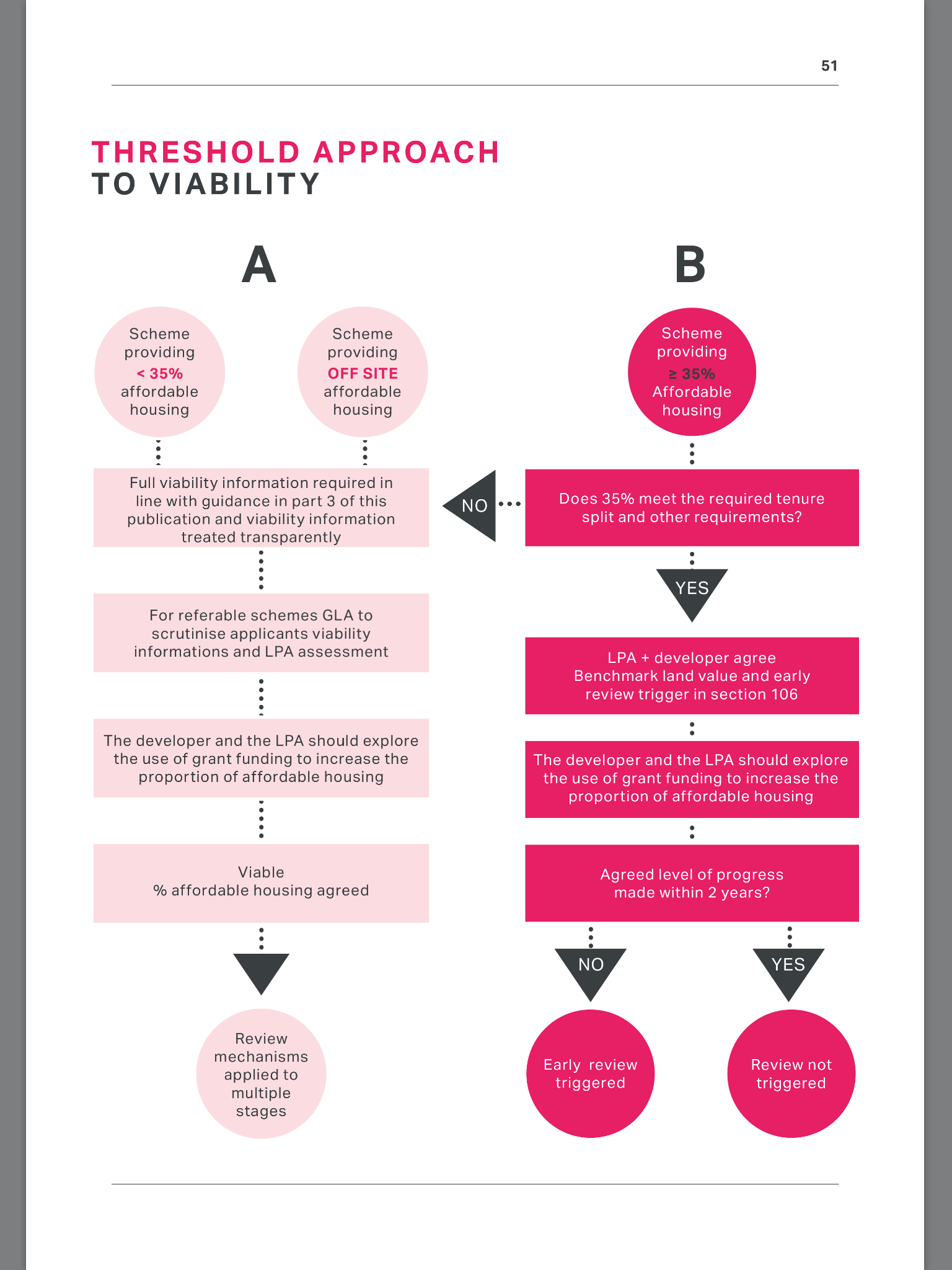
One of the most contentious issues in relation to developers’ project viability appraisals (carried out for the purposes of seeking to agree reductions in the scale of section 106 affordable housing and other obligations) is the benchmark land value that should be applied as a cost input. Clearly it should not be the actual market value (which would lead to circularity) but equally it should not be just the existing use value (EUV), which would not reflect reality and would result in schemes being assumed to be viable when in reality they would not be because the land would not be made available at the assumed benchmark value.
The 2012 RICS guidance, Financial Viability In Planning , advises that it is appropriate to take into account alternative use value (AUV):
“Site Value should equate to the market value subject to the following assumption: that the value has regard to development plan polices and all other material planning considerations and disregards that which is contrary to the development plan.”
As summarised in my 1.12.16 blog post , the London Mayor is seeking to move away from accepting AUV, preferring an “EUV+” approach, ie existing use value “plus premium”, with the methodology for calculating the premium left undefined, and therefore a recipe for continuing debate.
In practice, surely any attempt to pitch EUV+ at less than AUV is equivalent to restricting the application of the “no scheme world” rule – a policy intervention to apply that shortfall for public purposes. Except that with viability negotiations, it could of course lead to development simply not proceeding. Is there then a stalled scheme and grounds for compulsory purchase? The extent to which this sort of economic intervention is acceptable needs to be carefully limited and defined.
CIL reform
There have been rumours that the reason why the Government parked in February any response to the CIL review team’s report was that the new ministerial team had started to think about whether in fact any replacement for CIL should encapsulate land value concepts (memories of the planning gain supplement anyone?). There is certainly no mention of CIL in the Conservative manifesto. Certainly the policy priorities as between CIL and affordable housing need to be reconsidered.
If we weren’t in such dire straits, we could of course go back to a position where the state invested in social housing and funded public services without weighing the costs so heavily on land owners and developers. In the meantime, over the next five years we’ll definitely see answers emerge to those questions I posed back at the beginning of this overlong post.
Simon Ricketts 20.5.17
Personal views, et cetera