I’ve written before about the need to Keep It Simple Stupid.
The restructuring of the English planning system, as described in my 19 December 2025 blog post Framework Good Work, might turn out to be one of the lasting achievements of this government – a coherent tiered structure with the opportunity for faster, simpler, plan-making with all the benefits and efficiencies which flow from that predictability – but that good work may be undone, not least at the ballot box, if it is not widely understood or supported. Or if elected positions are secured primarily for the purposes of pursuing politics, providing a platform, rather than positive planning.
Secondary legislation is expected to be laid before Parliament breaks for the Parliamentary summer recess in mid July, with the spatial development strategy (SDS) provisions in the Planning and Infrastructure Act 2025 also to be switched on, meaning that the duty to produce an SDS will then immediately become active. The secondary legislation will provide for the setting up (possibly in more than one wave) of strategic planning boards (SPBs) in those areas where the SDS will be prepared by a combination of authorities.
The big question though is how can this emerging structure be made understandable and relevant to people, particularly alongside the complexities and uncertainties caused in many areas by the separate process of local government reorganisation?
I would like to see a “plain English” campaign as to the benefits, in terms of devolved powers, of Mayoral strategic authorities; of the power that strategic authorities’ spatial development strategies will have in directing areas for growth, infrastructure and investment; spelling out to people how quickly all of this will be coming down the track; the benefits that will flow from the new larger unified authorities sitting beneath the strategic tier, and public reassurance as to how the local, neighbourhood, voice will not be lost.
Some great work has been done, including by the Strategic Planning Group led by Prior + Partners and chaired by Catriona Riddell which led to the May 2025 paper Planning Positively For the Future (by coincidence the group, in which I was pleased to be a member of, met again on 12 February, the day of those announcements. Nice forward planning as always Shaun and Catriona…).
However, uncertainties remain. Would it be useful to have a “dummy” example of how straightforward and visual an SDS might be? I do worry about mission creep – you planners love words more than even lawyers do.
And do we need some greater clarity on “nuts and bolts” questions such as:
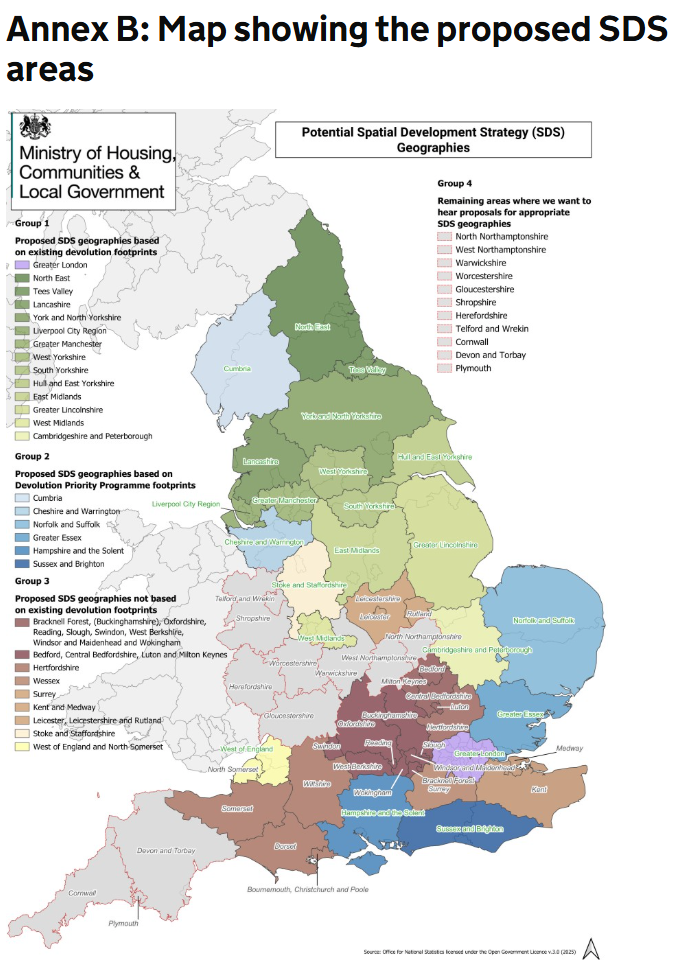
what will the starting point be for each SDS in terms of housing numbers? For the purpose of apportioning numbers between the local plan-making authorities within the SDS area, will it simply be the overall number for the SDS area derived from the standard method, subject to the opportunity to reach agreements with other strategic authorities? The challenges are well articulated in a Lichfields blog post Spatial Development Strategy Geographies – Will the map change the landscape? (Edward Clarke, Dominic Bowers & Matthew Spry, 16 February 2026):
“Analysis of recent housing delivery rates shows that for many SDS areas, housing delivery over the last three years is less than 60% of the local housing need (Figure 3) indicating that new strategies will need to demonstrate a real step change in provision, most likely pursuing spatial approaches to land release that the local plans of the last 15 years did not consider.
Across the South East those preparing SDSs will face some of the greatest challenges in meeting housing need. London, Hertfordshire, and Surrey will require building at between 120-150% of the current rates (over the last three years). A similarly big task faces much of the South West of England including Cornwall and Plymouth, Devon and Torbay, where the Government says it awaits to “hear proposals for appropriate SDS geographies”.
“A particular challenge will arise in the more tightly defined SDS areas such as the West Midlands Combined Authority where the SDS has an acute challenge (one with which the wider West Midlands RSS tried and failed to grapple) accommodating its own development needs within its current administrative boundary. Across the WMCA SDS area, recent delivery is around 65% of the aggregate housing need, but three quarters of the land area is either already built-up or subject to national planning restrictions or the green belt.
In this, and many other SDS areas, reviewing green belts will be critical to achieve sustainable patterns of development. But the big questions remain as to how effective will be the SDS process in engaging with overlapping housing market or functional economic areas without falling into (a larger-scale version of) the local duty to cooperate trap.”
Will SDSs have a role in setting targets for levels of affordable housing? And if so, how do we avoid the slippery slope into viability appraisal?
I know it hasn’t been an easy ride, politically or administratively: on 16 February 2026 under the pressure of litigation from Reform, it was announced that local government elections will be taking place after all in 30 areas this May which had previously been postponed by the government due to imminent reorganisation in those areas. By contrast, in relation to emerging strategic authority areas under the devolution priority programme (DPP), in December 2025 MHCLG announced that inaugural Mayoral elections which were due to take place in May 2026 would be delayed by a year in some areas, and by two in others – leading to the prospect of incoming Mayors finding that that the SDS is already underway with limited scope to withdraw or influence it.
How to explain this complicated new system to non-planners? Indeed, what can we call each of these SDSs for a start, as per the London Plan? We need to avoid the democratic deficit that ultimately sunk the regional assemblies, or worst of all the system faltering before it has been embedded across the country and had a chance fully to prove itself.
However, in suitably positive and festive mode, the theme of this blog post is as follows:
🎵 It’s beginning to feel a lot like we are moving towards a coherent, understandable, English planning system 🎵 and for that the relevant ministers and civil servants deserve a couple of weeks’ rest and reflection before the hard work begins again (because it certainly isn’t all finished yet…).
After all, doesn’t the following summary start to make sense to someone fresh to all this? In a way that the system hasn’t since the abolition of the regional strategies in 2010, or indeed long before that in much simpler times?
At a national level:
a comprehensive set of numbered policies setting out the approach to development plan-making to be taken by plan-making authorities at three levels: strategic (via procedures the framework of which is set out in the 2025 Act); local (via procedures the framework for which is set out in LURA 2023), and neighbourhood;
a comprehensive set of numbered policies to be followed when planning applications and appeals are determined, written in a rules-based style so as to minimise ambiguity – policies which (from the date the draft NPPF is finalised) override any inconsistent policies in any development plan (unless those policies have been examined and adopted against the finalised NPPF).
Planning practice guidance will still have an important “but supporting” role to national planning policy “and its status should be regarded in that light”.
At a strategic level (the boundaries of which in many cases will be determined in due course via the devolution process happening meanwhile in another part of the forest):
a comprehensive set of spatial development strategies focused on providing a clear spatial framework for investment and growth, including new housing, looking forward at least 20 years (to be altered at least every five years to reflect any changes to housing requirements for the local planning authorities in the strategy area and to be replaced at least every ten years). This will include apportioning to local planning authorities in the strategy area the objectively assessed needs for housing and other uses which those authorities should plan for in their local plans and identifying “broad locations for strategic development including new settlements, major urban extensions, major cross-boundary development and key locations with the potential for new homes and jobs” as well as strategic infrastructure requirements. There should be no duplication, substantive restatement or modification of the content of the NPPF, unless any policy in the NPPF so directs.
At a local level (the boundaries of which in many cases will be determined in due course via the local government reorganisation process happening meanwhile in yet another part of the forest):
slimmed-down local plans, to be prepared and adopted within 30 months, setting out a vision with a limited number of measurable outcomes, policies for minimum amounts of development to be provided for, land allocations (with a specified amount of detail), broad locations for growth, infrastructure requirements to support delivery of the plan and other policies “only where these support the delivery of specific allocated sites”. There should be no duplication, substantive restatement or modification of the content of the NPPF, unless any policy in the NPPF so directs. There must be “general conformity” with the relevant spatial development strategy. Supplementary plans may be used to address specific issues, subject to constraints set out in the NPPF.
At a neighbourhood level (optional):
allocating land to meet the development needs of the neighbourhood (with a prohibition on promoting less development than provided for in other parts of the development plan for the area) and policies to address particular local issues. Neighbourhood plans should accord with the plan-making policies in the NPPF and again there should be no duplication, substantive restatement or modification of the content of the NPPF.
At each level (strategic; local; neighbourhood) a specific set of tests is set out against which draft plans will be examined. There are specific requirements for plan-making authorities at each level to engage with infrastructure providers, other relevant plan-making bodies and other relevant bodies and to demonstrate this by way of statements of common ground. Expectations as to developer contributions should be set at the relevant level. Qualitative standards for development should not cover matters already addressed by Building Regulations with limited specific exceptions and should not cover matters relating to the construction or layout of buildings unless they are to implement the nationally described space standard. Plans are to be published in a searchable digital format – no more PDFs!
Aside from there being a more cohesive, tiered, policy basis for decision making, the decision-making process will be made simpler and more predictable by way of simplified procedural requirements for schemes of less than 50 dwellings, by way of increasing the standardisation of section 106 agreements and viability inputs and by way of greater delegation of decision-making to officers.
I’m focusing here more upon the structural framework of the system – the hardware as it were – rather than the substantive direction of the policies – the software as it were. But the software also now works more smoothly. Rather than the previous tilted balance, with its various caveats over time and footnotes, we have, front and centre, policy S4 setting out the principles to be applied to development within settlements and policy S5 setting out the principles of development outside settlements (including the new criteria for housing and mixed-use development within reasonable walking distance of railway stations which meet a specifically defined level of connectivity to jobs and services (with those criteria also now providing a new category of not inappropriate development in the green belt)) and the drive towards densification, a more diverse mix of homes, focus on particular areas and sectors (e.g. those names in the government’s growth strategy, AI growth zones, logistics, town centres and agricultural and rural development), minerals, a vision-led approach to transport, addressing climate change, a tidying up of heritage policies and finally a more strategic approach to the natural environment (with the read-across to local nature recovery strategies as well as the environmental delivery plans provided for within the 2025 Act).
Complicated? Inevitably. But refreshingly it does all hang together. In fact, the new system is probably more intimidating for all of us who have to get to grips with this quite different approach and unlearn a whole host of previous policy tests and workarounds than for someone coming at this afresh. Any attempt at a straightforward mark-up of changes from the current December 2024 NPPF is doomed to failure but this side-by-side comparison of the paragraphs of the draft revised NPPF as against the relevant paragraphs of the existing 2024 NPPF may help (for which I thank my colleagues Archie Hunter and Adam Choudhury).
What are the challenges ahead?
How to get there from here, i.e. transition. The NPPF’s decision-making policies will have full effect from the day that the final version of the document is published. We are of course going to have to wait longer for spatial development strategies (individual timescales dependent on dependent on individual devolution processes but against the government’s ambition of a full suite of adopted SDSs by 2029) and indeed the next generation of local plans (27 November 2025 written ministerial statement: “Local planning authorities covered by the NPPF transitional arrangements will have to commence formal plan making (Gateway 1) by 31 October 2026, while those that have a plan that is already over five years old must commence by 30 April 2027”).
Politics and administrative processes. The planning system is under major reconstruction but of course so is the whole architecture of sub-national government. The worst that could happen would be for any of these reconstruction jobs to be left half-done. Continuity is important and if this is going to work, for the long-term improvement of the whole system, those elected to prepare plans need to proceed in a way which is consistent with the timescales and objectives that have been set out – and to avoid every understandable temptation in a period of transition to wait first for the next jigsaw piece to fall into place.
Have a good Christmas everyone and don’t worry: I shall switch back to Grinch-mode in the new year I feel sure.
I covered Matthew Pennycook’s 30 July 2024 letter to the Planning Inspectorate’s chief executive Paul Morrison in my 11 August 2024 blog post Plan-Making, Or, The Olympic Sport Of Trying To Hit A Slowly Moving Target, which announced a reversal of the previous Government’s “expectation that Inspectors should operate “pragmatically” during local plan examinations to allow deficient plans to be ‘fixed’ at examination. This has gone too far and has perversely led to years of delays to local plan examinations without a guarantee that the plans will ever be found sound, or that the local authorities will take the decisions necessary to get them over the line. This has to end.
[…]
Pragmatism should be used only where it is likely a plan is capable of being found sound with limited additional work to address soundness issues. Any pauses to undertake additional work should usually take no more than six months overall. Pragmatism should not be used to address fundamental issues with the soundness of a plan, which would be likely to require pausing or delaying the examination process for more than six months overall. Local authorities should provide regular progress updates of their work to the Planning Inspector during any agreed pause.”
Muscular stuff in that heady first month. Principles above pragmatism and the delays thereby arising, addressing the problem of submitted plans being allowed to limp on for years through long examinations, through authorities being given time by inspectors to try to fix soundness issues arising.
“In advance of the new plan-making system and mechanisms for cross-boundary cooperation coming into force, the final set of local plans being delivered within the current system remain essential to facilitating the effective delivery of housing, jobs and infrastructure. It is therefore critical that Inspectors approach examinations of current system plans with the appropriate degree of flexibility. The evidencing of expectations to establish whether the legal and soundness tests have been met – including with respect to the Duty to Cooperate – should be proportionate to the context in which plans in the existing system are being prepared. I very much welcome that in some cases Inspectors are already exercising a degree of flexibility to expedite adoption of local plans. For example, I note recent pragmatic decisions to proceed toward adoption in instances where a five-year housing land supply cannot be evidenced at the point of adoption but where the plan significantly boosts supply and still meets housing needs over the plan period or by providing additional opportunities to clarify compliance with the Duty to Cooperate. Relevant Planning Practice Guidance provides advice in respect of both of these matters, and will no doubt be of ongoing assistance in assessing whether proportionate evidence has been provided or considering whether stepped housing requirements may be justified.
It remains important that we do not see the adoption of poor-quality plans, or accept overly long examinations (I am grateful for the action that Inspectors have taken following my letter of 30 July 2024 in that regard). However, within those bounds, where plans are capable of being made adoptable, I want Inspectors to seek to do so in the examination process.”
It was unsurprising to see the pendulum swing back, because we aren’t ever really talking about, or dealing with, the planning system in isolation, are we? The three Ps in our world are planning, pragmatism and politics. Pragmatically, what is a plan-led system without … plans?
And p for pragmatism has been given extra oomph with the 27 November 2025 announcement that the forthcoming regulations that will specify how the new plan-making system is to work will (once made) immediately abolish the statutory duty to co-operate (i.e. affecting plan making under the current system as well). See the minister’s letter of that date to Paul Morrison :
“We intend to shortly lay regulations which will enable Local Planning Authorities (LPAs) to initiate formal preparation procedures for new-style plans. These Regulations will also have the effect of abolishing the Duty to Co-operate for the existing plan-making system.
As you know, the Duty to Co-operate (“the Duty”) was inserted into the Planning and Compulsory Purchase Act 2004, through the Localism Act 2011, to help bridge the gap in co-operation resulting from the abolition of regional planning. The Duty requires LPAs to “engage constructively, actively and on an ongoing basis” with neighbouring authorities whilst preparing their local plan. However, as noted in your letter of 30 October, the Duty as a legal provision has, at times, been difficult to comply with and has led to some notable local plan failures. This is in part because any shortcomings relating to the Duty cannot lawfully be remedied during examination.
The new plan-making system provided by the Levelling Up and Regeneration Act 2023 does not include the Duty. Instead, the new system will rely on revised national policy and the new tier of strategic planning to ensure effective co-operation between plan-making authorities. The Regulations for the new system will also ‘save’ the current plan-making system for a period to allow emerging plans to progress to examination by 31 December 2026. Given the above, andto help drive local plans to adoption as quickly as possible and progress towards our objective of universal local plan coverage, we have decided not to ‘save’ the Duty, thereby removing this requirement for plans in the current system.
The Duty will therefore cease to apply when the Regulations come into force early next year, including for plans at examination at that point. On the basis of the government’s firm intention to abolish the Duty for the current system, examining Inspectors may wish to begin any necessary dialogue with LPAs in advance of the Regulations coming into effect, with reference to this letter. Of course, LPAs should continue to collaborate across their boundaries, including on unmetdevelopment needs from neighbouring areas and Inspectors should continue to examine plans in line with the policies in the NPPF on ‘maintaining effective co-operation’.”
This is perilously close to retrospective legislation it seems to me but, pragmatically, politically, a potential lifeline has been thrown to, for instance, the Mid-Sussex local plan and the South Oxfordshire and Vale of White Horse joint local plan. For some background on the Mid-Sussex local plan duty to cooperate issue, see my 7 June 2025 blog post Not Sure Why The Media Was So Focused On Musk v Trump This Week Given What Has Been Happening In Sussex since when the inspector, in a letter dated 3 November 2025, had – can we say grudgingly? – agreed to hold a further hearing session in January 2026. The South Oxfordshire and Vale of White Horse joint local plan inspectors had written to the two authorities on 26 September 2025 indicating that they considered that the duty to cooperate had not been met. Since the minister’s 27 November 2025 announcement they have now written again to the authorities in a letter dated 1 December 2025 seeking their views on the implications of the announcement for the examination and “in particular how the Councils wish to proceed”.
Plan-making deadlines
Two reasons why the notion of a “plan-led” system is increasingly theoretical are surely:
Obviously, the continuing lack of up-to-date local plan coverage across England.
The increasingly impenetrable nature of the local plans system, already with plans proceeding under the previous and current NPPFs and now to overlap with the proposed new system, supposedly to be faster but that was initially designed with the concept of (a) statutory national development management policies (we will see if the non-statutory fudge makes a practical difference in that respect) so as to narrow down their role basically to the allocation of land for development and the designation of land for specific forms of protection and (b) a now abandoned watered-down “soundness” test.
Is a simpler, speedier system on the horizon? Hmm.
In his Q&A session with Sam Stafford at the LPDF conference on 27 November 2025, Matthew Pennycook revealed that timescales for authorities to prepare new style local plans would in some instances be brought forward, rather than the previously proposed phased introduction. That day we then had a press statement (New local plan system launching early 2026: latest update), a written ministerial statement (Reforming Local Plan-Making) and a detailed Plan-making regulations explainer.
From the written ministerial statement:
“Having considered carefully responses to the earlier consultation, I am announcing today that we no longer intend to roll the system out in a series of plan-making ‘waves’. Instead, local planning authorities will be encouraged to bring plans forward as soon as possible following the commencement of the regulations early in the New Year.
Whilst authorities will have discretion over how soon they start their plan, regulations will set out final ‘backstop’ dates for when plan-making must legally have commenced. Local planning authorities covered by the NPPF transitional arrangements will have to commence formal plan making (Gateway 1) by 31 October 2026, while those that have a plan that is already over five years old must commence by 30 April 2027. Further information will be set out in the regulations and in guidance.”
From the explainer:
“In general, the regulations will require that local planning authorities publish their Notice to Commence Plan-Making within 4 years and 8 months of adopting their existing local plan, or by 31 December 2026, whichever is the latest. They must then begin preparation of a new local plan (publish their gateway 1 self-assessment form) within 5 years of adopting their existing local plan, or by 30 April 2027, whichever is the later.
However local planning authorities who submitted a plan for examination on or before 12 March 2025 with an emerging housing requirement that was meeting less than 80% of local housing need will be required by regulations to publish their Notice to Commence Plan-Making by 30 June 2026 and their Gateway 1 self-assessment by 31 October 2026. This will not apply to areas where there is an operative Spatial Development Strategy which provides the housing requirement for the relevant areas.
If an existing system plan is withdrawn from examination prior to adoption, regulations will require local planning authorities to publish their Notice to Commence Plan-Making in the new system at the same time as the plan is withdrawn, and to publish their Gateway 1 self-assessment 4 months later.
Further details on the initial rollout of the new plan-making system will be set out on Create or Update a Local Plan.
Supplementary Planning Documents (SPDs) will remain in force until planning authorities adopt a new style local plan or minerals and waste plan. The final adoption date for new SPDs will be 30 June 2026, to ensure any advanced emerging SPD can be adopted.
These Regulations will also have the effect of abolishing the Duty to Co-operate for the existing plan-making system, by not saving this provision for plans progressing to examination in the existing system by 31 December 2026.”
Whilst in theory encouraging an earlier start to plan making sounds positive, in many areas these emerging plans could well get stalled by a combination of local government reorganisation and the incoming spatial development strategies.
The local government reorganisation map is still unclear, with authorities in two tier areas outside the devolution priority programme having now submitted their proposals by the 28 November 2025 deadline, apparently proposing more than 50 different potential configurations for ministers to consider (Exclusive: Over 50 LGR proposals sent to MHCLG – Local Government Chronicle, 3 December 2025). Elections for the new authorities are due in May 2027 ahead of going live in April 2028. How many current authorities will push through their plans to a conclusion ahead of, and in the face of, what lies ahead?
The map is also unclear as to what will be the new England-wide strategic tier. The government’s commitment was that the new spatial development strategies, with which in the future local plans should confirm, would be in place by 2029, but this looks increasingly unlikely. Yes it is all complex, but one wonders what role politics will increasingly play. Last week there was the unexpected announcement that Mayoral elections in four areas within the devolution priority programme, Greater Essex, Sussex and Brighton, Hampshire and the Solent, and Norfolk and Suffolk have been delayed from May 2026 to May 2028. There is apparently nothing to prevent the new strategic authorities, once created, from making progress with preparing SDSs ahead of their Mayors being elected but how does this work democratically?
Oh and in a couple of weeks we will see the new consultation draft NPPF, incorporating, we assume, more targeted sets of policies for plan making and for decision taking. And the latest set of housing delivery test outcomes. And throughout, p for politics…
Essay question for the festive period: Is our planning system in practice currently plan-led or application–led? And is this likely to change?
Lastly, thank you Paul Morrison for your work as chief executive of the Planning Inspectorate over the last three years. PINS is the main glue holding the current system together and its performance remains impressive. Congratulations to new interim chief executive Graham Stallwood. No pressure Graham!
Simon Ricketts, 6 December 2025
Personal views, et cetera
Sam Stafford and minister Matthew Pennycook MP at LPDF conference 27 November 2025
I’m preparing to speak at a couple of events at UKREiif this week, I’m trying to finish reading a book, I’m pleased that the Strategic Planning Group’s report Planning Positively for the Future has now been published (16 May 2025) and I’ve been dipping into the Mayor of London’s Towards a New London Plan consultation document (9 May 2025)
And the over-arching theme for me is Keep It Simple, Stupid.
The book is Abundance: How We Build A Better Future by Ezra Klein and Derek Thompson. A few people have mentioned it but what caused me finally to reach for my wallet was when Strategic Land Group’s Paul Smith recommended it on a 50 Shades of Planning podcast – he’s a good reader is Paul.
You might get the basic ideas from this Guardian review from which I quote the following passages:
Abundance for all of us, via an entirely possible techno-optimistic “future is behind schedule – and Abundance holds late 20th‑century liberalism responsible. (Klein and Thompson critique the right, too – they are themselves liberals – but this book speaks only to their co-partisans, with the downside of artificially telling just half the story). Liberals, Klein and Thompson say, nobly fought to redistribute what we have to those without, while losing sight of the goal of creating more to redistribute in the first place. Meanwhile, they sought to protect the public from the unchecked consequences of growth: the bulldozers of urban renewal and the pollution of industrialisation. They succeeded, but left the state too constrained to solve the challenges of today.”
“For example, they tell how California began studying high-speed rail, a clean and congestion-free alternative to cars and planes, more than 40 years ago. It took a decade for planning to begin in earnest; another decade-and-a-half to get funded; 16 years after that, it still doesn’t exist. High-speed rail has been swallowed by procedures erected to prevent every conceivable harm to every conceivable stakeholder. The environmental reviews needed just to describe the project’s impacts began in 2012; they still aren’t done. All the while, costs keep increasing.”
“In everything from planning regimes that block badly needed housing and solar farms, to the ossified processes for writing federal regulations and hiring civil servants, they see systems attuned to the harms of action and not its benefits, and convincingly argue that the rewards of reform are immense.”
“Klein and Thompson’s story of sclerosis is of a “system so consumed trying to balance its manifold interests that it can no longer perceive what is in the public’s interest.”
The sorry story of the Californian High Speed Rail project reads across precisely to HS2 and the book’s description of the sometimes-unintended sometimes-intended obstacles to housing development and green energy projects in many US states are only too familiar here.
The book makes a telling point about how “a complex society begins to reward those who can best navigate complexity”. Doesn’t that apply to many of us at UKREiif – not really a conference about how to build, but rather a conference about navigating the regulatory and other complexities to be sorted before anyone gets near an actual construction contract?
And, uncomfortable for me and other lawyers (already well rewarded for navigating complexity), there’s much in addition about the dead hand of “adversarial legalism”.
The KISS mantra was certainly front of mind for me when I was participating as the only lawyer member of the Strategic Planning Group. In designing for the reintroduction of strategic planning, via spatial development strategies, how to reduce the scope for mission creep in the documents, how to reduce ambiguity, duplication and delay, and how to arrive at a proportionate evidence base and examination process. Developing the 17 recommendations in the report was a superb, thoughtful but practical project, by way of six half day workshops and much work by chair Catriona Riddell and by the Prior + Partners team between the sessions and in writing it all up. Do let us know what you think.
I hope that once the National Development Management Strategies take shape we have a much more logical and non-duplicative cascade of NDMPs, SDSs, local plans and neighbourhood plans with as little duplication, gold plating and unnecessary text as possible – and that one day soon the whole cascade will be available at the click of a button in relation to any site. Will we get there or, as a “complex society”, is simplicity beyond us?
The London Plan is of course an awkward example of a spatial development strategy. This is not what the new breed of SDSs should look and feel like at all. Indeed, my personal vision is that the key diagram for an SDS should tell the main story, as to broad locations for strategic growth, infrastructure and the scale of housing development required in local plan areas. With previous iterations of the London Plan being so all-encompassing, is it really possible for the next version to be radically stripped back? I doubt it. But if it is not to be, could we at least avoid London Plan policies being duplicated (often in slightly different terms) and gold-plated in boroughs’ local plans? If a trade-off for the scale of the London Plan were to be much shorter borough plans that would be something. It will also be interesting to see what the new regime of NDMPs will mean for the London Plan.
The election for the first London Mayor took place 25 years today, 4 May 2000. I learned this via a piece by Nick Bowes in LCA’s latest LDN newsletter.
It is a topical weekend to think back as to the influence of the three very different political figures who have been London Mayor: Ken Livingstone, Boris Johnson and Sadiq Khan. Even without the extent of devolved powers available to their counterparts in other world cities, they have been able to exert significant influence over the shape and operation of our capital city, particularly in relation to transportation and in relation to strategic planning, including in relation to individual development projects of “potential significant importance”.
As Labour rolls out its vision for Mayoral strategic authorities across the country, what are going to be the political consequences over time and for the shaping of those areas? My 18 January 2025 blog post Viva La Devolution sought to summarise what lies ahead in terms of devolution and the introduction of strategic planning, modelled (in legislative form at least) on the spatial development strategy (aka London Plan) model, with equivalent intervention powers to the London Mayor in relation to applications of potential strategic importance (the power to direct refusal or to take over as decision maker).
For example, Greater Lincolnshire is now of course a combined county authority, covering the Lincolnshire County Council, North East Lincolnshire Council and North Lincolnshire Council’s areas. On 1 May 2025, Reform party politician Dame Andrea Jenkyns was elected Mayor and will lead the authority, the other members being:
Constituent members: Six members appointed by the constituent councils. Agreed at the first GLCCA meeting on 6 March, these are:
Councillor Martin Hill OBE – Leader of Lincolnshire County Council
Councillor Patricia Bradwell OBE – Lincolnshire County Council Councillor
Philip Jackson – Leader of North East Lincolnshire Council
Councillor Stan Shreeve – North East Lincolnshire Council
Councillor Rob Waltham MBE – Leader of North Lincolnshire Council
Councillor Richard Hannigan – North Lincolnshire Council
Non-constituent members: Four people nominated by the district councils within the area. Agreed at the first GLCCA meeting on 6 March, these are:
Councillor Richard Wright – Leader of North Kesteven District Council
Naomi Tweddle – Leader of City of Lincoln Council
Craig Leyland – Leader of East Lindsey District Council
Nick Worth – Leader of South Holland District Council
Additional non-constituent or associate members: Up to two further members, including one of the police and crime commissioners for the area and another from a business background. Agreed at the first GLCCA meeting on 6 March, these are:
Marc Jones – Police and Crime Commissioner for Lincolnshire
Aside from a whole page on scrapping the government’s net zero policies, this is all there is on planning, on housing:
“Review the Planning System
Fast-track planning and tax incentives for development of brownfield sites. ‘Loose fit planning’ policy for large residential developments with pre-approved guidelines and developer requirements.
Reform Social Housing Law
Prioritise local people and those who have paid into the system . Foreign nationals must go to the back of the queue. Not the front”.
It will be interesting to see how the new authority engages with the process of preparing a spatial development strategy in due course and the extent to which the process will be used a wider political platform. Social media posts from Reform’s deputy leader and MP for Boston and Skegness (Lincolnshire of course) and from Dame Andrea Jenkyns perhaps give a flavour of what is in store:
Conflict with the government on national policy issues:
Influence in relation to wider political/cultural issues:
Of course it must be said that each of our London Mayors have used their role from time to time in equivalent ways!
Turning back to London, one long-running east-west scar across the centre of the capital has been Oxford Street. I wrote in my 21 September 2024 blog post Street Robbery about the Mayor’s 17 September 2024 announcement that he is to create a Mayoral Development Corporation to “transform Oxford Street, including turning the road into a traffic-free pedestrianised avenue” so that it can “once again become the leading retail destination in the world”. Since then a public consultation process was launched on 28 February 2025 which closed on 2 May 2025. For a detailed, authoritative account of the last hundred years of managing transport on Oxford Street, which puts the current proposals into context, I strongly recommend you read an On London blog post published today, 4 May 2025, by Paul Dimoldenberg, long serving Westminster City Council member. How much progress will be made towards at least partial pedestrianisation before the end in 2028 of Sadiq Khan’s current term? One to watch.
We are also watching and waiting for the Mayor’s high level Towards a London Plan consultation document, initially expected last month but now delayed to May. Adoption is not expected of the final document until 2027, a year from the next Mayoral election. These slow time periods are crazy.
As we wait for those documents, the inspector’s decision letter dated 2 May 2025 in relation to the Stag Brewery proposed development in Mortlake, Richmond-on-Thames, makes for interesting reading – and a reminder of how financially challenging it is to bring forward large-scale brownfield development. I need to declare an interest in that my Town Legal colleagues Elizabeth Christie and Aline Hyde acted for the successful appellant, Reselton Properties Limited. The proposals entail the redevelopment of the site for residential and mixed use purposes (including up to 1,075 new homes), together a new secondary school. The decision letter follows a lengthy saga, with a previous scheme on the site having been the subject of refusal by the Mayor in May 2021 following resolution to grant by the London Borough of Richmond-on-Thames in January 2020. The local planning authority had similarly resolved to approve this latest scheme; the main issue, again, was with the Mayor, primarily in relation to viability and the approach to affordable housing.
The appellant and local planning authority agreed that viability testing had demonstrated that the viable position would be zero affordable housing, and that, against this technical position, the offer of 7.5% affordable housing (split 80% social rented, 20% intermediate), with viability review mechanism to capture future uplifts in viability, was a benefit. The Mayor disagreed that this represented the maximum viable provision required by policy, questioning some of the viability inputs, namely on private residential sales values, developer return (appellant’s and council’s position: 17.2%, Mayor’s position 15%) and growth and review potential. However, the inspector accepted the appellant’s and council’s position, indeed rejecting an alternative offer by the appellant of 12% affordable housing if the inspector were to have found against the appellant and council on elements of the viability case. In the context of the council having marginally less than five years’ housing land supply; the additional presumption to be given to brownfield development, and other benefits including the opportunity for delivery of a new secondary school as required by the local plan allocation and wider economic benefits flowing from the development, planning permission was granted.
Perhaps it’s more like revolution, certainly rapid evolution, and possibly even in some respects the reverse of devolution…
In my 21 December 2024 blog post And Now Take A Deep Breath… I set out what there was in the 16 December 2024 English Devolution White Paper as to the proposed introduction of spatial development strategies across the whole of the country by the end of this Parliament with which local plans will need to be in general conformity. Aside from setting minimum housing requirements for each member authority, SDSs will identify infrastructure needs and strategic locations for development, presumably including where appropriate high level reviews of green belt boundaries.
SDSs will be produced by strategic authorities and in some instances, to begin with, other groupings of local authorities directed by the Secretary of State via powers to be included in the Planning and Infrastructure Bill which is to be published in March.
Strategic authorities will fall into one of two categories:
“Foundation Strategic Authorities: these include non-mayoral combined authorities and combined county authorities automatically, and any local authority designated as a Strategic Authority without a Mayor.
Mayoral Strategic Authorities: the Greater London Authority, all Mayoral Combined Authorities and all Mayoral Combined County Authorities will automatically begin as Mayoral Strategic Authorities. Those who meet specified eligibility criteria may be designated as Established Mayoral Strategic Authorities. This unlocks further devolution, most notably an Integrated Settlement.
The government’s strong preference is for partnerships that bring more than one local authority together over a large geography. In exceptional circumstances the Secretary of State will have the power to designate an individual local authority as a Foundation Strategic Authority only. Our ambition remains for all parts of England to ultimately have a Mayoral (and eventually Established Mayoral) Strategic Authority.”
Much of the detail is yet to emerge, for instance:
What will be the necessary evidence base to support these SDSs and how will they be examined and will there be a refined version of the current “soundness” test?
Will SDSs have to divide out for the constituent member authorities as minimum housing requirements the collective total local housing need for the SDS area and will each local plan need to accept that figure as its minimum housing target?
What will be the tramlines as to what may, must and must not and may be included in SDSs?
How will internal political differences between member authorities be contained where real tensions arise over, for instance, the allocation of housing numbers?
How and to what extent will strategic authorities be required to coordinate with their neighbours?
Of course, core to the government’s reform proposals is not just the universal coverage of the country by strategic authorities (the default assumption being for each to have a combined population of 1.5 million or above), but, below that level, unitary rather than two tier authorities:
“We will expect all two tier areas and smaller or failing unitaries to develop proposals for reorganisation. We will take a phased approach to delivery, taking into account where reorganisation can unlock devolution, where areas are keen to proceed at pace or where it can help address wider failings. However, we are clear that reorganisation should not delay devolution and plans for both should be complementary.
New unitary councils must be the right size to achieve efficiencies, improve capacity and withstand financial shocks. For most areas this will mean creating councils with a population of 500,000 or more, but there may be exceptions to ensure new structures make sense for an area, including for devolution, and decisions will be on a case-by-case basis.”
In terms of the creation of strategic authorities, many councils have already expressed interest in becoming part of the Government’s Devolution Priority Programme, which is for areas wishing to pursue establishment of a Mayoral Strategic Authority. This will be with a view to inaugural mayoral elections in May 2026. The Local Government Association has published a list.
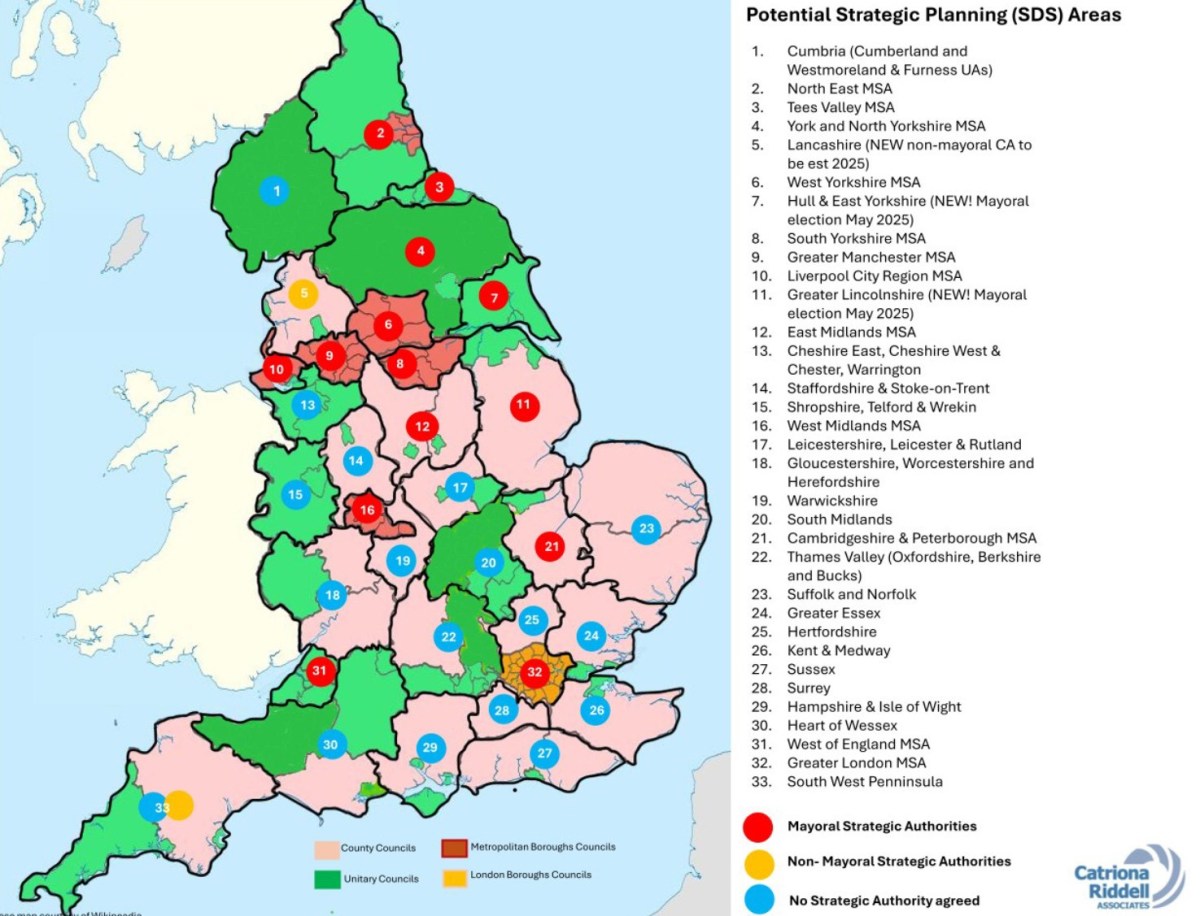
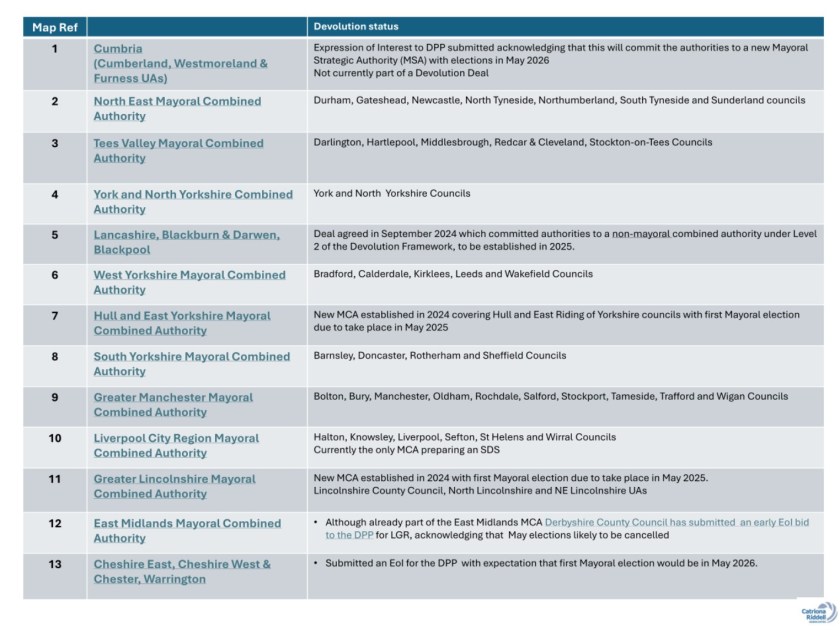
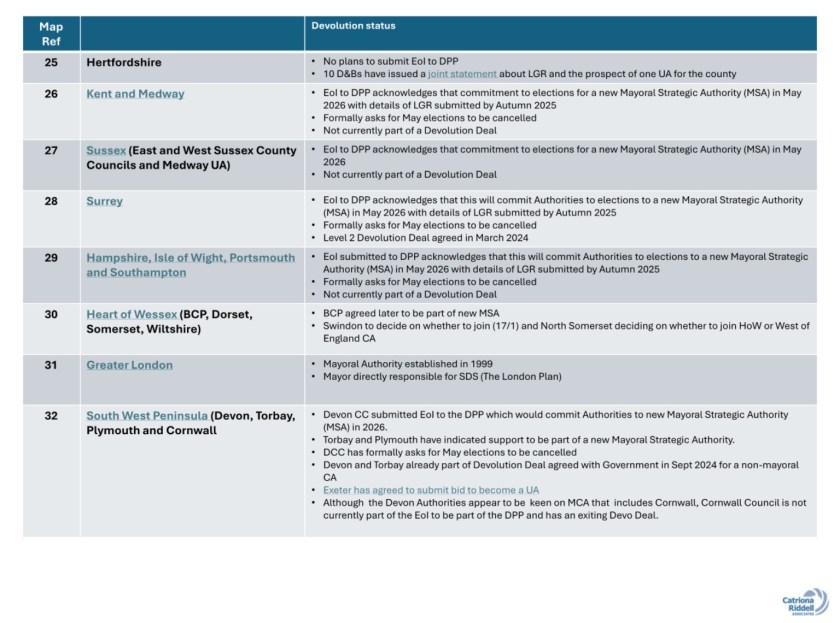
What could this all mean in terms of what the areas will be for SDSs? Catriona Riddell yesterday posted her current understanding as below:
In terms of the move towards unitary authorities, local government minister Jim McMahon wrote to two tier authorities on 16 December 2024:
“As set out in the White Paper, new unitary councils must be the right size to achieve efficiencies, improve capacity and withstand financial shocks. For most areas, this will mean creating councils with a population of 500,000 or more. However, there may be exceptions to ensure new structures make sense for an area, including on devolution.”
“We will take a phased approach and expect to deliver new unitary authorities in April 2027 and 2028.”
“I have heard from some areas that the timing of elections affects their planning for devolution, particularly alongside reorganisation. To help manage these demands, alongside our objectives on devolution, and subject to meeting the timetable outlined in this letter, I am minded-to lay secondary legislation to postpone local council elections from May 2025 to May 2026.
However, I will only do this where this will help the area to deliver both reorganisation and devolution to the most ambitious timeframe – either through the Devolution Priority Programme or where reorganisation is necessary to unlock devolution or open up new devolution options.”
“To lay the relevant legislation to postpone elections, I will need a clear commitment to devolution and reorganisation aims from upper-tier councils in an area, including a request from the council/s whose election is to be postponed, on or before Friday 10 January.”
Again, the Local Government Association’s list is helpful – of counties and unitaries which have made requests, involving postponing their election from 2025 to 2026.
Whilst the government’s advice is that none of this should slow down current local plan making it is going to be interesting to see what transpires – and the local political implications more generally of postponed elections (who knows, perhaps the potential for longer term decision making?).
The pace of change ahead of publication of either the Planning and Infrastructure Bill or the English Devolution Bill is certainly impressive.
There’s an interesting quote from Arthur C Clarke about revolution – and possibly it extends to devolution as well:
“Every revolutionary idea seems to evoke three stages of reaction. They may be summed up by the phrases: (1) It’s completely impossible. (2) It’s possible, but it’s not worth doing. (3) I said it was a good idea all along.”
Can I share with you that there have been times this year when the pace of announcements in terms of changes to the planning system, when taken with some significant case law to digest, has led me to wonder how I am meant to keep up?
Even in the last month, no sooner than the new National Planning Policy Framework and associated announcements (see my 14 December 2024 blog post I Love It When A National Planning Policy Framework Comes Together) was published, there were pre-Christmas sucker punches in the form of:
I’m not complaining; change is needed. However, now is not the time for deep dives into either topic, other than to say this:
The English Devolution white paper is necessary, if complex, reading. Aside from heralding significant local government reorganisation and devolution of power to sub-national levels, for us the most key paragraph 3.5, housing and strategic planning, which concludes with this summary of what is proposed:
“Box A: Universal system of strategic planning
The government has been clear that it will implement a universal system of strategic planning within the next five years. The model that is proposed is the Spatial Development Strategy (SDS), which is well established in London, the London Plan having been produced and continually reviewed over 20 years. As set out at 3.5, where Strategic Authorities exist, they will be responsible for producing or agreeing the SDS for their areas.
While it is our ambition for every area of England to be covered by a Strategic Authority, this will be a gradual process. We want to move quickly on strategic planning. This means that where no Strategic Authority is in place or is planned to be in place, the government will take a power through the forthcoming Planning and Infrastructure Bill to direct defined groupings of upper-tier county councils, unitary councils, and in some cases Foundation Strategic Authorities to deliver an SDS. Given the intention to have all SDSs produced by Strategic Authorities in due course, the government believes it makes sense in the first instance for these groupings of local authorities to be guided by the sensible geography criteria that have been set out for agreeing new devolution deals (see 2.2.1). The arrangements for agreeing a SDS in areas without a Strategic Authority will follow the same principles as Foundation Strategic Authorities.
In all areas, SDSs will guide development for the Local Planning Authorities in the area, and their local plans will need to be in general conformity with the SDS. However, Local Planning Authorities should not delay development of Local Plans while they await the adoption of an SDS. Relevant Local Plans should continue to be updated or developed alongside the SDS process.
Areas will be able to set a SDS to enable their area to grow, identify the infrastructure that is needed and strategic locations for development. This will include an obligation to apportion an assessment of the housing need of the Strategic Authority across its constituent members. The government intends for that assessment to be the cumulative total of the local housing need of each constituent member, as determined by the Standard Method set out in national planning policy. The apportioned figure set for each constituent member in the SDS will then be the minimum housing requirement for the purposes of each member authority’s next Local Plan. Agreement on the precise distribution of housing need will be agreed through the SDS development process. We also expect that the authorities producing SDSs will be able to encourage the pooling of resources and prioritising of efforts across their constituent authorities to meet housing need.
The content of SDSs will be kept deliberately high level with the dual purpose of preserving detailed policy and site allocations for local planning authorities through their local plans, and for enabling strategic plans to be produced quickly, with the intention of achieving national coverage by the end of this Parliament. The government expects high levels of collaboration to be demonstrated between the Strategic or upper-tier local authorities who are responsible for the SDSs and local planning authorities in the area. There will be a formal duty for responsible authorities to consult district councils on the development of the SDS and a route for district councils to raise concerns with the planning inspectorate.
Across all areas, these arrangements will encourage partnership working and we envisage that there will be genuine opportunities for efficiencies by sharing research, evidence and expertise that can support both the SDS and Local Plans. However, the government is determined to ensure that, whatever the circumstances, SDSs can be concluded and adopted in a reasonable time period. In order to ensure universal coverage of strategic plans, we will legislate for intervention powers, which will enable the government to intervene where plans are not forthcoming to the timeframe. These will include directing on timetables or particular policy content such as the distribution of housing need, through to taking over the preparation of an SDS and adopting it on behalf of strategic planning authorities.”
The intention of achieving national coverage by the end of this Parliament”! The necessary legislative changes will be introduced in part via the forthcoming Planning and Infrastructure Bill and partly through the forthcoming English Devolution Bill. I’m pleased to be part of the strategic planning working group chaired by Catriona Riddell and founded by Prior + Partners which is looking to help lay the groundwork to ensure that strategic planning can work effectively. Three half days sessions have been held so far, with two to follow in January.
But there will be plenty more to explore in the white paper beyond the introduction of strategic development strategies. For instance, once the relevant strategic development strategy is in place, Mayoral Strategic Authorities will have equivalent development management powers as the London Mayor, enabling them to intervene with applications of potential strategic importance and will have the power to raise a Mayoral Community Infrastructure Levy to support the delivery of strategic infrastructure projects.
There are other nuggets hidden away in the text, for instance the proposed replacement of the community “right to bid” for assets of community value by a strengthened “right to buy”.
As for the Government’s compulsory purchase compensation proposals, the big news is of course the potential widening of the scope for “no hope value” CPOs, to include acquisitions of “brownfield land in built-up areas, suitable for housing delivery, but with no extant planning permission for residential development” and “land allocated for residential development in an adopted plan but which has not come forward for development.” I speculated as to what might be proposed, and as to the potential implications, in my 21 July 2024 blog post, Hope/No Hope. Although you may prefer just to try my Spotify playlist, A Deep Dive Into Land Value Capture.
Can I end on a more serious note? I started this post wondering how people are meant to keep up. I’ve also been wondering what the best role is for blogs like this. I started writing it for my own benefit – just to join the dots on what is happening week by week , as well as for amusement – I like writing! It’s brilliant that many of you regularly read what I do but I never meant to replace more reliable sources of CPD. Indeed just preparing summaries of documents is not what this blog is about. It hit me hard when I learned that EG (formerly the Estates Gazette) will be closing next year. Those are proper journalists. My gratitude goes out to all of those in the specialist press (particular shout-outs to Planning and the Planner) and also those in the sensible end of mainstream media who are all trained, and paid, to report and analyse on what is happening. I can only provide amateur snapshots. The day job – practising, rather than pontificating on, all this stuff – is always my bigger focus. This is a golden age for planning and planning law blogs (I’m always in awe of eg Zack, Nicola, Sam Stafford, Philip Barnes, Paul Smith and others – oh no who have I offended by omission?) but we need to keep professional journalism alive too!
Related thought: this week there was a fascinating The Lawyer Podcast: Christmas Special — is someone you know a workaholic? Do listen – it is equally relevant for planners as lawyers! The evening I listened to it I was going to go back to my desk to read one of the documents I mentioned above but, taking in its message, I stopped and deliberately closed my eyes and listened to some music instead. Our professional area of interest is so intertwined with public policy, industry gossip etc that I find it difficult sometimes to work out whether what I am doing is work. Maybe LinkedIn needs that gambling industry warning: “When the Fun Stops, Stop”.







 SIMONICITY