When The Wind Blows

Relax – this blog post is about on shore wind turbines rather than nuclear fallout.

But there is somewhat of a “dig for victory” feel to our current conversations about energy. If we all just turn down our thermostats by one degree and so on.

Against the urgent need for greater energy security, against the escalating costs of energy and fuel (which make “levelling up” a side show) and of course against the largest and most relentless horseman of the apocalypse, climate change – there is one central question: How can we reduce our energy requirements and maximise the potential of our “home grown” sources of energy?

Following this 8 March Government press statement UK to phase out Russian oil imports (phasing out to be by the end of this year), we await a statement from the prime minister next week on the future of UK energy supply. He was quoted last week as follows:

We need to intensify our self reliance as a transition with more hydrocarbons, but what we also need to do is go for more nuclear and much more use of renewable energy,” he said. “I’m going to be setting out an energy strategy and energy supply strategy for the country in the days ahead.”

This is not going to be uncontroversial, both by reference to “more hydrocarbons” (see eg Johnson hints UK oil and gas output must rise to cut dependence on Russia (The Guardian, 7 March 2022)) but also unfortunately in relation to renewables, the further encouragement of which should surely be a no-brainer.

We had a wide-ranging clubhouse discussion back on 8 February 2022, Renewable energy and using less energy: are you plugged in? which is worth listening back to (it includes discussion of energy reduction and of what is happening in relation to off shore wind energy which this blog post will not), and there is also my 23 October 2021 blog post Net Zero Strategy: We Can Have Cake & Eat It, but all that seems a long time ago set against recent events.

Warning: this blog post only considers England’s, particularly troubled, policy position, rather than the rest of the United Kingdom.

The July 2021 update to the NPPF did not contain any specific changes in relation to planning for climate change. Paragraph 152 (previously paragraph 148) still reads:

The planning system should support the transition to a low carbon future in a changing climate, taking full account of flood risk and coastal change. It should help to: shape places in ways that contribute to radical reductions in greenhouse gas emissions, minimise vulnerability and improve resilience; encourage the reuse of existing resources, including the conversion of existing buildings; and support renewable and low carbon energy and associated infrastructure.”

When the update was published the Government’s response to consultation stated that 20% of respondents to that draft section of the framework “recognised the importance of climate change and indicated a need for stronger terminology to reflect this, such as specific references to the net zero target and emphasis on renewable energy” and stated that the Government is “committed to meeting its climate change objectives and recognises the concerns expressed across groups that this chapter should explicitly reference the Net Zero emissions target. It is our intention to do a fuller review of the Framework to ensure it contributes to climate change mitigation/adaptation as fully as possible, as set out in the [planning white paper].”

So we expect changes to the NPPF to strengthen planning policies on climate change. Can we expect any change of policy in relation to on-shore wind in particular?

If you recall, following its 2015 election manifesto pledge, the Government significantly toughened its stance in relation to on shore wind. Greg Clark issued this written ministerial statement on 18 June 2015:

“I am today setting out new considerations to be applied to proposed wind energy development so that local people have the final say on wind farm applications, fulfilling the commitment made in the Conservative election manifesto.

Subject to the transitional provision set out below, these considerations will take effect from 18 June and should be taken into account in planning decisions. I am also making a limited number of consequential changes to planning guidance.

When determining planning applications for wind energy development involving one or more wind turbines, local planning authorities should only grant planning permission if:

· the development site is in an area identified as suitable for wind energy development in a Local or Neighbourhood Plan; and

· following consultation, it can be demonstrated that the planning impacts identified by affected local communities have been fully addressed and therefore the proposal has their backing.

In applying these new considerations, suitable areas for wind energy development will need to have been allocated clearly in a Local or Neighbourhood Plan. Maps showing the wind resource as favourable to wind turbines, or similar, will not be sufficient. Whether a proposal has the backing of the affected local community is a planning judgement for the local planning authority.”

New subsidies for on shore wind were also ended.

The stance flowed through to the NPPF and the relevant paragraph remains – supportive of renewable energy in principle but with a killer footnote in relation to on shore wind:

158. When determining planning applications for renewable and low carbon development, local planning authorities should:

(a) not require applicants to demonstrate the overall need for renewable or low carbon energy, and recognise that even small-scale projects provide a valuable contribution to cutting greenhouse gas emissions; and

(b) approve the application if its impacts are (or can be made) acceptable 54 . Once suitable areas for renewable and low carbon energy have been identified in plans, local planning authorities should expect subsequent applications for commercial scale projects outside these areas to demonstrate that the proposed location meets the criteria used in identifying suitable areas.”

Footnote 54:

(54) Except for applications for the repowering of existing wind turbines, a proposed wind energy development involving one or more turbines should not be considered acceptable unless it is in an area identified as suitable for wind energy development in the development plan; and, following consultation, it can be demonstrated that the planning impacts identified by the affected local community have been fully addressed and the proposal has their backing.”

BEIS’s December 2021 document Community Engagement and Benefits from Onshore Wind Developments – Good Practice Guidance for England is, I suspect, largely wishful thinking without a remotely encouraging policy position. Is anyone aware of many (any?) local or neighbourhood plans which actually do identify suitable areas for wind energy development?

It seems that the wind could soon be changing if these media pieces are to be believed:

Relaxing rules on wind farms could ease gas crisis (The Times, 9 March 2022)

BEIS to tackle onshore wind planning restrictions in England (renews.biz, 10 March 2022)

The Government has of course been consulting on its suite of energy national policy statements, which set the policy basis for the determination of development consent order applications for nationally significant infrastructure projects. The draft national policy statement for Renewable Energy Infrastructure (EN‐3) (September 2021) is not currently relevant to on shore wind, as on shore wind projects were entirely removed from the NSIP system. However, could we see a volte face on that restriction too?

It was interesting last week to read the detailed 9 March 2022 House of Commons briefing paper research paper on large solar farms and the Hansard transcript of the Westminster Hall debate on the subject. As with on shore wind, there are of course conflicting priorities to be weighed up – with on shore wind it is most often issues as to effect on protected landscapes and heritage assets and with solar farms most often the use of productive farm land (after all, food security is possibly as important as energy security). I wonder whether the position in relation to solar farms would be clearer if the NPPF reflected the language of the draft renewable energy infrastructure NPS (which of course only applies to solar farms of 50 MW capacity or above):

Whilst the development of ground mounted solar arrays is not prohibited on sites of agricultural land classified 1, 2 and 3a, or designated for their natural beauty, or recognised for ecological or archaeological importance, the impacts of such are expected to be considered […]. It is recognised that at this scale, it is likely that applicants’ developments may use some agricultural land, however applicants should explain their choice of site, noting the preference for development to be on brownfield and non-agricultural land.”

But back to the big picture – what direction are the prime minister’s announcements likely to take? This is such a precarious moment for the country’s approach to the climate crisis, with siren calls from the likes of Farage for a “net-zero referendum” and from some, equally opportunistically, even for a reversal of the Government’s ban on fracking.

Dangerous times.

Simon Ricketts, 12 March 2022

Personal views, et cetera

PS no Clubhouse this week, due to MIPIM for some. We return on the 22 March – subject yet to be announced!

Oligarchs Out

In the 21st century, London has increasingly been a safety deposit box for the wealthy of the world – so many people with incomprehensible amounts of wealth, including (but not exclusively) the so-called Russian “oligarchs” (“one of a small group of powerful people who control a country or an industry”).

Just look at some of the properties we’re talking about: The London mansions owned by Russian oligarchs from ‘Billionaire’s Row’ pad to estate almost size of Buckingham Palace (MyLondon, 4 March 2022). See also this BBC piece this morning (5 March 2022): The mega-rich men facing global sanctions.

Obviously, if you come by your wealth legitimately so be it, but the sums these people apparently own would suggest at best that something is wrong with the very structure of capitalism, and at worst…well draw your own conclusions. And to what extent is this all assisting the evils of the Putin regime – and its equivalents briefly eclipsed in the news cycle?

The UK financial sanctions list (4 March 2022) currently identifies 196 Russian individuals, with the reason for each person being on the list.

For a good introduction to the complex and evolving world of sanctions, I found DAC Beachcroft’s 4 March 2022 briefing UK Sanctions – The Evolving Response to the Russian Invasion of Ukraine and what it means for UK businesses particularly useful:

Prior to 10 February 2022, the Regulations allowed the UK Government to ‘designate’ (that is, to impose sanctions on) a person who is or has been involved in ‘destabilising Ukraine or undermining or threatening the territorial integrity, sovereignty or independence of Ukraine’. Individuals and entities that are so ‘designated’ are listed on the UK Consolidated Sanctions List (“the UK Sanctions List”) along with confirmation of the reasons for designation.

Asset freeze” sanctions “seek to impose prohibitions or requirements for the purposes of:

1. freezing the funds or economic resources owned, held or controlled by certain individuals and entities;

2. preventing financial services being provided to or for the benefit of certain individuals or entities;

3. preventing funds or economic resources from being made available to or for the benefit of certain entities or individuals; or

4. preventing funds or economic resources from being received from certain individuals or entities.

On 10 February 2022, the UK Government expanded its power to designate entities and individuals from a wide variety of sectors as it gave itself the power to designate persons ‘involved in obtaining a benefit from or supporting the Government of Russia’, including:

1. Carrying on business as a Government of Russia affiliated entity

This will include any entity which is owned directly or indirectly by the Russian Government or in which the Government of Russia holds directly or indirectly a minority interest or which has received some form of financial or other material benefit from the Government of Russia.

2. Carrying on business of economic significance or in a sector of strategic significance to the Government of Russia

This includes the Russian, chemicals, construction, defence, electronics, energy, extractives, financial services, information and communications and transport sectors.

3. Owning or controlling directly or indirectly or working as a director or trustee of a Government of Russia affiliated entity or an entity falling within any of the other above categories.

As described in Commons Library briefing Countering Russian influence in the UK (25 February 2022), the so-called “golden visa” scheme has now been scrapped:

On 17 February, the Government announced the immediate closure of the Tier 1 (Investor) visa to new applicants. The visa offered up to five years’ permission to stay in the UK and a route to permanent residence, in return for a minimum £2m investment. A review of all investor visas granted between 2008 and April 2015 was announced in 2018. The Government has said results will be published “in due course”.

Russians are the second most common nationality granted investor visas since 2008, although they accounted for a much smaller proportion of applicants since 2015. Just over 2,500 investor visas have been issued to Russians since 2008 (roughly one fifth of all such visas issued). People granted investment visas before 2015 may have now completed the residence requirement for permanent residence (and possibly British citizenship).”

Events have of course prompted the Government belatedly to fast-track the Economic Crime (Transparency and Enforcement) Bill. Its 2nd Reading will be on 7 March 2022. As set out in its explanatory notes, the Bill’s main objectives are to:

Prevent and combat the use of land in the UK for money laundering purposes by increasing the transparency of beneficial ownership information relating to overseas entities that own land in the UK. The Bill therefore creates a register of the beneficial owners of such entities. The register will be held by Companies House and made public.

Reform the UK’s Unexplained Wealth Order (UWO) regime to enable law enforcement to investigate the origin of property and recover the proceeds of crime. The measures in the Bill aim to strengthen the UK’s fight against serious economic crime; to clarify the scope of UWO powers; and to increase and reinforce operational confidence in relation to UWO powers.

Amend financial sanctions legislation, including the monetary penalty legal test and information sharing powers to help deter and prevent breaches of financial sanctions.

However, is this going far enough? There have been pieces in the media reporting that the French government had “seized” a Russian oligarch’s yacht. There is no detail as to what the precise legal status of that action was – there would need of course to be a solid legal basis for confiscation (presumably without compensation) but it is interesting that Boris Johnson and Michael Gove have been reported to be looking at the potential to bolster the Economic Crime Bill so as to facilitate the confiscation of UK property owned by Russian oligarchs (see for instance Michael Gove calling for UK to seize London homes of Russian oligarchs CityAM 27 February 2022 and Michael Gove considers options for seizing oligarchs’ property The Times 3 March 2022). Is this just tough talk and no action? I know you may not want to hear this but… any legislation, and individual decisions made under it, would need to be tightly framed to be consistent with the European Convention on Human Rights (and in a rule of law based, democratic, society that is surely right):

Everyone has the right to respect for his private and family life, his home and his correspondence.

There shall be no interference by a public authority with the exercise of this right except such as is in accordance with the law and is necessary in a democratic society in the interests of national security, public safety or the economic well-being of the country, for the prevention of disorder or crime, for the protection of health or morals, or for the protection of the rights and freedoms of others.” (Article 8).

Every natural or legal person is entitled to the peaceful enjoyment of his possessions. No one shall be deprived of his possessions except in the public interest and subject to the conditions provided for by law and by the general principles of international law.

The preceding provisions shall not, however, in any way impair the right of a State to enforce such laws as it deems necessary to control the use of property in accordance with the general interest or to secure the payment of taxes or other contributions or penalties.” (Article 1 of the First Protocol)

Of course, confiscation without compensation may be properly framed as necessary in the public interest but this will need care.

The London Mayor issued a press statement on 26 February 2022, Mayor demands seizure of property connected to oligarchs, supporting the confiscation of assets but going further in terms of measures to seek to minimise the number of empty homes in the capital (surely these measures are essential to ensure that we can look in the eye those who say that there is no need for additional new homes?) and to penalise foreign buyers more generally (jury out as far as I’m concerned – baby, bathwater etc):

“The Mayor has previously criticised the Government’s failure to deliver on the promise of a register of overseas property ownership and has now set out further measures to charge those who buy property in the UK with no intention of living here and leave them empty while London faces a housing crisis.

As well as the register of overseas ownership, the Mayor is calling for:

Seizure of property assets held by allies of President Putin

Raising the amount overseas owners have to pay for leaving their home empty by increasing the council tax ‘empty homes premium’

Raising capital gains tax on overseas buyers from 28 per cent to 40 per cent

Increasing the taxes paid by overseas companies investing in property by increasing the Annual Tax on Enveloped Dwellings

For further reading, there is this article in yesterday’s edition of the Economist: The rise and fall of Londongrad (behind pay wall, 5 March 2022).

Finally, there are some ways to support the people of Ukraine.

This week’s Clubhouse event will be at a slightly earlier time, at 5pm on Tuesday 8 March. Its theme is “BREAK THE BIAS – women in planning/law”, to mark this year’s International Women’s Day theme. We have various speakers including Meeta Kaur, Nikita Sellers, Caroline Daly, Nicola Gooch and Zenab Hearn. Link here.

Simon Ricketts, 5 March 2022

Personal views, et cetera

Liberty Leading The People (Delacroix)

Devolver

Tomorrow never knows. The Levelling Up white paper was due to be published next week but won’t now appear until early 2022.

Here, there and everywhere. If the leaks are to be believed, we may be in line for some radical reforms, indeed sounding much like proposals from the Centre for Cities that I referred to in my 25 September 2020 blog post The Devolution Dance: The Planning White Paper & Local Government Reorganisation, Neighbourhood Planning.

Ministers plan sweeping changes to local government as part of levelling up agenda, leaked paper reveals (Independent, 10 December 2021)

The government plans to radically alter local government in England, replacing it with a single-tier mayoral-style system.”

The ambition is to strip back layers of local government and replace them with a single-tier system, as in Northern Ireland, Wales and Scotland, but the government is already braced for a backlash to the plans, according to one senior official.”

The plans proposed in the draft paper would mean a huge overhaul of local government, and either scrapping or merging England’s 181 district councils and 24 county councils.”

The step towards single tier local government would need to be under way by 2023 in order to coincide with changes in funding for regions. A new Local Growth Funding Roadmap detailing how this will work will be released in 2022, and then enforced in 2023, according to the paper.

The document lays out 13 missions with which to “anchor” the agenda, which the prime minister has described as the central purpose of his administration, and all come with a 2030 deadline.”

Several parts of the draft paper show that key decisions from the levelling up cabinet committee and the Treasury have yet to be signed off.”

Ministers examine shake-up of regional development in England (FT, 7 December 2021)

Local Enterprise Partnerships (LEPs) appear to be for the chop.

American-style Governors could level up England (The Times, 4 December 2021)

Is the concept of a “governor” going to be any more attractive for local electorates than that of a Mayor?

County deals” (see this Institute for Government explainer) seem to be the reported carrot/stick.

There is also, groan, the possibility of a “statutory levelling-up quango”.

For no-one. I reported in my 24 September 2021 blog post Levelling Up Is… on the BEIS Commons Committee’s 22 July 2021 report Post-pandemic economic growth: Levelling up. On 3 December 2021 the Government published its response, which, ahead of publication of the white paper, is largely unspecific.

I want to tell you. With interesting timing, the County Councils Network published on 8 December 2021 its report prepared with assistance from Catriona Riddell, the future of strategic planning in England: effective decision making and robust governance, with proposals for an accountable strategic planning body which would prepare a strategic growth plan and a strategic planning advisory body to test and advise as to whether its vision is being delivered.

She said she said. Even though she has admitted that she doesn’t like the Beatles, I’m delighted that Catriona has agreed to be our special clubhouse Planning Law Unplanned guest at 6pm this Tuesday 15 December 2021, which will be a great opportunity to see if all of this thinking can come together. Do we need to get back to strategic or at least county level planning, and in place of LEPs something more resembling the old RDAs? I would love you to join us, link to app here.

Got to get you into my life. Do also listen back to our planning enforcement chat last week, now available on replay. Given how the conversation ended up, yes of course we should have called it “Everybody’s got something to hide, except me and my monkey”.

Good day sunshine.

Simon Ricketts, 11 December 2021

Personal views, et cetera

Net Zero Strategy: We Can Have Cake & Eat It

For years, going green was inextricably bound up with a sense that we have to sacrifice the things we love. But this strategy shows how we can build back greener, without so much as a hair shirt in sight. In 2050, we will still be driving cars, flying planes and heating our homes, but our cars will be electric gliding silently around our cities, our planes will be zero emission allowing us to fly guilt-free, and our homes will be heated by cheap reliable power drawn from the winds of the North Sea. And everywhere you look, in every part of our United Kingdom, there will be jobs. Good jobs, green jobs, well-paid jobs, levelling up our country while squashing down our carbon emissions.”

More cakeism from our prime minister, this time in his foreword to the Government’s Net Zero Strategy: Build Back Greener (19 October 2021).

The document is of course hugely important. Together with the Government’s heat and buildings strategy published the same day, this is the detailed plan, presented to Parliament pursuant to the Climate Change Act 2008, which sets out how our country will achieve its net zero carbon target by 2050. But it has a wider role ahead of next month’s COP 26 event in Glasgow, both pour encourager les autres and, more formally, to be “submitted to the United Nations Framework Convention on Climate Change (UNFCCC) as the UK’s second Long Term Low Greenhouse Gas Emission Development Strategy under the Paris Agreement.

It’s a detailed document, 368 pages – full of initiatives, science, business exhortation, more acronyms than you could shake a stick at and a fair degree of management consultancy/policy wonk speak (for instance, repeated use of “no regrets” and “low regrets” options terminology). After an evening’s scrolling I’m in no place to determine whether it’s brilliant or bonkers in its world-leading optimism. In fact, as someone always in need of a mental map as to how these sorts of strategy fit into the wider international and national legislative and policy framework, it was a relief to get to the technical annex (from page 306) and the client science annex (from page 362), which made for refreshingly clear if bracing reading.

The document largely dismisses any idea that there are any hard choices ahead. We have all seen the media gossip as to internal differences of view within the Conservative party, for instance UK meat tax and frequent-flyer levy proposals briefly published then deleted (Guardian, 20 October 2021) and Tempers fray as Tories fail to unite for Cop26 climate talks (The Times, 23 October 2021). The withdrawn BEIS research paper Net Zero: principles for successful behaviour change initiatives – key principles from past government-led behavioural change and public engagement initiatives makes interesting reading but is hardly any smoking gun.

The lack of any emphasis being given to the planning system as a mechanism for helping to deliver change and regulate against unwelcome outcomes is telling. I was dutifully gathering the snippets but I then read this very good piece by Michael Donnelly which pieces them together very much how I would have liked to have done: Net zero strategy promises to ’embed’ transport decarbonisation in spatial planning and reiterates NPPF review (Planning magazine, 20 October, behind paywall).

The fullest and most direct reference to planning in the whole strategy is probably on page 267:

National planning policies already recognise the importance of sustainable development and make clear that reducing carbon emissions should be considered in planning and decision making. The National Model Design Code provides tools and guidance for local planning authorities to help ensure developments respond to the impacts of climate change, are energy efficient, embed circular economy principles, and reduce carbon emissions. The government is considering how the planning system can further support our commitment to reaching net zero. We will make sure that the reformed planning system supports our efforts to combat climate change and help bring greenhouse gas emissions to net zero by 2050. For example, as part of our programme of planning reform we intend to review the National Planning Policy Framework to make sure it contributes to climate change mitigation and adaptation as fully as possible.”

There is no indication of how the planning system can help, or when the NPPF is to be reviewed. Of course the twin dangers are of, on the one hand, a set of changes in the near future that address net zero and then a further set of changes to reflect whichever changed direction planning reform more generally is to embark upon following the pause to the white paper thinking, and, on the other hand, a long long wait, whilst everything is knitted together.

The role of the planning system is of course intertwined with the various proposals within the Environment Bill, given plenty of airtime in the document, and, after all this is policy bingo, there are plenty of references to levelling up.

The present vacuum ahead of any hard news on the NPPF or wider reforms is of course being filled with noise, suggestions, exhortations (see eg There’s a climate emergency, and the planning system is not helping (Andrew Wood, CPRE, 18 October 2021) and, particularly recommended, joint guidance published on 19 October 2021 by the RTPI and TCPA on planning and climate change). You’re at a gig and the lights have gone down, the background music has been killed and there’s the occasional roadie scuttling across the stage.

Normal people can stop reading at this point and jump to the end. But for the cut and paste junkies, here are some other quotes from along the way:

Deliver four carbon capture usage and storage (CCUS) clusters, capturing 20-30 MtCO2 across the economy, including 6 MtCO of industrial emissions, per year by 2030

Following the Phase 1 of the Cluster Sequencing process, the Hynet and East Creating the skilled workforce to deliver net zero and putting UK Coast Clusters, will act as economic hubs for green jobs in line with our ambition supply chains at the forefront of global markets to capture 20-30 MtCO2 per year by 2030. This puts Teesside and the Humber, Merseyside and North Wales, along with the North East of Scotland as a reserve cluster, among the potential early SuperPlaces which will be transformed over the next decade.”

“We will also take a place-based approach to net zero, working with local government to ensure that all local areas have the capability and capacity for net zero delivery as we level up the country. And Government is leading the way – embedding climate into our policy and spending decisions, increasing the transparency of our progress on climate goals, and providing funding to drive ambitious emissions reductions in schools and hospitals.”

“These opportunities show that net zero and levelling up go hand in hand. Delivering net zero allows us to boost living standards by supporting jobs and attracting investment in the green industries of the future, which can be in areas that need this the most. Crucially, delivering net zero also involves supporting workers employed in high carbon industries that will be affected by the transition, by giving them the skills they need to make the most of new opportunities in the green economy. But the link between net zero and levelling up is wider than just the economy, net zero can deliver wider benefits for people and communities across the UK by helping spread opportunity and restore pride in place.

We are already taking action to make the most of these opportunities. We have embedded a net zero principle in our levelling up funding initiatives, such as the Levelling Up Fund and the Towns Fund, so that these schemes can contribute to meeting our net zero targets and help places to reduce their carbon impacts. Later this year, we will publish a Levelling Up White Paper. This will build on the actions the government is already taking to both deliver net zero and level up across the country, including the ones set out in this strategy, and set out new interventions to improve livelihoods and drive economic growth in all parts of the UK.”

The characteristics of the net zero challenge – requiring action by multiple parties across the public and private sectors, delivery at pace, and management of large uncertainties – underline the need for strong coordination in policy development and clear signalling to markets. Government taking a systems approach to policy will help to navigate this complexity. We must consider the environment, society, and economy as parts of an interconnected system, where changes to one area can directly or indirectly impact others. This will help to ensure we design policy to maximise benefits, account for dependencies, mitigate conflicting interests and take account of learning as we go. It reduces the risk of unintended consequences, ensuring individual decisions designed to help achieve net zero do not end up hindering it or other important objectives.

New standards and regulation.

In certain areas government will need to support and complement market-led decarbonisation with standards and regulation to ensure that, where appropriate, green options are pursued, while high carbon options are phased out. This will help to accelerate low regrets areas like energy efficiency, such as ensuring our homes are built to new standards, and high impact areas like zero emission vehicles. It will also ensure suppliers of higher-carbon technologies and fuels provide low carbon alternatives, driving deployment at scale.

Planning and infrastructure.

Low carbon solutions rely on transforming the infrastructure needed to deliver them. Increasing electricity generation needs to be accompanied by building out a flexible grid. Alongside dedicated hydrogen infrastructure, new CO2 transport and storage infrastructure is needed for the use of CCUS which will require investment of around £15 billion from now to the end of the Carbon Budget 6 period. We need to ensure that low carbon energy generation can be connected to sources of demand geographically, which means improving knowledge of local circumstances and opportunities for generation. We also recognise the importance of the planning system to common challenges like combating climate change and supporting sustainable growth.

Sustainable use of resources.

Net zero will mean maximising the value of resources within a more efficient circular economy. It will need a significant increase in the use of certain types of resources – critical minerals like lithium, graphite, and cobalt, as well an increased demand on resources like copper and steel – from manufacturing green technologies to building large-scale infrastructure. This will require new robust supply chains and provide economic opportunities, but there will be environmental trade-offs, and potential negative impacts on habitats, biodiversity, and water resources to be managed carefully. For example, ammonia emissions from anaerobic digestion, which can use waste as a feedstock, can also affect biodiversity and health.

Understanding land use trade-offs.

Like other resources, our land is finite and competition for it will need to be managed as we rely on natural resources and use land for multiple new purposes, such as perennial energy crops and short rotation forestry for energy generation, while allowing for afforestation and peatland restoration to sequester and avoid emissions. We will also need to ensure net zero is compatible with wider uses of land such as agriculture, housing, infrastructure, and environmental goals. These land use challenges are exacerbated by the impact of climate change on the availability of productive land and water in future.”

“New Buildings. We will introduce regulations from 2025 through the Future Homes Standard to ensure all new homes in England are ready for net zero by having a high standard of energy efficiency and low carbon heating installed as standard. This should mean that all new homes will be fitted with a low carbon heat source such as a heat pump or connected to a low carbon heat network. To reinforce this, we will consult on whether it is appropriate to end new gas grid connections, or whether to remove the duty to connect from the Gas Distribution Networks. As an interim measure to the Future Homes Standard, we plan to introduce an uplift in standards, effective from June 2022, for England that would result in a 31% reduction in carbon emissions from new homes compared to current standards. We will also respond to our consultation for the Future Buildings Standard for new non-domestic buildings.”

“47. We are driving decarbonisation and transport improvements at a local level by making quantifiable carbon reductions a fundamental part of local transport planning and funding. Local Transport Plans (LTPs) – statutory requirements that set out holistic place-based strategies for improving transport networks and proposed projects for investment – will need to set out how local areas will deliver ambitious carbon reductions in line with carbon budgets and net zero.

48. We will embed transport decarbonisation principles in spatial planning and across transport policy making. Last year, the government set out proposals for a new and improved planning system, central to our most important national challenges, including combating climate change and supporting sustainable growth. The National Model Design Code, published in July this year, guides local planning authorities on measures they can include within their own design codes to create environmentally responsive and sustainable places. The National Model Design Code provides tools and guidance for local planning authorities to help ensure developments respond to the impacts of climate change, are energy efficient, embed circular economy principles and reduce carbon emissions.”

The UK has a limited amount of land and delivering net zero will require changes to the way this land is used, for example, for afforestation, biomass production, and peat restoration. Opportunities for land to be used for multiple purposes, such as agroforestry will help to make sure land use for decarbonisation purposes is balanced with other demands, such as housing development and food production. These changes are likely to have varying effects on wider environmental outcomes and may completely alter the character of some landscapes and rural livelihoods (see section below). Land use change must be designed in a systemic, geographically targeted way with appropriate local governance and delivery structures which consider the complex range of interacting social, economic, and demographic factors. To support this, government is developing a Net Zero Systems Tool which aims to allow key decision makers to gain new insights and understanding, by highlighting dependencies and trade-offs within the land use system, as well as by demonstrating the knock-on effects of proposed policies. In addition, through the Environment Bill, the Government is introducing Local Nature Recovery Strategies (LNRS), a spatial planning tool for nature, allowing local government and communities to identify priorities and opportunities for nature recovery and nature-based solutions across England. The Bill includes a specific duty on all public authorities to “have regard” to relevant LNRSs and the spatial information they provide will support the development of local plans and other land use change incentives. Delivery of priorities and opportunities identified in LNRS will be supported by a range of delivery mechanisms including our environmental land management schemes, and in particular, the Local Nature Recovery scheme. By 2028, Defra’s current plans are for total spend to be evenly split between farm-level, locally tailored, and landscape-scale investment within ELM.”

“Local green infrastructure and the environment

34. Government will launch a new National Framework of Green Infrastructure Standards in 2022. This will support local areas and regions to deliver well-designed green infrastructure where it is most needed to deliver multiple benefits. These networks of green and blue spaces and other natural features, including trees, provide an opportunity to benefit local economies and bring about long-term improvements in people’s health and wellbeing. At the same time, it can help us to mitigate and adapt to climate change, through capturing and storing carbon, shading and cooling, and reducing flooding.

35. The Environment Bill is also creating a new system of spatial strategies called Local Nature Recovery Strategies to target action for nature and to drive the use of nature-based solutions to tackle environmental challenges like climate change. It is expected that there will be approximately 50 Local Nature Recovery Strategies covering the whole of England with no gaps and no overlaps. Preparation of each Strategy will be locally led and collaborative, with local government taking a critical role. This will provide local government with a new tool through which they can work with local partners to identify where effort to create or restore habitat would have greatest benefit for climate mitigation, whilst also having positive benefits for nature and the wider environment. Between 2021 and 2027, we will be doubling our overall investment in flooding and coastal erosion to £5.2 billion.

36. In addition, £200 million will be invested in the Innovative Flood and Coastal Resilience Innovation Programme. This will help over 25 local areas over six years to take forward wider innovative actions that improve their resilience to flooding and coastal erosion. The Environment Agency is also working with coastal authorities on a £1 million refresh of Shoreline Management Plans.”

Normal people you can start reading again…

I hope that was at least a taster and I recommend that you dip into the document itself. Whatever happens to the planning system, the initiatives set out in the document are undoubtedly going to be central to our lives and work over the years to come.

We’re going to be discussing all this for an hour or so from 6 pm on Tuesday 26 October 2021 on clubhouse. I’ve never been to a book club session but maybe it’ll be a bit like that, without the tortilla chips or wine. Join us. Link to the app here.

Simon Ricketts, 23 October 2021

Personal views, et cetera

Extract from photo by Angèle Kamp , courtesy Unsplash.

Levelling Up Is…

I’m reminded of those interminable “love is…” cartoons.

Levelling Up is…

…regenerating high streets?

… tackling obesity?

…investing in culture?

…increasing numbers of police officers?

…funding roads?

…establishing freeports?

…local devolution?

et cetera.

Maybe it would be easier to define what it isn’t?

From the ITV website today (24 September 2021): 58% of Brits don’t know what ‘levelling up’ policy is while ministers also unclear, reports find.

See also these tweets today from the Daily Telegraph’s chief political correspondent Christopher Hope (thank you for alerting me, Mike Best):

Congratulations to the 42% in the ITV poll but for the rest of us this is all no surprise. The House of Commons BEIS Committee’s 22 July 2021 report Post-pandemic economic growth: Levelling up lays it bare:

From the introduction:

“On his appointment as Prime Minister in July 2019, Rt Hon Boris Johnson MP said in a speech, on the steps of Downing Street, that he would “answer the plea of the forgotten people and the left behind towns” and “level up across Britain” by unleashing the “the productive power not just of London and the South East but of every corner of England, Scotland, Wales and Northern Ireland””.

From the summary:

Levelling up—meaning, in our view, the spreading of economic and social opportunities more evenly across the country—is laudable and should be a priority for any Government.

However, whilst recognising the understandable impact the pandemic has had on Government capacity, we are disappointed at how little detail has been put forward to explain what the Government sees levelling up to mean and how it will be delivered.”

As such, we have made several recommendations to Government, including recommendations to:

Urgently publish the Levelling Up White Paper, so that we are clear on what the Government defines levelling up to mean and what its priorities are.

Work with the Office for National Statistics, the Cities and Local Growth Unit in the Business Energy and Industrial Strategy department and the National Audit Office to agree a set of metrics for the routine reporting of progress in delivering levelling up priorities.

Establish the functioning of a Cabinet Committee on levelling up, that collaborates with devolved, regional, and local leaders.

Recognise that inequalities exist across the whole of the UK, including within cities, and that levelling up priorities should therefore not be focussed on only some regions or sub-regions of the UK.

Ensure that each region in England has the capacity to competitively bid for Government funding, given that some areas in England have a greater capacity to engage with Whitehall than other areas.

The levelling up agenda has been described by the Government as its ‘most important mission’. It is now imperative for Ministers to translate this from a political promise into a deliverable programme for Government. The forthcoming Levelling Up White Paper, which we understand will now include the previously announced Devolution White Paper, gives the Government the opportunity to be bold and progressive. We look forward to its publication and, in future, engagement with Ministers on their delivery of levelling up.

From the main part of the report:

“Giles Wilkes, former industrial and economic special adviser to former Prime Minister Rt Hon Theresa May MP, noted that the Government’s use of the phrase levelling up was so widespread that it had become nothing more than a generic term for “make things better”. Rafael Behr of the Guardian referred to levelling up as a “rhetorical zeppelin”, which was “floating on the political horizon, carrying no cargo of policy”.

“The current available documents on the policy instruments the Government aims to use to level up—the Conservative Party Manifesto, its submission to this inquiry and the 2021 Queen’s Speech—show a wide ranging and disjointed programme of random policies from an obesity strategy, an increase in police officers, to funding on A roads and the creation of Freeports. Although these policies are all very interesting and welcome, it is difficult to see how they all tie together under one over-arching strategy. The cohesion of the whole has not been well described to identify how these fit together. If the Government is serious about levelling up and for it to be a substantive strategy rather than merely a slogan, it must spell out a coherent ‘plan’ as a matter of urgency”

Is this unfair? Possibly not. Motherhood is good and it’s clear from the Conservative 2019 manifesto that levelling up is good:

“Our plan means making sure people have access to world-class public services, that they feel safe on the streets, that working families get to keep more of their own money, and that we help with cost of living pressures.

But it also means making sure that we share prosperity across the country, addressing the longstanding economic challenges in parts of the country. We will invest responsibly and prudently in the infrastructure that can make a difference, and ensure communities in every corner of the United Kingdom are pleasant, safe and prosperous. And we will invest far more in helping workers train and retrain for the jobs and industries of the future. Investing in people, restoring the fabric of our towns and cities, building the homes we need, supporting science and industry, strengthening the great Union between the United Kingdom’s four nations – that is how we will unleash our country’s full potential.”

“…in his first months as Prime Minister, Boris Johnson has set out an agenda for levelling up every part of the UK – not just investing in our great towns and cities, as well as rural and coastal areas, but giving them far more control of how that investment is made. In the 21st century, we need to get away from the idea that ‘Whitehall knows best’ and that all growth must inevitably start in London. Because we as Conservatives believe you can and must trust people and communities to make the decisions that are right for them.

There is of course the £4.8 billion Levelling Up Fund, announced as part of the 2020 Spending Review. As set out in the March 2021 Levelling Up Fund Prospectus:

The Fund will focus on capital investment in local infrastructure thereby building on and consolidating prior programmes such as the Local Growth Fund and Towns Fund. It will have a visible, tangible impact on people and places, and support economic recovery. In doing so, it will also create opportunity across the country, prioritising bids that invest in regeneration and growth in places in need and areas of low productivity and connectivity.

The first round of the fund is focusing on smaller transport projects; regeneration and town centre investment, and cultural investment : £4 billion for England for the next four years to 2024-2025 and at least £800,000 for Scotland, Wales and Northern Ireland. Save in Northern Ireland, funding will be delivered via local authorities. The fund is jointly managed by HMT, DLUHC and DfT.

The prospectus was published alongside a list of local authorities by priority category. There is also a June 2021 prioritisation of places methodology note. The Good Law Project secured permission from Bourne J on 19 August 2021 to take to a full hearing its judicial review of the methodology, which is reported to be based on its allegations that (according to the news piece) “the Government is using the £4.8bn fund to funnel money into regions and towns of political benefit to the Conservative Party. The not-for-profit legal group alleges that the Government is guilty of ‘pork barrel politics’. They cite, for example, the fact that 22 of 26 places that received funds from the Towns Fund are represented by Conservative MPs.”

I won’t comment on that allegation but do note that there is an unusual bidding criterion for local authorities, which gives MPs an important role in the allocation of monies:

We expect bidding authorities to consult local Members of Parliament as part of their bid; though such support from local MPs is not a necessary condition for a successful bid. MPs can have a positive role in prioritising bids and helping broker local consensus. When considering the weighting given to bids, the expectation is that an MP will back one bid which they see as a priority, and any bid may have priority backing from multiple MPs and local stakeholders. But Members of Parliament may also want to support any or all schemes that would have a benefit to their constituencies in the usual way.

The levelling up agenda is currently a potent political theme for Conservative MPs, 40 of whom formed a “Levelling Up Taskforce” in September 2020, the launch of which was marked by the publication by Onward of a report by MP Neil O’Brien, Measuring up for levelling up.

Neil O’Brien was subsequently appointed in May 2021 by the prime minister as Levelling Up Adviser. The announcement was made within a 4 May 2021 government press statement which referred to a “landmark” levelling up white paper “later this year, articulating how bold new policy interventions will improve opportunity and boost livelihoods across the country as we recover from the pandemic.” “The White Paper – which will be led by the Prime Minister – will focus on challenges including improving living standards, growing the private sector and increasing and spreading opportunity.” This white paper of course will partly be a rebadged version of the white paper which was originally promised for publication last year on “devolution and local recovery”. As of the date of the press statement, a “new No10 – Cabinet Office Unit [was to] be set up to drive through work on the White Paper.”

I am not sure how much “driving through” has since taken place but Neil O’Brien of course has been now appointed as a minister within the new Department for Levelling Up, Housing and Communities. In the Government’s 19 September 2021 press statement announcing the name of the new Department (massively symbolic in itself) and make-up of its ministerial team it was stated that former Bank of England chief economist (and incoming chief executive of the RSA) Andy Haldane has been appointed as a permanent secretary in the Cabinet Office for six months to “head up the Levelling Up Taskforce that will report jointly to the Prime Minister and the Secretary of State for Levelling Up, Housing and Communities.

“The Prime Minister, Boris Johnson MP, said:

This government is committed to uniting and levelling up every part of the UK and I am determined that as we build back better from the pandemic we are geared up with the teams and expertise to deliver on that promise.

Andy is uniquely qualified to lead our efforts to raise living standards, spread opportunity, improve our public services and restore people’s sense of pride in their communities. I look forward to working with him, and with my new ministerial team, to deliver the opportunities this country needs.”

Andy Haldane is a serious individual and it is a significant appointment, if only for a short period of time – blink and it’s gone.

I’m sure I’m not the only person utterly frustrated that the main engine of government in our specialist area of interest is now named, for party political reasons, after such an amorphous concept. I’m still not clear as to what levelling up is (or, rather, what it isn’t) but I sense that for the Government it is at the very heart of its political agenda in a way that will define its priorities in terms of housing and economic growth (and therefore its thinking in relation to reform of the planning system). I’m sorry to reduce it to this because the aspirations are, as the BEIS Committee said, laudable but… is it about any less than “making things better” in such a general sense as to be meaningless, or about any more than focusing on issues are relevant to voters in marginal seats in such tactical ways as have no strategic coherence?

Insights very welcome.

Simon Ricketts, 24 September 2021

Personal views, et cetera

For our Planning Law Unplanned clubhouse event at 6pm on Tuesday 28 September, we are picking up on a comment made by DLUHC minister Eddie Hughes this week that there would be a “full review” of the NPPF. Our theme is NPPF “full review”: what to expect in reality/your dreams? and our special guests will include Steve Quartermain, Nicola Gooch and Mike Best as well as our usual stellar panel. Link to app here.

“We Can Take Some Of The Edges Off That Are Upsetting People”

A personal rant, with apologies. Did you see that quote in the Daily Mail about the long awaited Planning Bill?

“A Government source said ministers would be in ‘listening mode’ on the issue when Parliament returns in September, adding: ‘We’ll listen and we’ll move.

We can take some of the edges off that are upsetting people and still get some important changes through.

‘The bottom line is we have got to get more houses built. The average age of a first-time buyer is 34. We have to get that down and give younger people a chance to get a stake in society.’”

Listening to whom, do we think? Backbench Conservative MPs of course and voters in relevant constituencies of course. Anyone else? Shrugging shoulders emoji.

Does the Government really believe that it can make changes that materially accelerate the delivery of homes, without upsetting voters and therefore backbench Conservative MPs? (I’m only focusing on the Conservative party because it is in Government – Labour MPs are hardly falling over themselves either to support development in their constituencies, and as for the Liberal Democrats…). I see it all around me, the social norm/knee jerk reaction to a development proposal being to object and being to assume that everyone else will want to object too – whether green field development (it should be on a brown field site) or the development of a brown field site (oh not there, too high, setting, infrastructure etc etc). Of course it is hoped that exhortations as to design will make a difference in making development less unpopular, but, even travelling optimistically, that is going to take a long long time.

So what are the “edges” that are going to be taken off the white paper proposals?

It’s obvious isn’t it? No doubt the idea that national housing targets will actually, perish the thought, have to be planned for by each local authority on a local basis, let alone find their way through to consents and development, isn’t just out of the window, it’s jumped down onto the pavement and skipped half way down the street by now.

One leading rebel said: ‘If this ends up being a developers’ free-for-all, it will be utterly toxic for Tory MPs everywhere – not just in the South East.

‘If ministers get this wrong we can kiss goodbye to our new electoral success.

‘We will be doing the Lib Dems’ job for them across the Midlands, the South and the suburbs where we’ve had massive growth in recent years.

‘People are fed up. Being seen as the party concreting over our countryside or ramming housing estates into suburban green spaces will be electoral suicide. Boris needs to get a grip on this.’ Rebels want the idea of mandatory house-building targets replaced with voluntary ones.

They also want ministers to drop ‘growth zones’ in which planning applications would be automatically approved.”

Can we be clear: no-one I know in the development and planning world wants a fudged, bodged, old failed ideas re-branded, camel of a Planning Bill. Forget the whole thing rather than waste valuable time on a set of reforms based on political trade-offs and trying to be all things to all people. If as a politician you can’t focus on the objectives – climate change, providing everyone with a decent home, a functioning economy – because you’re just worrying about holding onto power and a job, forget it, don’t even start: with that frame of mind you will make things worse not better.

Without (1) a clear articulation of how many homes need to be built across the country, with a published evidence base to support that number (whether that’s 300,000 a year, or lower, or – probably – higher) and (2) those numbers somehow being divided out across the country without local opportunities for prolonged delays, obfuscation and special pleading (a year on from the white paper it is still really difficult to work out how this can be done), the system will continue to meander on its way – through the interminable plan making local politics, through the lengthy, unpredictable, too detailed and yet too light touch, examinations and through the inevitable court challenges.

The incoming coalition government in 2010 tore up top-down planning, in the form of the regional strategies, before the system even had time to prove itself. Yes it was an slow and over-engineered process, but there was at least the opportunity for democracy at the regional level in setting and apportioning numbers. The return to a bottom up approach, together with the let’s cross our fingers and rely on the duty (not really) to co-operate, and with a semi voluntary, almost unmappable, ad hoc patchwork of local authority combinations and alliances, has led to local plans being mired in endless debates as to numbers. Even with a supposedly standard method for calculating local housing need, those endless debates continue in every green belt local authority area – see Cherwell Development Watch Alliance v Cherwell District Council & Secretary of State (Thornton J, 30 July 2021) for the most recent example.

How are we going to get out of that mire, plan quickly and positively, stabilise spiralling house prices, reduce the age at which adult working offspring can leave the parental home to live somewhere convenient (let alone buy their own home – that’s a first world problem compared to the need for an affordable home in the first place), if local housing numbers are going to be left for local authorities and communities to determine?

Pray tell, “Government source”.

Simin Ricketts, 6 August 2021

Personal views, et cetera

Two great clubhouse Planning Law Unplanned events coming up:

⁃ 6pm Tuesday 10 August: Stonehenge road tunnel consent quashed: why, how, what next – discussion led by junior counsel to Save Stonehenge, Victoria Hutton. Link to invitation here.

⁃ 6pm Tuesday 17 August: AN END TO UGLY: The Office for Place & NMDC unpacked – special guests Nicholas Boys-Smith (chair, Office for Place), Dr Chris Miele (Montagu Evans) and Vicky Payne (URBED). Link to invitation here.

‘Twas The Week Before Recess

The House of Commons and House of Lords both rise on 22 July 2021 and are due to return on 6 September 2021, which means that each year this week and next we always see many documents published and announcements made. Much festivity.

This week last year the Planning White Paper was eagerly awaited of course but ran late, eventually being published in the first week of August. At one stage we had expected an update by the Government on progress by now, including its response to last year’s consultation process but Robert Jenrick announced back at the beginning of the month that we will not see this until the Autumn and there will be no Bill until some time after that. (For a summary of MHCLG’s current priorities, see his 6 July 2021 speech to the Local Government Association, or indeed Nicola Gooch’s 16 July 2021 blog post on the speech).

But there have already been various other announcements and publications and in this post I will just pick randomly from them, Quality Street style.

Of particular interest is the Department for Transport’s Transport Decarbonisation Plan (14 July 2021) which sets out the road map (no, wrong expression) for reducing transport’s greenhouse gas emissions to net zero. It is a turbo-charged (no, wrong expression), “high ambition”, plan covering all modes of transport. There is a wide-ranging series of commitments over 220 pages of text.

What is there that directly refers to the planning system? Aside from confirmation that the Government will be reviewing the National Networks National Policy Statement, there is a wider commitment to “embed transport decarbonisation principles in spatial planning and across transport policymaking“. Pages 156 to 160 address this in detail and I am going to no more than set out below large sections of this section:

…The planning system has an important role to play in encouraging development that promotes a shift towards sustainable transport networks and the achievement of net zero transport systems.

Traffic issues have often caused opposition to housebuilding. There is a legacy of developments that give people few alternatives to driving, are difficult to serve efficiently by public transport and are laid out in ways which discourage walking and cycling. Developments which are planned to minimise car use, promote sustainable transport choices, and are properly connected to existing public transport could help make new building more publicly acceptable.

The National Planning Policy Framework (NPPF) makes clear we already expect sustainable transport issues to be considered from the earliest stages of plan-making and development proposals, so that opportunities to promote cycling, walking and public transport are pursued. Planning policies should already provide for high quality cycling and walking networks and supporting facilities such as cycle parking (drawing on Local Cycling and Walking Infrastructure Plans). The NPPF also outlines that new developments should promote sustainable transport, taking opportunities to promote walking, cycling and public transport. However, while many local plans already say the right things, they are not always followed consistently in planning decisions. Developments often do little or nothing meaningful to enable cycling and walking, or to be properly and efficiently accessible by public transport. Sometimes they make cycling and walking provision worse. We can and must do better.

Last summer, the Government set out its vision for a new and improved planning system in the Planning for the Future White Paper, a vision to make good on the Government’s pledge to build back better, build back faster and build back greener. The White Paper set out how the planning system is central to our most important national challenges, including combating climate change and supporting sustainable growth.

A reformed planning system can assist in achieving the ambition of a zero emission transport future. The planning reforms will provide an opportunity to consider how sustainable transport is planned for and importantly how it is delivered to support sustainable growth and drive more sustainable use of our existing built environment e.g. planning for new development around existing transport hubs, for all developments to be easily and safely accessible and navigable by foot and cycle, and to make existing cycling and walking provision better. Through good design and proper consideration of the needs of our communities, we can better connect people, making communities more accessible, inclusive, safe, and attractive as well as promoting the principles of 20-minute neighbourhoods. We are working with the Ministry of Housing, Communities & Local Government and the Local Government Association to place cycling, walking and public transport provision at the heart of local plan making and decision taking for new developments. In doing so, we recognise the particular challenges faced by rural and remote areas in this regard, and will work, including through the upcoming Future of Transport: Rural Strategy, to ensure policies recognise differing geographies.

The National Model Design Code sets out a process for developing local design codes and guides, with supporting design guidance on movement and public spaces including streets. It outlines an expectation that development should consist of a well-connected network of streets with good public transport and an emphasis on active travel modes including walking and cycling. Building on this, we will also ensure that an updated Manual for Streets aligns with these principles and is routinely used for plan making and decision taking to secure better outcomes for our streets and public realm. These documents can play a key role in delivering high quality, accessible, secure and safe cycle storage. We will work with Active Travel England and other key stakeholders to ensure that the importance of securing high quality cycling and walking provision is embedded within the planning system.

We recognise that the Government has a role in helping Local Planning and Highways Authorities to better plan for sustainable transport and develop innovative policies to reduce car dependency. We need to move away from transport planning based on predicting future demand to provide capacity (‘predict and provide’) to planning that sets an outcome communities want to achieve and provides the transport solutions to deliver those outcomes (sometimes referred to as ‘vision and validate’). We will continue to work with MHCLG to identify how we can best support local authorities to develop innovative sustainable transport policies as part of the planning process, how this can be used to better assess planning applications, and better monitor local transport outcomes to deliver on our ambitions for sustainable transport use.

Achieving these ambitions will require a long-term collective effort across government, local authorities, communities, businesses, and developers. We are exploring with MHCLG how the planning system can be designed to facilitate better collaboration and planning for growth across local authority boundaries, with all key stakeholders involved, to ensure that we align that growth with both strategic and local infrastructure delivery to make good on our manifesto commitment to put infrastructure first and drive growth sustainably.”

The next day, 15 July 2021, we had the Prime Minister’s florid Levelling Up speech, although for actual announcements it might be better to go straight to, for example, a press statement issued the same day: PM sets out new ‘County Deals’ to devolve power to local communities in Levelling Up speech (15 July 2021).

“New ‘County Deals’ to take devolution beyond the largest cities, offering the rest of England the same powers metro mayors have gained over things like transport, skills and economic support.

County Deals will be bespoke to the needs of individual places, bringing decisions closer to people and places, potentially allowing more places to benefit from strong, high profile local champions. County Deals will give places the tools they need to pilot new ideas, create jobs, drive growth and improve public services.

Further detail will be set out in the Levelling Up White Paper, but as the Prime Minister set out, county deals will not be one size fits all, and government will take a flexible approach to allow more places to agree devolution.”

The same day there was also the press statement Government strategy to regenerate high streets (MHCLG, 15 July 2021), with various announcements, including the publication of Build Back BHS – apologies: Build Back Better High Streets. Compulsory purchase practitioners will be interested to see this passage:

“We are […] encouraging councils to use Compulsory Purchase Orders (CPOs) for long-term empty properties and where property owners are stalling regeneration plans. We want to:

• Ensure councils have the right Compulsory Purchase Order enabling powers to support the transformation of high streets and other regeneration projects so that they can acquire vacant and derelict buildings in order to attract new private investment.

• Ensure as part of our planning reforms that Compulsory Purchase Orders can support more effective land assembly to facilitate the development of growth areas identified in the new-style local plans, particularly when they support town centre regeneration.

Strengthen the capacity and support for local authorities to ensure they are able to use these new Compulsory Purchase Order powers and rights to support the transformation of high streets.”

As regards the conversion of high streets to homes, the following passage was eyebrow raising. So how would this work with the operation of permitted development rights then? And the provision of “green infrastructure” a justification for development intensification?

Where high streets are being repurposed for homes, green infrastructure and improved public space should be integral. We will explore how reforms to the planning system can ensure green infrastructure is better incorporated into new development. Development of homes, businesses and community space could be intensified on parts of sites to free up land for green infrastructure provision.”

And just to keep practitioners on their toes, there was the Planning Inspectorate’s announcement Plans to resume in-person events (15 July 2021). In one part of the policy forest there’s the transport decarbonisation plan, in another part, brmm brmm, off we go back to in person inquiries from 13 September:

“For hearings and inquiries taking place from 13 September we will be reverting to the pre-pandemic approach of them being arranged by local authorities. In-person events will be possible, but where participants (including the inspector) need to present their evidence or participate virtually this will need to be facilitated by the local authority.

Where in-person elements are planned, the local authority will need to be prepared for the event to be held fully virtually in case pandemic restrictions change.

Let’s see what more announcements the coming week brings…

Simon Ricketts, 16 July 2021

Personal views, et cetera

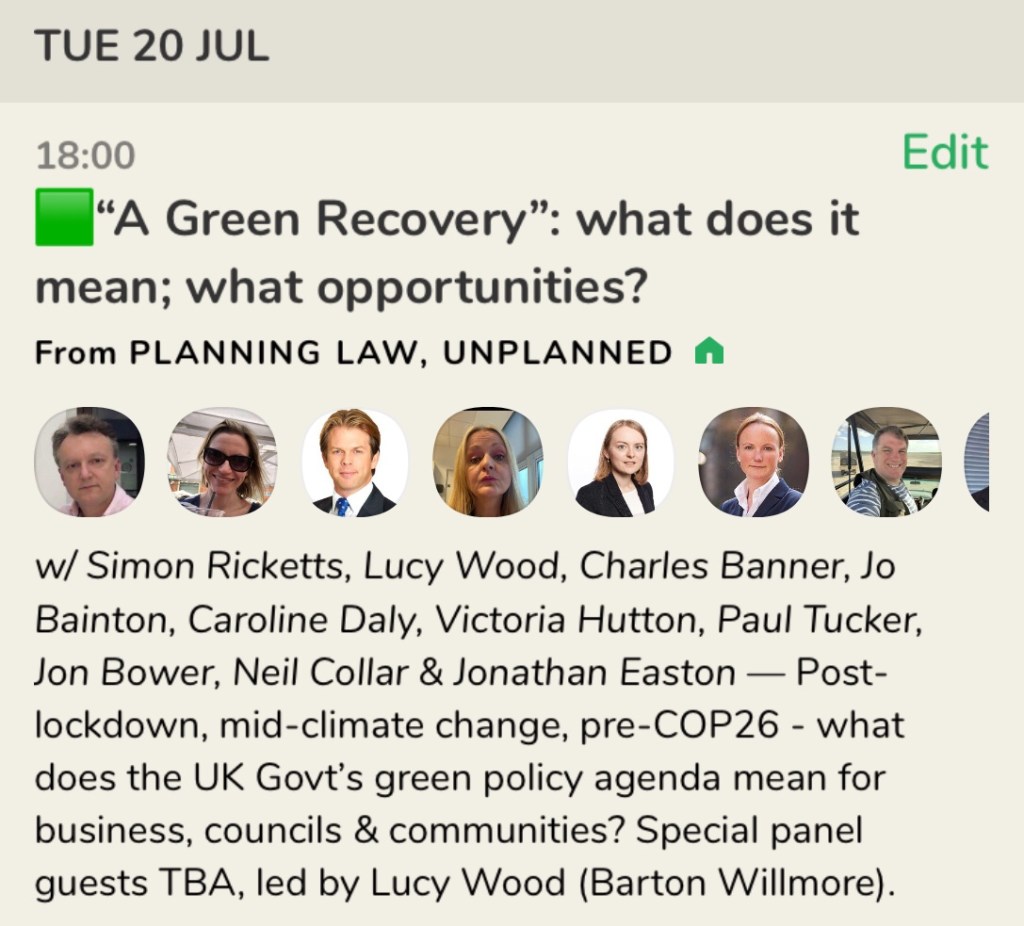
This week’s clubhouse Planning Law Unplanned session (6pm Tuesday 20 July) is on the theme “A Green Recovery”: what does it mean; what opportunities? Lucy Wood (Barton Willmore) will lead the session, which will take a good hard look at the government’s green policy agenda (including the transport decarbonisation plan) and what it means for business, councils and communities, alongside special guests including Neil Collar (Brodies) and others still to be confirmed. An invitation to the app and event is here.

(Public transport = tick).

People In Houses…

…really don’t want other people to have houses, do they?

FT, 19 June 2021
Times, 19 June 2021
Telegraph, 19 June 2021

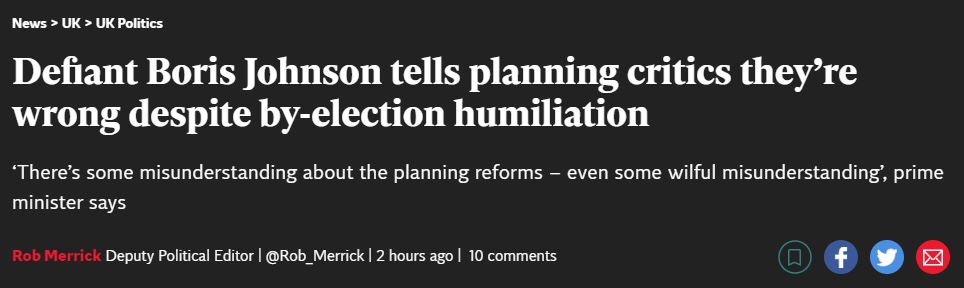
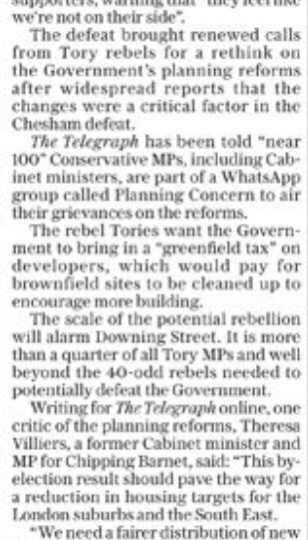
The prime minister can hardly be surprised when the affluent home-owning constituents of Chesham and Amersham register a protest vote against his plans for change, thinking that in some way he is coming for their beautiful part of the country, even though it bristles with statutory protections from development. First there has been the insensitivity with which HS2 has been forced through the Chilterns AONB with the case for longer tunnelling rejected (see my 30 July 2016 blog post HS2: The Very Select Committee) and secondly, as hitherto loyal Conservatives, they will have taken the prime minister at his word when with typical hyperbole he said in his foreword to last August’s white paper:

“Thanks to our planning system, we have nowhere near enough homes in the right places. People cannot afford to move to where their talents can be matched with opportunity. Businesses cannot afford to grow and create jobs. The whole thing is beginning to crumble and the time has come to do what too many have for too long lacked the courage to do – tear it down and start again.

That is what this paper proposes.

Radical reform unlike anything we have seen since the Second World War.

Not more fiddling around the edges, not simply painting over the damp patches, but levelling the foundations and building, from the ground up, a whole new planning system for England.”

“And, above all, that gives the people of this country the homes we need in the places we want to live at prices we can afford, so that all of us are free to live where we can connect our talents with opportunity.

Getting homes built is always a controversial business. Any planning application, however modest, almost inevitably attracts objections and I am sure there will be those who say this paper represents too much change too fast, too much of a break from what has gone before.

But what we have now simply does not work.

So let’s do better. Let’s make the system work for all of us. And let’s take big, bold steps so that we in this country can finally build the homes we all need and the future we all want to see.”

How easy it must be for other parties and for campaign groups to scaremonger when such coarse analogies are used – war, tearing things down, levelling foundations, building from the ground up.

The paper itself was not nearly as radical as the foreword would suggest and we have seen no further detail since. And so he is now on the defensive:

The Independent, 18 June 2021

“What we want is sensible plans to allow development on brownfield sites. We’re not going to build on greenbelt sites, we’re not going to build all over the countryside.”

[What does this even mean? Of course there will continue to be green field development, and of course some green belt development – as there is under the current system].

This is such an unnecessarily controversial issue, carelessly caused, cynically amplified. The planning system doesn’t need to be torn up and was never going to be torn up. But where have the ministers been to explain, to persuade, to engage? Instead, a resounding, almost embarrassed, silence since that August 2020 white paper. The news vacuum as to the form that changes are likely to take has of course been filled with media speculation and campaigners’ characterisations which have now served to make the whole question more political than it ever needed to be.

We all know that what is needed is for the current planning system to work better, largely through clearer carrot and stick policies, through specific process improvements and simplifications – and with better resourcing. So as to deliver, yes, more homes, yes economic growth, yes in a planned way, yes meeting environmental and social, not just economic, goals. But none of that’s going to happen now is it? Because politics is all about retaining power, and planning is dependent on politics. So if you are relying on the planning system to enable you to move out of your parents’ house or out of an HMO; to start a family, or to grow a business, you know what? Your needs don’t matter. Not against the needs of a politician who doesn’t want to be the next Peter Fleet.

All this of course means that the current system needs to continue to work as best it can. The good news is that at least this week we had that Colney Heath appeal decision letter to demonstrate that the entire system is in fact not in total meltdown. If an area is without an up to date plan, with a severe unmet housing need, with need for affordable housing and for sites for self build homes, planning permission may be granted even if the land is, horror of horrors, politicians look away, green belt. My firm Town (well, my colleague Paul Arnett) was pleased to play at least a small role in the appeal as planning solicitors for the appellant, negotiating a section 106 agreement with the St Albans and Welwyn Hatfield councils that secured a commitment that 45% of the 100 homes proposed would be affordable housing and 10% would be self-build, delivering a strategy first formulated by Chris Young QC and developed and implemented at the inquiry itself by Zack Simons (who kindly brought us onto the team). Russell Gray at Woods Hardwick was the lead planning witness and coordinated the team.

Inspector Christa Masters determined that the following were “very special circumstances” that justified inappropriate development in the green belt:

provision of market housing

“I am aware of the Written Ministerial Statement of December 2015 which indicates that unmet need is unlikely to clearly outweigh harm to Green Belt and any other harm so as to establish very special circumstances. However, in common with the appeal decision referred to, I note that this provision has not been incorporated within the Framework which has subsequently been updated and similar guidance within the Planning Practice Guidance has been removed. I can therefore see no reason to give this anything other than little weight as a material consideration.

It is common ground that neither SADC or WHBC can demonstrate a five year supply of deliverable homes. Whilst there is disagreement between the parties regarding the extent of this shortfall, the parties also agreed that this is not a matter upon which the appeals would turn. I agree with this position. Even taking the Councils supply positions of WHBC 2.58 years and SADC at 2.4 years, the position is a bleak one and the shortfall in both local authorities is considerable and significant.

There is therefore no dispute that given the existing position in both local authority areas, the delivery of housing represents a benefit. Even if the site is not developed within the timeframe envisaged by the appellant, and I can see no compelling reason this would not be achieved, it would nevertheless, when delivered, positively boost the supply within both local authority areas. From the evidence presented in relation to the emerging planning policy position for both authorities, this is not a position on which I would envisage there would be any marked improvement on in the short to medium term. I afford very substantial weight to the provision of market housing which would make a positive contribution to the supply of market housing in both local authority areas.”

⁃ provision of self-build

“In common with both market housing and affordable housing, the situation in the context of provision of sites and past completions is a particularly poor one. To conclude, I am of the view that the provision of 10 self build service plots at the appeal site will make a positive contribution to the supply of self build plots in both local planning authority areas. I am attaching substantial weight to this element of housing supply.”

⁃ provision of affordable housing

“The uncontested evidence presented by the appellant on affordable housing for both local authorities illustrates some serious shortcomings in terms of past delivery trends. In relation to WHBC, the affordable housing delivery which has taken place since 2015/16 is equivalent to a rate of 23 homes per annum. The appellant calculates that the shortfall stands in the region of 4000 net affordable homes since the 2017 SHMA Update, a 97% shortfall in affordable housing delivery. If the shortfall is to be addressed within the next 5 years, it would required the delivery of 1397 affordable homes per annum. In SADC, the position is equally as serious. Since the period 2012/13, a total of 244 net affordable homes have been delivered at an average of 35 net dwellings per annum. Again, this equates to a shortfall also in the region of 4000 dwellings (94%) which, if to be addressed in the next 5 years, would require the delivery of 1185 affordable dwellings per annum.

The persistent under delivery of affordable housing in both local authority areas presents a critical situation. Taking into account the extremely acute affordable housing position in both SADC and WHBC, I attach very substantial weight to the delivery of up to 45 affordable homes in this location in favour of the proposals.”

I recommend Zack’s 15 June 2021 blog post Notes from the Green Belt: what’s so very special about Colney Heath?

I also recommend Chris’ earlier paper Winning an inquiry: it’s the benefits, stupid.

More decisions such as Colney Heath are inevitable where authorities, admittedly struggling at times with a sclerotic local plans system, fail to deliver, which of course makes this scaremongering about a new planning system so nonsensical.

Topically, at 6pm this Tuesday 22 June our Clubhouse Planning Law, Unplanned theme is “How can we build enough, affordable, housing?”. Our special guests are Chris Young QC, Nick Walkley (ex Homes England chief executive), Claire Dickinson (director, Quod) and Ric Frankland (founder, wudl.). Please join us. A free link to the app and event is here.

Simon Ricketts, 19 June 2021

Personal views, et cetera

“Our Number One Domestic Priority”: Taking Stock

I tweeted that yesterday was the 5th anniversary of my first simonicity blog post. 273 posts later and 496,000 words (War and Peace = 587,000 words) and to what effect?

As I also said, it can be deflating to look back. So many posts expressing frustration about the same topics, yes obviously CIL, but also the recurring debates as to how to address the country’s housing crisis and as to what the obstacles are: is it the planning system or are other factors at play? Something Must Be Done. But what?

Unpacking Use It Or Lose It (16 July 2016) was one of my first posts. It referred to that week’s House of Lords Economic Affairs Committee’s report, Building More Homes.

“Paragraphs 129 to 139 of the report’s section on Planning Reform set out the “criticism made of the large house builders…that they hold land suitable and with permission for building, yet build at a slow pace and thus maximise the profit from each development”.

The conclusion is arrived at:

“139.We recommend that local authorities are granted the power to levy council tax on developments that are not completed within a set time period. This time period should be negotiated when planning consent is sought and be varied according to the size and complexity of a development. To ensure that the local authority also has an incentive to accelerate the process, the clock should start to run only when the local authority has signed off all conditions and obligations“.”

The allegation that house builders hold unnecessarily large land banks, going slow to maximise profits, was considered in detail by Oliver Letwin in his 2018 review. Incidentally, a constant theme of my blog posts over the last five years has been reviews commissioned by the Government the recommendations of which it then ignores – my first ever post, on 3 June 2016, was about the recommendations of the CIL independent working group (sensible recommendations, ignored by Government) – and Oliver Letwin’s recommendations in his final report (summarised in my 3 November 2018 blog post Oliver’s Twist: Letwin’s Proposals For Large Housing Sites) were of course similarly ignored, but perhaps the findings in his earlier interim report (June 2018) were more interesting, where he rejects that land banking allegation:

“5.40 It is of course true that, although the land market can be highly volatile, land (unlike most assets) does not depreciate, and has generally tended to increase in value across the cycle, and has a ‘real option’ value. By holding rights over land that benefits from (or is soon likely to benefit from) some form of permission to build houses, the company which holds that land obtains a valuable ability to make profit by building on it at whatever time is thought likely to maximise the profitability of doing so. It would therefore be perfectly possible for financial investors of a certain kind to seek to make a business out of holding land as a purely speculative activity.

5.41 But I cannot find any evidence that the major house builders are financial investors of this kind. Their business models depend on generating profits out of sales of housing, rather than out of the increasing value of land holdings; and it is the profitability of the sale of housing that they are trying to protect by building only at the ‘market absorption rate’ for their products. I have heard anecdotes concerning land owners who seek to speculate in exactly this way by obtaining outline permission many years before allowing the land to have any real development upon it – and I am inclined to believe that this is a serious issue for the planning system. But it is not one that is consistent with the business model of the major house builders.

And yet here comes the allegation again in an 8 May 2021 Local Government Association press statement: Over 1.1 million homes with planning permission waiting to be built – new LGA analysis. “The LGA is calling for councils to be given powers in a Planning Bill in the Queen’s Speech to incentivise developers to build housing more quickly. Latest figures show that 2,782,300 homes have been granted planning permission by councils since 2010/11 but over the same period only 1,627,730 have been built.”

And look at their proposal, which harks back (without reference to it) to the rejected idea in that 2016 House of Lords Economic Affairs Committee Report. They say:

While there will be in some cases legitimate reasons as to why development has stalled, and it is recognised that there is a time lag between permission being granted and homes being built, new build completions have only increased by just over half as much in that time. The LGA, which represents councils, says this shows that planning is not the barrier to house-building and that it is the housing delivery system that needs to be reformed.

To help councils get developers building more quickly, the Queen’s Speech should bring forward legislation that enables councils to charge developers full council tax for every unbuilt development from the point the original planning permission expires.”

Lichfields’ Matthew Spry rebuts the idea again in his 26 May 2021 blog post Use it or lose it: the taxing problem of undelivered homes.

The wider assertions in the Local Government Association press statement that sufficient planning permissions are already being granted to achieve the Government’s target of 300,000 net additional homes a year are tackled in Lichfields subsequent report, “Taking stock: The geography of housing need, permissions and completions”, published on 1 June 2021, commissioned by the Land Promoters and Developers Federation and the Home Builders Federation. Indeed they conclude that the necessary annual figure to achieve that target is 520,000.

The report represents the first stage of their work: “Analysis of how the number of homes with planning permission relates to housing need and delivery in different parts of the country through a comparison of housing need (either as per the standard method or recently adopted local plans), planning permissions and completions at a regional and housing market area level”.

We await stages 2 and 3:

“2. Assessing how the stock of permissions relates to housebuilder pipelines, rates of build out and the number of extra sites required to meet the government’s ambition; and

3. An analysis of what happens to the stock of permissions for a number of local authority case studies. This is a more in-depth ‘deep dive’ exploration on how the stock of permissions granted is linked to the number of homes completed within a given timescale by monitoring the land supply positions across the authorities over a five year period”

It is a great shame that MHCLG has not provided any detailed methodology to support the national target of 300,000 net additional homes a year. If anything it may be an under-estimate (see the 14 January 2021 House of Commons briefing paper Tackling the under-supply of housing in England) but surely it needs underpinning to avoid any assertion that it is too high. The background to the figure is mentioned in my 10 February 2018 blog post Nothing Was Delivered – the immediate context at the time being the first meeting of then prime minister Theresa May’s “housing implementation taskforce” (always good to have a taskforce). You recall Mrs May’s promise that the housing crisis would be her “number one domestic priority”? Roll forward three years: Theresa May leads Tory revolt over push for new housing (The Times, 12 May 2021).

What has got in the way of a sensible debate as to how we might resolve this country’s housing crisis since I started this blog? Politics. What might get us out of it? Action based on robust factual analysis.

Simon Ricketts, 4 June 2021

Personal views, et cetera

This week’s Clubhouse Planning Law, Unplanned discussion examines the Lichfields Taking Stock report. We will be joined by Lichfields’ Matthew Spry , together with the LPDF’s chairman Paul Brocklehurst, Lambert Smith Hampton’s Mary-Jane O’Neill, the BPF’s Sam Bensted, Blackstock Consulting’s Joshua Carson and our brilliant usual panel. Do tune in to join the discussion, or just to listen. This is a free invitation to the app.

Whitechapel Bell Foundry: Facts, Media, Politics

Government approves plan to turn Whitechapel Bell Foundry into boutique hotel (The Standard, 17 May 2021). Well, what do we think about that?

Bell foundry that cast Big Ben can be turned into boutique hotel, UK government says – Decision has drawn wave of criticism from culture and heritage professionals, accusing government of ‘money-grabbing philistinism’ (The Art Newspaper, 14 May 2021). Crumbs.

From the piece:

Andrew Wilson, a curator at Tate, wrote on Twitter that this is “another example of the normalisation of money-grabbing philistinism that this government promotes”. Writing on his blog, Charles Saumarez-Smith, the former chief executive of the Royal Academy of Arts in London, says that the government “is play-acting, [putting] a superficial veneer over rather brutal capitalists, who are happy to use British history for their own purposes… a hotel for foreign tourists is more important than a bit of living history”.

Saumarez-Smith also criticises the heritage body Historic England, which backed the boutique hotel project, saying: “I hope that the Commissioners of Historic England, who have so conspicuously failed in their public duty, might consider what went wrong: why they did nothing; why they have allowed this to happen in such a conspicuously supine way.” Historic England said in a statement: “We believe that the proposals have the makings of a successful heritage regeneration scheme, and would provide a sustainable future for this important group of listed buildings.”

Whitechapel Bell Foundry to be turned into a hotel, after Government greenlights plans (The Telegraph, 14 May 2021) – a piece that also quotes the tweets from Andrew Wilson and Charles Saumarez-Smith (Saumarez-Smith then writing a long piece in the same newspaper on 18 May 2021, If Robert Jenrick doesn’t act now, the Whitechapel Bell Foundry will be lost for good – A priceless piece of our heritage is on the brink of being turned into a hotel. Why won’t our public institutions protect it? ).

Bell tolls for historic Whitechapel foundry that created Big Ben (The Times, 14 May 2021), a piece which starts:

The housing secretary has ordered a review of planners’ approach to heritage after a decision was made to allow a 450-year-old bell foundry that cast Big Ben to be turned into a boutique hotel.”

Away from the traditional media, there has inevitably also been much tweeting and perhaps it is apt that the Secretary of State took to twitter to announce that review, the announcement so far taking the form just of the final sentence of this thread of tweets:

The one thing you get from the newspaper headlines is that the foundry is being turned into a hotel. Isn’t it interesting/worrying how these stories take on a life of their own, reduced to compelling headlines.? Of course, it’s inevitable – who has the time to read even the Secretary of State’s 13 May 2021 decision letter and accompanying inspector’s report, let alone any of the underlying documents? The foundry is not being turned into a hotel.

To take a step back…

First, what was the site? As described by the inspector:

“2.2 The entry in the statutory list provides a great deal of information about the Whitechapel (or what it terms the Church) Bell Foundry. It suffices to set out here that it is a Grade II* listed building. However, the situation is complicated, to a degree, by the fact that parts of the overall foundry site are specifically excluded from the listing.

2.3 Put simply, the application site has three main elements. Firstly, there is the front range (including 32 and 34 Whitechapel Road and 2 Fieldgate Street). Secondly, behind that front range, lie the courtyard and old stables and thirdly, beyond those, are the old foundry and former cottages. Together, these elements comprise the Grade II* listed building.

2.4 Beyond that lies what has been termed the 1980s building. This building is specifically excluded from the listing. Beyond and adjacent to the 1980s building are two areas of car park and hardstanding which were not part of the Whitechapel Bell Foundry but are parcels of land that have been assembled by the applicant.”

The foundry use had ceased in 2017.

What are the proposals by the applicant, Raycliff Whitechapel LLP? Again, as described by the inspector:

4.1 In simple terms, there are two main components of the proposals that can loosely be classified as the listed building and the new building. In terms of the listed building itself, it would play host to a modern foundry, interpretation spaces, a café and events space, workspaces and workshops. The proposed uses and improved circulation are intended to allow the maximum number of people to access and experience the building.

4.2 The new building would be home to a hotel, with 103 bedrooms, a restaurant, a bar, and a roof-top terrace and pool, and a workspace at ground floor level.

4.3 The ground floor across both the listed building and the new building would be open to the public, with the foundry, interpretation spaces and the café in the historic building, the restaurant bar and hotel reception in the new building. The main entrance to the buildings would be common to both.”

Tower Hamlets Council resolved to grant planning permission and listed building consent on the advice of its officers on 14 November 2019 and the Secretary of State then issued a holding direction on 2 December 2019.

Remember Rory Stewart’s campaign to be London Mayor? Back in December 2019, his campaigning included support for the Save the Whitechapel Bell Foundry campaign (Rory Stewart Declares His Support To Save The Whitechapel Bell Foundry, Spitalfields Life, 19 December 2019).

Photo courtesy of Spitalfields Life website

The applications were called in by the Secretary of State on January 2020. There was an early hiccup in the process when housing and planning minister Chris Pincher mistakenly told MPs in a debate on 11 June 2020 (seeking to defend the Secretary of State’s position in relation to another scheme in Tower Hamlets, Westferry – now incidentally back at inquiry for redetermination but that’s another story):

“I am obliged to the hon. Gentleman for his question. As I said, it is not unusual for Ministers to look at and call in significant applications, and for them to come to a different conclusion from that of the Planning Inspectorate. My right hon. Friend’s reasons for his decision were clearly outlined in his decision letter of 14 January. He makes it clear that one reason for his decision to allow the application was the very significant number of homes that were going to be built as a result of it, including affordable homes. I might say in response to the hon. Gentleman that in the same week, in an application to the same authority, my right hon. Friend came to a very different conclusion when he refused a planning application made by and supported by the local authority to demolish the Whitechapel Bell Foundry, the one that created Big Ben and the Liberty bell. The local authority, the well-known tribunes of the people in Tower Hamlets, wanted to demolish it and build a luxury boutique hotel. My right hon. Friend will always come down on an application based on its merits and in the interests of the people. That is what he did on this occasion and that is what he will always do.”

He later apologised for his mistake – it had only been called in by the Secretary of State, not refused, but an unhelpfully politically charged note in the process for sure.

An inquiry took place, which opened on 6 October 2020 and sat for nine days. The main objectors to the proposals were a group known as Re-Form Heritage, which appeared at the inquiry as a Rule 6 Party, represented by Rupert Warren QC and Matthew Dale-Harris, who called four witnesses including professional evidence on heritage and planning – no “David and Goliath” contest this). Tower Hamlets Council was in support of the proposals (Alexander Booth QC appearing), as was Historic England. David Elvin QC appeared for the applicant.

(Thanks to my Town Legal colleague Tom Brooks for much of the following summary, although any views expressed are mine).

Re-Form argued that:

– Raycliff’s proposals were unacceptable in heritage terms, and would cause, in the language of the NPPF (paras 193-196), “substantial harm” to the significance of the listed building; and

– Re-Form’s alternative vision for the future of the site, as a working foundry for casting both bells and other artistic commissions, was less harmful, so the applications should be refused.

Raycliff’s position was that only a low level of less than substantial harm would be caused by the proposals, that this would be outweighed by their public benefits (heritage and otherwise), and that Re-Form’s idea was undeliverable and unviable.

The inspector concluded that the listed building was “of profound significance” (IR 12.14), noting that all agreed there were elements of the proposals that would cause harm to that significance (IR 12.17), whether substantial (leading to NPPF 194-195) or less than substantial (leading to NPPF 196).

As spelt out by the inspector: the end of the bell foundry business in 2017 was unconnected to the present proposals (“Traditional bell founding on the site…ended for economic reasons mainly to do with a drop in demand for tower bells, and the difficulties, both operational and environmental, the business encountered in operating from a Central London address”); and therefore the starting point for the assessment was a “largely vacant Grade II* listed building that formerly housed traditional bell founding…It is not a situation where a traditional bell foundry is to be closed in order to be replaced by something else”. IR 12.23).

Following the inspector’s conclusion that the proposals cannot be taken to cause harm to the listed building as a result of the closure of the business, the only harm possible was any arising from the physical works now proposed. No harm was found to the other heritage asset in this case, the Whitechapel Conservation Area, and that the hotel extension was said by the inspector to be a “subtle and pleasingly understated” addition (IR 12.52).

The inspector concluded that the harm to the listed building “would be very much at the lower end of the scale of less than substantial” (IR 12.44), would be outweighed by the public benefits of the scheme (albeit with some non-consequential discussion as to how this balancing should be carried out – see below), and so planning permission and listed building consent should be granted.

This advice was accepted by the Secretary of State.

There are some interesting issues arising:

– Obviously, there is no planning control whatsoever to preserve as operational the specific use that was said to be significant in heritage terms – as a “large church bell foundry” (IR 8.46) – clearly the planning system cannot require a business to continue to operate or indeed to prevent other industrial uses of the site, or uses which may be possible by way of permitted development. The Secretary of State concluded that “the end of traditional bell making on the site has…nothing whatsoever to do with the proposals at issue”.

– Re-Form argued that that Raycliff needed to demonstrate that its scheme was the “optimum viable use” of the site (following the reference in NPPF 196). This suggestion was dismissed by the inspector: optimum viable use is an example of the public benefits that are to be weighed against harm in the balancing process, but in such “a situation where the heritage and other public benefits of the proposals so far outweigh the harm they would cause, it appears to me unnecessary” (IR 12.82).

– The inspector followed Bramshill at first instance (Waksman J, 16 December 2019) that not much detail of an alternative scheme for a heritage asset is needed for that scheme to be a relevant consideration. Nonetheless, he found Re-Form’s scheme to be “somewhat sketchy, and lacking in detail [with…] far too many uncertainties” (IR 12.92). Moreover, even if it had been shown to be viable, “the mere presence of an alternative scheme offers no justification to resist a proposal that is otherwise acceptable, and statute and policy compliant” (IR 12.77).

– One of the more surprising aspects of the decision is the inspector going out of his way to endorse the so-called “internal heritage balance” method of assessing heritage harm following Palmer (Court of Appeal, 4 November 2016), despite numerous subsequent judgments emphasising that such an approach should be used with caution (see recently the Court of Appeal judgment on Bramshill which I covered in my 12 March 2021 post).

While the inspector was at pains to make his view clear that such an “internal heritage balance” approach was “perfectly legitimate”, and this was endorsed in the Secretary of State’s letter, it actually made no difference to the conclusion reached.

The inspector thus carried out an initial balancing exercise of heritage harm against heritage benefits, prior to the NPPF 196 test considering the wider public benefits. In doing so, he found that “there would be no harm caused to the special architectural and historic interest of the listed building […and] no need to consider paragraphs 195 or 196 because considered in the round, the proposals would cause no harm to the significance of the designated heritage asset affected” (IR 12.75-12.76).

What the inspector had done, though, was exactly the same as carrying out the NPPF 196 test, and simply stopping after the heritage benefits because the scales were already tipped in their favour, and so there was no need to include the wider public benefits too. In fact, the inspector then carried out the NPPF 196 test doing this anyway (at IR 12.78-12.81), leaving it unclear as to why the “internal heritage balance” approach was taken in the first place.

It’s certainly a topical issue. In the middle of my writing this post, judgment was handed down in Juden v London Borough of Tower Hamlets (Sir Duncan Ouseley, 21 May 2021) – another social media cause celebre, the “mulberry tree” case. See discussion at paragraphs 59 to 87 on ground 3 (“inclusion of heritage benefits when assessing the level of heritage harm”).

– It is common, thanks partly to the shared application form these days, for applications for planning permission and listed building consent to share the same description of development. Unusually, in this case, the inspector sought during the inquiry to understand exactly which works should be the subject of each application, resulting in an amendment to the description for the listed building consent – a useful reminder of the proper scope of listed building consent in section 7 of the Act (for “works which would affect its character as a building of special architectural or historic interest”), and that despite their often parallel consideration by planning authorities, they are separate regimes with separate legislative and policy considerations.

Here was a proposal that was supported by Tower Hamlets officers and members, supported by Historic England, recommended for approval by an independent inspector and approved by the Secretary of State (the decision apparently taken by another minister but “on behalf of” the Secretary of State). In the meantime, commentary in social media and the broadsheet newspapers continues to attack the conclusions reached, repeating arguments that have already been rejected throughout this process.

There are plenty of participants to go at of course – the Secretary of State mentions the Planning Inspectorate (why?); Charles Saumarez-Smith (who appeared at the inquiry) alleges that Historic England “conspicuously failed in their public duty” (how?), and as always everyone has a go at the developer, without putting forward any realistic alternative proposals.

What has led to the Secretary of State’s announcement of a “review of how the Planning Inspectorate and planning policy considers and defends heritage”? An attempt to appease, without implementing substantive changes to the current system, those who wish that somehow a different decision could have been reached? Or something more fundamental? If the latter (and I’m struggling to visualise what form that might take), it needs to get hitched pretty quickly to the planning white paper bandwagon.

Finally, I of course recommend Zack Simons’ 19 May 2021 blog post Old buildings: what’s new in heritage planning? – a brilliant analysis as always.

Simon Ricketts, 21 May 2021

Personal views, et cetera

This week’s 6pm Tuesday 25 May #PlanningLawUnplanned Clubhouse session, provocatively titled, looks more widely at the treatment of planning issues in the media, already with a fascinating list of guest contributors in addition to our usual panel. Invitation to the app here (and, hooray, no longer limited to iphone users).