Slow Train Coming: Strategic Rail Freight Interchanges In The South East

The planning system doesn’t just fail to provide homes. There are clear lessons to be learned from the unstructured and inadequate approach that successive governments have applied to securing appropriate strategic rail freight interchange developments (SRFIs, in the jargon) to serve London and the south east. That approach has now wasted decades without a spade in the ground, despite millions of pounds having been spent, countless inquiries and High Court proceedings and no doubt a lifetime of worry for those potentially affected. The difficulties with SRFIs also illustrate that the problems aren’t over even when planning consent is obtained – issues of commercial viability and land control are as fundamental. 
This blog post summarises where the three leading contenders have reached: Goodman’s Colnbrook Slough scheme, Helioslough’s former Radlett Aerodrome scheme and Roxhill’s Howbury Park scheme, all in the green belt. It is a long story but that’s why I have tried to tell it.

What is an SRFI?

An SFRI is defined in the Government’s National Networks national policy statement January 2015 as a “large multi-purpose rail freight interchange and distribution centre linked into both the rail and trunk road system. It has rail-served warehousing and container handling facilities and may also include manufacturing and processing activities”.

What is the consenting process?

If the proposal falls within the criteria in section 26 of the Planning Act 2008 (eg a site area of at least 60 hectares, to be connected to national rail network and capable of handling (a) consignments of goods from more than one consignor and to more than one consignee, and (b) at least four goods trains a day), it falls under the NSIP procedure.

The only SRFIs so far consented as NSIPs have been Prologis’ Daventry International Rail Freight Terminal (3 July 2014) and Roxhill’s East Midlands Gateway Rail Freight Interchange  (12 January 2016) (the latter against the examining authority’s recommendations). Goodman’s East Midlands Intermodal Park, Roxhill’s Northampton Gateway Rail Freight Interchange, Ashfield Land’s Rail Central Strategic Rail Freight Interchange  (also Northampton) and Four Ashes’ West Midlands Interchange are all at pre-application stage. 

An NSIP can of course include associated development. There can be uncertainties as to the extent of warehousing that is justified and the degree to which commitments are to be given as to its rail-connectedness. For applications made from 6 April 2017, up to around 500 homes may also be included (see section 160 of the Housing and Planning Act 2016 and the Government’s March 2017 guidance). 

If the proposal doesn’t meet the NSIP criteria, it will need to proceed by way of a traditional planning application. The NSIP process has its pros and cons. It is interesting to note that the three schemes we will be looking at in this blog post have been proceeding by way of a planning application, with the site areas of the Colnbrook and Howbury Park schemes being 58.7 hectares and 57.4 hectares respectively (given an NSIP threshold of 60 hectares that looks like a deliberate “serve and avoid” to me…) and with the Radlett application process having predated the switching on of the 2008 Act. 

The need case

The National Networks NPS sets out the need for SRFIs in paras 2.42 to 2.58:

“2.53 The Government’s vision for transport is for a low carbon sustainable transport system that is an engine for economic growth, but is also safer and improves the quality of life in our communities. The Government therefore believes it is important to facilitate the development of the intermodal rail freight industry. The transfer of freight from road to rail has an important part to play in a low carbon economy and in helping to address climate change.

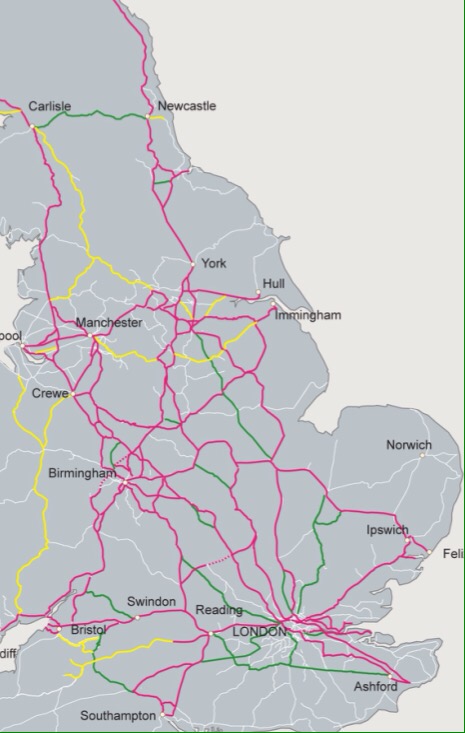
2.54 To facilitate this modal transfer, a network of SRFIs is needed across the regions, to serve regional, sub-regional and cross-regional markets. In all cases it is essential that these have good connectivity with both the road and rail networks, in particular the strategic rail freight network (see maps at Annex C). The enhanced connectivity provided by a network of SRFIs should, in turn, provide improved trading links with our European neighbours and improved international connectivity and enhanced port growth.

“2.56 The Government has concluded that there is a compelling need for an expanded network of SRFIs. It is important that SRFIs are located near the business markets they will serve – major urban centres, or groups of centres – and are linked to key supply chain routes. Given the locational requirements and the need for effective connections for both rail and road, the number of locations suitable for SRFIs will be limited, which will restrict the scope for developers to identify viable alternative sites. 


2.57  Existing operational SRFIs and other intermodal RFIs are situated predominantly in the Midlands and the North. Conversely, in London and the South East, away from the deep-sea ports, most intermodal RFI and rail-connected warehousing is on a small scale and/or poorly located in relation to the main urban areas. 


2.58  This means that SRFI capacity needs to be provided at a wide range of locations, to provide the flexibility needed to match the changing demands of the market, possibly with traffic moving from existing RFI to new larger facilities. There is a particular challenge in expanding rail freight interchanges serving London and the South East.


Annex C strategic rail freight network map

These facilities are important for our economy, and for reducing vehicle emissions (not that there is any reference to this, or indeed any other supra-local planning interventions, in the Government’s draft air quality plan published on 5 May 2017). Unfortunately, the strategy in the NPS is very general. Whilst there are the references to London and the South East in the passages above, this is even less specific than the former Strategic Rail Authority’s Strategic Rail Freight Interchange policy  March 2004, much argued over at inquiries, which asserted that “required capacity would be met by three or four new Strategic RFI” in London and the South East and that the “qualitative criteria to deliver the capacity mean that suitable sites are likely to be located where the key rail and road radials intersect with 
the M25.”

Currently it is down to the private sector to identify sites which may meet the NPS criteria, with a wary eye on what other sites may be in the frame – a game not for the faint-hearted, meaning a very limited pool of potential promoters.

Since the NPS, we have had DfT’s Rail Freight Strategy  13 September 2016:

Para 53 “This Rail Freight Strategy will not set out proposals for new enhancements to the network nor specify in detail the freight paths that will be needed in future. These issues are being considered by DfT on a longer timescale as part of the long-term planning process for the rail network, which will consider priorities for the railway beyond the current control period (from 2019). To inform the industry’s advice to DfT as part of this process, Network Rail is currently consulting on a more detailed Freight Network Study. This considers the requirements of the rail network over the next 30 years and is intended to support the series of Route Studies that have been published or are under development by Network Rail.”

Will we see an amended National Networks NPS in the foreseeable future so as to give greater direction? I doubt it.  

So now let’s look at the most likely candidates to serve London and the South East

Colnbrook 

Those with long memories may recall Argent’s LIFE (London International Freight Exchange) scheme proposed on land to the north of the A4 at Colnbrook, near Slough. The then Secretary of State dismissed an appeal against refusal of planning permission on 20 August 2002, stating:

“The central issue remains […] where to strike the balance between Green Belt and sustainable transport interests. The proposal would be inappropriate development in the Green Belt and would harm the openness of the Green Belt, at the same time there are positive aspects including some sustainable transport benefits”. 


“The Secretary of State continues to support the principle of encouraging more rail freight, but shares the Inspector’s judgement that the balance of benefits and disbenefits is against the LIFE scheme as currently proposed and that the general presumptions against inappropriate development in the Green Belt should apply”.

Goodman are now promoting a smaller SRFI on part of the site. Their scheme is now imaginatively called SIFE (Slough International Freight Exchange) and was the subject of a planning application in September 2010. It was refused by Slough Borough Council and an inquiry was due to take place into Goodman’s appeal in October 2012. However, the inquiry was then put in the sidings whilst the then Secretary of State decided whether to re-open an inquiry into the Radlett SRFI scheme, which he considered might have significant implications for SIFE. As it happened, due to delays in that inquiry process (of which more later), the SIFE inquiry was not rescheduled until The Radlett decision letter was issued in July 2014. 

After a ten day inquiry in September 2015, the Secretary of State on 12 July 2016 dismissed Goodman’s appeal against refusal by Slough Borough Council of planning permission for SIFE. The Secretary of State addresses the extent to which there is a need for all three facilities (SIFE Colnbrook; Radlett, and Howbury Park):

24. The Secretary of State has carefully considered the Inspector’s reasoning about need at IR12.88 – 12.103 and accepts the Inspector’s conclusion that the current policy need for a regional network has not been overcome by the SRFI at Radlett and SIFE is able to be regarded as a complementary facility as part of a wider network (IR12.104). 

25. With regard to the Inspector’s analysis of other developments and sites at IR 12.105 – 12.106, the Secretary of State agrees that the NPS makes clear that perpetuating the status quo, which means relying on existing operational rail freight interchanges, is not a viable option. 

26. The Secretary of State agrees with the Inspector that there is a reasonable probability that Radlett will be operational in 2018 and there is the prospect of Howbury Park being progressed to implementation. In addition, rail connected warehousing is under development in Barking. On the downside, the geographical spread is uneven. There is a noticeable gap in provision on the west side of London, with Radlett being complementary to rather than an alternative to SIFE. SIFE would contribute to the development of a network of SRFI in London and the South East and a wider national network in accordance with the policy objective of the NPS (IR12.107).”

However he goes on to reach the following conclusions as to whether there are very special circumstances justifying inappropriate development in the green belt:

“13. The Secretary of State agrees with the Inspector’s comments at IR12.8, and like the Inspector, concludes that the appeal proposal would be inappropriate development in the Green Belt and that it is harmful as such. As the proposal amounts to inappropriate development he considers that, in the absence of very special circumstances, it would conflict with national policies and with the CS. Like the Inspector, the Secretary of State considers that the NPS does not change the policy test for SRFI applications in the Green Belt or the substantial weight to be attached to the harm to the Green Belt (IR12.8). For the reasons given by the Inspector at IR12.9 – 12.11, the Secretary of State agrees with the Inspector’s conclusion (IR12.12) that the proposed development would result in a severe loss of openness

14. The Secretary of State agrees with the Inspector that the introduction of major development on the site, even if enclosed within well-defined boundaries, would not assist in checking sprawl and hence would conflict with a purpose of the Green Belt (IR12.13). For the reasons given by the Inspector at IR12.14, the Secretary of State agrees that the proposal would not be compatible with the purpose of preventing neighbouring towns merging into one another. The Secretary of State accepts the Inspector’s conclusion that the proposed development would encroach into the countryside. He agrees too that this conflict is not overcome by the proposed creation of new habitats and other aspects of mitigation in existing countryside areas (12.15). The Secretary of State agrees with the Inspector’s overall conclusion that these conflicts should be afforded substantial weight (IR12.18). The Inspector acknowledges that the proposed SRFI development’s location in the Green Belt may well be an optimum solution in relation to existing patterns of distribution activity, but like the Inspector, the Secretary of State concludes that this does not reduce the actual harm that would occur (IR12.19)”

His overall conclusions:

40. The Secretary of State accepts that the most important benefit of the proposal is the potential contribution to building up a network of SRFIs in the London and South East region, reducing the unmet need and delivering national policy objectives. In addition, there is the prospect of SIFE being complementary to Radlett and other smaller SRFI developments and improving the geographical spread of these facilities round Greater London. In this context, the Secretary of State accepts that the contribution it would make to meeting unmet need is considerable. 

41. He accepts too that SIFE would comply with the transport and location requirements for SRFIs to an overall very good standard. He acknowledges that sites suitable for SRFIs are scarce and the difficulty in finding sites in the London and South East region. On account of this factor, and the standard of compliance achieved, he affords meeting the site selection criteria significant weight. No less harmful alternative site has been identified in the West London market area, a factor which he affords considerable weight. Attracting less but nevertheless moderate weight are the economic benefits, the reduction in carbon emissions and improvements. 

42. In common with the Inspector in her conclusion, the Secretary of State has been persuaded by the irreparable harm that would be caused to this very sensitive part of the Green Belt in the Colnbrook area, leading to the high level of weight he attaches to this consideration. Overall, the Secretary of State concludes that the benefits of the scheme do not clearly overcome the harm. Consequently very special circumstances do not exist to justify the development. Furthermore, he finds that planning conditions would not be able to overcome the fundamental harms caused to the Green Belt, Strategic Gap and Colne Valley Park and the open environment enjoyed by the local community. In addition, he has concluded that the proposal does not have the support of the NPS because very special circumstances have not been demonstrated.”

Goodman challenged the decision on the basis that it was wrong for the Secretary of State, in adjudicating the “very special circumstances” test, to give no weight to Goodman’s argument that it was inevitable that a Green Belt location is essential for meeting the need for an SRFI in this location. However the decision has been upheld: Goodman Logistics Developments (UK) Ltd v Secretary of State  (Holgate J, 27 April 2017). Holgate J stated:

“It should be noted that Goodman did not advance the extreme argument that the need for another SRFI to serve London and the South East was such that it was inevitable that a a Green Belt site would have to be released for that purpose. There is no policy support for any such proposition. The NPS does not suggest that the need for a network of SFRIs, or for any particular SFRI, is a need to be met come what may, irrespective of the degree of harm which may be caused, or indeed the degree of need for an SRFI in a particular region. Instead, Goodman relied upon an “inevitability” which was qualified. The claimant argued that it is inevitable that another SRFI to serve the London and South East region will be located on a Green Belt site and harm to the Green Belt will occur, if the need for such a SRFI is to be met. The merits of the “inevitability” argument put forward by Goodman were therefore dependent upon the decision-maker’s assessment as to what importance or weight should be attributed to that need and whether that need should indeed be met after taking into account all the harm that would result.

He goes on:

“The degree of harm that would result from the appeal proposal is only inevitable (in one sense) if the decision-maker concludes that the need for the SRFI and any other benefits flowing from the proposal are of such weight that the balance comes down in favour of granting planning permission. It is not in fact inevitable that the balance will be struck in that way

But if the “need” for SRFIs is not allowed to amount to “very special circumstances” for the purposes of green belt policy, and if there is room for a balancing of the seriousness of that need as against the degree of harm that would be caused, does this lead to unnecessary uncertainty right until the conclusion of the decision making process? Couldn’t the suitability in principle of development in the green belt have been resolved at an earlier stage, preferably via the national policy statement? Similarly, the uncertainties as to the inter-relationship between the three schemes. Why was a decision on Radlett (positive or negative) allowed to become a prerequisite to determining SIFE?

So what next for the site? As it happens, the proposed new runway at Heathrow Airport in combination with associated mitigation proposals and associated development would in fact take up most of the site in any event. Is this planning process now at least partly about establishing “no scheme world” value? 

Radlett

Helioslough’s proposal for an SFRI on the former Radlett Aerodome site has a similarly lengthy – and even more convoluted – history. Two appeals had been dismissed for rail freight distribution proposals on the site, which again is in the green belt. The second appeal decision, dated 7 July 2010, turned on a conclusion by the Secretary of State that the Colnbrook site could be a less sensitive site than the Radlett site for an SRFI and that therefore “very special circumstances” for the development of the Radlett site had not been made out. 

Helioslough successfully challenged that decision. On 1 July 2011 HH Judge Milwyn Jarman QC ordered that the Secretary of State‟s decision be quashed, holding that the Secretary of State had misconstrued the Strategic Gap policy in Slough’s. Core Strategy and consequently had failed to treat that as an additional policy restraint over and above the Green Belt designation. So the appeal fell to be redetermined by the Secretary of State.

Prior to redetermining it, the Secretary of State consulted with the parties as to whether to conjoin a re-opened inquiry with the inquiry that was to be held into the SIFE Colnbrook appeal. On 14 December 2012 he notified the parties that we was not going to re-open the inquiry but determine it on the basis of the evidence already before him. On 20 December 2012 he issued a letter  indicating that he was minded to allow the appeal, subject to completion of a section 106 agreement. 

St Albans City and District Council sought to challenge by way of judicial review the Secretary of State’s decision to not to re-open the inquiry. However that challenge was refused permission  by Patterson J on 14 June 2013 (and a subsequent renewal application before Collins J failed). 

As it happened, the “minded to grant subject to section 106 agreement” indication was unsatisfactory for the promoter too, which had problems completing a section 106 agreement due to land ownership difficulties (part of the site being owned by Hertfordshire County Council) which had led it to press for obligations to be secured by way of negative Grampian-style condition. Helioslough challenged the Secretary of State’s continued delay in issuing a final decision but permission to proceed with judicial review was rejected by John Howell QC sitting as a deputy judge  on 1 July 2013. 

A section 106 agreement was finally submitted and the Secretary of State granted planning permission in his decision letter  dated 14 July 2014. His conclusions were as follows:

“In conclusion, the Secretary of State has found that the appeal proposal would be inappropriate development in the Green Belt and that, in addition, it would cause further harm through loss of openness and significant encroachment into the countryside. In addition the scheme would contribute to urban sprawl and it would cause some harm to the setting of St Albans. The Secretary of State has attributed substantial weight to the harm that would be caused to the Green Belt. In addition he has found that harms would also arise from the scheme’s adverse effects on landscape and on ecology and that the scheme conflicts with LP policies 104 and 106 in those respects. 

53. The Secretary of State considers that the factors weighing in favour of the appeal include the need for SRFIs to serve London and the South East, to which he has attributed very considerable weight, and the lack of more appropriate alternative locations for an SRFI in the north west sector which would cause less harm to the Green Belt. He has also taken account of the local benefits of the proposals for a country park, improvements to footpaths and bridleways and the Park Street and Frogmore bypass. The Secretary of State considers that these considerations, taken together, clearly outweigh the harm to the Green Belt and the other harms he has identified including the harm in relation to landscape and ecology and amount to very special circumstances. Despite the Secretary of State’s conclusion that the scheme gives rise to conflict with LP policies 104 and 106, in the light of his finding that very special circumstances exist in this case he is satisfied that, overall the scheme is in overall accordance with the development plan”. 

Inevitably, the council challenged the decision. They asserted that the Secretary of State had applied too strict a test in considering whether he could depart from conclusions he had reached in his initial decision and that the Secretary of State failed to take into account a recent decision that he had made on a nearby site. The challenge failed: St Albans City and District Council v Secretary of State  (Holgate J, 13 March 2015).

So shouldn’t this be a scheme that is now proceeding, after all of that work? Reserved matters have been applied for, leading to local heat if a report of a recent planning committee is anything to go by. But the rub is that Hertfordshire County Council as land owner hasn’t made a decision as to whether to make its land available to enable the development to proceed. 
Howbury Park
The third scheme is one in Crayford, again on green belt land, that was initially promoted by Prologis and secured planning permission on appeal in December 2007. However, due to the global financial crisis it did not proceed and the permission is now time expired.

Roxhill has now replaced Prologis as developer and has submitted fresh applications for planning permission to London Borough of Bexley and to Dartford Borough Council (the proposed access road is in Dartford’s administrative area). 

Bexley members resolved to approve the scheme on 16 February 2017 but Dartford members resolved to reject it on 20 April 2017 following their officers’ recommendation. So presumably we may see yet another appeal. 

The Bexley part of the scheme is of course within the remit of the Mayor of London, but not the Dartford part, so there is little that he can do by way of intervention. In any event, it will be seen from his 6 June 2016 Stage 1 report  that he is not particularly providing  a clear strategic lead on the issue:

“11. … The majority of the SRFI developments to date have been in the Midlands and the North, and the aspiration is to have a network of three SRFI around the M25, including this site at Howbury Park, South East London, Radlett, North London(approved by the Secretary of State) and Colnbrook, West London (decision awaited from the Secretary of State) to build a national network.”

“28 Although London Plan policy 6.15a Strategic Rail Freight Interchanges is supportive of the type of facility proposed due to identified strategic need, policy 6.15b caveats this support and sets out criteria which must be delivered within the facility. 

A)  The provision of strategic rail freight interchanges should be supported. Including enabling the potential of the Channel Tunnel Rail link to be exploited for freight serving London and the wider region. 


B)  The facilities must: (a) deliver model shift from road to rail; (b) minimise any adverse impact on the wider transport network; (c) be well related to rail and road corridors capable of accommodating the anticipated level of freight movements; and (d) be well related to the proposed market. 


29 Supporting text paragraph 6.50 acknowledges that these types of large facilities can often only be located in the Green Belt. The Howbury Park site is referenced as a site potentially fulfilling these criteria, reflecting the previous planning permission. Paragraph 6.50 also states: 

‘The Mayor will need to see robust evidence of savings and overall reduction in traffic movements are sufficient to justify Green Belt loss in accordance with policy 7.16, and localised increases in traffic movements.’ “


”38 The need for a SRFI is accepted, and is borne out through the NPS, the London Plan and the Inspector’s decision on the 2007 case. The applicant has made a compelling ‘very special circumstances’ case but GLA officers would advise further clarification should be sought on the biodiversity benefits of the proposal and the environmental benefits, notably whether the emission savings and overall reduction in traffic movements are sufficient to justify the loss of Green Belt in line with London Plan policy 6.15 and supporting paragraph 6.50. It should be noted that TfL has raised concerns in respect of the potential impact on the passenger rail network and has suggested conditions to limit the hours of operation of rail movements in and out of the SRFI. GLA Officers would want to know the full details of the potential impacts on the wider transport network (in line with London Plan policy 6.15B (b) and whether such conditions would hinder the operation and whether this would reduce the potential emission savings and traffic movements. GLA officers would also seek details of the proposed biodiversity management plan and compensatory measures. GLA officers would also expect a similar obligations package as that previously agreed to encourage the take up of rail use. 

39 For the above reasons, at this stage, it is considered premature for GLA officers to make a concrete judgement as to whether the applicant’s very special circumstances case outweighs the identified harm to the Green Belt, and any other harm.”

Concluding thoughts

Even if your work never brings you into contact with the rail or logistic sectors, these convoluted stories must surely give rise to serious concerns. Successive governments have said that these types of facilities are needed in the public interest, for the sake of our national economy and to reduce polluting road freight miles. And yet they wash their hands of any responsibility for lack of delivery. 

The consequences of not providing clear strategic guidance is that years are spent on expensive, contentious planning processes. Often by the time that a process has concluded the world has moved on and the process has to start all over again. 
These are massively expensive schemes to promote. What can we do to make that investment worthwhile? If a site is unacceptable, can’t we indicate that at the outset and not many years later?

To what extent should land ownership issues be resolved at the outset of a major project?

Should the NSIP threshold be reduced? These schemes end up being determined at a national level anyway. Why not funnel them through a process that is more fit for purpose? 

Why don’t we bite the bullet and arrive at more spatially specific policies in the National Networks NPS rather than leave it for promoters to read between the lines as to what the Government’s approach may end up being to particular proposals – particularly given the inevitably sensitive locations involved, often in the green belt? (Or is that taboo issue the answer to my question?). 

Simon Ricketts 6.5.17

Personal views, et cetera

Make No Little Plans: The London Plan 

“Make no little plans; they have no magic to stir men’s blood and probably themselves will not be realized. Make big plans; aim high in hope and work, remembering that a noble, logical diagram once recorded will never die, but long after we are gone be a living thing, asserting itself with ever-growing insistency” (Daniel Burnham)
The current version of the London Plan is no little plan, but fails the “magic to stir blood” and “noble, logical diagram” tests. It runs to over 400 pages, which is surely ridiculous – particularly since it is legally constrained only to deal with “matters which are of strategic importance to Greater London”. (Whilst no replacement for a formal document, New London Architecture’s 2015 summary of the document in a four minute video fronted by Peter Murray shows how the key messages can be got across in a more accessible and rousing style).

We are expecting initial non-statutory public consultation this autumn into a review of the current plan, so as to reflect the policy priorities of our third London Mayor, Sadiq Khan. Following this initial process, there would then need to be two formal consultation stages (the first with the London Assembly and GLA bodies, the second with the public) before an examination in public into the submitted document, which the Mayor projects for summer 2018, and perhaps adoption (his fingers still crossed) in autumn 2019. So even on a best case the Mayor will not have an adopted plan until over three quarters of his way through his four year term of office. 
His predecessors had the same problem. It took Ken Livingstone four years from election in 2000 to have in place the first London Plan (which ran to an even more thudding 420 pages) and it took Boris Johnson three years from election in 2008 to have in place his 2011 Replacement London Plan, which, subject to three sets of alterations, remains the current plan, supplemented by no fewer than adopted 21 SPGs with two further SPGs currently in draft (Culture and Night Time Economy (April 2017); Affordable Housing & Viability (November 2016)). The extent of reliance on SPGs is no doubt partly down to the exclusion of non-strategic matters from the plan itself (although the SPGs cover a whole range of strategic matters) but as much as anything is probably down to pragmatism, given the slowness of the statutory process. 
Strange and dysfunctional system isn’t it? Particularly when one recalls that the inspector, Anthony Thickett, concluded his report dated 18 November 2014 into the Further Alterations to the London Plan as follows:
“57. The evidence before me strongly suggests that the existing London Plan strategy will not deliver sufficient homes to meet objectively assessed need. The Mayor has committed to a review of the London Plan in 2016 but I do not consider that London can afford to wait until then and recommend that a review commences as soon as the FALP is adopted in 2015 (IRC3). In my view, the Mayor needs to explore options beyond the existing philosophy of the London Plan. That may, in the absence of a wider regional strategy to assess the options for growth and to plan and co-ordinate that growth, include engaging local planning authorities beyond the GLA’s boundaries in discussions regarding the evolution of our capital city. “
There are urgent and important issues to be grappled with, with implications far beyond London postcodes. Why do we put up with such slow processes?
The London Plan, or “spatial development strategy” to give it its statutory title, is a strange and unwieldy beast and, as we await consultation on its new incarnation, let’s remind ourselves of some of the curiosities arising from its statutory basis in sections 334 to 341 of the Greater London Authority Act 1999 and the Town and Country Planning (London Spatial Development Strategy) Regulations 2000.
The legal structure for the plan arrived at in the 1999 Act was at the time largely novel. The plan superseded the then Government’s non-statutory regional planning guidance (specifically, RPG3, the then regional planning guidance for London) and the procedure set out for the adoption of this new strategic regional plan echoed in part the examination-in-public process for structure plans of the time. (My recollection from then was that the emphasis on “strategic” was to mark a contrast from the over-prescriptive and slow plan-making of the previous Greater London Council – nice try!). 
When the development plans system (over-engineered in the extreme) was created by virtue of the Planning and Compulsory Purchase Act 2004 (which also introduced statutory regional spatial strategies for the rest of England), although the London Plan was not a “development plan document”, it was part of the statutory development plan alongside the boroughs’ development plan documents (ie core strategies etc). Under section 38(6) of the 2004 Act, planning applications therefore must be determined “in accordance with the plan unless material considerations indicate otherwise”. 
Increased powers were devolved to the Mayor, including, by way of the Mayor of London Order 2008, the ability to direct that he should be the local planning authority on a planning application of potential strategic importance and determine it himself. The plan’s policies are central to the call-in criteria in Article 7(1) of the Order, all of three of which must be met in order for the Mayor to be able to intervene:
“(a)  the development or any of the issues raised by the development to which the PSI application relates is of such a nature or scale that it would have a significant impact on the implementation of the spatial development strategy;

(b)  the development or any of the issues raised by the development to which the application relates has significant effects that are likely to affect more than one London Borough; and 


(c)  there are sound planning reasons for issuing a direction

The application of the criteria was tested in R (Spitalfields Historic Trust) v Mayor of London  (Gilbart J, 10 May 2016).

By way of the Localism Act 2011 the regional spatial strategies were abolished but the London Plan remained. The extent to which the London Plan was a development plan for the purposes of the new “duty to cooperate” that the 2011 Act introduced (by way of inserting a new section 33A into the 2004 Act) was left unclear. The plan also now sat not just above the boroughs’ individual local plans but also above potentially a tier of neighbourhood plans below those plans. 
When the Government’s National Planning Policy Framework (haiku-like little plan, in contrast to the swathes of guidance it replaced) was published in March 2012, it cancelled the guidance there had been in Circular 1/2008 as to the contents of the London Plan. There is now very little direct guidance for the Mayor in the NPPF or indeed in subsequent Planning Practice Guidance.
These are some of the key legal elements of the London Plan process:
What it must contain
The plan’s functions are unique:
As well as the Mayor’s “general policies in respect of the development and use of land in Greater London” (section 334(3)), it must deal with any “general spatial development aspects” of the other strategies, policies and proposals that he is responsible for, whether or not they relate to the development or use of land (section 334(4)). These other strategies include transport, bio-diversity, waste, air quality, noise and culture. 
The plan “must deal only with matters which are of strategic importance to Greater London” (section 334(5)). The meaning of “strategic” was tested in R (Mayor of London) v First Secretary of State (Forbes J, 7 April 2008). The then Mayor had directed that Brent Council should refuse planning permission for a student housing scheme on design grounds. The developer appealed against the refusal and in allowing the appeal the Secretary of State awarded costs against the Mayor on the basis that he should not have intervened on grounds that were not of strategic importance. The Mayor challenged the award of costs but the court held that the Secretary of State had been entitled to reach that conclusion. 
Co-operation
There has been legal argument as to the extent to which the formal “duty to co-operate” (for what it’s worth) is engaged in relation to the London Plan. This occupied time at the examination of the 2012 examination of “revised early minor alterations” to the plan and the 2014 examination of further alterations. 
Inspector Geoff Salter in his report dated 19 June 2012 concluded that the duty did not formally apply:
“Section 110 of the Localism Act introduced a new section (33A) of the Planning and Compulsory Purchase Act 2004 which imposes a duty on local planning authorities and other prescribed bodies to co-operate in a range of planning activities. The Mayor is a prescribed person for the purposes of the duty but the London Plan is in effect a regional strategy (RS), the preparation of which does not fall within the list of activities covered by the duty, such as preparation of Development Plan Documents (DPDs). Activities that can reasonably be described as preparing the way for activities such as DPD preparation fall within the duty. However, I do not agree with the South East Waste Planning Advisory Group and the East of England Waste Technical Advisory Body that the LP can be considered to meet this definition, since its production is an activity in its own right“. 
Whereas Inspector Anthony Thickett in his report dated 18 November 2014 appears to reach the opposite conclusion: 
“Section 33A(3) lists the activities to which the duty applies. The first activity is the preparation of development plan documents. The London Plan is part of the development plan for London but the Mayor points to Section 38(2) of the 2004 Act which defines the FALP as a spatial development strategy and not a development plan document. Section 33A(3)(d & e) apply the duty to any activities that can reasonably be considered to prepare the way for or support the preparation of development plan documents. The preparation of the FALP is an activity in its own right but it must, in my view, also prepare the way for and support the preparation of development plan documents.”
By the time of the most recent examination, into further minor alterations to housing and parking standards, inspector David Hogger’s report dated 15 December 2015 simply accepts the Mayor’s position that the duty does not formally apply, as set out in a procedural note submitted to him which contains the following passage:
“Although the duty applies to the Mayor in respect of other authorities’ plans, it is the Mayor’s view (upheld by Leading Counsel) that section 33A does not apply specifically to the activity of preparing or amending the London Plan. However, London Plan Policy 2.2 makes clear that the Mayor is strongly committed to working with authorities and agencies in the East and South East of England to secure sustainable development and the management of growth in the wider metropolitan area and to co-ordinate approaches to other strategic issues of common concern.” (paragraph 3.6)
The point may be a sterile one in part given that all three Inspectors found that in practice there had been sufficient co-operation in any event, in the context of specific duties in the 1999 Act for the Mayor to:

* consult on any alteration to or replacement of the spatial development strategy (the London Plan) with counties and districts adjoining London (section 335), and
* inform local planning authorities in the vicinity of London of his views concerning any matters of common interest relating to the planning or development of London or those areas (sections 339 and 348).

However, it is a point that needs urgently tidying up to avoid legal uncertainty in the context of the forthcoming plan. 

The previous Mayor established the Outer London Commission to consider how parts of outer London might better realise their economic potential. Given as well Anthony Thickett’s urging in his report of the need for a new approach given the pressures for housing, inter-relationships with surrounding areas outside London’s formal boundaries cannot be ignored. The Outer London Commission’s March 2016 report, Coordinating Strategic Policy And Infrastructure Investment Across The Wider South East, touches on the taboo subject of green belt review:

“3.24 […] a strategic review [of green belt boundaries] in London may raise legal issues. The NPPF is very clear that Green Belt reviews should be a local planning authority matter and the two London’s Mayors have so far accepted this. However, S30 of the GLA Act enables the Mayor to take action to further one or more of the authority’s principal purposes. Moreover, the London Plan is legally part of the Development Plan for any area of London and, more practically, the NPPF is clearly written with single tier planning authorities in mind. A case might well be constructed to justify Mayoral/strategic involvement in a review (he already addresses other issues to which the NPPF attributes responsibility to the local planning authority). A formal legal opinion on the admissibility of the Mayor leading a strategic review might inform this.”
No doubt, the new plan will duck the issue, but should it?
Relationship with the boroughs
Section 24(1)(b) of the Planning and Compulsory Purchase Act 2004 requires borough plans to be in general conformity with the London Plan. 
The content of the plan is clearly of critical importance to the boroughs and the sensitivity is heightened given that the Mayor does not have to accept an inspector’s recommendations. Differing political priorities between the Mayor and boroughs can lead to tensions, as we saw in relation to the affordable rented housing policies in “revised early minor modifications” introduced by Boris Johnson. Nine boroughs challenged the policy which had been adopted in the face of recommendations from inspector Geoff Salter in his report dated 19 June 2012. They argued that the policy would unlawfully preclude them from imposing borough-wide caps on rent for affordable rented housing at lower than a London-wide default level of 80% of market value.
The dispute reached the High Court in London Borough of Islington (& 8 other London boroughs) v Mayor of London (Lang J, 25 March 2014). The court dismissed the challenge:
“28. In my view, the Claimants have failed to establish that the Defendant’s strategy is contrary to the NPPF. The NPPF is a national policy framed in terms of broad policy objectives. Detailed decisions on how those objectives can be best achieved have to be made at a regional and local level. The only reference to rent caps for affordable rented housing is in the definition of affordable rented housing, which provides that the rent must be “no more than 80% of the local market rent”. Paragraph 47 of the NPPF does not speak either for or against local rent caps. Nor does it prevent the Defendant from adopting a London-wide policy against rent caps with which local boroughs must comply. There are other ways in which the Claimants can and should “use their evidence base” to ensure their local plans meet “objectively assessed needs” for affordable housing…”
The future
So, a plan is to be adopted in 2019 with a two year preparation process, within which period the environmental and other implications of emerging policies will need to be thoroughly tested. How will it point London forward in a certain and confident way given the various current uncertainties over such issues as Brexit (given the particularly internationally-facing role that Greater London plays, a clear priority for Khan will be to avoid a hard Glexit, regardless of the consistency of any Brexit); Heathrow; Crossrail 2; the Bakerloo Line extension and other infrastructure proposals, and whatever emerges as the (new) Government’s air quality plan? But perhaps above all of these uncertainties remains the continued desperate need for increased housing, with affordability a key component. 

What a challenging prospect the Mayor and his team have ahead of them in appropriately directing boroughs and developers with clarity and precision, retaining the good, snipping out the unnecessary or counter-productive. Let’s hope that, in every respect save its length, this turns out to be no little plan. 
Simon Ricketts 23.4.17
Personal views, et cetera

London Calling: Mayoral Interventions

Sadiq Khan is now 10 months into his role. How has he been using his Mayor of London Order 2008 powers to intervene in relation to strategic planning applications? The number one priority in his manifesto was, after all, to:
tackle the housing crisis, building thousands more homes for Londoners each year, setting an ambitious target of 50 per cent of new homes being genuinely affordable, and getting a better deal for renters.”


The consultation draft of the new London Plan is expected in August 2017, although we already have his draft affordable housing and viability SPG with its 35% affordable housing threshold approach (below which viability appraisal justification is required), covered in my 1.12.16 blog post. Ahead of the anticipated adopted version, a couple of items in the 14 March 2017 report to the London Assembly’s Planning Committee are of background interest:

– from page 9 a transcript of a discussion held on 1 February 2017 with James Murray, Jamie Ratcliff and private sector representatives in relation to the draft SPG

– from page 51 the Committee’s proposed response to the draft SPG.

Given that the Mayor’s intervention powers under the 2008 Order (to direct refusal of an application or call it in for his own determination) are the most direct levers that he can pull in relation to specific development proposals, it is perhaps surprising that so far we have not seen them used as much as under the last days of the Johnson regime.
This is how it stands as at 18 March 2017:
Flamingo Park, Bromley
Khan’s first intervention was in fact to direct refusal on 15 June 2016 of the Flamingo Park scheme in Bromley of a Green Belt scheme for a new stadium for Cray Wanderers FC along with 28 flats. (One for pub quizzes: Cray Wanderers claim to be the oldest football club in London – and second oldest in the world!). 
The London Borough of Bromley was minded to grant planning permission, but the Mayor considered that the ‘very special circumstances’ test for inappropriate development in the Green Belt had not been met. He added:
“Whilst writing I would take this opportunity to express my concern as to the lack of affordable housing and the effect the excess parking provision will have on the highway network in the vicinity of the site.”
Unusually, the Secretary of State promptly intervened and called in the application before the refusal was issued. The Mayor was preparing to defend the refusal direction but the applicant Cray Wanderers announced yesterday (17 March 2017) that it has withdrawn the application following legal advice and discussions with the Mayor and Bromley Council. It will resubmit a new application “in the next four to six weeks”. 
It will be interesting to see the extent to which the new scheme sees any increased housing component and the approach taken to affordable housing. 

Plough Lane, Merton

Khan’s next intervention also related to a proposed football stadium – this time Galliard Homes proposal for a new 20,000 seat football stadium for AFC Wimbledon and 602 residential units, on the Wimbledon Greyhound Stadium site, next to the site, now redeveloped for housing, of the old Wimbledon FC stadium in Plough Lane (Wimbledon FC now having of course having emigrated to Milton Keynes as MK Dons). (I hope you’re following this – I rather wish I had included Wimbledon and Cray Wanderers in my 7.1.17 blog post Level Playing Fields: Football Stadia & Planning).
The proposals included 9.6% affordable housing (all intermediate, shared ownership) with a review mechanism. The application was called in by previous Mayor Boris Johnson on 26 March 2016 (against GLA officers’ advice), but in an unusual twist, Mayor Sadiq Khan released it back to Merton on 19 August 2016 for Merton to approve. I had previously doubted (and possibly still do) whether it is lawful for a Mayor to release back an application which has previously been called in – there is certainly no express power to do so – but the Mayor’s reports set out the legal justification that he relies on. 
Bishopsgate Goodsyard, Hackney

There is one further Johnson hangover, the application for the mixed use redevelopment of Bishopsgate Goodsyard (including 1,356 residential units) which was called in by him on 23 September 2016 at the request of the applicant. Despite having been called in presumably with the intention of approving it, or at least reaching a determination more speedily than if it had been left with the London Borough of Hackney as local planning authority, the application then hit the buffers when a GLA officers’ report was published on 8 April 2016, recommending that he refuse it at the representation hearing arranged for 18 April 2016. The applicant decided to defer the hearing to address the issues and there it rests. The next twist is anyone’s guess. Will Khan even have to reach any decision or will we see withdrawal and resubmission?

We now come to two much more recent decisions, both on 10 March 2017. The Mayor’s draft SPG was obviously referred to in both cases and affordable housing review mechanisms imposed in both cases, with a cap of 50% – which is the borough-wide requirement applicable in both cases (albeit Haringey’s emerging local plan appears to be proposing a lower 40% borough wide target). 
Hale Wharf, Haringey
Haringey members had resolved, against officers’ recommendations, to refuse planning permission for this 505 residential unit scheme, within the Upper Lee Valley Opportunity Area and the Tottenham Housing Zone, on no fewer than eleven grounds. The Mayor called it in on 4 January 2017 and approved it on 10 March 2017 as recommended in his officers’ stage 3 report.
The position secured on affordable housing was as follows:
a minimum of 177 units (35% of overall units) to be affordable, with 20% affordable rent and 80% shared ownership by habitable room. 

Details of affordability will be secured. Review mechanisms as follows will secure the delivery of more affordable housing (up to 50% of the scheme or the level of grant funding) should it be viable: 
- 

Review mechanism (1): In the event that the development has not been substantially implemented within 2 years of the date of the decision, an updated viability assessment shall be submitted in order to establish if additional affordable housing can be provided and any such additional affordable housing shall be provided on site; 
- 

Review mechanism (2): A viability assessment shall be submitted prior to substantial completion of Phase 1 in order to establish if additional affordable housing can be provided and any such additional housing shall be provided on site; 
- 

Review mechanism (3): A viability assessment shall be submitted prior to substantial completion of Phase 3, to establish whether there is any surplus from the completed scheme which can be contributed towards off-site provision of affordable housing. 
- 

Review mechanism (4): Further review if development stalls for a period of more than 24 months.
It’s worth noting that there was already significant GLA funding being given for infrastructure for the scheme before the application was called in but the Mayor’s involvement appears to have secured £7.75m worth of affordable housing funding to a registered provider, so the review mechanism will be aimed at recovery and recycling of that grant funding.
Palmerston Road, Harrow

Harrow members resolved, again against their officers’ recommendations, to refuse an application by Origin Housing for a mixed use development within the Harrow and Wealdstone Opportunity Area and the Heart of Harrow Housing Zone to provide 187 residential units, within 5 buildings of between 1 and 17 storeys. Again, on 10 March 2017 the Mayor accepted the recommendations in his officers’ stage 3 report.
The affordable housing position secured is as follows: 
– a minimum of 74 homes (40% of overall units) on the site to be provided as affordable homes, with 30% affordable rent and 70% shared ownership (40% was proposed in the original application but the tenure mix is different);

– a viability review mechanism will secure the delivery of more affordable housing (up to a level of 50% of the scheme) should it be viable. 

 The affordable housing is with grant based on the Mayor’s Affordable Housing Programme 2016-21, with an early review mechanism if enabling works are not substantially commenced within two years. 

Conclusions

Of course the Mayor has to be selective as to how to use his powers. After all, the legal limits are clear from R (Spitalfields Historic Trust) v Mayor of London (Gilbart J, 10 May 2016), where Mayor Johnson’s use of the Mayoral call in power was tested and just about survived. However, so far, perhaps true to the man – and maybe no bad thing – we have seen a more cautious approach from Sadiq Khan:

– one direction of refusal where, who knows, a compromise may be on the cards

– one previously called in application returned to the borough to determine

– two applications called in and approved, but both schemes offering more than 35% affordable housing, with a review mechanism potentially to get to 50% – both schemes in opportunity areas and London housing zones where officers’ recommendations to approve had been overturned.

Administrations usually become more interventionist over time. I headed this piece London Calling, but with Mayor Khan we certainly haven’t yet seen The Clash. 
Simon Ricketts 18.3.17
Personal views, et cetera


Affordable Housing & Viability: London Leads

Full credit to Sadiq Khan for pressing ahead with his heavily trailed draft Affordable Housing and Viability SPG  despite the Government’s inexplicable delay in publishing the Housing White Paper (whatever its contents prove to be). The deadline for consultation responses to the draft SPG is 28 February 2017. As the draft warns, when the Government’s detailed proposals in relation to starter homes are published, presumably as part of the white paper, there will be knock-on implications for the SPG – after how can the percentages in the draft SPG possibly survive the imposition of a mandatory starter homes top slice?
The SPG will be guidance rather than policy (although I suspect that the distinction may over time prove largely semantic when non compliant schemes come before the Mayor for sign off) and LPAs are “strongly encouraged” to follow it for schemes of ten or more dwellings. The SPG will supersede section 3.3 (Build to Rent) and Part 5 (Viability) of the March 2016 housing SPG. The rest of that SPG remains current. It will inform the drafting of the new London Plan, a consultation draft of which is expected in Autumn 2017. 
What follows will become very familiar I’m sure to all of us negotiating London section 106 agreements. The level of prescription may prove helpful in narrowing the scope for re-inventing the wheel, subject to the attitude that LPAs take to what after all is only draft non-statutory guidance. 
The ‘threshold’ approach
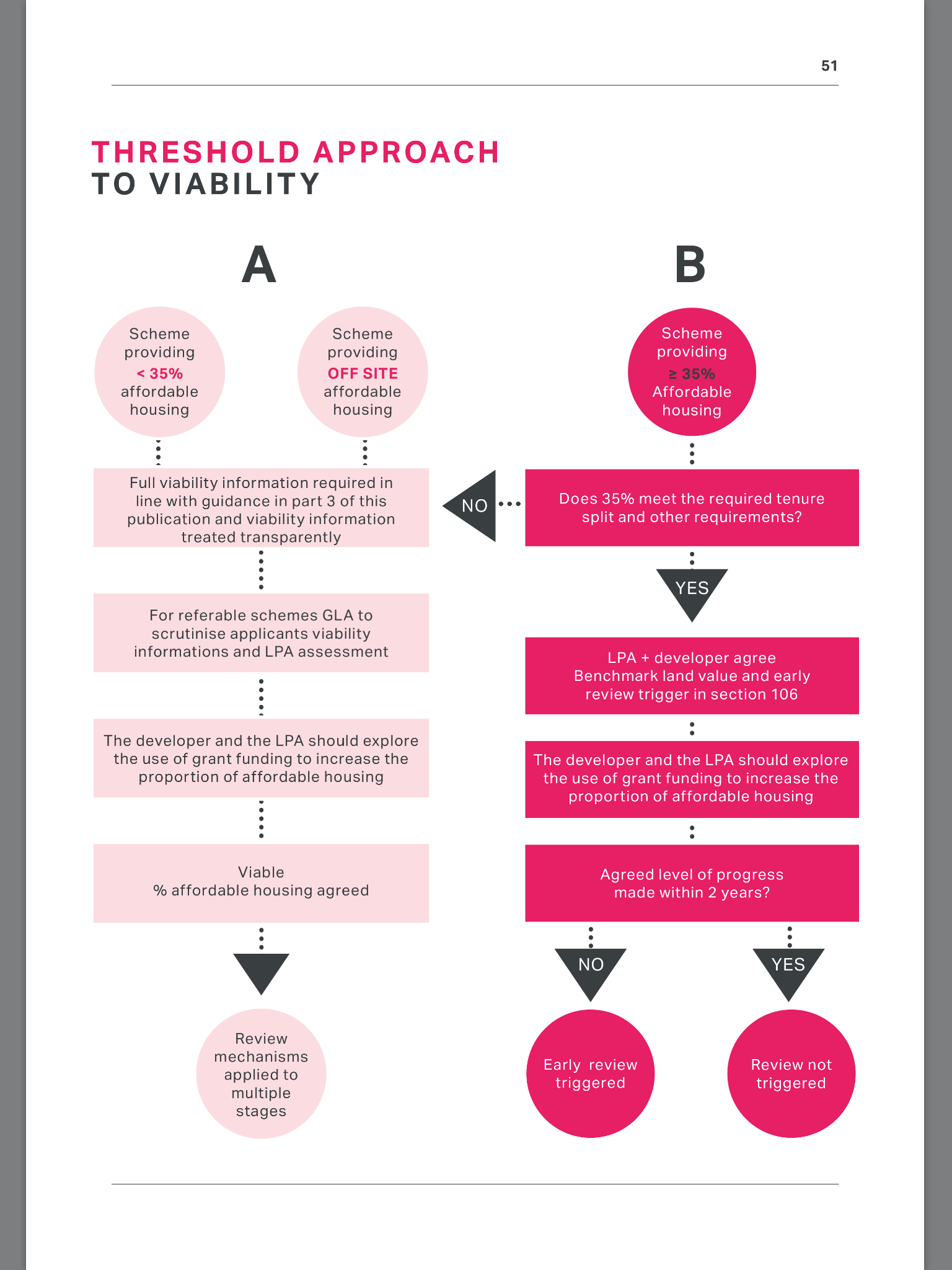
The draft SPG introduces a ‘threshold approach’, whereby schemes meeting or exceeding 35% (by habitable room) affordable housing without public subsidy will not be required to submit viability information. 
Schemes are divided into “route A” and “route B”. 

Route A schemes are:
. applications which do not meet the 35% threshold and required tenure split;

• applications which propose affordable housing off-site or as cash in lieu contribution; 

• applications which involve demolition of existing affordable housing (in particular estate regeneration schemes); 

• applications where the applicant claims the vacant building credit applies. 

Route B schemes are schemes which meet the 35% threshold and required tenure split (and which do not otherwise fall within the route A scheme definition above). Viability appraisal is not required, although there will be an “early review mechanism … triggered if an agreed level of progress is not made within two years of permission being granted” (the agreed level of progress being defined at the outset in the section 106 agreement).
The required tenure split
The required tenure split is:
– “at least 30% low cost rent (social rent or affordable rent) with rent set at levels that the LPA considers ‘genuinely affordable’ (this will generally be significantly less than 80% market rent). As part of [the] consultation, LPAs are being invited
to give guidance on what rent levels they consider to be genuinely affordable if above the benchmarks for London Affordable Rent”.
– “at least 30% as intermediate products, with London Living Rent … and/ or shared ownership being the default tenures assumed in this category. For viability purposes, London Living Rent homes in mixed-tenure schemes can be treated similarly to shared ownership, as it can be assumed that they will be sold on a shared ownership basis after a period of 10 years”.

– the remaining 40% is to be determined by the relevant LPA but must be “genuinely affordable”.

“London Living Rent is a new type of intermediate affordable housing that will help, through low rents on time-limited tenancies, households with around average earnings save for a deposit to buy their own home”. It has “ward-level caps … based on one-third of median gross household income for the local borough. The cap varies from the Borough median by up to 20 per cent in line with house prices within the ward”. The Mayor intends to limit eligibility for London Living Rent and other intermediate rent products to households on incomes of £60,000 a year or less, down from £90,000. 

“[F]or intermediate dwellings to be considered affordable, annual housing costs, including mortgage (assuming reasonable interest rates and deposit requirements), rent and service charges should be no greater than 40% of net household income. 
For shared ownership properties, to ensure mortgage costs assumptions are reasonable, boroughs, developers and registered provides are advised to assume buyers will access RPs, with a term of 25 years and a 90% loan to value ratio. The prevailing average interest rate being offered to lenders based on the terms above should be used to calculate the monthly payments. Generally shared ownership is not appropriate where unrestricted market values of a unit exceed £600,000”. 
Viability appraisal
Viability appraisal will be required to following a prescriptive approach, set out in part 3 of the draft. In relation to some familiar areas for dispute:
– “The price the RP has agreed to pay for each unit should be used in the viability appraisal and should be enshrined in the Section 106 agreement (for phased schemes the price in the Section 106 should be inflation linked)”.

– It should be assumed that all developers will incur generic average finance costs based on standard market rates.

– The IRR approach will not generally be appropriate for schemes of fewer than 1,000 units. 

– The benchmark value will be based on an existing Use Value plus premium (EUV+) approach, rather than the circularity of a market value approach. The Mayor will generally only accept an Alternative Use Value (AUV) approach where there is an existing implementable permission for that use.

The Mayor expects “all information to be made public, including council and third party assessments. Applicants will have the opportunity to argue that limited elements should be kept undisclosed, but the onus is on the applicant to make this case”. 

Review mechanisms
Section 106 agreements for route A schemes will need to require a two stage review mechanism:
– An “early review” where an agreed level of progress with the scheme is not made within two years of the permission being granted. Any surplus to be split 60/40 between the LPA and the developer and any surplus identified to translate into additional onsite affordable housing. “Thus plans should identify which units would switch to affordable accommodation in the event of an increase in viability at this early stage. If the agreed level of progress has been made, this review will not be triggered. All signatories to the Section 106 need to commit to making their best endeavours to fulfil their relevant requirements (setting out key milestones and requirements) to deliver the scheme and account may be had of the market situation at time of review”. 

– A “near end of development review which will be applied once 75% of units are sold. Where a surplus profit is identified this should be split 60/40 between the LPA and developer. The outcome of this review will typically be a financial contribution towards off-site affordable housing provision”. 

– The surplus is applied up to a total of 50% affordable housing.

The review should consider changes in gross development value and build costs using formulae set out in Appendix A to the draft SPG and which should be set out in the section 106 agreement. 
Build To Rent
Specific favourable provisions apply to Build To Rent, defined as complying with the following criteria:
“• a development, or block/ phase within a development, of at least 50 units; 

• the homes to be held as Build to Rent under a covenant for at least 15 years; 

• all units to be self-contained and let separately; 

• unified ownership and unified management of the development; 

• professional and on-site management; 

• longer tenancies offered (ideally three years or more) with defined in-tenancy rent reviews; and 

• property manager to be part of an accredited Ombudsman Scheme and a member of a recognised professional body”.

The Build To Rent restriction should usually be by way of section 106 agreement and should include a clawback mechanism if the units cease to be used for Build To Rent purposes. Two potential, alternative , clawback mechanisms are being consulted upon:
– to seek to recoup the initial loss of affordable housing if the homes are sold out of the Build to Rent sector, based on an appraisal submitted at application stage showing the reduced number of affordable homes possible due to the Build To Rent model. 

– a clawback to secure a total of 35% affordable housing. 

Affordable housing within Build To Rent schemes can be by way of discounted market rent (DMR), managed by the private sector landlord. The Mayor is seeking that the DMR be at London Living Rent. 
Some relaxation of space standards may be acceptable for Build To Rent products, particularly where they are subject to a longterm covenant that they will remain as Build To Rent. 
Differences are recognised in the approach to viability for Build To Rent schemes. Particularly:
“a different approach to profit (often lower than a build for sale scheme); 
• different approaches to sales and marketing; 

• rate of sale/disposal – this will generally be faster for a Build to Rent scheme (generally a build to rent appraisal will assume a development period and then a sale to an investor or operator); and 

• potentially lower risk compared to for sale schemes”. 

Finally, the Mayor is keen to secure the following five management standards:

“- Longer tenancies (three years or more) should be available to all tenants. These should have break clauses for renters, which allow the tenant to end the tenancy with a month’s notice any time after the first six months. 

– Within these tenancies there should be formula-linked rent increases. The LPA should not stipulate the level of rent increases on market rate tenancies, but these should be made clear to the tenant when the property is let and LPAs should ensure they are not set to discourage tenants from taking longer tenancies. Rents should normally be reset on each new tenancy.

– There must be on-site management. This does not necessarily have to mean
full time dedicated on-site staff in every case, as this could be unviable and unnecessary on small schemes. However all schemes need to have prompt issue resolution systems and some daily onsite presence.

– Providers must have a complaints procedure in place and be a member of
a recognised ombudsman scheme. They must also have membership of a designated professional body, such as the British Property Federation or Royal Institute of Chartered Surveyors.

– Finally, properties must be advertised on the GLA’s London-wide portal, in due course, which can be in addition to any advertising the provider may already be undertaking”.

Registered providers/grant funding

Applicants are encouraged to have registered providers on board at pre-application stage. 
The Mayor’s grant funding will only be available for route B applications if it increases the proportion of affordable housing above the nil-grant position to a level of 40% or more.
“The Mayor’s Homes for Londoners: Affordable Homes Programme 2016-2021, sets out how grant is going to be used to increase the amount of affordable housing delivered on developer-led sites above 35%, and to support approved providers deliver programmes with at least 50% affordable housing”. 

Concluding thoughts

In 2015 private sector schemes only delivered on average 13% affordable housing. Will this approach nudge the percentage upwards? This largely depends on whether developers believe that to button down 35%, with no review as long as development is not delayed, and with no need for viability appraisal, is sufficiently achievable or attractive. If it isn’t then it will be business as usual, with viability appraisals submitted to seek to secure a significantly lower percentage. 

How will LPAs react, particularly those inclined to hold out for the 50% target? And how will the imposition of a mandatory proportion of starter homes impact on this nuanced, London-specific approach?

Is the Mayor’s target of 50% now unachievable by flagging 35% as in practice acceptable or can the use of public land and grant funding make any appreciable difference?

Pass. But at least the likely structure of section 106 agreements for route A, route B and Build To Rent schemes (or rather the Mayor’s starting position) is increasingly clear. Which means, if the approaches are commercially palatable, faster permissions and less delay to development (particularly with the spectre of reviews triggered by delayed implementation). And:

Mayor of London: 1

Secretary of State: nil.
Simon Ricketts 1.12.16
Personal views, et cetera