Some Week, Some Thoughts

This post will mostly be about judicial review but if instead you have come here for a summary of the implications arising from the joint government/Mayor of London package of support for housebuilding in London (23 October 2025) why not listen to my interview with Concilio’s Nick Dines and we’ll see you back here in 35 minutes?

Judicial review…

Depends which side you’re on doesn’t it.

There have been at least two interesting judgments in the last couple of weeks, interesting for different reasons which nothing to do with the substantive issues involved. I’m not going to summarise the actual cases because they are both covered well (by my Town Legal colleagues Archie Hunter and Adam Choudhury respectively) in Town Legal’s latest weekly planning judgments update (you can subscribe gratis via the button at the foot of the update):

All I wanted to say about CG Fry, given all the excellent summaries that are already out there (including Archie’s), was:

  • Fortune favours the brave. This is a case which was lost by CG Fry at first instance and in the Court of Appeal (all this of course following an unsuccessful planning appeal at which the same arguments were run). Who might have given up rather than carry on, with the exposure to costs arising? Great credit is due to Lord Charlie Banner KC. Would you in that position be resilient enough to hold to your initial opinion and to retain the trust of those relying on it? I’m thinking back to Richard Harwood KC in Dill v Secretary of State (Supreme Court, 20 May 2020) – where the stats were the same: LLW. I’m thinking back also to Estelle Dehon KC in R (Finch) v Surrey County Council (Supreme Court , 20 June 2024) – ruled unarguable on the papers, unarguable at renewal hearing, arguable by the Court of Appeal on two grounds, dismissed then by the High Court and then by the Court of Appeal before success in the Supreme Court: LLWLLW. Within boundaries (some cases are sure-fire losers), litigation is inherently uncertain. Judgments of lower courts may be overturned on appeal. It isn’t over till it’s over. I’ll come back to that theme in my comments on HyNot.
  • Isn’t it interesting that the outcome of the case turned upon the decision of a previous government that the “easy” way to give Ramsar sites the same protection as habitat sites that are protected under the Conservation of Habitats Regulations (special areas of protection and special protection areas) was simply to set that out in national policy rather than by way of amending the relevant legislation? That is now being rectified, belatedly, by way of a government amendment to the Planning and Infrastructure Bill. But isn’t there a lesson when it comes to the NPPF itself or rather the proposed National Development Management Policies, envisaged by mechanisms set out in the Levelling-up and Regeneration Act 2023 as being statutory documents with equivalence to statutory local development plans. Parliament clearly considered that it would not be enough for NDMPs to be given weight through policy-expression but we are all waiting to see in what form these NDMPs are finally going to emerge.
  • Lastly, it’s nice to read a Supreme Court judgment that is so straightforward and clear in its expression – and descriptive of the planning system in a way that any of us would recognise. It’s not always the case (mentioning no names, *coughs* Hillside).

Now to HyNot, again some excellent summaries out there (including Adam’s) so I just wanted to focus on the judge’s comments about “promptness” in bringing judicial review proceedings and on whether the “arguability” threshold should be higher in some cases:

  • This was a permission hearing, where the claimant simply needed to persuade the judge that the claim was arguable.
  • What was under challenge was the grant of consent by Secretary of State for Energy Security and Net Zero of the “HyNet Carbon Dioxide Transportation and Storage Project – Offshore” The project “comprises 3 geological gas storage sites in the Liverpool Bay Area beneath the East Irish Sea. The proposal is designed to store 109 million tonnes of carbon dioxide and is a core part of the Government’s legal commitment to Net Zero. It is expected to create 2,000 construction jobs. The Development (called the Liverpool Bay CCS project) is part of a nationally significant infrastructure development in the North West which will have a very significant regional and national economic impact.”
  • The second paragraph of the judgment describes the claimant as follows: “The Claimant company and the group of individuals behind it do not like CCS in relation to power generation. They oppose it because they believe that CCS in relation to power generation and ‘blue’ hydrogen production is a costly and time-consuming distraction that will lock society into continued fossil fuel use and prevent investment in other more proven climate solutions. The Claimant is a Company Limited by Guarantee which was incorporated the day before this claim was filed. The name chosen by the incorporators of their company, “HyNot”, reveals the nature of its opposition to what, as appears below, is loosely known as the “HyNet Cluster”. The Claimant represents a campaign group which its director, Nicky Crosby, describes as being a loose group of campaigners from different environmental and climate campaign backgrounds, such as Frack Free Dee, Friends of the Earth, Extinction Rebellion, Chester Sustainability Forum, and CAFOD.”
  • Unlike more usual planning cases where there is now a six weeks’ deadline for bringing judicial review proceedings, this was a claim where the traditional judicial review deadline applied that the claim must be brought “promptly … and in any event not later than 3 months after the grounds to make the claim first arose”. The claim was brought on the last day within the three months’ deadline.
  • After finding the claim to be unarguable, the judge found that he would also have refused permission on the basis that the claimant failed to act “promptly”: “challenges to major infrastructure call for particular urgency. Whilst the volume of documentation was substantial, that did not in my judgment justify the delay, especially in circumstances where the Claimant ultimately filed only on a protective basis, without a pleaded case. I consider that the Claimant was aware of all of the information it required to enable it to bring proceedings on the grounds pleaded approximately 8 weeks before it filed its ‘protective’ claim. Certainly, by the end of April 2025 it was aware of the essential substance of the grounds that would have been available to it, and that is all that was required (see British Gas at paras. [141]-[145]). Detailed disclosure normally follows the grant of permission for judicial review, which is the trigger for the duty of candour and cooperation with the court and is not necessary before a claim can be brought (see British Gas at [145]). There is no reason why the Claimant could not have filed (whether ‘protectively’ or with proper pleadings, to be amended if required) much sooner. It is apparent, however, that the Claimant took the position that it could simply wait until the last day of the three-month period to file. The courts have stated emphatically that that is not the case.”
  • Whilst Saini J found the claim to be unarguable, there is an interesting concluding passage in the judgment recording that counsel for the government had urged the judge in submissions “to apply a more demanding test of the Claimant at the hearing than the traditional arguability test familiar at the permission stage”, relying on case law starting with the 1994 Mass Energy case. Counsel (Charles Streeten) “argued that the Claimant must satisfy a heightened test described as a “reasonably good prospect of succeeding” at a substantive hearing. The following facts were said to justify this more onerous hurdle: (1) the urgency (illustrated both by the categorisation of this claim as Significant under CPR 54D paras. 3.1 and 3.2 and by the measure of expedition ordered by Mould J); (2) the fact that a decision on permission has been adjourned to a hearing listed for half a day; (3) that the Court will have the benefit of extensive written and oral submissions from all three active parties; and (4) that the claim substantially affects the interests of a third party (the Developer).”  Whilst this proved unnecessary for his reasoning, Saini J went on to consider this argument “obiter” as lawyers like to say, i.e. even though it was not determinative and therefore less binding in terms of creating any legal precedent, although in my view still interesting. He considered “that there was substantial force in Mr Streeten’s submissions. A court does retain the discretion to require more of a claimant in establishing the merits of its case at a hearing of the type convened before me concerning an urgent matter of national importance, where there has been substantial pre-reading, detailed skeletons and oral submissions over half a day from all relevant parties. The grant of permission in a planning case on the type of facts before me is in itself highly likely to cast a long shadow over a development of national interest, with substantial financing and construction arrangements involving many third parties. I can see the force of an argument that much more than mere arguability of a claim (such as establishing that the claim is more likely than not to succeed) should be required in circumstances where such prejudice will be caused. Uncertainty as to the legal position is itself highly prejudicial in commercial arrangements.”

All this is relevant in the light of continuing thinking by the government as to ways of closing down unmeritorious judicial review cases. I referred in my 25 January 2025 blog post to the government’s announcement as to changes to be made to procedures governing legal changes of development consent order decisions in relation to nationally significant infrastructure projects (now the subject of provisions within the Planning and Infrastructure Bill), following first the report by Lord Banner KC and subsequent consultation that I summarised in my 28 October 2024 blog post Banner Review Into Legal Challenges of NSIPs (NB there really are other barristers out there I feel sure, I’m not being sponsored or anything). Lord Banner had recommended that there may be a case for raising the permission threshold for judicial review claims challenging DCOs (“There is much to be said for raising the threshold for permission to apply for judicial review of DCOs, to the heightened Mass Energy threshold, so that only those claims likely to succeed are allowed to proceed to a substantive hearing. There is no right, either under UK constitutional principles or international law, for an arguable but weak or mediocre claim to proceed to a full hearing rather than being weeded out beforehand)”, but the government was not inclined to accept this; perhaps the courts are beginning to get there of their own volition in relation to challenges of nationally significant projects? (Although what is the risk that a claim such as that in Finch is prematurely ruled out?). The big question is of course: if these measures are appropriate for challenges to nationally strategic infrastructure projects, why should they not be introduced in relation to planning-related challenges more generally?

To my mind, it is good to see the tough line taken by Saini J on promptness. Given the six weeks’ deadline for planning-related judicial review cases, why is there even still the traditional “prompt but in any event within three months” test, which can be so uncertain in its practical application? I’m currently dealing with a case, in relation to a proposed commercial development, where the claimant (a public authority) filed a day out of time, the challenge delaying significantly a development project, resulting in, according to my client’s evidence, several million pounds of lost rental income. The court has taken over three months before finally allowing the claim to be filed out of time. What sort of signal does this send? Is there some sort of institutional bias towards large infrastructure developments?

And on the question of court delays, is anyone else experiencing unusually long delays before securing decisions at the permission stage on the papers? I have one case where we filed on 6 May. Still… nothing.

Getting the balance right in relation to sieving out unmeritorious judicial review cases is so important given the implications not just for the project under challenge but in terms of giving reassurance to all those operating in the planning system that every document does not need to be “gold plated” as an insurance against even unmeritorious challenge. The fear of a claim for judicial review (successful or otherwise) is skewing every stage of the system!

Finally,  as a result of an amendment to the Planning and Infrastructure Bill tabled by a conservative peer, also a working planning KC (*checks notes* him again!!), the government is put forward its own amendment which will build on the current provisions in the Town and Country Planning Act 1990 which allow for an extension of the time for implementing a planning permission which has been challenged by way of judicial review. At present, under section 91 (3), if proceedings are brought to challenge the validity of a planning permission, the deadline for implementation is extended by one year.  The amendment will extend the deadline by a further year if the proceedings have permission to go to the Court of Appeal and by two years if they have permission to go to the Supreme Court. In the case of outline planning permissions, reserved matters submissions will be extended by equivalent periods.

All good and necessary but any steps to speed up judicial proceedings, and to sieve out doomed claims as at early as stage as possible, would of course be more likely to address the root problem.

Simon Ricketts, 24 October 2025

Personal views, et cetera

Court of Appeal Cuts Down Epping Forest

It was interesting YouTube viewing this afternoon (29 August 2025) wasn’t it? A press summary has been released, which is what Bean LJ read out. A longer full text judgment will be published later today or Monday.

I cover Eyre J’s first instance ruling in my 20 August 2025 blog post Planning Law Is Being Used For Politicking About Asylum Seekers. But we can now forget about that ruling. The Court of Appeal has overturned it, with robust criticism both of Eyre J’s approach and, it must be said, that of Epping Forest District Council.

Kemi Badenoch, leader of the Conservative Party, has subsequently issued a statement urging council’s seeking similar injunctions to “KEEP GOING!”. That is reckless advice.

Nigel Farage, leader of Reform, has Xed:

The government has used ECHR against the people of Epping.

Illegal migrants have more rights than the British people under Starmer

Again, recklessly wrong, inflammatory even. And, as you will see, the rights of asylum seekers (not “illegal”, not “migrants”) under the European Convention on Human Rights played no part in the Court of Appeal’s reasoning.

Eyre J’s rulings in Epping Forest District Council v Somani Hotels Limited (19 August 2025) were:

  • To refuse to allow the Home Secretary to be joined as a party to the proceedings
  • To grant an interim injunction requiring the hotel to be vacated of asylum seekers by 12 September, until a final ruling in the proceedings at a full hearing which will take place in mid-October 2025
  • To refuse an interim declaration that the use of the hotel for asylum seekers’ accommodation is a breach of planning control (Epping Forest District Council subsequently, wrongly, represented in its subsequent press statement that the declaration had been granted but had to retract that when contacted by Planning magazine!).

Today’s appeals by the Home Secretary and Somani Hotels Limited were in respect of the first two matters and were successful.

Home Secretary to be joined as a party

From the press summary of the Court of Appeal’s judgment:

“The judge denied himself the opportunity to consider the wider range of public interest factors which would be relevant to this application; these, in our view, rendered it more than just merely ‘desirable’ that the Home Secretary be enabled to participate in the court process.  The judge needed to put himself in a position to determine the application from the most informed perspective.”

Grant of the temporary injunction

The Court of Appeal found that although the question of  whether to grant an interim injunction is a matter for the discretion of the judge, only to be set aside where the appeal court identifies “a flaw or flaws in the judge’s treatment of the question to be decided, such as an error of law, a gap in logic, or a failure to take account of some material factor, which undermines the cogency of the conclusion”, the judge had made “a number of errors of principle which undermine his decision.”:

(from the press summary:)

  • The provision of accommodation for asylum seekers pursuant to the Home Secretary’s statutory duty is a national issue requiring a structured response. Ad hoc interim injunction applications seeking closure of particular sites may each have some individual merit, but the judge’s approach ignores the obvious consequence that closure of one site means that capacity needs to be identified elsewhere in the system, and may incentivise local planning authorities who wish to remove asylum accommodation from their area to apply to the court urgently before capacity elsewhere in the system becomes exhausted. The potential cumulative impact of such ad hoc applications was a material consideration within the balance of convenience, but was not considered by the judge, perhaps because he did not have the advantage in reaching his decision of evidence and submissions from the Home Office.”

Incidentally, the Court of Appeal goes on to describe as “unattractive” an argument raised by the Home Secretary as to a hierarchy of human rights with particular weight to be given to the fact that “the Home Secretary’s statutory duty is a manifestation of the UK’s obligations under Article 3 of the European Convention on Human Rights”. Even if in Farage language the government “used ECHR”, this is no basis for the Court of Appeal’s ruling.

  • The fact that the judge gave even limited weight to the fact of protests occurring, including unlawful protests, outside the hotel, were “worrying aspects of the judgment. If an outbreak of protests enhances the case for a planning injunction, this runs the risk of acting as an impetus or incentive for further protests, some of which may be disorderly, around asylum accommodation. At its worst, if even unlawful protests are to be treated as relevant, there is a risk of encouraging further lawlessness. The judge does not appear to have considered this risk, again perhaps because he had denied himself the advantage of hearing submissions on the merits from counsel for the Home Secretary.”

By judicial standards this again is trenchant criticism by the Court of Appeal of Eyre J’s approach.

  • Epping’s previous delays in taking any steps whatsoever:

For much of the period of four years from 2020-2024 Somani had been running the Hotel as accommodation for asylum seekers without enforcement action from the Council.  When, in 2023, Somani sought planning consent to change its use, for over a year Epping did not process the application, notwithstanding the statutory duty upon it to do so within eight weeks.   The Council was aware by February 2025 that the Hotel was once again to be used to house asylum seekers, and by its letter of 15 May 2025 Somani made clear that it had been advised by the Home Office that a planning application was unnecessary.

The Council took no steps in response to this letter whether by issuing an enforcement notice or otherwise.  There was no threat of court proceedings.

Somani was first made aware of any step of this kind when it received the court papers and a court bundle running to over 1600 pages together with a detailed skeleton argument prepared by leading and junior counsel.  The tactics used on the Council’s behalf in this regard were not only procedurally unfair to Somani,  but ought to have reinforced the argument that the delay was a significant factor in the balance against the grant of interim relief.”

  • The hotel’s actions were wrongly characterised as “deliberate”:

The judge found as a fact that Somani had acted “deliberately” in declining to seek change of use permission under planning law after April 2025; he was critical of them for taking this line.  He was wrong in both respects.  Those undeserved criticisms (which were repeated several times in the judgment) plainly played a material part in the judge’s ultimate decision. If the Council had considered Somani to be in breach of planning laws, it could have taken enforcement measures provided for within the 1990 Act.  It did not do so.  In short, the judge’s exercise of discretion in this case was seriously flawed by his erroneous reliance on the “deliberate breach” as a significant factor in favour of the grant of an interim injunction.”

  • The temporary nature of the injunction

We emphasise here, as we did at the outset, that the issue for the judge in August was whether to grant a temporary injunction until the trial in October.  The judge appears to have given very little weight to the desirability of preserving the status quo until that point.  The risk of injustice to the residents of the Hotel by being dispersed by 12 September, when the trial of the claim was to take place only some six weeks later, seems to have had oddly little resonance with the judge.”

What now?

We now await the full hearing of the case in mid-October, where a central issue will be whether there is a breach of planning control in the first place. For the avoidance of doubt that question is not addressed by the Court of Appeal in its judgment – and did not need to be at this stage. Of course, it is conceivable that there will never be a full hearing if the Home Office decides no longer to use the Bell Hotel in any event.

It is inconceivable that any council would now succeed with an application for an interim injunction, save in the most extreme circumstances, ahead of a ruling following that final hearing, or a final hearing in any future case that is brought. There would be significant cost risks for any council that took that “KEEP GOING!” advice seriously.

Finally, as the court made clear, this case (like this blog post) is “not concerned with the merits of Government policy in relation to the provision of accommodation for asylum seekers, in hotels or otherwise.”

Simon Ricketts, 29 August 2025

Personal views, et cetera

DCO JR Changes, #silkyplanoraks

Congratulations to those in our planning world who have been recommended to be appointed as King’s Counsel in the latest round – Zack Simons (presumably now #silkyplanoraks), Sasha Blackmore and Harriet Townsend.

It occurs to me that belated congratulations are also due to Sarah Sackman KC MP, who many of us know primarily as a superb planning and public law advocate, first at Francis Taylor Building and then Matrix Chambers, but who of course became MP for Finchley and Golders Green in July 2024. She took silk on being appointed as Solicitor General on entering the House of Commons and since 2 December 2024 has been Minister of State in the Ministry of Justice.

I mention Sarah’s background because it is important: we have one of our own, who understands the practical nuances of planning and public law and the operations of the judicial review process, at the heart of government.

There has been much press attention this week on the Prime Minister’s announcement on 23 January 2024, Prime Minister clears path to get Britain building as to changes to be made to procedures governing legal changes of development consent order decisions in relation to nationally significant infrastructure projects, following first the report by Lord Banner KC and subsequent consultation that I summarised in my 28 October 2024 blog post Banner Review Into Legal Challenges of NSIPs.

However, the proposals themselves were announced in more detail in a written statement to the House of Commons that day by Sarah Sackman: Infrastructure Planning and Judicial Review Reform. Working through that statement, first of all the background is set out:

The delivery of major infrastructure projects is central to the Government’s mission to drive growth and unlock clean power. The largest and most complex of these projects currently require a Development Consent Order (DCO) under the Nationally Significant Infrastructure Projects (NSIPs) regime established by the Planning Act 2008.

The number of legal challenges against DCOs has spiked in recent years, with 58% of decisions being subject to legal challenge. Delays to these major projects have serious implications, including holding back the delivery of essential benefits to the country and imposing considerable additional costs on development.

Despite 30 challenges being brought against major infrastructure projects, only four decisions to approve a project have been overturned by the courts. It comes as research shows that, on average, each legal challenge takes 1.4 years to reach a conclusion and the courts have spent over 10,000 working days handling these cases. Such cases impact upon the use of public money, with major road projects paying up to £121 million per scheme due to delays in legal proceedings. Whilst it is fundamental that the public can challenge the lawfulness of government decisions, there is scope for rebalancing the judicial review process to improve efficiency and reduce delays to NSIPs.”

Few of us would disagree with this.

The statement then sets out the specific changes that are to be introduced in relation to claims for judicial review in relation to DCOs:

  • Once the claim is made, there will not be an initial High Court stage where a judge considers “on the papers” whether the case is arguable, instead the issue of arguability and as to whether the case should proceed to a full hearing will be considered by a judge at a short hearing. (This is already the case in relation to applications to challenge inspectors’ decision letters in relation to enforcement notice appeals under section 289 of the Town and Country Planning Act 1990, where indeed there is no subsequent right to apply to the Court of Appeal for permission to proceed if the High Court judge finds the challenge to be unarguable,. Indeed, the deadline for bringing such challenges is four rather than six weeks!).

This change follows Lord Banner’s recommendation. The government’s consultation paper had floated the possibility of extending the change to all judicial reviews but this week’s announcement is entirely limited to DCO judicial reviews.

  • If the judge at that short permission hearing deems the case to be “totally without merit” (i.e. bound to fail), it will not be possible to ask the Court of Appeal to reconsider. At present if the judge considers “on the papers“ that a case is totally without merit, the claimant cannot renew its application for permission before a judge at a short hearing, but can only appeal to a Court of Appeal judge who will determine the appeal on the papers. So, there will be one bite at the cherry – at a short hearing before a High Court judge – rather than two paper stages with no hearing. Given that “totally without merit” grounds are not difficult to identify, is this really very radical?
  • non-mandatory” case management conferences will be introduced – sensible and reflecting one of Lord Banner’s recommendations.
  • All DCO judicial reviews will be designated as significant planning law claims. This is important because specific timescale targets then apply at the High Court stage (not the Court of Appeal) as to how speedily they should be dealt with. However, the issue is somewhat academic given that according to Lord Banner’s report all DCO judicial reviews to date have in practice been treated as significant planning law claims!
  • The government will “work with the judiciary to introduce target timescales for NSIP judicial reviews in the Court of Appeal and in the Supreme Court”. Given the delays that do happen at these later stage this would be very welcome.

Unsurprisingly the announcement has generated flak on the one hand from those who see the changes as reducing access to justice (see e.g. the Law Society’s position, Society counsels caution over JR curbs (25 January 2025), with comments from Law Society president Richard Atkinson that “Removing the paper permission stage could increase both the cost and length of permission hearings”. “‘It is possible that the certainty of higher costs – especially so early in the case, before permission is even granted – could discourage a claimant to the extent that it raises concerns for access to justice”. “Requiring oral hearings for all permission applications may also lengthen these proceedings, as it prevents those that could be easily dealt with from progressing more quickly.”) and on the other hand from those primarily acting for promoters who see the measures as not going far enough (see e.g. Judicial review reform ‘one step’ to enabling UK infrastructure development (24 January 2025) where infrastructure planning law guru Robbie Owen is quoted as saying that “these changes to judicial review are a step in the right direction but they are relatively minor and do not move the dial nearly enough. The government should be providing for any nationally significant infrastructure project that is a critical national priority to be immune from judicial review altogether, by the DCO for the project being confirmed by parliament through a one clause bill after it has been through the DCO process successfully”)

I don’t agree with either extreme. Mr Atkinson is wrong in what he says: any judicial review claimant at the moment needs to factor in the likely need for a permission hearing in any event (of the 27 challenges determined at the time of the Banner report, only 7 had received permission on the papers – and only 2 did not renew after being refused on the papers. 8 proceeded to a full or rolled-up hearing in any event). Robbie’s approach in my view goes too far the other way and takes away the necessary backstop that is needed by way of judicial review.

However, I do think there is more that could be done by way of changes in due course, in some cases not limited to DCO judicial reviews:

  • Why not reduce the challenge deadline for DCO judicial reviews from six weeks to four weeks, but at the same time take the opportunity to rectify the issue frequently arising on statutory challenges of all kinds as regards the current need to serve on the parties within that period, by allowing claimants seven days to serve on the defendant and interested parties, after the claim has been filed? By the time the DCO decision has been issued, any claimant will have been engaged for a long time in the process and will have secured access to legal advice. All that remains to be scrutinised is the Secretary of State’s reasoning for the decision – follow the precedent set in the case of enforcement notice appeals.
  • In the case of non DCO judicial reviews within the remit of the Planning Court, tighten up the requirement for pre-action protocol letters, such that the guidance makes clear that they should be sent as soon as grounds for potential judicial review are considered by a potential claimant to arise, for instance when a local planning authority has resolved to grant planning permission but ahead of the permission being issued. Presently, most potential claimants store up their potential grounds of challenge until the permission has been issued and there is nothing in practice that the local planning authority can do to remedy the position even if it accepts the position set out in the PAP letter. There could be the warning that non-compliance with this guidance may be taken into account in decisions as to the award of costs and as to cost-capping.
  • Much litigation in this field nowadays is crowdfunded. The Government might give thought as to whether greater controls are required as to the use of crowdfunding in relation to litigation and particularly whether sufficient information is given to potential contributors as to the precise nature of the action contemplated, its prospects of success and the implications of a successful outcome (i.e. usually simply resulting in redetermination) and how funds are used if no action is lodged.
  • More information should be made available by the courts, particularly the orders made at permission stage so as to inform decisions taken by subsequent claimants and as to the High Court’s and Court of Appeal’s performance as against timescale targets.

Lastly, what possible basis is there for not extending the changes announced to cover legal challenges to the adoption of local plans and in due course spatial development strategies?

There is always a need for judicial overview of decision making. But there is also always a need for speed – justice delayed is justice denied. Bridget Rosewell’s review was an important catalyst for improvement in relation to the Planning Inspectorate’s administration of planning appeal inquiries, at no cost to the quality or fairness of the process itself. The DCO judicial review changes announced this week to my mind are in a similar vein, although I do agree with Robbie that they are relatively minor. Let’s not give up looking for those incremental gains.

Simon Ricketts, 25 January 2025

Personal views, et cetera

Banner Review Into Legal Challenges of NSIPs

Making the planning system work more effectively should not be party political. So it is at least a good start to see that conservative life peer Charles Banner KC’s Independent review into legal challenges against Nationally Significant Infrastructure Projects (28 October 2024), commissioned by the previous government, has now been published by the current government. There is nothing very radical in it but, when it comes to making the planning system and associated litigation process work better, surely so much comes down to a version of Sir Dave Brailsford’s theory of marginal gains (see for example the undoubted success which was Bridget Rosewell’s review of planning inquiry processes).

LCB (is that yet an acceptable acronym?) had been appointed alongside fellow barrister Nick Grant in March 2024 to “explore whether NSIPs are unduly held up by inappropriate legal challenges, and if so what are the main reasons and how the problem can be effectively resolved, whilst guaranteeing the constitutional right to access of justice and meeting the UK’s international obligations.”

As per the Government’s press statement that accompanies the review, the Ministry of Justice has now separately published a call for evidence, based on his recommendations, ending on 30 December 2024 – “the Government is of the view that further analysis of a broader evidence base is necessary before decisions can be taken on the Review’s recommendations”.

Charlie Banner and Nick Grant had clearly put in the hours. It’s a well-thought through document. The review contains much useful background as to the current position, including analysis of the 34 challenges to DCOs which have been brought (30 of which have challenged the grant of a DCO and of which 4 claims were successful), average timescales for each stage of the process and some of the wider implications arising. This is valuable work – I’ve grumbled previously as to how unnecessarily difficult it can be to extract data like this.

They interviewed over 60 people with experience in the field (I’ll declare an interest as being one of many spoken to. I’m feeling rather guilty now for the whole hour that I took up…).

Ten recommendations are made, which I summarise as follows, adding anything particularly interesting from the Government’s accompanying call for evidence as I go:

Recommendation 1 – For so long as the UK remains a member of the Aarhus Convention, there is no case for amending the rules in relation to cost caps in order to reduce the number of challenges to NSIP.

Views not sought on this option. The call for evidence notes the government’s separate call for evidence seeking views on options to bring the UK’s policies into compliance with its obligation under the access to justice provision of the Aarhus Convention (30 September 2024)

Recommendation 2 – There is no convincing case for amending the rules in relation to standing to reduce the number of challenges to NSIPs.

Views not sought on this option.

Recommendation 3 – The current three bites of the cherry to obtain permission to apply for judicial review is excessive and should be reduced to either two or one: (1) an oral hearing in the High Court with a target timescale of within four weeks of the deadline for filing of acknowledgements of service and (2) consideration on the papers in the Court of Appeal within four weeks of the application for permission to appeal against the refusal of permission to apply for judicial review.

The commentary in the call for evidence document is interesting, pointing at the potential for any such changes to apply to judicial reviews of other planning decisions:

If the proposed change could result in time and cost savings for litigants and the courts, whilst maintaining adequate access to justice, there could be merit in considering this change not only in the context of NSIPs but also for judicial reviews of other planning decisions in general.

The Government is, however, of the view that more evidence is required to inform a decision on the implementation of this proposed change. We would, therefore, welcome views on the expected benefits and potential risks of this change, both in the context of the NSIP regime and in wider judicial review cases.”

Recommendation 4 – There may be a case for raising the permission threshold for judicial review claims challenging DCOs, which could be achieved by amendments to the CPR.

“The Government is of the view that in addition to the practical risks highlighted in the report, there is a more fundamental concern that raising the permission threshold in this way could unduly restrict the right of access to justice…the Government would however welcome views with supporting evidence, where available, on the likely benefits and potential risks of raising the permission threshold as discussed in the report.”


Recommendation 5 – On balance the case has not yet made out for a panel of judges with specialist NSIP experience to be eligible to hear judicial review challenges to DCO decisions.

The call for evidence document notes that there are currently 35 full time High Court judges authorised to consider planning cases, four of whom specialised in planning as practitioners prior to joining the judiciary.

“The Government would welcome views on whether this idea should be taken forward, whilst recognising that the authorisation of judges to hear certain types of case is part of judicial allocation and deployment which is a matter for the judiciary. We would particularly welcome views from members of the judiciary.”

Recommendation 6 – The Civil Procedure Rules should provide that DCO judicial reviews are automatically deemed Significant Planning Court Claims.

(This is important because stricter target timescales apply. All DCO judicial reviews to date have been treated as such – so this should not be controversial…).

“Given the national significance of NSIPs and the complexity of the claims against them, there is a case for formalising the existing practice of designating all judicial review cases concerning DCO decisions as Significant Planning Court Claims. The Government would, however, welcome views on the practical benefits of formalising this existing practice.”

Recommendation 7 – Automatic pre-permission case management conferences should be introduced in relation to judicial review claims challenging DCOs.

Views sought.

Recommendation 8 – Target timescales should be set for the Court of Appeal to  target timescales for determine applications for permission to appeal, and (where permission is granted) thereafter substantive appeals.

“The Government considers that a better understanding of the causes of the current delays at the Court of Appeal and the Supreme Court is needed to determine whether imposing target timescales would help to ensure consistent timely processing of DCO judicial reviews at the appellate courts. In addition, although the report suggests that the relatively limited number of DCO judicial review claims means that these timescales should not be too onerous on the courts, we would welcome views, particularly from the senior judiciary, as to how the introduction of target timescales might affect the operation of the appellate courts.”

(NB somewhat deferential? There are undoubtedly delays at the appeal stages. delays which look to mere mortals to be capable of reduction…)

Recommendation 9 – The President of the Supreme Court should be invited to consider amending the Supreme Court Rules to introduce target timescales for the determination of applications to the Supreme Court for permission to appeal in judicial review challenges to DCOs.

Same commentary as for recommendation 8.

Recommendation 10 – The Planning Court and Court of Appeal should be invited to publish data on a 3 month rolling basis which, at minimum, should indicate the number and percentage of cases which in the last 3 month period have met the target timescales either for NSIP cases specifically or Significant Planning Court cases generally, or both; as well as what the average and maximum turnaround times have been in that period (for both the permission and the substantive stages).

“This recommendation to invite the Planning Court and the Court of Appeal to improve the way they publish data on the progress of DCO judicial reviews and/or planning cases would not directly address the issue of delays, but it could, as the report notes, provide stakeholders with greater transparency and help inform consideration of further procedural reforms. The report also suggests that this could be easily implemented at little or no additional cost. The Government would welcome views on the likely benefits and potential costs of this proposal.”

The Government is also welcoming views as to:

  • The review and its methodology more generally and whether there is indeed a case for streamlining the process for judicial reviews of DCO decisions
  • other possible changes that could help reduce judicial review related delays to the delivery of NSIPs and provide parties greater certainty in the process. Any proposed change must, however, ensure the right of access to justice is maintained in line with the UK’s domestic and international legal obligations.

Simon Ricketts, 28 October 2024

Personal views, et cetera

Table from review

Planning For Industrial Growth & Investment

Sir Keir Starmer’s speech on 14 October 2024 at the international investment summit held at the Guildhall in the City of London generated much media coverage. This blog post is going to look briefly at the references he made in that speech to the planning process.

But first of all, I do draw attention to the important document published by the Government alongside the conference:   Invest 2035: the UK’s modern industrial strategy  (14 October 2024), now being consulted upon until 24 November 2024.

Some snippets:

Eight growth-driving sectors have been identified: Advanced Manufacturing, Clean Energy Industries, Creative Industries, Defence, Digital and Technologies, Financial Services, Life Sciences, and Professional and Business Services.”

A core objective of the Industrial Strategy is unleashing the full potential of our cities and regions. The Industrial Strategy will concentrate efforts on places with the greatest potential for our growth sectors: city regions, high-potential clusters, and strategic industrial sites. The Government is committed to devolving significant powers to Mayoral Combined Authorities across England, giving them the tools they need to grow their sectoral clusters and improve the local business environment through ambitious Local Growth Plans. Partnership with devolved governments will make this a UK-wide effort and support the considerable sectoral strengths of Scotland, Wales, and Northern Ireland.”

The Industrial Strategy and growth-driving Sector Plans will be published alongside the Spending Review in Spring 2025.”

Under the “energy and infrastructure” section:

An effective planning system is a fundamental enabler for business investment in our growth-driving sectors. At the national and regional level, planning constraints hold back growth, including in high-performing life sciences clusters like Cambridge and clean energy industries hubs such as Tees Valley and the North-East. Firms require predictability and efficiency when applying for consent for projects, but this is not being provided by existing processes. Businesses have told us that the planning consent process is too lengthy and uncertain – infrastructure projects spend an average of 65 months in pre-construction phases, the highest among peer countries.”

Targeted, long-term infrastructure investment is a vital catalyst to the success and stability of major city regions and clusters of our growth-driving sectors. Businesses agree that the UK has for too long failed to provide a long-term vision and clear statement of intent to support this. A lack of housing in some places across the UK also prevents labour markets from operating effectively and prevents successful agglomerations. Further, additional data centre capacity and access to fast, secure, and reliable digital connectivity is essential to enabling economic growth and to reap the transformational productivity benefits of digitalisation and the adoption of AI. Continued investment is needed to meet our ambitious targets to bring gigabit-capable broadband to all of the UK, and standalone 5G to all populated areas, by 2030.”

Under a section entitled “Growing high-potential clusters”:

The Industrial Strategy will concentrate efforts on places with the greatest potential for the growth sectors: city regions, high-potential clusters, and strategic industrial sites. The success of the Industrial Strategy’s growth-driving sectors can only be achieved if these clusters reach their full potential, supported through a place-based approach to policy.

Local Growth Plans are a cornerstone of the place-based approach. These locally owned, 10-year strategies will set out how Mayoral Combined Authorities (MCAs) will use their devolved powers and funding to drive growth in their region. They will build on the region’s unique strengths and opportunities to support sectors, identify wider business environment priorities, and provide a framework to unlock private investment. They represent strategic partnerships between central Government and MCAs to identify priorities for growth and will be aligned to the Industrial Strategy.

Alongside this, the Government will explore how to build on existing place-based initiatives to support high-potential clusters and align them behind the Industrial Strategy. This includes considering how the Industrial Strategy can be a ‘lens’ for informing the recommendations for New Towns locations, creating new large-scale settlements in places where high housing demand constrains the growth of high-potential clusters.”

Now to Keir Starmer’s summit speech. I have copied and pasted the passages most relevant to the planning system. (I do apologise that the format of the transcript makes it appear rather lyrical)

Now, I don’t see regulation as good or bad.

That seems simplistic to me.

Some regulation is life-saving…

We have seen that in recent weeks here, with the report on the tragedy of Grenfell Tower.

But across our public sector…

I would say the previous Government hid behind regulators.

Deferred decisions to them because it was either too weak or indecisive…

Or simply not committed enough to growth.

Planning is a very real example of that…

Or – for our friends from across the pond…

‘Permitting’ is a really clear example of that…”

“we’ve also got to look at regulation – across the piece.

And where it is needlessly holding back the investment we need to take our country forward…

Where it is stopping us building the homes…

The data centres, the warehouses, grid connectors, roads,  trainlines, you name it…

Then mark my words – we will get rid of it.

Take the East Anglia 2 wind farm.

A £4 billion investment.

One Gigawatt of clean energy.

An important project – absolutely.

But also the sort of thing a country as committed to clean energy as we are…

Needs to replicate again and again.

Now regulators demanded over four thousand planning documents for that project…

Not 4000 pages – 4000 documents.

And then six weeks after finally receiving planning consent…

It was held up for a further two years by judicial review.

I mean – as an investor…

When you see this inertia…

You just don’t bother do you?

And that – in a nutshell…

Is the biggest supply-side problem we have in our country.

So it’s time to upgrade the regulatory regime…”

Is the focus of his criticism the influence on the planning system of those aspects which are regulated (or at least the subject of oversight) from the likes of the Environment Agency and Natural England, is it the planning system itself, or is it the role of the courts? Or all of the above? I’m not sure that Anglia Two was particularly an example of where the regulatory regime needs to be (or at least can in a straight-forward way be) “upgraded”, but the previous government of course did of course commission Lord Banner KC in March 2024 to lead a review to “explore whether NSIPs are unduly held up by inappropriate legal challenges, and if so what are the main reasons and how the problem can be effectively resolved, whilst guaranteeing the constitutional right to access of justice and meeting the UK’s international obligations.” It would have been better if perhaps the current government had published the report (assuming it is concluded) alongside Monday’s speech because, guess what, it may point to some of the answers. When can we see it?

DCOs authorising construction of the East Anglia ONE North and East Anglia TWO Offshore Wind Farms with associated onshore and offshore development were granted on 31 March 2022, the case for challenge having been found to be arguable. The challenge to those DCOs, brought by a campaign group Substation Action Save East Suffolk Limited was rejected in the High Court on 13 December 2022 (relatively speedy as far as this sort of litigation is concerned – the Planning Court does generally make sure that cases move at a pace). As is often the way, the greater delay then came at Court of Appeal stage, with the Court of Appeal only dismissing the group’s appeal on 17 January 2024. Any planning lawyer will say the same: get the Court of Appeal operating at the pace of the Planning Court. The Court of Appeal’s judgment in R (Substation Action Save East Suffolk Limited) v Secretary of State  (Court of Appeal, 17 January 2024) was summarised by my Town Legal colleague Jack Curnow here.

Some of you will have been at, or heard the subsequent 50 Shades of Planning podcast recording of, our recent Town Legal/Landmark Chambers 100 Days of Labour event. I did ten minutes on what had emerged to that point in relation to commercial and infrastructure development. If only we had waited a week or so! People may find interesting this table of decisions on recovered appeals, call-ins and DCOs (in relation to all types of development) since 4 July 2024, prepared by Town Legal’s Victoria Porter alongside Landmark Chambers’ Edward Arash Abedian, and which shows a 100% approval rate for each to date…

Simon Ricketts, 16 October 2024

Personal views, et cetera

The Guildhall, in the City of London

The Updated Town Legal/Landmark Chambers Planning Court Case Explorer

None of the usual commentary this week. Instead I wanted briefly to share with you that Town Legal and Landmark Chambers have finally updated our joint Planning Court Case Explorer.

This is a tool which we have designed to provide anyone interested in the planning process with free-to-access data in relation to all cases which have been handed down in the Planning Court following a full hearing,  since the creation of the Court in 2014 up to 31 August 2023. The Case Explorer also includes data on cases subsequently heard in the Court of Appeal and Supreme Court.

Please explore – and save it on your browser!

You’ll see that the Case Explorer now covers 766 cases (Planning Court: 591, Court of Appeal: 160; Supreme Court: 15). You can click through to the transcript for each of them, and to a summary, by Town Legal lawyers as part of their free weekly Town Library service, of all judgments since 2017. Cases have been categorised by Landmark’s Rebecca Sage, Harley Ronan and Barney McCay.

You will currently see glitches (do tell me about them) and we do not vouch for its absolute accuracy or that nothing has slipped the net. But we hope that is a useful jumping off point for initial research.

Some basic examples of routes you might take through the information:

Know your subject area… If your research task is, for instance, statutory challenges to local plans you will find 222 of them. You want to see which these are? They are all there.

Know your judge… You can search the cases by judge. (By the way, Lang J has handed down more Planning Court judgments than any other judge: 106. Holgate J stands at 54, Dove J at 38).

Who are the most active litigants? In terms of the private sector and NGOs, whether as claimant or interested party, way out in front is Gladman, at 16 (including three appeals); second is Redrow at 8; joint third are Friends of the Earth and the Open Spaces Society, both at 6. In terms of the public sector, we have four authorities which are all at 9: Canterbury, Lambeth, Maidstone and Westminster.

Again, in every instance you can click through to the actual judgment transcripts – and, usually, Town Legal case summaries.

Predicting likely timescales is so often critical… The average duration of a case, from the date of the decision that is challenged to the date of handing down of the Planning Court’s judgment following a full hearing is 333 days, if you consider all of the 591 judgments handed down since 2014. If you just consider the 12 judgments handed down in Q3 2023 up to 31 August, the period rises to 393. (Bear in mind that these statistics do not include cases that do not reach a full hearing, having been sieved out at permission stage or withdrawn – it would be extremely useful to have this further information).

Town Legal and Landmark Chambers will be doing some more in-depth analysis over the coming weeks. If you would be interested in any of the output, do let me know, or indeed Mike Gooch at Landmark Chambers (without whom, et cetera).

Simon Ricketts, 13 October 2023

Personal views, et cetera

The Removal Of Rights Bill

A codified list of British values might very well start with those within the European Convention on Human Rights, summarised as follows:

the right to life (Article 2)

freedom from torture (Article 3)

freedom from slavery (Article 4)

the right to liberty (Article 5)

the right to a fair trial (Article 6)

the right not to be punished for something that wasn’t against the law at the time (Article 7)

the right to respect for family and private life (Article 8)

freedom of thought, conscience and religion (Article 9)

freedom of expression (Article 10)

freedom of assembly (Article 11)

the right to marry and start a family (Article 12)

the right not to be discriminated against in respect of these rights (Article 14)

the right to protection of property (Protocol 1, Article 1)

the right to education (Protocol 1, Article 2)

the right to participate in free elections (Protocol 1, Article 3)

the abolition of the death penalty (Protocol 13)

This would be no coincidence. The UK was one of the founding members of the Council of Europe, which comprises 46 member states since the expulsion of Russia in March 2022. Whilst it includes all 27 EU member states it is of course entirely separate from the EU.

The Council of Europe was founded after the Second World War to protect human rights and the rule of law, and to promote democracy. The Member States’ first task was to draw up a treaty to secure basic rights for anyone within their borders, including their own citizens and people of other nationalities.

Originally proposed by Winston Churchill and drafted mainly by British lawyers, the Convention was based on the United Nations’ Universal Declaration of Human Rights. It was signed in Rome in 1950 and came into force in 1953.”

(Equality and Human Rights Commission website)

Sad fact of human society: states and public bodies, on occasion, whether carelessly or on purpose, breach these fundamental rights. Of course when this happens there needs to be redress available, without disproportionate cost and delay. And let’s not kid ourselves via some weird form of British exceptionalism that UK institutions have ever been, are or will ever be flawless paragons of virtue.

In its manifesto for the 1997 general election, the Labour Party pledged to incorporate the European Convention into domestic law. When the election resulted in a landslide Labour victory, the party, under the leadership of Tony Blair, fulfilled the pledge by the Parliament passing the Human Rights Act the following year.

The 1997 White Paper “Rights Brought Home” stated: “It takes on average five years to get an action into the European Court of Human Rights once all domestic remedies have been exhausted; and it costs an average of £30,000. Bringing these rights home will mean that the British people will be able to argue for their rights in the British courts – without this inordinate delay and cost.” [Wikipedia]

Back to that Equality and Human Rights Commission website:

The Act has three main effects:

1. You can seek justice in a British court

It incorporates the rights set out in the European Convention on Human Rights (ECHR) into domestic British law. This means that if your human rights have been breached, you can take your case to a British court rather than having to seek justice from the European Court of Human Rights in Strasbourg, France.

2. Public bodies must respect your rights

It requires all public bodies (like courts, police, local authorities, hospitals and publicly funded schools) and other bodies carrying out public functions to respect and protect your human rights.

3. New laws are compatible with Convention rights

In practice it means that Parliament will nearly always make sure that new laws are compatible with the rights set out in the European Convention on Human Rights (although ultimately Parliament is sovereign and can pass laws which are incompatible). The courts will also, where possible, interpret laws in a way which is compatible with Convention rights.”

As at December 2019, “there have been 547 judgments concerning the UK up to the end of 2018. Of these, over half (315) found at least one violation of the European Convention on Human Rights, and about a quarter (141) found no violation.” (House of Commons Library publication UK cases at the European Court of Human Rights since 1975, 19 December 2019). Have a browse – the cases do not concern trivial matters, as is sometimes made out.

In our planning world, the rights that are most frequently relevant are:

The right to a fair trial (article 6), most particularly article 6.1 which is not limited to criminal trials but any determination by a state body as to an individual’s or organisation’s rights and obligations:

In the determination of his civil rights and obligations or of any criminal charge against him, everyone is entitled to a fair and public hearing within a reasonable time by an independent and impartial tribunal established by law. Judgment shall be pronounced publicly but the press and public may be excluded from all or part of the trial in the interests of morals, public order or national security in a democratic society, where the interests of juveniles or the protection of the private life of the parties so require, or to the extent strictly necessary in the opinion of the court in special circumstances where publicity would prejudice the interests of justice.”

I have emboldened the key elements of interest.

The right to respect for family and private life (Article 8)

“1. Everyone has the right to respect for his private and family life, his home and his correspondence.

2. There shall be no interference by a public authority with the exercise of this right except such as is in accordance with the law and is necessary in a democratic society in the interests of national security, public safety or the economic well-being of the country, for the prevention of disorder or crime, for the protection of health or morals, or for the protection of the rights and freedoms of others.”

The right to protection of property (Protocol 1, Article 1), particularly relevant in the field of compulsory purchase:

Every natural or legal person is entitled to the peaceful enjoyment of his possessions. No one shall be deprived of his possessions except in the public interest and subject to the conditions provided for by law and by the general principles of international law.

The preceding provisions shall not, however, in any way impair the right of a State to enforce such laws as it deems necessary to control the use of property in accordance with the general interest or to secure the payment of taxes or other contributions or penalties.”

Other rights of course are relevant in particular cases, for example the right not to be discriminated against (article 14) frequently arises in issues concerning gypsies and travellers.

Soon after the 1998 Act came into law, the House of Lords tested various aspects of our planning and compulsory purchase system as against Convention rights, in the Alconbury cases (9 May 2001), and the system was found to be compliant – as it was then at least (we must not be complacent as regards any changes).

The English courts have subsequently considered the relevance of the rights to particular planning situations in many cases but this has certainly not opened the floodgates.

Two examples:

R (RLT Built Environment Limited) v Cornwall Council and St Ives Town Council (Hickinbottom J, 10 November 2016) concerned a challenge to the policies in the St Ives neighbourhood plan designed to limit second home ownership by imposing residency requirements. The developer claimant sought unsuccessfully to argue that the policies contravened article 8.

The judge rejected the claim:

Where article 8 rights are in play in a planning control context, they are a material consideration. Any interference in such rights caused by the planning control decision has to be balanced with and against all other material considerations, the issue of justification for interference with article 8 rights effectively being dealt with by way of such a fair balance analysis.

That balancing exercise is one of planning judgment. Consequently, it may be amenable to more than one, perfectly lawful, result; and this court will only interfere if the decision is outside the legitimate range. Indeed, in any challenge, the court will give deference to the decision of the primary decision-maker, because he has been assigned the decision-making task by Parliament, and he will usually have particular expertise and experience in the relevant area. Such a decision-maker will be accorded a substantial margin of discretion. The deference and margin of discretion will be the greater if he has particular expertise and experience in the relevant area, and/or if he is acting in a quasi-judicial capacity (such as an inspector).

If the decision-maker has clearly engaged with the article 8 rights in play, and considered them with care, it is unlikely that the court will interfere with his conclusion. Article 8 rights are, of course, important: but it is not to be assumed that, in an area of social policy such as planning, they will often outweigh the importance of having coherent control over town and country planning, important not only in the public interest but also to protect the rights and freedoms of other individuals. In practice, cases in which this court will interfere are likely to be few.”

In R (Moore & Coates) v Secretary of State (Gilbart J, 21 January 2015) a claim based on article 6 succeeded. This was the challenge to the then Secretary of State’s policy to recover or call-in gypsy and traveller cases, causing huge delays in decision making.

To anyone with experience of development control and planning inquiries, it is remarkable that cases involving a modest amount of evidence, and typically taking two days at most, could then require consideration for in excess of 6 months, let alone the 10 months that has elapsed in Mrs Coates’ case. I recognise that Mrs Moore’s case has involved some complexities, but there is no evidence at all that it was anything but atypical. But as Mr Watson’s evidence showed with clarity, it is the effect of the recovering of all cases which was expected to, and has, caused significant delays in determination. It was not the issues raised by any of the cases which caused the delays but the Ministerial decision to recover them all for determination. No evidence has been put forward by the SSCLG to show that the delays were necessary in travellers’ cases, and it must again be observed that although WMS 1 sought to stress the same substantive policy message for cases in the Green Belt relating both to travellers’ housing and “conventional” housing, yet appeals of the latter kind have not been delayed whereas appeals of the former kind have been delayed, and considerably so. The pitches concerned (and certainly so in the Claimants’ cases) contain their homes where they live, or wish to live, with their children. The SSCLG has failed to show that the delays caused to the determination of the appeals was a proportionate response to the issue of giving the policy “steer.” It follows that the appeals have not been determined within a reasonable time.”

Here, the ability to use article 6 was certainly a useful hook and the reference in article 6 to decisions needing to be made in a “reasonable time” is pretty much all we have to hang on when complaining about the inevitable delays that are one of the root causes of dissatisfaction in the planning system!

Although quite dated, the House of Commons Library research briefing Human Rights and Planning (21 June 2010) is a further useful resource.

My reflection would be that in our field the Human Rights Act has operated as was envisaged. Instead of the prolonged uncertainty to everyone caused by aggrieved parties deciding to continue their battles in Strasbourg, human rights issues have been dealt with by the Planning Court, and on appeal, as part and parcel of the challenge process. Even drawing upon the ECHR jurisprudence that is regarded by our Government with such suspicion, winning on a human rights point is not exactly easy.

But when it comes to public policy, the planning system is always a sideshow. Driven by political sensitivities in relation to areas such as extradition policy and prisons, the Government has of course been intent on reducing the influence of the Convention and the risk of judgments against it by the ECHR. Hence, its consultation document Human Rights Act Reform: A Modern Bill of Rights (14 December 2021):

“We make far-reaching proposals for reform, with a particular focus on those quintessentially UK rights, such as freedom of speech and the right to trial by jury. We examine problematic areas, including the challenges in deporting foreign national offenders. We consider in detail the procedural framework of the Human Rights Act. And we look at the relationship between the UK courts and Parliament and the European Court of Human Rights in Strasbourg.

We intend to revise and reform the flaws we have identified, and replace the Human Rights Act with a modern Bill of Rights, one which reinforces our freedoms under the rule of law, but also provides a clearer demarcation of the separation of powers between the courts and Parliament.

Our proposals recognise the diverse legal traditions across the UK, alongside our common heritage. We will be seeking the views of each of the devolved administrations, and across all four nations of the UK, to ensure we safeguard our human rights protections in accordance with a common framework, whilst reflecting our diversity and devolved competences.

We will carefully consider all the responses we receive, as the government takes forward the proposals in this consultation. The task of nurturing the UK’s tradition of liberty and rights is never finished. This consultation turns the first page of the next chapter in our long history of human rights – and begins the work to refine our law, curtail abuses of the system, restore public confidence, reinforce the independence of the judiciary, and shore up the sovereignty of elected law-makers in Parliament.”

The Government’s consultation response is fascinating. “Carefully consider”, my foot! The majority of respondents to each question raised favoured no change but such is the nature of consultation the Government has sailed on. (For instance 90% of respondents disagreed that a claimants should have to show a “significant disadvantage” to be able to bring a claim but the government has not backed down – in these circumstances what really is the point of consultation, or, more to the point, responding to consultation?).

The Bill of Rights Bill was laid before Parliament on 22 June 2022, accompanied by the publication of an explanatory memorandum , impact assessment and press statement.

From the press statement:

This country has a long and proud tradition of freedom which our Bill enhances, for example, in respect of free speech and recognition of the role of jury trial. Equally, over the years mission creep has resulted in human rights law being used for more and more purposes, with elastic interpretations that go way beyond anything that the architects of the Convention had in mind. Following careful consideration of the responses to the government’s consultation on the Bill of Rights, these reforms reinforce our tradition of liberty whilst curtailing the abuses of human rights, restoring some common sense to our justice system, and ensuring that our human rights framework meets the needs of the society it serves. As we make these reforms, we are clear that we are committed to remaining party to the European Convention on Human Rights (ECHR).

For a summary of the Bill’s contents and actual implications, I urge you now at least to skim through Mark Elliott’s blog post The UK’s (new) Bill of Rights (22 June 2022). Here is an expert on the subject – Professor of Public Law and Chair of the Faculty of Law at the University of Cambridge and former Legal Adviser to the House of Lords Constitution Committee.

In summary he argues “that the Government’s strategy appears to involve making it more difficult for human rights to be enforced in UK law both by marginalising the domestic influence of the ECtHR and by limiting the capacity of domestic courts to uphold Convention rights. [He concludes] that these policy objectives form part of a wider picture according to which the present UK Government exhibits authoritarian tendencies that are in tension with British constitutional tradition.”

His conclusion is that this is “a Bill that seeks to diminish the domestic legal impact of the transnational human rights system of which the UK has chosen — and agreed in international law — to be a part, and which seeks at the same time to make significant inroads into the powers of domestic courts to uphold fundamental rights. All of this is infused with the notion of ‘taking back control’ from those — ‘foreign’ judges in particular, but also courts and lawyers more generally — who are viewed as an inconvenience at best, an illegitimate interference at worst. The Government claims to be doing this in the name of — and the Bill explicitly references — ‘parliamentary democracy’. But it is becoming abundantly clear that the true objective underpinning this Bill (and the Government’s wider project) concerns not the so-called restoration of parliamentary sovereignty or the strengthening of democracy, but the entrenchment of a form of executive hegemony — one that smacks of authoritarian resistance to scrutiny and is antithetical to the best traditions of the British constitution.

The Bill starts with a curious “introduction” clause:

Of particular relevance to our subject area I would identify:

• Various attempts to constrain the role of the courts versus that of the Government or Parliament (starting with various passages in that clause 1, but see eg clause 7)

• Various attempts to warn the courts away from applying or expanding Strasbourg jurisprudence (eg see clause 2)

• Preventing UK courts from interpreting Convention rights so as to require a public authority to comply with a positive obligation (clause 5)

• Placing very high thresholds in the way of claimants seeking remedies in UK courts (a “victim” plus “significant disadvantage” test for standing – clauses 13 and 15 – that is tighter than the standing test in relation to judicial review)

What is this likely to mean in practice for our planning and compulsory purchase system?

• Human rights compliance cases are likely to be even more difficult to run in the UK courts, leading some litigants to resort to commencing claims in the European Court of Human Rights in Strasbourg (probably having first had to try – and fail – in the UK courts).

• In practice, weaker discipline over the behaviour of the Government and public bodies – this will be to the detriment of good governance.

• Generally, more uncertainty as to the appropriate tests for the UK courts to apply in human rights cases, as case law develops around the new tests, in some parts of the Bill expressed in curiously subjective or general language.

What this Bill most certainly does not do is give any individual or company more rights than at present; quite the contrary. If the 1998 Act brought the rights home, to use the language of the 1997 white paper, such that they could be relied upon in the UK courts, this Bill does the opposite – their utility in the UK courts is to be constrained, meaning that once again the ultimate backstop is a claim to the European Court of Human Rights in Strasbourg.

Whether constraining the role of the UK courts in relation to the protection of our human rights is a good thing or a bad thing might depend upon whether which side of the fence you are on – but remember: there isn’t one of us who may not need to rely on our rights as against the state at some point, whether in our personal or work lives.

And if we are going to have a Bill of Rights Act, shouldn’t we have a think about what further rights should now be included?

Topically, the application of the Convention (particularly article 1 of the first protocol – the right to protection of property) very much came into our clubhouse discussion on 15 June, Land value capture via CPO. You can listen again here.

Simon Ricketts, 25 June 2022

Personal views, et cetera

Sad When Our Planning System Is Media Laughing Stock

It was hard not to laugh – and back in February 2021 laughs were in short supply. But that Handforth Parish Council viral video was also deeply depressing as a vignette of the planning system in action and hardly a recruitment drive for parish councils.

This has been another bad week for the planning system in the media.

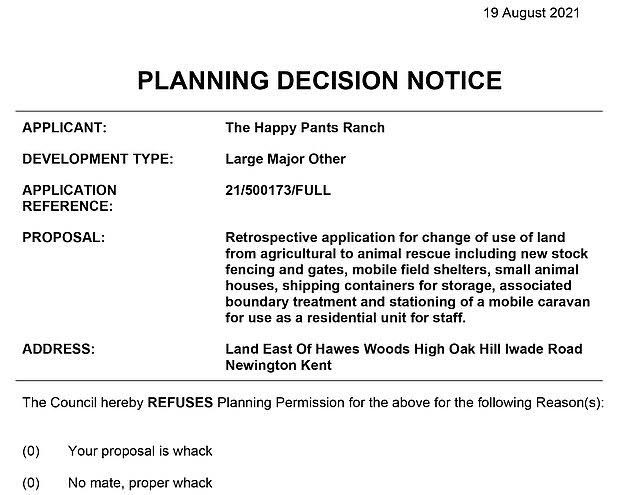
“Your proposal is whack”

Your proposal is whack’: Chaos as ‘junior worker’ who thought he was testing dummy council website rejects and approves REAL planning applications – including allowing two pubs to be demolished – but they’re all legally BINDING (Daily Mail, 9 September 2021):

• “Staff at Swale Council, Kent accidentally rejected or approved five applications

Blunder was made by a ‘junior’ staff member at Mid Kent Planning Support team

The person was trying to resolve software issues, but in doing so, five ‘dummy’ decisions, used to test the website was working, were accidentally published

Among them included the rejection of an animal sanctuary to stay on its site

• Two Kent pubs were also given permission to be demolished or part-demolished

• A butcher’s change-of-use application in Sittingbourne was turned down

A farm was granted planning permission with 20 conditions, listed just as 1 – 20”

It’s certainly not very clever that anyone untrained was left unsupervised with access to the business end of the local planning authority’s IT system. This has obviously caused a big legal mess. Nicola Gooch sets out the law in her 10 September 2021 LinkedIn blog post.

Older lawyers can’t help thinking in Latin, unwelcome in the courts these days but handily concise:

Functus officio – the LPA has made its final decision (to issue the planning permission or refusal notice) and can’t re-open it.

• Administrative decisions are very rarely treated by the court as void ab initio (of no legal effect from the date they were purported to be made, even without a quashing order from the court), no matter how absurd – it takes a formal application to the court for judicial review to undo the mistake by quashing the decision, enabling it to be re-taken.

Accordingly, even with no arguments being made to the contrary by any interested parties, proceedings will need to be issued in the High Court on behalf of the council, a consent order agreed by the parties and then (usually after a wait of several weeks) rubber-stamped by the court – much money and much time wasted.

As Nicola identifies, this is by no means the first example of this sort of thing, although I do find it bewildering – was each decision not only generated by the system but then actually transmitted, without approval of a senior officer with the necessary delegated authority?There is surely a failing in the council’s internal system.

Local Government Lawyer reported in November 2020 as follows on the South Cambridgeshire examples she mentions:

“South Cambridgeshire District Council is to commence proceedings in the High Court after discovering two planning permission errors.

The local authority said one mistake had led to planning permission for an extension and annexe in Steeple Morden being issued in error. The permission was granted despite the application still being open for people to comment on.

“This planning decision, issued without the relevant authorisation, was caused by human error when the wrong box was ticked on the planning computer system,” it explained.

The second case saw a planning permission being issued without the accompanying conditions. It related to the landscaping, layout and other details around eight new homes in Great Abington.

Another mistake was the subject of a ruling by the Scottish Court of Session (Outer House) in Archid Architecture and Interior Design v Dundee City Council (20 August 2013). The Council had intended to refuse an application but instead granted planning permission but with reasons for refusal. It tried to get away with simply issuing a second notice, refusing permission. However, the applicant succeeded in obtaining a declaration from the court upholding the validity of the first notice. The court decided that a decision issued by a planning authority, however legally flawed, is to be treated as valid unless and until it is overturned in court proceedings.

When taken to extremes, this does start to look absurd. Whilst of course people should be able to rely on a planning permission or refusal notice that on the face of the document looks legitimate, the concept is strained when you have a refusal notice with the reason for refusal being “No mate, proper Whack” or, in another Swale example, a planning permission issued with the conditions: “(2) Incy (2) Wincy (3) Spider”. What if he or she had issued a planning permission for development in another district – in South Cambridgeshire, say – would that also be valid until quashed?

Any argument for the “voidable not void” approach on the basis that there needs to be certainty in the system (that a permission is valid until quashed, and that there is a short deadline for legal challenge after which the permission can be relied upon as valid) begins surely to lose some legitimacy when planning permissions are quashed after many years as happened in the Thornton Hotel case I mentioned in my 7 April 2018 blog post Fawlty Powers: When Is A Permission Safe From Judicial Review or this year’s Croyde Area Residents Association, R (On the Application Of) v North Devon District Council (Lieven J, 19 March 2021) where a 2014 planning permission was quashed that had mistakenly authorised development in relation to a wider area than had been intended.

“I hope Al Qaeda bombs the f…… ugly thing”

Chaotic scenes at planning meeting as anger erupts over new West Hampstead development (Camden New Journal, 9 September 2021). The video of two local objectors screaming vitriol at Camden’s Planning Committee last night makes uncomfortable viewing. If you want to understand what the scheme actually was, perhaps read the officer’s report (from page 191) in relation to the application and in particular the plans and images from page 235 to page 257. In my view it is an excellent scheme but that’s nothing really to do with it – there was no excuse for that reaction. We are all entitled to our own views but it is depressing that individuals feel driven to scream at their locally elected representatives like this. I do not use the often unfairly insulting and counter-productive “NIMBY” insult, but you can see why people do.

By this afternoon, the Secretary of State himself was tweeting about it:

And the planning system’s journal of record was of course also soon on the band wagon, ‘I hope Al-Qaeda bombs the f***** ugly thing!’: Moment two women yell abuse at Camden Council bosses for approving four new homes and turning area into a ‘s**t-hole’ before one hurls CHAIR during live-stream meeting (Daily Mail, 10 September 2021).

None of this is healthy.

Simon Ricketts, 10 September 2021

Personal views, et cetera

Thank you to everyone who attended our fantastic Clubhouse event last week with Graham Stallwood, Bridget Rosewell, Alice Lester and James Cross. It was a hard one to beat. This week’s will be a more informal session – do turn up if you would like to say hello – and maybe join some chat about what’s happening in the literally whacky world of planning. Link here.

Beauty & The Beach

Let’s see what more announcements the coming week brings…” was my sign off to last week’s ‘Twas The Week Before Recess blog post.

After this week your holiday reading now includes:

A new NPPF and national model design code

The revised NPPF was published on 20 July 2021, along with the new national model design code and MHCLG’s NPPF & national model design code: response to consultation document, and the announcement of the creation of the Office for Place and its impressive Advisory Board , chaired by Nicholas Boys Smith. There was a Policy Exchange launch event at which the Secretary of State spoke and of course a press statement.

My Town colleague Victoria McKeegan has written a piece for Estates Gazette on the changes, Government parades beauty in revised NPPF (23 July 2021, subscription only).


Here is a comparison of the text as against the February 2019 version and here is a comparison as against the January 2021 proposed changes that I wrote about in my 30 January 2021 blog post Beautiful Day.

Various of us, including Victoria, will be discussing the documents in detail at our clubhouse Planning Law Unplanned session from 6pm on Tuesday 27 July 2021. Do join us, either to listen or to make your views known. A link is here.

The Judicial Review and Courts Bill

The Bill was introduced to Parliament on 21 July 2021. We covered the Government’s March 2021 consultation document on judicial review reform in a recent clubhouse Planning Law Unplanned event, with guest speakers including Celina Colquhoun (39 Essex Street, member of the Lord Faulks Committee which had previously carried out its Independent Review of Administrative Law) and Joshua Rozenberg. The Bill appears not to be as radical as the consultation document, the main proposal of interest being the potential for suspended, or non-retrospective, quashing orders. For more information see Richard Harwood QC’s 22 July 2021 blog post The rise of Incrementalism or Joshua Rozenberg’s 22 July 2021 blog post Fettering the courts’ discretion. The Ministry of Justice’s response to consultation document was published alongside the Bill.

The House of Commons HCLG Committee report on permitted development rights

The Committee’s report was published on 22 July 2021.

I recommend reading the report itself. But some extracts from the summary:

“Whilst we understand the intention behind the recent changes, we have concerns about their impact, including on local planning authorities (LPAs) and the critical role they play in place-making. The ability of LPAs to control permitted development is limited to certain prescribed matters, principally those set out in the prior approval process. We support the use of prior approval and other conditions to control the quality of permitted development, but we heard the regime had become so complicated it was now little different from the full planning system. Furthermore, the Government has not explained how its approach to PDR fits with its proposed reforms in the planning White Paper. In particular, the recent changes appear to contradict the increased focus in the White Paper on plan-led development and local democratic involvement.

For these reasons, we recommend the Government pause any further extensions of permitted development rights for change of use to residential, including the new class MA right, which is due to take effect on 1 August, and conduct a review of their role within the wider planning system. As part of that review, we recommend it set out its long-term vision for permitted development for change of use to residential and explain how it plans to retain the benefits of these PDRs whilst not also sacrificing the ability of LPAs to shape their communities.

We broadly welcome the new use class E, as we can see the advantages of greater flexibility, but we are concerned it allows out-of-town premises, such as office blocks, to convert to retail without having first gone through the sequential test.”

As mentioned above, the revised permitted development regime kicks in on 1 August, further minor permitted development changes have been introduced in the Town and Country Planning (General Permitted Development etc.) (England) (Amendment) (No. 2) Order 2021 (made 7 July 2021) and we still await judgment being handed down by the Court of Appeal in the Rights Community Action judicial review…

Happy summer reading and I hope you can join us on Tuesday evening.

Simon Ricketts, 23 July 2021

Personal views, et cetera

M’lud On The Tracks: HS2

Great Bob Dylan album, almost.

This post collects together in one place some of the recent planning, environmental and compulsory purchase litigation in relation to the High Speed Two rail project.

R (Keir) v Natural England (16 April 2021, Lang J; further hearing before Holgate J, 23 April 2021, judgment reserved)

This is the interim injunction granted by Lang J preventing HS2 and its contractors from varying out works at Jones’ Hill Wood, Buckinghamshire, until either the disposal of the claim or a further order.

The claim itself has Natural England as the defendant and seeks to challenge its grant of a licence under the Conservation of Habitats Regulations 2017 in relation to works that may disturb a protected species of bat.

The question as to whether the injunction should be maintained came back to court yesterday, 23 April, before Holgate J, as well as whether permission should be granted in the claim itself, and he has reserved judgment until 2pm on 26 April.

Secretary of State for Transport v Curzon Park Limited (Court of Appeal hearing, 21 and 22 April 2021, judgment reserved)

This was an appeal by the Secretary of State for Transport against a ruling by the Upper Tribunal on 23 January 2020. My Town Legal colleagues Raj Gupta and Paul Arnett have been acting for the first respondent, landowner Curzon Park Limited, instructing James Pereira QC and Caroline Daly. Thank you Paul for this summary:

The case concerns certificates of appropriate alternative development (‘CAADs’) under the Land Compensation Act 1961. A CAAD is a means of applying to the local planning authority to seek a determination as to what the land could have been used for if the CPO scheme did not exist. Its purpose it to identify every description of development for which planning permission could reasonably have been expected to be granted on the valuation date if the land had not been compulsorily purchased. Importantly, subject to a right of appeal, the grant of a CAAD conclusively establishes that the development is what is known as ‘appropriate alternative development’. This is significant as:

• When compensation is assessed it must be assumed that planning permission for that development(s) in the CAAD either was in force at the valuation date or would with certainty be in force at some future date and

• Following reforms in the Localism Act 2001, where there is, at the valuation date, a reasonable expectation of a particular planning permission being granted (disregarding the CPO scheme and CPO) contained in a CAAD it is assumed that the planning permission is in force which converts the reasonable expectation into a certainty.

There are four adjoining sites, each compulsorily acquired by HS2 for the purposes of constructing the Curzon Street HS2 station terminus at Cuzon Street Birmingham – four different landowners and four different valuation dates (i.e. vesting dates under the GVD process). Each landowner applied for a CAAD for mixed use development including purpose-build student accommodation (PBSA). In the real world, the cumulative effects of the proposed adjoining developments (e.g. including but not limited to the proposed quantum and need for PBSA in light of a PBSA need in the local plan) would have been a material planning consideration. However, Birmingham City Council considered each CAAD application in isolation. The Secretary of State argued that they should have considered the other CAAD applications as notional planning applications and, therefore, as material considerations which would have been very likely to result in CAADs issued for smaller scale mixed-used development being issued leading to a lower total compensation award and bill for HS2. The preliminary legal issue to be determined by the Upper Tribunal and now the Court of Appeal is:

Whether, and if so how, in determining an application for a certificate of appropriate alternative development under section 17 LCA 1961 (CAAD) the decision-maker in determining the development for which planning permission could reasonably have been expected to be granted for the purposes of section 14 LCA 1961 may take into account the development of other land where such development is proposed as appropriate alternative development in other CAAD applications made or determined arising from the compulsory acquisition of land for the same underlying scheme’.

The Upper Tribunal had rejected the landowners’ argument that the scheme cancellation assumption (i.e. disregarding the CPO scheme) under the Land Compensation Act 1961 required CAAD applications on other sites to be disregarded. However, critically, the Tribunal agreed with the landowners’ that CAAD applications were not a material planning consideration and that there was no statutory basis for treating them as notional planning applications as the Secretary of State has argued. The Tribunal also disagreed with the Secretary of State that the landowners’ interpretation of the statutory scheme would lead to excessive compensation pointing out that the landowners’ ability to develop their own land in their own interests was taken away when their land was safeguarded for HS2 and from November 2013 when the HS2 scheme was launched until 2018 when the land interests were finally acquired by HS2 any planning permissions for these sites would have been determined in the shadow of the HS2 scheme and safeguarding of the land. The Secretary of State appealed the Upper Tribunal decision and the Court of Appeal granted permission to appeal in July 2020 noting that the appeal raises an important point on the principle of equivalence (i.e. the principle underpinning the CPO Compensation Code) that a landowner should be no worse off but no better off in financial terms after the acquisition than they were before) which may have widespread consequences for the cost of major infrastructure projects.

A judgment from the Court of Appeal (Lewison LJ, Lindblom LJ and Moylan LJ) is expected in the next month or so.

Sarah Green v Information Officer & High Speed Two Limited (First Tier Tribunal, 19 April 2021)

This was an appeal against the refusal by HS2 Limited to disclose, pursuant to the Environmental Information Regulations 2004, information as to the potential effect of its works on chalk aquifers in the Colne Valley. The information requested was as follows:

What risk assessments have taken place, of the potential increased risk to controlled waters as a result of imminent works by HS2 contractors along the Newyears Green bourne and surrounding wetland?

Are any of the risk assessments independent from the developers (HS2) and where are the risk assessment (sic) accessible to the public?

By the time of the hearing before the First Tier Tribunal, three reports had been disclosed, redacted. The Tribunal summarised the issues before it as follows:

“(1) whether HS2 correctly identified the three reports as being the environmental information which Ms Green requested and whether there was further material held which came within the request;

(2) whether at the time of Ms Green’s request the three reports were “still in the course of completion” or comprised “unfinished documents” and, if so, whether the public interest in maintaining the regulation 12(4)(d) exception outweighed that in disclosure;

(3) whether disclosure of those parts of the three reports which have been redacted in reliance on regulation 12(5)(a) would have adversely affected “public safety” and, if so, whether the public interest in maintaining the regulation 12(5)(a) exception outweighed the public interest in their disclosure.”

The Tribunal found, expressing its reasoning in strong terms, that the public interest in disclosure outweighed the public interest in maintaining any exemption.

“The reports in question in this case concern a major infrastructure project which gives rise to substantial and legitimate environmental concerns. They specifically relate to the risks of contamination to the drinking water supplied to up to 3.2 million people resulting from the construction of the HS2 line. This is clearly environmental information of a fundamental nature of great public interest.”

HS2 appeared to be concerned that “if the versions of the reports current in January 2019 were made public they “… could have been used to try and impact work undertaken in finalising the information”.

“It seems to us that such an approach almost entirely negates the possibility of the public having any input on the decision-making process in this kind of case, which goes against a large part of the reason for allowing public access to environmental information.

The suggestion that public officials concerned in making enquiries and freely discussing options to mitigate environmental problems might be discouraged or undermined by early disclosure of their work seems to us rather fanciful and was not supported by any kind of evidence; the case is not comparable in our view to that of senior officials indulging in “blue sky” thinking about policy options. We accept that the material is “highly technical” but we cannot see why a lack of understanding on the part of the public would have any negative impact on HS2’s work; if a member of the public or a pressure group wanted to contribute to the debate in a way that was likely to have any effect on the decision-making process they would no doubt have to engage the services of someone like Dr Talbot, who would be able to enter the debate in a well- informed and helpful way.”

“HS2’s second main point, that the Environment Agency will be approving and supervising everything, does not seem to us of great weight. Of course the Environment Agency is there to act in the public interest in relation to the environment but its involvement cannot be any kind of answer to the need for public knowledge of and involvement in environmental decisions. The EA is itself fallible and should be open to scrutiny. If the public could simply entrust everything to it there would be no need for the EIR.

HS2’s third main point is that if inchoate information is released it could be misleading and they would incur unnecessary expense correcting false impressions. We were not presented with any specific evidence or examples to illustrate how this problem might have been encountered in practice. It does not seem to us a very compelling point.”

R (Maxey) v High Speed 2 Limited (Steyn J, 10 February 2021)

This was an interim ruling in an application for judicial review, made only nine days previously, of the decision by HS2 Limited to extract the protesters that were occupying the tunnel under Euston Square Gardens and alleging a failure to safely manage Euston Square Gardens in a manner compatible with HS2 Limited’s obligations under the European Convention of Human Rights. It followed a rejection of an application by Mr Maxey for an interim injunction and followed an order made requiring him to cease any further tunnelling activity, to provide certain categories of information to HS2 Limited or others and to leave the tunnel safely, with which he had not complied.

At the hearing, Mr Maxey was renewing his “application for orders requiring (a) the cessation of operations to extract the protesters from the tunnel and (b) to implement an exclusion zone. In addition, the Claimant has expanded the interest relief he seeks to include provision forthwith by the Defendant of (a) oxygen monitoring equipment; (b) a hard-wired communication method; (c) food and drinking water for the Claimant and the protesters; and (d) to make arrangements for the removal of human waste from the tunnel.” He was also seeking to overturn the orders against him.

The judge rejected Mr Maxey’s arguments:

While I accept that the Defendant is (or at the very least there is a good argument that the Defendant is) currently under a duty to take all reasonable steps to protect those in the tunnel under the site (including the Claimant) from death or serious injury, on the evidence before me there is no realistic prospect of the Court finding that the Defendant is breaching its duty. In my judgment, the claim for interim relief does not meet the first test.

That suffices to dispose of the interim relief application. But if it were necessary to consider the balance of convenience, I would have to bear in mind the strong public interest in permitting a public authority’s decision (here a decision to proceed with the operation and a decision as to the necessary safeguards) to remain in force pending a final hearing of the application for judicial review, so the party applying for interim relief must make out a strong case for the grant of interim relief. The Claimant has not come close to establishing a strong enough case to justify the Court stopping the operations to remove those who are in the tunnel, given the compelling evidence as to how dangerous it is for them to remain there.”

R (Packham) v Secretary of State for Transport (Court of Appeal, 31 July 2020)

I summarised this case in my 9 January 2021 blog post Judges & Climate Change. It was Chris Packham’s failed challenge to the Government’s decision to continue with the HS2 project following the review carried out by Douglas Oakervee, the grounds considered by the Court of Appeal being “whether the Government erred in law by misunderstanding or ignoring local environmental concerns and failing to examine the environmental effects of HS2 as it ought to have done” and “whether the Government erred in law by failing to take account of the effect of the project on greenhouse gas emissions between now and 2050, in the light of the Government’s obligations under the Paris Agreement and the Climate Change Act 2008”.

R (London Borough of Hillingdon) v Secretary of State for Transport (Court of Appeal, 31 July 2020)

This case was heard consecutively with the Packham appeal. It related to Hillingdon’s challenge to the Secretary of State’s decision to allow (against his inspector’s recommendations) an appeal against Hillingdon’s refusal to grant HS2 Limited’s application for approval, under the Act authorising the relevant stage of the HS2 project, of plans and specifications for proposed works associated with the creation of the Colne Valley Viaduct South Embankment wetland habitat ecological mitigation. HS2 Limited had refused to provide Hillingdon with information so that an assessment could be made as to the effect of the proposed works on archaeological remains, HS2 Limited’s position being that it was “under no obligation to furnish such information and evidence. It says that this is because it will, in due course, conduct relevant investigations itself into the potential impact of the development upon any archaeological remains and take all necessary mitigation and modification steps. HS2 Ltd says that it will do this under a guidance document which forms part of its contract with the Secretary of State for Transport which sets out its obligations as the nominated undertaker for the HS2 Project.”

Lang J had upheld the Secretary of State’s decision but this was overturned by the Court of Appeal:

“The key to this case lies in a careful reading of Schedule 17 and the powers and obligations it imposes upon local authorities and upon HS2 Ltd. In our judgment, the duty to perform an assessment of impact, and possible mitigation and modification measures under Schedule 17, has been imposed by Parliament squarely and exclusively upon the local authority. It cannot be circumvented by the contractor taking it upon itself to conduct some non-statutory investigation into impact. We also conclude that the authority is under no duty to process a request for approval from HS2 Ltd unless it is accompanied by evidence and information adequate and sufficient to enable the authority to perform its statutory duty.”

[Subsequent note: Please also see London Borough of Hillingdon v Secretary of State for Transport (Ouseley J, 13 April 2021), “Hillingdon 2” where on the facts Ouseley J reached a different conclusion, holding that an inspector had not acted unlawfully in determining an appeal without information sought by the council from HS2 Limited as to the lorry routes to be used by construction lorries to and from the HS2 construction sites within its area].

R (Granger-Taylor) v High Speed Two Limited (Jay J, 5 June 2020)

This was a judicial review claim brought by the owner of a listed Georgian building near Regents Park. The property was separated by a large retaining wall, built in 1901, from the perimeter of the existing railway. “It rests approximately 17 metres from the front of the property and the drop from the level of the road to the railway below is approximately 10 metres. Unsurprisingly, given that the substrate is London clay, the wall has suffered periodic movement and shows signs of cracking. The Claimant’s expert says that it is “metastable”.”

The claimant was concerned as to the engineering solution arrived at for that section of the route, which was known as the Three Tunnels design. “This judicial review challenge is directed to the safety of the Three Tunnels design in the specific context of the outbound tunnel travelling so close to the base of the retaining wall. It is contended on the back of expert engineering evidence that this aspect of the design has engendered an engineering challenge which is insurmountable: in the result, the design is inherently dangerous. The risk is of catastrophic collapse of the retaining wall, either during the tunnelling works or subsequently, which would if it arose cause at the very least serious damage to the Claimant’s property. Consequently, the Claimant asserts a breach of section 6 of the Human Rights Act 1998 because her rights under Article 8 and A1P1 of the Convention have been violated.”

The judge boiled the questions down to the following:

has the Claimant demonstrated that she is directly and seriously affected by the implementation of the Three Tunnels design, given the risk of catastrophic collapse identified by Mr Elliff? In my view, that question sub-divides into the following:

(1) should I conclude on all the evidence that the Three Tunnels design is so inherently flawed in the vicinity of the retaining wall that no engineering solution could be found to construct it safely? and

(2) have the Defendants already committed themselves to implement the Three Tunnels design regardless of any further work to be undertaken under Stage 2?

After detailed consideration of expert engineering expert on both sides, the judge rejected the claim.

Anixter Limited v Secretary of State for Transport (Court of Appeal, 30 January 2020)

This was a compulsory purchase case, about whether an owner of four units on the Saltley Business Park in Birmingham, faced with compulsory purchase of one of them, had served counter-notices in time such as to trigger its potential ability to require acquisition of its interests in all four buildings. The court ruled that it had not.

It certainly seems an age since R (HS2 Action Alliance) v Secretary of State for Transport (Supreme Court, 22 January 2014) where in a previous law firm life I acted for the claimant, instructing David Elvin QC and Charlie Banner (now QC). The case concerned whether the publication by the Government of its command paper, “High Speed Rail: Investing in Britain’s Future – Decisions and Next Steps” engaged strategic environmental assessment requirements and whether the hybrid bill procedure would comply with the requirements of the Environmental Impact Assessment Directive (for more on the HS2 hybrid bill procedure, see my 30 July 2016 blog post HS2: The Very Select Committeehttps://simonicity.com/2016/07/30/hs2-the-very-select-committee/). The loss still grates. And in consequence of that ruling…

There’s a slow, slow train comin’.

Simon Ricketts, 24 April 2021

Personal views, et cetera

Thank you to my Town Legal colleague Lida Nguyen for collating a number of these cases.

Our clubhouse Planning Law, Unplanned session at 6pm on 27 April will follow a similar theme, so if you are interested in issues relating to HS2 or in wider questions as to judicial review, interim injunctions, access to information or compulsory purchase compensation, do join us, whether to contribute to the discussion or just listen in. As always, contact me if you would like an invitation to the clubhouse app (which is still iphone only I’m afraid).

Detail from Bob Dylan’s painting Train Tracks