Do you have a growth mindset? It’s increasingly a challenge just to keep up but, if we don’t, who will? Today’s blog post does no more than try to keep track of some of the latest announcements.
Does the government have a growth mindset? Well, if “growth” isn’t written in big letters on a white board in the Cabinet Room I’ll be surprised.
In terms of planning reforms, the current pace and focus is growth, growth, growth.
Then changes to judicial review procedure in relation to nationally significant infrastructure projects (see my 25 January 2025 blog post DCO JR Changes, #silkyplanoraks).
The Chancellor’s speech , headlined “Chancellor vows to go further and faster to kickstart economic growth”.
The Chancellor’s speech was certainly a very clear mood board as to where she (“I have been genuinely shocked about how slow our planning system is”) and the government are at. In fact it was a smogasbord of specific announcements (listed in Nicola Gooch’s excellent 1 February 2025 blog post) including
delivery of the Lower Thames Crossing (ahead of any formal decision in relation to the current DCO application…)
measures to unlock the potential of the Oxford-Cambridge growth corridor (noting that there have already been “18 submissions for sizeable new developments” along the route of the East West Rail project) and
(the focus of much media attention) support for a third runway at Heathrow.
Stating the obvious, all of these measures will only work with both (1) a sufficiently stable economy and political environment as a basis for business to make long-term investment decisions (Heathrow’s owner will no doubt be deciding whether finally to press the button on the application process, assessing how long-term this political commitment is likely to be and whether the changes announced to DCO and judicial review procedures have gone far enough in practice to avoid another quagmire of legal challenges) and (2) with the necessary resources and experience available to local authorities, the Planning Inspectorate and statutory consultees. And in addition, another reason why “our planning system is so slow” is because there are always fresh legal pitfalls to avoid (eg see Campaigners hail “important victory” in protection of England’s national parks (Guardian, 1 February 2025).
Of course, there are always calls for the government to go even further. Someone brought to my attention Times’ columnist Emma Duncan’s piece this week, Time for Starmer to cut out the planning lawyers, which ends “What Reeves is doing to the bats she now needs to do to the planning lawyers”. No more living in a £100 million bat tunnel for me. 😥
Congratulations to those in our planning world who have been recommended to be appointed as King’s Counsel in the latest round – Zack Simons (presumably now #silkyplanoraks), Sasha Blackmore and Harriet Townsend.
It occurs to me that belated congratulations are also due to Sarah Sackman KC MP, who many of us know primarily as a superb planning and public law advocate, first at Francis Taylor Building and then Matrix Chambers, but who of course became MP for Finchley and Golders Green in July 2024. She took silk on being appointed as Solicitor General on entering the House of Commons and since 2 December 2024 has been Minister of State in the Ministry of Justice.
I mention Sarah’s background because it is important: we have one of our own, who understands the practical nuances of planning and public law and the operations of the judicial review process, at the heart of government.
There has been much press attention this week on the Prime Minister’s announcement on 23 January 2024, Prime Minister clears path to get Britain building as to changes to be made to procedures governing legal changes of development consent order decisions in relation to nationally significant infrastructure projects, following first the report by Lord Banner KC and subsequent consultation that I summarised in my 28 October 2024 blog post Banner Review Into Legal Challenges of NSIPs.
However, the proposals themselves were announced in more detail in a written statement to the House of Commons that day by Sarah Sackman: Infrastructure Planning and Judicial Review Reform. Working through that statement, first of all the background is set out:
“The delivery of major infrastructure projects is central to the Government’s mission to drive growth and unlock clean power. The largest and most complex of these projects currently require a Development Consent Order (DCO) under the Nationally Significant Infrastructure Projects (NSIPs) regime established by the Planning Act 2008.
The number of legal challenges against DCOs has spiked in recent years, with 58% of decisions being subject to legal challenge. Delays to these major projects have serious implications, including holding back the delivery of essential benefits to the country and imposing considerable additional costs on development.
Despite 30 challenges being brought against major infrastructure projects, only four decisions to approve a project have been overturned by the courts. It comes as research shows that, on average, each legal challenge takes 1.4 years to reach a conclusion and the courts have spent over 10,000 working days handling these cases. Such cases impact upon the use of public money, with major road projects paying up to £121 million per scheme due to delays in legal proceedings. Whilst it is fundamental that the public can challenge the lawfulness of government decisions, there is scope for rebalancing the judicial review process to improve efficiency and reduce delays to NSIPs.”
Few of us would disagree with this.
The statement then sets out the specific changes that are to be introduced in relation to claims for judicial review in relation to DCOs:
Once the claim is made, there will not be an initial High Court stage where a judge considers “on the papers” whether the case is arguable, instead the issue of arguability and as to whether the case should proceed to a full hearing will be considered by a judge at a short hearing. (This is already the case in relation to applications to challenge inspectors’ decision letters in relation to enforcement notice appeals under section 289 of the Town and Country Planning Act 1990, where indeed there is no subsequent right to apply to the Court of Appeal for permission to proceed if the High Court judge finds the challenge to be unarguable,. Indeed, the deadline for bringing such challenges is four rather than six weeks!).
This change follows Lord Banner’s recommendation. The government’s consultation paper had floated the possibility of extending the change to all judicial reviews but this week’s announcement is entirely limited to DCO judicial reviews.
If the judge at that short permission hearing deems the case to be “totally without merit” (i.e. bound to fail), it will not be possible to ask the Court of Appeal to reconsider. At present if the judge considers “on the papers“ that a case is totally without merit, the claimant cannot renew its application for permission before a judge at a short hearing, but can only appeal to a Court of Appeal judge who will determine the appeal on the papers. So, there will be one bite at the cherry – at a short hearing before a High Court judge – rather than two paper stages with no hearing. Given that “totally without merit” grounds are not difficult to identify, is this really very radical?
“non-mandatory” case management conferences will be introduced – sensible and reflecting one of Lord Banner’s recommendations.
All DCO judicial reviews will be designated as significant planning law claims. This is important because specific timescale targets then apply at the High Court stage (not the Court of Appeal) as to how speedily they should be dealt with. However, the issue is somewhat academic given that according to Lord Banner’s report all DCO judicial reviews to date have in practice been treated as significant planning law claims!
The government will “work with the judiciary to introduce target timescales for NSIP judicial reviews in the Court of Appeal and in the Supreme Court”. Given the delays that do happen at these later stage this would be very welcome.
Unsurprisingly the announcement has generated flak on the one hand from those who see the changes as reducing access to justice (see e.g. the Law Society’s position, Society counsels caution over JR curbs (25 January 2025), with comments from Law Society president Richard Atkinson that “Removing the paper permission stage could increase both the cost and length of permission hearings”. “‘It is possible that the certainty of higher costs – especially so early in the case, before permission is even granted – could discourage a claimant to the extent that it raises concerns for access to justice”. “Requiring oral hearings for all permission applications may also lengthen these proceedings, as it prevents those that could be easily dealt with from progressing more quickly.”) and on the other hand from those primarily acting for promoters who see the measures as not going far enough (see e.g. Judicial review reform ‘one step’ to enabling UK infrastructure development (24 January 2025) where infrastructure planning law guru Robbie Owen is quoted as saying that “these changes to judicial review are a step in the right direction but they are relatively minor and do not move the dial nearly enough. The government should be providing for any nationally significant infrastructure project that is a critical national priority to be immune from judicial review altogether, by the DCO for the project being confirmed by parliament through a one clause bill after it has been through the DCO process successfully”)
I don’t agree with either extreme. Mr Atkinson is wrong in what he says: any judicial review claimant at the moment needs to factor in the likely need for a permission hearing in any event (of the 27 challenges determined at the time of the Banner report, only 7 had received permission on the papers – and only 2 did not renew after being refused on the papers. 8 proceeded to a full or rolled-up hearing in any event). Robbie’s approach in my view goes too far the other way and takes away the necessary backstop that is needed by way of judicial review.
However, I do think there is more that could be done by way of changes in due course, in some cases not limited to DCO judicial reviews:
Why not reduce the challenge deadline for DCO judicial reviews from six weeks to four weeks, but at the same time take the opportunity to rectify the issue frequently arising on statutory challenges of all kinds as regards the current need to serve on the parties within that period, by allowing claimants seven days to serve on the defendant and interested parties, after the claim has been filed? By the time the DCO decision has been issued, any claimant will have been engaged for a long time in the process and will have secured access to legal advice. All that remains to be scrutinised is the Secretary of State’s reasoning for the decision – follow the precedent set in the case of enforcement notice appeals.
In the case of non DCO judicial reviews within the remit of the Planning Court, tighten up the requirement for pre-action protocol letters, such that the guidance makes clear that they should be sent as soon as grounds for potential judicial review are considered by a potential claimant to arise, for instance when a local planning authority has resolved to grant planning permission but ahead of the permission being issued. Presently, most potential claimants store up their potential grounds of challenge until the permission has been issued and there is nothing in practice that the local planning authority can do to remedy the position even if it accepts the position set out in the PAP letter. There could be the warning that non-compliance with this guidance may be taken into account in decisions as to the award of costs and as to cost-capping.
Much litigation in this field nowadays is crowdfunded. The Government might give thought as to whether greater controls are required as to the use of crowdfunding in relation to litigation and particularly whether sufficient information is given to potential contributors as to the precise nature of the action contemplated, its prospects of success and the implications of a successful outcome (i.e. usually simply resulting in redetermination) and how funds are used if no action is lodged.
More information should be made available by the courts, particularly the orders made at permission stage so as to inform decisions taken by subsequent claimants and as to the High Court’s and Court of Appeal’s performance as against timescale targets.
Lastly, what possible basis is there for not extending the changes announced to cover legal challenges to the adoption of local plans and in due course spatial development strategies?
There is always a need for judicial overview of decision making. But there is also always a need for speed – justice delayed is justice denied. Bridget Rosewell’s review was an important catalyst for improvement in relation to the Planning Inspectorate’s administration of planning appeal inquiries, at no cost to the quality or fairness of the process itself. The DCO judicial review changes announced this week to my mind are in a similar vein, although I do agree with Robbie that they are relatively minor. Let’s not give up looking for those incremental gains.
Making the planning system work more effectively should not be party political. So it is at least a good start to see that conservative life peer Charles Banner KC’s Independent review into legal challenges against Nationally Significant Infrastructure Projects (28 October 2024), commissioned by the previous government, has now been published by the current government. There is nothing very radical in it but, when it comes to making the planning system and associated litigation process work better, surely so much comes down to a version of Sir Dave Brailsford’s theory of marginal gains (see for example the undoubted success which was Bridget Rosewell’s review of planning inquiry processes).
LCB (is that yet an acceptable acronym?) had been appointed alongside fellow barrister Nick Grant in March 2024 to “explore whether NSIPs are unduly held up by inappropriate legal challenges, and if so what are the main reasons and how the problem can be effectively resolved, whilst guaranteeing the constitutional right to access of justice and meeting the UK’s international obligations.”
As per the Government’s press statement that accompanies the review, the Ministry of Justice has now separately published a call for evidence, based on his recommendations, ending on 30 December 2024 – “the Government is of the view that further analysis of a broader evidence base is necessary before decisions can be taken on the Review’s recommendations”.
Charlie Banner and Nick Grant had clearly put in the hours. It’s a well-thought through document. The review contains much useful background as to the current position, including analysis of the 34 challenges to DCOs which have been brought (30 of which have challenged the grant of a DCO and of which 4 claims were successful), average timescales for each stage of the process and some of the wider implications arising. This is valuable work – I’ve grumbled previously as to how unnecessarily difficult it can be to extract data like this.
They interviewed over 60 people with experience in the field (I’ll declare an interest as being one of many spoken to. I’m feeling rather guilty now for the whole hour that I took up…).
Ten recommendations are made, which I summarise as follows, adding anything particularly interesting from the Government’s accompanying call for evidence as I go:
Recommendation 1 – For so long as the UK remains a member of the Aarhus Convention, there is no case for amending the rules in relation to cost caps in order to reduce the number of challenges to NSIP.
Recommendation 2 – There is no convincing case for amending the rules in relation to standing to reduce the number of challenges to NSIPs.
Views not sought on this option.
Recommendation 3 – The current three bites of the cherry to obtain permission to apply for judicial review is excessive and should be reduced to either two or one: (1) an oral hearing in the High Court with a target timescale of within four weeks of the deadline for filing of acknowledgements of service and (2) consideration on the papers in the Court of Appeal within four weeks of the application for permission to appeal against the refusal of permission to apply for judicial review.
The commentary in the call for evidence document is interesting, pointing at the potential for any such changes to apply to judicial reviews of other planning decisions:
“If the proposed change could result in time and cost savings for litigants and the courts, whilst maintaining adequate access to justice, there could be merit in considering this change not only in the context of NSIPs but also for judicial reviews of other planning decisions in general.
The Government is, however, of the view that more evidence is required to inform a decision on the implementation of this proposed change. We would, therefore, welcome views on the expected benefits and potential risks of this change, both in the context of the NSIP regime and in wider judicial review cases.”
Recommendation 4 – There may be a case for raising the permission threshold for judicial review claims challenging DCOs, which could be achieved by amendments to the CPR.
“The Government is of the view that in addition to the practical risks highlighted in the report, there is a more fundamental concern that raising the permission threshold in this way could unduly restrict the right of access to justice…the Government would however welcome views with supporting evidence,where available, on the likely benefits and potential risks of raising the permission threshold as discussed in the report.”
Recommendation 5 – On balance the case has not yet made out for a panel of judges with specialist NSIP experience to be eligible to hear judicial review challenges to DCO decisions.
The call for evidence document notes that there are currently 35 full time High Court judges authorised to consider planning cases, four of whom specialised in planning as practitioners prior to joining the judiciary.
“The Government would welcome views on whether this idea should be taken forward, whilst recognising that the authorisation of judges to hear certain types of case is part of judicial allocation and deployment which is a matter for the judiciary. We would particularly welcome views from members of the judiciary.”
Recommendation 6 – The Civil Procedure Rules should provide that DCO judicial reviews are automatically deemed Significant Planning Court Claims.
(This is important because stricter target timescales apply. All DCO judicial reviews to date have been treated as such – so this should not be controversial…).
“Given the national significance of NSIPs and the complexity of the claims against them, there is a case for formalising the existing practice of designating all judicial review cases concerning DCO decisions as Significant Planning Court Claims. The Government would, however, welcome views on the practical benefits of formalising this existing practice.”
Recommendation 7 – Automatic pre-permission case management conferences should be introduced in relation to judicial review claims challenging DCOs.
Views sought.
Recommendation 8 – Target timescales should be set for the Court of Appeal to target timescales for determine applications for permission to appeal, and (where permission is granted) thereafter substantive appeals.
“The Government considers that a better understanding of the causes of the current delays at the Court of Appeal and the Supreme Court is needed to determine whether imposing target timescales would help to ensure consistent timely processing of DCO judicial reviews at the appellate courts. In addition, although the report suggests that the relatively limited number of DCO judicial review claims means that these timescales should not be too onerous on the courts, we would welcome views, particularly from the senior judiciary, as to how the introduction of target timescales might affect the operation of the appellate courts.”
(NB somewhat deferential? There are undoubtedly delays at the appeal stages. delays which look to mere mortals to be capable of reduction…)
Recommendation 9 – The President of the Supreme Court should be invited to consider amending the Supreme Court Rules to introduce target timescales for the determination of applications to the Supreme Court for permission to appeal in judicial review challenges to DCOs.
Same commentary as for recommendation 8.
Recommendation 10 – The Planning Court and Court of Appeal should be invited to publish data on a 3 month rolling basis which, at minimum, should indicate the number and percentage of cases which in the last 3 month period have met the target timescales either for NSIP cases specifically or Significant Planning Court cases generally, or both; as well as what the average and maximum turnaround times have been in that period (for both the permission and the substantive stages).
“This recommendation to invite the Planning Court and the Court of Appeal to improve the way they publish data on the progress of DCO judicial reviews and/or planning cases would not directly address the issue of delays, but it could, as the report notes, provide stakeholders with greater transparency and help inform consideration of further procedural reforms. The report also suggests that this could be easily implemented at little or no additional cost. The Government would welcome views on the likely benefits and potential costs of this proposal.”
The Government is also welcoming views as to:
The review and its methodology more generally and whether there is indeed a case for streamlining the process for judicial reviews of DCO decisions
other possible changes that could help reduce judicial review related delays to the delivery of NSIPs and provide parties greater certainty in the process. Any proposed change must, however, ensure the right of access to justice is maintained in line with the UK’s domestic and international legal obligations.
Sir Keir Starmer’s speech on 14 October 2024 at the international investment summit held at the Guildhall in the City of London generated much media coverage. This blog post is going to look briefly at the references he made in that speech to the planning process.
But first of all, I do draw attention to the important document published by the Government alongside the conference: Invest 2035: the UK’s modern industrial strategy(14 October 2024), now being consulted upon until 24 November 2024.
Some snippets:
“Eight growth-driving sectors have been identified: Advanced Manufacturing, Clean Energy Industries, Creative Industries, Defence, Digital and Technologies, Financial Services, Life Sciences, and Professional and Business Services.”
“A core objective of the Industrial Strategy is unleashing the full potential of our cities and regions. The Industrial Strategy will concentrate efforts on places with the greatest potential for our growth sectors: city regions, high-potential clusters, and strategic industrial sites. The Government is committed to devolving significant powers to Mayoral Combined Authorities across England, giving them the tools they need to grow their sectoral clusters and improve the local business environment through ambitious Local Growth Plans. Partnership with devolved governments will make this a UK-wide effort and support the considerable sectoral strengths of Scotland, Wales, and Northern Ireland.”
“The Industrial Strategy and growth-driving Sector Plans will be published alongside the Spending Review in Spring 2025.”
Under the “energy and infrastructure” section:
“An effective planning system is a fundamental enabler for business investment in our growth-driving sectors. At the national and regional level, planning constraints hold back growth, including in high-performing life sciences clusters like Cambridge and clean energy industries hubs such as Tees Valley and the North-East. Firms require predictability and efficiency when applying for consent for projects, but this is not being provided by existing processes. Businesses have told us that the planning consent process is too lengthy and uncertain – infrastructure projects spend an average of 65 months in pre-construction phases, the highest among peer countries.”
“Targeted, long-term infrastructure investment is a vital catalyst to the success and stability of major city regions and clusters of our growth-driving sectors. Businesses agree that the UK has for too long failed to provide a long-term vision and clear statement of intent to support this. A lack of housing in some places across the UK also prevents labour markets from operating effectively and prevents successful agglomerations. Further, additional data centre capacity and access to fast, secure, and reliable digital connectivity is essential to enabling economic growth and to reap the transformational productivity benefits of digitalisation and the adoption of AI. Continued investment is needed to meet our ambitious targets to bring gigabit-capable broadband to all of the UK, and standalone 5G to all populated areas, by 2030.”
Under a section entitled “Growing high-potential clusters”:
“The Industrial Strategy will concentrate efforts on places with the greatest potential for the growth sectors: city regions, high-potential clusters, and strategic industrial sites. The success of the Industrial Strategy’s growth-driving sectors can only be achieved if these clusters reach their full potential, supported through a place-based approach to policy.
Local Growth Plans are a cornerstone of the place-based approach. These locally owned, 10-year strategies will set out how Mayoral Combined Authorities (MCAs) will use their devolved powers and funding to drive growth in their region. They will build on the region’s unique strengths and opportunities to support sectors, identify wider business environment priorities, and provide a framework to unlock private investment. They represent strategic partnerships between central Government and MCAs to identify priorities for growth and will be aligned to the Industrial Strategy.
Alongside this, the Government will explore how to build on existing place-based initiatives to support high-potential clusters and align them behind the Industrial Strategy. This includes considering how the Industrial Strategy can be a ‘lens’ for informing the recommendations for New Towns locations, creating new large-scale settlements in places where high housing demand constrains the growth of high-potential clusters.”
Now to Keir Starmer’s summit speech. I have copied and pasted the passages most relevant to the planning system. (I do apologise that the format of the transcript makes it appear rather lyrical)
“Now, I don’t see regulation as good or bad.
That seems simplistic to me.
Some regulation is life-saving…
We have seen that in recent weeks here, with the report on the tragedy of Grenfell Tower.
But across our public sector…
I would say the previous Government hid behind regulators.
Deferred decisions to them because it was either too weak or indecisive…
Or simply not committed enough to growth.
Planning is a very real example of that…
Or – for our friends from across the pond…
‘Permitting’ is a really clear example of that…”
“we’ve also got to look at regulation – across the piece.
And where it is needlessly holding back the investment we need to take our country forward…
Where it is stopping us building the homes…
The data centres, the warehouses, grid connectors, roads, trainlines, you name it…
Then mark my words – we will get rid of it.
Take the East Anglia 2 wind farm.
A £4 billion investment.
One Gigawatt of clean energy.
An important project – absolutely.
But also the sort of thing a country as committed to clean energy as we are…
Needs to replicate again and again.
Now regulators demanded over four thousand planning documents for that project…
Not 4000 pages – 4000 documents.
And then six weeks after finally receiving planning consent…
It was held up for a further two years by judicial review.
I mean – as an investor…
When you see this inertia…
You just don’t bother do you?
And that – in a nutshell…
Is the biggest supply-side problem we have in our country.
So it’s time to upgrade the regulatory regime…”
Is the focus of his criticism the influence on the planning system of those aspects which are regulated (or at least the subject of oversight) from the likes of the Environment Agency and Natural England, is it the planning system itself, or is it the role of the courts? Or all of the above? I’m not sure that Anglia Two was particularly an example of where the regulatory regime needs to be (or at least can in a straight-forward way be) “upgraded”, but the previous government of course did of course commission Lord Banner KC in March 2024 to lead a review to “explore whether NSIPs are unduly held up by inappropriate legal challenges, and if so what are the main reasons and how the problem can be effectively resolved, whilst guaranteeing the constitutional right to access of justice and meeting the UK’s international obligations.” It would have been better if perhaps the current government had published the report (assuming it is concluded) alongside Monday’s speech because, guess what, it may point to some of the answers. When can we see it?
DCOs authorising construction of the East Anglia ONE North and East Anglia TWO Offshore Wind Farms with associated onshore and offshore development were granted on 31 March 2022, the case for challenge having been found to be arguable. The challenge to those DCOs, brought by a campaign group Substation Action Save East Suffolk Limited was rejected in the High Court on 13 December 2022 (relatively speedy as far as this sort of litigation is concerned – the Planning Court does generally make sure that cases move at a pace). As is often the way, the greater delay then came at Court of Appeal stage, with the Court of Appeal only dismissing the group’s appeal on 17 January 2024. Any planning lawyer will say the same: get the Court of Appeal operating at the pace of the Planning Court. The Court of Appeal’s judgment in R (Substation Action Save East Suffolk Limited) v Secretary of State (Court of Appeal, 17 January 2024) was summarised by my Town Legal colleague Jack Curnow here.
Some of you will have been at, or heard the subsequent 50 Shades of Planning podcast recording of, our recent Town Legal/Landmark Chambers 100 Days of Labour event. I did ten minutes on what had emerged to that point in relation to commercial and infrastructure development. If only we had waited a week or so! People may find interesting this table of decisions on recovered appeals, call-ins and DCOs (in relation to all types of development) since 4 July 2024, prepared by Town Legal’s Victoria Porter alongside Landmark Chambers’ Edward Arash Abedian, and which shows a 100% approval rate for each to date…
Labour announced on 9 June 2024 that, if in power, it would:
“Take control of the planning process by classifying prisons as being of ‘national importance’ on public safety grounds, so the approval decision is in ministers’ hands.”
It made me smile, given that in practice recent decisions in relation to new prisons have already been in ministers’ hands by way of recovered planning appeals. Labour’s announcement is possibly pointing towards including prisons within the scope of the Planning Act 2008 nationally significant infrastructure projects regime, although it is of course carefully enigmatic.
Securing planning permission for new prisons is slow and difficult, given the usual extent of local objections. Three recent examples:
Proposed new category C prison (up to 67,000 sq m gross external area) within a secure perimeter fence adjacent to HMP Grendon and HMP Springhill, Grendon Underwood, Edgcott
This application was submitted to Buckinghamshire Council for approval in June 2021 and was refused by committee, on officers’ recommendations) in March 202. The Ministry of Justice appealed. An inquiry took place in January and February 2023, lasting for eight days. The appeal was allowed by the Secretary of State, on the inquiry inspector’s recommendation, on 20 January 2024.
I note in passing that the constituency MP, Greg Smith (Conservative), standing again in this election, has described Mr Gove’s decision on his website as “devastating and preposterous”:
“Needless to say, my faith in the whole Planning Inspectorate has now hit absolute zero. Local people said no, Buckinghamshire Council as the planning authority said no, but this potty system has walked all over local wishes. It’s not right.”
Proposed new category B prison (up to 82,555 sq m gross external area) within a secure perimeter fence adjacent to HMP Gartree, Market Harborough
This application was submitted to Harborough District Council in September 2021. It was refused at planning committee against officers’ recommendations in April 2022. The Ministry of Justice appealed. An inquiry took place in October 2022 and the appeal was allowed by the Secretary of State, contrary to the inquiry inspector’s recommendation, on 15 November 2023.
The constituency MP, Neil O’Brien (Conservative), standing again in this election, has been one of the objectors to the proposal.
Proposed new prison adjacent to HMP Garth and HMP Wymott, Leyland, Lancashire
This application was submitted to Chorley Borough Council and was refused, again against officers’ recommendations, in December 2021. Following an inquiry held in July 2022, the Secretary of State determined on 19 January 2023 (unusually) that notwithstanding the inquiry inspector having recommended dismissal, the Secretary of State was minded to allow the appeal, subject to giving the parties the opportunity to provide further evidence on highways matters. He then decided on 6 April 2023 to reopen the inquiry. It reopened in March 2024 and the outcome is awaited.
The constituency MP, Katherine Fletcher (Conservative), standing again in this election, has been one of the objectors to the proposal.
That tension between national politics versus local politics, time and time again.
What’s the answer? I’m not sure that it is to bring new prisons within the Planning Act 2008 regime, as nationally significant infrastructure projects. First, this would be likely to require primary legislation to bring prisons within the definition of “infrastructure” and secondly it is such a procedurally onerous process! Alternatives would be to use the special development order route under section 59 of the Town and Country Planning Act 1990 or to promote the projects as Crown development under section 293D of the 1990 Act. However, whichever the route and whichever the party in government, shall we start with some specific national policy guidance…?
(from The Rime of the Ancient Mariner, by Samuel Taylor Coleridge, 1834)
But that’s all I’m going to say about MIPIM. This post is just a toe dip into (1) flood risk and (2) water scarcity.
Water Water Everywhere
Government policy on planning and flood risk is set out in paragraphs 165 to 175 of the current December 2023 version of the NPPF, supplemented by Government’s Planning Practice Guidance on flood risk and coastal change. The Environment Agency is the Government’s statutory planning consultee on flood risk issues.
The proper interpretation of the Government’s policy on flood risk, and in particular on the risk-based sequential approach to locating development which is at the heart of it, was considered in two recent cases. In relation to each of them I am simply going to point to the relevant Town Library summary (to subscribe for free to our weekly case law and other summaries click here ).
My colleague Jack Curnow summarised this case here. This was a legal challenge to two development consent orders for the construction of the East Anglia ONE North and East Anglia TWO Offshore Wind Farms together with associated onshore and offshore development. The environmental statement for the project dealt with flooding from surface water stated that the onshore substations and National Grid Infrastructure were located in areas primarily at low risk of surface water flooding, with some permanent infrastructure (parts of access roads) likely to cross areas at both high risk and medium risk of surface water flooding, with appropriate mitigation measures within the design to address any remaining surface water flood risk concerns. The court held that the sequential approach does not apply to the risk of flooding from surface water, as opposed to the risk of fluvial flooding. Whilst the risk of flooding from surface water is to be taken into account when deciding whether to grant development consent, that is a matter of planning judgment for the decision maker.
My colleague Chatura Saravanan summarised this case here. This case dealt with two challenges to inspectors’ decision letters:
a) a decision to dismiss the appeal by Mead Realisations Limited against the refusal by North Somerset Council for a residential development of up to 75 dwellings; and
b) a decision to dismiss the appeal by Redrow Homes Limited against the refusal by Hertsmere Borough Council for a residential development of up to 310 units and other facilities.
The claims were heard together as they raised the common central issue of what is the correct interpretation and application of the flood risk sequential test. Specifically, Mead and Redrow argued that the Inspectors misinterpreted paragraph 162 (now 168) of the NPPF in identifying what might be “reasonably available” sites under the sequential approach, in that they applied the guidance in paragraph 028 of the PPG, which conflicted with paragraph 162 of the NPPF. This raised the question of whether the PPG did indeed conflict with the NPPF and, if so, whether the NPPF should supersede the PPG.
Holgate J held that there was no rule that the PPG could not be inconsistent with the NPPF:
“As a matter of policy, PPG is intended to support the NPPF. Ordinarily, therefore, it is to be expected that the interpretation and application of PPG will be compatible with the NPPF. However, I see no legal justification for the suggestion that the Secretary of State cannot adopt PPG which amends, or is inconsistent with, the NPPF”.
However he held that in any event there was no conflict in any event:
“The PPG performs the legitimate role of elucidating the open-textured policy in the NPPF. The PPG describes “reasonably available sites” as sites “in a suitable location for the type of development with a reasonable prospect that the site is available to be developed at the point in time envisaged for the development.” The PPG provides for issues as to suitability of location, development type, and temporal availability to be assessed by the decision-maker as a matter of judgment in accordance with the principles set out above. In this context, the PPG correctly states that “lower-risk sites” do not need to be owned by the applicant to be considered “reasonably available.” That is consistent with the need for flexibility on all sides.”
For a number of more detailed arguments raised by the claimants (and all rejected), it’s worth reading the case itself or Chatura’s summary.
Nor Any Drop To Drink
Water scarcity is becoming one of those worrying “neutrality” issues which can cut across the more familiar uncertainties of the planning system – see the ongoing issues in Sussex referred to in my 9 October 2021 blog post Development Embargos: Nitrate, Phosphate & Now Water .
Another area where water scarcity concerns have been raised is of course Cambridge (where Samuel Taylor Coleridge was an undergraduate at Jesus College between 1791 and 1794 – these blog posts aren’t just thrown together). The Secretary of State’s 24 July 2023 long-term plan for housing committed to “transformational change” in Cambridge:
“Proposals will see Cambridge supercharged as Europe’s science capital, addressing constraints that have left the city with some of the most expensive property markets outside London, and companies fighting over extremely limited lab space and commercial property with prices that rival London, Paris and Amsterdam.
These ambitious plans to support Cambridge include a vision for a new quarter of well-designed, sustainable and beautiful neighbourhoods for people to live in, work and study. A quarter with space for cutting-edge laboratories, commercial developments fully adapted to climate change and that is green, with life science facilities encircled by country parkland and woodland accessible to all who live in Cambridge.
Any development of this scale will have substantial infrastructure requirements. The government will deliver as much of the infrastructure and affordable housing as possible using land value capture – with the local area benefiting from the significant increase in land values that can occur when agricultural land is permitted for residential and commercial development. Land values will reflect the substantial contributions required to unlock the development (see annex).
A Cambridge Delivery Group, chaired by Peter Freeman and backed by £5 million, will be established to begin driving forward this project. The Group will work to turn this vision into a reality, taking a lead on identifying the housing, infrastructure, services and green space required. It will also consider options for an appropriate delivery mechanism that will be needed to lead the long-term work on planning, land acquisition and engagement with developers, starting in this Parliament but running through the next few years as development takes shape.”
The Delivery Group was to “take forward immediate action to address barriers such as water scarcity across the city, including:
Convening a Water Scarcity Working Group with the Environment Agency, Ofwat, central and local government and innovators across industries to identify and accelerate plans to address water constraints. The Group will include all relevant partners to understand what it would take to accelerate building the proposed new Fens Reservoir and enabling Cambridge to reach its economic potential.
Supporting the council in efforts to make sure new developments proposed as part of the local plan can be as sustainable as possible, including whether new houses in planned developments such as Waterbeach and Hartree can be made more water efficient. To support this, the government is announcing today a £3 million funding pot to help support measures to improve the water efficiency of existing homes and commercial property across Cambridge, to help offset demands created by new developments in the local plan.
The government will also take definitive action to unblock development where it has stalled, providing £500,000 of funding to assist with planning capacity. Cambridge City Council, Anglian Water, Land Securities PLC and Homes England will work together to accelerate the relocation of water treatment works in Northeast Cambridge (subject to planning permission), unlocking an entire new City quarter – delivering approaching 6,000 sustainable well-designed homes in thriving neighbourhoods – as well as schools, parks and over 1 million square feet of much needed commercial life science research space.”
“Our first priority is water scarcity, which is holding back development and risks causing environmental harm. It is vital that the city has the water supply it needs to support long-term growth, including a new reservoir in the Fens and a new pipeline to transfer water from nearby Grafham Water. We are also making a one-off intervention to support growth in the shorter-term by delivering water savings through improved water efficiency of appliances in existing buildings that can offset new homes and commercial space.
The government will:
Deliver a unique offsetting intervention to save water now through improving efficiency and support sustainable growth – set out in detail in a paper published alongside this document.
Issue a joint statement from the Environment Agency, Greater Cambridge Shared Planning, DLUHC and Defra, outlining our commitment to sustainable growth and development on the basis of our water credits scheme.
Appoint Dr Paul Leinster to chair the Water Scarcity Group to advise the government on future water resource options, including the reservoir in the Fens and the Grafham Water pipeline.”
Alongside the case for Cambridge document, a joint statement between DLUHC, Defra, the Environment Agency and Greater Cambridge councils (Cambridge City and South Cambridgeshire districts) on measures to address water scarcity issues in the area was published on the same day, setting out its proposed scheme to develop, and help to fund, a water credits market “intended to provide greater certainty through:
a. The delivery of water savings measures in the Cambridge Water operating area, supported by the government’s spending.
b. A robust water credit system being in place to assure those water savings and issue credit certificates to developers and housebuilders.
c. Application of enforceable planning mechanisms so that planning permissions are linked to water savings measures in a robust way.”
The focus is of course welcome but water scarcity is increasingly going to be a challenge facing us in many parts of the country– see for instance this 4 September 2023 FT article The UK is at risk of running low on water. Why? (although the answer to the question in the heading to the article may lie in its sub-heading: “A country famous for its rainy climate faces grave supply issues, after years of poorly managed systems”…)
Turbulent times as the Conservative party desperately looks to position itself for the next general election, still mindful, it seems, of its narrow, anti-ULEZ fuelled, win in the Uxbridge and South Ruislip by-election in July 2023.
I wonder if the prime minister has recently read chapter 9 of the NPPF (“Promoting Sustainable Transport”)?
I wonder if the prime minister recalls that since 1 June 2023 a new Government quango, Active Travel England is a statutory consultee on all large planning applications to “to help planning authorities in their work to implement good active travel design – for example, by ensuring developments include walking, wheeling and cycling connectivity to schools and local amenities. This will help improve public health, save people money and reduce harmful emissions.” ATE’s framework document may be seen as dangerously woke in this new political climate, aiming to deliver increases in active travel to 50% of all journeys in urban areas.
“End the sale of new petrol and diesel cars and vans from 2030; from 2035, all new cars and vans must be zero emission at the tailpipe.” (long gone)
“Increase the share of journeys taken by public transport, cycling and walking.”
“Invest £2 billion in cycling and walking, building first hundreds, then thousands of miles of segregated cycle lane and more low-traffic neighbourhoods with the aim that half of all journeys in towns and cities will be cycled or walked by 2030. As announced in the Transport Decarbonisation Plan, we will create at least one zero emission transport city.”
The party’s Manchester conference saw two major policy announcements by the Government on transport (neither made first to Parliament as convention requires):
From the foreword to the Plan for Drivers, the car is king again:
“There’s nothing wrong with driving. Most of us use a car and, for many, life would not be liveable without their car. For those in rural areas, it is a lifeline. A car can hugely expand the independence of a younger person, as well as keep older people connected to key services and their families.”
There is the rather grudging nod to other modes of transport, but whatever you do, don’t vilify the private car:
“Walking, cycling and public transport are necessary in a multi-modal transport system and we support their continued growth, but they are not the right choice for everyone’s journey. Being pro-public transport does not mean being anti-car. The easy political choice is to vilify the private car even when it’s been one of the most powerful forces for personal freedom and economic growth in the last century. Used appropriately and considerately, the car was, is, and will remain a force for good.”
That first sentence is somewhat mealy mouthed in the face of what follows. The Government apparently intends to:
“update guidance (in England) on 20mph speed limits. While 20mph zones are an important tool in improving road safety in residential areas, over-use risks undermining public acceptance, so we are clear that 20mph zones should be considered on a road-by-road basis to ensure local consent, not as blanket measures
stop local authorities using so-called “15-minute cities” to police people’s lives. We will consult on measures including the removal of local authorities’ access to DVLA data to enforce such schemes by camera
following the LTN review, consider new guidance on LTNs with a focus on the importance of local support, and consider as part of the LTN review how to address existing LTNs that have not secured local consent”
Local authorities policing people’s lives via “15 minute cities” enforced by cameras? Bizarre.
There will be restrictions on the operation of bus lanes, measures to make parking easier, discouragement of penalty charge notices. And so it goes on.
And then today we had, to accompany the prime minister’s party conference speech, Network North – serving as the political cover for today’s decision to scrap HS2 north of Birmingham. Regardless of the noise about monies being diverted to other transport projects (many of which, worryingly for our climate change targets, are of course road projects), the cancellation decision is disturbing – not just for people and businesses who would have benefited from the longer route – but of course hugely upsetting also those whose properties have already been taken, as well of all of us whose money has been spent, irreversibly changing the environment including areas of outstanding natural beauty and ancient woodlands, on the basis of asserted public benefits that will now never be fully realised. In retrospect, today’s decision raises question marks over the initial decision by David Cameron’s government to proceed – as well as subsequent governments’ decisions to continue.
I was at least pleased to see that the Government has at re-committed to the line actually reaching Euston:
“We are going to strip back the project and deliver a station that works, and that can be open and running trains as soon as possible, and which has the leadership in place to deliver maximum value to the taxpayer. We will not provide a tunnel between Euston and Euston Square underground station or design features we do not need. Instead we will deliver a 6-platform station which can accommodate the trains we will run to Birmingham and onwards and which best supports regeneration of the local area. That is how we properly unlock the opportunities the new station offers, while radically reducing its costs.
We will appoint a development company, separate from HS2 Ltd, to manage the delivery of this project. We will also take on the lessons of success stories such as Battersea Power Station and Nine Elms, which secured £9 billion of private sector investment and thousands of homes. So we will harness the future growth that the station will unleash to support its development, to ensure we get the best possible value for the British taxpayer – and ensure that funding is underpinned by contributions from those people and businesses its development supports. At the same time, we are considerably upping the ambition of the Euston redevelopment, where we will be looking to establish a Development Corporation to create a transformed ‘Euston Quarter’ – potentially offering up to 10,000 homes.”
It will be interesting to see what ensues.
Foot to the floor, election ahead….
Simon Ricketts,4 October 2023
Personal views, et cetera
Detail from one of the first records I ever owned…
The question as to “what is the project?” for the purposes of environmental impact assessment has been arising a lot since R (Ashchurch Rural Parish Council) v Tewkesbury Borough Council (Court of Appeal, 7 February 2023), which I summarised in my 11 February 2023 blog post The Bridge To Nowhere Case. The facts in that case were stark but people have been worrying about how far to extrapolate the principle.
Briefly, the Cardiff local development plan has allocated a large area north west of Cardiff for development, including at least 5,000 homes. Redrow Homes had been granted planning permission to build just under 6,000 homes on part of the allocation. To quote from the judgment:
“The application was accompanied by an environmental statement (ES) which stated that Dŵr Cymru had confirmed that the significant volume of foul sewage which would be generated by the proposal could be accommodated on its network, but a hydraulic modelling assessment (HMA) would be needed before the extent of infrastructure improvements and storm water removal from the network could be finalised. Outline permission was granted on the application in March 2017, condition 24 of which required a HMA to be approved.”
“Dŵr Cymru [the statutory undertaker with the responsibility of providing a sewerage system under the Water Industry Act 1991] in November 2021 submitted an application to build a pumping station to serve the developer’s proposal. This would comprise a pumping station at the north end of a large open space called Hailey Park to the east of, and on the banks of, the River Taff. The site of the pumping station is about 1Km away from the site of the developer’s proposed development. Also included in the application is a valve kiosk on the other side of the river. What is not included is a pipe under the river to connect the two, as Dŵr Cymru proposes to use permitted rights to construct it. The authority granted that application in September 2022.
At the same time, the authority granted an application made by the developer to discharge condition 24 after a HMA had been obtained. Two applications were made, because of re-design, and each was granted by the authority, the latest one in September 2022.
The claimant is an association of residents of Llandaff North, which adjoins Hailey Park to the east. With permission granted by Steyn J, it challenges both decisions of the authority to grant planning permission for the pumping station and to discharge condition 24.”
“The application was accompanied by a planning statement by Dŵr Cymru’s consultants, Arup, which stated that the need for the proposed development “derives from” the grant of planning permission for 6000 homes at Plasdŵr. Arup submitted a screening request in relation to the sewage scheme which was being provided for that development, recognising that it was “effectively part of” that development on the basis that it would provide that additional capacity needed “to serve the increase in the local population size.” Arup considered the proposed development to be listed as Schedule 2 development and identified several potential impacts, including to protected sites of international significance such as those located on the Severn Estuary, but did not consider the impacts to be significant.
The authority issued a negative screening opinion on the basis that the sewage scheme and the residential development are stand-alone projects, and gave several reasons. The two schemes would not be located on adjacent land. The former was being undertaken by Dŵr Cymru and the latter by the developer. The former was being undertaken not only to serve the latter but also other existing and potential developments in the area so that there was a functional relationship between the two but no functional interdependence. The former was considered to be the project for EIA purposes and did not exceed the thresholds set out in Schedule 2. Accordingly, the authority did not consider whether any potential impacts would be significant. A separate screening opinion was issued in respect of the pumping station, which mirrored that in respect of the sewage scheme.”
The claimant’s first two grounds of challenge were as follows:
“i) The authority failed to take into account that there is functional interdependence between the Plasdŵr development and Dŵr Cymru’s application and wrongly took into account that the pumping station will serve other developments in the area;
ii) The authority failed to consider an integral part of Dŵr Cymru’s proposal, namely a scheme to remove surface water from its network thus increasing its capacity for foul sewerage. So considered, the scheme as a whole would amount to Schedule 2 development under the Town and Country Planning (Environmental Impact Assessment) (Wales) Regulations 2017 (the EIA Regulations) requiring an environmental statement (ES)”.
So, we are back to the question of “what is the project?” Did the pumping station proposal require EIA because it was part of a larger project (the Redrow development) which had been the subject of EIA?
His Honour Judge Jarman summarised the caselaw:
“In R (Ashchurch Rural Parish Council) v Tewkesbury BC [2023] EWCA Civ 101, Andrews LJ, giving the lead judgment, said at [74] that the term “project” should be interpreted “broadly, and realistically”. At [80], she added that the identification of the project is based on a fact-specific inquiry.
What constitutes the project is a matter of judgment for the planning authority, subject to challenge on grounds of rationality or other public law error. Lang J in R (Wingfield) v Canterbury City Council [2019] EWHC 1975 (Admin) at [64] after a review of the authorities, identified four criteria against which that judgment may be made: (i) whether two sites are owned or promoted by the same person; (ii) simultaneous determination; (iii) functional interdependence; and (iv) stand-alone projects. These were cited with approval in Ashchurch at [81] as “a non-exhaustive list of potentially relevant criteria, which serves as a useful aide-memoir.”
“The weight to be given to them will depend upon the circumstances of each case and is a matter for the decision maker.
Interdependence would normally mean that each part of the development is dependent on the other, as, for example, in Burridge v Breckland District Council [2013] JPL 1308 at [32] and [42].“
At [70], Holgate J pointed out that an irrationality challenge presents a high threshold:
Although two sets of proposed works may have a cumulative effect on the environment, this does not make them a single project for these purposes. Two potential projects but with cumulative effects may need to be assessed, see R (Larkfleet Ltd) v South Kesteven DC [2015] EWCA Civ 887, Sales LJ (as he then was) at [36]…”
If I can pause there, the recent Sizewell case cited by HHJ Jarman was an interesting example of the courts’ regular attempts to avoid EIA becoming an impossible obstacle course. There the argument by the claimants was that the Sizewell C nuclear power project should be defined for the purposes of the Conservation of Habitats Regulations as encompassing proposals by Northumbrian Water Limited to provide the significant amounts of potable water required during the construction, commissioning and operational phases of Sizewell C
Holgate J had this to say:
“The claimant’s argument has much wider implications. The need for the supply of utilities such as water is common to many, if not all, forms of development. A utility company’s need to make additional provision so as to be able to supply existing and new customers in the future does not mean that that provision (or its method of delivery) is to be treated as forming part of each new development which will depend upon that supply. The consequence would be that where a new supply has yet to be identified by the relevant utility company, decisions on those development projects would have to be delayed until the company is able to define and decide upon a proposal. That approach would lead to sclerosis in the planning system which it is the objective of the legislation and case law to avoid (R (Forest of Dean (Friends of the Earth)) v Forest of Dean District Council [2015] PTSR 1460 at [18]).
By way of a side-bar on this whole EIA sclerosis question, we all of course also await the Supreme Court’s ruling in R (Finch) v Surrey County Council on the question of whether it was unlawful for a local planning authority not to require the environmental impact assessment for a project of crude oil extraction for commercial purposes to include an assessment of the impacts of downstream greenhouse gas emissions resulting from the eventual use of the refined products of the extracted oil. The hearing took place on 21 and 22 June and if you have a couple of days spare (maybe you are between projects), you can watch it all here. By way of reminder, this was the Court of Appeal’s ruling, dated 17 February 2022.
Back to the Cardiff case. What did HHJ Jarman conclude on the facts? He found that the council’s planning officer was entitled to deal with the issue in the way that they had. “The fact that the pumping station is needed for the Plasdŵr development does not mean that it will not also serve other existing and potential developments in the area, and the officer and the authority were entitled to have regard to those matters. The high threshold of irrationality in this approach has not been surmounted.”
This is a helpful reminder both of how extreme the facts need to be (as they were with the bridge to nowhere) in order for a decision maker not to be able to conclude that works are not an integral part of a larger project and of the reluctance of the courts to interfere with the planning judgment reached on such issues by the decision maker.
I hope that calms some nerves.
I’m not sure nerves will have been calmed at DLUHC by publication on 14 July 2023 by the House of Commons Levelling Up, Housing and Communities Committee of its Reforms to National Planning Policy report. Let’s just say that when it comes to the Government’s proposed reforms, the Committee has not been getting with the project…
More on the report’s findings from the rest of your social media I am sure.
Finally, I’ve reluctantly got with another project. Having decided not to use Twitter since last November, I have signed up with the Meta alternative, Threads. It’s not perfect but if it places real pressure on Twitter to retreat from the harmful changes made since Elon Musk acquired that company, so much the better. There are already plenty of familiar names on the Threads app and, if you can bear being subject to yet another mutant algorithm, it’s very easy to use (suspiciously similar to Twitter’s interface in fact). If you’re passing, I’m on it as @sricketts101.
I have been commuting into Euston station for over twenty years, experiencing increasing frustration: at the past we have lost; the future that we are losing, and at the tatty and graceless perma-temp arrangement we have today.
I’m not sure that this week’s Public Affairs Committee report, HS2 Euston (7 July 2023), has yet had the attention it deserves and I’ll come back to that. But first:
But then so was the 1968 modernist version of Euston when it opened:
This 1968 British Rail brochure gushed with excitement at the wonders of the grill room, party catering room, “high class toilets with showers and baths” and underground car park, showing no regret for the previous building that had been swept away.
Since then, the modernist lines of the new station have of course long been lost by way of multiple interventions. It’s frankly a mess. And for the last few years, as you pull into the station by rail, to the right is a swathe of HS2 construction activity. If you walk out of the station towards Euston Square, via that unsignposted corridor past the left luggage place, through the door into the between the bicycle racks area, across Melton Street you have hoardings either side as you walk past where businesses have been acquired and demolished at the eastern end of Drummond Street – this really is HS2World.
Screenshot courtesy Google
The future
HS2 was going to be the future. Just as those in the 60s were seduced by the clean lines, the white heat of technology, the chance to wipe away the inefficiencies of the past, we were seduced by the idea of high speed rail, with Euston as its southern terminus.
From the Department for Transport’s March 2010 High Speed Rail command paper (foreword by then prime minister Gordon Brown and then Secretary of State for Transport Andrew Adonis):
“… HS2 Ltd’s recommended route for a London-Birmingham high speed line (‘High Speed Two’), which would run from a rebuilt Euston station in London to a new Birmingham City Centre station at Curzon/Fazeley Street, is viable, subject to further work on reducing specific impacts on the local environment and communities.”
“…effective integration with London’s current and planned transport networks is crucial, and that this is best delivered through the combination of a Euston terminus and a Crossrail Interchange station sited between Paddington and Heathrow, which would also provide a link to the Great Western Main Line.”
“…the new British high speed rail network should be connected to the wider European high speed rail network via High Speed One and the Channel Tunnel, subject to cost and value for money. This could be achieved through either or both of a dedicated rapid transport system linking Euston and St Pancras and a direct rail link to High Speed One. HS2 Ltd will carry out further work to assess the viability and cost of each of these, including a full assessment of the business case, prior to any public consultation.”
“The HS2 Y network (so named due to its shape) will provide direct high capacity, high speed links between London, Birmingham, Leeds and Manchester, with intermediate stations in the East Midlands and South Yorkshire.”
“The network will also provide improved links from the Midlands and the North to Heathrow Airport and the Channel Tunnel (via the existing High Speed 1 line). HS2 passengers will be able to travel directly to Heathrow and the Channel Tunnel without having to change trains.”
“Having reviewed the options again the Government’s conclusion remains that Euston is the right site for a London terminus, best serving passenger requirements and offering greater access to alternative onward travel networks than either Old Oak Common or Stratford. Any terminus other than Euston would offer a worse overall balance of costs and benefits.”
These aspirations weren’t properly tested. The Supreme Court held in R (HS2 Action Alliance) v Secretary of State for Transport (22 January 2014) that the white paper was not subject to any requirement for strategic environmental assessment as it was not a plan that “set the framework” for subsequent decision making. This is still one of the most disappointing litigation outcomes of my career and indeed the court’s consideration of Parliamentary sovereignty versus the effect of EU Directives was a forerunner of much of the subsequent debate over Brexit. I’m not sure that Parliamentary sovereignty has helped us achieve a good outcome on HS2…
I re-read yesterday the House of Commons second reading debate (28 April 2014) in relation to what was at that point the High Speed Rail (London–West Midlands) Bill (short title: “A Bill to make provision for a railway between Euston in London and a junction with the West Coast Main Line at Handsacre in Staffordshire, with a spur from Old Oak Common in the London Borough of Hammersmith and Fulham to a junction with the Channel Tunnel Rail Link at York Way in the London Borough of Islington and a spur from Water Orton in Warwickshire to Curzon Street in Birmingham; and for connected purposes.”) . Patrick McLoughlin (now Lord McLoughlin) was Secretary of State for Transport:
“…it is time to connect great cities such as Birmingham, Manchester, Sheffield and Leeds. It is time for better links between north and south and between east and west, and time to connect to world markets to make the most of their skills and talents. It is time for HS2; time for a new north-south railway line.”
With the benefit of hindsight, the two “on the money” contributions to the debate were from MPs from different sides of the political divide, now both sadly deceased, but both superb representatives of their constituents and true Parliamentarians:
Cheryl Gillan, then Conservative MP for Chesham and Amersham, focused on the implications of the choices as to route and extent of tunnelling for the Chilterns area of outstanding beauty, alternative horizontal and vertical alignments having been rejected for reasons which in my view would not have stood up to proper independent scrutiny (I’ve already mentioned the lack of strategic environment assessment at the white paper stage; the other issue was the Select Committee process for testing the detailed proposals in the Bill – see my 30 July 2016 blog post, HS2: The Very Select Committee)
Frank Dobson, then Labour MP for Holborn and St Pancras, focused on the implications for the area surrounding Euston station:
“I should point out the ridiculous situation whereby the hybrid Bill before the House proposes major works in my constituency, none of which the Government now intend to carry out. The Bill also provides for a link from HS2 to HS1. That ridiculous proposal has been abandoned altogether. The Bill provides for the option 8 design of the station at Euston. That ridiculous proposal, we are told, is shortly to be abandoned, but the design, cost and construction timetable for the alternative to it have not yet been worked out, so there’s nowt to vote on.
The neighbourhoods to the east and west of Euston station and its railway approaches are densely populated with a variety of uses. Most of the streets are overwhelmingly residential. They are home to large numbers of residents living in high densities in settled and varied communities, with a wide range of incomes, housing tenures, jobs, ethnic origins and religions. Most of those residents want to continue to live there. They rightly resent patronising references to their neighbourhood by the much lauded chair of HS2 Ltd and have asked me to remind him and everyone else that where they live is not like the Olympic site. It is not a brownfield site, ripe for redevelopment.
The HS2 project as now proposed would wreak havoc on those neighbourhoods. It would expand Euston station by 75 metres to the west, demolish the homes of 500 people and subject 5,000 more to living for a decade next to the construction site or beside roads that will be made intolerable by the heavy goods vehicles servicing the main site and the 14 satellite construction compounds. No consideration has been given to the cumulative harm that all this would do to the quality of life of my constituents. The proposed working hours regime enables work to proceed at any hour of the day or night. Every little park and play space near the site is to be taken over. Small, locally owned and locally staffed businesses, especially cafes, shops and restaurants in Drummond street, face financial disaster. Between 40% and 70% of their business is passing trade from pedestrians going to and from Euston station, which, for the duration of the works—10 years—will be cut off by a solid, 3.6 metre-high security fence.
The people I represent believe that HS2 should not go ahead. Failing that, they believe that HS2 should terminate at Old Oak Common, at least temporarily, to test its capacity and permit the assessment of any capacity needed at Euston to be based on experience rather than the guesswork used so far.”
Of course the Bill was passed in due course. There have been successive plans unveiled for Euston Station and then effectively abandoned:
Updated plans were then unveiled in March 2022 of a revised concept design by a design consortium made up of Arup, WSP, Grimshaw Architects, Haptic, and LDA Design, alongside HS2’s Station Construction Partner, Mace Dragados JV.
Despite nearly all of the disruption feared by Frank Dobson already having been caused by the construction works around Euston that are now well underway, Mark Harper, current Secretary of State for Transport, released a press statement on 9 March 2023, pausing new construction work at Euston for two years:
“The Government is prioritising HS2’s initial services between Old Oak Common in London and Birmingham Curzon Street to provide delivery of passenger benefits as soon as possible. We remain committed to delivering HS2 services to Euston, and will address affordability pressures to ensure the overall spending profile is manageable. We will therefore take the time to ensure we have an affordable and deliverable station design, delivering Euston alongside high-speed infrastructure to Manchester.”
“We remain committed to delivering HS2 services to Euston. We have decided not to proceed with construction at Euston over the next 2 years both to reduce expenditure during that period and to address the affordability challenge set out in the recent National Audit Office report. We will use this time to develop a more affordable scheme design that delivers for passengers, the local community and taxpayers.
The government will not be proceeding to construction on Phase 2a (West Midlands to Crewe) in the next 2 years to reduce expenditure. We will use the time to develop mature designs and delivery approaches to ensure that this section is delivered in the most cost-effective way.”
“As reported in the recent National Audit Office report on Euston, the latest proposed target price from the construction partner (Mace Dragados joint venture) is £4.8 billion – around £2.2 billion over HS2 Ltd’s budget and a higher cost than the previous design.
I visited the Euston site on 5 April 2023 and saw for myself the challenges of constructing a complex station in a dense urban environment that will integrate with the existing conventional station and London Underground and local transport, as well as enabling oversite development.
Nonetheless, the station is not affordable at this cost, nor in any case, does the government have the financial headroom to proceed with the construction over the next 2 years. We will, therefore, use the time to look again at the Euston station design to ensure it delivers for passengers, the local community and taxpayers. This will include considering how we might partner with the private sector to capture benefits for customers. It will require careful prioritisation of requirements and a willingness from stakeholders to compromise.”
It’s way over budget and they don’t know how to build it. And what delay do we think “two years” will turn into? Bodes well doesn’t it?
Which takes us to yesterday’s excoriating Public Accounts Committee’s report, HS2 Euston (7 July 2023).
Its summary:
“Despite being eight years into planning the High Speed 2 station at Euston, the Department for Transport (the Department) still does not know what it is trying to achieve with the station and what sort of regeneration it will support. It is clear now that the £2.6 billion budget HS2 Ltd set for the project was completely unrealistic, even before the impacts of inflation are considered. The Department will now need to reset the project for a second time in order to find a design that is realistic, affordable and provides value for money.
The Department does not know what the additional costs and impacts will be from its decision to pause construction at the station for two years. Working alongside HS2 Ltd, it now has a big task to identify what these costs and impacts are, including the impact on the supply chain and on local residents. It is essential for the Department to collect this information both to help it and HS2 Ltd manage the additional costs effectively and also to better inform any decisions in the future on whether to pause major projects.
Disappointingly, HS2 Euston station is yet another example of the Department making the same mistakes and failing to learn lessons from its management of other major rail programmes. Parliament has also not had the full transparency it needed on the likelihood of cost increases at Euston, despite the improvements the Department and HS2 Ltd have made in reporting on progress.”
I think I can point to something good that came out of Liz Truss’s premiership.
On 26 September 2022 she appointed former energy minister Chris Skidmore MP to carry out an “Independent review of net zero delivery by 2050 aims to ensure delivery of legally-binding climate goals are pro-growth and pro-business” and to “scrutinise green transition to make sure investment continues to boost economic growth and create jobs as well as increase energy security”.
Some of us may have feared the worst as to what lay behind this. Was the intention to back-end progress on the net zero by 2050 target?
The final report, Mission Zero: Independent Review of Net Zero, was published on 13 January 2023. I’m no expert but it seems to me – and to many better-informed commentators (although some of course express disappointment that the recommendations could be more radical) – to be a remarkably thorough and practical piece of work – running to 340 pages of waffle-free analysis and recommendations, with (such is the modern way of these things):
7 conclusions
10 priority missions
6 pillars
A “25 by 2025” set of recommendations
It only needed a golden thread and … bingo!
There is this good House of Lords library summary published on 20 January 2023 ahead of a short debate on the document that is due to take place on 26 January 2023.
Actually, if one looks more closely, there is a golden thread to the report: the need for urgent reform of the planning system so as to make the path to decarbonisation smoother and faster.
From the paragraph 12 of the executive summary:
“We have made great progress decarbonising already with success stories in offshore wind and electric vehicles and it is essential we continue these. However, too often, we heard of problems hampering business and local areas from going as far and as fast as they want to. Whether it is lack of policy clarity, capital waiting for investible propositions, infrastructure bottlenecks, or delays in the planning system, it is clear that we need action to catalyse the deployment of clean solutions, particularly if we want British companies to capture the economic benefits.”
See priority mission 7: ““unblocking the planning system and reforming the relationship between central and local government to give local authorities and communities the power they need to act on net zero”.
From pillar 4, “Net Zero and the Community”:
“There is plenty of regional, local and community will to act on net zero, but too often government gets in the way. The UK government must provide central leadership on net zero, but it must also empower people and places to deliver. Place-based action on net zero will not only lead to more local support but can deliver better economic outcomes as well.
Key recommendations
1. Government should simplify the net zero funding landscape by the next Spending Review
2. Government should fully back at least one Trailblazer Net Zero City, Local Authority and Community, with the aim for these places to reach net zero by 2030
3. Government should reform local planning and the National Planning Policy Framework now”
See recommended action 21 in the “25 by 2025” list:
“Local and regional Reform the local planning system and the National Planning Policy Framework now. Have a clearer vision on net zero with the intention to introduce a net zero test, give clarity on when local areas can exceed national standards, give guidance on LAEP, encourage greater use of spatial planning and the creation of Net Zero Neighbourhood plans, and set out a framework for community benefits.”
See also commentary like this:
“Planning system presents major barrier to net zero action. View of system on net zero is unclear and does not give sufficient weight to net zero as a national priority. Often slow and difficult to navigate, especially for individuals and communities.
Central government should reform the local planning system and the NPPF now. Have a clearer vision on net zero with the intention to introduce a net zero test, give clarity on when local areas can exceed national standards, give guidance on LAEP, encourage greater use of spatial planning and the creation of Net Zero Neighbourhood plans, and set out a framework for community benefits. Government should undertake a rapid review of the bottlenecks for net zero and energy efficiency projects in the planning system, and ensure that local planning authorities are properly resourced to deliver faster turnaround times”
“817. While the National Planning Policy Framework (NPPF) references climate change, it does not reference net zero specifically and the Review heard that the vision of the planning system on net zero is not clear. Too often there are conflicting or unclear messages, with important points relegated to footnotes.
818. The planning system should be an essential tool in delivering the changes needed for net zero. A system that appears ambivalent to net zero will not be capable of delivering the scale of change required.
819. The planning system should move towards implementing a test for all developments to be net zero compliant, ensuring enough lead-in time to prevent adverse economic consequences or stalling of current development plans. Across the economy the cost of building to net zero standards and using net zero technologies is coming down. Providing clarity and certainty on net zero requirements in the planning system could help drive further action and build supply chains, making net zero development the norm.
“Planning can be a driving force for not only net zero but for growth as well, helping to unlock opportunities across the country […] The reputation of planning in the UK would only be furthered if it were given the ability and position to be a key driving force for net zero. Our own research suggests that planning brings in millions to the UK and has the potential to have a much larger impact if the passion and expertise of our consultancies both large and small were showcased as one of our key exports” – the Royal Town Planning Institute.
820. There is also confusion over whether, where and how local authorities can exceed national standards on planning. The litigious nature of the planning system means local authorities are often unwilling to take risks, and so the system effectively puts a ceiling on local ambition.
821. For example, the Review heard from several stakeholders about the difficulty faced by West Oxfordshire District Council in their plans for the Salt Cross Garden Village.568 The Council had proposed that development at Salt Cross would be required to demonstrate net zero carbon, with submission of a validated and monitored energy strategy. However, in May 2022 the Planning Inspectorate provisionally found that such a policy was not ‘consistent with national policy or justified’ and the plan was modified as a result. This is a clear example of the planning system being unclear in its support for net zero.
“Local authorities are wary of the threat of legal challenge, this means to make confident use of their powers, they have to undertake rigorous legal checks, which slows delivery, adds expense and makes some of them risk averse” – Climate Change Committee (CCC).
822. Similarly, some local authorities felt that planning requirements on viability presented a hindrance to net zero development. These local authorities felt that some developers use viability requirements to reject proposed net zero improvements. These local authorities suggested that such viability considerations should be reformed or scrapped, and that net zero should be a fundamental consideration when determining the viability of a project. Current guidance states that viability assessments “should not compromise sustainable development.” This language should be strengthened to ensure that viability assessments actively encourage sustainable and net zero developments, and that assessments take a longer-term approach to determining what is viable.
823. Reforms to the planning system should therefore make it clear when local authorities can exceed standards and provide guidance on how local areas could go further should they wish to.”
(and there is more, through to paragraph 836 in the document, but you get the picture).
So how joined-up is this with current proposals to reform the planning system?
In summing up on behalf of the Government at the end of the House of Lords second reading debate on the Levelling-up and Regeneration Bill on 17 January 2023 Baroness Scott said this on climate change:
“The Government recognise the challenge of climate change. It is critical that the planning system must address this effectively. Through the Climate Change Act 2008 the Government have committed to reduce emissions by at least 100% of 1990 levels by 2050 and to produce national adaptation programmes every five years that respond to economy-wide climate change risk assessments. The Bill sets out that local plans “must be designed to secure that the development and use of land in”— the local planning authority area — “contribute to the mitigation of, and adaptation to, climate change.”
Our new outcomes-based approach to environmental assessment will ensure that the ambitions of the Environment Act and the 25-year environment plan are reflected in the planning process, placing the Government’s environmental commitments at the centre of decision-making.
The National Planning Policy Framework is already clear that plans should take a proactive approach to mitigating and adapting to climate change, taking into account the long-term implications for flood risk, coastal change, water supply, biodiversity and landscapes, and the risk of overheating from rising temperatures, in line with the objectives and provisions of the Climate Change Act 2008. The National Planning Policy Framework must be taken into account in preparing the development plan and is a material consideration in planning decisions. This includes the framework’s current policies related to climate change mitigation and adaptation. Furthermore, as committed to in the net-zero strategy, we will carry out a full review of the National Planning Policy Framework to ensure it contributes to climate change mitigation and adaptation as fully as possible. This will be consulted on as part of wider changes to the National Planning Policy Framework to support the ambitions in the Levelling-up and Regeneration Bill.”
Does this go far enough? Chris Skidmore’s report is a useful reminder of the importance of a properly functioning, resourced and managed planning system and I hope he has a hand in shaping the current reforms.





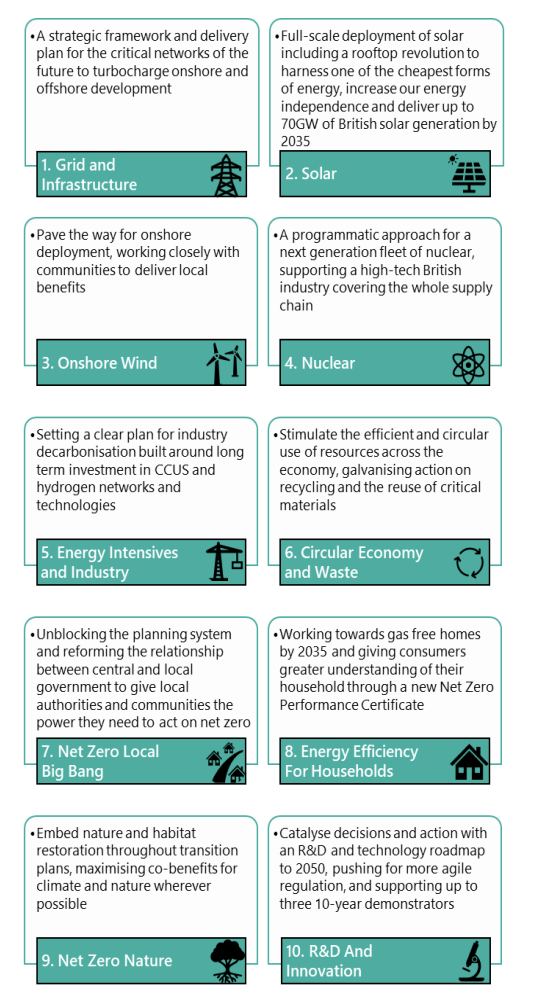
 SIMONICITY