Is The London Mayor Doing Enough In Practice To Accelerate Housing Delivery?

Congratulations Sir Sadiq Khan, Mayor of London, and Christopher Katkowski CBE KC on your respective new year’s honours.

CK CBE KC of course led work on a report published in January 2024 for the last government which considered any changes to the London Plan which might facilitate housing delivery on brownfield sites in London. The report lays bare the undersupply of new homes in London, which has not kept pace with increases in jobs, population and housing demand.

Sir SK’s Greater London Authority published on 19 December 2024 Accelerating Housing Delivery: Planning and Housing Practice Note. I summarise the document later in this post and would welcome reactions as to whether the document – non-statutory, intended as practical guidance and a material consideration in the determination of planning applications and, in part, renegotiation of existing section 106 agreements – really goes far enough, given where we currently are.

The need for additional housing in London, at all price points, both subsidised (“affordable”) housing and general market housing, has never been more acute. It is in fact much worse now than when CK CBE KC wrote that report. The statistics back that up, with planning approvals and housing starts both down sharply last year.

Annual housing completions have been falling short of the policy target in the 2021 London Plan of 522,870 net housing completions from (2019/20 -2028/29). Everyone knows that the viability position for developers is increasingly difficult, faced with build cost inflation, high interest rates and the costs and uncertainty of, for example, additional building safety requirements. Similarly everyone knows that there is an absence of registered providers willing to take on the affordable housing, leading to stalled schemes (a national problem – see the HBF’s December 2024 press statement 17,000 Affordable Homes stalled by lack of bids from Housing Associations and accompanying report).

We have the London Plan’s 50% affordable housing requirement – and with a relatively rigid and formulaic system of early stage and late stage viability review mechanisms where that cannot be met (the late stage review not being required where the “fast track” applies, i.e. if the developer commits to at least 35% affordable housing – 50% on industrial or public sector land), all in accordance with London Plan Guidance on affordable housing and on development viability which have remained in draft since May 2023.

Before we look at the practice note, let’s see what some of the evidence is saying, for instance the GLA’s own November 2024 document, Housing in London 2024: The evidence base for the London Housing Strategy (the charts referred to are here):

London is home to both the fastest and slowest-growing local housing stocks in England. The number of homes in Kensington and Chelsea grew by 2% over the last decade, compared to 26% in Tower Hamlets (chart 2.1). Using data on new Energy Performance Certificates to track completions of new homes, it looks like new supply in 2024 is following the trend of 2022 and 2023, two of the lowest years in the last five years (chart 2.2).

The quarterly number of planning approvals is falling, and they are concentrated on fewer, larger sites (chart 2.4).  Increasing construction on small sites might be key to increasing overall delivery, with 65,000 new build homes completed on small sites between 2012/ 13 and 2021/ 22 (chart 2.3). Sales of new market homes in London peaked in 2022 and then fell considerably, partly due to lower demand from Build to Rent (BTR) providers and the end of Help to Buy (chart 2.6). The BTR sector, which completed 44,585 new homes in London between 2009 and 2023 is nevertheless still growing (chart 2.7).

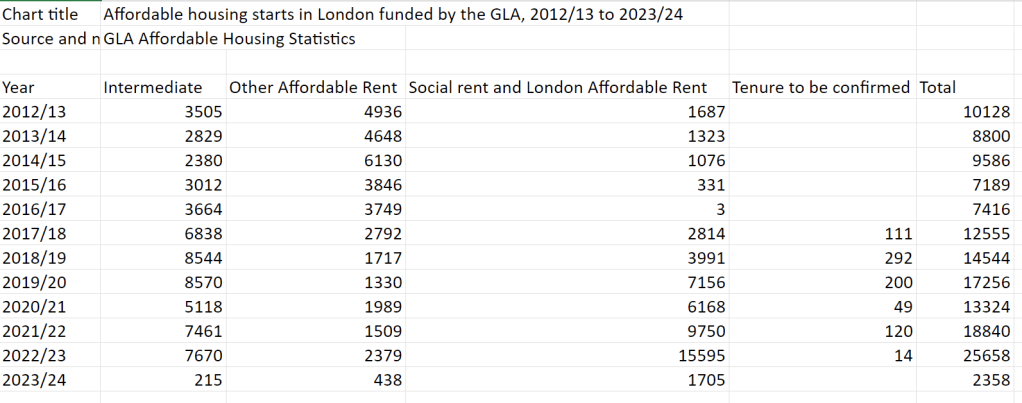
38% of homes and 46% of habitable rooms recommended for approval by the Mayor in 2023 were affordable, with both of these figures a record high (chart 2.5). Affordable housing starts funded by the GLA fell sharply between 2022/ 23 and 2023/ 24 (charts 2.8 and 2.9), as registered providers and local authorities have diverted resources away from new supply in response to increased remediation and refurbishment costs and the costs of adapting to changing regulations. Completions are also down, but not as much. Of the affordable homes started with GLA support in 2023/ 24, 72% were for social rent. Affordable completions from all funding sources also rose to a recent high of 15,768 in 2022/ 23 (chart 2.10), with data for 2023/ 24 not yet available.

Social housing landlords in London owned just under 800,000 affordable homes for rent in 2023, the highest total since 2002 (chart 2.12). Sales of council homes through the Right to Buy (RTB) scheme have been on a downward trend since their peak in the 1980s, totalling 1,080 in 2023/ 24 (chart 2.11).

Council tax data showed that 2.3% of homes in London were empty in 2023, with only 1% empty longer than 6 months (chart 2.13). These are much lower levels than in the 1980s and 90s, when around 5% of homes used to be empty.

1.34 million homes in London, or 36% of its stock were leasehold homes in 2022/ 23, over half of which were privately rented (chart 2.15).  In 2023, there were 22,770 homes in multiple occupation (HMOs) with mandatory licences in London. This is the highest of any region (chart 2.14).”

This is chart 2.8 referred to in that text:

This is an extract from chart 2.4, showing the annualised trend per quarter in the number of new homes approved, and the number of projects:

Ahead of the awaited review of the London Plan, what can be done? The sorts of specific, practical,  issues that currently come up again and again relate to the operation of the viability review mechanisms in particular. Since the new Building Safety Act regime came into force on 1 October 2023 the early stage review mechanism, kicking in if substantial implementation (usually defined as construction of the foundations and ground or first floor) hasn’t taken place within two years of permission, is increasingly unworkable for higher-risk buildings given how long the gateway two stage is taking in practice. The contingent liability that the late stage review mechanism represents is unattractive in principle to funders, which is a big challenge in a weak market.

For measures that could have had an immediate positive impact, what about, for instance, introducing suitable flexibility into the triggering of the early stage review?  Potentially a temporary “holiday” from the late stage review for schemes that committed to proceed to completion within an agreed timescale?  A willingness to accept renegotiation of section 106 agreements on schemes which are now unviable? Some pragmatism as to commuted payments towards off-site delivery where a registered provider cannot be found?

Whilst the document does include some measures which may help at the margins, there’s certainly no “big bang” of that nature. It is in fact curious how little fanfare the practice note has been given. I can’t even find it on the GLA website, let alone any press release. Nor was any formal consultation or indeed feedback invited.

Anthony Lee at BNP Paribas did this good summary on LinkedIn before Christmas but I have seen little else.

I draw out some of the measures as follows:

  • Allowing the fast track threshold to be reduced, both for new and current applications and also for consented schemes, where the tenure split provides proportionately more social rent than the policy requirement, in accordance with a formula that appears to seek to avoid any financial advantage to the developer in so doing – the only advantage being if that unlocks more GLA funding and/or more willingness on the part of registered providers.
  • Estate regeneration schemes will be able to qualify for the “fast track” if at least 50% of the additional housing will be delivered as affordable.
  • The GLA will consider accepting supported housing and accommodation for homeless households, with nomination rights for the relevant borough, as a like for like alternative for intermediate housing, again both for new and current applications and also for consented schemes.
  • The cost of any meanwhile accommodation for homeless households, with nomination rights given to the relevant borough, may be taken into account in the operation of viability review mechanisms.
  • With the late stage review, the developer currently retains 40% of any surplus profit. In certain circumstances this can now increase to 70%.  However, the criteria are tight. “To qualify for this, the application must provide at least 25 per cent onsite affordable housing by habitable room for schemes with a 35 per cent threshold, and 35 per cent onsite for schemes with a 50 per cent threshold, at the relevant local plan tenure split, and be certified as reaching practical completion within three years of the date of this document.” “For larger phased schemes that provide at least 25 per cent affordable housing across the scheme as a whole that are granted planning permission after the date of this practice note, if the initial or a subsequent phase is certified as reaching practical completion within three years of the date of this document, the GLA will consider allowing the applicant to retain 70 per cent of any surplus profit identified in that phase when the late review is undertaken. The relevant phase must include at least 100 residential units.”
  • There is this enigmatic sentence: “The GLA will also work with boroughs to identify sites that have been allocated for development or that have been granted consent but that have not come forward for development for many years, or where limited progress has been made, and will assess the nature of interventions required to facilitate this.”
  • Great flexibility is announced as to the permissible inputs into review mechanisms. The formulae currently focus on changes in gross development value and build costs. “However, in some cases it may be more appropriate to allow for a full viability review to be undertaken which reconsiders all development values and a greater scope of development costs, including professional fees and finance costs.”
  • The Mayor’s housing design guidance should not be applied mechanistically, in relation to, for instance, the reference to the need to submit “fully furnished internal floorplans” and the objective that new homes should be dual aspect.
  • Various grant funding measures but I’ll look to others to comment as to the extent they will move the dial.

Thoughts?

Simon Ricketts, 11 January 2025

Personal views, et cetera

How About A Five Yearly Review Of The Use Classes Order & GPDO, Starting This Year?

Changes in the law relating to e.g. tripe shops, maggot breeding and bone grinding were my special subject as a late 80s young lawyer so please hear me out, because this is all central in my view to thinking with regard to the government’s (currently rather all shades of grey) “brownfield passports” concept (see my 28 September 2024 blog post Brownfield Passports…To What? When? How? ).

Two things I find interesting about the UK (now, for the purposes of this post, English and Welsh) town and country system:

  1. The stability of its underlying structure: Many of the provisions of the Town and Country Planning Act 1947  are there, as the kernel of the current, much amended, 1990 Acts. Compare for instance section 12 of the 1947 Act (defining “development”) with section 55 of the Town and Country Planning Act 1990 or section 13 of the 1947 Act with section 59 of the Town and Country Planning Act 1990 (“development orders”).
  1. The continual sets of amendments, large and small,  that have been made, within that framework, to reflect differing political priories and economic and social pressures. Drafting by committee? What we have now is the almost impenetrable result of many generations of that. It always helps to understand who added, amended or removed what, when and why.

The tension for law makers is always the same: how to retain what works but ensure, without unnecessary complexity, that the system remains fit for purpose.

Maybe nowhere is this more so than in relation to the concepts of use classes (changes of use within a use class not amounting to “development” requiring planning permission) and permitted development (classes of development which have the benefit of automatic, deemed, planning permission).

When I first studied planning law (at bar school in 1984-85: course run by Victor Moore, as of “A Practical Approach To Planning Law”), we were all operating under the Use Classes Order 1972 (which was largely in the same form as the first Use Classes Order in 1950) and under the General Development Order 1977 (again largely in the form of the first General Development Order in 1948). This truly makes me feel old. These were the 1972 Use Classes Order use classes, dominated by all of those special industrial groups, and with those references to tripe shops, cats-meat shops and the like.

The categories of permitted development rights in the 1977 Order will look very familiar:

The brevity of the “changes of use” category, less familiar:

Conservative governments have been responsible for two major revisions of the system.

The first was shortly after I qualified, with the introduction of the (now amended many times) Town and Country Planning (Use Classes) Order 1987 the main functions of which do not nowadays appear very controversial: (1) lumping together office, light industrial and research and development uses within a new use class B1 and (2) abolishing the use classes containing all those old special industrial groups. Alongside this was the Town and Country Planning General Development Order 1988.

That system then survived without major reform for around quarter of a century.

The second set of changes to the system has been the multiple waves of deregulatory changes made between 2013 and 2024, particularly the creation of class E for a wide range of commercial uses in 2020 (see my 24 July 2020 blog post E Is For Economy) and the various new permitted development rights enabling residential conversion and demolition/rebuild in relation to commercial (and in some instances agricultural) buildings. The Town and Country Planning (General Permitted Development) (England) Order 2015 (as amended) is a shape-shifting monster.

The system is in desperate need of reform:

  • what should be the core objectives behind removing the need for planning permission for certain categories of use and works, given the Government’s missions?
  • How can the system operate with simplicity but also appropriate flexibility and reflecting local circumstances where appropriate?
  • What areas of the current system need modernising to reflect current economic or social pressures, priories and ways of living and working?

Depressingly, my 1 July 2016 blog post Time To Review The C Use Classes remains more relevant than ever. It’s still time! The nettle has not been grasped.

As for permitted development rights, perhaps the big political question is whether the concept of automatic planning permission for the conversion of certain types of commercial buildings to residential use should be rejected outright, based on the experience since May 2013, or can be made to work acceptably.

In 2023-24 8,825 of England’s 198,610 new dwelling completions were by way of permitted development rights . Between 2015/16 and 2022/23, 102,830 new homes were delivered by way of permitted development rights, around 6% of new homes. This is a not insignificant contribution, by numbers at least.

To this we add the Government’s drive towards brownfield development in urban areas (that brownfield passports document I mentioned); the extent to which commercial space is surplus to market requirements, and the carbon benefits of finding new uses for existing buildings (although query how this squares with the “demolish commercial and rebuild as residential” permitted development right).

Of course a big problem is that much of the resulting accommodation has not been of a decent standard (see e.g. Research into the quality standard of homes delivered through change of use permitted development rights by Dr Ben Clifford, Dr Patricia Canelas, Dr Jessica Ferm and Dr Nicola Livingstone Bartlett School of Planning, UCL and Professor Alex Lord and Dr Richard Dunning, Department of Geography and Planning, University of Liverpool, July 2020, published by MHCLG in 2020, strangely alongside yet further deregulatory measures). The Town and Country Planning Association is lobbying for a “Healthy Homes Bill”, describing permitted development rights as creating “slums for the future”.

Is there a middle ground? Do permitted development rights have a role in delivering homes, in the quantity needed but also to the necessary quality – decent, healthy?

The previous government consulted on further changes to permitted development rights in February 2024 . The outcome of that process was never published. We await Labour’s next steps.

What went wrong with commercial to residential permitted development rights?

For a start the measure seemed to be seen by ministers as a short-term tactical intervention rather than based on any longer-term strategy or analysis. In May 2013 the right was first introduced (initially just for three years) to allow changes from office use to residential use, the twin objectives being to boost housing and to help regeneration by way of putting vacant or under-utilised office space to productive use. The “prior approval” requirements were minimal, with no minimum space standards, no minimum standards for daylight and no protection in relation to noise, for instance. As is still the case, local planning authorities could not impose requirements as to affordable housing or require contributions towards for instance education or health facilities. Authorities could make “article 4” directions limiting the areas within which the permitted development right would apply but at risk of these being cancelled or amended by the government (as has frequently happened).

The right was extended to shops and to financial and professional services uses in April 2014 and made permanent in Autumn 2015. Adequacy of daylight was introduced as a prior approval requirement in August 2020 and minimum space standards in April 2021. Initially buildings of any size could be converted to residential. A 1,500 sq m cap was introduced in September 2020 (at the same time that there was the separate but related de-regulation measure of gathering together most commercial uses within a single use class, the new class E) and then that cap was removed in March 2024. Similarly, a requirement was also introduced that the building should have been vacant for at least three months before the application was made, only for that also to be removed. Are you keeping up? (Incidentally, I am grateful to my colleague Gregor Donaldson for reminding me of some of these twists and turns).

One might conclude from this chopping and changing that from the outset the process has lacked a proper strategic foundation, core objectives and a commitment to ensure that resulting development is not of poorer quality, or having a free ride at the expense of development achieved by way of the traditional planning application route.  Care is needed with criticism of outcomes: to what extent did these result from the initial wave of conversions, before additional prior approval safeguards had been introduced? Also remember that these developments do have to comply with the Building Regulations and with housing legislation. Not every failing is down to the GPDO.

Before we give up on removing unnecessary matters from the planning application process and on this streamlined route for delivering new accommodation on urban brownfield land, surely there is an urgent need to examine whether the system can indeed ensure, by way of objective criteria, that:

–              (possibly by way of an article 4 direction process following better national guidance and the opportunity for public consultation) development locations are sustainable for their residents, with access to public transport, schools, health and community facilities;

–              schemes should pay their way in terms of affordable housing and other section 106 agreement requirements in the same way as schemes delivered by way of planning application.

But more widely, surely we need to embed a rhythm within government of reviewing the operation of the Use Classes Order and General Permitted Development Order regularly, in an orderly rather than ad hoc way, so as to ensure that we have both a reasonable level of stability but also a proper regular process for reflecting emerging economic, social and indeed technological trends?

Happy new year!

Simon Ricketts, 5 January 2025

Personal views, et cetera

I Just Called You In To Say I Love You

NB The title to this post is just for the benefit of those who say to me that the titles are the best bit. (I agree).

Following on from my 9 November 2024 blog post Intervention, there were two decisions issued yesterday (22 November 2024) resulting from call-ins of applications by the previous Government, one in relation to Berkeley’s Cranbrook scheme (initially refused by the previously Secretary of State, which decision was then quashed by consent, and now finally approved), the other in relation to a large logistics scheme in the Warrington green belt (initially resolved to be approved by Warrington Council, but now refused by the Secretary of State).

 The Secretary of State’s power in section 77 of the Town and Country Planning Act 1990 to call-in applications for planning permission which raise planning issues of more than local importance is sparingly used. Usually, the power is used after the local planning authority has resolved to approve an application for planning permission for development. The Secretary of State’s policy remains that examples of where “planning issues of more than local importance” include those which in her opinion:

  • may conflict with national policies on important matters;
  • may have significant long-term impact on economic growth and meeting housing needs across a wider area than a single local authority;
  • could have significant effects beyond their immediate locality;
  • give rise to substantial cross-boundary or national controversy;
  • raise significant architectural and urban design issues; or
  • may involve the interests of national security or of foreign Governments.
  • However, each case will continue to be considered on its individual merits.”

The Quinn Estates/Sittingbourne situation I mentioned in my Intervention blog post is unusual, in that the decision to call-in was taken just before a meeting of the local planning authority’s planning committee where the applications in question were recommended for refusal.

The case remains that call-in by the Secretary of State (under section 77) is of little advantage to an applicant as opposed to appeal (under section 78) against the refusal or non-determination of the relevant application. The procedures are equivalent. The position is very much in contrast to the position in London where the Mayor can become the relevant planning authority for applications which meet specified criteria and then determine them rapidly via a representations hearing – a useful process in unlocking situations as with, recently, the proposed redevelopment of Springfield Hospital in Wandsworth and the proposed expansion of the All England Lawn Tennis Club in Wimbledon.

Turning to yesterday’s decisions (neither of which incidentally draw at all on the contents of the draft revised NPPF – we should hold our excitement as to the relevance of that document until the final version emerges before the end of the next month – these Christmas NPPF drops are now an annual staple of our festive plans):

Cranbook

I reported on the previous Secretary of State’s initial decision to refuse the application in my 22 April 2023 blog post, Mind Blowing Decisions. As it turned out, the decision was so mind blowing that the Secretary of State ended up consenting to judgment in October 2023 when the decision was challenged in the High Court by Berkeley.

The new Secretary of State has considered further representations from the parties and has now approved the scheme.

You may recall the previous Secretary of State’s criticisms of the scheme as not “sensitively designed” and being “of a generic suburban nature”. Those concerns haven’t entirely gone away but their relevance is now downplayed:

Whilst the Secretary of State has concerns about the layout and design of the proposal, particularly the sensitivity and appropriateness of the design in the context of its setting, she has taken into account that only 20% of the site would be built on (IR730) and the proposed development would deliver landscape enhancements (IR826). Overall, she considers that the design of the scheme is a neutral factor in this case.”

The Secretary of State also notes the now enhanced protection for AONBs (now national landscapes) via section 245 of the Levelling-up and Regeneration Act 2023 and that the local planning authority can now demonstrate a five-year housing land supply but again these factors do not lead to refusal of the application. She “considers that the delivery of 165 homes (40% affordable housing) carries significant weight.”

Her overall conclusions:

58. For the reasons given above, the Secretary of State considers that the application is not in accordance with Policies LBD1 of the Local Plan, Core Policies 1 and 14 of the Core

Strategy, and Policy AL/STR 1 of the Site Allocations LP, and is not fully in accordance with Policy EN21, EN22, EN25 of the Local Plan or Core Policy 12. She considers that the application is not in accordance with the development plan overall. She has gone on to consider whether there are material considerations which indicate that the proposal should be determined other than in accordance with the development plan.

59. Weighing in favour of the development are the need for and delivery of housing, the BNG, enhanced recreation opportunities, improvements in highway safety, heritage benefits to the historic landscape and landscape benefits by way of woodland planting and management, which collectively carry substantial weight.

60. Weighing against the proposal is the harm to the landscape and the scenic beauty of the HWAONB which attracts great weight, harm arising from development outside the limits of built development which carries moderate weight, harm to air quality which carries very limited weight and the effect on the plan-making process of the eLP which carries very limited weight.

61. The Secretary of State has concluded for the reasons given above that exceptional circumstances exist to justify the proposed development in the HWAONB and that the

development would be in the public interest.  The AONB test at paragraph 183 (formerly 177) of the Framework is therefore favourable to the proposal.

62. Overall, the Secretary of State’s conclusion on section 38(6) of the Planning and Compulsory Purchase Act 2004 is that despite the conflict with the development plan, the material considerations in this case indicate that permission should be granted.

63. The Secretary of State therefore concludes that planning permission should be granted.”

Warrington

This was an application for planning permission for around 3 million square feet of B8 development at Bradley Hall Farm, Grappenhall Lane, Warrington. The application was originally made in April 2019. Warrington Council had resolved to approve the application in March 2022 before it was called in in November 2022. The site had been proposed to be allocated in the emerging local plan before then being removed in the plan that was adopted in December 2023, the local plan inspector having concluded that there was no strategic need for the allocation.

In her decision letter yesterday, the Secretary of State reaches this conclusion on employment land supply and demand, and the need for employment land:

For the reasons given at IR340-349 the Secretary of State recognises that there is a strong demand for logistics facilities and that the supply of the largest sites is limited within the region (IR347). However, overall she agrees with the Inspector at IR350 that the case for logistics supply and demand is overstated and largely based on subjective opinion rather than robust quantitative data.”

The Secretary of State agrees at IR353 that it was not for the Inspector to revisit the underlaying basis of the very recently adopted Local Plan and determine the objectively assessed need for employment land in Warrington.

For the reasons given at IR351-359 and IR384, the Secretary of State, like the Inspector, accepts that a need for large scale units across the region is present (IR358).  Like the Inspector, she is not persuaded that there is a lack of alternatives across the region, but agrees that provision is limited and not ideal. She further agrees therefore that a genuine need for the site within a regional context has not been wholly proven (IR359). The Secretary of State agrees with the Inspector at IR384 that the need for employment land carries limited weight.”

Overall, she found that the necessary “very special circumstances” case had not been made out.

Simon Ricketts, 23 November 2024

Personal views, et cetera

Photo courtesy of Jon Tyson via Unsplash

Brownfield Passports…To What? When? How?

At 9.30 am last Sunday out popped an MHCLG policy paper Brownfield Passport: Making the Most of Urban Land  and an accompanying press statement New ‘brownfield passports’ to seize the growth opportunities of urban areas (22 September 2024).

The timing was interesting:

  • Obviously, synchronised with the Labour party conference in Liverpool last weekend – Sir Keir Starmer’s speech there promised: “‘we are introducing new planning passports that will turbo-charge housebuilding in our inner cities.” In more general terms Rachel Reeves there: “What you will see in your town, your city, is a sight that we have not seen often enough in our country – shovels in the ground, cranes in the sky, the sounds and the sights of the future arriving. We will make that a reality.”
  • Coincidentally, synchronised with a presentation starting, also starting at 9.30 am last Sunday, by the first of that day’s Oxford Joint Planning Law Conference speakers, Ant Breach of Centre for Cities: “BOLDER: A Zoning System for England”. In some ways, the idea of passporting particular types of development is nothing if not zoning.

We have been clear that development must look to brownfield first, prioritising the development of previously used land wherever possible. To support this, we will make the targeted changes set out below, including making clear that the default answer to brownfield development should be “yes”, as the first step on the way to delivering brownfield passports.”

If the work had been done in time, it would obviously have made more sense for the proposals in the latest working paper to have been part of the July 2024 consultation, both so that those responding had a better understanding of the intended policy end-point and so that the changes could be introduced at the same time that the revised NPPF itself is published (still, we hope, before the end of this year – maybe keep 20 or 23 December free of meetings folks…).

We are where we are. What do we learn from this latest policy paper? I hesitate to be hyper-critical as we all know that a new government is moving at pace, that these issues are difficult and that the objective is to be applauded (in my view at least) but…

It is a bit of a “throw ideas at the wall and see what sticks” piece of work isn’t it? “Brownfield passport” is nice branding, up there with “grey belt”, but what rights would this “passport” actually bring?

Its purpose is to be “more specific about the development that should be regarded as acceptable, with the default answer to suitable proposals being a straightforward “yes”.”

This needs to be viewed against the changes to the NPPF that are already proposed that would reinforce the presumption in favour of granting planning permission for development proposals on brownfield land. Paragraph 122 of the draft revised NPPF states that planning policies and decisions should, amongst other things: “give substantial weight to the value of using suitable brownfield land within settlements for homes and other identified needs, proposals for which should be regarded as acceptable in principle, and support appropriate opportunities to remediate despoiled, degraded, derelict, contaminated or unstable land” (the underlined text is what is proposed to be inserted into what is already within the current NPPF at paragraph 123 (c)).

So how is the “brownfield passport” concept intended to move the dial still further in favour of brownfield development?

Well first of all, it’s not the equivalent of planning permission: “while we are not considering the granting of automatic planning permission on suitable brownfield sites or removing appropriate local oversight of the development control process, we do want to explore ways in which providing more explicit expectations for development could lower the risk, cost, and uncertainty associated with securing planning permissions on brownfield land.”

Instead:

In order to maximise clarity and certainty about the opportunities to make best use of urban land, we think there is scope to make further policy changes, at both a national and local level, relating to the principle, scale, and form of development in different types of location.

We see these potential changes as a form of ‘brownfield passport’: setting clear parameters which, if met, serve as accepted markers of suitability, with approval becoming the default and a swifter outcome.”

Hmm.

MHLG floats a number of options:

  • First, tightening the NPPF further, by “being explicit that development on brownfield land within urban settlements is acceptable unless specified exclusions apply. Those exclusions could, for example, include that there is no adverse impact in relation to flood risk and access that cannot be mitigated.”
  • Secondly, by using the proposed National Development Management Policies system “to set minimum expectations for certain types of location where a particular scale of development may be appropriate.

Policy could, for example, say that development should be of at least four storeys fronting principal streets in settlements which have a high level of accessibility, and/or set acceptable density ranges that allow for suitable forms of intensification. A similar approach has been used successfully in some other countries where efforts have been made to densify urban areas through ‘upzoning’. While it would still require approval from the local planning authority, it would establish a very strong starting position which would carry significant weight in making decisions and create an expectation that compliant schemes are approved.

The policy parameters, such as height and what conferred a high degree of accessibility, would need to be set carefully, both to make the most of suitable opportunities and to avoid inappropriate development.”

It would surely be difficult to do this on a blanket, national, basis. MHCLG recognises this, so a less exciting variant is that “policy could be amended to encourage such parameters to be set through local development plans, which could also be articulated through design codes for appropriate locations – whether across whole urban areas or at a more local scale.”

  • Thirdly, “the potential to use design guides and codes that draw on the existing character of places, to identify these opportunities and provide clarity on the types of development that are regarded as acceptable in particular locations.”
  • Fourthly, for local planning authorities to make local development orders “in order to provide upfront consent to developments that meet the specified criteria…Combining them with criteria on the scale and/or form of development as suggested above would allow a local planning authority to effectively establish one or more zones in which particular types of development had planning permission without the need for individual applications.”
  • Fifthly, whether any of these proposals “could be supported by linking them to the national scheme of delegation, which [the government has] committed to provide for through the Planning and Infrastructure Bill.” Now there’s an idea!

The paper ends with this paragraph:

As part of wider action to support the development of small sites, we will also consider whether any of these proposals could apply to non-brownfield land in urban areas, with suitable safeguards to retain land which should be kept open or has important environmental benefits.”

So, having established that we are not really talking about “passports” – rather, various ways in which the planning system might further assist in the promotion for development of particular categories of schemes,  and we aren’t really just talking about “brownfield” either.

There will in due course be a call for evidence.

Brownfield land“ in planning-speak is “previously developed land”, or PDL. I’m beginning to wonder whether there should be another specific terms that we might all find helpful: Previously Developed Policy Interventions, or PDPI. Nicola Gooch wrote a great blog post last Sunday, Brownfield Passports: building on old foundations? reflecting some of the PDPIs which have sought in recent years to encourage brownfield development and the promote the ‘gentle densification’ of urban areas, e.g.:

  • Street votes
  • Permissions in principle
  • Zoning (as per the 2020 white paper)

To this I would add the various waves of changes to the General Permitted Development Order including Part 20 of Schedule 2  – construction of new dwellinghouses. Or indeed, what about this for déjà vu, the previous government’s 13 February 2024 consultation paper Strengthening planning policy for brownfield development (13 February 2024)?

Someone quipped to me this week that a brownfield passport is all well and good but that the big question will be how easy it will be to get the visa that allows us actually to get anywhere. Mind you that wording on the inside cover of your passport does always sound good:

His Britannic Majesty’s Secretary of State Requests and requires in the Name of His Majesty all those whom it may concern to allow the bearer to pass freely without let or hindrance and to afford the bearer such assistance and protection as may be necessary.”

Let’s not lose sight of that as the objective!

Simon Ricketts, 28 September 2024

Personal views, et cetera

When Would Local Plan Policies Be “Out Of Date” For The Purposes Of Para 11(d) Of The Draft Revised NPPF?

This is an important question, given that the consequence is that what is called in the jargon the “tilted balance” applies, namely that planning permission should be granted for any development proposal unless:

  • The application of policies in the NPPF “that protect areas or assets of particular importance provides a clear reason for refusing the development proposed” – those areas and assets being habitats sites, SSSIs, green belt, local green space, AONBs (now “national landscapes”), national parks, Heritage Coast, irreplaceable habitats, designated heritage assets (and some other heritage assets of archaeological value) and areas at risk of flooding or coastal change; or
  • Any adverse impacts of doing so would significantly and demonstrably outweigh the benefits, when assessed against the policies in [the NPPF] taken as a whole, in particular those for the location and design of development … and for securing affordable homes”; or
  • The proposal would conflict with a neighbourhood plan which is no more than five years old and contains policies and allocations to meet its identified housing requirement.

The new Government is of course not just consulting on the draft revised NPPF but on a revised “standard method” for determining local housing need (see chapter 4 of its consultation document) and that standard method would significantly increase the local housing plan figure for most authorities. The effect for each authority is shown on this MHCLG spreadsheet or visually on Lichfields’ interactive map.

Maybe it’s just me but I found it quite difficult to get straight in my mind when an authority’s failure to demonstrate a five year supply of housing land to meet the new local housing need figure would mean that its local plan is to be treated as “out of date” such that the tilted balance applies. Here’s my thinking and it perhaps points to some areas where the draft revised NPPF needs to be tightened or at least made clearer.

Paragraph references in what follows are to the draft revised document.

  • The reference in paragraph 11 (d) is to “where “the policies for the supply of land are out of date
  • Footnote 9 explains that:

This includes, for applications involving the provision of housing, situations where: (a) the local planning authority cannot demonstrate a five year supply of deliverable housing sites (with the appropriate buffer, if applicable, as set out in paragraph 76); or (b) where the Housing Delivery Test indicates that the delivery of housing was substantially below (less than 75% of) the housing requirement over the previous three years.”

  • Paragraph 76 states:

Strategic policies should include a trajectory illustrating the expected rate of housing delivery over the plan period, and all plans should consider whether it is appropriate to set out the anticipated rate of development for specific sites. Local planning authorities should identify and update annually a supply of specific deliverable sites sufficient to provide a minimum of five years’ worth of housing against their housing requirement set out in adopted strategic policies, or against their local housing need where the strategic policies are more than five years old. The supply of specific deliverable sites should in addition include a buffer (moved forward from later in the plan period) of:

  1. 5% to ensure choice and competition in the market for land; or
  1. 20% where there has been significant under delivery of housing over the previous three years, to improve the prospect of achieving the planned supply
  • Paragraphs 224 and 225 state:

224. The policies in this Framework are material considerations which should be taken into account in dealing with applications from the day of its publication. Plans may also need to be revised to reflect policy changes which this Framework has made.

225. However, existing policies should not be considered out-of-date simply because they were adopted or made prior to the publication of this Framework. Due weight should be given to them, according to their degree of consistency with this Framework (the closer the policies in the plan to the policies in the Framework, the greater the weight that may be given).”

  • Accordingly, until it is five years old, an adopted local plan will not be “out of date” on the basis of applying the proposed new standard method for assessing local housing need, but rather on the basis of whether it can demonstrate a five year supply of deliverable housing sites (calculated by reference to the housing requirement set out in strategic policies in the plan), with the appropriate buffer set out in paragraph 76 and has delivered at least 75% of its housing requirement over the last three years. Once the plan is five years old, the tilted balance will apply if there is not at least a five year supply of deliverable housing sites as against their new standard method local housing need figure (and delivery of 75% of its housing requirement over the last three years).
  • This applies to plans submitted for examination or adopted no later than one month after publication of the final version of the draft revised NPPF (see paragraph 226). For plans not adopted by that date the following transitional arrangements apply (in summary) as per paragraphs 226 and 227:

Where a plan was submitted for examination within a month of publication of the revised NPPF with a local housing requirement that is more than 200 dwellings lower than the relevant local housing need (under the new standard method), once the plan is adopted, the authority will be “expected to commence plan-making in the new plan-making system at the earliest opportunity to address the shortfall in housing need”. [There is no reference in the draft revised NPPF as to how long the authority has to conclude that process before its plan will be treated other than set out in my emboldened paragraph above. Surely this needs to be clarified, because otherwise it is a recipe for confusion at best and gaming of the system at worst].

Where a local plan has reached regulation 19 pre-submission stage with an emerging annual housing requirement that is more than 200 dwellings lower than the relevant local housing need (under the new standard method), the plan should proceed to examination within 18 months of publication of the revised NPPF. [There is no express indication of what the consequences are if this deadline is missed; presumably the need to plan as against the relevant local housing need (under the new standard method) – again, shouldn’t this be clarified?].

Hence presumably why we are seeing some authorities speed up with their emerging plans, with an eye on baking in housing targets based on the current standard method, although of course that is only going to work if their plans do not require significant further work during the examination process to make them sound (see the planning minister’s 30 July 2024 letter to the Planning Inspectorate).

I will try to make next weekend’s post (if there is one: I just remembered it’s the Oxford Joint Planning Law Conference – may see you there) more exciting, sorry.

Simon Ricketts, 14 September 2024

Personal views, et cetera

Oldest example of tilted balance: photo by Manish Tulaskar courtesy of Unsplash

Grenfell Tower Inquiry Report Phase 2: What Implications For The Planning System?

The inquiry’s recommendations are within volume 7, part 14, chapter 113, pages 231 to 249 of its phase 2 report published on 4 September 2024, following publication of its phase 1 report in 2019. After 1,500 or so pages, the recommendations are expressed concisely, with precision and urgency.

The question for this phase of the inquiry to answer was specific:

In Phase 2 we have set out to answer the question that has been at the forefront of many people’s minds: how was it possible in 21st century London for a reinforced concrete building, itself structurally impervious to fire, to be turned into a death trap that would enable fire to sweep through it in an uncontrollable way in a matter of a few hours despite what were thought to be effective regulations designed to prevent just such an event?”

The conclusions of the report lay bare the tangle of causes:

There is no simple answer to that question, but in this report we identify the many failings of a wide range of institutions, entities and individuals over many years that together brought about that situation.”

These pieces in Inside Housing, ‘Complacent’ government ‘well aware’ of cladding risks before Grenfell fire but ‘failed to act’ and What the Grenfell Tower Inquiry report said about the key players in the disaster draw together those conclusions.

With some humility given the seriousness of the topic and its breadth, I thought that I should at least try to identify some potential consequences for the planning system. This follows two earlier blog posts, Tall Buildings & Fire Safety (7 January 2023) and Safety & Planning (3 July 2021). Themes of those posts included the extent to which human safety, and the safe construction of buildings, are a matter for the planning system rather than Building Regulations and the problems arising where policies are continually in a state of flux, when there is uncertainty as to where the controls lie – via the planning system or via separate legislation – and when there is the possibility of inconsistency as between the differing regimes.

Partly as a response to phase 1 of the inquiry’s work, the previous Government made the Town and Country Planning (Development Management Procedure and Section 62A Applications) (England) (Amendment) Order 2021, which introduced a requirement for a fire statement to be submitted with applications for planning permission for development involving a building (1) contains two or more dwellings or educational accommodation and (2) contains 7 or more storeys or is 18 metres or more in height. This “Planning Gateway One” fire statement is published on the planning register and the Health and Safety Executive must consulted before the grant of planning permission involving a high-rise residential building in certain circumstances.

The Planning Practice Guidance explains:

The changes are intended to help ensure that applicants and decision-makers consider planning issues relevant to fire safety, bringing forward thinking on fire safety matters as they relate to land use planning to the earliest possible stage in the development process and result in better schemes which fully integrate thinking on fire safety.”

Against that context, let’s look at some of the phase 2 report recommendations most relevant to the Town and Country Planning Act system. On a narrow reading, the recommendations focus on the need for improvements to the separate Building Regulations/”building control” system, rather than the planning system (although note my comments later):

  • The Building Regulations system as at the time of the disaster was “seriously deficient” – poorly worded, lack of active monitoring of their performance by Government.
  • The arrangements under which the construction industry are regulated have become too complex and fragmented, as between different government departments, but also: “Building control was partly in the hands of local authorities and partly in the hands of approved inspectors operating as commercial organisations, enforcement of the law relating to the sale of construction products was carried out by Trading Standards and commercial organisations provided testing and certification services to manufacturers of products. UKAS accredited organisations operating as conformity assessment bodies. In our view, this degree of fragmentation was a recipe for inefficiency and an obstacle to effective regulation.”

In our view all the functions to which we have referred, as well as some others to which we refer below, should be exercised by a single independent body headed by a person whom, for the sake of convenience, we shall call a construction regulator, reporting to a single Secretary of State.”

We are aware that in the period since the Grenfell Tower fire Parliament has passed the Building Safety Act 2022 to regulate work on higher-risk buildings, to impose particular duties on those involved in the construction and refurbishment of such buildings and to establish a Building Safety Regulator responsible for building control and for overseeing standards of competence. However, responsibility for the range of functions identified above remains dispersed. We therefore recommend that the government draw together under a single regulator all the functions relating to the construction industry to which we have referred.”

  • For the purpose of this and our other recommendations we have used the expression “higher-risk building” in the sense in which it is used in the Building Safety Act, that is, a building that is at least 18 metres in height (or has at least seven storeys) and contains at least two residential units. However, we do not think that to define a building as “higher-risk” by reference only to its height is satisfactory, being essentially arbitrary in nature. More relevant is the nature of its use and, in particular, the likely presence of vulnerable people, for whom evacuation in the event of a fire or other emergency would be likely to present difficulty. We therefore recommend that the definition of a higher-risk building for the purposes of the Building Safety Act be reviewed urgently.” [my emboldening]
  • We think that a fresh approach needs to be taken to reviewing and revising the Building Regulations and statutory guidance that is driven primarily by considerations of safety. Fresh minds are needed. We therefore recommend that, as far as possible, membership of bodies advising on changes to the statutory guidance should include representatives of the academic community as well as those with practical experience of the industry (including fire engineers) chosen for their experience and skill and should extend beyond those who have served on similar bodies in the past.”
  • “We […] recommend that it be made a statutory requirement that a fire safety strategy produced by a registered fire engineer (see below) to be submitted with building control applications (at Gateway 2) for the construction or refurbishment of any higher-risk building and for it to be reviewed and re-submitted at the stage of completion (Gateway 3). Such a strategy must take into account the needs of vulnerable people, including the additional time they may require to leave the building or reach a place of safety within it and any additional facilities necessary to ensure their safety.”
  • “We […] recommend that the profession of fire engineer be recognised and protected by law and that an independent body be established to regulate the profession, define the standards required for membership, maintain a register of members and regulate their conduct. In order to speed up the creation of a body of professional fire engineers we also recommend that the government take urgent steps to increase the number of places on high-quality masters level courses in fire engineering accredited by the professional regulator.”
  • “We recognise that both the Architects Registration Board and the Royal Institute of British Architects have taken steps since the Grenfell Tower fire to improve the education and training of architects. We recommend that they should review the changes already made to ensure they are sufficient in the light of our findings.

We also recommend that it be made a statutory requirement that an application for building control approval in relation to the construction or refurbishment of a higher-risk building (Gateway 2) be supported by a statement from a senior manager of the principal designer under the Building Safety Act 2022 that all reasonable steps have been taken to ensure that on completion the building as designed will be as safe as is required by the Building Regulations.”

  • “We […] recommend that a licensing scheme operated by the construction regulator be introduced for principal contractors wishing to undertake the construction or refurbishment of higher-risk buildings and that it be a legal requirement that any application for building control approval for the construction or refurbishment of a higher-risk building (Gateway 2) be supported by a personal undertaking from a director or senior manager of the principal contractor to take all reasonable care to ensure that on completion and handover the building is as safe as is required by the Building Regulations.”
  • “One of the causes of the inappropriate relationship to which we have referred was the introduction into the system of commercial interests. Approved inspectors had a commercial interest in acquiring and retaining customers that conflicted with the performance of their role as guardians of the public interest. Competition for work between approved inspectors and local authority building control departments introduced a similar conflict of interest affecting them. As things stand that underlying conflict of interest will continue to exist and will continue to threaten the integrity of the system. We therefore recommend that the government appoint an independent panel to consider whether it is in the public interest for building control functions to be performed by those who have a commercial interest in the process.

The shortcomings we have identified in local authority building control suggest that in the interests of professionalism and consistency of service all building control functions, including those currently performed by local authorities, should be exercised nationally. Accordingly, we recommend that the same panel consider whether all building control functions should be performed by a national authority.”

The implications for the planning system of the conclusions and recommendations of the report should not be under-estimated:

  • The Grenfell Tower tragedy had a specific factual background: the building had been constructed long ago – the issues arose through its refurbishment. Whilst building control should be the mechanism for ensuring the safety of the works carried out, the position is more complex in the case of the proposed construction in the first place of a higher-risk building. Building control is ultimately the detailed mechanism for ensuring that the development constructed can be safely occupied, but, as recognised by the Government in introducing the Planning Gateway One stage, fire safety needs to be considered at an early stage in the gestation of development proposals – it is too late for effective influence over issues such as emergency escape routes at the building control stage, there does need to be that early opportunity for safety to be built in from the outset. How are we likely to see that Planning Gateway One process change in the light of the recommendations? Clearly there will need to be some consideration as to whether 18 metres should still be the threshold. And what will the single regulator be, which responds at this stage? Will its decision-making be final or one consultation response of potentially many (albeit of significant weight)? How can we make sure that its decision-making is predictable and timely? This is also delicate to say given the potential consequences of a wrong decision, but: what if its decision-making is at times unreasonably prescriptive?
  • How will this changed approach flow through into private sector appetite to embark on multi-storey residential projects, on which any achievement of the new Government’s targeted housing numbers is predicated?
  • In circumstances where registered providers are generally reluctant to take on section 106 affordable housing (see eg The challenges for affordable housing delivery in London (Savills, 27 August 2024)), to what extent will the continuing focus on remedying existing unsafe buildings serve to increase that reluctance?
  • Are there the resources? Anecdotally there is already a lack of fire engineers to advise appropriately on projects. How much will it cost to have a properly staffed and experienced national body for building control and how to move to such as system without creating further uncertainty?

When taken with other recent or current public inquiries, such as the Infected Blood Inquiry and the Post Office Horizon IT Inquiry, aside from the frustratingly long time it takes for the wheels of justice to turn, the themes arising appear to be depressingly recurring: individual greed or complacency; business objectives that have become disconnected from the public interest; how difficult it is to stand up to “the establishment” in its varying forms; inadequate often confusing or ineffective regulatory or administrative systems; ineffective agencies, and inadequate checks and balances on ministers’ actions (and inactions).

My respect goes out not just to Sir Martin Moore-Bick, Ali Akbor OBE and Thouria Istephan for their important work in relation to the Grenfell Tower Inquiry, but to all those affected by the tragedy, many of whose testimonies form such an important part of the reports. It will all unfortunately be forever part of this country’s history. It needs also to shape the future.

Simon Ricketts, 7 September 2024

Personal views, et cetera

What To Look Out For With This Week’s Promised Draft Revised NPPF

As Zack Simons noted in his LinkedIn post this morning (27 July 2024), there was a detailed story in today’s Times as to what will be in the consultation draft revised NPPF. As Zack summarises:

“-  Tuesday’s the day. 

–   8 week consultation, new NPPF adopted late September. 

–   “Mandatory housing targets” going up by 50%. 

–   That’s a circa 100,000 home national increase to what we now call “local housing need”. Changes include: (i) “toughened” affordability ratios “to take account of how many people might move into an area if housing was cheaper”, and (ii) no use of “previous oversupply of housing to reduce future targets”

  Councils “must review protections for the green belt if they cannot meet their housing need on brownfield land”.”

It’s such a detailed story that depressingly the new Government is obviously continuing the previous Government’s routine practice of trailing imminent significant announcements in the weekend newspapers as unattributed news stories rather than first announcing them in Parliament. Easy spin, easy journalism.

However, the story is totally and deliberately useless as anything that can yet be relied upon.

Here are some of the things I’ll be looking to understand on Tuesday (no surprise it’s Tuesday: that’s when the House of Commons rises for the summer):

  • I assume that the consultation document will be accompanied by a ministerial statement setting out the Government’s policy objectives underlying the document. This is important because, subject to anything specified to the contrary, then the statement and at least the direction of travel demonstrated by the draft is capable of being a material consideration in the determination of planning applications and appeals, with the weight to be given to it a matter for the decision maker. Depending on its potential relevance to current applications and appeals, the decision maker may choose to invite representations as to the implications for the particular application or appeal of what has been published, and, indeed, in some circumstances decisions may be susceptible to legal challenge if such an announcement is “obviously material” and not taken into account. So as much as its content, what will be important will be the tone of the consultation (is the consultation just about detailed wording or is it more open-minded, testing alternative potential approaches?) and of the accompanying statement or statements (particularly, what is said about its immediate intended effect). (And incidentally what we don’t want is for decision-makers to conclude that they need to wait for the final version!)
  • What transitional arrangements, if any, are proposed in relation to emerging and adopted local plans before their policies are to be treated as out of date by virtue of the new policies and targets? After all, we still have a plan-led system.
  • To what extent will the requirement that councils “must review protections for the green belt if they cannot meet their housing need on brownfield land” simply be a peeling back of the December 2023 revision to the NPPF?
  • If local housing targets are going to be increased, does this mean that the consultation process will include (long awaited) proposed revisions to the standard method? If so, how extensive will the changes be? For instance will the 35% uplift remain for England’s 20 largest towns and cities?
  • Is this going to be a “big bang” set of NPPF changes delivering on all that has been previously trailed by Labour, for instance giving some reality to the “grey belt” notion, or (possibly more pragmatically) are we to expect a further set of revisions before long, possibly alongside a proposed initial set of national development management policies and/or alongside guidance to reflect the amended local plans system enabled by the Levelling-up and Regeneration Act?
  • What about anything other than housing?
  • When really will we see the final version? Eight weeks’ consultation takes us to the end of September. To avoid an obvious legal challenge, the Government will need to consider properly the representations received (and there will be many). My bet is that the final version will be October at the earliest (12 October is the 100th day after the election and they will be going very fast to publish by then…). 

Anyone else remember the annual Beaujolais Nouveau races? That used to be how the industry routinely did business development, for better or worse, before we all became amateur journalists. These days its more sober and less fun replacement is the “who can get their NPPF text mark-up up first on LinkedIn” game. But that’s a young person’s sport. I’ll be truffle-hunting instead for the answers to those seven questions. 

Simon Ricketts, 27 July 2024

Personal views, et cetera

Photo by Maja Petric courtesy Unsplash

Not Bad For A First Day At Work

That Rachel Reeves speech today (8 July 2024) is here in full. The key passages in relation to planning reform:

Nowhere is decisive reform needed more urgently than in the case of our planning system.

Planning reform has become a byword for political timidity in the face of vested interests and a graveyard of economic ambition.

Our antiquated planning system leaves too many important projects getting tied up in years and years of red tape before shovels ever get into the ground.

We promised to put planning reform at the centre of our political argument – and we did.

We said we would grasp the nettle of planning reform – and we are doing so.

Today I can tell you that work is underway.

Over the weekend, I met with the Prime Minister and the Deputy Prime Minister to agree the urgent action needed to fix our planning system.

Today, alongside the Deputy Prime Minister, I am taking immediate action to deliver this [political content removed] government’s mission to kickstart economic growth;

And to take the urgent steps necessary to build the infrastructure that we need, including one and a half million homes over the next five years.

The system needs a new signal. This is that signal.

First, we will reform the National Planning Policy Framework, consulting on a new growth-focused approach to the planning system before the end of the month, including restoring mandatory housing targets.

And, as of today, we are ending the absurd ban on new onshore wind in England. We will also go further and consult on bringing onshore wind back into the Nationally Significant Infrastructure Projects regime, meaning decisions on large developments will be taken nationally not locally.

Second, we will give priority to energy projects in the system to ensure they make swift progress…

… and we will build on the spatial plan for Energy by expanding this to other infrastructure sectors. 

Third, we will create a new taskforce to accelerate stalled housing sites in our country…

…beginning with Liverpool Central Docks, Worcester Parkway, Northstowe and Langley Sutton Coldfield, representing more than 14,000 homes.

Fourth, we will also support local authorities with 300 additional planning officers across the country.

Fifth, if we are to put growth at the centre of our planning system, that means changes not only to the system itself, but to the way that ministers use our powers for direct intervention.

The Deputy Prime Minister has said that when she intervenes in the economic planning system, the benefit of development will be a central consideration and that she will not hesitate to review an application where the potential gain for the regional and national economies warrant it.

… and I welcome her decision to recover two planning appeals already, for data centres in Buckinghamshire and in Hertfordshire.

To facilitate this new approach, the Deputy Prime Minister will also write to local mayors and the Office for Investment to ensure that any investment opportunity with important planning considerations that comes across their desks is brought to her attention and also to mine.

The Deputy Prime Minister will also write to Local Planning Authorities alongside the National Planning Policy Framework consultation, making clear what will now be expected of them…

…including universal coverage of local plans, and reviews of greenbelt boundaries. These will prioritise Brownfield and grey belt land for development to meet housing targets where needed.

And our golden rules will make sure the development this frees up will allow us to deliver thousands of the affordable homes too, including more for social rent.

Sixth, as well as unlocking new housing, we will also reform the planning system to deliver the infrastructure that our country needs.

Together, [political content removed] we will ask the Secretaries of State for Transport and Energy Security and Net Zero to prioritise decisions on infrastructure projects that have been sitting unresolved for far too long.

And finally, we will set out new policy intentions for critical infrastructure in the coming months, ahead of updating relevant National Policy Statements within the year.

I know that there will be opposition to this.

I’m not naïve to that;

And we must acknowledge that trade offs always exist: any development may have environmental consequences, place pressure on services, and rouse voices of local opposition.

But we will not succumb to a status quo which responds to the existence of trade-offs by always saying no, and relegates the national interest below other priorities.”

That reference to “ending the absurd ban on new onshore wind in England” has been given effect by a DLUHC policy statement on onshore wind (8 July 2024), removing – with immediate effect – the additional tests that have applied to on-shore wind as opposed to other energy proposals, namely that the proposal has policy and community support.

Simon Ricketts, 8 July 2024

Personal views, et cetera

Courtesy Nik via Unsplash

Coded Hints As To Labour’s New Towns Thinking

Shadow Secretary of State Angela Rayner’s speech at UKREiif in Leeds on 21 May 2024 was interesting, particularly on new settlements. I have emboldened some key passages below:

New Settlements

And while we work with the grain of local communities and their character, we’ll also consider how urban regeneration and extension can play their part.

We want homes on these sites within the first term of a Labour government.

But these new large settlements must be built in the right place, in partnership with local people.

This is why an expert independent taskforce will be set up to help choose the right sites and a list of projects will be announced within our first 12 months of government, so we can start building the towns of the future within months, not decades.

Our next generation of New Towns will build homes fit for the future. Creating places where people want to live. Inspired by garden suburbs like Hale in Manchester, Roundhay in Leeds, and the Garden City project

But let me be clear – I will not simply demand “more units, at any cost”.

The reason many local communities resist new homes is often because the housing is of the wrong type, in the wrong place – it doesn’t come with the schools, GP surgeries and green spaces that make communities, not just streets.

Or the affordable and social housing local people need.

Our next generation of New Towns will build homes fit for the future. Creating places where people want to live. Inspired by garden suburbs like Hale in Manchester, Roundhay in Leeds, and the Garden City project.

We will set out a New Towns Code – criteria that developers must meet in these new settlements:

More social and affordable homes – with a gold standard aim of 40%

Buildings with character, in tree-lined streets that fit in with nearby areas

Design that pays attention to local history and identity

Planning fit for the future, with good links to town and city centres

Guaranteed public transport and public services, from doctors’ surgeries to schools

And access to nature, parks, and places for children to play “

New Towns are just one way we get good quality, affordable houses built in the national interest.

Our local housing recovery plan will reverse the Conservatives’ damaging changes to planning, getting stalled sites moving at speed.

We’ll give Mayors the tools they need to deliver homes in their areas, revitalising brownfield first, unlocking ugly, disused grey belt land for housebuilding and setting tough new conditions for releasing that land.

Our ‘golden rules’ will ensure any grey belt development delivers affordable homes, new public services, and improved green spaces.

This means more social and affordable homes and we will ensure that brownfield sites are approved quicker so homes get built fast.

Together, we will unleash the biggest wave of affordable and social housing in a generation.

Because a safe, secure, affordable home is the foundation of a good life.

We can see the consequences when that foundation is taken away.

Today, there is an epidemic of homelessness and rough sleeping in Britain.”

Some intriguing aspects here that go beyond the Labour Party’s Plan to Power-Up Britain that I covered in my 13 April 2024 blog post Powering Up Britain  and beyond Sir Keir Starmer’s party conference speech in October 2023 (see 10 October 2023 BBC piece Keir Starmer promises to build new towns and 1.5m homes). Particularly intriguing that “an expert independent taskforce will be set up to help choose the right sites and a list of projects will be announced within our first 12 months of government, so we can start building the towns of the future within months, not decades.”.

The huge question will be how to avoid previous governments’ false starts and missteps. The last Labour government’s eco-towns programme was similarly ambitious, with preferred sites arrived at on the basis of criteria set out in a prospectus which became hotly contested by those whose sites were not selected and by local campaigners. A High Court challenge to the process failed but, given time slippages, the programme was ultimately overtaken by the 2010 General Election. The judgment in the case, Bard Campaign v Secretary of State (Walker J, 25 February 2009) makes for interesting reading as to the context. For a wider piece setting out subsequent proposals by the present government for “locally-led” new towns see my 11 July 2020 blog post The New Towns Question (Again) .

Full marks for ambition but how to balance speedy top-down decisions as to quantum, potential locations, scale and so on (however “independent” “expert” led) with ensuring that (1) there is a joined up plan to deliver the necessary infrastructure (2) schemes have sufficient local buy-in (3) schemes are commercially viable (4) there is a fit-for-purpose consenting process if building is to start “within months” (polite cough) and (5) all legal trip hazards in terms of, for instance adequate assessment and consultation can successfully be navigated? Those will be some of the questions.

And the “gold standard aim of 40%”  affordable housing is an interesting political phrase!

Simon Ricketts, 25 May 2024

Personal views, et cetera

GB News, Hertfordshire Edition

Some of the planning bar was all-caps aplenty on LinkedIn this week in relation to a couple of Hertfordshire green belt appeal decisions by the Secretary of State:

Before I discuss these (together with in fact a third one – take a bow David Hardy and team), I thought I would share with you some statistics. I have been looking at DLUHC’s list of called in planning application decisions and recovered appeal decisions to get a feel for the recent pass/fail rate and the extent to which the Secretary of State is departing from inspectors’ recommendations (a feature of two out of three of the recent decisions).

In relation to call in decisions over the last year, the Secretary of State has approved 5 out of 8. In 4 of them (half!) he has reached a different decision to that which the inspector recommended – two approvals against recommendation, two refusals against recommendation (although one of the latter – M&S Oxford Street – is of course back for redetermination).

In relation to recovered appeals, there have been 17 decisions – 10 allowed and 7 dismissed. In 5 of them he has reached a different conclusion to that which the inspector recommended – two allowed against recommendation, three dismissed against recommendation.

I’m not sure what you take from this back of the envelope calculation other than how unpredictable the process is. I feel I need to point again to my 9 February 2024 blog post, The Weighting Game .

Turning to these Hertfordshire green belt decisions…

Tring

This was an appeal against Dacorum Borough Council’s refusal of an application for planning permission for up to 1,400 dwellings (including up to 140 falling within use class C2), a new local centre, sports/community hub, primary school, secondary school and public open space on land bound by Bulbourne Road and Station Road, bisected by Marshcroft Lane, Tring, Hertfordshire. The site is in the green belt and surrounded on three sides by the Chiltern area of outstanding natural beauty. By his decision letter dated 15 March 2024 he disagreed with his inspector’s recommendations and refused planning permission.

The Secretary of State found that Dacorum has a significant housing land supply deficit – its supply stands at just 2.06 years. The inspector gave moderate weight to the provision of recreational and sporting facilities, whereas the Secretary of State gave this limited weight but, other than that, his findings did not materially depart from those of the inspector. However, it all came down to that tricky issue of weight:

In line with paragraph 148 (now 153) of the Framework, the Secretary of State has considered whether the harm to the Green Belt by reason of inappropriateness, and any other harms resulting from the development is clearly outweighed by other considerations. Overall, he considers that the other considerations in this case do not clearly outweigh the harm to the Green Belt and the other identified harms relating to impact on character and appearance, setting of the AONB, harm to designated and non- designated heritage assets and loss of agricultural land. He therefore considers that [very special circumstances] do not exist to justify this development in the Green Belt.”

Chris’ LinkedIn post on the decision is here .

Chiswell Green Lane, St Albans

This was the Secretary of State’s decision letter dated 22 March 2024 in relation to two appeals against refusal by St Albans City and District Council of applications for up to 391 new dwellings, the provision of land for a new school and associated development on land south of Chiswell Green Lane and  for up to 330 discounted affordable homes for key workers, including military personnel, the creation of open space and associated development on land north of Chiswell Green Lane, St. Albans

St Albans’ housing land supply stands at only 1.7 years and its housing delivery test figure stands at 55% (both figures worse at the time of the decision than at the inquiry). Although St Albans’ emerging local plan is still only at regulation 18 stage, the Secretary of State agreed with the inspector that “the Green Belt Review is a material consideration relevant in considering Green Belt matters in the district, and that the relative suitability of strategic sub-area S8 (which both appeal sites fall within), as defined by the Green Belt Review, is an important consideration.” and that the land to be secured for a new school via appeal A should attract significant weight.

In terms of housing:

“The Secretary of State agrees with the Inspector that there is a very substantial need for housing in the district which is persistently going unmet, that the Local Plan housing requirement is hopelessly out of date, and that, using the standard method, the Council can demonstrate just a two-year housing land supply at best. He also notes that the latest HDT has been failed by some margin.  Therefore, the presumption in favour of sustainable development is triggered, in accordance with footnote 8 to paragraph 11(d) of the Framework.

For the reasons given in IR586-591, the Secretary of State agrees with the Inspector that in the context of such a great housing need, very substantial weight should be attached to the proposed housing.”

Compare and contrast with that Tring decision – Dacorum 2.06 years versus St Albans 1.7 years – hmmm, not much in it is there?

“The Secretary of State has considered whether the harm to the Green Belt by reason of inappropriateness, and the other harms he has identified, are clearly outweighed by other considerations. He considers that they are, and therefore very special circumstances exist to justify permitting the development. As such, the proposed development accords with Policy S1 of the St Stephen Parish Neighbourhood Plan 2019-2036 and Policy 1 of the St Albans District Local Plan Review 1994, and national planning policy on Green Belt.”

Charlie’s LinkedIn post is here .

Great Wymondley

This was a decision dated 11 March 2024 taken on behalf of the Secretary of State in relation to an application, which he had called in, for a proposed solar array with associated battery storage containers and ancillary development including means of access and grid connection cable on land at Graveley Lane and to the east of Great Wymondley, Hertfordshire. The inspector recommended that the application be refused but the Secretary of State disagreed and granted planning permission.

The Secretary of State placed significant weight on the contribution that the scheme would have to renewable energy targets, including “the generation of sufficient electricity to meet the requirements of about 31% of the homes in” North Hertfordshire. He disagreed with the inspector’s conclusion that the development would cause serious harm to the setting of the grade 1 listed Wymondley Priory and a nearby grade II* listed nearby tithe barn and with the inspector’s concerns as to the inadequacies of the site selection process carried out.

In summary (although as always do read the full letter):

Weighing against the proposal is harm to the Green Belt which carries substantial weight, harm to heritage which carries great weight and uncertainty about mitigation for displaced Skylarks which carries moderate weight. Further to this, harm is found to the impact on views from Graveley Lane and the Hertfordshire Way which carries considerable weight, to the landscape of the site and its immediate surroundings which carries significant weight and to the effect on landscape character area which carries moderate weight.

The Secretary of State has considered paragraph 208 (formerly paragraph 202) of the Framework. He considers that the public benefits of the proposal do outweigh the less than substantial harm to the designated heritage assets and therefore, in his judgement, the Framework’s heritage balance is favourable to the proposal.

The Secretary of State has considered paragraph 153 (formerly paragraph 148) of the Framework. He considers that the potential harm to the Green Belt by reason of inappropriateness, and any other harm resulting from the proposal, is clearly outweighed by other considerations, and therefore considers that VSCs exist.”

It is so hard to predict outcomes or to establish reliable patterns: three decisions – one allowed in accordance with the inspector’s recommendations, one refused against the inspector’s recommendations and one allowed against the inspector’s recommendations. Rather dispiriting for any inspector, one imagines.

In return for reading this free blog post….

Chris Young is doing a seriously great thing again this year, running the London marathon dressed as a house, for Shelter. Sponsor this qood cause here .

Town Legal partners, staff and their pressganged families are all running, walking, roller-skating etc at least 5km this weekend in aid of XLP, a charity which does life-changing work for disadvantaged young people. I’m checking internally as to whether tapping out 5k words counts but if not I may go walking tomorrow, either in the direction of the Tring appeal site or in the direction of the St Albans one. Or maybe I’ll just head in the direction of my favourite hefty Belties on Blackbird’s Moor. Please help XLP and give me a bit of impetus to keep typing away by sponsoring this good cause here .

Simon Ricketts, 23 March 2024

Personal views et cetera

The Belted Galloways on Boxmoor, Hertfordshire, pic courtesy of the Boxmoor Trust