Tate Modern Viewing Platform Supreme Court Ruling: What Is There For Planners To See?

By contrast with the timeline of this case to date, the planning system zips along.

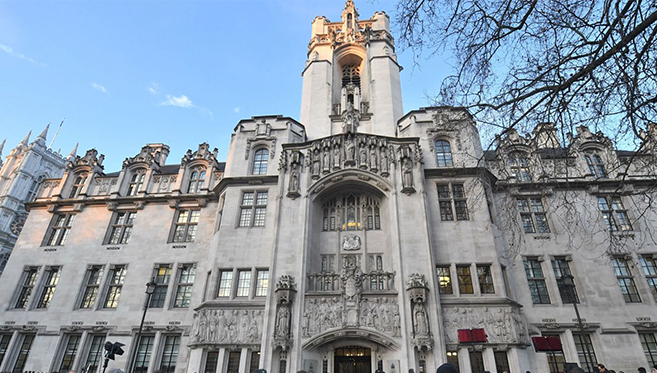
This week the Supreme Court delivered its judgment in Fearn & Others v Board of Trustees of the Tate Gallery  (Supreme Court, 1 February 2023), the most important private nuisance case in many years. I’m not hoping to analyse the reasoning of the court in relation to the law of private nuisance, but if you are interested I suggest that you start with the Supreme Court’s own press summary and then enter the blizzard of property litigation lawyers’ updates and thought pieces on LinkedIn etc. I’m only interested in what it means for the town and country planning process – if anything.

I wrote about the first instance ruling of the High Court in my 2 March 2019 blog post, Trial By Instagram: Privacy & Planning. I used to be quite lyrical:

Photo-sharing social media apps, weaponised by the smartphone camera, are changing our experience and expectations of place. Is the planning system, and the law of private nuisance, keeping up?

The London Evening Standard had a story for our times last night: Please stop ‘influencing’ on our doorsteps, Notting Hill residents tell ‘unapologetic’ Instagrammers.

At a personal level we have all become artists, influencers, curators, with our instant pics, filtered, composed, annotated. Fomo for you = dopamine for me. But zoom out and through endlessly snapping, sharing, liking and commenting, we are of course the product, the hive mind, the crowd source, working for the data mine, adding to the geo-cache, mapping ceaselessly where the sugar is in the city.

In this context, what sells a place? From outside in: a glimpse of the life style, the life, that could be yours. From inside out: unique views out onto a city. The two ugly i words: iconic, instagrammable.

Which all makes the parable of Fearn & others v The Board of Trustees of the Tate Gallery (Mann J, 11 February 2019) so perfect.

On one side, the residents of Neo Bankside, housed from floor to ceiling in glass so as to achieve spectacular views out and having paid no doubt precisely to be able to enjoy that experience.

On the other side, at its closest point 34 metres to the north of Block C of Neo Bankside, the viewing gallery on the tenth floor of the Blavatnik Building extension to Tate Modern, from which visitors also have spectacular views, including, to the south, of those residents in their transparent homes.”

And so I went on, analysing Mann J’s judgment in detail, but that analysis is now completely redundant. The Supreme Court has overturned the ruling both of Mann J and subsequent ruling of the Court of Appeal and held, by a majority of three to two that the Tate was liable in nuisance for inviting the public to look out from a viewing platform from which they can, and many do, peer into the claimants’ flats – and (the saga is far from over yet) another court will now need to grapple with the issue of what remedies (injunction/damages) may be appropriate.

However, for planners, it is still worth reading paragraphs 29 to 53 of Mann J’s first instance judgment, where he sets out in detail the planning history of the properties.

Because, for all of us engaged in the town and country planning process, the big question is whether it should be the role of the planning system to seek to prevent juxtapositions of uses like this – or is that a matter for private law (and this case is now a demonstration of the remedies available for individuals who have their private law rights infringed)?

 I agree with a post by Dentons’ Michele Vas this week, It’s official – it’s not the role of the planning system to police private rights – or is it? (2 February 2023):

Whilst this case did concern a very particular set of circumstances as to the level of invasion of privacy the Claimants were subjected to (i.e. I suspect “overlooking” alone is unlikely to be sufficient to base a private nuisance claim on) it does stress how fundamental good design in new development is to avoid future private nuisance claims.

Placemaking, understanding and respecting the integrity of neighbourhoods should be a building block to good design.  A further thought is that there is no useful “planning tool” to avoid or minimise future private nuisance claims; unlike property rights, it is not a right which can be lawfully interfered with or compulsorily acquired by relying on a local planning authority’s statutory powers.

Whilst the judgment is an incredibly welcome confirmation that the planning system is not there to police private rights, it is a reminder that design of development is at the heart to preventing these issues arising in the first place.

 I had noted down pretty much the same passages in the judgment as she identifies, namely paragraphs 109 and 110 from Lord Leggatt’s majority judgment:

Reliance on planning law

109. The second matter of policy raised by the Court of Appeal was a suggestion that planning laws and regulations would be a better medium for controlling “inappropriate overlooking” than the common law of nuisance (para 83). This seems to me to overlook (if I may use the term) the fact that, while both may sometimes be relevant, planning laws and the common law of nuisance have different functions. Unlike the common law of nuisance, the planning system does not have as its object preventing or compensating violations of private rights in the use of land. Its purpose is to control the development of land in the public interest. The objectives which a planning authority may take into account in formulating policy and in deciding whether to grant permission for building on land or for a material change of use are open-ended and include a broad range of environmental, social and economic considerations. While a planning authority is likely to consider the potential effect of a new building or use of land on the amenity value of neighbouring properties, there is no obligation to give this factor any particular weight in the assessment. Quite apart from this, as Lord Neuberger observed in Lawrence v Fen Tigers Ltd [2014] UKSC 13; [2014] AC 822, para 95:

“when granting planning permission for a change of use, a planning authority would be entitled to assume that a neighbour whose private rights might be infringed by that use could enforce those rights in a nuisance action; it could not be expected to take on itself the role of deciding a neighbour’s common law rights.”

110. For such reasons, the Supreme Court made it clear in Lawrence that planning laws are not a substitute or alternative for the protection provided by the common law of nuisance. As Carnwath LJ said in Biffa Waste, para 46(ii), in a passage quoted with approval by Lord Neuberger in Lawrence, at para 92:

“Short of express or implied statutory authority to commit a nuisance … there is no basis, in principle or authority, for using such a statutory scheme to cut down private law rights.”

The practical as well as legal irrelevance of planning permission in this case is apparent from the judge’s finding that no consideration was given to overlooking in the planning process for the Tate extension: [2019] Ch 369, paras 58-63.”

It is also worth noting that Lord Sales’ minority judgment does not dissent in terms of the role of the planning system:

“148. The designs for the Blavatnik Building always included a viewing gallery in some form, although its precise extent varied through successive iterations of the design. Planning policy for the South Bank encourages the construction of viewing galleries in buildings of significant height. However, there is no planning document which indicates that overlooking by the viewing gallery in the direction of Block C was considered by the local planning authority at any stage. It is not likely that the planning authority considered the extent of overlooking. Further, while the Neo Bankside developer was aware of the plans for a viewing gallery, it did not foresee the level of intrusion which resulted. In broad terms, the design and construction of the Blavatnik Building with the viewing gallery in its final form took place in parallel with the design and construction of Neo Bankside, without the effects of the one on the other so far as visual intrusion was concerned being fully appreciated or addressed.”

201. At para 81 the Court of Appeal also pointed out that overlooking is frequently a ground of objection to planning applications and noted that “any recognition that the cause of action in nuisance includes overlooking raises the prospect of claims in nuisance when such a planning objection has been rejected”. However, other forms of activity which can give rise to claims in nuisance, such as the generation of noise, smoke or smells, are also matters which may be addressed in objections to planning applications, so this does not give rise to any point of distinction. More fundamentally, as this court pointed out in Lawrence, at paras 77-95 per Lord Neuberger, the planning regime is concerned with issues of the public interest, not with resolving questions of individual rights. So it is not surprising, and is not a matter of particular concern, that a cause of action in nuisance may be found to exist in a case where an objection to the grant of planning permission founded on similar matters has been rejected. A grant of planning permission pursuant to the administrative processes under the planning regime cannot remove private rights which neighbouring landowners may have. See also Hunter, p 710D, per Lord Hoffmann and Lawrence, paras 156 (Lord Sumption), 165 (Lord Mance) and 193 (Lord Carnwath).”

This must all surely be right. The right approach to the determination of any application for planning permission is whether the proposal is in accordance with the provisions of the local plan unless material considerations indicate otherwise. There may often be policies which seek to protect existing residential amenity (although when I look for instance at the current Southwark local plan, postdating these proposals, I see no specific references to protection of existing residents’ privacy or to avoiding overlooking). Even without local policy support, aspect of a development proposal which may adversely affect neighbours are certainly capable of being a material consideration in the determination of an application for planning permission, but as always it is for the decision-maker to decide how much weight to apply to those considerations.

I don’t believe that the judgment increases the onus on local planning authorities to consider privacy/overlooking considerations: planning decisions can only go so far and private law remedies are the ultimate safety net. And of course the circumstances of the Tate Modern case, by virtue of the unusual nature of the viewing platform and the extent of its use, should not be applied too widely. However, one would hope that the Government’s increased emphasis on design in the planning process may reduce the risks of these sorts of unanticipated juxtapositions in the future. It will be interesting to see the Government’s proposed National Development Management Policies in due course…

Simon Ricketts, 4 February 2023

Personal views, et cetera

Photograph by Jay Mullins courtesy of Unsplash

Thank You Mikael Armstrong: New Case On Scope Of Section 73

Thank you also to my Town Legal partner Patrick Robinson who spotted this hand-down yesterday from the Planning Court: Armstrong v Secretary of State (Deputy High Court Judge James Strachan KC, 27 January 2023). 

Who is Mr Armstrong? Well Mr Armstrong had the benefit of a planning permission for the erection of a new dwelling in Cornwall with the wonderful address of The Beach House, Finnygook Lane, Portwrinkle. The planning permission dated back to 2007 but had been kept alive by way of minor implementation works. 

A house had previously stood on the site. This photograph from the application documentation on Cornwall Council’s planning portal gives a sense of its dramatic location:

Mr Armstrong made an application under section 73 of the Town and Country Planning Act 1990 to vary the approved scheme, by way of amendment of a condition which listed the approved drawings (a condition which had been added by way of section 96A, to enable use of section 73 – the now familiar approach following Finney (if any non planners or planning lawyers are still reading, you must think we are all mad)). 

The application was refused by Cornwall Council, with one reason for refusal:

The proposed development seeks to change the design of the dwelling approved via, E2/06/01798/FUL, from an irregularly-shaped boldly modernist dwelling to a dual-pitched alpine lodge style dwelling. The application site occupies a highly prominent and sensitive coastal plot. The proposed revised design completely alters the nature of the development and would result in a development that would differ materially from the approved permission. As a result this proposal goes beyond the scope of Section 73 of the Town and Country Planning Act 1990 and is contrary to guidance within the National Planning Practice Guidance, specifically paragraph 001 Reference ID: 17a- 001-20140306.”

There are these images of the approved and proposed schemes, courtesy of Cornwall Council’s planning portal:

(Whilst not relevant to the legal issues, I note that the proposed revisions to the scheme would cause it more closely to resemble the dwelling that had previously been on the site). 

Mr Armstrong appealed. His appeal statement made these (entirely correct) points:

a. although an application under section 73 of the 1990 Act is sometimes referred to as an application to make a “minor material amendment”, the terms of section 73 of the 1990 Act are not limited in that way and place no restriction on the magnitude of the changes that can be sought;

b. reference had been made by the Courts in the consideration of section 73 of the 1990 Act to not permitting amendments which amount to a fundamental alteration to the terms of a planning consent, but there was nothing of a fundamental nature such as scale, size, massing or footprint and positioning on the Site which would result in any significant change;

c. section 73 applications still receive the same amount of scrutiny as a full planning application and the process does not prejudice the ability for relevant parties to make representations”.

The appeal was determined by way of written representations. The inspector determined the main issue to be: “whether the proposal could be considered as a minor material amendment under section 73 of the TCPA 1990“.

(Alarm bells already…)

The inspector’s analysis includes the following passages:

The original planning permission was for a bespoke dwelling in a contemporary architectural style, with the external materials being natural stone and cedar cladding. The approved plans show a multi-faceted building, with an organic form, including curved walls and sedum-covered roofs. By contrast, the proposed plans submitted with the section 73 application show a dwelling with a simple rectilinear form, rendered walls and a pitched slate roof. Consequently, although it is similarly sited, and has a comparable floorspace and volume, it is fundamentally different in its design, bearing virtually no resemblance to the approved building. The modifications are, therefore, substantial.


The appellant contends that the term “minor material amendment” infers that material changes are allowable under a section 73 application. However, the word “minor” qualifies the extent to which material changes should be considered via this route. In this case, the wholesale redesign of the house results in a development that would be of a substantially different nature than the one originally approved. In these circumstances, the PPG advises that a new planning application is necessary
.”

He dismissed the appeal. 

Thankfully, Mr Armstrong didn’t give up on the entire pettyfogging planning system at that point but, as a litigant in person, challenged the decision in the High Court. 

And, as was only right in the face of this sort of reasoning from the inspector, he won! And in so doing, has provided further judicial authority for what planning lawyers end up saying again and again – the limits of section 73 are not confined by the question of whether there would be a minor material amendment to the approved scheme, but whether there would be a fundamental variation to the approved scheme (as that is the test previously set down in Arrowcroft and subsequent cases).

Deputy High Court Judge James Strachan KC’s gave no fewer than eight reasons why the inspector’s decision was unlawful:

First, I consider the correct starting point must be the words of section 73 of the TCPA 1990 itself. As the Defendant accepts, there is nothing in section 73, or in the TCPA 1990, that limits its application to “minor material amendments”, or to amendments which do not involve a “substantial” or “fundamental” variation. On the face of the words used, s.73 applies to any application for planning permission for development of land “without complying with conditions subject to which a previous planning permission was granted” (see s.73(1)). It limits the local planning authority’s consideration to the “question of conditions subject to which planning permission should be granted (see s.73(2)). There are other limitations as to its scope such as those in ss73(4) and (5), but they are not engaged here. There is nothing in the language used that restricts an application to vary or remove a condition to “minor material amendments”, or to what a decision-maker considers to be a “non-fundamental variation”. I accept that the absence of such a limitation on the face of the statute does not automatically mean that such limitations cannot arise as a matter of statutory interpretation, in accordance with well-established principles requiring one to consider the meaning of a statute and its statutory purpose. However it is an important starting point that, on the face of the statute, provided the application is limited to non-compliance with a condition (rather than any other part of the permission) it falls within the stated scope of s.73 of the TCPA 1990.

Second, as now properly understood in light of Finney, the requirement that a s.73 application be confined to applications for non-compliance with a condition is significantly restrictive in and of itself. There is no obvious need, justification or statutory purpose for reading in additional restrictions which are not expressed on the face of the statute. Finney confirms that section 73 cannot be used to vary the operative part of a planning permission. It is a section concerned with non-compliance with condition, rather than the operative part of a permission. One therefore cannot use s.73 to vary or impose a condition where the resulting condition would be inherently inconsistent with the operative part of the planning permission; that would also involve effective variation of the operative part of the planning permission as well. That point was exposed clearly in Finney where the resulting varied condition caused the Inspector to omit the conflicting words in the description of development in her decision. The power under s.73 is therefore a limited one (as briefly observed in Hillside). But in such circumstances, it is difficult to see why it is necessary to introduce or read in further limits on its scope which are not otherwise expressed in the section itself. If, as accepted to be the case here, an application for non-compliance with a condition does not lead to any conflict or inconsistency with the operative part of the permission, it is difficult to see why it is objectionable in light of the statutory purpose of section 73 and the TCPA 1990 itself.

Third, section 73 is clearly intended to be a provision which enables a developer to make a section 73 application to remove or vary a condition, provided of course that the application does not conflict with the operative part of the planning permission. Any such variation application will be subject to the necessary procedural requirements for its consideration which, for example, enable representations to be received. If Parliament had intended the power to restrict its application further (for example to limit it to “minor material” amendments to a condition, or non-fundamental variations to a condition) one would have expected that to be expressed in the language used and it could readily have done so.

Fourth, and linked to the preceding point, the wording of section 96A of the 1990 Act is informative as part of the statutory context. Unlike section 73 which limits its application to conditions, section 96A was introduced as a power to amend a planning permission generally (including the operative part of the permission). But in introducing that power that is applicable to any part of a permission, Parliament expressly constrained its scope to “non-material amendments”. By contrast, no such limitation has been imposed on the scope of s.73 where it is applicable, but with the fundamental difference that s.73 is confined in scope to applications for non-compliance with conditions (rather than non-compliance with the operative part of a permission). From the perspective of statutory interpretation taking account of the statutory context, this is yet a further indication that if Parliament had wished to limit the power under s.73 to “minor material amendments” or so prevent “fundamental variations” to conditions, it would have done so expressly.

Fifth, the effect of giving the words used in s.73 their plain and ordinary meaning so as to allow an application to be made for non-compliance with any planning condition which is not in conflict with the operative part of permission does not, of course, dictate the outcome of that application. It simply means that the application can be entertained. Any such application would then fall to be determined on its planning merits. In this case, for example, the Inspector considered there to be a fundamental difference in the proposed aesthetics of the design shown in the drawings identified in Condition 10 and the proposed plans. That may well be the inevitable result of an application made under s.73. But provided there is no inherent conflict or inconsistency with the “operative part” of the planning permission – in this case the construction of a single dwelling – the planning merits of that proposed change can be assessed on its merits. No such assessment has occurred. As part of that assessment, the decision-maker will be able to consider whether the proposed change (fundamental or otherwise) is acceptable or not in planning terms, taking account of any representations received.

In this respect, I recognise that in Finney, arguments as to the ability to consider the merits of s.73 application in this way (with attendant publicity) was not seen as a factor justifying giving s.73 the more expanded interpretation that the developer and Welsh Ministers had advocated in that case. There is an important difference. There, such arguments were advanced to try and justify giving s.73 a more extended interpretation than its words supported so as to permit effective changes to the operative part of a planning permission. Here, the situation is reversed. The ability to consider the merits of any change to a condition that falls within the ordinary and natural scope of the language used in s.73 points away from the need to read in additional restrictions to the scope of the statutory provision.

Sixth, I do not consider that any of the caselaw materially supports the Defendant’s attempt to restricting the scope of s.73 to “minor material amendments” or non-fundamental variations where there is no conflict with the operative part of the permission. To the contrary, it is more consistent with giving the words of s.73 their plain and ordinary meaning.

….

Seventh, if I am wrong and section 73 is implicitly qualified so as to preclude applications which do not involve any conflict with the operative part of a permission, but do involve what the decision maker considered to be a fundamental variation, I am not convinced that the Inspector has properly addressed the question of what would constitute a fundamental variation in this context.

Eighth, even if a test of fundamental variation is a lawful one to apply, I am not persuaded that the Inspector applied such a test in this case. In my judgment there is more than sufficient doubt about that to justify quashing the decision on the basis that he misdirected himself by reference to the PPG and its concept of “minor material amendments”.”

The inspector’s decision letter was quashed and the appeal will now be redetermined. Stick with it, Mr Armstrong. 

NB For further background on the procedures available for amending schemes, see my 14 January 2023 blog post Greater Flexibility For Planning Permissions (Now I’m Just Showing My Age).

Simon Ricketts, 28 January 2023

Personal views, et cetera

Greater Flexibility For Planning Permissions (Now I’m Just Showing My Age)

Such a lot of hyperbolic talk and not enough doing.

The Conservatives’ Open Source Planning 2009 manifesto document started with this passage:

The planning system is vital for a strong economy, for an attractive and sustainable environment, and for a successful economy. At present, the planning system in England achieves none of these goals. It is broken”.

And then Boris Johnson in the foreword to Planning for the Future (August 2020):

“…we approach the second decade of the 21st century [the incredible potential of this country] is being artificially constrained by a relic from the middle of the 20th – our outdated and ineffective planning system.”

Well fix it, dear Henry, dear Henry, as the old song went. But, of course, it wasn’t broken in 2009 and it – just about – wasn’t outdated or ineffective in 2020. In 2023? I’m not so sure.

Given that the Government is currently refusing to accept there is an NHS crisis, I wonder if it would still accept that there is a housing crisis? Is it concerned by the number of local authorities deciding to pause or abandon preparation of their local plans? I’m genuinely unsure.

But let’s ignore for the moment the political direction in which this old vehicle should be headed and look instead at how the engine is working – can it actually deliver us to wherever it is we want to go?

Instead, let’s just focus on development management for a moment. In what should be a straightforward matter of processing, in accordance with statutory timescales, planning applications so as hold firm against the unacceptable and to approve the rest without delay , in form that that can lead to development taking place, and the public benefits which flow from that, there are currently at least two really horrible feedback loops, or vicious circles, that are holding back even the best projects:

  • Under-resourced planning departments, precautionary in nature, burdened with being the custodians of so many different policy objectives (climate change, health, building safety, beauty, air quality – you name it), take increasingly longer to process applications and their members’ decision-making is increasingly unpredictable (heads turned by lobby groups and hints from Government as to changing approaches). This leads to more applicants deciding to appeal so as to achieve a certain timescale and objective consideration of the issues. This places more work on officers, slowing down consideration of other applications. Which then also end up at appeal. And the slower the application and appeal process, the more likely that new issues arise, sending the applicant back to an earlier stage in the process again.
  • The demands on an applicant to tie down elements of a project at too early a stage, together with short implementation timescales and uncertain processes for processing scheme changes, lead to much unnecessary activity both in (a) keeping planning permissions alive with relatively minor works so that a permission that has taken years and a huge amount of money to achieve is not prematurely lost before the development is in a position to proceed and in (b) using clunky work-arounds – various combinations of section 96A, section 73 and/or drop-in applications – in order to refine proposals so that the permission is for a development which can actually be built. The longer the process for securing planning permission in the first place, the more likely that the resultant planning permission will need to be varied. The more certainty that the authority seeks to achieve with tightly drawn development parameters and a long list of planning conditions, the more likely that changes will be required.

I suspect that the Government is unaware of the true extent of the issue. I was looking at the latest statistics from December 2022. 86% of major applications last year were apparently determined “within 13 weeks or agreed time limit”. “or agreed time limit” is the clue, with time extensions routinely agreed so as to safeguard against premature refusal. Can anyone find where in the tables one might find how long an application for planning permission takes on average, from submission (usually after a lengthy and expensive pre-app process) to completion of section 106 agreement?

Another awkward reality to introduce at this point: projects need to be viable in order to proceed. Private sector development will not take place unless, broadly speaking, (1) the land owner will be paid by the developer an amount sufficiently above existing use value to make it make it worth his or her while to sell, and above what the land may be worth for any other development which could be carried out on the land (2) the developer can achieve a profit which makes undertaking the development commercially worthwhile, having regard to the financial risks inherent in the project, and can be sufficiently confident that there will be a market for the end product and (3) the capital deployed can achieve a better return than if it were to be deployed elsewhere. At present, with construction cost inflation, increased political risks, uncertainties as to the economy, is it any wonder when development is stalled; when development projects which may previously have been viable no longer make any financial sense on the terms negotiated, or when scheme changes are needed to reflect changing commercial (or indeed Building Regulations) requirements? I focus on private sector development given how reliant as a country we are on the private sector to deliver housing in particular, but of course most of the same economic realities apply, or should apply, to development carried out by the public sector.

None of this appears to be recognised in current Government announcements. Far from it. Instead, the rhetoric is to double down on developers who do not build out quickly, in genuflection to the myth of land-banking – with the Levelling-up and Regeneration Bill’s provisions about development commencement notices, changes to the completion notices regime and even a power for local planning authorities to decline to determine applications in cases of earlier implementation. As if these measures were ever going to force a developer to build out a permission for a scheme where the funding wasn’t yet in place, where there was not yet a ready market or where the project was no longer viable! Instead, these measures will simply discourage many from entering the process in the first place, rather than risk abortive expenditure, even if the odds are that the scheme will go ahead. Why take the additional risk?

To people like me, the 2007 – 2008 global financial crisis seems like yesterday. Development almost came to a halt. Whilst it seemed too slow at the time, the then Government responded with measures that were summarised in its guidance document, Greater Flexibility For Planning Permissions, published first in 23 November 2009 and revised  1 October 2010). Look at the 2009 impact assessment:

In current economic circumstances, there is a reduced take-up of existing permissions. Where permissions lapse, there are costs and delays associated with providing and processing an application for a fresh planning permission.

There is also a broader need for added flexibility to allow developers and local planning authorities to make non-material amendments to existing planning permissions and to clarify and streamline the process for making minor material amendments. There is currently a lack of clarity about what can be done, which is resulting in unnecessary expense and time for both parties.

The guidance:

  • set out the temporary arrangements that had been brought in to extend the life of planning permissions. “This measure has been introduced in order to make it easier for developers and local planning authorities to keep planning permissions alive for longer during the economic downturn so that they can more quickly be implemented when economic conditions improve.
  • explained about the then new section 96A process for non-material amendments to planning permissions, introduced on 1 October 2009 pursuant to the Planning Act 2008.

The guidance was withdrawn on 7 March 2014 and replaced with the Flexible options for planning permissions section of what was then the new Planning Practice Guidance. In the transition, somehow the policy thrust of the earlier guidance was lost – the notion that flexibility can be a good or even necessary thing.

If you recall, the coalition Government subsequently introduced by way of the Growth and Infrastructure Act 2013 new sections 106BA, BB and BC into the Town and Country Planning Act 1990, providing a new application and appeal procedure, to review affordable housing obligations on the grounds of viability. Whilst helpful in some situations, it was certainly abused in others, and it was then repealed in 2016.

More recently of course, during the pandemic there were temporary measures to allow for the extension of time limits on planning permissions.

The Levelling-up and Regeneration Bill has its second reading in the House of Lords on 17 January 2023 and, when it comes to greater flexibility for planning permissions, clause 102 (introducing new Section 73B into the Town and Country Planning Act) remains as a small step in the right direction. Section 73 will continue to exist but section 73B provides for an alternative procedure for amending schemes, given that as a result of the Court of Appeal’s ruling in Finney, section 73 cannot be used for amending the description of development on a planning permission. Section 73B will allow for an application to be made for planning permission to be granted for an amended form of a previous planning permission. Planning permission will only be able to be granted “if the local planning authority is satisfied that its effect will not be substantially different from that of the existing permission”. It will not be able to be applied for in relation to a section 73 permission. The local planning authority “must limit its consideration to those respects in which the permission would, if granted…differ in effect from…the existing permission”.

My worry with section 73B is that unless there is really encouraging guidance from DLUHC, local planning authorities will be cautious as to the “not substantially different” test. After all, where does it rest on the spectrum between “non-material amendment” and “fundamental alteration”?

It seems to be that we will now have the following procedural options:

  • Section 96A for non-material amendments
  • Section 73 for amendments which may be material but which are not a fundamental alteration to the approved scheme and which do not necessitate a change to the description of development on the face of the original planning permission.
  • Section 73B for amendments which do not approve development whose effect will be substantially different from that of the existing planning permission
  • A fresh application for planning permission (encompassing also the Supreme Court’s suggested solution given in paragraph 74 of  its Hillside judgment: “Despite the limited power to amend an existing planning permission, there is no reason why an approved development scheme cannot be modified by an appropriately framed additional planning permission which covers the whole site and includes the necessary modifications”)
  • In a case where the existing planning permission is, in the words of the Supreme Court in Hillside, “severable”, our old friend the “drop-in permission”. Unmentioned in Hillside, not to be found in legislation or guidance but still in my view clearly possible in the right situation.

Wouldn’t it be useful for DLUHC to publish a document now with the can-do tone of Greater Flexibility for Planning Permissions, recognising the obstacles in the way of achieving timely development, and encouraging local planning authorities to use these procedural tools available to them where necessary, so as not to delay or frustrate development, with suggestions as to how the appropriate tests should be approached? At present the whole thing is a lottery, dependent on the particular views of individual planning departments and even individual officers.

And wouldn’t it be useful if, instead of the hyperbole, there could be an honest look at the real stresses and strains the current system is under and if there could be a tightening of processes in the same way as Rosewell achieved for the planning appeals system? And above all, if planning departments could have available to them sufficient staff: well-trained, well-managed and well-motivated?

And now the prospect of strikes at the Planning Inspectorate. An interesting year ahead, folks.

Simon Ricketts, 14 January 2023

Personal views, et cetera

Running Down That Hillside

We now have the judgment of the Supreme Court in Hillside Parks Limited v Snowdonia National Park Authority (2 November 2022).

The case concerns the relationship between successive grants of planning permission for development on the same land and, in particular, about the effect of implementing one planning permission on another planning permission relating to the same site.

The facts concerned, in basic summary, a full planning permission for the development of 401 dwellings at Balkan Hill, near Aberdyfi in the Snowdonia National Park, granted in 1967. Development was to be in accordance with a detailed “master plan” showing the proposed location of each house and the layout of a road system for the estate.

Only 41 of the dwellings have been built to date, none in accordance with the masterplan. The developer, Hillside Parks Limited, has applied for and been granted a series of additional planning permissions permitting development which has taken place on parts of the site.

The Supreme Court has followed the Court of Appeal and High Court in concluding that development pursuant to the 1967 planning permission cannotlawfully be continued:

The courts below were right to hold that the 1967 permission was a permission to carry out a single scheme of development on the Balkan Hill site and cannot be construed as separately permitting particular parts of the scheme to be built alongside development on the site authorised by independent permissions. It is possible in principle for a local planning authority to grant a planning permission which approves a modification of such an entire scheme rather than constituting a separate permission referable just to part of the scheme. The Developer has failed to show, however, that the additional planning permissions under which development has been carried out on the Balkan Hill site since 1987 should be construed in this way. Therefore, that development is inconsistent with the 1967 permission and has had the effect that it is physically impossible to develop the Balkan Hill site in accordance with the Master Plan approved by the 1967 permission (as subsequently modified down to 1987). Furthermore, other development has been carried out for which the Developer has failed to show that any planning permission was obtained. This development also makes it physically impossible to develop the site in accordance with the Master Plan approved by the 1967 permission (as subsequently modified).” (paragraph 100).

Whilst the specific facts of the case are unusual (including a degree of uncertainty as to the intended procedural status and effect of the subsequent planning permissions, several of which on their face are described as “variations” of the 1967 planning permission) the Supreme Court sets down some general principles to be applied to situations concerning overlapping permissions. The judgment clarifies some ambiguities arising from the earlier Court of Appeal judgment, although ambiguities remain.

One ambiguity indeed is as to the extent to which the principles set out apply to outline planning permissions, given passages such as paragraph 20:

In this case, we are concerned with grants of full planning permission, in relation to which it is to be expected that a reasonable reader would understand that the detailed plans submitted with the application have particular significance.”

On first reading, I draw the following principles from the judgment:

  1. Approval of the Pilkington principle

In essence, the principle illustrated by the Pilkington case [[1973] 1 WLR 1527, Divisional Court] is that a planning permission does not authorise development if and when, as a result of physical alteration of the land to which the permission relates, it becomes physically impossible to carry out the development for which the permission was granted (without a further grant of planning permission) … Where the test of physical impossibility is met, the reason why further development carried out in reliance on the permission is unlawful is simply that the development is not authorised by the terms of the permission, with the result that it does not comply with section 57(1).” (paragraph 45)

“…([I]n the absence of clear express provision making it severable) a planning permission is not to be construed as authorising further development if at any stage compliance with the permission becomes physically impossible.” (see paragraph 68)

(my emboldening).

  1. Interpretation of planning permissions for multi-unit developments

A planning permission for a multi-unit development is unlikely properly to be interpreted as severable into a set of discrete permissions to construct each individual element of the scheme.

However, see the reference above to the possibility of “clear express provision making it severable”.  An early thought in reaction to the judgment is that in relation to large multi-phased planning permissions this may already be the case. Where it is not, it may often be useful in the future for it to be introduced.

  1. The whole development is not unlawful if a proposed development cannot be completed fully in accordance with the planning permission

The Supreme Court doubted that it was correct that “in carrying out a building operation, any deviation from the planning permission automatically renders everything built unlawful, even in relation to a single building” and considered that it was certainly not the case that failure to complete a building operation for which planning permission has been granted renders the whole operation including any development carried out unlawful (To that extent the Supreme Court disagreed with remarks of Lord Hobhouse in Sage v Secretary of State for the Environment, Transport and the Regions [2003] UKHL 22).

  1. Under the Pilkington principle, departures must be material

The Pilkington principle should not be pressed too far. Rightly in our view, the Authority has not argued on this appeal that the continuing authority of a planning permission is dependent on exact compliance with the permission such that any departure from the permitted scheme, however minor, has the result that no further development is authorised unless and until exact compliance is achieved or the permission is varied. That would be an unduly rigid and unrealistic approach to adopt and, for that reason, would generally be an unreasonable construction to put on the document recording the grant of planning permission – all the more so where the permission is for a large multi-unit development. The ordinary presumption must be that a departure will have this effect only if it is material in the context of the scheme as a whole: see Lever Finance Ltd v Westminster (City) London Borough Council [1971] 1 QB 222, 230. What is or is not material is plainly a matter of fact and degree” (paragraph 69)

  1. How to vary a planning permission

Aside from the specific statutory procedures (section 73 and section 96A – and potentially in due course the additional procedure proposed in the Levelling-up and Regeneration Bill), what else can a developer do where it wishes to depart from the planning permission it has been granted?

“73 … [Counsel for Hillside] also submitted that it would cause serious practical inconvenience if a developer who, when carrying out a large development, encounters a local difficulty or wishes for other reasons to depart from the approved scheme in one particular area of the site cannot obtain permission to do so without losing the benefit of the original permission and having to apply for a fresh planning permission for the remaining development on other parts of the site.

74.          In our view, that is indeed the legal position where, as here, a developer has been granted a full planning permission for one entire scheme and wishes to depart from it in a material way. It is a consequence of the very limited powers that a local planning authority currently has to make changes to an existing planning permission. But although this feature of the planning legislation means that developers may face practical hurdles, the problems should not be exaggerated. Despite the limited power to amend an existing planning permission, there is no reason why an approved development scheme cannot be modified by an appropriately framed additional planning permission which covers the whole site and includes the necessary modifications. The position then would be that the developer has two permissions in relation to the whole site, with different terms, and is entitled to proceed under the second.

75.          The Authority has argued that, because the planning legislation does not confer any power on a local planning authority to make a material change to an existing planning permission, a later planning permission cannot have the effect of modifying in any material way the development scheme authorised by an earlier permission.

76.          The trial judge, HHJ Keyser QC, did not find this argument persuasive and nor do we…”

(my emboldening).

If I have this right, this would be a procedure to fall back on in a situation where the Pilkington principle would otherwise bite i.e. where, even though development will be unchanged pursuant to part of the planning permission (1) that part can’t be shown to be clearly severable from the remainder (or presumably amended via section 96A or section 73 so as to be clearly severable) and (2) it would now be physically impossible to complete the planning permission in accordance with its terms (its original terms or presumably as amended via section 96A or section 73) if a separate permission were to be granted in relation to part of the development area covered by the permission.

  1. No principle of abandonment of planning permissions

The developer’s argument that Pilkington should be analysed as a case resting on a principle of abandonment was rejected. The Supreme Court does not accept “that there is any principle in planning law whereby a planning permission can be abandoned” (paragraph 35).

I hope this brief initial run down is a helpful introduction to what will in due course be a very familiar text for all of us. More anon I’m sure.

Simon Ricketts, 2 November 2022

Personal views, et cetera

Courtesy Mel Poole on Unsplashed

Clangers: Does An LPA Owe A Duty Of Care To An Applicant For Planning Permission?

Many a frustrated participant in the planning system has asked from time to time: is there any financial redress for mistreatment allegedly received at the hands of a local planning authority? (To be fair, sometimes a frustrated local planning authority may indeed also wonder what redress it has against mistreatment received at the hands of applicants or objectors).

Beyond the possibility of an award of costs on appeal (inadequate in that it will only cover professional costs in relation to the appeal stage rather than application stage, although still sometimes high, viz the figure of £2.1m reportedly agreed this week by Uttlesford District Council to be payable to Stansted Airport) or the possibility of obtaining a voluntary payment of compensation by way of a ruling by the Local Government Ombudsman, in what circumstances might the authority be sued in negligence?

The negligence route has now, expensively, been tested in Primavera Associates Limited v Hertsmere Borough Council (Leech J, 25 October 2022). Four days in what used to be known as the Chancery Division of the High Court, with various expert witnesses on both sides. It’s a horror story of a situation – what should have been a small and straightforward development project in Radlett, Hertfordshire promoted by Shandler Homes on behalf of Primavera Associates Limited. As is often the case in these situations, in the cold light of day neither party, neither applicant not local planning authority, could be said to have been entirely blameless.

As described from paragraph 36 onwards of the judgment, planning permission was granted on 3 September 2012 for the demolition of a house and the erection of seven self-contained apartments, following an application submitted on 13 January 2012. The planning permission was then challenged by the owner of the neighbouring property who had previously sought to redevelop it together with the Shandler Homes property and the council consented to judgment on the basis that a planning condition referred to a plan showing an incorrectly drawn visibility splay.

The application was then redetermined, with the council resisting submissions from the objector’s solicitors (supported by an opinion by Rupert Warren KC) that the application should now be assessed against the current development plan. Oh dear, another judicial review ensued and again the council consented to judgment.

A fresh application for permission was then submitted on 2 April 2014, for a very similar scheme. Delays ensued whilst financial viability appraisal work was undertaken to check whether the applicant’s proposed commuted sum towards affordable housing was sufficient.

By 14 November 2014 Shandler Homes and Primavera were threatening to bring proceedings in negligence against the council. Delays continued (I’m at paragraph 85 now – it really is a sorry tale) and by 14 October 2015 another letter was sent threatening proceedings in negligence. During this period CIL liability increased and then the council started to insist upon a clawback mechanism to secure 60% of any surplus that arose on a subsequent viability review to be carried out.

The application was resolved to be approved on 21 April 2016 and following fractious negotiations over the section 106 agreement, planning permission was issued on 28 September 2016.

A third application for planning permission was submitted on 30 September 2016, increasing the number of flats proposed from seven to ten, which was approved on 15 March 2017.

Primera sued Hertsmere Council for around £1.7m, which it claimed to be the losses suffered due to what it considered to be negligent conduct on the part of the council.

To turn briefly to the law. As I’m sure you know, in order to succeed in a claim in negligence it is necessary for the following factors to have been established:

  • The defendant owed a duty to the claimant

  • The defendant breached the duty owed to the claimant

  • The defendant’s breach of duty caused the claimant to suffer loss
  • The loss caused by the defendant’s breach of duty is recoverable

Duty of care

From paragraph 179 Leech J sets out the case law in detail as to when a duty of care arises, and does not arise. This includes, at paragraphs 203 to 215, the case law in relation to planning matters.

His findings start at paragraph 221. First of all no duty of care arose as a result of the statutory nature of the functions being undertaken by the council. The council did not give “any assurance to Shandler Homes that it would decide either application in a particular way or within a particular time. In either case, the remedy was to appeal.” The fact that an application fee was paid did not change the analysis, or indeed lead to a contractual relationship between the parties. In any event, any duty of care would not have stretched beyond Shandler Homes to Primavera and other entities related to the promotion of the development. No could any assumption of liability be inferred from the manner in which the council had behaved towards Primavera:

(1) I have found that the Council’s officers and the Committee’s members did not give any commercial or legal advice to Primavera or to Fusion (on its behalf) upon which Primavera (or Fusion) relied in relation to the First Application either when it was originally submitted or when it was submitted in a revised form.

(2) I have also found that Mr Down took a calculated decision not to appeal against the non-determination of the Second Application in the knowledge that the position was uncertain and changing. I am satisfied that Primavera chose to take the risk of any delay or flaw in the statutory process rather than to appeal.

(3) But even if (contrary to my finding of fact) Mr Down did not consider an appeal to be a realistic option because Mr Taylor and he did not know what they would have been appealing against, I have also held this belief was an unreasonable one and not induced by any representation or assurance made by the Council.

(4) I have found that in the period between 13 April 2013 and 27 September 2016 the Council did not assume responsibility for the progress and determination of the Second Application within a specific time frame or within a time which Mr Taylor or Mr Down considered reasonable. I have also found that Fusion and Primavera adopted a confrontational and heavy-handed approach. In my judgment, Mr Taylor’s complaints and the Letters of Claim which Lawrence Stephens sent to the Council negated any reliance by Primavera upon the competence or efficiency of the Council.”

He concludes that the claim fails because the council did not owe any duty of care to Primavera to exercise reasonable care in processing and determining the applications.

However, he goes on in any event to consider the further issues: breach of duty, causation and assessment of damages (if his finding on duty of care were to be overturned on appeal).

Breach of duty:

If the Council owed a duty of care (contrary to my finding above), then I find that it committed a breach of that duty and failed to exercise reasonable skill and care by determining the revised First Application by reference to the planning policy at the date on which the First Application was submitted and not by reference to the emerging planning policy at the date of the Second Decision. For the avoidance of any doubt, I add that I do not find that the Council failed to exercise reasonable care in relation to any other aspect of the First Application or the First and Second Decisions.”

If the Council owed a duty of care (contrary to my finding above), then … I also find that the Council was negligent and responsible for a six-month delay in the progress of the Second Application between January and July 2015. I dismiss all of the other allegations of negligence and lack of reasonable care against the Council.

Causation:

I also find on a balance of probabilities that if the Council had acted with reasonable care throughout the period between the submission of the Second Application on 2 April 2014 and 27 September 2016 when the Second S106 Agreement took effect, it would have taken six months less to progress and determine the Second Application and the Council would have issued the Third Decision by 21 October 2015. However, I would also have found that the conduct of Shandler Homes broke the chain of causation because (as I have found) Mr Down took a calculated decision not to appeal against the non-determination of the Second Application at any time between 3 June 2014 and 3 December 2014 (or to negotiate an extension of time for an appeal).”

Assessment of damages:

If I had found that the Council owed such a duty of care, I would also have found that the Council had committed two breaches of duty and that if it had not committed the first of those breaches of duty, it would have granted planning permission for the Second Application on 28 January 2014. I would, however, have dismissed all of the heads of loss claimed by Primavera apart from the claim relating to the Affordable Housing Contribution and the Additional Housing Contribution. Primavera adduced no evidence to prove these losses at trial and even this is wrong I would not have awarded any more than £134,724.80 in damages.

Concluding thoughts

The case certainly brings with it some salutary lessons – about trying to avoid the sort of breakdown of trust between the parties which led to so many flashpoints and mistakes on both sides. The applicant’s team, seeing life from its perspective, increasingly concerned about the cost, expense and uncertainties arising from what should have been a straightforward planning application process, was no doubt furious at the clangers on the part of the council’s officers and the timescales to which they were working. It’s easy to say perhaps from a distance, but a more consensual approach, providing good objective advice for the benefit of all parties where necessary, might have been more fruitful for the applicant than resorting to what the judge described as a “confrontational and heavy-handed approach”. And litigation, ultimately, was not the answer.

In other news, has Elon Musk found any Clangers on Mars yet? Plenty of surprises left for the rest of 2022 I’m sure.

Simon Ricketts, 29 October 2022

Personal views, et cetera

IZs: Some Handy Existing Legislation?

I know we all lose bits of legislation down the sofa. 

The Government’s 24 September 2022 guidance on investment zones in England said this:

The government will look to introduce primary legislation in order to enable the offer on tax and simplified regulations. The final offer will be subject to the passage of that legislation through parliament.”

There really isn’t much clarity as to the nature and extent of any primary legislation that will in fact be required to deliver the regimes envisaged for each investment zone (potentially bespoke for that investment zone). When you add this to the wider confusion as to the relationship of the proposed Planning and Infrastructure Bill with the current Levelling-up and Regeneration Bill (with much of what was trailed for the former either already within the latter – eg environmental law reform – or shortly to be added by way of amendments.- eg amendments to NSIP processes – or able to be secured by way of secondary legislation), some clarity from Government is urgently needed. 

Turning to the question of what amended planning regimes may be appropriate for some investment zones, people have rightly pointed to the potential use of local development orders, which for example the Government has previously encouraged in relation to enterprise zones and freeports. 

However I’m wondering whether, instead of further primary legislation to set out some unspecified new procedure (which sounds slow and impractical), the Government has considered whether two provisions which are already on the statute book are in fact sufficient: simplified planning zones and planning freedoms schemes. Are ministers even aware of them? I would be interested in people’s experiences with either. 

Simplified Planning Zones were introduced by way of section 82 of the Town and Country Planning Act 1990 which provides as follows:

(1) A simplified planning zone is an area in respect of which a simplified planning zone scheme is in force.

(2) The adoption or approval of a simplified planning zone scheme has effect to grant in relation to the zone, or any part of it specified in the scheme, planning permission—

(a) for development specified in the scheme, or

(b) for development of any class so specified.

(3) Planning permission under a simplified planning zone scheme may be unconditional or subject to such conditions, limitations or exceptions as may be specified in the scheme.

See also the Town and Country Planning (Simplified Planning Zones) Regulations 1992.

This is a good explainer, with examples: How simple are Simplified Planning Zones? (Local Government Lawyer, 4 February 2016) and here is some information about Slough Borough Council’s Slough Trading Estate SPZ.  

Planning freedom schemes were introduced by section 154 of the Housing and Planning Act 2016.

From the explanatory notes to section 154:

Section 154: Planning freedoms: right for local areas to request alterations to planning system

441 This section enables the Secretary of State, by regulations, to make planning freedom schemes in England. Planning freedom schemes may only be made following a request from the local planning authority for the relevant area and only if the Secretary of State considers the scheme will lead to additional homes being built.

442 Before bringing forward proposals for a scheme the local planning authority must consult in their local area.

443 Such schemes will operate for a specified period (although subsection (7) includes the power to bring schemes to an end early, for example, where the local planning authority asks the Secretary of State to do so).

444 Planning freedom schemes will apply in relation to a specified planning area which will be the area of a local planning authority or an area comprising two or more adjoining areas of local planning authorities. The Secretary of State may restrict the number of planning freedom schemes in force at any one time.

Is anyone aware of this, extremely open-ended, power ever having been used? 

Planning legislation is full of these false starts and dead ends. I’m sure there’s plenty more that you can point to. Regardless of any substantive changes, a spring clean of the whole legislative framework is well overdue. Although who knows what we’ll find. 

I hope people enjoyed listening to the clubhouse chat with Hashi Mohamed last week. If you missed it you can listen back here.

Simon Ricketts, 8 October 2022

Personal views, et cetera

Courtesy Kelly Sikkema, Unsplash

It’s Planning Law Month In The Supreme Court!

The UK Supreme Court, that is. The US Supreme Court has gone back at least 50, maybe 55, years as we all know. 

I’m ignoring as too painful for this blog post:

  • those rulings, which had their gestation partly in the process by which the judiciary is appointed in the US and partly in that country’s Delphic and out of date written constitution
  • the current uncertainties at the heart of UK politics, which must be giving rise to the question as to whether this country should have a written constitution. 

I’m also not yet making any predictions about what the changes within DLUHC ministerial team mean for the planning system reforms that are currently underway. 

However let’s just say that Where Did Our LURB Go? is pretty likely to be a future blog post title.

Whilst all this has been swirling around, two cases are before the UK Supreme Court which raise fascinating planning law questions, both of them having their root in what is, in the context of our relatively youthful postwar planning system, ancient and well-known case law.

On 4 July 2022 the court (Lord Reed, Lord Briggs, Lord Sales, Lord Leggatt and Lady Rose) heard Hillside Parks Limited v Snowdonia National Park Authority

I was very pleased to be part of the Hillside Parks team, behind Charlie Banner QC, Robin Green & Matt Finn & lead solicitor David Harries (Aaron & Partners). Before being appointed, I wrote a 7 November 2020 blog post Multiple Planning Permissions, Antique Planning Permissions: Hillside which set out my concerns with the Court of Appeal’s ruling. 

There is a brief summary of the issues before the court and relevant facts on the Supreme Court website and that page also includes links to recordings of the day’s proceedings, featuring some lively questioning of Charlie and (appearing for the park authority) of Gwion Lewis QC by the Supreme Court justices. 

At the heart of the arguments was the question of the proper application of  Pilkington v Secretary of State for the Environment (1973), where the Court of Appeal had held that where there were two incompatible permissions, the developer could not implement the earlier development when the later had rendered it no longer capable of implementation in the permitted terms. What is the position where the later permissions are for changes to one part of a wider development approved in the original planning permission? Zack Simons has done a good #planoraks blog post on the subject (of course): When you can’t build both – clashing permissions  (8 January 2021). 

How long until judgment? Your guess is as good as mine. The Supreme Court website says this:

“As a very broad indication, judgments tend to follow between three to nine months after the conclusion of the appeal hearing, although in some cases it may be earlier than that.”

On 12 July 2022 a similarly constituted court (Lord Reed, Lord Hodge, Lord Kitchin, Lord Sales and Lady Rose) will hear DB Symmetry Limited v Swindon Borough Council. The summary on the Supreme Court website sets out the issue as follows:

“Whether the principle enunciated by the Court of Appeal in Hall & Co Ltd v Shoreham by Sea Urban DC [1964] 1 WLR 240, that a planning condition could not lawfully require the developer to dedicate land for public purposes without the payment of compensation, is correct in law. 


Proper interpreted in light of the answer to the first issue, what is the legal effect of the relevant planning condition.”

There is some background and commentary on the Court of Appeal’s judgment in my 17 October 2020 blog post Do Your Conditions Have Symmetry In Mind? 

It is going to be useful to have an up to date articulation by the Supreme Court of the proper approach to both of these sets of issues: overlapping permissions and also what can be secured by condition. Indeed the rulings will have implications for the Levelling-up and Regeneration Bill: respectively (1) does clause 98 go far enough in providing a new procedure for amending permissions and (2) if the role of section 106 agreements is to be much diminished under the new infrastructure levy system, how much of the heavy lifting can lawfully done by way of imposition of planning conditions?

In the meantime, there is plenty to listen to at least:

  • My Town Legal colleagues Meeta Kaur, Victoria McKeegan and Nikita Sellers have embarked upon a new podcast, Planning Law (With Chickens), which is very very good. There is a bumper first episode, with special guest Stephanie Hall, available via eg Apple and Spotify.
  • Sam Stafford kindly invited me onto his 50 Shades of Planning podcast to talk about the LURB with Catriona Riddell, Jennie Baker and Tony Burton. The episode will be released shortly. 
  • As previously mentioned, our next Planning Law Unplanned discussion on Clubhouse will be at 6 pm on 19 July: “LURB: who will have the power?” Do join here. Indeed, if you would like to speak do let me know – we would like a diverse range of voices and views. 

Simon Ricketts, 9 July 2022

Personal views, et cetera

Sad When Our Planning System Is Media Laughing Stock

It was hard not to laugh – and back in February 2021 laughs were in short supply. But that Handforth Parish Council viral video was also deeply depressing as a vignette of the planning system in action and hardly a recruitment drive for parish councils.

This has been another bad week for the planning system in the media.

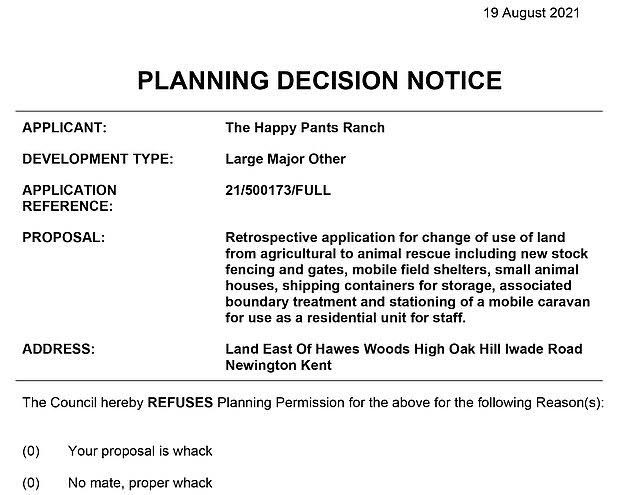
“Your proposal is whack”

Your proposal is whack’: Chaos as ‘junior worker’ who thought he was testing dummy council website rejects and approves REAL planning applications – including allowing two pubs to be demolished – but they’re all legally BINDING (Daily Mail, 9 September 2021):

• “Staff at Swale Council, Kent accidentally rejected or approved five applications

Blunder was made by a ‘junior’ staff member at Mid Kent Planning Support team

The person was trying to resolve software issues, but in doing so, five ‘dummy’ decisions, used to test the website was working, were accidentally published

Among them included the rejection of an animal sanctuary to stay on its site

• Two Kent pubs were also given permission to be demolished or part-demolished

• A butcher’s change-of-use application in Sittingbourne was turned down

A farm was granted planning permission with 20 conditions, listed just as 1 – 20”

It’s certainly not very clever that anyone untrained was left unsupervised with access to the business end of the local planning authority’s IT system. This has obviously caused a big legal mess. Nicola Gooch sets out the law in her 10 September 2021 LinkedIn blog post.

Older lawyers can’t help thinking in Latin, unwelcome in the courts these days but handily concise:

Functus officio – the LPA has made its final decision (to issue the planning permission or refusal notice) and can’t re-open it.

• Administrative decisions are very rarely treated by the court as void ab initio (of no legal effect from the date they were purported to be made, even without a quashing order from the court), no matter how absurd – it takes a formal application to the court for judicial review to undo the mistake by quashing the decision, enabling it to be re-taken.

Accordingly, even with no arguments being made to the contrary by any interested parties, proceedings will need to be issued in the High Court on behalf of the council, a consent order agreed by the parties and then (usually after a wait of several weeks) rubber-stamped by the court – much money and much time wasted.

As Nicola identifies, this is by no means the first example of this sort of thing, although I do find it bewildering – was each decision not only generated by the system but then actually transmitted, without approval of a senior officer with the necessary delegated authority?There is surely a failing in the council’s internal system.

Local Government Lawyer reported in November 2020 as follows on the South Cambridgeshire examples she mentions:

“South Cambridgeshire District Council is to commence proceedings in the High Court after discovering two planning permission errors.

The local authority said one mistake had led to planning permission for an extension and annexe in Steeple Morden being issued in error. The permission was granted despite the application still being open for people to comment on.

“This planning decision, issued without the relevant authorisation, was caused by human error when the wrong box was ticked on the planning computer system,” it explained.

The second case saw a planning permission being issued without the accompanying conditions. It related to the landscaping, layout and other details around eight new homes in Great Abington.

Another mistake was the subject of a ruling by the Scottish Court of Session (Outer House) in Archid Architecture and Interior Design v Dundee City Council (20 August 2013). The Council had intended to refuse an application but instead granted planning permission but with reasons for refusal. It tried to get away with simply issuing a second notice, refusing permission. However, the applicant succeeded in obtaining a declaration from the court upholding the validity of the first notice. The court decided that a decision issued by a planning authority, however legally flawed, is to be treated as valid unless and until it is overturned in court proceedings.

When taken to extremes, this does start to look absurd. Whilst of course people should be able to rely on a planning permission or refusal notice that on the face of the document looks legitimate, the concept is strained when you have a refusal notice with the reason for refusal being “No mate, proper Whack” or, in another Swale example, a planning permission issued with the conditions: “(2) Incy (2) Wincy (3) Spider”. What if he or she had issued a planning permission for development in another district – in South Cambridgeshire, say – would that also be valid until quashed?

Any argument for the “voidable not void” approach on the basis that there needs to be certainty in the system (that a permission is valid until quashed, and that there is a short deadline for legal challenge after which the permission can be relied upon as valid) begins surely to lose some legitimacy when planning permissions are quashed after many years as happened in the Thornton Hotel case I mentioned in my 7 April 2018 blog post Fawlty Powers: When Is A Permission Safe From Judicial Review or this year’s Croyde Area Residents Association, R (On the Application Of) v North Devon District Council (Lieven J, 19 March 2021) where a 2014 planning permission was quashed that had mistakenly authorised development in relation to a wider area than had been intended.

“I hope Al Qaeda bombs the f…… ugly thing”

Chaotic scenes at planning meeting as anger erupts over new West Hampstead development (Camden New Journal, 9 September 2021). The video of two local objectors screaming vitriol at Camden’s Planning Committee last night makes uncomfortable viewing. If you want to understand what the scheme actually was, perhaps read the officer’s report (from page 191) in relation to the application and in particular the plans and images from page 235 to page 257. In my view it is an excellent scheme but that’s nothing really to do with it – there was no excuse for that reaction. We are all entitled to our own views but it is depressing that individuals feel driven to scream at their locally elected representatives like this. I do not use the often unfairly insulting and counter-productive “NIMBY” insult, but you can see why people do.

By this afternoon, the Secretary of State himself was tweeting about it:

And the planning system’s journal of record was of course also soon on the band wagon, ‘I hope Al-Qaeda bombs the f***** ugly thing!’: Moment two women yell abuse at Camden Council bosses for approving four new homes and turning area into a ‘s**t-hole’ before one hurls CHAIR during live-stream meeting (Daily Mail, 10 September 2021).

None of this is healthy.

Simon Ricketts, 10 September 2021

Personal views, et cetera

Thank you to everyone who attended our fantastic Clubhouse event last week with Graham Stallwood, Bridget Rosewell, Alice Lester and James Cross. It was a hard one to beat. This week’s will be a more informal session – do turn up if you would like to say hello – and maybe join some chat about what’s happening in the literally whacky world of planning. Link here.

This Is Not A Blog Post

Faithful reader, life’s hard enough and I’m giving you another week off from a proper blog post. However…

The High Court rulings and planning appeal decisions keep coming and it’s worth subscribing to the Town Library free weekly updates for those, including great summaries of every High Court ruling, prepared by my Town Legal colleagues.

I know I go on about clubhouse but do join one of our Planning Law Unplanned sessions if you can. I suppose that in tone it’s a cross between a live podcast (there’s no subsequent recording – miss it and it’s gone), a radio phone-in show and an after-work chat in the pub around a (large) table. Clubhouse recently upgraded their audio system to what they call spatial audio and if you listen now on earphones on an iphone or ipad you’ll notice that there is indeed the sense that you are in a room with the voices coming from different directions, as if around the table.

This Tuesday’s (7 September 2021, 6 to 7.15 pm) is genuinely unmissable: “Planning application/appeal timescales – tell us your tales”. It follows on from my last blog post, How Long Has This Been Going On and features the following special guests: Graham Stallwood (director of operations at The Planning Inspectorate), Bridget Rosewell (chair of the 2018 independent review into planning appeal inquiries), Alice Lester (director regeneration at Brent Council) & James Cross (strategic sites project planner, Arun District Council).

Timing is all, so they say. What are people’s current experiences of “the system”, good & bad?

In relation to appeals, PINS these days publishes excellent data but where are the pinchpoints that people experience in practice (without referring to specific cases)? Post lockdown, are we now on our way back to the improved timescales for appeal inquiries that were being achieved as a result of the Rosewell reforms? What about hearings and written reps appeals? How are we finding the move back from wholly screen-based events?

In relation to applications, what approaches by applicants and/or LPA can help avoid undue delays? How can we speed up negotiation of section 106 agreements? What is the role for pre-app discussions and early public engagement?

Please join us for a good-natured, positive but hopefully probing session. You are free just to listen or to participate in the discussion. Indeed we would love to hear your tales, of woe or joy! Link to app here.

Finally, clubhouse obviously is a platform for all sorts of discussions on all manner of topics. Nothing to do with work – any reference to planning or law, or indeed whatever work you do, is entirely banned – but tomorrow evening (Sunday 5 September, 8 pm) a few of us are hosting the third in an occasional series of events I’ve called Sound Recommendations, which is basically just chats about music, around a theme, as a result of which we put together a spotify playlist of what’s been mentioned (search for Sound Recommendations #1 and #2 on spotify). Tomorrow night’s theme is: “GIGS: first, best, last, next”. Do join us for that one too! Link here. (And if you’re only reading this after the event you’ll have to console yourself by searching for the Sound Recommendations #3 playlist).

Maybe next week I’ll get round to a proper post again….

Simon Ricketts, 4 September 2021

Personal views, et cetera

How Long Has This Been Going On?

Time is money. Time is unmet needs. Time is unrealised public benefits.

I just wanted to capture some of the current, frankly depressing, data that is out there on application and appeal timescales.

The purpose of this post is to underline that there is a significant problem to be addressed. What to do about it will be for another post – there is certainly much that can be done that does not require (1) legislation (2) additional resources or (3) any procedural shortcuts.

Applications

A piece from yesterday’s Planning daily online: Council signs off 2,380-home urban extension almost four years after committee approval (£). Four years is certainly going it some but I can confirm from constant first-hand experience how difficult it can be to move a project from resolution to grant to permission at any speed. The larger or more complex the project, the longer those negotiations over the section 106 agreement and associated aspects can end up taking.

My colleague Lida Nguyen has been looking at the position in London. She has looked at all applications for planning permission which were referred to the Mayor between 3 January and 11 December 2020, so applications of potential strategic importance as defined in the Mayor of London Order 2008 and, for those which were then approved by the relevant borough (without intervention by the Mayor or secretary of State), she has looked at the average time that the application took from validation to the borough’s resolution to approve and from the borough’s resolution to approve to permission being issued. Discarding a few anomalous cases, this left 88 to be analysed.

In my humble view the statistics are appalling, but not surprising:

Application submission to resolution to approve

Median: 228.5 days

Mean: 269 days

Resolution to approve to grant of permission

Median: 218.5 days

Mean: 259 days

It’s rather deflating for applicants and (when you stand back from the detail) surely absurd that resolution to grant in reality only marks the halfway point to a permission in relation to significant projects in London. Wouldn’t it be a start for boroughs, the Mayor and those acting for applicants to set a target of halving each of those figures and agreeing the necessary steps to achieve that reduction?

Appeals

My 25 May 2019 blog post Pace Making: Progress At PINS reported on Bridget Rosewell’s recommendation, adopted by the Planning Inspectorate, that inquiry appeals decided by an inspector (i.e. not recovered by the Secretary of State) should be decided within 24 weeks of receipt and that where the Secretary of State is to be the decision-maker, inspectors’ reports should be submitted to the Secretary of State within 30 weeks of receipt of the appeal. Initial progress was really impressive – until the first lockdown struck in March 2020. After a slow start (see my 2 May 2020 blog post There Is No E In Inquiry), PINS of course eventually, to the massive credit of all involved, embraced virtual hearings, inquiries and examinations and the risk of an impossible backlog was averted. However, it is clear from the latest Planning Inspectorate statistical update (19 August 2021) that there is still much work to do:

“The mean average time to make a decision, across all cases in the last 12 months (Aug 20 to Jul 21), was 27 weeks. The median time is 23 weeks.

The median time to decide a case decreased by 0.6 weeks between June and July 21, with the median being 21.4 weeks.

Median timeliness by procedure type is shown in the summary table below.

Performance since April 21 against the median measure has only varied by 0.7 weeks, between 21.4 weeks and 22.1 weeks. Performance had been improving between November 20 and March 21. For inquiries, in the last two months, cases have taken longer to decide as a result of very old enforcement inquiry cases being decided.

Enforcement decisions made in the last 12 months had a median decision time of 34 weeks. Looking at the annual totals, the median and mean time to decision for specialist decisions have been broadly the same as for enforcement decisions, and longer than the median for planning decisions. Since February 21 there has been a change in this trend, with Specialist cases being quicker than Enforcement.

The median time for planning appeals decided by inquiry under the Rosewell Process over the 12 months to July 21 is 35 weeks. This is quicker than other types of casework decided by inquiry.

Whilst the extent of statistical information provided these days is welcome, it is difficult sometimes to track the figures through the different tables so as to work out what the likely timescale outcome for a prospective appellant will turn out to be. I have also looked in vain within the statistics for any information as the time being taken between appeal receipt and validation – a traditional black hole when it comes to appeal timescales. I’m also struggling to see any breakdown as to what the “Rosewell” inquiries were (35 weeks average) as compared to inquiries overall (79 weeks!).

That overall 27 weeks average is deceptively encouraging for anyone looking at anything other than a written representations appeal. Because those appeals make up 95% of the total of course they massively skew the mean figure. But even then, although not reflected in these statistics, my own anecdotal impression is that validation of appeals which proceed by way of written representations or hearing is very slow indeed, raising a large question mark over the overall statistics. Possibly something to do with the focus on Rosewell inquiry appeal targets. Am I being unfair? What solid information on this is there out there? If there isn’t any, why not??

The Planning Inspectorate Annual Report and Accounts (July 2021) contains further statistical information, with tables such as these looking back at the changing position over the last five years:

In order to meet Rosewell targets, surely on that last table the 90th percentile needs to come down from 66 weeks to 24 weeks – and to be measured from receipt of appeal rather than validation?

Again, as with timescales for major applications in London, with appeal inquiries, surely we are looking at the need to more than halve current timescales?

All tables above have been taken from PINS documentation, for which thanks.

Simon Ricketts, 20 August 2021

Personal views, et cetera

Planning Law Unplanned is having a summer break this week, before returning at 6pm on Tuesday 31 August for somewhat of a BECG/DP9 special, London Elections 2022: Politics Meets Planning. Join the club here for notifications of this and future clubhouse Planning Law Unplanned events.

Photograph by Ben White on Unsplash