As a sorbet course to be enjoyed as a palate cleanser between the excitement last week of the general election and associated announcements and the excitement of further announcements promised by MHCLG (RIP DLUHC) later this month (plus this Wednesday’s King’s Speech), I thought we might look at a couple of Planning Court rulings this month which provide reminders as to some development management procedural fundamentals.
R (Gurajena) v London Borough of Newham (Deputy High Court Judge Timothy Corner KC, 5 July 2024) – what is the extent of the duty on a local planning authority to (1) notify “adjoining” owners and occupiers of an application and (2) publicise changes made to an application after initial consultation has taken place?
This case concerned a planning permission for works to a terraced house at 5 Silver Birch Gardens, West Ham. The proposed works comprised the construction of a rear extension, rear garden decking and an outbuilding. The grant of permission was challenged by way of judicial review by the next door neighbour at no 6 and another neighbour two houses away at no 8. They had objected to the application on grounds of privacy, overlooking and effect on visual amenity (although no 8 had not been notified of the application by the council, despite having been consulted in 2022 in relation to a proposed dormer loft extension and associated works to the roof).
Once the permission had been issued the claimants had realised that amended drawings had been submitted after their objections had been received, changing the location of the stairs to the decking and replacing a close boarded timber fence between numbers 5 and 6 with the retention of a low picket fence. The claimants argued that there was (1) a breach of Article 15 (5) of the Town and Country Planning (Development Management Procedure) (England) Order 2015 (which requires that “adjoining” owners and occupier be notified) given that no 8 had not been notified (2) a breach of no 8’s legitimate expectation that they would be consulted (having been consulted over the 2022 application) and (3) procedural unfairness by way of the council’s failure to carry out any further consultation despite a material change to the application after the close of the consultation period.
The judge held:
“”adjoining” in Article 15 of the DMPO embraces not just properties which are contiguous, but also those which are “very near to” or “lying close to” the application site”…”Whether one site is “very near to” or “lying close to” another requires judgement, and that judgement is one for the local planning authority. The court will interfere with the authority’s judgement only if it is Wednesbury unreasonable, by reason of being a judgement that is so unreasonable that no reasonable authority could have reached it.” The council’s decision in this case could not be impugned as being unreasonable.
“In my judgement the Second Claimant did not have a legitimate expectation that she would be consulted about the Application. The reality is that a judgement was reached in the case of the 2022 application as to whom to consult, based on the anticipated impact. The Application in the present case was different, being at ground floor level only. The fact that no. 8 was consulted once about a planning application different in nature from the Application does not amount to a practice of consultation sufficiently settled and uniform to amount to a clear, unambiguous and unqualified promise to consult the Second Claimant on a planning application having the nature of the Application.”
The application plans were confusing and there was clearly confusion as to what was shown on the original application plans and therefore as to the extent to which the revised plans amounted to changes to the proposals which had previously been consulted upon. The judge found that the first claimant had already made clear in her objections that even a close boarded fence in place of the existing low picket fence would not be acceptable so there was no requirement to re-consult her on that aspect. However, in relation to the stairway to the decking: “I accept that an assessment of whether the outcome for the First Claimant might have been different (i.e. refusal of the Application) had she had the chance to comment on the realignment of the stair must take account of the context, which is the Application as a whole. The Application comprised erection of an extension, with raised timber deck and a new outbuilding on the deck. The stair to the deck was only a part of the Application as a whole. However, in my judgment the position and orientation of the new stair is capable of having an important effect on the privacy of no. 6.”
The permission was quashed on that final ground. Lesson: local planning authorities (and applicants) should be careful to ensure that plans are accurate and comprehensible and that revisions which may have a material effect on potential objectors are adequately publicised.
For the detail please see my colleague Sophie Bell’s Town Library summary but, very briefly, the case concerned competing planning applications for supermarkets in Horncastle. There would be a significant adverse impact on the town centre if both developments were to proceed. Lidl’s and Aldi’s applications were both due to go to the same committee meeting but there was a hold-up with Aldi’s application and so only Lidl’s application was taken to the committee, where it was approved. The judge held that the council was required to consider the competing merits of the two schemes but failed to do so properly by considering the applications separately: “the need for a comparison was “so obviously material” as to ” require direct consideration“.
This was certainly “store wars” nostalgia for some of us! It is a useful case to help guide what should be done where applications for competing developments have been submitted, although the judge does warn that his “decision is not based on accepting [the] proposition that there is a special category of cases which applies to rivals. I consider that this contention underplays the importance of the particular facts of the case. To make generalisations about categories of cases risks oversimplification. It fails to heed the warnings that there is no “one size fits all” approach (per Sullivan LJ in R (Langley Park School) v Bromley LBC [2010] 1 P&CR 10 at para 52) and that categorisation can be “dangerous” (per Oliver LJ in GLC)… the specific evidential circumstances of this case is one in which there are two proposals before the authority aiming to address what on the evidence has been found to be finite retail capacity (without causing significant adverse impact on the town centre). Those are the uncontentious facts which mean that in the specific circumstances of this case a comparison was necessary (and was not undertaken). Moreover, as I have found, the reason for declining to undertake it reveals a logical gap in the Defendant’s decision making.”
There, I hope you’re suitably refreshed. I’m sure something more substantial will be served up before too long.
Whether tis nobler in the mind to suffer the slings and arrows of outrageous fortune. Or to take arms against a sea of troubles by amending your permission to reflect current market or occupier requirements? Because, of course, in the equally timeless words of Gary Barlow, everything changes.
The main part of this blog post is a detailed examination by my Town Legal colleague Susie Herbert of the potential opportunities arising from use of section 73B of the 1990 Act, introduced by way of the Levelling-up and Regeneration Act 2023, and its potential limitations and ambiguities versus section 73. It’s an important part of DLUHC’s current consultation as to an accelerated planning system which I said I would come back to in my 9 March 2024 post that covered the rest of the proposals.
But first, an interesting appeal decision letter from last week. You may remember that for a temporary period (2013 to 2016) there was a specific statutory procedure, section 106BA, which allowed developers to apply to modify or discharge planning obligations in a section 106 agreement on the basis that they made the development unviable.
Since the repeal of section 106BA the question often arises as to how we might still achieve the same ends. After all, an application under section 106A to amend a section 106 agreement can only be made if the agreement is at least five years’ old. Otherwise, in proposing a deed of variation to the existing agreement, you are in the local planning authority’s hands with no right of appeal.
The alternative options would be to make an entirely fresh application for planning permission (an onerous process) or, conceivably, to make an application under section 73 for removal or variation of a condition attached to the previous planning permission and to use the application as a vehicle for proposing an amended form of planning obligation. The section 73 route was accepted by an inspector in a decision letter dated 25 March 2024 in relation to a proposed development in Thornton Heath, Croydon. There is an existing planning permission for 57 new dwellings , with a section 106 agreement requiring 35% of the homes to be delivered as affordable housing. A Section 73 application was made to amend condition 2 attached to the permission which set out a list of the approved drawings, proposing amended drawings increasing the proportion of three bedroom homes and external alterations to fenestration and elevations. A section 106 unilateral undertaking was put forward proposing no affordable housing, on the basis of a viability appraisal, which had been reviewed and accepted by the local planning authority. The application was not determined within the statutory period and the developer appealed. The authority resisted the appeal on the basis that a section 73 application was not the appropriate means to reduce the level of affordable housing previously secured.
Having reviewed the relevant case law in relation to section 73, the inspector allowed the appeal:
“In this instance, a change in policy has not made it appropriate or essential to amend the obligation. However, there has been a significant change in circumstances relating to the viability of the scheme. It seems to me that it is a matter of planning judgment whether the change in circumstances makes it appropriate, essential or desirable to enter into a planning obligation in different terms to the original. Given the case law outlined above, the terms of a new obligation may be connected to or intertwined with the amendments sought to the drawings, but there is nothing of substance to suggest they must. Consequently, it would be going too far to suggest an amended obligation must be a consequence of, or directly related to, changes flowing from the proposed alterations detailed on the new drawings.
There is no dispute between the Council and appellant that since the original permission was approved, and the evidence underpinning it prepared, construction costs have rapidly risen whilst house prices have remained static. This has had a significant impact on the viability of the scheme. As mentioned above, the situation is so altered that the Council and appellant agree the scheme can no longer provide affordable housing and remain viable. Moreover, there is also common ground that the provision of affordable housing is not a benefit, alone or taken with other factors, which is required to outweigh any harmful impacts emulating from the scheme. Indeed, the Council has only identified limited harm in respect of the housing mix, which is outweighed by other considerations in any event. In these circumstances, altering the level of affordable housing would not be a fundamental change to the proposal.
Therefore, the current circumstances are such that there is a need for a planning obligation in different terms to the original to facilitate delivery. The altered terms of the planning obligation would be consistent with the development plan taken as a whole. The consequence being that the change would not have a bearing on whether the scheme would be acceptable. Thus, the amended planning obligation is necessary, reasonable, supported by development plan policy and proportionate in the context of the prevailing circumstances. Therefore, it is desirable, essential and appropriate to consider a planning obligation in different terms to the original, namely the provision of 0% affordable housing with a review mechanism as required by the LP. In conclusion, the s73 application is an appropriate means in this instance to reduce the level of affordable housing relative to that previously secured.”
The case is another example of the potential flexibility of the existing section 73 procedure, notwithstanding the constraints imposed by the courts – particularly by way of Finney (the inability to use section 73 where the desired changes would be inconsistent with the description of development on the face of the existing permission (leading to a workaround in practice, with a willing authority, by way of use of section 96A in conjunction with section 73 – see my previous blog post here for more information).
Section 73B
So will the new section 73B procedure be the solution. Over to my colleague Susie Herbert for the detail…
On Budget Day, 6 March 2024, DLUHC launched a consultation on accelerating the planning system which closes on 1 May 2024. As well as proposals relating to the application process, this includes a consultation on the implementation of section 73B to vary planning permissions and on the treatment of overlapping permissions. This post concentrates on the proposals concerning variations to planning permissions via the new section 73B and the proposals for overlapping permissions.
Section 73B was introduced by the Levelling-up and Regeneration Act 2023 (“LURA”). The provision is headed “Applications for permission not substantially different from existing permission”. It is not yet in force and secondary legislation is required to specify the application procedure including consultation arrangements, information requirements and the application fee as well as amendments to the CIL regulations. The government proposes to implement section 73B following the consultation “as soon as parliamentary time allows”.
The consultation asks questions on:
The scope of the proposed Planning Practice Guidance relating to section 73B;
Procedural arrangements for a section 73B application;
Application fees for section 73B applications;
CIL and section 73B applications.
As background, the introduction to this section of the consultation notes “The ability to vary planning permissions in a proportionate, transparent and timely manner is an important feature of the development management system. It is common for developments, particularly if they are large, to require variations to the planning permission in response to further detailed design work, new regulatory requirements, and changing market circumstances. Without this flexibility, development risks being delayed or abandoned as the only option would be the submission of a brand new application for the development which would create uncertainty, delay and further costs.”
The consultation notes that the current legislative routes to varying planning permissions are section 73 and section 96A. In 2009, guidance was introduced on “Greater Flexibility for Planning Permission”. It was at this point that section 96A was introduced into the legislation to allow for “non-material” amendments to existing planning permissions. The guidance envisaged that section 73 could be used for “minor-material” amendments by varying a condition that listed the approved plans by substituting new plans that showed the varied scheme.
However, in 2020, the Courts confirmed that section 73 cannot be used to amend the description of development (Finney). Therefore, the scope to use section 73 to make “minor material amendments” by varying a condition which lists the approved plans is limited.
Although not expressly explained in the consultation document, the reason that the inability to use section 73 to amend the description of development causes such difficulties in practice is because the case law has established that a permission granted under section 73 cannot introduce a condition which creates a conflict or is inconsistent with the description of development. It has therefore become standard practice to minimise the level of detail provided in the description of development and thereby reduce the potential for future scheme amendments to conflict with the description. In some cases an original description of development can be amended via s96A to remove detail from the description of development into a condition and thereafter amend this condition via section 73.
Section 73B is intended to deal with this issue by allowing both the description of development and the conditions to be varied in a single process. The restriction on the use of section 73B is that the amended development cannot be “substantially different” from the existing development.
“Subtantially different”
A key point in the consultation is that the Government does not propose to provide prescriptive guidance on is what is meant by “substantially different”. The consultation notes that section 73B does not provide a definition of the test and that it will depend on the scale of the changes required in the context of the existing permission. Factors that could be relevant are location and the scope of the existing permissions and the proposed changes.
It is not clear where “substantially different” will sit on the scale of potential changes. We note that this term was used in the 2009 guidance on flexible planning permissions in respect of what was meant by a “minor material amendment” which stated:
“We agree with the definition proposed by WYG: “A minor material amendment is one whose scale and nature results in a development which is not substantially different from the one which has been approved.” This is not a statutory definition.”
This suggests that the intention may have been that section 73B was intended to align with the minor material amendments that the guidance envisaged to be made under section 73 with the additional ability to amend the description of development (to make “non-substantial” changes).
However, since this drafting was introduced into the Levelling Up and Regeneration Bill, the Armstrong and Fiske cases have confirmed that section 73 is not restricted to minor material amendments. It is helpful that at footnote 4, the document expressly states that “the department acknowledges that section 73 is not limited in scope to minor material amendments” following the recent cases of Armstrong and Fiske. The judge in Fiske held that there is a restriction on the scope of section 73 which is whether the alteration is fundamental (while in Armstrong the judge had considered that even this restriction did not apply and the only restriction is consistency with the description of development).
Therefore, if the scope of changes allowed by section 73B is intended to be similar to “minor material amendments”, there is the possibility that section 73 would actually allow more flexibility as it extends to “not fundamental” amendments (provided always that it is possible to remain within the description of development).
While it is understandable that the Government does not propose to provide prescriptive guidance on the meaning of “substantially different” because it will be a matter of judgement dependent on the context (as for section 96A), it is clear that the application and interpretation of this provision by each LPA is going to be a key to how useful this provision is in practice.
The consultation states that the government’s proposed objective is for the section 73B route to replace the use of section 73 to deal with proposals for general material variations while the use section 73 would return to focus on the variation of specific conditions and that it proposes to introduce guidance to this effect.
It would therefore be helpful if the scope of changes allowed under section 73B was not less that the scope of changes that could be made via a section 73/ section 96A approach: otherwise the end result of the changes would be more complexity but less flexibility. It does not seem that it would be overly prescriptive for the Government to provide guidance to this effect. It would also be consistent with the general proposed approach of treating a section 73B application in a similar way to a section 73 application in terms of procedure (as detailed below).
Features of section 73B
The consultation summarises the key legal features of section 73B as follows:
a section 73B application must identify the existing permission (which cannot be a section 73, section 73A or other section 73B permission, or permission granted by development order), and can propose conditions for the new permission;
as an application for planning permission to a local planning authority, the determination of a section 73B application is subject to section 70 and other decision making duties. But the local planning authority cannot grant permission for a section 73B application if the effect of the section 73B permission would be substantially different from the existing permission, and when determining the application, they must limit their consideration to the variation between the application and the existing permission; and
like a section 73 permission, a section 73B permission is a separate permission to the existing permission (and any other section 73 or 73B permissions related to the existing permission) so the granting of a section 73B permission does not affect the validity of the existing permission (or other section 73 or 73B permissions).
The provision also applies to applications for permission in principle.
Proposed general approach
As noted above, the Government’s proposed objective is for the section 73B route to replace the use of section 73 to deal with proposals for general material variations while the use section 73 would return to focus on the variation of specific conditions. The consultation notes that because section 73 cannot be used to amend the description of development, it has become common practice to submit generic descriptions of development which do not specify key feature such as the number of dwellings with those details set out in conditions to allow them to be varied via section 73. The consultation identifies that a benefit of using section 73B would be to allow a return to clear and more specific descriptions which would help improve the transparency of development proposals for local communities.
The Government therefore proposes to use Planning Practice Guidance to encourage the use of clearer, more transparent descriptors of development and the use of section 73B to deal with general material changes to development granted planning permission. The consultation asks “do you agree that guidance should encourage clearer descriptors of development for planning permissions and section 73B to become the route to make general variations to planning permissions (rather than section 73)? (Question 26)” and “also for any further comments on the scope of the guidance (Question 27)”. This includes the question of whether the guidance should discourage the use of the, now standard, condition which lists approved plans which was introduced to facilitate minor-material amendments via section 73. The consultation states that they are not minded to discourage the use of this condition and that it is beneficial to help support effective planning enforcement, particularly in relation to design.
Procedural arrangements
The aim is for the procedural requirements set out in regulations for a section 73B application to be “proportionate reflecting the position that the development proposed in the application is a material variation to an existing permission while still ensuring there is transparency about the proposed variation” and that “Local communities should be aware of proposed variations so they can make representations: the section 73B route is not a mechanism to undermine scrutiny.”
The proposal is:
information requirements will be generally the same as other applications for planning permission but certain requirements (such as a design and access statement) will not be required.
publicity requirements will be the same as other applications for the type of development (i.e. if it is a variation to major development, the major development publicity requirements would apply).
Consultation with statutory consultees would follow the approach of section 73 applications where there is a duty on the local planning authority to consult a statutory consultee if they consider appropriate (reflecting the position that a proposed variation may only engage specific issues which of an interest to only some statutory consultees and so it would be disproportionate to require those statutory consultees without an interest to respond) although the footnote states that applications would automatically be in scope of the consultation duty between counties and district LPAs, the consultation arrangements for parishes and neighbourhood forums and the arrangements for applications of potential strategic importance under section 2A TCPA 1990 for the Mayor of London and those combined authorities which have section 2A powers.
EIA and HRA requirements would apply as for section 73 permissions and a similar approach would be taken to Biodiversity Net Gain.
The consultation asks whether consultees agree with this proposed approach to procedural requirements.
Fees
The proposal is to align the fee for a section 73B application with the fee for a section 73 application. The alternative approach of setting a higher fee for a section 73B application was considered on the basis that the section 73B route could be the default route for general material variations while section 73 focuses on the variation of a specific condition. However, the higher fee could encourage applicants to continue to use section 73, undermining the purpose of the reform.
However, it is proposed to change the current flat fee approach for a section 73 application (£293) so that there would be three separate fee bands for householder, non-major development and major development.
The householder fee would be reduced to £86 (double the fee for discharge of condition and removing the anomaly that an original householder application fee is lower than the section 73 fee). The non-major development fee would remain at £293.
For major development, there would be a higher fee which would be less than the fee for the original application and proportionate to the work necessary to consider the proposed variation (without exceeding full cost recovery). The consultation asks for views about where this fee should be set, including evidence from local planning authorities for the typical work which is involved dealing with an average section 73 application for a major development.
CIL
It is proposed that CIL would apply to section 73B in the same way that it applies to section 73 permissions. This would mean that “if the section 73B permission does not change the CIL liability, the chargeable amount is that shown in the most recent liability notice issued in relation to the previous permission. But if the section 73B permission does change the CIL liability, the most recently commenced or re-commenced scheme is liable for the levy.”
Overlapping permissions and section 73B
The consultation refers to the recent Hillside and Dennis cases on overlapping permissions [see previous simonicity blog posts respectively here and here] and how these judgments have questioned the ability to use ‘drop in’ permissions where a subsequent permission is granted for an alternative development on a section of a larger development previously granted permission and still being implemented.
It summarises Hillside as confirming existing caselaw that “full planning permissions are not usually severable. That is to say, parts of the permission cannot be selectively implemented and that, if a new permission which overlaps with an existing permission in a material way commences, should the carrying out of the new permission make it physically impossible to carry out the rest of the existing permission, it would be unlawful to continue further development under the existing permission. The Court then went on to say, if someone wanted to change part of the development, they should seek to amend the entire existing permission.” And notes that Dennis considered the implications for outline planning permissions and the question of severability further.
It notes that “drop in permissions have often been used during the implementation of outline planning permissions for large scale phased residential and commercial developments where a new development is proposed through a separate application for a phase outside the scope of the outline planning permission while the rest of the phases continue to be implemented under the outline permission. This approach has provided a flexible way of enabling changes to a specific phase to be managed through planning without having to seek a new planning permission for the entire development, particularly when the scale of change is outside the scope of a section 73 application.”
In terms of section 73B, “The government believes that the new section 73B route provides a new way of dealing with such changes to a specific phase of a large scale development granted through outline planning permission in many cases. While the use of section 73B is constrained by the substantively different test, these changes often continue to fit within the existing masterplan which underpins the outline permission and do not necessarily fundamentally change this permission – for instance, changing a phase of commercial development (use class E) to a cinema (use class – sui genesis) where the outline permission only allows class E uses. In this case, the section 73B application would provide details of the proposed variation to the outline planning permission and the consideration by the local planning authority would focus on the merits of this variation.”
However it is recognised that “there could be circumstances where the section 73B route may not be appropriate – for instance, if the change could be considered to be substantially different or there are wider financial and legal relationships between the master developer, land owners and investors which makes the preparation of a section 73B application difficult.”
The consultation asks for views about the extent to which the section 73B route could be used to grant permission for changes for outline planning permission in practice and what the constraints are.
It is clearly helpful that the consultation acknowledges that a new use could be introduced via section 73B which gives more potential flexibility and simplicity than a section 73 approach. However, as noted, changes may well be considered “substantially different” even if they allow the remainder of a masterplan to be developed without amendment. There are also undoubtably complications in obtaining a new planning permission (even a section 73B) for an entire site where development has started and different plots are being developed by different developers, particularly if a section 106 agreement is required to be varied.
The final section of the consultation is a proposal to create a framework through a new general development order to deal with circumstances that cannot be addressed via section 73B. This general development order would deal with overlapping permissions in certain prescribed circumstances. It notes that the Secretary of State has broad powers under section 59 of the Town and Country Planning Act to provide for the granting of planning permission through an order, including classes of development. This may be for a specific development or for a class of development.
The consultation asks for views on whether the focus of such an approach should be on outline permissions for largescale phased development or whether there are any other categories of development which could benefit from an alternative approach.
The consultation questions are:
Question 33. Can you provide evidence about the use of the ‘drop in’ permissions and the extent the Hillside judgment has affected development?
Question 34. To what extent could the use of section 73B provide an alternative to the use of drop in permissions?
Question 35. If section 73B cannot address all circumstances, do you have views about the use of a general development order to deal with overlapping permissions related to large scale development granted through outline planning permission?
It is not clear what the general development order proposal would entail but it is clear that an alternative approach for circumstances where section 73B cannot be used would be valuable and it is encouraging that the government is exploring further options to address the Hillside issue.
Thanks Susie for the above. Given ongoing concerns that I suspect many of us have both as to the need for a proportionate procedure for amending permissions but also more specifically to find a solution to the unnecessary complexities we all face by way of Hillside and Dennis, this is going to be an important consultation process.
The uncertainties as to whether “minor material” “substantially different” and “fundamental alteration” also bring to mind the consideration given recently by the Planning Court to whether, in the NPPF, “substantial” has a different meaning to “significant“, in Ward v Secretary of State (Lang J, 25 March 2024) (answer, after lengthy and unnecessary confusion which could have been prevented by accurate language used at the outset: nope).
Simon Ricketts, 1 April 2024
Personal views, et cetera
Edwin Booth as William Shakespeare’s Hamlet, circa 1870, courtesy Wikipedia
How clear do you think you are on the various pulleys and levers that make up the English development management system? A further series of proposed alterations were announced this budget day.
1. introduce a new Accelerated Planning Service for major commercial applications with a decision time in 10 weeks and fee refunds if this is not met
2. change the use of extensions of time, including ending their use for householder applications and only allowing one extension of time for other developments, which links to a proposed new performance measure for local planning authority speed of decision-making against statutory time limits
3. expand the current simplified written representations appeals process for householder and minor commercial appeals to more appeals
4. implement section 73B for applications to vary planning permissions and the treatment of overlapping permissions”
I will leave the 4th strand of that, section 73B, for another day as in order to do that justice I would need to go into some heavy legal engineering detail, but today I will summarise the main components of the rest of the proposals and then wrap up with a few guesses at the more obvious risks to be avoided, if acceleration is indeed to be achieved without unintended adverse consequences.
The Accelerated Planning Service
“9. All local planning authorities will be required to offer an Accelerated Planning Service for major commercial applications [i.e. applications for major commercial development which create 1,000 sqm or more of new or additional employment floorspace, including mixed use developments if they meet the employment floorspace criteria]. The applicant would pay a higher planning fee to the local planning authority which, in exchange, will be required to determine these applications within 10 weeks (rather than the 13-week statutory time limit), with a guarantee that the fee would be refunded if the application is not determined within this timescale.
10. We are exploring two options for the detailed design of this service. Under the first discretionary option, applicants could choose to use the Accelerated Planning Service where their application meets the qualifying criteria or they could use the standard application route for a major development (with a lower fee and longer timescales). A second mandatory option could be that the Accelerated Planning Service is the only available application route for all applications in a given development category. This would have the benefit of clarity and certainty for applicants and local planning authorities but remove the element of choice for the applicant.”
The service would not apply to applications which are for EIA development, although DLUHC is “interested to receive views on whether there is scope for EIA development to also be covered by an Accelerated Planning Service that offers a guaranteed decision before the 16-week statutory time limit.”
“The service would apply to section 73 and 73B applications which seek to vary existing planning permissions for relevant commercial development.”
“Over time, we are keen to explore the extension of the Accelerated Planning Service to similar major infrastructure and residential developments. But we want to ensure the Service works for commercial development before any extension is made, given that there are significantly more residential applications and often a larger number of matters to be considered with these types of applications.”
“The key aim is to ensure that these applications are prioritised through the local planning authority’s own internal processes faster. This would require local planning authorities to: set up efficient case work systems; ensure validation teams, lawyers and internal expertise are on hand; and, where relevant, convene planning committees on time. The availability of a higher planning fee (discussed below) is intended to ensure that local planning authorities have the resources to do this.”
The ten weeks’ deadline would be “used as the trigger point for when appeals can be made against non-determination and for monitoring the performance of local planning authorities”.
DLUHC recognises that it is “crucial that the applications submitted are of good quality with the right information” and to that end proposes that:
“local planning authorities should offer a clear pre-application service to potential applicants so they can discuss their proposals, key issues, information requirements and any other issues (such as EIA screening), and we will strongly encourage applicants to use these services…We will ensure best practice is disseminated across the sector building on the work the Planning Advisory Service has been undertaking on pre-application services”
“prior to submitting their application, applicants should notify key statutory consultees which are likely to be engaged that they are making an application under the Accelerated Planning Service… The government will look to use its oversight of statutory consultees to prioritise applications under the Accelerated Planning Service and to monitor their performance. In the meantime, we welcome views about how statutory consultees can best support this accelerated service. In most cases, early pre-application engagement will be important”
“To cover the additional resourcing costs, we propose to set a premium fee for an application through the Accelerated Planning Service… It is proposed that an applicant or the local planning authority would still have the ability to propose an extension of time to the determination of the application (for instance, if there is an outstanding matter which could be readily resolved to make an application acceptable). But such an extension of time should be an exception. An extension of time would not affect any potential refunds… We propose that either all or a proportion of the statutory application fee must be refunded by the local planning authority to the applicant if the application is not determined within the 10-week timescale, even if an extension of time has been agreed. This refund policy differs from the existing Planning Guarantee where a refund is not provided if an extension of time has been agreed.
We have considered whether it is appropriate for the whole fee to be refunded if the application is not determined within the required 10-week period and recognise that if the whole fee is refunded at 10 weeks, in cases where no decision has been made, and the performance target is therefore missed, there is no further incentive for the local planning authority to make a decision on the application. To mitigate this, we consider that there is an alternative option, to stagger the fee refund. For example, if no decision has been made within 10 weeks, the premium part of the fee or 50% of the whole fee could be refunded at that point with the remainder of the fee refunded at 13 weeks, if the application was still undecided.”
As part of the consultation, views are sought as to whether the accelerated planning service should be optional or mandatory.
Planning performance and extension of time agreements
“the government has published a new Planning Performance Dashboard . This dashboard displays performance figures over a 12-month period and includes performance within statutory time limits, excluding extension of time agreements, so a true picture of local planning authority performance figures is accessible. We expect local planning authorities to report on their data from the Planning Performance Dashboard to their planning committees and other stakeholders, in order to drive continual improvements in performance, identify areas of weakness at an early stage, and help inform priorities for service delivery.”
“It is proposed that the new performance thresholds would be:
major applications – 50% or more of applications determined within the statutory time limit; and
non-major applications – 60% or more of applications determined within the statutory time limit
The proposed thresholds do not preclude the use of extension of time agreements and planning performance agreements, but the expectation is that such agreements are used only in exceptional circumstances. The proposed threshold is also lower for major applications in recognition that, in more instances, extension of time agreements may still be required due to the more complex nature of the applications and major applications are also more likely to be subject to a planning performance agreement.”
“Following a transition period, it is proposed that we measure performance against both the current measure, which includes extension of time agreements and planning performance agreements, and the new measure, which would cover decisions within statutory time limits only. We would continue to measure major and non-major applications separately.
Local planning authorities would be at risk of designation for speed [of] decision-making in the following circumstances:
1. if a local planning authority does not meet the threshold for the current measure, inclusive of extension of time agreements and planning performance agreements (as per current regime), or
2. if a local planning authority meets the threshold for the current measure, inclusive of extension of time agreements and planning performance agreements, but does not meet the new threshold for the proportion of decisions within the statutory time limit, or
3. if a local planning [authority] does not meet the threshold for both the current and the new measure
Where a local planning authority is designated, applicants may apply to the Planning Inspectorate (on behalf of the Secretary of State), rather than the local planning authority, for the category of applications (major, non-major or both) for which the authority has been designated.”
It’s worth clicking into that Planning Performance Dashboard which will provide some welcome transparency as to individual authority performance.
Performance for speed of decision-making is currently assessed across a 24 month period. DLUHC is seeking views as to whether the assessment period should be reduced to 12 months.
Incidentally, whilst there is a reference in the general introductory passages of the consultation paper to only allowing one extension of time, I couldn’t find it in the actual section on the proposals (paragraphs 40 to 46) – can you?
The proposed assessment periods and measures of performance for speed of decision-making are as follows:
DLUHC proposes to remove the ability to use extension of time agreements for householder applications and is considering prohibiting their use where a repeat application is submitted.
Simplified process for planning written representation appeals
There is already an accelerated appeals procedure for householder and small commercial appeals, with for instance no opportunity for additional information to be provided at the appeal stage by the main parties or other interested parties. DLUHC proposes to expand this to a far greater range of written representations appeals, namely:
appeals relating to refusing planning permission or reserved matters
appeals relating to refusing listed building consent
appeals relating to refusing works to protected trees
appeals relating to refusing lawful development certificates
appeals relating to refusing the variation or removal of a condition
appeals relating to refusing the approval of details reserved by a condition
appeals relating to the imposition of conditions on approvals
appeals relating to refusing modifications or discharge of planning legal agreements
appeals relating to refusal of consent under the Hedgerow Regulations
appeals relating to anti-social high hedges
Time limits for appealing would remain unchanged but “appeals determined through the simplified route would be based on the appellant’s brief appeal statement plus the original planning application documentation and any comments made at the application stage (including those of interested parties). There would be no opportunity for the appellant to submit additional evidence, to amend the proposal, for additional comments to be made from interested parties or for the main appeal parties to comment on each other’s representations.”
Non-determination appeals would still follow the existing procedure.
What do we think about all this? From a development industry perspective I suspect that the proposals will be cautiously supported, but we all know it is all going to be about the actual implementation, about the proactive management and resources available to authorities and about closing off the obvious loopholes:
If there are hard-edged consequences for authorities of not determining applications within ten weeks, won’t some authorities be tempted to persuade applicants to delay submission until they can be sure that the application is oven-ready, or to delay validation (NB we really do need controls on local validation lists which have become lengthy shopping lists)?
Won’t we see more refusals where the authority is approaching the relevant determination deadline without being in a position to agree an extension of time and should the appeal costs regime be updated to ensure that authorities do not take this step unreasonably?
What about where any delay is not down to the authority (or the authority alone), as is often the case? The exhortation to approach statutory consultees at pre-application stage may not be enough to ensure a timely response.
Wouldn’t it be helpful for any guidance to encourage that a greater proportion of decisions are taken by way of delegated powers, particularly where applications are consistent with the relevant local plan?
How do we ensure that section 106 agreements are completed in a timely manner, given the lack still of any recommended template and, in particular, the delays caused by the push and pull of negotiations in two tier areas, whether county and district, or London Mayor and borough?
Does the idea of excluding third parties from written representations appeals accord with the principles of natural justice if issues arise or arguments made by the main parties which could not have been foreseen at the application stage?
Will there be time to introduce the necessary legislation before the election, whenever that may be, and how many of these proposals may in fact ultimately have cross-party support?
In the meantime, two further authorities have been designated for their poor speed in determining applications for non-major development: St Albans and Bristol, meaning that applications for minor development other than householder development and retrospective applications may be made direct to the Planning Inspectorate.
I was going to call this blog post National Lottery but then I remembered I’ve already used that strapline back in 2019. 7 years of this blog, 408 posts – round and round the same track we go.
Much has already been written about the Secretary of State’s decision letter dated 6 February 2024 in which he granted planning permission for the redevelopment of the former London Television Centre, on London’s south bank (NB paragraph 1 of the Secretary of State’s letter curiously describes it as an appeal against refusal of the application by Lambeth Council, which it was not – Lambeth was supportive and had resolved to grant planning permission before the Secretary of State intervened by calling in the application).
See eg Zack Simon’s post as to what the decision may tell us as to the question of “beauty”, Nicola Gooch’s post on severability (although maybe the applicant didn’t have Hillside severability in mind so much as simply phasing for CIL purposes?) and Andy Black’s post on the some of the wider implications of the decision.
I’m not going to duplicate any of those posts. I’m just going to use another aspect of the decision as a jumping off point both for sympathising with all parties who spend vast amounts of time and money at risk on these sorts of application and appeal processes and for giving a small jab at us lawyers.
Because the decision essentially turned on one thing: the Secretary of State having (crucially) found that there was compliance with the development plan as a whole (despite some conflict with individual policies), the pivot was whether there were material considerations which indicated that the proposal should be determined other than in accordance with the development plan – or, more basically, how much relative weight the Secretary of State decided to apply to the public benefits arising from the scheme as against the harms arising from the scheme (whilst applying the appropriate tests in relation to elements of “heritage” harm, for instance requiring “clear and convincing justification” by way of the public benefits arising). To quote the key paragraphs:
“35. Weighing in favour of the proposal are the employment generating opportunities for the Borough in the construction phase as well as the operational phase of the development, which both carry substantial weight, the placemaking benefits delivered by the public realm strategy which carry substantial weight, and the commitment towards an employment and skills strategy over and above the policy requirements as well as the provision of affordable creative workspace which carries moderate weight.
36. Weighing against the proposal is the less than substantial harm to the significance of the designated heritage assets of the RNT, the IBM building, Somerset House, the South Bank CA and the Roupell Street CA, which carries great weight. The Secretary of State has also found that the proposal would not provide a positive contribution to the townscape of the South Bank, which carries moderate weight.
37. The Secretary of State has considered the heritage balance set out at paragraph 208 of the Framework (formerly paragraph 202). He has noted public benefits deriving from the public realm strategy, as well as the other public benefits identified in paragraph 35 above. However, he has also identified less than substantial harm to the significance of the RNT, the IBM building and Somerset House, and to the South Bank CA and Roupell Street CA. Having carefully weighed up the relevant factors, he has concluded that the public benefits of the proposal do outweigh the harm to designated heritage assets. Therefore, in his judgement, the balancing exercise under paragraph 208 of the Framework (formerly paragraph 202) is favourable to the proposal.
38. Overall, in applying s.38(6) of the PCPA 2004, the Secretary of State considers that the accordance with the development plan and the material considerations in this case indicate that permission should be granted.”
Of course, a huge amount of expert evidence was given at the inquiry over 12 sitting days by the parties as to each of these matters and the weight to be applied to each of them, but if the Secretary of State had chosen to give less weight to the public benefits set out in paragraph 35, the decision would probably have gone the other way. How much weight the Secretary of State (or any decision maker) gives to such considerations is very difficult to predict – it is quintessentially a matter of planning (whisper political) judgment. (Similarly his decision as to whether, despite non-compliance with some individual policies, there was compliance with the development plan as a whole).
The weighting is particularly interesting, given that he was more bearish than the inspector (who had recommended that permission be granted) on various aspects, including:
whether “the scale of the building and the proposed massing provides an appropriate response to the site”
finding negative elements to the effects on townscape
disagreeing that “the proposed palette of materials and the aesthetic appearance of the building is appropriate for what is a very prominent and sensitive site. He disagrees with the Inspector that an attractive development would be delivered.”
The Planning Practice Guidance summarises the legal position as to the weight to be given to material considerations:
“What weight can be given to a material consideration?
The law makes a clear distinction between the question of whether something is a material consideration and the weight which it is to be given. Whether a particular consideration is material will depend on the circumstances of the case and is ultimately a decision for the courts. Provided regard is had to all material considerations, it is for the decision maker to decide what weight is to be given to the material considerations in each case, and (subject to the test of reasonableness) the courts will not get involved in the question of weight.
Paragraph: 009 Reference ID: 21b-009-20140306
Revision date: 06 03 2014”
And as for public benefits:
“What is meant by the term public benefits?
The National Planning Policy Framework requires any harm to designated heritage assets to be weighed against the public benefits of the proposal.
Public benefits may follow from many developments and could be anything that delivers economic, social or environmental objectives as described in the National Planning Policy Framework (paragraph 8). Public benefits should flow from the proposed development. They should be of a nature or scale to be of benefit to the public at large and not just be a private benefit. […]
“Planning decision-making is far from being a mechanical, or quasi-mathematical activity. It is essentially a flexible process not rigid or formulaic. It involves, largely, an exercise of planning judgment, in which the decision-maker must understand relevant national and local policy correctly and apply it lawfully to the particular facts and circumstances of the case in hand, in accordance with the requirements of the statutory scheme. The duties imposed by section 70(2) of the 1990 Act and section 38(6) of the 2004 Act leave with the decision-maker a wide discretion.”
We often pretend that planning decision-making to be a quasi-scientific, quasi-judicial process. But it’s really nothing of the sort. We lawyers can seek to ensure that all material considerations are taken into account, that immaterial considerations are not taken into account, that thresholds and criteria in specific statutory and policy tests are taken into account and that the decision-maker’s reasoning is adequate and rational. We can apply our forensic experience to ensure that the necessary evidence is brought forward and is presented as persuasively as possible – and can stress-test the evidence against us. But beyond that, rather than anything resembling the scales of justice, there is a black box in which there is simply the exercise of planning judgment. (I’m not complaining about that – that is the essence of the role of the planner I would have thought).
My jab at us lawyers is simply that perhaps we do not stress strongly and frequently enough to clients how unscientific the planning application and appeal process is. We are often asked to indicate what the odds are on a proposal finding favour with the decision-maker: what are the percentage prospects of success? This is an entire reasonable question to ask, because otherwise how can the client carry out a proper cost benefit analysis of whether the process is likely to be a worthwhile investment? But save for rare examples of cases which mainly turn on the correct interpretation of a particular policy, we have so little to go on other than analysis (which is often not sufficiently objective and evidence-based and possibly infected by eg optimism bias) of previous trends in decision-making to see what weight has previously been applied to various material considerations, in differing circumstances and permutations – trends which in any event do not amount to formal precedents.
I’m not even sure that appeal odds can be given which are much more than, say:
Less than 35 – 40% ie very unlikely to succeed given significant technical or legal hurdles to be overcome.
Circa 50% ie yes it’s arguable but it’s going to come down to whether there has been development plan compliance as a whole and the weight that the decision-maker gives to competing material considerations
Circa 60% – 65% ie a scheme which appears to be policy compliant and to meet the relevant legislative and policy tests
Would anyone be prepared to bet good money on the basis of assuming prospects materially higher than 65%? In my view it would need to be an unusual case turning on relatively binary issues.
Factors which lead to additional variability:
The scale of the development proposal, the range of potential issues and process timescale (will the decision maker or other circumstances in fact change along the way?!)
Cases where the principal live issues give rise to a large element of subjectivity, in relation to matters such as design or townscape
Is this a Secretary of State decision (ie in relation to an application which he has called in or an appeal he has recovered for his own determination)? – again this inevitably makes the outcome less predictable, both due to the influence of “politics” but due to the additional delays thereby arising (see above)
Political/media interest or pressure
Unusual proposals and/or where the decision-maker does not have a relevant or consistent track record.
When set against the scale of investment required to promote a large scheme at inquiry or indeed to defend against it, these may be sobering thoughts.
Simon Ricketts, 9 February 2024
Personal views, et cetera
PS Since I left Twitter I have experimented with a few social media platforms. None are ideal but, now that it is finally public access, you could give Bluesky a go. I share these posts there (my account is here) and on LinkedIn and you may find some related content.
There was an interesting Hillside after-tremor this week by way of R (Dennis) v London Borough of Southwark (Holgate J, 17 January 2024) which may prove useful in giving more practical guidance as to the approach to drop-in applications in the context of modern multi-phase masterplan-style permissions.
(For a quick refresher on the Hillside judgment itself, see my 2 November 2022 blog post Running Down That Hillside)
In Dennis an objector challenged the decision by Southwark Council to grant a section 96A (non-material amendments) approval the effect of which was intended to make an outline planning permission for the phased redevelopment and regeneration of the Aylesbury Estate in south east London “severable” (within the meaning of the Hillside judgment) by the insertion of that word into the description of development authorised by the outline planning permission. The claimant contended that the amendment was “material” and therefore outside the scope of section 96A. Southwark Council and the developer, Notting Hill Genesis, submitted that the outline planning permission should be interpreted as “severable” in any event and that the amendment sought was just by way of caution. The amendment was made so as to pave the way for implementation of a drop-in permission for development within one of the phases, which would be inconsistent with what the outline planning permission had authorised. The drop-in application had been resolved to be approved subject to grant of the section 96A application.
There are already a few particular aspects as to the facts which need to be borne in mind before applying the judgment more broadly:
The approach to seeking to make a particular phase “severable”, in Hillside terms, from the rest of the permission was simply by way of introducing the word “severable” into the description of development!
The parties disagreed as to whether the permission was already to be construed as severable but agreed for the purposes of the litigation that if it was not already severable the amendment would be material and therefore fell outside of section 96A. The judge did not reach a ruling that changes to accommodate drop-in applications are necessarily material and of course that will be a matter for the planning judgment of the decision-maker in every case.
The amendment was by way of securing “severability” rather than adjusting the permission so that building it out would not be materially incompatible with what was to come forward by way of a drop-in application.
This is to be contrasted by many Hillside strategies that we see, where alongside submission of the drop-in application care is taken to amend the existing permission to the extent necessary to achieve material physical compatibility – often by way of section 96A because the local planning authority in its planning judgment determines those amendments not to be material. This after all makes sense and, whilst I might have some sympathy for objectors where the strategy is taken that was taken in Dennis, where there would be no control over what might come forward on the severed part of the permission, I don’t have any sympathy where it is perfectly clear what the changes are, by virtue of the drop-in application having been made, accompanied by full assessments of the acceptability of the proposal in the context of the wider consented development and where this is all reported to committee so that everyone is clear and has a full opportunity to make representations to the same extent as if the whole development had been the subject of a fresh application (the Supreme Court’s impractical suggestion in Hillside).
So what did we learn from Dennis, aside from the extent to which Hillside issues remain a menace for all concerned, and aside from being reminded, again, that the Government really should have grasped the nettle and legislated to address the problem in the way that many of us urged (we even provided draft clauses!) rather than sticking with introducing via LURA the very weak section 73B procedural option into the 1990 Act?
Hillside applies as much to outline planning permissions as to full permissions.
Care is needed as to the word “severable” used by the Supreme Court in Hillside. Simply inserting the bare term “severable” into a permission does not make it severable.
Phasing alone does not connote severability. Indeed, “if the inclusion of phasing provisions were to be sufficient to sever a planning permission, whether detailed or outline, that could have consequences which nobody involved in seeking or granting that permission would have envisaged, such as the application of the statutory time limits for the implementation of each separate permission. For example, if the outline permission in Percy Bilton had been treated by the court as severed, the statutory time limits for submitting reserved matters for approval would have applied to each of the resulting discrete permissions and so some of those consents would have become time-expired. That was the issue in the case. Practitioners will therefore need to consider carefully the possible consequences of seeking to argue that a single planning permission should be treated as severed.”
A final point to note is that this case arose not from a challenge to the approval of the drop-in application (quite right, see my 15 December 2023 blog post Permission Incompatibility Not Relevant For The Decision Maker – Court of Appeal In Fiske). The case arose from the attempt of the developer to ensure, by way of the section 96A application, that implementation of that drop-in permission would not lead to a risk that the existing planning permission could no longer be relied on. I would comment that it is of course open to the developer to seek again to amend the permission such that the proposals can proceed.
I noted the statement in Planning Resource from the Public Interest Law Centre, which represented Dennis:
“This is an important judgement for housing campaigners across the country, as large estate redevelopments often unfold from outline planning permissions over time – or ‘phased’ like this. This case scrutinises the method in which developers use ‘drop in’ applications to deviate from what was promised to residents.”
My response would be: What really has been achieved by the challenge? What further assessments will be needed and further opportunity for views to be expressed, as a result of this outcome, that could not have been made in the context of the drop-in application? I’m sceptical.
On a separate note, I was really pleased at the beginning of the week to participate in a joint Landmark Chambers and Town Legal event, looking at the implications of the revised NPPF, chaired by Hashi Mohamed and with other panellists Rupert Warren KC, Anjoli Foster, Meeta Kaur and Sam Stafford. If you missed it (we were hugely oversubscribed), Sam has now put it out online as a 50 Shades of Planning podcast. Listen via this link or on Apple. Spotify etc.
I know we are all trying to wind down, or maybe are slumped there fully unwound already, I do know that, I do see you. However, I couldn’t let a DLUHC consultation paper just slip out unnoticed on 22 December…
The consultation paper summarises as follows how SVDOs will work in practice:
“11. A group of residents which meets certain requirements will be able to come together with a proposal for permission to be granted for development on their street, for example the addition of an extra storey to properties. The proposal can be put forward by the group of residents directly or with the assistance of an individual such as an architect.
12. The proposal will be examined by the Planning Inspectorate on behalf of the Secretary of State to check that the proposed development is in scope and that requirements prescribed in secondary legislation are met. These requirements will help ensure that development meets high design standards and that local impacts are taken into account.
13. If the proposal passes the examination, it is then put to a referendum. Where the required threshold of votes is met, subject to any final checks, the Planning Inspectorate will make the street vote development order on behalf of the Secretary of State. Once the street vote development order is made, granting planning permission, a person with control of the land can then decide whether they want to take forward development.
14. Where street vote development takes place, local authorities will be able to capture value from the new development via the Community Infrastructure Levy and, when it is introduced, the new Infrastructure Levy, and use it to fund infrastructure that will support the local area.”
The Government proposes that for the procedure to be available there will need to be at least ten residential properties in the street, with rules as to the minimum size of the qualifying group of voters and percentage of votes required as follows:
It is proposed that any proposal must include:
“a signed and witnessed letter from members of the qualifying group declaring that they support the proposal, where a proposal has been submitted on their behalf
a map which identifies the street area and the land in that street area to which the proposal relates
a draft order which includes a description of the development to which the order relates and any proposed planning conditions
any necessary supporting information such as impact assessments or statements. Further information is set out in the “Managing local impacts” section of this consultation
details of any consultation with statutory bodies
a declaration that the qualifying group has engaged with the local community”
“21. In addition, we propose that qualifying groups (or those acting on their behalf) must submit a street design code that sets out illustrated design parameters for physical development within the street area such as number of floors, plot use and the facade treatment of buildings.
22. We also propose qualifying groups (or those acting on their behalf) will have the option to submit a detailed specification of the elevations visible from public spaces for new or extended buildings that are permitted in the street area. If these are submitted, they must include at least one detailed elevation drawing for facades facing public spaces. Specifications of elevations not facing public spaces are optional. Qualifying groups may provide various façade options if a varied streetscape is desired.
23. If plot widths in the street area vary, the specification must include requirements on how the elevations can be adapted to deal with such variation. If they wish, qualifying groups may also choose to include permitted elevations for wider buildings that can be created by merging plots e.g. an elevation for a small mansion block created by merging three existing plots.”
A ”street area” is to be defined as “the properties on each stretch of road starting or ending at a crossroads or as a minor road at a T-junction or where there is a gap between buildings of more than 50 metres. A street is treated as terminated if the continuous stretch of buildings is broken by a bridge wider than 3 metres. This applies to both the street running beneath and over the bridge. A residential property is counted as being in a street area if any part of its boundary runs along the highway. The street area must have at least 10 residential properties within its boundary. We also propose that adjoining streets could be joined together to form one street area, for example, joining together two streets that have fewer than 10 residential properties.”
Detailed design requirements are set out in a table at paragraph 35 of the consultation document, informed by six design principles:
Supporting a gradual evolution in the character of neighbourhoods
Limiting impacts on neighbours
Preserving green space and increasing outdoor space (including balconies)
Celebrating heritage
Promoting active travel
Creating sociable neighbourhoods
If you look at the paragraph 35 table you will see that there is much detail as to for instance, the maximum number of extra storeys (dependent on the density of the area); setbacks; basements; angled light planes; ceiling heights and corner properties.
It is proposed that “street vote development orders should be permitted to go beyond that which might be permitted under the local development plan where the impacts are broadly acceptable in the view of the Secretary of State according to national policy, and it will not cause problems with the implementation of the local plan.”
If the proposal survives examination and the necessary referendum, the Government hasn’t yet decided how long property owners will have to commence development:
“Option A: Development must be commenced within 10 years of the order being made. This is longer than is typically allowed for planning permission granted through existing consent routes because the permission will potentially apply to properties under many different owners, some of which may not be able to commence development within a shorter period (e.g. 3 years). The qualifying group would also have the option to propose an increase to this period as part of its proposal if it takes the view more time is needed to commence development;
Option B: Development must be commenced within a specified period (e.g.10, 20 or 30) years of the order being made. The qualifying group would also have the option to apply to the local planning authority after the order has been made to extend the commencement period; and
Option C: No time period. Permission granted through a street vote development order would be permanent.”
In summary, there’s a lot here for local planning authorities, planning professionals and (above all) home owners to get their heads around. The concept has been widely lobbied for by eg Policy Exchange, Create Streets and YIMBY. I’ll be interested to see the extent to which ultimately there is take-up and, aside from the inevitable definitional problems with any rules-based process such as this, of course there are some open questions as to the extent to which this process, alongside continuing extensions of permitted development rights and the prospect of national development management policies, further marginalises the role of the local planning authority. And does anyone remember neighbourhood development orders and all of that malarkey…?
But something to be picked up again on the other side, as they say.
In the meantime, peace to all in 24 – even to those I may be seeing across a planning inquiry or court room!
To what extent is a decision-maker required to consider, before granting planning permission, whether there are alternative, more acceptable, development proposals compared to that which has been applied for?
The question arises again and again and the answer can be a bit of a blur.
Now that Marks and Spencer’s challenge to the Secretary of State’s decision to refuse planning permission for the demolition and redevelopment of its Oxford Street building has been ruled by Lang J to be arguable and will proceed to a full hearing, we shall see what the court makes of the reliance that the Secretary of State placed upon his conclusion that:
“32. Overall, the Secretary of State concludes that the evidence before him is not sufficient to allow a conclusion as to whether there is or is not a viable and deliverable alternative, as there is not sufficient evidence to judge which is more likely. The Secretary of State also does not consider that there has been an appropriately thorough exploration of alternatives to demolition. He does not consider that the applicant has demonstrated that refurbishment would not be deliverable or viable and nor has the applicant satisfied the Secretary of State that options for retaining the buildings have been fully explored, or that there is compelling justification for demolition and rebuilding.
33. The Secretary of State notes that M&S has stated that it will not continue to occupy and trade from the store for very much longer if permission is refused (IR13.46). Whether or not M&S leave the store following the Secretary of State’s decision is a commercial decision for the company. However, taking into account the locational advantages of the site, the Secretary of State does not agree with the Inspector at IR13.75 that redevelopment is the only realistic option to avoid a vacant and/or underused site.”
“269 The analysis by Simon Brown J (as he then was) in Trusthouse Forte Hotels Ltd v Secretary of State for the Environment (1986) 53 P & CR 293,299–300 has subsequently been endorsed in several authorities. First, land may be developed in any way which is acceptable for planning purposes. The fact that other land exists upon which the development proposed would be yet more acceptable for such purposes would not justify the refusal of planning permission for that proposal. But, secondly, where there are clear planning objections to development upon a particular site then “it may well be relevant and indeed necessary” to consider whether there is a more appropriate site elsewhere. “This is particularly so where the development is bound to have significant adverse effects and where the major argument advanced in support of the application is that the need for the development outweighs the planning disadvantages inherent in it.” Examples of this second situation may include infrastructure projects of national importance. The judge added that, even in some cases which have these characteristics, it may not be necessary to consider alternatives if the environmental impact is relatively slight and the objections not especially strong.
270 The Court of Appeal approved a similar set of principles in R (Mount Cook Land Ltd) v Westminster City Council [2017] PTSR 1166, at para 30. Thus, in the absence of conflict with planning policy and/or other planning harm, the relative advantages of alternative uses on the application site or of the same use on alternative sites are normally irrelevant. In those “exceptional circumstances” where alternatives might be relevant, vague or inchoate schemes, or which have no real possibility of coming about, are either irrelevant or, where relevant, should be given little or no weight.”
“Ground 1: The Secretary of State unlawfully failed to comply with the requirement in Regulation 21(1)(b) of the Infrastructure Planning (Environmental Impact Assessment) Regulations 2017 to provide a reasoned conclusion on the significant effects of the Scheme because he erroneously treated National Highways’ Environmental Statement as providing a cumulative assessment of the carbon emissions from the Scheme in conjunction with other developments when it did not and he failed to assess the significance of those cumulative impacts.
Ground 2: when concluding that the benefits of the Scheme clearly outweighed the harm to the Green Belt such that there were ‘Very Special Circumstances’ justifying inappropriate development in the Green Belt, the Secretary of State unlawfully failed personally to assess whether credible alternatives proposed might deliver substantially similar benefits with less harm to the Green Belt.”
Both grounds of challenge were rejected but I am going to focus on the second.
“Twenty-two hectares of the Scheme will be located on Green Belt land. The Panel reached the view that the Scheme will cause harm to the openness of the Green Belt. It will cross the Green Belt, introduce permanent embankments, bunds, and barriers alien to the Green Belt; give prominence to vehicles and introduce new street lighting. The Panel gave the harm significant weight in its decision making but concluded that the need for, and considerable public benefits of, the Scheme clearly outweighed the adverse effects of the Scheme, including its harm to the Green Belt. The public benefits weighing significantly in favour of granting consent were said to include the reduced congestion and improved journey time through Mottram, Hollingworth and Tintwistle, as well as between Manchester and Sheffield, together with the significant economic benefits brought about by the improvements proposed. The Secretary of State agreed with the Panel’s conclusion.”
CPRE argued that “in the circumstances of this case, the existence or absence of alternatives that might deliver the same or similar benefits, with no or substantially less harm to the Green Belt, was a mandatory material consideration which the Secretary of State unlawfully failed to take into account. The following reasons were advanced for this assessment. First, the Scheme will involve large scale civil engineering works that will be permanent and irreversible. Second, the Scheme was considered to be inappropriate development and the harm caused to the openness of the Green Belt by the Scheme was given “substantial weight” by the Secretary of State. Third, National Highways had expressly relied on its options appraisal, and “the lack of alternatives” to demonstrate very special circumstances justifying inappropriate development. Fourth, interested parties had specifically identified credible alternatives in the course of the Examination that they claimed would deliver the same or similar benefits with no or substantially less harm to the Green Belt. Fifth, the alternatives proposed were concrete and capable of genuine assessment. They had scored well in early options appraisals, and their promoters were present and engaged in the Examination. Those credible alternatives had received considerable attention in the Examination. Sixth, this was not an “alternative sites” case. Rather, as in Langley Park School for Girls v Bromley London Borough Council ([2010] 1 P & CR 10) and R (Save Stonehenge World Heritage Site Ltd) v Secretary of State for Transport ([2021] EWHC 2161 (Admin)) it was an “alternative schemes” case where the alternative schemes advanced by interested parties fell within the red line boundary of the application site. Seventh, the initial options appraisal was more than seven years old and did not reflect substantial changes in policy and technology since then and had not assessed alternatives with regard to their impacts on Green Belt purposes and openness, as in Langley Park.“
The judge referred to Holgate J’s summary of the case law.
“The category of legal error relied on in the present case is said to be that the Secretary of State erred by failing to take account of the alternatives advanced by CPRE and Mr Bagshaw. An error of law cannot arise in this regard unless, on the facts, the alternatives advanced by CPRE and Mr Bagshaw were so obviously material, that it was irrational for the Secretary of State to fail to consider them.”
The judge rejected the arguments as follows:
“In conclusion; I do not accept the underlying factual basis of CPRE’s primary case that the Secretary of State treated alternatives as a material consideration but failed to assess them for himself. Permission to apply for judicial review on CPRE’s primary case is refused.
Nor am I persuaded that the alternatives advanced by CPRE and Mr Bagshaw were mandatory material considerations such that it was unlawful for the Secretary of State to rely on their assessment by National Highways in its options appraisal of the Scheme. The present case is not analogous with the wholly exceptional set of circumstances in R (Save Stonehenge World Heritage Site) v Secretary of State for Transport [2021] EWHC 2161 (Admin). There is no general principle of law that the existence of alternative sites inevitably becomes a mandatory material consideration in any case where a proposed development would cause adverse effects but these are held to be outweighed by its beneficial effects (Lang J in R (Substation Action Save East Suffolk Ltd) v Secretary of State for Business, Energy and Industrial Strategy [2022] PTSR 74 at §211). Neither the applicant for development consent or the decision maker relied on the absence of alternatives to justify the Scheme. The credibility of the alternatives advanced was in dispute. The present case is distinguishable from Langley Park School for Girls v Bromley London Borough Council [2010] 1P & CR 10). The criticism advanced about the age of the options appraisal by National Highways was addressed by the Panel in its Report.
The Panel approached the alternatives proposed as a matter of planning judgement, giving them brief consideration but focussing its consideration on whether a proportionate options appraisal had been carried out by the applicant for development consent, in accordance with paragraph 4.27 of the Policy Statement on National Networks. The Secretary of State agreed with the Panel’s approach and conclusion. In my judgment the approach taken demonstrates no error of law.”
I have emboldened above the passages which are of most interest.
It is also worth remembering that environmental impact assessment does not require consideration of alternatives, simply a description of the “reasonable alternatives” which have in fact been “studied by the developer”.
In summary, whilst there are exceptions, decision making in relation to planning applications and appeals is not generally about casting around for better alternatives to the proposal under consideration, but about assessing its adequacy, judged against the development plan and other material considerations.
The development sector has made it clear for a long time that it is generally willing to pay more to planning departments by way of increased planning application fees if the money enables those departments to be better resourced. Accordingly there was widespread support for most of the proposals within the consultation paper. The whole thrust of the consultation paper was that the government accepted that “local planning authorities need more resource in order to perform their critical social, economic and environmental functions on planning effectively”. Also that the government was “only prepared to introduce fee increases if planning performance also improves. We want to ensure that all applicants experience a high-quality and timely service. This consultation therefore also proposes a new approach to how the performance of local planning authorities is measured across a broader set of quantitative and qualitative measures. This will provide greater transparency of service delivery and earlier and more targeted support to local planning authorities where needed.”
Obviously significant increases in planning application fees would not be likely to lead to improvements in the operation of the system, and indeed would simply place a more onerous financial burden on applicants, if the additional income were not ringfenced to be spent on maintaining or improving planning services. Whilst improved performance may not all be about money, when it comes to significant hikes in planning application fees, more money, better services, that’s the quid pro quo.
The consultation document addressed the issue directly:
“The purpose of planning application fees is to enable a local planning authority to perform the statutory function of processing planning applications. However, we recognise that planning budgets are not ringfenced which means that planning fees often can be diverted as part of a wider corporate budget priorities to support other council services. This can limit the benefit of any increase in planning fees.
To ensure that the proposed additional fee income directly supports increased resourcing of local authority planning departments, it is sometimes suggested that planning fees should be ringfenced to planning services only. This would enable direct improvements in service delivery but does undermine the general flexibility afforded to local authorities on their wider financial management. We are seeking views on whether the additional income arising from the proposed fee increase (35% for major applications, 25% for all other applications) should be ringfenced for spending within the local authority planning department. Past increases have required a written commitment from all local planning authorities in advance of implementation.”
The question was asked:
“Question 7. Do you consider that the additional income arising from the proposed fee increase should be ringfenced for spending within the local authority planning department?
Yes/no/don’t know. Please give your reasons.”
The response document sets out the significant increases that are to be introduced by way of draft Regulations laid before Parliament on 20 July 2023 – basically:
Application fees for major development (broadly speaking 10 dwellings or more or if non-residential 1,000 sq m or more) to be increased by 35% and for other forms of development by 25%.
Annual inflation indexation from 1 April 2025.
Removal of the “free go” (for repeat application within 12 months).
The response document records that the responses to the consultation document were “generally very supportive of the measures to increase planning fees, recognising the importance of securing additional income for local planning authorities”. But hang on! Look at the response to question 7, as to whether the additional income should be ringfenced for spending within the local authority planning department:
“A total of 457 respondents answered this question. There was strong support for this proposal to ringfence the additional income generated by the increase in fees. 88% agreed with the proposal, 8% did not and 4% didn’t know.
Respondents considered that ringfencing was needed to justify the increase in fees and to ensure the additional resources directly lead to improvements in performance. The extra income could be used to expand planning teams (by providing higher salaries to attract planners from private sector, training and development of planners) and improve IT systems. Many suggested that all fee income should be ringfenced for planning. On the implementation of ringfencing, others commented that resources were needed across other areas of the local authority which provided input into planning decisions, including highways, environmental health, ecology, design, drainage and heritage, so any ringfencing conditions needed to be flexible enough to allow these to be funded too.
Those who did not agree were concerned that ringfencing removed flexibility over spending decisions from local authorities. Some were concerned that ringfencing could be difficult to implement and monitor. Some considered that local planning authorities may not end up with more resources if the projected additional fee increase was netted off the baseline budget.”
88% per cent in favour. A no brainer in the circumstances one would think.
The Government’s response?
“We welcome the strong support for this proposal. We want to ensure that the fee increase results in additional funds being available to local authority planning departments, but we will not take ringfencing forward through legislation as this would impose a restriction on local authorities when they are best placed to make decisions about funding local services, including planning departments. However, we would expect local planning authorities to protect at least the income from the planning fee increase for direct investment in planning services.”
No ring-fencing. It will be left to local authorities to make that decision..
This is hugely unfair. It is unfair on local authorities with severe financial constraints such that they will need to consider whether they can afford to ringfence these monies on a voluntary basis or to use them to maintain other statutory services. No doubt heads of planning will have a limited say in that particular tug of war. It is also unfair on applicants because this significant hike in fees was to secure stronger performance from local planning authorities (see the very name of the consultation document!) – that is the only reason why it was supported.
The other important element of the proposals consulted upon was the proposed introduction of a series of new detailed metrics against which local planning authority performance can be measured. Whilst I recognise that the information gathering in itself would have been onerous, we know that what’s measured does get valued and the statistics would be useful both internally within authorities (so as to make the case for better resourcing) and externally to drive better performance. The government’s response again is in my view rather a cop-out:
“In relation to planning performance, we are grateful for the wide range of comments that have been received, relating to how we can better assess the speed of decision-making through both amending existing metrics and introducing new ones, and in response to proposed new quantitative metrics which could allow performance to be measured more widely across a range of important planning functions. We are also grateful to hear a range of feedback on our proposals to introduce qualitative metrics, including customer experience, which could capture a more holistic picture of the quality of service delivery within planning departments. This feedback is highly valued and will be drawn upon as we develop our proposals for a new planning performance framework.
We are clear that an increase in planning fee income and resourcing to local planning authorities must lead to improved performance. It is our intention to introduce a new planning performance framework once we have increased planning fees and invested in supporting the capacity and capability of planning departments. However, we recognise that local planning authorities need a period of adjustment to any new planning performance framework, and we would reiterate our commitment to consult further on detailed proposals, including thresholds, assessment periods and transitional arrangements from the current performance regime.”
There is no reason why performance measurement should not start now – let’s get to the bottom of how bad the problems currently are. It’s almost as if the Government doesn’t want to find out…
I know the Government will point to different funding streams it is making available to support capacity and capability in planning departments, for instance to the statement in Michael Gove’s long-term plan for housing 24 July 2023 announcement that the government is taking other steps to “unblock the bottlenecks in the planning system that are choking and slowing down development, and stopping growth and investment by:
Launching a new £24 million Planning Skills Delivery Fund to clear planning backlogs and get the right skills in place.
Establishing a new “super-squad” team of leading planners and other experts charged with working across the planning system to unblock major housing developments, underpinned by £13.5 million in funding. The team will first be deployed in Cambridge to boost our plans in the city, before also looking at sites across our eight Investment Zones in England, to provide high-quality homes to go alongside the high-quality jobs being created there.”
That is cautiously welcomed. But it does not change my three conclusions:
Personally I think that the “no ringfencing” decision should be re-considered.
Surely we need better performance metrics now, not some time in the indeterminate future
There really does appear to be little point in responding to Government consultation processes when a 88% response one way or the other ultimately counts for nothing (and when perhaps a substantial proportion of the 88% would have responded differently to the questions about application fee increases if the assumption had been that the increases would not be ringfenced).
Plenty of quids, no pros.
Final thought – the Government has previously floated, in Planning for the Future, the idea of introducing planning appeal fees. Personally, my view is that if the fees genuinely increased resources and sped up the system, why ever not? Nothing else comes free.
I’m not sure that the architects of the 1947 town and country planning system could have foreseen the extent to which it so frequently ends up being tested to its limits by the need to protect the specific, often legitimate, interests of neighbours and the extent to which the process has become weaponised in neighbour disputes.
To what extent can and should local planning authorities supplement adjoining owners’ private rights with policies and decision-making that protect those adjoining owners’ interests over matters such as the impact of noise and vibration on a particularly sensitive neighbour – and, if so, how do they make sure that they have the right engineering basis for their interventions? Particularly in London of course these issues arises again and again – see eg my 5 December 2016 blog post First World Problems: Basements and planning officers can get drawn into a neighbour versus neighbour quasi-mediation.
I was reminded by all this again by a case this week, Strongroom Limited v London Borough of Hackney (Deputy High Court Judge Tim Corner KC, 8 March 2023). I only recite the facts by way of illustration of the way these things escalate – the legal issues were settled on the day of the hearing.
The claimant operates a recording studio. The council granted planning permission for redevelopment of an adjoining property, with which the claimant shares a party wall. The claimant had objected to the planning application, submitting a report by consultant Jim Griffiths of the music acoustic consultancy, Vanguardia [pause here for quiet shout out to the excellent Jim] setting out his advice that “unless noise and vibration levels were strictly controlled during construction, the use of the Studios would be subject to harm, impossible to use and might be compelled to close as a result”. He set out the maximum noise and vibration levels that could be tolerated during the construction phase. The developer responded with their own commissioned report. The council in turn commissioned their own report and in consequence planning permission was granted with a detailed condition requiring submission of a “demolition and construction method statement covering all phases of the development to include details of noise control measures” with specific limits on noise and vibration levels set out in the condition.
Once the developer applied to discharge the condition the claimant argued strongly that the developer’s technical work was flawed and commenced proceedings for an injunction to stop construction works from being carried out. That resulted in a settlement agreement allowing, amongst other things, for on-site noise testing and disclosure of testing results. The claimant continued to take issue with the technical work and with some undisclosed testing which had been made available to the council. The council discharged the condition on the basis of the information submitted by the developer and the claimant challenged this by way of judicial review.
In the meantime, the, presumably despairing, developer sought and obtained a separate planning permission simply for change of use of its building, without any condition prescribing numerical noise and vibration limits during construction but requiring a construction management plan to be submitted including details of noise control measures. Again, the council discharged the condition on the basis of information submitted by the developer and again the claimant challenged this by way of judicial review.
So the Deputy High Court Judge had two complicated judicial reviews to determine, both revolving around whether the the council had acted properly in discharging the respective conditions. Unusually, on the very day of the hearing the parties reached a further settlement agreement resolving all of the issues. Even more unusually the one matter the parties had not managed to agree upon was the question of who should bear the costs of the proceedings and so the judge had to proceed with a relatively full analysis of the relative strength of the parties’ arguments before finally determining that (you may have seen this coming) each party should bear its own costs.
What an expenditure of time and money all round, at every stage of the process. Surely there must be a better way?
One of the problems is that outside the planning system, potential private law remedies in relation to matters such as noise, vibration and potential effects on the structural stability of adjoining buildings do not provide protection in a particularly straightforward and light-touch way. Yes, actions in private nuisance are available but the Tate Modern case is a high profile example of the inherent uncertainties of that expensive process. Yes, there is also the Party Wall Acts process in relation to certain matters but that only covers a narrow range of the issues arising from development and is in itself a rather antiquated system which could do with a thorough statutory review (for a topical description of the system, see another case last week: Power & Kyson v Shah (Court of Appeal, 7 March 2023)).
What’s the solution? I quite like the Australian approach:
Neighbours need to get to know each other. Next door is only a footstep away.
Finally, can I recommend the latest episode of the Planning Law (With Chickens) podcast by my colleagues Victoria McKeegan and Nikita Sellers. They chat through some of the most interesting things in planning law which have happened in the last few months and also have a good interview with James Wickham of Gerald Eve.
As is the English way, it’s rather more nuanced than Money Money Money. And it’s hardly an Abba singalong, but speak to someone with practical experience of the operation of the planning system about what is needed to improve its operation: these three words constantly ring out – way above any chatter about the changes proposed in the Levelling-up and Regeneration Bill or by way of the Government’s wider policy reforms.
This consultation seeks views on improving the performance of English local planning authorities by increasing planning fees, “building capacity and capability” and “introducing a more robust performance regime”
Now you have responded to the last consultation process, you can start on this one! The deadline is 25 April 2023.
The document sets out the Government’s threefold strategy:
Financial support
“this consultation proposes an increase in planning application fees for major applications by 35% and for all other applications by 25%, together with an indexation proposal for fees to be adjusted annually in-line with inflation.”
Additional resource
“This consultation outlines how we are working with representatives across the planning and development sector to design and deliver a programme of support for building planning capacity and capability within local planning authorities and to seek views on how we can increase capacity and capability in the planning system as quickly as possible.”
Improved performance
“This consultation therefore also proposes a new approach to how the performance of local planning authorities is measured across a broader set of quantitative and qualitative measures”
Some examples of proposed fee increases:
Subject to the outcome of the consultation process, the increases will be introduced this summer and will be reviewed within three years.
The consultation raises various specific questions, such as:
Whether there are examples of bespoke or ‘fast track’ services which have worked well or could be introduced for an additional fee – and of any schemes that have been particularly effective
whether there should be a commitment on the part of authorities to ringfence the fees for spending within their planning departments (surely a no-brainer – and one to be firmly policed).
whether the ability for a “free go” repeat application be limited or removed
whether the fee for retrospective applications should be doubled.
In terms of increasing resources in the planning system, the consultation document says this:
“43. We want to support and work with local planning authorities to make sure that planners and the planning system are valued, and that there is a culture of proactive delivery, pride in performance and a clear understanding of high-quality customer service; as well as being ready to adapt to the new measures and ways of working methods proposed in the Levelling Up and Regeneration Bill.
44. We must also promote a broader understanding of the value of planning in supporting the country in its Levelling Up ambitions as a positive driver of sustainable economic growth and the development and building of homes and places that communities can be proud of.
45. We have created a cross-sector working group with representatives from local government, the private sector and professional bodies to design and deliver a programme of support to build capacity and capability strategy across local planning authorities. This programme will seek to provide the direct support that is needed now, deliver upskilling opportunities and further develop the future pipeline into the profession in order to continually improve the quality of service delivered and resilience of local planning authorities.
46. To support the development of our planning capacity and capability strategy and programme we would like to hear your views and experience of the specific challenges in recruiting and retaining planning professionals with the right skills and experience and the best ways in which government, working with professional bodies, can boost the capacity and capability of local planning authorities. It is our intention to carry out numerical research in the coming months to support this important strand of work, but in the meantime we would welcome any data and insight that you would like to provide.”
In terms of increasing the performance of local planning authorities:
“48. As we propose to introduce measures to increase fee income relating to planning services specifically, we want to amend the existing metrics that measure performance of local planning authorities for speed of decision-making so that local planning authorities are primarily held to account for the number of applications that are determined within the statutory determination periods rather than through an extension of time agreement. We also propose to tighten the Planning Guarantee period for non-major applications.”
“we propose that where the statutory determination period is 8 weeks the Planning Guarantee should be set at 16 weeks and where the statutory determination period is 13 weeks (or 16 weeks for Environmental Impact Assessment developments) the Planning Guarantee should be retained at 26 weeks.”
[What are your experiences of the Planning Guarantee? The only time I’ve seen someone apply for their money back (with every justification), the local planning authority refused to progress the section 106 agreement until the applicant had agreed in writing to waive his rights to rely on it!]
“We propose that the performance of a local planning authority for speed of decision making should be primarily assessed on the percentage of applications that are determined within the statutory determination period, not an agreed extended period of time. We also believe that the performance of local planning authorities for speed of decision-making should be assessed separately for the following application types:
Major applications (10 or more new dwellings, or site area of 0.5 hectares or more and the number of dwellings is unknown; provision of a non-residential building or buildings where the floor space created by the development is 1000sqm or more; development on a site with an area of 1 hectare or more)
Non-Major applications (excluding householder applications) (anything smaller than the criteria for major development, including residential development of between 1 and 9 new dwellings on a site with an area less than 1 hectare, or site area is less than 0.5 hectares and the number of dwellings is unknown; non-residential development where the floor space created is less than 1000sqm or where the site area is less than 1 hectare; or other types of non-major development such as change of use)
Householder applications (development within the curtilage of a dwelling house which requires an application for planning permission and is not a change of use)
Discharge of conditions
County matters (minerals and waste) applications”
The document seeks views on the suitability of these individual metrics:
It suggests that there could be a standardised “customer satisfaction survey” (sigh, is “customers” really the right word?).
What do you think? I was quite encouraged by the various proposals although do they really go far enough? I suspect that the fee increases are pitched about right but how much extra money will the Government be committing to this essential service?
The document asks whether there any other application types or planning services which are not currently charged for but should require a fee or for which the current fee level or structure is inadequate. There are no fees at present for listed building consent applications – not mentioned in the consultation document. Is that right? The fee for section 73 applications is very light – currently £234 – when in reality the work involved can be extensive. The consultation does ask as to the appropriate fee for the LURB’s proposed section 73B procedure but not about our familiar friend section 73. Should the fee be higher for EIA development – I would have thought so? (and, by the way, whilst outside the remit of this consultation, there is still no visible progress on introducing fees in relation to planning appeals).
Separately, should there be greater control over non-statutory fees for planning performance agreements and for pre-application advice? I increasingly hear tales of woe from applicants as to large fees paid only for advice to be provided very late – and then sometimes reversed once the application has been submitted.
I know that the information gathering in relation to the metrics will entail further work on the part of already busy staff but it will give a much clearer picture than anyone has at the moment – huge delays are masked by routinely agreed time extensions. And the requirement, for instance, for data to be supplied on the “percentage of committee decisions to refuse against officer recommendation that are subsequently allowed at appeal” should certainly focus minds….
Sam Stafford has done wonders via his 50 Shades of Planning podcast series to shine a life on what “life on the frontline” for planning department staff can be like – I recommend his 25 February 2023 Life on the frontline II episode. In the light of these proposals, Life on the frontline III next year will make for even more interesting listening.



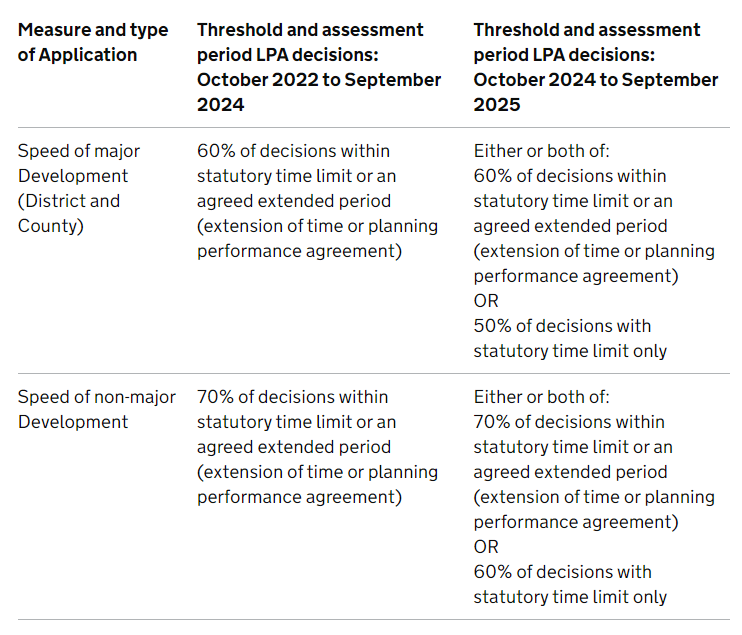









 SIMONICITY