“Government to overhaul planning and licensing rules to make it quicker and easier for new cafes, bars and music venues to open in place of disused shops.
New ‘hospitality zones’ will fast-track permissions for alfresco dining, pubs, bars and street parties.
Reforms will also protect long-standing venues from noise complaints by new developments.”
“The reforms will make it easier to convert disused shops into hospitality venues, and protect long-standing pubs, clubs, and music venues from noise complaints by new developments – ensuring the buzz of the high street can thrive without being silenced.
As part of this, the Government will introduce the ‘Agent of Change’ principle into national planning and licensing policy – meaning developers will be responsible for soundproofing their buildings if they choose to build near existing pubs, clubs or music venues.
New dedicated ‘hospitality zones’, will also be introduced where permissions for alfresco dining, street parties and extended opening hours will be fast-tracked – helping to bring vibrancy and footfall back to the high street.
The new National Licensing Policy Framework will streamline and standardise the process for securing planning permission and licences, removing the patchwork of local rules that currently delay or deter small businesses from opening. This means that entrepreneurs looking to turn empty shops into cafes, bars or music venues will face fewer forms, faster decisions, and lower costs.
This transformation is already underway through the High Street Rental Auction Scheme, which gives councils the power to auction off leases for commercial properties that have been vacant for over a year—bringing empty shops back into use and turning them into vibrant community hubs where people can enjoy a meal, drink, or night out.”
We wait to see what all this means in practice for our planning and licensing systems. The agent of change is after all already in the NPPF. Paragraph 200:
“Planning policies and decisions should ensure that new development can be integrated effectively with existing businesses and community facilities (such as places of worship, pubs, music venues and sports clubs). Existing businesses and facilities should not have unreasonable restrictions placed on them as a result of development permitted after they were established. Where the operation of an existing business or community facility could have a significant adverse effect on new development (including changes of use) in its vicinity, the applicant (or ‘agent of change’) should be required to provide suitable mitigation before the development has been completed.”
Perhaps there will be a super-charged National Development Management Policy version? Anecdotally, I am still being approached by music venues finding that permissions have been granted for adjoining development without adequate noise mitigation conditions having been applied (most recently a London borough being prepared to consent to judgment in just such a situation). And is the government right to be removing the Theatres Trust as a statutory consultee on relevant planning applications, which is an important check against these sorts of problems arising in relation to some types of venue at least?
The HBF’s May 2025 research piece What is the timeframe for local authorities to agree community investment? shows what a huge drag on planning permission timescales is represented by the process of negotiating a section 106 agreement (which of course needs to have been completed before planning permission can be issued).
Read this:
“To better understand the current state of S106 agreement timelines, the Home Builders Federation (HBF) submitted a Freedom of Information (FOI) request to local planning authorities across England. These results are based on the data from more than 2,500 S106 agreements across over 50 local authorities.
The FOI exercise found that the average S106 approval timeline was:
2022/23: 425 days
2023/24: 459 days
2024/25: 515 days
In just two years, the average time required to finalise an S106 agreement has increased by 90 days – a 20% increase.
The responses also highlight the extremities that developers in some local authorities are facing. The maximum recorded timescale was 2,679 days, or more than seven years, for a single S106 agreement to complete the agreement process. The shortest average timescale reported by any of the respondent councils was 192 days.
Additionally, 35% of all S106 agreements took longer than 12 months to finalise. Across all responses, 76% of local authorities reported average timelines that exceeded a year, and over a third of councils had an average timeframe of over 500 days.
In 2024/25, 45% of LPAs had agreements finalised that had taken over 1,000 days to complete.”
The document doesn’t specify the scale threshold of applications considered (I’m assuming by the number of agreements that this is in relation to developments of any scale, not just complex schemes where we know that specific issues requiring bespoke solutions and substantive negotiations may required to unlock solutions). Nor does the document specify when these time periods are measured from: validation of the application, instruction of the LPA’s solicitor or the resolution to grant. Whatever, the statistics are appalling as is the relentlessly worsening trend.
The work is of a piece with the equally depressing Richborough/LPDF research carried out by Lichfields, How long is a piece of string? (16 May 2025). The average determination period for outline planning applications for 10 dwellings or more was 284 days in 2014. In 2024 it was 783 days. Given improvements in the performance of the Planning Inspectorate in relation to planning appeals (particularly appeals determined by way of public inquiry), it is now substantially quicker to secure a decision by way of appeal than by waiting for a final decision from the local planning authority.
This reflects our own anecdotal experience; we are seeing far more appeals on the basis of non-determination within the statutory period, and (tying back into that HBF work) one factor for clients is that with an appeal there is an external discipline upon the parties to agree and complete the section 106 agreement or unilateral undertaking within a specific, externally set, timescale.
Stepping back, this is all crazy and contrary to the efficient operation of the public sector. It’s equivalent to the use of A&E departments by those who find it faster, easier or more effective than going to their GP. Something is massively wrong with the operation of the planning system and it’s nothing that the Planning and Infrastructure Bill or indeed in the government’s December 2024 changes to the NPPF will fix. MHCLG’s proposed alterations to the system in relation to “minor” and “medium” residential development (summarised in my 31 May 2025 blog post Small Changes). Indeed I referenced in that post what was said in relation to section 106 agreements for “medium” residential development (less than 50 dwellings – although why stop at that size cap?):
“We … welcome views and evidence on:
1. the specific barriers facing SMEs in agreeing s.106 obligations – including availability of willing and suitable Registered Providers
2. what role national government should play in improving the process – including the merits of a standardised s.106 template for medium sites
3. how the rules relating to suitable off-site provision and/or appropriate financial payment on sites below the medium site threshold might be reformed to more effectively support affordable housing delivery, where there is sufficient evidence that onsite delivery will not take place within a suitable timeframe and noting the government’s views that commuted sums should be a last resort given they push affordable housing delivery timescales into the future.”
The lack of a standardised template is one issue. We end up having frustrating arguments over what should be uncontentious and standard wording, for instance to protect mortgagees in a way which is institutionally acceptable, or simply over our attempts to make a particular LPA’s “standard” drafting operate as the parties intend. The failure of the Law Society to update its June 2010 template (which never really achieved sufficient support and was not well used) is disappointing. Without drama we need a national template on the MHCLG website asap for smaller schemes, expressly supported by local government, the development industry and professional bodies (including those representing banks), with specific guidance as to the circumstances in which there can be departures.
But the problems go much wider than that:
Many LPA legal teams are woefully under-resourced, without a lawyer with the necessary experience, project management focus or internal clout to do more than act as a post-box with those instructing them, adding pressure and unfair responsibility on planning case officers or allowing other internal or external consultees to drive their particular agendas. There is often a reluctance on the part of the in-house legal team to outsource to an external law firm (even though the applicant pays and is usually eager to pay more if that results in faster delivery of the completed agreement) because of internal pressures not to de-skill further the in-house team or lose the ability to recoup costs.
I suspect that LPA lawyers (some of whom are true unsung heroes) would equally point the finger at some applicants’ solicitors – and indeed some applicants – who may be unprepared to back down from unreasonable negotiating positions or may introduce new points post committee resolution – or who may start ghosting them when something commercially is happening in the background.
“When should discussions on planning obligations take place?
Discussions about planning obligations should take place as early as possible in the planning process. Plans should set out policies for the contributions expected from development to enable fair and open testing of the policies at examination. Local communities, landowners, developers, local (and national where appropriate) infrastructure and affordable housing providers and operators should be involved in the setting of policies for the contributions expected from development. Pre-application discussions can prevent delays in finalising those planning applications which are granted subject to the completion of planning obligation agreements.”
So often though, this isn’t happening.
There also no easy answer if negotiations genuinely hit a brick wall – for instance as to whether a particular contribution is justified or as to the precise drafting of a particular clause. Section 158 of Housing and Planning Act 2016 specifically inserted section 106ZA and Schedule 9A (“resolution of disputes about planning obligations”) into the 1990 Act, to provide for a system where an independent expert could be called upon where there are sticking points in section 106 negotiations, but it was never brought into force. It’s sitting there just waiting to be fleshed out by an SI and switched on! Whether the third party were to make a binding determination or, more practically, gave non-binding guidance that would still carry some weight if an appeal were subsequently required, in my view this needs to be dusted off!
Section 106 agreements are also of course lumbering beasts of burden, the legal mechanism for delivering so many strands of public policy – affordable housing, affordable workspace, carbon reduction measures, social infrastructure (eg education, health), transport infrastructure, local employment and training, affordable workspace, air quality, the complexities of viability review processes. What can we deal with by way of other mechanisms (eg conditions), or standardise? What should be left to other legislation? The financial weight of the obligations in a section 106 agreement in relation to any large scheme is huge – in some ways, it is no surprise that the agreement may take as long or longer to negotiate than it took for the application to get from validation to committee resolution, but what can we simplify, speed up, twin-track?
The Planning Inspectorate also has its Planning obligations: good practice advice (updated 5 February 2025), which is more specific than the government’s planning practice guidance and has its more prescriptive timing requirements (completed planning obligation at the time the written representations appeal is lodged is a tough one…). This is the sort of thing (with suitable adjustments) we need for the application stage, with real consequences for those who do not follow it.
Going back to the HBF work, several suggestions for improvements were made, various of them overlapping with what I have been saying:
“Increase resourcing for planning departments: Local planning authorities are currently under significant resource constraints, which affect their capacity to process planning obligations in a timely manner. To alleviate these challenges, government should allocate targeted funding to increase staffing levels within planning departments. By investing in dedicated S106 teams and offering professional development opportunities, councils can improve both the speed and quality of agreement processes.
Develop national standard templates and best practices: A lack of standardisation in the drafting of S106 agreements often leads to protracted negotiations and inconsistencies across councils. The government, in collaboration with planning authorities and the development sector, should produce standardised procedural guidelines and clauses to minimise the need to draft agreements from scratch. In lieu of official standardisation, there could be clearer guidance and expectations on good practice.
Encourage a more flexible use of cascade agreements where necessary to ensure homes can be built and give reassurance to the developer that if an RP cannot be found, that the Affordable Homes can be changed to an alternative tenure or as last resort, a payment made to the LPA in lieu of the Affordable Housing.
Introduce statutory timelines for S106 agreements: Consideration should be given to implementing statutory or guideline-based timescales into the application and pre-application process for handling Section 106 negotiations and the drafting and signing of agreements.
Monitor, benchmark, and report performance: Introducing monitoring and reporting of S106 performance metrics could drive improvements. Local authorities should publish data on average timescales, agreement outcomes, and compliance rates as part of the general reporting on S106 agreements through Infrastructure Funding Statements. This information could be used to benchmark performance across regions, highlight best practices, and identify areas needing intervention. Increased transparency can also build trust among stakeholders and help developers better plan and budget projects.”
I’m sure this can be cracked, easily. Look what Bridget Rosewell’s recommendations on the planning appeal process achieved. If in a couple of years colleagues are still spending much of their time chasing for progress on draft agreements and having to explain to frustrated clients why there is no progress, I’ll be pointing you back to this blog post.
I know most of us have all grown up with this section 106 run-around – indeed some of us are in fact part of Generation Section 52 – hard-copy travelling drafts sent by post, marked up in a sequential series of colours, by pen – yes it was, despite all that, a faster process than present – but, in the words of the Blow Monkeys from that period: it doesn’t have to be this way.
I’ve mainly called this blog post “small changes” because that is the name of a beautiful, calming and rather lush album by Michael Kiwanuka released last year. Perhaps your social media timeline needs that sort of cleanse? Mine does regularly.
But I was also thinking of that old David Brailsford British Cycling philosophy about marginal gains (“The whole principle came from the idea that if you broke down everything you could think of that goes into riding a bike, and then improved it by 1%, you will get a significant increase when you put them all together”) and of the successive incremental changes that the government has been making to the planning system, most recently those measures flagged in the 28 May 2025 MHCLG press release as Government backs SME builders to get Britain building, measures which were the subject of three consultation documents published that day:
All of this follows last Sunday’s Speeding Up Build Out consultation (consultation closing 7 July 2025), which I summarised that day in my blog post Now Build.
It is an interesting, maybe theoretical, question as to whether system changes are better announced and delivered in one go (soaking up all the political heat at once) or in the current lapping waves. It is also interesting to see the political heat rising from different quarters in relation to different elements.
Concern has been expressed from environmental interest groups and a number of firms providing ecological services, as to Part 3 of the Planning and Infrastructure Bill (nature recovery – see my 11 May 2025 blog post Nature Recovery Position where I tentatively suggest a middle ground).
The Speeding Up Build Out announcement then led to an outcry from many in the development world – how dare the government threaten developers with being blacklisted, fined or having land compulsorily acquired if they delayed unreasonably in building out planning permissions etc etc? I explain in my 25 May 2025 Now Build piece why I don’t think that should be a real concern and why, if only for pragmatic political reasons, the government has to have basic protections along these lines in place. But that was based on me focusing on the working paper and consultation document, not on the government’s PR spin, which I think was unnecessarily overblown, particularly:
That tweet from the prime minister (NB what is the government doing still being on X in any event? Full marks to Matthew Pennycook and others for using Bluesky).
All that developer-demonisation (“Developers who repeatedly fail to build out or use planning permissions to trade land speculatively could face new ‘Delayed Homes Penalty’ or be locked out of future permissions by councils”), whereas I’m not sure anyone would disagree with what is actually said in the working paper itself:
“The Competition and Markets Authority (CMA) and others have concluded that most homes in England are not built as fast as they can be constructed, once permission is granted, but only as fast as the developer expects to sell them at local second-hand market prices. This leads to a build out rate for large sites which can take decades to complete. While it is commercially rational for developers to operate in this way, the systemic impact is a lower level of housebuilding than we need. The government is therefore committed to taking firm action to ensure housebuilding rates increase to a level that makes housing more affordable for working people.
In the public debate on housebuilding rates, 3 related concepts are often confused.
a. Land banks are, for the most part, a normal part of the development system. Developers hold a pipeline of sites at all stages of the planning process, to avoid stop/starts between schemes. In its 2024 study, the CMA found no evidence of current land banks systemically distorting competition between housebuilders. We do, however, have concerns that certain types of contracts over land prior to its entry into the planning system (which can be part of ‘strategic’ land banks) can be a barrier to entry for SME developers. We are therefore legislating to make Contractual Control Agreements (‘option agreements’) more transparent, to help diversify the industry and reduce barriers to entry for SME builders.
b. Delayed or stuck sites are those at all stages of the planning and building process (including with full planning permission) that are delayed, not building out, or only building out very slowly due to a problem that the developer or landowner is struggling to resolve themselves. Often this is due to the discharge of a planning condition, an issue raised by a statutory consultee, a newly discovered site issue, or the developer running into financial difficulties. We have created the New Homes Accelerator to tackle this sort of blockage … and get stuck sites moving. In wider cases, sites may be stuck in negotiations over suitable S106 contributions, sometimes because the promoter has overpaid for the land not fully factoring in the policy requirements set out in planning policy. In this paper we consider further reforms to the Compulsory Purchase Order (CPO) process, relevant to stalled sites.
c. Slow build out is where sites have full planning permission, are being built, but the pace of building is slower than it could be under different development models and incentives. Multiple market studies have found that most large housing sites are built at the pace the homes can be sold at current second-hand market prices, rather than the pace at which they could be constructed if pre-sold (i.e. to an institutional landlord). The rate of building consistent with selling at local second-hand market prices is known within the industry as the ‘absorption rate’. The Letwin Review concluded that local absorption rates were a “binding constraint” on build out rates. The CMA observed, that “the private market will not, on its own initiative, produce sufficient housing to meet overall housing need, even if it is highly competitive”.
So that was the furore earlier this week. And then when Wednesday’s announcements were made, environmentalists focused on the potential rolling back of the statutory BNG regime from smaller projects and opposition politicians turned on the (not new, but in my view improved) proposals to ensure that more applications are determined through use of planning officers’ delegated powers rather than Planning Committee.
You can’t please all the people all the time…
What is the thrust of the latest changes?
The starting point is to change the current categorisation of planning applications for residential development from those for “minor” development” and those for “major” development, so as to introduce a “medium” development category.
The categories would be:
Minor Residential Development – fewer than 10 homes /up to 0.5 ha (and within that a sub-category of 1b. Very small sites – under 0.1ha)
Medium Residential Development – between 10-49 homes/up to 1.0 ha
Major Residential Development – 50+ homes / 1+ hectare
In due course, consideration would be given to appropriate categories for non-residential development.
The following would apply to each category:
Minor
streamlining requirements on Biodiversity Net Gain (BNG) including the option of a full exemption
retaining the position that affordable housing contributions are not required on minor development
retaining the position that sites of fewer than 10 units are exempt from paying the proposed Building Safety Levy (BSL)
retaining the shorter statutory timeframe for determining minor development at 8 weeks “however we will take steps to improve and monitor performance so SMEs can expect a better service”
reducing validation requirements “through setting clearer expectations in national policy on what is reasonable, which could form part of the forthcoming consultation on national policies for development management”
requiring that all schemes of this size are delegated to officers and not put to planning committees as part of the National Scheme of Delegation.
reviewing requirements for schemes of this size for consultation with statutory consultees “instead making use of proportionate guidance on relevant areas. This forms part of our review of statutory consultees”
On the “very small sites” sub-category:
“The government will consult on a new rules-based approach to planning policy later this year through a set of national policies for development management. This will include setting out how the government intends to take forward relevant aspects of the proposals contained in the previous ‘Brownfield Passport’ working paper.”
“The government is therefore proposing to further support the delivery of very small sites through:
providing template design codes that can be used locally for different site size threshold and typologies – which will take a rules-based approach to design to help identify opportunities and enable faster application processes
using digital tools to support site finding and checking compliance of design requirements on specific sites.”
Medium
simplifying BNG requirements “reducing administrative and financial burdens for SME developers and making it easier for them to deliver BNG to help restore nature on medium sites by consulting on applying a revised simplified metric for medium sites. Further details are set out Defra’s consultation on potential BNG changes offering stakeholders the opportunity to give their views on this issue.”
exploring exempting these sites from the proposed Building Safety Levy “we intend to lay regulations for the Building Safety Levy in Parliament this year (as set out in our response to our technical consultation) and the Levy will come into effect in Autumn 2026. As part of this working paper, we are keen to explore whether, if introduced, medium sites should also be exempt from paying the Levy”
exempting from build out transparency proposals
maintaining a 13-week statutory time period for determination “in line with major development – but specifically tracking performance of these types of developments directly so SMEs can expect a better service”
including the delegation of some of these developments to officers as part of the National Scheme of Delegation
ensuring referrals to statutory consultees are proportionate “and rely on general guidance which is readily available on-line wherever possible. This forms part of our review of statutory consultees”.
uplifting the Permission in Principle threshold “allowing a landowner or developer to test for the principle of development for medium residential development on a particular site without the burden of preparing an application for planning permission. We recognise take up of Permission in Principle by application for minor residential development has been relatively limited since its introduction in 2017, and we would therefore like to gauge the appetite for this reform before exploring further”
minimising validation and statutory information requirements “through setting clearer expectations in national policy which could form part of the forthcoming consultation on national policies for development management”
There is also an important reference to streamlining section 106 agreement negotiations:
“We … welcome views and evidence on:
1. the specific barriers facing SMEs in agreeing s.106 obligations – including availability of willing and suitable Registered Providers
2. what role national government should play in improving the process – including the merits of a standardised s.106 template for medium sites
3. how the rules relating to suitable off-site provision and/or appropriate financial payment on sites below the medium site threshold might be reformed to more effectively support affordable housing delivery, where there is sufficient evidence that onsite delivery will not take place within a suitable timeframe and noting the government’s views that commuted sums should be a last resort given they push affordable housing delivery timescales into the future.”
(I will be doing a separate blog post on that one).
Major
“This working paper primarily considers targeted changes and easements to sites below 50 homes. Sites above 50 will benefit from overall government reforms to the planning system – including those set out in the revised National Planning Policy Framework published in December, the Planning and Infrastructure Bill, and future reforms to statutory consultees and through emerging national policies for development management.
Nevertheless – the government is interested in views in response to this working paper on:
applying a threshold for mixed tenure requirements on larger sites – as set out in the government’s working paper on speeding up build out, we are considering a range of options to set a threshold whereby mixed tenure development should apply – including at 500 units. We welcome further views on the right threshold – and on whether and how there should be some discretion for Local Planning Authorities – ahead of consulting on the policy as part of a consultation on national policies for development management and a revised National Planning Policy Framework later this year.”
Turning to the paper on reforming planning committees, thankfully the thinking has moved away from taking into account whether or not a proposal is in compliance with the development plan (which would have led to endless arguments and disputes). Instead, the proposal is that a scheme of delegation would be introduced which would have two tiers:
“Tier A which would include types of applications which must be delegated to officers in all cases; and
Tier B which would include types of applications which must be delegated to officers unless the Chief Planner and Chair of Committee agree it should go to Committee based on a gateway test.”
“We propose the following types of applications would be in Tier A. This is in recognition that they are either about technical matters beyond the principle of the development or about minor developments which are best handled by professional planning officers:
applications for planning permission for:
Householder development
Minor commercial development
Minor residential development
applications for reserved matter approvals
applications for s96A non-material amendments to planning permissions
applications for the approval of conditions
applications for approval of the BNG Plan
applications for approval of prior approval (for permitted development rights)
applications for Lawful Development Certificates
applications for a Certificate of Appropriate Alternative Development”
Note: “we are keen for views whether there are certain circumstances where medium residential developments could be included in Tier A. For instance, given the scale and nature of residential development in large conurbations such as London, we could specify medium residential development in these conurbations should be included in Tier A (as well as minor residential development), while in other areas, only minor residential development would fall within Tier A.”
Tier B:
There is also a proposal to limit the number of members of a planning committee to 11 and to introduce a national training certification scheme for planning committee members.
I will do a separate blog post on the BNG changes at some point but in the meantime Annex A to the DEFRA consultation paper is a good summary of the various proposals.
I think that’s enough for now…
Simon Ricketts, 31 May 2025
Personal views, et cetera
“Small changes Solve the problems We were revolving in your eyes Wait for me All this time, we Knew there was something in the air“
Another MHCLG planning reform working paper this fine Sunday morning (25 May 2025), Speeding Up Build Out together with accompanying technical consultation (deadline for responses: 7 July 2025).
After the various policy changes and measures in the Planning and Infrastructure Bill aimed at seeking to encourage local planning authorities to plan for more homes and to encourage decision makers (whether local planning authorities or planning inspectors) to grant planning permission for more homes, this paper turns the spotlight onto developers.
“We know that slow build out is of great frustration to many local planning authorities and communities that rightly expect homes, infrastructure and services that have been promised as part of a planning approval to be delivered as quickly as possible. We also know that developers are responsive to commercial incentives and build out homes at a rate that is beneficial to their business and reflective of the wider economic environment.
This paper therefore invites views on options the government could pursue to ensure the right incentives exist in the housing market, and local planning authorities have the tools they need, to encourage homes to be built out more quickly. In addition to the transparency and accountability measures set out in the technical consultation, this includes incentivising and supporting models of development that build out faster, such as partnership models, greater affordable housing, public sector master-planned sites, and smaller sites. We also invite views on giving local authorities the ability – as a last resort – to charge developers a new ‘Delayed Homes Penalty’ when they fall materially behind pre-agreed build out schedules.”
The paper unpacks the issues; land banks (to the limited extent that option agreements may be a barrier to entry for SME developers); delayed or stuck sites (to which the New Homes Accelerator initiative is aimed, as well as further potential reforms to the CPO process) and slow build out. The paper focuses on how to:
“a) overcome absorption constraints to get more homes built more quickly
b) continue to strengthen the local authority toolkit to unblock stalled and stuck sites.”
The government intends to bring into force various provisions contained in the Levelling-up and Regeneration Act 2023, namely:
The requirement to submit a build out statement (in LURA a “development progress report” – section 90B Town and Country Planning Act 1990 as introduced by section 1154 of LURA) with prescribed categories of planning applications
To notify LPAs before development is commenced through a commencement notice (section 93G of the TCPA as introduced by section 111 of LURA)
To report annually to LPAs on housing delivery via a development progress report (see above)
To give LPAs the power to decline to determine planning applications made by persons who applied for, or who are connected to, an earlier planning permission for the development of land in the LPA’s area which has not been built out at a reasonable rate (section 70D of the TCPA as introduced by section 113 of LURA)
To simplify the process for LPAs to issue completion notices “to require developers to complete their development within a certain period of time if the LPA considers it will not be completed in a reasonable time, otherwise the planning permission will cease – a form of “use it or lose it”.” (section 93H of the TCPA as introduced by section 112 of LURA).
The government is consulting on introducing in policy a “site size threshold above which sites must deliver on a mixed tenure basis”.
On CPO, the government intends to bring forward secondary legislation later this year to implement provisions in LURA “to allow the conditional confirmation of CPOs. This will allow the compelling case for use of CPOs to be established earlier in the land assembly process on sites where alternative proposals have been put forward by landowners.“
“The conditional confirmation of CPOs could be used to ensure landowners progress their alternative proposals within certain timescales, which would be made clear when an individual CPO is conditionally confirmed. Where they fail to do so, CPO powers could then be switched on. We believe the conditional confirmation power will de-risk use of CPOs on stalled sites because the existence of alternative proposals will no longer carry the same weight in the decision-making process.”
So far, the above proposals go no further legislatively than was proposed by the previous government.
However, the government has announced in today’s documents that it is “exploring the possibility of introducing a new tool for local authorities: the “Delayed Homes Penalty”. This would effectively be a last resort measure, which we hope not to have to implement, but may be needed if industry does not sufficiently adapt and fulfil their commitment to deliver homes more quickly.
The Delayed Homes Penalty would be available to local authorities for development which falls materially behind pre-agreed build out schedules, as set out through the transparency measures. While subject to further work, including drawing on responses to this working paper, we are considering the following framework for the Delayed Homes Penalty.
a. The Penalty would apply only to sites over a threshold size and only where there is evidence of a developer falling substantially behind a build out schedule, pre-agreed with the LPA.
b. Agreement and monitoring of build out rates would be aligned to the new transparency measures, which will require developers to pre-agree a build out schedule with the local planning authority before consent, provide a commencement notice before the development begins and then annual development progress reports.
c. If a site falls substantially behind the pre-agreed build out schedule in a given year (to 90% or less of the agreed delivery), then the developer would be required to justify the slower build out rate to the planning authority. If this cannot be shown to have been caused by an external factor – such as unusually severe weather, or an unexpected site issues – the developer could become liable for the Delayed Homes Penalty.
d. The relevant external factors would be nationally set out in guidance and could be informed by those already used in contracts between Homes England and developers under the ‘build lease’ model.
e. If the Delayed Homes Penalty were applied, the relevant party (developer or landowner) would be charged for each home behind the pre-agreed build out schedule. Penalties could be based on a percentage of the house price, or via reference to local Council Tax rates, given the loss of income that a local authority incurs when homes are not built and occupied at the expected rate (although this would not be applied via the Council Tax system itself).
It would be important in the introduction of any Delayed Homes Penalty that industry was confident in when and how this would be applied, to ensure that they did not disincentivise land being brought forward for development. We therefore intend to use all views expressed in response to this working paper to inform further policy development, and if the government decided to take this proposal forward, we would propose to undertake further consultation.”
In my personal view, none of this should be regarded as controversial by the private sector. The quid pro quo for the policies and initiatives introduced to seek to ease the allocation of land for housing, and the approval of development proposals, has to be a recognition on the part of those who promote development or seek planning permission that this is not a one-way street and that participation in the system brings with it certain responsibilities. Of course, we do need to make sure that measures of last resort (compulsory purchase of stalled sites, penalties) do not unnecessarily spook funders and investors so as to ensure that the measures are not counter-productive – which will need for there to be appropriate protections in the legislation and clear communication from ministers as to the limited circumstances in which the government envisages that these sticks should actually be applied.
It was disappointing to read, in the BBC’s online coverage this morning, New rules may take unfinished housing sites off developers (in itself a bit of a tabloid-style headline – not a new rule, just the previous government’s legislation being brought into force), the quoted response from Conservative shadow Secretary of State Kevin Hollinrake. Being charitable, perhaps he hadn’t had time to be briefed or understand the policy context or indeed read his previous government’s legislation) but what about this for dogwhistle politics (and nothing on what is actually proposed)?
“Shadow housing secretary Kevin Hollinrake claimed that “many hardworking Brits will be shut out of the housing market forever” as “Labour’s open door border policy” meant “many of these houses will end up going to migrants”.
He added: “In the same week that Angela Rayner has been caught red-handed plotting to raise everyone’s taxes, it’s clear she doesn’t have the interests of working people at heart.”
(This in a week where net migration was reported to have halved in 2024).
What planning reform needs so desperately is cross-party consensus. This week’s 50 Shades of Planning Shades of Planning podcast episode , Sam Stafford’s recent 45 minutes long interview one-on-one with Lord Michael Gove is a must-listen – not just for Gove’s honest and detailed reflection on what went wrong under his tenure but also for his fair assessment as to the current government’s direction of travel in terms of planning reform. Does every policy proposal really have to be a pawn in a now multi player chess game?
I hope that there is wide engagement with the government’s technical consultation, particularly: “Are there wider options you think worth worthy of consideration that could help speed up build out of housing?”
Until this morning’s announcement I was going to focus on various discussions I had in Leeds this week, which were exactly on the theme as to the nature of some of those “wider options”. Sam Stafford (now as of this week the new LPDF chief executive – congratulations) has been calling for a development management “snagging list”. There are so many incremental improvements to be made – now is the opportunity with that 7 July 2025 response deadline – and wouldn’t it be good if there were as much private/public sector consensus as possible in coming up with that list. Watch this space for some of the items on mine…
This is the tripwire: Article 40(3)(b) of the Town and Country Planning (Development Management Procedure) (England) Order 2015 provides that a local planning authority’s planning register must contain, amongst other things, in relation to a planning application “a copy (which may be photographic or in electronic form) of any planning obligation or section 278 agreement proposed or entered into in connection with the application.”
The requirement should not be news for any local planning authority but it is often honoured in the breach. Until now it has not formed a basis for the quashing of a planning permission. But that could well be the outcome, subject to the court’s final order, of the Court of Appeal’s judgment yesterday (16 April 2025) in R (Greenfield (IOW) Limited v Isle of Wight Council , which concerned a challenge to Isle of Wight Council’s decision to grant planning permission for a development comprising 473 dwellings and related development, in circumstances where the proposed or completed agreement had not been placed on the planning register before planning permission was issued. One can see the problem arising from the particular facts: the planning committee’s resolution to grant planning permission was subject to prior completion of a section 106 agreement, one of the heads of terms of which was to be a financial contribution (amount unspecified although at the time of the committee the developer had indicated that the costs could be in the region of £777,000) but then only when planning permission had been granted did it transpire that the section 106 agreement, subsequently negotiated, provided for a contribution of £406,359.
The court made it clear that the implications of failure to comply with the duty are fact-specific. Here the heads of terms in the committee report were insufficient to inform the reader as to the nature of the contribution (namely its quantum) and the overwhelming evidence was that the claimant and others would have wished to make representations had they known what figure was proposed. Whilst the court found that the claimant had not made any request of the council a copy of the proposed obligation, it was accepted that they had searched the online planning register for sight of it. Lastly, the court could not conclude that even if the duty had been complied with it would have been highly likely that the outcome would have been the same.
At first instance HHJ Jarman KC had found this ground of challenge to be unarguable. Ah the uncertain joys of litigation.
What practically should we take from the judgment? These are just my own personal thoughts:
It is prudent for a local planning authority to place a copy of the draft and/or completed planning obligation (i.e. section 106 agreement or unilateral undertaking) on its planning register before the document is completed and permission issued.
This is particularly the case where the substantive contents of the agreement or undertaking are not already summarised in an officer’s report (and, if relevant planning committee resolution) which is in the public domain
The duty is to put the document on the register rather than to undertake further consultation and there is no minimum period specified as between placing the document on the planning register and issuing the permission, although in my view it would be sensible to allow at least a few days (e.g. when the document is probably in any event being engrossed and doing the rounds for execution – complying with this duty should not be an excuse for further delay in the process).
The question often arises as to whether successive drafts of a planning obligation need to be put on the register. What, after all, is the version of the document which is, in the vague words of the statutory duty, “proposed or entered into“? In my view successive drafts certainly do not need to be put on the register and it is sufficient to place on the register the version that the authority intends to enter into or (in the case of a unilateral undertaking intends to rely on) as a basis for granting planning permission.
None of this should be news, but local planning authority practice to date has often been rather more laissez faire, perhaps partly because the courts have previously declined to quash permissions in not dissimilar circumstances (see for instance R (Police and Crime Commissioner for Leicestershire) v Blaby District Council (Foskett J, 27 May 2014) and maybe partly because, well, this is a statutory duty, tucked away in the Development Management Procedure Order, that it can be easy to overlook.
A list of the 25 or so current statutory consultees in relation to relevant planning applications is set out in table 2 of the government’s guidance, here.
The previous government appointed Sam Richards in December 2023 to carry out an independent review of the role of statutory consultees in the planning system, since when that, er, consultation disappeared into a large hole. Would the new government take up the cudgels? Sam Stafford’s 6 November 2024 blog post On Stat Cons is good on the subject, referring back to previous concerns raised by the RTPI and a series of suggestions that had been made by the Competition and Markets Authority. On 26 January 2025, the Deputy Prime Minister and the Chancellor announced a moratorium on the creation of new statutory consultees and committed to reviewing the existing arrangements.
Anecdotally, the statutory consultees where issues most frequently arise are surely National Highways, the Environment Agency and Natural England. True, the issues within their domain are often technically, and sometimes legally, complex, but how often does the local planning authority or applicant receive a relatively standard holding response or objection and then have to engage in lengthy chasing process to resolve the issue?
“Review of statutory consultee system to promote growth and unblock building
Consultation on limiting the scope of statutory consultees and removing a limited number of them, including Sport England, Theatres Trust and The Gardens Trust in planning decisions, while ensuring necessary community facilities and needs continue to be met
Will also establish a new performance framework with greater ministerial oversight
Reforms will reduce delays and uncertainty on planning proposals, demonstrating the government’s Plan for Change in action”
The government will be:
Consulting on reducing the number of organisations, including the impact of removing Sport England, the Theatres Trust and The Gardens Trust.
Reviewing the scope of all statutory consultees, to reduce the type and number of applications on which they must be consulted – and making much better use of standing guidance in place of case-by-case responses.
Clarifying that local authorities should only be consulting statutory consultees where necessary to do so, and decisions should not be delayed beyond the 21 day statutory deadline unless a decision cannot otherwise be reached or advice may enable an approval rather than a refusal.
Instituting a new performance framework, in which the Chief Executives of key statutory consultees report on their performance directly to Treasury and MHCLG Ministers.”
“The purpose of our statutory planning remit is to protect playing fields and community spaces for sport and physical activity.
“Britain’s childhood obesity crisis is rising and low physical activity levels cost our economy £7.4billion a year, making it vital we protect the places that local communities can be active.
“We support growth and exercise our powers carefully and quickly, ensuring local neighbourhoods are designed to help people live healthy, happy and active lives.
“We look forward to taking part in the Government’s consultation exercise and arguing the importance of protecting playing fields and places where local people can keep active.“
It perhaps has a reason to feel sore. The government’s press statement picks out a particular incident where “In Bradford, a development to create 140 new homes next to a cricket club was significantly delayed because the application was thought to have not adequately considered the speed of cricket balls.” I decided to look into this one. It was in fact widely publicised, for instance in a 12 November 2024 piece Speed of cricket balls could stump housing scheme. Sport England had queried the applicant’s consultant’s conclusions as to risk, based on the consultant’s assumptions as to the speed at which the balls might travel. Was this so wrong in principle or was the problem one of the slowness or over-rigidity of Sport England’s reaction? It is not clear.
I am a past trustee of the Theatres Trust and I was disappointed to see that the Trust is being considered for removal from the list. It is difficult to see how the Trust can effectively fulfil its statutory role under the Theatres Act 1976 of protecting theatres (widely defined) without being consulted on any planning application involving land on which there is a theatre or which will have an impact on theatre use. The Trust responded to 289 applications last year and, from my now admittedly historic knowledge of how the Trust operates, I would be surprised if any of those responses were late or unhelpful.
The written ministerial statement gives this further detail as to the government’s intentions:
“…we will review the range and type of planning applications on which statutory consultees are required to be consulted and consider whether some types of application could be removed, or addressed by alternative means of engagement and provision of expert advice. In some cases, this could be done through undertaking more effective strategic engagement at the local and strategic plan level, reducing the need for comments on individual planning applications, and increasing the role of standing advice. We will consult on these changes in the Spring alongside the impact of removal of the organisations identified above, before taking forward any resulting changes in secondary legislation later this year.”
There is also the advice in the WMS that: “local planning authorities should limit consultation of statutory consultees to only those instances where it is necessary to do so. Local planning authorities must still consult with statutory consultees where there is a legislative requirement to do so, noting that if there is relevant and up to date standing advice published with respect to that category of development, then consultation is not required. Applications may need to be referred to particular statutory consultees outside of the statutory requirements where their expertise is required, given the nature of the development, but should not be referred where standing advice is sufficient.”. “Decisions should not be delayed in order to secure advice from a statutory consultee beyond the 21 (or 18) day statutory deadlines unless there is insufficient information to make the decision or more detailed advice may enable an approval rather than refusal.” “In those limited circumstances where the statutory consultee is expected to provide advice on significant issues and it is necessary (for example, on safety critical issues), appropriate extensions to the 21 day deadline should be granted so that sufficient and timely information is available to inform the decision.“
“To support timely and effective engagement with the planning system, we will also institute a new performance framework. As part of this framework, an HM Treasury and MHCLG Minister will meet annually with Chief Executive Officers of key statutory consultees in order to review their performance.” “Finally, the Government recognises that statutory consultees need to be resourced adequately, and on a sustainable basis to enable them to support the government’s growth objectives in full.”
Much of this is surely to be welcomed but I think we need to focus on ensuring that the main statutory consultees respond positively, effectively and quickly rather than simply cutting out those which look a little niche (they are – and when your proposals are in that niche that’s where their specialist input is so important).
It is very difficult to think of a “one size fits all” policy intervention that would achieve what the government is looking for, namely “further action that we could take through the planning system to support the development of brownfield land in urban areas.” The paper “proposes options for a form of ‘brownfield passport’, which would be more specific about the development that should be regarded as acceptable, with the default answer to suitable proposals being a straightforward “yes”. It seeks views in particular on the following questions:
“Could national policy be clearer if it were explicit that development on brownfield land within urban settlements is acceptable unless certain exclusions apply?
What caveats should accompany any general expectation that development on brownfield land within urban settlements is acceptable?
How best can urban areas be identified and defined if this approach is pursued?
Could national policy play a role in setting expectations about the minimum scale of development which should be regarded as acceptable in accessible urban locations?
What parameters could be set for both the scale of development and accessibility?
Could more use be made of design guidance and codes to identify specific forms of development that are acceptable in particular types of urban area?
What sort of areas would be most suited to this approach, and at what geographic scale could such guidance and codes be used?
How could Local Development Orders be best used with these proposals?
Are there any other issues that we should consider if any of these approaches were to be taken forward, in particular to ensure they provide benefits as early as possible?
In addition to streamlining permissions on urban brownfield sites, where else do you consider this type of policy could be explored to support economic growth?”
“Passport” is undoubtedly over-optimistic branding, but I suppose even one of those Easyjet speedy boarding passes would be helpful.
Published after the paper, on 12 December 2024, the final revised version of the NPPF does of course contain a strengthened presumption in favour of brownfield development in paragraph 125 (c):
“Planning policies and decisions should:
(c) give substantial weight to the value of using suitable brownfield land within settlements for homes and other identified needs, proposals for which should be approved unless substantial harm would be caused, and support appropriate opportunities to remediate despoiled, degraded, derelict, contaminated or unstable land”
“Substantial weight”; approval “unless substantial harm would be caused”: a strong signal one might think. However, it is interesting to see how the policy has been taken into account by appeal inspectors. Perhaps to state the obvious, it is not a “get out of jail free” card and in any event you do need to make sure you fit within the definition. We have found four examples but you may be aware of others:
Appeal reference APP/L1765/W/24/3344776 – decision letter dated 31 December 2024 dismissing an appeal for the demolition of existing office and ancillary buildings on site, conversion of an existing industrial warehouse and the construction of 9 residential properties in Denmead, Winchester. “…whilst the site comprises previously developed land, I do not find conflict with the substantial weight given within the Framework to the value of using suitable brownfield land within settlements for homes and other identified needs (Paragraph 125 c)) given the countryside location of the site and the market housing nature of the residential development proposed.”
Appeal reference APP/N5090/W/24/3345445 – decision letter dated 15 January 2025 dismissing an appeal for a proposed care home in Barnet. “In addition to outlining the […] benefits of the proposed development, the appellant has drawn my attention to NPPF paragraph 125 c) which states that planning decisions should give substantial weight to the value of using suitable brownfield land within settlements for homes and other identified needs, proposals for which should be approved unless substantial harm would be caused, and support appropriate opportunities to remediate despoiled, degraded, derelict, contaminated or unstable land. Furthermore, the appellant has highlighted the removal from the NPPF of what was paragraph 130 in the 2023 NPPF, which made reference to the possibility that significant uplifts in the average density of residential development may be inappropriate if the resulting built form would be wholly out of character with the existing area.” However, the inspector “found that there would be harm to the character and appearance of the area resulting from the proposed development. That harm stems from both the bulk and massing of the proposed development in a sensitive context, but also in relation to the retention of trees along the site’s frontage.”
Appeal reference APP/F2605/W/24/3344783 – decision letter dated 30 January 2025 dismissing an appeal for a single detached dwelling in Breckland. “The appellant has identified that the site, as part of the garden of 1 Sandfield Lane, constitutes brownfield land. The Framework, at paragraph 125 c) states that planning decisions should give substantial weight to the value of using suitable brownfield land within settlements for homes and other identified needs, proposals for which should be approved. The site, as identified above, lies outside of any defined development boundary. It does, however, lie within a grouping of buildings focussed around the pedestrian level crossing. However, I have identified that the proposal would rely almost totally on the private car for transport. Thus, the site is not suitable, as it would, through the generation of greenhouse gasses, have an adverse effect on the natural environment.”
Appeal reference APP/W3520/W/24/3352607 – decision letter dated 4 February 2025 dismissing an appeal for 11 dwellings and a commercial unit in Mid Suffolk. “In line with paragraph 125c of the Framework I give the housing, in this context, substantial weight. Although not in a settlement, it is in an accessible location.” However, the “proposal would be contrary to the Council’s spatial strategy with houses of an unacceptable mix, would fail to secure 10% BNG together with appropriate affordable housing, infrastructure requirements, habitat mitigation and has not demonstrated that it would not increase or cause flooding elsewhere. Consequently, it conflicts with the development plan as a whole.”
Given the range of questions raised by MHCLG, what might be additional appropriate interventions look like? Because I’m sure there will need to be various interventions. This is the part where I can plug last week’s Homes for Britain publication, Brownfield Planning Passports: The Fast Track To Growth, sponsored by Berkeley Group, which contains 14 essays with practical ideas from a wide range of public and private sector people (including me, returning to some of the themes of my 5 January 2025 blog post, How About A Five Yearly Review Of The Use Classes Order & GPDO, Starting This Year?). As you prepare your responses by 28 February, do have a read and it may spark some additional, or perhaps better, ideas.
PS I couldn’t mention blue sky without mentioning Blue Sky again. If you’re still looking for a replacement for whatever the present unpleasant tense of Twitter may be, come join. Link here.
Changes in the law relating to e.g. tripe shops, maggot breeding and bone grinding were my special subject as a late 80s young lawyer so please hear me out, because this is all central in my view to thinking with regard to the government’s (currently rather all shades of grey) “brownfield passports” concept (see my 28 September 2024 blog post Brownfield Passports…To What? When? How? ).
Two things I find interesting about the UK (now, for the purposes of this post, English and Welsh) town and country system:
The stability of its underlying structure: Many of the provisions of the Town and Country Planning Act 1947 are there, as the kernel of the current, much amended, 1990 Acts. Compare for instance section 12 of the 1947 Act (defining “development”) with section 55 of the Town and Country Planning Act 1990 or section 13 of the 1947 Act with section 59 of the Town and Country Planning Act 1990 (“development orders”).
The continual sets of amendments, large and small, that have been made, within that framework, to reflect differing political priories and economic and social pressures. Drafting by committee? What we have now is the almost impenetrable result of many generations of that. It always helps to understand who added, amended or removed what, when and why.
The tension for law makers is always the same: how to retain what works but ensure, without unnecessary complexity, that the system remains fit for purpose.
Maybe nowhere is this more so than in relation to the concepts of use classes (changes of use within a use class not amounting to “development” requiring planning permission) and permitted development (classes of development which have the benefit of automatic, deemed, planning permission).
When I first studied planning law (at bar school in 1984-85: course run by Victor Moore, as of “A Practical Approach To Planning Law”), we were all operating under the Use Classes Order 1972 (which was largely in the same form as the first Use Classes Order in 1950) and under the General Development Order 1977 (again largely in the form of the first General Development Order in 1948). This truly makes me feel old. These were the 1972 Use Classes Order use classes, dominated by all of those special industrial groups, and with those references to tripe shops, cats-meat shops and the like.
The categories of permitted development rights in the 1977 Order will look very familiar:
The brevity of the “changes of use” category, less familiar:
Conservative governments have been responsible for two major revisions of the system.
The first was shortly after I qualified, with the introduction of the (now amended many times) Town and Country Planning (Use Classes) Order 1987 the main functions of which do not nowadays appear very controversial: (1) lumping together office, light industrial and research and development uses within a new use class B1 and (2) abolishing the use classes containing all those old special industrial groups. Alongside this was the Town and Country Planning General Development Order 1988.
That system then survived without major reform for around quarter of a century.
The second set of changes to the system has been the multiple waves of deregulatory changes made between 2013 and 2024, particularly the creation of class E for a wide range of commercial uses in 2020 (see my 24 July 2020 blog post E Is For Economy) and the various new permitted development rights enabling residential conversion and demolition/rebuild in relation to commercial (and in some instances agricultural) buildings. The Town and Country Planning (General Permitted Development) (England) Order 2015 (as amended) is a shape-shifting monster.
The system is in desperate need of reform:
what should be the core objectives behind removing the need for planning permission for certain categories of use and works, given the Government’s missions?
How can the system operate with simplicity but also appropriate flexibility and reflecting local circumstances where appropriate?
What areas of the current system need modernising to reflect current economic or social pressures, priories and ways of living and working?
Depressingly, my 1 July 2016 blog post Time To Review The C Use Classes remains more relevant than ever. It’s still time! The nettle has not been grasped.
As for permitted development rights, perhaps the big political question is whether the concept of automatic planning permission for the conversion of certain types of commercial buildings to residential use should be rejected outright, based on the experience since May 2013, or can be made to work acceptably.
In 2023-24 8,825 of England’s 198,610 new dwelling completions were by way of permitted development rights . Between 2015/16 and 2022/23, 102,830 new homes were delivered by way of permitted development rights, around 6% of new homes. This is a not insignificant contribution, by numbers at least.
To this we add the Government’s drive towards brownfield development in urban areas (that brownfield passports document I mentioned); the extent to which commercial space is surplus to market requirements, and the carbon benefits of finding new uses for existing buildings (although query how this squares with the “demolish commercial and rebuildas residential” permitted development right).
Of course a big problem is that much of the resulting accommodation has not been of a decent standard (see e.g. Research into the quality standard of homes delivered through change of use permitted development rights by Dr Ben Clifford, Dr Patricia Canelas, Dr Jessica Ferm and Dr Nicola Livingstone Bartlett School of Planning, UCL and Professor Alex Lord and Dr Richard Dunning, Department of Geography and Planning, University of Liverpool, July 2020, published by MHCLG in 2020, strangely alongside yet further deregulatory measures). The Town and Country Planning Association is lobbying for a “Healthy Homes Bill”, describing permitted development rights as creating “slums for the future”.
Is there a middle ground? Do permitted development rights have a role in delivering homes, in the quantity needed but also to the necessary quality – decent, healthy?
The previous government consulted on further changes to permitted development rights in February 2024 . The outcome of that process was never published. We await Labour’s next steps.
What went wrong with commercial to residential permitted development rights?
For a start the measure seemed to be seen by ministers as a short-term tactical intervention rather than based on any longer-term strategy or analysis. In May 2013 the right was first introduced (initially just for three years) to allow changes from office use to residential use, the twin objectives being to boost housing and to help regeneration by way of putting vacant or under-utilised office space to productive use. The “prior approval” requirements were minimal, with no minimum space standards, no minimum standards for daylight and no protection in relation to noise, for instance. As is still the case, local planning authorities could not impose requirements as to affordable housing or require contributions towards for instance education or health facilities. Authorities could make “article 4” directions limiting the areas within which the permitted development right would apply but at risk of these being cancelled or amended by the government (as has frequently happened).
The right was extended to shops and to financial and professional services uses in April 2014 and made permanent in Autumn 2015. Adequacy of daylight was introduced as a prior approval requirement in August 2020 and minimum space standards in April 2021. Initially buildings of any size could be converted to residential. A 1,500 sq m cap was introduced in September 2020 (at the same time that there was the separate but related de-regulation measure of gathering together most commercial uses within a single use class, the new class E) and then that cap was removed in March 2024. Similarly, a requirement was also introduced that the building should have been vacant for at least three months before the application was made, only for that also to be removed. Are you keeping up? (Incidentally, I am grateful to my colleague Gregor Donaldson for reminding me of some of these twists and turns).
One might conclude from this chopping and changing that from the outset the process has lacked a proper strategic foundation, core objectives and a commitment to ensure that resulting development is not of poorer quality, or having a free ride at the expense of development achieved by way of the traditional planning application route. Care is needed with criticism of outcomes: to what extent did these result from the initial wave of conversions, before additional prior approval safeguards had been introduced? Also remember that these developments do have to comply with the Building Regulations and with housing legislation. Not every failing is down to the GPDO.
Before we give up on removing unnecessary matters from the planning application process and on this streamlined route for delivering new accommodation on urban brownfield land, surely there is an urgent need to examine whether the system can indeed ensure, by way of objective criteria, that:
– (possibly by way of an article 4 direction process following better national guidance and the opportunity for public consultation) development locations are sustainable for their residents, with access to public transport, schools, health and community facilities;
– schemes should pay their way in terms of affordable housing and other section 106 agreement requirements in the same way as schemes delivered by way of planning application.
But more widely, surely we need to embed a rhythm within government of reviewing the operation of the Use Classes Order and General Permitted Development Order regularly, in an orderly rather than ad hoc way, so as to ensure that we have both a reasonable level of stability but also a proper regular process for reflecting emerging economic, social and indeed technological trends?
I want to share with you my colleague Susannah Herbert’s summary today of yesterday’s Court of Appeal judgment, Test Valley Borough Council v Fiske . It will form part of our next weekly case update (subscribe for free here).
What follows is all Susicity rather than Simonicity:
The Court of Appeal has clarified the scope of variations that can be made by an application under section 73 of the Town and Country Planning Act 1990. Lord Justice Holgate’s leading judgment also contains guidance on the Wheatcroft principle as well as the scope of section 96A.
In the High Court, Morris J had held that the use of section 73 was subject to two restrictions and that conditions imposed under section 73 would be unlawful if:
(1) they are inconsistent in a material way with the operative part of the original permission (“restriction 1“);
(2) if they make a “fundamental alteration” of the development permitted by the original permission, reading that permission as a whole (“restriction 2“).
This was in contrast to the case of Armstrong v Secretary of State for Levelling Up, Housing and Communities [2023] EWHC 176 (Admin) decided earlier that year which had concluded that the only restriction on the use of section 73 was restriction 1 and that there was no “fundamental alteration” test.
The Court of Appeal has confirmed that restriction 1 does apply to section 73 permissions and restriction 1 is the correct test (paragraph 121) and that restriction 2 does not apply (paragraph 126).
Restriction 1
In respect of the scope of restriction 1, paragraph 130 explains that “Restriction (1) is not limited to conditions which fundamentally or substantially alter the operative part of the earlier planning permission. Whilst a de minimis alteration of an operative part may not be ultra vires s.73 (see Lane J in R (Atwill) v New Forest National Park Authority [2023] EWHC 625 (Admin); [2023] PTSR 1471 at [64]), that concept only refers to trifling matters which are ignored by the law. It would not apply, for example, to the alteration of that part of a grant which relates to incidental or ancillary development.”
It was accepted that Finney v Welsh Ministers [2019] EWCA Civ 1868; [2020] PTSR 455 had decided that the operative part of a planning permission granted under s.73 cannot differ from the operative part of an extant permission. The planning permission that was the subject of this case stated in the operative part that original 2017 full planning permission was granted for “for the above development in accordance with the approved plans listed below” and the section 73 planning permission also used this formulation. The ”above development” included reference to a substation and the effect of the plans approved pursuant to the section 73 permission was to exclude the substation from the development authorised by the permission. This therefore breached restriction 1 because this exclusion of the substation means that the conditions of the section 73 permission are inconsistent with the operative part of that consent (paragraph 36).
Extent of the operative part of the permission
In terms of what is to be considered the extent of the operative part of the permission, the judgment also notes (at paragraph 37), that there were various other changes made to the plans that had been referred to in the operative part of the permission which would “At first sight … appear to infringe the [Finney] principle”. The court did not hear argument on this point so this was not elaborated on. However, this suggests that where plans are listed or directly referred to in the description of development, such plans would be included in the scope of the operative part of the permission and therefore, it would not be possible to amend them by way of a section 73 application.
Wheatcroft
The judgment also addressed the relevance of the Wheatcroft principle that had been cited in many of the relevant cases. The judgment explains “The important point here is that the Wheatcroft principle is concerned with the effects of altering a development proposal on the process for assessing and determining the merits of a planning application (or appeal), including procedural effects on parties participating in that process. By contrast, the limits of the power conferred by s.73 are concerned with the relationship between the alteration of conditions in an existing planning permission and the protection of substantive development rights granted by that permission. This is a completely different matter, which is subject to the express language of s.73.”
Restriction 2
In respect of restriction 2, paragraph 126 states that “Provided that a s.73 permission does not alter the operative part of an extant permission, there is nothing in Finney to suggest that conditions imposed under s. 73 may not have the effect of substantially or fundamentally altering the earlier planning permission.”. The reasoning (paragraph 129) explains that:
(1) Section 73 is limited to applications to develop land without complying with conditions attached to a permission previously granted (s.73(1)). Parliament has empowered a LPA to grant a s.73 permission without any of the conditions to which the original permission was subject. What the planning authority may consider is limited by s.73(2). Parliament has expressly provided for specific situations where the power may not be used (s.73(4) and (5)). But it has not restricted the power to vary or remove conditions previously imposed to non-substantial or non-fundamental alterations;
(2) Parliament has inserted s.96A into the TCPA 1990, allowing for an application to be made to alter both a grant of planning permission and the conditions imposed, subject to a restriction to non-material amendments. In addition, the new s.73B will allow for the grant of a new permission “not substantially different” from an existing permission. If Parliament had wished to prohibit the imposition under s.73 of conditions which make a “fundamental” or “substantial” alteration to a permission without changing the operative part, it would have said so in the legislation;
(3) The power in s.73 is subject to the restriction that it may not result in a permission, the operative part and/or the conditions of which are inconsistent with the operative part of the earlier permission, either in terms of the language used or its effect. No justification has been identified for imposing restriction (2) as an additional limitation on the power of s.73, in the light of the statutory purpose of that provision;
(4) Parliament has provided what it considers to be adequate procedural protections for the consideration of s.73 applications, including consultation and an opportunity for representations to be made;
(5) Although a substantial or fundamental alteration may be sought under s.73, that does not dictate the outcome of the application. The planning authority has ample jurisdiction to determine the planning merits of any such application
This is also helpful in confirming that s96A allows for non-material amendments to both the description of development and the conditions attached to a permission. Points 4 and 5 are also a helpful reminder that the LPA does have discretion in deciding whether a section 73 application is acceptable in planning terms.
Conclusions
A section 73 permission cannot be granted if it would conflict with the operative part of the permission in a way that is more than de minimis (restriction 1).
There is no test of “fundamental alteration” applicable to section 73, and therefore, provided that the conditions are not in conflict with the operative part of the permission, a section 73 permission may include conditions that allow for a development that would otherwise be considered a fundamental alteration to the original permission.
The operative part of a planning permission may be considered to include plans referred to in that part of the permission which may reduce the scope of potential section 73 applications depending on the specific wording of the permission.
It is also important to note that section 73 applications are still subject to consultation and they should be decided in accordance with the development plan and any material considerations.
The government has not confirmed a timetable for bringing section 73B into force. This would allow local planning authorities to grant permission under this section if they are satisfied that its effect will not be “substantially different” from that of the existing permission. Section 73B will allow for amendments to both the operative part of the permission and the conditions which should allow for a more straightforward process in many cases, but subject to that “not substantially different” limitation.
Thanks Susannah. Back to me for a final brief comment: Dear MHCLG, this is all unnecessary complexity and a significant cause of delay in the delivery of development. Yes to bringing section 73B into force but it could be improved upon (whisper the additional complication of “Hillside” for scheme amendments) and the forthcoming Planning and Infrastructure Bill would surely be an early opportunity!
“Modernising planning committees” is one of the promised objectives of the Planning and Infrastructure Bill, likely to be introduced into Parliament this Autumn.
The Government has not yet provided any colour as to what modernisation means in this context but the general assumption is that it is likely to include moving to a national scheme of delegation, setting out which categories of planning applications should not be determined by planning committee but should instead be taken by planning officers by way of delegated powers.
Appropriate use of delegation is a good thing. Indeed, that is already reflected in the Government’s Planning Practice Guidance, unchanged for the last ten years:
The exercise of the power to delegate planning functions is generally a matter for individual local planning authorities, having regard to practical considerations including the need for efficient decision-taking and local transparency. It is in the public interest for the local planning authority to have effective delegation arrangements in place to ensure that decisions on planning applications that raise no significant planning issues are made quickly and that resources are appropriately concentrated on the applications of greatest significance to the local area.
Local planning authority delegation arrangements may include conditions or limitations as to the extent of the delegation, or the circumstances in which it may be exercised.
Paragraph: 015 Reference ID: 21b-015-20140306
Revision date: 06 03 2014”
The Local Government Association has published this piece which sets out examples of categories of applications included in individual authorities’ schemes of delegation as requiring determination by committee – together with a brief analysis of the advantages and disadvantages of including each category. As we know, almost every authority has a slightly different set of rules – and sometimes it takes some website burrowing (a particular curse upon every authority which does not a clear index to its constitution) to ascertain what they are…
However, despite what it may seem like to practitioners focused on larger applications, nearly all planning applications are of course already delegated to officers. This is a list of the authorities which last year delegated the lowest proportion of decisions to officers:
And yet still there is the sense that even more applications could be determined by officers. For instance, the RTPI published this press statement on the day of the King’s Speech (17 July 2024):
“The Institute believes planning committees need modernisation and could include a national scheme of delegation, allowing planning officers to make some decisions themselves. Qualified planners should be able to implement agreed planning policy, freeing up councillors’ time to focus on the most challenging planning cases. This change would help to unblock many applications and speed up the planning process.”
Definitely, in a more perfect system, with clear policies in an up-to-date local plan, surely applications for planning permission which accorded with the local plan should be able to be approved by officers without reference to committee, and those not in accordance refused. Local democracy should be focused on the plan rather than its implementation.
The previous Government’s 2022 Planning For The Future white paper of course took this to the max, envisaging allocations which had the effect of granting the equivalent of outline planning permission and that thereafter “the delegation of detailed planning decisions to planning officers where the principle of development has been established, as detailed matters for consideration should be principally a matter for professional planning judgement”.
Maybe indeed, we should be heading in that direction (although it is all of course predicated on having that clear, up-to-date, plan!). Is legislation required to achieve greater delegation of decision making? I’m not sure. I shall be interested to see the “one size fits all” outcome. And as with any suggested legislative change, have we looked at whether behaviour can be changed without resorting to the law? By all means come up with a scheme of delegation template – but why not then include it immediately in Planning Practice Guidance and advise authorities that they adopt it? That could make a difference by as early as next year. Legislation won’t.
In the meantime, two of the many things which keep planning lawyers busy are (1) the behaviour at meetings of planning committee members and (2) the interpretation of local authority constitutions as to how committee meetings should be run. Two recent cases of interest:
Read about the agony of prolonged debate of a contentious application at a committee meeting, allegations of predetermination and bullying and a councillor changing their mind at the last moment…
More agony, with successive planning committee meetings in relation to another contentious application and arguments as to which members could participate. The Court of Appeal (and before that the High Court) determined that was lawful for a local authority’s constitution to restrict voting by members on a deferred application for planning permission to those who had been present at the meeting(s) at which the application had previously been considered. However, the Supreme Court heard the subsequent appeal on 25 July 2024 and we await its final ruling.


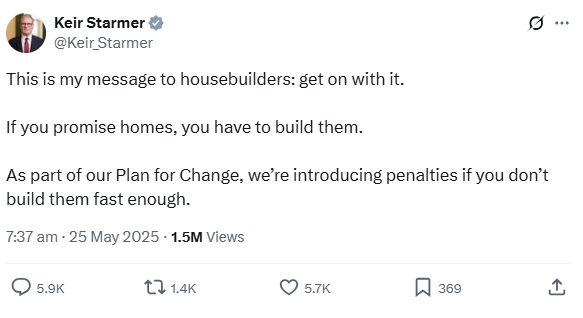
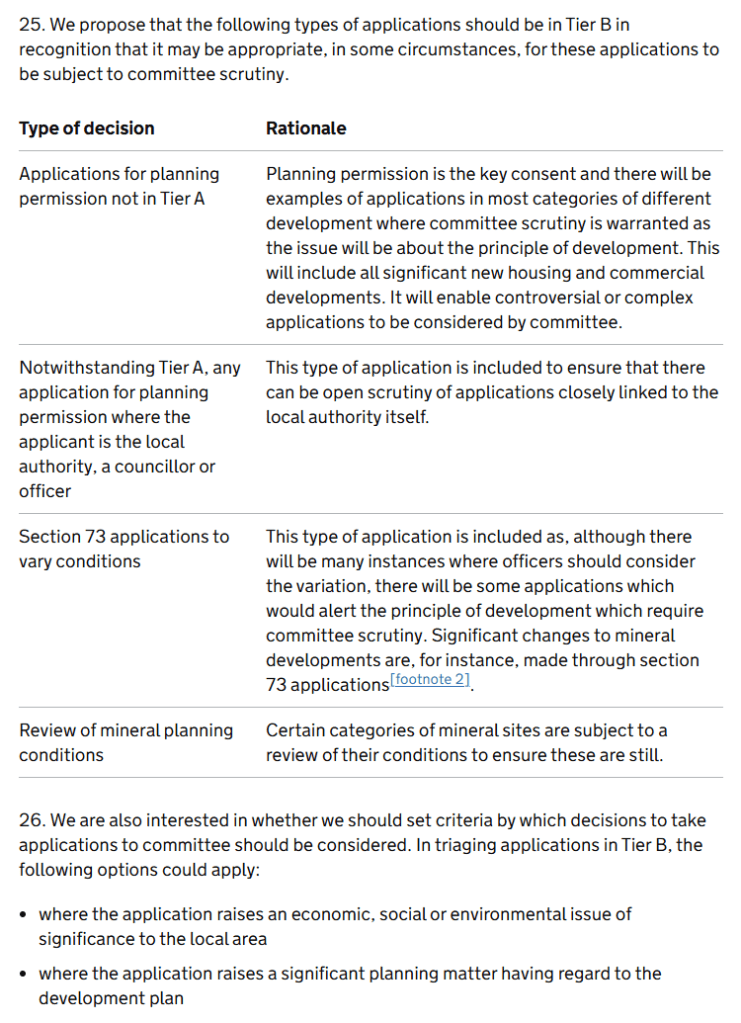


 SIMONICITY