Small Changes

I’ve mainly called this blog post “small changes” because that is the name of a beautiful, calming and rather lush album by Michael Kiwanuka released last year. Perhaps your social media timeline needs that sort of cleanse? Mine does regularly.

But I was also thinking of that old David Brailsford British Cycling philosophy about marginal gains (“The whole principle came from the idea that if you broke down everything you could think of that goes into riding a bike, and then improved it by 1%, you will get a significant increase when you put them all together”) and of the successive incremental changes that the government has been making to the planning system, most recently those measures flagged in the 28 May 2025 MHCLG press release as Government backs SME builders to get Britain building, measures which were the subject of three consultation documents published that day:

All of this follows last Sunday’s Speeding Up Build Out consultation (consultation closing 7 July 2025), which I summarised that day in my blog post Now Build.

It is an interesting, maybe theoretical, question as to whether system changes are better announced and delivered in one go (soaking up all the political heat at once) or in the current lapping waves. It is also interesting to see the political heat rising from different quarters in relation to different elements.

Concern has been expressed from environmental interest groups and a number of firms providing ecological services, as to Part 3 of the Planning and Infrastructure Bill (nature recovery – see my 11 May 2025 blog post Nature Recovery Position where I tentatively suggest a middle ground).

The Speeding Up Build Out announcement then led to an outcry from many in the development world – how dare the government threaten developers with being blacklisted, fined or having land compulsorily acquired if they delayed unreasonably in building out planning permissions etc etc? I explain in my 25 May 2025 Now Build piece why I don’t think that should be a real concern and why, if only for pragmatic political reasons, the government has to have basic protections along these lines in place. But that was based on me focusing on the working paper and consultation document, not on the government’s PR spin, which I think was unnecessarily overblown, particularly:

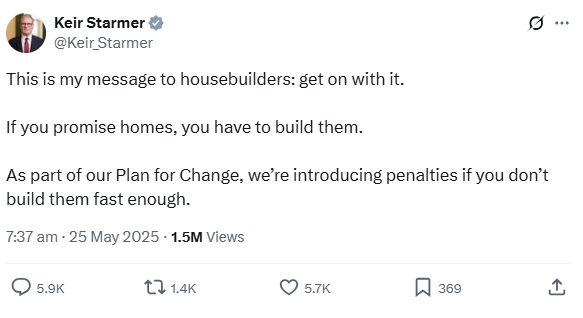
  • That tweet from the prime minister (NB what is the government doing still being on X in any event? Full marks to Matthew Pennycook and others for using Bluesky).

All that developer-demonisation (“Developers who repeatedly fail to build out or use planning permissions to trade land speculatively could face new ‘Delayed Homes Penalty’ or be locked out of future permissions by councils”), whereas I’m not sure anyone would disagree with what is actually said in the working paper itself:

The Competition and Markets Authority (CMA) and others have concluded that most homes in England are not built as fast as they can be constructed, once permission is granted, but only as fast as the developer expects to sell them at local second-hand market prices. This leads to a build out rate for large sites which can take decades to complete. While it is commercially rational for developers to operate in this way, the systemic impact is a lower level of housebuilding than we need. The government is therefore committed to taking firm action to ensure housebuilding rates increase to a level that makes housing more affordable for working people.  

In the public debate on housebuilding rates, 3 related concepts are often confused.

a. Land banks are, for the most part, a normal part of the development system. Developers hold a pipeline of sites at all stages of the planning process, to avoid stop/starts between schemes. In its 2024 study, the CMA found no evidence of current land banks systemically distorting competition between housebuilders. We do, however, have concerns that certain types of contracts over land prior to its entry into the planning system (which can be part of ‘strategic’ land banks) can be a barrier to entry for SME developers. We are therefore legislating to make Contractual Control Agreements (‘option agreements’) more transparent, to help diversify the industry and reduce barriers to entry for SME builders. 

b. Delayed or stuck sites are those at all stages of the planning and building process (including with full planning permission) that are delayed, not building out, or only building out very slowly due to a problem that the developer or landowner is struggling to resolve themselves. Often this is due to the discharge of a planning condition, an issue raised by a statutory consultee, a newly discovered site issue, or the developer running into financial difficulties. We have created the New Homes Accelerator to tackle this sort of blockage … and get stuck sites moving. In wider cases, sites may be stuck in negotiations over suitable S106 contributions, sometimes because the promoter has overpaid for the land not fully factoring in the policy requirements set out in planning policy. In this paper we consider further reforms to the Compulsory Purchase Order (CPO) process, relevant to stalled sites. 

c. Slow build out is where sites have full planning permission, are being built, but the pace of building is slower than it could be under different development models and incentives. Multiple market studies have found that most large housing sites are built at the pace the homes can be sold at current second-hand market prices, rather than the pace at which they could be constructed if pre-sold (i.e. to an institutional landlord). The rate of building consistent with selling at local second-hand market prices is known within the industry as the ‘absorption rate’. The Letwin Review concluded that local absorption rates were a “binding constraint” on build out rates. The CMA observed, that “the private market will not, on its own initiative, produce sufficient housing to meet overall housing need, even if it is highly competitive”.

So that was the furore earlier this week. And then when Wednesday’s announcements were made, environmentalists focused on the potential rolling back of the statutory BNG regime from smaller projects and opposition politicians turned on the (not new, but in my view improved) proposals to ensure that more applications are determined through use of planning officers’ delegated powers rather than Planning Committee.

You can’t please all the people all the time…

What is the thrust of the latest changes?

The starting point is to change the current categorisation of planning applications for residential development from those for “minor” development” and those for “major” development, so as to introduce a “medium” development category.

The categories would be:

  • Minor Residential Development – fewer than 10 homes /up to 0.5 ha (and within that a sub-category of 1b. Very small sites – under 0.1ha)
  • Medium Residential Development – between 10-49 homes/up to 1.0 ha
  • Major Residential Development – 50+ homes / 1+ hectare

In due course, consideration would be given to appropriate categories for non-residential development.

The following would apply to each category:

Minor

  • streamlining requirements on Biodiversity Net Gain (BNG) including the option of a full exemption
  • retaining the position that affordable housing contributions are not required on minor development
  • retaining the position that sites of fewer than 10 units are exempt from paying the proposed Building Safety Levy (BSL)
  • retaining the shorter statutory timeframe for determining minor development at 8 weeks “however we will take steps to improve and monitor performance so SMEs can expect a better service”
  • reducing validation requirements “through setting clearer expectations in national policy on what is reasonable, which could form part of the forthcoming consultation on national policies for development management”
  • requiring that all schemes of this size are delegated to officers and not put to planning committees as part of the National Scheme of Delegation.
  • reviewing requirements for schemes of this size for consultation with statutory consultees “instead making use of proportionate guidance on relevant areas. This forms part of our review of statutory consultees

On the “very small sites” sub-category:

The government will consult on a new rules-based approach to planning policy later this year through a set of national policies for development management. This will include setting out how the government intends to take forward relevant aspects of the proposals contained in the previous ‘Brownfield Passport’ working paper.”

The government is therefore proposing to further support the delivery of very small sites through:

  • providing template design codes that can be used locally for different site size threshold and typologies – which will take a rules-based approach to design to help identify opportunities and enable faster application processes
  • using digital tools to support site finding and checking compliance of design requirements on specific sites.

Medium

  • simplifying BNG requirements “reducing administrative and financial burdens for SME developers and making it easier for them to deliver BNG to help restore nature on medium sites by consulting on applying a revised simplified metric for medium sites. Further details are set out Defra’s consultation on potential BNG changes offering stakeholders the opportunity to give their views on this issue.”
  • exploring exempting these sites from the proposed Building Safety Levy “we intend to lay regulations for the Building Safety Levy in Parliament this year (as set out in our response to our technical consultation) and the Levy will come into effect in Autumn 2026. As part of this working paper, we are keen to explore whether, if introduced, medium sites should also be exempt from paying the Levy”
  • exempting from build out transparency proposals
  • maintaining a 13-week statutory time period for determination “in line with major development – but specifically tracking performance of these types of developments directly so SMEs can expect a better service”
  • including the delegation of some of these developments to officers as part of the National Scheme of Delegation
  • ensuring referrals to statutory consultees are proportionate “and rely on general guidance which is readily available on-line wherever possible. This forms part of our review of statutory consultees”.
  • uplifting the Permission in Principle threshold “allowing a landowner or developer to test for the principle of development for medium residential development on a particular site without the burden of preparing an application for planning permission. We recognise take up of Permission in Principle by application for minor residential development has been relatively limited since its introduction in 2017, and we would therefore like to gauge the appetite for this reform before exploring further”
  • minimising validation and statutory information requirements “through setting clearer expectations in national policy which could form part of the forthcoming consultation on national policies for development management”

There is also an important reference to streamlining section 106 agreement negotiations:

We … welcome views and evidence on:

1. the specific barriers facing SMEs in agreeing s.106 obligations – including availability of willing and suitable Registered Providers

2. what role national government should play in improving the process – including the merits of a standardised s.106 template for medium sites

3. how the rules relating to suitable off-site provision and/or appropriate financial payment on sites below the medium site threshold might be reformed to more effectively support affordable housing delivery, where there is sufficient evidence that onsite delivery will not take place within a suitable timeframe and noting the government’s views that commuted sums should be a last resort given they push affordable housing delivery timescales into the future.”

(I will be doing a separate blog post on that one).

Major

This working paper primarily considers targeted changes and easements to sites below 50 homes. Sites above 50 will benefit from overall government reforms to the planning system – including those set out in the revised National Planning Policy Framework published in December, the Planning and Infrastructure Bill, and future reforms to statutory consultees and through emerging national policies for development management.

Nevertheless – the government is interested in views in response to this working paper on:

  • applying a threshold for mixed tenure requirements on larger sites – as set out in the government’s working paper on speeding up build out, we are considering a range of options to set a threshold whereby mixed tenure development should apply – including at 500 units. We welcome further views on the right threshold – and on whether and how there should be some discretion for Local Planning Authorities – ahead of consulting on the policy as part of a consultation on national policies for development management and a revised National Planning Policy Framework later this year.”

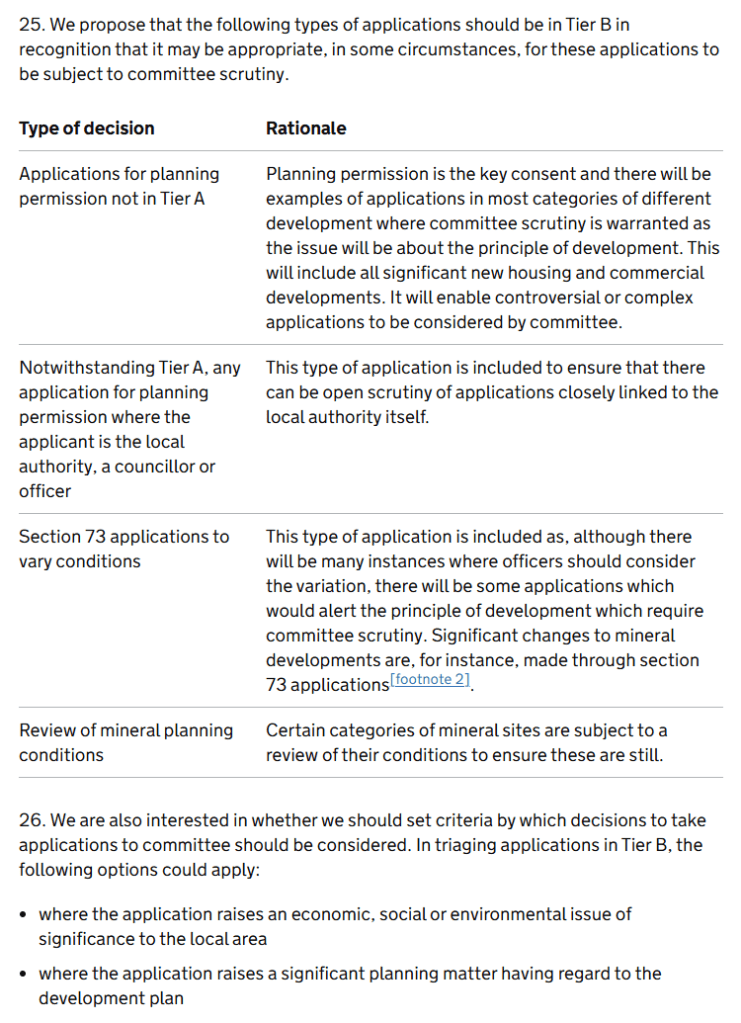
Turning to the paper on reforming planning committees, thankfully the thinking has moved away from taking into account whether or not a proposal is in compliance with the development plan (which would have led to endless arguments and disputes). Instead, the proposal is that a scheme of delegation would be introduced which would have two tiers:

Tier A which would include types of applications which must be delegated to officers in all cases; and

Tier B which would include types of applications which must be delegated to officers unless the Chief Planner and Chair of Committee agree it should go to Committee based on a gateway test.”

We propose the following types of applications would be in Tier A. This is in recognition that they are either about technical matters beyond the principle of the development or about minor developments which are best handled by professional planning officers:

  • applications for planning permission for:
    • Householder development
    • Minor commercial development
    • Minor residential development
  • applications for reserved matter approvals
  • applications for s96A non-material amendments to planning permissions
  • applications for the approval of conditions
  • applications for approval of the BNG Plan
  • applications for approval of prior approval (for permitted development rights)
  • applications for Lawful Development Certificates
  • applications for a Certificate of Appropriate Alternative Development

Note: “we are keen for views whether there are certain circumstances where medium residential developments could be included in Tier A. For instance, given the scale and nature of residential development in large conurbations such as London, we could specify medium residential development in these conurbations should be included in Tier A (as well as minor residential development), while in other areas, only minor residential development would fall within Tier A.”

Tier B:

There is also a proposal to limit the number of members of a planning committee to 11 and to introduce a national training certification scheme for planning committee members.

I will do a separate blog post on the BNG changes at some point but in the meantime Annex A to the DEFRA consultation paper is a good summary of the various proposals.

I think that’s enough for now…

Simon Ricketts, 31 May 2025

Personal views, et cetera

Small changes
Solve the problems
We were revolving in your eyes
Wait for me
All this time, we
Knew there was something in the air

(c) M Kiwanuka

Extract from album sleeve

Definitely Delegate Maybe

Modernising planning committees” is one of the promised objectives of the Planning and Infrastructure Bill, likely to be introduced into Parliament this Autumn.

The Government has not yet provided any colour as to what modernisation means in this context but the general assumption is that it is likely to include moving to a national scheme of delegation, setting out which categories of planning applications should not be determined by planning committee but should instead be taken by planning officers by way of delegated powers.

Appropriate use of delegation is a good thing. Indeed, that is already reflected in the Government’s Planning Practice Guidance, unchanged for the last ten years:

Who in a local planning authority makes a planning decision?

Section 101 of the Local Government Act 1972 allows the local planning authority to arrange for the discharge any of its functions by a committee, sub-committee, or an officer or by any other local authority. An exception where this power may not apply is where the local authority’s own application for development could give rise to a conflict of interest, when regulation 10 of the Town and Country Planning General Regulations 1992 applies.

The exercise of the power to delegate planning functions is generally a matter for individual local planning authorities, having regard to practical considerations including the need for efficient decision-taking and local transparency. It is in the public interest for the local planning authority to have effective delegation arrangements in place to ensure that decisions on planning applications that raise no significant planning issues are made quickly and that resources are appropriately concentrated on the applications of greatest significance to the local area.

Local planning authority delegation arrangements may include conditions or limitations as to the extent of the delegation, or the circumstances in which it may be exercised.

Paragraph: 015 Reference ID: 21b-015-20140306

Revision date: 06 03 2014

The Local Government Association has published this piece which sets out examples of categories of applications included in individual authorities’ schemes of delegation as requiring determination by committee – together with a brief analysis of the advantages and disadvantages of including each category. As we know, almost every authority has a slightly different set of rules – and sometimes it takes some website burrowing (a particular curse upon every authority which does not a clear index to its constitution) to ascertain what they are…

However, despite what it may seem like to practitioners focused on larger applications, nearly all planning applications are of course already delegated to officers. This is a list of the authorities which last year delegated the lowest proportion of decisions to officers:

The councils that delegated the highest proportion of decisions to officers in 2023 (Planning Resource, 16 May 2024 – paywall)

The top twenty are all 98.5% plus!

And yet still there is the sense that even more applications could be determined by officers. For instance, the RTPI published this press statement on the day of the King’s Speech (17 July 2024):

The Institute believes planning committees need modernisation and could include a national scheme of delegation, allowing planning officers to make some decisions themselves. Qualified planners should be able to implement agreed planning policy, freeing up councillors’ time to focus on the most challenging planning cases. This change would help to unblock many applications and speed up the planning process.”

Definitely, in a more perfect system, with clear policies in an up-to-date local plan, surely applications for planning permission which accorded with the local plan should be able to be approved by officers without reference to committee, and those not in accordance refused. Local democracy should be focused on the plan rather than its implementation.

The previous Government’s 2022 Planning For The Future white paper of course took this to the max, envisaging allocations which had the effect of granting the equivalent of outline planning permission and that thereafter “the delegation of detailed planning decisions to planning officers where the principle of development has been established, as detailed matters for consideration should be principally a matter for professional planning judgement”.

Maybe indeed, we should be heading in that direction (although it is all of course predicated on having that clear, up-to-date, plan!). Is legislation required to achieve greater delegation of decision making? I’m not sure. I shall be interested to see the “one size fits all” outcome. And as with any suggested legislative change, have we looked at whether behaviour can be changed without resorting to the law? By all means come up with a scheme of delegation template – but why not then include it immediately in Planning Practice Guidance and advise authorities that they adopt it? That could make a difference by as early as next year. Legislation won’t.

In the meantime, two of the many things which keep planning lawyers busy are (1) the behaviour at meetings of planning committee members and (2) the interpretation of local authority constitutions as to how committee meetings should be run. Two recent cases of interest:

R (Greenfields (IOW) Limited v Isle of Wight Council (HH Judge Karman KC, 23 August 2024)

Read about the agony of prolonged debate of a contentious application at a committee meeting, allegations of predetermination and bullying and a councillor changing their mind at the last moment…

R (Spitalfields Historic Building Trust) v London Borough of Tower Hamlets (Court of Appeal, 28 July 2024)

More agony, with successive planning committee meetings in relation to another contentious application and arguments as to which members could participate. The Court of Appeal (and before that the High Court) determined that was lawful for a local authority’s constitution to restrict voting by members on a deferred application for planning permission to those who had been present at the meeting(s) at which the application had previously been considered. However, the Supreme Court heard the subsequent appeal on 25 July 2024 and we await its final ruling.

Simon Ricketts, 31 August 2024

Personal views, et cetera

Plug Pulled On Local Authority Meetings

I pointed out in my 23 January 2021 blog post Temporary Covid Measures – Planning, Traffic, Local Government: There May Be Trouble Ahead that after 6 May 2021 local authorities may not be able to hold virtual meetings given the expiry on that date of the temporary freedom provided by Regulation 5 of the Local Authorities and Police and Crime Panels (Coronavirus) (Flexibility of Local Authority and Police and Crime Panel Meetings) (England and Wales) Regulations 2020 , pursuant to section 78 of the Coronavirus Act 2020.

Let’s be clear – the Government has had ample time to bring forward emergency primary legislation to extend that regime if it considered that the issue was sufficiently important. But it doesn’t.

Instead, even in the face of litigation from local government bodies which is heading to a High Court hearing next month, MHCLG minister Luke Hall wrote to local authority leaders on 25 March 2021 to confirm that the power will not be extended.

The suggestions in the letter appear to be somewhat of a sticking plaster, compared to the proven solution of allowing meetings to be remotely conducted; appear to be pushing at the bounds of what is advised to be prudent in the Government’s roadmap out of lockdown, and leave us all without any Plan B.

To be clear, what we are talking about is not whether meetings should be able to be watched online – the letter encourages that in any event “to minimise the need for the public to attend meetings physically until at least 21 June, at which point it is anticipated that all restrictions on indoor gatherings will have been lifted in line with the Roadmap”.

Rather, the issue is whether participants in the meeting, whether councillors or other parties, need to be in physical attendance in order for the meeting to be lawfully conducted.

Meetings between 7 May until 17 May (or later)

If we go by the roadmap, when 7 May comes life will still be relatively restricted even assuming that by then we will have moved to step 2 of the roadmap. Whilst public buildings will be open again, people will still not be able to gather in groups, and wherever possible people will still be advised to work from home. Further opening up via step 3 will not be until 17 May or later.

The letter advises that during this period “options would include use of your existing powers to delegate decision making to key individuals such as the Head of Paid Service, as these could be used these to minimise the number of meetings you need to hold if deemed necessary. Additionally, some of you will be able to rely on single member decision making without the need for cabinet meetings if your constitution allows.”

As for annual meetings, for authorities without elections on 6 May, the letter suggests that these be brought forward to be held before 6 May (so they can still be held remotely). Otherwise, given the need to hold the meeting within 21 days of the election, the meeting can (just about) be held after 17 May (assuming that date doesn’t slip).

What does this mean for planning committee meetings? Well, even for authorities without elections, meetings between 7 and 17 May would now appear unlikely. For authorities with elections the process of selecting committee meetings at the annual meeting is going to be elongated, with committees not formed until after 17 May.

Meetings from 17 May (or later) to 21 June (or later)

The letter states:

The Government’s roadmap proposes that organised indoor meetings (e.g. performances, conferences) are permitted from 17 May, subject to Covid secure guidelines and capacity rules.”

A few problems with this…

⁃ The roadmap actually says “no earlier than” 17 May. If we’ve learned anything from this pandemic it is that covid doesn’t respect deadlines!

⁃ What about individual councillors and other participants who may not by then have been vaccinated and therefore reluctant to attend in person (after all, the guidance as to working from home will apparently not be reviewed until some time during this step 3) or indeed may be shielding?

There is a real risk that authorities will be reluctant during this period to hold potentially controversial meetings which may attract significant numbers of members of the public. Indeed many authority buildings do not lend themselves well to such events on a socially distanced basis.

From the Local Government Association’s statement (25 March 2021):

Councils are already actively considering the options the minister has suggested, including looking at alternative larger meeting venues at significant extra cost. The proposal to delegate significant decisions to officers is likely to be viewed as undermining democratic accountability due to the fact that such decisions are not subject to direct member involvement. Given the circumstances authorities find themselves in due to the imminent loss of virtual meeting provision, they now face unpalatable decisions, which include restricting member attendance and a reduction in members roles in decision making, whilst attempting to keep the machinery of local government moving. LLG & ADSO remain fully committed to presenting our case at the High Court Hearing timetabled to be heard before the end of April 2021.”

See also the Lawyers in Local Government’s statement The letter to Council Leaders from Luke Hall MP received yesterday (25th March 2021) does not change the need for our court hearing, in fact if anything, it makes the need for it more pressing (26 March 2021).

More generally

More generally, why let go of the flexibility that the current legal regime gives to local authorities, not just for public health reasons (although this is important, it would be foolhardy to think that from 21 June there will be no further outbreaks or no longer any need for caution) but equally for reasons of efficiency and inclusion?

The Government recognises the potential case for virtual meetings but instead kicks the can down the road by “launching a call for evidence on the use of current arrangements and to gather views on the question of whether there should be permanent arrangements and if so, for which meetings. There are many issues to consider and opinions on the detailed questions vary considerably. This will establish a clearer evidence base of opinion and enable all the areas to be considered before further decisions are made. The Government will consider all responses carefully before deciding to how to proceed on this issue.”

Don’t hold your breath then.

Simon Ricketts, 26 March 2021

Personal views, et cetera

Keeping Calm & Carrying On: Planning Committee Meetings

[Subsequent note: much of this post is now superseded by regulation 5 of the Local Authorities and Police and Crime Panels (Coronavirus) (Flexibility of Local Authority and Police and Crime Panel Meetings) (England and Wales) Regulations 2020]

Things are moving fast. My blog post last week was titled What To Do? This week focuses on the solutions that we are seeing already coming forward in the face of local planning authorities’ practical inability at present to hold “normal” planning committee meetings.

It’s not straightforward because obviously any solution isn’t just about the law at all, but about the individual authority’s organisational priorities, operational resilience and access to technology.

I referred in last week’s blog post to the letter dated 17 March 2020 to MHCLG from ADSO (Association of Democratic Services Officers) & LLG (Lawyers in Local Government):

We have advised local authorities to hold only essential meetings and with the minimum number of people attending to satisfy a quorum. Where possible, Councils should be using urgency powers within their Constitutions to take decisions outside of public meetings. This will be possible in most instances but not in others. For example, Schedule 12 of the Local Government Act 1972 requires Councils to hold an Annual meeting during March, April or May depending on whether it is an election year or not. As you will be aware, important business is conducted at these meetings including the election of Mayor/Chairman of the Council and appointments to Committees etc to enable decision-making processes to function effectively.

Paragraph 39 of Schedule 12 to the Local Government Act 1972 states that any decision taken at a local authority meeting (including committees and sub committees) shall be decided by a majority of those present and voting. This means that it is impossible to have a meeting unless a quorum is present in the room. Whilst the law permits other members to join the meeting virtually, they cannot vote. This will become increasingly more difficult as further restrictions on peoples’ movements are imposed. For example, a high proportion of councillors are over 70 years of age and could be prevented from attending even essential meetings if currently publicised Government measures are imposed for that age group. We appreciate that this will require an amendment to the Local Government Act 1972, but we feel it essential to ensure continuity in local authority decision making and the provision of essential services. An alternative could be that local authority members could be counted as being present in a meeting if they are in a location where they can hear the conversation in the meeting room and persons present in the room can hear what they are saying.”

In order to enable “virtual” council meetings, an amendment was introduced to the Coronavirus Bill on 23 March 2020 before it was enacted as the Coronavirus Act 2020 on 25 March 2020. In consequence, section 78 of the Act includes a delegated power enabling the Secretary of State to make regulations relating to:

(a) requirements to hold local authority meetings;

(b) the times at or by which, periods within which, or frequency with which, local authority meetings are to be held;

(c) the places at which local authority meetings are to be held;

(d) the manner in which persons may attend, speak at, vote in, or otherwise participate in, local authority meetings;

(e) public admission and access to local authority meetings;

(f) the places at which, and manner in which, documents relating to local authority meetings are to be open to inspection by, or otherwise available to, members of the public.

In relation to (d) above, Section 78(2) of the Act enables provision to be made in the regulations for persons to attend, speak at, vote in, or otherwise participate in, local authority meetings without all of the persons, or without any of the persons, being together in the same place (i.e. remotely).

Section 78(3) of the Act provides that the special arrangements for Local Authority Meetings to be enacted in the regulations will only apply to meetings to be held before 7 May 2021.

Section 78(13) provides that the regulations to be made under this delegated power are to be subject to the ‘negative resolution procedure’. Under the negative procedure, the regulations become law on the day that the Secretary of State signs them and remain law unless a motion to reject it is agreed by either House of Parliament within 40 sitting days (highly unlikely in practice). Such regulations can also be laid when Parliament is not sitting (handy given that Parliament is currently prorogued until 21 April 2020).

So far so good but obviously (1) regulations are needed and (2) unless the regulations specifically provide (which I would not anticipate) they will not override each authority’s individual constitution which sets out the necessary procedures within that authority as to for instance the holding of meetings and the extent of officers’ delegated powers. Each constitution sets out the procedure to be followed for its amendment.

There are legal risks in any “short cuts” in decision making, where the procedure followed does not comply with legislative requirements, the authority’s own required processes as set out in its constitution or is in breach of wider administrative law requirements. There was an interesting discussion on this tension during today’s 50 Shades of Planning podcast episode Planning and Coronavirus (28 March 2020) featuring Anna Rose (Planning Advisory Service), Jonathan Easton (Kings Chambers) and Stefan Webb (FutureGov) – participants in the process may presently be “nice” in the face of the present Covid-19 crisis but what about in several months’ time when decisions are being crawled over, for instance by objectors?

Ahead of the implementation of the legislation, and after an initial wave of cancelled committee meetings, we are seeing authorities arrive at practical solutions. For instance:

Trio take over Manchester planning decisions (North West Place, 27 March 2020)

The power to decide on major Manchester planning applications has now been delegated to council chief executive Joanne Roney, alongside chair of the planning committee Cllr Basil Curley and deputy chair Cllr Nasrin Ali.

The trio will decide whether to consent or refuse proposals for schemes based on recommendations from the director of planning, Julie Roscoe.

The delegation of power was confirmed at the council’s full meeting on Wednesday. 

A report to the meeting called for authority to be given to the chief executive to enable her to determine any planning application, listed building consent or tree preservation order which would otherwise have been decided by a planning committee.”

Team of just three Brighton councillors will make planning decisions (The Argus, 26 March 2020)

Brighton and Hove City Council’s three party leaders agreed one councillor from each of the Labour, Green and Conservative groups will make urgent decisions rather than leave them to officers.

Three councillors sitting as the Planning Committee on Monday, 23 March, agreed to create the urgency sub-committee to decide on any major developments that need a decision during the Coronavirus (Covid19) pandemic emergency.

For those concerned as to the implications of decisions being left within a small caucus of members, Luton Borough Council has an approach (recounted by David Gurtler on twitter) whereby four members are physically present, with officers presenting virtually and with other members able to log in and participate in the debate (although not vote).

These options seem pretty practical to me. Concerns have been expressed as to whether options such as these constrain the ability for the public to participate. In my view, this concern is overdone. Participation amounts to (1) having the papers in advance (2) being present in order to hear what is said and (3) (subject to what is provided for in the individual authority’s constitution) being allowed to speak. The papers will still be available in advance. If meetings are available on webcast, as many have been for some time, the second concern is addressed. The right to speak is already tightly constrained, invariably with requirements as to advance notification and strict time limits for a presentation and the relevant individual (whether applicant, supporter or objector) could easily join remotely by telephone or web link to say his or her piece in exactly the same way as if present. As for the presentation of schemes to committee and the ability for members to understand the implications of a proposal without the need for a site visit, the possibilities of technological solutions such as Vucity are almost boundless.

Of course, there is no reason why less controversial applications should not be determined by delegated powers as indeed most already are – see my 14 January 2017 blog post The Rest Of The Iceberg: Delegated Decisions.

Various authorities are looking to focus on the use of delegated powers, with additional oversight/ sign-off at chief executive and/or committee chair level. See this statement by Wychavon District Council, for instance:

Planning Committee meetings have been cancelled for the foreseeable future. To make sure planning decisions can continue to be made at the current time, we will be using emergency decision making powers, as delegated within our constitution to the Managing Director, Deputy Managing Director, Planning Committee Chair or Vice-Chair. 


These individuals will work with planning officers  to make what would have been Planning Committee decisions. We are working to minimise the overall level of applications that are required to be considered by the Planning Committee in accordance with the Council’s constitution regarding delegated powers.


Officers will not be carrying out site visits at this time. Instead we will be requesting  applicants provide photographic and/or video evidence as may be necessary. If insufficient evidence is made available to allow officers to adequately assess the applications, we will seek to agree extensions of time with applicants, to deal with their planning applications.  Officers will not themselves  be placing site notices at this time, but will ask applicants to display these and provide evidence to confirm this.”

All of this chimes with the advice in Steve Quartermain’s final chief planners letter (24 March 2020):

It is important that authorities continue to provide the best service possible in these stretching times and prioritise decision-making to ensure the planning system continues to function, especially where this will support the local economy.

We ask you to take an innovative approach, using all options available to you to continue your service. We recognise that face-to-face events and meetings may have to be cancelled but we encourage you to explore every opportunity to use technology to ensure that discussions and consultations can go ahead. We also encourage you to consider delegating committee decisions where appropriate. The Government has confirmed that it will introduce legislation to allow council committee meetings to be held virtually for a temporary period, which we expect will allow planning committees to continue.

We encourage you to be pragmatic and continue, as much as possible, to work proactively with applicants and others, where necessary agreeing extended periods for making decisions.”

One side effect of this period has been to jolt many of us finally into more modern and efficient ways of working and communicating. As a result of new processes having to be used, it could well be that the planning committee process, and indeed local democratic process more generally, will also operate rather differently in the longer term and for the better – perhaps a wider cross-section of the community might even be prepared to play a role as elected councillors if fewer hours needed to be spent physically in the council chamber and committee rooms?

Simon Ricketts, 28 March 2020

Personal views, et cetera

With thanks to Michael Gallimore (who will spot that I cut and pasted passages from a client note that he prepared earlier in the week), Rebecca Craig and Safiyah Islam.
The Rest Of The Iceberg: Delegated Decisions

What percentage of planning decisions would you say were made by officers, acting under delegated powers, rather than by members?
Back in 2002 the then Labour Government introduced a target that 90% of planning decisions should be delegated to officers but in recent times ministers appear to have gone quiet on the issue, despite greater use of delegated powers plainly leading to faster determination of applications. And if (big if) an LPA has an up to date local plan and/or neighbourhood plan, one of the benefits should be that decision-making on planning applications should be more straight-forward. 

The Planning Practice Guidance simply says: “The exercise of the power to delegate planning functions is generally a matter for individual local planning authorities, having regard to practical considerations including the need for efficient decision-taking and local transparency. It is in the public interest for the local planning authority to have effective delegation arrangements in place to ensure that decisions on planning applications that raise no significant planning issues are made quickly and that resources are appropriately concentrated on the applications of greatest significance to the local area.”  
So I was ready to write a blog post suggesting that perhaps there should be greater encouragement for delegation arrangements, whereby applications only need to go to committee unless there is genuine uncertainty as to the application of policy. After all there is a certain logic to a model where politicians arrive at the detailed plan for their area and then officers make depoliticised decisions in accordance with that plan.
However, the statistics are interesting. When one looks at the latest DCLG figures for England, for July to September 2016  published on 15 December 2016, 94% of decisions were taken by officers over the quarter. (There were 115,800 decisions in the quarter of which 108,500 were delegated). This is the same percentage as for the same quarter in 2015 and 2014, prior to which the proportion was significantly lower. 
94%! So the more major applications that many of us focus on are the tip of a very large iceberg. Do people think that there is scope for this proportion to go even higher?
The criteria for selection of applications that are to be determined by officers are of course set out in the LPA’s scheme of delegation, within its constitution. There can be significant differences as between the approaches of authorities. So long as the decision as whether an application is to go to committee or is to be determined by an officer is made within a valid scheme of delegation there is little scope for legal challenge – see for example R (Technoprint) v Leeds City Council (Wyn Williams J, 24 March 2010). 
However, nowadays the delegated decision-making process itself is more transparent. Regulation 7 of the Openness of Local Government Bodies Regulations 2014 (made under section 40(3) of the equally catchily titled Local Audit and Accountability Act 2014) provides as follows:
“(1) The decision-making officer must produce a written record of any decision which falls within paragraph (2). 


(2) A decision falls within this paragraph if it would otherwise have been taken by the relevant local government body, or a committee, sub-committee of that body or a joint committee in which that body participates, but it has been delegated to an officer of that body either—


(a) under a specific express authorisation; or


(b) under a general authorisation to officers to take such decisions and, the effect of the decision is to—

(i) grant a permission or licence; 


(ii) affect the rights of an individual; or


 (iii) award a contract or incur expenditure which, in either case, materially affects that relevant local government body’s financial position.


(3) The written record must be produced as soon as reasonably practicable after the decision-making officer has made the decision and must contain the following information—


(a) the date the decision was taken;


(b) a record of the decision taken along with reasons for the decision;


(c) details of alternative options, if any, considered and rejected; and


(d) where the decision falls under paragraph (2)(a), the names of any member of the relevant local government body who has declared a conflict of interest in relation to the decision.”
The High Court in R (Shasha) v Westminster City Council  (Deputy High Court Judge John Howell QC, 19 December 2016) recently held that this means that there is a duty to provide reasons where a decision is taken under delegated powers. He quashed a planning permission granted by Westminster City Council for development of a site at Portman Mansions, Chiltern Street on the basis that the officer’s report did not adequately deal with a number of material considerations. 
Of course this may be seen as strange given that, since 25 June 2013, LPAs are generally no longer required to give reasons for granting planning permission. The deputy judge dealt with that argument as follows:
“The suggestion that imposing a requirement to give reasons for the decision to grant planning permission under delegated powers with effect from August 6th 2014 under the 2014 Regulations sits ill with the earlier removal of the requirement in all cases to give summary reasons for the grant of planning permission on June 25th 2013 provides no reason to construe regulation 7 of the 2014 Regulations other than in accordance with its terms. The Explanatory Memorandum to Order which removed the requirement, the Town and Country Planning (Development Management Procedure) (England) (Amendment) Order 2013, explained the change on the basis that officer reports typically provided more detail on the logic and reasoning behind a particular decision to grant planning permission than the decision notice and that the requirement to provide summary reasons for that decision added little to the transparency and quality of the decision making process but that it did add to the burdens on local planning authorities. It is at least consistent with such reasons for that change that reasons should nonetheless be required to be provided for delegated decisions. Whereas officer reports are almost invariably produced when decisions are taken by members of planning authorities, an equivalent document or one with the content that regulation 7(3) requires need not be produced when an officer takes a decision to grant planning permission. But, whether or not that provides an explanation for regulation 7 of the 2014 Regulations and whether or not the requirement it imposes may be thought anomolous given the removal of the requirement to give summary reasons in all cases, in my judgment there is no basis for reading the words “other than a planning permission” into regulation 7(2)(b)(i), where they do not appear, or to exclude decisions to grant planning permission from those falling within section 7(2)(a) or 7(2)(b)(ii) if they would also otherwise fall within those provisions.
Is it just me or is there an element of “I know it’s crazy, but…” about that explanation?
Whilst it must be right that we should know the reasoning for a decision to grant planning permission, is Shasha going to lead to a more cautious approach on the part of LPAs, with the length of officers’ delegated powers reports extending to the length of reports to committee, so as to guard against similar challenges, in turn leading to longer lead-in periods and greater calls on officer time (like the rest of the iceberg, surely they are going to be underwater)? And what about that reference in regulation 7(3)(c) to “details of alternative options, if any, considered and rejected“?  Now that would be an interesting case….


Simon Ricketts 13.1.17
Personal views, et cetera