The Proposed London Housing Emergency Measures Package Is Underwhelming

That is the message I have been receiving in many discussions with developers and advisors since consultation started on MHCLG’s Proposed London Emergency Housing Package and The Mayor of London’s draft Support for Housebuilding London Plan Guidance, both documents published on 27 November 2025 for consultation until 22 January 2026.

I’m picking up that the conclusion is reluctant. Clearly, it is helpful that the drought of new housing activity in London has been recognised. Clearly, it is appreciated that MHCLG and the London Mayor have worked hard at a co-ordinated package as between them which moves significantly, and no doubt with much internal organisational pain, from the previous policy position in terms of affordable housing expectations, in terms of the usual approach to CIL and in terms of some aspects of housing standards. There is also a dilemma on the part of the industry: this is an emergency; measures are needed now; if this set of proposals has to be ditched and replaced with a more effective package, we are just losing more time, unless the industry can point with some unanimity towards practical, easily implemented, improvements to what is on offer.

But the reality is that the current package (1) will not be enough and (2) is too caveated and conditional to provide the crucial reassurance that is needed to those who hold the strings in terms of funding or financing. From what I hear I’m not at all sure that the Mayor’s new time-limited route is even likely to be used, as opposed to continued reliance on viability testing.

Following the initial joint announcement on 23 October 2025 I wrote a blog post on 1 November 2025 setting out 4 Key Asks For The London Housebuilding Support Package Consultation. None were taken on board in the consultation drafts. Let’s hope that there still is time before the package is finalised.

To follow the structure of my previous post:

Should there be more focus on stalled sites that already have planning permission?

Of course!

Why ignore the lowest hanging fruit? The opportunity has now passed for primary legislation to reintroduce section 106BA (which could have been a late bolt-on to the Planning and Infrastructure Bill). But why not by ministerial direction reduce the minimum period of five years for the purpose of being able to make applications under section 106A, which are capable of appeal, to say two years – and introduce guidance as to MHCLG’s interpretation of “useful purpose” (of course the courts’ legal interpretation ultimately will be what counts but guidance will still be useful!)?  And in any event introduce firm guidance to local planning authorities that they should approach requests for deeds of variation on viability grounds positively where the case has been made (and set out in the guidance what will be sufficient to make that case)?

Is late stage (as opposed to early stage) review necessary in relation to the proposed “time-limited planning route”?

No!

The uncertainties caused to funders by the mere existence of any review mechanism the application of which is outside their control has a deadening effect on developers’ ability to fund schemes, utterly disproportionate to the likelihood that any review mechanism will ever deliver any material amount of additional affordable housing, schemes are so underwater. And unnecessary uncertainty has been created because the time-limited route envisages a different set of mechanisms to those which currently exist.

The simple change would be for the Mayor’s LPG to specify that for a time-limited period the fast-track thresholds will be reduced from 35% and 50% to 20% and 35% with the structure remaining exactly the same as to when review mechanisms will be required and how they will operate. A bucketload of uncertainty would be immediately removed.

Are there unnecessary difficulties with introducing a viability test into the proposed CIL relief?

Yes!

In fact, this whole new intended structure for 50 to 80% relief from borough CIL is going to be disproportionately complex given that it will rarely make the difference between a project going ahead or not (and with the prospect of later clawback, funders will always assume the worst in any event so it just won’t help bring them over the line). What I’m being told is that where CIL is a killer is on cash flow. On viability – the overall go/stop on development – it is of only marginal influence.

If there is going to be any tweaking of the Regulations:

  • Why not allow for payment at a later stage (you recall that when the infrastructure levy was touted by the previous government as  replacement for CIL it was to be payable at upon completion of the development so would there be such a problem with it being paid, say, on occupation)? Boroughs don’t spend the monies upon receipt – timing isn’t critical to them! And Mayoral CIL is simply paying down long-term debt in relation to Crossrail.
  • Require all boroughs to switch on the potential for exceptional circumstances relief and see what can be done to simplify the process.

Ahead of any Regulations, just lean on the boroughs to switch on exceptional circumstances relief (if they refuse that is a warning sign in itself) and introduce advice as to the evidence that should normally be sufficient. Even that would help.

And incidentally this would actually also would help SMEs, currently shut out of the relief proposed in the consultation document by a combination of the £500,000 liability threshold and the proposed £25,000 application fee. And while we’re at it, extend this beyond residential C3 development.

Are the proposed additional powers to be given to the Mayor enough?

Probably, but…

It really would be useful if the Mayor could call in schemes of 50 units or more even before the borough is minded to refuse them, as long as the statutory determination period has passed – thereby reflecting the current arrangements in the Mayor of London Order 2008 for schemes of 150 units or more.

Final thoughts

Of course the proposed additional grant funding for affordable housing is welcome. But inevitably it isn’t enough.

Surely, we all agree that the thrust of all these measures is not good to the extent that, consistent with the operation of the existing system, it assumes that affordable housing, including social housing (for which there is such a desperate need in the capital) is what has to give in order to enable development to proceed. How can we move to a system where the delivery of social housing is not reliant on, effectively, an affordable housing tax imposed on residential development, given that the current model is not working?

To end on a positive note, I was really cheered to hear about Homes For People We Need campaign and to read their report Making Social Rent Homes Viable. Whilst it identifies that £18.83 billion is required to develop 90,000 social rent homes per year, there is a strong investment case for substantial government subsidy, given that temporary accommodation costs of £2.8 billion annually could in theory service index-linked bonds worth circa £160 billion. “In theory an investment by HM Treasury to build c.130,000 Social Rent homes for those families currently in temporary accommodation, assuming £209,000 subsidy per home and thus a total subsidy of £27.2bn, could reduce the current bill for Temporary Accommodation to zero”.

There are a number of strategic recommendations and suggested policy reforms in the report:

“• Social Housing Tax Credits represent a promising approach, enabling private capital deployment now in exchange for future tax relief.

• Section 106 Agreements should fix affordable housing values at the planning stage to improve market efficiency.

• Right to Buy should be further reformed to preserve the affordable housing stock.

• ‘Flex Rent’ approaches linking rents to household income should be considered to optimise revenue generation whilst maintaining affordability.

• The Housing Association sector desperately needs recapitalisation in addition to the recent 10-year rent settlement.”

Santa hat-tip to Thursday’s Planning After Dark Podcast episode Santa Hats, Social Rent and Squeaky Leather Trousers for the chat with Grainger’s Michael Keaveney which introduced me to this.

In summary I hope that what is arrived at is fast, simple, measures to help meet the current housing and affordable housing emergency. But then I hope that there is a proper longer-term solution along the lines promoted by this report to help meet the underlying and remaining (national not just London) housing and affordable housing crisis. The current section 106 model is not working!

Simon Ricketts, 13 December 2025

Personal views, et cetera

Local Plans, LGR, Devolution: Goal Posts Moving On A Sloping Pitch For A Game Of Indeterminate Length With Shifting Rules & Teams

Am I wrong?

Let’s ease ourselves in gently…

Pragmatism, co-operation

I covered Matthew Pennycook’s 30 July 2024 letter to the Planning Inspectorate’s chief executive Paul Morrison in my 11 August 2024 blog post Plan-Making, Or, The Olympic Sport Of Trying To Hit A Slowly Moving Target, which announced a reversal of the previous Government’s “expectation that Inspectors should operate “pragmatically” during local plan examinations to allow deficient plans to be ‘fixed’ at examination. This has gone too far and has perversely led to years of delays to local plan examinations without a guarantee that the plans will ever be found sound, or that the local authorities will take the decisions necessary to get them over the line. This has to end.

[…]

Pragmatism should be used only where it is likely a plan is capable of being found sound with limited additional work to address soundness issues. Any pauses to undertake additional work should usually take no more than six months overall. Pragmatism should not be used to address fundamental issues with the soundness of a plan, which would be likely to require pausing or delaying the examination process for more than six months overall. Local authorities should provide regular progress updates of their work to the Planning Inspector during any agreed pause.”

Muscular stuff in that heady first month. Principles above pragmatism and the delays thereby arising, addressing the problem of submitted plans being allowed to limp on for years through long examinations, through authorities being given time by inspectors to try to fix soundness issues arising.  

But then, more recently, in his 9 October 2025 letter to Paul Morrison, pragmatism isn’t dead after all:

In advance of the new plan-making system and mechanisms for cross-boundary cooperation coming into force, the final set of local plans being delivered within the current system remain essential to facilitating the effective delivery of housing, jobs and infrastructure. It is therefore critical that Inspectors approach examinations of current system plans with the appropriate degree of flexibility. The evidencing of expectations to establish whether the legal and soundness tests have been met – including with respect to the Duty to Cooperate – should be proportionate to the context in which plans in the existing system are being prepared. I very much welcome that in some cases Inspectors are already exercising a degree of flexibility to expedite adoption of local plans. For example, I note recent pragmatic decisions to proceed toward adoption in instances where a five-year housing land supply cannot be evidenced at the point of adoption but where the plan significantly boosts supply and still meets housing needs over the plan period or by providing additional opportunities to clarify compliance with the Duty to Cooperate. Relevant Planning Practice Guidance provides advice in respect of both of these matters, and will no doubt be of ongoing assistance in assessing whether proportionate evidence has been provided or considering whether stepped housing requirements may be justified.

It remains important that we do not see the adoption of poor-quality plans, or accept overly long examinations (I am grateful for the action that Inspectors have taken following my letter of 30 July 2024 in that regard). However, within those bounds, where plans are capable of being made adoptable, I want Inspectors to seek to do so in the examination process.”

It was unsurprising to see the pendulum swing back, because we aren’t ever really talking about, or dealing with, the planning system in isolation, are we? The three Ps in our world are planning, pragmatism and politics. Pragmatically, what is a plan-led system without … plans?

And p for pragmatism has been given extra oomph with the 27 November 2025 announcement that the forthcoming regulations that will specify how the new plan-making system is to work will (once made) immediately abolish the statutory duty to co-operate (i.e. affecting plan making under the current system as well). See the minister’s letter of that date to Paul Morrison :

We intend to shortly lay regulations which will enable Local Planning Authorities (LPAs) to initiate formal preparation procedures for new-style plans. These Regulations will also have the effect of abolishing the Duty to Co-operate for the existing plan-making system.

As you know, the Duty to Co-operate (“the Duty”) was inserted into the Planning and Compulsory Purchase Act 2004, through the Localism Act 2011, to help bridge the gap in co-operation resulting from the abolition of regional planning. The Duty requires LPAs to “engage constructively, actively and on an ongoing basis” with neighbouring authorities whilst preparing their local plan. However, as noted in your letter of 30 October, the Duty as a legal provision has, at times, been difficult to comply with and has led to some notable local plan failures. This is in part because any shortcomings relating to the Duty cannot lawfully be remedied during examination.

The new plan-making system provided by the Levelling Up and Regeneration Act 2023 does not include the Duty. Instead, the new system will rely on revised national policy and the new tier of strategic planning to ensure effective co-operation between plan-making authorities. The Regulations for the new system will also ‘save’ the current plan-making system for a period to allow emerging plans to progress to examination by 31 December 2026. Given the above, and to help drive local plans to adoption as quickly as possible and progress towards our objective of universal local plan coverage, we have decided not to ‘save’ the Duty, thereby removing this requirement for plans in the current system.

The Duty will therefore cease to apply when the Regulations come into force early next year, including for plans at examination at that point. On the basis of the government’s firm intention to abolish the Duty for the current system, examining Inspectors may wish to begin any necessary dialogue with LPAs in advance of the Regulations coming into effect, with reference to this letter. Of course, LPAs should continue to collaborate across their boundaries, including on unmet development needs from neighbouring areas and Inspectors should continue to examine plans in line with the policies in the NPPF on ‘maintaining effective co-operation’.”

This is perilously close to retrospective legislation it seems to me but, pragmatically, politically, a potential lifeline has been thrown to, for instance, the Mid-Sussex local plan and the South Oxfordshire and Vale of White Horse joint local plan. For some background on the Mid-Sussex local plan duty to cooperate issue, see my 7 June 2025 blog post Not Sure Why The Media Was So Focused On Musk v Trump This Week Given What Has Been Happening In Sussex since when the inspector, in a letter dated 3 November 2025,  had – can we say grudgingly? – agreed to hold a further hearing session in January 2026. The South Oxfordshire and Vale of White Horse joint local plan inspectors had written to the two authorities on 26 September 2025 indicating that they considered that the duty to cooperate had not been met. Since the minister’s 27 November 2025 announcement they have now written again to the authorities in a letter dated 1 December 2025 seeking their views on the implications of the announcement for the examination and “in particular how the Councils wish to proceed”.

Plan-making deadlines

Two reasons why the notion of a “plan-led” system is increasingly theoretical are surely:

  • Obviously, the continuing lack of up-to-date local plan coverage across England.
  • The increasingly impenetrable nature of the local plans system, already with plans proceeding under the previous and current NPPFs and now to overlap with the proposed new system, supposedly to be faster but that was initially designed with the concept of (a) statutory national development management policies (we will see if the non-statutory fudge makes a practical difference in that respect) so as to narrow down their role basically to the allocation of land for development and the designation of land for specific forms of protection and (b) a now abandoned watered-down “soundness” test.

Is a simpler, speedier system on the horizon? Hmm.

In his Q&A session with Sam Stafford at the LPDF conference on 27 November 2025, Matthew Pennycook revealed that timescales for authorities to prepare new style local plans would in some instances be brought forward, rather than the previously proposed phased introduction. That day we then had a press statement (New local plan system launching early 2026: latest update), a written ministerial statement (Reforming Local Plan-Making) and a detailed Plan-making regulations explainer.

From the written ministerial statement:

Having considered carefully responses to the earlier consultation, I am announcing today that we no longer intend to roll the system out in a series of plan-making ‘waves’. Instead, local planning authorities will be encouraged to bring plans forward as soon as possible following the commencement of the regulations early in the New Year.

Whilst authorities will have discretion over how soon they start their plan, regulations will set out final ‘backstop’ dates for when plan-making must legally have commenced. Local planning authorities covered by the NPPF transitional arrangements will have to commence formal plan making (Gateway 1) by 31 October 2026, while those that have a plan that is already over five years old must commence by 30 April 2027. Further information will be set out in the regulations and in guidance.”

From the explainer:

In general, the regulations will require that local planning authorities publish their Notice to Commence Plan-Making within 4 years and 8 months of adopting their existing local plan, or by 31 December 2026, whichever is the latest. They must then begin preparation of a new local plan (publish their gateway 1 self-assessment form) within 5 years of adopting their existing local plan, or by 30 April 2027, whichever is the later.

However local planning authorities who submitted a plan for examination on or before 12 March 2025 with an emerging housing requirement that was meeting less than 80% of local housing need will be required by regulations to publish their Notice to Commence Plan-Making by 30 June 2026 and their Gateway 1 self-assessment by 31 October 2026. This will not apply to areas where there is an operative Spatial Development Strategy which provides the housing requirement for the relevant areas. 

If an existing system plan is withdrawn from examination prior to adoption, regulations will require local planning authorities to publish their Notice to Commence Plan-Making in the new system at the same time as the plan is withdrawn, and to publish their Gateway 1 self-assessment 4 months later.

Further details on the initial rollout of the new plan-making system will be set out on Create or Update a Local Plan.

Supplementary Planning Documents (SPDs) will remain in force until planning authorities adopt a new style local plan or minerals and waste plan. The final adoption date for new SPDs will be 30 June 2026, to ensure any advanced emerging SPD can be adopted. 

These Regulations will also have the effect of abolishing the Duty to Co-operate for the existing plan-making system, by not saving this provision for plans progressing to examination in the existing system by 31 December 2026.”

Whilst in theory encouraging an earlier start to plan making sounds positive, in many areas these emerging plans could well get stalled by a combination of local government reorganisation and the incoming spatial development strategies.

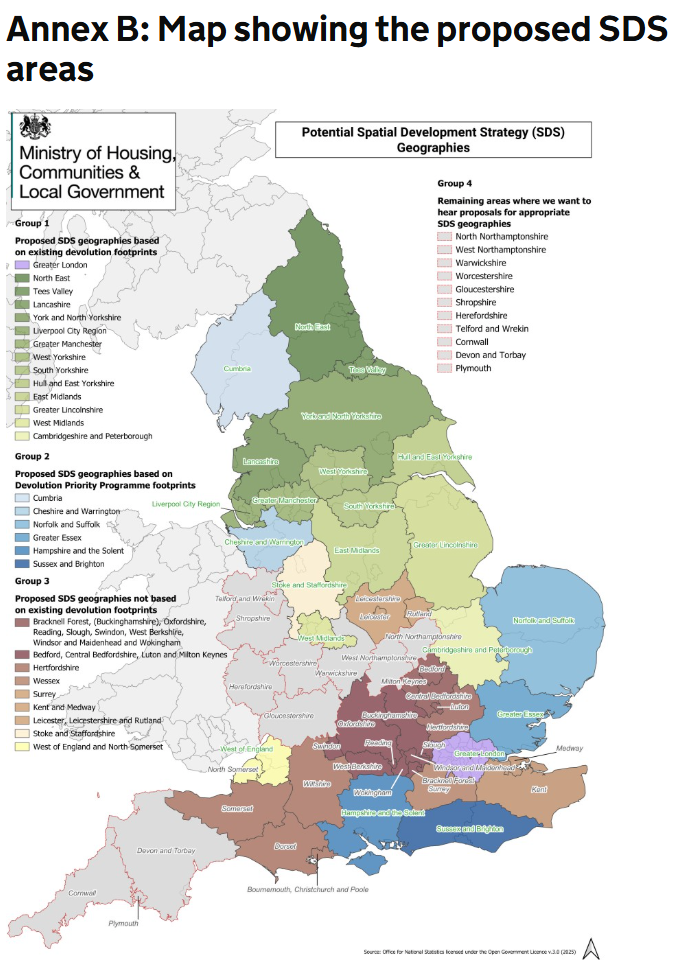
The local government reorganisation map is still unclear, with authorities in two tier areas outside the devolution priority programme having now submitted their proposals by the 28 November 2025 deadline, apparently proposing more than 50 different potential configurations for ministers to consider (Exclusive: Over 50 LGR proposals sent to MHCLG – Local Government Chronicle, 3 December 2025). Elections for the new authorities are due in May 2027 ahead of going live in April 2028. How many current authorities will push through their plans to a conclusion ahead of, and in the face of, what lies ahead?

The map is also unclear as to what will be the new England-wide strategic tier. The government’s commitment was that the new spatial development strategies, with which in the future local plans should confirm, would be in place by 2029, but this looks increasingly unlikely. Yes it is all complex, but one wonders what role politics will increasingly play. Last week there was the unexpected announcement that Mayoral elections in four areas within the devolution priority programme, Greater Essex, Sussex and Brighton, Hampshire and the Solent, and Norfolk and Suffolk have been delayed from May 2026 to May 2028. There is apparently nothing to prevent the new strategic authorities, once created, from making progress with preparing SDSs ahead of their Mayors being elected but how does this work democratically?

Oh and in a couple of weeks we will see the new consultation draft NPPF, incorporating, we assume, more targeted sets of policies for plan making and for decision taking. And the latest set of housing delivery test outcomes. And throughout, p for politics…

Essay question for the festive period: Is our planning system in practice currently plan-led or application–led? And is this likely to change?

Lastly, thank you Paul Morrison for your work as chief executive of the Planning Inspectorate over the last three years. PINS is the main glue holding the current system together and its performance remains impressive. Congratulations to new interim chief executive Graham Stallwood. No pressure Graham!

Simon Ricketts, 6 December 2025

Personal views, et cetera

Sam Stafford and minister Matthew Pennycook MP at LPDF conference 27 November 2025

Announcements

Announcements from MHCLG are coming thick and fast ahead of this week’s budget and we had an announcement of our own at Town this week.

So, briefly, on 18 November 2025 there was:

Housebuilding around train stations will be given default “yes”

“Planning reforms to give greater certainty and strength for development around well-connected rail stations, including trains and trams, will be proposed through a new pro-growth and rules-based National Planning Policy Framework, which will be consulted on later this year.”

“The default “yes” will also apply equally across all local authorities, so that these benefits are seized across the country. The proposals will also include minimum housing density standards for these sites, expected to be exceeded in many cases, to make the most of sustainable growth opportunities for local housing, jobs, and businesses.”

This is all rolling the pitch for what will be in the consultation draft NDMPs next month (NB a convenient acronym – now that the NDMPs are to be non-statutory, I suspect that national development management policies may conveniently switch to national decision-making policies, perhaps less of a tongue twister or is that just me?).

What is “well-connected” and how will national minimum density standards be arrived at? We shall have to be patient and wait for the (large) pre-Christmas consultation package.

The announcement also included a separate proposal:

Measures will also require councils to inform government when they’re inclined to block applications of 150 homes or more so ministers can decide whether to step in and make the decision instead, making sure that good housing projects don’t get lost. 

Particular attention will be paid to those applications where a planning committee intends to refuse it contrary to the advice of planning officers.

Applications called in by ministers will also be sped up through the removal of the mandatory requirement for inquiries, with the option to consider matters through written representations before reaching a decision where appropriate.”

This is big and will require legislation. But it could have a significant effect. In my view the biggest effect would be to create a cooling-off period where a planning committee has resolved to refuse a scheme for 150 homes or more against officers’ recommendations. Not only would the risk of call-in arise before the refusal could be issued but that delay would also lead to the opportunity in practice for the application to return to committee, potentially with a different outcome.

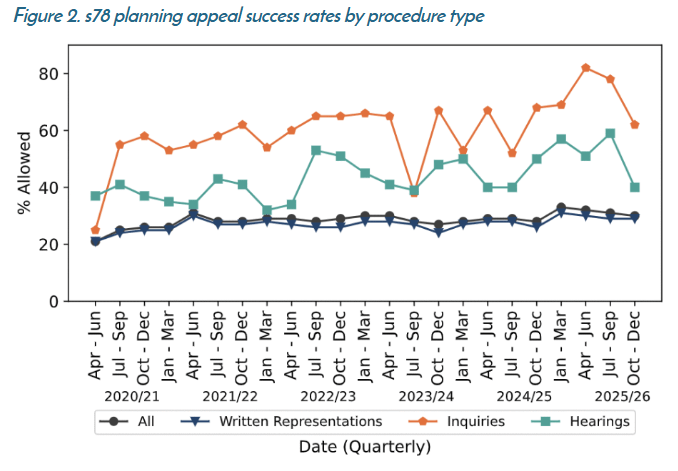
Given that almost 80% of appeals determined by inquiry are currently successful (possibly even higher when it comes to major residential appeals), this surely makes huge sense.

See the fascinating statistics published by Appeal Finder from which I have taken these screenshots:

Written representations determination of some call-ins is an interesting idea – a speedier call-in procedure would be so much more effective (see the way that the Mayor of London uses his call-in power for instance) but how many applicants, looking at these statistics will get nervous as to the prospect of their precious scheme being at the mercy of the written representations process?

Also on 18 November 2025, a consultation paper Reforms to the statutory consultee system was published, with responses due by 13 January 2026. Sport England, The Gardens Trust, and Theatres Trust are proposed no longer to be statutory consultees, with replacement “mitigations” put in place. The criteria are proposed to be tightened for consultation with seven national statutory consultees (see Anne1 for details): The Environment Agency, Natural England, Historic England, National Highways, the Health and Safety Executive, the Mining Remediation Authority and Active Travel England.

Lastly in terms of announcements, we at Town Legal seized that old 2010 concept of “open source planning” to publish our discussion document Simplifying & Standardising Section 106 Agreement Processes: Proposals for Reform which we were pleased to launch in the House of Commons this week through the auspices of the LPDF at an event sponsored by Mike Reader MP (and thank you Lord Charlie Banner for your supportive words too). What do you make of it? Do let us know. We are really keen to reduce the time it takes to conclude section 106 agreements, particularly in relation to small and medium sized schemes. I hope that MHCLG’s consultation package will touch on these issues as well. It is the unglamorous elements of the process that gum up the system, after all.

To quote always-glass-half-full Paul McCartney in that song from the Sergeant Pepper album: “It’s getting better all the time”. To quote John Lennon from the same song (maybe having seen MHCLG’ latest housing supply data on net additional dwellings – 6% decline in housing delivery from last year): “It can’t get no worse”.

Simon Ricketts, 22 November 2025

Personal views, et cetera

There Was Some Controversial News In Planning This Week But Instead Let’s Focus On the Latest Ruling In The Epping Forest Asylum Seekers Litigation

The Secretary of State finally said it out loud on 11 November 2025: the proposed National Development Management Policies will be non-statutory. There will be more detail in a speech he will give “in a couple of weeks” and consultation as part of consultation on the NPPF (which presumably the NDMPs will either form part of or partly replace) “later this year” (which I take to mean Christmas Eve, again).

So, sections 93 and 94 of The Levelling-up and Regeneration Act 2023 will not be brought into force, we assume. What a lot of wasted energy that was. I’m not going to comment in this post on the rights and wrongs of statutory versus non-statutory NDMPs (even I’m getting bored of that one). But simply to note this latest reminder that we can place too much weight on legislation as an agent of change. Rolling forward, I hope people appreciate that it will take years for much of the Planning and Infrastructure Bill to come into force and to have any real effect. And that some of it inevitably will either never get that far or will be subsequently repealed. How much of the long running debate over Part 3, environmental delivery plans, will turn out to be time well spent?

Anyway, let’s move quickly on to my main topic, because I never want to be controversial.

One thing that the government has steadfastly declined to address by way either of legislation, policy or guidance is the question of whether the accommodation by the Home Office of asylum seekers in hotels constitutes, in planning law terms, a material change of use. It would have been easy to signpost a position in one direction or the other. The conclusion that must have been reached is that sometimes the best thing to say is to say nothing at all.

When I last wrote about the saga in my 29 August 2025 blog post Court of Appeal Cuts Down Epping Forest the Court of Appeal in August overturned the interim injunction that the High Court had imposed earlier that month (see my 20 August 2025 blog post Planning Law Is Being Used For Politicking About Asylum Seekers), that would have required the use of the Bell Hotel in Epping for the accommodation of asylum seekers to cease, pending a full hearing into its claim for a final injunction and a declaration that the use was in breach of planning control.

We now have the High Court’s judgment as to whether a final injunction and/or a declaration should be granted: Epping Forest v Somani Hotels Limited  (Mould J, 11 November 2025). And the High Court’s ruling is: no and no.

Mould J set out the position under section 187B of the Town and Country Planning Act 1990, which provides that where “a local planning authority consider it necessary or expedient for any actual or apprehended breach of planning control to be restrained by injunction, they may apply to the court for an injunction” and that, whilst “the court must not re-assess for itself the local planning authority’s planning judgment which formed the basis for that authority’s decision to apply for the injunction … the factors which, on the evidence before the court, weighed with the local planning authority in making their planning judgment may properly be considered by the court, in the context of reaching its own judgment as to whether the circumstances of the case are such as to justify the grant of an injunction. Moreover, where as in the present case, the Defendant questions the validity of the local planning authority’s decision to apply for an injunction on public law grounds, the court may properly consider the points raised in the exercise of its discretion whether or not to grant the injunction.”

Mould J went through the various considerations:

  • whilst he was prepared to accept that the “local planning authority had at least a reasonable basis for alleging and asserting that the current use of the Bell as contingency accommodation for asylum seekers is in breach of planning control”, this “is not a case in which conventional enforcement measures taken by the local planning authority over a lengthy period of time have failed to secure the effective remediation of a clear breach of planning control, which has resulted in and continues
  • there were serious gaps in the record of the decision making which led to the conclusion that an injunction should be sought;
  • contrary to the council’s assertions, in the light of the actual chain of events and communications the hotel had not “acted in flagrant breach of planning control
  •  any harm to the green belt and conservation area by way of the security fencing in place was “limited by the fact that it is localised and very likely to be temporary in its duration, with the fencing likely to be removed no later than by April 2026, when the Defendant’s current contract with CTM comes to an end. Moreover, the fencing was installed in response to street protests, rather than being an integral requirement of the use of the Bell as contingency accommodation for asylum seekers
  • in terms of retaining existing visitor accommodation “the degree of harm resulting from that can be argued to be limited both by the temporary nature of the current use of the Bell and by virtue of the economic advantage to the Defendant of that current use, which is expected to assist in bringing the hotel back into conventional use in the longer term
  • I have heard no evidence to support the concern that the current use of the Bell is placing local GP, health, social and community services under undue pressure, to the detriment of the settled population of Epping. There is no evidential basis at all for the assertion that asylum seekers as a cohort have a greater propensity than the settled population to engage in criminal or anti-social behaviour
  • I have carefully considered the degree of planning and environmental harm which may reasonably be said to result from the actions or alleged actions of the three individuals accommodated at the Bell who have been convicted or charged with criminal offences since April 2025 … I accept that, in the light of those actions or alleged actions, the fears and concerns of local residents of which I have been made aware in evidence have a reasonable basis. However, the resulting degree of planning and environmental harm is limited, in my view. It has not been established that those fears and concerns are grounded in the use of the Bell as contingency accommodation for asylum seekers. They are properly to be regarded as the understandable reaction of local residents to the well-publicised criminal behaviour, actual and alleged, of three individuals who happen to have been accommodated there
  • Public opposition to the development of land, even if that opposition manifests itself in street protests, is not in itself evidence of planning or environmental harm generated by the development to which there is such strong objection
  • There are countervailing factors in this case which are properly to be weighed in the balance against the planning and environment harm which may reasonably be said to result from the postulated breach of planning control. In particular, the evidence before me clearly establishes that there is a continuing need to source contingency accommodation for asylum seekers from hotels, to enable the Home Secretary to discharge her statutory responsibilities under the 1999 Act. That consideration carries significant weight
  • There is “no duty as such placed upon a local planning authority to enforce against unauthorised development simply because it is considered to be in breach of planning control. An informed planning judgment is required of the local planning authority as to whether enforcement action is appropriate; and, if so, as to whether the harm caused by the unauthorised development is of such a degree as to merit restraint by injunction. Proper and effective planning control is not undermined by the normal enforcement regime, which permits a person served with an enforcement notice to appeal against that notice and, unless a stop notice is served, to continue with the alleged breach of planning control at least until that appeal has been determined by the Secretary of State

Bringing all that together:

I have reached the clear conclusion that this is not a case in which it is just and convenient for this court to grant an injunction. I give due respect to the Claimant’s judgment that the current use of the Bell as contingency accommodation for asylum seekers constitutes a material change in the use of those premises which requires planning permission. Nevertheless, I have not been persuaded that an injunction is a commensurate response to that postulated breach of planning control. The breach is far from being flagrant. Conventional methods of enforcement have not been taken. Taking a broad view, the degree of planning and environmental harm resulting from the current use of the Bell is limited. The continuing need for hotels as an important element of the supply of contingency accommodation to house asylum seekers in order to enable the Home Secretary to discharge her statutory responsibilities is a significant counterbalancing factor. This is decidedly not a case in which there is an abuse of planning control resulting in serious planning or environmental harm which now demands an urgent remedy. In my judgment, it is not appropriate to grant an injunction on the Claimant’s application for the purpose of restraining the use of the Bell as contingency accommodation for asylum seekers.”

It remains open to the Claimant as local planning authority to consider the expediency of taking enforcement action by issuing an enforcement notice. It is also open to the Defendant to reconsider whether it would be appropriate to apply for retrospective planning permission; or to apply to the Claimant for a certificate of lawfulness of the existing use of the Bell pursuant to section 191 of the 1990 Act. Each of those possible courses of action would enable the planning issues raised by this case to be evaluated by the local planning authority, through the transparent and consultative decision-making processes with public participation which apply under the 1990 Act and its attendant regulations.”

As for the application for a declaration that “the current use of the Bell does not amount to use as a hotel within the meaning of Use Class C1”:

Given the statutory procedures available for this to be determined, either by way of applications for certificates of lawfulness or by way  of the making of an enforcement notice (and if necessary the determination of appeals to the Planning Inspectorate) “it will  rarely be appropriate for this court to seek to resolve them beforehand through the grant of declaratory relief. In the present case, I consider that there is at least a real possibility that the Claimant and the Secretary of State on an appeal may be called upon, in the context of those statutory procedures, to determine the ongoing dispute as to whether the current use of the Bell constitutes development requiring planning permission. I have found it to be neither necessary nor appropriate to reach my own conclusions on those questions for the purpose of determining the Claimant’s application for an injunction. Instead, I have ultimately deferred to the Claimant’s judgment as local planning authority in alleging and asserting a breach of planning control. I have already addressed the propriety of the Claimant’s conclusion that it was necessary or expedient for that alleged and asserted breach of planning control to be restrained by an injunction.”

Practical outcome: the question remains unanswered by the courts as to whether, and in what circumstances, the accommodation of asylum seekers in a hotel amounts to a material change of use. Indeed, I would venture to suggest that the judgment seeks, by way of its dissection of the issues, to dampen down the moral panic that led to officer and councillor decisions to bring this litigation in the first place instead of relying on the usual statutory planning framework and processes.

Will the legal question ever be determined by the courts? I suppose it might, but most likely by way of a legal challenge to an inspector’s decision following an appeal arising from an enforcement notice or from refusal of a certificate of lawfulness. And even then, that determination will be specific to the facts and to the application of relevant local policies.

Finally, for the avoidance of doubt, I do like flags as much as the next person. I flagged these two passages in particular:

There is no evidential basis at all for the assertion that asylum seekers as a cohort have a greater propensity than the settled population to engage in criminal or anti-social behaviour”

Public opposition to the development of land, even if that opposition manifests itself in street protests, is not in itself evidence of planning or environmental harm generated by the development to which there is such strong objection

Simon Ricketts, 15 November 2025

Personal views, et cetera

4 Key Asks For The London Housebuilding Support Package Consultation

Most chats this week have been about the 23 October 2025 homes for London policy note.

tl;dr summary: positive direction but concerns about potential complexities, uncertainties and as to whether it will all be in place speedily enough.

We’re all now waiting for the consultation to start “over six weeks from November” (fair play, at least no “by the end of Autumn” fudge).

There are plenty of detailed issues arising, and differing interests will want to re-prioritise the measures in different ways, but I thought I would set out four key asks that I have, which in my view should be specifically addressed in the consultation documents:

  1. Should there be more focus on stalled sites that already have planning permission?

This is the lowest hanging fruit. And yet all we have (in paragraphs 33 and 34) is a reference to the potential for renegotiating previously agreed arrangements by way of deed of variation and discouragement as to the use of section 73.

This isn’t enough. I set out the current procedural constraints in my 18 October 2025 blog post London Stalling.

Procedurally, bar reintroducing section 106BA or, for a temporary period, amending section 106A to reduce the 5 years’ requirement, at the very least we need:

  • Specific encouragement for local planning authorities to accept developers’ requests to engage with the process of varying existing agreements where specific criteria (consistent with the direction of the policy note) are met, linked to some sort of oversight, monitoring and/or route for complaint where authorities refuse to engage (given that unless your section 106 agreement is at least five years’ old, or unless this is in the context of a section 73 application (of which more in a moment) there is no right of appeal on the part of the developer)
  • Not the current suggestion that the section 73 process “should no longer be used as an alternative means of reconsidering fundamental questions of scheme viability or planning obligations” but rather a proper recognition of the real challenge of keeping planning permissions, and associated planning obligations packages, up to date as against changing circumstances and the important role that section 73 plays in this. Attempts to make currently unviable schemes viable invariably involve an intertwined mix of scheme changes and changes to planning obligations. Section 73B, introduced by the Levelling-up and Regeneration Act 2023, is less useful as only the implications of the proposed changes are to be taken into account rather than considering the amended proposal holistically against the current development plan and other material considerations. This all needs to be connected up with the continuing problem that Hillside creates for amendments to projects (I was pleased to see Baroness Taylor confirm this week, on behalf of the government, in response to Lord Banner’s tabled amendment to the Planning and Infrastructure Bill, that the government will “explore with the sector” a “statutory role for drop-in permissions to deal with change to large-scale developments”. This is so important!).
  1. Is late stage (as opposed to early stage) review necessary in relation to the proposed “time-limited planning route”?

In basic summary, this route is where a residential scheme can commit to at least 20% affordable housing with a 60/40 social rent/intermediate tenure split with planning permission issued by the end of March 2028. If the first floor of the scheme has not been built by 31 March 2030 (in the case of larger phased schemes, in the case of any phase where the first floor of buildings providing at least 200 dwellings has not been built by that date), “a late review will be undertaken once 75 per cent of homes within the scheme or the final phase are occupied to determine whether a higher contribution for affordable housing can be made”.

Why the late stage review mechanism in these circumstances, rather than the early stage review that is currently the case with fast track schemes that don’t achieve substantial implantation by the specified deadline under London Plan policy H5? Late stage reviews unnecessarily spook funders and lenders, leaving the eventual outcome too late in the process – and also having the public policy disbenefit of being too late to allow for any further affordable housing, that can be unlocked via the review, to be accommodated within the scheme. There is also inconsistency with paragraph 30 which suggests another approach for multi-phase schemes: “For multi-phase schemes, a review of the scheme will apply prior to the start of each phase for which the milestone in paragraph 27 has not been reached, to determine whether additional affordable housing can be provided in subsequent phases.”

Isn’t it better to keep things simple and follow, where possible, the existing mechanisms within policy H5, just with the thresholds temporarily reduced?

  1. Are there unnecessary difficulties with introducing a viability test into the proposed CIL relief?

Permissions which are secured via the new time-limited planning route that commence after the relief is in place and but before December 2028 will qualify for at least 50% relief from borough CIL (NB is this 50% after reliefs and exemptions have been applied and what will be the calibration to work out the higher level of relief where the scheme is delivering more than 20% affordable housing?), but the relief would be “contingent upon meeting proportionate qualifying criteria to ensure relief is targeted at schemes which would otherwise remain stalled or fail to come forwards, with a lower relief applicable where the full available amount is shown not to be warranted.” This sounds complicated. With this hurdle in place, not only would the developer not know whether they will qualify for the relief until planning permission is granted and they receive their liability notice, but it means that the purported advantage with the time-limited planning route of not having to undertake viability assessment is illusory, because the work will be needed in any event to secure the CIL relief – and the requirement will surely be very hard to turn into workable legislative drafting – we know how difficult exceptional circumstances relief is to secure due to the various criteria and requirements built into that particular mechanism.

  1. Are the proposed additional powers to be given to the Mayor enough?

Boroughs would be required to “refer planning schemes of 50 units or more where the borough is minded to refuse the application – this would be a more streamlined process operating alongside the existing referral threshold of 150 units which applies regardless of a borough’s intended decision, and would ensure that the Mayor was able to review whether the right decision had been reached in the context of the housing crisis.”

But there may well be cases where schemes are being held up at borough level, either pre-resolution or post resolution whilst for instance the section 106 agreement is being negotiated, and where securing planning permission by the end of March 2028 will be critical under this package of measures. Here, speedy intervention, or threatened intervention, by the Mayor could really help. So, for this time limited period at least, why not allow the Mayor to intervene at any time after the end of the statutory determination period in relation to any scheme comprising at least 50 dwellings? Otherwise, that absolute cut of the end of March 2028 for grant of planning permission will need to some flex built in to allow for the possibility of appeal etc.

I’ll confine myself to those four although I have others, and I know that you do too…

NB none of this is to be churlish as to the scale of the task that MHCLG and the GLA have before them. It is of course by no means easy to get this package right and to avoid unintended consequences.

Simon Ricketts, 1 November 2025

Personal views, et cetera

Commons Select Committee: Land Value Capture

Today’s Commons Housing Communities and Local Government Committee’s report Delivering 1.5 million new homes: Land Value Capture (28 October 2025) contains recommendations which are more wide-ranging than the report’s title would suggest: some practical and, one would hope, uncontroversial; others touching on some raw political nerves at MHCLG no doubt.

Starting with the latter, do turn to the “epilogue” which comments directly on what were at that stage just media reports as to the “package of support for housebuilding in the capital” announcement which the government and the Mayor of London issued on 23 October 2025. The Committee expresses itself to be “seriously concerned by media reports that London’s affordable housing target could be cut” and “the Secretary of State may be considering suspending local authorities’ powers to charge the Community Infrastructure Levy to address concerns about development viability. None of the evidence to our inquiry—including from representatives of developers—advocated abolishing CIL entirely as a means of addressing viability concerns. On the contrary, we heard that the Government should reform CIL to extend its coverage where it is viable.”

The Ministry must continue its work with the Greater London Authority to deliver an acceleration package, so that London boroughs are delivering housing in line with their local housing need targets. In response to this Report, the Ministry must provide its assessment of how changes to London’s affordable housing target may deliver more affordable housing units, by increasing the number of new homes built overall. Any reduction to London’s affordable housing target must be accompanied by a clawback mechanism to ensure developers return a portion of their profits to the local authority, ringfenced for affordable housing delivery, if a development surpasses an agreed benchmark profit. If London’s affordable housing target is reduced and the number of affordable housing units delivered declines, the Ministry and the Greater London Authority must commit to reinstating the 35% target.”

Perhaps this epilogue is slightly premature, given the actual announcement proved only to be a prologue to a consultation process that will run “from November” (late November is my guess). Perhaps the Committee should hear further evidence on that back of the consultation material to be published – it is slightly odd to be responding just to a newspaper report, particularly given that the actual announcement has been made.

But that epilogue does point to the fundamental policy tension in the current economic environment: what matters most – affordable housing delivery by percentage, or by absolute numbers? See for instance its recommendation that the government’s “forthcoming reforms to its guidance on viability assessments must ensure developers reliably deliver on their agreed affordable housing commitments, with viability assessments only used to alter these commitments retrospectively in the most exceptional circumstances. To support this, we recommend that all local authorities in England must be encouraged to set a minimum percentage target for affordable housing in their local plan [NB what don’t?], with a ‘fast-track’ route planning route for developments which meet this local target.”

Too often, site-specific viability assessments are used by developers to negotiate down affordable housing requirements in circumstances where this is completely unjustifiable. Affordable housing contributions are frequently the first provision to be cut following a viability assessment, even where a developer may be making other significant contributions through Section 106 agreements and CIL. In areas with high land values, viability assessments should only be used in this way in very exceptional circumstances. Currently, not all local authorities have their affordable housing requirements clearly set out in local policy. Greater clarity from local authorities would provide developers with the right incentives to avoid lengthy viability negotiations, and ensure more applications are meeting local affordable housing requirements from the outset.

As part of its ongoing review of the viability planning practice guidance, the Government must consider how different types of developer contribution could be re-negotiated following a viability assessment, to protect affordable housing contributions. The Government must also update national policy to encourage all local authorities to set a minimum percentage target for affordable housing in their Local Plan for all major developments that include housing. This figure should be based on a local need assessment for affordable housing in each local authority, with particular regard for the local need for Social Rent homes. Local authorities should be encouraged to offer a ‘fast-track route’ for developments which meet the local affordable housing target, by making those developments exempt from detailed viability assessments and re-assessments later in the development process. This would encourage developments with a high percentage of affordable housing and speed up the delivery of housing of all tenures.

The Government must continue to develop its proposal to publish indicative benchmark land values to inform viability assessments on Green Belt land across England. The Government must publish different benchmark land values for each region of England, to reflect variation in land values. The Government must also ensure that the viability planning practice guidance contains clear advice on the “local material considerations” that would warrant local adjustments. The Government should continually review the effectiveness of the policy and consider how it may be extended to development on land that is not in the Green Belt.”

On land value capture itself:

There is scope to reform the current system of developer contributions in England to capture a greater proportion of land value uplifts from development to deliver affordable housing and public infrastructure. There is a compelling case for such reforms—especially in the context of a deepening housing crisis and with public finances currently under strain. However, a radical departure from the Section 106/Community Infrastructure Levy (CIL) regime, which currently constitute the existing mechanisms of land value capture in England, would risk a detrimental impact on the supply of land in the short-term. We recognise that this would be disruptive to the Government’s housebuilding agenda.

Reforms to land value capture should be iterative, starting with improvements to existing mechanisms. Therefore, the Government must immediately pursue the reforms to Section 106 and CIL outlined in the chapters below. These reforms must optimise the system’s capacity to capture land value uplifts and deliver infrastructure and affordable housing—particularly homes for Social Rent—in line with the Government’s wider policy ambitions. The Government must also trial additional mechanisms of land value capture in areas where there are significant uplifts in land value which current mechanisms may not capture effectively. Specifically, the New Towns programme discussed in Chapter 5 presents a vital opportunity to test new ways of financing infrastructure delivery on large developments and learn lessons for future reforms.

Any reforms to land value capture should also be considerate of the wider tax system, to balance public needs and equitable charges on development. To support this work, the Government should publish updated land value estimates, which were last published in August 2020. If the Government does not intend to do so, it must explain why it no longer publishes this data.”

In essence, the Committee sees any radical change as likely to be disruptive to the government’s current agenda. Instead, it is recommending a number of changes which in my view are “no brainers”, for instance better resources for local planning authorities and looking to simplify the approach to section 106 agreements and to CIL:

Reforms to section 106 agreements

“There is a strong case for the introduction of template clauses for aspects of Section 106 agreements across England, as was recommended by the National Audit Office and others. Templates would allow local authorities to focus negotiations on site-specific factors rather than legal wordings. Template clauses would also allow for greater standardisation and clarity of requirements across all local authorities, and in turn reduce the workload of local authorities and Small and Medium-sized Enterprise developers.

As part of the site thresholds consultation that will take place later this year, the Ministry must seek views on how standardised Section 106 templates could most effectively streamline the negotiation process across sites of all sizes. Based on the consultation responses, the Ministry must work with the Planning Advisory Service to develop a suite of Section 106 template clauses and publish these within six months of the consultation closing. Alongside their publication, the Ministry must also update its guidance to local authorities on Planning Obligations to encourage local authorities to adopt these template clauses.”

I covered the same ground in my 14 June 2025 blog post Why Does Negotiating Section 106 Agreements Have To Be Such A Drag? Not only that, but my firm has also been working on an actual template draft for small and medium sized schemes and a specific set of proposals for ironing out the pinch points that currently exist at every step of the sway from arriving at heads of terms through to agreement completion. This was there to be grasped – it is a national embarrassment. We held a workshop on 30 September 2025, attended by a selection of thirty or so lawyers and planners from the public and private sectors, developers and representatives of industry bodies with MHCLG present in an observer capacity. If you weren’t invited I apologise but we were limited by the size of our meeting room! The draft output from the workshop will be released next month. If there is an organisation out there which is willing to make a larger space available in late November for a launch event please let me know.

Section 106 dispute resolution scheme

This may be why I write blog posts…. The Committee picked up on a reference I made in the blog post mentioned above to section 158 of the Housing and Planning Act 2016 which has never been switched on, allowing for a dispute resolution procedure to be able to be invoked where necessary during the course of negotiations.

Local planning authorities across England have expressed concern that protracted Section 106 negotiations are causing delays to housing delivery. Drawn out negotiations do not benefit public outcomes and cause undue delays to development, which may impede the Government’s housebuilding ambitions. Whilst we recognise the Minister for Housing and Planning’s concerns that introducing a dispute resolution scheme may add complexity to the system, we believe the potential benefits to affordable housing delivery and unlocking stalled development outweigh this risk.

The Government should introduce a statutory Section 106 dispute resolution scheme, under the provisions of the Housing and Planning Act 2016. If the Government does not intend to pursue this, it should set out a detailed explanation as to why the Ministry has chosen not to implement the provision legislated for by Parliament in the 2016 Act. This should include setting out any specific technical or legal barriers to implementation which the Ministry has identified.”

Community Infrastructure Levy

Again, nothing earth-shattering. Rather, calls for more transparency as to which authorities are charging CIL and at what rates; widening opportunities for authorities to pool receipts (and recognising the opportunity that the reintroduction of strategic planning will bring) and greater focus on infrastructure funding statements.

On new towns:

The Committee calls on the government to set out where the funding is to come from (“The Government’s New Towns programme is likely to require billions of pounds of public and private investment over several decades, including millions from HM Treasury to establish development corporations during this Parliament”); greater use should be enabled of tax increment funding to fund infrastructure in cities and new towns. Specifically on the role that land value capture might play:

There is significant potential to use land value capture as part of funding the proposed New Towns, especially on green field sites. However, we are concerned that the Government has announced substantial detail of the 12 potential sites without a planning policy to protect land value, contrary to the recommendation of the New Towns Taskforce. It appears that the Government has not yet established any delivery body to purchase land or enter agreements with landowners, which risks allowing developers considerable time to acquire sites for speculative development and immediately push up land values. The Taskforce said that, in the worst-case scenario, this could “jeopardise New Town plans”.

The Government must immediately conduct an analysis of Existing Use Values (EUV) on each of the 12 sites to maximise the capture of future land value uplifts, and develop plans for using appropriate mechanisms for land value capture on each site. This must include the option of development corporations using Compulsory Purchase Orders to assemble land where ownership is fragmented or negotiations stall. The Government must ensure arrangements for the purchase of land on New Towns sites are in place before it announces its final decision on locations by spring 2026.”

“The Ministry is right to prioritise New Towns which have the greatest potential to boost housing supply in the short-term, but its plan to “get spades in the ground on at least three new towns in this Parliament” does not match the scale of the Government’s housebuilding ambition. The New Towns programme can and must make a contribution towards increasing housing supply during this Parliament.

The Government must immediately clarify how housing delivery in New Towns will interact with local authority housing need targets. In its final response in spring 2026, the Government must include a roadmap for the New Towns programme, to show when each development corporation will be established, when development will commence on each site, and the estimated development timeline for each New Town.”

So will the government meet its 1.5m homes target?

The housing sector is eagerly awaiting the Government’s Long-Term Housing Strategy, which it first announced in July 2024. Originally, this was to be published alongside the Spending Review in spring 2025. The continuing lack of a cohesive plan to deliver 1.5 million new homes has left the sector in the dark. We are also deeply disappointed that the Government has been unwilling to engage with us on the development of the Strategy, or provide any updates on its delayed publication, other than to tell us that it will be published “later this year”.”

“The Government can only begin to make significant progress towards its 1.5 million target once the sum of local housing need targets in Local Plans add up to that figure. Whilst the Government’s reforms to the National Planning Policy Framework seek to plan for approximately 370,000 new homes per year, local authorities will take several years to transition to this national annual target, as the currently Local Plans take seven years to produce and adopt on average. The Government has stated its ambition to introduce a 30-month plan-making timeline, but the relevant provisions in the Levelling-up and Regeneration Act 2023 to speed up plan-making have still not been implemented.

The Government must immediately bring forward its Long-Term Housing Strategy without further delay. It must set out an ambitious, comprehensive, and achievable set of policies that will deliver 1.5 million new homes by July 2029. The Strategy must prioritise implementing reforms to the plan-making system to move towards a 30-month timeline. The Strategy document must include an annex to provide the Ministry’s assessment of how many net additional dwellings each policy change will contribute towards annual housing supply, adding up to 1.5 million new homes over the five-year Parliament. If the Ministry is unable to supply this, the Government must make an oral statement to the House to confirm how many new homes it will deliver by the end this Parliament.”

There we have it. If nothing else, that will all spur us on with the work on the template section 106 agreements work and, related to that, I’m very keen to discuss how section 158 of the Housing and Planning Act 2016 might provide an effective, light touch, procedure.

Simon Ricketts, 28 October 2025

Personal views, et cetera

Some Week, Some Thoughts

This post will mostly be about judicial review but if instead you have come here for a summary of the implications arising from the joint government/Mayor of London package of support for housebuilding in London (23 October 2025) why not listen to my interview with Concilio’s Nick Dines and we’ll see you back here in 35 minutes?

Judicial review…

Depends which side you’re on doesn’t it.

There have been at least two interesting judgments in the last couple of weeks, interesting for different reasons which nothing to do with the substantive issues involved. I’m not going to summarise the actual cases because they are both covered well (by my Town Legal colleagues Archie Hunter and Adam Choudhury respectively) in Town Legal’s latest weekly planning judgments update (you can subscribe gratis via the button at the foot of the update):

All I wanted to say about CG Fry, given all the excellent summaries that are already out there (including Archie’s), was:

  • Fortune favours the brave. This is a case which was lost by CG Fry at first instance and in the Court of Appeal (all this of course following an unsuccessful planning appeal at which the same arguments were run). Who might have given up rather than carry on, with the exposure to costs arising? Great credit is due to Lord Charlie Banner KC. Would you in that position be resilient enough to hold to your initial opinion and to retain the trust of those relying on it? I’m thinking back to Richard Harwood KC in Dill v Secretary of State (Supreme Court, 20 May 2020) – where the stats were the same: LLW. I’m thinking back also to Estelle Dehon KC in R (Finch) v Surrey County Council (Supreme Court , 20 June 2024) – ruled unarguable on the papers, unarguable at renewal hearing, arguable by the Court of Appeal on two grounds, dismissed then by the High Court and then by the Court of Appeal before success in the Supreme Court: LLWLLW. Within boundaries (some cases are sure-fire losers), litigation is inherently uncertain. Judgments of lower courts may be overturned on appeal. It isn’t over till it’s over. I’ll come back to that theme in my comments on HyNot.
  • Isn’t it interesting that the outcome of the case turned upon the decision of a previous government that the “easy” way to give Ramsar sites the same protection as habitat sites that are protected under the Conservation of Habitats Regulations (special areas of protection and special protection areas) was simply to set that out in national policy rather than by way of amending the relevant legislation? That is now being rectified, belatedly, by way of a government amendment to the Planning and Infrastructure Bill. But isn’t there a lesson when it comes to the NPPF itself or rather the proposed National Development Management Policies, envisaged by mechanisms set out in the Levelling-up and Regeneration Act 2023 as being statutory documents with equivalence to statutory local development plans. Parliament clearly considered that it would not be enough for NDMPs to be given weight through policy-expression but we are all waiting to see in what form these NDMPs are finally going to emerge.
  • Lastly, it’s nice to read a Supreme Court judgment that is so straightforward and clear in its expression – and descriptive of the planning system in a way that any of us would recognise. It’s not always the case (mentioning no names, *coughs* Hillside).

Now to HyNot, again some excellent summaries out there (including Adam’s) so I just wanted to focus on the judge’s comments about “promptness” in bringing judicial review proceedings and on whether the “arguability” threshold should be higher in some cases:

  • This was a permission hearing, where the claimant simply needed to persuade the judge that the claim was arguable.
  • What was under challenge was the grant of consent by Secretary of State for Energy Security and Net Zero of the “HyNet Carbon Dioxide Transportation and Storage Project – Offshore” The project “comprises 3 geological gas storage sites in the Liverpool Bay Area beneath the East Irish Sea. The proposal is designed to store 109 million tonnes of carbon dioxide and is a core part of the Government’s legal commitment to Net Zero. It is expected to create 2,000 construction jobs. The Development (called the Liverpool Bay CCS project) is part of a nationally significant infrastructure development in the North West which will have a very significant regional and national economic impact.”
  • The second paragraph of the judgment describes the claimant as follows: “The Claimant company and the group of individuals behind it do not like CCS in relation to power generation. They oppose it because they believe that CCS in relation to power generation and ‘blue’ hydrogen production is a costly and time-consuming distraction that will lock society into continued fossil fuel use and prevent investment in other more proven climate solutions. The Claimant is a Company Limited by Guarantee which was incorporated the day before this claim was filed. The name chosen by the incorporators of their company, “HyNot”, reveals the nature of its opposition to what, as appears below, is loosely known as the “HyNet Cluster”. The Claimant represents a campaign group which its director, Nicky Crosby, describes as being a loose group of campaigners from different environmental and climate campaign backgrounds, such as Frack Free Dee, Friends of the Earth, Extinction Rebellion, Chester Sustainability Forum, and CAFOD.”
  • Unlike more usual planning cases where there is now a six weeks’ deadline for bringing judicial review proceedings, this was a claim where the traditional judicial review deadline applied that the claim must be brought “promptly … and in any event not later than 3 months after the grounds to make the claim first arose”. The claim was brought on the last day within the three months’ deadline.
  • After finding the claim to be unarguable, the judge found that he would also have refused permission on the basis that the claimant failed to act “promptly”: “challenges to major infrastructure call for particular urgency. Whilst the volume of documentation was substantial, that did not in my judgment justify the delay, especially in circumstances where the Claimant ultimately filed only on a protective basis, without a pleaded case. I consider that the Claimant was aware of all of the information it required to enable it to bring proceedings on the grounds pleaded approximately 8 weeks before it filed its ‘protective’ claim. Certainly, by the end of April 2025 it was aware of the essential substance of the grounds that would have been available to it, and that is all that was required (see British Gas at paras. [141]-[145]). Detailed disclosure normally follows the grant of permission for judicial review, which is the trigger for the duty of candour and cooperation with the court and is not necessary before a claim can be brought (see British Gas at [145]). There is no reason why the Claimant could not have filed (whether ‘protectively’ or with proper pleadings, to be amended if required) much sooner. It is apparent, however, that the Claimant took the position that it could simply wait until the last day of the three-month period to file. The courts have stated emphatically that that is not the case.”
  • Whilst Saini J found the claim to be unarguable, there is an interesting concluding passage in the judgment recording that counsel for the government had urged the judge in submissions “to apply a more demanding test of the Claimant at the hearing than the traditional arguability test familiar at the permission stage”, relying on case law starting with the 1994 Mass Energy case. Counsel (Charles Streeten) “argued that the Claimant must satisfy a heightened test described as a “reasonably good prospect of succeeding” at a substantive hearing. The following facts were said to justify this more onerous hurdle: (1) the urgency (illustrated both by the categorisation of this claim as Significant under CPR 54D paras. 3.1 and 3.2 and by the measure of expedition ordered by Mould J); (2) the fact that a decision on permission has been adjourned to a hearing listed for half a day; (3) that the Court will have the benefit of extensive written and oral submissions from all three active parties; and (4) that the claim substantially affects the interests of a third party (the Developer).”  Whilst this proved unnecessary for his reasoning, Saini J went on to consider this argument “obiter” as lawyers like to say, i.e. even though it was not determinative and therefore less binding in terms of creating any legal precedent, although in my view still interesting. He considered “that there was substantial force in Mr Streeten’s submissions. A court does retain the discretion to require more of a claimant in establishing the merits of its case at a hearing of the type convened before me concerning an urgent matter of national importance, where there has been substantial pre-reading, detailed skeletons and oral submissions over half a day from all relevant parties. The grant of permission in a planning case on the type of facts before me is in itself highly likely to cast a long shadow over a development of national interest, with substantial financing and construction arrangements involving many third parties. I can see the force of an argument that much more than mere arguability of a claim (such as establishing that the claim is more likely than not to succeed) should be required in circumstances where such prejudice will be caused. Uncertainty as to the legal position is itself highly prejudicial in commercial arrangements.”

All this is relevant in the light of continuing thinking by the government as to ways of closing down unmeritorious judicial review cases. I referred in my 25 January 2025 blog post to the government’s announcement as to changes to be made to procedures governing legal changes of development consent order decisions in relation to nationally significant infrastructure projects (now the subject of provisions within the Planning and Infrastructure Bill), following first the report by Lord Banner KC and subsequent consultation that I summarised in my 28 October 2024 blog post Banner Review Into Legal Challenges of NSIPs (NB there really are other barristers out there I feel sure, I’m not being sponsored or anything). Lord Banner had recommended that there may be a case for raising the permission threshold for judicial review claims challenging DCOs (“There is much to be said for raising the threshold for permission to apply for judicial review of DCOs, to the heightened Mass Energy threshold, so that only those claims likely to succeed are allowed to proceed to a substantive hearing. There is no right, either under UK constitutional principles or international law, for an arguable but weak or mediocre claim to proceed to a full hearing rather than being weeded out beforehand)”, but the government was not inclined to accept this; perhaps the courts are beginning to get there of their own volition in relation to challenges of nationally significant projects? (Although what is the risk that a claim such as that in Finch is prematurely ruled out?). The big question is of course: if these measures are appropriate for challenges to nationally strategic infrastructure projects, why should they not be introduced in relation to planning-related challenges more generally?

To my mind, it is good to see the tough line taken by Saini J on promptness. Given the six weeks’ deadline for planning-related judicial review cases, why is there even still the traditional “prompt but in any event within three months” test, which can be so uncertain in its practical application? I’m currently dealing with a case, in relation to a proposed commercial development, where the claimant (a public authority) filed a day out of time, the challenge delaying significantly a development project, resulting in, according to my client’s evidence, several million pounds of lost rental income. The court has taken over three months before finally allowing the claim to be filed out of time. What sort of signal does this send? Is there some sort of institutional bias towards large infrastructure developments?

And on the question of court delays, is anyone else experiencing unusually long delays before securing decisions at the permission stage on the papers? I have one case where we filed on 6 May. Still… nothing.

Getting the balance right in relation to sieving out unmeritorious judicial review cases is so important given the implications not just for the project under challenge but in terms of giving reassurance to all those operating in the planning system that every document does not need to be “gold plated” as an insurance against even unmeritorious challenge. The fear of a claim for judicial review (successful or otherwise) is skewing every stage of the system!

Finally,  as a result of an amendment to the Planning and Infrastructure Bill tabled by a conservative peer, also a working planning KC (*checks notes* him again!!), the government is put forward its own amendment which will build on the current provisions in the Town and Country Planning Act 1990 which allow for an extension of the time for implementing a planning permission which has been challenged by way of judicial review. At present, under section 91 (3), if proceedings are brought to challenge the validity of a planning permission, the deadline for implementation is extended by one year.  The amendment will extend the deadline by a further year if the proceedings have permission to go to the Court of Appeal and by two years if they have permission to go to the Supreme Court. In the case of outline planning permissions, reserved matters submissions will be extended by equivalent periods.

All good and necessary but any steps to speed up judicial proceedings, and to sieve out doomed claims as at early as stage as possible, would of course be more likely to address the root problem.

Simon Ricketts, 24 October 2025

Personal views, et cetera

London Stalling

This one is about the current position with London (non) development and some thoughts about what procedural steps may be open to you if you are a London (non) developer with a planning permission for a scheme that is no longer viable to build out.

On 14 October 2025, Molior published figures for Q3 2025 construction starts and sales in relation to schemes in London with 25+ homes for private sale or rent. Apologies for the extensive quoting but their summary is clearer than anything I can write:

Between 2015 and 2020, there were 60-65,000 homes for private sale or rent under construction in London at any given time.

Today, that number has fallen to 40,000 … and 5,300 of those are halted part-built.

With a surge of completions expected in 2026, Molior forecasts that just 15-20,000 new homes will be actively under construction on 1st January 2027.”

London had just 5,933 new home sales in Q1-Q3 2025.

Sales rates are weak across all local markets and at every price point.

At prices up to £600 psf – the level at which most London owner-occupiers can buy – sales to individuals are virtually non-existent.”

Build-to-rent completions are about to plunge.

Interest rates rose during 2022, then the Liz Truss budget pushed them higher.

This stopped new money from funding London multifamily development.

Completions are set to disappear after 2027 because construction starts fell in 2023 / 2024.”

“There were 3,248 private starts in Q1-Q3 2025.

London is now on track for fewer than 5,000 private construction starts in 2025.”

“Starts have been falling for a decade because sales rates and profitability have been falling for a decade.

Building Safety Regulator delays have made things worse in 2025.”

“Development is unviable across half of London.

Development costs are high, so it is unviable to build profitably in half of London – areas under £650 psf.

This is even if the land is provided free and there are no planning obligations like CIL and affordable housing.”

“London has 281,000 unbuilt permissions.

These numbers are private + affordable C3 permissions.

The numbers include outline consents, detailed consents and unbuilt phases of schemes partly under way.

Also included are projects successful at committee but still waiting S106 sign-off.”

Set all that alongside the homelessness and rough sleeping crises in London. The BBC reported yesterday that more than 132,000 households were living in temporary accommodation on 30 June 2025, up 7.6% from the same time last year. Aside from the human cost, this is of course at a huge financial cost for London boroughs: £740m ‘black hole’: London’s temporary accommodation crisis draining local resources (London Councils, 13 October 2025). And at the sharpest end: Number of people “living on the streets” of London increases by 26% (Crisis, 31 July 2025).

Whilst I try not to wear out my two typing-fingers commenting on press speculation about forthcoming announcements, I think we can assume that the government and the Mayor of London will soon be announcing various measures to try to turn this around or at least provide some sort of jump-start (note to government press team, I suggest that we are in “jump-start” rather than “turbo-charge” territory). See for example the Guardian’s 17 October 2025 piece London developers to be allowed to reduce percentage of affordable homes.

The spectre in the press pieces of some temporary reduction in developers’ threshold for qualifying for the Mayor’s fast-track (i.e. basically avoiding the need for formal viability appraisal and a late stage viability review mechanism if they can commit to a level of affordable housing which is usually 35%, with a policy-compliant split of affordable housing tenure types within that – see policy H5 of the London Plan for more detail) down to perhaps 20% is being seen by some as amounting to an actual reduction in the amount of affordable (and particularly socially rented) housing that will be developed.  But this analysis is unfortunately wrong: very few schemes are currently proceeding with 35% or more affordable housing.  Viability appraisals either agreed or accepted after scrutiny on appeal (this is not developers cooking the books) are already coming out at way less than 20%, let alone 35% (which is why simply reducing the threshold alone wouldn’t be enough). See for instance the inspector’s decision in relation to the Stag Brewery appeal (summarised in my 4 May 2025 blog post (7.5% affordable housing) and the 29 May 2025 decision letter in relation to a proposed tower block in Cuba Street (16.6% affordable housing). Nor is this a purely London phenomenon, if you recall last month’s Brighton Gasworks decision (summarised in my 27 September 2025 blog post) (zero affordable housing).

20%, plus the other measures being whispered about such as increasing subsidies for socially rented housing and/or allowing councils not to charge CIL, may tip the balance so as to turn some non-developers back into being developers again and thereby deliver more affordable housing (including socially rented housing) in absolute numbers (which is what counts after all) than is currently the case.

But what about the many schemes consented on the basis of 35% or more, that simply aren’t proceeding, at least beyond basic operations to keep the permission alive (see my 7 September 2025 blog post The Stressful & Sadly Often Necessary Task Of Keeping Planning Permissions Alive)?

If we look to amend existing, unviable, section 106 agreements, no longer do we have the benefit of section 106BA, a provision introduced in April 2013 via the Growth and Infrastructure Act 2013, to allow developers to apply to modify or discharge affordable housing obligations in Section 106 agreements where those obligations made a development economically unviable, and then repealed three years later in April 2016. That provision unlocked various stalled permissions at the time. Is it too late, or too unpalatable, for an amendment to the Planning and Infrastructure Bill simply to reintroduce it?

Instead, the main routes are:

  • If the section 106 planning obligation is at least five years’ old, a formal application to the local planning authority can be made under section 106 A of the Town and Country Planning Act 1990 on the basis that the relevant obligation, unless modified, “no longer serves a useful purpose”.  The test is expressed very generally which is unhelpful but the case would be that if the obligation is causing development, otherwise beneficial, not to proceed, it cannot be serving a “useful purpose”. There is the right of appeal to the Planning Inspectorate.
  • Seeking variation of section 106 planning obligations in the slip-stream of an application made under section 73 of the Town and Country Planning Act 1990 (an application, of course, for planning permission for the development of land without complying with conditions subject to which a previous planning permission was granted – and which is to be assessed against the current development plan and other material considerations). This was the route taken in the Cuba Street appeal I mentioned above. Full planning permission had been granted in December 2022. A section 73 application was made to amend the approved floor plans set out in the schedule referenced in condition 2 of that permission, to “provide an increase in the residential units from 421 to 434, and a reduction in the affordable housing (AH) provision from 100 (71/29 affordable rented to intermediate split as a ratio) to 58 (66/44 affordable rented to intermediate split as a ratio). In percentage terms the change in AH would be from 30.15 % to 16.6%. A consequence of these changes would be amendments to conditions 24 and 29, with respect to wheelchair accessible homes and cycle storage, given that they relate to the quantum of development subject to the original permission.”
  • Negotiating a deed of variation to the section 106 planning obligation, outside these formal procedures, without any recourse to appeal if the authority is resistant.
  • A fresh application for planning permission – utterly the nuclear option in times of cost, time and risk.

If there is indeed some form of announcement from MHCLG and the Mayor of London, I will be interested to see:

  • What is said about existing stalled permissions and any advice that is to be given to boroughs as to the approach they should take when approached by way of any of these procedural routes.
  • More generally, how will any announced (presumably temporary) relaxations with regard to the London Plan policy H5 threshold approach  or any other policy requirements sit as regards section 38 (6) of the Planning and Compulsory Purchase Act 2004 (“If regard is to be had to the development plan for the purpose of any determination to be made under the planning Acts the determination must be made in accordance with the plan unless material considerations indicate otherwise”)? Where there’s a will there’s a way but this is all another reminder, as if we needed it, that the process for reviewing and updating the London is so slow as not to be fit for purpose.

Oh and we still await MHCLG’s updated planning practice guidance on viability.

“London calling, at the top of the dial.

And after all this, won’t you give me a smile?”

Simon Ricketts, 18 October 2025

Personal views, et cetera

Hillside: Every Journey Starts With The First Step

Various people have asked me what I made of the amendment to the Planning and Infrastructure Bill that Lord Charlie Banner KC sought to introduce last month, seeking to lance the large boil that is Hillside (and if that word means nothing (1) lucky you, read no further, or (2) please read my 2 November 2022 blog post Running Down That Hillside).

The truth is that for a long time I couldn’t really face getting back into the subject, having failed to get traction for expansion of what became section 73B when the Levelling-up and Regeneration Act Bill was passing through its Parliamentary stages, and, before that, having sat behind Charlie at the Hillside Supreme Court hearing. The problem is real, but arriving at a workable solution is hard.

The amendment was as follows:

Huge credit to Charlie because, if nothing else, his amendment has put the issue back on the table with MHCLG. Baroness Taylor’s response in the debate on 11 September 2025 (see columns 1736 to 1741), contained the following passages:

The Government recognise that the Hillside judgment and subsequent court decisions have caused concerns across the development sector, and the noble Lord was kind enough to send me some of the articles that have been written since, setting out which problems they are causing. It has made it more challenging to use the practice of drop-in permissions to deal with changes in development proposals for plots on large-scale residential and commercial development in response to changing circumstances.”

We want to ensure that large-scale developments, where they need to change, can secure the necessary consents to deal with these changes effectively and proportionately. Unfortunately, we are not persuaded that Amendment 169 is the solution to Hillside for overlapping planning permissions. It is too broad in scope, and we must be absolutely sure that it would not undermine the integrity of the planning system. The long-standing principle that Hillside endorsed—that it is unlawful to carry out a development when another permission makes it physically impossible to carry it out—is a sound one. Decisions are made on the merits of the entire development proposal, and this amendment would allow developers to pick and choose what parts of an approved development they wanted to implement when they had a choice.

Similarly, we need to consider carefully the implications of legislating to deal with overlapping planning permissions and development consent orders in general terms. […]

“We want to ensure that there is sufficient flexibility to deal with change to large-scale developments. Clause 11 already provides a framework for a more streamlined and proportionate process to change development consent orders, but we also want to look at how the framework can be improved for planning permissions. We would welcome further discussions with your Lordships and the wider sector on this matter.”

All this stuff about considering carefully and further discussions is all well and good but perhaps the next step now should be to keep a number of planners and planning lawyers in a locked room until they have arrived at a refined version of the proposal which is watertight, legally and in public policy terms? What situations are people actually worried may arise? How can those outcomes be designed out?

I don’t want to be locked in the room but to start the discussion…

I think we need a bit of clarity as to how an authority actually states in the later permission or in a section 106 agreement that the lawfulness of past and future development carried out pursuant to one of those planning permissions shall be affected. This wouldn’t really appropriately be done by way of a planning condition. Nor would it be part of the operative part of the permission. A statement of the legal effect of implementation of the permission on another permission or permissions sounds more like a role for an informative (although to have such a declaration with legal effect within an informative would be unprecedented and something for subsequent purchasers’ solicitors to root around for in acquisition due diligence processes) but what are the guardrails, for instance:

(1) Surely the local planning authority shouldn’t by this route be able to affect the lawfulness of past development (the Supreme Court in Hillside ruled out any potential effect on the lawfulness of development which has already happened)?

(2) Surely a statement as to the lawfulness of future development to be carried out under an existing permission should only be possible where otherwise Hillside could cause a problem ie where there would potentially be materially inconsistent development? Otherwise this could end up being potentially more constraining, dependent on the attitude of the relevant local planning authority.

(3) How can the rights of a landowner with the benefit of at least part of the existing planning permission be protected rather than find out after the event that another party has secured a permission with a statement that (potentially without justification) affects that landowner’s ability to continue to rely on that earlier permission?

(4) What is to prevent the outcome being a planning permission which allows plainly inconsistent planning permissions to be built out free even of the traditional Pilkington constraints?

These are the sorts of real-world issues the final version of any legislative provision would need to cover off. The drafting will be gnarly…

Secondly, we need to think about what procedural mechanisms would need to be put in place. For instance:

  • Should the planning application form include a question asking if within the planning application red line area there are any planning permissions on which the applicant still wishes to rely alongside implementation of any planning permission granted pursuant to this application, warning that if this question is not answered correctly, the consequence of implementing the planning permission sought may be that previously granted planning permissions may no longer be able to relied upon?
  • Should Planning Practice Guidance direct a local planning authority, in determining an application for planning permission, specifically to consider in a section of its relevant officer’s report whether there are any existing planning permissions, which relate to some or all of the land the subject of this planning application, and if so whether or not it would be appropriate in planning terms for further development to be carried out under each of those permissions should this application be approved and implemented? And might digital planning, possibly even the Extract tool, make this less of a paperchase than traditionally it certainly would be?

It’s good that people are thinking about all this again. But it is darned hard! Mountain not hill.

Simon Ricketts, 3 October 2025

Personal views, et cetera