“The Government And The Mayor Now Expect Boroughs, Developers And Delivery Partners To Make Full Use Of These Measures To Approve And Build The Homes That Londoners Urgently Need”

The government’s and Mayor of London’s final package of support for housebuilding in the capital  (25 March 2026) (published alongside the London Mayor’s Support for Housebuilding London Plan Guidance and the government’s consultation outcome document) has been substantially enhanced since my 13 December 2025 blog post on the initial draft and my earlier 1 November 2025 blog post where I set out certain key asks.

The final package goes some way to addressing my three main asks:

The requirement for a late stage (as opposed to an early stage) review mechanism has been removed from the time-limited planning route – and the qualifying timescale has been extended:

Certain elements of the proposed planning route have been adjusted. The route will now be open to applications submitted and validated by 31 March 2028 [the draft package proposed that schemes had to be consented by that date], by which time the new London Plan is expected to have been adopted. The Late Stage gain-share mechanism has also been replaced by an Early Stage Review – aligning directly with the GLA’s current Fast Track Route – with no further reviews required beyond this. The Early Stage Review will be triggered where an agreed build out milestone is not met within a stipulated time period – with a default position comprising of a build out milestone of a first-floor slab to be achieved within 30 months starting from the grant of planning permission. Flexibility will also be allowed for boroughs and housebuilders to agree differently defined build out milestones and time periods for achieving this milestone – appropriate to the circumstances of the site and reflecting the imperative to incentivise starting construction and housing delivery.”

“Any Early Stage Review should be carried out in accordance with Mayoral Guidance and where a surplus is identified, 100 per cent of this should be provided to the LPA. Where this surplus is sufficient to support on site social and affordable housing provision, the additional social and affordable homes should be provided within the development prior to the occupation of a specified proportion of market units. Where the surplus identified is insufficient to support on site provision, the surplus should be paid to the LPA as a financial contribution prior to the occupation of a specified proportion of the market units”.

The viability test within the CIL relief that is available has been simplified and the qualifying timescale has been extended:

This emergency relief will now apply to eligible schemes commencing before 31 March 2030,  with further simplified requirements and processes to access the relief and get schemes moving.” (The previously proposed deadline was 31 December 2028).

We now propose to:

  1. require viability evidence, but: (i) it will be sufficient for developments to demonstrate through a residual appraisal that they are unviable currently – rather than evidence that the CIL relief is demonstrably necessary to make the development viable; and (ii) clarify that the statutory declarations which must accompany viability evidence should confirm that any inputs and assumptions are fair and reasonable at the point of the application (recognising that these can change over time)
  2. amend the commencement deadline to 31 March 2030 (reflecting the changes made to the time limited planning route timescales) and set a default expectation of 5 years from commencement to completion (with the ability to deviate from this on a case-by-case basis through agreement between boroughs and developers), with relief being clawed back where this is not met.
  3. to restrict access to CIL relief to residential floorspace, but clarify that relief will not be limited to entirely residential developments (i.e. residential units within mixed use developments will be able to qualify, provided they also meet all other relevant criteria).
  4. focus relief on developments which do not predominantly take place on “excluded land”, but clarify that, where developments straddle multiple types of land with a limited portion on “excluded land”, these will be in scope of relief.
  5. limit relief to developments delivering a minimum of 20 per cent social and affordable housing (the first 10 per cent nil grant), with a higher level of relief available for schemes delivering up to 35 per cent social and affordable housing, but: (i) require a higher minimum of 35 per cent social and affordable housing on public sector and industrial land (where industrial floorspace capacity has not been re-provided) to align with the time limited route; (ii) clarify that at least 60 per cent social rent must be provided, but where social and affordable homes are provided above 35 per cent, their tenure is flexible (noting CIL relief is only available up to 35 per cent); and (iii) allow Build-to-Rent developments to meet a different test to the social rent requirement, aligning with the requirements of the time limited route to better reflect the nature of their delivery model.
  6. limit relief to developments attracting a whole-scheme borough-level CIL liability of over £500,000 on eligible residential floorspace, and clarify that, for multi-phased developments where the CIL on later phases is not yet certain, an estimate of overall liability may be provided.” [my emboldening]

“We intend to liaise with London boroughs, developers and other stakeholders on the implementation of the emergency relief from CIL and we intend to consult on the draft CIL amending regulations as soon as possible in the spring.”

There is now more focus on stalled sites that already have planning permission:

In some cases, there will be existing consents at higher levels of social and affordable housing than the 20 per cent minimum proposed via the Time Limited Route. Where such schemes are unviable and therefore stalled – in keeping with the stated objectives – immediate steps should be taken to get these schemes moving and accelerate the delivery of homes for Londoners.”

The first step should be to be to seek grant to maximise the level of social and affordable housing. Applicants should also factor in the availability of the time-limited emergency CIL relief. Importantly:

Having explored the availability of grant and factored in the available CIL relief, it may remain necessary to amend the scheme due to remaining viability challenges. As the Mayor of London Support for Housebuilding LPG makes clear, applicants who seek to amend their schemes in line with the terms of the new time limited route are not required to submit a full viability assessment. In such instances, applicants would need to seek a deed of variation to the Section 106 agreement and submit a Section 73 application where amendments to conditions are required. Again, the Government and Mayor are clear that ensuring schemes progress and housebuilding is accelerated is the priority, and local planning authorities are strongly encouraged to support applications that meet these minimum levels and conform to the eligibility criteria under the time limited route.” (my emboldening).

It’s time to get to work. The final sentence could indeed be read in part as a veiled threat to those who don’t play ball – whether from the private or public sector:

The Government and the Mayor now expect boroughs, developers and delivery partners to make full use of these measures to approve and build the homes that Londoners urgently need.”

Simon Ricketts, 25 March 2026

Personal views, et cetera
The Law Is An… Assets of Community Value Further Proposed Changes Announced

The current assets of community value regime was introduced by sections 81 to 108 of the Localism Act 2011. If you don’t have the now quite out of date book Localism and Planning gathering dust on your bookshelf, which my Town Legal colleague Duncan Field and I wrote in 2012, with assistance from various colleagues present (Meeta Kaur and Juliet Munn) and past, there is a useful summary in this House of Commons library research briefing.

I commented on some aspects of the regime in my 11 July 2018 blog post 2 ACV Disputes .

Beware, the regime is about to have sharper teeth, by way of provisions in the English Devolution And Community Empowerment Bill  (see my 11 July 2025 blog post A Bluffer’s Guide To The English Devolution And Community Empowerment Bill).

As introduced on 10 July 2025, what was Schedule 27 (now Schedule 29) of the Bill introduces the separate category of “sporting assets of community value”, providing enhanced protection for sports grounds and their supporting facilities. To quote from the explanatory notes to the Bill: “The amendments in this clause provide for the automatic and indefinite listing of sporting assets of community value. This Schedule also broadens the scope of what can be included within a listing, allowing assets that support the functioning of a sports ground, such as car parks, to be indefinitely listed as assets of community value.” In contrast to the five years’ period for listing of a asset of community value under the current legislation, after which the listing is to be reviewed, in some circumstances the listing of a sporting asset of community interest will have permanent effect.

 There are other changes but the most important is to give community groups greater influence where they make a bid to acquire an asset of community value once its intended disposal is publicised (you will recall that there is an initial six weeks’ moratorium period to give groups a chance to make a bid which is extended to six months if any groups indicate that they wish to bid). Rather than, as currently, the landowner being free to decline any bid made, the Bill “introduces a ‘right of first refusal’ for community groups, who will have the first option of purchasing an asset of community value that is put up for sale. This new section also sets out the circumstances in which an asset owner is able to sell an asset that is listed as an asset of community value to a buyer that is not a community buyer.” The Bill provides a process for determining the “price negotiation between the asset owner and  the community group and the role of the local authority in relation to this negotiation process” including a meeting as soon as possible between the asset group and the community buyer and for an independent valuation process if the community buyer and asset owner do not agree on a price for the asset within an eight week negotiation period. Rather than the owner being free to sell the asset on the open market if they wish, the “new provision will mean that, where an owner and the community buyer are not able to agree a purchase price for the asset during the negotiation period, there is an independent valuation process to ensure a fair price is obtained for both parties. This will be based on market value and carried out by an authorised valuation officer from District Valuer Services, unless there are circumstances which mean it is not realistic for the local authority to make this appointment. The community buyer will need to meet this price in order to purchase the asset.”

The six months’ moratorium period is extended to 12 months with “a new provision whereby the owner of the asset can request that the local authority reviews the progress made by the community buyer at the six-month point of the process, with the ability to terminate the process if adequate progress is not demonstrated. This will protect the rights of owners where the community buyer has no realistic prospect of purchasing the asset.”

This clearly gives additional power to community groups in the process and creates additional jeopardy for landowners.

But that power/jeopardy is now proposed to be further increased, by way of amendments that the government has made to the Bill, referred to in an MHCLG 18 March 2026 press statement New amendments will create safer streets, champion culture, and strengthen local accountability under the English Devolution Bill:

Communities will have far longer to save the pubs, parks, libraries and local spaces that matter most to them, with the Community Right to Buy listing period doubling from five to 10 years.”

The Bill completed the Lords Committee Stage on 5 March 2026. The Lords Report Stage runs from 24 March to 13 April 2026.

The changes to the ACV process have had surprisingly little publicity to date. I think we need to catch up. Will this strengthening of the assets of community value process have unanticipated consequences? I suspect that they will. Landowners should be even more aware of uses on their land which may give rise to the future risk of ACV listing and/or they will need to plan for the possible consequences. Might the fear of listing mean that owners are more reluctant to introduce “meanwhile” uses pending redevelopment? Indeed someone suggested to me this week that perhaps there should be a process whereby some form of immunity from listing might be sought in order to enable temporary uses to be introduced without giving rise to the risk that longer term redevelopment plans may be prejudiced?

If nothing else, this regime is going to become significantly more complicated and, from time to time, more adversarial. Is now really the right time to make these changes?

Simon Ricketts, 22 March 2026

Personal views, et cetera

Save The Date: Live Event 1 June 2026

I would have put the title of the event in the header: Ten Years’ Time. However, it may have confused you given that the event will be this year rather than in 2036. To explain:

I had the sobering thought a while ago that this blog is ten years’ old at the beginning of June. I wanted to do something to mark that.

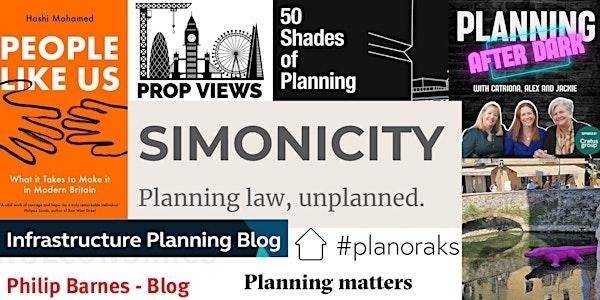
Why not bring together in one room for one time only some other opinionated planning and planning law bloggers, podcasters and writers?

And, in so doing, why not help London youth charity XLP?

So from 4.30pm until 7pm on Monday 1 June (followed by an informal drinks reception), the following people have all kindly agreed to be panellists at what I hope will be a unique, thought/smile/frown provoking, event:

Instead of looking back over the ten years and 508 posts so far of Simonicity, what I want to do is to look forward. We’re now 10 years on from 2016. So much has changed and yet so little. What can we expect in our planning and planning law world for 2036? How can we influence it for the better? What we all do as planners and planning lawyers boils down to trying to predict and influence future outcomes – but for most of us (certainly not the lawyers) not looking ahead so long. We are going to arrange those mentioned into two panels which I will chair. I want some unique and challenging perspectives from them – and from those of you in attendance.

Priority access tickets will be on sale from 2 April to subscribers of any of the blogs and podcasts mentioned – I will be circulating an Eventbrite link that day with details also of the City venue for the event which only has a 120-seat capacity.

Any remaining tickets will go more generally on sale from 7 April.

All proceeds will be in aid of XLP and the amazing work they do for young people in London. Tickets will be priced at £40 with a discounted price of £25 for those in the public sector and students.

Do look out for the notification on 2 April and in the meantime do save the date in your diaries if his is of interest.

Finally, a few sponsorship opportunities are still available. The event’s confirmed sponsors so far are Town Legal and Lichfields. If this is of interest do contact me.

Simon Ricketts, 15 March 2026

Personal views, et cetera

Planning Committees That Refuse Planning Applications Against Officers’ Advice: 5 Impending Procedural Protections for Applicants

Impending procedural protection #1: a greater proportion of applications being determined by planning officers

Section 54 of the Planning and Infrastructure Act 2025 enabled the Secretary of State to make arrangements by regulations that would limit the categories of applications that may be determined by planning committee rather than by officers. The power to make those Regulations has been “switched on” since 18 February 2026. MHCLG’s May 2025 technical consultation closed on 23 July 2025. We await the government’s response to that consultation and the regulations themselves.

Impending procedural protection #2: better training for planning committee members

Section 53 of the 2025 Act enabled the Secretary of State to make regulations specifying mandatory training and certification for planning committee members. This was part of that same technical consultation. Again, the power to make regulations was switched on from 18 February 2026. We await the government’s response to that consultation and the regulations themselves.

Impending procedural protection #3: written representations appeals where the local planning authority will not be able to expand upon its case following refusal

This is an important element of the changes I summarised in my 15 February 2026 blog post Don’t Be An April Fool: Written Reps Planning Appeals Are About To Get Faster But Also Riskier and applicable to appeals resulting from applications made from 1 April 2026 onwards.

I was interested to hear the discussion about what this may mean in practice for those submitting planning applications, on yesterday’s 50 Shades of Planning podcast episode Appeal Ready featuring my Town Legal colleague Lisa Tye.

Impending procedural protection #4: greater potential for call-in by the Secretary of State

As well explained by Nicola Gooch in her 6 March 2026 LinkedIn post, the Town and Country Planning (Development Management Procedure) (England) (Amendment and Transitional Provision) Order 2026  was made on Friday which paves the way for the government to require local planning authorities to notify the Secretary of State where they intend to refuse a planning application for 150 dwellings or more, so as to give the Secretary of State an opportunity to call in the application for his own determination (confirmed in the explanatory memorandum that accompanied the Order).

Impending procedural protection #5: (in London) greater potential for the London Mayor to call in applications for his own determination

Consultation closed on 26 January 2026 in relation to MHCLG’s Proposed London Emergency Housing Package, which includes a proposal for permanent changes to the Town and Country Planning (Mayor of  London) Order 2008, the effect of which would be to create a new category of applications referable to the Mayor: those for the development of 50 dwellings or more where the local planning authority proposes to refuse the application. Again, we await the response to consultation and the statutory instrument which will give it effect. The government has also tabled an amendment to the English Devolution and Community Empowerment Bill which would in due course enable the Mayor to determine by way of written representations rather than a formal hearing applications he calls in – which could free up GLA officer resources for a greater number of call-ins…

Final comment from me: Lichfields published research, Refused for good reason?  in August 2018, examining what happens to applications on appeal when they are refused by members against officers’ advice (finding that 65% of such appeals were successful compared with 40% where officers had recommended refusal).  Has anyone any more up-to-date statistics? Anecdotally I suspect that the delta remains at least that wide, which is why these are all important proposals.

Simon Ricketts, 8 March 2026

Personal views, et cetera

And Another Thing….Another Misconception About Amending Section 106 Agreements

I really am the person you don’t want to be left sitting next to at the end of an evening in the pub: “and another misconception about amending section 106 agreements…”

This weekend I belatedly set about unpicking that recent Kimblin J judgment in Lancaster City Council v Secretary of State (High Court, 18 February 2026). The case was a legal challenge by the council to an inspector’s decision letter. The inspector had allowed a section 73 appeal that sought to amend a condition attached to a planning permission for the development of 24 homes. The condition required that the housing mix across the site be implemented in accordance with an approved accommodation schedule which was specifically referenced. The proposal was to amend the condition, on grounds of viability, so as to refer to a revised accommodation schedule, which (unlike that which had been previously approved) referred to all of the dwellings for sale in the open market rather than a proportion being affordable. In so doing he had taken into account a deed of variation agreed between the parties which removed from the existing section 106 agreement an obligation that at least 30% of the dwellings be affordable, whilst still requiring the payment of an open space obligation and setting out a mechanism for the provision and ongoing maintenance of certain areas within the proposed development.

Despite having entered into the deed of variation in the course of the appeal, the council’s ground for challenging the inspector’s decision was that somehow in concluding as part of his decision whether it was appropriate for the parties to enter into the deed of variation he should have applied the test in section 106A of the Town and Country Planning Act 1990 which is higher than the test to be applied under section 73 as to whether a planning permission condition should be discharged or amended, namely as to whether the original section 106 agreement continued to serve a useful purpose and if so whether it would serve that purpose equally well subject to the modifications in the deed of variation.

The judge sensibly rejected that argument and upheld the permission.

The case possibly does illustrate what we know the government has become vexed about: section 73 applications and appeals being used as a “Trojan horse” to achieve variations to section 106 agreements (albeit there does not appear to me to be anything wrong in law with that approach – equivalent to what happened in the Cuba Street appeal I referred to in my 8 October 2025 blog post London Stalling).

But more directly, it also triggered a different peeve: those local planning authorities that insist that any proposal for a section 106 deed of variation be the subject of a formal application under section 106A, with application form to be completed, notices served etc. This is just yet another example of procedural gold-plating or maybe just a misconception as to how section 106A works.

I think I need to set out relevant parts of the section:

“106A Modification and discharge of planning obligations.

(1 ) A planning obligation may not be modified or discharged except—

  1. by agreement between the authority by whom the obligation is enforceable […] and the person or persons against whom the obligation is enforceable; or
  1. in accordance with

(i) this section and section 106B […]

Site Icon

(2) An agreement falling within subsection (1)(a) shall not be entered into except by an instrument executed as a deed.

(3) A person against whom a planning obligation is enforceable may, at any time after the expiry of the relevant period, apply to the local planning authority by whom the obligation is enforceable […]  for the obligation—

  1. to have effect subject to such modifications as may be specified in the application; or
  1. to be discharged.

(4) In subsection (3) “ the relevant period ” means—

  1. such period as may be prescribed; or
  1. if no period is prescribed, the period of five years beginning with the date on which the obligation is entered into.

(5) […]

(6) Where an application is made to an authority under subsection (3), the authority may determine—

a. that the planning obligation shall continue to have effect without modification

    b. if the obligation no longer serves a useful purpose, that it shall be discharged; or

    c. if the obligation continues to serve a useful purpose, but would serve that purpose equally well if it had effect subject to the modifications specified in the application, that it shall have effect subject to those modifications.”

      It will be seen that the general position is that a planning obligation (i.e. section 106 agreement or unilateral undertaking) may be modified or discharged (i.e. in practice the subject of a deed of variation) simply by agreement between the local planning authority and those bound by the existing document, with no prior procedural requirements and no specific test for the local planning authority to address before so agreeing.

      What section 106A(3) on the other hand enables is a formal application to be made by a party against whom the obligation is enforceable, if the planning obligation is at least five years old (the government could prescribe a different period for the purposes of sub-section (3) but so far hasn’t) . If it does that, there is the specific test in subsection (6) for the authority to apply before determining whether to grant the application. If the authority refuses the application or doesn’t determine it within the statutory period the applicant can appeal to the Secretary of State pursuant to section 106B (for a recent example of a decision in relation to such an appeal see here).

      Not only does this explain for the purposes of the Lancaster case why the subsection (6) test was entirely inappropriate but it also identifies why authorities should not insist upon a formal application process where the person requesting the variation is not proceeding by way of subsection (3).

      Of course, this does mean that, unless there is a specific publicity commitment set out in the relevant authority’s constitution or statement of community involvement, the local community may not have sight of any proposed deed of variation before it is completed. However in my view this is neither required directly by Article 40(3)(b) of the Town and Country Planning (Development Management Procedure) (England) Order 2015 or as a result of the Court of Appeal’s judgment in R (Greenfield (IOW) Limited v Isle of Wight Council (Court of Appeal, 16 April 2025) – a case which in my view has led to further unnecessary delays in the completion of agreements and the issue of planning permission but…

      … I see that last orders have been called and I think you quietly moved away to another table some time ago now.

      Simon Ricketts, 1 March 2026

      Personal views et cetera