LGR, SDSs, SPBs & Other TLAs

I’ve written before about the need to Keep It Simple Stupid.

The restructuring of the English planning system, as described in my 19 December 2025 blog post Framework Good Work, might turn out to be one of the lasting achievements of this government – a coherent tiered structure with the opportunity for faster, simpler, plan-making with all the benefits and efficiencies which flow from that predictability – but that good work may be undone, not least at the ballot box, if it is not widely understood or supported. Or if elected positions are secured primarily for the purposes of pursuing politics, providing a platform, rather than positive planning.

Further progress has been made this month, with the consultation until 26 March 2026 on areas for producing spatial development strategies (MHCLG, 12 February 2026), which accompanied the planning and housing minister’s written ministerial statement that day and letter to council leaders. In particular we now have the draft map:
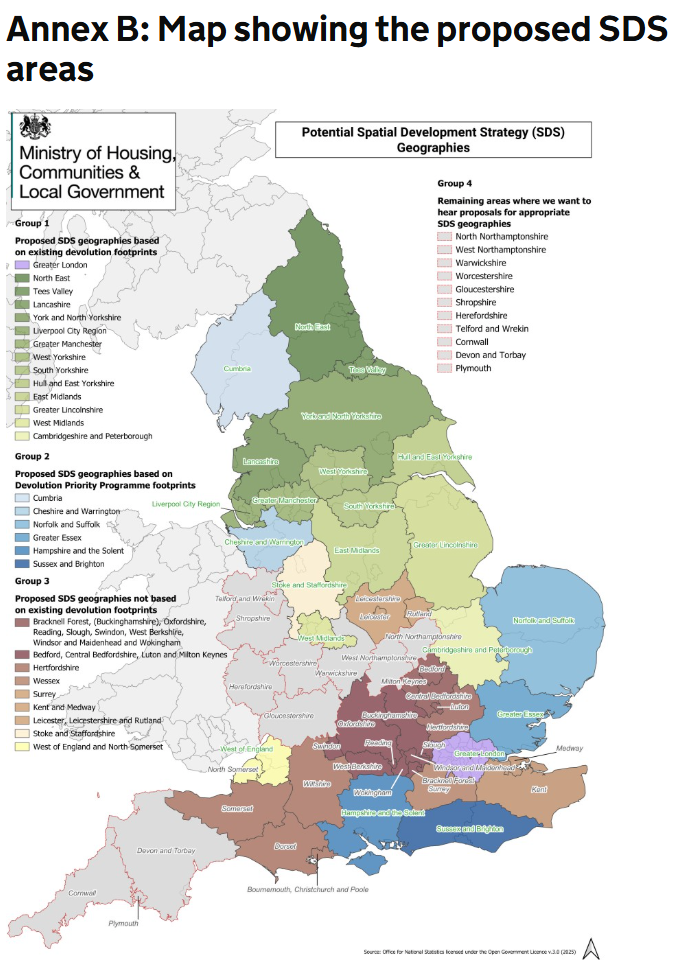
Secondary legislation is expected to be laid before Parliament breaks for the Parliamentary summer recess in mid July, with the spatial development strategy (SDS) provisions in the Planning and Infrastructure Act 2025 also to be switched on, meaning that the duty to produce an SDS will then immediately become active. The secondary legislation will provide for the setting up (possibly in more than one wave) of strategic planning boards (SPBs) in those areas where the SDS will be prepared by a combination of authorities.

 The big question though is how can this emerging structure be made understandable and relevant to people, particularly alongside the complexities and uncertainties caused in many areas by the separate process of local government reorganisation?

I would like to see a “plain English” campaign as to the benefits, in terms of devolved powers, of Mayoral strategic authorities; of the power that strategic authorities’ spatial development strategies will have in directing areas for growth, infrastructure and investment; spelling out to people how quickly all of this will be coming down the track; the benefits that will flow from the new larger unified authorities sitting beneath the strategic tier, and public reassurance as to how the local, neighbourhood, voice will not be lost.

Some great work has been done, including by the Strategic Planning Group led by Prior + Partners and chaired by Catriona Riddell which led to the May 2025 paper Planning Positively For the Future (by coincidence the group, in which I was pleased to be a member of, met again on 12 February, the day of those announcements. Nice forward planning as always Shaun and Catriona…).

However, uncertainties remain. Would it be useful to have a “dummy” example of how straightforward and visual an SDS might be?  I do worry about mission creep – you planners love words more than even lawyers do.

And do we need some greater clarity on “nuts and bolts” questions such as:

  •  what will the starting point be for each SDS in terms of housing numbers? For the purpose of apportioning numbers between the local plan-making authorities within the SDS area, will it simply be the overall number for the SDS area derived from the standard method, subject to the opportunity to reach agreements with other strategic authorities? The challenges are well articulated in a Lichfields blog post Spatial Development Strategy Geographies – Will the map change the landscape? (Edward Clarke, Dominic Bowers & Matthew Spry, 16 February 2026):

Analysis of recent housing delivery rates shows that for many SDS areas, housing delivery over the last three years is less than 60% of the local housing need (Figure 3) indicating that new strategies will need to demonstrate a real step change in provision, most likely pursuing spatial approaches to land release that the local plans of the last 15 years did not consider. 

Across the South East those preparing SDSs will face some of the greatest challenges in meeting housing need. London, Hertfordshire, and Surrey will require building at between 120-150% of the current rates (over the last three years). A similarly big task faces much of the South West of England including Cornwall and Plymouth, Devon and Torbay, where the Government says it awaits to “hear proposals for appropriate SDS geographies”.

“A particular challenge will arise in the more tightly defined SDS areas such as the West Midlands Combined Authority where the SDS has an acute challenge (one with which the wider West Midlands RSS tried and failed to grapple) accommodating its own development needs within its current administrative boundary. Across the WMCA SDS area, recent delivery is around 65% of the aggregate housing need, but three quarters of the land area is either already built-up or subject to national planning restrictions or the green belt.

In this, and many other SDS areas, reviewing green belts will be critical to achieve sustainable patterns of development. But the big questions remain as to how effective will be the SDS process in engaging with overlapping housing market or functional economic areas without falling into (a larger-scale version of) the local duty to cooperate trap.”

  • Will SDSs have a role in setting targets for levels of affordable housing? And if so, how do we avoid the slippery slope into viability appraisal?

I know it hasn’t been an easy ride, politically or administratively: on 16 February 2026 under the pressure of litigation from Reform, it was announced that local government elections will be taking place after all in 30 areas this May which had previously been postponed by the government due to imminent reorganisation in those areas. By contrast, in relation to emerging strategic authority areas under the devolution priority programme (DPP),  in December 2025 MHCLG announced that inaugural Mayoral elections which were due to take place in May 2026 would be delayed by a year in some areas, and by two in others – leading to the prospect of incoming Mayors finding that that the SDS is already underway with limited scope to withdraw or influence it.

How to explain this complicated new system to non-planners? Indeed, what can we call each of these SDSs for a start, as per the London Plan? We need to avoid the democratic deficit that ultimately sunk the regional assemblies, or worst of all the system faltering before it has been embedded across the country and had a chance fully to prove itself.

Simon Ricketts, 22 February 2026

Personal views et cetera
Don’t Be An April Fool: Written Reps Planning Appeals Are About To Get Faster But Also Riskier

You need to know how the rules are changing from 1 April 2026 for 94.7% of planning appeals: those that proceed by way of written representations. There are traps for the unwary: whether for appellant, local planning authority or third party.

The changes have been on the cards since last June – see my 28 June 2025 blog post How Do You Solve A Problem Like…Speeding Up Planning Appeals Without Being Unfair Or Counter Productive?

On 12 February 2026 the Planning Inspectorate published Planning appeals: procedural guide. For appeals relating to applications dated on or after 1 April 2026  alongside the Town and Country Planning (Appeals) (Written Representations Procedure) (England) (Amendment and Saving Provision) Regulations 2026 which were laid before Parliament that day.

The main difference is that the “expedited” or “part 1”  written representations procedure, which currently applies in relation to householder and minor commercial appeals, will be extended to most appeals to be determined by way of written representations, resulting from applications made from 1 April onwards.

Under the procedure, the appellant is not able to submit evidence at appeal not previously considered by the LPA when they determined the application, leaving the appeal to be determined by the inspector solely by reference to:

  • the application that the LPA determined (including all supporting evidence, plans and interested party comments)
  • the LPA’s decision notice (including their reasons for refusal where applicable)
  • The LPA’s committee minutes and planning officer report
  • The appeal form
  • The LPA’s appeal questionnaire

Third parties are not able to make further representations at the appeal stage so will have to rely on the inspector taking into account any representations that were made during the course of the application.

As is already the case with all written representations appeals (part 1 or part 2), if a section 106 agreement or unilateral undertaking is required, the completed (i.e. executed and dated) version needs to be submitted at the time the appeal is submitted.

This part 1 procedure will apply to the following types of appeal:

  • Appeals against a refusal of planning permission
  • Appeals against a grant of planning permission subject to conditions that the applicant objects to
  • Appeals against a refusal of prior approval
  • Appeals against a refusal of advertisement consent
  • Appeals against the refusal of an application to approve a reserved matter
  • Appeals against the LPA’s refusal of an application to modify or remove a condition under section 73 of the Town and Country Planning Act 1990
  • Appeals against the LPA’s refusal of an application for planning permission for development already carried out under section 73A of the Town and Country Planning Act 1990
  • Appeals against permission in principle or refusal of technical details consent

It is open to the Planning Inspectorate to decide that that an appeal which is eligible to follow the part 1 procedure should instead follow a different procedure. For example the guidance says that “appeals against an LPA’s refusal of a biodiversity gain plan, whilst eligible to proceed under part 1, will usually follow the part 2 procedure”.

This leaves only the following types of written representations appeal as still following the existing part 2 procedure:

  • Appeals against the LPA’s failure to determine an application within their time limit for doing so (‘non-determination’ cases)
  • Appeals in relation to an application for Listed Building Consent
  • Appeals in relation to a discontinuance notice

Why the changes? The most useful, detailed, justification for the changes is set out in the explanatory memorandum to the Regulations. It states that as at March 2025, appeals following the part 2 procedure took an average of 29 weeks whereas appeals following the part 1 procedure took an average of 18 weeks. (In fact the Planning Inspectorate’s December 2025 figures show improvements on these timescales, the averages now being 21 and 14 weeks respectively – with hearings taking an average of 25 weeks and inquiries an average of 38 weeks).

The memorandum says this:

The number of appeals decided through both written representations procedures will remain the same. Expanding the expedited procedure will allow more appeals to be decided more quickly. It will reduce pressure on local planning authorities by removing the need for them to submit a full statement of case, although they will need to ensure that the decision notice or officer’s report is sufficiently detailed. Additionally, with no further opportunity to comment, it removes the need to process and publish representations from interested parties. It will reduce the burden on appellants by reducing the amount of documentation needed when submitting an appeal. It will reduce the burden on all parties by removing the opportunity for any comments at the appeal stage. By expanding the expedited written representations appeal procedure to a broader range of appeals, larger developments will also benefit from the streamlined process and quicker decisions, helping to unlock economic growth and accelerate the delivery of homes.”

Taking this at face value, obviously quicker decision times are in everyone’s interests.

However, certainly there are concerns:

  • Whilst it is said that the number of appeals decided by way of written representations will remain the same, is this the slippery slope and will we see over time a greater overall proportion of appeals going by this route, including a greater proportion where the complexity of issues and level of potential third party interest makes the process appear like an inappropriately summary form of justice?
  • What happens in the frequent case where the appellant requests a hearing or inquiry route but is pushed down the written representations route by the Planning Inspectorate (given that the criteria for which appeals are appropriate for written representations, hearings and inquiries are not objective but rely on the application of judgment in each particular case)? The procedural switch is already problematic but will get more difficult.
  • What about where members refuse an application against officers’ advice? Perhaps helpfully for appellants, in practice the basis for the members’ decision will have to rest on the minutes of the committee meeting. In practice will this mean a greater number of deferrals so that credible potential reasons for refusal can be prepared?
  • Do the changes favour well-advised potential appellants? The strategy is now clear: the applicant needs to make sure that their application package is robust and appeal-ready,  that they have responded to issues raised by third parties and they have resolved or narrowed down any potential difference in relation to any necessary section 106 agreement or undertaking – and to have made good progress on a draft.

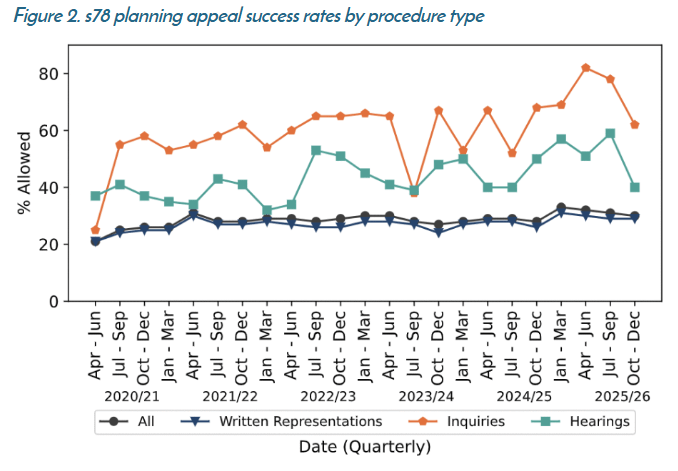
Lastly, perhaps a few words on the statistics as to which procedure is most likely to result in an appeal being allowed. Appeal Finder have done some good statistical analysis.

Whilst this shows that by comparison of appeal route, inquiries are most likely to succeed, followed by hearings – and with the written representations procedure being least fruitful for appellants, I am always cautious as to the conclusions to be drawn. It is tempting to think that the obvious strategy is to seek an inquiry and, failing that, a hearing – and lawyers like me will usually trot out the benefits of cross-examination and formal exchange of evidence (inquiries), the greater likelihood of a senior inspector being appointed and at the very least the opportunity to tell from the inspector’s body language and line of questioning whether he or she has understood the particular issues. Much of this is true. But to what extent are the statistical differences simply correlation rather than causation? Surely the larger the scheme the better professional advice the applicant is likely to have had and the less likely the applicant is to contemplate taking to appeal a proposal that is doomed to fail? I wonder if there is any housebuilder that has collected statistics on their own projects as to whether there is a material difference in outcomes for projects with an equivalent project team involved?

In the meantime, if you have an application on the stocks where a written representations appeal may ultimately be required, don’t get caught out come 1 April….

Simon Ricketts, 15 February 2026

Personal views, et cetera

Grey Belt Tests Tested

There have been three examples in recent weeks of either the High Court considering arguments that an inspector had misapplied the grey belt tests within the NPPF or of the government legal department conceding that an inspector had misapplied the tests, each example useful in isolating a specific element of the required decision-making process:

How should footnote 7 be applied?

Grey belt” is defined in the NPPF glossary as follows:

“Grey belt: For the purposes of plan-making and decision-making, ‘grey belt’ is defined as land in the Green Belt comprising previously developed land and/or any other land that, in either case, does not strongly contribute to any of purposes (a), (b), or (d) in paragraph 143. ‘Grey belt’ excludes land where the application of the policies relating to the areas or assets in footnote 7 (other than Green Belt) would provide a strong reason for refusing or restricting development.”

Footnote 7 reads:

“The policies referred to are those in this Framework (rather than those in development plans) relating to: habitats sites (and those sites listed in paragraph 194) and/or designated as Sites of Special Scientific Interest; land designated as Green Belt, Local Green Space, a National Landscape, a National Park (or within the Broads Authority) or defined as Heritage Coast; irreplaceable habitats; designated heritage assets (and other heritage assets of archaeological interest referred to in footnote 75); and areas at risk of flooding or coastal change.”

In Wrotham Parish Council v Secretary of State (Lieven J, 30 January 2026) the specific question arose as to whether “development” for the purposes of that sentence I emboldened above, means any hypothetical development, or whether it means the specific development the subject of the application or appeal.

The case concerned a proposal by Moto Hospitality for a secure 24-hour truck stop facility on the A20 in Wrotham, Kent. An inspector had allowed Moto’s appeal against refusal of planning permission by Tonbridge and Malling Borough Council. The inspector had allowed the appeal and, in her reasoning, had determined that the proposal would “only limited and localised harm to the setting of the [Kent Downs National Landscape] and no harm to the special characteristics of the views into or out of the Protected Landscape. Notwithstanding that the proposal will not conserve and enhance the landscape and its setting considered together, I do not consider the identified harm would provide a strong reason to refuse or restrict the development.”

The claimant, Wrotham Parish Council, argued that the impact of development generally on the national landscape should be considered and whether impact generally of development on the setting of a national landscape would provide a strong reason for refusing or restricting development.

Lieven J rejected that argument:

In my view the Inspector in DL/41 was correct to apply the footnote 7 test to the development that was the subject of the application and not to all development, or any hypothetical development.”

For development control purposes the acceptability or otherwise of that impact will fundamentally turn on the impact of the development applied for. This is particularly clear with heritage and habitats impacts, where some developments might have minimal impact, while others provide a strong reason for refusal.”

This “interpretation is strongly supported by the policy purpose of the introduction of the Grey Belt. That purpose, as set out in NPPF paragraph 155, is to allow the release of Green Belt land where it does not strongly contribute to the purposes of the Green Belt; and where there is no strong reason for refusal by reference to the important policy safeguards in footnote 7. It is obviously intended to lead to the release of some additional Green Belt land to meet development needs. It is a further exception to Green Belt policy, but that is not a reason to interpret the policy in a restrictive manner. The interpretative principle is to consider the words in context and with regard to the policy purpose.”

“In this case the Inspector found that the Site did not strongly contribute to the Green Belt purposes in NPPF paragraph 143(a), (b) or (c), and that finding is not challenged. Further, she found that footnote 7 did not provide a strong reason for refusing the Development. A conclusion that, despite those findings, planning permission should be refused is plainly contrary to the purpose of the introduction of the Grey Belt into the NPPF. It is not an answer that the developer can fall back on broader Green Belt policies and show very special circumstances. The point of the introduction of the Grey Belt is to avoid that policy requirement.”

What does “strong reason for … restricting development” mean?

What if one of the policies listed in footnote 7 would provide a strong reason for resisting development within a particular part of the relevant site, even though the specific development proposal being determined does not entail development within that part of the site? You can perhaps guess the correct answer to that test, in the light of the Wrotham case.

By her decision letter dated 13 November 2025 an inspector had dismissed an appeal by Boningdale Homes following South Staffordshire District Council’s refusal of planning permission for up to 100 dwellings in Boscobel Lane, Bishops Wood, Staffordshire. Following a six day inquiry, the inspector agreed with the council that the impact the scheme would have on the local grade II listed Church of St John “represents a strong restriction on development”, concluding that “the appeal site is not grey belt land”.  

She said this:

66. The parties differ regarding the application of footnote 7 with reference to the potential heritage impact of the proposed development. The appeal site extends close to the Grade II listed Church of St John. There was no heritage reason for refusal and the parties agree that the eastern part of the site is not proposed for development because of the harm that it would cause to the heritage significance of the Church of St John. The Council maintain that this represents a strong restriction on development and for this reason the proposed development would not be grey belt development.”

“71. When considered together with the definition of grey belt, I consider that grey belt is an assessment of the land rather than the proposed development, and that the Council’s interpretation correctly reflects the definition of grey belt within the Framework. Consequently, even though the parties agree that the heritage harm would not be a strong reason for refusal, it is a strong reason for restricting the development and as such I conclude that the appeal site is not grey belt land.”

Lord Charlie Banner KC posted on LinkedIn on 22 December 2025 that in the face of a legal challenge brought by Boningdale, the government has now agreed to consent to judgment on the basis that the inspector’s approach was unlawful.

[NB Of course, the December 2025 draft NPPF proposes removing footnote 7 in its entirety and the reference to it within the “grey belt” definition.]

How does one interpret “fundamentally undermine the purposes (taken together) of the remaining Green Belt across the area of the plan”? (NPPF paragraph 155a)

Is it relevant to consider whether the proposed development would fundamentally undermine the Green Belt purposes of the development site itself, rather than simply the purposes of such parts of the Green Belt as would remain? One might think that the latter interpretation is obviously the case. I’m glad that the government legal department plainly agrees, given that again it has agreed to consent to judgment, this time following a decision letter dated 22 December 2025 in relation to an appeal by O15 from refusal by Warwick District Council of permission in principle for up to three dwellings.

The inspector dismissed the appeal, with her decision letter including this reasoning:

18. Criterion a. requires the development to not fundamentally undermine the purposes (taken together) of the remaining Green Belt across the area of the plan. This refers to all five Green Belt purposes set out at paragraph 143 of the Framework, not only the three purposes referred to in the definition of grey belt.

19. Green Belt purpose c) seeks to safeguard the countryside from encroachment. I have characterised the site as countryside rather than as part of the village. The proposal would introduce built development onto land which is currently free from development. As such, the proposal would result in encroachment into the countryside and thus would fundamentally undermine purpose c). Consequently, the proposal would fail to meet the requirements of criterion a.”

Another Lord Charlie Banner KC quick win. Planning magazine reported on 2 February 2026 that following receipt of a pre-action letter the Secretary of State had confirmed by letter on 23 January 2026 that it was minded to concede.

Taking a step back… the introduction of grey belt has not seen the avalanche of litigation catastrophised by some. This is the system working as it should. The NPPF grey belt tests are relatively clear in my view but inevitably there are uncertainties and/or misinterpretations. The acceptance of MHCLG to admit where a mistake has been made is always welcome.

Simon Ricketts, 7 February 2026

Personal views, et cetera