Announcements

Announcements from MHCLG are coming thick and fast ahead of this week’s budget and we had an announcement of our own at Town this week.

So, briefly, on 18 November 2025 there was:

Housebuilding around train stations will be given default “yes”

“Planning reforms to give greater certainty and strength for development around well-connected rail stations, including trains and trams, will be proposed through a new pro-growth and rules-based National Planning Policy Framework, which will be consulted on later this year.”

“The default “yes” will also apply equally across all local authorities, so that these benefits are seized across the country. The proposals will also include minimum housing density standards for these sites, expected to be exceeded in many cases, to make the most of sustainable growth opportunities for local housing, jobs, and businesses.”

This is all rolling the pitch for what will be in the consultation draft NDMPs next month (NB a convenient acronym – now that the NDMPs are to be non-statutory, I suspect that national development management policies may conveniently switch to national decision-making policies, perhaps less of a tongue twister or is that just me?).

What is “well-connected” and how will national minimum density standards be arrived at? We shall have to be patient and wait for the (large) pre-Christmas consultation package.

The announcement also included a separate proposal:

Measures will also require councils to inform government when they’re inclined to block applications of 150 homes or more so ministers can decide whether to step in and make the decision instead, making sure that good housing projects don’t get lost. 

Particular attention will be paid to those applications where a planning committee intends to refuse it contrary to the advice of planning officers.

Applications called in by ministers will also be sped up through the removal of the mandatory requirement for inquiries, with the option to consider matters through written representations before reaching a decision where appropriate.”

This is big and will require legislation. But it could have a significant effect. In my view the biggest effect would be to create a cooling-off period where a planning committee has resolved to refuse a scheme for 150 homes or more against officers’ recommendations. Not only would the risk of call-in arise before the refusal could be issued but that delay would also lead to the opportunity in practice for the application to return to committee, potentially with a different outcome.

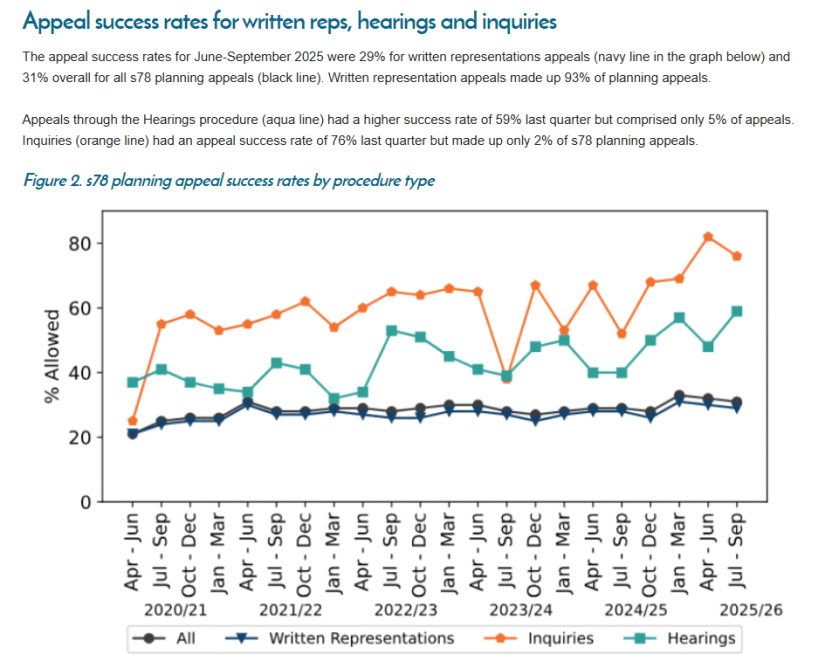
Given that almost 80% of appeals determined by inquiry are currently successful (possibly even higher when it comes to major residential appeals), this surely makes huge sense.

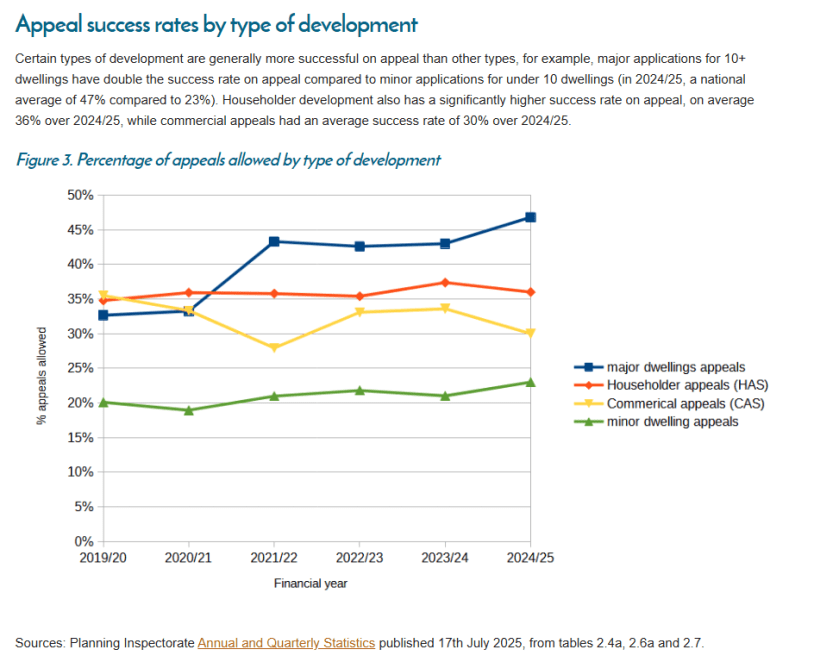
See the fascinating statistics published by Appeal Finder from which I have taken these screenshots:

Written representations determination of some call-ins is an interesting idea – a speedier call-in procedure would be so much more effective (see the way that the Mayor of London uses his call-in power for instance) but how many applicants, looking at these statistics will get nervous as to the prospect of their precious scheme being at the mercy of the written representations process?

Also on 18 November 2025, a consultation paper Reforms to the statutory consultee system was published, with responses due by 13 January 2026. Sport England, The Gardens Trust, and Theatres Trust are proposed no longer to be statutory consultees, with replacement “mitigations” put in place. The criteria are proposed to be tightened for consultation with seven national statutory consultees (see Anne1 for details): The Environment Agency, Natural England, Historic England, National Highways, the Health and Safety Executive, the Mining Remediation Authority and Active Travel England.

Lastly in terms of announcements, we at Town Legal seized that old 2010 concept of “open source planning” to publish our discussion document Simplifying & Standardising Section 106 Agreement Processes: Proposals for Reform which we were pleased to launch in the House of Commons this week through the auspices of the LPDF at an event sponsored by Mike Reader MP (and thank you Lord Charlie Banner for your supportive words too). What do you make of it? Do let us know. We are really keen to reduce the time it takes to conclude section 106 agreements, particularly in relation to small and medium sized schemes. I hope that MHCLG’s consultation package will touch on these issues as well. It is the unglamorous elements of the process that gum up the system, after all.

To quote always-glass-half-full Paul McCartney in that song from the Sergeant Pepper album: “It’s getting better all the time”. To quote John Lennon from the same song (maybe having seen MHCLG’ latest housing supply data on net additional dwellings – 6% decline in housing delivery from last year): “It can’t get no worse”.

Simon Ricketts, 22 November 2025

Personal views, et cetera
There Was Some Controversial News In Planning This Week But Instead Let’s Focus On the Latest Ruling In The Epping Forest Asylum Seekers Litigation

The Secretary of State finally said it out loud on 11 November 2025: the proposed National Development Management Policies will be non-statutory. There will be more detail in a speech he will give “in a couple of weeks” and consultation as part of consultation on the NPPF (which presumably the NDMPs will either form part of or partly replace) “later this year” (which I take to mean Christmas Eve, again).

So, sections 93 and 94 of The Levelling-up and Regeneration Act 2023 will not be brought into force, we assume. What a lot of wasted energy that was. I’m not going to comment in this post on the rights and wrongs of statutory versus non-statutory NDMPs (even I’m getting bored of that one). But simply to note this latest reminder that we can place too much weight on legislation as an agent of change. Rolling forward, I hope people appreciate that it will take years for much of the Planning and Infrastructure Bill to come into force and to have any real effect. And that some of it inevitably will either never get that far or will be subsequently repealed. How much of the long running debate over Part 3, environmental delivery plans, will turn out to be time well spent?

Anyway, let’s move quickly on to my main topic, because I never want to be controversial.

One thing that the government has steadfastly declined to address by way either of legislation, policy or guidance is the question of whether the accommodation by the Home Office of asylum seekers in hotels constitutes, in planning law terms, a material change of use. It would have been easy to signpost a position in one direction or the other. The conclusion that must have been reached is that sometimes the best thing to say is to say nothing at all.

When I last wrote about the saga in my 29 August 2025 blog post Court of Appeal Cuts Down Epping Forest the Court of Appeal in August overturned the interim injunction that the High Court had imposed earlier that month (see my 20 August 2025 blog post Planning Law Is Being Used For Politicking About Asylum Seekers), that would have required the use of the Bell Hotel in Epping for the accommodation of asylum seekers to cease, pending a full hearing into its claim for a final injunction and a declaration that the use was in breach of planning control.

We now have the High Court’s judgment as to whether a final injunction and/or a declaration should be granted: Epping Forest v Somani Hotels Limited  (Mould J, 11 November 2025). And the High Court’s ruling is: no and no.

Mould J set out the position under section 187B of the Town and Country Planning Act 1990, which provides that where “a local planning authority consider it necessary or expedient for any actual or apprehended breach of planning control to be restrained by injunction, they may apply to the court for an injunction” and that, whilst “the court must not re-assess for itself the local planning authority’s planning judgment which formed the basis for that authority’s decision to apply for the injunction … the factors which, on the evidence before the court, weighed with the local planning authority in making their planning judgment may properly be considered by the court, in the context of reaching its own judgment as to whether the circumstances of the case are such as to justify the grant of an injunction. Moreover, where as in the present case, the Defendant questions the validity of the local planning authority’s decision to apply for an injunction on public law grounds, the court may properly consider the points raised in the exercise of its discretion whether or not to grant the injunction.”

Mould J went through the various considerations:

  • whilst he was prepared to accept that the “local planning authority had at least a reasonable basis for alleging and asserting that the current use of the Bell as contingency accommodation for asylum seekers is in breach of planning control”, this “is not a case in which conventional enforcement measures taken by the local planning authority over a lengthy period of time have failed to secure the effective remediation of a clear breach of planning control, which has resulted in and continues
  • there were serious gaps in the record of the decision making which led to the conclusion that an injunction should be sought;
  • contrary to the council’s assertions, in the light of the actual chain of events and communications the hotel had not “acted in flagrant breach of planning control
  •  any harm to the green belt and conservation area by way of the security fencing in place was “limited by the fact that it is localised and very likely to be temporary in its duration, with the fencing likely to be removed no later than by April 2026, when the Defendant’s current contract with CTM comes to an end. Moreover, the fencing was installed in response to street protests, rather than being an integral requirement of the use of the Bell as contingency accommodation for asylum seekers
  • in terms of retaining existing visitor accommodation “the degree of harm resulting from that can be argued to be limited both by the temporary nature of the current use of the Bell and by virtue of the economic advantage to the Defendant of that current use, which is expected to assist in bringing the hotel back into conventional use in the longer term
  • I have heard no evidence to support the concern that the current use of the Bell is placing local GP, health, social and community services under undue pressure, to the detriment of the settled population of Epping. There is no evidential basis at all for the assertion that asylum seekers as a cohort have a greater propensity than the settled population to engage in criminal or anti-social behaviour
  • I have carefully considered the degree of planning and environmental harm which may reasonably be said to result from the actions or alleged actions of the three individuals accommodated at the Bell who have been convicted or charged with criminal offences since April 2025 … I accept that, in the light of those actions or alleged actions, the fears and concerns of local residents of which I have been made aware in evidence have a reasonable basis. However, the resulting degree of planning and environmental harm is limited, in my view. It has not been established that those fears and concerns are grounded in the use of the Bell as contingency accommodation for asylum seekers. They are properly to be regarded as the understandable reaction of local residents to the well-publicised criminal behaviour, actual and alleged, of three individuals who happen to have been accommodated there
  • Public opposition to the development of land, even if that opposition manifests itself in street protests, is not in itself evidence of planning or environmental harm generated by the development to which there is such strong objection
  • There are countervailing factors in this case which are properly to be weighed in the balance against the planning and environment harm which may reasonably be said to result from the postulated breach of planning control. In particular, the evidence before me clearly establishes that there is a continuing need to source contingency accommodation for asylum seekers from hotels, to enable the Home Secretary to discharge her statutory responsibilities under the 1999 Act. That consideration carries significant weight
  • There is “no duty as such placed upon a local planning authority to enforce against unauthorised development simply because it is considered to be in breach of planning control. An informed planning judgment is required of the local planning authority as to whether enforcement action is appropriate; and, if so, as to whether the harm caused by the unauthorised development is of such a degree as to merit restraint by injunction. Proper and effective planning control is not undermined by the normal enforcement regime, which permits a person served with an enforcement notice to appeal against that notice and, unless a stop notice is served, to continue with the alleged breach of planning control at least until that appeal has been determined by the Secretary of State

Bringing all that together:

I have reached the clear conclusion that this is not a case in which it is just and convenient for this court to grant an injunction. I give due respect to the Claimant’s judgment that the current use of the Bell as contingency accommodation for asylum seekers constitutes a material change in the use of those premises which requires planning permission. Nevertheless, I have not been persuaded that an injunction is a commensurate response to that postulated breach of planning control. The breach is far from being flagrant. Conventional methods of enforcement have not been taken. Taking a broad view, the degree of planning and environmental harm resulting from the current use of the Bell is limited. The continuing need for hotels as an important element of the supply of contingency accommodation to house asylum seekers in order to enable the Home Secretary to discharge her statutory responsibilities is a significant counterbalancing factor. This is decidedly not a case in which there is an abuse of planning control resulting in serious planning or environmental harm which now demands an urgent remedy. In my judgment, it is not appropriate to grant an injunction on the Claimant’s application for the purpose of restraining the use of the Bell as contingency accommodation for asylum seekers.”

It remains open to the Claimant as local planning authority to consider the expediency of taking enforcement action by issuing an enforcement notice. It is also open to the Defendant to reconsider whether it would be appropriate to apply for retrospective planning permission; or to apply to the Claimant for a certificate of lawfulness of the existing use of the Bell pursuant to section 191 of the 1990 Act. Each of those possible courses of action would enable the planning issues raised by this case to be evaluated by the local planning authority, through the transparent and consultative decision-making processes with public participation which apply under the 1990 Act and its attendant regulations.”

As for the application for a declaration that “the current use of the Bell does not amount to use as a hotel within the meaning of Use Class C1”:

Given the statutory procedures available for this to be determined, either by way of applications for certificates of lawfulness or by way  of the making of an enforcement notice (and if necessary the determination of appeals to the Planning Inspectorate) “it will  rarely be appropriate for this court to seek to resolve them beforehand through the grant of declaratory relief. In the present case, I consider that there is at least a real possibility that the Claimant and the Secretary of State on an appeal may be called upon, in the context of those statutory procedures, to determine the ongoing dispute as to whether the current use of the Bell constitutes development requiring planning permission. I have found it to be neither necessary nor appropriate to reach my own conclusions on those questions for the purpose of determining the Claimant’s application for an injunction. Instead, I have ultimately deferred to the Claimant’s judgment as local planning authority in alleging and asserting a breach of planning control. I have already addressed the propriety of the Claimant’s conclusion that it was necessary or expedient for that alleged and asserted breach of planning control to be restrained by an injunction.”

Practical outcome: the question remains unanswered by the courts as to whether, and in what circumstances, the accommodation of asylum seekers in a hotel amounts to a material change of use. Indeed, I would venture to suggest that the judgment seeks, by way of its dissection of the issues, to dampen down the moral panic that led to officer and councillor decisions to bring this litigation in the first place instead of relying on the usual statutory planning framework and processes.

Will the legal question ever be determined by the courts? I suppose it might, but most likely by way of a legal challenge to an inspector’s decision following an appeal arising from an enforcement notice or from refusal of a certificate of lawfulness. And even then, that determination will be specific to the facts and to the application of relevant local policies.

Finally, for the avoidance of doubt, I do like flags as much as the next person. I flagged these two passages in particular:

There is no evidential basis at all for the assertion that asylum seekers as a cohort have a greater propensity than the settled population to engage in criminal or anti-social behaviour”

Public opposition to the development of land, even if that opposition manifests itself in street protests, is not in itself evidence of planning or environmental harm generated by the development to which there is such strong objection

Simon Ricketts, 15 November 2025

Personal views, et cetera
4 Key Asks For The London Housebuilding Support Package Consultation

Most chats this week have been about the 23 October 2025 homes for London policy note.

tl;dr summary: positive direction but concerns about potential complexities, uncertainties and as to whether it will all be in place speedily enough.

We’re all now waiting for the consultation to start “over six weeks from November” (fair play, at least no “by the end of Autumn” fudge).

There are plenty of detailed issues arising, and differing interests will want to re-prioritise the measures in different ways, but I thought I would set out four key asks that I have, which in my view should be specifically addressed in the consultation documents:

  1. Should there be more focus on stalled sites that already have planning permission?

This is the lowest hanging fruit. And yet all we have (in paragraphs 33 and 34) is a reference to the potential for renegotiating previously agreed arrangements by way of deed of variation and discouragement as to the use of section 73.

This isn’t enough. I set out the current procedural constraints in my 18 October 2025 blog post London Stalling.

Procedurally, bar reintroducing section 106BA or, for a temporary period, amending section 106A to reduce the 5 years’ requirement, at the very least we need:

  • Specific encouragement for local planning authorities to accept developers’ requests to engage with the process of varying existing agreements where specific criteria (consistent with the direction of the policy note) are met, linked to some sort of oversight, monitoring and/or route for complaint where authorities refuse to engage (given that unless your section 106 agreement is at least five years’ old, or unless this is in the context of a section 73 application (of which more in a moment) there is no right of appeal on the part of the developer)
  • Not the current suggestion that the section 73 process “should no longer be used as an alternative means of reconsidering fundamental questions of scheme viability or planning obligations” but rather a proper recognition of the real challenge of keeping planning permissions, and associated planning obligations packages, up to date as against changing circumstances and the important role that section 73 plays in this. Attempts to make currently unviable schemes viable invariably involve an intertwined mix of scheme changes and changes to planning obligations. Section 73B, introduced by the Levelling-up and Regeneration Act 2023, is less useful as only the implications of the proposed changes are to be taken into account rather than considering the amended proposal holistically against the current development plan and other material considerations. This all needs to be connected up with the continuing problem that Hillside creates for amendments to projects (I was pleased to see Baroness Taylor confirm this week, on behalf of the government, in response to Lord Banner’s tabled amendment to the Planning and Infrastructure Bill, that the government will “explore with the sector” a “statutory role for drop-in permissions to deal with change to large-scale developments”. This is so important!).
  1. Is late stage (as opposed to early stage) review necessary in relation to the proposed “time-limited planning route”?

In basic summary, this route is where a residential scheme can commit to at least 20% affordable housing with a 60/40 social rent/intermediate tenure split with planning permission issued by the end of March 2028. If the first floor of the scheme has not been built by 31 March 2030 (in the case of larger phased schemes, in the case of any phase where the first floor of buildings providing at least 200 dwellings has not been built by that date), “a late review will be undertaken once 75 per cent of homes within the scheme or the final phase are occupied to determine whether a higher contribution for affordable housing can be made”.

Why the late stage review mechanism in these circumstances, rather than the early stage review that is currently the case with fast track schemes that don’t achieve substantial implantation by the specified deadline under London Plan policy H5? Late stage reviews unnecessarily spook funders and lenders, leaving the eventual outcome too late in the process – and also having the public policy disbenefit of being too late to allow for any further affordable housing, that can be unlocked via the review, to be accommodated within the scheme. There is also inconsistency with paragraph 30 which suggests another approach for multi-phase schemes: “For multi-phase schemes, a review of the scheme will apply prior to the start of each phase for which the milestone in paragraph 27 has not been reached, to determine whether additional affordable housing can be provided in subsequent phases.”

Isn’t it better to keep things simple and follow, where possible, the existing mechanisms within policy H5, just with the thresholds temporarily reduced?

  1. Are there unnecessary difficulties with introducing a viability test into the proposed CIL relief?

Permissions which are secured via the new time-limited planning route that commence after the relief is in place and but before December 2028 will qualify for at least 50% relief from borough CIL (NB is this 50% after reliefs and exemptions have been applied and what will be the calibration to work out the higher level of relief where the scheme is delivering more than 20% affordable housing?), but the relief would be “contingent upon meeting proportionate qualifying criteria to ensure relief is targeted at schemes which would otherwise remain stalled or fail to come forwards, with a lower relief applicable where the full available amount is shown not to be warranted.” This sounds complicated. With this hurdle in place, not only would the developer not know whether they will qualify for the relief until planning permission is granted and they receive their liability notice, but it means that the purported advantage with the time-limited planning route of not having to undertake viability assessment is illusory, because the work will be needed in any event to secure the CIL relief – and the requirement will surely be very hard to turn into workable legislative drafting – we know how difficult exceptional circumstances relief is to secure due to the various criteria and requirements built into that particular mechanism.

  1. Are the proposed additional powers to be given to the Mayor enough?

Boroughs would be required to “refer planning schemes of 50 units or more where the borough is minded to refuse the application – this would be a more streamlined process operating alongside the existing referral threshold of 150 units which applies regardless of a borough’s intended decision, and would ensure that the Mayor was able to review whether the right decision had been reached in the context of the housing crisis.”

But there may well be cases where schemes are being held up at borough level, either pre-resolution or post resolution whilst for instance the section 106 agreement is being negotiated, and where securing planning permission by the end of March 2028 will be critical under this package of measures. Here, speedy intervention, or threatened intervention, by the Mayor could really help. So, for this time limited period at least, why not allow the Mayor to intervene at any time after the end of the statutory determination period in relation to any scheme comprising at least 50 dwellings? Otherwise, that absolute cut of the end of March 2028 for grant of planning permission will need to some flex built in to allow for the possibility of appeal etc.

I’ll confine myself to those four although I have others, and I know that you do too…

NB none of this is to be churlish as to the scale of the task that MHCLG and the GLA have before them. It is of course by no means easy to get this package right and to avoid unintended consequences.

Simon Ricketts, 1 November 2025

Personal views, et cetera